by Khaled Abu Toameh
Before demanding the creation of a Palestinian state, Turkish leaders, and others, should answer a simple question: How would such a state be prevented from becoming another Hamas-ruled Gaza? No one in Ankara or anywhere else appears willing to provide an answer.
For years, Israel was told that economic development, international aid, and territorial withdrawals would moderate Hamas. Instead, Hamas used billions of dollars in foreign assistance to build military tunnels, manufacture rockets, train terrorists, and prepare for war.
The result was the slaughter of 1,200 Israelis and foreign nationals, as well as the kidnapping of more than 250 others.
Turkey nevertheless appears determined to ignore this reality.
Before demanding the creation of a Palestinian state, Turkish leaders, and others, should answer a simple question: How would such a state be prevented from becoming another Hamas-ruled Gaza? No one in Ankara or anywhere else appears willing to provide an answer.
Turkey, and others, instead continue to present Palestinian statehood as a magical solution to the conflict while avoiding the far more difficult questions about terrorism, anti-Israel incitement, Iranian influence, and the refusal of Palestinian leaders to accept Israel's right to exist as a Jewish state.
What makes the position of Turkey and the others even more remarkable is that they place all responsibility on Israel while making virtually no demands of Hamas, such as abandoning terrorism, disarming and recognizing Israel's right to exist.
For the past century, Palestinian and Arab leaders have rejected multiple opportunities to establish a Palestinian state alongside Israel.
This pattern [of Palestinian leaders refusing a Palestinian state] raises a legitimate question: Was statehood ever the primary objective? Or was the larger goal always the elimination of Israel?
[T]he conflict is not actually about land and borders. Hamas and its supporters in the West Bank do not seek a state alongside Israel. They seek a state instead of Israel.
It is hard to believe that those pressing for a Palestinian state, including many European countries and the United Nations, do not know all this – which raises another legitimate question: Are they, too, actively trying to bring about the annihilation of Israel?
For years, Turkish President Recep Tayyip Erdogan has claimed that "Jerusalem is ours," based on his reported goal of reconstructing the Ottoman Empire. Just a year ago, he called for Israel's destruction.
In 2024, Erdogan threatened to invade Israel. A recent credible report concluded that "Turkey has been quietly preparing for a war, with Israel the primary target," with Israel "now framed as a fundamental national security threat" in Turkey's strategic doctrine.
Before lecturing Israel about Palestinian statehood, Ankara should focus on a more urgent task: pressuring Hamas to abandon its genocidal goal of eliminating the Jewish state.
Until that happens, Turkey's proposal is not a roadmap to peace. It is a blueprint for the next war.
Turkish Foreign Minister Hakan Fidan recently declared that Israel could eventually become part of a proposed regional security framework that would include Turkey, Saudi Arabia, Egypt, Pakistan, the Gulf states, and even Iran. There is, however, one condition: Israel must first recognize a Palestinian state on the 1949 armistice lines.
"If that problem is solved, I think the security of Israel will be very much assisted by the regional countries, too," Fidan told the Japanese news agency Nikkei Asia.
The proposal would be laughable if it were not so dangerous.
Less than three years after the October 7, 2023 Hamas invasion of Israel – the deadliest attack against Jews since the Holocaust – Turkey and others are still promoting the same failed formula that produced disaster in the first place: Israeli territorial concessions first, security later.
The Hamas-led invasion of Israel should have buried forever the illusion that creating another Palestinian-controlled territory automatically leads to peace and stability. Instead, October 7 demonstrated what happens when an Islamist movement is allowed to establish a mini-state on Israel's border.
Such a mini-state already did exist: in the Gaza Strip, after Hamas initiated a violent coup in 2007 and seized control of the coastal territory. Hamas overthrew the Palestinian Authority while killing hundreds of Palestinians, some of whom were thrown from rooftops or tortured and executed in the public squares.
It is worth remembering that in the summer of 2005, Israel had already withdrawn every soldier and Jewish civilian from the Gaza Strip.
For years, Israel was told that economic development, international aid, and territorial withdrawals would moderate Hamas. Instead, Hamas used billions of dollars in foreign assistance to build military tunnels, manufacture rockets, train terrorists, and prepare for war.
The result was the slaughter of 1,200 Israelis and foreign nationals, as well as the kidnapping of more than 250 others.
Turkey nevertheless appears determined to ignore this reality.
Before demanding the creation of a Palestinian state, Turkish leaders, and others, should answer a simple question: How would such a state be prevented from becoming another Hamas-ruled Gaza? No one in Ankara or anywhere else appears willing to provide an answer.
Turkey, and others, instead continue to present Palestinian statehood as a magical solution to the conflict while avoiding the far more difficult questions about terrorism, anti-Israel incitement, Iranian influence, and the refusal of Palestinian leaders to accept Israel's right to exist as a Jewish state.
What makes the position of Turkey and the others even more remarkable is that they place all responsibility on Israel while making virtually no demands of Hamas, such as abandoning terrorism, disarming and recognizing Israel's right to exist.
The fundamental obstacle to peace has always been the refusal of Hamas, and many other Palestinians, to accept Israel's legitimacy within any borders. The events of October 7, 2023 only reinforced that reality.
The history of the conflict raises hard questions for those who continue to argue that the absence of a Palestinian state is the root cause of the conflict.
For the past century, Palestinian and Arab leaders have rejected multiple opportunities to establish a Palestinian state alongside Israel.
The 1947 UN Partition Plan proposed the creation of both a Jewish and Arab state. The Jewish leadership accepted it; the Arab side rejected it, and a year later the armies of Egypt, Transjordan (today's Jordan), Syria, Lebanon and Iraq invaded the new State of Israel.
At Camp David in 2000, US President Bill Clinton invested enormous efforts in attempting to broker a final-status agreement between Israeli Prime Minister Ehud Barak and Palestinian Authority Chairman Yasser Arafat.
Clinton presented his famous parameters, which envisioned a Palestinian state in nearly all of the West Bank and Gaza Strip, with east Jerusalem serving as the capital.
Israel accepted the framework as a basis for negotiations. Arafat not only rejected the plan without even a counteroffer, but shortly after, launched a war he had been planning, the Second Intifada, to deflect attention from his refusal.
Years later, Clinton expressed frustration that many younger people were unaware of what had happened. They could not believe that a Palestinian state had once been within reach. "I killed myself to give the Palestinians a state," Clinton said. "I had a deal they turned down."
In 2008, Israeli Prime Minister Ehud Olmert made a groundbreaking, far-reaching two-state solution proposal to Palestinian Authority President Mahmoud Abbas. Olmert's plan called for the establishment of an independent Palestinian state on 95% of the West Bank and Gaza Strip. Abbas effectively rejected the offer and walked away, again without so much as a counterproposal. "I did not agree," Abbas later acknowledged. "I rejected it out of hand."
One may debate the shortcomings of each recommendation and the reasons Palestinian leaders rejected them. Yet one undeniable fact remains: Palestinian leaders passed on opportunities to establish a state.
This pattern raises a legitimate question: Was statehood ever the primary objective? Or was the larger goal always the elimination of Israel?
The popularity of Hamas among many Palestinians before and after October 7 offers troubling evidence that the conflict is not actually about land and borders. Hamas and its supporters in the West Bank do not seek a state alongside Israel. They seek a state instead of Israel.
Turkey's latest proposal – and its statements – completely sidestep this reality.
It is hard to believe that those pressing for a Palestinian state, including many European countries and the United Nations, do not know all this – which raises another legitimate question: Are they, too, actively trying to bring about the annihilation of Israel?
For years, Turkish President Recep Tayyip Erdogan has claimed that "Jerusalem is ours" (also here and here), based on his reported goal of reconstructing the Ottoman Empire. Just a year ago, he called for Israel's destruction.
In 2024, Erdogan threatened to invade Israel. A recent credible report concluded that "Turkey has been quietly preparing for a war, with Israel the primary target," with Israel "now framed as a fundamental national security threat" in Turkey's strategic doctrine.
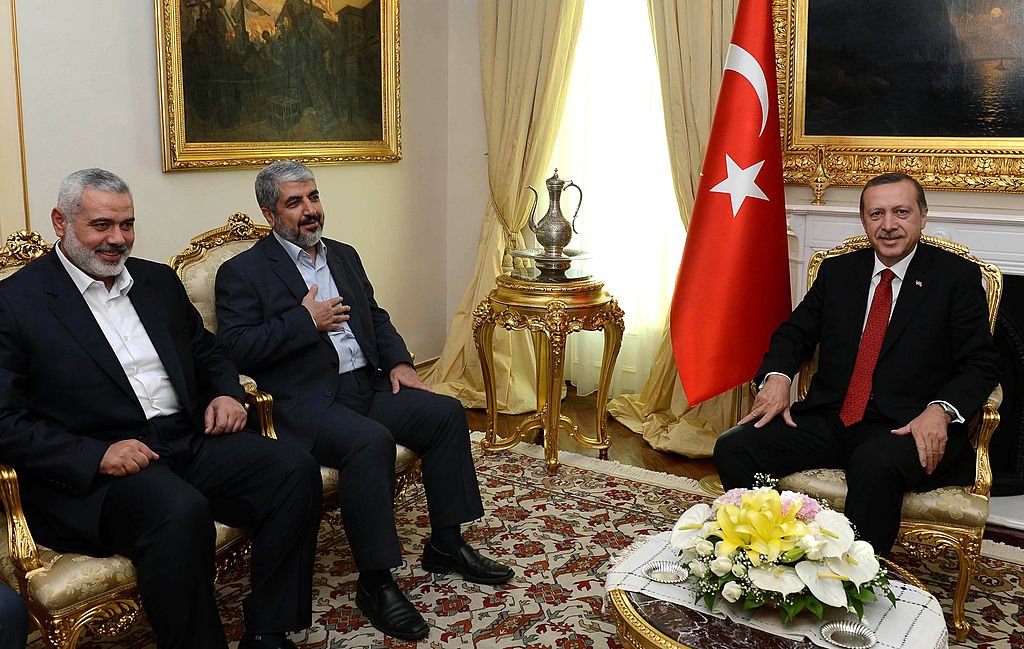
Just as troubling is Ankara's own relationship with Hamas. Turkey has hosted senior Hamas officials on its territory. Israeli and Western security officials have repeatedly accused Hamas operatives based in Turkey of coordinating terrorist activities, raising funds, and helping direct attacks against Israel.
Rather than pressuring Hamas to disarm and abandon terrorism, Erdogan has repeatedly embraced Hamas leaders and portrayed them as legitimate representatives of the Palestinian people.
If Turkey is serious about regional security, why is it not demanding that Hamas surrender its weapons? If Turkey genuinely seeks peace, why is it not insisting that Hamas and many other Palestinians recognize Israel? If Turkey wants stability, why is it providing support and political legitimacy to an organization whose charter calls for Israel's destruction?
Equally puzzling is Turkey's claim that a regional security alliance would somehow guarantee Israel's security.
Where were these regional security guarantees when Iran was arming Hamas, Hezbollah, the Houthis, Iraqi militias and other terrorist proxies?
Why would Israel place its security in the hands of countries that have repeatedly failed to stop Iranian aggression? Why would Israel join a security mechanism that includes states that either tolerate or actively support anti-Israel forces?
Before October 7, 2023, many Israelis still believed that territorial concessions could eventually produce peace. After October 7, the overwhelming majority understand that any future Palestinian state could easily become another Iranian-backed Islamist stronghold dedicated to Israel's destruction.
Turkey's leaders may dislike this reality, but they cannot ignore it. Before lecturing Israel about Palestinian statehood, Ankara should focus on a more urgent task: pressuring Hamas to abandon its genocidal goal of eliminating the Jewish state.
Until that happens, Turkey's proposal is not a roadmap to peace. It is a blueprint for the next war.
- Follow Khaled Abu Toameh on X (formerly Twitter)
Khaled Abu Toameh is an award-winning journalist based in Jerusalem.
Source: https://www.gatestoneinstitute.org/22576/turkey-palestinian-state-fantasy

No comments:
Post a Comment