The "Middle East and Terrorism" Blog was created in order to supply information about the implication of Arab countries and Iran in terrorism all over the world. Most of the articles in the blog are the result of objective scientific research or articles written by senior journalists.
From the Ethics of the Fathers: "He [Rabbi Tarfon] used to say, it is not incumbent upon you to complete the task, but you are not exempt from undertaking it."
The IDF on Tuesday unveiled new pathways to increase haredi enlistment, aiming to prevent major troop shortages when 2,500 soldiers are released in January 2027.
Israel’s ultra-Orthodox Jewish sector has been protesting over the attempts to draft young haredi men into the military. (photo credit: Amir Levy/Getty Images)
The IDF on Tuesday said that already in March, it needs to be able to summon a much larger number of soldiers, with an emphasis on haredim, in order to avoid an impending crisis in January 2027.
In
January 2027, around 2,500 mandatory service combat soldiers will be
released all at once, an unusual number to be released simultaneously
and one that will put the military at risk of major holes in readiness
without an immediate, correspondingly large influx of new soldiers.
While
the IDF is working to increase the interest in combat among the wider
population, and that interest has increased during the war, both among
male and female recruits, it is likely to be insufficient without an
additional source of recruits, with the haredi community still a
massive, mostly untapped source.
Continuing
its efforts to encourage haredim to join the army in larger numbers,
the IDF released on Tuesday its new order formally setting down several
different pathways to service in the IDF for haredim.
In some ways, the order does nothing new, given that in recent years, a plethora of new programs like Hashmonaim, Magen, Tomer, Chetz, and others are already gotten off the ground and running.
A haredi man and an IDF soldier pray at the Western Wall in Jerusalem, November 14, 2024 (credit: MARC ISRAEL SELLEM)
For
example, the Hashmonaim combat service for haredim involves essentially
zero interaction with women, only serving with haredim, a special time
for Jewish studies with those haredim, and soldiers in that developing
brigade have already served in Gaza.
IDF signals readiness for larger haredi enlistment
In
that sense, issuing the order is more of a public relations exercise by
the IDF signaling that it is fully ready to absorb a much larger influx
of haredim into the new pathways it created to facilitate a haredi
lifestyle.
On
a more formal note, the order makes clear to the haredi and general
public exactly what they can expect from what it means and will mean for
more haredim entering the military, and how the IDF has struck a
balance between special haredi rights versus the rights of secular women
and other sectors.
Despite
the push by the IDF, the military recognizes that many issues are not
in its control, but rather in the purview of the government and the
Knesset.
Currently, the Knesset
is working on a new law which will exempt many haredim from service and
only increase haredi service very gradually and with a myriad of
loopholes which could render it meaningless.
Accordingly,
the IDF said that regardless of how much the volume of haredi recruits
increases, it is in favor of the Knesset extending the service for
mandatory soldiers from 30-32 months to 36 months.
In
contrast, Attorney-General Gali Baharav-Miara, the political
opposition, and some MKs within the government have opposed extending
mandatory service unless and until a much larger portion of haredim are
drafted into the military.
The
vast majority of Israelis, including inside the government, lost
patience during the war, and with around 2,000 Israelis killed, with the
haredi community avoided IDF service, something which much of the
population has been upset about for years.
However,
Prime Minister Benjamin Netanyahu has pushed forward with the current
partial exemption, limited recruitment bill to try to keep the haredi
political parties in his government and to avoid early elections, given
their opposition to a large-scale draft.
Recently,
a senior IDF officer told the Knesset that there is already an
increased rate of haredim drafting to the IDF, which, if it stays at the
new, higher rate, could lead to over 3,000 haredi draftees in a year.
While
this would be a relative increase, it would still fall far short of
drafting 50% or more (which would be around 5,000-6,000 per year) as
opposition parties have demanded as a baseline from which to gradually
scale up.
Rafah is one of the sticking points in the ongoing conflict between Israel and Hamas and was often the focal point of the war that began in October 2023.
The Rafah border crossing between Gaza and Egypt opens to pedestrian traffic on Feb. 2, 2026.(photo credit: TPS-IL)
The Rafah crossing, Gaza’s border with Egypt, will reopen on Sunday after being shut down by Israel for nearly two years.
Rafah
is one of the sticking points in the ongoing conflict between Israel
and Hamas and was often the focal point of the war that began in October
2023.
Israel
is caught between international pressure to open the crossing and to
gradually begin the process of Gaza’s rehabilitation after a lengthy and
costly war, and its security concerns.
For
Palestinians, Rafah is the only exit from Gaza not controlled by
Israel. In the past, it supplied a rare conduit for medical treatment
abroad, family reunifications, and relief from the territory’s isolation
and dire conditions.
Last week, a statement released by the office of Prime Minister Benjamin Netanyahu
said the opening of the crossing was part of the implementation of US
President Donald Trump’s 20-point peace plan. “The crossing will be
limited solely to people with a full Israeli oversight mechanism,” the
statement read.
The Rafah border crossing between Gaza and Egypt opens to pedestrian traffic on Feb. 2, 2026. (credit: TPS-IL)
Quotes
by unnamed officials in Israeli media gave different numbers of
Palestinians that will be allowed through the crossing, both in and out
of Gaza. The number of Palestinians ranged from 50 to 150.
Foreign journalists are still not allowed to enter the territory
Data released by the Hamas-run Gaza Ministry of Health suggest at least 16,500 patients are in need of medical evacuation.
International
humanitarian organizations believe the reopening of the crossing is
critical not only for medical cases but also for restoring the limited
civilian movement that existed prior to the war, after months of
near-total isolation, even though access will remain highly restricted
and subject to Israeli approval.
According
to the Coordinator of Government Activities in the Territories (COGAT),
the European Union will also be part of the oversight mechanism. Only
Gaza residents who left the territory during the war will be allowed to
return, subject to advance Israeli approval.
The
opening of the crossing, Gaza’s main opening to the world, comes days
after the remains of the last Israeli hostage were recovered by the
Israeli military, marking the end of the first phase of the Trump peace plan.
“Rafah
is the only point in Gaza which allows for movement to another
country,” Col. (res.) Eldad Shavit, a senior researcher at the Institute
for National Security Studies and a former senior intelligence officer,
told The Media Line. “Its high sensitivity is the reason why Israel is putting emphasis on the matter.”
“Rafah
is important for all sides – for Hamas, for the mediators, for the US
and for Israel, which wants to make sure that there is no way to use
Rafah against Israeli interests,” Shavit added.
One
of Israel’s objectives during the war was to establish control over a
narrow strip of land called the Philadelphi Corridor, which is
approximately 13 kilometers (8 miles) long and located along Gaza’s
southern border with Egypt.
As
part of the peace agreement between Israel and Egypt in 1979, the area
was designated as a buffer zone that was monitored by Israeli forces.
Coined
the “Philadelphi Corridor,” Israel maintained control of it until its
disengagement from the Gaza Strip in 2005. Egypt then deployed troops on
its side of the border, with the Palestinian Authority taking over
control of the Gaza side. In 2007, the Hamas terrorist organization
violently overthrew the PA, seizing control of Gaza and the Philadelphi
Corridor.
Both
Israel and Egypt imposed major restrictions on the Palestinians in
Gaza, with Egypt restricting the flow of goods to and from the crossing,
especially after Hamas took over in 2007.
Egypt
reopened the crossing after the 2011 revolution, but closed it in 2013
when President Mohamed Morsi was ousted. Morsi was a leader of the
Muslim Brotherhood, the Islamist movement from which Hamas stemmed.
Before
the war, Rafah served as Hamas’ main armament lifeline, in addition to
being where much of the humanitarian aid entered the Gaza Strip.
According to the Israel Defense Forces (IDF) and the Israeli defense
establishment, Rafah was the hub of Hamas’ intricate tunnel network that
allowed its members to move freely throughout the Gaza Strip.
Last
week, Israeli defense officials quoted in the media said Hamas was
already making headway in its rehabilitation efforts, using the
humanitarian aid to make money from goods being sold in local markets.
“Hamas
is making efforts to rehabilitate,” said Shavit. “The question is how
successful it will be, and it largely depends on how much the Americans
will hold Hamas to its promise to disarm.”
Under
the terms of the ceasefire, the IDF will control the area between the
Rafah crossing and the zone where most Palestinians live. During the
second phase of the peace plan, Hamas is supposed to give up its weapons
and control of Gaza, letting a government of technocrats rule the
territory. The Israeli military is also supposed to withdraw from most
of the Gaza Strip.
President
Trump’s newly established Board of Peace and the proposed Gaza
Stabilization Force are intended to oversee the implementation of the
20-point peace plan, aimed at sidelining Hamas and shaping Gaza’s
postwar future.
According
to American officials, the Board of Peace will coordinate diplomatic
efforts, oversee security arrangements, and promote economic incentives
intended to weaken Hamas’ grip on Gaza. The Gaza Stabilization Force is
supposed to oversee disarmament and prevent the rehabilitation of the
terrorist group. Together, both are intended to create the conditions
for a transitional administration in Gaza, reduce Israel’s direct
involvement, and open the door to reconstruction efforts.
Rafah is a major part of the puzzle
Many
Israelis are skeptical that Hamas will willingly disarm. With the Rafah
crossing now open, Hamas may be able to speed up its efforts to
regroup.
“Trump
may have established the Board of Peace, but Israel needs to establish
the Board of War,” Israeli Cabinet Minister Avi Dichter said in a radio
interview on Sunday morning. “There are zero chances of Hamas disarming.
No one seriously thinks an international force will do the job for
Israel.”
Avi
Melamed, founder of Inside the Middle East Institute and a former
intelligence official, believes that two and a half years after the war
between Israel and Hamas began, the terrorist organization is far from
being sidelined.
“What
we are seeing is international involvement in Gaza,” Melamed told The
Media Line. “Theoretically, the control of the Rafah crossing is no
longer in the hands of Hamas, but on the ground, Hamas still has control
of the territory.”
Throughout
the war, Israeli forces uncovered and destroyed Hamas tunnel shafts and
underground infrastructure in Rafah. It is unclear how much of the
infrastructure remains and whether Hamas is already rebuilding it.
“The
reality on the ground is stronger than any speech or declaration,” said
Melamed. “Israel cannot be calm. Hamas hasn’t disappeared; it remains
steadfast and is rebuilding, in addition to seeing Turkey and Qatar as
major players in Gaza. Israel’s ability to control the area is getting
smaller.”
Israel’s
concern is compounded by the growing involvement of Turkey and Qatar,
both of which seek to solidify their influence in Gaza through political
mediation, financial support, and intense involvement in the
reconstruction efforts of the territory.
Since
Qatar has long served as a key financial backer of Hamas and of Gaza,
Israeli officials say Qatari funds and diplomatic cover have helped
sustain the group’s grip on the territory. Turkey, meanwhile, has
increased its regional footprint through outspoken and often
controversial political support for Hamas, while simultaneously engaging
in Gaza-related initiatives. This has raised fears in Israel that
external actors will assist in Hamas’ recovery while limiting Israel’s
ability to shape postwar security arrangements.
With
eyes on the delicate setup in Rafah that could quickly become a reality
over which Israel has no control, the central question for the Jewish
state remains whether Gaza’s future will be shaped by a weakened Hamas
or by an international framework that, intentionally or not, allows the
terrorist group to survive, regroup and continue exerting control both
beneath and above the ground.
Despite the reopening of Rafah, Israel is still limiting the entry of foreign and Israeli journalists and insisting on supervising their visits.
A truck carrying humanitarian aid at the Rafah border on the Egyptian side, in Rafah, Egypt, January 29, 2026(photo credit: REUTERS/STRINGER)
Israel fully reopened the Rafah Border Crossing
between Gaza and Egypt on Monday for people on foot, a day after
rolling out a limited pilot-day opening to address unforeseen logistical
issues.
Collectively,
the Sunday-Monday rollout now allows Palestinians to leave the enclave
and to let back in certain Gazans who fled during the war in the
enclave.
While Sunday's opening was for a very small number of Palestinians,
mostly to help the three-fold Israeli, EUBAM, and Palestinian officials
involved to figure out some of the inevitable holes in the process on
the ground from such a large and complex undertaking.
Monday's opening is expected to allow the maximum number of people to pass through the crossing under the Trump ceasefire deal.
Even
this full opening is limited in some respects, with Israel requiring
security checks for Palestinians entering and exiting Jerusalem.
Gazans are moving toward the northern part of the Strip following the start of the ceasefire. (credit: Majdi Fathi / TPS)
Cairo
is also expected to impose unannounced caps on the number of travelers,
though the number of daily travelers allowed was expected to be
substantial.
IDF outlines response to Rafah crossing opening
Last week, in response to the opening of the Rafah Crossing, the IDF outlined a complex border-check arrangement.
The
European EUBAM organization will handle the main border checks for the
Rafah Crossing going in and out of Gaza, reportedly with some
Palestinian involvement.
Next, the IDF will do a second round of physical checks of all those entering Gaza after the EUBAM check.
Exiting
Gaza for Egypt, the IDF will not undertake any physical checks, but
will have video cameras taking pictures of the faces of all those
exiting.
In
addition, IDF sources recommended that despite all of the authorities
being passed on to the Palestinian technocratic committee, EUBAM, and
the ISF, the IDF avoid a complete withdrawal from the Philadelphi
Corridor, near the Rafah Crossing.
Israel
cut off Gaza in the early weeks of October 2023 after Hamas's invasion
of Israel's South, but then started to open certain crossings to
facilitate humanitarian aid and pressed Egypt to do so with Rafah.
Despite
Israeli and US requests, Egypt closed the Rafah Crossing near the start
of the war, with Israel accusing Egypt of doing so to pressure
Jerusalem into being the sole source of humanitarian aid for Gaza and to
protest the IDF's counter-attack on Hamas.
Later, in May 2024, Israel seized the border crossing.
From
May 2024 until Trump's final October 2025 ceasefire, Jerusalem and
Cairo haggled over potentially reopening the crossing, with neither side
agreeing to the other's terms, though the crossing opened on a limited
basis during the January 2025-March 2025 temporary ceasefire.
For
example, Egypt wanted the Palestinian Authority involved in the
crossing, which Israel objected to at the time, but is now allowing on a
limited basis.
Palestinian
officials say about 100,000 Palestinians have fled Gaza since the war
began, most of them during the first nine months. Some were sponsored by
aid groups, while others paid bribes to parties in Egypt to secure
permission to leave.
The closure of Rafah cut off an important route for wounded and sick Palestinians to seek medical care outside Gaza.
Israel
allowed a few thousand people to seek medical treatment in third
countries via its own border over the past year, though thousands more
are in need of care abroad, according to the United Nations.
Despite
the reopening of Rafah, Israel is still limiting the entry of foreign
and Israeli journalists and insisting on supervising their visits.
Gaza's
about two million Palestinians mostly live in makeshift tents and
damaged homes, surrounded by the ruins of their destroyed cities.
Israel's
Supreme Court is considering a petition by the Foreign Press
Association that demands foreign journalists be allowed to enter Gaza
from Israel in unlimited numbers and without supervision.
Government
lawyers have said that letting journalists into Gaza could pose risks
to Israeli soldiers, while also highlighting potential risks to
reporters, though they have been more circumspect about these dangers at
the current time, given the October 2025 ceasefire.
The officials said Witkoff's visit to the country was expected to begin on Tuesday.
US Special Envoy Steve Witkoff meets with Prime Minister Benjamin Netanyahu in Jerusalem, Israel, July 31, 2025(photo credit: KOBI GIDEON/GPO)
US President Donald Trump's
senior envoy Steve Witkoff is expected to visit Israel for meetings
with Prime Minister Benjamin Netanyahu and IDF Chief of Staff Eyal Zamir, two senior Israeli officials said on Monday.
The
officials said Witkoff's visit to the country was expected to begin on
Tuesday. It comes amid heightened regional tensions with Iran, and as
the Trump administration presses ahead with its plan to end the Gaza war.
Additionally, as Phase II has officially begun, Israel fully reopened the Rafah Border Crossing
between Gaza and Egypt on Monday for people on foot, a day after
rolling out a limited pilot-day opening to address unforeseen logistical
issues.
Collectively,
the Sunday-Monday rollout now allows Palestinians to leave the enclave
and to let back in certain Gazans who fled during the war in the
enclave.
In addition, according to two senior diplomatic sources who spoke with The Jerusalem Post
on Monday, Eyal Zamir’s recent visit to Washington, DC, included highly
discreet meetings with Chairman of the Joint Chiefs of Staff Dan Caine
and the entire senior team, in what was one of the most significant
working channels in Israel-US relations.
CENTCOM's
Adm. Brad Cooper meets with IDF Chief of Staff Lt. Gen. Eyal Zamir on
January 24, 2026. (credit: IDF SPOKESPERSON'S UNIT)
The
meetings took place at The Pentagon and were held behind closed doors,
with details kept tightly controlled on both sides, consistent with
public reporting that Zamir held a secret weekend visit and met senior
US defense officials.
A growing axis: IDF, CENTCOM, and the Joint Chiefs
According
to one source, a three-part operational and strategic axis has taken
shape between the IDF chief of staff, the commander of United States
Central Command, and the Joint Chiefs and their staff. The channel has
produced frequent engagement, including periodic meetings that, at
times, have occurred on a near-weekly basis.
Publicly, Zamir has held recent meetings with Brad Cooper, including during Cooper’s late-January trip to Israel.
House Intelligence Committee member Greg Steube cites law making threats against federal officers a felony
Soros-backed Democratic prosecutor Larry Krasner is
facing criticism for his inflammatory remarks against federal
immigration enforcement, with a Republican lawmaker urging the Justice
Department to launch a criminal investigation after Krasner said he
would "hunt down" ICE agents.
Krasner, the
district attorney for Philadelphia, took to the podium at Penn Square
last week to denounce ICE agents as "a small bunch of wannabe Nazis,"
adding, "if we have to hunt you down the way they hunted down Nazis for
decades, we will find your identities."
House Intelligence
Committee member Greg Steube, R-Fla., called out Krasner and recommended
that Attorney General Pam Bondi take a closer look at his
ever-escalating remarks on the issue.
Steube cited federal code categorizing threatening a federal officer as a felony punishable by up to 10 years in prison.
"The DOJ should absolutely arrest and convict this guy," he said.
Krasner previously said he would seek to arrest and prosecute federal agents
who "come to Philly to commit crimes" — in an apparent reference to
allegations that law enforcement acted unlawfully when shooting a
Minnesota woman who appeared to intentionally hit one of them with her
car while disrupting an operation.
In the remarks that drew
Steube’s ire, Krasner boasted that the 350 million Americans who live in
the U.S. outnumber the "small bunch of wannabe Nazis" before offering
to work with other states’ prosecutors to pursue them criminally after
President Donald Trump’s term ends.
Fox
News Digital reached out to the Justice Department to ask whether it
planned to follow Steube’s recommendation, but received no response. A
White House official who was asked about the situation directed Fox News
Digital back to the DOJ.
Krasner also earned a rebuke from his own party, as Pennsylvania Democratic Gov. Josh Shapiro told Fox News that such remarks are "unacceptable… abhorrent and it is wrong; period; hard-stop; end of sentence."
"We have a psychopath with a badge," fellow Pennsylvanian Rep. Dan Meuser, a Dallas Republican, said in a statement to Fox News Digital.
Philadelphia DA Larry Krasner(Matthew Hatcher/Reuters)
Meuser
condemned Krasner for repeatedly failing to prosecute actual violent
criminals, citing a reported prosecution rate of 30% for such crimes.
"Every
responsible Democrat must condemn this behavior. Failure to do so only
increases the temperature in an already volatile situation, endangering
federal law enforcement and communities alike," he said, adding that Senate Democrats are borrowing Krasner’s "reckless political playbook" in using DHS funding as a cudgel in government-shutdown negotiations.
Meuser
quipped that many critics rightly dub Krasner "Let ‘Em Go Larry" for
his position toward prosecution of suspects who aren’t members of
federal immigration enforcement.
Meuser has been at the forefront of calling out prosecutors for their actions and statements, authoring the Holding Prosecutors Accountable Act,
which would make district attorney offices that fail to prosecute at
least two-thirds of arrests ineligible for certain Justice Department
grants.
DHS Assistant Secretary Tricia McLaughlin was asked about Steube’s call and said that Krasner’s comments were "vile."
"He
is intentionally stoking the flames of hatred and division in this
country for political gain. Calling law enforcement Nazis and
encouraging violence and doxing of them is absolutely disgusting," she
said, citing the 1,300% increase in assaults against ICE.
"The
violence and dehumanization of these men and women who are simply
enforcing the law must stop," McLaughlin said, adding that Krasner
should instead be thanking ICE for removing several dangerous illegal
immigrants from the Delaware Valley itself.
She cited Yehi Badawi
from Egypt, who was convicted of aggravated assault and robbery; Cuban
national Alan De Armas-Tundidor, a convicted drug trafficker; and Thanh
Long Huynh of Vietnam, who was convicted of both rape and cocaine
distribution.
In recent comments to Fox News Digital, another top
Pennsylvania Republican who taught relevant subjects at the U.S. Army
War College, said the federal supremacy clause would likely moot any
actions by Krasner or Philadelphia against ICE agents following lawful
federal orders.
"The Constitution is not optional," said state Sen. Doug Mastriano of Gettysburg, who ran against Shapiro in 2022.
State
Senate Intergovernmental Operations Committee Chairman Jarrett Coleman,
an Allentown Republican whose panel oversees local-state-federal
interactions, told Fox News Digital earlier this month that claims
Philadelphia officials can intercede with federal immigration
enforcement are "empty threats."
"If
they do obstruct federal law enforcement efforts, the Pennsylvania
Senate will be the least of their worries," he said, later remarking
that if Krasner paid more attention to actual violence, "Philadelphia
wouldn’t be such a s---hole."
Hungarian-American billionaire George Soros,
a far-left funder of many allegedly soft-on-crime prosecutors in
localities around the country, dumped $1.7 million into Krasner’s 2017
election, according to Philadelphia’s PBS affiliate.
Philadelphia City Council Minority Leader Kendra Brooks, of the left-wing Working Families Party, and Democrat Rue Landau also authored legislation intended to limit ICE operations within city limits.
The
city’s lone Republican councilman, Brian O’Neill, is ranked as the
third party rather than minority in the Democratic-led chamber.
Fox News Digital reached out to DHS for further comment.
Charles Creitz is a reporter for Fox News Digital. He is a Pennsylvania native and graduated from Temple University with a
B.A. in Broadcast Journalism. Story tips can be sent to
charles.creitz@fox.com.
Some employees claimed they were accused of racism, in part because the money was flowing to "diverse communities," the letter said. Most of those who have been federally indicted for the fraud schemes are of Somali descent.
(The Center Square) -
Claims from current and former
Minnesota state employees that have been vetted by state lawmakers
allege their bosses ignored and rebuked fraud warnings for years,
retaliated against the employees who raised the alarms and protected
leaders who oversaw the fraud-laden programs, according to a whistleblowers' letter obtained by The Center Square.
The claims are made in an unsigned letter to Congress as it
investigates fraud schemes that bilked government assistance programs
for hundreds of millions of dollars in the state.
Some employees claimed they were accused of racism, in part because
the money was flowing to "diverse communities," the letter said. Most of
those who have been federally indicted for the fraud schemes are of Somali descent.
Minnesota state Rep. Kristin Robbins – a Republican who leads a state
investigation into the fraud and has communicated with the letter's
authors –submitted the letter as part of her testimony to federal
lawmakers this month. Its contents have not been previously reported.
Specifically, the letter focused on the state's Housing Stabilization
Services program, which awarded taxpayer dollars to organizations to
ensure housing for older residents and those with disabilities,
significant mental illness and substance-abuse disorders.
That program – initially estimated to cost less than $3 million each
year when it launched in 2020 – swelled to about $104 million in 2024
and was on track to surpass that figure in 2025 before the program was
shuttered, according to federal court records.
More than a dozen people have been indicted in recent months for fraud schemes related to the program.
Eric Grumdahl, an assistant commissioner for the Department of Human
Services who oversaw the program, was fired in September, shortly before
he was expected to testify before a state committee that is
investigating the fraud.
The whistleblower group that penned the letter said concerns about
the program – the first in the nation to offer Medicaid coverage for the
housing services – culminated in late 2022, when state employees
pressed Grumdahl to act.
"His response to staff was alarming," the letter said. "Fraud
concerns ... were strongly dismissed and numerous employees experienced
serious retaliation."
State employees who aired their worries about fraud allege they were
the subject of repeated internal investigations and surveillance, work
reassignments and veiled threats about their employment.
"You will never get another state job," one employee was allegedly told.
In January 2023, state workers took their concerns to top Department
of Human Services leadership, human resources administrators and
auditors, and later to the governor's office.
The next month, the department's then-leader, Jodi Harpstead, told
hundreds of employees in an all-staff meeting "to stop reporting
concerns that she did not feel were relevant," the letter said.
Harpstead resigned in February 2025.
At the time, Gov. Tim Walz praised her job performance.
"I am proud of her work running the most complex and wide-ranging agency in state government," he said.
Harpstead's successor, interim Commissioner Shireen Gandhi, said the
department has taken steps to "change the culture" to be more receptive
to employee feedback.
"When employees feel heard and trusted, they are better positioned to
surface risks early, improve systems, and deliver strong outcomes for
Minnesotans," she said in a statement her department provided to The
Center Square.
The department did not directly respond to the contents of the whistleblowers' letter.
In recent months, 13 people have been accused of federal crimes for
fraud schemes related to the housing program. They submitted claims to
the state for about $14 million worth of reimbursements, court records
show.
The people are accused of drastically overstating the actual help
they provided to people who need housing assistance and of using the
public money instead for personal expenses, such as buying land in Kenya
and investing in cryptocurrency.
"What we see are schemes stacked upon schemes, draining resources
meant for those in need," former U.S. Attorney Joseph Thompson said in
September, when the first federal charges related to the Minnesota
housing program were announced. "It feels never ending."
Fraud investigations related to the housing program and other
assistance programs in Minnesota are ongoing. They have identified about
$300 million of fraud related to the former Feeding Our Future
organization, which had claimed it provided meals to children. That
government aid was overseen by the state Department of Education.
The whistleblower letter said Human Services employees reported their
concerns about contract irregularities, fraud potential, lax oversight,
unusual financial transactions, compliance failures, improper
promotions and others, repeatedly between 2019 and 2025 about a variety
of programs.
Iraqi Shi’ite leaders arrived in Erbil for talks with Kurdish officials as political deadlock deepens over appointing a new president and prime minister.
Supporters of former Iraqi Prime
Minister Nouri al-Maliki gather to protest what they say is U.S.
interference in Iraq’s sovereignty near the entrance to the Green Zone,
which houses the U.S. embassy and other missions, in Baghdad, Iraq,
January 29, 2026.(photo credit: REUTERS/THAIER AL-SUDANI)
According to reports on February 2, a delegation of Iraq’s Shi’ite Coordination Framework arrived in the Kurdistan Region’s capital of Erbil on Monday to meet with the Kurdish leadership.
The meeting is taking place because Iraq’s political leaders
have been thrown into turmoil, and the country is having trouble
appointing a new president and prime minister. The office of the
president has usually been held by a Kurd.
In
the past, the position of president of Iraq was often held by a Kurd
from the Patriotic Union of Kurdistan party (PUK). The Kurdish
leadership in Erbil is dominated by the Kurdistan Democratic Party (KDP), which is often a rival of the PUK.
However,
on some issues, the Kurdish parties coordinate closely. Regarding
Baghdad, this is sometimes one of the issues they work together on. The
reasons that a Kurd holds the presidency are a result of the post-2003
US invasion constitution and consensus in Iraq. Iraq was led by Saddam
Hussein, a Sunni Arab dictator, for many decades.
After
his fall, the concept was that Shi’ites would usually be prime
minister, while a Kurd would be president and a Sunni would be speaker
of parliament. In some ways, this is how Lebanon’s politics is also
organized along sectarian lines.
A
supporter of Iraqi Shi'ite armed groups burns a poster with red X marks
on the images of a U.S. flag and U.S. President Donald Trump during a
protest against what they say is U.S. interference in Iraq’s
sovereignty, near the entrance of the Green Zone, home to the U.S.
embassy and other missions, (credit: REUTERS/Thaier Al-Sudani TPX IMAGES
OF THE DAY)
Although
the KDP is the larger Kurdish party, there is a kind of trade-off where
the KDP runs the Kurdistan autonomous region, or KRG, and PUK gets to
be the largely ceremonial Iraqi president.
A report at The New Region said that Iraq’s current Prime Minister, Mohammed Shia al-Sudani,
arrived in Erbil with the Coordination Framework. The goal is to iron
out the problems Iraq has had in appointing the president and prime
minister. The Kurds look to be power brokers in Iraq today.
This
is partly a result of the KRG being a stable region. It also links Iraq
to Turkey and Syria. In addition, the KRG has close ties to the US. US
President Donald Trump has opposed Nouri al-Maliki becoming Iraq’s next
prime minister.
Maliki
was the prime minister in 2014 when part of Iraq was taken over by
ISIS. He wants to return to the office. He is a Shi’ite and close to
Iran.
The
Kurdish leadership, often represented by the KDP’s Barzani family and
the PUK’s Talabani family, has had complex ties with the Shi’ite
parties. Back in 2017, Masoud Barzani, the KDP leader, led the Kurdistan
region to an independence referendum.
This
angered Baghdad and Iran. Qasem Soleimani was sent to talk to the PUK
and work with Baghdad to thwart the Kurds’ power. After the referendum,
Baghdad sent tanks into the city of Kirkuk, forcing the Kurdish
Peshmerga fighters to flee.
The
KDP at the time believed the PUK had done a secret deal with Soleimani
and Baghdad. The PUK has often been portrayed as being closer to Iran.
However,
years later, things have changed. The KDP and PUK, and also Baghdad,
are sometimes able to work together, sometimes against one another. For
instance, Baghdad had tried to prevent the KRG from exporting oil to
Turkey. Now there is a deal.
US envoy meets Barzani amid Iraq and Syria talks
At
the same time, in the wake of Trump's posting about Maliki, the US
Charge d’Affaires in Iraq has been meeting with Iraqi politicians. Rudaw
media in Erbil noted, “President Masoud Barzani on Sunday received in
Erbil the Charge d’Affaires of the US Embassy in Iraq, Joshua Harris,
where the two officials highlighted Erbil’s role in supporting a
milestone integration agreement between Damascus and the Kurdish-led
Syrian Democratic Forces (SDF).”
The
report noted that in a statement on Facebook, the Barzani Headquarters
quoted the US diplomat as conveying “the thanks and appreciation of the
President and Government of the United States to President Barzani for
the support and assistance he provided toward reaching the recent
agreement between the Syrian [interim] government and the Syrian
Democratic Forces (SDF).”
In
another report by Rudaw, it is noted that “Abbas Radi, the Coordination
Framework’s secretary-general, said in a statement on Sunday that a
‘high-level delegation’ from the bloc ‘will travel on Monday to the
Kurdistan Region to meet Kurdish leaders’ in Erbil, a power base of the
Kurdistan Democratic Party (KDP), and in Sulaimani, the stronghold of
its rival, the Patriotic Union of Kurdistan (PUK).”
The
report added that “Radi detailed that the delegation will comprise
senior Coordination Framework leaders, including Iraqi Prime Minister
Mohammed Shia’ al-Sudani, Badr Organization head Hadi al-Ameri, and
former Iraqi deputy speaker and al-Asas Coalition leader Mohsen
al-Madalawi.”
The
Kurdish leadership is clearly working as a power broker. It must
balance many things. It must balance the close ties it has with the US
with the discussions with the Shi’ite parties about who might be the
prime minister. There may also be a trade-off regarding the presidency.
With so many balls in the air, the Kurdish parties once again have a
chance to showcase their importance in Iraq.
Groups are required to submit a list of all employees. Médecins Sans Frontières agreed to do so and then reversed itself.
The office of Médecins Sans Frontières (Doctors Without Borders) in Khan
Yunis, the southern Gaza Strip, Feb. 21, 2024. Photo by Mohammed
Abed/AFP via Getty Images.
Israel announced on Monday that Médecins
Sans Frontières (MSF), also known as Doctors Without Borders, must cease
its activities in the Gaza Strip and leave by Feb. 28 after failing to
hand over a list of its local and international staff for security
purposes.
On Dec. 30, 2025, Israel suspended 37 NGOs
that failed to meet stricter requirements announced last March by a new
inter-ministerial committee set up to handle the registration and
supervision of international organizations operating in Judea and
Samaria and the Gaza Strip. (It approved 24 groups, which it said
account for 99% of total aid to the Strip.)
“Humanitarian aid—yes. Security
blindness—no,” said Israeli Diaspora Affairs Minister Amichai Chikli in a
statement provided to JNS on Sunday. The Diaspora Affairs and Combating
Antisemitism Ministry leads the inter-ministerial committee.
“Unfortunately, [Médecins Sans Frontières]
is once again showing a lack of transparency. … The organization
changed its position abruptly, after publicly pledging to act in
accordance with the regulations,” said Chikli.
Among the new regulations, groups are
required to submit a list of all employees. “The list shall include full
names, passport numbers (for foreign employees), identification numbers
(for Palestinian employees), and contact details,” according to the
guidelines published on the Israeli government’s website on March 9,
2025.
At first, MSF refused to comply. Then,
faced with the end of its activities in Gaza, it agreed to the new
requirements on Jan. 23, and promised to transfer a list of its staff by
Jan. 27. That date came and went without a list being provided.
The group then backtracked, announcing in a
Jan. 30 statement that it would not provide a personnel list “in the
absence of securing assurances to ensure the safety of our staff or the
independent management of our operations.”
“In practice, despite the public
commitment, the organization refrained from transferring the lists
…, contrary to its previous statements and the binding procedure,” said
the Diaspora Affairs Ministry. “In light of this and in accordance with
the provisions of the procedure, by Feb. 28, 2026, MSF will cease its
activities and leave the Gaza Strip and Judea and Samaria.”
The ministry stressed that the regulation
is intended to enable legitimate humanitarian activity while preventing
“the exploitation of humanitarian cover for hostile purposes and
terrorist activity.”
This is particularly relevant to Médecins Sans Frontières, which has employed terrorists in the past.
“We have at least two documented cases of
MSF activists that were directly involved in terrorism, Hamas
organizations and Palestinian Islamic Jihad,” said Chikli.
Israel’s Foreign Ministry tweeted a video
of those terrorists on Sunday, noting MSF had “publicly mourned” an
employee, Nasser Hamdi Abdelatif al-Shalfouh, who was a “confirmed Hamas
terrorist.” It also employed Fadi al-Wadiya, a Palestinian Islamic
Jihad terrorist, the ministry said.
Humanitarian status is not immunity. Due diligence saves lives.
Turns out Doctors Without Borders has something to hide. Rather than accepting transparency, meant to protect all parties, @MSF prefers to withdraw from Gaza.
Chikli noted that MSF coordinates with the
Gazan Ministry of Health, run by Hamas, and the NGO’s statements are
published in tandem with similar statements from Hamas sources in the
Strip.
This pattern repeated itself with MSF’s
announcement that it would not share its staff lists. COGAT, the Israel
Defense Ministry’s Coordinator for Government Activities in the
Territories unit, tweeted on Sunday:
“Interestingly, on the same day that MSF
announced they will not be sharing the lists of local employees after
all, Hamas released a statement calling for organizations to not share
local employee information lists. Coincidence?”
Although it defines itself as an
“international, independent, medical humanitarian organization,” MSF is
highly controversial. Israeli watchdog group NGO Monitor reported that
MSF “consistently abuses its status as a humanitarian organization to
launch venomous anti-Israel political campaigns.”
In September 2025, two Hamas documents found by
Israeli forces in Gaza showed that Doctors without Borders (along with
the International Committee of the Red Cross) were aware of the presence
of Hamas in the Gaza Strip’s medical facilities despite obfuscating or
outright denying it publicly.
At the same time that MSF ignored Hamas’s
use of homes, schools and medical facilities for terrorist attacks, the
group accused Israel of “genocide,” “collective punishment,”
“apartheid,” “indiscriminate bombings” and “wholesale massacres,” NGO
Monitor reported.
In December 2023, former MSF Secretary
General Alain Destexhe said in a report that MSF’s communications show a
“systematic bias in favor of Hamas and hostility to Israel,” as do its
employees.
“Despite being subject to the MSF Charter,
a significant proportion of its staff seem to share the Hamas point of
view and support the terrorist attacks of 7 October,” said Destexhe.
Gerald Steinberg, president of NGO
Monitor, told JNS: “MSF has gotten away with using its massive annual
budget ($2.4 billion) and the influence this buys to promote antisemitic
propaganda like [accusing Israel of] genocide, and to avoid
accountability for links to Hamas.
“But attempts to use bullying tactics
through journalists and European political allies to avoid vital Israeli
counterterror registration have failed. Their moral medical facade has
been exposed for all to see,” he said.
The U.S.-UAE relationship stands out as one of the few alliances that has consistently transcended administrations, ideologies, and regional crises. Today, this relationship — particularly in artificial intelligence and advanced technology — offers Washington something rare: strategic leverage.
Unlike alliances that
fluctuate with electoral cycles, the U.S.-UAE partnership has proven
durable because it is grounded in shared strategic instincts: opposition
to political Islam, preference for state stability over chaos, and a
pragmatic understanding of power. From counterterrorism cooperation to
energy security and regional normalization, Abu Dhabi has repeatedly
aligned with U.S. objectives when it mattered.
Under U.S. President Donald Trump, the UAE played a central role
in the Abraham Accords — one of the most consequential diplomatic
breakthroughs in the Middle East in generations. The Accords succeeded
because they were deal-oriented, interest-based, and insulated from
ideological illusion.
In Ukraine, the Western toolkit has been largely binary:
sanctions or weapons. AI introduces a third vector — structured
information dominance — enabling better forecasting of economic stress,
battlefield dynamics, energy flows, and negotiation windows.
Abu Dhabi offers what fragile states do not: political stability,
centralized decision-making, and the ability to translate technology
into governance outcomes. This is not outsourcing American power — it is
multiplying it through a reliable strategic node.
One of the most underappreciated assets in modern diplomacy is
trustworthiness across adversarial lines. Sheikh Mohamed bin Zayed has
valued precisely this asset.
During the Trump administration, this approach proved effective
in the Middle East, where MBZ acted as a stabilizing force capable of
translating American objectives into regional outcomes. In the Ukraine
context, such a figure matters. The United States cannot credibly
mediate without appearing partisan, and Europe lacks both cohesion and
leverage. Russia and Ukraine, meanwhile, require off-ramps that do not
resemble capitulation. A trusted intermediary with credibility in
Washington — and channels to Moscow and Kyiv — becomes indispensable.
The UAE fits this profile better than any European actor.
Importantly, this role does not replace U.S. leadership; it extends it
by enabling outcomes Washington cannot directly engineer.
A U.S.-UAE-enabled AI architecture could support a structured
quadrilateral framework involving the United States, the UAE, Russia,
and Ukraine — not for symbolic summits, but for continuous, data-driven
de-escalation. AI systems can model ceasefire stability, monitor
compliance using satellite imagery and open-source intelligence,
forecast humanitarian and energy impacts, and identify negotiation
windows based on battlefield and economic indicators. These tools
already exist, but remain fragmented and politically underutilized. What
is missing is a solidly dependable architecture and convener. The UAE,
with U.S. backing, can provide both.
AI-backed governance — applied carefully and under U.S. strategic
oversight — could help stabilize a post-conflict Ukraine by
strengthening verification mechanisms, transparency, and reconstruction
oversight. For Washington, this aligns directly with a Trump-era
doctrine: achieve peace through cooperation, not endless war. It avoids
U.S. troop involvement, limits financial drain, and reasserts American
leadership through outcomes rather than ideology.
The choice facing U.S. policymakers is not between victory and
surrender, but between strategic innovation and strategic exhaustion.
The Ukraine war has exposed the limits of escalation without resolution.
Artificial intelligence, when embedded in loyal, committed alliances,
offers a new instrument of American statecraft — one that favors
precision over destruction and trustworthiness over attrition.
The U.S.-UAE partnership is uniquely positioned to pioneer this
model. Sheikh Mohamed bin Zayed has demonstrated that credible
intermediaries can deliver where traditional diplomacy fails. Under a
results-oriented American leadership, this partnership could help
transform AI from a battlefield advantage into a peace-building
architecture.
The lesson of the Abraham Accords still applies: real peace is
made by those willing to deal, not posture. In an age of endless war,
peace through AI — backed by power, reliability and strategy —could well
be the most productive solution of all.
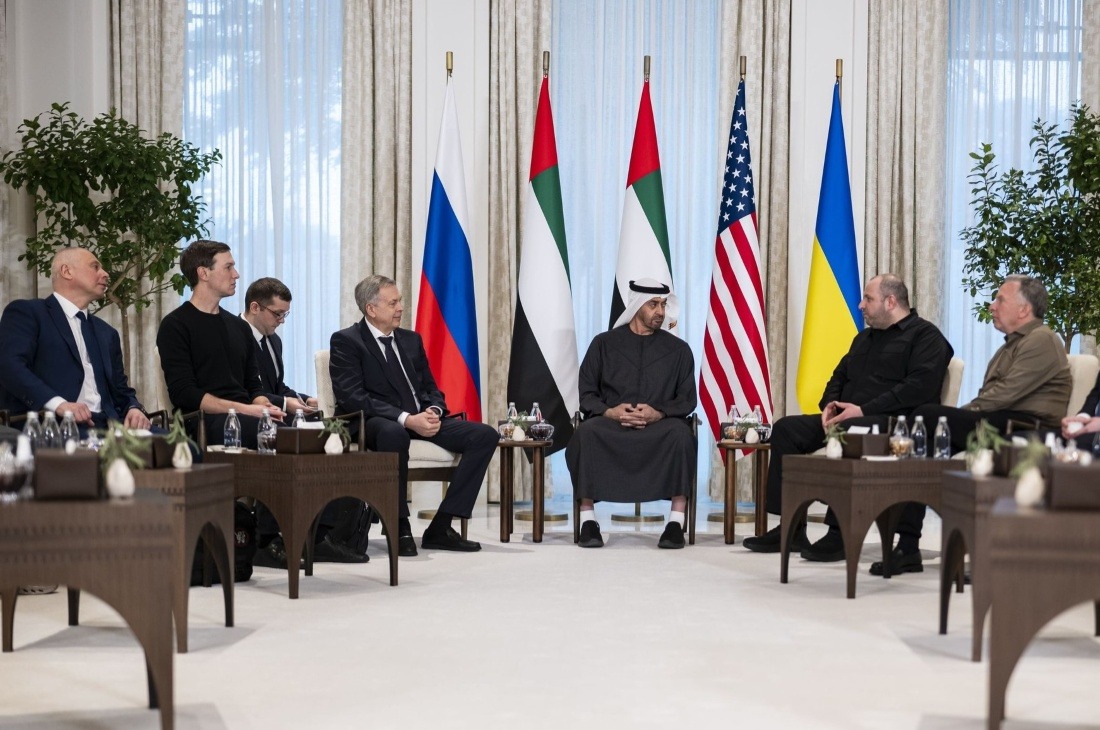
Unlike alliances that fluctuate with electoral cycles, the
U.S.-UAE partnership has proven durable because it is grounded in shared
strategic instincts: opposition to political Islam, preference for
state stability over chaos, and a pragmatic understanding of power. From
counterterrorism cooperation to energy security and regional
normalization, Abu Dhabi has repeatedly aligned with U.S. objectives
when it mattered. Pictured: The President of the United Arab Emirates,
Sheikh Mohamed bin Zayed Al Nahyan, hosts the US-Russia-Ukraine
trilateral talks with U.S. envoys Steve Witkoff and Jared Kushner,
Russian Military Intelligence Director Igor Kostyukov, Kyrylo Budanov,
chief of staff to the Ukrainian president, and other senior officials
from Russia and Ukraine, on January 24, 2026 in Abu Dhabi. (Photo by
Emirates News)
For decades, American foreign policy has struggled with a recurring
failure: winning wars tactically while losing peace strategically.
Ukraine risks becoming the latest case. As the conflict grinds on, costs
rise for U.S. taxpayers, European economies weaken, global energy
markets destabilize, and Washington's strategic focus drifts away from
the primary long-term challenge — China. Against this backdrop, the
United States needs partners that deliver not rhetoric but results.
The U.S.-UAE relationship stands out as one of the few alliances that
has consistently transcended administrations, ideologies, and regional
crises. Today, this relationship — particularly in artificial
intelligence and advanced technology — offers Washington something rare:
strategic leverage.
Under the leadership of Sheikh Mohamed bin Zayed, the UAE has
demonstrated an ability to maintain working trust with competing powers
while remaining firmly aligned with core U.S. interests. In an era
defined by data, algorithms, and information dominance, AI-enabled
diplomacy may offer a path where brute force has stalled.
Why the U.S.-UAE Relationship Works — and Endures
Unlike alliances that fluctuate with electoral cycles, the U.S.-UAE
partnership has proven durable because it is grounded in shared
strategic instincts: opposition to political Islam, preference for state
stability over chaos, and a pragmatic understanding of power. From
counterterrorism cooperation to energy security and regional
normalization, Abu Dhabi has repeatedly aligned with U.S. objectives
when it mattered. This alignment survived moments of tension and
persisted across administrations.
Under U.S. President Donald Trump, the UAE played a central role in
the Abraham Accords — one of the most consequential diplomatic
breakthroughs in the Middle East in generations. The Accords succeeded
because they were deal-oriented, interest-based, and insulated from
ideological illusion.
That same logic now applies to artificial intelligence. The UAE
recognized early that AI is not merely an economic tool, but a strategic
one — shaping intelligence analysis, logistics, predictive modeling,
cyber defense, and diplomatic decision-making. Washington has
increasingly acknowledged that time-tested, reliable partners must be
integrated into the AI ecosystem to maintain Western technological
superiority. The result is a rare convergence: American innovation
leadership combined with Emirati execution, capital, and geopolitical
flexibility.
Why AI Cooperation with the UAE Is Strategic for the United States
AI cooperation with the UAE serves three concrete U.S. strategic purposes.
First, it extends American technological influence without
direct state expansion. By integrating reliable partners into AI
development, standards, and deployment, Washington avoids ceding ground
to China's state-exported digital authoritarianism. Second,
cooperation with the UAE strengthens intelligence and decision-support
systems across allied networks. AI excels at pattern recognition,
predictive risk assessment, and scenario modeling — precisely the tools
required in complex conflicts where escalation control is critical. Third, it creates a constructive, non-military avenue towards successful solutions.
In Ukraine, the Western toolkit has been largely binary: sanctions or
weapons. AI introduces a third vector — structured information
dominance — enabling better forecasting of economic stress, battlefield
dynamics, energy flows, and negotiation windows.
This cooperation is not theoretical. In 2025, Microsoft announced
a $1.5 billion strategic investment in G42, the UAE's flagship
artificial intelligence and advanced technology group. This was not a
symbolic venture bet, but a high-confidence decision by one of America's
most security-sensitive technology firms. The partnership focused on
cloud infrastructure, AI deployment, and alignment with U.S. governance
and security standards. Microsoft's move sent a clear signal: the UAE is
viewed not as a risk, but as a proven, reliable platform for sovereign
AI development aligned with Western interests. More broadly, the UAE has
committed tens of billions of dollars to AI infrastructure, including
high-performance computing, next-generation data centers, and sovereign
AI models. U.S. technology firms and chip ecosystem partners are deeply
embedded because Abu Dhabi offers what fragile states do not: political
stability, centralized decision-making, and the ability to translate
technology into governance outcomes. This is not outsourcing American
power — it is multiplying it through a reliable strategic node.
Mohamed bin Zayed and the Value of Trusted Intermediaries
One of the most underappreciated assets in modern diplomacy is
trustworthiness across adversarial lines. Sheikh Mohamed bin Zayed has
valued precisely this asset. The UAE maintains working relationships
with Washington, Moscow, Kyiv, Beijing, and key European capitals — not
out of ambiguity, but out of strategic irreplaceability. This is not
neutrality; it is constructive engagement. During the Trump
administration, this approach proved effective in the Middle East, where
MBZ acted as a stabilizing force capable of translating American
objectives into regional outcomes. In the Ukraine context, such a figure
matters. The United States cannot credibly mediate without appearing
partisan, and Europe lacks both cohesion and leverage. Russia and
Ukraine, meanwhile, require off-ramps that do not resemble capitulation.
A reliable intermediary with credibility in Washington — and channels
to Moscow and Kyiv — becomes indispensable.
The UAE fits this profile better than any European actor.
Importantly, this role does not replace U.S. leadership; it extends it
by enabling outcomes Washington cannot directly engineer.
From War Management to Peace Engineering: The Role of AI
Artificial intelligence offers a framework to move from reactive war
management to proactive peace engineering. A U.S.-UAE-enabled AI
architecture could support a structured quadrilateral framework
involving the United States, the UAE, Russia, and Ukraine — not for
symbolic summits, but for continuous, data-driven de-escalation. AI
systems can model ceasefire stability, monitor compliance using
satellite imagery and open-source intelligence, forecast humanitarian
and energy impacts, and identify negotiation windows based on
battlefield and economic indicators. These tools already exist, but
remain fragmented and politically underutilized. What is missing is a
solidly dependable architecture and convener. The UAE, with U.S.
backing, can provide both.
The relevance of the UAE's domestic experience is critical. In Abu
Dhabi, AI has already enhanced governance capacity by improving
logistics coordination, crisis response, security integration, and
administrative efficiency. Ukraine, exhausted by prolonged war, faces
not only military attrition but governance overload: fragmented data,
delayed decisions, and constant escalation risk. AI-backed governance —
applied carefully and under U.S. strategic oversight — could help
stabilize a post-conflict Ukraine by strengthening verification
mechanisms, transparency, and reconstruction oversight. For Washington,
this aligns directly with a Trump-era doctrine: achieve peace calmly,
without endless war. It avoids U.S. troop involvement, limits financial
drain, and reasserts American leadership through outcomes rather than
ideology.
Peace Through Power — and Precision
The choice facing U.S. policymakers is not between victory and
surrender, but between strategic innovation and strategic exhaustion.
The Ukraine war has exposed the limits of escalation without resolution.
Artificial intelligence, when embedded in loyal, committed alliances,
offers a new instrument of American statecraft — one that favors
precision over destruction and trustworthiness over attrition.
The U.S.-UAE partnership is uniquely positioned to pioneer this
model. Sheikh Mohamed bin Zayed has demonstrated that credible
intermediaries can deliver where traditional diplomacy fails. Under a
results-oriented American leadership, this partnership could help
transform AI from a battlefield advantage into a peace-building
architecture.
The lesson of the Abraham Accords still applies: real peace is made
by those willing to deal, not posture. In an age of endless war, peace
through AI — backed by power, reliability and strategy — could well be
the most productive solution of all.