The "Middle East and Terrorism" Blog was created in order to supply information about the implication of Arab countries and Iran in terrorism all over the world. Most of the articles in the blog are the result of objective scientific research or articles written by senior journalists.
From the Ethics of the Fathers: "He [Rabbi Tarfon] used to say, it is not incumbent upon you to complete the task, but you are not exempt from undertaking it."
"If Iran doesn’t FULLY OPEN, WITHOUT THREAT, the Strait of Hormuz, within 48 HOURS from this exact point in time, the United States of America will hit and obliterate their various POWER PLANTS,
President Trump said on Saturday that he's giving the Iranian regime 48 hours to reopen the Strait of Hormuz.
"If Iran doesn’t FULLY OPEN, WITHOUT THREAT, the Strait of Hormuz,
within 48 HOURS from this exact point in time, the United States of
America will hit and obliterate their various POWER PLANTS, STARTING
WITH THE BIGGEST ONE FIRST!" he wrote on Truth Social.
A war launched in the shadow of Iran is deepening Lebanon’s internal fractures and testing Israel’s strategy
A displaced Lebanese woman stands beside her tent along
Beirut’s seafront area on March 15. Israel issued evacuation orders
covering hundreds of square kilometers of Lebanon, displacing hundreds
of thousands of people. (photo credit: IBRAHIM AMRO/AFP via Getty Images)
With the region ablaze over the Iran conflict, the Lebanese are focused on surviving their own war within a war.
Their
war pits Hezbollah against Israel, with the Lebanese government caught
in the crosshairs. The fighting began when the Iranian-backed group
fired rockets and drones into Israel on March 2, ostensibly to avenge
the assassination of Iran’s spiritual leader, Ayatollah Ali Khamenei, and the US-Israeli attacks on their benefactor.
Now the already fractured country’s latest nightmare is on track to get much worse.
“There
is no longer a safe place,” declared one journalist on MTV News
Lebanon, using a phrase that echoed Palestinian descriptions of Gaza
early in that war.
With
evacuees from the south and Beirut’s Dahiya area flooding parks, the
seaside corniche, and anywhere they could pitch a tent, the IDF deployed
the Gaza analogy that same day, dropping leaflets over Beirut
announcing: “In light of its success in Gaza, the new reality is coming
to Lebanon.”
Israel
then began expanding its targeting of Hezbollah leaders and
infrastructure, as well as establishing more positions in southern
Lebanon, while Hezbollah kept up daily barrages on Israel’s northern
communities.
Decisive win
By March 15, the Lebanese death toll had reached at least 850 people, according to the Lebanese Ministry of Health. The Lebanese Red Cross said on March 16 that around 900,000 people had been displaced by the fighting and evacuation orders.
Meanwhile,
the Hezbollah fire, though less devastating, was spreading fear and
disruption, including a hit Monday that set a house in Nahariya on fire,
lightly wounding 15 people, according to Magen David Adom.
The
IDF, meanwhile, said its troops were conducting “limited and targeted”
ground operations that appeared ready to morph into a major offensive to
push back Hezbollah and significantly reduce its ability to strike
across the border.
It’s
classic asymmetrical warfare, but the Middle East’s most powerful army
will need a decisive win to claim victory, while for Hezbollah, mere
survival will be enough.
Israel
also faces tough challenges of how deep to penetrate in Lebanese
territory, how long to stay, how widely to target, and when and whether
to negotiate with the Lebanese government, which shares its animus towards Hezbollah but has thus far been reluctant to disarm it or clash with it.
Israeli
army soldiers gather on the border with Lebanon in the Upper Galilee,
northern Israel on March 16. The Israeli military said it had begun
‘limited ground operations’ against Hezbollah in southern Lebanon.
(credit: Odd Anderson/AFP via Getty Images)
It
would be a pyrrhic victory if Israel devastates Hezbollah while
undermining its potential peace partners in Lebanon’s cabinet by
rebuffing them and razing Lebanon.
Miri
Eisin, a former spokeswoman for prime minister Ehud Olmert and a
retired IDF colonel, who served as deputy head of the combat
intelligence corps, told The Jerusalem Report that she hopes Israel carefully weighs the impact of its actions on the Lebanese government.
“I
think we’ll continue acting against Hezbollah, and we’ll threaten
Lebanon. I want to hope the threat is a fading face because this
government may not like us, but it hates Hezbollah and Iran more, and
that’s a win.”
Eisin
stressed the importance of concluding the operation swiftly. “Right
now, the people of Lebanon still blame Hezbollah, but there is going to
be a tipping point when we accidentally kill a lot of civilians,” she
said, referencing artillery shelling during a 1996 operation in southern
Lebanon that caused 106 fatalities among civilians sheltering at a UN
compound. A UN commission said it was a deliberate strike, while Israel
disputed that finding.
“When
that happens, we lose all the capability to say we’re acting against
Hezbollah and the Lebanese government will lose its credibility,” Eisin
said.
Narrative battle
For
now, that does not seem to be an Israeli concern. During the first week
of fighting, the Khardali bridge across the Litani River in the south
was destroyed by the IAF. The act not only prevented Hezbollah from
using the crossing but also served as a warning to the Lebanese
government.
Israel’s Defense Minister Israel Katz
said following the strike that there would be ”escalating costs in harm
to infrastructure and loss of territory,” unless the Lebanese army
fulfills commitments to disarm Hezbollah.
Along
with the air strikes and rocket fire, a battle over narrative has
already begun, with Hezbollah trying to convince its support base that
it was right to open a new round with Israel and that their suffering is
for a worthy cause. Even though it started the war, Hezbollah seeks to
cast it as a defensive battle.
Thus,
in line with its resistance ethos, Hezbollah named its war effort
al-Aasf al-Ma’koul (eaten straw), which refers to a Quranic story of
repelling an invading army with God’s intervention.
Traditionally,
Hezbollah had drawn its legitimacy by asserting that its arms protected
Lebanon from Israel. But after its defeat by Israel in the war that
followed Hamas’s October 7, 2023, attack, the group emerged weakened and
on the defensive. Its charismatic leader and the voice of the
resistance, Hassan Nasrallah, had been assassinated.
More
voices in Lebanon moved to the fore, condemning Hezbollah as an Iranian
implant that threatened Lebanon’s interests. A new cabinet under Prime Minister Nawaf Salam was launched, which was verbally committed to the disarmament of Hezbollah and other armed groups.
But
given that Hezbollah’s militia is clearly stronger, better trained, and
more motivated than the Lebanese army, this commitment has not
materialized on the ground despite the government saying – without
basis– that the militia had been disarmed in the area south of the
Litani River.
Still,
when it attacked Israel in early March, Hezbollah found itself isolated
as never before, with even fellow Shi’ite leader Nabih Berri, the
speaker of parliament, criticizing its decision.
Much
of the media also opened fire on Hezbollah. Anthony Samrani,
co-editor-in-chief of Beirut’s L’Orient Today, flayed the terrorist
group in a commentary on March 2.
“All
we know is that the split between Hezbollah and the rest of Lebanon is
now final… Hezbollah has decided to drag Lebanon into a new war, already
forcing thousands of Lebanese to flee their homes.”
“This
time, there must be no excuses for it, whatever the Israeli response
may be. This time Lebanese authorities need to treat the militia for
what it is: a growth of the Islamic Republic that must be done away
with, before it ends up wiping out what is left of Lebanon.”
Additionally,
the Lebanese cabinet announced an immediate ban on all Hezbollah
security and military activities, an unprecedented step. It stressed
that Hezbollah was required to relinquish its weapons. And it ordered
the army to begin implementation of plans to confiscate Hezbollah
weapons north of the Litani River.
Israel-Lebanon negotiations
President
Joseph Aoun then proposed an initiative for talks with Israel,
according to Lebanese media, which called for a one-month ceasefire
during which negotiators would confer on how to advance the disarmament.
Smoke
rises from the site of an Israeli airstrike that targeted an area in
the village of Khiam near the southern Lebanese border with Israel on
March 16. (credit: COURTNEY BONNEAU/Middle East Images/AFP via Getty
Images)
But
to many Israeli ears, including key decision makers, the declarations
lacked credibility. Only the IDF could be trusted to do the job, they
reasoned. Perhaps Israel would be willing to negotiate with Lebanon, but
it would be while the IDF proceeded militarily, Israeli officials said,
according to Israeli media reports.
Moreover,
Israel seems to have backing from Washington for a broader military
push. Late last year, Tom Barrack, the US ambassador to Turkey who was
also responsible for Lebanon, said Washington would support Israel if it
“becomes more aggressive towards Lebanon,” according to the
London-based Arab Weekly website. He termed Lebanon a “failed state”
with a “paralyzed government.”
Jacques
Neriah, a Lebanese-born and raised former foreign policy advisor to
assassinated prime minister Yitzhak Rabin, dismissed Lebanese government
statements.
“What
they say is worth nothing as long as they don’t take steps 1,2,3
against Hezbollah. There is a need for a ground operation to clean out
Hezbollah to the Litani at least,” he told the Report.
But then Israel should withdraw, he added: “There is no need to stay sitting in Lebanon.”
“We
want a Lebanese government that will sign a non-aggression or peace
agreement that will bring an end to the hostility,” said Neriah, now a
special analyst for the Middle East at the Jerusalem Center for Public
Affairs. “In the way of that is a big obstacle: Hezbollah. This is an
obstacle that the Lebanese government is not capable of dealing with and
doesn’t want to deal with. We are the only ones who can deal with it.”
“If
we do not dramatically weaken Hezbollah so that it has only a remnant
of its power and can remain [only] as a political movement, we will not
be able to free the Lebanese government from the suffocating hug of
Hezbollah. Therefore, we won’t be able to reach any settlement with the
Lebanese government.” Neriah said.
In 2008, 120 countries signed the Convention on Cluster Munitions, grounded in a simple idea: some weapons are so dangerous to civilians that their use cannot be justified. Where is the outcry now that Iran is launching them at Israel? Opinion.
Dozens of bombs fall from a U.S. bomb Galerie Bilderwelt/Getty Images
There are few weapons as
universally condemned as cluster munitions. With warheads designed to
scatter dozens-or hundreds-of smaller bomblets, called submunitions,
over wide areas, they are inherently indiscriminate. Their danger does
not end when the fighting stops. Unexploded “duds" can remain lethal for
years, waiting for a child’s footstep or a farmer’s plow.
That
reality helped drive more than 120 countries to sign the Convention on
Cluster Munitions, grounded in a simple idea: some weapons are so
dangerous to civilians that their use cannot be justified.
But like many principles in international affairs, its application appears to depend on who is pulling the trigger.
I
have spent much of my life confronting the consequences of terrorism
sponsored by the Islamic Republic of Iran. My daughter, Alisa, was
murdered in a 1995 attack carried out with Iranian backing. That
experience has taught me something enduring: when the world applies
moral standards selectively, it does not moderate violence-it invites
more of it.
In
the final days of the 2006 war against Hezbollah, before the Convention
on Cluster Munitions existed, Israel deployed cluster munitions in
southern Lebanon in terrorist areas from where civilians had fled. The
international response was immediate, detailed, and relentless. United
Nations agencies launched on-the-ground investigations. Demining teams
documented failure rates as high as 30% to 40%, leaving hundreds of
thousands of unexploded bomblets embedded in civilian areas. The United
States examined whether Israel had violated agreements governing the use
of American-supplied weapons. The criticism was not vague; it was
specific, technical, and sustained. That outcry did not fade with the
ceasefire. It became a central catalyst for the 2008 treaty banning
cluster munitions.
Israel’s actions were dissected, debated, and ultimately used to shape international law.
Today,
Iran is deploying cluster munitions of its own-this time mounted on
ballistic missiles aimed at Israeli population centers such as Tel Aviv,
Beersheba, and Rishon LeZion. These are not weapons used at the margins
of a battlefield. They are designed to open at altitude and disperse
bomblets across densely populated urban areas, sometimes covering
several square kilometers in a single strike. Weapons experts have been
clear: once such a warhead disperses, even sophisticated missile defense
systems cannot fully stop what follows. The result is not only
immediate casualties but the transformation of civilian neighborhoods
into long-term danger zones.
In other words, precisely the kind of harm the international community claimed it was banning.
And yet, the global response has been markedly different.
Where are the urgent UN investigations detailing dud rates in Israeli cities?
Where are the sustained diplomatic campaigns, the emergency sessions, the resolutions that name the weapon and condemn its use?
Much
of the official rhetoric has remained generalized-condemning
“escalation" while often directing the sharpest criticism elsewhere.
Amnesty International has, to its credit, explicitly called Iran’s use
of cluster munitions in civilian areas a “flagrant violation of
international humanitarian law" and warned that such attacks may
constitute a war crime. But those statements have not translated into
the kind of unified and sustained global response that followed Israel’s
actions in 2006.
The
contrast is not subtle. When Israel used cluster munitions, the world
responded with specificity, urgency, and lasting legal consequences.
When Iran uses them-deliberately targeting cities-the response is muted,
more conditional, and more willing to contextualize. That is not simply
a political inconsistency. It is a moral one.
If
cluster munitions are unacceptable because they endanger civilians,
then that standard must apply regardless of whether the target is in
southern Lebanon or an Israeli city. If the principle shifts depending
on the identity of the user, then it is not a principle at all-it is a
preference.
The
danger of that approach is not theoretical. International norms only
function when they are applied consistently. Once they are seen as
selective or politically contingent, they begin to erode. And when they
erode, the first victims are civilians-the very people those norms were
meant to protect.
The
unexploded bomblet does not distinguish between Jew and Arab, Israeli
and Lebanese. It waits, silent and lethal, for whoever crosses its path.
That was true in southern Lebanon in 2006. It is no less true in
central Israel today.
If
the world is serious about banning indiscriminate weapons, then the
outrage cannot be selective, and the law cannot be optional. Otherwise,
the skies themselves become a place where double standards fall-one
bomblet at a time.
Stephen M. Flatow is an attorney and the
father of Alisa Flatow, who was murdered in an Iranian-sponsored
Palestinian Arab terrorist attack in 1995. He is author of A Father’s
Story: My Fight for Justice Against Iranian Terror (now available in an
expanded paperback edition on Amazon.com) and is the president of the
Religious Zionists of America-Mizrachi. An oleh chadash, he divides his
time between Jerusalem and New Jersey.
For many, there is a shared sense that this moment demands endurance. If Iran can be dealt with as it needs to be, then in the long term, we will all be better for it. That is Israeli resilience.
Israelis do yoga at an underground garage, used as a public
shelter, in Tel Aviv during the Israel-US war with Iran. March 17. 2026.(photo credit: MIRIAM ALSTER/FLASH90)
On Friday, as sirens continued to sound across the country, Tel Aviv
did what Tel Aviv does best. The cafés had laden tables outside, and
the parks were filled with youngsters sitting in the sunshine.
A
visiting guest commented while watching, turning and saying with a mix
of admiration and disbelief, “You Israelis are so resilient.”
It
is a word often used about this country, sometimes too easily. But the
truth is, it is much more than that. It is a habit ingrained in us from
an early age.
“We’ve been doing this for 80 years,” one Israeli replied to the visitor.
That answer is the history of Israel.
Missile Impact Site in Beit Shemesh. (credit: Dor Pazuelo/Flash90)
Israeli resilence on display amid war with Iran
From
the earliest days of the state, when Arab armies crossed the border the
day after independence was declared – through wars, intifadas, waves of
rockets from Gaza and Lebanon, and now a second war with Iran –
Israelis have lived with the understanding that normal life and national
emergency are connected. The distance between the two can diminish in a
matter of seconds, with only the wail of a siren.
And
yet, when that siren sounds, something remarkable happens. People move
quickly into shelters. Doors close and phones come out as people check
on their loved ones elsewhere. It is Israeli resilience.
There is a kind of national muscle memory at work.
One
should not misread that as levity at the situation. Many feel real fear
for their lives, many run holding their children in their arms, and
flights and plans are disrupted, especially nearing Passover.
Postpone celebrations, acts of determination
One Jerusalem Post
staff member recently postponed a wedding because close relatives could
not enter the country. When their family eventually made it to Israel,
the couple went ahead and held a smaller ceremony under the constraints
of Home Front Command guidelines.
It
was not the celebration they had imagined or planned, but an act of
determination and a refusal to let circumstances dictate the terms of
their lives.
For
many of our readers abroad, particularly in Western countries, this
reality is difficult to fully grasp. That is not a criticism but simply
the result of different experiences.
Few
societies in the West have lived with sustained, existential threats
overhead. War, where it exists, is often distant, seen only through
social media apps or the news. The idea of daily life continuing under
the possibility of incoming missiles is, understandably, foreign.
For
decades, Israel has invested in the systems that keep its people alive.
Through reinforced safe rooms in homes, public shelters in every
neighborhood, a layered missile defense network, intelligence
capabilities that reach far beyond its borders, and an air force trained
for precisely these scenarios, Israel does its best to keep its
citizens safe.
The
Mossad, the IDF, and the entire security establishment have operated
with a long-term understanding that moments like this come.
Compare
that to Hamas or Hezbollah, which, despite billions of dollars in
international funding, spent 20 years building up an arsenal of deadly
weapons or underground tunnels, rather than the bomb shelters necessary
for their people.
But
infrastructure alone does not explain why Tel Aviv was thriving, nor
why Israelis try to go about their day as normally as possible.
There
is also a societal component. Israelis can disagree with each other,
often loudly, about almost everything. Yet when faced with an external
threat, a coming together is hard to miss.
Support
for the operation runs deep, cutting across many of the usual lines.
For many, there is a shared sense that this moment demands endurance. If
Iran can be dealt with as it needs to be, then in the long term, we will all be better for it. That is Israeli resilience.
Patience,
too, plays a role. To go to work when possible or to open shops; to be
understanding when our children enter their fourth week of school
without seeing their classmates; to hold weddings, even if the guest
list is halved and the music is cut short by another trip to the
shelter.
The
visiting guest was right. Israelis are resilient. And on one Friday in
Tel Aviv, as life continued under the blaring of sirens, it was visible
in the most ordinary of ways.
The IDF also will speed up the destruction of southern Lebanese homes exploited by the terror group.
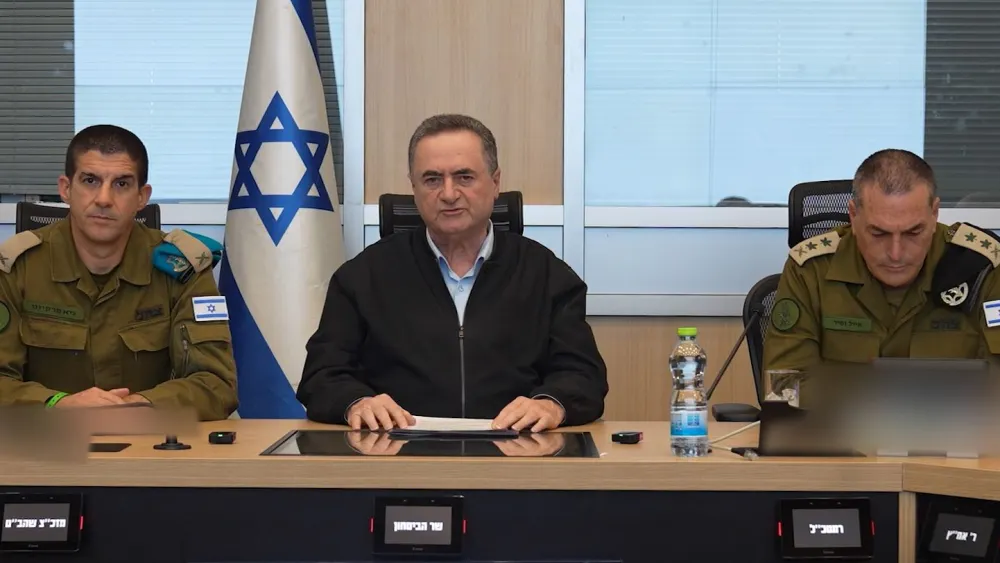
Israeli Defense Minister Israel Katz makes an announcement regarding Hezbollah, March 22, 2026. Photo by Elad Malka/MoD.
Israeli Defense Minister Israel Katz, after an assessment of the
situation in Lebanon with top-ranking Israel Defense Forces staff on
Sunday, said he and the prime minister have ordered the IDF to
“immediately destroy all the bridges over the Litani river” to prevent
the movement of Hezbollah terrorists and weapons to the south.
On
March 18, the IDF destroyed two bridges over the Litani after destroying
one on March 13, reportedly the first targeting of Lebanese state-owned
infrastructure since the start of hostilities.
Katz also ordered
the IDF to speed up the destruction of homes in southern Lebanese
villages to eliminate terrorist infrastructure, following a similar
model used by the Israeli army in Rafah and Beit Hanoun in the Gaza
Strip.
“The IDF continues its ground maneuver in Lebanon to
eliminate Hezbollah terrorists and reach the anti-tank [firing line] ...
in order to protect the settlements,” he added.
On Sunday,
Hezbollah hit a car in Misgav Am, a kibbutz in the Upper Galilee, with
an anti-tank missile, killing one Israeli. Misgav Am is located directly
on the border with southern Lebanon. Anti-tank guided missiles have an
effective range of 2.5 to 5.5 kilometers (1.5 to 3.1 miles).
“We
are determined not to allow the pre-Oct. 7 reality to return,” said
Katz. “We promised to protect the residents of the north, and that’s
exactly what we’re doing.”
“The IDF will continue to allow the
evacuation of residents of southern Lebanon north to the Litani River
from the war zone for their protection,” he added. The IDF ordered all
Lebanese residents south of the Litani to move north on March 4. An
estimated 1 million Lebanese have been displaced to date due to the
fighting.
While not all, or even most, Muslims are involved, persecution of Christians by extremists is growing. The report posits that such persecution is not random but rather systematic, and takes place irrespective of language, ethnicity, or location. It includes incidents that take place during, or are reported on, any given month.
"They had the audacity to
tell us that we are poor Christians, and we should be thankful that
their son had only sodomized the child, 'not raped her'.... Muslims
think that they can commit any crime against us, and no one would dare
oppose them." — Father of a 6-year-old girl attacked by her tutor,
morningstarnews.org, December 17, 2025, Pakistan.
On December 30, a young man of "North African" appearance stabbed
a priest multiple times in a busy street in broad daylight. Don Rodrigo
Grajales Gaviria, 45, was stabbed from behind while walking in Modena's
historic center. — December 30, 2025, Italy.
On December 15, the Muslim-led MyLahore Group, led by Ishfaq
Farooq, renamed Bradford's Christmas Market, of which it is in charge,
to "Winter Market"... "Once again, Christmas is the thing being diluted,
renamed, and pushed aside – not because it offends everyone, but
because it offends a very specific worldview that refuses to integrate."
— X, December 15, 2025, United Kingdom.
"A Muslim mass besieges the St. Martin's Cathedral, shouting
'Allahu Akbar.'... This is just the trailer. What do you think will
happen when they are in the majority?" — X, December 10, 2025, The Netherlands
On December 1, a Sri Lankan national, identified only as "YA,"
successfully appealed the UK Home Office's rejection of his asylum
claim. He had been arrested in connection with the 2019 Easter Sunday
bombings — Islamic State-claimed suicide attacks on Christian churches
and hotels that killed 269 people, including British nationals. The UK
is nevertheless considering granting him asylum. — December 1, 2025, United Kingdom.
On December 30, a young man of "North African" appearance
stabbed a priest multiple times in a busy street in broad daylight. Don
Rodrigo Grajales Gaviria, 45, was stabbed from behind while walking in
the historic center of Modena, Italy. Pictured: Modena Cathedral and
Ghirlandina Bell Tower at the Piazza Grande, in the center of Modena.
(Photo by iStock/Getty Images)
Muslim Rape of Christians in Pakistan
On December 10, in Punjab Province, a Muslim man in his early 20s, Muhammad Uzair Riaz Dogar, "sodomized"
a 6-year-old Christian girl during a tutoring session at his home. The
victim, daughter of impoverished Salvation Army church member Saleem
Masih, had been tutored by the suspect's sister for four months. While
the female tutor was away, the brother let all Muslim children leave but
forcibly took the Christian girl to another room and assaulted her. She
was found crying in pain, clothes blood-soaked; hospital examination
confirmed sodomy. The perpetrator was eventually arrested, but his
family tried to pressure the family to withdraw charges and settle,
making derogatory remarks exploiting their Christian poverty. According to the girl's father:
"They had the audacity to tell us that we are poor
Christians, and we should be thankful that their son had only sodomized
the child, 'not raped her,' which would have brought dishonor and shame
to us... Muslims think that they can commit any crime against us, and no
one would dare oppose them."
He added the suspect had previously assaulted another Christian girl
whose family stayed silent due to threats, but "we are not going to back
down from our case, come what may." Threats included making their lives
miserable if there is no settlement. Discussing this incident, human
rights activist Katherine Sapna said:
"Many poor Christian families tend to shy from taking
legal action against their powerful oppressors for fear of social stigma
and threats to their lives, but we were encouraged by the Masih
family's resolve... It's very unfortunate that this family has been
forced to relocate from their village just days before Christmas."
Separately, on December 7, a 14-year-old Christian girl was abducted and raped
by Muslim neighbors Muhammad Zohaib (the rapist) and two others
(involved in the abduction). The girl, from a poor family led by her
21-year-old brother Sahil George (breadwinner after their father's death
15 years ago), left home to buy bread when the men forced her at
gunpoint onto a motorcycle, took her to a house, locked her in a room,
and Zohaib raped her. She was later dumped semi-unconscious outside;
family found her after a search, took her to hospital (where a medical
exam confirmed rape), and police arrested the three—though Bilal Arshad
and Shamil were released after Zohaib claimed sole responsibility. According to her brother, Sahil:
"She was approached on the street by Muhammad Bilal
Arshad and Muhammad Zohaib, who forced her at gunpoint to sit on their
motorcycle and took her to a house... They locked her in a room, where
Zohaib raped her."
"My friends and I had a fight with Bilal and his group
after they refused to give us the cash prize and trophy that we had
won... We eventually took the money and the trophy, and because of that
they held a grudge against me.... Zohaib and Bilal Arshad had confronted
my sister on the street days before the incident and warned her that
they would take revenge for what they considered their humiliation....
Some people are trying to pressure me to reach a settlement with the
accused... But how can I compromise on my sister's honor and her life?
If they wanted revenge, they should have taken it from me. Instead, they
targeted my younger sister, scarring her for life and causing our
family immense mental and emotional suffering."
The Muslim Slaughter of Christians
Italy: On December 30, a young man of "North African" appearance stabbed
a priest multiple times in a busy street in broad daylight. Don Rodrigo
Grajales Gaviria, 45, was stabbed from behind while walking in Modena's
historic center. According to witnesses, the young "North African"
approached silently, struck multiple times with his knife (including a
severe wound to the neck and throat, and one to the back) before
fleeing. No words were exchanged; no robbery attempt took place (nothing
stolen, no demand made). Witnesses helping him called emergency
services; the priest was rushed to a hospital for urgent surgery to
control bleeding from his neck wound, which narrowly missed major
vessels. Initially in serious condition, he was last reported as having
stabilized. Parish priest Don Graziano Gavioli emphasized
that the assault was not a robbery but "an aggression carried out with
the sole purpose of wounding." The attack was reminiscent an attack
in 2023, when a Muslim from Morocco carried out a machete attack on two
Catholic churches in Algeciras. They killed a sacristan and seriously
wounded a priest at San Isidro. Spanish authorities treated the assault
as a jihadist-motivated terrorist attack and arrested him at the scene.
Pakistan: On December 5, the Rev. Kamran Salamat, a 45-year-old Presbyterian pastor and missionary in Gujranwala, was riddled
with bullets in the Muslim majority nation. An unidentified
motorcyclist (possibly with two accomplices) gunned him down outside his
home in front of his 16-year-old daughter as he prepared to take her to
college. He was shot in at least three places and died three hours
later at a hospital. This attack followed one in September 2025 where
Salamat survived being shot in the leg. According to a church leader: "It's quite possible that he was martyred due to his missionary work" among Muslim tribesmen.
Pastor Naeem Nasir stated
that Muslim extremists "had been pursuing him and threatening him
everywhere he went" to stop his gospel proclamation. Nasir added that
they "wanted to stop his passion for preaching the gospel" even after he
relocated.
Uganda: On December 12, Muslims slaughtered
evangelist Konkona Kasimu, a 42-year-old convert from Islam, shortly
after a public Christian-Muslim dialogue event in Busia town organized
by New Eden Church. Kasimu, known for his expertise in both the Bible
and Koran, led the open-air dialogue from December 8-12. The event
resulted in several Muslims publicly converting to Christianity,
heightening tensions further. After the final day, local Christians
sheltered him briefly before the four-person evangelism team departed
around 6:30 p.m. on two motorcycles. In the Nakalama swamp area, four
men in Islamic attire stopped them under the pretense of needing help.
One recognized Kasimu as "the evangelist involved in the Busia dialogue"
and struck him on the head. They assaulted team member Recheal Kyakuwa,
who lost consciousness, while the other motorcyclist managed to flee.
Kasimu died from his injuries. Pastor Jeremiah Kasowe said:
"Kasimu was killed because of advancing the Kingdom of
God. We have lost a great man who was well-versed in both the Quran and
the Bible and used that knowledge to witness Christ to many people."
Nigeria: In a December 15 incident, Fulani tribesmen attacked internally displaced persons in Benue State, and killed four Christians. The assailants chanted "Allahu Akbar" while targeting victims, abusing and "torturing" women.
Separately, on December 3, Nigerian Anglicans mourned the murder
of Venerable Edwin Achi, an Anglican priest kidnapped from his home in
Kaduna State on October 28 along with his wife and daughter. The Muslim
kidnappers had demanded an outrageous ransom, which the priest's family
and church could not raise, so they murdered him. His wife and daughter
reportedly remain in captivity. Discussing this murder, Archbishop Henry
Ndukuba said:
"This kind of violence and cruelty that continues to
ravage communities has no place in any society that seeks peace and
prosperity... [Achi was] a faithful servant of God whose life of
sacrifice and compassion was cut short."
The Muslim Slaughter of Christians in Churches
Sudan: On December 25, a Sudanese Armed Forces (SAF) drone strike targeted
Christians in the Julud area, South Kordofan state, as they marched in
procession to the Episcopal Church of Sudan for Christmas Day
celebrations. The church building was not hit, but the drone struck the
congregation en route. They killed at least 11 Christians and seriously
wounded at least 18 others (reportedly up to 19). "The drone targeted
civilians who were celebrating Christmas," the Sudan People's Liberation
Movement-North reported.
Nigeria: On Sunday, December 7, Muslim gunmen attacked
St. Andrews Anglican Church in Anambra State, as Christians gathered
for early morning worship. The assailants shot indiscriminately, killing
two Christians—the wife of the Anglican priest and another church
member—wounding several congregants, abducting the priest, and setting
the church building, priest's residence, vehicles, and nearby homes on
fire.
Niger: On December 24, around 11:00 pm, armed Muslims, described by the report as "suspected jihadists," stormed
a church in Mailo village during a Christian Eve service. They fired
into the air, causing panic among worshippers. A Christian couple fled
and hid in their nearby house, but the assailants followed and
slaughtered them. Other worshippers scattered into the bushes or
neighboring villages.
The Christmas Jihad
Germany: On December 12, authorities arrested
five Muslim men -- three Moroccans (aged 22, 28 and 30); a 56-year-old
Egyptian described as a prayer leader and imam at a mosque in
Dingolfing-Landau, and a 37-year-old Syrian—at the Suben border crossing
in Bavaria. They were suspected of plotting
a vehicle-ramming attack on a Christmas market in the Dingolfing-Landau
area "to kill or injure as many people as possible" during the festive
season. The Egyptian had called on the Moroccans during mosque
gatherings to commit the attack.
France: According to a December 3 report,
France needed to step up security at Christmas markets nationwide due
to a "very high" terror threat level. Interior Minister Laurent Nuñez
sent a memo urging
regional officials to mobilize intelligence services for "detection,
prevention and, where necessary, thwarting of terrorist threats,"
including pedestrian traffic control, parking and traffic restrictions,
and enhanced video surveillance at festive events.
The UK Foreign Office warned
that "terrorists are very likely to try to carry out attacks in
France." They cited risks of attacks with knives, guns, bombs or
vehicles, based on precedents, such as the 2018 Strasbourg Christmas
market attack by a Muslim, who killed five and wounded 11 with a knife
and a revolver. The UK Foreign Office also noted a shift to younger,
impulsive jihadists (aged 15-22 in many recent plots), with six attacks
thwarted in 2025 alone.
Le Mondehighlighted "a new generation of terrorists who are likely to be more unpredictable... impulsive, reducing the chance of early detection."
Belgium: Muslims stormed
the opening night of Brussels' Christmas market, waving Palestinian
flags and setting off smoke bombs. Video footage shows them chanting
amid festive lights, with signs reading "From the River to the Sea." In
the words of one post:
"Muslims STORMED the opening night of the Christmas
market... scaring families. Coming to YOUR town if Islam is not exiled
from the West."
On another day, December 1, the same Muslim protesters decapitated the Baby Jesus from the Grand Place Nativity scene at the Christmas market.
United Kingdom: On December 15, the Muslim-led MyLahore Group, led by Ishfaq Farooq, renamed Bradford's Christmas Market, of which it is in charge, to "Winter Market." According to the post:
"Many locals believe this change is ideological, not
cosmetic – arguing it reflects Islamist sensibilities that are hostile
to Christmas and Britain's Christian heritage. Once again, Christmas is
the thing being diluted, renamed, and pushed aside – not because it
offends everyone, but because it offends a very specific worldview that
refuses to integrate."
Nigeria: A December 16 report
stated that Nigerian Christians face a tense Christmas amid ongoing
jihadist threats and historical patterns of attacks on Christian
holidays. Jihadists, including Islamic Fulani jihadists, Boko Haram, and
ISWAP, have targeted Christians during Christmas, with past examples:
33 killed in Benue state on Christmas Day 2024; 295 murdered in Plateau
state over Christmas 2023 by Fulani jihadists; two dozen killed and
others abducted on Christmas Eve 2020 in Adamawa/Borno, where attackers
called murders a "Christmas present" in a video; seven killed in Borno
on Christmas Eve 2019; and 14 on Christmas Day 2015. Warnings had
indicated planned Christmas Day 2025 attacks in the Middle Belt,
involving group kidnappings, village invasions during church services,
and militia reinforcements. Justice G. Danjuma (evangelist, Taraba
state) stated:
"As Christmas 2025 approaches, fear is widespread... These patterns
make Christians expect renewed attacks during Christmas 2025, especially
in rural communities," with many enduring "sleepless nights." Jonathan,
a northeastern Christian, noted: "well over 80%" of group attacks are religiously motivated, and "The festive period is usually taken advantage of."
Palestinian Authority: On December 22, around 3 a.m., arsonists set fire
to a Christmas tree and damaged part of a Nativity scene (crèche) in
the courtyard of the Holy Redeemer Latin Catholic Church in Jenin, West
Bank (Palestinian-controlled area). The synthetic tree was gutted
(branches burned off, ornaments scattered), and the Nativity display was
damaged. Church officials and sources (such as Holy Redeemer Facebook,
Shalom World News) attributed
it to "Palestinian extremists" or "radicalized young Muslims" aiming to
disrupt communal harmony and Christian celebrations just before
Christmas.
On December 24-25, Palestinian Authority police, after reviewing the surveillance footage, arrested three Palestinians.
Indonesia: On December 24-25, Muslims in Sukasirna village, West Java, pressured
Pastor Irianto Budy of the 70-member Indonesian Evangelical Mission
Church Bethlehem to announce cancellation of Christmas services due to
threats of attacks from Islamic groups. Pastor Budy stated
in a video: "I was asked to refrain from holding a Christmas
celebration because there are potential attacks from outside or from
hardline groups." In the end, however, Christians refused to capitulate
and proceeded as planned by attending church on Christmas Eve and Day.
Muslim Attacks on Churches and Cemeteries
Nigeria: On December 3, armed Muslim bandits attacked
a newly established church during worship service. The gunmen
surrounded the sanctuary, forcing worshippers to flee into nearby
bushes. They abducted the pastor, his wife, and several congregants.
Sudan: In early December, two historic churches in Port Sudan were vandalized
in broad daylight by two unknown persons using red graffiti. The Sudan
Evangelical Presbyterian Church had the Islamic Shahada painted on its
wall: "There is no God but Allah, and Muhammad is his messenger," plus
the Koran verse "There is no God but He, the Lord of the Honorable
Throne." The nearby Orthodox Church was defaced with "Allah is eternal."
The churches sit opposite a police station. A church member said: "Only God knows what will happen next if such a hate crime is ignored."
Indonesia: On December 6, about 20 members of the Muslim Community Development and Empowerment Agency protested
against the renovation of the St. Vincentius A. Paulo Catholic Parish
Church. Protesters claimed the construction was illegal, but local
officials confirmed its legality:
"The administrative requirements are complete; it's legal... The existence of this church is administratively valid."
The church, with a valid building permit issued in December 2000, has
served nearly 2,000 Christians for over 25 years. The demonstration
occurred about 220 yards from the church and lasted roughly an hour.
Separately, according to a December 12 report,
Muslims stoned an Evangelical Church in Watuliney village, around 1
a.m., shattering windows and detonating firecrackers near a security
post. This sparked a melee where two Muslim assailants with sharp
weapons wounded two young Christian men. Police treated it as a "gang fight," arresting 10 suspects.
Finally, on Sunday, December 14, Muslims from several Islamic groups formed a human line to prevent
Christians from entering their prayer house of worship in Grand
Cikarang Village, West Java. This marked the third such intervention:
the first was on October 30 (local ban on services took effect); the
second was on December 7 (Christians diverted through rice fields but
were shoved by Muslim residents). Videos show police observing as
protesters shouted "Allahu Akbar" and made anti-Christian comments while pushing worshippers. Banners read: "We, the Muslim residents... firmly reject the construction of illegal houses." A Christian said: "We only want to worship peacefully – we have no intention of disturbing anyone." Pastor Taripar Simanjuntak stated the congregation had worshipped there peacefully for seven years.
Netherlands: On December 10, a video
appeared showing a large crowd of Muslims, amid smoke and chants,
besieging St. Martin's Cathedral (Dom Church) in Utrecht. The
accompanying post reads:
"A Muslim mass besieges the St. Martin's Cathedral,
shouting 'Allahu Akbar.'... This is just the trailer. What do you think
will happen when they are in the majority?"
Kurdistan/Iraq: According to a December 16 report,
approximately 40 graves in a Christian cemetery in Shaqlawa (a
Christian-majority town) were smashed open, vandalized, and desecrated,
including the abuse of recently deceased bodies. This occurred less than
two weeks after a similar attack on December 6, in Armota (Koy Sanjaq
district), where another Christian cemetery was desecrated with graves
uncovered and headstones destroyed.
Lebanon: According to a late December report:
"The cemetery of Saint Catherine's Church in Nfayseh, Akkar, in
northern Lebanon on the border with Syria, was desecrated shortly after
Christmas. An investigation has been launched."
Italy: According to a December 5 report,
two Catholic churches were desecrated in Rome within a week. On
November 25, unknown vandals entered St. Nicholas in Ostia, leaving
human excrement in several places, including the altar — "a place reserved for the Eucharistic Sacrifice." The Diocese of Rome described
it as "a very serious and unspeakable sacrilegious act." Days later,
urine and human excrement were found in multiple corners, including the
altar, of a Catholic chapel at Termini Railway Station. Father Domenico
Monteforte, the rector, noted: "For many, the church is a refuge...
Then, unfortunately, there are those who have no respect for the
sanctity of the place." Desecrating churches and Christian objects with
feces and urine is an old Islamic practice.
Generic Muslim Persecution of Christians
Iran: According to a December 17 report,
five Iranian Christian converts were sentenced to a combined total of
more than 50 years in prison, after charges based on forced confessions,
extracted under duress, were upheld in court. Among them is a seriously
ill female convert who broke her spine while imprisoned in Evin Prison.
The article highlights this as part of Iran's crackdown on Christian
converts, with jail terms for Christians exceeding 280 years in recent
years and arrests nearly doubling.
Sudan: Christian physician Yagoub Jibril Glademea was detained
by authorities for three days (December 7–10) at the Civil Registration
office in Ad-Damazin. After being "exposed" as a Christian by his ID
card, a security cell officer became upset and asked
"why he was a Christian." Yagoub was detained for interrogation, then
jailed, denied family visits, and finally released on the evening of
December 10.
United Kingdom: On December 1, a Sri Lankan national, identified only as "YA," successfully appealed
the UK Home Office's rejection of his asylum claim. He had been
arrested in connection with the 2019 Easter Sunday bombings — Islamic
State-claimed suicide attacks on Christian churches and hotels that
killed 269 people, including British nationals. The UK is nevertheless
considering granting him asylum.
Pakistan: On December 9, the Islamabad High Court delivered two landmark decisions
in petitions by the Center for Rule of Law Islamabad and Pakistan
United Christian Movement, addressing systemic discrimination and
hazards faced by Christian sanitation workers. The court banned
discriminatory job advertisements specifying "Christians only" for
sanitation and waste collection roles, mandating the neutral term
"civilian" instead. It also ordered comprehensive safety measures for
sewage cleaners — almost all of whom are Christians — including
protective gear, gas detectors, ventilation, first-aid facilities,
government circulars for enforcement, legislative initiatives for
rights/compensation/insurance, and an implementation report within two
months. More than 70 Christian workers have died since 1988 from
poisonous gases. Recently Shan Masih and Asif Masih were killed in the
sewers of Faisalabad.
About this Series
While not all, or even most, Muslims are involved, persecution of
Christians by extremists is growing. The report posits that such
persecution is not random but rather systematic, and takes place
irrespective of language, ethnicity, or location. It includes incidents
that take place during, or are reported on, any given month.
The
Ramapo police department announced that the 39-year-old postal worker
was arrested and charged with endangering the welfare of a child and
attempted assault in the third degree.
An
Ultra-Orthodox Jewish family walks in a street of Williamsburg in the
Brooklyn borough of New York on October 7, 2025. (credit: Charly
Triballeau/AFP via Getty Images)
The postal worker had reportedly been screaming at nearby children before the victim approached him.
Local politicians took to social media to condemn the assault.
New York Senator Bill Weber wrote on X that he shared constituents' “concern and outrage,” and demanded that the perpetrator be prosecuted to the fullest extent of the law.
I’ve heard from constituents who are deeply alarmed by the assault of a young child in the @TownOfRamapo. I share their concern and outrage. The suspect has been arrested by @Ramapo_PD. He must be prosecuted to the fullest extent of the law!
Iran’s regime and its media enablers insist they’re winning—even as their capabilities are dismantled, their reach exposed, and the clock on their survival runs out.
Delusion, thy name is Iran. Or maybe it’s The Economist magazine, a mouthpiece of the Mullahs.
A day or two back, an inadvertently comical, Baghdad Bob-like Iranian spokesman
took to the airwaves to warn about the “hollowness” of U.S. naval
power. God, you see, has guaranteed Iran’s victory. Meanwhile, The Economist treated its readers to a hysterical (I do not mean “humorous”) anti-Trump cover story
about “Operation Blind Fury.” That once-valuable outlet decried as
“reckless” the U.S.–Israeli effort to liberate Iran from the grip of the
theocratic death cult that has oppressed Iranians since 1979, when the
Ayatollah Khomeini arrived from Paris and began hanging people he didn’t
like from cranes.
Just Friday, The Wall Street Journalreported
that “Iran Believes It’s Winning—and Wants a Steep Price to End the
War.” “Litotes” is a fancy word for rhetorical understatement. The Journal gave
its readers a beaut: “This attitude may prove to be a dangerous
misreading of President Trump’s determination, or of Israel’s capacity
to inflict strategic blows on the Islamic Republic’s surviving
leadership and military capabilities.” Indeed. Those commentators who
have compared the bluster from Iran and our complicit media to the Monty Python skit
about the Black Knight are closer to reality. King Arthur slices off
both the knight’s arms; then he slices off both his legs. The knight
continues to insist that he is winning the fight. “’Tis but a flesh
wound,” he cries.
The New York Times wonders, “Who Is winning the War in Iran?” A couple of days ago, Secretary of War Pete Hegseth offered a clue: “We’ve decided to share the ocean with Iran,” he said. “We’ve given them the bottom half.”
True, Iran continues to lob missiles and drone swarms at Israel and
at its Arab neighbors. Most are neutralized. A few get through. Last
week, an attack inflicted serious damage on an important energy
installation in Qatar. Perhaps the most surprising development was Iran’s launching two ballistic missiles
at the U.S.–U.K. airbase in Diego Garcia. Apparently, one failed in
mid-flight, the other was intercepted. Diego Garcia is nearly 4,000
kilometers from Tehran. A few weeks ago, Abbas Araghchi, Iran’s foreign
minister, said
that his country had deliberately limited the range of its missiles to
2,000 kilometers. Oops. Turns out that was a fib. If Iran has missiles
that can travel 4,000 kilometers, that means they have missiles that can
target cities in Western Europe. As one commentator observed, “A 4,000-kilometer capability changes the map.”
Major European capitals begin to enter the
conversation. Paris comes into range. London moves much closer to the
edge of vulnerability depending on launch point and payload. This would
mean the missile threat is no longer confined to the Gulf, Israel, or
parts of South Asia. It would mean the radius of deterrence, defense,
and fear has expanded dramatically. . . . Diego Garcia was not just a
target. It was a message.
That is worth bearing in mind when confronting people like Joe Kent,
the now-former counterterrorism official who maintains that Iran is not
an imminent threat to the West. The long-range missiles are one threat.
So are the 460 kilograms of uranium enriched to 60 percent. With a few
more turns through the centrifuge, that is enough, Iran’s own negotiators acknowledged (or perhaps bragged), for 11 nuclear bombs.
Iran is an atavism with nuclear ambitions. The United States has a
serious national security interest in frustrating its efforts to acquire
nuclear weapons. Those countries that depend on Iran’s oil—not the
United States, by the way—have a serious national interest in making
sure that the Strait of Hormuz remains open for the passage of that
black gold. The Iranian people have a serious existential interest in
ridding their country of the oppressive theocratic regime of the
mullahs.
On Friday, Donald Trump said
that “We are getting very close to meeting our objectives as we
consider winding down our great Military efforts in the Middle East with
respect to the Terrorist Regime of Iran.” Some people think that Trump
was signaling his impatience with the war. I think that what he went on
to say puts paid to that idea. Our military efforts, Trump said,
include:
(1) Completely degrading Iranian Missile
Capability, Launchers, and everything else pertaining to them. (2)
Destroying Iran’s Defense Industrial Base. (3) Eliminating their Navy
and Air Force, including Anti-Aircraft Weaponry. (4) Never allowing Iran
to get even close to Nuclear Capability, and always being in a position
where the U.S.A. can quickly and powerfully react to such a situation,
should it take place. (5) Protecting, at the highest level, our Middle
Eastern Allies, including Israel, Saudi Arabia, Qatar, the United Arab
Emirates, Bahrain, Kuwait, and others. The Hormuz Strait will have to be
guarded and policed, as necessary, by other Nations who use it—the
United States does not! If asked, we will help these Countries in their
Hormuz efforts, but it shouldn’t be necessary once Iran’s threat is
eradicated. Importantly, it will be an easy Military Operation for them.
The United States and Israel began their operation against the
Iranian regime just three weeks ago. Iran’s military movements now
resemble the movements of a frog’s legs during dissection. The legs may
twitch, but the frog isn’t going anywhere. Meanwhile, the U.S. and
Israel continue to search for and destroy
weapons storage and manufacturing facilities and anything having to do
with Iran’s nuclear program. Early yesterday, we again struck a uranium
enrichment facility at Natanz. On March 13, a 2,500-man Marine
Expeditionary Force left Okinawa for the Persian Gulf. It is due to
arrive any day. Its object? The consensus is Kharg Island at the north
end of the Persian Gulf. Some 90 percent of Iran’s oil passes through
Kharg Island. Secure that, and the regime starves.
The anti-Trump press is skirling about soaring gas prices and
shudders in the stock market. Those shocks are painful but temporary. A
nuclear-armed Iran would be a disaster and permanent. Mark Penn got it
exactly right in a post on X called “War Resolve.” “In the past,” Penn noted, “casualties were the important and real limiting factor in any war.”
Today, people are worked up over a
transitory increase in the price of gasoline and the most evil regime on
earth is banking its survival on the West being more concerned about
money than lives.
Consequently they even execute teenagers
without fair trials to create fear among the population to prevent an
uprising. And the global anger is over gas prices not the executions.
It will take resolve to see it through.
The Iranians appear to have enough command and control left to launch
desperate attacks on the region and suppress people at home. The aims of
the operation have not been met until that chain is broken and the
regime can no longer inflict terror on the world. And that may well take
another month or so to accomplish and so the world will have to decide
if it can withstand a temporary bump in gas prices to rid us of one of
its most evil actors whose despicable actions are even more evident each
passing day. Hopefully we can find that resolve because the good of
ridding the world of this regime, ending its terror network and ending
its threats against the West far outweigh a spike at the pump that will
quickly be forgotten once this is finished.
My only quibble is with Penn’s timetable. He said it “may well take
another month or so.” I give the regime another ten days or two weeks,
tops.