by Drieu Godefridi
The high point of the Spanish left's radicalization was reached with a January 2026 decree legalizing between 500,000 and a million illegal immigrants. Although presented as a humanitarian and economic measure, this slap-happy decision provoked widespread outrage among Spaniards.
Deprived of Marxism, the Spanish left has sought refuge in a disparate ideological mosaic: radical environmentalism, complicit indulgence toward political Islam, the dismantling of borders, unconditional support for the Palestinians against Israel – all stacked together into an improbable and incoherent magma.
The Sánchez government has another reason for aligning with jihadists: the corruption scandals that have engulfed even the prime minister's immediate family.
The high point of the Spanish left's radicalization was reached with a January 2026 decree legalizing between 500,000 and a million illegal immigrants. Although presented as a humanitarian and economic measure, this slap-happy decision provoked widespread outrage among Spaniards.
Traumatized by its history, cornered by the judiciary, and deprived of ideological reference points, the Spanish left appears to be locking itself into radical dogmas and adopting increasingly divisive policies simply to remain in power.
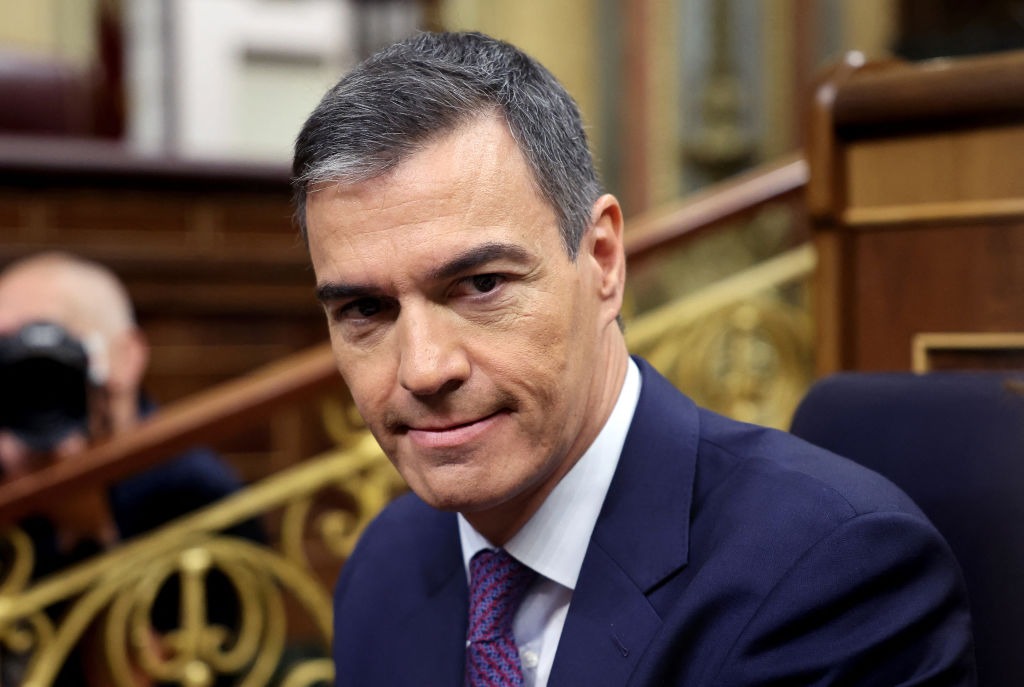
Between corruption and radicalization, Spain's government seems to be spinning out of control.
In 1936, Spain plunged into civil war. A proud nation collapsed into violence, fire, and devastation. The Spanish Civil War, which set a communist-dominated Republican left against an authoritarian nationalist right, claimed roughly half a million lives. Priests were dragged through the streets, beaten, and mutilated — ears, noses, even genitals cut off — before being shot or having their throats slit. Nuns were raped prior to execution, in cases documented across several regions. Churches were set ablaze with priests still inside. In many towns, militiamen forced clergy to drink motor oil or gasoline before burning them alive. Spain's right wing, not to be outdone, killed just as many.
Almost a century later, when one might have hoped that these wounds had finally healed, political and cultural fault lines are reopening. Polarization has reached levels rarely seen since Spain's transition to democracy.
1. The original trauma of the Spanish left
The Spanish Civil War, in Spain's collective memory, remains an open wound. For a significant portion of the Spanish "left" -- standing for workers' rights, a shorter work week, women's and transgender rights, reducing carbon emissions -- the dominant narrative remains that of a revolution betrayed, confiscated by fascism, and still pending, never repaired. This historical resentment has been transmitted from generation to generation like an act of faith. Today, under the government of Prime Minister Pedro Sánchez and his coalition, which governs with the support of the extreme-left, this resentment is resurfacing in the form of historical revisionism.
By constantly summoning the specters of the past — going so far as to exhume Francisco Franco's remains, in a direct evocation of civil-war-era practices, when communists gleefully desecrated the graves of their so-called "class enemies" — is the left not in danger of reviving the hatreds and violence of the past?
2. A left without a compass: ideological orphanhood
Spain's left is becoming more radical precisely because it has run out of ideas. Marxism, long the doctrinal backbone of the global left, lost all credibility with the implosion of the USSR, amid the stench of cabbage and corpses. Spain is no exception. Stripped of this ideological foundation, the Spanish left now finds itself without a compass.
Before the July 2023 elections, Sánchez promised a bold progressive agenda: mass public housing construction, reducing the working week to 37.5 hours, large minimum wage hikes, slashing healthcare waiting lists with binding maximum times, free public transport for youth, and expanded public education. Critically, delivery on these massive flagship promises has been dismal to date: virtually no new public housing built, prices soaring, the work-week reduction defeated in parliament, real wages eroded by inflation, and chronic healthcare waiting lists unchanged.
Sánchez's Spanish Socialist Workers' Party (PSOE), once anchored in moderate, reformist social democracy, has gradually shifted toward a strategy of sheer political survival. To remain in power, it allied itself first with Podemos and then with Sumar—two extreme left-wing parties obsessed with supporting Palestinians, against NATO, and soft on Russia — as well as with separatist movements. In doing so, the PSOE diluted its original moderate reformist vision through blatant opportunism, sacrificing doctrinal coherence in favor of questionable alliances.
3. A patchwork of incoherent dogmas
Deprived of Marxism, the Spanish left has sought refuge in a disparate ideological mosaic: radical environmentalism, complicit indulgence toward political Islam, the dismantling of borders, unconditional support for the Palestinians against Israel – all stacked together into an improbable and incoherent magma. Added to this are recurring undertones of anti-Semitism in left-wing discourse — one thinks in particular of Yolanda Díaz, seemingly a figure of clinical hysteria, whose face visibly contorts the moment she pronounces the word "Israeli."
By radicalizing itself across every issue, the left fuels the anger of the right, the middle classes, and a growing segment of the population that feels marginalized, despised, and alienated within its own country.
4. A regime corrupt to the core?
The Sánchez government has another reason for aligning with jihadists: the corruption scandals that have engulfed even the prime minister's immediate family.
First comes the Koldo-Ábalos scandal involving irregular public contracts, illegal commissions, and bribes linked to public-works contracts, totaling several hundred million euros. Several figures are particularly implicated. Former Minister of Transport José Luis Ábalos, a close ally of Sánchez, is in pre-trial detention for criminal organization, corruption, embezzlement, and influence peddling.
Koldo García, Ábalos's former adviser, is a central figure in the scheme. He too is in pre-trial detention and under prosecution. Santos Cerdán, former secretary of organization of the PSOE and Ábalos's successor, is under investigation and was detained for corruption in public-works contracts. The Civil Guard is examining 22 contracts, worth €355 million, that were allegedly manipulated by favoritism.
Added to this are the cases involving Sánchez's own family. Begoña Gómez, his wife, was formally charged with influence peddling, corruption in business, embezzlement of public funds, misappropriation, and illegally practicing a regulated profession, in a case that was opened in April 2024. In August 2025, the probe was extended to include her advisor Cristina Álvarez.
The investigation into Gómez has been extended until at least April 2026 and continues with active measures, including February 2026 requests to the Interior Ministry for travel records of Gómez and Álvarez since 2018 (covering destinations such as the Dominican Republic, Congo, Guinea, and Russia), access to emails, and Civil Guard reports.
David Sánchez, the prime minister's brother, is also being prosecuted, for influence peddling and malfeasance in connection with his employment at the Badajoz Provincial Council. "The prime minister faces multiple legal challenges this year that could lead to the downfall of his family, his party, and his government," summarizes Spanish daily El Mundo.
5. An ideological junta radicalizing itself to survive
The high point of the Spanish left's radicalization was reached with a January 2026 decree legalizing between 500,000 and a million illegal immigrants. Although presented as a humanitarian and economic measure, this slap-happy decision provoked widespread outrage among Spaniards. The Vox party has identified this as a massive "pull factor" that will inevitably attract millions of additional illegal immigrants. Public services, already under severe strain, are on the brink of collapse. Entire swathes of Spanish territory are, additionally, drifting toward an Islamic cultural environment.
Heading toward the point of no return?
The warning signs are multiplying. Traumatized by its history, cornered by the judiciary, and deprived of ideological reference points, the Spanish left appears to be locking itself into radical dogmas and adopting increasingly divisive policies simply to remain in power.
Drieu Godefridi is a jurist (University Saint-Louis,
University of Louvain), philosopher (University Saint-Louis, University
of Louvain) and PhD in legal theory (Paris IV-Sorbonne). He is an
entrepreneur, CEO of a European private education group and director of
PAN Medias Group. He is the author of The Green Reich (2020).
Source: https://www.gatestoneinstitute.org/22293/spain-government-spinning-out-of-control

No comments:
Post a Comment