by Reuters
Small but deadly "first-person-view" drones now dominate the skies above Ukraine's battlefields, making it extremely risky for armored vehicles to move.
 |
Ukrainian tank platoon commander Valentyn Bohdanov remembers a time earlier in Russia's war when heavy armor fought pitched battles like boxers trading punches in the ring. Four years into the conflict, he says such showdowns are all but impossible.
Small but deadly "first-person-view" drones now dominate the skies above Ukraine's battlefields, making it extremely risky for armored vehicles to move, said Bohdanov, a senior sergeant in Ukraine's 127th Separate Heavy Mechanised Kharkiv Brigade.
"They won't enter an open field: they'll be peppered by FPV drones and stronger ones," said the 36-year-old, who goes by the military call sign "Bodia."
These days, his T-72 tank, which was captured from the Russians, remains hidden beneath webbing near the snowy frontline in the northeast region of Kharkiv - reduced, effectively, to a static piece of artillery.
Bohdanov, who has served since early in Moscow's February 2022 invasion, has seen traditional military tactics upended as technology has forced both sides to make new battlefield calculations.
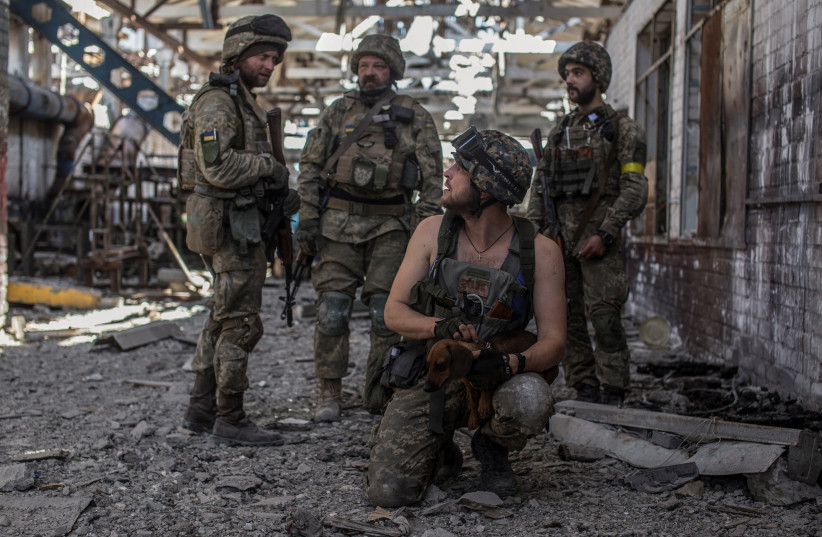
Thousands of precision drones, often costing only several hundred dollars apiece, roam the skies daily across an expanding "kill zone" along the 1,200-km front. They are joined by a growing range of more powerful drones capable of flying farther and carrying heavier payloads.
The ever-present threat from the sky makes virtually any movement - from troop rotations and evacuations to tank assaults - increasingly deadly.
Drone-inflicted casualties have jumped from less than 10% of the total in 2022 to up to 80% last year, as much of the war has morphed into an "air battle of mutual denial," according to a report by the French Institute of International Relations published this month.
It described the shift as part of "a new logic of warfare defined by speed of innovation, rapid adaptation, and seamless technological integration" that would include other technologies, including artificial intelligence.
'In the air all the time'
Mobile drone-hunting teams, like the one Reuters recently visited near the besieged eastern city of Kostiantynivka, are now commonplace.
Patrolling roads shrouded in anti-drone netting and littered with the charred remains of vehicles, members are on constant alert for drones ranging from FPVs to larger, long-range Shaheds. They are tasked with defending supply routes critical for troops in a section of the front line where Russia is advancing.
Drone-hunter "Marine" of the 93rd Mechanised Brigade, who introduced himself by his call sign, recalled once seeing 54 drones attack a single target within one hour.
"Three would circle, another would attack while the others join," he said. "They're in the air like that all the time, not letting anyone get away."
Many soldiers who have been directly under fire describe being overwhelmed by the speed and agility of FPVs. Footage of their strikes now saturates social media on both sides.
Speaking in a military hospital in the northeastern city of Kharkiv, Andriy Meskov said he had been returning from an assignment when he and two comrades were attacked by drones that whizzed after them as they sought cover.
"We ran into a building, not really expecting that it would follow us," said Meskov, 42, himself a drone pilot in the 151st Separate Reconnaissance-Strike Battalion.
"The speed of a human being doesn't compare to the speed of an FPV drone, so I didn't even have time to pick up my rifle to shoot at it."
New battlefield lessons
Meskov's knee was shattered when a drone ricocheted off his helmet and exploded near his leg.
He was eventually evacuated for medical treatment on an unmanned ground vehicle. Such ground drones are increasingly employed for tasks ranging from logistics to evacuations, to minimize casualties.
They carried out more than 7,000 missions in January, Defence Minister Mykhailo Fedorov said last week. Ukraine plans to boost its production and procurement this year, he said.
Longer evacuation times are another potentially fatal consequence of the expanding "kill zone." Col. Viacheslav Kurinnyi, 45, chief doctor at the Kharkiv hospital where Meskov was being treated, said the drone threat to vehicles had pushed the average time for medical evacuation beyond three days.
That flies in the face of the so-called "golden hour" of battlefield medicine, he added, referring to the 60-minute window when intervention is critical to saving a fighter's life.
Ukraine's Western allies needed to learn the lessons: "Any countries that are preparing for war at home need to realize that there will be no 'golden hour,'" Kurinnyi said. "Maybe a 'golden day' if they're lucky."
Once, his hospital received a wounded soldier who had been wearing a tourniquet for more than two months.
Waiting for next breakthrough
Standing next to his snow-covered tank, Commander Bohdanov said he believes such weapons are becoming irrelevant and should be scaled back in favor of longer-range artillery. His crew is open to re-training to become more effective, he added.
While tanks are still used in urban battles or in poor weather conditions, armor-led attacks have largely been replaced by small infantry assaults, said military analyst Rob Lee at the Foreign Policy Research Institute.
But it is too soon to write off tanks. The pace of change means tactics could shift again soon, Lee said.
"Right now, the current role is diminished, and I think we're waiting for the next technological breakthrough that will enable maneuvering again," he said.
Reuters
Source: https://www.jpost.com/international/internationalrussia-ukraine-war/article-887712

No comments:
Post a Comment