by Grégoire Canlorbe
Trump's abrupt decision, on April 8, 2026, to end the joint U.S.-Israel offensive (Operation Epic Fury and Operation Roaring Lion), which had begun February 28 -- evidently signaled to adversaries not strength but weakness: that he could not tolerate more than a short-run intervention.
Unfortunately, when it comes to the Middle East, Trump's approaches have not been the magic bullets he might have hoped.
With the plan of turning Gaza into a "Riviera of the Middle East," both Hamas-free and (in the October 2025 update of the plan) placed under the administration of a committee supervised by a "Board of Peace" -- much of which, bizarrely, appears made up of countries engrossed in waging jihad -- Trump has so far been less than successful. Hamas, to this day, has not disarmed and refuses even to entertain the notion. Much of Gaza remains solidly under its control.
In addition, Trump's January promise to the Iranian people that "HELP IS ON ITS WAY" seems equally on the rocks. Executions of dissidents have once again been stepped up, and the US is apparently doing nothing about it.
Trump's abrupt decision, on April 8, 2026, to end the joint U.S.-Israel offensive (Operation Epic Fury and Operation Roaring Lion), which had begun February 28 -- evidently signaled to adversaries not strength but weakness: that he could not tolerate more than a short-run intervention.
Most of the declared goals of the US offensive – including that "Help is on its way" –- have, tragically, been abandoned.... Now Iran is saying that it has "no choice but to obtain nuclear weapons."
American voters are watching the IRGC dictate its terms to the US -- as if they are the victors. No wonder Iran's leaders are celebrating.
Souk-bargaining over the end of the MOU, after all the money and benefits have been given up front... will easily outlast the Trump Administration to enable Iran's regime to rebuild, possibly stronger than before. Trump's MOU will not bring peace. It is simply a coffee break until he is safely out of office.
Trump's current MOU "deal" is a deal to talk about a deal – for eternity.
Later, when Iran's hardline regime – the same as before, just with new faces – becomes restive again, it will be far more difficult, and more costly in blood and treasure, to stop. A single one of Iran's ballistic missiles can obliterate an entire city block. Ballistic missiles may not be able to "blow up the planet," but they can threaten and devastate other countries -- and were seemingly the reason Trump called for the April 8 ceasefire. That call was possibly Trump's greatest disaster. America was winning -- then Trump stopped!
Iran's ballistic missiles can hit Europe as well as Israel and other neighbors in the Middle East. Future models will be able to reach Boston, Washington, DC and New York. It would have been so much easier to stop Hitler before he crossed the Rhine.
There are no moderate IRGC jihadists -- no Delcy Rodríguez-like figure with whom to negotiate -- just as there were no moderate Nazis in Germany. If there is no real regime change, there will be no peace.
No one is expecting Iran's regime to live up to anything it signs anyway. It never has. The Trump Administration is reportedly waiting to see a "change in destructive behavior" -- which may last only as long as the time it takes to change a "toll" to a "fee," for the "service" of allowing transit of commercial cargo ships through an international waterway, especially when Trump's term in office is over.
The most tragic part is that Trump's original instincts were right. Turn Gaza into a "Riviera in the Middle East" -- an American protectorate on the Mediterranean, perhaps with a U.S. military base to keep order. Trump seems to have let himself fall into a trap of listening to "friends " -- who are not friends -- then sidelining and excoriating his true friends, such as Israel.
If some of the rulers in the Middle East convinced Trump to let them generously "help" with the reconstruction of Gaza, it may well have been to acquire a foothold on Israel's border from which to keep trying to obliterate Israel.... no one new seems to be rushing to join them. Perhaps these countries have a different plan in mind.
America regrettably cannot be "made great again" without restoring its leadership as a bulwark against oppression and barbarism.... No wonder Trump did not want the MOU made public. By now, he probably knows it is a dud. He is probably concerned about America's 250th birthday party this week and the price of gas at the pump.
Perhaps Trump has become infatuated with dreams of glory – even for a fake peace – rather than for America First or even the future of the West. Many of Trump's new fake "friends" are, in reality, cold-blooded dictators who loathe the West and, despite what they tell him, have not lost their appetite one day to overthrow it.
If one were to ask many countries in the Middle East if they would rather go forward into the 21st century with artificial intelligence and high tech or remain in the 7th century, they would probably ask why they cannot have both: better technology with which to fulfill Allah's divine mission of a global caliphate?
Perhaps Trump is hoping to win over these dictators. Perhaps they might even sound won over – until his presidency is over.
Trump has negotiated impressive investments in the US from oil-rich Arab states. Qatar... What have they asked for from Trump as his end of the deal?
Trump still can inform Iran's regime that "We won, you lost, now here is what you are going to do." Trump can still decide to make Gaza the "Riviera of the Middle East " under joint American and Israeli supervision. It is what American voters are waiting to hear. Until then, Iran is effectively calling the shots while Trump is backtracking off one red line after another... Why should Americans vote for that? Many must be justifiably horrified. America is -- again! -- choosing to lose.
The entire West would do well to get over the illusion that fighting back against those planning to destroy you is endangering you. If adversaries are planning to destroy you, you are already in danger. Confronting them is the proper reaction, not the wrong one
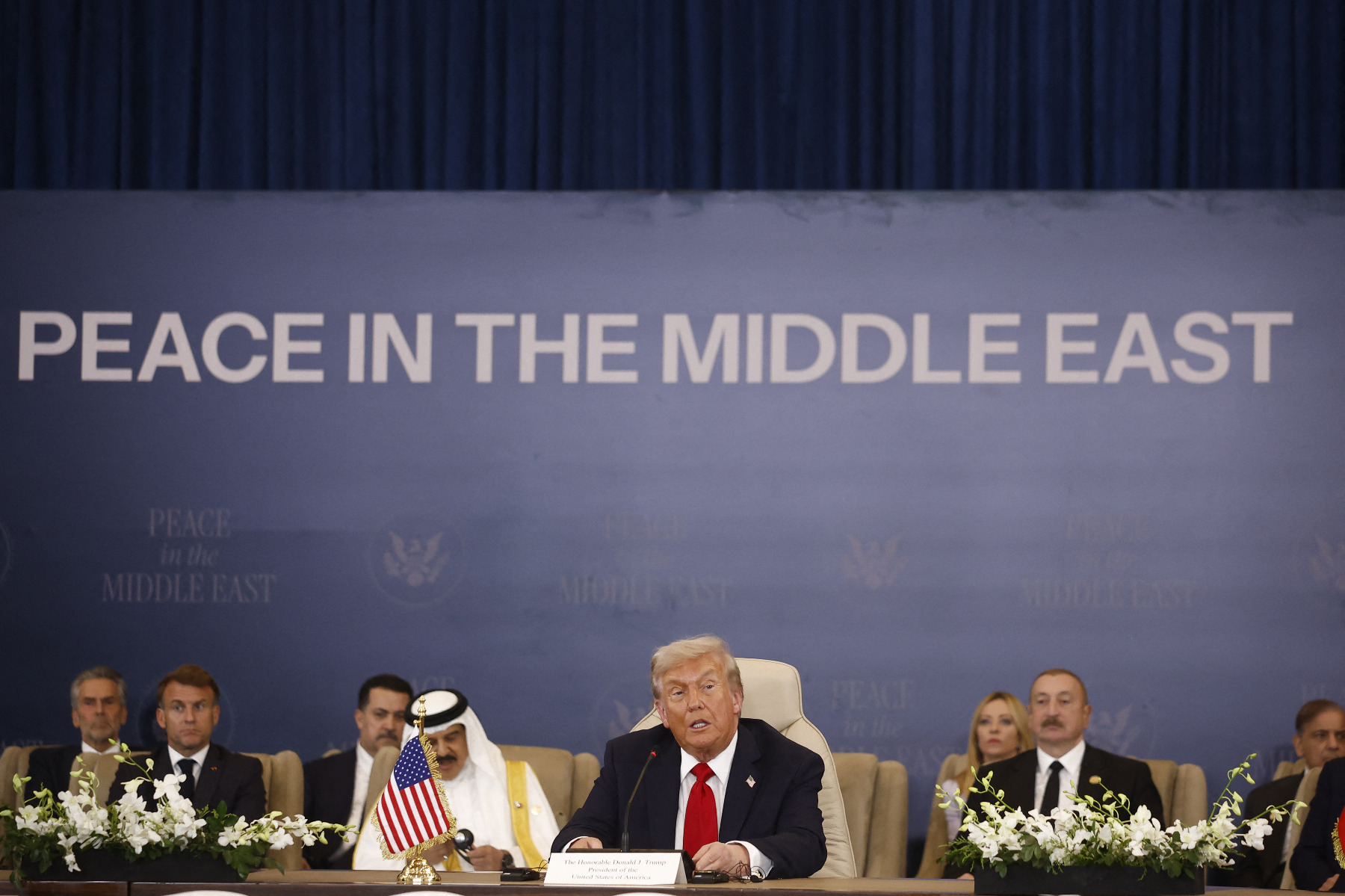
"Peace through strength," when it comes to U.S. President Donald J. Trump, appears to mean "peace through whatever works" – diplomacy, sometimes seeming to verge on suicidal patience, and economic pressure, with military pressure only as a last resort, and even then, only in a short-run way.
As one might expect from the co-author of The Art of the Deal, the core of his foreign policy so far has been making deals – or trying to.
Trump has not been afraid to use pressure — economic and short-run military — to persuade foreign powers to sign agreements that match U.S. interests or, when U.S. interests are not involved, to make the world, eventually, more peaceful for the free world.
Among Trump's amazing achievements at the White House are indisputably the Abraham Accords, and -- in dazzling partnership with Israel, under the leadership of Prime Minister Benjamin Netanyahu -- freeing the Hamas hostages and effectively demolishing much of Iran's military and nuclear infrastructure, a threat no prior president had the courage to confront.
Unfortunately, when it comes to the Middle East, Trump's approaches have not been the magic bullets he might have hoped.
With the plan of turning Gaza into a "Riviera of the Middle East," both Hamas-free and (in the October 2025 update of the plan) placed under the administration of a committee supervised by a "Board of Peace" -- much of which, bizarrely, appears made up of countries engrossed in waging jihad -- Trump has so far been less than successful. Hamas, to this day, has not disarmed and refuses even to entertain the notion. Much of Gaza remains solidly under its control.
In addition, Trump's January promise to the Iranian people that "HELP IS ON ITS WAY" seems equally on the rocks. Executions of dissidents have once again been stepped up, and the US is apparently doing nothing about it.
Trump appears first to envision a goal and then the extent to which that goal may be reached through dealmaking or pressure. If the goal cannot be reached fully in those ways, the goal is then revised downward, if not abandoned. Trump appears to choose dealmaking over war, and adjust his goals accordingly.
When the goals are adjusted downwards from U.S. and Western interests, the results tend to be less than positive. One issue in which The Art of the Deal might have been better left aside is trying to negotiate with the Islamic Republic of Iran.
Trump's abrupt decision, on April 8, 2026, to end the joint U.S.-Israel offensive (Operation Epic Fury and Operation Roaring Lion), which had begun February 28 -- evidently signaled to adversaries not strength but weakness: that he could not tolerate more than a short-run intervention.
The Arab Gulf states, as Iran's rulers had most likely planned, presumably informed Trump that they did not appreciate being attacked.
Most of the declared goals of the US offensive – including that "Help is on its way" –- have, tragically, been abandoned. According to the U.S. version of the MOU (Iran released this one) and according to Trump himself, "It's okay" if Iran's radical Islamic Revolutionary Guard Corps has ballistic missiles. In addition, after 60 days, control of the Strait of Hormuz will be negotiated, as will control of Iran's enriched uranium, which Iran is apparently planning to "blend down" until it is enriched back up again. Also apparently up for grabs are control of a sovereign state, Lebanon, in addition to Iran's other proxies, Hamas and the Houthis, neither of which was even mentioned in the MOU – and control of Iran's centrifuges to resume enriching uranium "for peaceful purposes only," of course – and presumably for making nuclear weapons on the side, just as in President Barack Obama's 2015 Joint Comprehensive Plan of Action (JCPOA) "nuclear deal."
Trump's stated reason for going to war was that "Iran cannot have a nuclear weapon" -- it is why the U.S. and Israel in June 2025 bombed three mountains within which Iran stored its enriched uranium. Now Iran is saying that it has "no choice but to obtain nuclear weapons."
American voters are watching the IRGC dictate its terms to the US -- as if they are the victors. No wonder Iran's leaders are celebrating.
Souk-bargaining over the end of the MOU, after all the money and benefits have been given up front -- including $300 billion, $3 billion of which has already been transferred to them --- will easily outlast the Trump Administration to enable Iran's regime to rebuild, possibly stronger than before. Trump's MOU will not bring peace. It is simply a coffee break until he is safely out of office.
Later, when Iran's hardline regime – the same as before, just with new faces – becomes restive again, it will be far more difficult, and more costly in blood and treasure, to stop. A single one of Iran's ballistic missiles can obliterate an entire city block. Ballistic missiles may not be able to "blow up the planet," but they can threaten and devastate other countries -- and were seemingly the reason Trump called for the April 8 ceasefire. That call was possibly Trump's greatest disaster. America was winning -- then Trump stopped!
Iran's ballistic missiles can hit Europe as well as Israel and other neighbors in the Middle East. Future models will be able to reach Boston, Washington, DC and New York. It would have been so much easier to stop Hitler before he crossed the Rhine.
When the ceasefire was announced in April, Iran's missile and drone capabilities had been severely degraded, its air force and navy mostly annihilated, and its defense-industrial base largely destroyed (but its reconstitution not prevented). Iran's energy infrastructure is still in place and, most importantly, there has been no regime change: the IRGC became the sole power structure with the new, incapacitated Supreme Leader Mojtaba Khamenei formally sitting at the top.
There are no moderate IRGC jihadists -- no Delcy Rodríguez-like figure with whom to negotiate -- just as there were no moderate Nazis in Germany. If there is no real regime change, there will be no peace.
After the April 8 ceasefire, several requests were relayed to Tehran through the U.S. blockade of the Strait of Hormuz, and strikes on naval vessels, air-defense systems, radar, surveillance, and command-and-control sites, and drone- or missile-related control nodes.
In the meantime, however, demands for Iran to renounce its nuclear weapon ambitions, relinquish its enriched uranium, limit its ballistic missile production and discontinue support for its proxies, would all be reduced to just opening the Strait for shipping, possibly until the IRGC felt like closing it again
No one is expecting Iran's regime to live up to anything it signs anyway. It never has. The Trump Administration is reportedly waiting to see a "change in destructive behavior" -- which may last only as long as the time it takes to change a "toll" to a "fee," for the "service" of allowing transit of commercial cargo ships through an international waterway, especially when Trump's term in office is over.
Trump's current MOU "deal" is a deal to talk about a deal – for eternity.
"Rather than waging the war to the end, Trump chose to suspend it," wrote Guy Millière, a senior fellow of the Gatestone Institute, on May 26.
"When one wages a war and is winning, one does not stop along the way; otherwise, one gives the enemy a respite and gives it the means to reorganize and rearm. [...] The agreement, if it is reached and if it corresponds to what it appears to be [...], will lead to the regime parting with its enriched uranium and saying that it renounces its military nuclear program. That said, the renunciation of its military nuclear program will be merely a verbal renunciation. [...] If the agreement is reached, whatever its content, it will leave the regime in place, and that regime will still be a fanatical regime [...] seeking to destroy Israel and support Islamic terrorism. This regime will regard its survival as a victory."
Trump, for all his mastery in the "art of the deal," refuses to see the leadership role of the U.S. through to the end. He "choked," as he would say.
Trump, after claiming that "help is on its way," abandoned the Iranian populace. Then, when Israel was told not to protect itself adequately from the missiles and attack drones launched by Iran's proxy Hezbollah, Trump abandoned Israel – just as the Iranians had planned.
The most tragic part is that Trump's original instincts were right. Turn Gaza into a "Riviera in the Middle East" -- an American protectorate on the Mediterranean, perhaps with a U.S. military base to keep order. Trump seems to have let himself fall into a trap of listening to "friends " -- who are not friends -- then sidelining and excoriating his true friends, such as Israel.
While Trump was boasting that Iran's new IRGC rulers with whom he is negotiating are "less radical," the very man who had electronically signed the MOU, Iran's "New Rational Leader," Speaker of the Parliament Mohammad Bagher Ghalibaf, immediately went on television declaring the "liberation of Jerusalem."
If some of the rulers in the Middle East convinced Trump to let them generously "help" with the reconstruction of Gaza, it may well have been to acquire a foothold on Israel's border from which to keep trying to obliterate Israel. Despite all the glowing advancements promised by the Abraham Accords, no one new seems to be rushing to join them. Perhaps these countries have a different plan in mind.
America regrettably cannot be "made great again" without restoring its leadership as a bulwark against oppression and barbarism. Unless the Trump Administration can demonstrate a real win -- not a fake one, no matter how often Trump tries to tell us how good his deal is -- his party may not even be able to keep the House and Senate in the midterms this November. No wonder Trump did not want the MOU made public. By now, he probably knows it is a dud. He is probably concerned about America's 250th birthday party this week and the price of gas at the pump.
Where fulfilling the role of a great world leader is compatible with dealmaking, Trump appears to be willing to assert himself as a great power; but where a choice has to be made between that and the terrible advice he is following to negotiate with terrorists instead of dictating his terms to them, he appears to shrink back to his role as a dealmaker – and from the looks of it, not even one that can best Iran or Hamas.
Perhaps Trump has become infatuated with dreams of glory – even for a fake peace – rather than for America First or even the future of the West. Many of Trump's new fake "friends" are, in reality, cold-blooded dictators who loathe the West and, despite what they tell him, have not lost their appetite one day to overthrow it.
Qatar has "invested" more than $400 billion in infiltrating the US – possibly more than a trillion dollars all told -- no doubt with Muslim Brotherhood "strings attached." China is waging war on America every way it can. It maintains secret biological warfare laboratories in California and Nevada that are developing deadly genetic pathogens. It sends poisonous agriculture seeds to the U.S.; steals American intellectual property valued at roughly $600 billion a year; sends spy balloons over U.S. military sites, buys up "farmland" next to them, and smuggles in fentanyl to kill around 100,000 Americans each year -- the equivalent of one jumbo jet crashing every day.
Trump's Russian "friend," President Vladimir Putin, has a record of killing critics too numerous to name; razing Grozny, and invading Georgia and Ukraine.
If one were to ask many countries in the Middle East if they would rather go forward into the 21st century with artificial intelligence and high tech or remain in the 7th century, they would probably ask why they cannot have both: better technology with which to fulfill Allah's divine mission of a global caliphate?
Trump is poorly placed to warn that the U.S. might have to distance itself from some European countries undergoing Islamization when he himself cozies up to supporters of terrorism such as Qatar – which according to at least one expert, "funds more terrorism than Iran " -- or Turkey, which is reportedly preparing for war, or Syria's President Ahmed al-Sharaa, whom Trump appears proud of having "essentially put there; he's doing a phenomenal job," but under whose leadership attacks on Alawites, Christians and Druze have "skyrocketed," despite Western-friendly talk about "inclusivity" and "pluralism." Meanwhile, Syria is "coming together" more hard-core Islamized than ever.
Perhaps Trump is hoping to win over these dictators. Perhaps they might even sound won over – until his presidency is over.
As a Western power, you should never prioritize the interests of a non-Western power over those that are Western -- even if it looks as if your short-term interests are being served. It can backfire someday. The issues of civilization, the continuing security of the West, cannot be detached from national interests.1
The 2025 White House National Security Strategy correctly refers to European countries' ongoing "loss of national identities" and to the "stark prospect of civilizational erasure." The report also raises the question of, by that erasure or by "regulatory suffocation", "whether certain European countries will have economies and militaries strong enough to remain reliable allies."
Trump has negotiated impressive investments in the US from oil-rich Arab states. Qatar, for instance, committed last year to investing $1.2 trillion in America, as well as a $400 million aircraft, the "flying palace," among other tributes.2 What have they asked for from Trump as his end of the deal?
Regarding the U.S.-Israel strikes on Iran, Trump lately has been favoring the interests of Muslim countries over those of Israel. On June 24, 2025, then on April 8, 2026, Trump prevented escalations that would have endangered Iran's Muslim neighbors. However, he then called for a ceasefire that prevented Israel from further weakening Iran.
On April 8, Trump called for another ceasefire just as Israel was successfully degrading Iran's biggest proxy Hezbollah, which has been bombarding Israel, most likely at the behest of Iran. Having Hezbollah bombard Israel serves at least two of Iran's objectives. It drives Israelis out of the northern part of their country -- Iran might hope permanently -- then, when Israel retaliates, Trump orders it to stop before it can accomplish its goals. The latest ceasefire also created tension between the U.S. and Israel, which Iran regards as its two biggest targets singled out for demolition.
Trump acted similarly again on March and May, when he asked Netanyahu to abstain from some strikes.
Trump would have done better to learn from Netanyahu rather than to hamper his efforts. Trump still can inform Iran's regime that "We won, you lost, now here is what you are going to do." Trump can still decide to make Gaza the "Riviera of the Middle East " under joint American and Israeli supervision. It is what American voters are waiting to hear. Until then, Iran is effectively calling the shots while Trump is backtracking off one red line after another: ballistic missiles, removing Iran's enriched uranium, "Help is on its way," ending Iranian support for terrorist proxies, possibly freedom of navigation – and a status quo of once more having Iran enrich uranium for nuclear weapons. Why should Americans vote for that? Many must be justifiably horrified. America is -- again! -- choosing to lose.
The entire West would do well to get over the illusion that fighting back against those planning to destroy you is endangering you. If adversaries are planning to destroy you, you are already in danger. Confronting them is the proper reaction, not the wrong one
Israel's retaliation against Hamas in Gaza did not cause masses of Muslims or Palestine-friendly Westerners to rally against Israel. Pursuing the operations in Iran would not have resulted in chaos. Now, Iran is being allowed to continue being a major source of regional and worldwide destabilization and a threat to Israel and America. That is what will result in chaos.
1 Previous cases of such detachment are certainly legion: the French-Ottoman alliance that, in the 16th century, was directed against Habsburg Spain and the Holy Roman Empire; the England-Morocco alliance that, at the crossroads of the 16th and 17th centuries, was directed against Spain; the Britain-Ottoman alliance that, in 1798-1801, was directed against France during the French campaign in Egypt; or the alliance that Britain and France, in the Crimean War of 1853-1856, formed with the Ottoman Empire against Russia.
2 Trump, on the occasion of his May 2025 Middle East trip, signed a U.S.-Qatar economic agreement worth at least $1.2 trillion, which included commercial aircraft but also defense, energy, and advanced technology; and announced a $600 billion Saudi commitment to invest in the U.S., in areas like energy security, defense, technology, infrastructure, or critical minerals, as well as more than $200 billion in new U.S.–UAE deals. Other Islamic countries with which substantial economic agreements, in 2025, were announced are Indonesia, Pakistan, Malaysia, or even Turkey; concerning the latter, on the occasion of Erdoğan's White House visit on September 25, 2025, a U.S.-sourced LNG supply deal involving Turkey's BOTAS and Mercuria, with a targeted bilateral trade volume of $100 billion, was settled in the natural gas sector. A U.S.-Turkey memorandum on strategic civil nuclear technology, beside was concluded, as well as Turkish Airlines' planned purchase of up to 225 Boeing aircraft.
Grégoire Canlorbe
Source: https://www.gatestoneinstitute.org/22659/iran-deal-is-a-coffee-break

No comments:
Post a Comment