The "Middle East and Terrorism" Blog was created in order to supply information about the implication of Arab countries and Iran in terrorism all over the world. Most of the articles in the blog are the result of objective scientific research or articles written by senior journalists.
From the Ethics of the Fathers: "He [Rabbi Tarfon] used to say, it is not incumbent upon you to complete the task, but you are not exempt from undertaking it."
This is the first big crisis between the U.S. and Iran since signing a memorandum of understanding to end the war earlier this week.
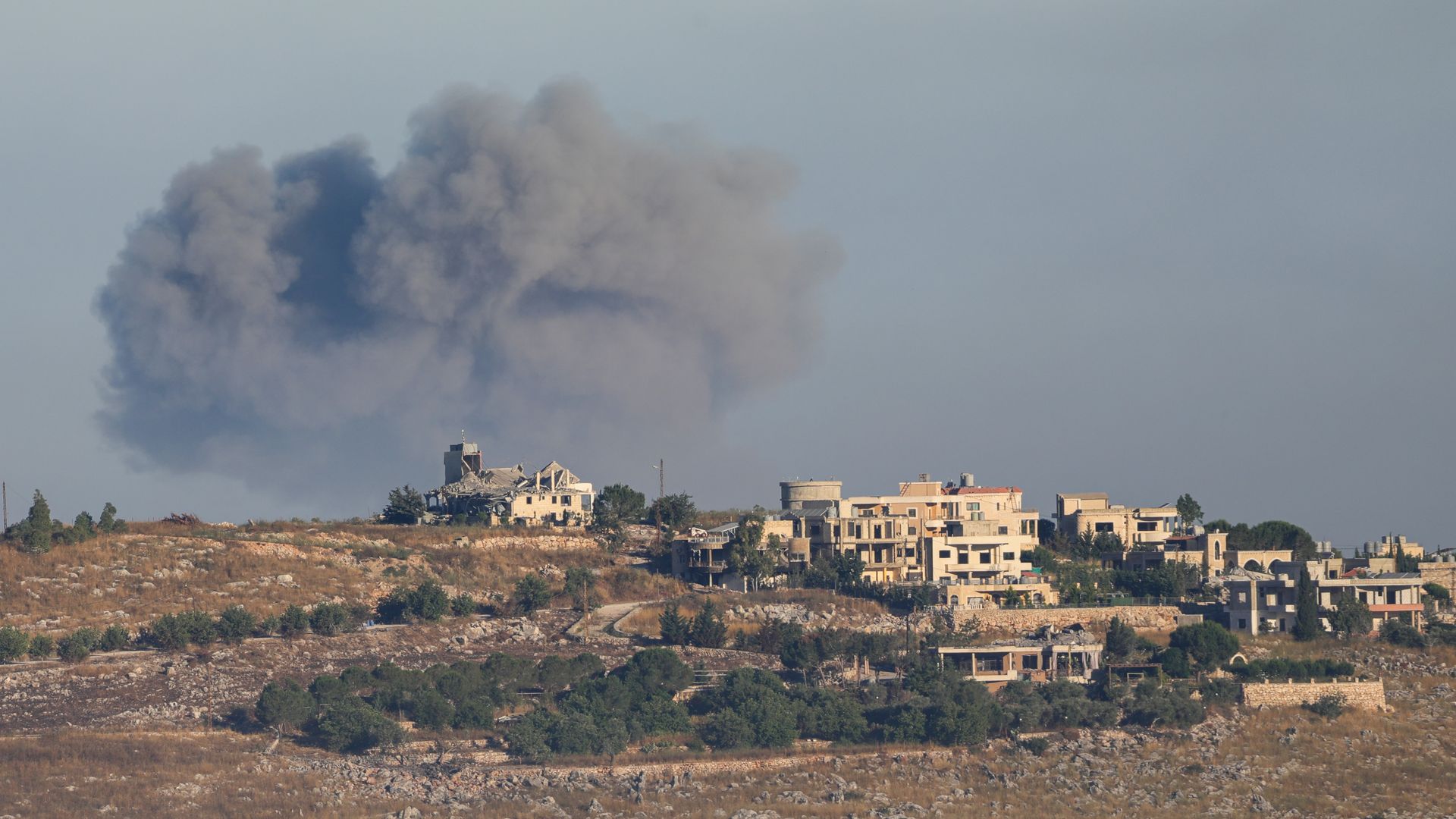
Smoke rises from the town of Shweikin and the Ali al-Tahir hill area in
southern Lebanon following Israeli airstrikes on June 20. Photo: Ramiz
Dallah/Anadolu via Getty Images
The Iranian armed forces announced
Saturday they will close the Strait of Hormuz — just three days after it
reopened — alleging America's failure to rein in Israeli attacks on
Lebanon violates the new ceasefire deal.
Why it matters: This is the first big crisis between the U.S. and Iran since signing a memorandum of understanding to end the war earlier this week.
It takes place as President Trump's envoys are already in Switzerland ahead of a potential first round of nuclear negotiations planned for Sunday.
The
Iranian delegation headed by speaker of parliament Mohammad Bagher
Ghalibaf and foreign minister Abbas Araghchi is expected to arrive in
Switzerland on Saturday.
State of play: A
senior U.S. defense official said the U.S. military is still not seeing
any Iranian military movements on the ground that reflect a potential
"closing" of the strait.
"Safe passage through the
international waterway remained intact today as 55 merchant ships
transited, moving large amounts of cargo and more than 17 million
barrels of oil to global markets," U.S. CENTCOM said Saturday.
CENTCOM
spokesman Capt. Tim Hawkins told Axios that "Iran does not control the
Strait of Hormuz. Traffic continues to flow, and U.S. forces are
monitoring the situation to ensure this remains the case."
What they're saying: Shortly
before Araghchi announced he is traveling to Switzerland, the Khatam
al-Anbiya central headquarters of the Iranian armed forces announced it
was closing the Strait of Hormuz.
"In light of the United
States' clear bad faith and breach of its commitment to implement the
first clause of the memorandum of understanding for ending the war, and
in response to the continuous and ongoing violations of the ceasefire by
the Zionist regime in southern Lebanon, it is hereby announced that the
Strait of Hormuz will be closed to maritime traffic."
The
Iranian military said this is "the first step" in responding to alleged
violations of the ceasefire. "Should the aggression continue, further
measures have been planned and will be implemented to compel the enemy
to abide by and carry out its obligations."
Shortly after that,
the Iranian Revolutionary Guards Corps navy said the strait "is closed
to all vessels" and warned ships not to approach.
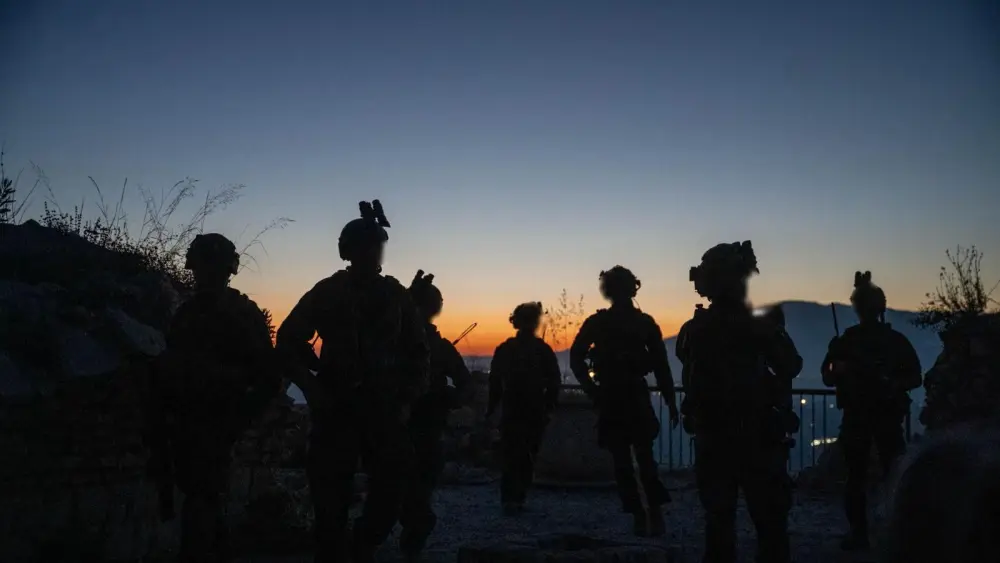
“IDF soldiers must stand between Hezbollah and Israeli civilians. We will not wait for the next attack to reach our homes.”
Israeli soldiers in Southern Lebanon, dismantling Hezbollah terrorist infrastructure, June 2026. Credit: IDF.
Hezbollah overnight Friday launched more than 50 projectiles at
Israeli soldiers stationed in Southern Lebanon in violation of the
ceasefire, the Israel Defense Forces said on Saturday.
In
response, the IDF struck dozens of Hezbollah terrorist infrastructure
sites and terrorists in Southern Lebanon, the military stated.
Among the targets were rocket launch positions, weapons storage facilities and Hezbollah command centers.
“The
IDF will not tolerate attacks against Israeli civilians or IDF soldiers
and will respond with determination to any act of aggression directed
against them,” the army continued.
The Israeli military remains
committed to the truce according to the directives of the political
echelon and will continue to operate to remove any threat posed to the
State of Israel and IDF soldiers, the IDF said.
IDF Spokesperson
Brig. Gen. Effie Defrin released a recorded message in which he
mentioned the killing of four Israeli soldiers “while protecting their
country” overnight Thursday, which led to the escalation in violence.
“Over the course of weeks, and including last night, Hezbollah has
launched hundreds of explosive drones and rockets at Israeli civilians
and soldiers. ... They prove that Hezbollah’s goals remain the same: to
remain on Israel’s borders and to plan and carry out attacks on our
civilians,” Defrin said.
“This is not a reality we can accept, and
this is exactly why the IDF continues to operate in Southern Lebanon.
... IDF soldiers must stand between Hezbollah and Israeli civilians. We
will not wait for the next attack to reach our homes. We will continue
to remove immediate threats, respond to Hezbollah’s violations, and do
whatever is necessary to protect our civilians. Our mission remains the
same: to ensure that Hezbollah cannot rebuild itself and pose a threat
to our civilians,” the spokesperson added.
In a separate statement
on Friday, the IDF said that it struck more than 80 command centers,
terrorists, launch positions and additional terrorist infrastructure
sites in the area of Nabatieh and additional areas in Southern Lebanon,
“within the Security Zone and beyond it.”
During these strikes, dozens of Hezbollah operatives were killed, the military said.
The
strikes were carried out in response to the killing of four IDF
soldiers the previous night by an explosive drone launched by the
Iranian proxy group.
In a separate incident on Friday night, the
IDF identified rocket fire launched by Hezbollah. Following the
identification, the IDF eliminated two terrorists who fled the launch
area on a motorcycle.
The IDF subsequently struck and dismantled
the launcher from which the rockets were fired toward the soldiers, the
military said.
‘Hezbollah broke the ceasefire’
Israeli
Ambassador to the U.S. Yechiel Leiter on Saturday lambasted the Shi’ite
terrorist organization, stating that it is the one that broke the
ceasefire, not Israel.
“Terrorists lie. Hezbollah is a terrorist
organization. Hezbollah lies. Iran is using its proxy to extract
concessions. That is the modus operandi of the murderous regime in
Tehran. Don’t be fooled,” the diplomat tweeted.
He emphasized that
Israel has no territorial ambition in Lebanon and that it seeks to live
side by side with its neighbors “behind secure and recognized borders.
“Israel
is honoring the ceasefire while defending itself against terrorist
attacks, as any self-respecting country would,” Leiter said.
𝐇𝐞𝐳𝐛𝐨𝐥𝐥𝐚𝐡 𝐛𝐫𝐨𝐤𝐞 𝐭𝐡𝐞 𝐜𝐞𝐚𝐬𝐞𝐟𝐢𝐫𝐞, 𝐧𝐨𝐭 𝐈𝐬𝐫𝐚𝐞𝐥.
Terrorists lie.
Hezbollah is a terrorist organization.
Hezbollah lies.
Iran is using its proxy to extract concessions. That is the modus operandi of the murderous regime in Tehran.
Don't be…
— Ambassador Yechiel (Michael) Leiter (@yechielleiter) June 20, 2026
In a subsequent tweet, Leiter listed 13 villages in Southern Lebanon
from which Hezbollah fired a total of 147 rockets, 20 UAVs and nine
anti-tank missiles at Israeli soldiers deployed there and at Israel in
the span of 24 hours.
“Hezbollah is Iran’s long arm and they don’t want a ceasefire,” he said.
These are all villages in southern Lebanon. From these villages they fire into the yellow zone and into Israel.
147…
— Ambassador Yechiel (Michael) Leiter (@yechielleiter) June 20, 2026
Iran reimposes closure on choke point
Israel has agreed
to implement a ceasefire in Lebanon in the wake of the Memorandum of
Understanding signed last week between the U.S. and Iran.
Discussions
between the latter two parties were scheduled to take place in
Switzerland on Friday, but were postponed after the flare-up in Lebanon.
The top command center of the Iran Armed Forces announced
on Saturday that it is again shutting maritime transit in the Strait of
Hormuz, citing hostilities in Lebanon as the driver of the measure,
according to Reuters.
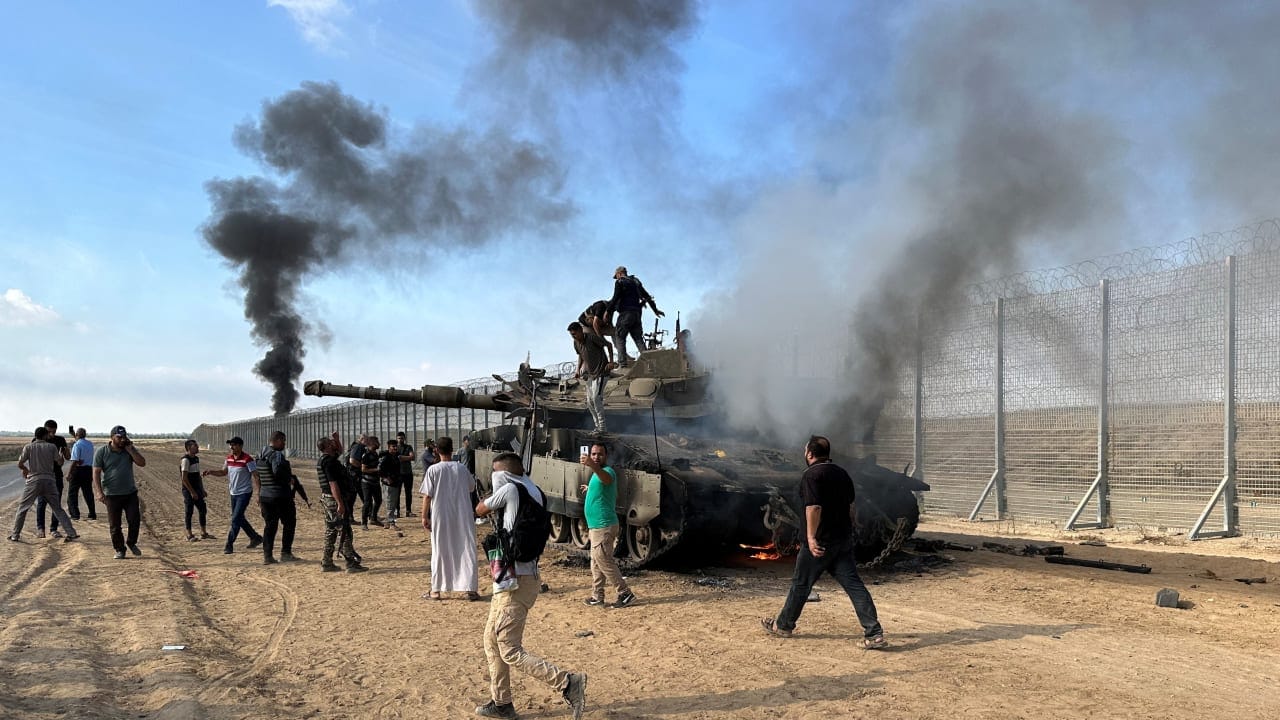
The documents, provided by the Meir Amit Institute, detail the progression of Hamas's secret plans to systematically deceive Israel into complacency before the October 7 massacre.
Palestinians react as an Israeli military vehicle burns after
it was hit by Palestinian gunmen who infiltrated areas of southern
Israel, at the Israeli side of Israel-Gaza border, October 7, 2023. (photo credit: REUTERS/Mohammed Fayq Abu Mostafa)
New secret Hamas
internal documents have been provided by IDF intelligence to the Amit
Terrorism and Intelligence Research Institute, which provided them
exclusively to The Jerusalem Post on Thursday.
An analysis by the Amit Center includes six documents viewed by the Post,
of which three are covered in this article, showing the progression of
Hamas’s secret plans from 2022 to 2023 to systematically deceive Israel
into complacency so as to surprise the IDF during the October 7
massacre.
A
Hamas document planning the deception plans surrounding the October 7
massacre. (credit: THE MEIR AMIT INTELLIGENCE AND TERRORISM INFORMATION
CENTER)
Although
much is already known by now about Hamas’s deception, these original
documents have not previously been made public and reveal a variety of
new pieces of the puzzle of Hamas’s strategy and tactics.
The first document is from September 13, 2022, and is titled Building a Strategic Deception Plan Which Will Be the Basis for a Surprise Attack by Hamas on Israel.
Section 5 of the document emphasized Hamas’s need “to formulate a multi-disciplinary strategic deception plan
(diplomatic-military-economic-public relations) which will include
advancing the exchange issue [ongoing negotiations at the time to return
two living and two deceased Israeli citizens held hostage by Hamas even
prior to 2023] with prime minister [Yair] Lapid [Lapid was prime
minister from mid-2022 to December 2022].”
A
Hamas document planning the deception plans surrounding the October 7
massacre. (credit: THE MEIR AMIT INTELLIGENCE AND TERRORISM INFORMATION
CENTER)
Hamas outlines strategy of normalizing border activity ahead of attack
It
also highlighted Hamas operatives “building the military [border]
positions at a normal pace and continuing drills in a routine manner
until the opening of the pressure campaign, which will provide an
appropriate excuse for reducing (open military activities).”
Section
6 said that Hamas would “act to summon the Nukhba Force fighters
repeatedly and in different ways, and in a manner which would cause ‘the
enemy’ [Israel] to lose the ability to identify the moment of the
attack.”
According
to Section 7, Hamas should put special effort into evaluating specific
moments when its forces would be extra ready for an attack and when
Israel and the IDF would have a reduced focus on defense.
In
Section 8, Hamas recommended increasing the frequency of routine drills
involving certain forces moving to and from the border in a way that
could confuse the IDF.
It
also suggested sending high-level commanders to the border more often
and increasing the overall presence of Hamas terrorists there to make it
even more difficult for the IDF to notice that anything unusual might
happen.
The
Amit Center then notes in its own analysis that top Hamas officials
later proudly admitted that they had utilized a systematic deception
plan to fool Israel and the IDF into a sense of complacency and to
believe that the Gaza terror group was too deterred to mount any real
threat.
According
to the center, this deception plan included Hamas standing down during
multiple rounds of conflict between Israel and Palestinian Islamic
Jihad, even at the cost of looking weak in the Strip in the short term.
A
Hamas document planning the deception plans surrounding the October 7
massacre. (credit: THE MEIR AMIT INTELLIGENCE AND TERRORISM INFORMATION
CENTER)
Hamas documents describe effort to mislead Israel into complacency
Top
Hamas officials were totally willing to look weaker in the short term
in order to fool Israel so that their larger “Big Project” surprise
attack plan on Israel would later fully catch the Jewish state off
guard.
In
the intelligence center report, these officials are quoted as saying
they “undertook unprecedented intelligence tactics to confuse Israel,
including convincing Israelis that Hamas was afraid to go to war and
just wanted to improve its economic situation.”
According
to the report, Hamas continued to send deceptive and pro-negotiation
messages to Israel even in the days leading up to October 7.
Next,
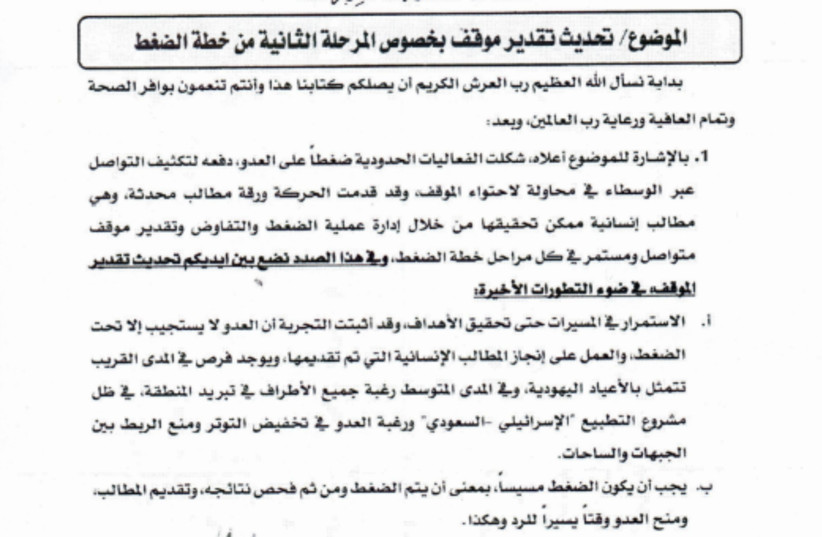
a year later, there is a September 25, 2023, document, Document Five,
entitled “Situational Update Regarding the Second Stage of Pressure”
from Mohammed Odeh [who later became Hamas’s chief briefly in May 2026
before being assassinated] to Yahya Sinwar.
According
to the document, “The additional pressure on ‘the enemy’ caused it to
work more intensely with ‘middle-man negotiators’ [such as the Qataris]
to calm the situation. ‘The Movement’ [Hamas] presented official updated
conditions regarding humanitarian aid.”
Regarding
strategy leading up to the invasion, which took place only two weeks
later, the document emphasized the importance of continuing the marches
until Hamas’s goals were achieved.
A
Hamas document planning the deception plans surrounding the October 7
massacre. (credit: THE MEIR AMIT INTELLIGENCE AND TERRORISM INFORMATION
CENTER)
“Experience
has shown that the enemy only responds to pressure. Jewish holidays
represent opportunities in the short term,” and in the medium term,
there is a desire to calm matters in order to facilitate normalization
with the Saudis and to avoid any connection between the different
fronts, said a Hamas analysis of the current situation.
Document details calibrated pressure and negotiation timeline
Next,
the document said that pressure must be based on “political motivations
and goals, including pressure, clear presentation of demands, and
giving the enemy a reasonable time to respond.”
Further,
the document stated, “Our humanitarian goals are limited, and we can
achieve them through patience and continuous pressure so that the amount
of pressure and effort is attuned to the scope of the achievements.”
In addition, the document said that the pressure should continue on September 24 but should be reduced on September 25-27.
“This
brief amount of time will allow the enemy time to respond, time to
speak to the negotiators, and time to move more personnel and resources
toward the border in order to inflame it more [on September 28-29.]”
Moreover,
the document said that “the Movement should ensure that other armed
groups do not overheat conflict on the border, which could be used to
undermine Hamas’s control of the national narrative [and by extension
the future of the Big Project].”
The
document then issues a list of specific recommendations, such as: “It
is critical to push into the public sphere the slogans which will ignite
the situation, such as al-Aqsa, security prisoners, enemy
aggressiveness against West Bank Palestinians, removing the Gaza sea
blockade, the right to work, the right to travel, and the right to
medical care without being extorted at the Erez Crossing.”
“These must be inculcated with determination into the national Palestinian consciousness,” added the document.
Next,
it recommended that all military forces be kept up-to-date and ready to
act and that there be comprehensive efforts with Qatar, Turkey,
Algeria, and Kuwait to keep pressure on Israel to improve the
humanitarian and unemployment situation.
Curiously,
Hamas recommended that a civilian delegation be sent to visit
parliaments around the world to rally support for ending the sea
blockade of Gaza and to encourage weekly and monthly protests outside
American embassies worldwide for the same goal.
Hamas seeks to broaden conflict by linking regional territorial claims
Another
strategy of Hamas was to press for tying the Palestinian cause to the
cause of restoring territory from Israel to Syria, Lebanon, and Jordan.
Document
Six from October 2, 2023, only five days before the invasion, is a
“List of Those in Attendance from a Transcript of the Political Bureau
of Hamas,” – which was the last major meeting of the specific high
committee.
Of
the 22 committee members, the transcript noted that seven members were
not present, including Khalil al-Hayya, Bassam Naim, and Kamal Abu Oun,
with the reason for their absence labeled as “travel.”
Hayya,
who was Yahya Sinwar’s top aide at the time, would fly to Qatar and
serve as the main negotiator for Hamas over hostages and ceasefires over
the course of the war.
He
remains one of Hamas’s top officials, although so many have been killed
by the IDF that there is currently some ambiguity about exactly who has
which authorities.
Since Odeh was killed, Hamas has not announced a new military leader.
The
Amit Center is unique because it is run by former top officials from
IDF intelligence, the Mossad, and the Shin Bet (Israel Security Agency),
in addition to talented outside researchers, and has had special access
to Hamas documents seized by IDF intelligence, on top of its high-level
open-source research.
Trump may have given Iran everything it wanted on paper—but the real question is whether Tehran fell for a deal that gives America the leverage to walk away.
To evaluate the Iran
Memorandum of Understanding on its merits, beyond the hype, let’s start
by separating what we know from what we don’t.
Iran’s military has been destroyed. It has no air force, no navy, and no air defenses.
We have obliterated Iran’s uranium enrichment
plants, its uranium mills, and its uranium hexafluoride conversion
facility, as well as the secret bomb-making workshops in Parchin that
Iran would never allow the IAEA to inspect.
We have destroyed most of Iran’s ability to manufacture drones and ballistic missiles.
We have shattered the Iranian economy.
We have pitted the regime against itself, as seen in recent demonstrations organized by hard-liners against the MoU.
We have also demonstrated that America has a new
“special relationship”—with Israel, not Britain. We have gone to war
with the IDF, flying thousands of joint air missions without a single
mishap, something we could arguably not do today with our NATO allies.
These are facts, and they are major accomplishments
of a military campaign that no previous American president has been
willing to attempt.
But we did not defeat the Iranian regime. That, too, is a fact—one the regime reminds the U.S. of every day.
Not only do they appear to be undeterred, but they
enjoy taunting us, threatening to “bloody” our noses, and deliver a
“harsh blow” should we not keep up our commitments under the MoU.
But just what are the U.S. commitments?
The 14-point MoU reads like a wish list crafted in Tehran. And I suspect that is exactly what it is. (More on that below).
Over the past several weeks, I have watched with
disbelief as pro-regime media in Tehran released this or that version of
the accord, including what appeared to be U.S. commitments to establish
a $300 billion reconstruction fund and to withdraw all U.S. military
forces from the region.
Astonishingly, those measures do indeed figure in the 14-point MoU.
Paragraph 6 says that the United States “undertakes with regional
partners to develop a definitive, mutually agreed plan with at least USD
300 billion for the reconstruction and economic development of the
Islamic Republic of Iran.”
Paragraph 4 states that the United States
“undertakes to remove its forces from the proximity of the Islamic
Republic of Iran within 30 days after the final deal.”
These are just two of the extraordinary concessions
made by Trump’s negotiating team to the Iranian regime. Other
concessions include immediately releasing frozen Iranian assets, and the
future removal of sanctions.
But will all of those U.S. concessions actually
occur? Listening to President Trump at his G7 press conference on
Thursday suggests perhaps not.
He said that if the Iranians didn’t hold up their
end of the agreement—opening the Strait of Hormuz and surrendering their
nuclear material—then the U.S. would return to bombing, maybe for two
weeks, maybe for two years.
He also said the U.S. wasn’t putting up one cent for
the reconstruction fund. Any U.S. “contribution” would come from
Iranian money the U.S. has frozen and now has pledged to release.
It all raises the question whether Trump didn’t somehow snooker the Iranians.
That’s right.
From the man who said the Iranians had never won a
war but never lost a negotiation, did Team Trump actually get the better
of the Iranians in this deal?
He gave them all they could possibly want. But it’s not a deal. It’s an MoU.
It contains only three active pieces: an end to
immediate hostilities, opening the Strait, and an undefined release of
frozen Iranian assets. Everything else is to be negotiated at a later
date, in principle, by August 15.
Those follow-on negotiations were supposed to have
started in Geneva on Friday, June 19—the day after Trump signed the MoU
publicly at the G7 conference in Evian.
But nobody came.
Ever since Jimmy Carter, U.S. presidents have bet a
piece of their presidency on the quixotic notion that somehow they could
offer the Iranians something so enticing they would change their
behavior.
But I have long argued that this Iranian regime can
never change the behavior we object to. It can never abandon its nuclear
ambitions; it can never give up its terror proxies; it can never
abandon the charter of the Islamic Revolutionary Guards Corps, which is
to spread the Islamic revolution around the globe, because these are
core values of the regime.
Give up on those core values, and the regime disintegrates.
JD Vance has made clear that the goodies contained
in the MoU are all “performance-based.” In other words, if the Iranians
don’t deliver on their commitments—whether it’s the ceasefire itself,
freedom of navigation in the Strait, or the surrender of their nuclear
program—then they will not receive the benefits set forth in the MoU.
And that’s what leads me to suspect that the president may actually have snookered the Iranians.
When they see a U.S. president offering them $150
billion in sanctions relief, as Obama did, they take it to the bank.
It’s not up to further negotiation; it’s a fait accompli.
But with President Trump, those bets are off. They
can point to all the goodies they believe they are entitled to in the
14-point MoU, but until Trump declares that they have fulfilled their
commitments, they won’t be getting them. Not a one.
So what does the MoU achieve? It settles the oil
markets, it fuels the stock market, and arguably it enhances the chances
of the Republicans to win the midterm elections. If it collapses on
November 5 because the Iranians didn’t carry out their part of it, so be
it. America will be back to war without the restraint of another
election.
* * *
Ken Timmerman's 14th book of non-fiction, The Iran House: Tales of Revolution, Persecution, War, and Intrigue, can be ordered on Amazon. He
was nominated for the Nobel Peace Prize in 2006 by former deputy
Swedish premier Per Ahlmark for his work on Iran and is a senior fellow
at the America First Policy Institute.
The New York Times won Pulitzer Prizes for its coverage of President Donald Trump and Russia, yet it continues to get basic facts wrong.
In an article published this week, The New York Times
twice claimed President Donald Trump had no basis to claim the federal
government under former President Barack Obama spied on him during the
2016 election or abused surveillance powers despite a large body of
public evidence showing both things happened.
In the article about Trump’s statements on Section 702 of the Foreign Intelligence Surveillance Act, the Times
insisted that Trump has a “long and complicated relationship” with
FISA, alternating between “condemning it" and "embracing it."
"During his first term, Mr. Trump posted on social media just hours
before Congress was to vote on it to suggest without evidence that the
program had been abused by the Obama administration to surveil his
presidential campaign," the newspaper wrote.
Trump has plenty of evidence to suggest his campaign was spied on by
the Obama administration, including the release of declassified memos
showing two undercover informants directed by the FBI engaged with Trump
campaign figures trying to lure information out of them.
The president also has ample evidence that the FBI abused surveillance rules under Obama, including a lengthy Inspector General report from the Department of Justice released in 2019 and a statement by the DOJ admitting some of the surveillance was "unlawful."
That report found that the FBI altered evidence against Trump
campaign adviser Carter Page in order to investigate him. A former FBI
attorney, Kevin Clinesmith, pleaded guilty
in 2020 to altering an email for the purposes of obtaining a FISA
warrant that authorized spying on Page and his dealings with the Trump
campaign.
Page had worked with an unnamed U.S. intelligence agency dealing with
Russians during the early days of the Obama administration, but
Clinesmith altered an email saying this to make it appear as though Page
had never worked with the agency. Just the News has confirmed that agency was the CIA.
The FBI received the accurate information under Obama in 2016 and doctored it in 2017, court records show.
In response to a Just The News inquiry, the Times said its
"reporting on the challenges to reauthorize FISA section 702 presents
readers with a clear and factual picture."
The IG report noted 17 “inaccuracies and omissions” that were not
brought to the attention of the Office of Intelligence prior to the
final FISA application filed against Page in 2017. These included
Clinesmith’s alteration; omissions from another Trump campaign aide,
George Papadopoulos, denying anyone in the Trump campaign was
collaborating with Russia; and omitting statements from Page about never
meeting then-campaign chairman of Trump’s 2016 presidential campaign,
Paul Manafort, which spoke to the credibility of the Clinton
campaign-funded “Steele Dossier,” which claimed otherwise.
Page filed a lawsuit against the federal government for its
mistreatment of him, and in April 2026, the Justice Department agreed to
settle the lawsuit for $1.25 million.
“No American should ever face covert and unlawful surveillance based
on their political view,” a Justice Department spokesman said at the
time after the settlement was revealed in a court filing.
“The investigation into Carter Page — a man never charged with a single
crime — relied on inherently flawed and uncorroborated information,
proving it was a political sham from the get-go.”
The Supreme Court recently declined
to revive a separate lawsuit from Page against former FBI Director
James Comey and others for their roles in the investigation against
Page.
Declassified records released by the FBI and obtained by Just the News
show an informant who also worked as a Pentagon researcher, Stefan
Halper, was directed to meet with Page at a Virginia farm in October
2016, while Obama was still president, to try to elicit information
about the campaign's possible ties to Russia. Halper was given the FBI
codename "Mitch," the memos show.
A transcript of the conversations recorded by the FBI shows that
rather than confirming contacts between the Trump campaign and Russia,
Page actually disputed the allegations to Halper.
"The core lie is that I met with these sanctioned Russian officials,
several of which I never even met in my entire life, but they said that I
met them in July," an FBI transcript quotes Page as telling Halper
during an Oct. 17, 2016 interaction at Halper's farm in Northern
Virginia.
And Page wasn’t the only Trump aide targeted by the Obama administration’s intelligence apparatus.
The FBI sent an undercover operative to meet with Papadopoulos while posing as a research assistant named Azra Turk. The Times broke the story
in 2019. The investigators attempted to get Papadopoulos to falsely
admit the Trump campaign was working with Russia. Halper was also asked
by the FBI to speak with Papadopoulos about alleged Russia collusion,
records show.
You can read the FBI documents about Halper's interaction with Papadopoulos here.
The plan makes abundantly clear the FBI was trying to elicit information about the Trump campaign using the informants.
If the Trump campaign figure "does not provide tangible information
during the meeting, or if CD explicitly states he does not know of any
RF (Russian federation) involvement in the campaign the FBI will focus
on a second target of the investigation," the memo stated,
The memo warned that Halper's efforts may cause Page to "recognize
this meeting as a way to collect information about the Trump Campaign
that he is not willing to share. The conversation may be relayed to
others in the Trump Campaign and create a possible issue for the" FBI
informant.
Special Counsel Robert Mueller’s massive investigation into Russia
collusion determined there was no criminal conspiracy between Vladimir
Putin's Russia and the Trump campaign.
A second Special Counsel, John Durham, went even further, concluding
during the Biden administration that the Obama-era FBI and DOJ had no
basis to open an investigation of Trump-Russia collusion.
"Neither U.S. law enforcement nor the Intelligence Community appears
to have possessed any actual evidence of collusion in their holdings at
the commencement of the Crossfire Hurricane investigation," Durham wrote
in a 300-plus page report sent to Congress in spring 2023.
In other words, the Obama FBI and DOJ opened up a probe to spy on the rival Trump campaign without evidence or justification.
Following the dismantling of the Russia collusion claims, former New
York Times award-winning reporter Jeff Gerth wrote a four-piece series published
by the Columbia Journalism Review that explained at length many of the
media’s errors when reporting about Trump and Russia in the early days
of his first presidency.
One example of the Times being so sure of a scoop only to
end up embarrassed involved a story about members of Russian
intelligence allegedly having conversations with Trump’s campaign.
Then-Times editor Dean Baquet said in conversations recorded for a
Showtime documentary that he wanted the top of the story to “show the
range” and level of the alleged Russian contacts and “meetings, some of
which may be completely innocent.” Baquet then wanted a paragraph to
explain why these contacts continue “to hobble them.”
Gerth wrote of the piece:
As for the specific details Baquet asked to be
included in the story, the reporters simply wrote that their sources
“would not disclose many details.” The piece did contain a disclaimer up
high, noting that their sources, “so far,” had seen “no evidence” of
the Trump campaign colluding with the Russians.
But in the next paragraph it reported anonymous officials being
“alarmed” about the supposed Russian-Trump contacts because they
occurred while Trump made his comments in Florida in July 2016 wondering
whether Russia could find Hillary’s missing emails.
FBI agents behind the scenes shredded the report, according to Gerth,
including disgraced former agent Peter Strzok writing that the FBI was
unaware “of ANY Trump advisers engaging in conversations with Russian
intelligence officials.”
The FBI remained publicly silent, however.
Gerth also described the “secret surveillance of Page” as “an effort
to bring in heavier artillery to an FBI inquiry that, in the fall of
2016, wasn’t finding any nefarious links, as the Times reported back
then.”
Yet this week, the Times claims Trump has no evidence that he was
spied on during his 2016 campaign. The Times won a Pulitzer Prize for
its flawed coverage, and has previously stood by its reporting. Trump
has sued the Pulitzer Prize board for standing by the awards.
“I think we covered that story better than anyone else,” Baquet said,
according to a tape of an internal event at the Times on the day
Mueller announced his findings.
In a statement to CJR in 2023, the Times stood by its
reporting and mentioned its prizes, saying it “thoroughly pursued
credible claims, fact-checked, edited, and ultimately produced
ground-breaking journalism that has proven true time and again."
Editor’s Note: John Solomon is temporarily working as an unpaid
member of a government transparency task force helping to identify
information that can be released to the public. During the temporary
assignment, he has stepped down as Editor In Chief of Just the News
Major pro-life candidate bankroller demands Todd Blanche "immediately" settle Louisiana challenge to mifepristone mail-order regulation, used by abusive partners, parents to acquire pills and secretly or coercively induce abortion.
When the Supreme Court stopped an appeals court from blocking a federal rule allowing mail-order prescriptions
of mifepristone while a legal challenge continues against the abortion
pill's prescribing conditions, the high court extended the opportunity
for abusive partners and parents to acquire the pill and secretly or
coercively give it to women with wanted pregnancies.
Both district and appellate judges agreed Louisiana faces
"irreparable harm" every day the FDA's 2023 Risk Evaluation and
Mitigation Strategy for mifepristone remains, undermining its pro-life
laws and forcing it to "spend Medicaid funds on emergency care for women
harmed by mifepristone," the motion for expedited oral argument Monday says.
The 2023 REMS made a pandemic telehealth exception permanent, an explicit response to the Supreme Court's Dobbs ruling ending federal abortion rights.
The government opposes the motion, which seeks a hearing
the week of Aug. 31 "or on the next available oral argument calendar,"
the motion says.
The Department of Health and Human Services has not
answered queries Monday to confirm it opposes expedited review, and if
so to explain why, but the Justice Department has repeatedly argued that a ruling against the mail-order rule would upend the FDA's ongoing safety review of mifepristone, which critics allege the agency has slow-walked.
It said Louisiana has three known criminal cases of alleged mifepristone coercion, most recently last week, when local news outlet KADN reported
that Jamelle Kelly, 39, was arrested on felony charges of "attempted
first-degree feticide and domestic abuse/battery of a pregnant victim."
His daughter took the pill unknowingly at 23 weeks pregnant
– long past mifepristone's regulatory window, initially set at seven
weeks gestation but extended to 10 by the Obama administration
– and required emergency cesarean surgery. The baby was born weighing a
pound and remains hospitalized as of Friday, Carencro Police Chief
David Anderson said.
My prayers are with this mother and her baby, now fighting for life. This terrible case shows the dangers of mifepristone and its illegal, irresponsible, and unchecked distribution in our state. We’ve challenged the Biden administration’s reckless expansion of dangerous… pic.twitter.com/OQ0zDrFbVM
— Attorney General Liz Murrill (@AGLizMurrill) June 13, 2026
Blanche must agree to a "court-ordered consent decree"
ending the Biden administration's telehealth policy and "restore
in-person dispensing immediately" while the FDA continues its safety
review, SBA President Marjorie Dannenfelser said.
"Pro-life laws enacted following the Dobbs victory
are effectively nullified, 15,000 babies in states with pro-life laws
are killed every month, and women suffer physical and mental
consequences in addition to abuse and coercion."
Her group recently shared nearly 20 cases nationwide of partners charged with and convicted of "poisoning" pregnant women with the pill.
In The Daily Wire,
Ohio's Jona Affholder said her partner "repeatedly pushed" her to
abort, obtained mifepristone online "using his ex-wife's information"
and forced "crushed drugs" in her mouth, causing miscarriage. Former
surgeon Hassan-James Abbas, 32, pleaded no contest to felony charges and faces up to five years in prison at his June 24 sentencing.
Mifepristone facilitators routinely flout even the Obama administration's extended 10-week gestation window, according to a recent review of abortion drug directory Plan C by the Charlotte Lozier Institute, a pro-life research group comparable to the abortion-rights movement's Guttmacher Institute.
Four-in-five participants "within the formal U.S.
healthcare system that publicly report the gestational age at which they
will ship abortion drugs" – including physical centers, "community
networks" and online-only providers – are exceeding the 10-week limit,
CLI said. Nearly a third who received FDA "abuse letters" in 2019 are
still operating.
A peer-reviewed CLI study published last week in the prestigious journal PLoS One,
based on a review of 179 online "narratives" and a subsequent survey of
362 women ages 23-55 who took medication abortion, found that many felt
informed consent was lacking. Notably, three-in-10 reported "unexpected
levels" of bleeding and pain.
While women sought information from the internet about
their abortions, 94% said they didn't want more information, suggesting
they "may not recognize gaps in the information they received, raising
concerns about true informed consent," CLI said.
FDA relied on safety database it admits isn't reliable
Pro-life groups are hoping acting FDA Commissioner Kyle
Diamantas is more receptive to their pleas than predecessor Marty
Makary, who antagonized them early by saying he had "no plans" to
restrict mifepristone despite its alleged 11% rate of serious adverse reactions.
Diamantas told Live Action
founder Lila Rose last month that he regretted representing Planned
Parenthood of Greater Orlando as an attorney in private practice and had
requested to be removed from the case because of his pro-life views.
The mifepristone safety review is a "top priority for him
and the Trump administration FDA," Live Action paraphrased Diamantas
telling Rose in their phone conversation.
HHS disputed Wall Street Journal reporting earlier this month that the FDA had just started the Kennedy-promised review, telling Reuters the agency "has been actively working on a science-based safety review of the mifepristone REMS for months."
The Journal reported that some officials expect
preliminary results to be available internally in July but the full
review to take six months, meaning after the midterm elections. Sen. Jim Banks, R-Ind., called it a "good first step" Monday.
Fourteen GOP attorneys general including Louisiana's Liz
Murrill are also hoping for better luck with President Trump's
Environmental Protection Agency, asking it to add mifepristone to the EPA's next "contaminant candidate list" because the "upsurge in home-setting chemical abortions has serious implications for the Safe Drinking Water Act."
If mifepristone "reaches sufficient concentration, pregnant
women who unintentionally ingest the drug through the public water
supply could be at greater risk of health complications than the general
population," says the letter led by Missouri AG Catherine Hanaway.
We appreciate these 15 state attorneys general who are urging the Environmental Protection Agency (EPA) to add mifepristone to the agency’s Contaminant Candidate List. https://t.co/2DBTkG3ylV
The 5th Circuit opening brief by Louisiana AG Murrill and resident Rosalie Markezich, who claims her boyfriend forced her to take pills he obtained
from a California doctor using her email address but was apparently
never charged, emphasizes the FDA isn't defending the 2023 REMS as
comporting with the Administrative Procedure Act.
Three appellate panels and two district judges determined
the agency "arbitrarily concluded" that its FDA Adverse Event Reporting
System supported removing in-person dispensing, when its "own public
statements repeatedly acknowledge that FAERS data cannot be used to
indicate drug safety" because reporting is voluntary, the brief says.
"Worse, FDA is responsible for the absence of probative
data" since it eliminated the abortion drug providers' requirement to
report "serious adverse events other than death" in 2016, when the
deregulatory spree for mifepristone started.
It also relied on studies "not inconsistent" with its plans
to remove in-person prescribing while admitting the literature did not
"affirmatively" support its case, which "flunks the basic APA question
of whether an agency’s action is reasoned and reasonable," the brief
says.
Justice Clarence Thomas's dissent from SCOTUS blocking the
5th Circuit preliminary injunction, in reasoning seconded by 5th Circuit
Judge James Ho, is also correct that the 2023 REMS flatly violates the
Comstock Act, which prohibits "the shipment of abortion drugs." It's
even worse because the intent is to facilitate shipments "from
pro-abortion states into pro-life states."
Recent mainstream polls show declining U.S. support for Israel and its Prime Minister Netanyahu.
Vice President JD Vance on Thursday warned Israel about continued
military strikes in Lebanon that have put the United States and Iran's
already fragile agreement to end their war in further jeopardy.
"The president has grown frustrated sometimes that we seem to be
right on the cusp of a major breakthrough in the agreement, then all of a
sudden there's a major explosion that goes off in a civilian population
center in Beirut and a lot of people who have nothing to do with
Hezbollah lose their lives," Vance said from the White House briefing
room, referring to the Islamist militia and Iranian proxy entrenched in
Lebanon.
Vance spoke one day after President Trump signed a 14-point
Memorandum of Understanding with Iran that also includes a commitment
from both sides to hold further talks on a final agreement over the next
60 days.
He said the Israeli strikes inside Lebanon amid the negotiating period were "not acceptable."
The conflict, now nearly four months old, has driven up global oil prices
and U.S. gasoline costs, compounding inflation concerns and fueling
voter dissatisfaction that could erode Republican support in competitive
districts during the midterm elections.
The memorandum includes the reopening of the Strait of Hormuz, off
the coast of Iran, through which roughly 20% of the world's oil supply
travels.
Public disapproval of the handling of the war, along with bipartisan
congressional rebukes and perceptions of it as a costly quagmire
contradicting the president's "America First" ethos, could mobilize
opposition turnout and sway independents, enabling Democrats to flip the
narrow GOP majorities in the House and potentially challenge the
Senate.
Recent mainstream polls show declining U.S. support for Israel and Netanyahu.
Pew Research
in March found 60% of Americans view Israel unfavorably, up from 42% in
2022, with 59% expressing little or no confidence in Netanyahu.
As Iran's primary proxy in Lebanon, Hezbollah serves as a key
component of its "axis of resistance" against Israel, providing Tehran
with a heavily armed forward base on Israel's northern border that has
triggered major escalations, including Israel's 2024 ground operations in southern Lebanon.
The now-signed MOU calls for the immediate and permanent termination
of military operations "on all fronts, including in Lebanon," by the US,
Iran, and their allies, while committing both sides to enduring
Lebanon's territorial integrity and sovereignty.
The clause, which was reportedly pushed by Iran
during negotiations, aims to halt fighting involving Hezbollah and
Israel but has sparked disputes, as Israel is not a signatory and has signaled it will not be bound by the agreement regarding its operations or presence in southern Lebanon.
"The Lebanon component is about regional peace," Vance said Thursday.
"What that means is we expect Hezbollah is not going to be firing
rockets and firing drones at the Israelis, and we also expect that the
Israelis are not going to be going wild in Lebanon. Both sides have to
honor their end of the deal."
He also said, "The president said this a couple of weeks ago – that a
ceasefire in that region of the world just means they're shooting a
little bit less at each other than they were before.
Trump acknowledged reports that during a phone call earlier this
month, he called Netanyahu "crazy" over the Lebanon issue but said the
world leaders still get along.
Responding to reporting
that Netanyahu is "fuming" over the Iran deal and how the White House
would respond if Israel continued attacks as a result, Vance told the
press, "That's not reflective of the conversations that I've had with
him, but maybe he's saying something to somebody else that he's not
saying to me."
"You've seen people within Bibi's [Netanyahu's] Cabinet who have come
out and attacked the deal and in some ways very personally attacked the
President of the United States," Vance said.
In a moment that appeared to reveal the administration's awareness of
global sentiment against Israel, Vance also said, "Number one, Donald
J. Trump is the only head of state in the entire world who is
sympathetic to the nation of Israel at this moment in time, and he
happens to be the head of state of the world's superpower."
Warning Netanyahu's cabinet members, Vance also said, "If I was in
the Cabinet of the Israeli government, I might not be attacking the only
powerful ally that I have anywhere left in the entire world."
The vice president also laid out the administration's vision for how
Lebanon and Israel, considered the United States' longest and closest
Middle East ally, can continue to exist as neighbors without severe
conflict.
"Eventually, what we want to see is the Lebanese government, the
elected representatives of the people of Lebanon who are able to police
southern Lebanon so that Hezbollah has not taken over the country, the
Israelis are not threatened and then, consequently, the Israelis are not
attacking southern Lebanon or Beirut either."
In a moment of levity, Vance addressed criticisms that his experience
doesn't lend itself to hostile, high-stakes negotiations, to which he
answered, "I would point those progressive critics to the fact that just
two days ago, I spent over an hour on The View.
So, I actually have great experience in very hostile negotiations and
look, Joy Behar is way tougher than the Iranians and she and I are best
friends now."
Amanda Head is White House Correspondent for Just The News. You can follow her here.
The city council voted to put the measure on the general election ballot.
(The Center Square) -
The Los Angeles City Council is
facing criticism from a Republican Party leader after deciding to move
forward with a Nov. 3 ballot initiative to allow noncitizens to vote in
local elections.
The council voted Thursday to put the measure on the general election ballot.
“Yesterday's vote by the LA City Council, a body that cannot keep its
streets clean of filth, save the lives of broken drug-addicted souls in
encampments, fight fires or stop crime, is an affront to all
Americans,” Roxanne Hoge, Los Angeles County Republican Party chair,
told The Center Square, answering questions by email.
Hoge, who's from Jamaica, said she believes the right to vote is a privilege reserved for American citizens.
“As a naturalized American citizen, the right to vote in this
country's elections is incredibly important to me,” Hoge said Friday.
“It is a privilege that is properly reserved for people who are either
born here or love the U.S.A. enough to make a commitment to follow its
laws and swear an oath to protect and defend and follow our constitution
— and who then choose to register to vote.”
“Giving noncitizens the ability to vote in our elections is a
logistical nightmare that would erode trust in our already-tainted
system in California and is wrong,” Hoge added.
Soto-Martinez cited other cities such as San Francisco, which allow
noncitizen voting in local elections, as grounds for new voting laws in
Los Angeles.
Soto-Martinez previously said at a Rules Committee meeting, that if
his plan was passed by the council and later approved by voters, nothing
would take effect until a future ordinance was adopted by the council
and signed by the mayor.
“This gives us the time and flexibility to get it right, to build in
safeguards, to protect people's security and to ensure any policy can
withstand legal challenges,” Soto-Martinez said.
The Center Square reached out to the office of Soto-Martinez and the
White House Press Office for comment on Thursday’s City Council meeting,
but did not hear back by the time of publication.
Memos released by Tulsi Gabbard also reveal CIA, Fauci new workers at Wuhan lab were sickened before pandemic but pushed natural origins narrative over lab leak evidence.
An intelligence community whistleblower formally accused Dr. Anthony
Fauci of lying to Congress during the COVID-19 pandemic, but the Biden
administration took the unusual step of yanking the complaint from the
government's independent watchdogs and referring it instead to the
political appointee overseeing the Health and Human Services Department,
bombshell memos released by departing Director of National Intelligence
Tulsi Gabbard show.
The effort to divert the investigation of Fauci to then-HHS Secretary
Xavier Becerra occurred shortly after the government's top pandemic
doctor engaged in a discussion with the CIA about evidence that workers
at the Wuhan Institute of Virology (WIV) in China had been sickened in
fall 2019, potentially explosive evidence that the virus emerged from a
lab leak at the very facility where Fauci's office was funding dangerous
research on bat viruses, the memos show.
"On the 3 sick WIV researchers, Dr. Fauci said key gaps that need to
be filled are 1) If they were sick, what does their medical records
show; 2) Do we have blood culture of these sick researchers; and 3) Did
we ask China about/for this information?” one summary of the June 2021
meeting at the CIA stated.
Despite the evidence of a potential lab leak sickening workers, Fauci
continued to double down on his claim that the COVID-19 virus had
emerged naturally from a wet-market in the same areas as the lab.
Fauci also continued to insist in congressional testimony that his
office had not funded gain-of-function research at the Wuhan lab, a
claim that an intelligence official believed was false and potentially
prosecutable, the memos show.
Shortly after the June 2021 CIA meeting, the Office of the Director
of National Intelligence received a whistleblower complaint formally
alleging that Fauci testified falsely to Congress.
“The complaint alleges Dr. Fauci provided false testimony to Congress
related to the conduct of gain of function research at the National
Institutes of Health, thereby ‘misleading the American people and
Congressional oversight,’” Acting Intelligenve Community Inspector
General Tamara Johnson wrote Aug. 11, 2021, to then-DNI Avril Haines.
Rather than refer the alleged lie to the independent watchdog at HHS,
which was responsible for probing misconduct in Fauci's office, Haines
referred the concerns instead to Becerra, a Biden political appointee
who is now running to be California governor.
Johnson also made clear she didn't want to send the complaint to her peer at HHS, the inspector general.
"The general dispute about 'gain-of-function' research is already in
the public domain making it highly probable that the HHS-OIG would
already be aware of the allegation that the Dr. Fauci’s testimony was
inaccurate (albeit from a different source, not our ICWPA submitter).
Consequently, we determined there would be no merit in referring the
matter to HHS OIG," she wrote.
Gabbard said the documents she released late Thursday in her final
hours as DNI demonstrate that government officials, including Fauci,
engaged in a cover-up to mislead the public about how the COVID-19
pandemic started.
“The tactics used to hide the truth are straight from the deep state
playbook: politicized self-serving leaders like Dr. Fauci covered up
their own wrongdoing and abuses of power, manipulated intelligence, lied
to Congress, and undermined a duly elected President by restricting his
access to vital facts needed to keep the country safe," Gabbard said,
"It’s time the American people learn the real story.”
Fauci, who retired before President Donald Trump returned to the
White House, has repeatedly denied in engaginfg in wrongdoing or lying
to Congress. But he did accept a pardon from President Joe Biden in late
2024.
Beyond the intelligence community whistleblower's allegations,
Gabbard said she too believed Fauci lied to Congress on another matter
in 2024 when he claimed he had not talked to intelligence agencies about
virus research.
"The correspondence released today directly contradicts Fauci’s 2024
testimony to the House Select Subcommittee on the Coronavirus Pandemic,"
her statement said. "In that hearing, while under oath, Fauci was
repeatedly asked whether he spoke to 'FBI, CIA, DIA or any U.S.
intelligence agency concerning viral research' before, during, or after
the pandemic. Fauci repeatedly dodged the questions, before falsely
stating, 'not to my knowledge about COVID.'"
Two GOP senators -- Rand Paul and Ron Johnson -- told Just the News
this week they believe the Trump DOJ should challenge the legality of
Fauci's pardon -- which was signed by an autopen -- and try to
prosecutor Fauci,
Belgium... banned the
overflight of aircraft carrying materials that could be used by Israel
for military purposes. That is how my country treats the only democracy
in the region, which is currently fighting an existential war on seven
fronts -- not just to defend itself but to defend Western civilization.
Belgium and other countries in Europe are trying to prevent Israel from
defending itself -- and Europe!
In Belgium... there are people of integrity, but they remain the
exception. In the political sphere, the most notable example is
Georges-Louis Bouchez, president of the Mouvement Réformateur
("Reformist Movement," a center-right party)....
Two thousand years ago, Jews were accused of "deicide"; today, of
"genocide." Antisemitism, like a virus, adapts to its environment. In
Western societies, where religion is less important, the accusation is
recast in the dominant language of the moment — that of human rights.
The problem is that he has to hold the coalition together.
In Belgium, the most notable example of a politician with
integrity is Georges-Louis Bouchez, president of the Mouvement
Réformateur, who regularly speaks out against antisemitism and defends
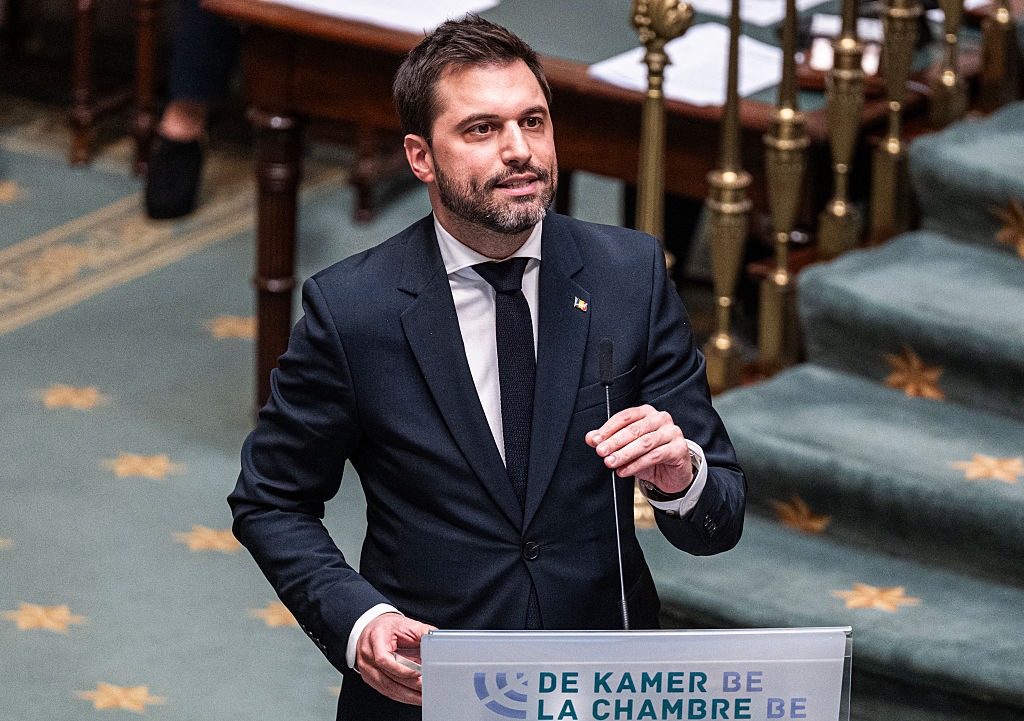
pro-Israel positions. Pictured: Bouchez speaks in the Chamber of the
Federal Parliament in Brussels on March 12, 2026. (Photo by Emile
Windal/Belga/AFP via Getty Images)
Joël Rubinfeld is a founding member and president of the Belgian
League Against Antisemitism and president of the Jewish Coalition for
Kurdistan. He was president of the Coordinating Committee of Jewish
Organizations in Belgium, vice-president of the European Jewish
Congress, and co-chairman of the European Jewish Parliament.
Grégoire Canlorbe: With the rise of antisemitism in Europe,
what has been the result? Has there been an exodus of Jews from Belgium,
and if so, what has been its scale?
Joël Rubinfeld: Yes, there has been, although there is no
precise data. We might turn to the statistics of the Jewish Agency for
Israel, which records how many Jews from different countries who settle
in Israel under the Law of Return, the right to come "home" - called Aliyah,
to go up. These figures make it possible to tell how many Belgian Jews
move to Israel each year but do not include those moving to other
countries.
Many of these new arrivals are closely linked to the resurgence of
antisemitism in Europe, which has unfolded in two main phases.
The first phase began in late September 2000, with the outbreak of
the Second Intifada. The months that followed saw a re-emergence of
unabashed antisemitism here in Belgium, mainly driven mainly by
political and activist circles on the left. Since then, the spectrum has
broadened.
From 2000, the numbers rose from around 60 departures a year to more than a fivefold increase over 15 years.
Before this century, departures were generally driven by ideological
or identity-based choices, such as idealism or Zionism, without any
sense of urgency. From 2000 onward, a different dynamic emerged:
whenever a conflict broke out in the Middle East, antisemitism spiked in
Belgium. This happened during the Second Intifada, which began in 2000;
then during the war with Hezbollah in 2006, then on four occasions
during conflicts with Hamas (2008–2009, 2012, 2014, 2021). Events taking
place thousands of kilometers away had a direct impact on the daily
lives of Jews in Belgium.
The second phase took place in the last two-and-a-half years,
starting with Hamas's invasion of Israel on October 7, 2023 -- but with a
change in nature. One might have expected that the jihadist invasion of
October 7, would trigger a wave of solidarity and empathy toward
Israel. It did -- for maybe two hours. On the very day of the attack --
days before the IDF retaliated -- the antisemites you see today came out
of the woodwork. They exploited the war in Gaza to advance their
narrative and swell their ranks -- to the point of turning the debate
into a form of institutional hostility.
This is also what took place in Belgium in most political parties.
They began accusing Israel of committing "genocide" in Gaza, calling for
economic sanctions or even a boycott of the Jewish state.
The latest example was the twelve-point anti-Israel plan pushed by
Foreign Minister Maxime Prévot, a leading figure and former president of
the centrist party Les Engagés, The Committed Ones. The plan includes discriminatory measures targeting not only Israel, but also Belgian Jews.
One point, particularly troubling, is a case that came to us
recently: Belgian citizens in the eastern part of Jerusalem and in Judea
and Samaria are denied access to Belgian consular services. A family of
Belgian Jews living in Ma'aleh Adumim, in Judea, went to the Belgian
consulate in Jerusalem the other day to renew their passports and were
turned away. They then turned to the embassy in Tel Aviv and were
refused as well. The message being sent was: "If you want a passport,
move to the internationally recognized areas of Israel."
One must grasp the symbolic meaning of this: Judea is where the name
"Jew" originated. Yet today, Belgian citizens of Jewish faith are being
discriminated against for living on their own ancestral land.
The Belgian authorities try to defend themselves by claiming that
this is not an ethnic specification, but a geographic one. In practice,
however, this measure applies only to "Belgians residing in the
settlements" — that is, Jews living in the Old City of Jerusalem or in
Judea and Samaria. What is ironic is that a Belgian residing in
Ramallah, for example, would face no obstacle in renewing their
documents. Does this also mean that a Belgian living in East Jerusalem
would receive consular services — provided they were not Jewish?
I actually put this question to the Foreign Ministry spokesperson; he
dodged it. He claimed not to know the answer. The question, though, is
simple: what is done for Belgians living in other disputed or
occupied territories — Taiwan, Northern Cyprus, Crimea,
Nagorno-Karabakh, and so on? There, one does not see exceptional
treatment. This is clearly a double standard, like the special "legal
status" imposed on Jews during the Second World War.
Belgium has also banned the overflight of aircraft carrying materials
that could be used by Israel for military purposes. That is how my
country treats the only democracy in the region, which is currently
fighting an existential war on seven fronts--not just to defend itself
but to defend Western civilization. Belgium and other countries in
Europe are trying to prevent Israel from defending itself – and Europe!
Canlorbe: How do you and other Jews view the various
antisemitic acts that have occurred in Belgium since October 7? Was
October 7 a catalyst?
Rubinfeld: We witnessed not just a simple increase in antisemitic acts, but an explosion.
According to figures from Unia — the inter-federal body responsible
for monitoring racism and discrimination — in the three months after
October 7, 2023, reported antisemitic acts rose by 1,000% -- ten times
higher than for the same period the previous year.
Another organization, Antisemitisme.be, recently published its
figures for 2025, recording 232 antisemitic incidents – which may not
seem all that many, but these figures remain far below the reality. They
are just, as the saying goes, "the tip of the iceberg."
In Brussels, for instance, there is a "pro-Palestinian" demonstration
in the city center every day. It is not authorized, but it is tolerated
by the city's mayor. During these gatherings, participants openly chant
the 2.0 slogan of the "Final Solution" -- "From the river to the sea,
Palestine will be free" -- yet such incidents are not included in the
statistics. If these daily occurrences alone were added, they would
already exceed all official totals.
The problem is the trend. The official figures represent an 80%
increase compared to 2024, which was already an abnormally high year
after October 7, 2023, when levels were high.
Canlorbe: Are the French different from the Belgians in their attitude toward antisemitism?
Rubinfeld: Belgium broadly faces the same problems as France. The reactions, however, differ.
In France, when an antisemitic act takes place, it often triggers a
clear public response: statements from political leaders, media
coverage, and condemnations from public figures. This was seen again
recently when the names of Jews were mangled by the leader of the French
far left, Jean-Luc Mélenchon. The incident sparked an uproar and was
denounced by many political, intellectual, and media figures.
In Belgium, this kind of mobilization is rare. Yes, there are people
of integrity, but they remain the exception. In the political sphere,
the most notable example is Georges-Louis Bouchez, president of the
Mouvement Réformateur ("Reformist Movement," a center-right party), who
regularly speaks out against antisemitism and defends pro-Israel
positions.
Of the twelve Belgian political parties, eight have embraced what is
currently the central antisemitic theme: falsely accusing Israel of
"genocide" in Gaza. Three of the five parties are in the governing
coalition — the foreign minister himself speaks that way.
At its core, there seems to be a historic, ancient hatred that
changes its vocabulary according to the era. Two thousand years ago,
Jews were accused of "deicide"; today, of "genocide." Antisemitism, like
a virus, adapts to its environment. In Western societies, where
religion is less important, the accusation is recast in the dominant
language of the moment — that of human rights.
In addition, there seems to be a linguistic drift: Israel means
Zionist means Jew. By conflation, what begins as criticism of a state
gradually turns into targeting people -- a "domino effect" -- in France
and Belgium and other places as well.
Canlorbe: Unless I am mistaken, your family on both sides, had
to flee countries where there was antisemitic persecution. Morocco
joined the Abraham Accords. In Russia, Federal Law No. 128-FZ of May 5,
2014 criminalizes Holocaust denial and the approval of Nazi crimes. In
your view, are Morocco and Russia fallback options for Jews?
Joël Rubinfeld: Yes, the last three generations of my father's
family had to flee antisemitic persecution, first from Russian pogroms,
then from Poland, then, in 1939, from Austria, after which, they found
refuge in Belgium.
On my mother's side, the story is different. She was born in Morocco
and had to leave her country in 1960 amid a growing climate of
insecurity for Jews. Further back, her family descends from Jews
expelled from Spain at the time of the Inquisition — under Isabella the
Catholic and Torquemada — who found refuge in Morocco in 1492. Life
there was not always idyllic, but my mother's family were able to remain
on the same land for nearly five centuries.
Today, as his ancestors did before him, the King of Morocco protects
the Jews, but very few remain. When my mother was born in 1943, there
were nearly 300,000 Jews in Morocco; today, the number is estimated at
2,000 to 3,000. Despite this, I feel a bond with the country. I do not
feel a bond with Austria. I feel somewhat at home in Morocco. In fact, I
feel safer walking around in Morocco than in many neighborhoods in
Brussels.
I know Russian Jews living in Moscow, and they seem to live there
normally. However, Russia does not really seem like a fallback option,
not least because of local practices when it comes to democracy and
freedom of expression.
Canlorbe: Trump is probably the most pro-Israel president
America has ever had. Do you have any concerns that the MAGA movement,
despite Trump's support for Israel, could become a springboard for a new
generation of right-wing antisemites?
Rubinfeld: Antisemitic tendencies can be found in every camp.
On the radical fringe of the MAGA movement and the American far right,
influencers such as Tucker Carlson, Candace Owens, and Nick Fuentes are
injecting the antisemitic poison into the minds of millions of young
people online. It is a real problem that needs to be confronted with the
utmost determination.
On the Republican side, this type of discourse is relatively recent
and has mainly developed around purveyors of hate active on social
media. But over the past twenty years, it is above all within the
Democratic camp that antisemitism has gained ground through its radical
wing, such as the "Squad."
One must fully grasp the significance of certain political signals,
such as the election of Zohran Mamdani as mayor of New York. His
election may herald a national trend, in two, six, or ten years. This is
all the more striking given that New York is, outside Israel, the city
with the world's largest Jewish population.
Antisemitism is universal. It can be found on the left and on the right. Herbert Pagani in Plea for My Land (Plaidoyer pour ma terre)
summed it up: the left-wing antisemite blames the Jews for being
capitalists, while the right-wing antisemite blames them for being
revolutionaries.
Canlorbe: In Belgium and France, where socialism and anti-Zionism have risen simultaneously, do you see any connection?
Joël Rubinfeld: Antisemitism fits nicely with the views of the
far left. Some authors regarded as foundational have made explicitly
antisemitic statements. Karl Marx, for instance, in On the Jewish Question
(1843), evidently innocent of the psychological device known as
projection --attributing to others aspects of yourself of which you feel
ashamed -- "What is the secular basis of Judaism? Practical need,
self-interest. What is the secular cult of the Jew? Huckstering. What is
his secular God? Money. Very well then! In emancipating itself from
huckstering and money, and thus from real and practical Judaism, our age
would emancipate itself."
This passage contains a line of thinking still present in certain
minds: the idea that "the Jew" embodies money, calculation, enslavement,
and that, in order to be "free", one must "emancipate oneself" from
Jews. This twisted rhetoric culminated in the industrial-scale
mass-extermination of Jews carried out by Nazi Germany.
Pierre-Joseph Proudhon also expresses
a rather raw antisemitism: "The Jew is the enemy of the human race.
This race must be sent back to Asia, or exterminated." "Rothschild,
Crémieux, Marx, Fould — malicious, bilious, envious, acrid beings (...)
The Jew must disappear: by iron, by fire, or by expulsion."
Proudhon even includes Marx, although he was not, strictly speaking,
Jewish: his grandfathers were indeed rabbis, but his parents had
converted to Protestantism, and Marx was baptized at the age of six. Yet
beyond personal rivalries and sectarian quarrels, the central idea
remains: the Jew — or the presumed Jew — is portrayed as the incarnation
of evil.
The same interpretive lens is at work today among certain frameworks:
whether one calls it wokism, intersectionality, or Islamo-leftism, one
often finds a Marxist worldview divided between oppressors and
oppressed. The designated enemy is "the white person," and even more so
"the white male"; within a Marxian or Proudhonian logic, "the Jew" ends
up being portrayed as a kind of "super-white" — the ultimate enemy.
Antisemitism: it reaches levels of verbal and physical violence
rarely seen in other forms of hatred, because it does not merely target
an individual or a group; it constructs a totalizing myth — that of a
supposedly omnipresent, corrupting force responsible for all evils.
Grégoire Canlorbe: Although Bart De Wever condemned the
October 7 attack, he refused to support Israel in the war in Gaza;
moreover, he conditionally recognized the Palestinian state. Is that
really a policy worthy of someone claiming to support Israel?
Joël Rubinfeld: The reality is more complex.
Within the coalition, there are five parties, three of which follow
an anti-Israel line: the Flemish Christian Democrats, the Flemish
socialists, and the French-speaking centrists. On the other side are the
government's two heavyweight parties: the Flemish nationalists — De
Wever's party — and the French-speaking center-right party led by
Georges-Louis Bouchez.
Bart De Wever is neither an outspoken critic of Israel nor an
unwavering supporter; yet if most likely, if left to his own judgment,
he would stand on Israel's side rather than oppose it.
The problem is that he has to hold the coalition together. The three
anti-Israel parties are smaller, but each could bring down the majority
by leaving the government. And for those parties, the Palestinian cause
has become a central electoral issue — in a sense, a matter of political
survival. So De Wever is not hostile to Israel; he is above all
constrained by the internal balance of his coalition.
On the question of recognizing Palestine, Bart De Wever accepted a
conditional formula: the anti-Israel parties wanted immediate
recognition, as Ireland, Spain, Slovenia, and others did — and as France
later put on the agenda. De Wever and Bouchez did not want to go that
far.
In the end, it is a "Belgian compromise": no one is happy, but no one is entirely losing either.
Canlorbe: What hopes do you place in conservative [in French: libéral] politician Georges-Louis Bouchez?
Rubinfeld: He represents the main political shield for
Belgium's Jews. And I do mean the man, more than the party: if he were
replaced tomorrow by someone more lukewarm, it is not unthinkable that
the Reformist Movement, too, could end up on the wrong side of history.
What makes the difference is his personality. Bouchez is a
straight-talker, someone who is neither impressed nor intimidated. In a
context where media, activist, and electoral pressure push many
politicians into making concessions, this ability to stand firm makes
all the difference. Georges-Louis Bouchez may not have Winston
Churchill's composure, but he does have his resolve.