by Uzay Bulut
A new 2026 annual report, "Scapegoats: Rights Violations Against Christians in Iran," published by Article18 in partnership with Open Doors, Christian Solidarity Worldwide and Middle East Concern, sheds an alarming light on the persecutions of Christians in Iran.
House churches have been labeled as enemy groups. IRGC involvement in raids tends to be characterized by increased brutality.
The IRGC agents, singling out whoever was wearing a cross, tore them off and conducted body searches. After they wounded several individuals, the agents blocked emergency medical personnel who attempted to assist them.
Last month, regime security forces moved to seize Saint Peter Evangelical Church in Tehran. They ordered residents of the church compound to leave their homes, and worshippers were told to find a different church. The seizure of Saint Peter, built in 1876 and also known as Qavam Church, and the eviction of its residents, who belong to Iran's recognized Armenian and Assyrian Christian communities, come after a state organization moved to enforce a court order issued nearly 30 years ago. The order, issued by a Revolutionary Court in 1998, ruled that the entire church compound -- around 10 acres, which includes two schools and dozens of homes -- should be handed over to the Execution of Imam Khomeini's Order.
"House churches are commonly raided, often followed by arrests, interrogations, pressure to inform on other Christians and long-term imprisonment. This is typically under charges of breaching 'national security'. The conditions in prison are dire... Each year, thousands of converts flee Iran to escape persecution." — Open Doors.
A year after the Bible Society's closure [in 1990], Iran's representative at the United Nations wrote to the UN's special rapporteur, saying the Bible Society had been "temporarily closed", pending investigation of "violations of the Islamic Republic's laws and regulations" – without specifying which – and adding that "when the situation of the accused becomes clear, the Society could continue its activities."
Yet, 36 years later, Iran's Bible Society remains closed, and the Bible and other Christian books are frequently treated as illegal contraband and evidence of a crime.
The same regime that terrorizes its own citizens has also been demanding the right to develop and build nuclear weapons and ballistic missiles, and plans the continued use of centrifuges for uranium enrichment in its underground site at Pickaxe Mountain. The Islamic Republic has also declared that it will charge "fees" from commercial maritime passage through the Strait of Hormuz, and retain control of its main terrorist proxy, Hezbollah, which is now controlling beautiful Lebanon -- known before its 1975-1990 civil war as the "Switzerland of the Middle East."
The Islamic Republic of Iran has no intention of giving up exporting its terrorism throughout the wider Middle East. It funds, arms, and trains a network of terrorist proxies, in addition to Hezbollah in Lebanon: the Houthis in Yemen and various Islamic militias in Syria and Iraq.
The Islamabad Memorandum of Understanding that the Trump administration signed with Iran is most likely regarded by Iran's IRGC regime as an irrelevant infidel document. It will do nothing to curb their hatred for Christians, Jews, their own citizens, and the West.
A new 2026 annual report, "Scapegoats: Rights Violations Against Christians in Iran," published by Article18 in partnership with Open Doors, Christian Solidarity Worldwide and Middle East Concern, sheds an alarming light on the persecutions of Christians in Iran.
According to the report, at least 21 Christians have received custodial sentences in 2025 related to their alleged involvement in the distribution of Bibles in Iran, in addition to other forms of punishment, such as fines, exile, and social deprivation.
In June 2025, two Christian converts were convicted under Article 500 of "propaganda activity of deviant Christian 'Zionist' beliefs opposed to the system of the Islamic Republic of Iran." Each was sentenced to 10 years in prison. They were also accused of "distributing smuggled goods" (Bibles) under Articles 22 and 24, for which they received two years and additional fines. They were tried in absentia, with the only evidence produced against them being Bibles and other Christian literature found in their homes.
Contempt for the Bible, the report states, can also be seen in a reference to it as a "prohibited book" in a different indictment of two Iranian-Armenians and three Christian converts. In June 2025, they were charged with "propaganda" and "collusion," and in November were sentenced to a combined total of more than 50 years in prison. In other court verdicts in 2025, the Bible was referred to as a "distorted", "deviant", "corrupt", or "misleading" book.
Other trends, according to the report, include the increasing involvement of the Islamic Revolutionary Guard Corps (IRGC) in arresting Christians, targeting those involved in distributing the Bible; severe mistreatment of Christian detainees; consistent use of Article 500 of the penal code (relating to "propaganda contrary to the holy religion of Islam") to convict Christians; and the monitoring of Christians' overseas activities, such as attending theological seminars.
The IRGC is now playing an expanding role in gathering intelligence on and persecuting Iran's Christians. As the IRGC's declared role is to defend the Islamic Republic, the increasing arrests of Christians would suggest that the regime sees them as a threat.
House churches have been labeled as enemy groups. IRGC involvement in raids tends to be characterized by increased brutality. On the evening of February 6, 2026, for instance, at least 20 plainclothes IRGC agents raided a gathering of around 80 Christians in Gatab, Mazandaran Province, confiscated Bibles and musical instruments, and arrested a Christian convert, Somayeh Rajabi.
The IRGC agents, singling out whoever was wearing a cross, tore them off and conducted body searches. After they wounded several individuals, the agents blocked emergency medical personnel who attempted to assist them. A day after her arrest, Rajabi was permitted a brief phone call to her family, in which she informed them that she was being held in a prison in Sari. She was later transferred to Mati Kola Prison in Babol. On March 8, she was released on bail of more than $40,000 after being charged with "gathering and collusion" and "propaganda against the regime". On April 15, Rajabi and six others were summoned to the prosecutor's office of Babol to offer their final defense, the final step before an indictment. At the time of the report's release, no further updates had been received.
In 2021, Iran's parliament amended Articles 499 and 500 of the penal code to increase penalties and broaden the scope against those who could be charged with membership of a group "aiming to perturb the security of the country" or of engaging in "propaganda against the Islamic Republic of Iran".
Civil rights organizations, such as Article18, warned that these provisions would be used to "choke... freedoms" and intensify criminalizing minorities. The UN Human Rights Committee subsequently called on the Islamic Republic to "repeal or amend" the articles.
The Islamic Republic has nevertheless abused its laws to crack down on Christians even further. In 2025, according to the report, 254 Iranian Christians were arrested, nearly twice as many as in 2024, and sentenced to a total of more than 280 years in prison.
In the vast majority of cases (nearly 90%), charges against Christians were brought under the amended Article 500 of the penal code, which criminalizes "propaganda contrary to the holy religion of Islam."
The convictions and imprisonments of Christians continue. On July 3, Article18 reported that the sentences of five Iranian Christians condemned to a combined more than 70 years in prison -- for ordinary Christian activities, such as praying, performing baptisms, taking Communion and celebrating Christmas -- have been upheld by an appeals court.
On top of the prison sentences, the Christians' personal property, including Bibles and other Christian literature, was confiscated by the state for the "research" purposes of the Ministry of Intelligence – as in another case last year in which two Christians were sentenced to 12 years each in prison for "smuggling" Bibles into Iran.
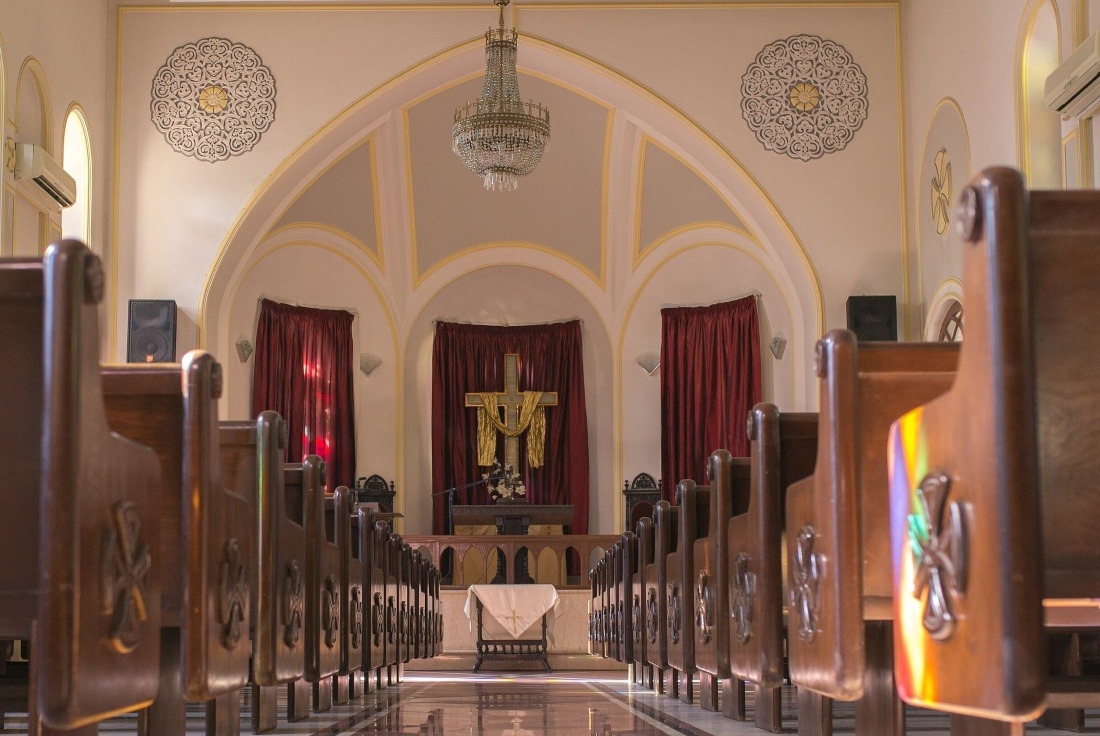
Last month, regime security forces moved to seize Saint Peter Evangelical Church in Tehran. They ordered residents of the church compound to leave their homes, and worshippers were told to find a different church. The seizure of Saint Peter, built in 1876 and also known as Qavam Church, and the eviction of its residents, who belong to Iran's recognized Armenian and Assyrian Christian communities, come after a state organization moved to enforce a court order issued nearly 30 years ago.
The order, issued by a Revolutionary Court in 1998, ruled that the entire church compound -- around 10 acres, which includes two schools and dozens of homes -- should be handed over to the Execution of Imam Khomeini's Order (EIKO). EIKO has also been responsible for the confiscations of Assyrian Presbyterian churches in Tabriz and Mashhad, as well as an Assemblies of God church in Gorgan and a retreat center in Karaj.
According to a report on Iran by the organization Open Doors:
"[Chrisian] converts are most in the firing line. House churches are commonly raided, often followed by arrests, interrogations, pressure to inform on other Christians and long-term imprisonment. This is typically under charges of breaching 'national security'. The conditions in prison are dire, and bail sums can be extortionately high, financially paralyzing families. For Christians who are released, that typically comes with strict conditions, such as exile to another part of Iran, or self-censorship... Each year, thousands of converts flee Iran to escape persecution."
For 47 years, the Iranian people have been subjected to a regime that brutally quashes dissenting voices, opinions and beliefs.
For 47 years, the Islamic Republic has systematically repressed its own citizens, including the Muslim majority, through ruthless state-sponsored violence, discrimination, and political persecution targeting any citizen who dissents from the government's radical religious and political mandates.
If citizens criticize the regime or protest economic distress, they face heavy state surveillance, arbitrary detention, and lethal force. Women and girls who refuse to comply with mandatory hijab laws face savage crackdowns, imprisonment, and physical and sexual abuse by "morality" police.
Apart from tormenting their own Muslim population, the Islamic Republic of Iran also criminalizes conversions to Christianity, church activities and the printing and possession of Bibles. Printing and distributing Bibles within Iran has been a criminal offense since the Islamic regime closed the Bible Society in 1990.
Globally, the Bible Society plays a key role in the translation, publishing and distribution of Bibles, and the presence of the Bible Society in Iran dates back to 1811, with the visit of Henry Martyn and the revision of his Persian translation of the New Testament.
This changed in Iran in February 1990, when regime authorities raided the Bible Society of Iran in Tehran and ordered its closure. The organization had served for decades as the country's principal publisher and distributor of Persian-language Bibles and Christian literature. Its closure effectively ended the legal printing and publication of Christian texts in Persian — the language spoken by the overwhelming majority of Iranians — and marked a significant escalation in state efforts to restrict public access to Christian teachings.
Since the forced closure and confiscation of the Bible Society's premises in Tehran in 1990, Christians have found it challenging to access printed Bibles and the Iranian authorities have criminalized importing and distributing Bibles.
A year after the Bible Society's closure, Iran's representative at the United Nations wrote to the UN's special rapporteur, saying the Bible Society had been "temporarily closed", pending investigation of "violations of the Islamic Republic's laws and regulations" – without specifying which – and adding that "when the situation of the accused becomes clear, the Society could continue its activities."
Yet, 36 years later, Iran's Bible Society remains closed, and the Bible and other Christian books are frequently treated as illegal contraband and evidence of a crime.
Ordinary Christian activities are also criminalized and punished by the Islamic regime. Christians are arrested and imprisoned over charges related to church activities, such as baptism, Communion, gathering for prayer or Bible study, including those conducted abroad.
On December 28, 2025, mass protests erupted in Iran, leading to weeks-long nationwide demonstrations calling for an end to the Islamic Republic's leadership of the country.
"The response to those protests has been horrifying, with reports of many thousands killed, including several Christians, and every Iranian -- regardless of their religious background -– affected," states the recent report by Article18, Open Doors, Christian Solidarity Worldwide and Middle East Concern
The same regime that terrorizes its own citizens has also been demanding the right to develop and build nuclear weapons and ballistic missiles, and plans the continued use of centrifuges for uranium enrichment in its underground site at Pickaxe Mountain. The Islamic Republic has also declared that it will charge "fees" from commercial maritime passage through the Strait of Hormuz, and retain control of its main terrorist proxy, Hezbollah, which is now controlling beautiful Lebanon -- known before its 1975-1990 civil war as the "Switzerland of the Middle East."
The Islamic Republic of Iran has no intention of giving up exporting its terrorism throughout the wider Middle East. It funds, arms, and trains a network of terrorist proxies, in addition to Hezbollah in Lebanon: the Houthis in Yemen and various Islamic militias in Syria and Iraq.
The Islamabad Memorandum of Understanding that the Trump administration signed with Iran is most likely regarded by Iran's IRGC regime as an irrelevant infidel document. It will do nothing to curb their hatred for Christians, Jews, their own citizens, and the West.
Uzay Bulut, a Turkish journalist, is a Distinguished Senior Fellow at Gatestone Institute.
Source: https://www.gatestoneinstitute.org/22678/iran-war-on-christians

No comments:
Post a Comment