Saturday, February 15, 2025

The Case for Ending the Israel-Hamas Ceasefire - Jonathan Spyer


by Jonathan Spyer

The Question Now Facing Israel Is This: Will the War in Gaza Recommence?


Hamas terrorists hand over Israeli hostages to the Red Cross as part of the ceasefire agreement with Israel; Khan Yunis, southern Gaza Strip, January 30, 2025.

Hamas terrorists hand over Israeli hostages to the Red Cross as part of the ceasefire agreement with Israel; Khan Yunis, southern Gaza Strip, January 30, 2025. Shutterstock

The question now facing Israel is this: will the war in Gaza recommence? The ceasefire agreement was signed less than a month ago, and it is already looking shaky.

The first phase of the deal has not yet been completed. Sixteen of the 33 Israeli hostages scheduled to be freed in this phase have been released, and so have 656 of 2,000 Palestinian prisoners. But Hamas has now announced the postponement of the release of an additional three hostages, which was scheduled to take place this Saturday.

As currently constituted, the agreement leads to an outcome which is, and which should be, entirely unacceptable to Israel: namely, the survival of the Hamas regime in Gaza.

US President Donald Trump has expressed support for abandoning the phasing of the deal, and demanded that all hostages be released by Saturday at noon – not just those scheduled for the weekend. Israeli Prime Minister Benjamin Netanyahu, meanwhile, has also said that the ceasefire will end if hostages are not released, but has not echoed Trump’s call for every hostage to be immediately freed: ‘If Hamas does not return our hostages by Saturday noon,’ he said, ‘the ceasefire will end, and the IDF will return to intense fighting until Hamas is completely defeated.’

Regardless of these specifics, the fact is that, as currently constituted, the agreement leads to an outcome which is, and which should be, entirely unacceptable to Israel: namely, the survival of the Hamas regime in Gaza. In the second phase of the agreement, the IDF will fully withdraw from Gaza, and there will be a long-term cessation of fire.

At that point, if it’s reached, as the smoke begins to clear, it will become apparent that the Hamas regime in Gaza has survived Israel’s response to the massacres of 7 October. A narrative will then begin to be spun: the events of the past 18 months, Hamas will argue, show the way forward in the battle against Israel: if you want to strike at the Jewish state and prevent it from an effective response, all you have to do is make sure that you capture some Israeli hostages.

They can be military or civilians, male or female. If you can secure these unfortunates, and begin to bargain for them, then you will succeed in preventing any serious harm to the things that matter to you. (In the case of the Palestinian Islamists, the things that matter to them do not include the lives of Palestinian civilians, or the infrastructure of civil life). At the end, you will have suffered, but you will have survived to plan the next attack.

It seems fairly clear that the Israeli prime minister, while wanting to secure the freedom of as many hostages as possible, considers that this outcome to the war would constitute a mortal peril to the future security of Israel, and perhaps over the long term to its survival. As a result, it looks like he is reluctant to go further down this road, and may well prefer to recommence the fighting rather than acquiesce to the survival of Hamas governance in Gaza.

If Hamas in Gaza can secure its survival through the taking of hostages and their exchange for its continued governance, it will justifiably be able to claim victory in its most recent war with Israel.

He would be right to do so. While Israel has tended to emphasise the regional level threats to its security in recent years, its core challenge, as demonstrated on 7 October, is closer to home. There is, between the Jordan River and the Mediterranean Sea, two populations of roughly equal size, one Israeli-Jewish, the other Palestinian-Arab-Muslim. The latter population, as all electoral records and polling will confirm, favours political Islam as its preferred form of governance. Political Islam, in both its Sunni and Shia forms, rejects the possibility of continued sovereignty for the Israeli-Jewish people, and is actively engaged in efforts to undermine, erode and eventually destroy Jewish sovereignty in the area. Islamist movements are engaged in a long war, intended to break the will of the Israeli people and slowly to erode Israel’s viability.

The 2023-24 Gaza war began with the worst single massacre of Jews since the Holocaust. If it ends with the survival of the authority which ordered and carried out this massacre, then that authority and the idea it represents will have been immeasurably strengthened. Israel’s continued viability depends on the maintenance of deterrence, in hostile surroundings. It is in this context that current events should be viewed. If Hamas in Gaza can secure its survival through the taking of hostages and their exchange for its continued governance, it will justifiably be able to claim victory in its most recent war with Israel. Its actions on 7 October and subsequently will then form a model for the next generation of jihadis. The second phase of the ceasefire agreement is set to produce this outcome. It ought to be unacceptable to Israel.


Jonathan Spyer oversees the Forum’s content and is editor of the Middle East Quarterly. Mr. Spyer, a journalist, reports for Janes Intelligence Review, writes a column for the Jerusalem Post, and is a contributor to the Wall Street Journal and The Australian. He frequently reports from Syria and Iraq. He has a B.A. from the London School of Economics, an M.A. from the School of Oriental and African Studies in London, and a Ph.D. from the London School of Economics. He is the author of two books: The Transforming Fire: The Rise of the Israel-Islamist Conflict (2010) and Days of the Fall: A Reporter’s Journey in the Syria and Iraq Wars (2017).

Source: https://www.meforum.org/mef-online/the-case-for-ending-the-israel-hamas-ceasefire

Follow Middle East and Terrorism on Twitter

Thursday, February 13, 2025

Even before the war: 44% of young Gazans considered emigrating - opinion - Itamar Marcus


by Itamar Marcus

Gazans who choose to leave must be guaranteed secrecy and protection during the process.


Palestinians celebrate the release of security prisoners in the central Gaza Strip, February 8, 2025 (photo credit: Ali Hassan/Flash90)
Palestinians celebrate the release of security prisoners in the central Gaza Strip, February 8, 2025
(photo credit: Ali Hassan/Flash90)

The question being asked today around the world is whether President Donald Trump’s plan to resettle Gazans in other countries can succeed. Judging by a poll taken just prior to the war, before much of Gaza was destroyed, Trump’s proposal is reasonable.

The poll by the top Palestinian polling agency, the Palestinian Center for Policy and Survey Research, found that a full 44% of Gazan youth between the ages of 18-29 were considering emigrating. Nearly a third (31%) of the entire population considered emigrating.

Gazans’ “most preferred destination for immigration is Turkey, followed by Germany, Canada, the United States, and Qatar,” the poll found.

The largest percentage said they want to leave for economic reasons; second and third reasons are “political” or educational opportunities. The fourth reason is security, and the fifth is corruption.

Since such a large number wanted to leave when there was no war and no destruction, there is no doubt that today, the numbers will be much higher.

 View of the southern Gaza Strip.  February 7, 2025. (credit: ABED RAHIM KHATIB/FLASH90)Enlrage image
View of the southern Gaza Strip. February 7, 2025. (credit: ABED RAHIM KHATIB/FLASH90)

Facing years of life in tents and rubble, breathing dust and hearing endless construction noise, the number wanting to leave today, especially among the youth who desire to start a life and build a future, will be far above 50%.

PA and Hamas will reject the plan

Two important things must be noted: Firstly, the Palestinian Authority and Hamas undoubtedly will reject this plan for political reasons, even though it is best for the residents. Neither the Palestinian Authority nor Hamas has put the good of its people ahead of political considerations. They will fight it in every possible way. 

Secondly, if pollsters ask Palestinians what they want now, they might not choose emigration because of fear of being called traitors.

Accordingly, if Trump wants his plan to succeed, he must bypass the Palestinian Authority and Hamas and work directly with the people. Gazans who choose to leave must be guaranteed secrecy and protection during the process.

Once people start leaving, those left behind will feel jealous of those already out of the Gaza hell. Once those who are resettled start sending messages about their new lives and pictures of their new homes, the floodgates will open.

The writer is director of Palestinian Media Watch.


Itamar Marcus

Source: https://www.jpost.com/opinion/article-841362

Follow Middle East and Terrorism on Twitter

Israel could strike Iran nuclear sites this year, US intel document shows - report - Mathailda Heller, Jerusalem Post Staff


by Mathailda Heller, Jerusalem Post Staff

A report by the Wall Street Journal shows Israel may be planning major strikes on Iran's nuclear sites this year, seeking potential US backing under the Trump administration.


Iranians burn makeshift Israeli and US flags along with a cardboard obelisk, in Tehran, Iran, February 10, 2025 (photo credit: MAJID ASGARIPOUR/WANA (WEST ASIA NEWS AGENCY) VIA REUTERS)
Iranians burn makeshift Israeli and US flags along with a cardboard obelisk, in Tehran, Iran, February 10, 2025
(photo credit: MAJID ASGARIPOUR/WANA (WEST ASIA NEWS AGENCY) VIA REUTERS)

An American intelligence assessment determined that Israel may be considering strikes on Iran’s nuclear facilities this year, the Wall Street Journal and the Washington Post reported Wednesday night.

The Washington Post was more specific, claiming Israel plans to attempt a strike on Iran’s Fordow and Natanz nuclear facilities in the first six months of 2025.

The two articles are based off a report produced by the intelligence directorate of the Joint Chiefs of Staff and the Defense Intelligence Agency, published in January. The assessment, conducted during the final days of the Biden administration, claims that Israel has been considering large-scale strikes on Iranian nuclear sites, with the aim of exploiting Iran’s weaknesses.

The WSJ also reported that Israel is expected to urge the current administration to back the idea, as US President Donald Trump is seen as someone who could potentially join the strikes.

Last week, Trump signed a national-security memorandum regarding his policy of “maximum pressure” on Iran. While he did not exclude the possibility of Israeli strikes on Iran, he showed preference for a diplomatic method first.

 Iran's Defense Minister Brigadier General Mohammad-Reza Ashtiani walks near an Iranian missile during an unveiling ceremony in Tehran, Iran, in this picture obtained on February 17, 2024. (credit: Iran's Defense Ministry/WANA (West Asia News Agency)/Handout via REUTERS)Enlrage image
Iran's Defense Minister Brigadier General Mohammad-Reza Ashtiani walks near an Iranian missile during an unveiling ceremony in Tehran, Iran, in this picture obtained on February 17, 2024. (credit: Iran's Defense Ministry/WANA (West Asia News Agency)/Handout via REUTERS)

“Reports that the United States, working in conjunction with Israel, is going to blow Iran into smithereens, ARE GREATLY EXAGGERATED,” he wrote last week on Truth Social. 

US military sources told the WSJ that American support, including in the form of weapons, would prove essential for Israel to successfully carry out such attacks.

The Washington Post lays out two possible attacks: one, a distance attack, known as a standoff strike, which involves the launching of air-launched ballistic missiles, or ALBMs, outside of Iranian airspace; the second, arguably riskier option, involves Israeli air craft entering Iranian airspace, flying near the nuclear sites and dropping BLU-109s, a type of bunker buster.

Notably, the sale of guidance kits for BLU-109s to Israel was approved by the Trump administration last week. 

Iran continues to grow its nuclear capabilities

Additionally, it was reported that Israel is concerned about the time frame as the opportunity to stop Iran’s nuclear capabilities shrinks.

However, the Washington Post added that the intelligence assessment found that an Israeli attack on Iran’s nuclear facilities would - in the best case scenario - only set Tehran back by months, or maybe even weeks. It also suggested that such strikes would propel Iran to pursue weapons-grade enrichment of uranium.

The report stated that the Prime Minister's Office did not respond to the allegations, nor did the IDF spokesman.

Trump recently stated that he would prefer to sign a deal with Iran that renders it non-nuclear rather than attack the Islamic Republic in an interview with the New York Post.

"I would like a deal done with Iran on non-nuclear. I would prefer that to bombing the hell out of it," the president was cited as saying.

"They don’t want to die. Nobody wants to die," he added. 

Echoing these sentiments, former Israeli national security advisor Yakov Amidror told WSJ that Israel would be better served by a new deal in which Iran agrees to dismantle its nuclear program.

If this fails, "Israel will have to act against the nuclear project of Iran,” he added. 

 
Mathailda Heller, Jerusalem Post Staff

Source: https://www.jpost.com/middle-east/article-841917

Follow Middle East and Terrorism on Twitter

Resettling Gaza - Daniel Greenfield


by Daniel Greenfield

Is it the right thing to do and can it work? Yes it can.


  • Many, if not most, "peace plans" propose the further resettlement of hundreds of thousands of Jews living in Judea and Samaria to make way for a "Palestinian" state. Even as they object to resettling Gazan Muslims in Arab countries, they refer to Jews living in the "West Bank" as settlers, refer to their communities as "settlements," and propose that they be resettled elsewhere.

  • The same people who insist that it's morally wrong and impractical to resettle 2 million Muslims out of Gaza also argue that it's morally right and practical to resettle nearly half a million Jews....

  • Despite being told it was impossible, Israelis evacuated hundreds of thousands of Gazans to make way for military operations. During the beginning of the war, around one million Gazans left the north for the south of the Gaza Strip, and the UN would later claim that as many as 1.5 million Muslim settlers in Gaza had been displaced.

  • The resettlement of large numbers of "Palestinians" has happened before in the Middle East. While the resettlement of Gaza would take place on a larger scale, it would not be that much larger than the resettlements during the war or in the aftermath of the Gulf War.

  • The objections to it [resettlement], both moral and practical, are groundless. Resettlement is feasible and moral. If the Kuwaitis and the Jordanians could resettle the "Palestinians" out of their countries on far less grounds than the atrocities of Oct 7, the Israelis certainly have the right to do it.

  • The PLO and Hamas used terrorism at every turn to press for more Israeli concessions while giving nothing in return. Their leaders have said again and again that they intend to destroy Israel.

  • After Oct 7, everyone is finally taking them at their word.

The same people who insist that it's morally wrong and impractical to resettle 2 million Muslims out of Gaza also argue that it's morally right and practical to resettle nearly half a million Jews. Pictured: A car loaded with mattresses drives through Gaza on February 1, 2025. (Photo by Moiz Salhi/Middle East Images/AFP via Getty Images)

After President Donald Trump proposed resettling the Arab Muslim settlers currently living in Gaza, there was an outbreak of furious objections from politicians, activists and media outlets.

The objections could be roughly divided into the moral and the practical. The "moral" objection was that it is "wrong" to resettle the population currently occupying Gaza, and the "practical" objection was that it would be impossible to accomplish. Both objections do not hold up.

The Jewish population of Gaza was resettled twice, once after the Egyptian invasion and conquest of Gaza during the 1948-49 War of Independence, and the second time after the 2005 "disengagement" forcibly eliminated 21 Jewish communities and expelled families living there.

Not only did politicians and the media not object to the forcible removal of the Jewish communities of Gaza, but they celebrated it as a step forward for peace in the region.

Many, if not most, "peace plans" propose the further resettlement of hundreds of thousands of Jews living in Judea and Samaria to make way for a "Palestinian" state. Even as they object to resettling Gazan Muslims in Arab countries, they refer to Jews living in the "West Bank" as settlers, refer to their communities as "settlements," and propose that they be resettled elsewhere.

UN Security Council Resolution 242 has been interpreted by many politicians and the media to mean that Israel must withdraw from territory, including parts of Jerusalem, where 450,000 Jews live. The same people who insist that it's morally wrong and impractical to resettle 2 million Muslims out of Gaza also argue that it's morally right and practical to resettle nearly half a million Jews in Israel.

Opponents of Trump's proposal don't believe it's wrong to resettle a population; they would just rather expel and resettle Jews than expel and resettle the Arab Muslim colonial population.

They don't oppose resettlement, they support terrorism.

With the moral question out of the way, what about the practical one: is it even possible?

Some say that the Gaza Arab Muslim population could not be moved without "door-to-door fighting." But Israel's recent experience in the war after October 7, 2023 shows that's clearly not true.

Despite the false claims of genocide, the Israelis kept civilian casualties to a minimum by evacuating as much as the "civilian" population as possible from one part of Gaza to another.

Despite being told it was impossible, Israelis evacuated hundreds of thousands of Gazans to make way for military operations. During the beginning of the war, around one million Gazans left the north for the south of the Gaza Strip, and the UN would later claim that as many as 1.5 million Muslim settlers in Gaza had been displaced. Most of those in Gaza followed orders and got out of the way of the fighting.

Looking to examples beyond Israel, the Black September war between Jordan and the PLO in 1970 resulted in the deaths of some 4,000 terrorists and as many as 25,000 civilians, according to Yasser Arafat, and some 20,000 "Palestinians" were resettled in "refugee camps" in Lebanon

After the Gulf War in 1991, Kuwait punished the "Palestinians" who had collaborated with Iraq's Saddam Hussein, by expelling some 280,000 of them in a mass purge that was later joined by Saudi Arabia, Qatar and other Gulf allies for a total estimated by "Palestinian" advocates at 400,000.

Kuwait shelled "Palestinian" neighborhoods and sent in death squads to massacre them. Tanks and troops were deployed, checkpoints were set up and most of the "Palestinians" were driven from Kuwait and their neighborhoods were eliminated. Parts of Hawally, where the "Palestinians" used to live, were bulldozed and turned into an amusement park.

This was done with the support of the George H.W. Bush administration.

"I think we're expecting a little much if we're asking the people in Kuwait to take kindly to those that had spied on their countrymen that were left there, that had brutalized families there, and things of that nature," Bush told reporters at a press conference on July 1, 1991.

Saudi Arabia deported over 50,000 "Palestinians," Bahrain, the UAE and Qatar, which has since become a state sponsor of Hamas, also began firing, expelling and deporting "Palestinians."

None of these events occasioned much protest or commentary. They occurred with the support of western governments who, like Bush, compared it to the reactions of the French against collaborators after the Nazi occupation, and life soon went on as it had before.

The resettlement of large numbers of "Palestinians" has happened before in the Middle East. While the resettlement of Gaza would take place on a larger scale, it would not be that much larger than the resettlements during the war or in the aftermath of the Gulf War.

Such a resettlement is both practical and morally defensible since there are no other options.

The underlying problem in the conflict is that Israel resettled some 800,000 Jewish refugees from the Muslim world, while the Arab Muslim nations who attacked it failed to do likewise. Along with the UN, they insisted on maintaining them under the fake identity of "Palestinians" as a perpetual army of occupation, forming into terrorist groups for an endless war with Israel.

"You have to learn from history. You can't keep doing the same mistake over and over again," Trump pointed out.

Every possible effort has been made to create a "Palestinian" state for over 30 years. After multiple peace proposals, land concessions, endless rounds of negotiations and taxpayer funding (over $2 billion through USAID to the "Palestinians" since Oct 7 alone) nothing worked.

When Israel withdrew from Gaza in 2005, leaving behind greenhouses and plans for new industries, along with sizable international funding, Hamas turned it into a war zone.

Two-state solutionists continue to argue that if Israel were to offer even more land, expel and resettle more Jews, the Muslim terrorists would finally agree to a permanent peace.

But there has never been a single shred of evidence that would work. None of the Israeli proposals or concessions undertaken since the late 1980s have led to any kind of peace. The PLO and Hamas used terrorism at every turn to press for more Israeli concessions while giving nothing in return. Their leaders have said again and again that they intend to destroy Israel.

After Oct 7, everyone is finally taking them at their word.

Diplomats insisted that peace could not come without the expulsion and resettlement of Jews from Judea and Samaria. Trump has flipped the table by suggesting that it can't come without the resettlement of Arab Muslims from Gaza. Which makes more sense?

Debate is still going on about Trump's proposal for an American role in Gaza. Many Americans and Israelis see the move as unnecessary. They would prefer to have Israel take care of business alone with the political support of the United States. Just as Bush senior provided political support for the Kuwaitis to expel the "Palestinian" population from their country.

Trump is a visionary and his idea reframed the entire view of the conflict, and while it may only be an opening for a negotiating position, like his talk of annexing Canada or Greenland, there is no doubt that it has shaken up all the conventional wisdom in the Middle East. His basic premise, that Gaza is a lovely place that will be a source of conflict as long as it is populated by Islamic terrorists and their supporters, is fundamentally sound.

The objections to it, both moral and practical, are groundless. Resettlement is feasible and moral. If the Kuwaitis and the Jordanians could resettle the "Palestinians" out of their countries on far less grounds than the atrocities of Oct 7, the Israelis certainly have the right to do it.

The politicians, diplomats and reporters who advocated for the mass resettlement of nearly half a million Jews have no moral grounds for opposing the resettlement of Gaza Muslims.

And after trying everything else, including decades of failed efforts to make peace with the terrorists or trying to coexist with them in the absence of peace, it's time to do what makes the most sense for everyone, and the only thing that has any hope of bringing peace to the region.

 
Daniel Greenfield
is a Shillman Journalism Fellow at the David Horowitz Freedom Center. Reprinted by kind permission of the Center's Front Page Magazine.

Source: https://www.gatestoneinstitute.org/21388/resettling-gaza

Follow Middle East and Terrorism on Twitter

Israel Katz warns Hamas: If we restart Gaza war, it will be different - Jerusalem Post Staff


by Jerusalem Post Staff

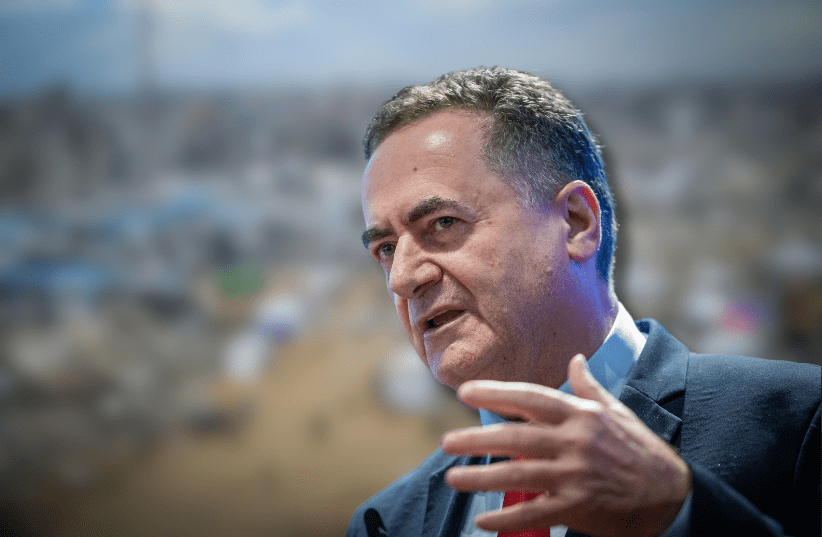
Katz reiterates US President Donald Trump's statements, adding that the new phase of the Gaza war would be different in intensity and would not end without defeating Hamas and freeing all hostages.


An illustrative image of Defense Minister Israel Katz.  (photo credit: Khalil Kahlout/Flash90/Yonatan Sindel/Flash90)
An illustrative image of Defense Minister Israel Katz.
(photo credit: Khalil Kahlout/Flash90/Yonatan Sindel/Flash90)

If Hamas does not release the Israeli hostages by Saturday, all hell will break loose, exactly as US President Donald Trump promised, Defense Minister Israel Katz said on Wednesday.

Katz also threatened Hamas terrorists, stating that "if they stop releasing the hostages, then there is no agreement, and there is war."

"The new Gaza war will be different in intensity from the one before the ceasefire – and it will not end without Hamas’ defeat and the release of all the hostages," Katz said.

"Every ceasefire agreement with Hamas terrorists was meant to secure the swift release of the Israeli hostages, who are being held under the harshest conditions in Gaza," Katz stated.

Israel "agreed to pay a heavy price in return," he added.

 An Israeli soldier sits on a tank on the Israeli side of the border with Gaza, amid a ceasefire between Israel and Hamas, as seen from Israel, February 11, 2025.  (credit: REUTERS/AMIR COHEN)Enlrage image
An Israeli soldier sits on a tank on the Israeli side of the border with Gaza, amid a ceasefire between Israel and Hamas, as seen from Israel, February 11, 2025. (credit: REUTERS/AMIR COHEN)

President Trump's plans for Gaza

Katz also referenced President Trump's plans for the Gaza Strip, including mass relocation of Palestinians and developing the territory into a riviera, stating that the resumption of war between Israel and Hamas terrorists would "enable the realization of Trump's vision for Gaza."

Katz had just held a meeting in the IDF Operations Directorate command bunker, accompanied by IDF Operations Directorate Chief Major General Oded Basiuk, and Head of the Operations Division Brigadier General Israel Shomer.

Katz clarified he came to the command bunker to meet the senior IDF figures in order to "ensure that the IDF is properly prepared for the resumption of the war in Gaza."


Jerusalem Post Staff

Source: https://www.jpost.com/breaking-news/article-841857

Follow Middle East and Terrorism on Twitter

Mythologies About Musk - Victor Davis Hanson


by Victor Davis Hanson

Musk's role in DOGE is misunderstood: he's an appointed auditor with legal authority to find waste, not cut programs, and foreign aid isn't ending, though USAID's inefficiencies may be restructured.


Here are some of the untruths told about Elon Musk and DOGE.

Musk has no right to cut USAID.” 

Elon Musk and his team are not cutting any federal programs.

They are auditors. They were given legal authority under a presidential executive order creating the Department of Government Efficiency (DOGE).

Its mandate is to identify waste, abuse, fraud, and irrelevance in the federal budget at a time when the U.S. is $37 trillion in debt.

The agency will expire on July 4, 2026.

Ultimately, Musk can propose program cuts, but Trump holds the authority to approve or reject them. He may or may not act on all, some, or none of the DOGE recommendations.

No one elected Musk.” 

Like hundreds of government officials, Musk was appointed by an elected president to run an agency that does not require Senate confirmation.

Musk is as legally legitimate as the national security advisor and his National Security Council, none of whom require Senate confirmation.

Does the left believe former national security advisor Jake Sullivan, who made decisions far more pivotal than Musk, had no authority to do so because he too was neither elected nor confirmed by the Senate?

It is a dangerous precedent to give a private citizen billionaire like Musk so much power.”

In fact, Musk has far more legal authority than did FDR’s best friend Harry Hopkins. He moved into the White House and de facto set U.S. foreign assistance policies toward Stalin’s Russia.

Musk’s position is more akin to past captains of industry like Henry Ford, Henry Kaiser, and William Knudson appointed by FDR to run the wartime economy.

None of them were either elected or confirmed by the Senate. All of them helped to save a poorly armed US after the debacle of Pearl Harbor.

Foreign aid is ending.”

Hardly.

Foreign aid, which in all its manifestations in various cabinets and agencies is reaching nearly $80 billion per year, is not ending.

One of its distribution centers, USAID, may be vastly curtailed or bundled into the State Department. But the important bulk grants to allies like Israel or friends like Egypt or aid in times of famine relief and natural disasters to the needy abroad will remain. And these programs will be strengthened and saved precisely because they will be trimmed of skimmers and scammers.

It is illegal to end USAID.”

USAID was created by an executive order in 1961 by then President John F. Kennedy in response to congressional legislation codifying foreign aid and allowing the president to execute the statute at his discretion.

Nearly four decades later, in 1998, Congress passed another law reifying Kennedy’s USAID as a formal agency but still within the executive branch.

But neither law mandates that Trump bundle all or even most foreign aid in USAID. He can disperse money as he sees fit throughout the cabinets. And he can keep whatever funds or programs he chooses under the aegis of USAID should he wish.

Trump cannot impound any USAID money legislated by Congress.”

That legal question apparently depends on whose ox is gored.

Neither Congress nor the courts have ever, in blanket fashion, either approved and sustained a line-item presidential veto or outright banned any form of presential impoundment.

But recently Joe Biden, as both vice president in 2016 and president in 2021, set a precedent that an administration most certainly can impound or delay congressionally passed funding as it pleases.

Infamously, Biden publicly bragged that on a trip to Ukraine, he had threatened that government by withholding $1 billion in approved US foreign aid unless it immediately fired Biden enemy prosecutor Viktor Shokin.

That condition was never discussed in any congressional aid authorization (and was the sort of act the left would impeach Trump for in 2020).

More flagrantly in 2021, Biden abruptly and permanently stopped all construction on the border wall. And he impounded those congressionally approved construction funds through a variety of gimmicks.

Biden, remember, without Congressional approval, gratuitously canceled student loan obligations, issued blanket loan amnesties, and promised to ignore or work around court prohibitions of his illegal acts.

China will be delighted by USAID cuts.”

False. China will be likely upset by the Trump cuts.

Beijing finds its own concrete development projects far more effective than USAID imposing American cultural agendas abroad. Beijing likes self-destructive American aid like LGBTQ activism, transgender chauvinism, and anti-conservative American media.

Does anyone believe China was angry that the USAID created a vast gender studies program at the University of Kabul or had the U.S. embassy there advertise its pride activism, or itself snagged $40 million to engineer deadly viruses?

So, China will be quite unhappy that organs like the New York Times and the BBC are having their USAID subsidies ended. After all, they, along with China, so often vilified their shared existential nemesis—Donald J. Trump.

 
Victor Davis Hanson

Source: https://amgreatness.com/2025/02/13/mythologies-about-musk/

Follow Middle East and Terrorism on Twitter

Critics decry Musk’s influence with Trump, ignore billionaires' influence in previous White House - Steven Richards


by Steven Richards

The Biden administration worked closely with billionaires like Bill Gates and Jeff Bezos, but Democrats and the media warn Elon Musk’s cooperation with Trump is unprecedented despite the fact that Trump announced Musk's involvement long before the election.

While the administration’s opponents express outrage over the work of Elon Musk and his team, billionaire influence in an administration is nothing new, and certainly was not foreign to the Biden administration.

Since the election, the media has warned about Musk’s role and influence on President Trump. “Elon Musk Is Inaugurating a New Era of Billionaire Rule,” a headline from the left-wing Jacobin Magazine reads. “Elon Musk puts unprecedented outsize influence on display in government funding fight,” another from ABC News reads.

Senator Bernie Sanders, I-Vt., in a speech on the Senate floor this week gave a sensational warning about the growing influence of “oligarchs” like Elon Musk in the Trump administration. 

The "surprise" and "shock" many leftists now express makes little sense, given that long before the election voters were told that Musk would be given this assignment, and Musk made robust campaign appearances on behalf of Trump.

“We are living in an extremely dangerous time. Future generations will look back at this moment – what we do right now – and remember whether we had the courage to defend our democracy against the growing threats of oligarchy and authoritarianism,” Sanders said. “For Mr. Musk and his fellow oligarchs, the needs, the concerns, the ideas, the dreams of ordinary people are simply an impediment to what they, the oligarchs, are entitled to.” 

Records obtained by the independent watchdog organization Protect the Public’s Trust during the Biden administration show that billionaires have for years rubbed elbows with senior officials that oversaw areas of interest to them and their companies, indicating that this pattern is not something new.

Billionaire George Soros donated $1 million to an Obama Super PAC in 2012, according to the Times of Israel, but that pales in comparison to the hands-on involvement that billionaires had with the function of the Biden administration.

Granholm and Gates

For example, PPT previously released documents it had obtained through Freedom of Information Act requests that showed Biden Energy Secretary Jennifer Granholm met with Bill Gates, the billionaire founder of Microsoft, just hours after being sworn in.

“What a difference a change in administration makes. Billionaires having access to government was no big deal in the Biden years. Now, it’s a ‘constitutional crisis.’ The double standard is glaring,” Michael Chamberlain, Director of Protect the Public’s Trust, told Just the News.

Gates’ TerraPower subsequently entered into a partnership with the department to build a nuclear reactor in Wyoming as part of the Advanced Reactor Demonstration Program. Records show that Secretary Granholm attended a virtual announcement for the project in June 2021, just four months after her meeting with Gates.

TerraPower, which was founded by Bill Gates in 2006, aimed to develop and build the country’s first Natrium nuclear reactor, which the company says harnesses new technology that makes the plant fit well with “renewable penetration grids where variable power output is a concern.” 

According to TerraPower, the company’s participation in the Energy Department’s Advanced Reactor Demonstration Program authorizes "50/50 cost share” and “up to $2 billion” for the project. 

PPT uncovered further meetings between Secretary Granholm and Gates in close proximity to the announcement of another project between one of the Microsoft founder’s companies and the Energy Department. 

According to the secretary’s calendar, Gates and Granholm met twice in August 2021 just ahead of a joint announcement that the Department of Energy would partner with Gates’ Breakthrough Energy Catalyst program, which they said could mobilize $15 billion in investments with the passage of the Infrastructure Investments and Jobs Act. 

Breakthrough Energy Catalyst invests in “project companies utilizing emerging climate technologies that reduce emissions” in order to "accelerate the adoption of these technologies worldwide.” The pair billed the assistance from the Energy Department as part of the Biden administration’s effort to reach net zero emissions by 2050.

The announcement of the partnership was made just days after two scheduled meetings with Gates on Granholm’s calendar. According to the records, the energy secretary was scheduled to meet with Gates on August 2, 2021 and August 11, 2021.

You can read both of those calendar entries below: 

At the time, Gates said the partnership with the Biden administration represented a “new model” for public-private collaboration on green energy projects. 

“Avoiding a climate disaster will require a new industrial revolution. We need to make the technologies and products that don’t cause emissions as cheap as those that do, reducing what I call Green Premiums, so the whole world can afford them and reach our climate goals,” Gates said

He continued, “Breakthrough Energy Catalyst is a new model of public/private partnership that can reduce Green Premiums and speed the deployment of these technologies, while building the American industrial foundation for generations to come.” 

Bezos and Climate Policy

Records previously obtained by PPT show Amazon founder Jeff Bezos was personally involved in the administration’s green energy efforts. Documents obtained by the watchdog group show Bezos hosted Treasury Department officials in his private Washington, D.C. residence for a climate action meeting that gathered international bureaucrats, a liberal foundation, and the senior officials, Just the News reported last year. 

The Spring 2022 event—recorded in Treasury Department ethics filings reviewed by Just the News last year—was held to coincide with the annual meetings of the International Monetary Fund and World Bank in Washington, D.C. and facilitate the Treasury’s relationship with those groups.

The dinner was called “Catalyze Finance for Climate Action and Economic Development,” according to the document. The records show two senior Treasury officials, Deputy Secretary Wally Adeyemo and Assistant Secretary of the Treasury for International Markets Alexia Latortue attended the dinner discussion which was held on April 22, 2022. 

Other attendees included “Ambassadors, Finance Ministers, NGOs including the IMF/WB, and Government officials,” according to Adeyemo’s filing. In other words, the attendees were the most powerful individuals in global finance.

Sponsoring the event alongside Bezos—who organized it through his Bezos Earth Fund—were the U.N. Climate Change Conference COP 26 and The Rockefeller Foundation. The Earth Fund and Rockefeller previously formed the Global Energy Alliance for People and Planet (GEAPP) with the IKEA Foundation to further efforts to harness private capital for the climate change transition according to U.N. goals.

The Treasury Department had applauded as congruent with its own Principles for Net-Zero Financing & Investment Bezos Earth Fund’s efforts to help private financial institutions develop net-zero commitments. The press release for the department commended the Earth Fund along with other partners for investing $340 million in helping financial institutions implement net-zero commitments that aligned with the Treasury’s principles.

This press release came in September 2023, a little more than one year after the two senior treasury officials attended the dinner at Bezos’ mansion and discussed catalyzing finance for taking action on climate change.


Steven Richards

Source: https://justthenews.com/accountability/political-ethics/critics-decry-elon-musks-influence-trump-ignore-billionaire

Follow Middle East and Terrorism on Twitter

Israel optimistic Hamas will release hostages on Saturday, source tell 'Post' - Amichai Stein Jerusalem Post Staff


by Amichai Stein Jerusalem Post Staff

Hamas confirmed its commitment to the continuation of the hostage-ceasefire deal in a statement on Telegram.


Woman walks past a poster calling for the release of the hostages held by Hamas, in Tel Aviv, December 5, 2024 (photo credit: REUTERS/STOYAN NENOV)
Woman walks past a poster calling for the release of the hostages held by Hamas, in Tel Aviv, December 5, 2024
(photo credit: REUTERS/STOYAN NENOV)

Israel is optimistic that the hostage deal can be continued and that the next release of hostages can be achieved on Saturday, a source with knowledge told The Jerusalem Post on Thursday. 

The Post learned on Thursday that Israeli ministers were insistent on "upholding the agreements as they are."

Later on Thursday, Hamas confirmed its commitment to the continuation of the hostage-ceasefire deal in a statement on Telegram. 

"Hamas confirms its continued position to implement the agreement in accordance with what was signed" and "the specified timetable," the Hamas statement read. 

The Prime Minister's spokesperson refuted Thursday reports made by Al Jazeera, noting the claims regarding Israel providing ready-made homes to the Gaza Strip were false. 

"No caravans or heavy machinery have been brought into the Gaza Strip, and no coordination for such entry exists.Additionally, in accordance with the agreement, no goods are being brought into the Gaza Strip through the Rafah crossing," the spokesperson said.  

An Israeli official told the Post that the images of caravans and tractors that were circulating were from Egyptian territory. No such tools could be entered from the Rafah Crossing, the official noted, adding that there was no Israeli agreement to allow such tools to enter Gaza.  

Reuters reported that mediators had received a commitment from both parties that the implementation of the hostage deal would be achieved. 

Earlier on Thursday, the Saudi news outlet Asharq reported, citing a source familiar with the matter, that Hamas is ready to commit to the continuation of the hostage deal and the sixth hostage release on Saturday.

The terror group "confirmed to Egyptian officials its commitment to the agreement" and the release of hostages on Saturday, the source was cited as saying. 

The report claimed that Hamas conditioned this step in exchange for Israel "bringing in [to the Gaza Strip] caravans, tents, fuel, heavy equipment, medicines, hospital renovation materials."

Hamas says it will not release 'all' hostages on Saturday

On Wednesday evening, senior Hamas spokesperson Sami Abu Zuhri spoke to Al Jazeera that Hamas was "committed" to implementing the previously agreed schedule of the hostage deal and that they would not release "all" Israeli hostages on Saturday.

Earlier on Wednesday, Israeli Defense Minister Israel Katz warned that if Hamas does not release the Israeli hostages by Saturday, "all hell will break loose."

James Genn contributed to this report. 


Amichai Stein Jerusalem Post Staff

Source: https://www.jpost.com/breaking-news/article-841925

Follow Middle East and Terrorism on Twitter

DOGE slashes billions, but allies in Congress eye an exponential expansion of savings - Ben Whedon


by Ben Whedon

Musk’s review has him convinced that “the magnitude of the fraud in federal entitlements (Social Security, Medicare, Medicaid, Welfare, Disability, etc) exceeds the combined sum of every private scam you’ve ever heard by FAR.”


As the Elon Musk-led Department of Government Efficiency (DOGE) continues its review of federal accounts and has already uncovered billions in wasteful spending, lawmakers in both chambers are eyeing legislation to escalate DOGE's efforts by an order of magnitude as the government faces its next budget deadline.

The Trump-created DOGE has put Washington careerists in a tizzy by highlighting billions in dubious spending or outright fraud across multiple agencies, notably the United States Agency for International Development (USAID). Though DOGE originally touted plans to cut up to $2 trillion in federal spending by eliminating waste, its efforts thus far, admittedly just weeks in, have yielded smaller savings.

Despite that, Musk’s review has him convinced that “the magnitude of the fraud in federal entitlements (Social Security, Medicare, Medicaid, Welfare, Disability, etc) exceeds the combined sum of every private scam you’ve ever heard by FAR.”

On the congressional side, the department has caucuses or committees in both chambers, which are taking the first steps to codify DOGE’s cuts and to substantially expand upon them. Rep. Marjorie Taylor Greene, R-Ga., on Wednesday, held the first hearing of the Oversight Subcommittee for DOGE to explore the scope of federal waste and possible ways to reduce it.

In the Senate, lawmakers have drawn up budgetary plans for ambitious spending cuts, with some hoping to completely balance the budget based on 2025 revenue projections. The House, meanwhile, faces internal battles over the extent of the cuts it plans to make. In any case, there is sure to be a substantive budget battle in the coming months over the matter.

Senate modeling off of Clinton, Obama

Speaking on the “John Solomon Reports” podcast this week, Sen. Ron Johnson, R-Wis., outlined a budget model that begins with the spending levels of the Obama and Clinton administrations and then accounts for increases in population and inflation. Under those models, he produced four budget projections based off of those presidents' budgets, Trump’s requested funds, and pre-pandemic spending levels.

“Well, what I've done is, first of all, pointed out the insanity of going from $4.4 trillion of spending in 2019 pre-pandemic, to averaging $6.5 over the last five years,” Johnson said. “This year, [we’ll] probably hit about $7.3 trillion worth of spending. So that's 60% higher than we were spending in 2019. Our population’s grown 2%. Of course, we had Biden inflation thrown in there.” 

“I went back to search for different pre-pandemic levels of spending, things that had broad bipartisan support or when we actually had a surplus,” he went on. “So first we [looked at] 1998 under Bill Clinton. He spent a little under $1.7 trillion. And what I did is I exempted Social Security, Medicare, and current interest. I use 2025, numbers for those, but all the other spending categories are increased by the growth in population, then by inflation. And so you take the $1.7 trillion of Clinton, that adjusts up to about $5.5 trillion which just happens to be what Biden was projecting for revenue for this fiscal year, we'd have a balanced budget.”

“I looked at Obama, 2014, same process went for about $3.6 trillion in spending. That'd be about $6.2 trillion, still more than a trillion less than we're spending today. Doesn't balance the budget, but gets us a whole lot closer,” Johnson continued. “The other one was 2019: $4.4 trillion. Increase that that ends up being about $6.5 trillion. I think that's still too much. But again, those are three options.”

Johnson also looked at Trump’s budget plans, indicating that taking the same approach would lead to $6.1 trillion in expenditures and that Sen. Lindsey Graham, R-S.C., was aiming for a budget to fund that level of spending. Johnson further lamented that the House seemed poised to shoot for minor spending cuts that would not substantively address the deficit.

“But look what the House is arguing over. They're looking at reducing spending maybe by a quarter of a trillion dollars,” he said. “I mean, I'm laying out proposals that would really reduce it by a trillion, a half or a full trillion, again, using Clinton and Obama spending levels.”

House DOGE Subcommittee eyes $1 trillion

Despite Johnson’s frustrations with the House budgetary process and their apparent inclination toward smaller cuts, the DOGE subcommittee appears interested in larger sums on par with his own projections.

During an exchange between Rep. Tim Burchett, R-Tenn., and Lexis/Nexis Risk Solutions CEO Haywood Talcove, the pair discussed 13-figure sums in possible savings through eliminating fraud.

“My number right now between federal, state and local government, is [that] you can save $1 trillion a year by simply putting in front-end identity verification, eliminating self-certification and monitoring the back end of the programs that are providing the benefits. Those three things,” Talcove said. “Start with those three things because they're simple. That'll take that 20% fraud rate that you're seeing in the public sector down below 5%.”

Rep. Brandon Gill, R-Texas, moreover, fumed over the estimated sums of improper payments in recent years, lamenting the disinterest of the opposition party toward addressing it.

“We're talking about $2.7 trillion in improper payments since 2003,” he said. “We're uncovering what could be the biggest money laundering scandal in American history. And the other side of the aisle could care less.”

House leadership has its own plans

While DOGE and its supportive committees might identify avenues for large cuts, the House Republican leadership seems to be at a crossroads, with Speaker Mike Johnson struggling to placate budget hawks who want deeper spending cuts.

Among the most vocal is Rep. Victoria Spartz, R-Ind., who has long sounded the alarm over deficit spending and warned that the nation was passing the buck to the next generation. Spartz has already taken potshots at her Senate colleagues over their budget plans.

“Senator [Lindsey Graham] and I probably have a different definition of what ‘fiscally responsible’ means, but up to $520B in new spending and only $5B in spending offsets does not appear to be that responsible to me,” Spartz posted on X.

Johnson, for his part, has touted the next budget resolution and that “nearly every House Republican” has been involved in the process.

“There will be ongoing debates and discussions in the coming weeks, and we remain focused on working through the process to deliver on our promises made to the American people,” he said. “There’s still much work to be done, but we are starting on the right path.”

 
Ben Whedon

Source: https://justthenews.com/politics-policy/thudoge-slashes-billions-allies-congress-eye-exponential-expansion

Follow Middle East and Terrorism on Twitter

Florida appeals court blisters Pulitzer board and rules in favor of Trump in defamation lawsuit - Misty Severi


by Misty Severi

The three-judge panel of the 4th District Court of Appeals ruled that Trump has met his burden of proof and establishing jurisdiction to proceed with the case.


A Florida Court of Appeals on Wednesday allowed President Donald Trump's lawsuit against the Pulitzer board to continue, ruling that the president had met his burden of proof that there was actual malice and bias against him.

The defamation lawsuit stems from a Pulitzer board decision to award a prize to The New York Times and The Washington Post for reporting about alleged Russian interference in the 2016 presidential election.

The president also claimed he was defamed in a statement  from the board, which came after Trump asked them to rescind the 2018 award. Trump filed the initial lawsuit in 2022.

The three-judge panel of the 4th District Court of Appeals ruled that Trump has met his burden of proof and established jurisdiction to proceed with the case.

"The President has met his burden of establishing jurisdiction to proceed with his asserted claims that the non-resident defendants acted with actual malice or reckless disregard for the truth by knowingly conspiring with the Florida resident defendant to defame the President," the panel wrote. "Therefore, the trial court correctly denied the non-resident defendants’ motion to dismiss the President’s claims over the asserted publication of defamatory 'FAKE NEWS.'"


Misty Severi
i is a news reporter for Just The News. You can follow her on X for more coverage.

Source: https://justthenews.com/government/courts-law/florida-appeals-court-blisters-pulitzer-board-and-rules-favor-trump

Follow Middle East and Terrorism on Twitter