The "Middle East and Terrorism" Blog was created in order to supply information about the implication of Arab countries and Iran in terrorism all over the world. Most of the articles in the blog are the result of objective scientific research or articles written by senior journalists.
From the Ethics of the Fathers: "He [Rabbi Tarfon] used to say, it is not incumbent upon you to complete the task, but you are not exempt from undertaking it."
For the first time in 13 nights, the United States did not attack Iran, but Israel is preparing for escalation.
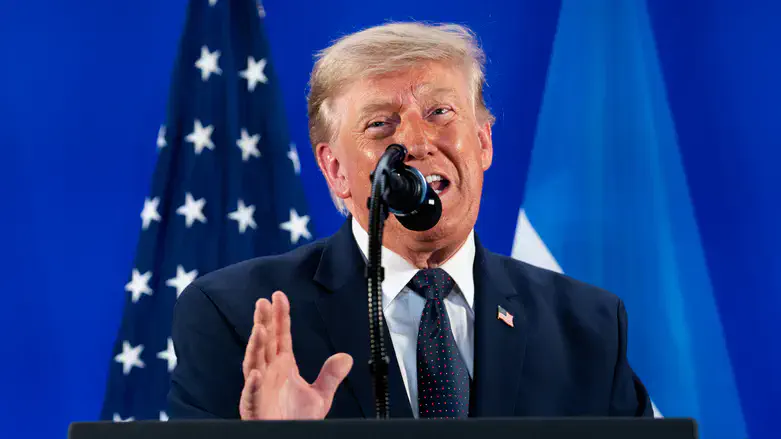
Donald TrumpWhite House Photo by Daniel Torok
For the first time in 13
consecutive nights, the United States did not carry out military strikes
against Iran overnight, but Israeli defense officials are maintaining a
high state of readiness amid expectations that Washington could still
launch a major operation.
According
to Israeli security assessments, preparations continue for the
possibility of a large-scale American strike after plans for such an
operation were reportedly postponed over the weekend. Officials believe
U.S. President Donald Trump may ultimately conclude that military action
is unavoidable. As a result, the Israeli Air Force is expected to
remain on heightened alert in anticipation of possible escalation.
Speaking
to reporters at the White House early Monday, Trump said no final
decision had been made. "They are talking to us right now. They want to
make a deal. I don't think they're ready for that. I don't think it's
time yet, but I'm willing to listen," he said.
Trump
reiterated that preventing Iran from obtaining nuclear weapons remains a
central objective. "They can't have nuclear weapons. We don't want to
see Washington, or any of our cities, or Israel, and, frankly, the
entire Middle East-destroyed with nuclear weapons. If they have such
weapons, they will use them," he said.
Meanwhile,
U.S. Central Command did not announce any overnight operations against
Iran, marking the first such pause in roughly two weeks. Earlier reports
indicated that an American naval vessel intercepted an oil tanker
attempting to break the blockade of Iranian ports in the Strait of
Hormuz, with the incident taking place in waters off Oman.
According to officials cited by The New York Times,
U.S. intelligence agencies believe Iran's new supreme leader, Ayatollah
Mojtaba Khamenei, is more supportive of developing nuclear weapons than
his father, former Supreme Leader Ali Khamenei. Ali Khamenei, who was
reportedly killed in an Israeli strike early in the war with U.S.
intelligence assistance, had publicly opposed nuclear weapons
development on religious grounds.
The
report follows news that Iran rejected a ceasefire proposal conveyed by
Iraqi Prime Minister Mohammed al-Sudani on behalf of the Trump
administration. Iranian and Iraqi officials told The New York Times that
the mediation effort came as Trump warned of expanding military action against Iran's critical infrastructure.
Israel
is continuing to prepare for the possibility of Iranian retaliation and
further escalation. Prime Minister Benjamin Netanyahu convened a
limited security cabinet meeting on Sunday to review developments,
though no changes have been made to the Home Front Command's civilian
guidelines.
With reports
of a possible meeting between Netanyahu and Trump, the IDF continues to
maintain a heightened level of readiness, assessing that a U.S. strike
on Iran could come at any time. The U.S. State Department also issued an
updated travel advisory overnight, urging American citizens to avoid
travel to Israel as tensions remain high.
The expanded operation comes after a short-lived ceasefire collapsed
The U.S. has widened its military campaign against Iran, shifting
from attacks on coastal military targets to strikes farther inland that
have damaged key infrastructure, including bridges, transportation
routes and utility facilities.
The expanded operation comes after a short-lived ceasefire collapsed,
reigniting fighting over the strategic Strait of Hormuz, one of the
world’s busiest oil shipping lanes, the Associated Press reported.
Since hostilities started again, U.S. forces have moved beyond
targeting naval capabilities and missile sites along Iran’s southern
coast to striking military and infrastructure targets deeper inside the
country.
Early strikes had focused on Iran’s naval assets, radar systems and missile installations near the Persian Gulf.
More
recent attacks have hit transportation links, communications
infrastructure, power facilities and other locations that support
military operations, while also affecting civilian services in some
areas, according to the AP.
“We’re locked and loaded and ready to go, but we’re talking to them," said Trump. "We’ll see what comes of it.”
US President Donald Trump takes questions from the media during
a bilateral meeting with President of Lebanon Joseph Aoun in the Oval
Office of the White House on July 21, 2026 in Washington, DC.(photo credit: KEVIN DIETSCH/GETTY IMAGES)
US President Donald Trump
said that the United States is "locked and loaded" to increase its
strikes on Iran, though he has not yet made a final decision, during a
press conference at the White House on Friday.
“We’re
locked and loaded and ready to go, but we’re talking to them," said
Trump in response to a reporter's question on the subject. "We’ll see
what comes of it.”
“I
think they are getting more serious as days go by for maybe obvious
reasons," he added. "But we are talking to them right now. We’ll see.”
President Trump held a cabinet meeting on the subject later on Friday, according to a New York Times report citing four sources with knowledge of the meeting.
Trump noted that the US had several "exit strategies" for its war with Iran,
including a "military exit," which would involve a continuation of its
strikes on the Islamic regime, with the potential of a "heavier dose."
An
aerial view of the island of Qeshm, separated from the Iranian mainland
by the Clarence Strait, December 10, 2023. (credit:
REUTERS/STRINGER/FILE PHOTO)
He
added that there was a "smarter strategy," in which Iran would make a
deal. "They want to make a deal," said Trump. "I just don't think
they're ready yet."
They want to be the tough guys," Trump continued. "As we speak, we are talking to them."
Trump: Iran caused Saudi hesitation to join Abraham Accords
When asked if targeting Iranian power plants would constitute a war crime, the US president declined to answer.
Trump initially began discussing Iran following a reporter's question on the US-Saudi nuclear deal, which, according to Trump, now hinges on Saudi Arabia joining thr Abraham Accords.
The
president said that Iran was a primary reason for Saudi hesitancy to
join the Accords, but things would be different now that the "problem"
of the regime was "disappearing day by day."
He described Iran as "the bully of the Middle East," saying that they "are not going to be that much of a bully anymore."
Trump added that Iran has "no navy, no air force, no anti-aircraft, no radar, no nothing."
President Trump emphasized the significance of the "iron wall" created by the US blockade against Iran in the Strait of Hormuz.
He noted the situation as "not very complex," hinging simply on the US demand that Iran "cannot have a nuclear weapon."
Trump 'not in a hurry' on Iran
"If
they have even the thought of a nuclear weapon, we would just continue
to go, but at much higher levels," Trump said, noting that he is "not in
a hurry."
"We've
taken out their first level of leadership," noted Trump. "We've taken
out their second level of leadership. We've taken out their third level,
and we're negotiating with the rest."
Trump
concluded by stressing that Israel "would not be around anymore" if he
had not been reelected, saying the Jewish state would have been "hit by a
nuclear weapon."
"If I wasn't here, there would be no Israel," he concluded. "And there would probably be no Middle East."
“This pattern is too familiar and echoes Europe 100 years ago,” stated Ofir Akunis, a day after a visibly Jewish man was stabbed outside a synagogue in Manhattan on the fast day Tisha B’Av.
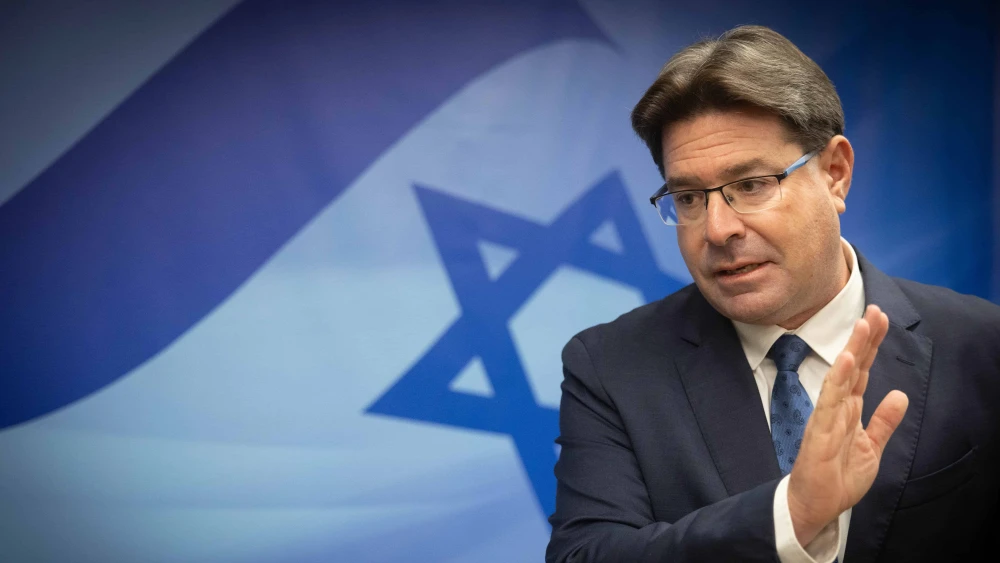
Ofir Akunis at a government
conference at the Israeli Prime Minister’s office in Jerusalem, on Sept.
27, 2023. Photo by Chaim Goldberg/Flash90.
Ofir Akunis, Israeli consul general in New York, stated on Friday,
the day after a visibly Jewish man and another man were stabbed outside a
synagogue in Manhattan on the fast day Tisha B’Av, that he had warned
about the consequences of New York City Mayor Zohran Mamdani’s actions.
The
mayor’s spokeswoman has said that synagogues violate international law
by hosting pro-Israel events, and Mamdani said often on the campaign
trail that he would have the Israeli prime minister arrested in New York
City. Benjamin Netanyahu is expected in Manhattan in September for the
United Nations General Assembly, and Mamdani recently released a video
in which he admitted that he lacked the authority to arrest the Israeli
premier but called him a “war criminal” and said that federal
authorities should detain him.
“Mayor Mamdani is inciting violence
against Jews in New York,” Akunis said. “I warned about the
consequences of his actions on his first day in office after he signed
the order abolishing the IHRA definition of antisemitism. Yesterday was
just another example of his hateful rhetoric fueling physical attacks.”
“This
pattern is too familiar and echoes Europe 100 years ago,” Akunis said.
“Incitement always promotes and encourages physical violence.”
Anti-Jewish hate crimes have surged this year, including a 182% increase during Mamdani’s first month in office.
Iran Cannot Have Centrifuges, Why Should Saudi Arabia?
The question before the US
Congress is not whether the two regimes [Iran and Saudi Arabia] are
morally equivalent. They are not. The question is whether uranium
enrichment becomes inherently safe simply because today's Saudi regime
happens to be friendly.
In Iran, what began as a civilian nuclear program of a trusted
ally before 1979 became the longest-running nuclear proliferation crisis
of the modern era.
The doctrine that emerged from that failure never rested on the
assumption that allies cannot be trusted. It rested on the recognition
that no one can predict who will govern a country 20 or 50 years after
sensitive technology has been transferred. Nuclear infrastructure
outlives the governments that acquire it and the administrations that
approve it.
The agreement signed this week authorizes a uranium enrichment
capability that will survive this and future governments in Riyadh, in a
region where the durability of governments cannot be assured.
The UAE's only nuclear power plant, Barakah, runs on imported
fuel. Nothing in their reactors suffers from the absence of centrifuges.
Saudi Arabia declined those terms, and rather than hold the line, Washington moved it.
Within 18 months, Washington went to war over centrifuges in one
country and signed a contract to build them in another. If President
Donald Trump said it would be "unfair" for Iran to not have ballistic
missiles since Saudi Arabia and Qatar have them, how is it not equally
"unfair" for Saudi Arabia to conduct uranium enrichment but not all the
other countries in the Middle East?
The precedent will not stop at the Saudi border. Turkey has
expansionist ambitions its president has articulated with increasing
candor.
"Jerusalem is our city," Turkish President Recep Tayyip Erdogan
has announced, and "We may come suddenly one night," he has threatened
Greece. "When you say 'Tayfun' [a Turkish ballistic missile]," he
continued, "the Greek is scared. They say it will hit Athens. Of course
it will hit it." This, incidentally, is the leader to whom Trump wants
to sell F-35 stealth fighter jets.
If enrichment is dangerous enough to justify war on one country
because governments change and capabilities endure, those realities do
not dissolve if the recipient should decide it is no longer a friend.
Benefits for friends cannot be retrieved if they are suddenly found in the hands of enemies.
At the moment, it looks as if Trump wants to arm his "friends,"
Saudi Arabia and Turkey, with advanced American weapons systems such as
the F-35 stealth fighter jet. When he leaves office, both countries will
be perfectly positioned with those deadly weapons to attack an infidel
West that they have never wanted and have never liked.
This week, the US signed a civilian nuclear cooperation
agreement with Saudi Arabia that opens a path to both uranium enrichment
and plutonium reprocessing on Saudi soil. The question before the US
Congress is whether uranium enrichment becomes inherently safe simply
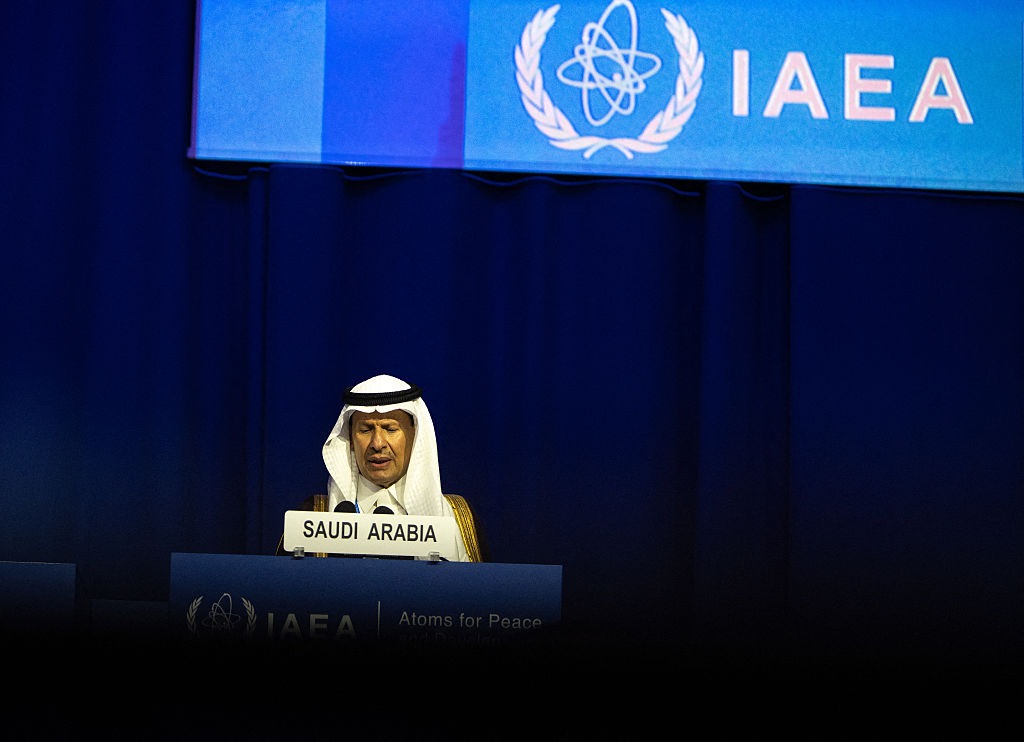
because today's Saudi regime happens to be friendly. Pictured: Saudi
Minister of Energy Prince Abdulaziz Bin Salman speaks at the plenary
session of the International Atomic Energy Agency (IAEA) in Vienna,
Austria on September 15, 2025. (Photo by Joe Klamar/AFP via Getty
Images)
For more than two decades, the policy of the United States toward the
Middle East, regardless of the party holding power in Washington,
rested on the proposition that certain nuclear technologies are too
dangerous to spread in an undemocratic region where regimes are
overthrown and strategic realities change overnight. At the center of
this policy sit centrifuges and uranium enrichment.
This week, the US signed a civilian nuclear cooperation agreement with Saudi Arabia that opens a path
to both uranium enrichment and plutonium reprocessing on Saudi soil. US
Energy Secretary Chris Wright and Saudi Energy Minister Prince
Abdulaziz bin Salman signed the nuclear accord, in compliance with
Section 123 of the Atomic Energy Act, alongside a bilateral safeguards
agreement whose contents were not disclosed. The framework contemplates a
uranium enrichment facility on Saudi territory, built by American
firms, after a two-year joint study. Congress now has 90 days
of continuous session to review it, and only a joint resolution of
disapproval carried by a veto-proof majority in both chambers can stop
it. No president has been overridden on one.
The Kingdom of Saudi Arabia cannot be exactly equated with the
Islamic Republic of Iran. Saudi Arabia has been a sometimes strategic
ally of the United States, apart from its involvement in the devastating
9/11 attacks,
while Iran has spent decades financing terrorism and directly attacking
American forces. The question before the US Congress is not whether the
two regimes are morally equivalent. They are not. The question is
whether uranium enrichment becomes inherently safe simply because
today's Saudi regime happens to be friendly.
Washington answered that question once, in the negative, on the basis
of an experience it paid dearly to acquire. In the mid-1970s, few
countries appeared more firmly anchored in the American camp than the
Imperial State of Iran under Shah Mohammad Reza Pahlavi, who purchased
advanced American weapons and was encouraged in his nuclear ambitions by
US administrations that treated the alliance
as a cornerstone of regional strategy. A few years later, the Shah was
gone, and the alliance was gone with him, while the reactors built by
the US and Germany, the trained nuclear physicists and the institutional
appetite for a nuclear program stayed where they were. In Iran, what
began as a civilian nuclear program of a trusted ally before 1979 became
the longest-running nuclear proliferation crisis of the modern era.
The doctrine that emerged from that failure never rested on the
assumption that allies cannot be trusted. It rested on the recognition
that no one can predict who will govern a country 20 or 50 years after
sensitive technology has been transferred. Nuclear infrastructure
outlives the governments that acquire it and the administrations that
approve it. Nuclear programs are measured in generations, political
arrangements in years. The agreement signed this week authorizes a
uranium enrichment capability that will survive this and future
governments in Riyadh, in a region where the durability of governments
cannot be assured.
Riyadh has never concealed how it thinks about this. Crown Prince Mohammed bin Salman said in 2018
that Saudi Arabia would pursue a nuclear weapon if Iran acquired one --
a statement he has never retracted. Whether that day comes is beside
the point. The declaration establishes that uranium enrichment is
understood in Riyadh through the lens of regional deterrence as much as
energy policy, an unusual foundation on which to build a fuel cycle in a
country floating on oil and natural gas.
There was a standard for exactly this situation, and Washington wrote it. When the United Arab Emirates signed its own nuclear agreement
with the US in 2009, Abu Dhabi renounced uranium enrichment and
plutonium reprocessing outright and accepted the IAEA's Additional
Protocol. American officials spent 15 years citing it as proof that
civilian nuclear power requires no domestic fuel cycle. The UAE's only
nuclear power plant, Barakah, runs on imported fuel. Nothing in their
reactors suffers from the absence of centrifuges.
Saudi Arabia declined those terms, and rather than hold the line,
Washington moved it. The agreement, as described by the administration,
leaves enrichment open and drops
the Additional Protocol, whose purpose is to give IAEA inspectors the
ability to detect undeclared activity. The unpublished bilateral
arrangement offered in its place is unlikely to be stricter than the
regime Riyadh refused. Enrichment itself is deferred to a two-year study
of "commercial viability," though nobody expects Saudi centrifuges to
undercut the global nuclear fuel market. A dozen Democrat lawmakers warned Secretary of State Marco Rubio in March that this was the direction of travel, and Rubio had himself co-sponsored legislation in 2018, with a Democrat colleague, requiring congressional approval of this kind of agreement.
The timing compounds the difficulty. American and Israeli aircraft struck Iranian nuclear facilities in June 2025 and again beginning
in February, on the stated grounds that Iran's uranium enrichment
constituted an intolerable threat. IAEA inspectors have had no access to
Iran's declared enrichment sites for more than a year and cannot
account for the 440.9 kilograms
of uranium enriched to 60% -- close to the level required for nuclear
weapons. Most of it is believed to be sealed in tunnels at Isfahan.
Within 18 months, Washington went to war over centrifuges in one country
and signed a contract to build them in another. If President Donald
Trump said it would be "unfair"
for Iran to not have ballistic missiles since Saudi Arabia and Qatar
have them, how is it not equally "unfair" for Saudi Arabia to conduct
uranium enrichment but not all the other countries in the Middle East?
The precedent will not stop at the Saudi border. Turkey has
expansionist ambitions its president has articulated with increasing
candor.
"Jerusalem is our city," Turkish President Recep Tayyip Erdogan has announced, and "We may come suddenly one night," he has threatened Greece. "When you say 'Tayfun' [a Turkish ballistic missile]," he continued,
"the Greek is scared. They say it will hit Athens. Of course it will
hit it." This, incidentally, is the leader to whom Trump wants to sell
F-35 stealth fighter jets.
Neither Turkey nor Egypt will accept the restrictions Washington has waived for Saudi Arabia. The editorial board of the Wall Street Journal, which has backed the campaign against Iranian enrichment throughout, immediately called the Saudi deal a mistake:
"Why does Saudi Arabia need to enrich uranium on its home
soil? The answer isn't complicated: It doesn't unless it would like to
establish the rudiments of a nuclear-weapons program...."
It is unclear why the editorial board bothered with "rudiments."
The WSJ noted that the UAE, a steadier ally through the Iran
war, now has little reason to keep to rules binding no one else. The
gold standard functioned because it was uniform. Applied selectively, it
becomes a bargaining position -- and bargaining positions can be
bargained away.
For Israel, the consequences are more immediate. Nuclear cooperation
had been the inducement for Saudi recognition of the Jewish state, the
entire logic of the arrangement discussed before October 7, and the
agreement signed Wednesday contained no such condition. Trump attached one
the following day, writing that the nuclear deal's approval depended on
Saudi Arabia joining the Abraham Accords and insisting there would be
no enrichment under the deal. Riyadh has not responded, the deal's text
remains unpublished, and the administration memo describing it permits
the Saudis to enrich uranium supplied by third parties. Nothing in
Trump's Truth Social post amends a signed instrument, and the leverage
the deal was meant to purchase had already been spent. Israeli officials
across the political spectrum had already said so bluntly, warning of
an arms race and a precedent leaving Israel to face nuclear weapons on
two fronts rather than one. Jerusalem could live with Saudi reactors
fueled with uranium enriched abroad. Uranium enrichment in Saudi Arabia
is another matter -- and Israel was not consulted.
When a country willingly joins the Abraham Accords, as did the UAE,
Bahrain, Morocco and Kosovo, that is one thing; but when a country is
coerced into joining to obtain a specific benefit, such as a nuclear
enrichment program, the likelihood that it will stay in the Accords has
to be open to question. It would be perfectly possible for Saudi Arabia
to agree to join the accords for now; then, when Trump leaves office,
and Saudi Arabia has its centrifuges comfortably enriching uranium, to
bow out of the Abraham Accords — and perhaps also at a time when US
oversight had become far less rigorous. Nuclear non-proliferation policy
was not designed to judge the intentions of current leaders, but to
limit the options available to their successors, whose intentions one
cannot know.
The US Congress is therefore deciding something more consequential than whether Saudi Arabia is a reliable partner today.
At stake is whether the principle that guided American policy toward
Iran for decades still exists in any form applicable to a country
Washington happens to like at this moment. If enrichment is dangerous
enough to justify war on one country because governments change and
capabilities endure, those realities do not dissolve if the recipient
should decide it is no longer a friend.
Benefits for friends cannot be retrieved if they are suddenly found in the hands of enemies.
At the moment, it looks as if Trump wants to arm his "friends," Saudi
Arabia and Turkey, with advanced American weapons systems such as the
F-35 stealth fighter jet. When he leaves office, both countries will be
perfectly positioned with those deadly weapons to attack an infidel West
that they have never wanted and have never liked.
Pierre Rehov, who holds a law degree from Paris-Assas,
is a French reporter, novelist and documentary filmmaker. He is the
author of six novels, including "Beyond Red Lines", "The Third
Testament" and "Red Eden", translated from French. His latest essay on
the aftermath of the October 7 massacre " 7 octobre - La riposte "
became a bestseller in France. As a filmmaker, he has produced and
directed 17 documentaries, many photographed at high risk in Middle
Eastern war zones, and focusing on terrorism, media bias, and the
persecution of Christians. His latest documentary, "Pogrom(s)"
highlights the context of ancient Jew hatred within Muslim civilization
as the main force behind the October 7 massacre.
According to the letter, no F-35 aircraft can be transferred to Turkey until Ankara fully complies with US law.
An F-35 pilot prepares for take off from the Vermont Air
National Guard Base with the flag of the United States, in South
Burlington, Vermont, US, May 22, 2020(photo credit: US AIR NATIONAL GUARD/MISS JULIE M. SHEA/HANDOUT VIA REUTERS)
Turkey
still does not meet the legal requirements to rejoin the F-35 fighter
jet program, the US State Department said in a letter to Congress
obtained by The Jerusalem Post.
The
July 22 letter, sent by the State Department’s Bureau of Legislative
Affairs on behalf of US President Donald Trump in response to a letter
from Rep. Wesley Bell (D-Missouri), reiterated that Washington’s policy
toward Turkey’s participation in the F-35
program remains unchanged and is fully consistent with the Countering
America’s Adversaries Through Sanctions Act (CAATSA) and Section 1245 of
the Fiscal Year 2020 National Defense Authorization Act.
According to the letter, no F-35 aircraft can be transferred to Turkey
until Ankara fully complies with US law. That includes resolving the
dispute over its acquisition of the Russian-made S-400 air defense
system by no longer possessing the system or any related equipment,
providing assurances that it will not acquire the system again, and
meeting all remaining statutory certification requirements.
“Turkey
has not yet met these conditions,” the State Department wrote. The
department added that any process aimed at resolving the S-400 issue
must be “transparent, lawful, and consistent with our national security
interests.”
Referring to President Trump’s recent bilateral meeting with Turkish President Recep Tayyip
Erdogan in Ankara, the letter said Washington will continue to engage
with Ankara to resolve the S-400 issue while also strengthening NATO
cooperation.
US
President Donald Trump shakes hands with Turkish President Recep Tayyip
Erdogan as he arrives at the Bestepe Presidential Compound during a
formal welcome for the NATO summit in Ankara, Turkey, Tuesday, July 7,
2026. (credit: Emrah Gurel/Pool via REUTERS)
The
letter described the broader US-Turkey relationship as one based on
shared security interests and balanced bilateral trade, while stressing
that Washington will continue engaging Turkey on areas of mutual
interest “while holding Turkey accountable when its actions undermine US
interests.”
The letter credits Turkey for its diplomatic support with Russia-Ukraine, Azerbaijan-Armenia, and Gaza
It
also credits Ankara with supporting several US diplomatic initiatives,
including efforts involving Russia and Ukraine, Azerbaijan and Armenia,
and Gaza, as well as counter-ISIS and broader regional counterterrorism
operations.
While
acknowledging Washington’s longstanding concerns over Turkey’s
relationship with Hamas, the State Department says Ankara played “a
pivotal role” in advancing President Trump’s Gaza peace plan.
According
to the letter, Turkey used its ties with Hamas’s political leadership
to help secure acceptance of the plan and advance the first phase of the
ceasefire, later becoming a founding member of the Board of Peace. The
letter also says Turkey continues contributing to regional stability,
including in Syria.
Hamas' financial relationship with Turkey is still a concern for Washington
At
the same time, the State Department emphasized that the United States
continues to sanction Hamas-related entities, including sham charities
that funnel money to the group’s military wing.
It
warned that Hamas’s use of informal financial networks and unlicensed
exchange houses in Turkey “remains a concern” and says Washington is
committed to disrupting those illicit financing streams.
The
letter concluded by reaffirming the department’s commitment to continue
working closely with Congress on developments related to US-Turkey
relations, the F-35 program, and broader regional security issues.
Sen Eric Schmitt obtained the document showing planned protections for Guatemalans, Ecuadorians, Nicaraguans and Venezuelans
A newly-uncovered Biden White House
memo from the administration's final days revealed plans that could
have expanded Temporary Protected Status (TPS) to more than 3 million
noncitizens while acknowledging that previous court challenges had
blocked many of President Donald Trump's efforts to end the protections.
TPS
is meant for foreign populations experiencing crises like political
unrest or natural disasters, and while Trump has tried to end the
"temporary" provisions for Haitians, Nepalese, Salvadorans and Sudanese
people, lawsuits from pro-migrant advocates have halted most attempts.
"My
investigation uncovered that the Lame Duck Biden White House tried to
keep millions of illegal aliens in our country by abusing the
'Temporary' Protected Status program," Sen. Eric Schmitt, R-Mo., who
acquired the memo, told Fox News Digital on Friday.
"After the American people voted for President
Trump’s promise to end the TPS scam, the Biden administration tried to
subvert the will of the American people. This was mass
amnesty-by-decree. America is for Americans, and it is our home—it is
not a permanent refugee camp," he said.
The memo argued that "granting TPS will potentially protect many vulnerable people from President-elect Trump's planned mass deportations...
They argue that these protections are likely to hold in court, and they
are prepared to litigate efforts to terminate or slow down the
implementation of TPS for specified nations by the Trump
Administration."
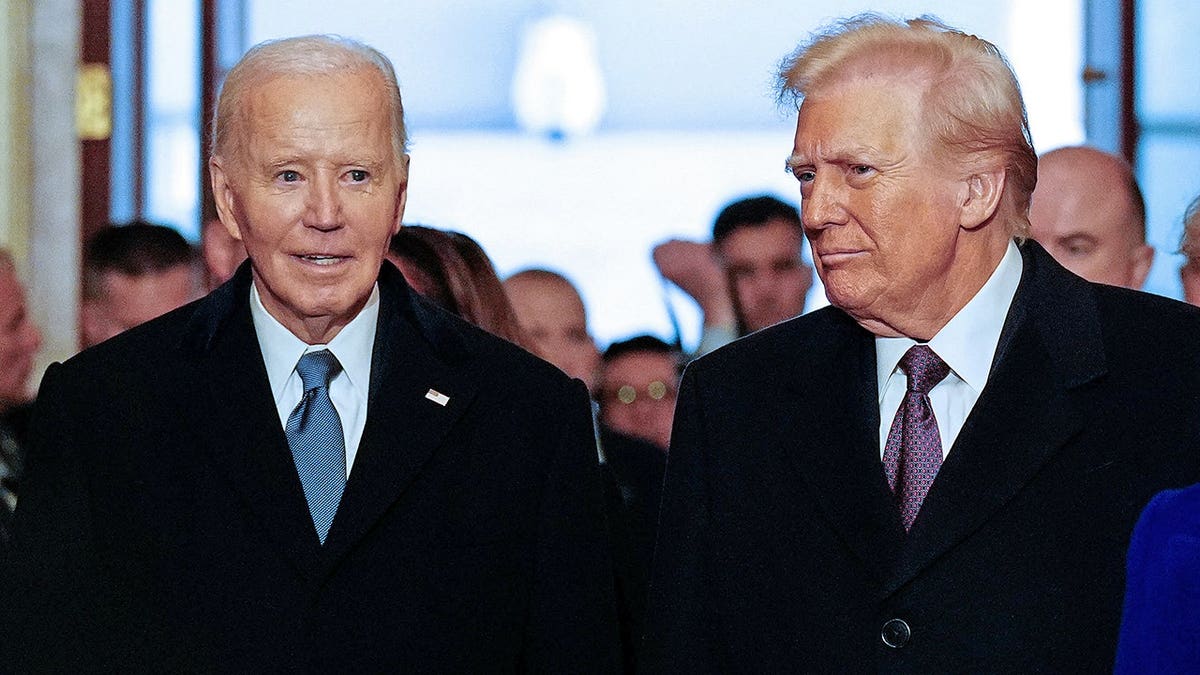
US
President Joe Biden (L) and President-elect Donald Trump arrive for the
inauguration ceremony where Donald Trump was sworn in as the 47th US
President in the US Capitol Rotunda in Washington, DC, on January 20,
2025.(Melina MARA / POOL / AFP via Getty Images)
"[P]rior
federal litigation brought by advocates during the first Trump
administration was successful in halting [its] efforts to terminate TPS,
though that was due in large part to [its] failure to produce a factual
record in support of termination, which is something that could be
rectified," the memo went on.
Schmitt said
he obtained the memo from Archivist of the United States Edward Forst
through his authority as chairman of the Senate Judiciary Subcommittee
on the Constitution.
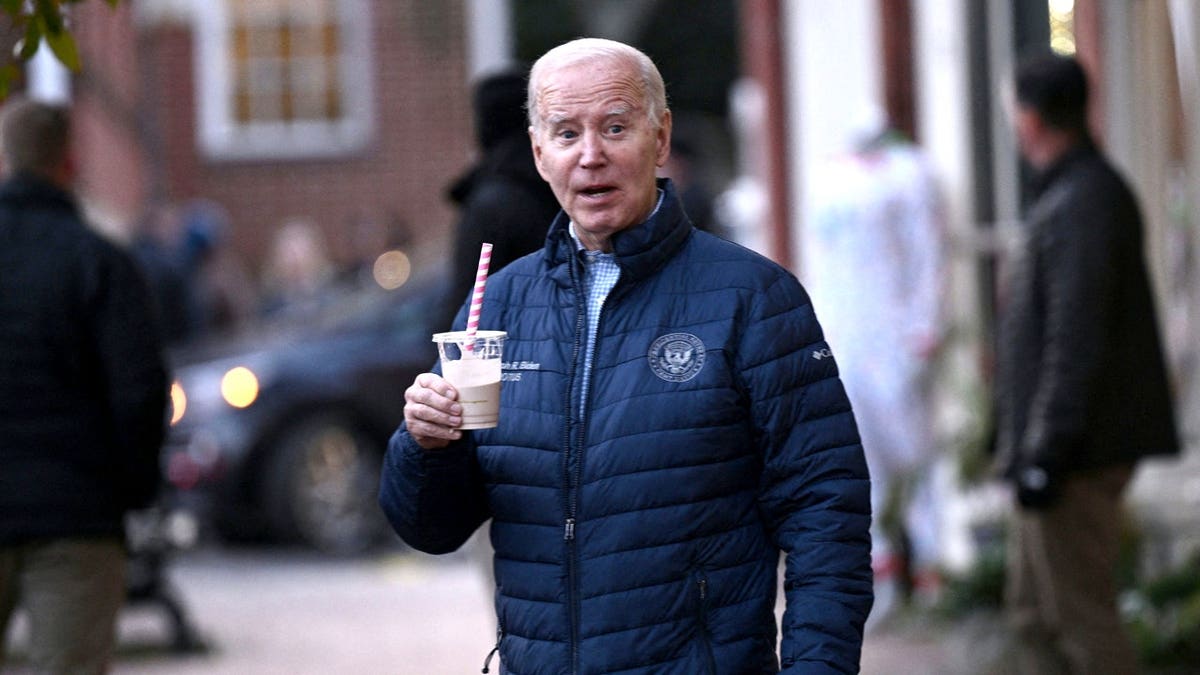
President Joe Biden carries a milkshake while visiting Nantucket for the Thanksgiving holiday in 2023.(BRENDAN SMIALOWSKI/AFP via Getty Images)
"Biden tried to turn TPS into a 3.1-million-person deportation shield, protect Tren de Aragua
members, and trap President Trump in years of litigation," he said,
adding the move directly betrayed the "will of the people" who ousted
liberal Democrats from power the prior election.
"The most disturbing part, Biden's ‘Senior
Advisors’ recommended he create 2.1 million NEW TPS designees in the
last few weeks of his presidency, despite admitting TPS applications
take 6 months," Schmitt added.
"Luckily, that never happened and we have been deporting Ecuadorians and Guatemalans."
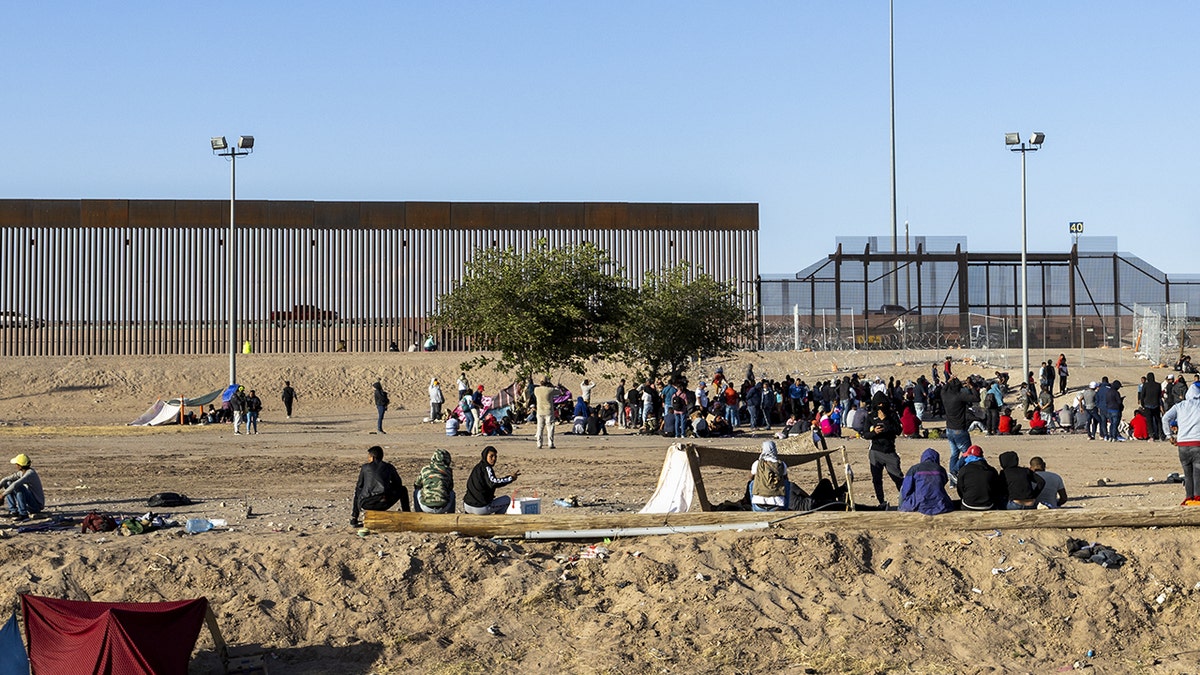
Hundreds
of Venezuelan migrants try to cross the border by foot from Mexico to
the United States on April 25, 2023, in Ciudad Juarez, Mexico. About
4,000 people left Chiapas city on Apr. 23 to reach the United States.(David Peinado/Anadolu Agency via Getty Images)
Fox News Digital reached out to Biden and a former Biden official for comment.
Schmitt
noted that one week after the January 2025 memo — which he said was
erroneously dated "2024" — Biden extended TPS protections for nearly 1
million noncitizens, meaning its transmission still led to "a concrete,
mass-migration action."
Schmitt shared a
clip of his recent floor remarks on a related topic, where he said the
U.S. should not be a "get-rich-quick scheme for the third world" and
that Americans don’t try to delay enforcement of squatters on their property in real-life.
The
memo reminded Biden he gave TPS protections to Afghans, Cameroonians,
Ethiopians, people from Burma, Lebanese, Ukrainians and Venezuelan
nationals and repeatedly extended protections for Haitians.
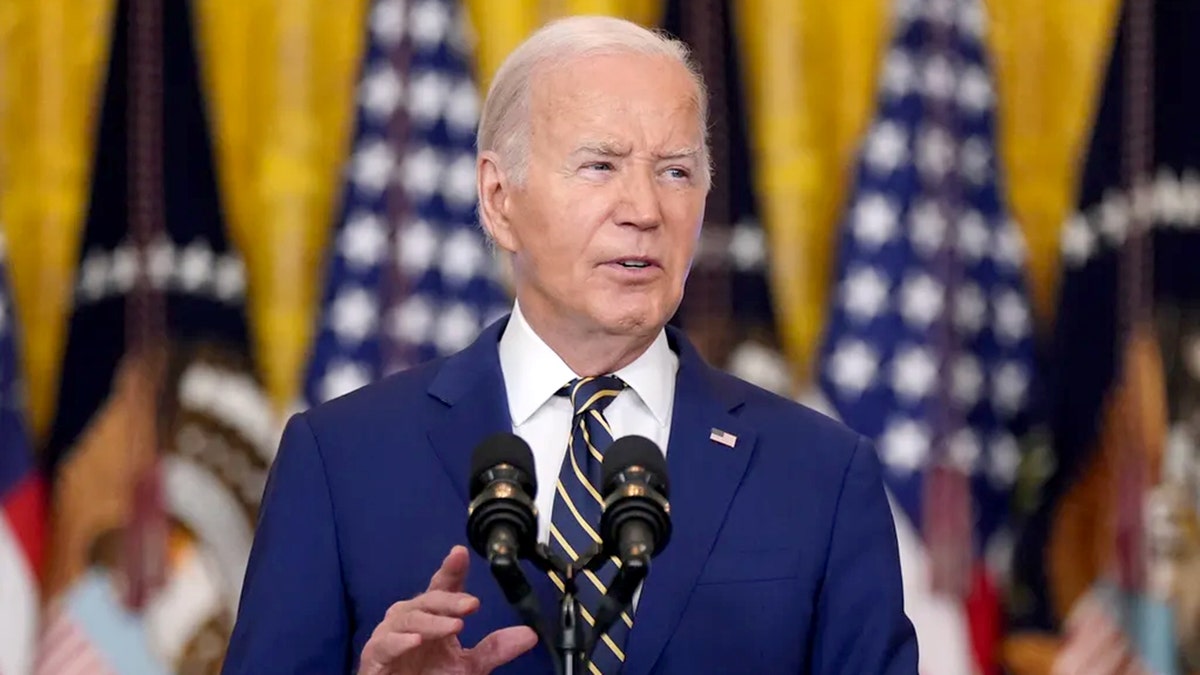
Former President Joe Biden addresses from a podium.(AP Photo/Manuel Ceneta)
"The previous Administration unsuccessfully
attempted to terminate TPS designations for Sudan, Nicaragua, Haiti, El
Salvador, Nepal, and Honduras. Courts issued preliminary injunctions
blocking the Trump Administration's actions," it read. "Your
administration took actions to resolve this litigation by either
redesignating Haiti or rescinding the terminations."
The memo noted that Trump had said during the 2024 campaign he intended to revoke TPS protections for Haitians and predicted his incoming administration would likely seek to rescind additional TPS designations.
A
chart in the memo estimated potential new TPS eligibility for roughly
1.5 million Guatemalans, 600,000 Ecuadorians, 464,000 Nicaraguans,
455,000 Venezuelans, and smaller populations from Ukraine, Sudan, and
Afghanistan — figures Schmitt said totaled more than 3.1 million people.
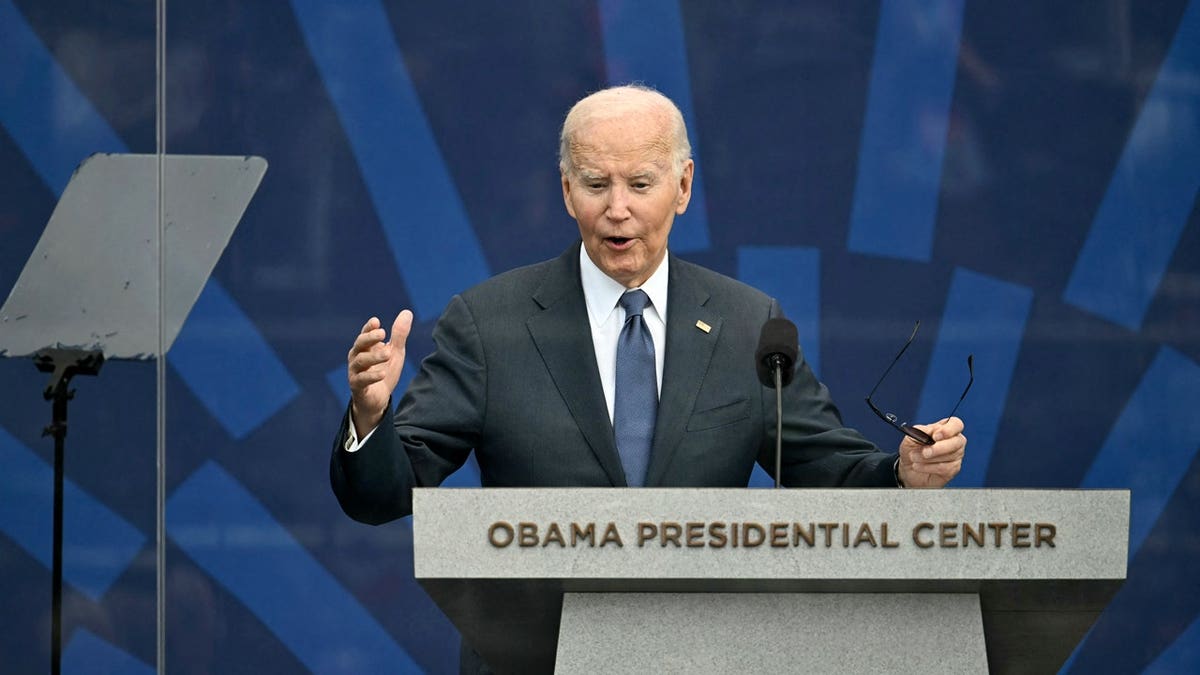
Joe Biden speaks during the opening of the Barack Obama Presidential Center in Chicago, Illinois(Kent NISHIMURA / AFP via Getty Images))
The
memo said Biden’s "senior team" had also received requests for varying
types of new TPS-related actions before Trump would take office from
Sens. Michael Bennet, D-Colo., Catherine Cortez-Masto, D-Nev., Cory
Booker, D-N.J., Richard Durbin, D-Ill., Mazie Hirono, D-Hawaii, Ben Ray
Lujan, D-N.M., Tammy Duckworth, D-Ill., and Alex Padilla, D-Calif.
"In
addition, some stakeholders are requesting that your Administration
designate nationals from new countries, most notably Ecuador and
Guatemala, for TPS," it stated.
While the proposals outlined in the memo were never fully implemented, the document offers a rare glimpse into the immigration options Biden advisers presented as Trump prepared to return to the White House promising mass deportations.
Charles Creitz was born and raised in Allentown, Pennsylvania. He has worked in both the New York and Washington bureaus for Fox News since 2013.
Netanyahu also plans to attend the funeral of the late Sen. Lindsey Graham, R-S.C.
President Donald Trump is set to meet with Israeli Prime Minister Benjamin Netanyahu at the White House next week.
The meeting marks the seventh time the Israeli leader has visited the
White House during this administration alone and comes amid an increase
in fighting against Iran.
"As part of the visit, the prime minister will meet with President
Trump at the White House on Tuesday and will attend the funeral service
for Senator Lindsey Graham," his office stated.
Ben Whedon is the Chief Political Correspondent for Just the News. Follow him on X.
The group raises the question of whether the same Justice Department officials who prosecuted Trump for mishandling classified information may have committed similar security lapses themselves, going to the heart of whether the law was applied evenhandedly.
A watchdog group is calling on Acting Director of National
Intelligence (DNI) William Pulte to review the security clearances of
certain members of Special Counsel Jack Smith’s team following
allegations they mishandled classified information.
The Center to Advance Security in America (CASA) has sent a letter
to the DNI asserting allegations against members of Smith’s team and
requesting an investigation to revoke security clearances if needed.
“As recent documents from Senator Grassley’s office have shown,
several members of former Special Counsel Jack Smith’s office were
extremely careless when handling classified documents and with the
security of designated classified areas,” CASA Director James
Fitzpatrick said in a statement.
“Given these troubling findings, we think it is appropriate for
Acting Director Pulte to initiate an immediate review into the
clearances of these individuals and believe enough evidence likely
exists per the relevant National Security Adjudicative Guidelines to restrict their access to classified information moving forward,” the statement said.
Smith alleged to have provided access to classified materials
Smith was appointed in 2022 as special counsel during the Biden
administration to investigate Trump for numerous alleged offenses,
including the mishandling of classified information, which led to a raid
on Trump’s home in Palm Beach, Florida. On July 8, 2026, Sen. Chuck
Grassley, R-Iowa, released documents showing Smith’s team allegedly
inappropriately provided access to classified materials without the
required “need to know” authorization, Just the News reported at the time.
The documents also revealed that Justice Department officials raised
concerns about the authorization, including one who said a secure
facility used by the special counsel team was left open on at least one
occasion.
“This conduct appears to show the Biden Justice Department may have
mishandled classified information while it prosecuted President Trump
for allegedly mishandling classified information,” Grassley wrote in a
short letter to Acting Attorney General Todd Blanche when he released
the documents. “This is yet another example of law enforcement’s double
standards in the previous administration.”
CASA also noted that Smith’s team was aware of the proper protocols
when it came to handling classified information, yet lapses still
allegedly occurred.
“Smith’s team was no stranger to the protocols and procedures for
handling classified information. This is especially true in light of
their targeted prosecution of President Trump for alleged mishandling of
classified information—an offense they appear far more guilty of than
President Trump,” CASA wrote.
Accusation: Lying to Congress under oath
Smith is also facing accusations of lying to Congress about spying on
lawmakers. On Wednesday, House Judiciary Committee Chair Jim Jordan,
R-Ohio, sent a letter
to the Justice Department referring Smith for criminal prosecution.
Jordan sought an investigation into Smith’s claim, under oath, that he
did not recall seeking a search warrant for lawmakers’ text messages.
Jordan said in his letter that his Committee has information revealing
that Smith’s team “obtained text messages of 44 Members of Congress —
implicating both Republicans and Democrats in both chambers of Congress —
that may have included privileged content. This information calls into
question the completeness and accuracy of statements that Mr. Smith made
under oath to the Committee regarding his team’s access to the content
of members’ text messages.”
The recently released records were reported by Just the News at the time.
One of Trump’s first acts as president during his second term was to revoke the security clearances
of the 51 former intelligence officials who coordinated with the Biden
campaign to issue a letter claiming that reporting on President Joe
Biden’s son Hunter leaving a laptop at a computer repair shop was
Russian disinformation. The story was real, but the letter was issued
just before Biden’s debate with Trump in 2020, allowing the Democrats
and legacy media to falsely dismiss the line of attack.
ABA has begun the process of rescinding its DEI requirements for law schools after President Donald Trump signed an executive order making such mandates illegal.
The chairman of a congressional task force examining civil liberties abuses tells Just the News he
plans to pursue legislation to strip the nation’s most powerful legal
profession body of its ability to accredit law schools after a bombastic
hearing over the group’s past promotion of diversity, equity and
inclusion (DEI) policies.
“I do think that we ought to be stripping the American Bar
Association of its status as a law school accreditor,” Rep. Brandon
Gill, R-Texas, said Thursday night in an interview on the Just the News, No Noise
television show. “I think that they have proven themselves to be a
fundamentally left-wing institution that is promoting leftism, that is
discriminating against conservatives and against racial groups that the
ABA disfavors.
“I think that they should have zero influence over the legal profession in this country,” he added.
Asked how Congress could act to strip the ABA of the role it plays in the private sector, Gill suggested legislation.
“That's something that we're looking into right now,” he said. “Now,
various states can choose to work with the American Bar Association, but
I think that we can that we can make that more difficult on a on a
federal level.”
Gill is the chairman of the House Oversight Committee's Task Force on
Defending Constitutional Rights and Exposing Institutional Abuse and on
Wednesday he interrogated ABA President Michelle Behnke, confronting
her with specific examples of how her group imposed DEI mandates on law
schools.
ABA has begun the process of rescinding its DEI requirements for law
schools after President Donald Trump signed an executive order making
such mandates illegal. But Behnke still defended the concept of DEI.
“Diversity and excellence are not mutually exclusive. In fact, the
opposite is true. Diversity, equity, and inclusion initiatives enhance
merit within the legal profession. When we have diverse teams, our
profession is stronger,” she testified.
Gill argued such DEI mandates illegally discriminate against certain
students and potentially undercut excellence in the legal profession.
“I think that the thing that was the most clear, more than anything
else, was that the ABA and its president are utterly unable to defend
any of their DEI practices,” he said. “…They have an enormous amount of
influence on law schools across the country, influence over their
admissions policies, where the ABA has been promoting DEI and all kinds
of diversity mandates.
“They have influence over law school curriculum, where they've been
pushing all kinds of left wing nonsense, and they also have a continuing
legal education that they make their members go through, which is
infused with some of the most far left ideology as you can imagine,” he
added.
“When the mayor of New York repeatedly uses his platform to relentlessly single out and demonize Israel, the world’s only Jewish state, and calls those who support it ‘monsters,’ he contributes to a climate in which Jewish New Yorkers are increasingly targeted and unsafe,” Eric Goldstein, CEO of the UJA, said at a press conference.
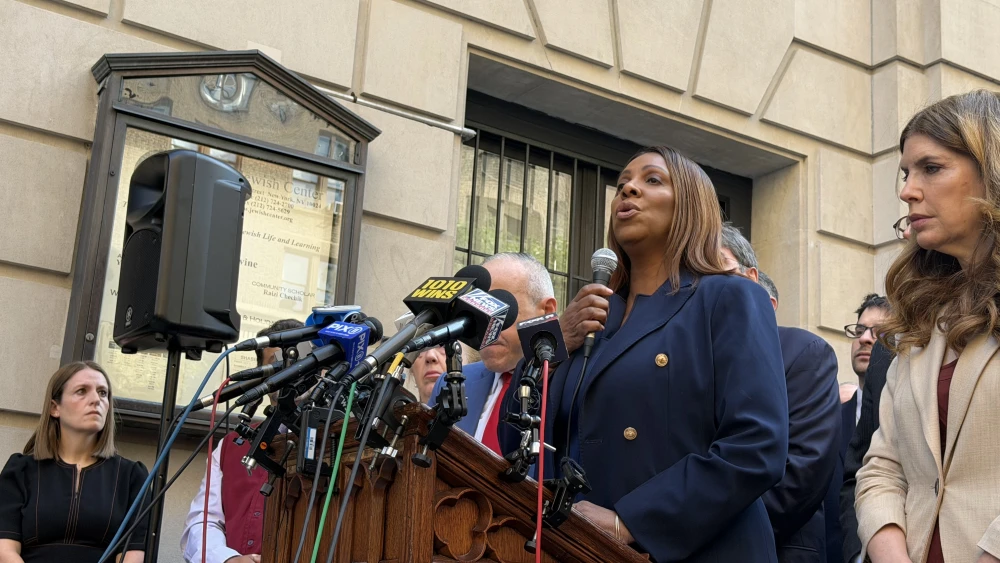
New York state attorney general Letitia James speaks alongside New York
City Council speaker Julie Menin at a press conference about an attack,
in which a visibly Jewish man and an Asian man were stabbed the prior
day, at the Jewish Center on Manhattan’s Upper West Side on July 24,
2026. Photo by Rikki Zagelbaum.
Mark Treyger, CEO of the Jewish Community Relations Council of New
York, identified the 50-year-old man, who was wearing a kippah when he was stabbed on Manhattan’s Upper West Side on Thursday during the fast of Tisha B’Av, as Moshe Yezhak Grunhaus.
According
to public profiles, Grunhaus has an M.B.A. and works in financial
services. One site states that he lives in New York and another in
Surfside, Fla. Multiple sources with knowledge told JNS that Grunhaus
was in the process of moving from Manhattan to Florida. One source said
that the move may be at least in part due to frustrations about Mamdani.
Another
source, who wasn’t sure of the victim’s motivation for moving, told JNS
that he was in the city “tying up loose ends” ahead of the move when he
was attacked with a screwdriver.
“It’s extra upsetting, because
he was on his way out of New York and heading toward Florida,” a friend
of the victim’s told JNS. “It’s especially frustrating, because he was
tying loose ends up in the city to head to Florida. This is such an
upsetting and traumatic way to leave Manhattan.”
Speaking at the
press conference, which the JCRC hosted with the UJA-Federation of New
York and other partners at the Jewish Center on Manhattan’s Upper West
Side on Friday morning, Rabbi Yosie Levine, of the Jewish Center, a
Modern Orthodox congregation, said that “when a member of our community
was stabbed on his way out of the synagogue, the evil we gathered to
remember stopped belonging to the past. Suddenly, it was right here in
the present.”
“When public officials repeatedly cast the Jewish
community as a stand-in for the actions of the Israeli government, they
create a climate in which Jews become targets,” he said. “When I was
growing up, the only time we saw security outside my synagogue or Jewish
day school was when the mayor came to speak. The police were there to
protect him.”
Rabbi
Yosie Levine, rabbi of the Jewish Center, and New York City Council
members take part in a UJA-Federation of New York press conference the
day after a Jewish man wearing a kippah was stabbed on Manhattan’s Upper
West Side on the fast day of Tisha B’Av, the Jewish Center, Manhattan,
July 24, 2026. Credit: Gerardo Romo/NYC Council.
“Today, every time the mayor speaks, we need the police to protect us,” he said.
“Jewish
life in America is starting to feel like Jewish life in Europe: armed
guards, bulletproof glass and the constant fear that yesterday’s
rhetoric will turn into today’s assault,” Levine said. “He was just
trying to pray at his synagogue, and now we’re the ones praying for his
recovery.”
“If a Jew can’t feel safe walking home from shul in
broad daylight on a Thursday afternoon on the Upper West Side of
Manhattan, then something has gone profoundly wrong—not only for the
Jewish community but for our city,” he said.
Treyger, of
the JCRC, said that “whether or not this attack is ultimately prosecuted
as a hate crime, its impact is already being felt.”
“Fear has
become a lived experience for far too many Jewish New Yorkers. That is
not normal,” he said. “Today, Jewish parents are asking whether it is
safe for their children to wear a kippah or a Magen David in public.”
“Words matter. Leadership matters. The climate we create matters,” he said.
New
York City Council speaker Julie Menin speaks alongside state, city and
Jewish leaders at a press conference about an attack, in which a visibly
Jewish man and an Asian man were stabbed the prior day, at the Jewish
Center on Manhattan’s Upper West Side on July 24, 2026. Photo by Rikki
Zagelbaum.
Jewish leaders in the city have decried Zohran Mamdani,
mayor of New York City, who recently released a video in which he called
the Israeli prime minister a “war criminal” and called on federal
authorities to arrest him. On the campaign trail, Mamdani promised
several times to arrest the Israeli premier, who is scheduled to come to
the city in September for the United Nations General Assembly, but he
recently admitted that he lacks the authority to do so.
“No
elected official is responsible for every act of hate. But every leader
is responsible for helping shape the climate in which we all live,”
Treyger said. “Responsible leadership requires lowering the temperature,
not raising it.”
Eric Goldstein, CEO of UJA-Federation of New
York, told the dozens assembled that “we’re horrified and heartbroken by
yesterday’s attacks.”
“But to be clear, we’re no longer
surprised,” he said. “When the mayor of New York repeatedly uses his
platform to relentlessly single out and demonize Israel, the world’s
only Jewish state, and calls those who support it ‘monsters,’ he
contributes to a climate in which Jewish New Yorkers are increasingly
targeted and unsafe.”
“Mayor Mamdani, stop fanning the flames of
hatred and division,” he said, raising his voice. “The consequences are
not abstract. They’re playing out on our streets.”
Eric
Goldstein, CEO of UJA-Federation of New York, speaks alongside state,
city and Jewish leaders at a press conference about an attack, in which a
visibly Jewish man and an Asian man were stabbed the prior day, at the
Jewish Center on Manhattan’s Upper West Side on July 24, 2026. Photo by
Rikki Zagelbaum.
Mark Levine, the city comptroller, said that “we are
feeling hatred right now. We are feeling it on social media. We’re
feeling it on the streets. We’re feeling it in colleges. We’re feeling
it in politics, and we are sick and tired of it.”
“There is no New
York without us,” he said. “We feel disregarded and disrespected and
targeted through hateful rhetoric directed at us, directed at our
students, directed at our young people, directed at our institutions,
directed at our symbols.”
The comptroller, who is Jewish, added that “we are, undeniably, being disproportionately targeted again and again and again.”
“We have a right, like every other community in this city, to live without fear,” he said.
In
the first month of Mamdani’s term as mayor, anti-Jewish hate crimes
were up 182% compared to the prior year. Since then, the New York City
Police Department has twice changed the ways it reports hate crimes,
making it more difficult to compare statistics in recent months with
prior years. Each month since January, Jews have been disproportionately
attacked, often by manyfold, compared to their percentage of the
population of the city, about 10%. Still, Jews were targets of 55% of all hate crimes in the city in the first six months of the year.
New
York state attorney general Letitia James said at the press conference
that “we cannot leave any one community to bear the burden of hate and
fear alone.”
Rabbi
Yosie Levine, rabbi of the Jewish Center, speaks alongside state, city
and Jewish leaders at a press conference about an attack, in which a
visibly Jewish man and an Asian man were stabbed the prior day, at the
Jewish Center on Manhattan’s Upper West Side on July 24, 2026. Photo by
Rikki Zagelbaum.
“I, as the attorney general, as the law-enforcement officer
of the state of New York, will stand with the Jewish community and use
every tool in my toolbox to protect them each and every day,” she told
reporters. “Hate will not be tolerated in this city or in this state.”
James
told attendees that everyone ought to “commit ourselves to doing the
good and necessary work of standing together, shoulder to shoulder, arm
in arm, with no space between us.”
New York City Council speaker
Julie Menin said at the press conference that she was “standing here not
only as the first Jewish speaker of the New York City Council but as a
mother of four kids.”
“My daughter wears a Jewish star, and the
conversations I’ve had with my husband—should she not wear the Jewish
star? Is it safe for her to wear? Is it safe for our sons to wear a
yarmulke? It’s shocking. It’s unacceptable,” she said. “When those of us
who go to Shabbat services walk into a synagogue and there are armed
guards outside, how can this be normal?”
“We have to bring the
temperature down. We have to change the rhetoric,” she said. “Words
matter, and we all have a responsibility to bring that temperature
down.”
“As a daughter and granddaughter of Holocaust survivors, I
know that what is happening right now to our community cannot continue,”
she said. “This just has to stop.”
New York City, state and Jewish leaders speak at a press conference the day after a Jewish man was stabbed on Tisha B’Av
Gail Brewer, a member of the New York City Council, said that “the horror of all of this never seems to end.”
“We
have so many scourges. One of them is hatred, and one of them is mental
illness, and we never seem to address either one correctly,” she said.
“I like love, but only to a certain extent, I’ll be honest with you.
When somebody commits a crime like that they have to be prosecuted to
the fullest extent.”
State representative Micah Lasher said that
“all of us have a right to be safe and feel safe in this city, and that
is not the feeling on the Upper West Side or in New York’s Jewish
community today.”
“We already have seen more than enough tragedy
to know that overheated rhetoric in the political arena can lead to
antisemitic violence,” he said. “I beseech all those in a position of
power, including our mayor, to hear our cry from the heart, to please
help take the temperature down and provide leadership that makes every
New Yorker feel safe in this glorious city.”
Treyger returned to talking about the mayor at the end of the press conference.
“What
might seem to be an effective communications strategy that could
generate tons of clicks and views might not be a good governing
strategy, because it has day-to-day implications for the people you
serve and represent,” he said. “We might be hurt, but we’re not broken.
You will never shatter the spirit of our people.”
“We’re going to get through it, but we are not OK,” Treyger added.
In
response to a question, Goldstein said that “we want the mayor to stop
demonizing the only Jewish state, using the most vilifying rhetoric and
focusing solely on the only Jewish state and its supporters.”
“His
video message about the prime minister was political grandstanding,” he
said. “A communications strategy is not an appropriate governing
strategy. You need to be responsible.”
“His words have profound,
real-world consequences for us,” Goldstein said. “Shame on him for doing
this for perceived political benefit when it has real-world
consequences for the Jews of New York.”