by Andrew Bernard
As NATO leaders meet in Ankara, JNS spoke with former U.S. envoy James Jeffrey and JINSA’s Blaise Misztal about why U.S. and Israeli officials disagree about Turkey.
 |
Amichai Chikli, Israeli minister for diaspora affairs and combating antisemitism, leaves little doubt about what he thinks of Turkish President Recep Tayyip Erdoğan.
“Greetings to the patron of Hamas and ISIS, the dictator who jails every critical journalist, the man behind the barbaric rapes and massacres of Kurdish, Druze and Alawite minorities, the megalomaniac who has lost his mind, a grotesque hybrid of Hitler and Sinwar,” the Israeli politician wrote on Monday.
Israeli Prime Minister Benjamin Netanyhu avoided comparing Erdoğan to the leaders of Nazi Germany and Hamas in an interview with CNN on Tuesday. But he warned that the Turkish president runs “a regime that’s infected with the Muslim Brotherhood, which hates the United States” and has threatened to destroy Israel.
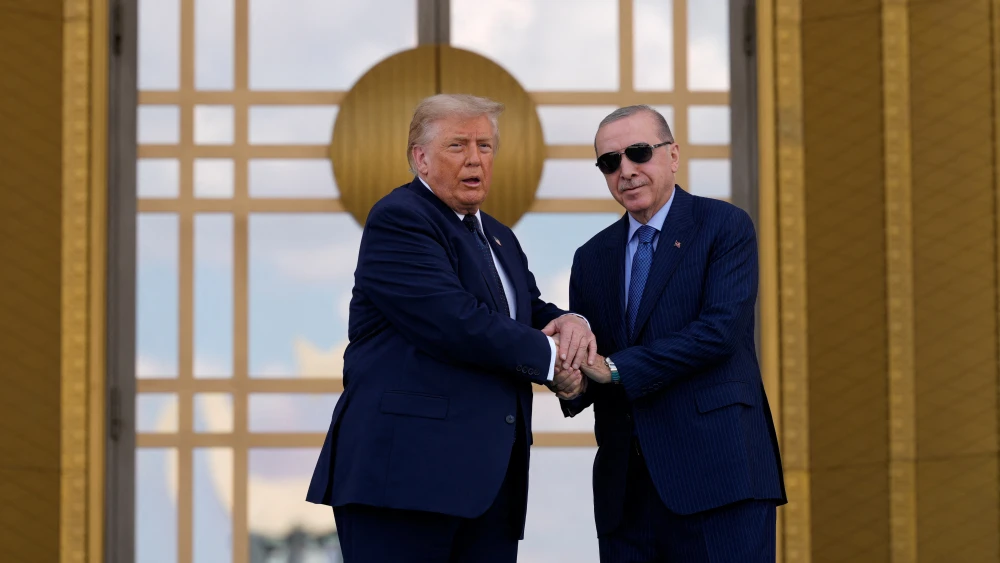
U.S. President Donald Trump, leader of the country most closely allied to Israel, took a markedly different tack as he sat beside Erdoğan in the Turkish presidential palace in Ankara on Tuesday ahead of a two-day NATO summit.
“As everybody knows, it’s been very much reported, we are great friends,” Trump said. “From the very beginning, from the first moment, I said it before, it’s a chemistry that works between us.”
“The relationship with Turkey right now is better, probably, than it’s ever been,” Trump added.
JNS spoke with James Jeffrey, former U.S. ambassador to Turkey and a fellow at the Washington Institute for Near East Policy, and Blaise Misztal, vice president for policy at the Jewish Institute for National Security of America, about whether Turkey and Israel are as deeply at odds as the rhetoric from their leaders suggests and what it means for the U.S. relationship with both countries.
“The Turks do not see Israel as an enemy state,” Jeffrey said. “I can say that authoritatively.”
Critics have accused Turkey of backsliding away from democracy, particularly following a coup attempt in 2016 and a constitutional referendum the following year that gave Erdoğan more power and will let him stay in office until at least 2028.
Despite that, Jeffrey told JNS that the country’s democratic institutions are what drive the main wedge between Israel and Turkey over Gaza.
“Turkey is a country that actually has to listen to its own population,” Jeffrey said. “They’re very unhappy about the treatment of the West Bank Palestinians, but Gaza is the most important issue between them.”
One of the critical topics of discussion in Ankara is Turkey’s potential purchase of F-35 fighter jets, after the United States barred it from doing so in 2019 during the first Trump administration when Turkey bought Russian S-400 surface-to-air missile defense batteries.
Erdoğan said at a press conference with Trump on Tuesday that the U.S. president had made a “promise” to let Turkey have the advanced stealth fighters, which Israel and other close U.S. allies also fly.
JINSA’s Misztal told JNS that despite its membership in the transatlantic alliance, Turkey should not be considered one of those close partners.
“Turkey is a NATO member in name only,” Misztal said.
He pointed to the country’s record of trying to block Sweden and Finland from joining the alliance and Erdoğan’s purge of the Turkish officer corps after the 2016 coup attempt.
“The idea that Turkey somehow naturally fits into NATO and that it is a member of NATO in good standing is very much open for dispute on the evidence over the past decade,” Misztal told JNS.
Misztal said that he would not describe Turkey as a “true enemy” of Israel, but the Israeli perception of Turkey is driven by how Jerusalem’s view of threats changed after Oct. 7 and concern over Turkey’s role in Syria under Syrian President Ahmed al-Sharaa.
“The lesson that Israel painfully learned on Oct. 7 is that it can no longer watch major military capabilities amass on its borders,” Misztal said. “The way the Israelis put this is they have to focus on capabilities, not intents, and so they see Turkey both significantly helping arm and train the new Syrian military, turning that into a more capable fighting force and seeking to have its own military in place in Syria.”
“From Israel’s new doctrine of not wanting to have a buildup of military capabilities on or near its borders, that looks problematic—especially given how big Turkey’s military is,” he added. “That is a fundamental problem.”
Jeffrey, who also served in U.S. special envoy roles for Syria and for the global coalition to defeat ISIS, told JNS that even as Syria has become a source of tension between Israel and Turkey, it is one of many areas where Turkey and the United States have grown closer.
“In its entire near abroad, either American policy has changed or Turkish policy has changed, so that we are aligned in a way that we weren’t,” he said.
He cited Erdoğan’s close work with Trump to try to resolve the conflict between Azerbaijan and Armenia, the peace process with Turkey’s Kurdish population and the warming ties between Washington and Damascus.
Those shifts have likely all contributed to Trump re-evaluating whether Turkey can once again join the F-35 partner program.
Despite the sharp rhetoric from both Ankara and Jerusalem, Jeffrey pointed to the long-term trends in Turkey that make real conflict or a full-blown diplomatic rupture unlikely.
“After 25 years of Erdoğan, who is a religious jerk, the country is still, if anything, more secular than it was before,” he told JNS.
“Turks aren’t interested in the Middle East,” Jeffrey said. “Turks are interested in Europe. They see themselves as Europeans to some degree.”
Misztal agreed that the potential for any sort of Israeli-Turkish conflict was remote but said that the United States should do more to pressure Turkey in areas where the two countries have disagreements, including areas of shared concern with Israel.
“It’s important for the United States to get over this idea that its partnership with Turkey is too big to fail, and that therefore we need to turn a blind eye to the ways in which Turkey has undermined U.S. interests in and around the Middle East,” he said.
“A tougher line against Turkey on areas where we do have real disagreements would actually, in the long term, be salutary to the relationship and give us a chance of returning to some better understanding between each other,” he added.
Andrew Bernard
Source: https://www.jns.org/news/u-s-news/experts-divided-on-whether-turkey-is-nato-member-in-name-only-or-closer-ally-than-ever

1 comment:
Why it only appears that I, whoes sole creditentials is former Officer trained at Sandhurst & West Point, seems to pose the simple logical question relating to Nato & Turkey as follows : Does current SG Mark Rutte and the Nato establishment really expect if, say Russia invades the Baltic countries or NW Europe Turkey will fully mobilize under Article 5 request and contribute very substantial forces to the defence of Nato ?
Post a Comment