Sunday, August 23, 2026

President Trump eyes ‘crushing’ economic blockade to bring Iran to its knees - Steven Richards


by Steven Richards

The Trump administration plans to escalate its strategy to economically isolate the Islamic Republic by targeting its international enablers and financial networks, and sends a warning shot to Beijing.


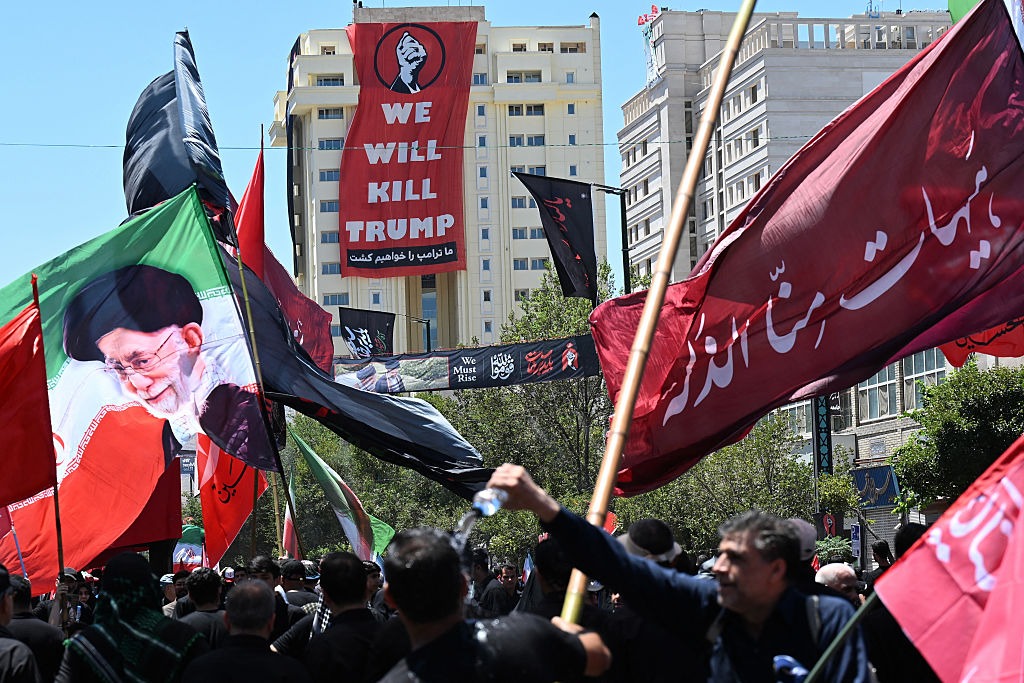
As the conflict with Iran nears its six-month anniversary, President Donald Trump has traded bombs for a comprehensive economic blockade of the Islamic Republic, hoping to strangle the regime by cutting off its economic lifelines.

This week, the president — frustrated with the Iranian leaders’ failure to agree to a deal to settle the conflict that includes ending the country’s illicit nuclear program — vowed to significantly ramp up the United States’ campaign to crush the Iranian economy. 

Trump: "Tremendous economic circumstances"

On Wednesday, Trump announced the "most crushing economic operation ever taken" against the Iranian regime that would target Iranian enablers, or any country “that allows its financial institutions, businesses, airports, or government entities to provide any type of lifeline to Iran.” 

“Those countries will face TREMENDOUS Economic Consequences,” the president said in a post to Truth Social. “Oil smuggling, swap lines, cash transfers, exchange houses, ship registries, front companies — It all needs to stop NOW. You know who you are,” Trump warned. 

Treasury Secretary Scott Bessent elaborated further on the president’s goal. “[W]e are going to collapse this regime,” he said on Thursday in an interview with CNBC. 

Strangling Iran

Victoria Coates, Vice President of Heritage’s Kathryn and Shelby Cullom Davis Institute for National Security and Foreign Policy at the Heritage Foundation, told Just the News that the president’s self-described “Economic D-Day” strategy began to take shape in April, when he first imposed a naval blockade on Iran’s ports and in the Strait of Hormuz, seeking to strip Iran of smuggled oil revenues it was using to fund its fight against the U.S. military. 

“There was a major shift in April when the president decided, you know what, we're going to blockade them. We're not going to let them hold us hostage over the Strait of Hormuz. We're going to hold the Strait of Hormuz hostage. We're going to see who comes in and out,” Victoria Coates told the Just the News, No Noise TV show.

“And Iran wasn't prepared for that. So, they were expecting they could still get out about 750,000 barrels [of oil] a day, they could still get in their critical imports, and that's really important. Most people don't appreciate this because Iran hasn't invested anything in their own economy. They're heavily dependent on imports. We cut all that off, and so slowly over the summer, … we're just strangling them,” Coates said. 

UAE cuts trade with Iran

The president’s latest announcement outlines a plan to go even further by targeting the countries that are supplying so-called lifelines to Iran. Just a day before the president’s announcement, the United Arab Emirates announced that it would suspend all trade and financial transactions with Iran after the regime allegedly fired a missile at the UAE. The United States has for weeks been encouraging the UAE, which is a close ally, to crack down on the Iranian finance networks in the country. Tehran has long used the UAE as a conduit for financial and trading networks designed to circumvent international sanctions.   

“The big move  [...]by the UAE to cut them off from Dubai, from any kind of commerce with the international financial markets, is huge, and I think that's just going to continue on, and nature will take its course,” Coates said. 

Aside from being a major trade partner of Iran before the war, the UAE has served as an intermediary for Iranian exports and financial exchanges in the global market, to which Iran’s access has been heavily restricted under sanctions regimes. U.S. government sanctions on Iranian regime-linked targets frequently include individuals based in Dubai, the UAE’s largest city. For example, the U.S. sanctioned companies and individuals in the UAE for their roles in a petroleum smuggling network linked to the Yemen-based Iranian proxy group, the Houthis.  

Widespread effects of "Economic D-Day"

In June, the U.S. Treasury Department unveiled sanctions on the personal banker of Iran's new Supreme Leader Mojtaba Khamenei, targeting his network of assets abroad that benefit the country's most senior leadership, Just the News previously reported. The banker, Ali Ansari, is an Iranian national who lives abroad in Dubai, where he has used his ties to the Iranian regime to embezzle government funds and amass "a global network of investment properties and financial holdings," according to the U.S. government. 

China, Iran’s largest trading partner, would also face actions from the United States if President Trump imposes his “Economic D-Day.” China has purchased the vast majority of Iranian oil for years, even while its exports are under international sanctions. Chinese banks and front companies help Iran with oil transactions to avoid the sanctions and operate ships in a shadow fleet to transport the sanctioned oil, according to the U.S.-China Economic and Security Review Commission. China has also sold Iran the technology and inputs required to construct its fleet of attack drones and missiles. 

China Treasury Secretary Bessent on Thursday urged Beijing to “get with the program” and support the United States’ planned economic blockade. He cited China’s dependence on Middle East oil imports as a reason to get behind ending the conflict, indicating that the Chinese could face consequences if they continue to back Tehran. The issue of Beijing’s support for Iran during the war remains sensitive ahead of Chinese President Xi Jinping’s planned visit to the United States in September. 

China not taking the bait

However, Chinese foreign policy experts believe that the Trump administration’s threats are empty. “This threat reveals how desperate the Trump administration has become on the issue of Iran,” Wu Xinbo, an American studies scholar at Fudan University in Shanghai and who serves as an advisor to the Chinese Foreign Ministry, told The New York Times. “They issue this threat, not because they think it is workable, but because they have no other options.” 

Chinese Foreign Ministry spokesman Lin Jian said on Friday that “sanctions and pressure” will not bring the conflict to an end. “China calls on all relevant parties to take responsible measures and resolve the problem through political and diplomatic means,” he said.

“China opposes illegal unilateral sanctions that have no basis in international law and are not authorized by the UN Security Council,” Lin added.  

President Trump's plans to ramp up economic pressure on Tehran stem from the belief that Iran’s beleaguered economy cannot take many more hits before the regime's internal system begins to break down, but it remains to be seen just how much pressure the country can withstand. Iran’s economy was already in dire straits before the initial U.S. strikes in February. 

Iran’s economy was suffering from persistently high inflation, the collapse of its currency, and declining agricultural production after years of drought, Just the News previously reported. The economic instability fueled the largest round of anti-regime protests in recent Iranian history which brought the Islamic Republic to the brink of political collapse. Only a violent crackdown by loyal security forces ended the wave of demonstrations.

More recent reporting indicates that unemployment in the country is soaring, inflation is still running out of control, and those that do work are struggling to afford necessities like food and medicine in the midst of the conflict with the United States.  


Steven Richards

Source: https://justthenews.com/government/diplomacy/president-trump-eyes-crushing-economic-blockade-bring-iran-its-knees

Follow Middle East and Terrorism on Twitter

Kushner's extraordinary warning to Hamas - Israel National News


by Israel National News

Jared Kushner reportedly met Hamas leader Khalil al-Hayya in Cairo after US intelligence indicated that some Hamas officials were planning to violate commitments to disarm.


Jared Kushne
Jared Kushner                                                                                               Reuters

The negotiations with the Hamas terrorist organization in Cairo have reportedly entered a critical phase, with a direct warning delivered to Hamas' leadership by the US. According to an exclusive report by Channel 12 News, US envoy Jared Kushner met with senior Hamas official Khalil al-Hayya and made it clear that any attempt to violate the agreement or conceal weapons would bring the diplomatic process to an immediate halt and leave Israel free to act militarily.

According to the report, the meeting was prompted by intelligence shared with the United States and mediators suggesting that elements within Hamas were planning to avoid full implementation of commitments to disarm and dismantle their military capabilities.

According to two sources present at the meeting, Kushner told Hamas representatives in front of all mediators: "The real test will be implementation. If you try to deceive us, the process will stop, and no one will stand in Israel's way."

The report adds that Kushner emphasized Israel's deep distrust of Hamas and stressed that if Israel fulfills its obligations under the agreement, Hamas will be expected to fully implement its own commitments, including complete disarmament, ending military rearmament, and demilitarizing the Gaza Strip.

Channel 12 further reported that officials involved in the negotiations said Kushner is determined to avoid a return to the status quo that allowed Hamas to remain armed and in power for years. According to those officials, if Hamas fails to honor its commitments, Israel would receive broad international legitimacy to take military action against the organization.

At the same time, Hamas leaders reportedly assured the mediators that they would implement all 20 clauses of the proposed framework, including those requiring disarmament and demilitarization. 


Israel National News

Source: https://www.israelnationalnews.com/news/432122

Follow Middle East and Terrorism on Twitter

What does IDF's first war crimes report mean for Israel's global accountability? - analysis - Yonah Jeremy Bob


by Yonah Jeremy Bob

Israel’s willingness to investigate its own, even if a case is later dropped, highlights a key distinction from adversaries who would never hold their own accountable for killing Israelis or Jews.


IDF soldiers are seen traversing northern Gaza rubble during Operation Brave Heart, the operation to rescue the body of St.-Sgt.-Maj. Ran Gvili, January 26, 2026.
(photo credit: IDF SPOKESPERSON'S UNIT)


In many senses, the IDF’s first official alleged war crimes report regarding Israeli soldiers’ conduct during the Israel-Hamas War was too little too late.

The report was released on Wednesday. From a pro-Israel perspective, for nearly three years Israel and the IDF have not been fully putting forth their narrative into the public sphere to defend themselves against genocide and other allegations.

Sure, there have been generic defenses about Hamas using human shields and the IDF trying to evacuate civilians away from the fighting (both of which are true), but at some point militaries have to address the specific allegations of distinct incidents.

For Israeli critics, the nearly three-year delay has solidified their conclusion that the IDF and Israel are not interested in true justice, but in a fancy whitewash process.

And yet, after both of those criticisms, the report was an important start.

Hind Rajab Foundation footage of IDF soldiers posing in Gaza used to file lawsuits for alleged war crimes; Illustrative.
Hind Rajab Foundation footage of IDF soldiers posing in Gaza used to file lawsuits for alleged war crimes; Illustrative. (credit: Via section 27a of copyright act)

The IDF only gave the public an update on five of its 150 criminal probes, not to mention over 3,000 disciplinary probes.

But the results in the five probes defied some critics’ expectations that there would be no deeper probes at all.

In two of the cases, IDF soldiers and commanders will be questioned under criminal caution, and may yet be indicted.

Critics are correct that indictments against Israeli soldiers for killing Palestinians are even rarer than criminal probes.

But they are not nonexistent, with at least half a dozen such cases in the decade before October 7.

And every time the IDF questions soldiers, not to mention commanders, under criminal caution, it creates major waves among the political class and general population.

Even when the IDF legal division later may reach a conclusion that an indictment would not succeed, and the case should be dropped, the simple act of interrogating Israel’s own is exactly what differentiates it and other democracies from many of the Jewish state’s enemies, who would never dream of putting someone on trial for killing Israelis/Jews.

Gazan patients and civilians evacuate from the Kamal Adwan Hospital in the Gaza Strip after the IDF eliminates Hamas terrorists in the area.
Gazan patients and civilians evacuate from the Kamal Adwan Hospital in the Gaza Strip after the IDF eliminates Hamas terrorists in the area. (credit: IDF SPOKESPERSON'S UNIT)

Criminal interrogation achieves a deterrent effect

While critics say that absent an indictment or even a conviction, there is no deterrence for soldiers to be more careful, in many cases the criminal interrogation itself, which leaves the soldiers and those around them in doubt for an extended period, achieves a deterrent effect.

Next, critics will compare the IDF legal division’s performance in this war negatively versus in past wars.

They will note the IDF legal division opened 32 criminal probes following the 2014 Gaza War when Israel killed over 2,100 Palestinians, at least 50% civilians.

Further, they will claim that after killing over 70,000 Palestinians – even if 25,000-30,000 were Hamas or killed in internal Palestinian fighting – 150 criminal probes is not even close to adequate.

They will denigrate the more than 3,000 disciplinary probes, claiming they are jokes that can be ignored completely.

There is no easy answer to some of these charges.

If Israel tried to open the same ratio of criminal probes per Palestinian killed during this war compared to the 2014 Gaza conflict, there would be over 1,050 criminal probes.

And no one would claim that fewer mistakes were made in this war, with a massive number of highly documented errors which led to the tragic killing of a sizable number of Palestinians.

IDF admits the errors it has made

In some cases, the IDF has admitted that tank shells hit the wrong target, in others that mistaken intelligence indicated that all civilians had left an area where dozens were still hiding and killed by aerial bombs, and in yet others where missiles hit one Hamas location but that location turned out to be linked to an unknown underground tunnel which then unexpectedly toppled an entire block of civilian homes on their residents.

In other words, there is no debate that a large volume of errors were made.

The question is how those errors are understood.

Pro-Israel advocates will note that these three years of war can be broken down into literally millions of smaller operations and fights versus Hamas, house-to-house, tunnel section to tunnel section. They will add that even if more mistakes were made than in any prior war, the volume of mistakes was still small compared to the number of battles.

In terms of time, some decisions were made earlier, but still have not been publicized, with The Jerusalem Post exclusively publishing back on February 8 that the IDF legal division had already delved into and closed dozens of cases, but was withholding publication.

Advocates will correctly note that at times the environment of criticism which enveloped Israel, even in October 2023 before the stains of blood of the 1,200 slaughtered Israelis were cleaned, has been intense and grossly disconnected from facts and context. This led Israeli officials to often hold back on publicizing their decisions out of fear that critics would abuse anything they put out.

Once the International Court of Justice took the spurious genocide charges against Israel seriously and the International Criminal Court (ICC) issued arrest warrants against between two and five senior Israeli officials, including Prime Minister Benjamin Netanyahu, Israeli hesitance to publicize information which could be abused became even stronger.

Moreover, Israeli legal officials would note that it was not easy to pick a time to publicize their results when the government has been trying to fire the Attorney-General, overhaul the court system, and threatened to go after IDF legal officials who would dare to charge soldiers.

Legal blunder of Sde Teiman saga 

The Sde Teiman saga is a case in point: Israeli legal officials started with good intentions but ended up with the worst of all worlds.

In July 2024, then IDF legal division chief Yifat Tomer-Yerushalmi faced hundreds of Israeli civilians, including some government Knesset members, who literally broke into an army base to try to free arrested IDF prison guards, who were being questioned for allegedly beating a Palestinian detainee.

At one stage, Tomer-Yerushalmi issued indictments against five soldiers and started to try to move the case to trial.

However, she severely erred in illegally leaking evidence against the five soldiers prior to trial (had she presented the evidence at trial or received permission from the IDF chief or the courts to publicize the evidence pretrial, there would have been no issue), then trying to cover up her illegal act, and then appeared to have a sensational public breakdown, almost committing suicide or faking suicide.

Ultimately, her successor, current IDF legal chief Maj. Gen. Itay Offir, closed the case not because he found the five defendants innocent, but largely because of the fantastical sideshow Tomer-Yerushalmi created, which he thought made a trial untenable.

Underlying Tomer-Yerushalmi’s clearly illegal leaking actions was a reasonable intent to ensure that the arrested soldiers be probed and tried on the charges as opposed to a mob breaking them out of prison with no accountability.

The fact that she melted down not only said something about her own personal failings, but also about the domestic atmosphere and unprecedented pressure that the government and portions of the public have placed on any legal officials daring to probe IDF soldiers’ actions.

All of that is to say that it becomes less surprising that Israeli legal officials took longer to publish their results when they knew that both most Israelis and most global critics would mercilessly attack them and their reputations for doing so.

There was no “reward” for honestly addressing complexity waiting at the end of the road.

It seems that Tomer-Yerushalmi’s fears delayed publication at least since January 2025, when sources first told the Post that many updates could already be published, with no real coherent explanation why those decisions were delayed.

Practically speaking, Offir cannot be blamed as he only took office in November 2025.

Nine months is not an unreasonable time for legal study

Publishing the results in nine months was certainly not fast, but also is not unreasonably slow, taking into account how much he had to study from scratch when he came on board.

But all of these internal Israeli sagas will not quiet critics and do not repair the damage done to Israel’s global legitimacy by the severe delay in publishing the report.

Tens of thousands of Palestinian civilians were killed alongside tens of thousands of Hamas terrorists, and there needs to be a more timely accounting for that.

The IDF put out five reports on its criminal probes and indictments following the 2014 Gaza conflict. It will eventually, hopefully sooner rather than later, need to put out at least that many, or its future reports will need to address a larger number of cases.

Of course that will only be a partial accounting.

One of the reasons that the ICC has been able to go after Netanyahu and other senior Israeli officials is because Israel has not probed any of them, only lower-down IDF soldiers involved in specific attacks.

But what about the policy decision to level 80-90% of Gaza’s structures? What about the decision to block food aid from March to May 2025, even if Israeli estimates were that there was sufficient food inventory for many months? What about the general ratio of “acceptable” collateral civilian deaths to military targets being hit even when there were military targets?

Offir cannot probe this.

Former deputy attorney-general Roy Schondorf already in May 2024 publicly recommended the one proper way to handle these issues: a re-run of the post-2009 Gaza conflict Turkel Commission.

Israel has probed its war-making decisions before.

If it does again, the ICC will have to freeze its arrest-warrant process.

Most importantly, probing everyone, from the highest officials to the lowest, has a shot at convincing those fair-minded people in the West and elsewhere that, however imperfect, Israel does care about human rights.

Such a detailed narrative is a moral obligation to do justice to Gazan civilians who got wrongly caught in the crossfire and to bring to justice any soldiers who broke the rules, and it can also finally put the simplistic, and sometimes antisemitic, genocide campaigners on the defensive for the first time, where they will have to address facts and depth, and not just make generic accusations. 


Yonah Jeremy Bob

Source: https://www.jpost.com/israel-news/defense-news/article-906349

Follow Middle East and Terrorism on Twitter

From crisis to comeback: How Trump’s war on fentanyl cut deaths by more than 10,000 - Amanda Head


by Amanda Head

The staggering drop happened after multiple coordinated law enforcement actions mandated under both the first and second Trump administrations. One U.S. Representative said "Republicans will send them [illegal aliens] home to their countries, and Democrats will send them home into your neighborhoods. That is the choice that is before us in November."


As the nation marked National Fentanyl Prevention and Awareness Day, a quiet but measurable shift is taking hold in communities long devastated by the synthetic opioid crisis: fewer funerals, fewer empty seats at dinner tables, and a 22% drop in deaths that ties directly as a result of the Trump administration's border crackdown and relentless pressure on the cartels fueling the poison.​​​​​​​​​​​​​​​​​​​​​​​​​​​​​​​​​​​​​​​​​​​​​​​​​​

"Every single person who came here illegally said, 'I don't respect the United States of America.' So of course, [there were] many, many criminals, and by rounding them up and deporting them, we've brought down crime," Rep. Randy Fine, R-Fla., told Just The News

"And folks need to understand," he continued, "Republicans will send them [illegal aliens] home to their countries, and Democrats will send them home into your neighborhoods. That is the choice that is before us in November."

Synthetic opioid deaths in the United States fell 22% from 2024 to 2025, dropping from 48,913 to 38,084, according to Centers for Disease Control (CDC) figures cited by the White House. Total drug overdose deaths declined 14% over the same period. The Trump administration attributes the reductions to border security measures and pressure on cartels across both of its terms. 

How the cleanup happened: border barriers and migration enforcement

During the first term, the administration constructed about 450 miles of border fencing, including new and replacement sections, according to Customs and Border Protection (CBP) records

In the second Trump term, officials expanded barriers and reported a 45% drop in nationwide fentanyl seizures in fiscal year 2025, which the White House linked to a reduced supply reaching the border.

The first-term Migrant Protection Protocols, known as Remain in Mexico, required asylum seekers to wait in Mexico during proceedings and was applied to nearly 70,000 people, per American Immigration Council data. 

Second-term policies included expanded third-country deportations and increased ICE arrests of individuals with prior fentanyl convictions. The agency highlights specific high-profile arrests involving fentanyl trafficking in press releases, but says comprehensive nationwide totals are categorized broadly under general criminal history or overall drug-related offenses.

Targeting supply chains and cartels

In the first term, the administration applied diplomatic and public pressure on Beijing to add fentanyl and its chemical analogs (slightly modified versions of the drug) to China’s official list of controlled substances.

In the second term, Trump signed the HALT Fentanyl Act in July 2025, permanently classifying fentanyl analogs as Schedule I substances. An executive order in December 2025 designated illicit fentanyl and its precursors as weapons of mass destruction

Several notorious cartels — including Sinaloa — were designated as foreign terrorist organizations, enabling additional sanctions and prosecutions, according to White House statements. 

Officials said these steps disrupted trafficking networks. Independent analysts note overdose declines began earlier and cite multiple contributing factors, including changes in drug supply and expanded naloxone access.​​​​​​​​​​​​​​​​​​​​​​​​​​​​​​​​​​​​​​​​​​​​​​​​​​

The mess Biden created by his no-borders policy

Southwest border encounters surged to record levels, with U.S. Customs and Border Protection recording more than 8.7 million encounters at the southwest border from fiscal 2021 through 2024 and over 10.8 million nationwide, according to House Homeland Security Committee data citing CBP figures. Annual southwest border totals exceeded 2 million encounters in multiple years, peaking near 2.5 million in fiscal 2023. 

Synthetic opioid deaths, primarily from fentanyl, remained elevated, with CDC data showing tens of thousands of such fatalities annually; estimates placed illegally manufactured fentanyl-involved overdose deaths around 60,000–70,000 per year in 2021–2023. 

More than 500,000 unaccompanied children were encountered at the southwest border during the period. A DHS inspector general report found ICE could not effectively monitor the location and status of all unaccompanied minors after transfer to HHS custody, noting incomplete addresses for tens of thousands and thousands of court no-shows among those released to sponsors.


Amanda Head is White House Correspondent for Just the News. You can follow her here

Source: https://justthenews.com/government/white-house/crisis-comeback-how-trumps-war-fentanyl-cut-deaths-more-10000

Follow Middle East and Terrorism on Twitter

Canada tariffs take effect at 50%; Ottawa vows to match - Brett Rowland


by Brett Rowland

President Donald Trump imposed the tariffs under Section 338 of the Tariff Act of 1930, the Depression-era Smoot-Hawley law, after last-ditch talks collapsed late Friday. The duties cover about $20 billion in Canadian goods, from wine to hockey sticks to cement.


(The Center Square) -

The 50% U.S. tariffs on Canadian cars, dairy and alcohol took effect early Saturday, and Canada immediately moved to match them, with no federal estimate of what Americans will pay.

President Donald Trump imposed the tariffs under Section 338 of the Tariff Act of 1930, the Depression-era Smoot-Hawley law, after last-ditch talks collapsed late Friday. The duties cover about $20 billion in Canadian goods, from wine to hockey sticks to cement.

Prime Minister Mark Carney said he suspended negotiations and recalled Canada's negotiators, and that Canada would "match those tariffs dollar for dollar."

The two sides blamed each other. Carney said "last-minute changes in the U.S. proposed terms were unfair, uneconomic, and called into question the reliability of any deal." The U.S. Trade Representative's office said Canada "declined to finalize the trade deal," walking back commitments after Washington offered "significant tariff reductions on steel, aluminum, autos, and lumber" and the "best treatment of any major exporter to our market."

Neither government has said what the tariffs will cost. The White House detailed the harm it says Canada's trade barriers did to U.S. exporters, a roughly 22% drop in U.S. vehicle exports, from about $25.9 billion to $20.3 billion, and an 81% decline in alcohol sales. However, the U.S. has published no estimate of what the 50% duties will cost the U.S. importers who pay them or the consumers who may bear the price. The tariffs do not apply to energy, potash, fish, critical minerals or goods already covered by Section 232.

Section 338, a provision of the 1930 Smoot-Hawley tariff law, had never been used to impose tariffs before this year. It lets the president levy duties of up to 50% on countries found to discriminate against U.S. commerce, requires no investigation and sets no limit on how long the tariffs stay in place.

Trump turned to it after the Supreme Court in February struck down his earlier tariffs, imposed under the International Emergency Economic Powers Act, and ordered the government to refund about $166 billion to importers.

The dispute puts the North American trade pact in doubt. The Section 338 tariffs apply regardless of whether goods qualify under the U.S.-Mexico-Canada Agreement, and while the U.S. has begun talks with Mexico on renewing the deal, negotiations with Canada have not started. Carney said Canada would announce additional support for its workers and businesses in the coming days. 


Brett Rowland

Source: https://justthenews.com/nation/states/center-square/canada-tariffs-take-effect-50-ottawa-vows-match

Follow Middle East and Terrorism on Twitter

Science by press release: Moderna cashes in on mRNA cancer vaccine without publishing trial results - Greg Piper


by Greg Piper

"These corporations have learned how to play the medical-scientific establishment like a Stradivarius," Johns Hopkins cardiology operations chief says after Moderna share price spikes. Its mRNA flu vaccine trial data are still hidden.


When the Food and Drug Administration approved Moderna's mRNA flu vaccine, the first ever, two weeks ago, the pharmaceutical company that reaped billions from federal taxpayers with its mRNA COVID-19 vaccine didn't wait for the agency to even publicly post the approval. Moderna rushed out the news at 10 p.m., with a 4% increase in its share price the next morning.

It was a promising market signal for a drugmaker whose revenue cratered following the collapse in demand for COVID vaccines, which also led Pfizer to cancel a trial this spring for its own updated mRNA COVID jab. 

What Moderna left out of the release Wednesday, and the media ignored: the mRNA flu jab's disproportionately high rate of serious adverse events compared to a normal flu shot – the same problem with its Omicron-specific COVID vaccine three years ago – and the number of jabs required to prevent a single hospitalization, 5,000.

Yet the market and the media went crazy for Moderna this week when it announced "positive topline results" from a late-stage trial of its cancer vaccine with Merck, with a 177% spike in its share price on top of a 357% increase this year before the cancer vaccine news, despite no published trial data or FDA approval.  

The jargon-laden press release said the melanoma trial met its primary and secondary endpoints: "recurrence-free survival" and "distant metastasis-free survival." 

What it obscured: Taken with Merck's cancer therapy Keytruda following removal of cancerous tumors, the treatment – technically not a "vaccine" – lengthened cancer patients' lives and halted their cancer's progress for an unspecified period of time.

The company has laid out a potential media-tested roadmap for other drugmakers, at least those working with mRNA technology: A glowing but vague press release is enough to juice their coffers and create demand for as-yet unapproved products with unknown risk profiles.

'Essential' to WHO and stockpiled by governments without a rigorous trial 

Some doctors are asking why Moderna gets a pass from scrutiny by withholding data while juicing its share price. (Moderna has promised its cancer vaccine data will be "presented at an upcoming international medical meeting and shared with regulatory authorities.")

Data from its "pivotal clinical trial" for the recently approved mRNA flu vaccine is still missing from the National Institutes of Health's ClinicalTrials.gov, FDA adviser Retsef Levi, whose 2022 peer-reviewed study found COVID vaccination "significantly associated" with emergency heart problems in young Israelis, wrote on X.

"Is it not mandated?" he asked, tagging Director Jay Bhattacharya and Health and Human Services Secretary Robert  F. Kennedy Jr. "How come the data from the major trial used for approval [is] not publicly reported?" Robert Malone, the mRNA pioneer, deadpanned "Rules for thee but not for me."

The scrutiny of the hidden flu trial data comes as a new randomized trial of Roche's $18 billion flu antiviral Tamiflu (oseltamivir) suggests it's harmful to the most vulnerable patients, with fatality rates around 20% for those who took it for 5-10 days and 14% for the control group. 

Not yet peer-reviewed, the study is the first to compare Tamiflu to "no antiviral treatment in a randomized trial of critically ill patients with influenza," Harvard Med professor Paul Sax wrote in New England Journal of Medicine Voices this week. 

"We somehow reached a point where a drug was routinely given, endorsed by guidelines, placed on the World Health Organization’s Essential Medicines List specifically for severe influenza, and stockpiled by governments – all without that trial ever having been done," Sax wrote. 

Former New York Times drug industry journalist Alex Berenson, who flagged the Tamiflu trial, previously noted the perils of hyping a treatment without a rigorous trial, judging by a gonorrhea vaccine study in NEJM this summer.

The randomized placebo-controlled trial of men who have sex with men, following supposedly positive observational studies, found the vaccine didn't benefit the treatment group but seriously hurt some of them. 

"Not one mainstream American news outlet reported the vaccine’s failure" and England is "so far still recommending it despite the new results," Berenson wrote.

Played the 'medical-scientific establishment like a Stradivarius'

"Seeing numerous doctors and scientists hail this [Moderna cancer] 'breakthrough,'" Joseph Marine, vice director for operations in Johns Hopkins Hospital's cardiology division, wrote on X, explaining how "pharma companies manipulate the US health system" into paying the "highest drug prices in the world, even for many products that produce minimal real-world results."

"Press release amplified by 'thought leaders' produces media feeding frenzy and huge pop in stock price," he wrote. "Public and market expectations are now permanently anchored into 'breakthrough miracle cure.' Even if published trial results are much more modest [...] the public will demand that government and insurance companies pay" the "astronomical" prices.

"These corporations have learned how to play the medical-scientific establishment like a Stradivarius," Marine mused about Moderna and its peers.


"No data presented, no paper published – but apparently the stock market has already completed peer review," Charlotte Kupperwasser, cancer biology professor at Tufts Medical School, wrote on X. 

By contrast, Levi's paper with former FDA drug evaluation chief Tracy Beth Hoeg on "observed-to-expected fetal losses" from COVID vaccines remains in "pre-print purgatory because of journal gatekeeping," Kupperwasser said earlier this month, relating it to her writing on gatekeepering in "early warning signals" for cancer.

She elaborated to Just the News that the five journals that received the fetal-losses preprint, now more than a year old, have "rejected it without external peer review" and without transparent explanations.

"Show us some actual data," canceled doctor and medical freedom activist Mary Talley Bowden responded to Moderna's news. 

"Remember that press release when you told us [the] Covid-19 vaccine was 94.5% effective in preventing transmission?" she said, referring to Moderna's uncritically touted but widely misunderstood Phase 3 results for its original COVID vaccine, based on relative risk reduction from a negligible rate of symptomatic infection for both jabbed and control groups.

Faced with critical questions about the vague results in the Merck trial after touting his "superstar" wife, Merck Vice President of Oncology Jane Healy, sportswriter Luke Epplin simply responded to critics, "Isn't my wife awesome?"


Greg Piper

Source: https://justthenews.com/politics-policy/health/science-press-release-moderna-cashes-mrna-cancer-vaccine-while-hiding-trial

Follow Middle East and Terrorism on Twitter

Europe in Free Fall - Guy Millière


by Guy Millière

Most new immigrants in Europe come from the Muslim world and appear to have no interest whatever in assimilating or becoming more westernized.


  • [T]he terrifying fact [is] that Europe's erasure as a civilization is underway.

  • Economically, Europe is in ghastly shape.

  • For nearly five decades, the European Union's economic growth and productivity rates have lagged behind those of the United States.

  • European Union countries have established welfare states that have steadily expanded since 1980 and stifle economic growth.

  • The European Union has also proliferated stifling regulations that place a heavy encumbrance on businesses. Restrictions on gas and electricity production, combined with a drive for a rapid and extremely costly transition to "renewable energy", have resulted in natural gas prices in Europe that are now three to five times higher than in the US, and electricity prices that are 2 to 4 times higher than in the US. To survive, many European companies have relocated production outside Europe.

  • International investment is turning away from Europe. Nine of the world's top ten tech companies are American; the tenth is Taiwanese.

  • Although heatwaves have been affecting Europe for more than two decades, the continent remains resistant to air conditioning, viewing it as an expensive luxury (AC consumes costly electricity).... In 2003, a heatwave in Europe killed more than 20,000 people. Almost nothing was done to prevent a recurrence, so in 2026, another heatwave has already claimed 25,000 lives.

  • Pessimism about the future — fueled by the questionable narrative berating "man-made global warming" and the hyped-up fear that the planet may become uninhabitable — is on the rise in Europe.

  • Most new immigrants in Europe come from the Muslim world and appear to have no interest whatever in assimilating or becoming more westernized. Many are emphatically discouraged from doing either by the leaders of their communities, for instance, by "honor killings...." There appears to be a growing demand among immigrants, in fact, to make Europe more like the Third World countries they abandoned.

  • The proportion of Muslims in the United Kingdom, France, Belgium, the Netherlands, and Sweden has been increasing decade after decade – with consequences that anyone even slightly versed in history could have expected. Warnings have gone unheeded.

  • Political parties defending Western civilization and values — while asserting their opposition to the Islamization of Europe and "civilizational erasure" — are gaining electoral momentum. Meanwhile, political leaders across major European nations and at the helm of the EU appear determined to prevent those parties from governing.

  • The "offense" of those political parties disfavored by Europe's "elites" consists of defending the values of the West, fighting the Islamization of Europe, and opposing the erasure of European civilization. These political parties are consequently subjected to exclusionary maneuvers and are relentlessly harassed by rival political leaders who not only seem to disagree but are also dragging the continent into a free fall and a possible cultural death.

Europe's erasure as a civilization is underway. Europe is on a path toward rapid, widespread decline — potentially irreversible. It is already extremely late in the day. Unless drastic actions are taken to reverse firmly entrenched trends, European civilization, simply demographically, will soon be part of the past. (Image source: iStock)

On February 14, 2026, US Secretary of State Marco Rubio delivered a laudatory speech about Europe and its legacy at the Munich Security Conference. He noted, however, that Europe is weakening. "We don't want our allies to be weak," he said.

His remarks initially were well received by the European political leaders and journalists in the room; not for long. Several journalists soon mentioned that, while Rubio appeared friendlier toward Europe than US Vice President J.D. Vance's had been a year earlier, he was still "arrogant" in presuming that Europe needed advice on how to be stronger.

Some recalled that the Trump administration's November 2025 National Security Strategy had warned that Europe faces the "prospect of civilizational erasure" — a claim they described as an "insult" to Europe.

Political leaders were also quick to express their rejection of what Rubio had said. The European Union's foreign affairs and security policy chief, Kaja Kallas, in her own speech in Munich, declared: "Contrary to what some may say... Europe is not facing civilizational erasure."

German Chancellor Friedrich Merz made a point of emphasizing that "European values" were not those championed by the Trump administration.

These reactions unfortunately have not changed the terrifying fact that Europe's erasure as a civilization is underway. Europe is on a path toward rapid, widespread decline — potentially irreversible. It is already extremely late in the day. Unless drastic actions are taken to reverse firmly entrenched trends, European civilization, simply demographically, will soon be part of the past.

Economically, Europe is in ghastly shape. In 1980, the nine member states of the European Economic Community (today's 27-member European Union) accounted for approximately 27% of global GDP, according to the IMF. By the end of 2025, the figure for the same nine countries (plus the former East Germany) had fallen significantly to just 15.5% of global GDP. Some European economists explain this disparity by citing the rapid development of China and the East Asian nations. A look at the US economy, however, shatters that explanation: in 1980, the United States accounted for 25.3% of global GDP — less than the EU's share. By the end of 2025, the United States accounts for approximately 26% of global GDP -- slightly more than in 1980.

For nearly five decades, the European Union's economic growth and productivity rates have lagged behind those of the United States. Statistics also show that the total general government tax revenue as a percentage of GDP has increased in almost all member countries of the European Union — a trend not seen in the United States. Today, general government tax revenue accounts, on average, for more than 40% of the European Union's total GDP. The figure for some countries is lower (22.4% for Ireland), but higher for several others: Denmark (45.8%), France (45.3%), Belgium (45.1%), and Italy (42.6%). The total general government tax revenue (federal, state, and local taxes plus social security) in the United States in 1980 was 25.6% of GDP. Today, it is still 25.6%. On average, populations in European Union countries pay far higher total taxes than Americans do, despite significant US investment in defense. The gap between the European Union and the United States has become immense.

European Union countries have established welfare states that have steadily expanded since 1980 and stifle economic growth. Today, social spending accounts for nearly 40% of total government budgets across the European Union — a figure far higher than that of the United States. Social insurance mandatory contributions in Europe are 2 to 2.5 times higher than in the United States for the same gross salary. This burden significantly increases labor costs for European companies and explains why employee take-home pay is lower in Europe than in the US. On average, in Europe, paying a monthly salary of €2,000 ($2,300) costs a company €3,800 ($4,375). In the US, paying a monthly salary of $2,000 costs a company only $2,200 to $2,800, depending on the state where it operates. The difference is considerable, and helps explain why unemployment in Europe is higher than in the United States.

The European Union has also proliferated stifling regulations that place a heavy encumbrance on businesses. Restrictions on gas and electricity production, combined with a drive for a rapid and extremely costly transition to "renewable energy", have resulted in natural gas prices in Europe that are now three to five times higher than in the US, and electricity prices that are 2 to 4 times higher than in the US. To survive, many European companies have relocated production outside Europe.

International investment is turning away from Europe. Nine of the world's top ten tech companies are American; the tenth is Taiwanese. There are no major European players in this crucial sector, and Europe is almost entirely absent from the field of artificial intelligence.

Although heatwaves have been affecting Europe for more than two decades, the continent remains resistant to air conditioning, viewing it as an expensive luxury (AC consumes costly electricity). On average, only 20% of households in EU countries have air conditioning. In 2003, a heatwave in Europe killed more than 20,000 people. Almost nothing was done to prevent a recurrence, so in 2026, another heatwave has already claimed 25,000 lives.

Other factors are also contributing to Europe's decline.

Pessimism about the future — fueled by the questionable narrative berating "man-made global warming" and the hyped-up fear that the planet may become uninhabitable — is on the rise in Europe. Polls show that 63% of Europeans now believe their best years are behind them, and 77% believe that life in their country will be harder for the next generation. This pessimism is accompanied by a sharp drop in birth rates, with figures indicating that the population is rapidly aging. The average birthrate in the European Union now stands at 1.34 live births per woman, well below the generational replacement level of 2.1. This reflects an accelerating aging process that places an increasingly heavy obligation on pension and healthcare systems. In Spain, the figure is 1.10 live births per woman; in Italy, it is 1.14, and in Poland, it is also 1.10. Without major changes, Spain, Italy, and Poland will experience rapid population decline. Figures show that there were 3.46 million births and 4.81 million deaths in the European Union in 2025.

A trend toward downplaying traditional family roles is gaining ground in Europe, further exacerbating the problem of demographic replacement. In several European countries — Spain, Sweden, France, and the UK — sex education goes hand in hand with school textbooks explaining "gender identity," "the possibility of sex reassignment" and "diverse family structures," including having two mothers or two fathers. Across Europe, the number of same-sex and single-parent families is rising, and statistics show that such families generally have fewer children than families with both a father and a mother.

Europe's population is decreasing, but mass migration, at this stage anyway, might be more of a burden on Europe's finances than a contribution to its workforce or economic growth. Bureaucratic reports rosily predict "long term" gains. Even if mass migration were an economic benefit, it nevertheless is leading the European continent to cultural death.

Most new immigrants in Europe come from the Muslim world and appear to have no interest whatever in assimilating or becoming more westernized. Many are emphatically discouraged from doing either by the leaders of their communities, for instance, by "honor killings." In addition, Muslim women have more children than non-Muslim women. In the UK, Muslim men may have up to four wives if married abroad, each of whom receives extra social welfare benefits. Muslims are doctrinally directed to despise Europe's tolerance of the gay way of life; reject what is taught to their children regarding both history and sex education; see Europe as decadent and contemptible, and to openly reject the new societies in which they chose to live. There appears to be a growing demand among immigrants, in fact, to make Europe more like the Third World countries they abandoned.

The proportion of Muslims in the United Kingdom, France, Belgium, the Netherlands, and Sweden has been increasing decade after decade – with consequences that anyone even slightly versed in history could have expected. Warnings have gone unheeded.

Most Muslims arriving in Europe come from countries where antisemitism and hatred of Israel are widespread. Once settled in Europe, they remain antisemitic and hateful toward Israel, and contribute aggressively to the sharp rise of Jew-hate and anti-Israel bias in the countries where they now live. Many native Europeans ally themselves politically with them, declare themselves "anti-Zionist" (hostile to the existence of Israel), and show immense tolerance for Muslim antisemitism.

In the UK, the Equality and Human Rights Commission established in an October 29, 2020 report that the Labour Party was guilty of "inappropriate political interference" by Jeremy Corbyn's office in several antisemitism cases. Corbyn was suspended from party membership and, in 2024, expelled from the party. He created a separate party with another former Labour member, Zarah Sultana, an "anti-Zionist" Muslim. Both were reelected in 2024 and are still MPs.

In France, the main left-wing party, La France Insoumise (France Unbowed) is "anti-Zionist," openly supports Palestinian organizations, and refuses to define Hamas as a terrorist organization. Some of its leaders who have made antisemitic remarks have been prosecuted but not convicted.

Starting immediately with the terrorist group Hamas's invasion of Israel and massacre of October 7, 2023, and throughout Israel's war against Hamas in Gaza, anti-Israel demonstrations chanting slogans in support of Hamas were on the march in all major Western European cities. Appallingly, since the massacre, antisemitic attacks have seen a sharp increase across Western Europe, while Jews continue to leave Europe.

A poll conducted for the European Jewish Congress (EJC) shows that a majority of Jews still in Europe would like to leave. Ariel Muzicant, the president of EJC said in 2024, "We're losing the battle. 57% of European Jews are considering leaving. In a few years, 50% of the communities may no longer exist."

Political parties defending Western civilization and values — while asserting their opposition to the Islamization of Europe and "civilizational erasure" — are gaining electoral momentum. Meanwhile, political leaders across major European nations and at the helm of the EU appear determined to prevent those parties from governing (such as here, here and here).

In Germany, Alternative für Deutschland (AfD) leads in polls of voter intentions but faces a boycott by other parties known as the Brandmauer ("firewall"), with all other national and state parties forming alliances that exclude the AfD to prevent it from forming or even participating in governments.

In the United Kingdom — no longer part of the EU — Reform UK won many recent local elections and might be positioned to eclipse the Conservative Party. Meanwhile, a national poll conducted on July 26-27, 2026, revealed that the Labour Party had reached a record low among potential voters: 22%, the worst results for a British governing party since the 1940s. With no general election due until 2029, Keir Starmer resigned as prime minister, and his successor, Andy Burnham, was appointed by the Labour Party, apparently trying to avoid a new general election as long as it can.

In France, the National Rally (NR) has been the country's most popular party for years. During the 2024 legislative elections, the NR appeared poised to win an absolute majority. Just before the election's second round, President Emmanuel Macron urged all other parties to form a "Republican Front." Their leaders called for votes to go to whichever candidate stood the best chance of defeating the NR contender: leading moderate right-wing voters to vote for far-left candidates, and left-wing and far-left voters to vote for moderate right-wing parties. The result was a fragmented National Assembly, unable to form a government cohesive enough to make policy decisions.

France's economic situation was already concerning; it has since worsened. Unemployment is at 8% and is rising. Bankruptcies among small and medium-sized enterprises are increasing (in 2025, 69,957 businesses went bankrupt). National Rally's Marine Le Pen has been leading the polls for the 2027 presidential election. She had been sentenced to three years in prison and 45 months (with 30 months suspended) of a public office ban, for actions that had previously led to dropped charges for Jean-Luc Mélenchon, the leader of France Unbowed. The alleged crime was that Le Pen and Mélenchon allowed parliamentary assistants to Members of the European Parliament to work in Paris for the MEPs they served. Le Pen appealed the case to the Court of Cassation, France's supreme court of appeal, which suspended the sentence.

Le Pen's conviction has not diminished her popularity. The Court of Cassation has stated it will issue its ruling before the 2027 presidential election, and the court's president has hinted that the conviction will be upheld — meaning that if elected, Le Pen would become the first French president to win office while under a prison sentence. Mathilde Panot, president of the France Unbowed group in the National Assembly, declared that her party would not recognize the legitimacy of Le Pen's election should she win, and would call for an uprising.

The "offense" of those political parties disfavored by Europe's "elites" consists of defending the values of the West, fighting the Islamization of Europe, and opposing the erasure of European civilization. These political parties are consequently subjected to exclusionary maneuvers and are relentlessly harassed by rival political leaders who not only seem to disagree but are also dragging the continent into a free fall and a possible cultural death.


dR. Guy Millière, a professor at the University of Paris, is the author of 27 books on France and Europe.

Source: https://www.gatestoneinstitute.org/22801/europe-in-free-fall

Follow Middle East and Terrorism on Twitter