Sunday, October 25, 2015

Bibi and the Holocaust: An Informative Report - Jeff Lipkes


by Jeff Lipkes

In fact, objections to Jewish immigration by the State Department and the Foreign Office played a more important role in Hitler’s change of plans than the visit of the Grand Mufti.

In a speech to the 37th Zionist Congress last week in Jerusalem, Prime Minister Benjamin Netanyahu, in an aside, mentioned Haj Amin al-Husseini, Grand Mufti of Jerusalem from 1922 until 1948.  The subject of Bibi’s talk was ten lies about the current crisis in Israel, and the P.M. brought up the Grand Mufti in order to make the point that the false accusation that the Jews intend to destroy the Al-Aqsa Mosque goes back nearly a century.  Al-Husseini, he explained,
was later sought for war crimes in the Nuremberg trials because he had a central role in fomenting the Final Solution.  He flew to Berlin.  Hitler didn’t want to exterminate the Jews at the time; he wanted to expel the Jews.  And Haj Amin al-Husseini went to Hitler and said, "If you expel them, they'll all come here."  "So what should I do with them?" he asked.  He said, "Burn them."
The reaction was predictable.  Hostile journalists contacted historians and got the responses they were looking for.

Meir Litvak, a professor of Middle Eastern history at Tel Aviv University specializing in Iran and Shi’as, called the statement “a lie” and “a disgrace,” “the height of the distortion of history,” while Hebrew University professor Moshe Zimmermann claimed that “with this, Netanyahu joins a long list of people we would call Holocaust deniers.”

Are these guys right?

The first thing to be said is that there is no transcript of the conversation between Hitler and al-Husseini during their meeting of November 28, 1941.  So the words Netanyahu attributes to the two are invented.

But the P.M.’s claim raises some important, and still unresolved, questions about the origins of the Holocaust.

Briefly, there are two camps in this long debate, labeled decades ago “intentionalists” and “functionalists.”

The intentionalists believe Hitler was always determined to exterminate the Jews and, when war came, seized the opportunity.  Hitler waged three wars, they argue, the war against France and Britain to overturn what was left of the Versailles settlement and establish German hegemony in Europe, the war against Russia to overthrow Bolshevism and win lebensraum for future generations of Germans, and the war against the Jews.  The last is the title of what is still probably the most widely read book on the Holocaust, by Lucy Davidowicz.  She offers one of the strongest statements of the intentionalist position, but historians are more impressed by works by Gerald Fleming, Eberhard Jäckel, and others that draw on archival sources, as Davidowicz doesn’t.

Hitler’s Willing Executioners, by political scientist Daniel Goldhagen, offered a new version of the intentionalist case:  the perpetrator of the Holocaust, Goldhagen argues, was virtually the entire German nation, steeped for centuries in “eliminationist antisemitism.”  In graphically describing the killings by reserve police officers, and by guards in work camps and on the death marches at the end of the war, Goldhagen performed a useful service.  But for good reason, almost no historian accepts his thesis about “ordinary Germans.”  A number of antisemitic parties flourished between 1890 and 1914.  None called for expelling Jews from Germany.  Their vote total was pathetic, peaking at 3.9% in 1907 and dropping to 2.9% by 1912.  Voters got a second chance after the war.  But Hitler’s National Socialists got just 3% of the vote in 1924 and only 2.6% in 1928, before the Great Depression hit.  Germans hadn’t gotten the message that they were eliminationist antisemites.

Traditional intentionalists naturally cite Mein Kampf.  One quote invariably repeated is that “if at the beginning of the war and during the war, twelve or fifteen thousand of these Hebrew corrupters of the people had been held under poison gas…the sacrifice of millions at the front would not have been in vain.”  The most widely known quotation cited by the intentionalists, though, is undoubtedly Hitler’s promise from a two-hour speech to the Reichstag in January 1939 that “if the international Jewish financiers inside and outside Europe should again succeed in plunging the nations into another world war, then the result will not be the Bolshevization of the world and thus a victory for Jewry, but the annihilation of the Jewish race in Europe.”  (The irony of both quotes is that the most strenuous effort to avert the First World War was made by two Jews, Albert Ballin, shipping magnate and friend of the Kaiser, and Ernest Cassell, banker and confidante of King Edward and King George.)

There is no doubt Hitler was obsessed with Jews and filled with a pathological hatred, but when he took office in January 1933, what he introduced, in effect, was a thoroughgoing Affirmative Action program for Germans.  However, he clearly hoped to force Jews to emigrate, and the Nuremburg Laws of 1935 and the Kristallnacht pogrom of November 1938 were milestones in this campaign.  In that year the Führer also established the Central Office for Jewish Emigration, under Adolf Eichmann, which was to speed up the process.  The problem it ran into was the unwillingness of the U.S., Britain, and other nations to grant visas.  In fact, objections to Jewish immigration by the State Department and the Foreign Office played a more important role in Hitler’s change of plans than the visit of the Grand Mufti.

When and how did the transition from emigration to annihilation come about?

There was never any written order from Hitler launching the Holocaust, and seizing on this, the most extreme “functionalist,” David Irving, made the case that it was not something Hitler even intended, but was implemented haphazardly by his underlings, more hard-line antisemites than their boss. 

Nearly as few historians accept this as do Goldhagen’s thesis, but more cautious functionalists, like Martin Brozart, while acknowledging Hitler’s virulent antisemitism, focus on the chaotic way decisions were arrived at in the Third Reich.  Hitler was a “weak” dictator, lazy, indecisive, preoccupied, who created competing agencies whose leaders, intent on defending and expanding their turf, radicalized the regime on their own initiative, believing they were carrying out the Führer’s wishes.  The Holocaust began on the initiative of local officials, says Brozart.  A case in point is the use of mobile vans to kill Jews with carbon monoxide.

“Moderate functionalists,” like Christopher Browning and Hans Mommsen, offer a more persuasive analysis.  They make several points stressing the way the Holocaust began haphazardly, in fits and starts:

1.  From October 1939, the Jews of western and central Poland were in Hitler’s hands.  They were forced into ghettos, where conditions were horrendous, and worked in deplorable conditions in factories providing war materiel.  But 30 months went by before they were massacred.  Those profiting from Jewish labor lobbied against the liquidation of the ghettos.

2.  After the defeat of France in June 1940, the favored plan was to deport German and other Western European Jews to the island of Madagascar, a French colony.  This plan was reconsidered as late as early 1942.  There were additional plans to deport Jews to the Nisko region in Poland and to an area east of the Urals. 

3.  The mass killing of the Jews of the U.S.S.R. and eastern Poland, which began with the invasion of Russia in June 1941, was authorized under the “Commissar Order.”  This warned the Wehrmacht that the eastern campaign was a war of annihilation against “Judeo-Bolshevism,” and that the Geneva Conventions were to be abrogated.  All Soviet officials, partisans, and Jews would be liquidated.  They were shot en masse by four Einsatzgruppen, SS units which followed the army east.  As many as 1.4 million Jews were eventually killed, with the assistance of Ukrainian, Romanian, Belarusan, Lithuanian, and other auxiliaries.  But the order did not affect other Jews in territory controlled by the National Socialists.

The best-known book on the Holocaust, Raul Hilberg’s monumental The Destruction of the European Jews is functionalist through and through, focusing entirely on the mechanics of the Final Solution.
Back to Bibi.

He is a “moderate intentionalist.”  It was Hitler who made the call for the Final Solution, he says, not his subordinates.  But the Führer had not determined from the beginning of the war, let alone earlier, that all European Jews were to be killed. 

Netanyahu is undoubtedly correct that for some time after 1940, emigration was still looked upon as the answer to the Jewish Question.  In the summer of that year, Himmler wrote, “I hope to see the concept of Jew completely eradicated, through a large-scale deportation of the entire Jewish population to Africa, or else to some colony.”  He rejected “the physical extermination of a race through Bolshevik methods” as “un-Germanic and impracticable.”
So when and why did the Führer change his mind?

What makes the answer difficult was Hitler’s penchant for giving verbal instructions in coded language.  (The secrecy with which shrouded the discussion about and implementation of the Final Solution is still another argument against Goldhagen’s thesis.)

Some historians, like Uwe Adam, argue that the decision was not made until fall of 1941, as late as November.  But most others think it was earlier in the year.  In May of 1941 a circular was issued by a subordinate of Reinhard Heydrich, head of the RSHA, the Reich Security Office, announcing that emigration was to be forbidden for Jews in Belgium and France, “in view of the undoubtedly imminent Final Solution of the Jewish question.”  But “Final Solution” at this point could still have meant mass deportation to Africa.  The term was used several times with this meaning, sometimes as “territorial Final Solution.”  However when Goering instructed Heydrich at the end of July to draft a plan “describing the organizational, technical, and material requirements for carrying out the Final Solution which we seek,” the term Endlösung probably had a more sinister meaning.  It’s more than likely that by early November, when Heydrich began planning what would be called the Wannsee Conference, the National Socialists had decided to murder all the Jews they could get their hands on.

So when Hitler met the Grand Mufti at the end of November, he had probably already authorized the annihilation of the Jews.

Would the Führer have permitted them to go to Palestine before his talk with al-Husseini? 

Certainly prior to the outbreak of war, the National Socialists didn’t care where German Jews wound up.  The more who went to the Middle East, the more problems for the British.  But there was never a plan to deport Jews there once Hitler invaded Poland.  The Führer hoped the Arabs would join him in attacking the British, and would certainly have done nothing to alienate them, or Muslim opinion worldwide.

So this part of Netanyahu’s thesis is also dubious.

But the two Israeli historians, if they were quoted correctly, are engaging in rhetorical overkill.  It is nonsensical to call the P.M. a Holocaust denier, and his claim is hardly “the height of the distortion of history.”

Though he discusses al-Husseini in his own 1993 book, A Place Among Nations, Netanyahu had undoubtedly read Barry Rubin and Wolfgang Schwanitz’s Nazis, Islamists, and the Making of the Middle East, published last year, or spoke with advisors who had.  It is this book that makes the connection between the November 28th meeting and the Holocaust.   The invitation to the Wannsee Conference was issued the day after Hitler met with al-Husseini, and Rubin and Schwanitz argue that the Führer was finally persuaded by the Grand Mufti to exterminate European Jewry.  But the invitation itself refers back to the written order from Goering mentioned earlier, dated 31 July 1941.  So it’s not likely the convening of the conference was an impulsive decision made by Hitler after chatting with his Arab friend.  Of course this is possible, but it remains a matter of speculation.

More important for understanding the Middle East today is the influence on Islam exercised by the Nazis, rather than the other way around.   At least four additional books discuss this, David Motadel’s Islam and Germany’s War, a sweeping survey which emphasizes the problems the Nazis encountered in mobilizing Muslims, Jeffrey Herf’s Nazi Propaganda for the Arab World and Chuck Morse’s The Nazi Connection to Islamic Terrorism, which focus, as the titles suggest, on al-Husseini and the Arabs, and Edwin Black’s Farhud, which concentrates on Iraq (where the brutal Farhud massacre took place) and British and American oil interests.  The 1941 pogrom in Bagdad kicked off a wave of persecution that drove over 900,000 Jews out of lands in the Middle East and North Africa they’d lived in for as long as 2,500 years.

The Holocaust Museum, revealingly, has nothing to say on the killings of Jews carried out by Hitler’s Muslim allies.  (The museum, said Eli Wiesel, either “will be a sanctuary, or it will be an abomination.”  For a good look at how it’s become the latter, see this recent article by Daniel Greenfield.)

Conservatives often imagine that Islamic practices and rhetoric of today were typical of Islam since its inception.  The truth is that, as degrading and expensive as dhimmi status was for Jews, for six hundred years, from 1096 to the beginning of the 18th century, they were better off in Islamic territories than in Christian Europe.  The extortions, massacres, forced conversions, and expulsions in the West have no parallel in the Muslim East, particularly the Ottoman Empire.  Some sultans paid no more attention to sharia law than President Obama does to the Constitution. 

All that changed with resentment at European territorial encroachments and economic dominance, with anti-colonialism and nationalism, but above all with the exportation of Nazi propaganda.  The heirs of Goebbels and Streicher are alive and well in the Middle East, and enjoying more popularity than the Nazi propagandists did with Germans.  Islam was never a religion of peace, but it has been poisoned by German ideology.

Netanyahu clarified his position the following day, in Germany.  “My intention was not to absolve Hitler of his responsibility, but rather to show that the forefathers of the Palestinian nation, without a country and without a so-called occupation, without land and without settlements, even then aspired to…exterminate the Jews.”

But Angela Merkel, standing at Netanyahu’s side, objected to anyone else getting the credit for the Final Solution.  “We abide by our responsibility, in Germany, for the Holocaust.” 

Lost on the Chancellor is the prospect that, in admitting 1.5 million additional Muslims steeped in Nazi-inspired propaganda, she herself is creating a Germany that could be Judenfrei in less than a generation.  Ironically, by way of atoning for the Holocaust, Merkel may have launched the final Final Solution in Germany, an ethnic cleansing carried out by the protégés of Hitler’s friend and ally, the Grand Mufti.


Jeff Lipkes

Source: http://www.americanthinker.com/articles/2015/10/bibi_and_the_holocaust.html

Copyright - Original materials copyright (c) by the authors.

Gaza University Dean Of Quranic Studies Approves Killing Jewish Women And Children - MEMRI


MEMRI


In statements aired by Al-Aqsa TV (Hamas/Gaza) on October 16, 2015, Gaza University's Dean of Koranic Studies, Dr. Subhi Al-Yaziji, said that he approves the killing of Jewish women and children. The following are excerpts:

Capture5122.JPG

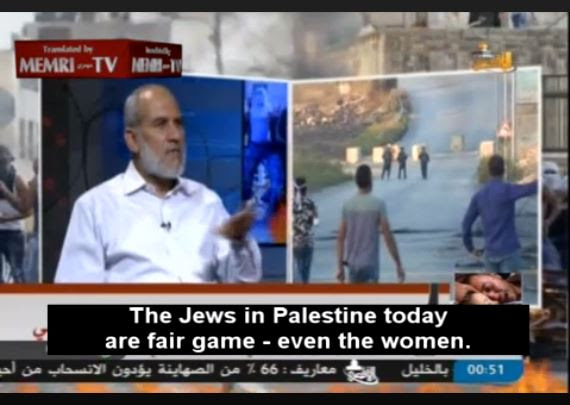
Dr. Subhi Al-Yaziji: "The Jews in Palestine today are fair game – even the women. - Because of the occupation, not because they are Jews."
Interlocutor: "Right."
[...]
Capture51221.JPG

Dr. Subhi Al-Yaziji: "Every single Jew in Palestine is a combatant, even the children. They train their children to use tanks and various kinds of weapons. They breastfeed them on hatred for the Palestinian people, and for that, they deserve [this].
[...]
Capture51222.JPG

"The military operations and the bombings should be carried out in the very heart of the enemy – in Haifa, Jaffa, Tel Aviv, and Hadera – as was the case in the past, because that is what hurts the Jews."


MEMRI

Source: http://www.memritv.org/clip/en/5122.htm

Copyright - Original materials copyright (c) by the authors.
Turkish Smoke and Mirrors - Robert Ellis


by Robert Ellis

Conspiracy theories run rife in Turkey.


Turkey is a field of daisies for conspiracy freaks, as there is ample opportunity to romp around. In the 1990s with the low-intensity war against the PKK (Kurdistan Workers’ Party) there was a whole spate of extra-judicial killings involving not only suspected members of the PKK and its supporters but also critical journalists. With the capture of Abdullah Öcalan in 1999 and the advent of the AKP (Justice and Development Party) government in 2002, all this was supposed to come to an end.

Now Turkey’s prime minister (and former foreign minister) Ahmet Davutoglu, who is generally regarded as President Erdogan’s stooge, has warned Kurdish voters that unless the AKP is returned to power at the new elections on November 1, they can expect a new period of unsolved murders and disappearances of Kurdish dissidents. Not that this hasn’t already happened.

The greatest threat to President Erdogan’s grip on power is the rise of the Kurdish-based HDP (Peoples’ Democratic Party) under the leadership of Selahattin Demirtas and his co-chair Figen Yüksekdag. At the June elections the HDP was the first Kurdish party to exceed the electoral threshold of 10 percent and with 13 percent of the votes seized 80 of the Turkish parliament’s 550 seats that the AKP regarded as belonging to them. Erdogan publicly declared the HDP was the parliamentary extension of the PKK, and in the run-up to the elections there were attacks on the HDP’s offices, supporters and vehicles as well as a bomb attack on a party rally in Diyarbakir two days before.  

According to the state-run Anadolu Agency the original target of the two suicide bombers at the Ankara peace rally on October 10 was the HDP’s offices in Ankara, and according to Turkish daily Cumhuriyet plans were also made to target an HDP election rally in Gaziantep. After the renewal of the conflict between government forces and the PKK following the suicide bombing in the Kurdish town Suruc on July 20, more than 130 attacks have been launched on HDP offices and Kurds throughout Turkey in an attempt to discredit the party before the November elections. 

Taking a step back, there is an overall link between these attacks and the AKP government’s (read: the dyad Davutoglu and Erdogan’s) discredited foreign policy on Syria, the aim of which was to replace Bashar al-Assad’s Alawite rule with a Sunni regime. Originally backed by the US, this policy has seriously backfired, leaving Erdogan and Davutoglu twisting in the wind. As a declassified report from the US Defense Intelligence Agency from 2012 makes clear, the West, Gulf states and Turkey initially supported the Salafist, Muslim Brotherhood and Al Qaeda opposition in Syria, but now this has morphed into ISIL and the Al Nusra Front, the situation has changed. 

Close links between Turkey, in particular Erdogan’s Prætorian Guard, MIT (National Intelligence Organization), and ISIL and the Al Nusra Front are well documented, but Turkey’s covert support of ISIL has turned out to be a two-edged sword. Nevertheless, Erdogan and Davutoglu have never given up trying to enlist the USA’s support in their attempt to overthrow Assad, by first calling for the creation of a ‘safe zone’, a no-fly area ostensibly for refugees in Syria, but Russia’s support of Assad has scuttled this plan. 

Furthermore, there have been incidents, staged or otherwise, which Erdogan and Davutoglu have used to pressure Obama into intervening; for example, two car bombs in the border town of Reyhanli in May 2013. Five days later, Erdogan (then prime minister), Davutoglu and Hakan Fidan, head of MIT, met with Obama in the White House to convince him of the threat posed by Syria to Turkey. 

Pulitzer Prize-winning journalist Seymour Hersh has in a controversial article in The London Review of Books claimed that the sarin gas attack on the Damascus suburb of Ghouta in August 2013 was in fact staged with sarin gas supplied through Turkey to cross Obama’s red lines and provoke a strike on Syria. Two deputies from the opposition CHP (Republican People’s Party) have claimed that an investigation into Turkey’s role in the gas attack has been derailed.

Shortly before local elections last March, a recording of a national security meeting surfaced on YouTube, where Hakan Fidan offered to stage a false flag operation putting the blame on ISIL to justify the Turkish army’s intervention in Syria. Hours later YouTube was blocked on grounds of national security. 

The HDP’s co-chair, Selahattin Demirtas, has alleged that the attack on the Ankara rally was carried out with the support of  “elements within the state,” and President Erdogan has declared that the massacre was “a collective act” involving ISIL, the PKK, the PYD (Kurdish Democratic Union Party), the PKK’s Syrian sister party, and the Mukhabarat, the Syrian intelligence service. This points to a remarkable degree of cooperation, which opens for a whole new round of conspiracy theories.


Robert Ellis

Source: http://www.frontpagemag.com/fpm/260538/turkish-smoke-and-mirrors-robert-ellis

Copyright - Original materials copyright (c) by the authors.

Egyptian Playwright Ali Salem in Final Interview: Israel Is Not an Enemy - MEMRI


by MEMRI

In an interview held several days before his death, renowned Egyptian playwright, author and political critic Ali Salem reiterated his view that Israel was not an enemy and expressed his hope that "that the political leadership in Egypt will not be ashamed of the peace accords." The interview aired on the Egyptian ON TV channel on September 20, 2015, two days before his death.

Following are excerpts:


Capture5095.JPG

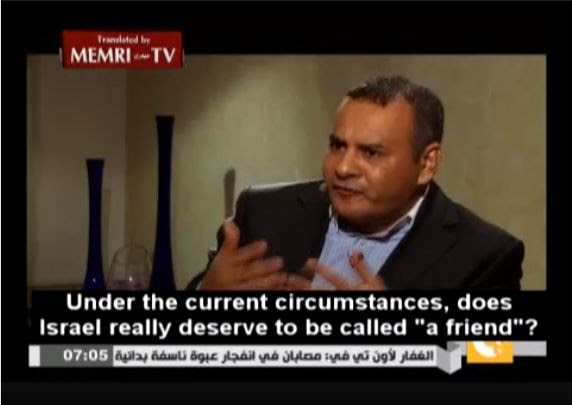
Host: "Under the current circumstances, does Israel really deserve to be called 'a friend'?"

Capture50952.JPG

Ali Salem: "First of all, there is no such thing as friendship or animosity between countries. It is all about interests. Israel is not an enemy state. I know this is not in line with your views and convictions, but I want you to think about something: Let's assume that they are against peace and that they are evil. Fine. Let's assume that the Lord created such an evil nation. But they are not fools and they are not stupid.Israel would not allow a neighboring country to be torn to pieces, to become all screwed up, and to be ruled by gangs and by ISIS. It would never allow this.A strong Egypt is in Israel's best interest."

Host: "But it welcomes all that is happening in Syria."

Ali Salem: "What did Israel do to the Syrians? The Syrian regime did it all. That regime has failed to protect its people, and has shamed us for the whole world to see. Since you brought it up, let me just say this: The only Syrians who can get a full 8 hours sleep every night are the ones living in the Golan Heights. Is any other Syrian citizen safe from the bombs and the killings?"

Host: "Are you talking about the Golan that is under Israeli control?"

Ali Salem: "Yes, I am talking about the irony of this.

[...]

Capture50953.JPG

"The Egyptians and the Hebrews are the most ancient peoples on Earth, and the relationship between them is real. I have never seen people who love the Egyptians as much as the Hebrews do.That is my opinion, and I stand behind it. This is what I have seen.
[...]

Capture50954.JPG

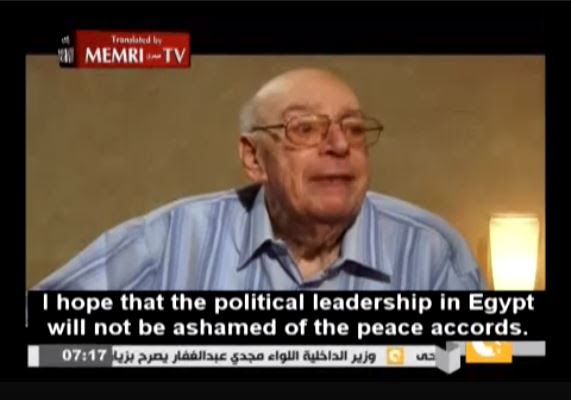
"I hope that the political leadership in Egypt will not be ashamed of the peace accords. We did not commit a crime. Anwar Sadat did not commit a crime. He regained the Sinai down to the last centimeter. We should not be ashamed of this when we address our people."

Host: "But how are we to persuade Egyptians that Israel is not an enemy, but that Hamas is? Can I at least say that they both pose a threat to our national security? I do not want to say that Hamas is an enemy."

View The Clip


MEMRI

Source: http://www.memritv.org/clip/en/5095.htm

Copyright - Original materials copyright (c) by the authors.

The Shi'ite Leopard: Iran's Religious Persecution - Denis MacEoin


by Denis MacEoin


  • Despite promises of amelioration from Iran's current President, Hassan Rouhani, the situation for Christians has not improved at all.
  • Rouhani, came to power as a proponent of human rights and reform, and has been considered a reformer and moderate in the West ever since. He made countless declarations of his intention to pursue a human rights agenda and guarantee equal rights for all Iranians: Every one of those promises has been broken, yet the U.S. continues to put faith in Rouhani as an honest broker.
  • "Christians continue to be arbitrarily arrested... [They] disappear for weeks at a time... Detainees are sometimes told they must to convert to Islam or their families will be killed." -- Ruth Gledhill, journalist
  • Even though many Sufi Muslims are fervently pious in their devotion to the faith of the Shi'a, clerics in Qom declared Sufis to be apostates and attempted to expel them from the town and to take over their religious centre.
  • The document organized the methods of oppression used to persecute the Baha'is, and contained specific recommendations. When Iranian judges offer the Bahai's life in exchange for abandonment of faith it is a clear admission of a purely religious motive.
  • Why do so many Western states and the UN condemn Israel while bending over backwards to accommodate every demand Iran makes in its bid to build nuclear weapons, expand its terrorist influence, and threaten the West?
In the wake of the infamous nuclear deal with the hard-line Iranian regime, countries around the world, led by U.S. President Barack Obama, are busy trying to bring the Islamic Republic, so long sanctioned and held at arm's length by decent people, in from the cold. Business deals beckon, great claims are made of coming dialogue and a slackening of the tensions of the Middle East. We are told that war has been avoided.
But has the Shi'ite leopard, overnight, truly changed its spots? It still executes more people per capita than China, it still supports and conducts terrorist activities in several countries, its leaders still preach hatred for America, Israel, and the West. In reality, nothing has changed, yet the theocratic, human-rights-denying regime is now to be everybody's best buddy.
An important indicator of Iran's unfitness to be counted among the nations as a legitimate actor must be its treatment of its many minorities, above all its religious minorities. As with Saudi Arabia, the theocratic character of the state is most clearly exposed when it comes to its treatment of religions and sects that are not held by the majority. A strict interpretation and application of Islamic law unfailingly leads to disrespect for and harshness towards non-Muslims.
Iran's current president, Hassan Rouhani, came to power as a proponent of human rights and reform, and has been considered a reformer and moderate in the West ever since. During his election campaign, he made countless declarations of his intention to pursue a human rights agenda. On April 11, 2013, he said: "All Iranian people should feel there is justice. Justice means equal opportunity. All ethnicities, all religions, even religious minorities, must feel justice." In a Press TV interview that August, he repeated that his administration would guarantee equal rights for all Iranians: "no authority should differentiate between various ethnicities, religions, minorities and followers of different faiths." Every one of those promises has been broken, yet the U.S administration continues to put faith in Rouhani as an honest broker.
Twelver Shi'ism, which has been the official faith of Iran since the 16th century, has itself been a persecuted religion wherever its adherents have lived under Sunni rule. It was imposed on the population of Iran by the Safavid dynasty (1502-1736), and during the nineteenth century, its clerical hierarchy grew steadily more powerful. Despite setbacks in the twentieth century, the clerical elite came to supreme power during the 1979 Islamic Revolution. Since the Shi'a are a minority in the Islamic world overall, they are deeply conscious of a need to clamp down on any other religious movements that might threaten to destabilize their rule.
Ironically, Iran is also home to a variety of religious communities, the most notable being the Jews, Christians, Zoroastrians, Sufis, and the indigenous Baha'i religion. Jews, who had lived in Iran for some 2,500 years, numbered between 60,000 and 80,000 in 1978; after the revolution the following year, two-thirds of the community went abroad. The 2011 census showed less than 9000 Jews left in Iran. It has just been reported that the last synagogue in Borujerd, once home for a significant Jewish community, had to close because there was not a minyan, a minimum prayer quorum of ten men.
Iran's regime has tried to portray itself as tolerant towards Jews, but its fanatical hatred for Israel and Zionism has often exposed the community to accusations of espionage, arrests, and executions. Outwardly, Iranian Jews are not particularly molested, and are represented by a single Member of Parliament. They operate synagogues and ritual baths, celebrate festivals, and are granted the status of dhimmi people: protected by an Islamic government in return for discriminatory debasing requirements. The tolerance, however, is apparently skin deep, with anti-Zionism lying near the surface.[1]
The second of Iran's dhimmi faiths, Christianity, has not fared as well. The total number of Christians in Iran (of all denominations) has been estimated at between 200,000 and 250,000. Ninety percent of these belong to long-standing indigenous churches, for Armenians, Assyrians, and Chaldeans. They do not seek converts and are relatively unmolested. But churches that have links to foreign countries are treated harshly. According to Minority Rights International:
"The Protestants, and particularly evangelical groups, face the most difficulties from amongst the Christian communities in Iran. Human Rights Watch estimated their numbers at around 10,000-15,000 in 2002. Churches have been closed down, the use of Persian in sermons banned, the publishing of Bibles restricted and Muslims strictly prohibited from attending sermons, with previous converts from Islam being put under particular surveillance. A number of Christian leaders have been killed or found murdered since the early 1990s: Assemblies of God Minister Bishop Haik Hovsepian Mehr was found stabbed to death in 1994; Reverend Mehdi Dibaj, pastor of the Church of the Assemblies of God, a convert from Islam 41 years previously, was released from prison in January 1994 but found dead by the authorities on July 2 that year; Reverend Tateos Michaelian, found murdered in July 1994; pastor Mohammad Bagher Yusefi, disappeared and was found dead in 1996, and pastor Ghorban Dordi Tourani was found dead in 2005.
Respected religious affairs journalist Ruth Gledhill has argued that, despite promises of amelioration from the current President, Hasan Rouhani, the situation for Christians has not improved at all. By the end of 2014, over 90 Christians were behind bars. Gledhill writes:
"Christians continue to be arbitrarily arrested and interrogated because of their faith. Some face 'severe physical and psychological torture' during detention, and simple prayer or Bible study meetings are regarded as political activities that threaten the national security of Iran.
...
"Christians disappear for weeks at a time while they are interrogated. They are held in solitary and questioned nightly, for hours at a time, beginning just after midnight. A key goal of the security services is to find and remove any New Testaments from the homes of Christians. Detainees are sometimes told they must to convert to Islam or their families will be killed."[2]
Despite such threats, it has been claimed by some missionary organizations that thousands of Iranian Muslims are converting to Christianity, resulting in a growth rate of 20% per annum. Mohammed Zamir, a church leader in the UK for expatriate Iranians, has stated that hundreds of thousands of Iranians are converting to Christianity, out of control of the authorities. These claims need to be taken with a pinch of salt. The longest-lasting and most indigenous faith in the country is, of course, the ancient Zoroastrian religion, founded by the Iranian prophet Zardosht (Zarathustra, Zoroaster) somewhere between 1700 and 500 BCE, but traditionally dated to around 600 BCE. Until modern times, the religion has remained largely confined to Iran and India (where Zoroastrians are known as Parsis, having moved to the sub-continent from Iran from the 8th to 10th centuries to avoid persecution by the Muslim newcomers).[3] Although the Qur'an mainly speaks of Jews and Christians when it refers to "the people of the book" (Ahl al-kitab), one verse (22:17) speaks of the Magis (al-Majus): "As for the believers [the Muslims], those who follow the Jewish religion, the Sabaeans, the Christians, the Magians, and the idol worshippers, God will decide between them on the Last Day."
After the Arab Muslim conquest of Iran between 633 and 651 CE, it became a matter of urgency to define the status of the Zoroastrian population. Exegetes and jurists agreed that they should be treated as scriptuaries and not pagans, which led to a degree of toleration for them and their religious practices.
Under the Islamic regime, however, this toleration has been severely strained. In November 2005, Ayatollah Ahmed Jannati, chairman of the Council of Guardians of the Constitution, disparaged Zoroastrians and other religious minorities as "sinful animals who roam the earth and engage in corruption." When the Zoroastrians' solitary parliamentary representative protested, he was hauled before a revolutionary tribunal. There, mullahs threatened execution before sparing his life with a warning never to challenge their declarations again. A frightened community subsequently declined to re-elect him. Writing in 2011, Sanskrity Sinha commented that "Zoroastrianism in Iran is on the verge of dying an ignominious death, with only a few thousand living in a country where their rights are suppressed."
Sufism is another indigenous community that has suffered greatly at the hands of the Islamic regime. Sufism is the mystical trend in Islam, and in the Sunni world, across North Africa, the Middle East, and far beyond. In some periods, the many Sufi brotherhoods (tariqat) were followed by as much as 90% of the population. Sufism has been attacked in modern times, especially by the Saudi Wahhabis, and its numbers have greatly fallen. In Iran (and in regions such as Tajikistan, Afghanistan and northern India, saturated with Persian influences), although there were few orders, the culture was deeply embedded with Sufi mysticism. Persian poetry, for example, is considered one of the greatest canons of verse in the world. [4]
The Islamic regime will never dare ban the works of these poets, considered the highest achievement of Persian culture. But in a bizarre move, it has clamped down hard on Iran's best-known Sufi order, the Ne'matollahis.[5]
Today, even though members of it are fervently pious in their devotion to the faith of the Shi'a and their twelve holy imams, the Sufis, especially the Gonabadi branch, have been persecuted. In 2006, for instance, clerics in Qom (where the important Khomeinist seminary is situated) declared Sufis to be apostates and attempted to expel them from the town and to take over their Shi'i-style religious centre. Dervishes from across Iran travelled to Qom, held several days of protests around the centre, and declared their desire for peace, their commitment to the Shi'i faith, and their loyalty to the revolution.
In spite of this display of devotion, police suppressed the protest. Over 1,000 Sufis were arrested and the religious centre was burned to the ground. The anti-Sufi campaign then moved to other cities such as Bojnurd and Isfahan, where more centres were destroyed. In 2009, the shrine of Sufi poet and philosopher Dervish Naser 'Ali, situated in a local cemetery in Isfahan, was looted and then destroyed. Protesters who gathered outside the Majlis (Iran's parliament) were disrupted when police arrested sixty of them.
That same year, the Green Movement for democracy in Iran was violently suppressed. It had been supported by the Gonabadi Sufis. Since then, lawyers, website managers, and others have been imprisoned, tortured and killed. On September 10, four Gonabadi activists were arraigned in Shiraz for trying to appeal their earlier convictions. Their website describes this: "At the court hearing in the case of four dervishes, Mr. Saleheddin Moradi, Mr. Farzad Darviah, Mr. Behzad Nouri and Mrs. Farzaneh Nouri that was held in Branch 16 of the appeals court of Shiraz, the representative of the prosecution contemptuously emphasized the necessity of their penitence, to discontinue... website activities... and also the maximum punishment for the mentioned dervishes."
The attack on the Sufis of Iran reveals something particularly dark about the Islamic regime. Sufi mysticism, with its close ties to the most central aspects of Persian culture -- poetry, calligraphy, music, miniature painting, the rose, the nightingale, the garden -- is vital to the healthy working of Iranian society, yet the regime that asserts its right to protect the people under its rule has turned on it.
Not far from that denial of Persian values stands the greatest persecution of all: the ongoing attack made on Iran's largest indigenous religious minority, the Baha'is. "The Baha'is of Iran," according to Payam Akhavan, Professor of International Law at McGill University, have long been the canary in the mineshaft as far as human rights are concerned. Their treatment is the litmus test of the direction the leadership intends to take the country."
This is a subject that has resulted in a vast outpouring of articles, reports, government debates, websites, legal appeals, protests, speeches and encyclopaedia articles. Although there have been many executions, this is not a story like that of Islamists killing Christians in the Middle East. It is something more chilling than that. It's best parallel is the persecution of Jews in Germany in the 1930s, before the move to a "Final Solution" -- a slow, steady, calculated, often bureaucratic campaign of attrition.
Baha'ism (the Baha'i Faith) is a monotheistic religion that emerged in the mid-nineteenth century out of a Shi'ite sect known as Babism.[6]
Today, it is estimated that there are about five million Baha'is across the globe, with their largest numbers among Hindu converts in India and Western converts in Europe, North and South America. The Baha'i temple in New Delhi, with over 100 million visitors, is considered by UNESCO to be one of the most visited buildings in the world. Although small in numbers, the Baha'is are racially, nationally, and religiously diverse, well organized and well integrated.
Where Babism was militant and grew embroiled in clashes with state troops in several places, Baha' Allah abrogated jihad, advocated world peace, equality of the sexes, world brotherhood and other teachings ultimately derived from Western sources. His religion, built on a mixture of Shi'i and Sufi beliefs, was nonetheless progressive in nature, at ease with modernity, and divorced from political intrigue. This combination of religious heresy and Western social themes brought it directly in conflict with the clergy of the day and through the twentieth century. Baha'is were martyred, imprisoned, and faced with daily suspicion and animosity. For all that, their stress on education and their openness to science and professional pursuits meant that they prospered as doctors, lawyers, teachers, academics, and technicians. Some even held positions at the Shah's court. More complicated is that many Iranian Jews converted to Baha'ism, despite this exposing them to harsher treatment.[7]
After the 1979 Islamic Revolution, things changed greatly for the worse. After the fall of the Shah, Dr. James Cockcroft interviewed Ayatollah Khomeini and asked specifically about the Baha'is:
Cockroft: Will there be either religious or political freedom for the Baha'is under the Islamic government?
Khomeini: They are a political faction; they are harmful. They will not be accepted.
Cockroft: How about their freedom of religion– religious practice?
Khomeini: No.[8]
So began the first major persecution in the Middle East in modern times.[9]
In the first ten years after the Revolution, over 200 Baha'is were murdered or executed, while hundreds more were tortured and imprisoned. Tens of thousands lost jobs, access to education, pensions, and other civil rights for no other reason than that they belonged to a religion that claimed there had been two new prophets after Muhammad. It was thought by many that the regime would finally carry out a genocide of the community, then numbering around 300,000.[10]
Among thousands of incidents, two stand out as indicative of the violent tactics underlying the Revolution, its institutions, and its laws. The single greatest example of violence towards Baha'is occurred in 1983 in the southern city of Shiraz. A few years earlier, in February 1979, the suburb of Sa'diyeh had been rocked by an anti-Baha'i pogrom that left over two hundred homes and businesses looted and burned. In 1981, five Baha'i leaders, and in 1982 another three, were executed. In October and November 1982, mass arrests were carried out by local members of the Islamic Revolutionary Guard Corps. The stage was set for further violence.[11]
After a prolonged persecution, at the beginning of June 1983, in accordance with Islamic tradition, the 22 remaining Baha'i detainees in prison were offered four last opportunities to convert to Islam and save their lives. They all declined.
Ten women who were hanged had been charged with the crime of teaching children's classes. The classes, known as Dars-e Akhlaq, "Morality lessons," are similar in nature to Christian Sunday schools or Jewish religious classes for children. They teach moral behaviour that could come straight from any Judaeo-Christian ethics curriculum. All ten had been tortured and interrogated for months before their execution. The youngest, Mona Mahmudnizhad, seventeen at the time of her death, has become a symbol of Baha'i martyrdom.
It is reported that while in prison Mona was bastinadoed on the soles of her feet with a cable and forced to walk while bleeding. One account states that she kissed the hand of her executioner and then the rope itself, before putting it around her own neck. Her father was arrested and executed at about the same time. During the trial of another young victim, 23-year-old Roya Eshraqi, a veterinary student, the judge said "You put yourselves through this agony only for one word: Just say you are not a Baha'i and I'll see that... you are released..." Ms. Eshraqi is said to have responded, "I will not exchange my faith for the whole world."
U.S. President Ronald Reagan asked the Iranian government to show clemency. He was ignored.
What is clear again is the purely religious character of the persecution. Khomeini's claim that the Baha'is "are a political faction" and the frequent claims that they are spies could not be farther from the truth. Baha'is are forbidden by their own doctrines to take part in any form of politics and are even dissuaded from voting in elections. They do have teachings about a future world government and international economics, but have no interest in party politics and are commanded to be loyal to whatever country they may live in. Baha'is can be sanctioned by their own institutions for breaking these rules. The Iranian government knows this perfectly well, and when judges offer life in exchange for abandonment of faith it is a clear admission of a purely religious motive.
Although clerics have called for genocide, it has became official policy to suppress the Baha'is in a more careful fashion.[12] It is highly likely that the international protests about the fate of the Baha'is may have convinced the regime that a total liquidation of the community would produce a storm of condemnation that they might find hard to weather.
In February 1991, a confidential circular[13] was issued by the Supreme Council of the Cultural Revolution, a body set up by Khomeini in Qom, whose members were at that time all appointees of Supreme Leader 'Ali Khamene'i. The Council has extraordinary powers. Its rulings must be treated as laws and may not be overruled. Stamped "confidential," the circular was signed by Hujjatu'l Islam Seyyed Mohammad Golpaygani, Secretary of the Council, and approved by Ayatollah Khamene'i, who added his signature. The circular addressed "the Baha'i question" and signalled an increase in efforts to suffocate the Iranian Baha'i community in a more "silent" fashion. The document organized the methods of oppression used to persecute the Baha'is, and contained specific recommendations on how to block the progress of the Baha'i communities both inside and outside Iran. The document stated that the most excessive types of persecutions should be avoided and instead, among other things recommended, that Baha'is be expelled from universities, "once it becomes known that they are Baha'is," to "deny them employment if they identify themselves as Baha'is" and to "deny them any position of influence."
The systematic exclusion of Baha'i professors and students from the universities started soon after the Revolution, but became clear by 1983. In response, the Baha'is themselves tried to remedy the situation by establishing in 1987 the Baha'i Institute for Higher Education, a clandestine university that operated underground and continues nowadays mainly through the internet. Its curriculum is broad; many graduates have been credited by American and European universities for higher studies. The teachers are generally made up of Baha'i lecturers and professors who have been dismissed from their posts in the regular Iranian universities. Over the years, the university has been closed down on several occasions, many teachers have been arrested, and many remain in Iran's prisons, serving long sentences.[14] The Bahai Institute of Higher Education in Iran has, however, received considerable support from universities, academic institutes, governments, and other bodies (such as Amnesty International) around the world, which have repeatedly petitioned the Iranian government to legalize it and permit Baha'is to attend national universities.
The Baha'is, like the Jews, have always considered education to be a primary function of a healthy society. In 1973, when the national literacy rate for women under 40 in Iran stood at 15%, the figure for Baha'i women was 100%.[15] The first Girls school in Iran was opened by Baha'is in 1899, closed down, then re-opened in 1911 as the Tarbiyyat-e Banat in Tehran, with a secular curriculum and American Baha'i women teachers. It was immensely popular, and by the 1930s there were dozens of Baha'i schools for both girls and boys. They were the best schools in the country, the academies to which many of the middle and upper classes sent their children. But in 1934, the government under Reza Shah shut them down permanently.[16] Today, Baha'i children in regular schools, the dabestans and dabirestans, suffer ill treatment. According to the Baha'i International Community, "Baha'i school children at all levels continue to be monitored and slandered by administrators and teachers in schools. Secondary school students often face pressure and harassment, and some have been threatened with expulsion. Religious studies teachers are known to insult and ridicule Baha'i beliefs. In a few reported cases, when Baha'i students attempt to clarify matters at the request of their peers, they are summoned to the school authorities and threatened with expulsion if they continue to 'teach' their Faith."
In one of the cruellest phases of this persecution, the Islamic government has behaved in an identical fashion to the Islamic State terrorist organization. Across Iraq and Syria, IS has destroyed churches, shrines, ancient monuments, and cultural artefacts of deep significance in human history. The Iranian regime has demolished all the holy places of the Baha'i faith in Iran, shrines and buildings associated with their prophets, martyrs, and early followers. In Shiraz, a charming early 19th-century dwelling known as the House of the Bab, where the first of the two Baha'i prophets revealed his mission to his first followers, was summarily bulldozed shortly after the Revolution, and a mosque built on the site. This little house, which the author visited several times while living in Shiraz in the 1970s, was of historical and religious significance, with its exquisite Persian carpets, stained glass windows, and genial atmosphere.
The regime has not stopped at shrines. Over the years, many Baha'i cemeteries have been dug up and the corpses in them disinterred and scattered. As recently as April 2014, Shiraz's Revolutionary Guards commenced the destruction of a historic Baha'i cemetery. International pressure halted this destruction for a while, but a few months later, in August, the work of demolition began again, and a concrete foundation was laid for a complex of recreational buildings. Among the 950 Baha'is who had been buried there were the ten women hanged in 1983. Incidentally, Baha'i law prohibits burial more than an hour's distance from the place of death. (This is in conscious contradiction of the Shi'i practice of keeping corpses for months or years before sending them to be buried at one of the shrine centres in Iraq.)

The destruction of a historic Baha'i cemetery in Shiraz, Iran, by the Islamic Revolutionary Guards Corp. (Image source: Baha'i World News Service)
This insidious process of attrition operates across the board. Baha'is face the monitoring of their movements, activities and bank accounts; the denial of their pensions and inheritances; exclusion from employment in most sectors; the closure of their shops and businesses; the prohibition of their access to publishing or copying facilities for the printing of Baha'i sacred and general literature; and the confiscation of property. Muslims who associate with Baha'is are intimidated. Anti-Baha'i writings and broadcasts are common. From January 2014 through May 2015, the Baha'i International Community documented more than 6,300 items of anti-Baha'i propaganda in Iran's official or semi-official media. A report on the media campaign to demonize Baha'is is available here.
A particular injustice that has received considerable comment around the world is the current imprisonment of seven Baha'i leaders. They were arrested in 2008 and given to a twenty-year prison sentence in 2010. Their sentence was passed by Mohammad Moghiseh, head of Branch 28 of Tehran's Revolutionary Court. Moghiseh is one of six regime judges accused of being behind recent crackdowns on dissidents, journalists and others. According to Mahmood Amiry-Moghaddam, an Iranian human rights activist in Norway, "This group is among the most notorious judges in Iran. They are known for their politicised verdicts, unfair trials [and] sentencing prisoners based on confessions made under duress." Gissou Nia, of the US-based Iran Human Rights Documentation Centre (IHRDC), said: "It seems that in the courtrooms of Salavati, Moghiseh and Pirabbasi, there is [something] counter-intuitive at play -- that is, the shorter the hearing, the longer the sentence." She added: "Those cases that have made their way before this trio of revolutionary court judges, and have resulted in long terms of imprisonment or, even worse, death, read like a who's who of the most high-profile miscarriages of justice in the Iranian legal system."
The condemned, five men and two women, were elected members of the National Spiritual Assembly of the Baha'is of Iran. The Baha'i religion has no priesthood and a very limited clerical class. All the main Baha'i institutions at local, national and international level are created through open elections (without electioneering), and individuals take on their responsibilities as a religious duty. In other words, these seven Baha'is are volunteers who took on administrative functions in a time of very great danger for their faith and themselves. Known as the Yaran (Friends), they embody the injustice, irrationality, and cruelty of the Iranian regime.
Writing on the day of their final trial in Canada's Globe and Mail, Howard Adelman (professor emeritus of philosophy at York University and founder of the Centre for Refugee Studies) lists the seven and provides short but pertinent information on who they are:
Fariba Kamalabadi, 46, whose physician father was arrested in the 1980s, tortured and imprisoned, was an honours student denied entry to university but who became a developmental psychologist while raising three children. On the first anniversary of Ms. Kamalabadi's arrest, her youngest, Alhan, wrote an open letter expressing the "mountain load of pain and sorrow" she carried during "a year of being far from a mother."
Jamaloddin Khanjani is a 75-year old industrialist, a father of four and a grandfather of six.
Afif Naeimi, 47, is a brilliant student who was denied entry to medical school but who became a successful industrialist. He is a father of two.
Saeid Rezaie, 51, is a Baha'i scholar and an agricultural engineer with a farming equipment business. He has three children.
Mahvash Sabet, 55, is a teacher and principal who was dismissed from public education for being a Baha'i. She served as director of the Baha'i Institute for Higher Education for 15 years. She has two children.
Behrouz Tavakkoli, 57, is a former lieutenant in the Iranian army and social worker who specialized in the care of people with disabilities. He lost his government job after the Islamic Revolution because he was a Baha'i. He has spent previous time under arrest in solitary confinement. He has two sons, one a student and the other an engineer living in Canada.
Vahid Tizfahm, 35, is an optometrist and a former member of the Baha'i National Youth Committee. He has one son.
The head of their legal team, Nobel Laureate Shirin Ebadi, has stated that her clients have been convicted of "spying for America and Israel, acting against national security and [engaging in] propaganda against the [Islamic Republic's] system", adding: "I read the dossier and fortunately or unfortunately, found in it no cause or evidence to sustain the criminal charges upheld by the prosecutor." In an interview with Washington TV, she described the difficulties she and her fellow lawyers faced:
"When I and my colleagues accepted to act as their defense lawyers, they had not been allowed to see their families for over a year. And for some time too, they were not allowed to meet with us. After a year and a half when the investigation ended, I and the rest of the lawyers were permitted to read the dossier and we met them on one occasion in prison."
The seven leaders are confined in Section 209 in Evin, Iran's most notorious prison. The campaign for their release continues. A detailed summary of the injustices meted out to them has been penned by American jurist Dr. Christopher Buck J.D., and is available here. In it, Buck argues with detailed use of quotations that the trial and sentencing were in contradiction of Iran's constitution, but argues that the protections offered in that document are always suspended if anything is deemed contrary to "Islamic criteria".
All of the above could be expanded on over a dozen articles or more. But I would like to end on a positive note. Iran, a country whose clerical leadership has for decades instructed the population to chant "Death to Israel" in its mosques and on its streets, terrorizes its religious minorities and threatens its Baha'i population with slow extinction. Israel, on the other hand, the one country in the world that almost every other country condemns as an evil Zionist entity, is the only country in the Middle East that offers full-time protection to its own religious minorities, be they Christians, Muslims, or Baha'is. Israel hosts the two holiest Baha'i shrines, the seat of the supreme Baha'i legislative body, the Universal House of Justice, gardens, a cemetery, their international archives, and other foundations. One day, a Baha'i temple as original in design as the other temples on five continents will be built atop Mount Carmel. Every year, thousands of Baha'i pilgrims from around the world come to perform visitation at the shrines. The Baha'i World Center has been designated by UNESCO as a World Heritage Site and is today one of the most popular destinations for tourists to Israel.
This single fact alone is the clearest evidence of how wholly different Iran is from Israel: Iran is a murderous theocracy while Israel is a thoroughly tolerant democracy. Why, then, do so many Western states and the UN, condemn Israel while bending over backwards to accommodate every demand Iran makes in its bid to build nuclear weapons, expand its terrorist influence, and threaten the West?
The Iranian leadership must now feel invulnerable; it seems that no matter what they do, the Western powers will let them get away with it. This sense of invulnerability, if not checked, will mean even harsher treatment of religious minorities and quite possibility a fast-track impetus towards a genocide of the Baha'i population, as well as the accelerated murder of others.
Denis MacEoin has a PhD in Persian Studies from King's College, Cambrdge. He has written many books, journal articles, and encyclopedia entries about the Baha'is and their predecessors.

[1] Dr. Esther Webman, director of the Stephen Roth Institute for the Study of Contemporary Antisemitism and Racism, has said the tolerance is a mere façade.
[2] Citing a 2015 report, The Persecution of Christians in Iran, from the UK all-party Christians in Parliament group.
[3] Regarding Iran, in a 2009 report, the U.S. State Department declared that "the [Iranian] Government estimates there are 30,000 to 35,000 Zoroastrians, a primarily ethnic Persian minority; however, Zoroastrian groups claim to have 60,000 adherents."
[4] The majority of these great poets – whose work has been translated into many languages – were Sufi mystics: Rumi (1207-1273, today known as America's favourite poet), Hafez (1325-1389), Sa'di (1210-1291), Omar Khayyam (1048-1131), Attar (1110-1221), Sana'i (d. 1131/41), and dozens more. Every Iranian home has a copy of Hafez's Divan alongside a copy of the Qur'an. Iranians, even peasants, will quote at length from this mystical poetry. Traditional singers use poetry for their lyrics. That most exquisite of all Persian arts, calligraphy, is seen everywhere in renditions of famous poems. In the famous city of Shiraz, the tombs of Hafez and Sa'di are daily visited by pilgrims from around the country. A series of radio programmes without parallel in the West, Barnama-ye Golha (The Flowers Programme), was broadcast in Iran for twenty-three years, from 1956 to 1979 (when the regime imposed a general ban on music), discussing the links between Persian poetry and musical traditions.
[5] The Ne'matollahis, and specifically on its chief branch, the Gonabadi-Ne'matollahis. The Ne'matollahi order was founded by Shah Ne'matollah Vali (1330-1431), an Iranian Sufi shaykh and poet. Soon after the establishment of the Shi'ite Safavid dynasty in 1501, the order declared itself Shi'i. Today, the Gonabadi branch, which emerged in 1861 following the death of the last overall Ne'matollahi shaykh, is fervently pious in its devotion to the faith of the Shi'a and their twelve holy imams.
[6] The fullest account of this movement is to be found in Denis MacEoin, The Messiah of Shiraz: Studies in Early and Middle Babism, 738 pp., Brill, Leyden, 2009. Readers should also consult, Abbas Amanat, Resurrection and Renewal: The Making of the Babi Movement in Iran, 1844-1850, 477 pp., Cornell U.P., Ithaca, N.Y., 1989. Its two prophet-founders, Sayyid 'Ali Muhammad Shirazi, the Bab [the Gate] (1819-1850) and Mirza Husayn-'Ali Nuri, Baha' Allah (Baha'u'llah) (1817-1892) were born Shi'i Iranians. The Bab, shot by a firing squad in Tabriz in 1850, is buried in the famous golden-domed shrine on the slopes of Mount Carmel in Haifa, Israel. Baha' Allah, exiled to Ottoman Syria, is buried in a shrine outside the city of Acco.
[7] See Mehrdad Amanat, Jewish Identities in Iran: Resistance and Conversion to Islam and the Baha'i Faith, I. B. Tauris, London, 2011.
[8] James Cockcroft, "Iran's Khomeini," an exclusive interview by Jim Cockcroft, SEVEN DAYS, February 23, 1979, Volume III, Number 1, pp. 17-24.
[9] The most comprehensive accounts of this phenomenon are three major reports by the Iran Human Rights Documentation Center, a non-profit organization based in New Haven, funded by the US State Department as well as the Canadian government, private foundations and other donors. The reports are available online: "A Faith Denied", "Crimes Against Humanity", and "Community Under Siege". Their work has been reinforced by Dr. Nabila Ghanea's 2003 book, Human Rights, the U.N. and the Baha'is in Iran, a 640-page report by an experienced human rights expert.
[10] In a 1982 study of the persecution, Iran's Secret Pogrom, British author Geoffrey Nash predicted such an outcome.
[11] In its Executive Report at the heads of its lengthy report on these incidents, the Iran Human Rights Documentation Center provides this summary: In February 1983, the Revolutionary Court in Shiraz accidentally sent an internal circular intended for distribution within the Revolutionary Guard Corps to the offices of a local newspaper, Khabar-i Junub. The circular stated that the Court had issued an order for the execution of twenty-two members of the local Baha'i community. The victims were not named. The newspaper published this information following it up with an interview with the Head of the Revolutionary Court, Hojjatolislam Qaza'i, ominously headlined: "I Warn the Baha'is to come to the Bosom of Islam." At the time one detainee had already been executed in January. Three more prominent Baha'i detainees were executed in March 1983.
The Khabar-i Junub article provoked an international outcry. The Islamic Republic regime responded by exploiting the foreign pressure as evidence to support its narrative that the Baha'i Faith was the artificial creation of the superpowers with the aim of undermining Iranian society. In a widely reported speech in May 1983, Iran's Supreme Leader, Ayatollah Khomeini, dismissed international protests with the comment: "Were these people not spies, you would not be raising your voices."
Six male detainees were executed on June 16. Ten female detainees were hanged in Shiraz's Chawgun Square on June 18. Of the two remaining male detainees who died in 1983, one was executed at the end of June and the other died while in prison custody.
Although the Iranian authorities have never explicitly named the Shiraz twenty-two, the IHRDC has identified twenty-two Baha'i detainees who died in 1983 in the custody of the Shiraz authorities. Twenty-one were executed and one victim died in prison after months of abuse. We believe that it is reasonable to conclude from the existing evidence that it was the original intention of the Shiraz Revolutionary Court that all twenty-two be executed for their refusal to recant their faith.
[12] Moojan Momen, "The Babi and Baha'i community of Iran: a case of 'suspended genocide'?", Journal of Genocide Studies, volume 7, number 2, June 2005, pp. 221-241, available at:
[13] UN Doc. E/CN.4/1993/41, Commission on Human Rights, 49th session, 28 January 1993, Final report on the situation of human rights in the Islamic Republic of Iran by the Special Representative of the Commission on Human Rights, Mr. Reynaldo Galindo Pohl, paragraph 310. See also "Iran's secret blueprint for the destruction of the Baha'i community."
[14] Friedrich W. Affolter, "Resisting Educational Exclusion: The Bahai Institute of Higher Education in Iran", International Journal of Diaspora, Indigenous and Minority Education 1 (1) 2007: 65–77.
[15] See Tahirih Tahririha-Danesh, "The Right to Education: The Case of the Bahá'ís in Iran", in Tahririha-Danesh, Bahá'í-Inspired Perspectives on Human Rights, Juxta Publishing Co., 2001, pp. 216–230.
[16] See Soli Shahvar (Haifa University), The Forgotten Schools: The Baha'is and Modern Education in Iran 1899-1934, I. B. Tauris, London and New York, 2009.


Denis MacEoin

Source: http://www.gatestoneinstitute.org/6671/iran-religious-persecution

Copyright - Original materials copyright (c) by the authors.