by Grégoire Canlorbe
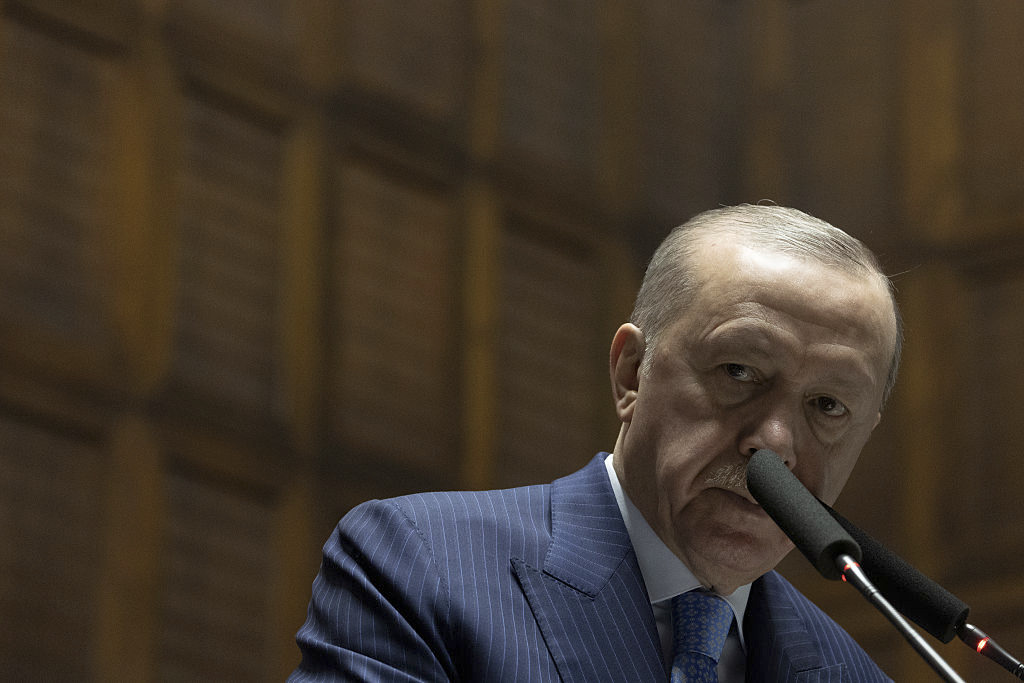
[Turkish President Recep Tayyip] Erdoğan sees the Muslim communities of Europe as a natural extension of Turkish power, not just the Muslims of Cyprus, Greece, the Balkans, Bulgaria, Bosnia, and Romania, but also the millions of Muslims settled in Western Europe as a result of mass immigration
An empire always seeks to expand its influence. From this perspective, [Turkish President Recep Tayyip] Erdoğan sees the Muslim communities of Europe as a natural extension of Turkish power, not just the Muslims of Cyprus, Greece, the Balkans, Bulgaria, Bosnia, and Romania, but also the millions of Muslims settled in Western Europe as a result of mass immigration.
Turkey occupies 37% of Cyprus. Year after year, its officials there pursue a policy of demographic colonization. Tens of thousands of Turks, notably from eastern Anatolia and often Islamized, have been settled in the northern part of the island presumably to alter the demographic balance.
In 2008, Erdoğan shocked Angela Merkel by declaring that the assimilation of Turks in Germany constituted a "crime against humanity." For Erdoğan, asking Turkish Muslims to integrate into the values of their host countries amounts to attacking the Turks' Islamic identity.
Saudi Arabia was also considering joining [the Abraham Accords], but in Europe, their reception was largely distorted by the choice of those Muslim interlocutors who were favored by states and institutions. The individuals who claim to represent Europe's Muslims are backed politically and financially by Qatar, Turkey, Pakistan, and Kuwait. Those countries fund and support Sunni associations and mosques linked to the Muslim Brotherhood, one of the Sunni movements most hostile to Israel, alongside Turkey's Millî Görüş movement. Both organizations have close ties to Hamas.
The representation of Europe's Muslims has often been entrusted to countries, associations, or networks ideologically hostile to Israel: Qatar, some movements linked to the Muslim Brotherhood, Milli Görüş, or other radical Islamist organizations. These networks are deeply anti-Zionist, extremely pro-Palestinian, and sometimes even complacent toward Hamas. The result is that the Abraham Accords, which should be seen as a diplomatic, security, and civilizational advance, have been presented in Europe as a betrayal.
Countries that support Islamist associations linked to the Muslim Brotherhood, such as Turkey and Qatar, as well as pro-Iranian influence groups that are highly active within radical left-wing and, at times, populist political movements, exert pressure on Muslims to regard countries supportive of the Abraham Accords—such as Morocco and the United Arab Emirates—as traitors to Islam. Those countries are portrayed as complicit with an allegedly "satanic" Israel, accused of massacring Palestinians in Gaza who are associated with Hamas. Hamas, itself a jihadist organization rooted in the Muslim Brotherhood, is in turn presented as the purest embodiment of the Islamic cause in its struggle against the American and Israeli-Zionist "devils."
[Most Muslims] are exposed to a demonizing discourse conveyed by associations, preachers, or extremely anti-Zionist states such as Algeria and Qatar. In this discourse, recognizing Israel or cooperating with it becomes unthinkable.
In fact, some Muslims in Europe are today more radicalized on the issue of Israel's right to exist than the populations of several Arab countries. In Egypt, Jordan, Bahrain, Saudi Arabia, and especially the Emirates, it is possible to defend the Abraham Accords or to criticize Hamas. In Europe, in some Muslim circles, such a position becomes much harder to maintain.
Some Emirati officials have been worried to see their nationals return from London with Islamist, radical pro-Palestinian ideas, whereas in their own country—the UAE—they had been protected from these influences.
Christians now represent 0.3% of the population of Algeria, Tunisia and Morocco, compared to 95% in 650. The fatal error of the West is to organize its own dhimmitude in the form of self-racism, self-flagellation, and self-destruction in a guilt-ridden Europe inclined to atone for its past by allowing itself to be overwhelmed by Islamization and extra-European immigration.
This new form of voluntary dhimmitude aims to buy peace. Europe agrees no longer to criticize Islam, it also agrees to finance mosques, and to allow a political and religious ideology to enter without reciprocity.
Alexandre del Valle is a French author specializing in geopolitics. He is the author of the acclaimed Islamist Totalitarianism: Democracies Under Attack, The Strategy of Intimidation: From Jihadist Terrorism to Islamic Correctness, and The Western Complex: A Short Treatise on De-culpabilization, among other publications.
- Read Part I: The Exploding Islamization of the West
Grégoire Canlorbe: Is Erdoğan's Turkey a danger at Europe's gates?
Alexandre del Valle: Erdoğan's Turkey is definitely a danger -- comparable to the Ottoman Empire. Erdoğan's entire geopolitical and ideological vision appears to rest on the idea of continuity with that empire. He seems to see himself as the heir of the Ottoman sultans, even as the restorer of an empire abolished by Atatürk. He appears to regard that rupture as being secular and anti-religious.
The movement from which Erdoğan comes, Milli Görüş, is in some ways the Turkish equivalent of the Muslim Brotherhood. This international Turkish Islamist organization regards Atatürk, the founder of modern and secular Turkey, as a traitor who destroyed a sacred institution, the caliphate. Erdoğan appears to be a proponent of historical reparation: he wants to reconcile Turkey with its Ottoman and Islamic past in order to restore imperial greatness to it.
An empire always seeks to expand its influence. From this perspective, Erdoğan sees the Muslim communities of Europe as a natural extension of Turkish power, not just the Muslims of Cyprus, Greece, the Balkans, Bulgaria, Bosnia, and Romania, but also the millions of Muslims settled in Western Europe as a result of mass immigration.
Turkey therefore presents itself as the only great Eurasian Muslim country capable of embodying the leadership of European Islam. After the fall of Andalusia in Spain and of Muslim Sicily, it was the Ottoman Empire that long carried political Islam in Europe, especially through the Balkans and Eastern Europe. Erdoğan seems to view a Neo-Ottoman Turkey as the natural heir to this European Islam.
That inclination might explain Erdoğan's apparent desire to extend the influence of networks such as Milli Görüş, but also official structures such as the Turkish Diyanet, the Ministry of Religious Affairs, and the German DITIB— the Turkish Islamic Union for Religious Affairs—its offshoot in European countries. Through these religious and consular networks, Erdoğan spreads a neo-Ottoman state Islam that seeks to impose itself as the protector, sponsor, and leader of Europe's Muslims.
Canlorbe: What importance does Cyprus have in Erdoğan's plans?
del Valle: Turkey occupies 37% of Cyprus. Year after year, its officials there pursue a policy of demographic colonization. Tens of thousands of Turks, notably from eastern Anatolia and often Islamized, have been settled in the northern part of the island presumably to alter the demographic balance. In the long term, Erdoğan's apparent objective is to ensure that Cyprus is placed entirely under Turkish influence, or better, under Turkish control.
The Turkish government also exerts constant pressure on Greece, particularly around its islands, while instrumentalizing the Muslim minority present on Greek territory. Turkish officials regularly raise issues concerning the Muslim minority in Muslim Thrace in its diplomacy with Greece, advocating for its rights and identity while using these issues as leverage in broader bilateral disputes.
Turkey also seeks to extend its influence among the Muslim minorities of Bulgaria, Romania, the Balkans, Albania, Kosovo, Bosnia, and Macedonia -- a considerable geopolitical lever.
For these reasons, the Turkish presence in the Mediterranean represents a direct threat to Cyprus and Greece. The danger is also ideological and is promoted among local communities. Through its religious, collaborative, and consular networks, Turkey exerts growing influence over the Muslim communities of Western Europe that have recently emerged from immigration, as well as over the historic Muslim communities of Eastern Europe.
In 2008, Erdoğan shocked Angela Merkel by declaring that the assimilation of Turks in Germany constituted a "crime against humanity." For Erdoğan, asking Turkish Muslims to integrate into the values of their host countries amounts to attacking the Turks' Islamic identity.
Such a view reveals a policy of subversion that, in the long term, threatens the sovereignty of European states. Large Muslim communities—10% on average in industrialized European countries, often from 20% to 80% in some cities or districts—will become Muslim in France, Belgium, Sweden, Great Britain, and the Netherlands. In a few years or decades, depending on the countries, the percentage could go as high as 20-30% and create loyalty conflicts and risks of partition. Europe will then find itself undermined from within by a foreign power that uses religion, demography, and identity as instruments of political influence, as in many places it already does, such as Molenbeek, Belgium; Malmö, Sweden; Marseille, France, and quite a few cities in the United Kingdom.
Canlorbe: Have the Abraham Accords had a positive effect on the perception that Islamic populations have of the West, and that small piece of the West that is Israel?
del Valle: Unfortunately, no. The Abraham Accords are a good thing, and the United Arab Emirates was one of their pioneers. Saudi Arabia was also considering joining them, but in Europe, their reception was largely distorted by the choice of those Muslim interlocutors who were favored by states and institutions. The individuals who claim to represent Europe's Muslims are backed politically and financially by Qatar, Turkey, Pakistan, and Kuwait. Those countries fund and support Sunni associations and mosques linked to the Muslim Brotherhood, one of the Sunni movements most hostile to Israel, alongside Turkey's Millî Görüş movement. Both organizations have close ties to Hamas.
The representation of Europe's Muslims has often been entrusted to countries, associations, or networks ideologically hostile to Israel: Qatar, some movements linked to the Muslim Brotherhood, Milli Görüş, or other radical Islamist organizations. These networks are deeply anti-Zionist, extremely pro-Palestinian, and sometimes even complacent toward Hamas. The result is that the Abraham Accords, which should be seen as a diplomatic, security, and civilizational advance, have been presented in Europe as a betrayal of Islam.
Countries that support Islamist associations linked to the Muslim Brotherhood, such as Turkey and Qatar, as well as pro-Iranian influence groups that are highly active within radical left-wing and, at times, populist political movements, exert pressure on Muslims to regard countries supportive of the Abraham Accords—such as Morocco and the United Arab Emirates—as traitors to Islam. Those countries are portrayed as complicit with an allegedly "satanic" Israel, accused of massacring Palestinians in Gaza who are associated with Hamas. Hamas, itself a jihadist organization rooted in the Muslim Brotherhood, is in turn presented as the purest embodiment of the Islamic cause in its struggle against the American and Israeli-Zionist "devils."
Most Muslims in Europe therefore do not receive the positive reading of the Abraham Accords — based on intellectual, strategic, and geopolitical cooperation with Israel — that are promoted by the Emirates. On the contrary, they are exposed to a demonizing discourse conveyed by associations, preachers, or extremely anti-Zionist states such as Algeria and Qatar. In this discourse, recognizing Israel or cooperating with it becomes unthinkable.
We are even increasingly seeing the use of the expression "Zionist entity," intended to deny the very legitimacy of the State of Israel. In fact, some Muslims in Europe are today more radicalized on the issue of Israel's right to exist than the populations of several Arab countries. In Egypt, Jordan, Bahrain, Saudi Arabia, and especially the Emirates, it is possible to defend the Abraham Accords or to criticize Hamas. In Europe, in some Muslim circles, such a position becomes much harder to maintain.
Some Emirati officials have been worried to see their nationals return from London with Islamist, radical pro-Palestinian ideas, whereas in their own country — the UAE — they had been protected from these influences.
In countries such as the Emirates, Bahrain, Jordan, or Egypt, it remains possible to support the Abraham Accords and condemn the terrorist group Hamas. In Europe, that view might not go down as well in the European Muslim community. It is increasingly shaped by a radical Islamic-Palestinian ideology enormously hostile to any normalization with Israel.
Canlorbe: You referred to Bat Ye'or earlier. What has been her impact?
del Valle: The theses she developed have had a profound impact alongside the works of Antoine Fattal and Samuel Huntington.
Bat Ye'or developed two key concepts from the history of non-Muslim minorities in Islamic lands. The first concept is jihad, understood not merely as holy war, but as a juridical and political doctrine of expansion — the legal instrument that enabled the expansion of Dar al-Islam [The House of Islam, as opposed to the Dar al-Harb, the House of War – denoting the rest of the world still to be conquered for the cause of Islam] from the seventh to the nineteenth century. The aim was to bring all territories under Islamic law. Peace exists only after submission or conversion.
The second concept is dhimmitude: the inferior, tolerated legal status imposed on conquered non-Muslim populations—Christians, Jews, Hindus, Zoroastrians, and so on. It means a monetary "protection pact": the dhimma. In exchange for being spared, the dhimmi pays a financial tribute, the jizya ["substitute tax', meaning a sufficient substitute for declining to convert to Islam]. Dhimmis are also subjected to legal discrimination: a prohibition on building new places of worship; testifying against a Muslim; criticizing Muhammed or Islam, riding horses, meaning relegated instead to donkeys, and so on. For Bat Ye'or, this is a "civilization of religious apartheid" that entrenches the slow disappearance of minorities through conversion, exile, or demographic attrition.
Bat Ye'or's dramatic conclusion, more of a warning, is that jihad and dhimmitude form a historical system of civilizational erosion and replacement, one that caused the Christian civilizations of North Africa, the Near East, Anatolia, and the Balkans to wither from within over twelve centuries. Christians now represent 0.3% of the population of Algeria, Tunisia and Morocco, compared to 95% in 650. The fatal error of the West is to organize its own dhimmitude in the form of self-racism, self-flagellation, and self-destruction in a guilt-ridden Europe inclined to atone for its past by allowing itself to be overwhelmed by Islamization and extra-European immigration.
This new form of voluntary dhimmitude aims to buy peace. Europe agrees no longer to criticize Islam, it also agrees to finance mosques, and to allow a political and religious ideology to enter without reciprocity.
The post-1968 West sees itself as guilty of colonialism and elevates repentance into a state morality. The result is that it disarms its own right to exist. Western slavery is taught, but not the Arab-Muslim slave trade. "Blasphemy" against Islam is criminalized in the name of "living together." That, however, is "Islamic correctness." It is the reintroduction of dhimmitude — societal self-destruction — but this time on European soil, and at the request of dangerous European elites whose wish to preserve their careers is more important than preserving Europe.
Grégoire Canlorbe, a journalist, currently lives in
Paris. He has conducted interviews for journals such as Man and the
Economy, founded by Nobel Prize-winning economist Ronald Coase, and
think tanks such as Mises Institute and Gatestone Institute. Contact: gregoire.canlorbe@wanadoo.fr
Source: https://www.gatestoneinstitute.org/22781/neo-ottomans-bat-yeor

No comments:
Post a Comment