Saturday, June 24, 2017

Europe Surrenders to Radical Islam - Guy Millière


by Guy Millière

Faces are sad but no trace of anger is visible. The Mayor of London, Sadiq Khan, a Muslim, gives a speech emphasizing against all evidence that the killers' ideas have nothing to do with Islam.

  • In spite of three attacks in three months, Britain does not seem to be choosing the path of vigilance and determination. June is not even over but the media barely talk about terrorism any more.
  • Then, in the early hours of June 19, a man who acted alone drove a van into a crowd of Muslims leaving Finsbury Park Mosque in London: the main "threat" to the British right now was soon presented in several newspapers as "Islamophobia".
  • Decolonization added the idea that the Europeans had oppressed other peoples and were guilty of crimes they now had to redeem. There was no mention of how, throughout history, recruits to Islam had colonized the great Christian Byzantine Empire, Greece, Sicily, Corsica, North Africa and the Middle East, most of the Balkans and eastern Europe, Hungary, northern Cyprus and Spain.
  • While most jihadist movements were banned by the British government, more discreet organizations have emerged and demurely sent the same message. The Islamic Forum for Europe, for example, depicts itself as "peaceful", but many of those it invites to speak are anything but that. The Islamic Human Rights Commission uses the language of defending human rights to disseminate violent statements against the Jews and the West.

London, June 5, 2017. A minute of silence is held at Potters Field Park, next to the City Hall, to pay tribute to the victims of the London Bridge jihadist attack three days before. Those who came have brought flowers, candles and signs bearing the usual words: "unity", "peace" and "love". Faces are sad but no trace of anger is visible. The Mayor of London, Sadiq Khan, a Muslim, gives a speech emphasizing against all evidence that the killers' ideas have nothing to do with Islam.

A few hours after the attack, Britain's Prime Minister Theresa May also refuses to incriminate Islam, but dares to speak of "Islamic extremism". She was immediately accused of "dividing" the country. On election day, June 8, her Conservative party lost the majority in the House of Commons. Jeremy Corbyn, a pro-terrorist, "democratic socialist", who demands the end of British participation in the campaign against the Islamic State (ISIS), led the Labour party to thirty more seats than it had earlier. In spite of three attacks in three months, Britain does not seem to choose the path of vigilance and determination. June is not even over but the media barely talk about terrorism any more. A devastating fire destroyed a building in North Kensington, killing scores of residents. Mourning the victims seems to have completely erased all memory of those killed in the terrorist attacks.

Then, in the early hours of June 19, a man who acted alone drove a van into a crowd of Muslims leaving Finsbury Park Mosque in London: the main "threat" to the British right now was soon presented in several newspapers as "Islamophobia".

The United Kingdom is not the main Muslim country in Europe, but it is the country where, for decades, Islamists could comfortably call for jihad and murder. Although most jihadist movements were banned by the British government, more discreet organizations have emerged and demurely spread the same message. The Islamic Forum for Europe, for example, depicts itself as "peaceful", but many of those it invites to speak are anything but that. One was Anwar al-Awlaki, who for years planned al-Qaeda operations until he was killed in Yemen in 2011 in an American drone strike. The Islamic Human Rights Commission uses the language of defending human rights to disseminate violent statements against Jews and the West.

The most flamboyant radical preachers have all but disappeared. The most famous among them, Anjem Choudary, was recently sentenced to five years and six months in prison for his open support of the Islamic State, but hundreds of imams throughout the country continue similar work. No-go zones, forbidden to the "infidels", continue to grow in big cities, and sharia courts continue to dispense a form of justice parallel to, but different from, the national one. Khuram Shazad Butt, one of the three London Bridge terrorists, could raise the Islamic State flag in front of cameras, be the main character of a documentary on jihad in Britain and still be considered "low priority" by the police. Salman Abedi, the Manchester killer, travelled to Libya and Syria for training before he decided to act; he could easily cross borders without being stopped.
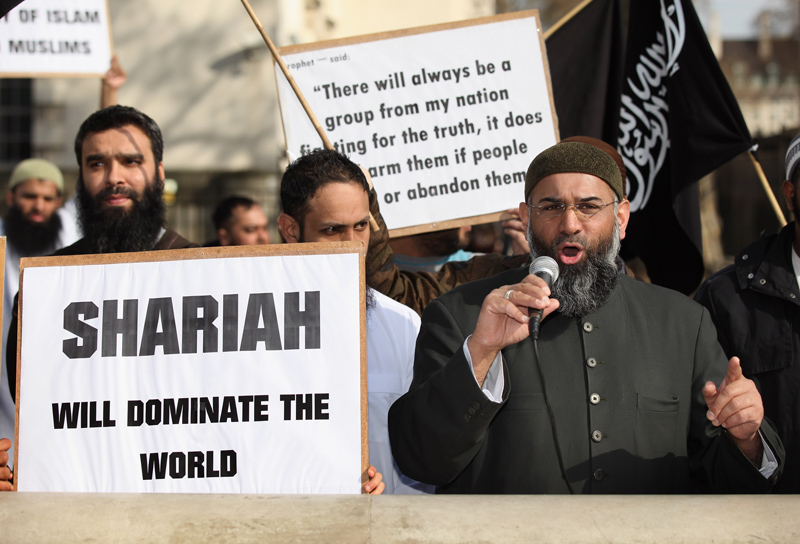

The most famous of Britain's radical Islamic preachers, Anjem Choudary (pictured holding the microphone), was recently sentenced to five years and six months in prison for his open support of the Islamic State, but hundreds of imams throughout the country continue similar work. (Photo by Oli Scarff/Getty Images)

Attempts to sound an alarm are rare, and quickly dismissed. Left-wing British politicians long ago chose to look the other way and indulge in complicity. Conservatives did not do much to help, either: after the uproar sparked by Enoch Powell's "Rivers of Blood" speech in 1968, British conservatives avoided the subject and became almost as complacent as their political opponents. In 2002, while portraying Islamism as the "new Bolshevism", Margaret Thatcher noted that "most Muslims deplore" terrorism. She described the "jihadist danger" without saying a single word on radical Muslims spreading Islamism in her own country.

In 2015, David Cameron said, "We need far more Muslim men and women at the head of British companies, more Muslim soldiers at the highest command posts, more Muslims in parliament, Muslims in a position of leadership and authority". He did not mention those who were joining jihad in London even as he was speaking.

When he was at the head of Britain's UKIP party, Nigel Farage said that there is a Muslim "fifth column" in the country. He was ferociously criticized for these words. Paul Weston, chairman of the GB Liberty party, was arrested by the police in 2014 for reading in public a text on Islam written by Winston Churchill. One wonders how Churchill would be regarded today.

Britain -- in spite of the Brexit referendum and even though it is more undermined by Islamization than most other European countries -- is fully imbued with a European, defeatist state of mind that corrodes its existence and is present throughout Europe.

At the end of World War II, Europe was exhausted and largely destroyed. The idea that prevailed among politicians was that it was necessary to make a clean sweep of the past. Nazism was described as the rotten fruit of nationalism and military power, and the only war that seemed to have to be waged was a war against war itself. Decolonization added the idea that the Europeans had oppressed other peoples and were guilty of crimes they now had to redeem. There was no mention of how, throughout history, recruits to Islam had colonized the great Christian Byzantine Empire, Greece, Sicily, Corsica, North Africa and the Middle East, most of the Balkans and eastern Europe, Hungary, northern Cyprus and Spain. Cultural relativism gained ground. The anti-Western revision of history gradually gained ground in media, culture, politics and education.

Immigrants from the Muslim world arrived in increasing numbers. They were not encouraged to integrate or respect the countries to which they came. In school, their children were told that European powers had misbehaved towards the Muslim world and that Muslim culture was at least as respectable as the Western one, maybe even more

Muslim districts emerged. Radical Islam spread. Whole neighborhoods came under the control of gangs and imams.

When violence erupted and riots took place, European politicians chose to placate them. European populations sometimes tried to resist, but they were constantly told that criticism of immigration and Islam is "racist". They were intimidated, pushed to shut up.

What is happening now in the United Kingdom and elsewhere in Europe is merely a continuation.

European political leaders all know that radical Islam has swept throughout the continent, that hundreds of Muslim areas are under Islamic control, that thousands of potential jihadists are there, hidden among the immigrants and ready to murder, and that the police are overwhelmed.

They know that radical Islam has declared war on the Western world and that it is a real war. They see that they are prisoners of a situation they no longer control and that reversing the course of events would involve drastic actions they are not ready to take, such as closing thousands of mosques, taking back lost territories by force, arresting thousands of suspects, and deporting foreign jihadists.

They are aware that an apparently unstoppable replacement of population is underway in Europe and that there will be more attacks. They speak as if to limit the damage, not prevent it.

European populations also see what is happening. They watch as entire areas of European cities become foreign zones on European soil; they view the attacks, the wounded, the corpses. It seems as if they have simply lost the will to fight. They seem to have chosen preemptive surrender.

British political commentator Douglas Murray writes in his important new book, The Strange Death of Europe: "Europe is committing suicide. Or at least its leaders have decided to commit suicide". He then wonders if the Europeans will agree to go along with what is happening. For the moment, it seems, the answer is yes.

Guy Millière, a professor at the University of Paris, is the author of 27 books on France and Europe.

Source: https://www.gatestoneinstitute.org/10574/europe-radical-islam

Follow Middle East and Terrorism on Twitter

Copyright - Original materials copyright (c) by the authors.

Yes, It Is All About Islam - Bruce Bawer


by Bruce Bawer


Ibn Warraq takes on the apologists' lies.


Douglas Murray, whose book The Strange Death of Europe I applauded here the other day, has called him “one of the great heroes of our time.” I fully agree. His name – or, at least, his pen name – is Ibn Warraq, and he's the author of such important and eloquent works as Why I Am Not a Muslim (which I wrote about here eleven years ago), Why the West Is Best (which I reviewed here five years ago), and What the Koran Really Says. Born in India and educated in Britain, Warraq began criticizing Islam in print during the 1988-89 Satanic Verses controversy, when he was appalled by the failure of celebrated writers and intellectuals to defend Salman Rushdie's freedom of speech. Warraq, who was then based in France and now lives in the U.S., has been publishing books on Islam ever since, and is one of the essential contemporary authors on the subject, courageously telling ugly truths about a religion – an ideology – that has been swathed in pretty lies.

His new book, The Islam in Islamic Terrorism: The Importance of Beliefs, Ideas, and Ideology, is (if it doesn't sound a bit odd to put it this way) a godsend – a comprehensive answer to every one of those duplicitous politicians, lily-livered journalists, and slimy professional “experts” and “consultants” who tirelessly insist that Muslim terrorists have hijacked a peaceful faith. Some of us don't need to be told that this “Religion of Peace” stuff is arrant nonsense; but innumerable apologists continue to absolve Islam itself of guilt for violent terror, and tens of millions of people in the West continue to buy their bull – some because they are themselves so pure of heart that they simply can't believe any religion would actually preach violence, and others because admitting the facts would make them feel like bigots.

Many apologists insist that violence in the name of Islam is a relatively recent development; Warraq makes it crystal clear that it's prescribed in the Koran and has been practiced from the outset. Since 9/11, apologists have attributed Islamic terrorism to such “root causes” as poverty, the Israeli-Palestinian conflict, U.S. foreign policy, Western imperialism, and the Crusades – anything but Islam itself. About this determination to formulate sophisticated answers to a question that the terrorists themselves have already answered repeatedly and definitively, Warraq observes that “[t]he centrality of religion in the Islamic world is something that Western liberals fail to understand or take seriously.” This isn't just true; it's one of the tragic realities of our time.

One by one, Warraq expertly shreds every one of the apologists' fake “explanations” for terror. Imperialism? Warraq reminds us that Muslims, too, have been imperialists, destroying “thousands of churches, synagogues, and temples...in a most brutal fashion” and exterminating “whole civilizations such as the Pre-Islamic cultures of Iran (Zoroastrians) and the Assyrians.” Saudi Arabia, homeland of fifteen of the nineteen 9/11 hijackers, “was never colonized by the West” but was, rather, part of an Islamic empire – namely the Ottoman Empire, governed by Turks from Constantinople. If those Saudis were spurred by a rage at empire, why not fly a plane into the Hagia Sophia?

No, as Warraq demonstrates, there's no way around it: Islamic terrorism is jihad. And jihad is a founding Islamic concept. The apologists, of course, have their own line on this one, too: under true Islam, they say, the word jihad denotes an inner spiritual process, and has nothing to do with violence; when terrorists use the word to describe their depredations, they're distorting the word and the faith. Warraq, citing a wide range of scholarly sources – both Western and Islamic, some recent and some dating back to the eighth century – puts that fulsome falsehood firmly in its place: yes, jihad can be used to mean an inner struggle, but in the Koran and Hadith, and in key texts ever since, it always refers, above all, to the sacred obligation to advance Islam by means of armed action against unbelievers.

Warraq also gives us a sweeping – but succinct – lesson in the history of jihad, beginning with Muhammed's own conquests, then moving on to ninth- through eleventh-century Baghdad, seventeenth-century Constantinople, eighteenth-century Saudi Arabia, and so on, right up to today's Muslim Brotherhood. Of course the apologists (Barack Obama among them) would have us believe that the Muslim Brotherhood is moderate and non-violent; Warraq establishes that throughout its existence, to the contrary, the Brotherhood has preached Holy War, period. Then there's the Nazis. Some apologists argue that Islam was just peachy until some of its leaders got chummy with Hitler and were infected by his love of violent world conquest and Jew-hatred; Warraq establishes that if Islamic higher-ups cozied up to the Nazis, it was because their totalitarian, exterminationist doctrines were already extremely similar.

Warraq also introduces us to a 1979 book that has been called “the most influential treatise on why Jihad is necessary and how it must be fought.” Written by one Brigadier S. K. Malik, The Qur'anic Concept of War won the endorsement of no less a jihad enthusiast than the late Pakistani president Zia al-Haq. A brief sample: “The Quranic military strategy...enjoins us to prepare ourselves for war to the utmost in order to strike terror into the hearts of the enemies....[The Koran] gives us a distinctive concept of total war. It wants both the nation and the individual to be at war 'in toto,' that is, with all their spiritual moral and physical resources.” In addition to Malik's tome, Warraq reads (so we don't have to) several other vile works that have also inspired the suicide-vest set – a veritable library of holy hate.

Warraq sums up his book's point as follows: “jihad is essential for the spread of Islam, and it is a duty incumbent on all Muslims until Islam covers the whole surface of the earth.” And what's essential for the West's survival is for us infidels to face up to the fact that nothing is more integral to Islam than that monstrous duty. If Islamic terror is, as apologists assert, a reaction to some action by the West, that action is, as Warraq points out, nothing more or less than our failure to “accept the Koran as a blueprint for a model society.” However much the talking heads may insist otherwise, it was Islam's explicit call for jihadist conquest, and nothing else, that motivated 9/11 and 7/7, Atocha and Nice, Bataclan and Ariana Grande. If we insist on clinging to lies about these atrocities – and thereby lose our freedom – it won't be because Ibn Warraq hasn't nobly and bravely shouted the truth from the rooftops.

Bruce Bawer is the author of “While Europe Slept,” “Surrender,” and "The Victims' Revolution." His novel "The Alhambra" has just been published.

Source: http://www.frontpagemag.com/fpm/267078/yes-it-all-about-islam-bruce-bawer

Follow Middle East and Terrorism on Twitter

Copyright - Original materials copyright (c) by the authors.

Israel, American Jewry and Trump’s GOP - Caroline Glick


by Caroline Glick

If the US administration keeps moving forward on this trajectory, it can do far more than suspend funding for one terrorism-supporting Palestinian NGO.


Earlier this month Norway, Denmark and Switzerland did something surprising.

Norway announced that it was demanding the return of its money from the Palestinian Human Rights and Humanitarian Law Secretariat, for the latter’s funding of a Palestinian women’s group that built a youth center near Nablus named for PLO mass murderer Dalal Mughrabi.

Denmark followed, announcing it was cutting off all funding to the group.

And last week, the Swiss parliament passed a resolution directing the government to amend Swiss law to block funding of NGOs “involved in racist, antisemitic or hate incitement actions.”

For years, the Israeli government has been urging these and other European governments to stop funding such groups, to no avail. What explains their abrupt change of heart? 

In two words: Donald Trump.

For years, the Obama administration quietly encouraged the Europeans to fund these groups and to ratchet up their anti-Israel positions. Doing so, the former administration believed, would coerce Israel to make concessions to the PLO.

But now, Trump and his advisers are delivering the opposite message. And, as the actions by Denmark, Norway and Switzerland show, the new message is beginning to be received.

If the US administration keeps moving forward on this trajectory, it can do far more than suspend funding for one terrorism-supporting Palestinian NGO. It can shut down the entire BDS industry before Trump finishes his current term in office.

To understand what can and ought to be done, it is first important to understand the nature of the BDS movement. Under the catchphrase BDS, two separate campaigns against Israel and against Jews are being carried out.

The first BDS campaign is a campaign of economic warfare. The focal point of that campaign is Europe. The purpose of the campaign is to harm Israel’s economy by enacting discriminatory, anti-Israel trade policies and encouraging unofficial consumer and business boycotts of Israeli firms and products.

The US Congress can end this economic war against Israel by passing laws penalizing European states for engaging in trade practices that breach the World Trade Organization treaties. The US Treasury Department can also push strongly and effectively for such an end in its trade negotiations with the EU. The Treasury Department can also investigate whether and how EU trade practices toward Israel constitute unlawful barriers to trade.

Unlike the situation in Europe, where the BDS economic war against Israel is fairly advanced, efforts in the US to mount economic boycotts of Israel hit an iceberg early on due to the swift preemptive actions taken by state legislatures.

In 2015, then-South Carolina governor Nikki Haley became the first governor to sign a law barring her state government from doing business or investing in companies that boycott Israel. Last week Kansas became the 21st US state to pass an anti-BDS law along the same lines. Last month, all 50 state governors declared opposition to BDS.

The second BDS campaign being carried out against Israel is a form of political and social warfare.

Its epicenter is US academia. Its purpose is to erode US support for Israel, by making it politically unacceptable and socially devastating to publicly voice support for Israel on college campuses and more generally in leftist circles.

As is the case with the economic BDS campaign, the best way to defeat political BDS is through state and federal government action. If state and federal governments withheld funding to universities and colleges that permit BDS groups to operate on their campuses, campus administrators, who to date have refused to lift a finger against these hate groups, would be forced into action.

If the US Education and Justice departments opened civil rights investigations against major BDS groups for antisemitic bigotry, campus administrators would finally begin banning them from their campuses.

For many Israelis, the notion that defeating BDS is a job for the US government rather than for grassroots, American Jewish activists, will come as a surprise.

When Israelis think about the BDS movement, they tend to think that the American Jewish community is the place to turn for assistance.

This is not merely incorrect.

As two studies published in the last few weeks show, the notion that Israel can look to the American Jewish community for help with anything is becoming increasingly dubious.

To be sure, there are several American Jewish groups that devote massive resources to combating BDS on campuses. But their actions are tactical.

They fight specific BDS resolutions coming to votes before student councils. They train pro-Israel students to defend Israel to their peers.

While helpful, none of these actions constitutes a serious challenge to the movement.

On a strategic level, the effective moves made to date against BDS have been initiated by Republicans.

Alan Clemmons, the South Carolina lawmaker who initiated the anti-BDS bill in his statehouse and has since gone on to spearhead the state government anti-BDS drive nationally, is a Christian Zionist.

Clemmons didn’t act out of concern for South Carolinian Jews. The Jewish community of South Carolina numbers a mere 20,000 members. The state-by-state anti-economic BDS campaign is neither the brainchild of any major Jewish group nor the product of their efforts.

So, too, to the extent that the Trump administration and the Republican-controlled Congress take action to defeat BDS on campuses and in Europe, they won’t be answering the call of their Jewish constituents. American Jews vote overwhelmingly for the increasingly anti-Israel Democratic Party. And while making up a mere 2% of the US population, American Jews contributed 50% of the donations to the Democratic Party in the 2016 elections.

This then brings us to the two studies of the American Jewish community and its future trajectory.

The first study was published by the Jewish Agency’s Jewish People Policy Institute. It analyzes the data from the 2013 Pew survey of American Jewish attitudes. The Pew survey demonstrated that the Jewish identity of American Jews is growing increasingly attenuated and superficial.

Famously, the study noted that while 19% of American Jews said that they view observance of Jewish law as an essential part of their Jewish identity, 42% said they viewed having a good sense of humor as an essential part of their Jewish identity.

The JPPI study analyzed the Pew data regarding rates of marriage and childbearing among American Jews aged 24-54. The study started with the data on intermarriage. Sixty percent of non-haredi American Jews are married to non-Jews. A mere 32% of married American Jews are raising their children as Jewish to some degree.

From there, the JPPI study considered marriage and childbirth rates in general. It works out that a mere 50% of American Jews between 24 and 54 are married. And a mere 40% of American Jews between those ages have children living with them. In other words, the majority of adult American Jews are childless. 

The JPPI study tells us two important things.

First, in the coming years there will be far fewer American Jews. Second, among those who are Jewish, their Jewish identity will continue to weaken.

Clearly, it would be unwise for Israel to believe that it can depend on such a community to secure its interests in the US for the long haul.

The second study shows that not only can Israel not expect the American Jewish community to help it maintain its alliance with the US. The number of American Jews willing to spearhead anti-Israel campaigns is likely to grow in the coming years.

The second study was produced by Brand Israel, a group of public relations experts that for the past decade has been trying to change the way young Americans think about Israel. The idea was to discuss aspects of Israel that have nothing to do with the Palestinians, with an emphasis on Israel as a hi-tech power. The hope was that by branding Israel as the Start-Up Nation, leftists, who support the Palestinians, would still support Israel.

Fern Oppenheim, one of the leaders of Brand Israel, presented the conclusions of an analysis of the group’s work at the Herzliya Conference this week and discussed them with the media. It works out that the PR campaign backfired.

Far from inspiring increased support for Israel, Oppenheim argued that the hi-tech-centric branding campaign made leftist American Jews even more anti-Israel. She related that over the past decade, there has been an 18-point drop in support for Israel among US Jewish students.

To remedy the situation, which she referred to as “devastating,” Oppenheim recommended changing the conversation from hi-tech to “shared values.”

The problem with Oppenheim’s recommendation is that it ignores the problem.

Young American Jews aren’t turning against Israel because their values are different from Israeli values. By and large, they have the same values as Israeli society. And if they know anything about Israel, they know that their values aren’t in conflict with Israeli values.

Young American Jews are turning on Israel for two reasons. First, they don’t care that they are Jewish and as a consequence, see no reason to stick their necks out on Israel’s behalf.

And second, due in large part to the political BDS campaign on college campuses, supporting Israel requires them to endanger or relinquish their ideological home on the Left. Since their leftist identities are far stronger than their Jewish identities, young American Jews are joining the BDS mob in increasing numbers.

This then brings us back to BDS.

The only way to diminish the groundswell of American Jews who are becoming hostile toward Israel is to defeat the forces of political BDS on campuses. To do this, Israel should turn not to the Jewish community but to evangelical Christians, the Trump administration and the Republican-controlled Congress.

As for the American Jews, Israel needs to stop viewing the community as a resource and begin to view it as a community in crisis. To this end, the most significant contribution Israel can make to the American Jewish community – particularly to non-Orthodox American Jews – is to encourage them to make aliya. Assuming that current trends will continue, the only way non-Orthodox American Jews can have faith their grandchildren will be Jewish is for a significant number of them to make aliya.

No, this won’t appeal to all American Jews. But nothing Israel does will. Israel’s job isn’t to reach the unreachable. It is to protect its alliance with the US and to help the Jews that remain in the room. 

Originally published in he Jerusalem Post. 


Caroline Glick

Source: http://carolineglick.com/israel-american-jewry-and-trumps-gop/

Follow Middle East and Terrorism on Twitter

Copyright - Original materials copyright (c) by the authors.

Arab states issue ultimatum to Qatar - Rick Moran


by Rick Moran

This is a dispute that has been simmering for years, according to the UAE ambassador.

The crisis in the Gulf over Qatar's ties to terrorism and Iran took an even more serious turn as Arab states issued an ultimatum to Doha demanding that it close the propaganda media outlet Al Jazeera, cut ties with Iran, remove a Turkish military base, and pay reparations.

Qatar is not expected to comply with any of these demands.

Reuters:
Saudi Arabia, Egypt, Bahrain and the United Arab Emirates have sent a 13-point list of demands apparently aimed at dismantling their tiny but wealthy neighbor's two-decade-old interventionist foreign policy which has incensed them. Kuwait is helping mediate the dispute.
A Qatari government spokesman said Doha was reviewing the list of demands and that a formal response would be made by the foreign ministry and delivered to Kuwait, but added that the demands were not reasonable or actionable.
"This list of demands confirms what Qatar has said from the beginning – the illegal blockade has nothing to do with combating terrorism, it is about limiting Qatar's sovereignty, and outsourcing our foreign policy," Sheikh Saif al-Thani director of Qatar's government communications office, said in a statement.
A Qatar semi-government human rights body said the demands were a violation of human rights conventions and should not be accepted by Qatar.
Foreign Minister Sheikh Mohammed bin Abdulrahman al-Thani had said on Monday that Qatar would not negotiate with the four states until economic, diplomatic and travel ties cut this month were restored.
The countries that imposed the sanctions accuse Qatar of funding terrorism, fomenting regional unrest and drawing too close to their enemy Iran. Qatar rejects those accusations and says it is being punished for straying from its neighbors' backing for authoritarian hereditary and military rulers.
The uncompromising demands leave little prospect for a quick end to the biggest diplomatic crisis for years between Sunni Arab Gulf states, regional analysts said.
"The demands are so aggressive that it makes it close to impossible to currently see a resolution of that conflict," said Olivier Jakob, a strategist at Switzerland-based oil consultancy Petromatrix.
Ibrahim Fraihat, Conflict Resolution Professor at the Doha Institute for Graduate Studies, forecast a prolonged stand-off.
Qatar will reject the demands as a "non-starter", he said, and its neighbors had already escalated as far as they were likely to go. "Military action remains unlikely at the moment so the outcome after the deadline would be a political stalemate[.]"
The four Sunni Arab states have boycotted Qatari products and the country's government-run airline. 

This is a dispute that has been simmering for years, according to the UAE ambassador.

Fox News:
Al Otaiba: This is a consistent pattern of behavior [by Qatar]. Let me start by telling you what it is not-- what it's not is an overreaction; it's not a hasty decision. It's not something that we came to in a rush.
Al Otaiba: So to point out some context, three years ago, we had a meeting in Riyadh under the leadership of King Abdullah of Saudi Arabia. In that meeting we had a confrontation essentially… and the leadership of Qatar, Emir Tamim [bin Hamad Al Thani], signed a document that pledged that he will stop and refrain from doing all the things that we've been complaining about.
Al Otaiba: The document has been released to the member countries. I don't think it's ever been released to the public, but the same things that we have said he has violated, are the same things that we are complaining about now, which are support for terrorist and extremist, meddling in our internal affairs, and using their media to attack us and incite. ...
James Rosen: Is it possible that it derives from philosophical wellspring or theological wellspring?
Al Otaiba: It's one of two things: it's either an ideological proximity to extremism, to terrorism, political Islam, groups like Hamas, groups like the Muslim Brotherhood who live opening in Qatar or it's hedging. It's opportunism. It's perhaps seeking to play a larger role in a region where Qatar is not allowed to play a larger role because of their size.
President Trump has taken credit for the crackdown on Qatar by Arab states. The ambassador confirmed that:
Al Otaiba: I think the excitement we see in President Trump is really because he addresses our two core problems in a very straight forward way. Our two problems in the region are two threats: are Iran and extremism, and on both of those situations President Trump has indicated that he wants to tackle those head on. You can look at the Cabinet around President Trump and you would feel very relieved. I think for any president of the United States, this foreign policy team could be considered the dream team. I mean [Defense] Secretary Maddis, Secretary [of State] Tillerson and [CIA] Director Pompeo, [National Security Adviser] General McMaster…These are very, very serious people.
Military action by the Sunni Arab states against Qatar is not likely, but a protracted political crisis in the region is not in the interest of the United States. Qatar seems determined to continue funding terrorism and cozying up to Iran. Until it can be persuaded otherwise, the crisis will only get worse.

Rick Moran

Source: http://www.americanthinker.com/blog/2017/06/arab_states_issue_ultimatum_to_qatar.html

Follow Middle East and Terrorism on Twitter

Copyright - Original materials copyright (c) by the authors.

When Evangelicals Become Useful Idiots for Islamism - James Simpson


by James Simpson

Robert Spencer: "They take advantage of our ignorance about Islam to mislead people into complacency about Islam."

Our culture looks to be coming apart at the seams. The June 14 attack on the GOP Congressional Baseball team is only an exclamation point in an increasingly hostile, increasingly violent, premeditated campaign by Democrats and other leftists to create an atmosphere of ungovernable anarchy. The Christian church has not escaped this agenda. In fact, it has become a major target. The Left, in concert with its allies among atheists, Islamists, and the homosexual lobby, is engaged in a multi-front war to destroy what remains of our nation's Christian bedrock. One of the fronts in this war comes under the innocuous heading "Interfaith Dialog". It sounds so compelling: a mutually beneficial outreach for "differing faith traditions" to find common ground and join forces to mend the fractious divisions between Muslims, Christians, Jews, and for that matter, practically everyone else.

But that is not what is accomplished. As Robert Spencer repeatedly argues, most Muslims want to live their lives like the rest of us. They want nothing to do with the radical jihadis, Islamic terrorism, or indeed much of the classical interpretations of Islam that classifies women and non-Muslims as second-class citizens. The problem is that while apologists reassure us that we have nothing to fear, those in the forefront of this battle, like the Council of American Islamic Relations (CAIR) and the hundreds of other Muslim Brotherhood front groups, are determined to use every tactic at their disposal to deconstruct our laws, our Constitution and our religious and secular institutions, to replace them with the Islamic version, Sharia law. As Spencer says, "They take advantage of our ignorance about Islam to mislead people into complacency about Islam."

And while the political side pushes for Muslim "rights", the violent side communicates its intentions with murder. Both seek destruction of Western society, they just use different methods. This is little different from, for example, the campaign of violence conducted for decades by the Irish Republican Army, and its political arm Sinn Fein, which pushed for, and obtained, representation in Ireland's government. The IRA/Sinn Fein are Marxist, and these are the tactics communists have successfully pursued all over the world. The Islamists have adopted this strategy and now work with them. We call it the Red-Green Axis.

Chris Gaubatz investigated CAIR undercover for six months while posing as an intern, and provided the raw material for his father's explosive book, Muslim Mafia. He has also testified before the U.S. Congress regarding Islamic subversion tactics. Gaubatz warns about the interfaith dialog:
Their whole purpose with this [interfaith dialogue] narrative war is to shut the discussion down because if you can shut the discussion down…and distance Islam from any part of the problem, then the people that are charged with protecting citizens are always looking elsewhere for the problem…and the problem is, and always has, been rooted right in Islam and right in the Sharia, they’re intertwined.
James White is a well-known conservative Christian evangelist who has been seduced by the siren call of the Interfaith Dialog, and has partnered with a Muslim Imam, Dr. Yasir Qadhi, to "educate" Americans on the Muslim religion. White finds their budding relationship "refreshing" and expounds on how much he has learned about Islam from his newfound friend. He calls Qadhi his "mentor" on aspects of Islam. He bristles at those who suggest he is being used, and instead has gone on offense, engaging his allies among Christian conservatives to attack his critics. And just as the #NeverTrumpers have created a war within the GOP, and assisted in Democrat efforts to make our nation ungovernable by vilifying and hobbling President Trump, so Christians like this have created new fissures in the Church that will not advance the Christian message, but rather further dilute and weaken it by allowing clever, articulate Muslims to explain why Islam is the ultimate religion.

From the Muslim perspective, White probably couldn't have picked a more effective apologist. Yasir Qadhi has an engaging manner, is very articulate and seems conciliatory. His speeches show that he is absolutely unwavering in his defense of Islam -- which White acknowledges -- while he recognizes the major Judeo-Christian "prophets." In a discussion with White, Qadhi states that Islam is essentially the same as Judaism and Christianity. "This in a nutshell is Islam: that there is but one God; this God is worthy of veneration and worship; and to be a good person you have to believe in Him, worship Him, follow the law, obey the commandments, and if you do so there will be a life after death and there is heaven or hell where there is accountability..."


Yasir Qadhi (L) and Dr. James White (R)
Sounds nice. But it reflects a basic misunderstanding of Christianity that he can only get away with because unfortunately it has become a mainstream assumption about "Christianity" in our increasingly secular society. Christianity, unique in all religions, does not condition salvation on works. Christians believe you don't get to heaven by being "a good person," or obeying the commandments. Indeed, the whole point of Christianity is that no one is good enough, no one can earn his or her way to heaven, as the New Testament makes plain, "for all have sinned and fall short of the glory of God." (Romans 3:23). Christians believe that was the entire point of Christ, who came to earth to intercede on our behalf. Christians believe that without Christ, we are all destined for Hell. We are all sinners. Christians are not saved by doing good works or being good. They are saved purely and solely by the grace of God alone through faith. As the Apostle Paul says, "And this is not your own doing, it is the gift of God, not a result of works, so that no one may boast." (Ephesians 2:8-9).

And there is the key, "so that no one may boast." Any religion that justifies salvation through works deifies pride. Not the pride of workmanship or accomplishment, but the pride of self. And that kind of pride is #1 on the list of the seven deadly sins. It elevates mankind for his works, and says, "We are better than you because of what we do." That kind of thinking justifies practically every form of evil on earth, from prejudice to genocide.

Christians don't come before God saying "look what I've done! Aren't you proud of me?" Christians come before God begging for mercy, because they believe, to a man, that we have sinned and fallen short. And while there may be individuals in history that justified violence on behalf of Christianity, nowhere does Christianity advocate it. Instead, it says we are to love our neighbors as ourselves (Mark 12:31), and forgive others "seventy times seven" (Matthew 18:22). Christianity calls for humility, not self-righteous preening, and the good works Christians do are supposed to be out of gratitude to their Savior, and to honor Him, not as a way to curry favor with God.

Not so with Islam. It is all about works. Furthermore, according to Qadhi, Islam is supreme. In a keynote speech before the 2016 Islamic Circle of North America (ICNA)-Muslim American Society (MAS) Convention, Qadhi described Moses' miracles -- turning his staff into a snake and parting the Red Sea; he described how Jesus brought  Lazarus back to life. (He did not discuss Jesus' resurrection however because Muslims don't believe Jesus is the Son of God, nor that he was ever resurrected). Qadhi says you would have had to live in those times to witness those miracles.

But not so with the Koran, which he describes as "the greatest miracle" because it lives on to this day. The Koran is "the eternal miracle." No other miracle is needed in Islam, and Qadhi quotes Mohammad as saying that "the only miracle Allah has given me is the Koran." In other words, Islam is supreme. Furthermore, Islam is a religion of works. You must believe, or else. If you pray towards Mecca five times a day and follow all the other Muslim commandments, you are free to engage in all kinds of barbaric lunacy, from child rape to beheading, all in Allah's name. Not only does Islam tell you what works you must perform, it specifies the punishments you are allowed to mete out to those who don't follow the law.

Qadhi claims to oppose violent Jihad and characterizes ISIS as "crazy," "something we have never seen before." For that he has been called "apostate" in the ISIS publication, Dabiq, along with Keith Ellison, Huma Abedin, Mohamed Elibiary, and others. However, it is difficult to understand how someone so certain of Islam's supremacy could at the same time work against it as ISIS claims he is doing. But Qadhi has much bigger problems that Dr. White is either unaware of or dismisses:

  • According to the New York Times, Qadhi is a Salafist, an ultraconservative sect of Islam associated with, but predating Saudi Wahhabism. Osama bin Laden was a Salafist.
  • Qadhi is a member of the Muslim Brotherhood’s Assembly of Muslim Jurists of America (AMJA). The AMJA is at the forefront of legal battles to legitimize Sharia law in U.S. courts.
  • Qadhi is both Dean of Academic Affairs and instructor at the Al Maghrib Institute, which has produced numerous jihadis. He personally taught Umar Farouk Abdulmutallab, the Nigerian "Underwear Bomber."
  • His speech at the ICNA-MAS convention is just one of many he has given at functions produced by organizations associated with radical Islam.
◦ MAS is a Muslim Brotherhood front.
◦ At the 14th Annual ICNA-MAS conference, MAS Immigrant Justice Ctr. Director Khalilah Sabra called for an Egypt-style nationwide street revolution.
◦ At that same conference, CAIR Director Nihad Awad declared CAIR's alliance with Black Lives Matter. CAIR has since participated in  nationwide BLM protests.
◦ Anti-Trump protester Linda Sarsour has also spoken at ICNA-MAS conferences.
◦ ICNA is the American branch of Jamaat-e-Islami (JI).
◦ JI's military wing owned the Pakistani compound where Osama bin Laden hid out and was finally killed by U.S. Special Forces.
◦ JI rivals the Muslim Brotherhood in its influence in modern Islam and is allied with the Brotherhood as well as Saudi Sunni Islamists.
◦ Like the MB, it developed a modern "revolutionary conception of Islam".
  • According to Understanding the Threat, Qadhi works with Hamas and other terrorist groups and has publicly defended notorious Islamists, including Sami al Arian, convicted terrorist Ali al-Timimi, American Taliban fighter John Walker Lindh and al Qaeda terrorist Aafia Siddiqui.
  • Qadhi invited Imam Siraj Wahhaj, "an all-time favorite of all of us," to speak at Qadhi's "Pleasant View" Islamic school in Memphis, TN. Wahhaj is a member of Louis Farrakhan's Nation of Islam, was an unindicted co-conspirator in the 1993 World Trade Center bombing, and spoke in court in defense of the so-called "Blind Sheik", Omar Abdel Rahman, who was convicted as the bombing's mastermind.
Now, Qadhi is not alone in lionizing Wahhaj. The Democratic Party featured Wahhaj in its first-ever Jumah, held at the 2012 Democratic National Convention. But this is not evidence of his moderation. Instead it shows just how far off the edge the Democratic Party has gone.
So never mind the doctrinal differences, Dr. White seems to have really picked a winner here. Now, in fairness to Dr. White, he plainly states that there are problems with Islam -- with its doctrine and its violence. Rather than being helpful, however, this simply disarms us by reassuring us that he is aware of the problems. So what does he do about it? He asks Qadhi to make a video that explains Islam to Christians. So, even assuming Qadhi means what he says, do you really expect him to get into those inconvenient truths?

One can find many passages in the Old Testament that call for extreme punishments. For example, Mosaic law treats adultery, homosexuality, incest, and bestiality as capital crimes. (Leviticus 20), but does that happen today? Only in Islam are these and other extreme punishments meted out for such behavior. Only in Islam is stoning and beheading still a routine form of execution. You could argue that ISIS does not follow Islamic law, but only in some of the novel forms of execution ISIS has dreamed up.

Conservative Christian evangelist and radio show host Brannon Howse has taken White on. Howse explained his case in a recent post:

I am saddened and heart-broken that people from conservative Bible and reformed institutions and churches think that holding a dialogue with a Jihadi imam in a church is acceptable. But to some, it now appears to be.
I have been writing and speaking on radio about Yasir Qadhi for several years, so it is not like I went looking for this controversy. I found it because I was on YouTube listening to speeches by Yasir and stumbled on videos of James White in a church in my hometown facilitating what was described as an “interfaith dialogue.”
Howse said that "participating in this sort of event with non-believers clearly violates the teaching of 2 John 9-11 and 2 Corinthians 6:14." Howse believes that White is simply playing into the Islamist's hands, and calls him a "dupe" and "useful idiot."

These terms may sound harsh, but are very apropos in this circumstance. "Useful idiot" is a term coined by Soviet leaders to describe Western liberals who enthusiastically promoted the communist line without knowing it. Today the "Interfaith Dialog" seeks to do the same for Islam.

Instead of considering that reality however, White's friends and allies have gone on the warpath. Probably the most prominent is Phil Johnson, Executive Director of John MacArthur's Grace To You ministries, who said on Facebook that "Howse's critique is overblown and exaggerated to a shameful degree," despite acknowledging that, "In the years I've been at GCC (Grace Christian Church) we have never sponsored any kind of debate with an unbeliever."

We are facing a multi-front, aggressive effort to disarm, emasculate, and delegitimize our nation. Apologists like Mr. Qadhi assure us there is nothing to fear, while the Islamist political operatives viciously attack us as "bigots" and "Islamophobes" when we express the slightest skepticism. Meanwhile our instincts and the increasing frequency of deadly attacks played out before our eyes every day, tell us otherwise. We really do need to confront the dangers posed by Islamic terrorism and the subversive effort to advance the conquest ideology of Sharia law. The answer, however, is not to make pretend there is no problem.

James Simpson is an economist, businessman and investigative journalist. His latest book is The Red Green Axis: Refugees, Immigration and the Agenda to Erase America. Follow Jim on Twitter & Facebook.

Source: http://www.americanthinker.com/articles/2017/06/when_evangelicals_become_useful_idiots_for_islamism.html

Follow Middle East and Terrorism on Twitter

Copyright - Original materials copyright (c) by the authors.

Islamic State's Raqqa Elegy Shows Both Weakness And Power - Alberto M. Fernandez


by Alberto M. Fernandez

The ISIS footprint, once it is "gone" from Raqqa and Mosul, will remain massive and will continue to shape and influence for years to come.


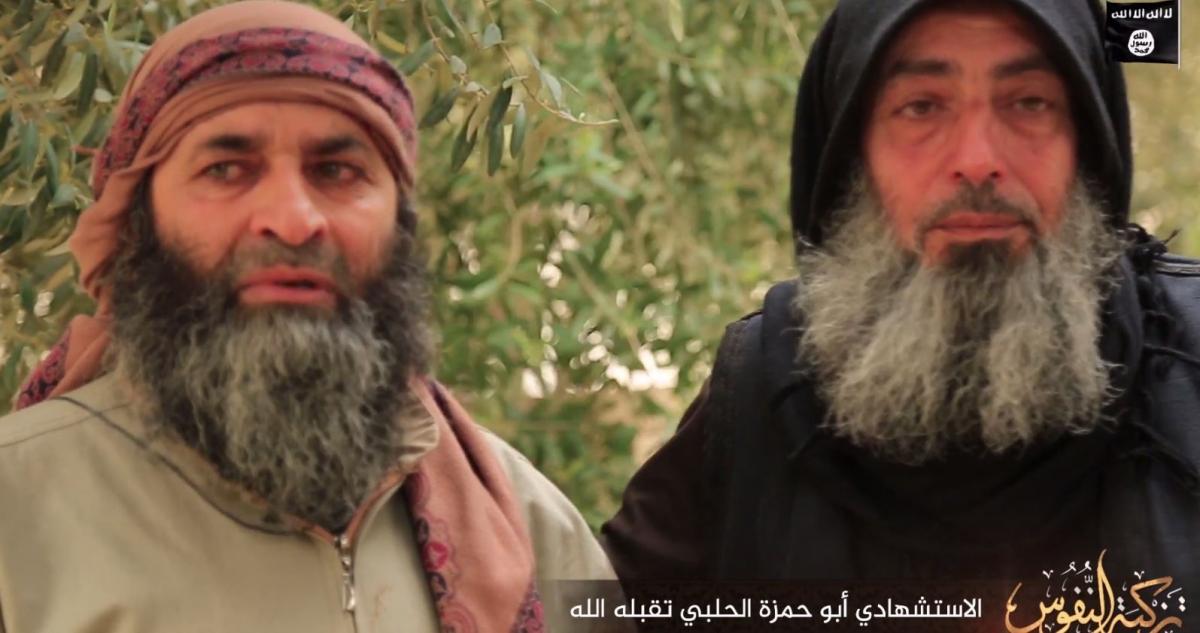
On June 19, 2017, the Islamic State's Wilaya (Province) of Raqqa, one of the two main cities of the ISIS "caliphate," released a 36-minute-long Arabic language video, "The Purification of Souls." The video included many of the elements we have seen repeatedly in ISIS propaganda: images of battle, dead enemy corpses, and calls for attacks in the West, in "the lands of infidelity."

But coming as Kurdish led-Syrian Democratic Forces (SDF) units inexorably bear down on Raqqa, the video also has a remarkable, extended elegiac tone unusual for ISIS propaganda. It is a Ramadan video and so a focus on the eternal and the divine is not out of place, but one has rarely seen so much weeping and emotion in an ISIS video, that is weeping and emotion on the part of ISIS fighters, not of their many victims.

Almost six minutes pass in the video focusing first on death and loss, and then on the sweetness and transitory nature of life: a grave is filled in with dirt; a young man gazes up at the heavens in the midst of Raqqa's rubble; an old man pulls a battered bicycle out of the ruins of a house; gold coins are counted and spin into eternity; a blacksmith labors wearily at his task; another man treads a path through fallen, sere leaves; a father gazes at his newborn baby; you see images of innocent children, of smiles and of flowers, of gold and of trees. You see normal streets and then those same streets that have been reduced to rubble.

This is Raqqa and it is in a way about the ongoing Coalition air campaign against ISIS. But the commentary is about much more than that. The commentator notes that those who have chosen the path of Jihad in the Path of God have made a better choice than the things of this world, of al-Dunya. You then hear the voice of a dead man, of Abu Musab Al-Zarqawi, just as you see an ISIS fighter on a sand berm shot and falling slowly to his death. Al-Zarqawi notes that there is in life, in the end, nothing for the Muslim but jihad and worship of their Lord. Focus, instead of this passing world, on the eternal, on al-Akhira, rather than this life.

The video then shifts to the obligatory battle scenes, of minor skirmishes in the olive groves and unfinished cinder block houses of Raqqa's outskirts portrayed as if they were the invasion of Normandy. The message here is not just about Raqqa but a much broader point, that patience and steadfastness will, sooner or later, lead to ultimate victory.


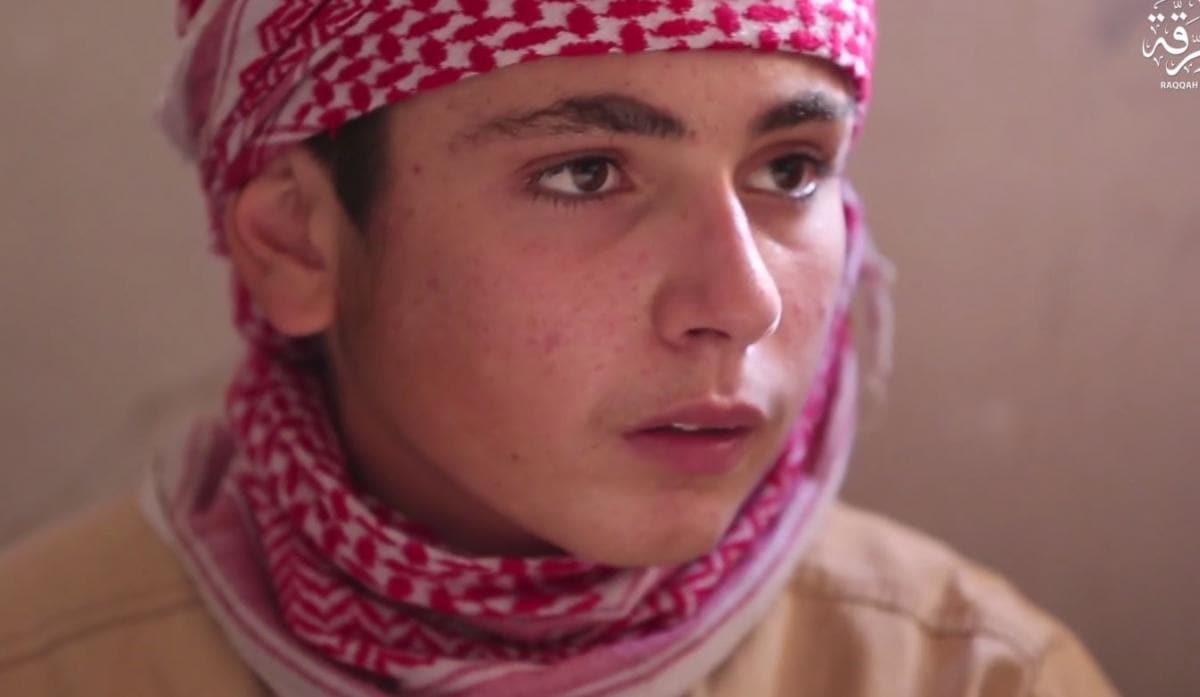
The scene shifts again now from the battlefield to the testimonies of individual ISIS fighters and suicide bombers. Several are young boys and old men. It is clear, as has been the case in other ISIS videos for quite a while, that the organization is seeking to maximize manpower by using the young, the elderly, and even the handicapped or war wounded as it tries to stave off defeat and compensate for its battlefield losses. The tone here is intimate, personal, and emotional, as individuals relate, often with tears, their struggle over doing the right thing in fulfillment of the tenets of their faith and overcoming the distractions and resistance of everyday life. Anyone who sees such testimony would be hard-pressed to say that these are losers or nihilists, or that the motivation for many ISIS fighters is anything but spiritual, emotional, and deeply-held. This is, of course, a propaganda video which presents a skewed and fabricated image of the reality of ISIS. But certainly the motivating force here is lovingly and carefully portrayed as belief and idealism.[i] One young boy relates how he registered to fight and was sent away to come back the next day. He remained convinced of what he wanted to do and told his mother, who was filled with joy.

An older man relates how most of his boys are mujahids and some are martyrs. He says he wishes had 20 sons to contribute to the fight, but has become convinced of himself taking up arms. Another older man tearfully says to remember that you are a guest and a stranger on this earth, and that Allah, for Whom we long, may accept us as martyrs. A smiling young man follows him, reminding viewers that the gates of heaven are open for the martyrs.


And just to make clear what the goal is on this earth for all this sacrifice and martyrdom, still another speaker spells it out. All these explosions and all these suicide operations, these Zarqawiyat, are to utterly extinguish unbelief (Kufr) from the earth so that in the end the worship of Allah alone will exist on the earth.

There is both apparent strength and debility here. One can look at this video and – rightly – see the weakness of an organization scraping the bottom of the barrel, taking boys, old men, office workers, doctors and dentists, and the disabled into its ranks as cannon fodder. But one can also see the inherent power to move men's minds to action that has mobilized thousands outside the borders of the Islamic State and that continues to inspire acts of mayhem even as the military fortunes of the Islamic State decline.


The irony is that three things are happening now simultaneously in this space for ISIS: (1) the imperative to do more worldwide, more and greater acts of mayhem, is paramount; (2) the ability for ISIS to carry out complex operations is increasingly hindered by its physical decline, as safe havens and established patterns are disrupted; (3) the ideological framework of ISIS, with all its political-religious power, remains, more or less, intact and potent in the same way as the dead Anwar Al-Awlaki and dead Al-Zarqawi still inspire.

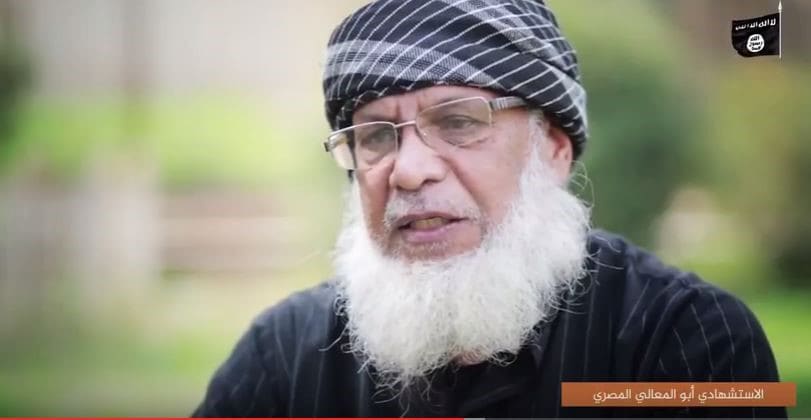
And while wars are fought on the battlefield, they are also fought in the mind and in the media. MEMRI recently documented, as it does almost daily, people openly demonstrating their allegiance to the Islamic State on social media.[ii] Some recent ones came from El Salvador and Tokyo, from a Nigerian prison, and from comfortable venues in Poland and Australia. One recent ISIS video from Mosul featured an elderly Egyptian who had previously lived in the U.S. States volunteering for a suicide mission. His last words to the infidels before he drove off to kill them in his SVBIED was a paraphrase of a Hadeeth of Muhammad repeated three times for emphasis: "We are coming to slaughter you."[iii]


As the Islamic State declines in its Syrian-Iraqi heartland, it will still leave behind a massive material culture. On June 11, 2017, the pro-ISIS Al-Yaqeen Media outlet issued an infographic documenting 41,230 media items produced by ISIS in the past three years. Of those, 2,880 are videos. This does not even include non-official material produced by ISIS supporters, or indoctrination by rival jihadi groups. The ISIS footprint, once it is "gone" from Raqqa and Mosul, will remain massive and will continue to shape and influence for years to come.

The great American conservative Catholic thinker Russell Kirk once wrote: "All great systems, ethical or political, attain their ascendency over the minds of men by virtue of their appeal to the imagination; and when they cease to touch the cords of wonder and mystery and hope, their power is lost, and men look elsewhere for some set of principles by which they may be guided. We live by myth.  'Myth' is not falsehood; on the contrary, the great and ancient myths are profoundly true."[iv]

Obviously, ISIS is not by itself a "great ethical or political system," but it certainly appropriates from one, from Islamic history and practice, and then selectively chooses various elements for maximum effect, which provides the depth and "appeal to the imagination" that the violence, the surface glitz and the superficial appeals to action by shallow youth alone cannot satisfy. It is all too easy to look at Salafi-jihadism and see only the slaughter and the intolerance. But there is more than that.

So the ISIS brand has, in a way, conquered as it has matured. Today, it is not, as far as we can tell, the latest video or act that radicalizes, but a much broader image which is itself made up of the sum of real actions and pronouncements, and tens of thousands of videos, photos, articles and commentary (including those against ISIS). ISIS is itself part of a much larger – and often bitterly contending and contradictory – brand of Islamist and jihadi action and thought, which has real power because it is rooted in the numinous and because it is also tethered in the language and aura of political revolution.


The unmooring of society happening most dramatically in the Sunni Arab Muslim world which has led to the rise of ISIS is also happening, to a lesser but real extent, in non-Muslim societies, in the West and perhaps in other places, as young people – even in affluent, democratic states – feel alienated from all sort of societal processes, from the political to the spiritual and economic, making them ripe for all sort of simplistic, powerful political pathologies.

In this reading of history, ISIS is not the past but the future. An organization that can couple an arresting political-religious narrative to a plausible reality on the ground may well find shallow, bored, disenchanted youth who are looking for something new and exciting in a perception of certainty coupled with redemptive violence.  In such a depiction of the political and spiritual moment, the challenge is not just Salafi-jihadi interpretations of Islam but any sort of convincing, well-articulated "new dogma" which can captivate youth to violence, this could be of the extreme left or far right or some sort of religious or ethnic based nationalist proposition, or a new iteration of the Al-Qa'idism we have seen in the past.[v]
One leader of the evanescent anti-capitalist Occupy Wall Street movement in the U.S. has spoken of the future as a place where "authenticity goes hand in hand with edginess," and that in this future that he sees being born, "the majority does not follow its center, it undulates towards its inspirational edges."[vi] While OWS didn't amount to much in the end, for many young people, ISIS and similar groups do live and breathe "on the edges" and that is where they get their power, in the "edginess" and rigidity found on the blade of a knife.

In a world where polite society and the cultural elite increasingly highlight the hedonistic cult of the individual or the vague feel-good brotherhood of hegemonistic globalism as the only two insipid choices available, many will seek something else, a cause that is about real sacrifice for something important. This will usually not lead to terrorism or even violence and is, in fact, a noble condition, to believe in something sincerely and fight for it.

As horrific and baleful a reality as the Islamic State is, the larger human impetus for sacrifice and faithfulness, expressed by dying or even killing for something important or transcendent, remains and is deeply rooted in the human psyche and imprinted on our spirits. We blind ourselves if we think this is a challenge only to be solved in the battlefields of Raqqa, or in the meeting rooms of Davos or Silicon Valley or Turtle Bay, for that matter.

*Alberto M. Fernandez is Vice-President of MEMRI.


[i] https://www.memri.org/reports/they-are-neither-losers-nihilists-worshipers-death-nor-sick-cowards%E2%80%93-rather-believers-and
[ii] https://www.memri.org/jttm
[iii] https://www.memri.org/jttm/egyptian-isis-fighter-featured-video-says-he-left-us-caliphate
[iv] http://www.theimaginativeconservative.org/2013/06/we-live-by-myth.html
[v] https://www.cfr.org/blog-post/rise-ethnonationalism-and-future-liberal-democracy
[vi] http://www.globatron.org/hashtag/author/micahwhite


Alberto M. Fernandez is Vice-President of MEMRI.

Source: https://www.memri.org/reports/islamic-states-raqqa-elegy-shows-both-weakness-and-power

Follow Middle East and Terrorism on Twitter

Copyright - Original materials copyright (c) by the authors.

Breaking the Silence spokesman questioned over 'beating an Arab' - Arutz Sheva Staff


by Arutz Sheva Staff

Spokesperson for radical leftist group who said he beat an innocent Arab during his IDF service under investigation for alleged incident.

 
Ayelet Shaked
Ayelet Shaked
Flash 90
Dean Issacharoff, a spokesperson for the radical leftist organization Breaking the Silence, was questioned under caution Friday morning after stating in one of his attempts to blacken the IDF that he unjustly assaulted an Arab while serving in the IDF.

Justice Minister Ayelet Shaked (Jewish Home) had approached Attorney General Avichai Mandelblit and requested that he open an investigation following recorded testimony by Issacharoff in which he admitted to the attack.

Shaked said that the state had to determine whether Issacharoff was "a liar who defames the IDF, or if it is a case of violence that needs to be investigated."

"The state has asked in the past and will continue to insist on receiving the testimonies that come to the organization in order to investigate the truth," said Shaked. "The IDF is the most moral army in the world and reported incidents of violence are investigated and dealt with."

Last month, the Reservists at the Front organization published a viral video of dozens of former Nahal Brigade soldiers who claim that Breaking the Silence spokesman Dean Issacharoff's story never happened.

"An entire platoon that says that its platoon commander, now the spokesman for Breaking the Silence, is lying! Simply inventing and falsifying a fictional event," Reservists at the Front said. "Dean Issacharoff gave testimony by which he allegedly committed a crime and ill-treated an innocent Palestinian. He began by saying, 'My soldiers were looking at me.' So we gathered all his soldiers (and the company commander) to tell him what they think. We will present this defaming and false testimony to the prosecutor."


Arutz Sheva Staff

Source: http://www.israelnationalnews.com/News/News.aspx/231481

Follow Middle East and Terrorism on Twitter

Copyright - Original materials copyright (c) by the authors.