Tuesday, November 14, 2017

The Real Victims of "Islamophobia" - Judith Bergman


by Judith Bergman

"We have to drive out racism in any form in our society," said Corbyn – whose own Labour party has never been more anti-Semitic and who considers Hamas and Hezbollah terrorists his "friends".


  • Local authorities, police, teachers and MPs have all been working with MEND even though the organization "meets the government's own definition of extremism" and "has regularly hosted illiberal, intolerant and extremist Islamist speakers... has openly sought to undermine counter-terrorism legislation and counter-extremism efforts, in addition to having its own links to extremists..."
  • Despite meeting the government's definition of an extremist group, MEND is nevertheless organizing a number of events for "Islamophobia Awareness Month" at British universities.
  • One can think of other issues that are more deserving of an "awareness month" in the UK, especially because many of the people affected by those issues have suffered the consequences of the British obsession with "Islamophobia".
In Britain, Labour leader, Jeremy Corbyn, along with Liberal Democrats leader Vince Cable, are the poster boys for this year's "Islamophobia Awareness Month" a yearly campaign, which has been running under the leadership of Islamist group Muslim Engagement and Development (MEND), since 2012.

"We have to drive out racism in any form in our society," said Corbyn – whose own Labour party has never been more anti-Semitic and who considers Hamas and Hezbollah terrorists his "friends". The message came wrapped in a propaganda video he stars in for the campaign. "Islamophobia," he continued, "is a terrible thing, causes terrible hurt and terrible pain".

"I greatly welcome the contribution that MEND is making to raise awareness of this issue and mobilise people in the political world and elsewhere to fight Islamophobia", Cable adds in the video.

Here are two leaders of British political opposition parties, virtually genuflecting to MEND, a group that was recently described, as "Islamists masquerading as civil libertarians".

Corbyn and Cable are not, however, the only ones to eager for the company of Islamic supremacists. Local authorities, police, teachers and MPs have all been working with MEND even though the organization "meets the government's own definition of extremism" ("Vocal or active opposition to fundamental British values, including democracy, the rule of law, individual liberty and mutual respect and tolerance of different faiths and beliefs.") and "has regularly hosted illiberal, intolerant and extremist Islamist speakers... has openly sought to undermine counter-terrorism legislation and counter-extremism efforts, in addition to having its own links to extremists..."

In addition:
"Several of the organisation's employees and volunteers, including senior figures, have publicly expressed a range of disturbing views on terrorism and anti-Semitism. This has included expressing support for terrorists overseas, dismissing recent terror attacks in the UK, promoting anti-Semitic conspiracies and even calling on British Mosques to hold prayers for 'the Mujahedeen'".
Despite meeting the government's definition of an extremist group, MEND is nevertheless organizing a number of events for "Islamophobia Awareness Month" at British universities. It will feature its "Islamophobia Exhibition', which "celebrates positive contributions of British Muslims, dispose of common myths about British Muslims and highlights the media's role in perpetuating anti-Muslim prejudice" at Brunel University, SOAS, The London School of Economics and Political Science, and King's College, among others. There will also be talks, such as "Causes and Cures of Islamophobia".

Last year, the Bedford police force joined the "Islamophobia Awareness Month" campaign, but then withdrew after using the campaign's logo, which is similar to the hand gesture used by ISIS jihadists. One year later, the campaign still uses the same one-finger logo, unconvincingly claiming that it stands for "I" as in "Islamophobia".

The UK appears almost clinically obsessed with "Islamophobia" awareness campaigns. Only a few weeks ago, London police teamed up with Transport for London authorities to encourage people to report hate crimes during "National Hate Crime Awareness Week", which ran from October 14-21. The events were mainly targeted at Muslims, with officers visiting the East London Mosque to encourage reporting hate crimes.

One can think of other issues that are more deserving of an "awareness month" in the UK, especially because many of the people affected by those issues have suffered the consequences of the British obsession with "Islamophobia".

British authorities, especially police and social workers, criminally turned their backs on thousands of girls, who were groomed and raped "on an industrial scale" by Muslim rape gangs, especially in the city of Rotherham. Officials let down these children in the most horrific manner exactly because they had become conditioned to think along the lines of "Islamophobia". They grossly neglected their duties to protect the public, because they cared more about being labeled an "Islamophobe" or a "racist" than they did about the many young innocent lives that were being destroyed. Why is there no ongoing, nationwide awareness campaign for the detection of such grooming activity, including a campaign for officials to put their professional and ethical obligations ahead of what others might think of them?


British police and social workers criminally turned their backs on thousands of girls, who were groomed and raped "on an industrial scale" by Muslim rape gangs, especially in the city of Rotherham (pictured). Photo by Anthony Devlin/Getty Images.
Victims of so-called honor crimes -- violence against women by their families in order to save the family's "honor", including honor killings -- are also badly in need of an urgent awareness campaign. Recent figures show that only 5% of honor-crime cases reported to the police were referred to the Crown Prosecution Service in 2016-17, despite a large increase in the number of cases being detected. More than 5,000 honor crimes were reported to the police in 2016-17. In fact, police often send battered women right back to the problems they came from, telling them to go home -- which might mean these women will likely become victims not only of violence but of an actual honor killing.

Victims of female genital mutilation (FGM) could also use an awareness campaign. In 2016-17, more than 9,000 instances of FGM were identified -- only slightly less than the previous year.

The UK also needs an awareness campaign on anti-Semitism, which has risen dramatically in the UK in the past three years, yet which the judiciary largely continues to ignore. In 2016/17, the Crown Prosecution Service litigated 14,480 hate crimes, yet, according to the Campaign Against Antisemitism:
"we have yet to see a single year in which more than a couple of dozen anti-Semitic hate crimes were prosecuted. So far in 2017, we are aware of... 21 prosecutions, in 2016 there were 20, and in 2015 there were just 12. So serious are the failures by the CPS to take action that we have had to privately prosecute alleged anti-Semites ourselves and challenge the CPS through judicial review, the first of which we won in March. Last year only 1.9% of hate crime against Jews was prosecuted, signaling to police forces that their effort in investigating hate crimes against Jews might be wasted, and sending the strong message to anti-Semites that they need not fear the law... Each year since 2014 has been a record-breaking year for anti-Semitic crime: between 2014 and 2016, anti-Semitic crime surged by 45%" .
The government's own counter-terrorism campaign, "Make Nothing Happen" -- a national public awareness advertising campaign launched in March 2017, urging citizens to contact police about suspicious activity -- risks being upended by the continued preoccupation with "Islamophobia". The risk is that people will hesitate and not report suspicious activity for fear of being labelled "racist" or an "Islamophobe". In the US, before the San Bernardino terrorist attack, a neighbor of the attackers, Syed Rizwan Farook and his wife Tashfeen Malik, apparently did not report suspicious activity he witnessed outside their apartment precisely because of that fear.

This fear of being called an Islamophobe or a racist seems to have become deeply ingrained in the Western psyche. No one presumably condones disparaging anyone based on an ethnicity or religion, or defaming any group with a broad, indiscriminate brush. People even go to exorbitant lengths to avoid unjustly criticizing anyone or any group, even if criticism might be merited, as with England's Rotherham grooming gangs. The accusations of racism or Islamophobia seem meant to stop people from pointing out abuses even before they are committed so that the abusers can keep on freely committing them. The other question that is virtually never asked, is: If Muslims are upset about Islamophobia, how come so many of them, compared to other religious groups, keep providing "ammunition" that only supports and reinforces such a view -- especially when other Muslims remain silent, fail to condemn attacks by name, or seem to be doing nothing to try to prevent them? In addition, there is also the question of reciprocity: How come there seems to be no compunction about constantly defaming Jews as descendants of apes and pigs; saying that Jews are "filthy" and should be "annihilated" or even recommending genocide? These are real questions, asked in all honesty.

In New York, the deputy police commissioner told Americans that the deadliest attack in New York since 9/11 -- the car ramming attack perpetrated by jihadist Sayfullo Saipov -- had "nothing to do with Islam". People who dared react to his jihadist murders by committing (undefined) "bias incidents" or "hate crimes" would be "prosecuted to the full extent of the law".

Authorities in Britain, Europe and the United States are not fostering an atmosphere conducive to effective public safety, police work or counter-terrorism. Quite the contrary. Do they even realize that?


Judith Bergman is a columnist, lawyer and political analyst.

Source: https://www.gatestoneinstitute.org/11367/islamophobia-victims

Follow Middle East and Terrorism on Twitter

Copyright - Original materials copyright (c) by the authors.

Stalking Horses - Walter Williams


by Walter Williams


The many forces on the Left sabotaging the black community.


When hunting was the major source of food, hunters often used stalking horses as a means of sneaking up on their prey. They would synchronize their steps on the side of the horse away from their prey until they were close enough for a good shot. A stalking horse had a double benefit if the prey was an armed person. If the stalkers were discovered, it would be the horse that took the first shot. That's what blacks are to liberals and progressives in their efforts to transform America — stalking horses. Let's look at it.

I'll just list a few pieces of the leftist agenda that would be unachievable without black political support. Black people are the major victims of the grossly rotten education in our big-city schools. The average black 12th-grader can read, write and compute no better than a white seventh- or eighth-grader. Many black parents want better and safer schools for their children. According to a 2015 survey of black parents, 72 percent "favor public charter schools, and 70 percent favor a system that would create vouchers parents could use to cover tuition for those who want to enroll their children in a private or parochial school" (http://tinyurl.com/y7d57cbg). Black politicians and civil rights organizations fight tooth and nail against charter schools and education vouchers. Why? The National Education Association sees charters and vouchers as a threat to its education monopoly. It is able to use black politicians and civil rights organizations as stalking horses in its fight to protect its education monopoly.

The Davis-Bacon Act of 1931 was the nation's first federally mandated minimum wage law. Its explicit intent was to discriminate against black construction workers. During the legislative debate on the Davis-Bacon Act, quite a few congressmen, along with union leaders, expressed their racist intentions. Rep. Miles Allgood, D-Ala., said: "Reference has been made to a contractor from Alabama who went to New York with bootleg labor. This is a fact. That contractor has cheap colored labor that he transports, and he puts them in cabins, and it is labor of that sort that is in competition with white labor throughout the country." American Federation of Labor President William Green said, "Colored labor is being sought to demoralize wage rates."

The Davis-Bacon Act is still law today. Supporters do not use the 1931 racist language to support it. Plus, nearly every black member of Congress supports the Davis-Bacon Act. But that does not change its racially discriminatory effects. In recent decades, the Davis-Bacon Act has been challenged, and it has prevailed. That would not be the case without unions' political and financial support to black members of Congress to secure their votes.

Crime is a major problem in many black neighborhoods. In 2016, there were close to 8,000 blacks murdered, mostly by other blacks (http://tinyurl.com/y8snbfga). In that year, 233 blacks were killed by police. Which deaths receive the most attention from politicians, civil rights groups and white liberals and bring out marches, demonstrations and political pontification? It's the blacks killed by police. There's little protest against the horrible and dangerous conditions under which many poor and law-abiding black people must live. Political hustlers blame their condition on poverty and racism — ignoring the fact that poverty and racism were much greater yesteryear, when there was not nearly the same amount of chaos. Also ignored is the fact that the dangerous living conditions worsened under a black president's administration.

There are several recommendations that I might make. The first and most important is that black Americans stop being useful tools for the leftist hate-America agenda. As for black politicians and civil rights leaders, if they're going to sell their people down the river, they should demand a higher price. For example, if black congressmen vote in support of the Davis-Bacon Act, they ought to demand that construction unions give 30 percent of the jobs to black workers. Finally, many black problems are exacerbated by white liberal guilt. White liberals ought to stop feeling guilty so they can be more respectful in their relationships with black Americans.

Walter Williams

Source: http://www.frontpagemag.com/fpm/268414/stalking-horses-walter-williams

Follow Middle East and Terrorism on Twitter

Copyright - Original materials copyright (c) by the authors.

Monday, November 13, 2017

The U.S. Middle East Peace Plan? - Bassam Tawil


by Bassam Tawil

Abbas knows that his people have been radicalized to the point that they will not agree to any concessions or compromise with Israel.

  • No American or European on the face of this earth could force a Palestinian leader to sign a peace treaty with Israel that would be rejected by an overwhelming majority of his people.
  • Trump's "ultimate solution" may result in some Arab countries signing peace treaties with Israel. These countries anyway have no real conflict with Israel. Why should there not be peace between Israel and Kuwait? Why should there not be peace between Israel and Oman? Do any of the Arab countries have a territorial dispute with Israel? The only "problem" the Arab countries have with Israel is the one concerning the Palestinians.
  • The question remains: how will the Saudis and the rest of the international community respond to ongoing Palestinian rejectionism and intransigence?
Who said that Palestinians have no respect for Saudi Arabia and the rest of the Arab countries? They do.

Palestinians have respect for the money of their Arab brethren. The respect they lack is for the heads of the Arab states, and the regimes and royal families there.

It is important to take this into consideration in light of the growing talk about Saudi Arabia's effort to help the Trump Administration market a comprehensive peace plan for the Middle East, the details of which remain beguilingly mysterious.

Last week, the Saudis unexpectedly summoned Palestinian Authority (PA) President Mahmoud Abbas to Riyadh for talks on Trump's "ultimate solution" for the Israeli-Arab conflict, reportedly being promoted by Jared Kushner.

According to unconfirmed reports, the Saudis pressured Abbas to endorse the Trump Administration's "peace plan." Abbas was reportedly told that he had no choice but to accept the plan or resign. At this stage, it remains unclear how Abbas responded to the Saudi "ultimatum."


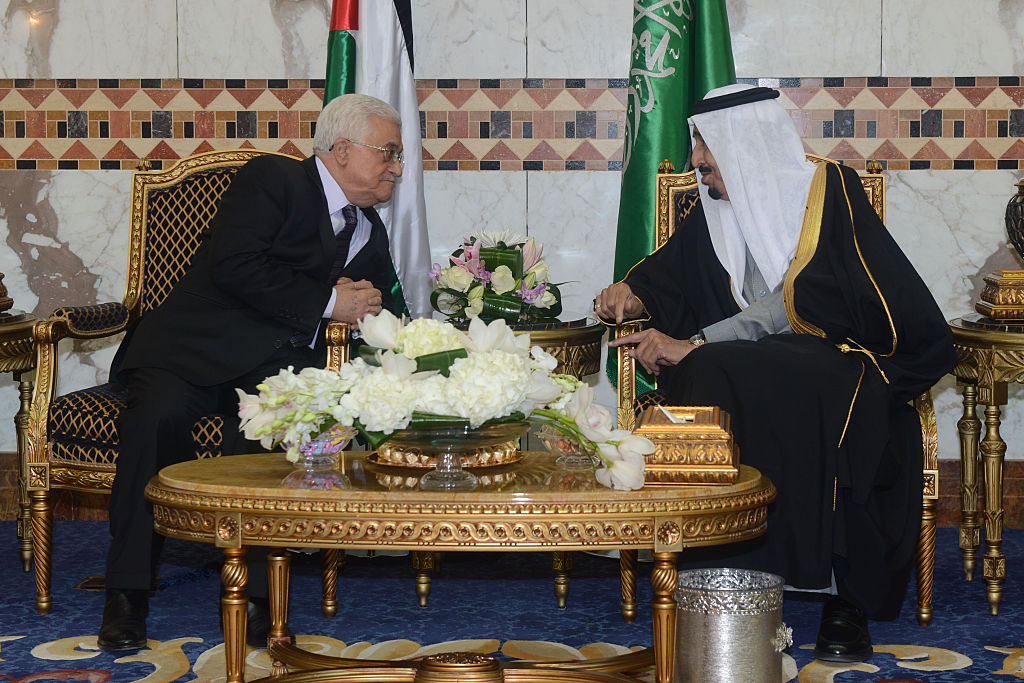
Last week, the Saudis unexpectedly summoned Palestinian Authority President Mahmoud Abbas to Riyadh for talks on Trump's "ultimate solution" for the Israeli-Arab conflict. Abbas was reportedly told that he had no choice but to accept the plan or resign. Pictured: Abbas on a previous visit to Saudi Arabia, on February 23, 2015, meeting with Saudi King Salman. (Photo by Thaer Ghanaim/PPO via Getty Images)
If true, the Saudi "ultimatum" to Abbas is tantamount to asking him to sign his death warrant. Abbas cannot afford to be seen by his people as being in collusion with an American "peace plan" that does not comply completely with their demands. Abbas has repeatedly made it clear that he will not accept anything less than a sovereign Palestinian state on all the pre-1967 lands, including east Jerusalem. He has also emphasized that the Palestinians will never give up the "right of return" for millions of "refugees" to their former homes inside Israel. Moreover, Abbas has clarified that the Palestinians will not accept the presence of any Israeli in their future Palestinian state.

Abbas has done his dirty work well. He knows that he cannot come back to his people with anything less than what he promised them. He knows that his people have been radicalized to the point that they will not agree to any concessions or compromise with Israel.

And who is responsible for this radicalization? Abbas and other Palestinian leaders, who continue unendingly to tell their people through the media, discourse and mosques that any concession to Israel constitutes treason, pure and simple.

So it would be naïve to think that Saudi Arabia or any other Arab country would be able to strong-arm any Palestinian leader to accept a "peace plan" that requires the Palestinians to make concessions to Israel. Abbas may have much respect for the ambitious and savvy young crown prince of Saudi Arabia, Mohammed bin Salman. This respect, however, certainly stops at the border of the political suicide – and extreme personal risk -- from Abbas's point of view.

Abbas is now caught between two choices, both disastrous: On the one hand, he needs the political backing of his Arab brothers. This is the most he can expect from the Arab countries, most of whom do not give the Palestinians a penny. It is worth noting that, by and large, the Arab countries discarded the Palestinians after the PLO and Yasser Arafat openly supported Saddam Hussein's invasion of Kuwait in 1990. Kuwait was one of several Gulf countries that used to provide the Palestinians with billions of dollars a year. No more.

Since then, the Palestinians have been almost entirely dependent on American and European financial aid. It is safe to assume, then, that the US and EU have more leverage with the Palestinians than most Arab countries.

Nevertheless, no American or European on the face of this Earth could force a Palestinian leader to sign a peace treaty with Israel that would be rejected by an overwhelming majority of his people.

Trump's "ultimate solution" may result in some Arab countries signing peace treaties with Israel. These countries anyway have no real conflict with Israel. Why should there not be peace between Israel and Kuwait? Why should there not be peace between Israel and Oman? Do any of the Arab countries have a territorial dispute with Israel? The only "problem" the Arab countries have with Israel is the one concerning the Palestinians.

For now, it appears that the vast majority of Arab regimes no longer care about the Palestinians and their leaders. The Palestinians despise the Arab leaders as much as they despise each other. It is a mutual feeling. The Palestinians particularly despise any Arab leader who is aligned with the US. They do not consider the US an honest broker in the Israeli-Arab conflict. The Palestinians, in fact, view the US as being "biased" in favor of Israel, regardless of whether the man sitting in the Oval Office is a Democrat or Republican.

The Saudi crown prince is viewed by Palestinians as a US ally. His close relations with Jared Kushner are seen with suspicion not only by Palestinians, but by many other Arabs as well. Palestinian political analysts such as Faisal Abu Khadra believe that the Palestinian leadership should prepare itself to face the "mysterious" Trump "peace plan." They are skeptical that the plan would meet the demands of the Palestinians.

The Palestinians appear to be united in rejecting the Trump Administration's effort to "impose" a solution on them. They are convinced that the Americans, with the help of Saudi Arabia and some Arab countries, are working towards "liquidating" the Palestinian cause. Abbas and his rivals in Hamas now find themselves dreading the US administration's "peace plan."

Like lemmings drawn to the sea, the Palestinians seem to be marching towards yet another scenario where they "never miss an opportunity to miss an opportunity." The question remains: how will the Saudis and the rest of the international community respond to ongoing Palestinian rejectionism and intransigence?

Bassam Tawil, a Muslim, is based in the Middle East.

Source: https://www.gatestoneinstitute.org/11353/middle-east-peace-plan

Follow Middle East and Terrorism on Twitter

Copyright - Original materials copyright (c) by the authors.
'This was never Palestinian land' - Hezki Baruch


by Hezki Baruch

ZOA chief Morton Klein slams claims Israel 'occupies' Judea, Samaria. 'This is Jewish land. Palestine isn't even an Arabic word!'


ZOA chief Morton Klein
Hezki Baruch
Zionist Organization of America chief Morton Klein ridiculed claims that Israel has ‘occupied’ Judea and Samaria, telling supporters at the ZOA annual gala Sunday night in New York that no Palestinian Arab nation ever existed.

“This was never their sovereign land,” said Klein. “And if it was their sovereign land, how could it be that they would have named it 'Palestine' - a Roman name, not an Arab name? We [the ZOA] are the only significant organization making it clear to Congress and the media and in public speeches that there is no 'occupation'. This is holy Jewish land, it has never been sovereign Arab land."

In addition, Klein noted, Israel has withdrawn from nearly all Arab population centers in Judea, Samaria, and Gaza, granting autonomy to the overwhelming majority, 98%, of Arabs in those areas.

"There are many falsehoods in the world being perpetrated against Israel. I'll only mention one - besides Apartheid and that Jerusalem is holy to Muslims, a total falsehood - this nonsense of 'occupation'. Is there really an 'occupation' now?"

"Israel has given away all of Gaza, 40% of Judea and Samaria. That's where 98% of the Palestinians live. They have their own parliament, schools, textbooks, newspapers, radio stations, TV, businesses, police force. There is no 'occupation'.”

Klein touted his organization’s credentials as the only “organization today of significance that opposes a Palestinian terror state,” and that “opposes any more unilateral concessions to [PA chief Mahmoud] Abbas and his racist, bigoted, Jew-hating terrorists. No more concessions!”

Founded in 1897 as the Federation of American Zionists, the ZOA has some 25,000 members.


Hezki Baruch

Source: http://www.israelnationalnews.com/News/News.aspx/238009

Follow Middle East and Terrorism on Twitter

Copyright - Original materials copyright (c) by the authors.

Trump Keeps Spotlight On North Korea - Joseph Klein


by Joseph Klein


Quiet from the Kim Jong-un regime during the president's Asia trip speaks volumes.


President Trump has maintained a laser-like focus on two themes during his Asia trip – the need for firm collective action against the North Korean regime to thwart its nuclear ambitions and the need for negotiation of fairer, more reciprocal bilateral trading arrangements between the United States and its Asian trading partners.

While modulating his rhetoric regarding North Korea, and even holding out the possibility of resumed talks under the right circumstances, the U.S. president made clear that he would not be content with a deal that continues to kick the can down the road. He pointed to the deals over the last 25 years that were supposed to lead to a denuclearized Korean Peninsula, which the North Korean regime failed to honor. “The North Korean regime has pursued its nuclear and ballistic missile programs in defiance of every assurance, agreement, and commitment it has made to the United States and its allies,” the president declared in his speech to the South Korean National Assembly in Seoul.

Trump warned North Korea that it now faced an administration determined to take a different approach.  “Do not underestimate us, and do not try us,” he said. The president added “a message directly to the leader of the North Korean dictatorship” that the weapons he is acquiring “are putting your regime in grave danger.”

Trump urged “all responsible nations” to “join forces” to isolate the North Korean regime. “We call on every nation, including China and Russia, to fully implement U.N. Security Council resolutions, downgrade diplomatic relations with the regime, and sever all ties of trade and technology,” he said. “And to those nations that choose to ignore this threat, or, worse still, to enable it, the weight of this crisis is on your conscience.”

North Korea and trade were very much on the president’s mind when he arrived in China and met with Chinese President Xi Jinping. Trump’s public statements were very complimentary towards China and its leader. However, he did not shy away from speaking frankly about the North Korean menace or the trade imbalance between the United States and China.

In his remarks to the press alongside President Xi, Trump said that “we discussed our mutual commitment to the complete denuclearization of North Korea…We agreed on the need to fully implement all U.N. Security Council resolutions on North Korea and to increase economic pressure until North Korea abandons its reckless and dangerous path.” President Xi spoke in similar terms on denuclearization and implementation of the UN sanctions in his own remarks to the press, while also calling for negotiations.

China has already taken steps to pressure North Korea far beyond what it had been willing to do prior to the Trump presidency. That said, Trump is looking for more. Behind the scenes during their private talks, Trump reportedly urged President Xi to increase China’s economic pressure on North Korea, including by cutting off oil shipments completely, cutting banking ties, and sending North Korean workers located in China back home. There has been no clear indication that China would agree to go this far, fearing that to do so would precipitate a chaotic breakdown of the North Korean state, mass exodus of North Korean refugees into China and the possibility of eventual re-unification of the Korean Peninsula on terms friendly to the United States. Squeezing North Korean dictator Kim Jong-un a bit further to persuade him to stop taking actions that could needlessly provoke the United States beyond its tipping point is one thing. Forcing a collapse of the North Korean regime if Kim Jong-un does not agree to complete denuclearization is quite another.

President Trump also discussed trade during his visit to China and during his subsequent stop in Vietnam to attend the Asia-Pacific Economic Cooperation (APEC) forum. He blamed prior U.S. administrations for agreeing to multilateral trade deals that were unfavorable to the United States. Standing alongside President Xi at their joint press appearance in Beijing, Trump complained of “the massive trade distortion” between the two countries. He called for the two nations to address “China’s market access restrictions and technology transfer requirements, which prevent American companies from being able to fairly compete within China.”

President Xi spoke in more general terms. He used one of his favorite expressions, “win-win cooperation,” to describe the relationship with the United States that he said he wants to foster, based on respect for “each other's sovereignty and territorial integrity.” He said China would be willing “to have continued in-depth discussion on trade imbalance, export, investment environment, market openness, and other issues.”  He mentioned the signing of “over $250 billion U.S. dollars of commercial deals and two-way investment agreements.”

At the APEC forum in Vietnam, Trump expanded on his complaints about multilateral trade deals and institutions that disadvantaged the United States. “I am always going to put America first, the same way that I expect all of you in this room to put your countries first,” the president remarked. “I will make bilateral trade agreements with any Indo-Pacific nation that wants to be our partner and that will abide by the principles of fair and reciprocal trade. What we will no longer do is enter into large agreements that tie our hands, surrender our sovereignty and make meaningful enforcement practically impossible.” Trump criticized the World Trade Organization for treating the United States unfairly and permitting other countries to flout its rules.

As he had done in China, the president blamed past weak American leaders for the bad deals, rather than other nations’ leaders who were simply looking after their citizens’ best interests. He was not going to fall into the trap he believed was set by the multilateral Trans-Pacific Partnership agreement, which he pulled the United States out of shortly after he took office.

Trump’s critics have been complaining about the president’s performance on his Asia trip. On a trivial note, the anti-Trump media went into a frenzy over the image of the president in Japan emptying a box of fish food into a koi pond. The fact that Japanese Prime Minister Shinzo Abe had done the same thing right before President Trump seems to have eluded the press.

Some critics have claimed that Trump was too nice to Chinese President Xi and came away from his visit to Beijing with little to show for it. The $250 billion package, for example, is said to be much less than meets the eye in terms of binding Chinese commitments and will do little to shrink the trade deficit. There was no visible progress on fixing the underlying causes of the trade imbalance or on thwarting North Korea’s nuclear ambitions, short of war, critics have argued.  Moreover, critics have complained that President Trump was too willing to cede to China the preeminence on the global stage that its leader has been trumpeting. Instead, as the New York Times op-ed columnist Roger Cohen put it, “America First, Trump’s ugly slogan, reeks of retrenchment.”

These critics are missing the bigger picture. First, they fail to appreciate the message that Trump’s public promotion of his closer relations and extensive meetings with China’s leader sent to Russian President Vladimir Putin, with whom Trump met only briefly in passing while in Vietnam. There were no formal structured talks as the Russians had hoped, which could be interpreted as intended to diminish Putin's image as a global leader at this juncture in comparison to President Xi's. Two issues the Russian and U.S. presidents did discuss during their short chats were Syria and Russian interference in last year’s U.S. presidential election. In response to critics, President Trump explained that he believed the assessment of the U.S. intelligence agencies, “especially as currently constituted with their leadership,” not President Putin's denial of Russian interference. At the same time, however, Trump wants to look forward rather than remain stuck on an issue that Putin refuses to acknowledge as valid.  He aims to secure needed Russian cooperation on some critical issues, particularly regarding North Korea, when they are ready to cooperate.

Second, Trump’s public demonstration of solidarity with China’s leader was meant to send a message to North Korea as well. The economic noose around Kim Jong-un’s neck is continuing to tighten. Moreover, China is no longer complaining so much about the deployment of the Terminal High Altitude Area Defense, or THAAD, system in South Korea. It is hardly a coincidence that just days before Trump’s visit to South Korea and China, those two countries put aside their dispute over the THAAD system and resumed normal relations.

Kim Jong-un may be starting to take notice, despite North Korea’s continued heated rhetoric to which Trump responded in kind via Twitter. So far, North Korea has not fired a ballistic missile or conducted a nuclear test as an act of defiance while Trump was in its neighborhood.

Third, Trump has laid down a clear marker for the kind of fairer, more reciprocal trade deals he will insist upon. Trade deficits caused by unbalanced trade deals result in a lower U.S. Gross Domestic Product and less jobs for American workers. Moreover, such a large trading imbalance favoring China, for example, is helping to fund its economic and military rise to a level that can pose the very type of serious challenge to U.S. global leadership that Trump’s critics claim to be worried about.

Finally, an America First policy does not mean ceding global leadership to China or retreating from multilateral cooperation. Protecting national sovereignty and supporting sensible multilateral cooperation are not mutually exclusive. A rational form of multilateral cooperation on a global or regional problem is aimed at producing net positive results against an achievable common goal while still respecting national sovereignty. On the other hand, it is not rational for a nation to allow itself to become “subservient to, dependent on, constricted by the will–and interests–of other nations,” as Charles Krauthammer put it, including by succumbing to a “mania for treaties.” China’s President Xi recognizes the difference. President Trump does also. 

Joseph Klein

Source: http://www.frontpagemag.com/fpm/268400/trump-keeps-spotlight-north-korea-joseph-klein

Follow Middle East and Terrorism on Twitter

Copyright - Original materials copyright (c) by the authors.

Israeli officials offer lukewarm reception to post-war Syria 'principles' - News Agencies and Israel Hayom Staff


by News Agencies and Israel Hayom Staff

Israel signals that it plans to maintain "free hand" with respect to preventing game-changing weapons from reaching Hezbollah


The Israel-Syria border
Photo: Reuters

Israeli officials are giving a lukewarm reaction to an international agreement laying out principles for post-war Syria.

The agreement, announced in a U.S.-Russian statement on Saturday, confirmed the importance of "de-escalation areas" as an interim step toward reducing violence, enforcing cease-fire agreements, facilitating humanitarian aid and setting conditions for the "ultimate political solution" to a war that has claimed hundreds of thousands of lives.

It also affirmed what it said was a U.S.-Russian-Jordanian understanding calling for "the reduction and ultimate elimination, of foreign forces and foreign fighters from the area to ensure a more sustainable peace."

Israel has long complained about the involvement of archenemy Iran and its proxy Hezbollah, in the Syria war. The Shiite allies have sent forces to back Syrian President Bashar Assad, who appears to be headed toward victory after years of fighting. Israel has said it will not accept a permanent military presence by Iran and its Shiite allies in Syria, especially near the Israeli border.

Israel signaled on Sunday that it would keep up military strikes meant to thwart the delivery of weapons to Hezbollah, as well as to prevent any encroachment by Iranian-allied forces.

Regional Cooperation Minister Tzachi Hanegbi said Sunday that the agreement "does not answer Israel's unequivocal demands that there will be no developments that bring Iranian or Hezbollah forces closer to Israel's border with Syria in the north."

Intelligence Minister Yisrael Katz said last week that an international agreement on Syria would be a positive development, but stressed that Israel is not a party to this deal and would defend its interests.

"We have proved that before and we will prove it again in the future," Katz said on Thursday, ahead of the expected agreement.

Israel has largely stayed on the sidelines of the Syrian war, but officials have said it will not allow Hezbollah to obtain "game-changing" weapons, and it has expressed deep concerns that Iran will carve out a "Shiite corridor" providing a land route to ship weapons from Iran to Lebanon.

U.S. President Donald Trump and Russian President Vladimir Putin on Saturday affirmed joint efforts to stabilize Syria as its civil war wanes, including with the expansion of a July 7 truce in the southwestern triangle bordering Israel and Jordan.

A U.S. State Department official said Russia had agreed "to work with the Syrian regime to remove Iranian-backed forces a defined distance" from the Golan Heights border with Israel.

The move, according to one Israeli official briefed on the arrangement, is meant to keep rival factions inside Syria away from each other, but it would effectively keep Iranian-linked forces at various distances from the Israel-held Golan as well.

Those distances would range from as little as 5 kilometers (3 miles) and up to around 30 kilometers (18 miles), depending on current rebel positions on the Syrian Golan.

Israel has been lobbying both big powers to deny Iran, Hezbollah and other Shiite militias any permanent bases in Syria, and to keep them away from the Golan, as they gain ground while helping Damascus beat back Sunni-led rebels.


News Agencies and Israel Hayom Staff

Source: http://www.israelhayom.com/2017/11/13/israeli-officials-give-lukewarm-welcome-to-post-war-syria-principles/

Follow Middle East and Terrorism on Twitter

Copyright - Original materials copyright (c) by the authors.

The British Political Crisis and European Politics: A Dystopian Scenario - Dr. Alex Joffe


by Dr. Alex Joffe

The ongoing collapse of Theresa May’s government in Britain raises the possibility of new elections in which Labour leader Jeremy Corbyn would be the likely winner.

BESA Center Perspectives Paper No. 640, November 13, 2017

EXECUTIVE SUMMARY: The ongoing collapse of Theresa May’s government in Britain raises the possibility of new elections in which Labour leader Jeremy Corbyn would be the likely winner. The red-green alliance between the European far left and Islamist parties threatens to create a dystopian scenario in which national identities are rapidly discarded and national security compromised by terrorism and separatism. This would represent a tremendous danger to the continent’s Jews, to Israel, and to the US. 

The resignation of Priti Patel from the British Cabinet after leaks that she had secretly met with Israeli officials to discuss aid to Syrian refugees has thrown the government of Theresa May into even greater upheaval. Already reeling after electoral failures earlier this year and unsuccessful Brexit negotiations, there is now the possibility that May’s government could fall.

This prospect once again brings into focus demographic and electoral trends in Britain and across Europe. Earlier in 2017, the alliance between the far left and Muslim voters was not sufficient to bring a Communist anti-Semite, Jeremy Corbyn, to power as prime minister under the banner of Labour, but it might pull it off next time. In Europe, the problem is compounded by the presence of Muslim political parties that are reshaping national politics.

What are the long-term implications for Israel and the US?

The promised economic and political consequences of a Corbyn victory – higher taxes, increased immigration, a renewed relationship with Europe (despite promised support for Brexit), and distance from the US – may prove insufficient to repel voters. In any coming election, growing frustration with the ineptitude of Theresa May and her government, undefined anger at the “establishment,” and the desire for change will again play roles.

That Corbyn, a vocal admirer of the IRA, Hamas, and Hezbollah and guest on Iranian television, is a credible politician at all says something about a sizeable portion of the British population. For British Jews especially, the message is ominous. Their concerns about rapidly rising anti-Semitism, anti-Israel bias, and terrorism are simply unimportant as electoral issues. Endlessly documented anti-Semitism within all levels of the Labour Party registers with Jews, but not with the broader electorate.

A Corbyn victory, which is entirely plausible, would be a harbinger of demographic and electoral changes throughout Europe. The “red-green alliance” of far-left and Muslim parties is nominally united against globalization, capitalism, imperialism, and colonialism, but it is more fundamentally linked by shared anti-Americanism and anti-Semitism.

The alliance is comprised primarily of Communists and Greens, but also by mainstream parties such as Corbyn’s Labour Party, as well as by explicitly Muslim parties, such as the DENK party in the Netherlands, the Equality and Justice Party in France, and the NZB Party in Austria. These purport to help downtrodden Muslim minorities, but are in fact part of a network controlled by Turkey’s AKP party that organizes Muslims under an anti-assimilation platform. Belgium’s Islam party is explicitly Islamist, as is the Arab-European League.

These Muslim parties and others are already reshaping local politics by functioning as voting blocs that influence mainstream candidates and by putting forward their own candidates. They are also influential in organizations such as unions. Sooner or later, one of these parties will be elected outright or will wield decisive national power in a coalition government. What might be expected to follow? Recent history suggests little reason for optimism.

The first concern is counterterrorism. On the one hand, incidents will be responded to and terrorists neutralized. But on the other, the “counter violent extremism” paradigm – which has proven only to empower clever Islamists with funding and credibility – will be expanded. This will amplify problems that have already overwhelmed counterterrorist and police forces in Western European countries. If “de-escalation” police tactics are adopted, the situation on the streets will become far worse.

But further loss of control is assured. The red-green alliance has already empowered local Muslim leaders who govern the banlieues and the hundreds of other no-go zones. Most mainstream and all Muslim parties are already opposed to assimilation as a means of national integration and favor increased immigration, ostensibly in the name of multiculturalism. Retreat from national control and national identity will accelerate.

Speaking out against these trends has already been deemed “racist” at the highest levels. Witness, for example, Angela Merkel’s collusion with Facebook and May’s promise to intensify Britain’s already obsessive policing of the Internet in the wake of recent London attacks, ostensibly in the name of preventing “radicalization.” Opposition to free speech on the grounds that it permits “defamation of religion” is already in the European mainstream and will expand further.

The parallel Muslim societies that already exist in Europe will expand and be protected by national authorities, since local authorities are too co-opted or frightened to take action. “Trojan Horse” takeovers of institutions like schools, from kindergartens onward, are already widespread. New generations of violent separatists are being both cultivated and imported, firming up voting bases for red-green alliances.

The existence of parallel Muslim legal structures beyond the reach of European states is well-established. Calls for Muslim communal autonomy and autonomous zones in Europe are increasing and, despite vociferous denials, no-go zones are proliferating. The temptation to formalize Muslim autonomous zones in the name of religious freedom or other rationalizations will be enormous, particularly as it will have electoral backing. A German court has started the process by declaring an unofficial “sharia patrol” that polices “morality” in Muslim neighborhoods to be legal.

Eventually, policies that endorse separatism, criminality, and violence emanating from places like Molenbeek in Brussels will provide safe havens for more systematic insurgent violence. It is unclear how governments will respond to entire neighborhoods or towns effectively outside national control. Security measures such as cordon and sweep operations still seem anathema, much less preventive detention, denaturalization, and deportation.

In this dystopian scenario, already problematic information-sharing between governments, the lifeblood of counterterrorism, will be disrupted as intelligence and security institutions are infiltrated by their targets, both as employees and as political overseers – a scenario already playing out in Germany and France. Intelligence and security services may even be tempted to interrupt information-sharing with their own political echelons. Democratic oversight will be shaken because police and spies will properly fear sharing information with a Home Secretary like Diane Abbott.

Predicting European red-green foreign policy is dismally easy. The convergence of traditional European, far left, and Muslim anti-Semitism and anti-imperialism has already produced an obsessive focus on Israel, the “little Satan,” and the “Great Satan,” the US. Corbyn, a supporter of Hamas and Hezbollah as well as the BDS movement, is an exemplar, as are virtually all European Muslim politicians. Leftist European politicians, such as German Foreign Minister Sigmar Gabriel, already find vocal condemnations of Israel irresistible. These will increase, both from leftist and Islamist conviction and political opportunism.

Suspension of trade, international sanctions, and legal action against Israelis are all on the cards once far left/Islamist governments wield power in Europe. This will not produce a Palestinian state, but that was never the goal. Shunning of the US might not be as great, but vilification will increase and security cooperation will decline, to the advantage of the Russians and the Chinese.

Blind eyes are already being turned across Europe to rapidly rising Muslim anti-Semitism and even the murder of Jews. The vehemence with which governments in Sweden and elsewhere have jettisoned their own national identities and abandoned their Jewish citizens reflects post-national eagerness to assimilate to “multicultural” ideals – that is, to norms established by immigrants, and the final expression of their loathing of Jews.

In response, the Israeli economic and diplomatic shifts to Asia and Africa will continue. Protection of Jewish refugees from Europe will become a factor in Israel’s relationship with the continent. Immigration to Israel from France has risen rapidly over the past decade, and Jews from other countries will likely join in. Jewish life in much of Western Europe will be extinct within decades. The rise of the far right and other separatist movements will also intensify, but these trends will also bode ill for national integration and for Jews.

Can anything be done to save these countries from their duly elected, suicidal fates? The US stepped in twice in the past century to help save Europe from German militarism and fascism, and then a third time to protect it from Communism. Some of the same tools that pushed back Communism may be of use against the far left/Islamist force.

US willingness to employ Russian-style “active measures” against European countries currently seems absent. But European problems invariably become problems for the US, and for Jews. In the US, political will and strategic daring are almost as lacking as they are in Europe. If this continues to be the case, a dystopian future will continue to unfold.


BESA Center Perspectives Papers are published through the generosity of the Greg Rosshandler Family


Dr. Alex Joffe is an archaeologist and historian. He is a Shillman-Ginsburg Fellow at the Middle East Forum.

Source: https://besacenter.org/perspectives-papers/britain-political-crisis/

Follow Middle East and Terrorism on Twitter

Copyright - Original materials copyright (c) by the authors.
U.S. Military: More Fake News from the New York Times - Peter Huessy


by Peter Huessy

For some reason, the Times did not get the memo some half-century ago that the United States deterrent policy does not target an adversary's cities.

  • While it was true, for example, that the Soviets under SALT II had to dismantle many missiles, a point the New York Times emphasized, what was also true was that the remaining silos under the terms of the treaty became the homes of new, vastly more powerful missiles with far more warheads.
  • President Reagan pursued a strategy of peace through strength and building a strong nuclear deterrent. While simultaneously seeking major arms reductions, he modernized what was to be kept. He then in 1983 added the Strategic Defense Initiative (SDI), to enhance further the U.S. deterrent capability and undermine the Soviet push for first-strike threats. The Soviets had no diplomatic answer to nuclear reductions and could not economically match U.S. modernization.
  • Even at such low levels, the U.S. deterrent holds at risk those military assets most important to our adversaries, the destruction of which would cripple them if they attacked the United States first. Radically changing this successful formula, as the Times wants the U.S. to do, would be a reckless, dangerous mistake.
The New York Times appears convinced the United States has plans to hurl 4000 nuclear warheads at Russian cities in the event deterrence breaks down, a retaliatory threat they claim is far beyond what is needed to keep the peace. Instead, they call for a unilateral cut in our nuclear force to roughly 1000.

For some reason, the Times did not get the memo some half-century ago that the United States deterrent policy does not target an adversary's cities. Nor are the number of warheads in the American deployed nuclear arsenal anywhere near the 4000 claimed by the Times.

They were reduced by half that number in 2002 under the Moscow Treaty, and to even lower by the 2010 New START Treaty.

The Times, believing American nuclear deterrent policy is still based on burning down to the ground our adversary's cities, calls for the country to keep no more than a few hundred warheads to incinerate either Russian or Chinese cities, and roughly no more than a total of 1100 warheads to raze the cities of an expansive list of our nuclear-armed enemies.

The Times's glaring error is its failure to grasp that since the late 1960's, the United States deterrent policy with respect to the Soviet Union and now Russia has been one of retaliating against or otherwise holding at risk the military capabilities of our enemies, and moving completely away from relying upon the assured destruction of cities that had earlier been adopted as part of U.S. nuclear policy.

Targeting civilian populations with nuclear weapons has long been held by America's leaders to be both an immoral and ineffective deterrent policy. Deterrence requires holding at risk what tyrannical societies value most -- and that is their military power, not their impoverished citizens.

Despite these facts, the Times claims the alleged current American "stockpile" of 4000 warheads the U.S. now has is far too high and can safely be reduced unilaterally, as the U.S. supposedly has more than enough warheads to target the cities of all our adversaries. Here the Times is adopting the most radical position of the arms control community.

In graphic displays of ostensibly U.S. surplus warheads, the Times calculates -- absurdly -- that the United States needs precisely 1103 warheads to fire at all our adversaries to maintain deterrence, which they define as killing 25% of our adversary's populations.

The Times does acknowledge that American nuclear weapons have already been significantly reduced since the height of the Cold War. The United States has, in fact, cut its deployed, strategic, nuclear, in-the-field weapons from around 13,000 in 1991, to 1550 warheads today, a 90% reduction.

Ironically, at any one time, roughly 1000 warheads -- not the 4000 the Times conjures up -- might be on alert and be available for retaliation. There is no possible way we could launch 4000 warheads at Russia or any adversary.

To get to 4000, after the initial warheads fall to their targets, and the delivery missiles burn up in the atmosphere while returning to earth, we would have to find hundreds of missiles we do not have, place them in our empty silos and submarine launch tubes, load up more warheads and launch them again.

Can we do this? Of course not. So, what are the real facts of its deterrent capability?

The U.S. deterrent policy currently holds at risk the critical military capabilities of our adversaries. U.S. national leaders -- in this instance, President Barack Obama -- determined in the 2010 nuclear posture review and the associated guidance to America's nuclear commanders that this is what the U.S. needs for deterrence. The nuclear force the U.S. now has was determined to be necessary by the previous administration and previous Presidents. At this time, a new nuclear posture review is examining those requirements; the third such review in the past 15 years.

Moreover, the number of warheads the U.S. has deployed -- on station -- in its nuclear deterrent, flow only from the President's determination, not from some false notion that to deter adversaries, it is necessary to kill millions of people.

Ironically, writers at the Times have not always thought 1000 weapons were sufficient to deter America's adversaries or that any deployment number above that level was unnecessary. On May 2, 1982, they ran an column by Senator Gary Hart that chastised the Reagan administration for proposing major reductions in nuclear weapons, and argued that the defunct 1979 SALT II treaty between the United States and Soviet Union -- withdrawn from the Senate by the Carter administration after the Soviet invasion of Afghanistan -- should nonetheless be agreed to as it would supposedly "slow Soviet acquisition of additional nuclear weapons."

As one nuclear expert has noted, the United States Senate Armed Services Committee, under the control of the Democratic majority, disagreed.

It unanimously concluded in 1979 that SALT II was not in the United States' "national security interests" -- precisely because it would not slow the build-up in Soviet nuclear weapons.

The chief criticism of the treaty, in fact, to which the Times seemed oblivious, was that SALT II would permit a destabilizing vast modernization and expansion of Soviet strategic forces, hardly the "arms control" slow-down the Times would claim was anticipated. The Times appeared to not be aware such growth was allowed, or perhaps the editors were taken in by the "arms control" propaganda of the treaty's proponents.


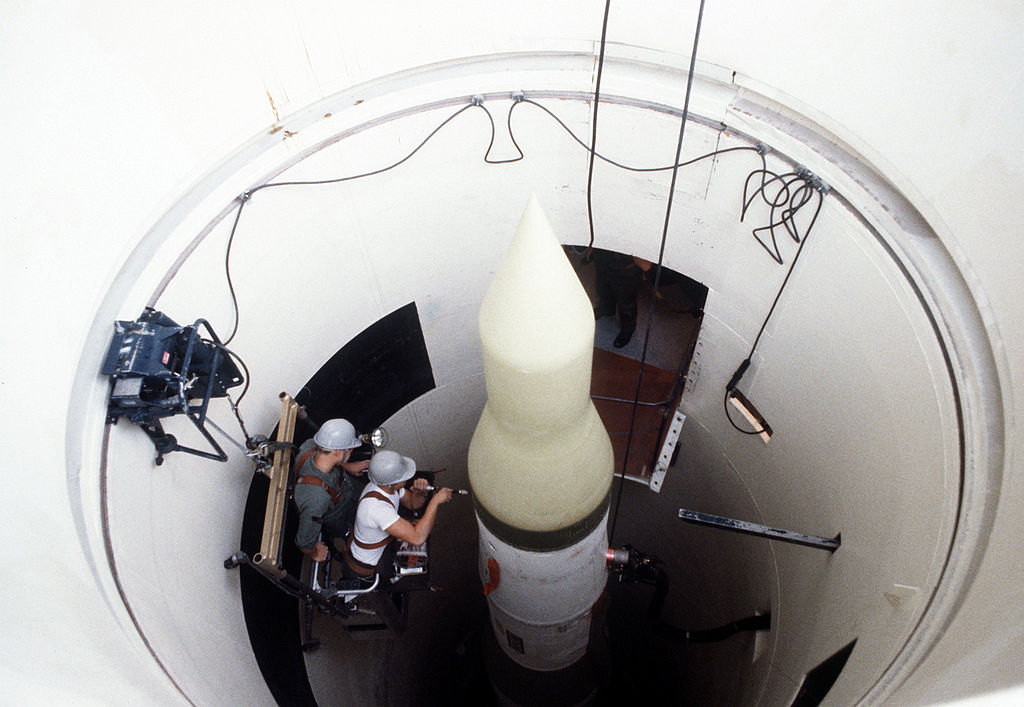
A Minuteman III intercontinental ballistic missile in its silo in Whiteman Air Force Base, Missouri, circa 1980. (Image source: U.S. Department of Defense)
While it is true, for example, that the Soviets under SALT II had to dismantle many missiles, a point the Times emphasized, what was also true was that the remaining silos under the terms of the treaty became the homes of new, vastly more powerful missiles with a lot more warheads. Even if the Soviets adhered to the terms of the 1979 SALT II deal, the Soviets could double the number of their strategic warheads, from 5,000 in 1979 to 9,200 by 1986 and to 12,000 by 1990.

Under the SALT framework, by the end of the Cold War, the Soviets could build more than 13,000 deployed strategic nuclear warheads, hardly characteristic of any "arms control" within the plain meaning of the term.

Reagan, on the other hand, sought real arms control -- reductions -- and spoke about it as early as 1977. As president, he persisted in pushing a strategy of peace through strength, and building a strong nuclear deterrent. While simultaneously seeking major arms reductions, he modernized what was to be kept. He then added the Strategic Defense Initiative (SDI) in 1983, to further enhance our deterrent capability and undermine the Soviet push for first strike threats.

While the SALT treaties in 1972 and 1979 were agreements to build-up both the Soviets' and Americans' nuclear weapons to the level both had already planned to reach, the START process was a revolutionary change to build-down -- reducing while modernizing.

But most importantly, while SALT led to dangerous instabilities with very large multiple warhead missiles dominating the Soviet force, START sought to channel modernization to vastly fewer warheads and more nuclear warheads based on submarines at sea, only single warhead missiles on land, and flexible bomber rules for the only recallable -- air -- portion of the U.S. Triad.

Coupled with that was a major push to challenge the Soviets to eliminate all their SS-20 medium range INF nuclear armed missiles in Europe and Asia under a zero-zero option.

Ironically, all these ideas were opposed by the then-Soviet inspired and popular "nuclear freeze" which, at the time, the New York Times embraced.

What was the result of the Reagan revolution in strategic thinking and doctrine of peace through strength?

Did it work? Yes, the U.S. won the Cold War because President Reagan combined military reductions while pushing for modernization, including SDI. The Soviets had no diplomatic answer to nuclear reductions and could not economically match U.S. modernization.

Bertrand Russell once said that people "often defend most passionately those opinions for which they have the least factual basis". The Times certainly does. It apparently believes there is a US deterrent policy of burning cities to the ground, but the policy does not exist.

The Times supported treaties such as SALT I and II that increased warheads dramatically, but later complained such numbers were far in excessive of what was needed. Russia then labeled as unfair Reagan's proposals to reduce warhead levels that the Times said were excessive.

The United States nuclear arsenal is the smallest it has been since the early Eisenhower administration.

Even at such low levels, the U.S. deterrent holds at risk those military assets most important to our adversaries, the destruction of which would cripple them if they attacked the United States first. That ability has been the essence of American nuclear deterrent policy for at least the past half century -- and it has worked perfectly. Radically changing that successful formula, as the Times wants the U.S. to do, would be a reckless, dangerous mistake.

Dr. Peter Huessy is President of GeoStrategic Analysis, a defense consulting firm he founded in 1981, as well as Director of Strategic Deterrent Studies at the Mitchell Institute for Aerospace Studies. He was also for 20 years, the senior defense consultant at the National Defense University Foundation.

Source: https://www.gatestoneinstitute.org/11335/us-military-new-york-times

Follow Middle East and Terrorism on Twitter

Copyright - Original materials copyright (c) by the authors.