Sunday, January 19, 2020

Iranian nuclear weapon plans go back to 2002, secret documents reveal - Aaron Reich

​
by Aaron Reich

These documents, if true, undermine the basis of the Joint Comprehensive Plan of Action (JCPOA), also known as the Iran deal, signed in 2015 by the US, Iran, France, the UK, Germany, China and Russia


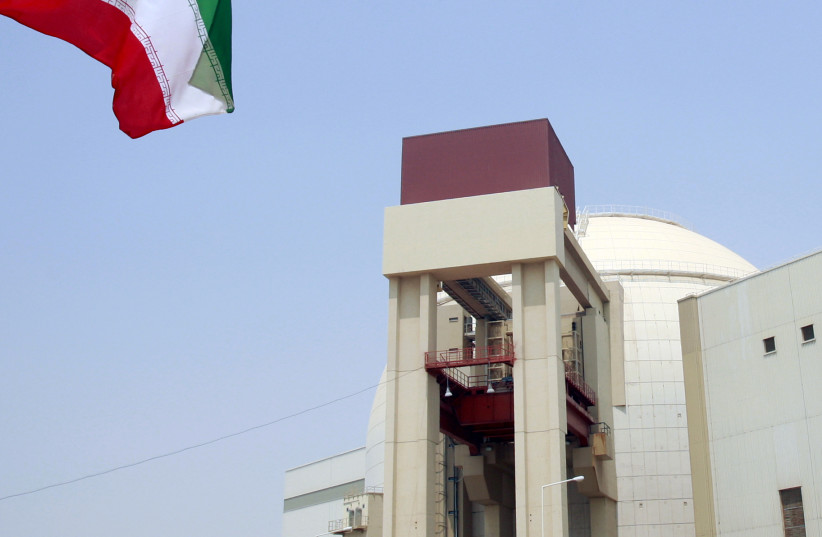
A general view of the Bushehr main nuclear reactor, Iran (photo credit: REUTERS/RAHEB HOMAVANDI)
A general view of the Bushehr main nuclear reactor, Iran
(photo credit: REUTERS/RAHEB HOMAVANDI)

A secret document from the Iranian government reveals that the Iranian regime's efforts to build nuclear weapons go back until at least 2002, the Daily Mail reported.

The document, which was one of several taken by a Mossad raid on Tehran in 2018, outlines the proposals of several scientists for a nuclear warhead, which were approved by the Iranian regime's top nuclear official, Mohsen Fakhrizadeh.


The document and blueprints – which will be the focus of a new report by the Friends of Israel Initiative (FOII), an NGO of several foreign policy experts and former presidents and prime ministers, currently chaired by former Canadian prime minister Stephen Harper – prove the military ambitions of Iran's nuclear studies, despite official regime statements to the contrary."Iran intended to become a fully operational nuclear state," the report states, according to the Daily Mail.These documents, if true, undermine the basis of the Joint Comprehensive Plan of Action (JCPOA), also known as the Iran deal, signed in 2015 by the US, Iran, France, the UK, Germany, China and Russia.Before the deal was signed, the International Atomic Energy Agency stated they found zero evidence "of the diversion of nuclear material in connection with the possible military dimensions" of Iran's nuclear program.However, the 2018 Mossad raid on Tehran produced several classified documents that at best, threw all of these claims into question.


Aaron Reich

Source: https://www.jpost.com/Middle-East/Secret-document-shows-Irans-nuclear-weapon-plans-go-back-to-2002-report-614591

Follow Middle East and Terrorism on Twitter


The Leviathan Natural Gas Field Could Be a Game-Changer for Israel-EU Relations - Frank Musmar

​
by Frank Musmar

A reliable and price-competitive natural gas alternative in the Mediterranean could diminish Moscow’s ability to use energy supplies as a political weapon against Europe.


view of the Mediterranean from Haifa, photo via Wikimedia Commons

BESA Center Perspectives Paper No. 1,411, January 19, 2020

EXECUTIVE SUMMARY: The vast Leviathan natural gas field off the Haifa coast could be a game-changer for Israel’s relations with the EU. Europe is currently dependent on Russian natural gas. A reliable and price-competitive natural gas alternative in the Mediterranean could diminish Moscow’s ability to use energy supplies as a political weapon against Europe.

Leviathan, the largest natural gas field ever discovered, is located in the Mediterranean Sea off the coast of Israel.  It is deep in the Levantine Basin, an area rich in hydrocarbons. The field is roughly 130 kilometers west of Haifa and 1,500 meters deep.

Leviathan is estimated to hold over 21 trillion cubic feet of natural gas—enough to fill Israeli power-generation needs for the next 40 years while still leaving ample supply for export.

Leviathan could prove to be a game-changer for Israel’s relations with the EU.

Israel’s proven gas reserves are estimated at some 455 billion cubic meters (bcm), while the Eastern Mediterranean has about 2,100 bcm of gas in total. The EU’s consumption of gas in 2017 was 410 bcm, meaning Israel’s reserves are enough to supply the EU.

Israel’s gas production is anticipated to exceed demand by 80% in 2020 thanks to production from Leviathan 1A. This will enable Israel to become a gas exporter in the Eastern Mediterranean. (The Karish field, which has recoverable reserves of 1.7 tcf [60 bcm], is also under development and is expected to start supplying the domestic market in 2021.)

Israeli natural gas offers the EU a rare opportunity to loosen Russia’s energy chokehold on parts of Europe. Moscow wields access to energy supplies as a political weapon. The Levantine basin offers the EU an alternative: a reliable and price-competitive source of liquefied natural gas.

In January 2019, Israel, Egypt, and Cyprus announced the creation of the Eastern Mediterranean Gas Forum, which aims to build a 1,200-mile pipeline connecting the abundant hydrocarbon reserves of the Levantine basin with Europe via Cyprus and Crete. The European Commission has contributed nearly $39 million to the project, which is forecast to be completed in seven years.

The transformation of the eastern Mediterranean into an energy hub could have major global geopolitical implications.

After a meeting in Tel Aviv with the energy ministers of Israel, Cyprus, Greece, and Italy, European Climate and Energy Commissioner Miguel Arias Canete said the pipeline would help the EU limit its reliance on the Nord Stream pipeline via Russia. This development concerns Moscow, of course, because the Russian economy is heavily dependent on the export of natural resources such as oil and natural gas. Russia holds 54% of the world’s total reserves of gas, 46% of its coal, 14% of its uranium, and 13% of its oil. It provides 37% of Europe’s gas supplies via its oil and gas giant Gazprom. Europe’s energy dependence has paid off handsomely for Russia.

Russia’s contract to use Ukrainian pipelines to ship natural gas to Europe expired on December 31, 2019. The last time the contract was up for negotiation, Russia stopped gas shipments for 13 days in the dead of winter. The result was freezing temperatures in homes from Sofia to Rome. If no contract is reached and Ukraine ceases to be a transit state, Europe may not immediately suffer a shortage, but prices will spike.

Ten years ago, Israel depended on Egyptian natural gas. Today, Israel exports natural gas to both Egypt and Jordan. Export agreements to Jordan and Egypt have already been concluded for Leviathan Phase 1A gas. Israel will export 106 bcf (3 bcm) natural gas per year to Jordan starting in 2020 through a 65-kilometer pipeline. Israel will need access to additional markets, however, if it is to export large quantities of natural gas. A burgeoning energy relationship with the EU is very much in Jerusalem’s interest.


Frank Musmar is a financial and performance management specialist.

Source: https://besacenter.org/perspectives-papers/leviathan-gas-israel-europe/

Follow Middle East and Terrorism on Twitter


IDF laying new infrastructure to detect sounds of Hezbollah digging - Anna Ahronheim

​
by Anna Ahronheim

Military says there is no intelligence on new cross border tunnels – project is defensive in nature.


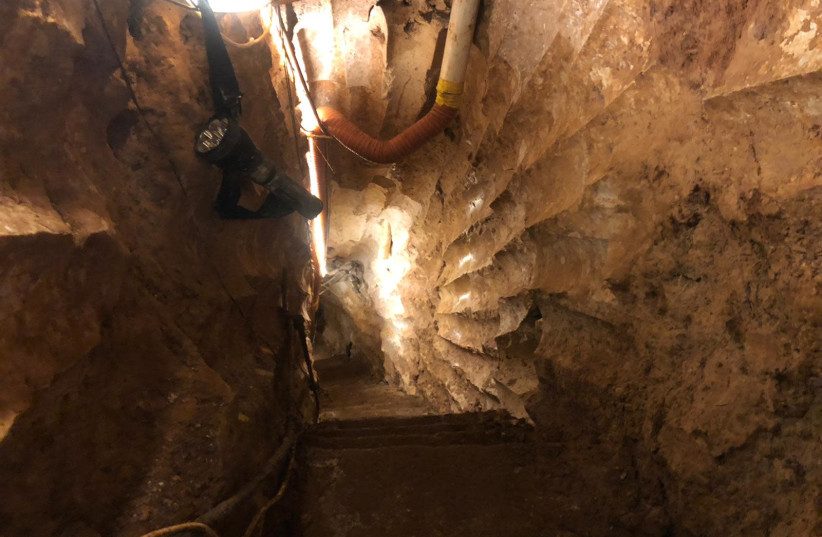
Hezbollah tunnel (photo credit: COURTESY ANNA AHRONHEIM)
Hezbollah tunnel
(photo credit: COURTESY ANNA AHRONHEIM)

A year after Operation Northern Shield destroyed six cross-border attack tunnels dug by Hezbollah, the Israeli army has begun deploying new sensors along the border with Lebanon that are able to detect and identify any sounds of new digging by the terrorist group.

IDF spokesman Brig.-Gen. Hidai Zilberman said that while there has been no new intelligence about new cross-border tunnels or new excavations, the new infrastructure will collect both acoustic and seismic data that will be used as a preventative measure, alerting the military to any new sounds of tunnel excavations.


The engineering project will begin near the community of Misgav Am on Sunday morning and will last several months. Zilberman stated that the project will continue over the coming year along the entire border based on intelligence, budget and situational needs.

While the infrastructure will be laid within Israel’s borders, with the sounds of the IDF’s operation expected to be heard on both the Israeli and Lebanese side, the military wants to prevent a miscalculation on both sides. 

There will be no troop reinforcements as part of the project, Zilberman said. Both the UN Peacekeeping Force in Lebanon (UNIFIL) and regional authorities have been informed of the project.

In December of last year, the IDF launched Operation Northern Shield to discover and destroy all cross-border tunnels dug by Hezbollah into northern Israel. 

While the military announced the end of the operation a month later after finding and destroying six tunnels, it noted that it “is simultaneously monitoring several locations where Hezbollah is digging underground structures which have yet to cross into Israel.”

According to the military, the deployment of the infrastructure is another component of the IDF’s extensive defensive effort to prevent any infiltration by Hezbollah operatives into Israeli territory.

“IDF forces will continue to fulfill their mission of defending, and will operate around the clock in order to preserve the sovereignty of the State of Israel and protect its citizens,” the military said in a statement.

While the primary threat posed by Hezbollah remains its missile arsenal, the IDF believes that the next war will see the group trying to bring the fight to the home front by infiltrating Israeli communities to inflict significant civilian and military casualties.

After the end of Operation Northern Shield, the military said that it had “deprived Hezbollah of the unique offensive abilities it had built for years as part of its planned attack on Israeli territory” and strengthened security along the northern border.

The military believes that the attack tunnels were built as a classified component in Hezbollah’s “Conquer the Galilee” plan that would have allowed the group’s elite Radwan fighters to infiltrate into Israel on land, fire short-range rockets and mortars, and allow other Radwan fighters to infiltrate into communities via the tunnels, cut them off from main roads and kill as many civilians and troops as possible.

The IDF stated that it will also continue a broad defense effort along the Lebanese border to ensure that Hezbollah does not try to dig future tunnels into Israel, by integrating various means such as the ongoing construction of the border wall with Lebanon.

Israel has invested significant amounts of money and effort into strengthening its defenses along the border with Lebanon over the past several years by creating obstacles such as artificial cliffs and building high concrete barriers to help prevent any ground attacks by Hezbollah. 


Anna Ahronheim

Source: https://www.jpost.com/Israel-News/IDF-laying-new-infrastructure-to-detect-sounds-of-Hezbollah-digging-614595

Follow Middle East and Terrorism on Twitter


Rep. Lee Zeldin on the NY bail reform backlash - Arutz Sheva

​
by Arutz Sheva

New York bail reform law is receiving some push back.


Arutz Sheva

Source: http://www.israelnationalnews.com/News/News.aspx/274726

Follow Middle East and Terrorism on Twitter


Ilhan Omar is finally getting the scrutiny she deserves for possible illegal acts - Andrea Widburg

​
by Andrea Widburg

Conservatives had  serious problems with her politics. And a small cadre of dogged conservative journalists -- found particularly dismaying Omar's probable marital and immigration fraud.


Rep. Ilhan Omar (D-Somalia) exploded on the national political scene in 2018, when she ran for and won a seat in the House of Representatives. Born in Somalia, she and her family had escaped that war-torn country when she was a small child and spent four years in a refugee camp in Kenya. Omar came to America in 1992, when she was 10.

Omar was a perfect candidate to take over the seat that Keith Ellison vacated when he moved on to become deputy chair of the Democratic National Committee. As was Ellison, Omar is a Muslim representing Minnesota's 5th congressional district — that is, Minneapolis and some suburbs — an area that is politically Progressive and that has a large Muslim population.

Beautiful, poised, articulate, and with impeccable Progressive credentials, Omar was a shoo-in. She also entered Congress at the same time as Alexandria Ocasio-Cortez, Ayanna Pressley, and Rashida Tlaib. All young, all leftist, all arrogant, the four women were dubbed "the Squad" and proceeded to act as if they owned Congress.

While Ocasio-Cortez burbled Leftist nonsense, Tlaib and Omar got down to the business of denigrating America, Israel, and Jews. They disliked the American military and mourned Soleimani's death. Despite their puritanical faith, they pushed on America every possible Progressive policy.

The mainstream media were in love with the Squad, especially the exotic Omar. Conservatives had problems, serious problems, with her politics. And a small cadre of dogged conservative journalists, most notably at PJ Media and Power Line, found particularly dismaying Omar's probable marital and immigration fraud.

If you search for Omar's name at either of those sites, you'll find article after article meticulously documenting her marriage to a man almost certainly her brother, which gained him entry into the American education system, while she was simultaneously in a "faith-based" marriage to another man with whom she had children and filed taxes. Other research revealed that her entire extended family may have been switching out identities to gain entry to America. Many of those articles reflected meticulous investigation by David Steinberg. (See here, for example.)

The unsavoriness of Omar's conduct escalated when she dumped her husband and went to live with another man who apparently left his wife for Omar. It turns out that beneath the modest headgear she wears, Omar is a Jezebel.

In October 2019, the Department of Justice finally assigned an FBI special agent in charge to look at Omar's conduct over an eight-year period. Steinberg has now written another detailed article explaining that these investigations are starting to bear fruit.

The Department of Education inspector general is examining whether her 2009 marriage to a U.K. citizen (who may well have been her brother) was meant to defraud the federal student loan system:
Shortly after Omar's 2009 marriage, the new couple moved to Fargo, North Dakota. Omar enrolled at North Dakota State University in August 2009. Her husband enrolled the following year.
Omar received a degree in June 2011. According to Omar herself, she and her husband then permanently separated in June 2011. The marriage's start and end coincide with the start and end dates of Omar's NDSU enrollment.
Incredibly — according to address records, and a statement from Omar herself — she was also still living with her first husband, and their two kids, throughout this second marriage.
This investigation will encompass the fact that, when Omar filed for divorce from that 2009 marriage, she perjured herself eight times in nine questions by claiming she had no contact with her husband, despite evidence strewn across social media that this was a lie.

Immigrations and Customs Enforcement (ICE) is also examining myriad immigration felonies Omar might have committed. No wonder that Omar has been in the forefront of those Progressive politicians demanding that ICE be abolished.

Many criminals fear getting caught and do their best to stay out of the limelight. There is, however, a class of criminal that functions on arrogance. These people believe that, like Yogi Bear, they're "smarter than the average bear." Their egos are so big that they cannot imagine that they'll ever be caught.

Jeffrey Epstein was one such person. Michael Avenatti is another. Both would have done well to stay in the shadows rather than to flaunt themselves and their crimes. And now it's beginning to look as if Ilhan Omar falls into the same category: people whose failed moral compasses allow them to commit crimes, and whose overweening egos compel them to seek the public spotlight.

Andrea Widburg

Source: https://www.americanthinker.com/blog/2020/01/ilhan_omar_is_finally_getting_the_scrutiny_she_deserves_for_possible_illegal_acts.html

Follow Middle East and Terrorism on Twitter


The Democrat candidates have consistently ignored Israel in their debates - Andrea Widburg

​
by Andrea Widburg

What the debate reflects, says Keinon, is a profound change in the Democrat Party as a whole. The candidates have determined that supporting Israel is no longer an advantage to a candidate


A Jerusalem Post article points out something interesting about the Democrat Party debates to date: they are loudly silent about Israel. While each of the six candidates who made it to the January 2020 debate had a great deal to say about Iran, and especially how wonderful Obama's Iran deal was and how all would handle Iran so much better than President Trump ever could, none even whispered the word "Israel."

Things would have been different, says Herb Keinon, at a Republican debate:
Were the tables reversed, were this a debate among Republican contenders, Israel would most likely have been a major part of the conversation, even if the thrust of the discussion was Iran and not the Palestinian issue. Republican candidates — in talking about Iran or the nuclear deal — would surely have inserted lines about "the need to keep Israel safe" or "working strongly with our close ally Israel."
As former Mideast negotiator Aaron David Miller told the Jewish Insider after the debate, "Had it been a Republican debate, with Iran as focus, they would have been stumbling over one another with pro-Israeli references."
What the debate reflects, says Keinon, is a profound change in the Democrat Party as a whole. The candidates have determined that supporting Israel is no longer an advantage to a candidate:
The current candidates — those on the debate stage and former New York mayor Michael Bloomberg, who was not there — apparently feel they have little to gain politically right now by speaking on Israel.
Israel, because of the very tight and highly visible relationship between Trump and Prime Minister Benjamin Netanyahu, has turned into a partisan issue in the US. For the Likud, the close Netanyahu-Trump relationship is an electoral asset, the reason that — in this year's election campaigns in Israel — large posters of a smiling Trump shaking the hand of a beaming Netanyahu have draped the country's major cities.
Keinon's halfway there, but he sells short the fact that the Democrat Party's break from Israel happened long before Trump. Trump's close relationship with Netanyahu only exacerbated it.

After all, Israel's friends haven't forgotten the cavalier way Obama treated Netanyahu when the latter visited the White House; they haven't forgotten Hillary Clinton's lifetime of hostility to Israel, including her role as "designated screamer" (no matter how cutely she tried to dress up that role); they haven't forgotten Obama's extortionate weapons deal with Israel; and, of course, they haven't forgotten the Iran deal itself, which fast-tracks Iran to nuclear weapons, a number of which will be aimed directly at Israel.

Nor have Israel's friends missed the rising anti-Semitism on America's colleges and universities, which are bastions of progressivism and the Democrat Party. They've also noticed that the Democrat primary candidate who is currently most popular is Bernie Sanders, who's besties with the openly anti-Semitic Linda Sarsour.

Currently, when pressed, the Democrat candidates will pay a little lip service to Israel and fairness before immediately reverting to Warren's favorite trope of "putting everything on the table" in the service of protecting the Palestinians from Israel's alleged depredations. Moreover, Warren, just like Bernie, proudly supports open anti-Semites, such as Palestinian-American Maysoon Zayid.

Despite the Democrat Party's growing hostility to Israel, American Jews still relentlessly side with Democrats. There are #Jexit and #Jexodus movements, but sadly, Jews are blind to something that American blacks have already begun to realize: the Democrat Party is the enemy. Just as with black interests, its policies are hostile to Jewish interests. Democrats take both black and Jewish votes for granted without giving them a thing in return.

Andrea Widburg

Source: https://www.americanthinker.com/blog/2020/01/the_democrat_candidates_have_consistently_ignored_israel_in_their_debates.html

Follow Middle East and Terrorism on Twitter


Lebanon: Tear gas, water cannons fired at anti-government protesters - Arutz Sheva Staff

​
by Arutz Sheva Staff

Lebanese police fire tear gas and water cannons at hundreds of anti-government protesters in downtown Beirut as demonstrations turn violent.


Riot police fire tear gas during anti government protests in Beirut
Reuters

Lebanese police fired tear gas and water cannons at hundreds of anti-government protesters in downtown Beirut on Saturday, CNN reports, as the ongoing demonstrations in the country turned violent.

The network’s reporters on the ground near Martyrs' Square saw demonstrators throw firebombs, rocks and fireworks at police, and shine lasers at them to disrupt successive rounds of tear gas.

Lebanon has been swept by a wave of mostly peaceful protests aimed at the country’s elite that prompted Prime Minister Saad al-Hariri to resign on October 29, pushing the country deeper into economic crisis.

The protests in Lebanon were initially started in response to what has become known as the “WhatsApp Tax”, which would have seen a 20-cent daily fee being charged for messaging app users. The tax was later scrapped but the protests have continued and have morphed into a cross-sectarian street mobilization against a political system seen as corrupt and broken.

While the protests but had largely been peaceful, things changed this week, when riots broke out in Beirut’s Hamra area, with bank facades smashed and stones pelted at security forces who fired back with tear gas.

Lebanese Interior Minister Raya Haffar El Hassan was forced to apologize after security forces attacked journalists at protests on Wednesday, saying officers were under stress and were struggling to keep up with the months of demonstrations.

Saad Hariri, who is currently leading the country in a caretaker role since resigning, issued a statement decrying the violence.

"The scene of confrontations, fires and acts of sabotage in Beirut Downtown is a crazy, suspicious, and unacceptable scene that threatens civil peace and warns of the most severe consequences," he said. "Beirut will not be an arena for mercenaries and deliberate policies to strike the peacefulness of popular movements."

Hassan Diab was designated by the President as prime minister in mid-December, but he has so far failed to form an emergency government amid political divisions and jockeying for power.

While Diab is backed by Hezbollah and its Shiite allies, he lacks the support of major Sunni figures.


Arutz Sheva Staff

Source: http://www.israelnationalnews.com/News/News.aspx/274751

Follow Middle East and Terrorism on Twitter


Iranian Women Defy the Mullahs; Western Feminists Nowhere in Sight - Giulio Meotti

​
by Giulio Meotti

Iran's mullahs seem to be willing to do everything in their power to destroy this women's movement. They have sentenced women, who shared videos of removing their veils, to 10 years in prison, and have introduced 2,000 new "morality police" units to break up the women's movement.

  • Before 1979, Iranian women had freedom. They want it back.
  • If Iranian feminists who refuse to wear the hijab are brave, their Western counterparts, who wear pink hats, have wretchedly abandoned them.
  • Why is Iranian barbarism so easily condoned in the West?
  • Thirty years ago, the Berlin Wall was torn down by ordinary citizens who wanted to reclaim their freedom of movement. Today, the wall of the Iranian regime could be torn down by these ordinary women who want to reclaim the freedom to wear what they like. They are bravely refusing to walk on flags of Israel and the U.S. -- and enjoying the wind in their hair again.

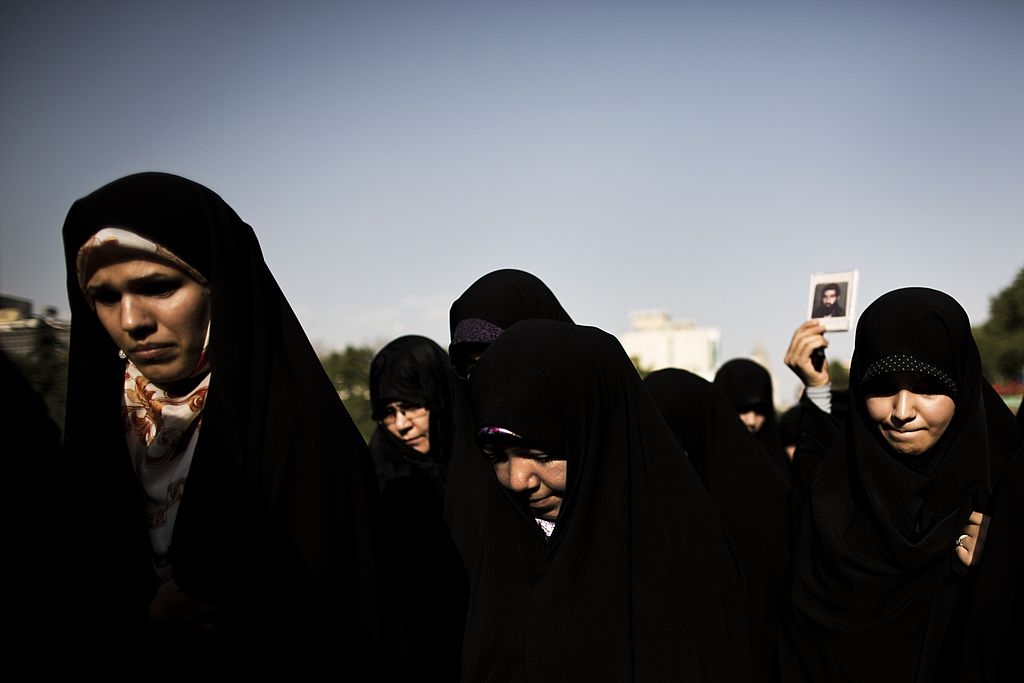
Today, courageous Iranian women are leading the uprising against the Iranian regime. They remind one the era before the 1979 Islamic Revolution, when the veil was not mandatory. They know the price: many who have taken part in anti-regime protests have been raped and tortured in prison. Pictured: Veiled women appear in a propaganda show on Iranian state television, on July 12, 2014. (Photo by Behrouz Mehri/AFP via Getty Images)

In October 1979, in a rare interview with Ayatollah Ruhollah Khomeini, the late Italian journalist Oriana Fallaci charged that the veil was symbolic of the segregation into which the Islamic revolution women had cast women. "Our customs," Khomeini answered, "are none of your business. If you do not like Islamic dress, you're not obliged to wear it because Islamic dress is for good and proper young women."

"That's very kind of you," Fallaci replied. "And since you said so, I'm going to take off this stupid, medieval rag right now." Fallaci removed her veil and left the room without saying another word. Iranian women, emulating Fallaci, are now leading protests against the regime.

Soon after Iran's regime admitted having shot down a Ukrainian passenger aircraft on January 8, Iranian women outside Tehran began tearing down posters of the assassinated terrorist, General Qasem Soleimani. A few hours earlier, the ayatollahs had attacked the Ain al-Assad base in Iraq, which houses U.S. troops. Before that, a picture was circulated on social media of an Iranian referee at the Women's World Chess Championship, Shohreh Bayat, overseeing a game without wearing a headscarf. "People should have the right to choose the way they want to dress, it should not be forced," Bayat said, challenging Iran's rule that mandates a strict Islamic dress code for women.

"Should I start with hello, goodbye or condolences? Hello oppressed people of Iran, goodbye noble people of Iran, my condolences to you people who are always mourning," Kimia Alizadeh, Iran's Taekwondo bronze medal champion, at the 2016 Rio Olympics, wrote after moving to Europe. She, too, protested the "obligatory veil."

On January 13, three Iranian female television presenters resigned from the regime's broadcaster, Islamic Republic of Iran Broadcasting (IRIB). "Forgive me for the 13 years I told you lies", Gelare Jabbari apologized in an Instagram post after state officials had denied for days that a Ukrainian passenger jet had been shot down by the Islamic Revolutionary Guard Corps, killing 176 passengers and crew.

These self-exiling Iranian women are similar to the dissidents behind the Soviet Iron Curtain, who eventually found refuge in the West. Their role in defeating the Soviet Union was fundamental: they opened the eyes of the Western public opinion to the reality in their country.

The Iranian women now openly challenging the mullahs remind one the era before the 1979 Islamic Revolution, when the veil was not mandatory. Pictures from that time show women wearing no veils. Overnight, clothing then went "from miniskirt to hijab."

"I'm sorry to say that the chador was forced on women", said Zahra Eshraghi, a granddaughter of Ayatollah Khomeini. "Forced -- in government buildings, in the school my daughter attends. This garment that was traditional Iranian dress was turned into a symbol of revolution."

The last empress of Iran, Farah Diba, noted that "in our time, women were active in all sorts of different areas. At one point, the number of Iranian women going to university was more than the men." But they "are now abused and disrespected and have had their rights taken away and yet they're so incredibly brave."

You can see in a photograph from 1979, how women took the streets to protest the veil. "This was taken on 8 March 1979, the day after the hijab law was brought in, decreeing that women in Iran would have to wear scarves to leave the house," said the photographer, Hengameh Golestan. "Many people in Tehran went on strike and took to the streets. It was a huge demonstration with women -- and men... We were fighting for freedom". Since then, women have not gone out uncovered.

At the time, 100,000 women protested Islamist rule. Today, courageous Iranian women are leading the uprising against the Iranian regime. They know the price: many who have taken part in anti-regime protests have been raped and tortured in prison. The mullahs, too, know that 40 million Iranian women are under their surveillance and that if these women as a group rebel against sharia, the Islamic revolution will implode. This fear may be part of the reason the regime is scapegoating the West.

When Iran's current supreme "guide", Ayatollah Ali Khamenei, gave a speech about the veil, he blamed Iran's "enemies" for trying to "deceive a handful of girls to remove their hijabs on the street." In 2009, the symbol of the Iranian protests was Neda Agha-Soltan, a young woman murdered by the regime. The case of Sakineh Mohammadi Ashtiani, an Iranian woman sentenced to death by stoning supposedly for "adultery", spurred rallies in France, which may have had a role her eventual release. Two years ago, another Iranian woman, Vida Movahedi, became a symbol of defiance in Tehran after she waved a white scarf.

Books on Iranian dissent -- such as Persepolis and Reading Lolita in Tehran -- have been written by women. Women are fighting the ayatollahs. The 1,500 people killed by Iran's regime in the recent crackdown on protesters, as reported to Reuters by Iranian interior ministry officials, included about 400 women.

According to the Iranian-French novelist Chahla Chafiq:
"Their act challenges us, above all, about the infernal order that the Islamic Republic establishes by making discrimination and violence against women sacred in the name of God... The demonization of women's bodies as places of sin, symbolized by the obligation to wear the veil, implies a series of prohibitions that alter the lives of women, who are subjected to constant humiliation and suffering."
A human rights lawyer, Nasrin Sotoudeh, who has represented women protesting the veil, was sentenced in March to 38.5 years in prison, of which she must serve 12. Activists Yasaman Aryani, her mother Monireh Arabshahi and Mojgan Keshavarz, were arrested after posting a video showing themselves without headscarves while distributing flowers to passengers. Three women charged with "disrespecting the compulsory hijab" have been sentenced to a total of 55 years. Shaparak Shajarizadeh, a 43-year-old woman from Tehran, has been sentenced to two years in prison for removing her veil. Azam Jangravi, who held her headscarf in the air and waved it above her head in a busy street of Tehran, said she did it for her eight-year-old daughter. "I was telling myself: 'Viana should not grow up in the same conditions in this country that you grew up in'", she said.

Iran's mullahs seem to be willing to do everything in their power to destroy this women's movement. They have sentenced women, who shared videos of removing their veils, to 10 years in prison, and have introduced 2,000 new "morality police" units to break up the women's movement. The Iranian regime is also producing propaganda videos about the hijab. One girl, who had attempted to enter a football stadium in Tehran disguised as a man, set herself on fire after her trial . Iranian women have "the highest rate of suicide among women and girls in the Middle East." Seventy percent of suicides in Iran are committed by women, who have so much to lose under this regime.

The veil, however, is not their only problem. Behind the veil, there are more activities that are risky for women in Iran: dancing, singing, playing music or shaking hands with men. Before 1979, Iranian women had freedom. They want it back.

"The flame of feminism is alive in Iran", Foreign Policy reported . If Iranian feminists who refuse to wear the hijab are brave, their Western counterparts, who wear pink hats, have wretchedly abandoned them. Federica Mogherini, the EU's former foreign policy chief who, while wearing a chador on official visits to Iran, took selfies with Iranian lawmakers, has said not one word about these extraordinary women.

Masih Alinejad, who helped spearhead the Iranian women's campaign against the forced wearing of headscarves, addressed female Western politicians who were covering themselves while visiting Iran: "Let me be clear with you: calling a discriminatory law a part of our culture -- this is an insult to a nation", she said. The Iranian regime promptly arrested members of her family.

A recent criminal law in Brunei -- death by stoning for sex between men or for adultery -- was followed by an international outcry. Iran, however, is doing the same thing: killing homosexuals and hanging women for "adultery." Why is Iranian barbarism so easily condoned in the West?

Iran's 1979 revolution created the first modern state based on Islamic principles. The ayatollahs proved that governance based on sharia was possible with the first modern effort to establish a Muslim theocracy. The center of their system was the subjugation of women.

Thirty years ago, the Berlin Wall was torn down by ordinary citizens who wanted to reclaim their freedom of movement. Today, the wall of the Iranian regime could be torn down by these ordinary women who want to reclaim the freedom to wear what they like. They are bravely refusing to walk on flags of Israel and the U.S. -- and enjoying the wind in their hair again.

Giulio Meotti, Cultural Editor for Il Foglio, is an Italian journalist and author.

Source: https://www.gatestoneinstitute.org/15464/iranian-women-western-feminists

Follow Middle East and Terrorism on Twitter


Turkey rapidly succeeds in taking over Libya conflict - analysis - Seth J. Frantzman

​
by Seth J. Frantzman

Libya is in the midst of a civil war that pits Khalifa Haftar, a general controlling most of the country, against a weak government.


Just weeks after Turkey’s parliament approved deploying troops to western Libya after Turkey signed a controversial Mediterranean deal with the embattled government in Tripoli, Ankara is now the central player in Libya. Nine years after he overthrow of the regime of Muammar Qadaffi, Ankara has transformed the Libyan conflict in weeks, more than many countries have accomplished in years. In Berlin at a summit on Libya's conflict Turkey's delegation has now met with US Secretary of State Mike Pompeo to discuss the future of Libya. This has long-term implications for Israel because Ankara's current leadership is hostile to Israel and has hosted Hamas.  

Libya is in the midst of a civil war that pits Khalifa Haftar, a general controlling most of the country, against a weak government in Tripoli that is called the Government of the National Accord. However, like other failed and failing states that have seen years of war, the government in Tripoli may not command most of the countryside but it commands a role internationally. It also has money and it has hired lobbyists and it realized that it can give away rights in the Mediterranean that it doesn’t control to Turkey. It did just that in November, which benefits Ankara by giving Turkey a claim to a huge swath of sea that gives Turkey overlapping claims with Greece and Cyprus and potentially frustrates a gas pipeline that Israel, Greece, Cyprus, Italy and others wants to build.


Good news for Turkey. With a bit of pluck and the usual nationalist religious chest-beating in Ankara, President Recep Tayyip Erdogan positioned Turkey as a player in the Mediterranean after years of watching international energy companies seek to explore off the coast of Cyprus, Israel or Greece. Turkey used the Libya deal to distract from its failures in northern Syria. In Syria Turkey has sold out Syrians in Idlib to constant bombing by the Syrian regime which is backed by Russia. Turkey has an S-400 deal with Russia and a TurkStream gas pipeline with Russia and it doesn’t want to jeopardize those. So Turkey is signaling an openness to the Syrian regime. Turkey’s main goal in Syria is to defeat Kurdish fighters who were aligned with the US until October 2019 when the US abandoned part of northern Syria so Turkey could takeover. 

Fresh from the success in pushing the US out of part of Syria and attacking a US partner, Turkey set its sights on Libya. It recruited the same Syrian rebels it used to fight Kurds to go to Libya and fight Haftar. Within weeks of sending them Turkey was already discussing a ceasefire deal with Russia. Haftar, invited to Moscow earlier this month, left without signing the deal. Now Turkey is using its usual threats toward Europe, claiming that if Europe doesn’t back Turkey on Libya then extremists will flood into Europe, to get what it wants from a Libya summit in Berlin. 

This is classic Ankara strategy. Insert Ankara’s troops and Syrian mercenaries into a conflict and then get a seat at the table. Ankara did this with the Astana process for the Syrian conflict, and has learned that nationalism, threats and combining economic, political and military strategy works well. Erdogan went to Berlin this week as if Turkey has always run Libya, rather than being a newcomer to the table. Turkey met its new ally, Fayez al-Sarraj of the Tripoli-based government, in Berlin. Now Turkey will gobble up influence in the Tripoli government as it bought up the Syrian rebellion, as it bought in to Northern Cyprus and also as it plays a role in Somalia and Qatar. Turkey’s strategy is to make Tripoli totally dependent on Ankara and nominate Turkey to do its work in international forums. This comes with a cost in the end, because Turkey will get its water and drilling rights and other economic rights. Turkey’s leaders have already claimed there are millions of Turks in Libya that give the former Ottoman Empire a right to influence Libya’s future. Where was this right a few years ago? Where were these supposed Turkish minorities a few years ago suddenly in need of saving? 

To launder its role Turkey met with US Secretary of State Mike Pompeo on Sunday in Berlin. It got the US to release a statement saying that “we agreed on the need for a formal ceasefire agreement and credible monitoring mechanism.” This is also the way Turkey got the US to do its bidding in northern Syria, by offering Washington a fait accompli of basically, “we are going in, so agree or get out of the way.” The US decision to back Turkey’s new role in Libya can be seen in how Pompeo spoke to Egypt and the UAE, two states that back Haftar. In speaking with the UAE in Berlin the US Secretary of State said that he emphasized the need to end “all foreign intervention.” Turkish intervention too? 

Turkey is the one foreign power sending ground troops and threatening to send more ground troops to Libya, whereas Egypt and the UAE have backed Haftar with other means. Turkey has successfully portrayed Egypt and the UAE as intervening in Libya to justify its own intervention. By doing so it raised the profile of the conflict and also raised the profile of the Berlin summit. It appears US relations with Egypt have now cooled and that Turkey is Washington’s bet for its next steps in Libya and Syria. Egypt and UAE failed in Libya to push their agenda because they weren’t willing to do what Turkey does, sending soldiers and jumping fully in. They tip-toed quietly into the conflict. The current US administration admires Turkey’s strength because it is skeptical of international organizations like the UN’s ability to solve the Syrian or Libyan crises. The UN’s only role has been to generally prolong these conflicts. Turkey pushes for a ceasefire to cement its role. 

For other US allies, such as Israel, this has longer term ramifications. Turkey ruling party is extremely anti-Israel, comparing Israel to Nazi Germany and claiming that Turkey is the lone champion of the Palestinians. Turkey hosts Hamas and seeks to prevent a pipeline that Israel and Greece want to build. Turkey’s real goal is not just to pressure Israel but to come away from Syria and Libya with ceasefire agreements and a greater alliance with Russia aimed at dividing the region between Russia, Iran and Turkey, with a reduced US presence and a US dependent on Turkey. Turkey understands the math there: If the US is faced with working with Iran, Russia or Turkey it will choose Turkey. That is also Ankara’s bet with EU countries.  


Seth J. Frantzman

Source: https://www.jpost.com/Middle-East/Turkey-rapidly-succeeded-in-taking-over-Libya-conflict-614628

Follow Middle East and Terrorism on Twitter


Iran: Why the Old Recipe Does Not Work - Amir Taheri

​
by Amir Taheri

For the first time, more and more Iranians are beginning to contemplate regime change not as merely a desirable slogan but as a practical strategy to lead the nation out of the impasse created by Khomeinism.


  • The latest protests, however, are clearly focused on a demand for regime change, even by some former "reform-seekers". All this means that the regime's classical recipe for survival isn't working as before.
  • For the first time, more and more Iranians are beginning to contemplate regime change not as merely a desirable slogan but as a practical strategy to lead the nation out of the impasse created by Khomeinism.

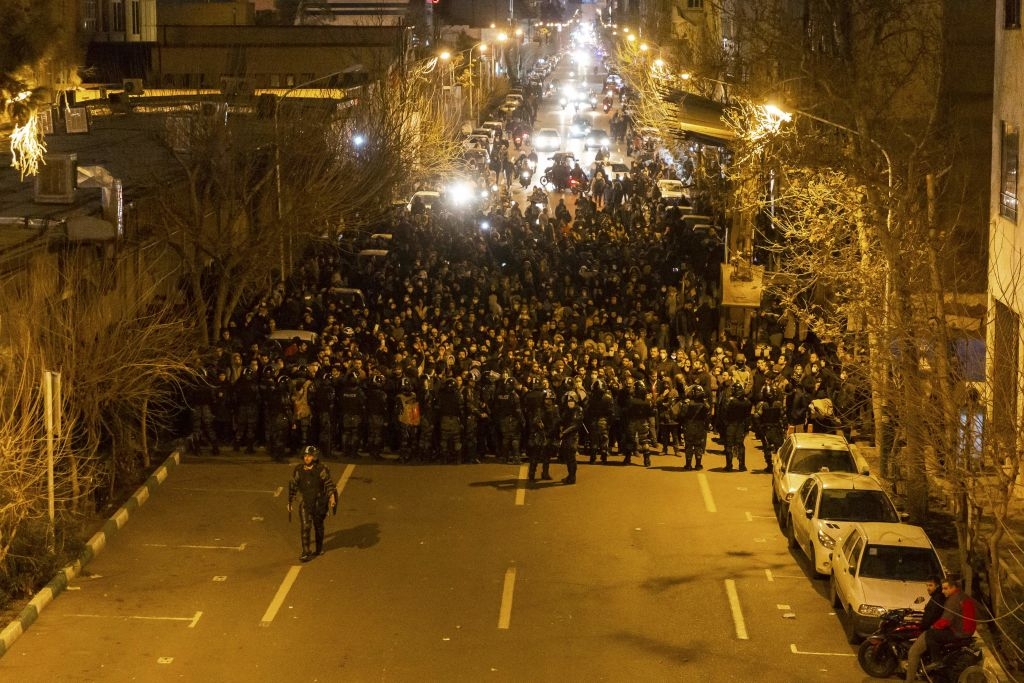
The latest protests in Iran are clearly focused on a demand for regime change, even by some former "reform-seekers". All this means that the regime's classical recipe for survival isn't working as before. Pictured: Riot police stand face off against anti-regime protesters in front of Amir Kabir University in Tehran, Iran on January 11, 2020. (Photo by STR/AFP via Getty Images)

No matter what gloss the ruling clerics might try to put on current events in Iran, one point is clear: their Islamic Republic is in trouble. Deep trouble.

This is, of course, not the first time that the system hastily put together by a bunch of mullahs and their leftist allies hits a bump on its road to nowhere. Even in its first year the Islamic Republic faced huge protest movements in Tehran and other major cities and had to use force to crush rebellions by Iranian-Kurdish and Turcoman communities.

According to best estimates, to remain in place the Islamic Republic has executed more than 15,000 people and driven more than 8 million Iranians into exile. And all that not to mention the eight-year war that the late Ayatollah Ruhollah Khomeini provoked with Iraq under Saddam Hussein. Despite all that the regime managed to survive, thanks to a number of factors.

The first of those was that the Islamic Republic had at its disposal a large amount of cash earned from oil exports. The steady rise in oil prices meant that in its first 30 years of existence, the Islamic Republic earned more than 20 times the money that Iran had made ever since it started exporting oil in 1908.

That ready source of cash meant that the new rulers of Iran did not need the citizenry for any of the ordinary things citizens in normal countries are needed for. The government did not depend on the people for revenue through taxation.

At the same time, it did not need citizens to win elections, as candidates were approved beforehand. Nor did the government need the citizens to work to keep the economy going. Over four million refugees from Afghanistan, Iraq and former Soviet Azerbaijan provided a huge source of cheap labor.

When it came to needing citizens to fight for the regime, citizens were again not indispensable as the regime succeeded in hiring mercenaries in a number of neighboring countries, notably Afghanistan, Iraq, Syria, Yemen and Lebanon.

It was that scheme of proxy wars that turned the late General Qassem Soleimani into a hero of the Islamic Republic. In fact, Soleimani did not need any military expertise. All he needed to do was to act as a cash machine for his proxy warriors.

Today, however, the oil cow is giving the mullahs much less milk than before. In fact, the regime's hope is to secure around USD $60 billion a year to cover its basic expenses. The existing war chest, built over the years, won't cover those basic expenses for more than a year from now.

The other important element in the regime's strategy was certainly that, whatever it did at home or abroad, its putative foes, preferring dialogue and compromise, would always shy away from taking strong action.

Tehran always knew that whatever it did against outside powers, it always had the option of surrendering at five minutes to midnight. Today, that option is also fading. I doubt that even the lily-livered Europeans would now settle for just a friendly smile and a promise of future good behavior from Tehran. President Hassan Rouhani and his "New York Boys" may still hope to see a Democrat in the White House soon. But even if that happens, I doubt that any future US president would repeat the mistakes made by President Barack Obama.

Even an opportunistic power such as Russia is no longer prepared to play the game according to the rules fixed by the mullahs. The mullahs' total disregard for international law and norms of behavior, tragically demonstrated with the shooting down of the Ukrainian jetliner in Tehran, makes it hard for even dyed-in-wool anti-Americans in the West and elsewhere to continue as apologists for an incompetent, corrupt and cruel regime.

The next item in the mullahs' scenario was to wrap themselves in patriotic colors and demand that Iranians forgive their peccadillos in the name of raw nationalism. Rouhani's closest associate Muhammad Javad Zarif, acting as foreign minister, often uses tropes such as, "Iran's 7,000-year civilization" and claims that "we were masters of the world long before Americans appeared on the map." However, that trick isn't working either. Most Iranians, including many regime apologists in the West, know that the regime's core ideology, Khomeinism, is built on a profound hatred of all things Iranian.

The mullahs' recent attempt at marketing Gen. Soleimani as an Iranian hero, a kind of nationalist icon, has proved a failure as posters lamenting his demise are torn down and/or effaced by protesters in the country.

Soleimani was a cash-dispensing machine that never asked Iranians for permission to spend their money abroad. The scheme he ran was never discussed anywhere, even in the regime's own institutions, let alone any public forum. Nor was he answerable to anyone but "Supreme Guide" Ali Khamenei who, if Soleimani's only press interview is believed, never bothered to go into any details.

Another feature of the regime's survival scenario was to foment false hopes by fielding supposedly "reformist" figures capable of replacing the regime's frown with a smile to please some Iranians and many gullible foreigners. Today, however, that trick is also hard to repeat, especially as more and more players in the "reform-seeking" game realize that they have been taken for a ride.

When everything else failed, the mullahs knew that they could hang onto power by mass killings and widespread arrests. Each time they used that trick they managed to buy a few more years. This time, however, may be different. The current wave of protests was launched just days after the crushing of the previous national uprising. The previous round of protests seemed divided between a demand for straight regime change or a demand for cosmetic moves, including the resignation of top officials.

The latest protests, however, are clearly focused on a demand for regime change, even by some former "reform-seekers". All this means that the regime's classical recipe for survival isn't working as before. For the first time, more and more Iranians are beginning to contemplate regime change not as merely a desirable slogan but as a practical strategy to lead the nation out of the impasse created by Khomeinism.
This article was originally published by Asharq al-Awsat

Amir Taheri was the executive editor-in-chief of the daily Kayhan in Iran from 1972 to 1979. He has worked at or written for innumerable publications, published eleven books, and has been a columnist for Asharq Al-Awsat since 1987. He is the Chairman of Gatestone Europe.

Source: https://www.gatestoneinstitute.org/15463/iran-old-recipe

Follow Middle East and Terrorism on Twitter