Sunday, October 18, 2020

Conservatives Must Fight Big Tech or Lose - Daniel Greenfield


​ by Daniel Greenfield

The problem isn’t simply radicalism. It’s power.


Long before, “In Soviet Russia, television watch you” became a staple of Cold War comedy routines, George Orwell’s 1984 novel had telescreens that broadcast propaganda and watched their citizens. Behind the satire is the core question of the struggle against Big Tech today.

Is technology going to be a tool of individual choice or social control?

Facebook and Twitter’s desperate attempts to block a damaging story about Joe and Hunter Biden is the culmination of four years of work to transform social media into the media. Under the guise of false claims about disinformation, foreign election interference, bots, networks, deepfakes, public health risks, and assorted tech paranoia, free speech died on the internet.

The moment when the White House Press Secretary had her account locked for tweeting a damaging news story about Joe Biden brought home the Big Tech reality to most Republicans.

Just like the media, Big Tech is the Democrat Party, and the Democrat Party is Big Tech. But, unlike the media, Big Tech controls the marketplace of ideas to an unprecedented degree.

Facebook controls 80% of social media and Google controls 80% of internet search traffic.

And that’s bad news because Democrats see the internet in the same terms as Xi, Putin, or your average dictator just about anywhere in the world, as a dangerous system spouting disinformation, damaging social ideas, and disruptive political rhetoric that must be controlled using a combination of economic and social pressures, along with government regulation.

Republicans and Democrats are both unhappy with the internet. Republicans are upset because there’s too much censorship and Democrats are upset because there isn’t enough censorship.

That Democrats, who once championed a free internet, now view it the same way all totalitarians do, speaks volumes not only about the death of liberalism but also about the transformation of the internet from a vox populi to a walled garden controlled by a handful of Big Tech monopolies whose cultural views and politics closely align with those of the Democrats.

‘Bigness’ has its own political and economic gravity. Big cities are more likely to have big governments and their inhabitants are more likely to vote for big government policies. They’re also more likely to use and generate the core companies and cultures that make up Big Tech.

The old political alignments based on questions of philosophy are being tossed aside and replaced with a new alignment based on the primevally simple questions of size and power.

The struggle is less defined by abstractions, than by the question of how much power you have.

In the Trump era, the more proximity to power you have, the more likely you are to be a Democrat, and the less proximity to power you have, the more likely you are to be a Republican.

The most striking thing about the Never Trumpers and the Rust Belt and Southern Democrats voting for Trump is how much power the former have and how little power the latter do.

Politics is being reduced to naked power.

Democrats shifted their stance on the internet because they gained control of core national institutions, in no small part through the growing fortunes pouring out of Silicon Valley which have tilted elections, financed political movements, and transformed public perspectives on social issues. And they are using their newfound power to do what the powerful always do, dismantle the safeguards of an open society so that there are no more threats to their power.

They’re doing this under the guise of fighting for equality and justice, and of waging a revolution for the oppressed, but so did most modern tyrants from Stalin to Hitler to Mao.

The Democrats are no longer interested in a free internet, for the same reason that they’ve tossed away free speech, the filibuster, or any institution or procedure that isn’t serving their interests this very minute. This isn’t due to a new progressive enlightenment, Republican obstinacy, grave new threats to democracy, or any of the other talking points they serve up.

The simple answer is that they won.

The Democrats of the 90s who welcomed an open internet were waging an uphill struggle against the open institutions of a generally conservative country. The country is now much less conservative, the institutions are much less open, and every major institutional force, from the biggest companies to the media, is unreservedly and uncritically backing them every step of the way, while suppressing any suggestion that they shouldn’t rule unopposed for all eternity.

All that’s left is collecting their winnings by shutting down the opposition.

Support for free speech is a matter of principle and practical politics. America was built on principle, but the Founding Fathers had a common-sense assessment of human nature. Free societies may be built on principles, but they survive through a balance of power. Every major faction must go on believing that it is in its interest to maintain free speech, checks and balances, and other protections against tyranny because it might end up needing them.

The Democrats have accumulated enough power that they no longer think that they need firewalls because if they play their cards right, the future, the right side of history, is their own.

That’s the fundamental development that explains the current crisis, not only of free speech, but of free elections, and a free country. The internet, like any society’s marketplace of ideas, is a symptom. Free countries have a robust marketplace of ideas. Unfree ones are obsessed with censoring speech and monitoring their citizens, all the while spinning paranoid fantasies about foreign interference, the threat of dangerous ideas, and the risk to political stability from speech.

Anyone who came out of a coma and spent an afternoon listening to CNN (owned by AT&T), reading the Washington Post (owned by the CEO of Amazon), and perusing the latest round of Democrat complaints about election interference and disinformation would know what we are.

The problem isn’t simply radicalism. It’s power.

Democrat radicalism isn’t being driven by the powerless, but by the powerful. That’s why Democrats with PhDs are more radical than those with a high school diploma. The problem of Big Tech can’t be separated from the problem of a political movement with too much power.

The culture of political censorship isn’t merely radical, it’s powerful. Cancel culture by college students or Big Tech censorship aren’t disparate phenomena, they’re the same phenomenon, often practiced on the same platforms by members of the same inbred ruling class.

America has been reconstructed to favor some classes at the expense of others. This new machine combining political institutions, activist groups, and corporations controls public life.

Conservatives can combat it or, like Soviet citizens, make jokes, and wait for it to collapse.

Big Tech is at the nexus of the political, economic, and cultural power of this new machine. That’s why breaking its power must be the objective of any winning conservative movement.

The massive monopolies control political discourse and as they tighten the noose around conservatives, political speech on the internet will consist of media narratives, a few tame conservatives, and little else. Imagine the high point of media dominance with no talk radio or cable conservative news. That’s the future. And it’s not going to arrive a year from now, it may already be here by Election Day. And if not, certainly when the next presidential election arrives.

But Big Tech also holds the key to the radical money machine. AOC and the Squad wouldn’t exist without a founding engineer from Stripe. The founder of eBay is responsible for everything from The Intercept to The Bulwark, the former is the media arm of the Sanders campaign and the latter of the Never Trumpers. The Washington Post was transformed from a fussy government paper into a den of furious radicals by the CEO of Amazon. Google money financed the Bernie Sanders campaign. Big Tech has poured a massive fortune into Black Lives Matter, from Steve Jobs’ widow, to Jeff Bezos’ ex-wife, to Jack Dorsey, the founder of Twitter.

And that’s the tip of the iceberg considering Facebook’s Chan-Zuckerberg Initiative.

The cultural power of Big Tech is even vaster. Google and Facebook determine what most people see on the internet. Amazon and Netflix are swallowing the entertainment industry. In a decade, a handful of vast, mostly, tech companies, Apple, Amazon, AT&T, Disney, Google, Netflix, and Verizon will control the culture far more than the old entertainment industry ever did.

By then it will be much too late to do anything except huddle in a few dark web outposts and mutter hate speech like the controversial words of the First Amendment.

If conservatives don’t fight Big Tech now, they will lose. And they will lose everything.

Big Tech’s power is growing exponentially, but it’s still vulnerable. The companies that will become immovable oligarchies in a decade can still be brought down and broken up. The internet and the marketplace of ideas can rise again from the ruins of those monopolies.

Now is the time. If we don’t fight Big Tech now, America has no future.


Daniel Greenfield, a Shillman Journalism Fellow at the Freedom Center, is an investigative journalist and writer focusing on the radical Left and Islamic terrorism.  

Source: https://www.frontpagemag.com/fpm/2020/10/conservatives-must-fight-big-tech-or-lose-daniel-greenfield/ 

Follow Middle East and Terrorism on Twitter

Anti-Trump Indoctrination Reported at California High School - Sara Dogan


​ by Sara Dogan

A "Friends Don't Let Friends Vote Republican" sticker was displayed in the classroom.


To learn more about the Freedom Center's campaign to halt indoctrination in K-12 schools, please visit stopk12indoctrination.org.  To read the K-12 Code of Ethics CLICK HERETo order the Freedom Center’s new pamphlet, “Leftist Indoctrination in Our K-12 Public Schools,” CLICK HERETo donate to the Stop K-12 Indoctrination campaign, CLICK HERE.

The Freedom Center’s Stopk12Indoctrination.org program was recently contacted by the mother of a student at Crescenta Valley High School who is deeply concerned about the leftist propaganda her daughter’s teachers are spewing in the virtual classroom. Crescenta Valley High is part of the Glendale Unified School District, which is located in the mostly-liberal Los Angeles area of California. The mother asked to remain anonymous to protect her daughter and family from possible retaliation.

The daughter is currently enrolled in a Government class where the teacher delivers near-daily rants complaining about how “stupid” President Trump is and how conservatives are destroying the world.

“You can tell that when she brought up anything that was happening she was blaming the conservative side…clearly very, very biased, calling the president ‘stupid’ and calling the him ‘Trump,’ you know she would never refer to him as ‘The President,’” described the student’s mother.

In a letter to the school’s administration, the mother described the many instances of indoctrination she has witnessed from this teacher in just the past few weeks. After the first presidential debate, for instance, the teacher “asked the students to create headlines about the previous night’s debate. Rather than acknowledging that both candidates sunk to a new low in the debate - there was name calling and childish behavior from both sides - she singled out student’s headlines that she happened to agree with and were critical of the President to praise and laugh at with the class. There was no attempt to hide her bias toward Trump.  She also accused Trump of pulling ‘illegal shenanigans’ and explained how he has an ‘evil but smart plan’ for winning the election.”

“If you need other examples of Mrs. [X]’s inappropriate behavior consider the following,” the mother’s letter continued. “When the topic of whether or not mail-in voting can be more susceptible to fraud than in-person voting, she denied there was ‘any evidence’ of this fact. While it may not be as wide spread as what the President was stating (yet), there certainly is evidence of voter fraud connected to mail in voting…”

“We strongly suggest you have a conversation with Mrs. [X] before we have a chance to speak reminding her that she is an ‘educator’ not a Democrat evangelist,” the mother concluded. “These are impressionable young minds and they have a right to hear both sides and decide for themselves what they believe in.”

Following the letter detailing the indoctrination, the mother received a phone call from the Vice Principal of her daughter’s high school. He claimed to have spoken with the teacher and promised to send out emails to all the faculty, reminding them of appropriate classroom conduct. The mother was hopeful that her daughter’s teacher would henceforth stick to the curriculum and cease the relentless indoctrination, but sadly that was not the case.

The mother made it a point to listen in on some of her daughter’s government classes and realized that nothing had changed. “I was like, wow, she’s still doing the same thing,” the mother told Stopk12Indoctrination.org. “I started really trying to listen and then I realized this is wrong… She’s not just talking about politics and what have you. She’s clearly making it try to seem like the conservatives are terrible people, ‘I can’t believe what they’ve done to our world’…..All I can hear is the teacher’s voice talking, talking, talking…she’s lecturing on and like brainwashing them.”

The mother then attempted to raise the issue on social media. While she received support from a number of other parents, many, she says, acted like she was a “liar” who was “out to get the teacher.”

Nor was this her daughter’s first brush with indoctrination at the school. The previous year, the daughter was taught by a male teacher who proudly displayed a sticker stating "Friends Don't Let Friends Vote Republican" in his classroom and called President Trump a “fascist pig” in his lectures.

The mother has a stepdaughter who also took a class with this teacher and is now so at odds with her father’s political views that she refuses to speak with him. “We’re not just separating people, we’re separating families over politics,” the mother said. “And I blame the school. Because the school is the one that made her believe it, that brainwashed her into it. She doesn’t even want to talk to her dad anymore over it.”

In researching the official school board policies of the Glendale Unified School District, StopK12Indoctrination.org discovered that the district has a policy specifically prohibiting the use of the classroom to promote controversial or partisan political views. GUSD Board Policy 6144 on “Controversial Issues” states that "In leading or guiding class discussions about issues that may be controversial, a teacher may not advocate his/her personal opinion or viewpoint." The policy further instructs teachers to provide “Adequate factual information…to help students objectively analyze and evaluate the issue and draw their own conclusions” and states that “Instruction shall be presented in a balanced manner, addressing all sides of the issue without bias or prejudice and without promoting any particular point of view.”

Despite the clear language of this official policy, it appears that school officials at Crescenta Valley High have done little to enforce it.

StopK12Indoctrination.org advised the mother to continue documenting instances of indoctrination in her daughter’s classes and to seek to form a coalition of like-minded parents to protest this blatant politicization of public education and violations of district policy.


Sara Dogan  

Source: https://www.frontpagemag.com/fpm/2020/10/anti-trump-indoctrination-reported-california-high-sara-dogan/ 

 Follow Middle East and Terrorism on Twitter

Is a Vote for Joe Biden in the Interest of American Jews? - Janet Levy


​ by Janet Levy


Biden’s record and current positions on Israel and Jewish issues portend a return to the disastrous policies of the Obama presidency.

A recent study conducted by the Jewish Electorate Institute found that 67% of American Jewish respondents planned to vote for Joe Biden and 30% for President Trump.  Eighty-eight percent of those surveyed claimed to be pro-Israel and 64% said Israel is an important election issue.  Most ranked Biden higher on U.S.-Israel relations, the handling of anti-Semitism, and ensuring the security of the Jewish community.  The survey results are surprising, given Trump’s stellar record on Jews and Israel.  American Jews must reconsider, for Biden’s record and positions on critical topics belie these perceptions.

Record on Israel

Biden’s record should dispel any notions he is staunchly pro-Israel.  In 1982, testifying before the Senate Foreign Relations committee as a Democratic senator from Delaware, he argued with Israeli Prime Minister Menachem Begin.  He threatened to cut aid to Israel if settlement expansion continued in Judea and Samaria, shouting and banging the table when Begin wouldn’t budge.

In 2010, Biden upbraided Israel for building apartments in a Jewish section of East Jerusalem and opposed Prime Minister Benjamin Netanyahu’s plan to extend sovereignty over Jewish communities in Judea and Samaria. 

In 2016, he pressured Ukraine, an abstainer, to vote for U.N. Security Council measure 2334, which identified the Jewish Quarter, the Temple Mount, and the Western Wall as located in “illegally occupied Palestinian territories,” an affirmation that defies historical fact.  UNSC 2334 also condemned Israel building settlements in the West Bank and East Jerusalem.  Approval of the resolution emboldened the Palestinian Authority to call for the ethnic cleansing of Jews from Judea, Samaria, and the Jewish Quarter, reversing decades of U.S. vetoes against such moves.  That year, the U.N. General assembly passed 20 resolutions against Israel.  There were only six against other countries.

Biden’s anti-Israel stance is further confirmed by how the Obama administration interfered in the 2015 Israeli elections and tried to get Netanyahu defeated.  Obama and Biden tried to rupture Netanyahu’s governing coalition and move it to the left.  That year, the Senate Permanent Subcommittee on Investigations found the State Department had granted $350,000 to OneVoice, a radical anti-Israel organization that supports Hamas and the boycott, divestment, and sanctions (BDS) movement.  The funds were issued for a political campaign known as V15 or Victory 2015, a political campaign that used voter contacts and State Department-funded activists to defeat the incumbent government.  The Obama-Biden administration also published never-before-released details of Israel’s nuclear program, heedless of its profound impact on Israel’s security and the balance of power in the region.

Presidential Platform

As a presidential candidate, Biden has pledged to reopen the Palestinian Liberation Organization (PLO) mission in Washington, rejoin the Iran nuclear deal, and reinstate Obama’s Middle East policy.  He spuriously claimed that Trump has “put Israel in danger” by dismantling the Obama-Biden administration’s Joint Comprehensive Plan of Action (JCPOA) and “undermined the stability of self-determination for the Palestinians.”  In fact, it was the JCPOA that removed sanctions against Iran, released $50 billion in frozen assets, provided $1.8 billion in cash, allowed it to develop nuclear-capable ballistic missiles and enabled the ayatollahs to sponsor terrorism and endanger regional security.  Clearly, Obama’s presidency saw a shifting of alliances away from Israel and Sunni Arab nations toward Iran and the Muslim Brotherhood as evidenced by noninterference in the Green Revolution and support for the “Arab Spring.”

Record on Anti-Semitism

Biden has publicly condemned anti-Semitism, but the Democratic National Convention featured several individuals, including Linda Sarsour, Tamika Mallory, Congressman James Clyburn, and Senator Corey Booker, who supported, praised, or defended Nation of Islam leader Louis Farrakhan.  Farrakhan has called Jews “termites” and “bloodsuckers,” praised Hitler as “a very great man,” blamed Jews for slavery, called them “deceivers” of the American people and even accused them of responsibility for 9/11.

In his acceptance speech, Biden said he could never be silent on anti-Semitism but raised no objections, as vice-president, to more than 60 White House visits by Al Sharpton, who incited anti-Jewish riots in New York City in the 1990s and was heard uttering, “Kill the Jews.”

At the convention, Biden failed to a) demand elimination of support for BDS; b) condemn the openly anti-Semitic members of “the squad” -- Representatives Ayanna Pressley (D-MA), Alexandria Ocasio-Cortez (D-NY), Rashida Tlaib (D-MI) and Ilhan Omar (D-MN);  and c) refuse to endorse anti-Semitic candidates for Congress.  He disavowed Linda Sarsour, removed from the Women’s March for her anti-Semitism, but later, his aides privately apologized to her.   

Endorsement by J Street

In April, Biden received endorsement from the George Soros-funded J Street, which opposes Israeli efforts to topple Hamas, and says Israeli settlements, not Palestinian terrorism, impede regional peace.  Biden is tied in gratitude to J Street for its support of the Iranian nuclear bomb deal.  This is the first time J Street -- disingenuously billed as “pro-Israel, pro-peace” -- has endorsed a presidential candidate.  Professor Alan Dershowitz of Harvard Law School, a liberal Democrat, has called J Street “the most damaging organization in American history against Israel... It has given cover to anti-Israel attitudes on campus and particularly its approach to Israels self-defense.”

Position on BLM Anti-Semitism

Tellingly, Biden has refused to acknowledge and condemn domestic terrorist groups such as the anti-Jewish, violent Black Lives Matter (BLM) movement. This May, BLM vandalized five synagogues and three Jewish schools and looted Jewish businesses to chants of “F—k the police and kill the Jews.”  BLM endorses BDS and calls Israel’s counterterrorist actions cruelty to Arab-Palestinians.  It accuses Israel of ethnic-cleansing, promotes the so-called “right of return” and makes false connections between Arab-Palestinians and American blacks’ struggles.

Unity Task Force

Recently, Biden joined a Unity Task Force with Bernie Sanders to craft an agenda that should worry Jews gravely.  Like Biden, Sanders pledges to reinstate the Iran nuclear deal and supports diverting to the Hamas-led Gaza government some of U.S. aid to Israel.  Sanders’ criticism of Israeli “occupation,” his sympathy for Palestinian refugees, and his campaign’s alliance with Dream Defenders, which promotes BDS and is linked to terrorist groups like the Popular Front for the Liberation of Palestine (PFLP), is well known.

Engagement with Radical Islamist Groups

Worst of all, Biden has appeased radical Islamist groups committed to shariah supremacy.  In July, he participated in a virtual conference by Emgage, which counterterrorism expert and former FBI supervisor John Guandolo calls “a Hamas-Muslim Brotherhood front organization deeply embedded in the Biden campaign.”  Emgage was founded by the Council of American-Islamic Relations (CAIR) leader Khurrum Wahid, defense attorney for convicted Palestinian jihadist Sami Al-Arian and Al Qaeda terrorist Ahmed Omar Abu Ali, who plotted to kill President George W. Bush. 

Biden’s thanking Emgage signals a partnership with the Muslim Brotherhood.  And while liberal Democrats rant about keeping Christian prayer and the Bible out of public schools, he said, “I wish we taught more in our schools about the Islamic faith.”

Pandering to Muslims, Biden promised to end an imaginary Muslim travel ban, factitiously referring to Trump’s January 2017 Executive Order barring tourism and immigration from seven countries the Obama administration had identified as vulnerable to terrorism.

Biden’s record and current positions on Israel and Jewish issues portend a return to the disastrous policies of the Obama presidency.  As a presidential candidate worthy of the Jewish vote, Biden pales against Trump, the most staunchly pro-Israel, pro-Jewish president in our nation’s history.


Janet Levy  

Source: https://www.americanthinker.com/articles/2020/10/is_a_vote_for_joe_biden_in_the_interest_of_american_jews.html 

 Follow Middle East and Terrorism on Twitter
Could Lebanon's first negotiations with Israel in decades lead to normalization? - Israel Kasnett , JNS and ILH Staff


​ by Israel Kasnett , JNS and ILH Staff

"It might be a first sign for peace that could maybe happen in the future," said Israeli Prime Minister Benjamin Netanyahu earlier this week. But he warned that "there will be no peace with Lebanon as long as Hezbollah is in control of it."


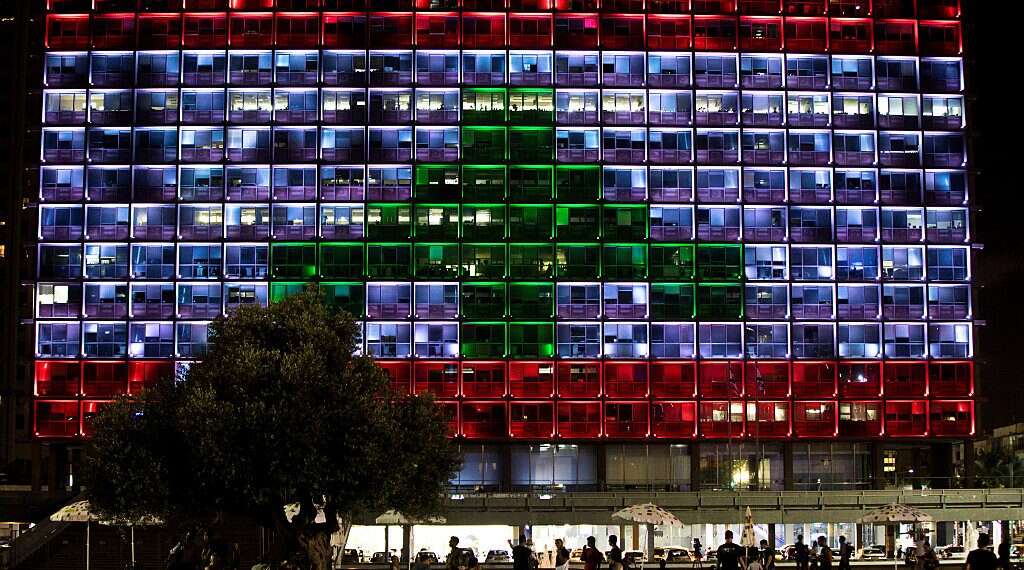
In show of support, Tel Aviv square lights up with colors of Lebanese flag

The Tel Aviv municipality building lit up with the Lebanese flag on Aug. 5, in solidarity with Lebanon in the wake of the devastating Aug. 4 explosions in Beirut | Photo: Reuters/Nir Elias

For the first time in three decades, Israel and Lebanon held the first of what is expected to be a series of negotiations over the next few months regarding the two countries' shared maritime border. Both countries, Lebanon in 2007 and Israel in 2010, delimited their respective exclusive economic zones (EEZ) in the eastern Mediterranean with Cyprus. But a 330-square-mile section of the Mediterranean Sea between Israel and Lebanon remains in dispute.

US officials mediated the negotiations, which took place at a base belonging to the U.N. Interim Force in Lebanon (UNIFIL) in the Lebanese town of Naqoura. Lebanese officials reportedly refused to speak directly with the Israeli representatives. The meeting lasted only an hour, but both sides agreed to meet again on Oct. 28. The question now is whether or not they can reach a compromise and whether these talks hint of the possibility for broader talks over normalization.

Alan Baker, director of the Institute for Contemporary Affairs at the Jerusalem Center for Public Affairs, said that the talks are significant since the disagreement has lasted for 10 years already, and every time Israel offered to sit and negotiate, Lebanon has refused.

Why all of a sudden has Lebanon relented to negotiating?

"It is connected to the Gulf states and the normalization of relations with Israel," said Baker. "The Lebanese have realized they have everything to benefit from coming to an agreement with Israel," especially when it comes to gas revenues, and possibly "some form of arrangement for cooperating with Israel for utilizing the resources of the sea."

"The Lebanese government would not be able to do this without getting a green light from Hezbollah," he added.

What is clear, according to Baker, is that Hezbollah is in dire financial straits, and if Lebanon benefits from this economically, then the terror group will as well.

'Hezbollah removed its veto over talks'

Israel and Lebanon have had a volatile relationship since both countries were established in the 1940s. While Lebanon did not formally take part in the succession of Arab-Israeli wars in 1948, 1967 and 1973, a more turbulent period of relations began between them during the Lebanese Civil War in the 1970s and '80s.

Israel has had warmer relations with Lebanon's Christian community, especially during the civil war, where it openly backed Christian leaders and occupied southern Lebanon as a buffer zone until 2000. However, as the balance of power in Lebanon has shifted in the ensuing decades towards its Shiite Muslim community dominated by Hezbollah, relations have become increasingly hostile with the two sides fighting a war in 2006. Hezbollah has continued to threaten Israel with cross-border raids with as many as 150,000 rockets and missiles pointed directly at the Jewish state.

Nevertheless, since the Aug. 4 multiple explosions in the capital city of Beirut that decimated buildings and led to nearly 200 civilian deaths, the world has increased scrutiny on Lebanon's government and internal corruption, in addition to Iranian influence through Hezbollah. As such, there may be a shift away from an overtly hostile approach to Israel.

Efraim Inbar, president of the Jerusalem Institute for Strategy and Security, also noted Hezbollah's relaxed stance regarding negotiations with Israel.

"It's clear that Hezbollah removed its veto over the talks," he said. "It tried to flex its muscles and prevent Israeli government officials from partaking in the talks, but it relented. This reflects its reluctance to be seen as not making a contribution to the rebuilding of Lebanon."

Inbar agreed with Baker that Hezbollah has an ulterior motive for the talks to succeed, as a deal would mean money ending up in its coffers.

Whether this will lead to a broader agreement akin to normalization by the United Arab Emirates and Bahrain, Baker remained skeptical.

"It's a beginning, and if it works out, it can lead to wider discussions on the land boundary, where the dispute is not so large, but there are points which need to be negotiated and agreed upon," he said.

"This, of course, depends on what the future government of Lebanon will look like," he added.

Speaking at the Knesset on Wednesday, Israeli Prime Minister Benjamin Netanyahu hinted at the possibility of broader negotiations when he called on the Lebanese government to continue and conclude talks with Israel regarding mutual maritime borders.

"It might be the first sign for peace that could maybe happen in the future," Netanyahu said. But he warned that "there will be no peace with Lebanon as long as Hezbollah is in control of it."

Inbar said he believes that it would be wrong to see the talks as an indication of expanding the normalization process. "It is a Lebanese development, and has to do with the economic and political crisis within Lebanon," he emphasized.

Inbar said he wouldn't read too deeply into the talks at this point: "I am a skeptic, and I am waiting. We will see what happens."

"In the Middle East, talks can go on forever," he forewarned. "And we shouldn't forget that even if we have an agreement, there is no assurance that it will be respected."

Reprinted with permission from JNS.org.


Israel Kasnett , JNS and ILH Staff  

Source: https://www.israelhayom.com/2020/10/18/could-lebanons-first-negotiations-with-israel-in-decades-lead-to-normalization/ 

Follow Middle East and Terrorism on Twitter
France: Death to Free Speech - Guy Millière


​ by Guy Millière


The French mainstream media, threatened with prosecution by their own government, have evidently decided no longer to invite on air anyone likely to make comments that could lead to convictions or complaints.

  • Paris, October 16. A history teacher who had shown his students cartoons of the Islamic Prophet Muhammad and had spoken with them about and freedom of speech was beheaded ....

  • [A different] attack shows that declaring oneself an "unaccompanied minor" in France can be sufficient not to be observed at all and all the same to receive full assistance from the government. The attack also suggests a disappointing grade for gratitude.

  • Any criticism of Islam in France can lead to legal action. The French mainstream media, threatened with prosecution by their own government, have evidently decided no longer to invite on air anyone likely to make comments that could lead to convictions or complaints. [The author Éric] Zemmour might still appear on television, but the increasingly heavy fines imposed on him are aimed at silencing him and potentially punishing stations that invite him.

  • "Strengthening the teaching of Arabic will simply help to nourish 'cultural replacement'". — Jean Messiha, senior civil servant and member of the National Rally party.

  • Commenting on a news report that stated, "The trial has sparked protests across France, with thousands of demonstrators rallying against Charlie Hebdo and the French government," the American attorney and commentator, John Hinderaker, wrote: "When thousands demonstrate against the prosecution of alleged murderers, you know you have a problem."

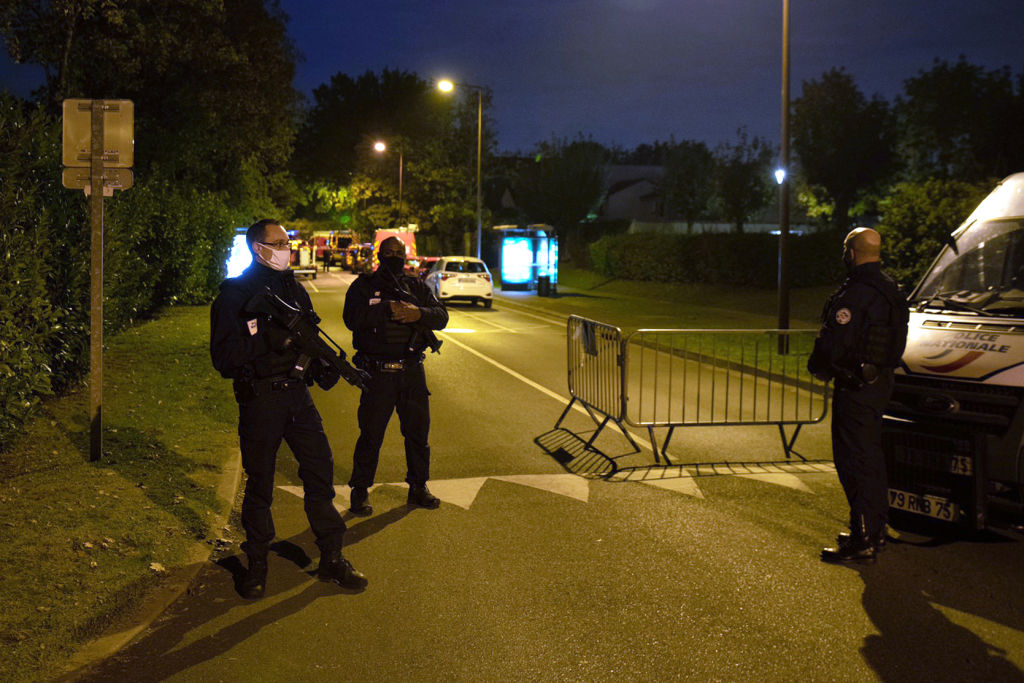
On October 16, a history teacher who had shown his students cartoons of the Islamic Prophet Muhammad was beheaded in a Paris suburb. The murderer, who tried to attack the police attempting to arrest him, was shot and killed while shouting "Allahu Akbar". Pictured: Police officers stand guard near the site where the teacher's murderer was killed. (Photo by Abdulmonam Eassa/AFP via Getty Images)

Paris, October 16. A history teacher who had shown his students cartoons of the Islamic Prophet Muhammad and had spoken with them about freedom of speech was beheaded in Conflans-Sainte-Honorine, a small town in the suburbs of Paris. The murderer, who tried to attack the police attempting to arrest him, was shot and killed while shouting "Allahu Akbar". According to the public prosecutor, he was a family member of one of the students. The facts are still unfolding....

A few weeks before that, on September 25, Zaheer Hassan Mehmood, a 25-year-old Pakistani man, attacked and seriously injured two people with a cleaver. When he tried to escape, he was arrested by police. He had entered France illegally in 2018, had appeared before a judge to ask for asylum and to benefit from the status of an "isolated minor". The information he gave the judge was false: he had said he was 18 years old. The judge accepted his request and refused any method of determining his real age. Since then, Mehmood has been financially supported by the French government. It gave him housing, training and a monthly allowance.

Just before the attack, Mehmood posted a video on a social network in which he tried to justify his act. He wanted, he said, to kill people working for the satirical magazine Charlie Hebdo because it had republished the cartoons that had triggered the murderous attack on the magazine in January 2015. He wanted, he said, to avenge the offense done to the Prophet Muhammad. He stated his allegiance to Ilyas Qadri, founder of Dawat-e-Islami, a Sufi movement that claims to condemn violence, even though its members have nevertheless murdered people they accused of blasphemy.

In September, Mehmood had gone to the magazine's old address. The people he injured were not working for Charlie Hebdo, which had long since moved, but for a documentary production company. They are now disfigured for the rest of their lives.

The attack sadly shows that criticizing Islam is still an extremely dangerous activity. Anyone even suspected of doing it can be injured or killed, anytime, anywhere. It also shows that one can decide to attack or become a murderer even if one does not belong to an organization defined as jihadist, or shown no signs of radicalization. The attack once again confirms the existence of what Daniel Pipes has called "sudden jihad syndrome".

The attack shows that, in addition, France, like other Western countries, is abysmally lax in guiding those who are arriving on its soil and asking for its help. A man can lie about his age and identity without their being detected and without tighter controls. The attack shows that declaring oneself an "isolated minor" in France can be sufficient not to be observed at all and still receive full assistance from the government. The attack also suggests a disappointing grade for gratitude.

Logic would require that a defense of freedom of expression be immediately and unanimously affirmed; that the government call for vigilance in the face of extremist danger, which seems to be persistent, and that more stringent controls on those who apply for asylum be set up. None of those improvements has taken place.

On September 23, two days before Mehmood's attack, an article purporting to defend freedom of speech was published in France by 90 newspapers. The article said that "women and men of our country have been murdered by fanatics, because of their opinions... we must join forces," it added, "to drive away fear and make our indestructible love of freedom triumph". The article seemed deliberately vague. It did not mention who the murderers were or what might have motivated them.

The day after the attack, several commentators counseled that in France, the love of freedom was not indestructible. They prescribed self-censorship and ventured -- unfortunately "blaming the victim" -- that those who had decided to republish the cartoons were the ones responsible for the attack. "When you repost cartoons", Anne Giudicelli, a journalist, said on television, "you play into the hands of these organizations. By not saying certain things, you reduce the risks."

"When you shock a person", TV host Cyril Hanouna ventured, "you have to stop. Charlie Hebdo drawings pour oil on the fire".

The persistence of Islamic danger was not mentioned, except by the journalist Éric Zemmour. Ironically, on the day of the attack, Zemmour was sentenced to a heavy fine (10,000 euros, nearly $12,000) for remarks on Islam in September 2019. He had said at the time that "Muslim foreign enclaves" exist in France. They do. At least 750 of them. He also noted that attacks in the name of Islam have not disappeared and seem likely to increase. The French justice system decided to regard these words as "incitement to hatred".

After the cleaver attack, no one requested tightening controls on asylum seekers, except, again, Zemmour. He said that "the uncontrolled presence of unaccompanied minors on the French territory is a very serious problem" and that "we must no longer welcome unaccompanied minors in France as long as drastic controls are not put in place". He recalled that many self-proclaimed unaccompanied minors lie about their age, commit crimes, and turn out to be "thieves and assassins".

His words immediately caused a massive scandal. Even though he did not say a single word about race or religion, dozens of complaints were lodged against him by "anti-racist associations", and the French Ministry of Justice robotically opened another investigation against him for "incitement to racial hatred" and "Islamophobic prejudice". He will most likely again be condemned by the courts.

Facts, however, prove Zemmour is right. The National Observatory of Delinquency and Penal Responses (ONDRP), an organization that analyzes crime in France, recently published reports noting that 60% of assaults, murders and violent robberies committed in France in 2019 were indeed committed by "unaccompanied minors". ONDPR published still another study, disclosing that, on average, 120 knife attacks per day occur in France and that those attacks are committed by "unaccompanied minors" or "refugees" coming from the Muslim world.

In addition, France's Directorate-General for Internal Security (DGSI) reported a few weeks ago, that, since January 2015, 59 Islamist attacks have been thwarted in France. Those, of course, not thwarted include the attack against Charlie Hebdo; the murders the same day in a kosher supermarket; a mass murder in the Bataclan Theater; the murder of Arnaud Beltrame, who took a bullet to shield others; the murders of Fr. Jacques Hamel; of schoolchildren and others in Toulouse, of elderly Jews in Paris, and of at least 84 people watching fireworks in Nice. These attacks were all committed by French Muslims or Muslims legally present in France.

French laws currently make it possible to prosecute just about anything regarded as "incitement to discrimination, hatred or violence against a person or a group of people because of their origin or their belonging to an ethnic group, a nation, a race or a religion." An openly Marxist organization of judges, the Judiciary Union (Syndicat de la magistrature), has steadily gained influence and uses applicable laws to suppress any criticism of either Islam or immigration. They work together with organizations such as SOS Racism, founded in 1984 by members to the left of the Socialist Party; the Movement against Racism and for Friendship between Peoples (MRAP), created in 1949 by members of the French Communist Party (the MRAP was initially called Movement Against Racism, anti-Semitism and for Peace, and removed "anti-Semitism and for Peace" from its name in 1989, when it devoted itself almost entirely to the fight "Islamophobic racism"); the Collective Against Islamophobia in France (CCIF), created in 2003 by members of the Union of Islamic Organizations of France (UOIF), the French branch of the Muslim Brotherhood, and Coordination Against Racism and Islamophobia (CRI), created in 2009.

Any criticism of Islam in France can lead to legal action. The French mainstream media, threatened with prosecution by their own government, have evidently decided no longer to invite on air anyone likely to make comments that could lead to convictions or complaints. Zemmour might still appear on television, but the increasingly heavy fines imposed on him are aimed at silencing him and potentially punishing stations that invite him.

No French political leader dares to say what he says, not even Marine Le Pen. She has been condemned several times by the French judicial system, and, as in the former Soviet Union, ordered to undergo a psychiatric evaluation for having shown the public what ISIS was doing to "disbelievers". She has evidently now decided to be "careful".

The French authorities continue to ignore most of the violent attacks committed in the name of Islam. When they occurred -- against a Jewish school in Toulouse in 2012, or against Charlie Hebdo and a kosher supermarket 2015, or at the Bataclan Theater in 2015, or by the truck-ramming in Nice in 2016 -- the country's leaders promised "firmness" but delivered nothing.

A week after the September 25 attack, French President Emmanuel Macron again delivered a speech that pledged "firmness". He denounced "Islamic separatism" and the "Islamic indoctrination" practiced by radical preachers. He said he would fight terrorism and "liberate French Islam from foreign influences" and that in French schools and universities, he would "strengthen the teaching of Islamic civilization" and "teaching the Arabic language". He said nothing that he has not said before. Seven months ago, on February 18, he gave almost the identical speech in Alsace.

Ibrahim Mounir, spokesman for the Muslim Brotherhood in Europe, nevertheless accused Macron of "hurting the feelings of more than two billion Muslims" and of "acting deliberately to incite Muslims to renounce their religion". He added: "The beliefs of the Muslim Brotherhood have always been able to overcome the mistakes of regimes using illegal and inhuman abuses to distort our religion". Manon Aubry, MEP from the leftist party Rebellious France, commented that "Macron obsessively wants to stigmatize Muslims".

Marine Le Pen, head of the National Rally Party, said that "Macron omitted certain subjects, probably deliberately: he said nothing on terrorism, and nothing on immigration". She added that "massive immigration is the breeding ground of communitarianism [empowering groups rather than individuals], which itself is the breeding ground of Islamist fundamentalism".

The journalist Celine Pina noted that Macron did not speak about the status of asylum seekers. "Once again," she wrote, "Macron refuses really to tackle the causes of the problems that the French suffer. The government fights terrorism by pretending not to see the link between the propaganda of political Islam and the proliferation of violent acts".

Columnist Ivan Rioufol wrote that "the measures Macron is advocating do not respond at all to the urgency of the threat."

Jean Messiha, a senior civil servant of Coptic Christian origin and member of the National Rally party, noted that "Islam does not seek to separate but to conquer". He added that "speaking of an Islam of France dissociated from Islam itself does not make any sense". As Turkish President Recep Tayyip Erdogan correctly noted, "There is no extremist Islam or moderate Islam; Islam is Islam and that's it".

Messiha also suggested that "strengthening the teaching of Islamic civilization is not a priority at a moment when so many young French people no longer know what French civilization is", and that "strengthening the teaching of Arabic will simply help to nourish 'cultural replacement'".

France is now the European country with the largest Muslim population (around six million, or nearly 10% of the total population); each year, moreover, thousand more people from the Muslim world arrive in France. Most of the Muslims living in France today reside in Muslim neighborhoods from which most non-Muslims have fled.

A 2016 study showed that 29% of Muslims living in France believe that Islamic law is superior to French law, and that they must first and foremost obey the laws of Islam. A recent study shows that four years later, the situation has only worsened. Now, 40% of Muslims living in France believe that Islamic law is superior to French law. Eighteen percent of French Muslims also apparently think that the deadly attack on Charlie Hebdo in 2015 was justified. Among Muslims between the ages of 18- 25, that number rises to 26%.

Studies show that if migratory flows continue at the current pace, France could become a Muslim-majority country within 30 to 40 years. Other European countries are moving in the same direction; their leaders are behaving no more courageously than French leaders are. Censorship against anti-Islamic statements is increasing rapidly across the continent.

Abdelaziz Chaambi, director of the group Coordination Against Racism and Islamophobia, recently said that "the data shows that France will be Muslim in a few decades... Islam is the second religion, the second community in France, and those who do not like Muslims have to leave France".

At the end of the speech that earned Zemmour his September 25 court sentence, he told the French, "You are right to be afraid".

A trial is now underway in Paris for those who attacked Charlie Hebdo and the kosher supermarket in 2015. The trial, however, is largely meaningless. All the terrorists are dead. The defendants are simply people who provided weapons or shelter to the terrorists. It is easy for them to say they did not know whom they were hosting or for what the weapons were intended. They have even said that they do not know anything about jihad.

Commenting on a news report that stated, "The trial has sparked protests across France, with thousands of demonstrators rallying against Charlie Hebdo and the French government," the American attorney and commentator, John Hinderaker, wrote: "When thousands demonstrate against the prosecution of alleged murderers, you know you have a problem."

On October 9, Macron announced that he had secured the release of a woman held hostage by a jihadist group in Mali. The release was obtained in exchange for a ransom of $12 million and the freeing of 200 jihadists ready to return to combat against the French military. The hostage, Sophie Petronin, a 75-year-old aid worker, said she converted to Islam, that her name is now Myriam, and that she wants to quickly go back to Mali to live among jihadists. She said she understands why the jihadists fight the French army. France is officially at war with the jihadists in Mali. Macron, it seems, has an oddball, idiosyncratic way of waging war.

This is not the first time that France has paid a ransom -- a practice many countries emphatically reject because it only invites more hostage-taking. Between 2008-2014, to free hostages, France has paid $58 million, more than any other country. Where does one sign up?


Dr. Guy Millière , a professor at the University of Paris, is the author of 27 books on France and Europe.

Source: https://www.gatestoneinstitute.org/16655/france-death-to-free-speech 

Follow Middle East and Terrorism on Twitter

A new blow to Iran's forgotten Jews - Dr. Rafael Medoff


​ by Dr. Rafael Medoff

Human rights group "3 Generations" should know better than to feature a journalist who denied oppression of Iran's Jews.


Torah scrolls inside Ezra Yagoub synagogue in Tehran

Torah scrolls inside Ezra Yagoub synagogue in Tehran
Courtesy of 7Dorim.com

Isn’t there something incongruous about a human rights organization providing a platform to a journalist who has whitewashed human rights abuses?

Next week, an online event organized by the human rights group “3 Generations” will feature New York Times op-ed columnist Roger Cohen, who sparked an international furor in 2009 when he visited Iran and announced that the oppressed Jews there were not really so oppressed, after all.

Cohen’s assertion that Iranian Jews were “living, working and worshiping in relative tranquility” was met with scorn across the political spectrum. Jeffrey Goldberg, in The Atlantic, called him “credulous.” The Anti-Defamation League charged Cohen with viewing Iran through “dangerous rose-colored lenses.” J.J. Goldberg, in The Forward, characterized Cohen as “simply naive, and dangerously so.”

In subsequent writings and remarks, Cohen not only doubled down on his denial of Iran’s antisemitic persecution, but also heaped praise on the ruling authorities for treating him “with such consistent warmth.” That prompted caustic comments recalling notorious instances in history which other dictators wined and dined gullible foreign journalists.

That year’s annual State Department report on international religious freedom presented a very different picture from the one Cohen had painted. Iran’s 25,000 Jews were the victims of “officially sanctioned discrimination, particularly in the areas of employment, education, and housing,” according to the 2009 report. The ruling regime “limited the distribution of Hebrew texts, particularly nonreligious texts, making it difficult to teach the language.” In addition, “There was a rise in officially sanctioned anti-Semitic propaganda involving official statements, media outlets, publications and books.”

Cohen tried—not very persuasively—to politicize the controversy. He claimed that allegations of Iranian Jewish suffering were conjured up by his political foes. “The hawks’ case against Iran depends on a vision of an apocalyptic regime” that is “frenziedly antisemitic,” Cohen asserted. Yet it was Barack Obama’s State Department that was portraying Iran as frenziedly antisemitic. It seemed Cohen was using Iran’s Jews to advance his own agenda—to soften Iran’s international image in order to encourage Western rapprochement with the ayatollahs.

The troubling phenomenon of political interests trumping human rights is something with which the leaders of “3 Generations” are all too familiar.

The group’s founder, Jane Wells, is the daughter of Sidney Bernstein, who was assigned by the British Ministry of Information in the spring of 1945 to make a film documenting the atrocities in Nazi death camps—until politics interfered.

Bernstein hired Alfred Hitchcock as his supervising director. They and their crew went into the liberated camps that spring and summer, filming the piles of unburied corpses, the emaciated survivors, and all the other horrific evidence of the Holocaust. Some of the footage was used in postwar trials of Nazi war criminals.

But just before the film was completed, the British authorities shelved it. His Majesty’s Government had decided upon a policy of “encouraging” and “stimulating” friendly relations with postwar Germany, Bernstein and Hitchcock were abruptly informed in September 1945. An “atrocity film” might make for bad feelings. According to some reports, the British were also concerned that the film might increase sympathy for creating a Jewish state in Palestine, something London was resisting.

It all came full circle sixty years later, when Ms. Wells, Bernstein’s daughter, met photojournalist Brian Steidle, who had just returned from Darfur. Steidle described how State Department officials had pressed him to stop circulating his photos of the genocide there; they feared Steidle was undermining U.S.-Sudanese relations. Moved by what she saw as the “overt parallels” between Steidle’s experience and her father’s, Wells produced an award-winning documentary about the Darfur slaughter, and established the “3 Generations” group to create and promote other human rights films.

The “3 Generations” website describes a number of worthy projects that the group has in the works, although there is no mention of any plan to document the plight of Iran’s Jews. That’s a pity, because according to the most recent State Department report on the subject, the persecution of Iranian Jewry continues unabated.

The 9,000-15,000 Jews remaining in Iran “face societal discrimination and harassment,” the report says. They cannot serve in the judiciary, the security services, or various other professions. They “may not engage in public religious expression.” Jewish schools must have Muslim principals, must remain open on the Jewish Sabbath, and must have their curricula and textbooks approved by the authorities. Iranian government officials “employ anti-Semitic rhetoric in official statements and to sanction it in media outlets, publications, and books,” “government-sponsored rallies continued to include chants of ‘Death to Israel,’” and “local newspapers carried editorial cartoons that were anti-Semitic.”

All of which makes the upcoming appearance by Roger Cohen at the “3 Generations” event more than a little ironic: An unrepentant denier of anti-Jewish persecution will be featured by an organization whose creation was inspired by the suppression of a film about anti-Jewish persecution.

One wonders what Sidney Bernstein would have thought about this turn of events.


Dr. Medoff is director of The David S. Wyman Institute for Holocaust Studies, in Washington DC, and author of more than 20 books about the Holocaust and Jewish history.

 Source: http://www.israelnationalnews.com/News/News.aspx/289224 

 Follow Middle East and Terrorism on Twitter
One War and Six Losers - Amir Taheri


​ by Amir Taheri


Israel may have to come off the fence and choose one side by losing the other.

  • If Azerbaijan wins, a coalition of Turkey, Israel and the United States would end up in the winning camp while the Islamic Republic will be seen as indifferent to the aspirations of Azerbaijan, which is supposed to be the third largest Shiite nation after Iran and Iraq. If Armenia wins, the likely co-winners would include Russia and Israel, again leaving Iran isolated.... If Armenia loses, Tehran will get a bad mark from Moscow as a fickle friend.

  • This war may produce only losers. Azerbaijan is unlikely to succeed in regaining full control of the disputed enclave. Armenia has already lost some territory and faces a wave of refugees flowing into the capital Yerevan. Turkey may win a propaganda round as protector of Azeris but would be dragged into a fifth war which, its economy already under stress, it may not be able to sustain. Israel may have to come off the fence and choose one side by losing the other. Russia would lose by seeing militants find a niche so close to itself while being forced to abandon its claim of peacemaker among former Soviet republics. Tehran, too, will be a loser on both geopolitical and ideological grounds. Khamenei claims to be the supreme leader of Muslims throughout the world. Yet, we now see that he cannot even influence events on his doorstep.

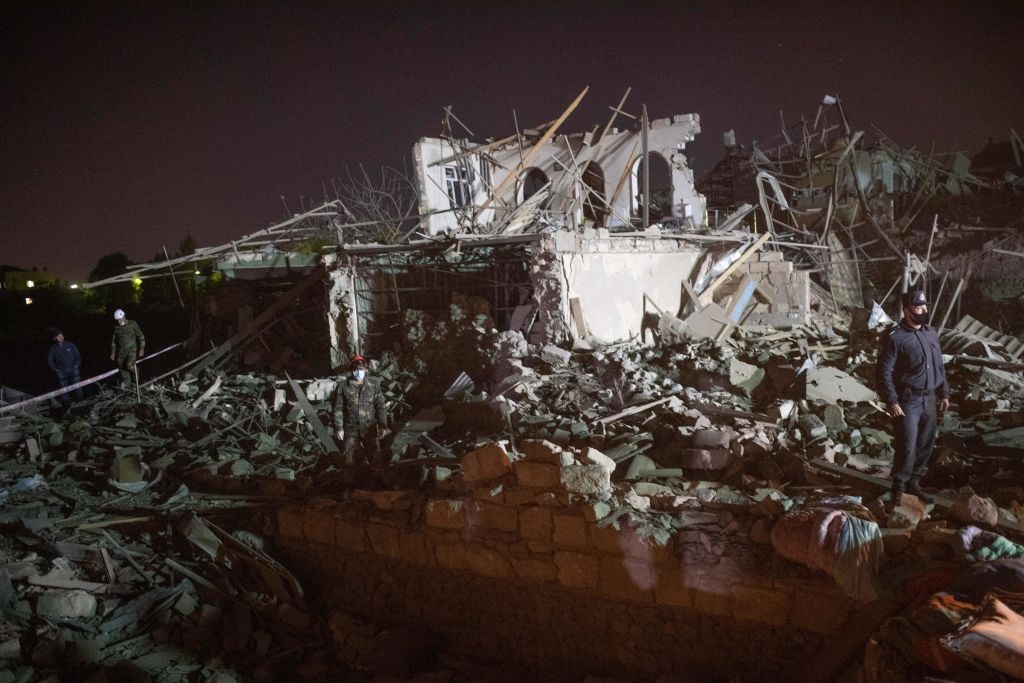
The war between Armenia and Azerbaijan may produce only losers. Pictured: Rescue teams work at a site hit by a missile in the city of Ganja, Azerbaijan on October 17, 2020. The missile strike levelled several homes in Ganja. (Photo by Bulent Kilic/AFP via Getty Images)

A small landlocked enclave tucked in a remote corner of Transcaucasia may be emerging as a powder keg that could threaten the security of several nations, among them Russia, Turkey, Iran and the two immediate protagonists Armenia and Azerbaijan.

High Qarabagh, Nagorno Karabakh in Russian, Artsakh in Armenian, Qarabagh Olya in Persian and Azeri covers an area of 4,400 square kilometres, less than half of Lebanon, with a population of 150,000 -- more than 90 percent of them ethnic Armenians. And, yet, in 1924 when Josef Stalin, then in charge of nationalities in the newly created Soviet Union, was carving the extinct tsarist empire into republics, High Qarabagh was attached to the autonomous republic of Azerbaijan, itself invented by Bolshevik chief out of territories known as Aran Shirvan and Nakhichevan.

If Stalin had gone by population, the enclave should have been attached to Armenia, another republic that he put on the map. However, Stalin's gerrymandering game didn't stop there. He put a chunk of his new Azerbaijan, known as Nakhichevan, at some distance from the rest of the republic with Armenia sandwiched in between. He went even further by dividing the Kurdish majority enclave of Lachin between Armenia and Azerbaijan while attaching Talesh, a non-Azeri coastal land to Azerbaijan. Stalin's divide-and-rule strategy, aimed at making the "captive nations" of the Bolshevik Empire dependent on Mother Russia for peace and security. He imposed a similar scheme in Central Asia by turning Uzbekistan, Turkmenistan, Tajikistan, Kyrgyzstan and Kazakhstan into patchworks of ethnicities.

When the Soviet Empire collapsed in 1991 it was inevitable that Stalin's geographical doodling would face questions. Seizing the opportunity, the Armenian population of High Qarabagh expelled the Azeri minority in what was to become a model for ethnic cleansing in other places, notably the Balkans. Backed by Armenia, the enclave's ethnic Armenians won a series of military victories and managed to set up their own autonomous republic. At the time, it was evident that the Artsakh rebels had received substantial aid from post-Soviet Russia. This was partly due to the fact that throughout Soviet history, ethnic Armenians, though fewer in number, played a much greater role than the Azeris.

The Soviet central leadership always included an Armenian at political and military levels; and some like Anastas Mikoyan reached the very top of the greasy pole. Even now, ethnic Armenians who decided to say in Russia proper have a high profile presence in the Moscow leadership, among them Foreign Minister Sergey Lavrov, whose real Armenian name is Serge Kalantarian.

In contrast, the ethnic Azeris who lived in Russia proper decided to return to their land en masse and were soon rewarded with new wealth generated by two decades of an oil boom. Throughout much of history, Armenians had regarded Russia, a fellow Christian nation, as their protector against Muslim neighbors, especially the Ottoman Empire. This was one reason why newly independent Armenia agreed to host a major Russian military base, which at its peak contained 20,000 Russian troops. In contrast, several Azeri leaders played the anti-Russian card by airing historical grievances against "the occupiers". The firebrand leader, Abulfazil Ilchibey, went even further by promoting a mass de-russification that included a change of alphabet and Russian-style family names. Independent Azerbaijan wanted to join the "Western World", casting itself as the United States' most reliable ally in the region. To emphasise that point, new Azerbaijan forged close relations with Israel to the point of promoting tight military cooperation, and talking of a Baku-Tel Aviv axis.

In the current round of fighting, Azerbaijan enjoys superiority in armament largely thanks to Israeli support. Nevertheless, Israel is anxious not to lose its other regional ally, Armenia. That ambiguity has enabled Turkey to cast itself as Azerbaijan's principal backer while depicting Russia and the Islamic Republic in Iran as Armenia's allies. The Khomeinist leadership in Tehran is especially confused about what line to take. The fighting looms as a security threat to Iran itself, even if only because of its overspill into Iranian territory.

In the past week of fighting, hundreds of shells fired by both sides have fallen into border areas in Iran. The fighting may also produce large numbers of refugees whose natural shelter would be Iranian territory. Tehran also faces pressure from powerful figures within the military and security services who regard Azerbaijanis as kith and kin. At the same time, "Supreme Guide" Ali Khamenei is anxious not to antagonise Russia, whom he now sees as his principal protector against the American "Great Satan." He has another worry: the introduction of hundreds of Syrian militants into the Azeri forces through Turkey. These fighters have little experience in warfare in the steep mountains of Transcaucasia, especially in the harsh climates of the winter. But, as committed militants of the Muslim Brotherhood, they could enable Turkey to create its own Hezbollah-like "foreign legion", challenging Iran elsewhere, including in Iraq and Lebanon.

Erdogan has tried to partly justify his backing for Azerbaijan by claiming that PKK fighters, supposedly coming from Soleymanieh in Iraq, via Iran, have joined Armenian forces in Qarabagh. He has also revived the theme of "Turkitude" (Turkishness) which he had only recently underplayed in favor of his claim to Islamic-ness as the foundation of Turkish identity. Erdogan's identity crisis was further highlighted by the national census held two years ago, when citizens were asked to cite their ethnic origins. The results had to be doctored because only a minority chose the label Turkish. The survey revealed most citizens remain attached to "mellat" identities they had during the Ottoman Empire, including Daghestani, Chechen, Alevite, Kurdish, Arab, Byzantine, Bulgarian, Udmurt, Circassian, Chechen and even Greek and Armenian. The surprise revelations forced Erdogan to try and fudge the identity issue by claiming Turks were descendants of ancient Hittites dating back to 3,000 years ago.

Tehran's reaction has been marked by confusion. It has refrained from taking a clear position while Khamenei was silent at the time of this writing. After a number of small demonstrations in Tabriz, capital of East Azerbaijan province, four Azeri mullahs identified as Khamenei's representatives issued a joint statement demanding that High Qarabagh be returned to Azerbaijan Republic.

Khamenei's foreign policy adviser Ali Akbar Velayati made a similar demand in carefully modulated tones not to anger Russia. The foreign ministry, however, tried to dodge the issue, not even calling in Armenia's ambassador for a routine dressing down.

Ignoring the crisis, Foreign Minister Mohammad Javad Zarif announced he was heading for Beijing in the hope of persuading the Chinese to release some of Iran's frozen assets.

The Qarabagh conflict could provoke uncontrollable reactions in Iran where an estimated 20 million Azeri-speakers spread all over the country regard the Azerbaijan Republic as part of greater Iran.

The slogans chanted in Tabriz and Tehran demonstrations included overtly irredentist ones such as "Qarabagh is ours, Azerbaijan is ours."

What are now Armenian and Azerbaijani republics, plus Georgia, were ceded to Iran in the treaties of Amassia (1550) and Qasr Shirin (1639) signed with Ottoman Empire. In exchange the Ottomans received Mesopotamia, today's Iraq, plus Abkhazia and Ajaria and the Armenian part of Anatolia.

If Azerbaijan wins, a coalition of Turkey, Israel and the United States would end up in the winning camp while the Islamic Republic will be seen as indifferent to the aspirations of Azerbaijan, which is supposed to be the third largest Shiite nation after Iran and Iraq. If Armenia wins, the likely co-winners would include Russia and Israel, again leaving Iran isolated. For the past 30 years, the Islamic Republic has been a lifeline to landlocked Armenia, channelling its foreign trade and providing it with electricity. If Armenia loses, Tehran will get a bad mark from Moscow as a fickle friend.

This war may produce only losers. Azerbaijan is unlikely to succeed in regaining full control of the disputed enclave. Armenia has already lost some territory and faces a wave of refugees flowing into the capital Yerevan. Turkey may win a propaganda round as protector of Azeris but would be dragged into a fifth war which, its economy already under stress, it may not be able to sustain. Israel may have to come off the fence and choose one side by losing the other. Russia would lose by seeing militants find a niche so close to itself while being forced to abandon its claim of peacemaker among former Soviet republics. Tehran, too, will be a loser on both geopolitical and ideological grounds. Khamenei claims to be the supreme leader of Muslims throughout the world. Yet, we now see that he cannot even influence events on his doorstep.

This article was originally published by Asharq al-Awsat


Amir Taheri was the executive editor-in-chief of the daily Kayhan in Iran from 1972 to 1979. He has worked at or written for innumerable publications, published eleven books, and has been a columnist for Asharq Al-Awsat since 1987.

Source: https://www.gatestoneinstitute.org/16653/one-war-six-losers 

Follow Middle East and Terrorism on Twitter