Sunday, April 18, 2021

Strategic Partnership Ltd. China-Iran Relations and their Significance for Israel - Assaf Orion


by Assaf Orion

China-Iran relations are the junction between an important economic partner of Israel and the most serious external threat to its national security. The strategic agreement between Beijing and Tehran signed recently continues their deep years-long relations, and reflects a low point in China-US relations. Beijing’s assistance to Iran to emerge from its isolation and rebuild its economy runs counter to Israel’s interests, while the military-technological and intelligence cooperation between them heightens the military threat to Israel and others in the Middle East and the Indo-Pacific. This trend demands adjustments in Israel’s policy, with an emphasis on more rigorous risk management and an updated dialogue with strategic partners
000_PA986_440_0

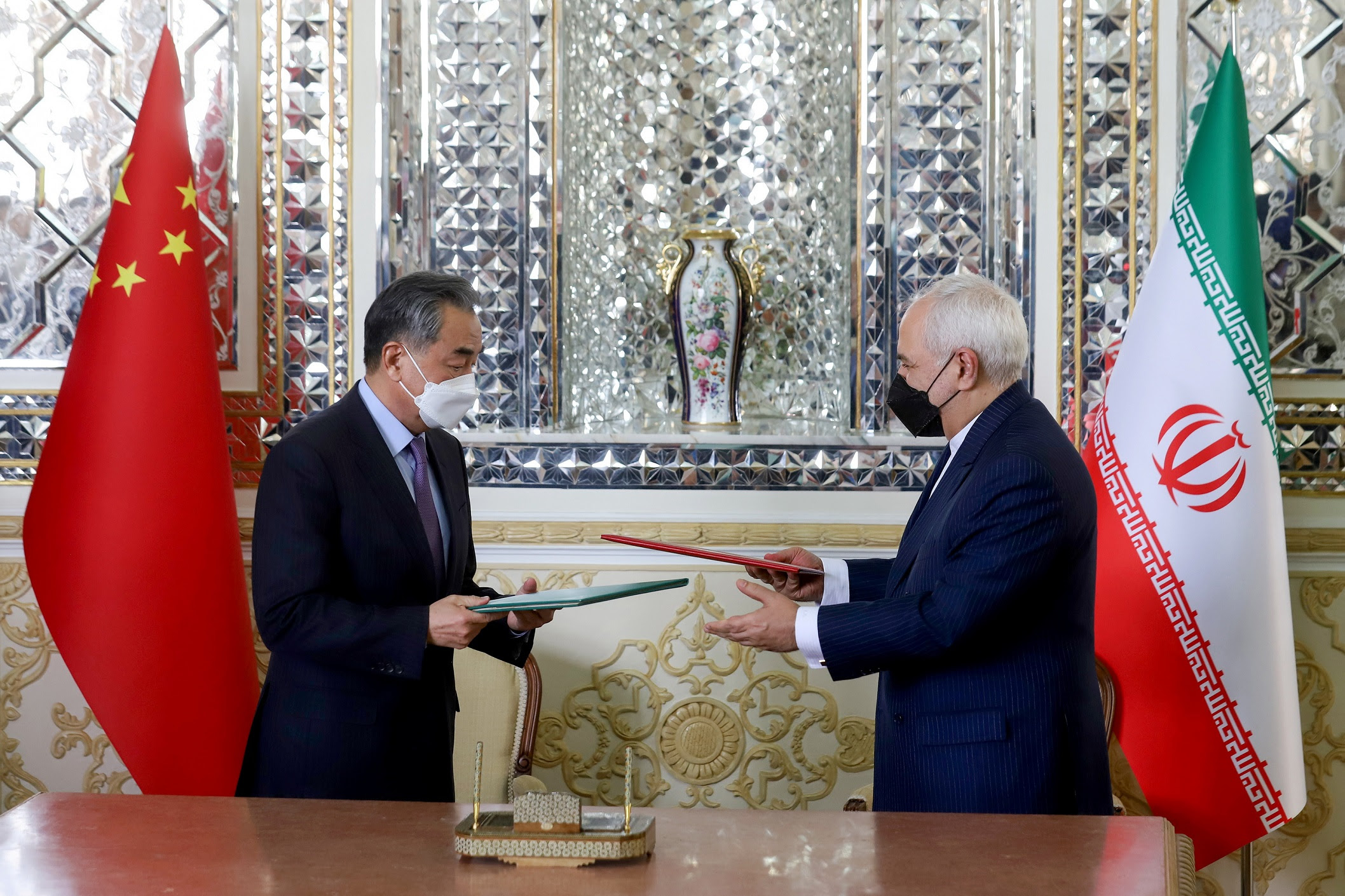
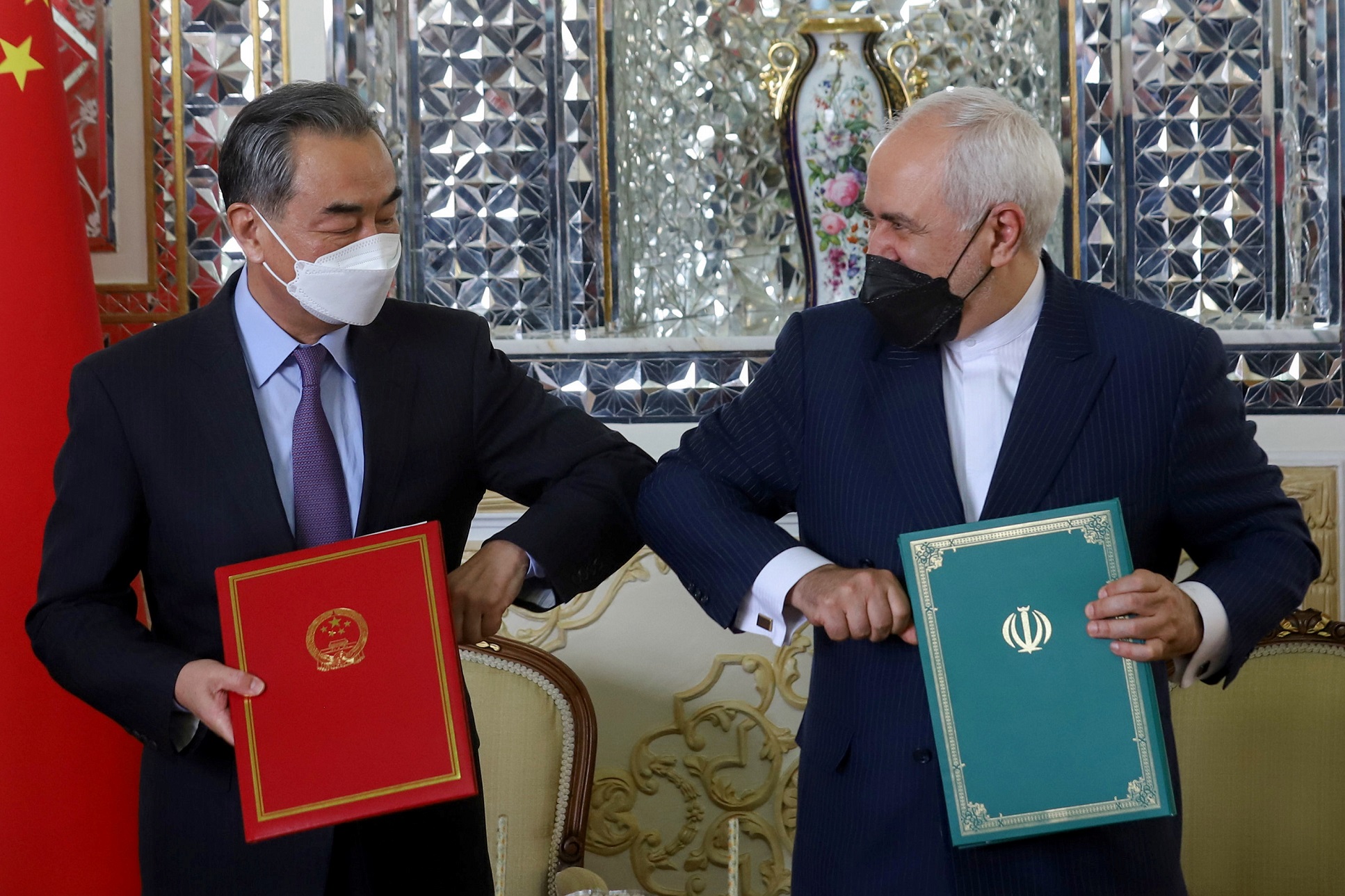
On March 27, 2021, China and Iran signed a strategic agreement focusing on large-scale investments by China in Iran in exchange for a supply of oil over the next 25 years. The very achievement of this agreement helps ease Iran’s economic isolation, imposed by the United States. At the same time, China-Iran relations are complex and tension-rich, and a far cry from an “all weather” solid alliance guaranteeing the Islamic Republic of Iran full strategic support from the People's Republic of China. Nonetheless, the developing China-Iran relations harbor negative trends for Israel's national security; they heighten tensions in Israel's own policy and require policy adjustments, more rigorous risk management in Israel's relations with China, and greater strategic cooperation with the United States and the Gulf countries.

On March 27, 2021, during a visit to Tehran by China’s foreign minister, China and Iran signed a strategic agreement focusing on large-scale investments by China in Iran in exchange for a supply of oil over the next 25 years.[1] The wording and details of the agreement have not yet been made public, but its very achievement helps ease Tehran’s economic isolation, imposed by the United States. To the extent that the signed agreement corresponds to the draft document leaked by Iran in July 2020, it includes agreement on progress in military, technological, and intelligence cooperation that is fraught with potential risks to Israel's security. Following the publication of the draft, the Trump administration stressed its demands of Israel to cool its relations with China and limit Chinese penetration of Israel's economy. US Special Representative for Iran Brian Hook reportedly said at the time, "China [cannot] have it both ways. They can’t strengthen Iran, which chants 'Death to Israel,' and have a business-as-usual relationship with Israel…I am sure Israel will do the right thing on China."[2] Concurrently, it was reported that in view of the growing competition by Chinese companies in the infrastructure sector in Israel at the expense of local companies, the Israel Builders Association demanded that government company NTA Metropolitan Mass Transit System invalidate the tender won by PCCC, a Chinese company, for construction of a bridge in Tel Aviv. The Builders Association asserted that PCCC's cooperation with Iran jeopardizes Israel's security and constitutes a breach of the law banning contact between an Israeli government corporation and a corporation maintaining business relations with Iran.[3]

Not surprisingly, however, the situation is more complicated than the messages and narratives that portray stark simplicity in the service of various interests. The overall picture is one of complexity and tensions, both in Iran-China relations and between different goals in their respective policies. The relations are thus a far cry from an “all weather” solid alliance guaranteeing the Islamic Republic of Iran full strategic support from the People's Republic of China. Yet the developing bilateral relations harbor negative trends for Israel's national security, heighten tensions in Israel's own policy, and require policy adjustments, more rigorous risk management in Israel's relations with China, and greater strategic cooperation with the United States and the Gulf countries.

Converging and Diverging Interests

China and Iran share a wide interest base: both seek to weaken the United States, decrease its role in the international order, and undermine its alliances. They both oppose external intervention in their affairs, and fear efforts seeking changes to their authoritarian regimes. The two countries suffered from the Trump administration's policy, and are looking forward to relief under the Biden administration. For Iran, China constitutes an important major power counterweight to the United States and an Eastern alternative to the West’s economy, especially under sanctions. For China, Iran is a useful energy supplier and a market of considerable size, and it occupies a central location on the road to Europe for the Belt and Road Initiative. No less importantly, Iran poses a strategic challenge to the United States in the Middle East – somewhat similar to the challenge posed to it by North Korea in East Asia.

At the same time, the two countries' interests do not overlap entirely, and there are quite a few tensions between elements of their policies. China, whose core interests are in East Asia, wants to drive the United States out of this immediate neighborhood; it benefits from America having been sucked into the Middle East and subsequently pinned down there, and its ensuing struggle to gravitate to the Indo-Pacific. For its part, Iran seeks an "imperialism and Zionism-free Middle East," i.e., with United States forces gone and with Israel destroyed. China, however, benefits from Israel's innovation, invests in Israel's economy, and certainly does not want its destruction. As an oil importer, China wants low energy prices, while Iran, as an exporter, prefers them high. China prefers stability in the Middle East that allows a safe environment for economic activity, while Iran is a systemic destabilizer across the region, igniting conflicts and fomenting unrest. Energy and navigation security are important interests for China, but in recent years Iran and its proxies have repeatedly attacked energy infrastructure, oil tankers, and other vessels in the Arabian peninsula, the Persian Gulf, the Arabian Sea, and the Red Sea. In the internal sphere, given the Muslim minorities in its population, China is somewhat perturbed about Sunni radicalism and terrorism and their infiltration to its territory, while Iran is maneuvering between fighting against ISIS and harboring al-Qaeda. These tensions reflect China's interest in principle in moderating Iran's regional aggression – a principle with positive potential should Beijing choose to exert its influence to that effect.

There are also internal tensions between elements in each country’s policy. While China wants to weaken the United States, it also relies on it as a security provider in the Middle East. China wants to protect its growing interests in the region, while at the same time it is concerned over entanglement there, and seeks to avoid the costs of inflexible commitments and direct involvement. On the other hand, while economic ties with China are essential for Iran, there is opposition in Iran to dependence on outside powers in general, and fear of excessive Chinese influence in particular, combined with dissatisfaction about the Iranian market being flooded with Chinese goods, at the expense of local producers and merchants.

RAND Corporation researchers Andrew Scobell and Alireza Nader described China in the Middle East as "an economic heavyweight, a diplomatic lightweight, and a military featherweight."[4] Recent studies conducted at the Institute for National Security Studies (INSS) in each of these areas highlight important insights for Israeli policy in the context of Chinese-Iranian relations.

In the economic sphere, China has contributed heavily to the Iranian economy, and particularly during the period of sanctions, thereby helping Iran to withstand the pressure of the sanctions and indirectly also increasing the resources available to Tehran for its destabilizing activities across the region. That said, China's economic relations with Tehran are smaller in scope than with Saudi Arabia and United Arab Emirates. Moreover, economic relations with Iran have shrunk over the past five years, in part to reduce China's exposure to sanctions, while relations with the Gulf states and Iraq expanded significantly. In addition, in part because of China's capital outflow control measures, the volume of China's trade with Iran and investments there declined. Simultaneously, Iranian dependence on China as a trade partner greatly increased, primarily as an importer of Iranian oil (as of 2019, China accounts for about a third of Iran's trade and half of its oil exports). At the same time, Iran's share of the energy supplied to China and in Chinese trade has sharply decreased as a result of a clear Chinese effort to diversify its sources and partners, but the sanctions have prevented Iran from such diversification. This trend reveals another source of tension between Iran's goal to have the sanctions against it lifted and to diversify its economic partners, and China, deriving major economic advantages from Iranian isolation under sanctions and minimal competition. Furthermore, as shown by China's relations with other countries, mostly in its nearer environment (Australia, Japan, South Korea, North Korea, and of course Taiwan), Beijing regularly leverages other countries' economic dependence for promoting its political goals. Iran's clear economic dependence on China, therefore, constitutes potential leverage for China to influence Iran, should it choose it use it.

In the political sphere, China and Iran signed a Comprehensive Strategic Partnership (CSP) agreement in 2016. This term describes China's relations with over 30 countries, among them Egypt, Saudi Arabia, Algeria, and United Arab Emirates. Parallel strategic partnerships with countries hostile to one another are a signature of China’s policy in the Middle East, as Beijing as a rule refrains from taking sides and involvement in conflicts, focusing instead on the promotion of its interests, mainly in the economic sphere. Israel and China signed an Innovative Comprehensive Partnership agreement in 2017. This singular title emphasizes the two countries’ sphere of shared interests, while avoiding a description of their relations as "strategic"; this is a definition that is mutually comfortable. China carefully maintains its advantageous position vis-à-vis Iran in the political sphere as well, with Iran having waited five years to sign the strategic agreement with China on the one hand, while still waiting for acceptance as a full member of the Shanghai Cooperation Organization (SCO) on the other.

No less complex is China's policy on the Iranian nuclear project. China provided technological and material assistance for the Iranian nuclear program until 1997, when it halted this aid in the framework of understandings with the United States on Taiwan. China thereby reduced its support of Iran in the service of two of its vital interests: its strategic relations with the United States and prevention of independence by Taiwan, which it regards as an integral part of one China and its sovereign right. Although it has since been reported that Chinese companies’ supplies aided Iran in its nuclear and missile development, the Chinese regime's part in these activities is unclear. Like Russia, China supported the UN Security Council resolutions on Iran's nuclear program, including those imposing sanctions on Iran, but at the same time diluted the resolutions and prevented their having “teeth” for viable enforcement. China also took part in formulating the 2015 nuclear agreement (JCPOA), and eventually signed it alongside the other major powers. Promoting this agreement postponed the risk of a military crisis, prevented a legitimate basis for external intervention in Iran (an important principle in Chinese foreign policy), and at the same time gave China an economic advantage in trade with Iran, under the shadow of the sanctions. As evident by the Biden administration's outreach to China in the framework of its efforts to renew negotiations on the Iranian nuclear program, China continues to be an important player in the talks with Iran, and its support is important for the success of these United States efforts. For Israel, it is important to realize that China is more concerned about military crises and external regime change attempts than about nuclear weapons in the hands of rogue countries like Iran and North Korea.

In the military-security sphere, there are growing indications of a trend, alarming for Israel, of increased military, technological, intelligence, and security cooperation between China and Iran. The transfer of Chinese military technology, which Iran is using to develop and produce weapon systems, some of which have already inflicted damage on Israel, is not a new threat: Chinese-manufactured cluster rockets were fired against Israel during the 2006 Second Lebanon War, and the Hezbollah missile that hit the Israeli naval vessel Hanit then was a variant of the Chinese C-802. Beyond this, however, since Chinese President Xi Jinping’s rise to power, there have been mounting public signs of increasingly close military cooperation between China and Iran: military exercises, port visits, and visits by senior naval, military, and defense figures. One salient area of these developing military relations is naval warfare, with a special emphasis on anti-ship missiles that threaten Israel in the Mediterranean Sea and the Red Sea, as well as the Gulf states and the United States navies in the Middle East and the Western Pacific. The strategic agreement between China and Iran, to the extent that the draft reflects the final version, outlines a zone of agreement on cooperation in intelligence, cyberwarfare, precision navigation systems, weapons research and development, and military training and instruction. As in other areas, the implications of the agreement will depend on its actual details and how they are implemented.[5]

Significance for Israel

The principal, prominent, and familiar tension in Israel's relations with China stems from the Israel-China-United States triangle, i.e., between China as an important economic partner of Israel and the United States as Israel's irreplaceable strategic ally. To the United States, China is its main rival in the great power competition and a grave threat to America's national security and global status. Israel and other United States partners are therefore required to restrict aspects of their relations with China and tighten their management of the risks incurred in those relations, including in economic spheres, and with a special emphasis on technology.


Chinese-Iranian relations add a complex challenge to Israel's policy by virtue of being the junction between a global power that is an important economic partner of Israel and a regional power that constitutes the principal and most serious external threat to it. China's relations with Iran are the convergence point of the number one threat to the United States and the number one threat to Israel. This suggests a significant area for extensive cooperation between Israel and the United States.

China’s Leverage on Iran: Will It Use It?

China is Iran’s economic and strategic prop, and serves as a counterweight to United States pressure and a means of evading the sanctions regime. Iran's dependence on China has increased greatly in recent years, and China's potential influence on Iran has grown accordingly. China also has an interest in principle in stabilizing the environment and reducing risks to its interests in the region, and thus in moderating Iran's aggression. The question therefore arises whether China will now be inclined to influence Iran to reduce the threats to its surrounding, including Israel.

Israel has conducted a prolonged and sensitive dialogue with Russia about the supply of arms to Israel's enemies, with partial success – despite the personal relationship between the two countries' leaders, the proximity of their militaries (since Russian forces deployed to Syria), and their deep mutual familiarity, thanks to the large portion of the Israeli public with roots in the Soviet Union. In contrast, Jerusalem's access to the leadership in Beijing is extremely limited, and Israel's relations with China are much narrower than with Russia. Consequently, Israel has little ability to influence China’s policy to moderate Iranian aggression and reduce Chinese aid for the development of Iran’s military threats. Nevertheless, Israel should voice its concerns to China about Iran's threats, both nuclear and conventional, and about China's contribution to the aggravation of these threats.

At the great power level, coordination with China is important for the United States in its effort to reach agreements with Iran and on other global issues, such as climate change and the COVID-19 pandemic. In the 1990s, China demonstrated its willingness to halt its nuclear assistance to Iran, putting its core interests in Taiwan and its relations with the United States first. Israel's influence on Chinese policy in the region therefore depends to a large extent on its success in integrating its goals with those of Washington, the main player in this context. Israel must also keep in mind the gaps between its positions and those of each of the major powers, and the extent and intensity of their other interests, while realizing that it may be called on to provide a quid pro quo in other areas for this assistance.

Regionally, Iran is not China's most important partner in the Middle East. Data on China's economic and energy relations show that the Gulf states are more important, especially Saudi Arabia and United Arab Emirates. The visits by Chinese leaders to the region also serve a broad and general perception of the web of Chinese interests there. President Xi Jinping visited Iran, Egypt, and Saudi Arabia in early 2016, while the stopping places on his foreign minister's visit in late March 2021 were Saudi Arabia, Turkey, Iran, United Arab Emirates, Bahrain, and Oman.[6] Following the signing of the Abraham Accords, which highlighted the shared interests between Israel and the Gulf states and their perception of Iran as a common threat, Israel should coordinate its policy on the matter with them too, and with them strive to exert a positive influence the policies of both Washington and Beijing, even though prospects for success in this endeavor are rather modest.

Iran Jeopardizes China's Interests: Will China Moderate Iran?

Beyond China's policy on the nuclear issue, important lessons for Israel emerge from Beijing’s reaction to the attacks initiated by Iran in the Gulf during 2019 against both oil tankers and oil infrastructure in Saudi Arabia. In these events, China confined itself to calling on all parties to exercise restraint, and refrained from putting public pressure on Iran. The same approach seems to reflect China’s stance following the reported maritime attack exchange between Israel and Iran. Nevertheless, in April 2020 it was reported that the Iranian Revolutionary Guards had seized a tanker in the Persian Gulf, but quickly released it when it turned out to be Chinese.[7] Presumably, China reached tacit understandings with Iran that its ships would not be harmed, but these understandings did not extend to tankers of other countries, or to the energy infrastructure of the Gulf countries with which China also signed Comprehensive Strategic Partnership agreements. It is therefore likely that as an expression of its policy of avoiding taking sides in regional conflicts, China will make no real effort to restrain Iran when it attacks Israel directly or uses Hezbollah and its other proxies. Consequently, despite the risk to China's economic interests in Israel, it can be expected to confine itself to public calls for restraint on both sides. It should therefore not be expected that operation of the Haifa Bay shipping containers pier by Chinese company SIPG in 2021 will deter Hezbollah and Iran from attacking Haifa Port or the city of Haifa, should they decide to do so. On the other hand, Israel should take into account that China opposes Israel's military action against the Iranian nuclear program, and may try to deter such action using the range of tools available to it.


Assaf Orion

Source: https://www.inss.org.il/publication/iran-china-cooporation/

Follow Middle East and Terrorism on Twitter

Israeli officials decry 'complete American capitulation' in nuclear talks with Iran - Ariel Kahana , Shahar Klaiman and Neta Bar


by Ariel Kahana , Shahar Klaiman and Neta Bar

According to information received by Israel, the six world powers will not require Iran to destroy the new advanced centrifuges it has built, rather just disconnect them.


Israeli officials decry 'complete American capitulation' in nuclear talks with Iran
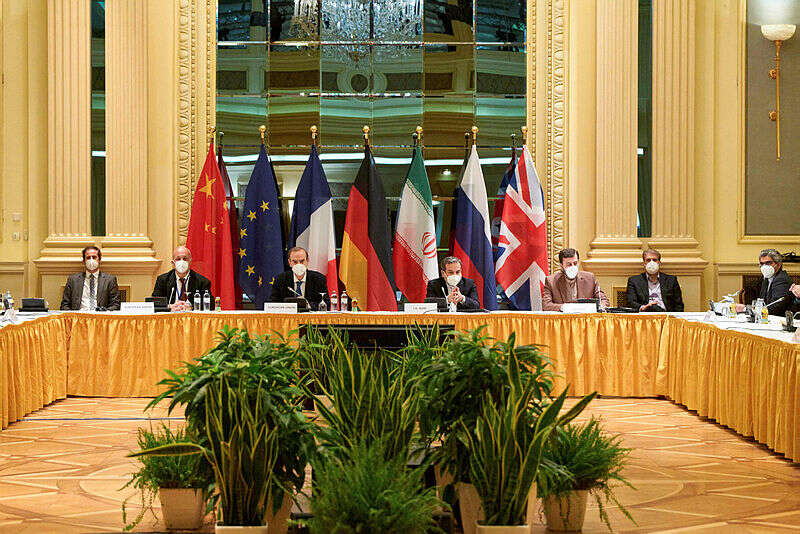
Delegation members from the parties to the Iran nuclear deal attend a meeting at the Grand Hotel of Vienna, Saturday April 17, 2021 | Photo: Handout/EU Delegation in Vienna/AFP

Unnamed Israeli diplomats over the weekend unofficially expressed disappointment over what they called "complete American capitulation" in nuclear talks with Iran in Vienna. Learning the lessons from the Obama administration's clashes with Israel in 2015, the Biden administration is trying to avoid any surprises and is keeping Israel abreast of developments. With that, the two allies remain at considerable odds over Iran and its nuclear ambitions.


According to information received by Israel, the six world powers – the United States, China, Russia, Great Britain, France and Germany – and Iran are indeed close to signing an agreement stipulating that the sides are returning to the original nuclear deal from 2015, from which former US President Donald Trump withdrew in 2018. However, Iran will not be required to destroy the new advanced centrifuges it has built, rather just disconnect them.

The world powers are also expected to ignore other violations that are difficult to reverse from a technical standpoint. The Americans have also accepted in principle Iran's demand for compensation over the economic damage caused by the Trump administration's decision to withdraw from the deal.

A compensation mechanism still doesn't exist and will likely be indirect once established. However, the fundamental decision to restore the nuclear deal has already been made.

In Israel, officials have fallen in step in terms of the dangers posed by Iran and not coming to terms with a nuclear Islamic republic. Foreign Minister Gabi Ashkenazi said on Friday at a meeting in Cyprus with his Greek, UAE and Cypriot counterparts that "Iran and its proxies are fomenting instability in Syria, Lebanon, Iraq and Yemen."

He continued: "Iran wants to acquire nuclear weapons and continues to develop long-range missiles. These will represent a significant threat to Israel and its neighbors. Israel is determined to defend itself from any attempt to infringe on its sovereignty and harm its citizens. We will do everything it takes to prevent the fanatical and antisemitic regime from acquiring nuclear weapons."

Other Israeli diplomats said the American promise of reaching "a stronger and more long-term nuclear deal" in the future is not feasible.

"Maybe the Americans want to believe they will get a better deal down the road," one of the Israeli officials said, "but the moment they return to the original agreement they lose all leverage with Iran, which has no interest whatsoever in altering it. This promise is either a lie or pretending to be naive."

Intelligence Services Minister Eli Cohen addressed the efforts to revive the nuclear deal, calling them "detached from every intelligence assessment and past experience, based on Iran's systematic deception and lies while striving to acquire a nuclear weapon. Particularly galling is that the countries pursuing the nuclear deal are ignoring Iran's widespread funding of terrorist organizations in several countries in the Middle East, about which can only be said that those who lie down with dogs shouldn't be surprised when they get up with fleas. Israel will remain committed to preventing Iran from acquiring nuclear weapons in every possible way."

The diplomatic-security cabinet, meanwhile, was expected to convene on Sunday amid Iran's announcement that it has begun enriching uranium up to 60% purity in response – three times higher than ever before, though in small quantities.

On Friday, meanwhile, Channel 12 News reported that the Biden administration has demanded that Israel cut down on the "chatter" concerning the alleged attacks against Iran's nuclear facilities.

The unsourced report described the US message as "resolute," using a Hebrew word that can also mean "aggressive," and said that it was relayed through "multiple channels."

The leaks by Israeli officials concerning sabotage operations against Tehran's nuclear program undermine the US effort to revive the nuclear deal, and "embarrass" American diplomats, US officials told their Israeli counterparts, according to the report.

While the extent of the damage from the April 11 sabotage remains unclear, it comes as Iran tries to negotiate with world powers over its tattered nuclear deal.

In Vienna, Iran's negotiator told his country's state TV that the nuclear talks had entered a new phase, adding that Iran had proposed draft agreements that could be a basis for negotiation.

"We think that the talks have reached a stage where parties are able to begin to work on a joint draft," Abbas Araghchi said. "It seems that a new understanding is taking shape, and now there is agreement over final goals."

Enrique Mora, the European Union official who chaired the talks, tweeted that "progress has been made in a far from an easy task. We need now more detailed work."

US President Joe Biden said on Friday that Iran's plan to enrich uranium to 60% was not helpful.

"We do not support and do not think it's at all helpful that Iran is saying it's going to move to enrich to 60%," Biden told reporters in Washington during a joint news conference with Japanese Prime Minister Yoshihide Suga.

"We are, though, nonetheless pleased that Iran has continued to agree to engage in discussions – indirect discussions – with us and with our partners on how we move forward and what is needed to allow us to move back into the [nuclear deal] ... without us making concessions that we are just not willing to make," Biden added.

Erez Lin contributed to this report.


Ariel Kahana , Shahar Klaiman and Neta Bar 

Source: https://www.israelhayom.com/2021/04/18/israeli-officials-decry-complete-american-capitulation-in-nuclear-talks-with-iran/

Follow Middle East and Terrorism on Twitter

The American-Iranian dialogue: No surprises - Dr. Salem Al Ketbi


by Dr. Salem Al Ketbi

The Biden administration’s steps are proceeding as if they were drawn up by the mullahs, who found themselves facing the scenario of their dreams.


 Joe Biden

I do not think that any of the observers or those interested in the Iranian nuclear file crisis was surprised by the (indirect) Iranian-American dialogue that took place in Vienna recently, as sitting at the negotiating table was a priority goal for both the Iranian mullahs and the Biden administration since the 20th of last January. And what happened since then in terms of tension, escalation, and de-escalation were only preludes to strengthening the negotiating position of each party before the negotiation.

There are several things that these negotiations confirm, including that US President Joe Biden is still imbued with the legacy of his previous experience as former Vice President of Barack Obama for eight years, and he still believes in the disastrous agreement concluded by that administration, and that it represents a basis for American relations with the mullahs' regime. That said, it is not expected that Biden would seek to build a new strategic approach to counter the Iranian nuclear threat.

The hard-to-deny fact is that the mullahs succeeded in “taming” the new American administration early, as well as isolating it from its traditional allies in the Middle East through a deliberate series of measures that violate Iran's obligations contained in the nuclear deal. They did not provide any opportunity for the American president to think and discuss the matter with these allies, and he was content with confining himself to the point of returning to the nuclear agreement, despite all the loopholes of the agreement, although this return will not cause any progress nor will it delay the cessation of Iranian threats.

Rather, this return has turned into a “goal” that Washington pursues, without thinking of subsequent stages because the mullahs ’strategy is based on gaining time in ensuring that the rest of the signatories to the agreement are certain of turning the page on violations and on the mullahs’ commitment to their obligations contained in the nuclear agreement. This, however, is an issue that may take a long time, perhaps approaching the first half of President Biden’s term!

There is another matter: the new US administration “rushing” to have the mullahs’ return to the nuclear agreement at any cost. Some US officials were even indicating the possibility of adopting steps that were not in complete agreement with President Biden’s announcement when he took office, of his intention to restore the prestige of the United States and its global influence.

“America is back” certainly did not mean that the only superpower in the world returned to make more concessions to the mullahs of Iran! This partially explains the tendency of the negotiating balance of power to the mullahs' advantage, and this was reflected in their initiative to say that their representatives in Vienna would not meet with the American delegation face to face unless the United States retreated from its withdrawal from the agreement first, and the mullahs considered that the United States had no role in the talks until it came back formally to the agreement.

In fact, I do not find a big difference between yesterday and today, and what is happening in Vienna is not very different from the beginnings of the negotiations that ended with the signing of the “Joint Action Plan” in 2015, as representatives of Britain, France and Germany are moving between the hotels of the Iranian and American delegations, to bring the destinations closer in those meetings that Russian and Chinese diplomats also attend!

The Russian ambassador to international organizations in Vienna, Mikael Ulyanov, described the preparatory talks as “successful,” and confirmed the formation of two committees of experts to discuss “moving forward” measures. The US State Department stated that the work of the expert committees continues to discuss “technical issues” in the areas of lifting US sanctions imposed on Iran and the nuclear steps that the latter may take to revive the agreement.

All the speakers agreed that the talks are “difficult” and that the return to the agreement will not happen in a short period, which is expected given the mullahs' keenness to extract the strategic gains they aspire to and exploit the American administration’s eagerness in trying to achieve a breakthrough in any of the complex foreign policy files.

The US special envoy to Iran, Robert Malley, said before the start of the Vienna talks that the United States knows that it must “lift the sanctions that are not commensurate with the agreement concluded with Iran.” When the Iranian government spokesman, Ali Rabiei, was asked about these statements, he said, “the position is realistic and promising.” He added, “We ​​are confident that we are on the right path,” and that seems to be true.

The Biden administration’s steps are proceeding as if they were drawn up by the mullahs, who found themselves facing the scenario of their dreams. There is no using the results of the severe sanctions imposed by the previous US administration on Iran, and there is no desire for using a strategy based on “the carrot and the stick” approach, but rather a return to the strategy of 2015, and building upon it again as if what happened during the past four years has not happened!

I will not jump to the expected results of these talks. Introductions - usually - provide a rough conception of the results, which are almost known, and it is certain that the current US administration’s use of the old negotiation strategy and its revival will not provide the United States with what the Obama administration failed to obtain in 2015. It is more likely that time will pass and matters end up reproducing the old, failed agreement in a new guise.


Dr. Salem AlKetbi is a UAE political analyst and former UAE Federal National Council candidate. 
   

Source: https://www.israelnationalnews.com/News/News.aspx/304249

Follow Middle East and Terrorism on Twitter

Posturing is No Policy on Iran - Amir Taheri


by Amir Taheri

What is Iran actually up to?

  • A nuclear armed Islamic Republic might be no more than a nuisance for the US, as is North Korea for example, while it would be an existential threat to Israel.

  • But what if the whole nuclear issue, built by former President Barack Obama as the core of the "Iran problem", is a diversion designed to put real or imaginary foes on a wrong trajectory?

  • So, is Iran enriching uranium to build a bomb?

  • He [Obama] cited a "fatwa" by "Supreme Guide" Ali Khamenei that forbids Muslims from building the bomb. (Needless to say possibly apart from Obama no one has seen the fatwa.)

  • What if what many see as the Islamic Republic's nuclear policy is a posture... not a policy? That posture serves the Khomeinist regime's interests by shifting the focus away from the real mischief and crimes it has been committing inside and outside Iran for four decades.

  • Its "exporting revolution" has already contributed to triggering and prolonging the war in Yemen. Without its involvement, the Syrian civil war may not have led to what is the greatest tragedy the world has seen in the new century. By creating Hezbollah, the mullahs have led Lebanon to the brink of ungovernability, not to say systemic collapse. By supporting the most radical rejectionist groups, the mullahs have also helped block the road to an Israeli-Palestinian coexistence accord.

  • To forget all that, not to mention the seizing of scores of hostages and the killing of hundreds of US, British and French soldiers with roadside bombs and terror attacks in Lebanon, Iraq and Afghanistan, and over 100 terror operations in 22 countries across the globe, would be the height of naiveté and a sure sign of moral decadence.


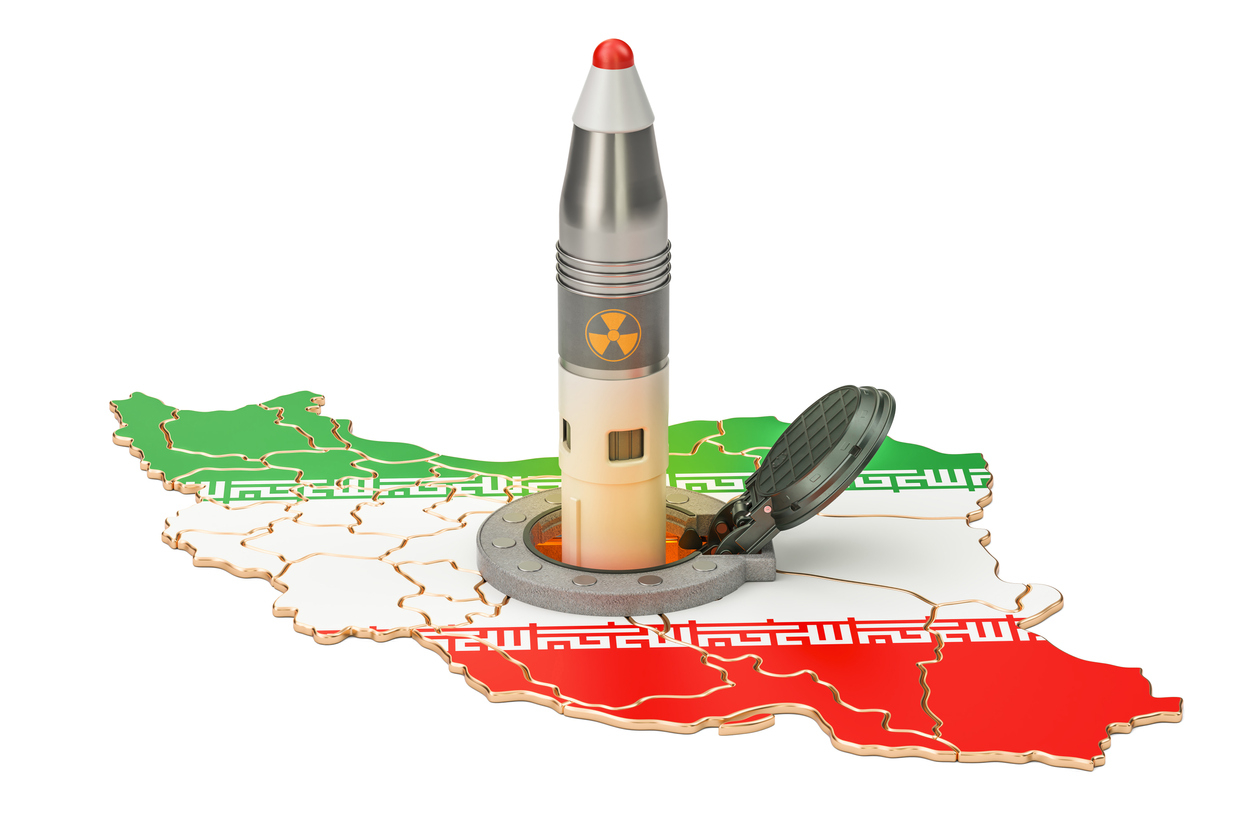
(Image source: iStock)

Two months or nine months? This is the question making the rounds with regards to the latest "incident" at Natanz nuclear center where Iran is engaged in a massive uranium enrichment program. Attributed to Israeli secret services, the incident disabled some 5,000 centrifuges put in full operation two months ago as a means of exerting pressure on the new administration in Washington.

Iranian experts say the infernal machine could be back in full gear within two months. Western experts say nine months is a likelier time-span. The "incident" came at a time that Tehran's envoys were engaged in indirect talks with US diplomats on a possible deal for Iran to reduce its enrichment program in exchange for the lifting of sanctions imposed by Washington, the UN and the European Union.

The question is whether Israel, if it were indeed behind the "incident," had coordinated it with the new Biden administration, something that Tehran regards as impossible. If there was coordination we must assume that Israel was doing its bit to help Biden soften the mullahs in new negotiations, a pas-de-deux that the US and Israel have performed in the Middle East many times before. However, if Israel acted alone we must assume that its assessment of the Iranian threat is different from the Biden administration's.

A nuclear armed Islamic Republic might be no more than a nuisance for the US, as is North Korea for example, while it would be an existential threat to Israel.

One thing is certain: as The Washington Post editorialized last week, the Biden administration believes that while Israeli "incidents" might delay Tehran's program, only the US can stop it through diplomacy.

But what if the whole nuclear issue, built by former President Barack Obama as the core of the "Iran problem", is a diversion designed to put real or imaginary foes on a wrong trajectory?

Does the Islamic Republic have a nuclear policy?

The ayatollah and his aides claim they do and that it is aimed at producing electricity for which they need enriched uranium.

However, 42 years after seizing power, they still have only one semi-derelict nuclear power station which is often shut and produces less than two percent of the electricity Iran needs. Even then Iran has no need of enriching uranium domestically as the fuel needed for its sole power plant is supplied by its Russian builders until the end of its life-span in 2032.

So, is Iran enriching uranium to build a bomb?

Obama was adamant that this was not the case.

He cited a "fatwa" by "Supreme Guide" Ali Khamenei that forbids Muslims from building the bomb. (Needless to say, possibly apart from Obama no one has seen the fatwa.)

If we assume that Biden shares Obama's conviction or that he, too, has seen and believed the fatwa, we would wonder why he should bother to stop the mullahs from wasting resources on something for which they have no obvious use. As for the mullahs, what they offer is simple: a promise not to do something that they claim they have never done, are not doing, and would never want to do.

What if what many see as the Islamic Republic's nuclear policy is a posture, not to say an imposture, not a policy? That posture serves the Khomeinist regime's interests by shifting the focus away from the real mischief and crimes it has been committing inside and outside Iran for four decades.

The current diplomatic "initiative", concocted by the Europeans, may end in a compromise with the US lifting at least some of its sanctions in exchange for Tehran agreeing to slow down its uranium enrichment program. The Biden administration could add a diplomatic feather to its cap while the mullahs, starved of cash since 2019, would get the money needed to keep their other mischiefs going on the old or perhaps even grander scale.

The Khomeinist regime isn't hurting anyone by enriching 20 percent uranium that it does not need, and, for technical reasons, wouldn't be able to use even if it decides to build a bomb. But it is hurting many by fomenting terror and instability in large chunks of the Middle East and beyond.

Its "exporting revolution" has already contributed to triggering and prolonging the war in Yemen. Without its involvement, the Syrian civil war may not have led to what is the greatest tragedy the world has seen in the new century. By creating Hezbollah, the mullahs have led Lebanon to the brink of ungovernability, not to say systemic collapse. By supporting the most radical rejectionist groups, the mullahs have also helped block the road to an Israeli-Palestinian coexistence accord.

Inside Iran, the Khomeinist regime has committed crimes against almost every section of society by massacring peaceful protesters, persecuting religious minorities and political dissidents and damaging the nation's key institutions with corruption, mismanagement and, as we witness in the current Covid-19 pandemic, sheer incompetence.

To forget all that, not to mention the seizing of scores of hostages and the killing of hundreds of US, British and French soldiers with roadside bombs and terror attacks in Lebanon, Iraq and Afghanistan, and over 100 terror operations in 22 countries across the globe, would be the height of naiveté and a sure sign of moral decadence.

At the same time, the mullahs have provided an "Islamic" cover for the crimes that Russia and China have committed in Chechnya and East Turkestan (Xinjiang). The fakeness of their Islamic pretensions is highlighted in other domains. They have endorsed the annexation by Russia of the Muslim enclaves of Abkhazia and South Ossetia and the stationing of Russian troops in Syria and Azerbaijan (former Soviet) Republic. The mullahs have blocked joint action in support of more than a million Muslim Rohingya driven out of their homes by the Burmese military. It is also interesting that, taking the clue from Moscow, a regime that casts itself as champion of "true Islam" refuses to recognize Kosovo, the latest Muslim majority nation to gain independence.

No, the so-called Iran problem cannot be summed up in the grade agreed for enriching uranium. Nor is the problem limited to Tehran's behavior, as Obama claimed. Posturing is no substitute for policy.

This article was originally published by Asharq al-Awsat


Amir Taheri was the executive editor-in-chief of the daily Kayhan in Iran from 1972 to 1979. He has worked at or written for innumerable publications, published eleven books, and has been a columnist for Asharq Al-Awsat since 1987.

Source: https://www.gatestoneinstitute.org/17289/iran-policy-posturing

Follow Middle East and Terrorism on Twitter

Depressed? Console yourself with the wit and wisdom of Thomas Sowell - Bill Hansmann


by Bill Hansmann

Tom Sowell: "In an age of artificial intelligence, they are creating artificial stupidity."

In troubled times such as these in which we now find ourselves, it is rewarding to reread the words of great individuals who offer comfort and hope.  One of those greats is the economist Thomas Sowell.  He has said and written so many undeniable truths that it is daunting to select a few that stand out.  Nevertheless, I will try.

"Ours may become the first civilization destroyed not by the power of our enemies, but by the ignorance of our teachers and the dangerous ignorance they are teaching our children.  In an age of artificial intelligence, they are creating artificial stupidity."  Mr. Sowell wrote these words even before some in our educational system decided that two plus two does not always equal four and that it is racist to demand or even suggest that it does.

"Stupid people can create problems, but it usually takes brilliant people to create a real catastrophe."  This one gives me hope because I see no brilliance emanating from our problem-creators in Washington.  It is possible that the American people have, likely unintentionally, "catastrophe-proofed" themselves for the next four years by electing an administration that no one would dare define as brilliant.

"The fact that so many successful politicians are such shameless liars is not only a reflection on them; it is also a reflection on us.  When the people want the impossible, only liars can satisfy."  What the public on the left demand is the equivalent of making an omelet without cracking an egg.  The Biden-Harris folks think we can give up our newfound energy independence by ridding ourselves of pipelines and fracking, depending instead on solar and wind power while continuing to eschew nuclear.  What they are inviting is a return to our dependence on OPEC and likely more unwanted U.S. involvement in Middle East conflicts.

"You cannot take any people of any color and exempt them from the requirements of civilization — including work, behavioral standards, personal responsibility and all the other things that the clever intelligentsia disdain — without ruinous consequences to them and to society at large."  LBJ's Great Society has proved to have gained little if anything for the poor of our nation.  Poverty has not been eliminated, and society is no greater as the result.  Black Americans have suffered most grievously as the result of this misplaced concern.  Had equal amounts of time and money been expended on reinforcing the value of self-reliance and responsibility for one's own actions, the goals of reaching a great society might have been met.

"If you have always believed that everyone should play by the same rules, that would have gotten you labeled a radical sixty years ago, a liberal thirty years ago, and a racist today."  You would think having the same rules apply to all would be a no-brainer.  You would be wrong.  Rush Limbaugh successfully took on the left with half his brain tied behind his back, but none of the world's survivors is Rush Limbaugh.  Progressives insist that the rest of us suspend disbelief at what is going on in our society and demand we handicap ourselves with a discrediting claim of white privilege.  It seems to many as though a large segment of the black community have carved themselves out a new "black privilege," which allows for a disrespect of national pride and a disregard for many of the nation's laws and values.

Finally, "It is hard to imagine a more stupid or more dangerous way of making decisions than by putting those decisions in the hands of those who pay no price for being wrong."  Actually, there is a price paid by those making foolish decisions, but it is paid to spin doctors who use smoke and mirrors to allow abdication of responsibility for whatever folly had been foisted on the public.

Wouldn't it be great if our leaders possessed the wisdom of Thomas Sowell.  Or as Liza Doolittle put it, "Wouldn't it be loverly?"

Image: HooverInstitute via YouTube.


Bill Hansmann

Source: https://www.americanthinker.com/blog/2021/04/depressed_console_yourself_with_the_wit_and_wisdom_of_thomas_sowell.html

Follow Middle East and Terrorism on Twitter

NYC mayoral candidate: Israel is an 'apartheid' state - Arutz Sheva Staff


by Arutz Sheva Staff

In a recording, NYC mayoral candidate Dianne Morales can be heard claiming Israel is an 'apartheid state,' criticizing 'propaganda trips.'


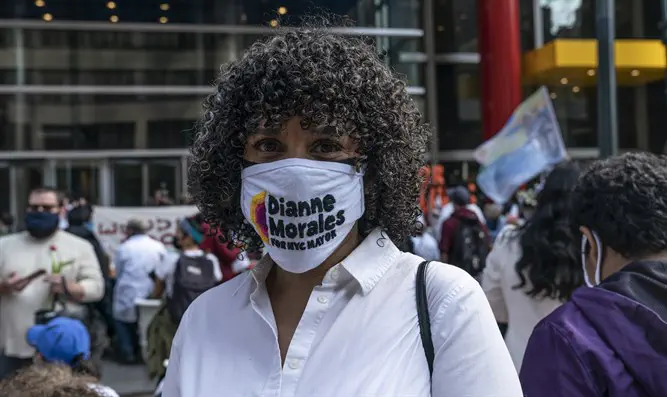
Dianne Morales
Dianne Morales                                                                               Lev Radin/Sipa USA/REUTERS

New York City mayoral candidate Dianne Morales called Israel an "apartheid state," The Forward reported Saturday.

In a December recording obtained by The Forward, Morales can be heard speaking with Jewish high school students, saying that she "cannot advocate for equity and justice in New York City and turn a blind eye to the challenges around those issues in Israel and with the folks living in Gaza and in Palestine."

"I think everybody has a right to live in dignity, everybody has a right to a home, everybody has a right to their land. No one has the right to do that at the expense of someone else, someone else's freedom in particular. And that’s problematic to me."

In addition to her claims of apartheid, she said that although she would not rule out future trips to Israel, she would also not participate in "propaganda trips," such as the one she went on in 2015, which was arranged by the Jewish Community Relations Council of New York, The Forward added.

Morales, a former non-profit CEO and public school teacher, is currently polling at approximately three percent.


Arutz Sheva Staff

Source: https://www.israelnationalnews.com/News/News.aspx/304528

Follow Middle East and Terrorism on Twitter

Can you blame Raúl for leaving? - Silvio Canto, Jr.


by Silvio Canto, Jr.

Cuba's getting ready to go (even more) downhill fast

According to news reports, Cuba's chief, Raúl Castro, is resigning and passing the ball to the younger generation.  This is from NBC News:

Raul Castro confirmed Friday he is stepping down as the head of the Communist Party of Cuba, the most powerful position on the island.

During a speech on the first day of the Communist Party's eighth congress, he said he would hand over power to a younger generation that is "full of passion and anti-imperialist spirit."

"I believe fervently in the strength and exemplary nature and comprehension of my compatriots, and as long as I live, I will be ready with my foot in the stirrups to defend the fatherland, the revolution and socialism," Castro told party delegates at the closed-door meeting at a convention center in Havana.

He was retiring, Castro said, with the sense of having "fulfilled his mission and confident in the future of the fatherland."

And so he will step down.

Some in the media are treating this as some "Washington moment," or when President Washington decided not to seek a third term in 1796.  Well, not really.  President Washington retired after being elected for two terms.  Raúl Castro was never elected to anything, unless you think running unopposed for head of the Communist Party is some kind of model election.

So what's going on?

Let's cut him a little slack and say he is old.  Yes, he will be 90 in a few months.  Let's accept that the absence of a Castro is historic.

My guess is that Raúl Castro knows that this is a good time to get out because the island is facing some difficult times.

COVID has hit Cuba hard and cut into tourism, the only thing the island has to bring in dollars.  Once upon a time, Cuba had a private economy.  It doesn't anymore, so tourism is about all they have.  COVID stopped those flights full of tourists, and the economy shrank 11% last year.  Thanks to President Trump, U.S. sanctions have made it more difficult for Cuba's regime.  And finally, long food lines and shortages are back, reminding my mother of those days when she stood in line to buy milk.

To make matters worse, the new leaders want to reform, but the Cuban version of Perestroika will probably work as well as the Soviet one from the late 1980s.

So Raul is handing the keys to the new generation.  The problem is that the engine does not run, the gas tank is empty, the car needs new tires, and there are still lots of payments due on that note.

Do you understand now why Raúl wants out?

PS: You can listen to my show (Canto Talk).

Image: Pedro Szekely via Flickr, CC BY-SA 2.0.


Silvio Canto, Jr.

Source: https://www.americanthinker.com/blog/2021/04/can_you_blame_ral_for_leaving.html

Follow Middle East and Terrorism on Twitter

Moving Netanyahu aside and other lies - Dr. Limor Samimian-Darash


by Dr. Limor Samimian-Darash

Abandoning the head of an ideological camp at a time when your opponents are trying to fence him in precisely because he has so forcefully stood up to them? That is more than a political move.

It's a tiny political, almost mathematical, matter. Simply move Prime Minister Benjamin Netanyahu a little to the side and you'll have a right-wing government. We heard this during the last election campaign when people like New Hope party member Danny Dayan proudly insinuated that the formulation of a coalition government was a matter of political maneuverability on one hand and political boycotts on the other. What is nevertheless surprising and disappointing is that politicians and commentators on the Right are reaping the fruits of the boycott started by New Hope in a follow-up to the one by the Left. What is even more disturbing is the attempt to push an equation in which the "small political" concession of Netanyahu stepping aside is supposed to assure something even greater – the establishment of a coalition government – in return. In reality, though, the true equation is one of ideological and moral sacrifice in return for narrow political interests.

Let's start with the obvious. Those with the most to gain from moving Netanyahu aside are not the right-wing lawmakers now wheeling and dealing with their Knesset seats but their friends on the Left that are set to earn the most precious asset of all: an ideological victory. It is clear to all that the only way to replace the right-wing rule, which has not been defeated since 2009, is to bring down Netanyahu. There are those who see such a move as allowing for a chance to level the playing field, and there are those who hope for the dissolution of the right-wing camp, which would get caught up in the internal struggle to consolidate an alternative. Either way, the arena would be vacated to the opposite camp. Is there any other explanation for the consensus on the Left that any other candidate, including Yamina head Naftali Bennett, should be crowned Israel's leader?

Yet we must not surrender to this false equation, and not just due to the political ramifications but also as a result of the deep moral significance of such a move. Abandoning the head of an ideological camp at a time when your opponents are trying to fence him in precisely because he has so forcefully stood up to them is more than a political move. More than politics are at stake when you throw your hands up in surrender when faced with boycott tactics and political or legal persecution and when the results of a democratic election are twisted. No, this is a moral and ethical matter.

A political imbroglio, boycott, stepping aside – none of these terms from the playbook of pragmatic politics has anything to do with ideology or morals. If we resolve the imbroglio at the expense of ideology, we will be destined to remain without either a political advantage or an ideology. Our political rivals are already waiting to use this exercise on the next in line.

For over a decade, Netanyahu has not just led the Right out of the political desert; he marched it and the State of Israel toward unprecedented achievements; kick-starting the economy, peace accordsrecognition of the Golan Heightsembassies in Jerusalem, a return to sovereignty discoursestanding up to Iran, and defeating a pandemic. Despite this long list of achievements, none of this seems to be enough. Just as the exodus from Egypt was not enough. Nor were the crossing of the Red Sea, the manna from heaven, or the pillars of cloud and fire. One short delay at Mt. Sinai and we run toward the golden calf. And while a momentary political catharsis is guaranteed to all those unable to stand the pressure, those who give up on basic morals for a hasty political deal could leave us out in the desert for another 40 years. And no, it's not the political desert I am worried about but the ethical and moral drought that has befallen us.


Dr. Limor Samimian-Darash

 
Source: https://www.israelhayom.com/opinions/moving-netanyahu-aside-and-other-lies/

Follow Middle East and Terrorism on Twitter

Can’t Stand Cant - Clarice Feldman


by Clarice Feldman

The country is drowning in hypocritical, sanctimonious blather so common to our public and private educational institutions, the media, politicians, interest groups and corporations.

I can’t stand any more cant -- the hypocritical, sanctimonious blather so common to our public and private educational institutions, the media, politicians, interest groups and corporations. Neither can more and more people -- and this week, across a variety of fields, they are hitting back at it. It’s as if the giant fog beclouding minds is beginning to disperse.

Hero of the Week: Andrew Gutmann

I like private schools. I think that for those who can afford them, they can provide an 'out' from the poor educations available at too many government-sponsored schools. I have, however, been horrified to read letters from heads of otherwise very good ones, endorsing -- if not openly, then subtly -- critical race theory, Black Lives Matter, and the very notion of  “systemic racism.” So I was delighted to read the letter by Andrew Gutmann, father of a student at Brearley, a very high-priced New York school, who attacks the school leadership for their “cowardly and appalling lack of leadership by appeasing an anti-intellectual, illiberal mob, and then allowing the school to be captured by that same mob.”  I can only give you a summary of its highlights, but please read it all. (What he says is equally applicable to the same hypocrisy evident in far too many colleges and universities around the country.)

He says he “cannot tolerate a school that not only judges my daughter by the color of her skin, but encourages and instructs her to prejudge others by theirs,” something he correctly argues desecrates the memory of Martin Luther King, Jr. and other civil rights leaders. As for systemic racism, Gutmann denies there is any such thing, and that there has not been any in the U.S. for more than 50 years. “To state otherwise is a flat-out misrepresentation of our country’s history and adds no understanding to any of today’s societal issues.” Differences in outcome are not evidence of “systemic racism,” he notes. “Facile and unsupported beliefs such as these are the polar opposite to the intellectual and scientific truth for which Brearley claims to stand.” As for the often-heard calls for “conversations about race,” he is just as blunt. They do not want an honest conversation about race, they want only to propagandize the false notion that blacks are helpless victims who, no matter their skills, talent or hard work, cannot succeed. In fact, he correctly tags such beliefs “racism.”

Best of all, he calls out the school’s “vacuous, inappropriate and fanatical use of words such as ‘equity’ and ‘diversity’ “as utter hypocrisy, pointing out if that really were its aims, it would scratch policies like preferences for legacies, siblings, and the children of the wealthy. And if it cared really about inclusiveness it would stop teaching “the extraordinarily divisive idea that there are only, and always, two groups in the country: victims and oppressors.”

As for the assertion by the school that its greatest concern should be education, not its stated goal as safety, something he says (with good reason) “damages the mental health and resiliency of the students.”

As if to prove this point, here’s the school’s response, a piece of fluffy faddish words strung together (“inclusive, antiracist, diverse”), contending that the dears were “frightened and intimidated” by Gutmann’s critical comments.

Gutmann also correctly characterized BLM as a “Marxist, anti-family, heterophobic, anti-Asian and anti-Semitic organization that neither speaks for the majority of the Black community in this country, nor in any way, shape or form, represents their best interests.”

Right on cue, Patrisse Cullors, a co-founder of BLM proves his point, as Larry Elder reports

“The first thing, I think, is that we actually do have an ideological frame. Myself and Alicia [Garza, BLM co-founder] in particular are trained organizers.”

Cullors also said: “We are trained Marxists. We are super-versed on, sort of, ideological theories. And I think that what we really tried to do is build a movement that could be utilized by many, many black folk.”

She’s doing well for herself, not so well for the intended beneficiaries. She’s been buying up real estate, three homes in Los Angeles, her latest a $1.4-million dollar home in tony Topanga Canyon, California. BLM Global Network received $90 million last year. Only $500 of that went to the family of Michael Brown, whose death in Ferguson, Missoouri set off a series of BLM demonstrations and riots.

In fact, the head of BLM Greater New York, not affiliated with the Global Network, has asked for “an independent investigation” of Cullors’ outfit, asking “If you go around calling yourself a socialist, you have to ask how much of her own personal money is going to charitable causes.” 

Cullors reponded, “I do understand why people expect [grants] from us,” she said. “But I think it’s important that people recognize there are other places they can also get grants. There are other places they can also get resources. And, most importantly, our target should be the United States government. Our target should be calling on Congress to pass reparations.” And she justifies her pelf and real estate investments with this:  “I see my money as not my own. I see it as my family’s money as well.”

Political Cant

And then there’s political cant of which President Biden is a master. As the border crisis explodes and public disagreement with open borders grows, Biden flails about and offers up immediately discredited solutions.

First, he said the border portfolio was being handled by Vice President Kamala Harris, who, not an utter fool, denied that instantly. Then a White House official claimed that the president had secured agreements with Central American countries to address the border crisis. 

Almost immediately thereafter, a State department spokeswoman said that no such agreements exist. Also contradicting the White House claim are northern triangle Special Envoy Ricardo Zuniga and Honduras Foreign Affairs Minister Lisandro Rosales.

Suspected terrorists and gang members have been apprehended, and border crossings in March hit a 15-year high, as an understaffed border patrol struggles to address the varied humanitarian and security problems that come with a massive influx of illegal immigration.

The Biden plan is to have no one in charge as the humanitarian crisis explodes and simply to lie about it .

Environmentalist Cant

Two items this week establish beyond doubt that those opposing fossil fuels are utterly ignorant or lying virtue signalers. 

Here’s a short video in which we learn that solar panels are made of quartz which rips up the land in the quarrying of it and requires lots of coal to heat it and turn it into silicon. And that the energy they provide is intermittent and unreliable and conventional fossil fuel and nuclear-powered generation is necessary to supplement it. 

Watch it to see how the promoters of solar panels ignore or lie about the production process.

It’s of a piece with a contretemps between Innovex, an oil and gas services company, and North Face, a producer of trendy outdoor fashions. Innovex wanted to present employees with North Face jackets with Innovex insignia, North Face refused the sale because it abhors fossil fuel production. The CEO points out how much depends on fossil fuel production and how it has reduced CO2 emissions, and such, and noted to the idiots at North Face “everything North Face produces depends on oil and gas.”

Social Media Cant

Last but not least is Facebook cant. A month ago, it bruited how ethical it is, something so many people who express opinions and cite facts in disagreement with the Zuckerberg-established preferences would dispute.

“Our goal is for Facebook, as a business and a platform, to be a place for equality, safety, dignity and free speech -- the core principles of human rights -- and to build systems that respect human rights and guidance of the UNGPs [UN Guiding Principles on Business and Human Rights].”

Nevertheless, it obtains revenue from ads by companies in China selling hair it admits are cut from Uyghurs, against whom the CCP is committing genocide and other crimes against humanity.  When confronted about the gap between their stated support for human rights and the continued running of these ads, Facebook declined comment.

It would be naive to believe the flood of cant can be stemmed, but let’s work to cut it to a much smaller trickle.


Clarice Feldman

 
Source: https://www.americanthinker.com/articles/2021/04/cant_stand_cant.html

Follow Middle East and Terrorism on Twitter

Jordan reaches 100 as its ruling Hashemite dynasty implodes - David Singer


by David Singer

After 100 years - Jordan’s ruling Hashemite dynasty finally needs to end its timidity.


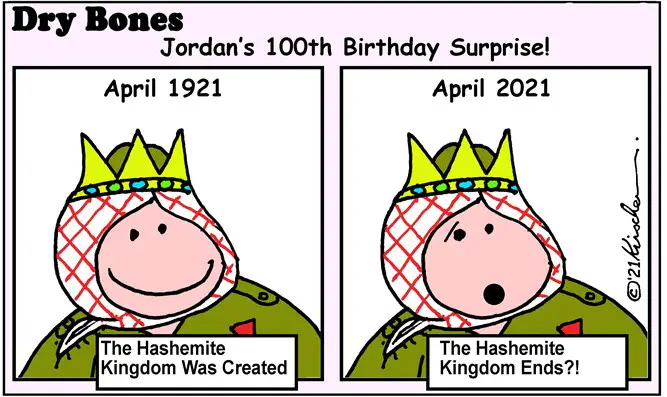
Dry Bones: Hashemite Kingdom
Dry Bones: Hashemite Kingdom                                                                         Yaakov Kirschen

Jordan continues to be the stumbling block to ending the 100 years old conflict between Jews and Arabs as it celebrated its founding 100 years ago on 11 April 1921 - whilst simultaneously 100 years of unbroken rule by the Hashemite dynasty has been publicly imploding.

Initially called the Emirate of Transjordan - the Hashemites - hailing from the Hejaz - now called Saudi Arabia – were anointed as Transjordan’s future rulers by Britain at the 1921 Cairo Conference as part of the machinations between Britain and France in the carve up of the territory of the defeated Ottoman Empire in World War 1.

99.99% of Ottoman-liberated territory was designated for Arab self-determination under the French Mandate for Syria and Lebanon and the British Mandate for Mesopotamia - whilst the remaining 0.01% was to be set aside for the reconstitution of the Jewish National Home in the area today called Israel, Jordan, Gaza and Judea and Samaria (West Bank) pursuant to the British Mandate for Palestine.

Two and a half of the twelve tribes of Israel had settled in Transjordan: Gad, Reuben and half the tribe of Manasseh:

Transjordan – 78% of the territory comprised in the Mandate - was however completely excluded as the site for any part of the future Jewish National Home - when Article 25 was inserted in the Mandate document unanimously endorsed by the League of Nations on 22 July 1922.

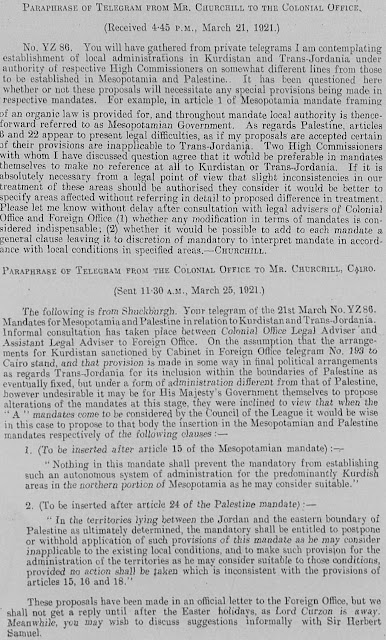
Transjordan’s exclusion from future Jewish settlement came after the exchange of the following telegrams between Britain’s State Secretary for the Colonies – Winston Churchill – and British Colonial Administrator – John Schuckburgh in March 1921:

C:\Users\dsing\Downloads\British_Government_memoranda_regarding_Article_25_of_the_Palestine_Mandate_with_respect_to_Transjordan,_March_1921.jpg

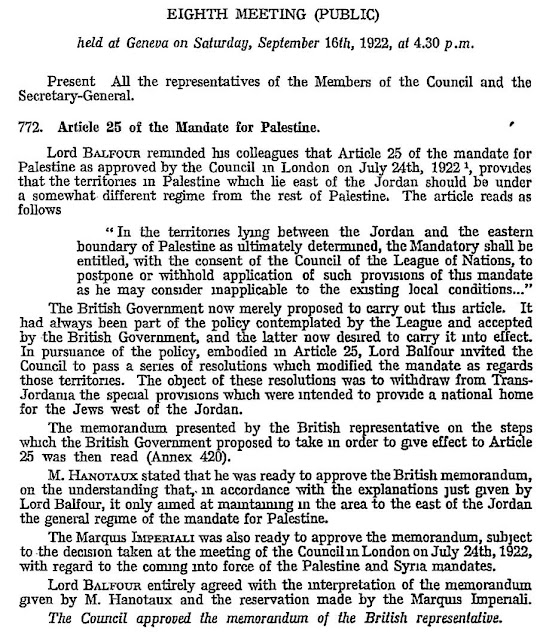
The coup de grâce was duly delivered by the Council of the League of Nations on 16 September 1922:

C:\Users\dsing\Downloads\Transjordan_memorandum_approval_at_the_Council_of_the_League_of_Nations,_16_September_1922.jpg

With impeccable Anglo-French doublespeak – the Jews were thus denied any right to reconstitute their National Home in any part of the Mandate territory east of the Jordan River. However – Jewish settlement anywhere west of the Jordan River – including Gaza and Judea and Samaria (aka 'West Bank') – was preserved until today under Article 6 of the Mandate for Palestine and Article 80 of the United Nations Charter.

Former American President Jimmy Carter summed up Jordan’s founding in Time Magazine on 11 October 1982:

“[Jordan’s King] Hussein is personally courageous but an extremely timid man in political matters. That timidity derives almost inevitably from the inherent weakness of Jordan. As a nation it is a contrivance, arbitrarily devised by a few strokes of the pen”

Transjordan remained part of the Mandate for Palestine until Britain granted it independence on 25 May 1946 when it was renamed “The Hashemite Kingdom of Transjordan”. A further name change to Jordan only came in 1950 after Transjordan had conquered Judea and Samaria and East Jerusalem in 1948 - uniting those areas with Transjordan to form a single territorial unit until their loss to Israel in the 1967 Six Day War.

In 1994 – Israel and Jordan signed a peace treaty- which remains in force today despite many events that could have derailed it.

The two-state solution first contemplated in 1922 for Palestine – one for the Jews in 22% of the Mandate territory – one for the Arabs exclusively in the remaining 78% – still remains the only realistic and politically-achievable basis for any two-state solution in 2021.

Subdividing Judea and Samaria (West Bank) and Gaza– 5% of the Mandate territory where sovereignty still remains unallocated – between Israel and Jordan – the two successor States to the Mandate for Palestine exercising sovereignty in the other 95% – remains the key to ending the Arab-Jewish conflict.

After 100 years - Jordan’s ruling Hashemite dynasty finally needs to end its timidity.

Author’s note: The cartoon — commissioned exclusively for this article — is by Yaakov Kirschen aka “Dry Bones”- one of Israel’s foremost political and social commentators — whose cartoons have graced the columns of Israeli and international media publications for decades. His cartoons can be viewed at Drybonesblog


David Singer is an Australian lawyer who is active in Zionist community organizations in that country. He founded the "Jordan is Palestine" Committee in 1979.

 
Source: https://www.israelnationalnews.com/News/News.aspx/304222

Follow Middle East and Terrorism on Twitter