Sunday, May 2, 2021

Refuting the Palestinian Allegation to the ICC that Israeli Settlements Are a War Crime - Amb. Alan Baker


by Amb. Alan Baker

Israel’s settlement activity is conducted in accordance with the requirements of international customary law

Institute for Contemporary Affairs

Founded jointly with the Wechsler Family Foundation

Vol. 21, No. 7

  • Israel’s settlement activity cannot be considered as a “war crime” in the context of the ICC Statute. The overriding criteria established by the Statute for war crimes include the requirement that such activity be “part of a plan,” “done on a large scale,” and be “of sufficient gravity as to justify further action by the Court.” Israel’s settlement activity does not fill any of these overriding criteria. Therefore, the allegation of a war crime cannot be considered admissible by the Court.
  • Israel’s settlement activity is conducted in accordance with the requirements of international customary law, which enables the legitimate use of state and non-privately owned land and property, pending resolution of the conflict. Strict measures are taken by Israel’s investigative and judicial authorities to ensure that violations of laws and norms are duly investigated and prosecuted. Israel’s ongoing legal and juridical supervision fulfills the complementarity requirement of the ICC Statute.
  • The most important legal document used to evaluate the legality of Israel’s settlement activity has been the 1949 Fourth Geneva Convention. As clarified by the ICRC Official Commentary to that document, the population transfer prohibition set out in the Convention was specifically drafted to address a repeat of the mass, forced population transfers conducted by the Nazis during the Second World War. As such, it is not applicable to Israel’s settlement activity.
  • The “transfer” prohibition in Article 8 of the ICC Statute does not reflect established international law inasmuch as it was deliberately tailored and manipulated to address Israel’s settlement activity. As such, Israel’s settlement activity cannot be seen to fulfill the Statute’s overriding requirement that such a crime be within the “established framework of international law.”
  • The Oslo Accords established an agreed legal regime enabling each party to conduct planning, zoning, and construction activities within the areas under its respective jurisdiction, pending the outcome of the permanent status negotiations. Israel’s investigative and judicial institutions regulate all such construction activity, including, where necessary, investigating and prosecuting violations. Such activity fulfills the complementarity requirement of the ICC Statute.
  • Israel’s official governmental commission to investigate the legality of construction in the territories established strict criteria prohibiting seizure and use of private property in violation of international law and requiring that construction be carried out in accordance with the law. The observance of such criteria fulfills the complementarity requirement of the ICC Statute.

Introduction

The announcement by ICC Prosecutor Fatou Bensouda of her decision to open an investigation of war crimes against Israel’s military and political personnel, pursuant to Palestinian referrals, involves two alleged spheres of activity:1

  1. Allegations that Israel’s military committed war crimes during the course of the 2014 “Protective Edge” operation against Hamas-ruled Gaza, including what the Prosecutor describes as “intentionally launching disproportionate attacks, willful killing, willfully causing serious injury, and intentionally directing attacks against objects or persons using the distinctive emblems of the Geneva conventions.”

    In addition, the investigation includes allegations that Israel’s military committed war crimes in 2018 by what the Prosecutor describes as a “disproportionate use of force that rises to the threshold of an international crime” committed by Israeli authorities since 2018 to disperse demonstrations along the Gaza border fence.

  2. The second sphere of Israeli activity is the alleged war crime of “facilitating the transfer of Israeli civilians into the West Bank since June 13, 2014.”

    The analysis below refutes the allegation by the Palestinians and by ICC Prosecutor Bensouda that Israel’s settlements are a war crime.

Military Actions in the Gaza Sphere

As with all military actions by Israel’s army, the issue of proportionality and necessity of any military action vis-à-vis Hamas in the Gaza area, in response to the threats posed by the Hamas forces are, by necessity, duly analyzed and investigated by Israel’s military and civil legal authorities.

Any specific allegations of misconduct, whether by commanders or by individual soldiers during the course of any such military action, are, as a matter of course, investigated by the responsible and appropriate investigative authorities, whether in Israel’s military or civil legal systems.

By the same token, suspicions of wrong-doing, misconduct, violation of orders, or commission of war crimes, if found to be well-founded, are referred to the appropriate legal authorities for judicial processing, whether within Israel’s military justice system or whether within Israel’s civil legal system.

As such, it may be assumed that the principle of complementarity, set out in articles 17 and 53 of the ICC Statute, according to which allegations are deemed inadmissible if they are duly and properly investigated or prosecuted by the state which has jurisdiction, would apply in relation to the Palestinian allegations regarding the hostilities in the Gaza area.2

Israel’s Settlements Policy

The alleged war crime, as noted by the ICC Prosecutor in her announcement on opening an investigation, is “facilitating the transfer of Israeli civilians into the West Bank since June 13, 2014.”

Before entering into a discussion as to whether Israel’s settlement policy may indeed be considered to be a crime under the ICC Statute, it is necessary to analyze the transfer provision listed as a crime in the Statute.

Transfer as a War Crime

The action of transferring parts of a civilian population into occupied territory is included in the all-embracing title of “war crimes” under Article 8 of the ICC Statute.

The overriding criteria for all such crimes listed in Article 8 are set out in its first paragraph, which determines that “[T]he Court shall have jurisdiction in respect of war crimes in particular when committed as part of a plan or as a large scale commission of such crimes.”

The qualifying and overriding umbrella criterion for war crimes, including the war crime of transfer, is that all the crimes listed in article 8 must have been “committed as part of a plan” or “as a large scale commission.”

The Statute contains neither a definition of the term “plan” nor determination as to the size, extent, or scale of such plan, nor does it define the relative proportions of what constitutes “large scale commission of such crimes.”

A further qualifying criterion determining whether a crime is or is not admissible – that of the “gravity” of a crime – is set out in Article 17 (1) (d) of the Statute, which refers to a case that “is not of sufficient gravity to justify further action by the Court.”

This concept of “gravity” is indeed one of the basic and essential components of the aims and purposes of the Court. This is illustrated in the preambular provisions and in the first, opening article 1 of the Statute that set the tone and character of the Court as a juridical body established in order to address “unimaginable atrocities that deeply shock the conscience of humanity.”

In these opening provisions of the ICC Statute, States Parties recognize that “such grave crimes threaten the peace, security, and well-being of the world” and affirm that “the most serious crimes of concern to the international community as a whole must not go unpunished.”

It would thus appear to be clear that such qualifying and overriding criteria of the crime of transfer would, logically, preclude any action that is not part of a plan, or that is not committed on a large scale, or that is not of sufficient gravity. This inasmuch as such action would, of necessity, be an individual or minor-scale action that would not attain the requisite or relative level or scale as intended to be applied in this article.

In light of the above, it is highly unlikely that Prosecutor Bensouda’s presumption and allegation that “facilitating the transfer of Israeli civilians into the West Bank since June 13, 2014,” could be seen to constitute a war crime within the qualifying criteria set out in the Statute, of being “part of a plan” or done “on a large scale,” or “of sufficient gravity as to justify further action by the Court.”

Clearly, Israel’s settlement policy, based on individual initiatives or incentives for those who wish to settle in any particular area, and, which in any event, is carried out on a relatively minor scale, could not be seen to enter any of the above large-scale criteria.

This especially as compared with the genuinely grave, large-scale, and massive projects of forced population transfer and settlement of millions of persons committed both during the Second World War, as well as mass transfer of populations carried out in recent years by Russia in Georgia and Ukraine, by Turkey in Northern Cyprus, by Indonesia in East Timor, by Morocco in Western Sahara, by Syria in Lebanon, by Vietnam in Cambodia, by Armenia in Nagorno-Karabakh, and elsewhere.3

Can Israel’s Settlement Activity Be Considered a War Crime?

Settlement activities by Israeli citizens in the West Bank areas of Judea and Samaria are not considered by Israel to be a violation of law, since international law specifically sanctions the use, by an administering or occupying power, of non-privately owned assets in the territory, pending an agreed resolution of the permanent status of the territory.

As administrator and usufructuary of public land and property in the territories that came under its control in 1967, and pending a peaceful resolution of the permanent status of the territories as called for in UN Security Council resolutions and in the agreements between Israel and the Palestinians, Israel maintains that it may legitimately use any such state-owned or public land and property that is non-privately-owned, including for the purpose of legitimate settlement by Israeli citizens.4

Israel has consistently maintained that the prohibition on the transfer of parts of a civilian population into the territory, set out in article 49 of the Fourth Geneva Convention (1949), inasmuch as that provision was intended to prohibit the mass and forced transfers of populations committed during the Second World War, has never been applicable to Israel’s practice of permitting settlement in the territory.

Furthermore, the Convention was never applicable to the territories that came under Israel’s authority in 1967 because they were not taken from a legitimate power, since the Hashemite Kingdom of Jordan had never been internationally acknowledged to be the sovereign power over the territory. Additionally, Jordan formally renounced and surrendered all claims to sovereignty and severed administrative ties with the territory in 1988.5

Manipulation of the Transfer Provision in the ICC Statute

Further qualifying factors limiting the extent and nature of the war crimes listed in the ICC Statute appear in the chapeau [introduction] to paragraph 2 (b) of article 8, which determines that the 26 crimes listed in paragraph 2(b), including the crime of “transfer” listed in subparagraph viii, must be “…serious violations of the laws and customs applicable in international armed conflict, within the established framework of international law.

These qualifying factors of seriousness of the violations of the laws and customs of international armed conflict, on the one hand, and their being within the established framework of international law, on the other, further limit the relevance of the crime of transfer attributed to Israel.

The criterion of seriousness is covered by the above-noted assumption that such action could indeed not be considered to enter into the criterion of gravity established by article 17 of the ICC Statute.

Additionally, the crime attributed to Israel in subparagraph 2(b) (viii) of “transfer, directly or indirectly, by the Occupying Power of parts of its own civil population into the territory it occupies” cannot be considered to constitute a crime “within the established framework of international law.”

The “established framework of international law” upon which article 8, subparagraph 2(b)viii is based, does not include the words “direct or indirect,” which were deliberately added to the text during the drafting of the 1998 Rome Convention, as a political manipulation by some Arab states specifically aimed at Israel’s settlement policies.

Article 49(6) of the 1949 Fourth Geneva Convention, the central legal provision used to evaluate the legality of Israel’s settlement activity and the source of the transfer provision, is indeed considered to be part of the “established framework of international law.” It was drafted as a response to the mass, forced transfers of populations conducted by the Nazis during the Second World War.

The official Commentary by the International Commission of the Red Cross (ICRC) to the Fourth Geneva Convention, edited by Jean S. Pictet, states that this article was:

… intended to prevent a practice adopted during the Second World War by certain Powers, which transferred portions of their own population to occupied territory for political and racial reasons or in order, as they claimed, to colonize those territories. Such transfers worsened the economic situation of the native population and endangered their separate existence as a race.6

Thus, article 49(6), inasmuch as it may be considered to reflect established international law, cannot be considered to be applicable to Israel’s settlement activity.

The text of the Fourth Geneva Convention does not contain the words “direct or indirect” in the context of its transfer provision, as the intention behind the article was clearly to address the severe, grave, and outrageous actions committed by the Nazis in Europe, and to prohibit a repeat of such activities.

The attempt to manipulate the terminology of the ICC Statute by deliberately tailoring the text of the transfer provision in order that it be applied explicitly to Israel’s settlement activity clearly defies the accepted and universally understood criterion that such crime be “within the established framework of international law.”

Oslo Accords as the Source of Legal Authority

While Israel maintains deep-rooted indigenous, historical, and legal claims to the territories, both Israel and the Palestinians are committed to negotiating the permanent status of the territories, as agreed in the universally acknowledged 1993-5 Oslo Accords between Israel and the PLO.7

This was also agreed in the 1993 Exchange of Letters between PLO Chief Yasser Arafat and Israel’s Prime Minister Yitzhak Rabin, in which the PLO committed to the Middle East peace process and declared that all outstanding issues relating to permanent status “will be resolved through negotiations.”

These accords established a sui generis legal regime – a lex specialis – determining shared administration of the territories, pending completion of the negotiation between them of a permanent status agreement. The accords are countersigned by the United States, the EU, Egypt, and Norway and have been endorsed by the United Nations.

The Oslo Accords determine that the issue of settlements is a “permanent status negotiating issue,” together with issues such as borders, refugees, water, security, and Jerusalem. Pending such a permanent status agreement, the accords permit each party to engage in planning, zoning, and building activities in the areas under its control.8

Any settlement activity by Israeli citizens in the territories is strictly regulated and supervised by Israel’s military, civil, and judicial authorities in order to ensure that it is carried out strictly in accordance with international norms as well as legal requirements set out in planning and zoning regulations, and does not violate property rights of local Palestinian residents of the territory.

Any violation of such rules, including violation of the prohibition on the seizure of, or incursion into land and property that is privately owned by local residents of the territories, or construction in violation of planning and zoning rules, is duly investigated. As necessary, such cases are brought before Israel’s courts, including the Supreme Court, which has a long history of jurisprudence reviewing any violations and ordering evacuation or demolition and compensation.9

Such supervision, investigation, and as necessary prosecution by Israel’s legal institutions, of violations of law and regulations in the context of settlement activities by Israelis, fulfills the complementarity proviso set out in article 17 of the ICC Statute.

The 2012 Edmond Levy Commission on the Status of Building in the Territories

A further, and no less vital factor ensuring the monitoring of the legality of settlement construction, and thereby fulfilling the ICC complementarity proviso, appeared in the conclusions and recommendations of the 2012 “Edmond Levy Commission to Examine the Status of Building in the Territories,”10 the terms of reference of which reaffirmed at the outset the government’s determination that:

As a rule, illegal construction situated on private land will be removed, and at the same time, the appropriate professional levels [will] act towards regulating the planning status of structures located on state land.

The commission recommended inter alia measures to ensure the existence of proper procedures to clarify matters related to real estate issues in the areas, including land ownership disputes, in accordance with the principles of justice and fairness within the Israeli judicial and administrative system, taking into consideration applicable laws in the area.

The commission determined that all actions regarding settlement construction, including at the most senior political levels, should only be carried out in accordance with the law and with due and proper alacrity and decisiveness in order to ensure full observance of the law.

Conclusion

The allegation by ICC Prosecutor Bensouda that Israeli citizens have committed war crimes by “facilitating the transfer of Israeli civilians into the West Bank since June 13, 2014” fails to meet central, overriding criteria set out in the ICC’s Statute, for gravity, relevance, and seriousness.

The allegation fails to meet the ICC Statute’s admissibility criterion of complementarity inasmuch as Israel’s investigative and juridical institutions maintain strict supervision of construction activities in the territories, and where necessary, offenders are prosecuted.

As such, the allegations by Prosecutor Bensouda and her instituting an investigation on such issues are incompatible with the requirements of the ICC Statute and must therefore be rejected by the Court.

* * *

Notes

1 https://www.icc-cpi.int/Pages/item.aspx?name=210303-prosecutor-statement-investigation-palestine

2 See articles 17(1) and 53(1) of the ICC Statute https://www.icc-cpi.int/nr/rdonlyres/add16852-aee9-4757-abe7-9cdc7cf02886/283503/romestatuteng1.pdf

3 For an excellent, detailed analysis of settlement activity in occupied territories throughout the world, see Eugene Kantorovich’s “Unsettled: A Global Study of Settlements in Occupied Territories” 2017, Oxford University Press https://academic.oup.com/jla/article-abstract/9/2/285/4716923

4 Hague Convention respecting the Laws and customs of War on Land 1907, Article 55 https://www.loc.gov/law/help/us-treaties/bevans/m-ust000001-0631.pdf

5 http://www.kinghussein.gov.jo/88_july31.html

6 https://www.loc.gov/rr/frd/Military_Law/pdf/GC_1949-IV.pdf

7 1993 Israeli-Palestinian Declaration of Principles on Interim Self-Government Arrangements (Oslo 1) https://mfa.gov.il/MFA/ForeignPolicy/Peace/Guide/Pages/Declaration%20of%20Principles.aspx and 1995 Israeli-Palestinian Interim Agreement on the West Bank and the Gaza Strip (Oslo 2), article XXXI (8) https://mfa.gov.il/mfa/foreignpolicy/peace/guide/pages/the%20israeli-palestinian%20interim%20agreement.aspx

8 Oslo 2, Annex III, article 27 https://mfa.gov.il/MFA/ForeignPolicy/Peace/Guide/Pages/THE%20ISRAELI-PALESTINIAN%20INTERIM%20AGREEMENT%20-%20Annex%20III.aspx#app-35

9 David Kretzmer and Yaël Ronen,  “The Occupation of Justice – The Supreme Court of Israel and the Occupied Territories”  2nd ed. 2021 https://global.oup.com/academic/product/the-occupation-of-justice-9780190696023?cc=il&lang=en

10 http://regavim.org.il/en/wp-content/uploads/2014/11/The-Levy-Commission-Report-on-the-Legal-Status-of-Building-in-Judea-and-Samaria2.pdf


Amb. Alan Baker

Source: https://jcpa.org/article/refuting-the-palestinian-allegation-to-the-icc-that-israeli-settlements-are-a-war-crime/

Follow Middle East and Terrorism on Twitter

US denies report of Iran prisoner swap deal, release of $7B in frozen funds - Peter Aitken


by Peter Aitken

Initial report broke on Lebanese pro-Iran TV channel Al Mayadeen

Tom Cotton concerned Joe Biden ready to 'surrender to Iran'

The U.S. has denied reports of a prisoner swap deal with Iran that would have resulted in the release of $7 billion in frozen Iranian funds.

The initial report broke Sunday on Lebanese pro-Iranian TV channel Al Mayadeen, claiming that U.S. and Iranian officials had agreed to the exchange.

SENATE REPUBLICANS DEMAND INVESTIGATION INTO CHARGES KERRY GAVE IRAN ISRAELI SECRETS

Iran would have released four Americans accused of spying in exchange for four Iranian prisoners in the U.S., as well as the frozen $7 billion, according to Reuters.

The story cited an unnamed Iranian official, but a State Department spokesman told Fox News that no deal has been struck.

IRAN HAS FUNDED SYRIAN MILITIA GROUPS, REGIME FOR YEARS TO THE TUNE OF BILLIONS

"Reports that a prisoner swap deal has been reached are not true," spokesman Ned Price told Fox News. "As we have said, we always raise the cases of Americans detained or missing in Iran.

"We will not stop until we are able to reunite them with their families."

Reports indicated that British-Iranian national Nazanin Zaghari-Ratcliffe would also be released once Britain had paid off a military debt owed to Tehran.

The British Foreign Office did not comment on the matter.

Fox News' Rich Edson contributed to this report.


Peter Aitken

Source: https://www.foxnews.com/world/us-denies-report-iran-prisoner-swap-7-billion

Follow Middle East and Terrorism on Twitter

Iranian envoy: We expect US sanctions to be lifted - Eldad Beck and News Agencies


by Eldad Beck and News Agencies

Diplomats offer contradicting accounts on the progress in the talks taking place in Vienna to bring Iran and the United States fully back into compliance with the 2015 nuclear deal.


Iranian envoy: We expect US sanctions to be lifted
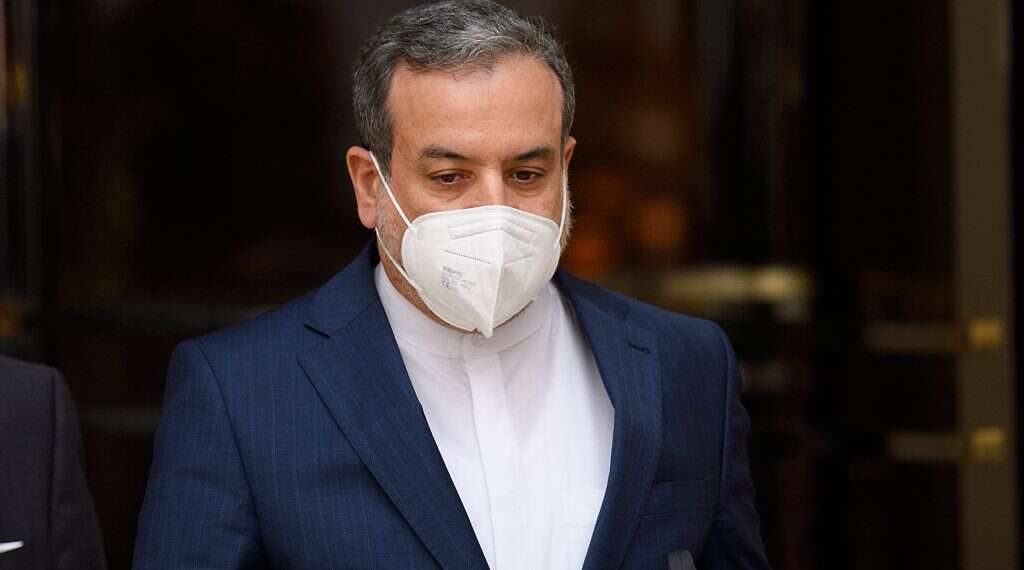
Iranian Deputy Foreign Minister Abbas Araghchi leaves the Grand Hotel after a meeting on the nuclear deal in Vienna, Austria on April 27, 2021 | File photo:

Following recent nuclear talks in Vienna, Iran expects US sanctions on oil, banks and most individuals and institutions to be lifted, Deputy Foreign Minister Abbas Araghchi told Iranian media Saturday, while the United States again downplayed the prospect of an imminent breakthrough.

"Sanctions ... on Iran's energy sector, which include oil and gas, or those on the automotive industry, financial, banking and port sanctions, all should be lifted based on agreements reached so far," Araghchi was quoted as saying by Iranian state TV.

He did not say how exactly the sanctions would be lifted or refer to how Tehran would meet Washington's demands to return to its commitments under the deal.

"We will negotiate until the two sides' positions come closer and our demands are met," he said. "If they are met there will be an agreement, if not there will naturally be no agreement."

The US State Department had no immediate comment on reports of progress,  and said the US assessment of the talks remained where it was on Thursday. On that day, State Department spokesman Ned Price said there had been some movement but that an agreement was far from done or even guaranteed.

Russian and Western European diplomats involved in the negotiations also gave contrasting accounts of the progress in the talks to bring Iran and the United States fully back into compliance with a 2015 nuclear deal, as the talks adjourned for six days.

After the meeting, Russia's top representative, Mikhail Ulyanov, tweeted that members of the Joint Comprehensive Plan of Action, or JCPOA, "noted today the indisputable progress made at the Vienna talks on restoration of the nuclear deal."

"The Joint Commission will reconvene at the end of the next week," Ulyanov wrote. "In the meantime, experts will continue to draft elements of future agreement."

"It's too early to be excited, but we have reasons for cautious and growing optimism," he added. "There is no deadline, but participants aim at successful completion of the talks in approximately three weeks."


The three Western European countries involved in the talks struck a more restrained note. "We have much work and little time left. Against that background, we would have hoped for more progress this week," the senior diplomats said, talking on condition of anonymity because they were not authorized to be publicly named. "We have yet to come to an understanding on the most critical points. Success is by no means guaranteed, but not impossible."  


Eldad Beck and News Agencies

Source: https://www.israelhayom.com/2021/05/02/nuclear-talks-reps-cite-reasons-for-optimism/

Follow Middle East and Terrorism on Twitter

A Palestinian State: What Would Ben Gurion Have Said? - Amir Taheri


by Amir Taheri

When the British mandate ended in 1948, there was no Palestinian nation

  • When the decision to hold the elections was first declared, some of us hoped that it would provide an opportunity for Palestinians to attempt three changes in their political trajectory: to organize a change of generations at the top levels of political decision-making, to forge a minimum of understanding among long rival political groups on the basic rules of the game, and, more importantly, to transform their various versions of "the cause" into a state-building project rooted in reality.

  • In its current form, Palestinian politics remains atrophied in a lost cause that, in zombie style, bars the route to positive energies.

  • He [the late Palestinian "negotiator" Saeb Erekat] ignored the fact that ceasefire lines exist in the context of a truce, not of peace and that, if achieving peace is the aim, there is no point in choosing them as a sine qua non in a negotiated deal.

  • The third "condition" concerned the status of Jerusalem as the capital of a putative Palestinian state. Here, too, the Palestinian position suited those for whom Palestine is a cause not a project for state building.

  • When the British mandate ended in 1948, there was no Palestinian nation, in the universally accepted sense of the term at least in the Westphalian treaties, to claim a state of its own. In fact, all mandate and subsequent United Nations documents refer to "inhabitants" of mandate Palestine presented as Arabs, Jews, Druzes, Armenians, Bahais, Turks and numerous Christian denominations, including Assyrians and Chaldeans.

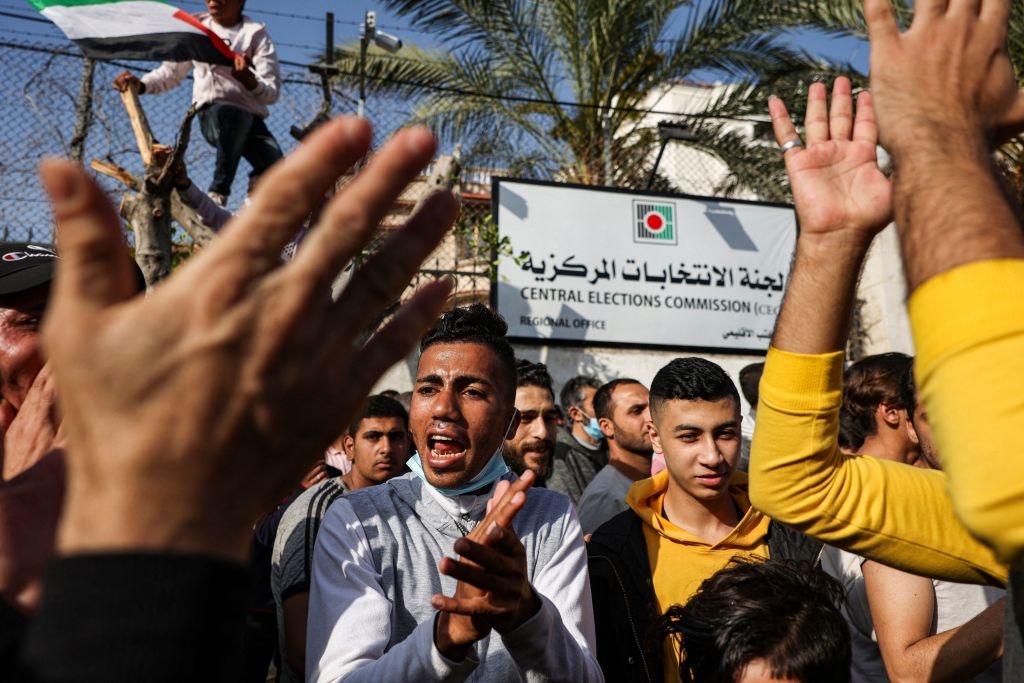
Pictured: Supporters of exiled former Fatah security chief Mohammed Dahlan demonstrate outside the Palestinian Central Elections Commission headquarters in Gaza City on April 29, 2021, protesting against any delay to the Palestinian elections. (Photo by Mohammed Abed/AFP via Getty Images)

Another missed opportunity?

This is the question that, observing the long overdue forthcoming Palestinian elections, comes to mind. When the decision to hold the elections was first declared, some of us hoped that it would provide an opportunity for Palestinians to attempt three changes in their political trajectory: to organize a change of generations at the top levels of political decision-making, to forge a minimum of understanding among long rival political groups on the basic rules of the game, and, more importantly, to transform their various versions of "the cause" into a state-building project rooted in reality.

Judging by the course that the lackluster election campaign has taken and the continued domination of today's scene by men of yesterday, none of those three hopes seems anywhere near realisation. In its current form, Palestinian politics remains atrophied in a lost cause that, in zombie, style bars the route to positive energies.

Less than a year ago, in what was to be his last trip abroad, veteran "negotiator" Saeb Erekat told a small audience at the home of the Kuwaiti ambassador in London that Palestinians were getting ready to attempt a radical change of course in the hope of achieving a "just peace."

In the debate that followed, we suggested that using any qualifier for peace could render it impossible to achieve. In a sense, all peace(s) are always unjust for one side and just for the other.

Erekat insisted that there could be no peace unless four conditions were met.

First, Israel should agree to return to the 1949 ceasefire lines. He ignored the fact that ceasefire lines exist in the context of a truce, not of peace and that, if achieving peace is the aim, there is no point in choosing them as a sine qua non in a negotiated deal.

In any case, why chose 1949 as a marker? Why not 1048 or even 68 AD? Moreover, those ceasefire lines were drawn between Israel on one side and four Arab states on the other without involving Palestine beyond a vague symbolic notion. In any case those ceasefire lines, with Egypt, Jordan, Syria and Lebanon have undergone changes, some quite significant and trying to revive them would affect the larger architecture of stability in the region.

Erekat's second "condition" concerned the "right of return" allowing Palestinians who wished to resettle in their ancestral land to do so. The "right of return" is recognized in international law and is routinely exercised by hundreds of peoples in several countries each year. However, this is an individual, not a collective, right and its exercise depends on the consent and laws of the states concerned. In other words, neither Israel nor any other state could grant a collective right that would allow any and all seekers of "return" to do so when and how they wished. In other words, Palestinians should first recognize Israel as a legitimate state before they can work with it to allow seekers of return to achieve their goal with its consent.

The third "condition" concerned the status of Jerusalem as the capital of a putative Palestinian state. Here, too, the Palestinian position suited those for whom Palestine is a cause not a project for state building. A Persian proverb says: You don't burn Caesarea for a handkerchief, meaning that a larger goal shouldn't be sacrificed to a smaller consideration. Accommodating a "capital" for a putative Palestinian state in the greater Jerusalem area has been regarded as a possibility since the 1990s.

As far as "capitals" are concerned, there are many atypical examples, not to say anomalies. The German Democratic Republic's "capital" was supposed to be in Berlin, then divided between the Soviet Union on one side and US, Britain and France on the other. In reality, however, the Communist regime was located in Panko, a suburb of Berlin. Kinshasa and Brazzaville are, in fact, urban twins on two banks of the same river but capitals of two different states. The entire state of Vatican is located in Rome, the capital of another state, Italy.

It is, of course, possible to refute that argument by referring to Jerusalem's "special place" in religious, not to say mythological, terms. Such a concern is understandable if one remains frozen with Palestine as a cause, not as a state-building project. Interestingly, some Zionist pioneers faced a similar state-or-cause dilemma. Many opposed David Ben Gurion's decision to accept the partition of what was left of the British mandate which left the Jews with a Swiss-cheese rump of territory that, worse still, did not include West Jerusalem, not to mention many other locations where Jewish "holy places" are located. If the creation of Israel as a state was the supreme goal, all other considerations would have to be regarded as secondary.

Erekat's fourth condition was "territorial contiguity" between the West Bank and Gaza. Provided that building a state is the aim, that too, is a minor problem that could be solved with an underground or over-ground passage through Israeli territory. After all, many states lack territorial contiguity, among them the US, Britain, France and Denmark. In 1947, the fact that East and West Pakistan were 1,000 miles apart, separated by a hostile Indian state, did not prevent India's Muslims from accepting the deal offered to them by British imperialists.

When the British mandate ended in 1948, there was no Palestinian nation, in the universally accepted sense of the term at least in the Westphalian treaties, to claim a state of its own. In fact, all mandate and subsequent United Nations documents refer to "inhabitants" of mandate Palestine presented as Arabs, Jews, Druzes, Armenians, Bahais, Turks and numerous Christian denominations, including Assyrians and Chaldeans. Today, however, a Palestinian nation is a reality shaped by eight decades of shared experience.

This newly shaped nation has its own culture, literature, music and world outlook which, though rooted in the deeper historic indemnities merging together, is distinct from its Arab and Israeli neighbors. The mass of Palestinians seem ready to make the transition from a cause into a state. However, their political establishment figures both in Fatah and Hamas remain prisoners of a strategy that belongs to the museum of lost causes

Just or unjust reality today lacks the means for realizing the ideal that merchants of Palestine-as-a-cause offer.

Younger Palestinians, however, might wonder: What Ben Gurion would have said: accept a hard deal and get a state or cling to a cause and remain stateless?

This election is unlikely to answer that question.

This article was originally published by Asharq al-Awsat


Amir Taheri was the executive editor-in-chief of the daily Kayhan in Iran from 1972 to 1979. He has worked at or written for innumerable publications, published eleven books, and has been a columnist for Asharq Al-Awsat since 1987.

Source: https://www.gatestoneinstitute.org/17331/palestinian-state

Follow Middle East and Terrorism on Twitter

Biden's Withdrawal from Afghanistan Undermines His Own Global Strategy - Richard Kemp


by Richard Kemp

Jihadists everywhere would be encouraged and empowered by a perceived US defeat at the hands of the Taliban, which was being trumpeted by Al Qaida within days of Biden's announcement.

  • Far worse than failing to intervene is intervening to fail. The withdrawal from Afghanistan is just that.

  • US allies who have themselves invested huge military and economic resources in Afghanistan fear a Taliban return to power and the blood-bath that would likely accompany it. Their concerns are shared by General Kenneth McKenzie, commander of US CENTCOM, responsible for Afghanistan, who told the Senate Armed Services Committee last week that Afghanistan's forces might well collapse following US withdrawal.

  • Jihadists everywhere would be encouraged and empowered by a perceived US defeat at the hands of the Taliban, which was being trumpeted by Al Qaida within days of Biden's announcement.

  • Biden justified his withdrawal with the need to counter challenges from China and Russia and strengthen democratic allies and partners against autocracy. His actions are likely to have the reverse effect.

  • The abandonment of Afghanistan will long be remembered by countries around the world as they weigh their choices between the US and authoritarian regimes. Already Saudi Arabia has recognised that Biden will not protect them from Iran....

  • Chinese President Xi Jinping says Taiwan must and will be "unified" with China, by force if necessary.... Xi will be... count[ing] the potential cost of moving against the country that he considers his own.

  • As Russian forces massed along the border with Ukraine last month, Xi will also have noticed that Biden cancelled a planned transit of the Black Sea by two US warships after Russia told Washington to stay away....

  • Like a kettle of vultures, Pakistan, Iran, China and Russia will all be circling the Afghan carcass following US withdrawal. Iran, which has long provided weapons, funding and safe haven to the Taliban, has been building its influence with them in recent months. Russia has also helped fund and arm the Taliban — sometimes in collaboration with Iran — to kill Afghan, US and NATO forces in order to challenge the US and increase its own influence in the country.

  • China too has been cooperating with the Taliban.... It also sees influence in Afghanistan as a means to confront New Delhi. Beijing knows that India, as a US ally and democracy, is the only regional power that could play a genuinely constructive role in a future Afghanistan. Xi is not willing to see that happen.

  • Pakistan, in cahoots with China, is also determined to keep India out of Afghanistan. Its Inter-Services Intelligence Directorate created the Taliban and today remains by far the greatest external backer of its campaign against Afghan and international forces. Islamabad sees the country as vital strategic depth in a future conflict with India and intends to hold sway over a future Taliban regime in Kabul.

  • The truth is this is a forever war only in the rhetoric of those who support surrender to the Taliban. The last US combat death there was over a year ago.

  • The net strategic effect of Biden's unconditional withdrawal is shaping up to be the opposite of what his national security strategy seeks to achieve: diminished confidence among allies, increased boldness among adversaries, the vital strategic territory of Afghanistan ceded to anti-democratic autocracies, a destabilised region containing two nuclear powers with associated proliferation risks, a spiralling of the global jihadist threat and massive population displacement.

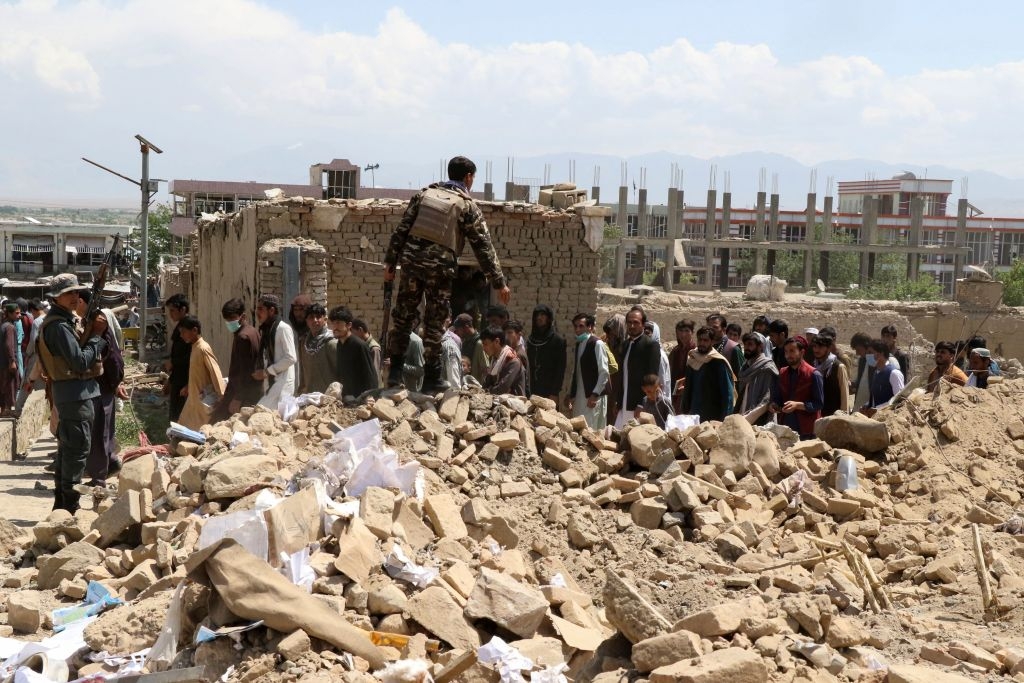
Jihadists everywhere would be encouraged and empowered by a perceived US defeat at the hands of the Taliban, which was being trumpeted by Al Qaida within days of Biden's withdrawal announcement. Pictured: Security personnel and local residents gather on May 1, 2021 at the site of a car bombing where, in the attack the previous day, at least 24 people were killed and 110 wounded, in Logar province, Afghanistan. (Photo by AFP via Getty Images)

US President Joe Biden's unconditional withdrawal of US forces from Afghanistan by September this year has potentially grave and dangerous consequences far wider than that embattled country and is set to undermine the national security strategy he proudly unveiled only days before announcing his pull-out.

In 1982, Admiral Sir Henry Leach, head of the Royal Navy, told Margaret Thatcher that if Britain didn't retake the Falkland Islands when Argentina invaded, "in another few months we shall be living in another country whose word counts for little". He knew that failure to resist a dictator who seized sovereign territory by force would be a green light to such aggression everywhere. The same calculation underpinned President George H. W. Bush's decision to unleash one of the most powerful armies in history following Saddam Hussein's 1990 invasion of Kuwait.

Far worse than failing to intervene is intervening to fail. The withdrawal from Afghanistan is just that. Biden did not order US forces there in 2001, but as Chairman of the Senate Foreign Relations Committee at the time, he strongly supported it. Later he said: "History will judge us harshly if we allow the hope of a liberated Afghanistan to evaporate because we failed to stay the course".

It will not be history alone that judges Biden's failure to stay the course now, but America's allies, enemies and competitors around the world. His March 2021 National Security Strategic Guidance says:

"Authoritarianism is on the global march, and we must join with likeminded allies and partners to revitalize democracy the world over. We will work alongside fellow democracies across the globe to deter and defend against aggression from hostile adversaries. We will stand with our allies and partners to combat new threats aimed at our democracies."

Biden emphasises the need to work with NATO and other allies, which he describes as "America's greatest strategic asset".

Fine words butter no parsnips, as Harry Truman was fond of saying. Biden's unconditional withdrawal from Afghanistan provoked the first public statement of dissent against US security policy that I can recall in my lifetime from Britain, America's closest military ally and NATO's next most powerful member. Prior to Biden's decision, both France and Germany, which is the second largest troop contributor behind the US, also opposed withdrawal in the current circumstances, and NATO Secretary General Jens Stoltenberg echoed their views.

US allies who have themselves invested huge military and economic resources in Afghanistan fear a Taliban return to power and the blood-bath that would likely accompany it. Their concerns are shared by General Kenneth McKenzie, commander of US CENTCOM, responsible for Afghanistan, who told the Senate Armed Services Committee last week that Afghanistan's forces might well collapse following US withdrawal.

America's partners are fearful also of an intensified threat from global jihadists. Al Qaida — along with Islamic State-Khorasan, with which it sometimes collaborates — would regain their preferred base for attack against the West. As before, Western citizens would flock to Afghanistan for terrorist training. Jihadists everywhere would be encouraged and empowered by a perceived US defeat at the hands of the Taliban, which was being trumpeted by Al Qaida within days of Biden's announcement.

Biden justified his withdrawal with the need to counter challenges from China and Russia and strengthen democratic allies and partners against autocracy. His actions are likely to have the reverse effect.

The abandonment of Afghanistan will long be remembered by countries around the world as they weigh their choices between the US and authoritarian regimes. Already Saudi Arabia has recognised that Biden will not protect them from Iran, with his administration rushing headlong to rejoin the catastrophic nuclear deal and withdrawing support to the Kingdom in its fight against Iranian proxies in Yemen. Fearful for their future, the Saudis know they cannot stand alone against Iran and have opened talks with Tehran, a move that could only harm US interests in the region.

Across the Pacific, Taiwan is increasingly plagued by Chinese bomber incursions into its airspace, at greater intensity since Biden took office. Chinese President Xi Jinping says Taiwan must and will be "unified" with China, by force if necessary. How confident can Taiwan now be that the US will actively help them resist should China invade? More importantly, Xi will be asking the same question while he counts the potential cost of moving against the country that he considers his own.

As Russian forces massed along the border with Ukraine last month, Xi will also have noticed that Biden cancelled a transit of the Black Sea by two US warships after Russia told Washington to stay away, calling its planned naval deployment an unfriendly provocation.

Like a kettle of vultures, Pakistan, Iran, China and Russia will all be circling the Afghan carcass following US withdrawal. Iran, which has long provided weapons, funding and safe haven to the Taliban, has been building its influence with them in recent months. Russia has also helped fund and arm the Taliban — sometimes in collaboration with Iran — to kill Afghan, US and NATO forces in order to challenge the US and increase its own influence in the country. China too has been cooperating with the Taliban, both to hunt down and kill Uighur Muslim leaders and in its hunger for natural resources. It also sees influence in Afghanistan as a means to confront New Delhi. Beijing knows that India, as a US ally and democracy, is the only regional power that could play a genuinely constructive role in a future Afghanistan. Xi is not willing to see that happen.

Pakistan, in cahoots with China, is also determined to keep India out of Afghanistan. Its Inter-Services Intelligence Directorate created the Taliban and today remains by far the greatest external backer of its campaign against Afghan and international forces. Islamabad sees the country as vital strategic depth in a future conflict with India and intends to hold sway over a future Taliban regime in Kabul. But it might have to pay a severe price it did not anticipate as it recklessly fuelled the conflict: a flood of Afghan refugees fleeing the Taliban onslaught. They would join the vast number already there, which Islamabad struggles to support. By the end of 2001, 4 million Afghan refugees were in Pakistan, with 1.4 million still there today. This will not be a problem for Pakistan alone; Iran, Turkey and Europe may also face a huge additional influx. Even before Biden's withdrawal, Afghans are already the second largest migrant population in the world.

There is also the prospect of instability in Afghanistan flowing across the border and further destabilising Pakistan with potentially devastating strategic consequences. Intent on overthrowing the government — with its nuclear armory — Jihadists there have been butchering mercilessly for years. Taliban success next door would embolden them and potentially provide support. The soon-to-be-ended US presence in Afghanistan has helped suppress the insurgency in Pakistan. There are suggestions that US assets deployed in Pakistan might have the same effect in Afghanistan, but that is at best questionable, even if Islamabad allows it.

All of this is a high price to pay for ending what Biden calls the "forever war" in Afghanistan. The truth is this is a forever war for the US only in the rhetoric of those who support surrender to the Taliban. Afghan troops continue to suffer horrific levels of attrition, but the last US combat death there was over a year ago. If a conflict needs to be fought in the first place, it may require an enduring presence, sometimes for decades — look for example at US forces still deployed today in South Korea, Germany and Japan. Look also at the consequences of Barack Obama's precipitate withdrawal from Iraq in 2011 — the rise of the Islamic State and the costly return of US forces for almost another decade and counting.

There are just 3,500 US forces (including off-the-books units) among the 10,000 NATO and other international troops in Afghanistan, all of whom are dependent on US presence. Their function is not combat but training and assistance to Afghan security forces. The US also conducts counter-terrorist operations using intelligence agencies, special operations forces and air assets, the very approach Biden unsuccessfully argued for when vice president, as he opposed the more extensive counter-insurgency campaign that Obama prosecuted while in office.

The net strategic effect of Biden's unconditional withdrawal is shaping up to be the opposite of what his national security strategy seeks to achieve: diminished confidence among allies, increased boldness among adversaries, the vital strategic territory of Afghanistan ceded to anti-democratic autocracies, a destabilised region containing two nuclear powers with associated proliferation risks, a spiralling of the global jihadist threat and massive population displacement.


Colonel Richard Kemp is a former British Army Commander. He was also head of the international terrorism team in the U.K. Cabinet Office and is now a writer and speaker on international and military affairs. He is a Shillman Journalism Fellow at Gatestone Institute.

Source: https://www.gatestoneinstitute.org/17322/biden-withdrawal-afghanistan

Follow Middle East and Terrorism on Twitter

Media hysteria means Arizona election audit may be on to something - John D. O'Connor


by John D. O'Connor

If the 2020 election were as well run as touted, then the Biden-centric media should be cheerleading the effort.

While an uncertain public awaits  results from the Arizona election audit, the immediate major media outcry, prematurely denouncing it, should be viewed as the audit's hitting a major media nerve.  The media's reaction vividly demonstrates their fear of a searching re-examination of the election purity they have so arrogantly and unwaveringly proclaimed.

After all, if this election were as well run as touted (with the customary admission to the mere occasional and inevitable, but insignificant, error), then the Biden-centric media should be cheerleading the effort.  Shouldn't the audit, to use a favored media word, be anticipated to "debunk" the claims of widespread irregularities?

The media have drawn great succor from numerous court cases turning down challenges to the 2020 election results.  However, these claims raised issues not properly cognizable by our judicial system.  Ordering a recount is one thing; relitigating a multimillion-vote election is quite another.  It looks tremendously suspicious that, after Republican poll-watchers were banished, massive blocs of Detroit votes were introduced in the early morning, with 95% Biden selection.  But what exactly is a smart person in black robes supposed to do with this tableau?  Overturn the election without taking evidence?  Convene a three-month trial with numerous witnesses and experts, while Biden and Trump cool their heels?  A wise court should toss the case, as each reviewing jurist did.  But this rejection should not be seen as validating the election process, as the major media did.

The election process itself, not the judicial system, is supposed to be administered so as to provide the public with confidence in the announced tallies.  For this reason, the only widely recognized judicial remedy, as in Bush v. Gore, is an order to recount, which brings the process back to its proper venue: the election centers.  So the unsuccessful Republican and Trump lawsuits to invalidate the various election results do not validate the propriety of election procedures; they merely demarcate the limited jurisdictional boundaries of our judicial system.

But that is not how major media, at once partisan and ignorant, have spun this string of unsurprising Republican defeats:

To Cast Doubt On Election Results, Republicans Lean On Conspiracy Theories —npr.org

Arizona Republicans are auditing election results using company run by man who spread conspiracy theories about them —chicagotribune.com

QAnon fans are obsessed with Arizona vote "audit," still hoping for Trump comeback —salon.com

Arizona Republicans' desperate crusade to find nonexistent voter fraud —washingtonpost.com


Media hyperventilation about the recently commenced Arizona audit is evidence that pro-Biden forces discern grave danger in the process.  They have known all along that an audit, not a court case, is the proper forum for detection of maladministration allowing improper votes.  If the media can portray the audit as being about nothing more than warmed-over voting machine paranoia, the yells of "conspiracy theory" will become even louder.  But if a credible evidentiary challenge to the results in Arizona can be strongly shown, the media will be soundly discredited, and with them their assurances of election legitimacy.

So it behooves the auditors and their sponsors to focus both on palpably wrongful voting and sufficient numerosity of suspect votes.  Such a result would not necessarily mean that the national election was illegitimate.  But it would give some support to that entirely reasonable inference.  At the least, it would dramatically demonstrate that, yes, our national election, especially in key urban areas controlled by Democrats, was so poorly administered, whether negligently or fraudulently, that radical reform is needed to ensure that this uncertainty never again occurs.  And yes, H.R. 1 would be a problem, not a solution.

One more conclusion that will be reasonably drawn if such an audit outcome is credibly proven: the major media were once again complicit in fraudulent partisan concealment of a major affront to our democracy, making their suppression of the Hunter Biden laptop story just one leaf of their poisonous tree.  Indeed, they would be convicted by the jury of public opinion as one of the main culprits in the fiasco we call the 2020 election.

Image: cagdesign via Pixabay, Pixabay License.


John D. O'Connor is a former federal prosecutor and the San Francisco attorney who represented W. Mark Felt during his revelation as Deep Throat in 2005.  O'Connor is the author of the book Postgate: How the Washington Post Betrayed Deep Throat, Covered Up Watergate, and Began Today's Partisan Advocacy Journalism and the host of the new podcast series The Mysteries of Watergate.

Source: https://www.americanthinker.com/blog/2021/05/media_hysteria_means_arizona_election_audit_may_be_on_to_something.html

Follow Middle East and Terrorism on Twitter

Biden economic adviser pushes global corporate tax minimum to counteract proposed US increase - Evie Fordham


by Evie Fordham

Opponents say Biden's plan will hurt US competitiveness

Biden's spending, tax plans will have 'bumps along the way': Economic Advisers chair

Council of Economic Advisers chair Cecilia Rouse pushed for a "global minimum tax" on corporations to counteract President Biden's proposed corporate tax rate hike.

"The idea is to make sure that corporations are paying their fair share, to button up some of the loopholes, which have meant more corporations were actually putting more money offshore – off of U.S. soil – and having a global minimum tax so that we’re working with the rest of our trading partners, so that we’re working with the rest of the world so that corporations are paying their fair share worldwide," Rouse told "Fox News Sunday."

BIDEN'S TAX HIKE PROPOSAL: ALL OF YOUR QUESTIONS, ANSWERED

"President Biden is really saying, 'Look, everybody should pay their fair share,'" she said. "Yes, internationally we don't want to be disadvantaged, so he's also working with other countries so that we have a minimum tax internationally so there's not a race to the bottom."

The American Jobs Plan, the $2.3 trillion spending plan that Biden introduced at the beginning of April, would raise the corporate tax rate to 28% from 21%, reversing a key part of Republicans' 2017 tax law. The measure would also impose a higher global minimum on companies' foreign earnings.

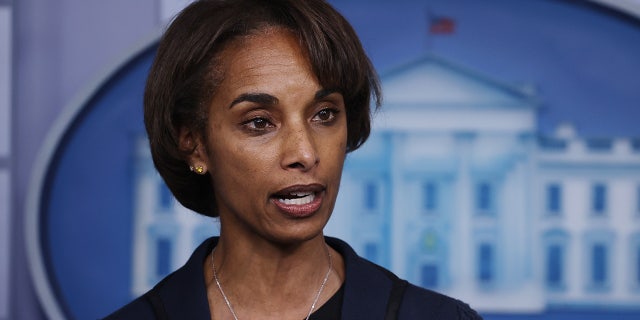
.Council of Economic Advisers Chair Cecilia Rouse talks with reporters in the Brady Press Briefing Room at the White House on March 24, 2021, in Washington, D.C. (Photo by Chip Somodevilla/Getty Images)

.Council of Economic Advisers Chair Cecilia Rouse talks with reporters in the Brady Press Briefing Room at the White House on March 24, 2021, in Washington, D.C. (Photo by Chip Somodevilla/Getty Images)

"What we've seen over the past several decades is that the wealthiest Americans, the big corporations are getting wealthier, and they're contributing less in terms of federal revenue," Rouse said.

The European Commission is on board for now as Treasury Secretary Janet Yellen works with G20 countries on the issue, Reuters reported earlier in April.

"We hope that the announcements of Secretary Yellen regarding the U.S. position, withdrawing the safe harbor regime proposal and calling for a minimum corporate taxation, will spur a new momentum toward agreement on a consensus-based global solution this summer," European Commission spokesman Dan Ferrie said earlier in April according to Reuters.

There's still work to do – the European Commission wants the minimum rate to be decided in talks with the Organisation for Economic Cooperation and Development.

Meanwhile, a majority of the nation's top CEOs agree that Biden's plan to raise the corporate tax rate in order to pay for his nearly $2.3 trillion spending proposal will hurt business competitiveness and slow wage growth. 

FOX Business' Megan Henney and Blake Burman contributed to this report.


Evie Fordham

Source: https://www.foxnews.com/politics/biden-corporate-tax-global-cecilia-rouse-hike

Follow Middle East and Terrorism on Twitter

WaPo and NYT forced to make ‘big retraction’ in reporting on Giuliani subpoena - Thomas Lifson


by Thomas Lifson

The Washington Post and New York Times put out what the social media censors like to call “harmful misinformation”

In their efforts to castigate Rudy Giuliani in their reporting on the search warrant raids on his apartment and office, the Washington Post and New York Times put out what the social media censors like to call “harmful misinformation” (the sort of thing that justifies suspending their reporting when alleged against conservative outlets) so egregious that both have been forced to acknowledge their publication of falsehoods in formal retractions. It’s a big deal. Don’t take my word for it, Trump-hating CNN’s Oliver Darcy calls it a “big retraction.”

Click here to read much more on this topic 


Thomas Lifson

Source: https://www.americanthinker.com/blog/2021/05/wapo_and_nyt_forced_to_make_big_retraction_in_reporting_on_giuliani_subpoena.html

Follow Middle East and Terrorism on Twitter

Saturday, May 1, 2021

How Biden is smashing America's moral compass - Melanie Phillips


by Melanie Phillips

Former President Barack Obama repudiated the "Durban Declaration and Program of Action" on the grounds of its unjust demonization of Israel and the "hateful and anti-Semitic displays" around its creation. The Biden administration has embraced it.


For eight years, the administration of former President Barack Obama behaved as if the security needs of the State of Israel were such an irritating impediment to American foreign-policy aims that it had no compunction in brutally swatting them aside.

As a result, the Obama years were very difficult for Israel. Appallingly, it looks as if the Biden years may be even worse.

Much concern has already been expressed about President Joe Biden's posture of appeasement towards Iran, along with other moves such as his withdrawal of support from Saudi Arabia and his decision to cut and run from Afghanistan. This has thrown some of the world's most dangerous places into a state of even more dangerous flux.

Until now, it was possible to believe that his administration was merely hopelessly naive, appeasement-minded or delusional as a consequence of its utopian liberal ideology, and that Israel just happened to be particularly vulnerable to its correspondingly bone-headed blundering in the Middle East. Now, however, there is evidence that the administration is driven by actual malevolence towards both Israel and Zionism itself, which lowers it into a pit of infamy fouler even than Obama's hostility and disdain.

That evidence concerns the infamous 2001 UN World Conference Against Racism, Racial Discrimination, Xenophobia and Related Intolerance that was held in Durban, South Africa, a few days before the 9/11 attacks.

This was an eye-watering, anti-Israel, anti-Jew hate-fest, whose sole purpose was to demonize and delegitimize Israel under the Orwellian banner of "human rights," and which erupted into openly Nazi-referenced anti-Semitism.

The notorious, forged handbook of deranged Jew-hatred, The Protocols of the Elders of Zion, was distributed to attendees. Leaflets saying Hitler should have finished "his job" circulated, along with fliers depicting him asking "What if I had won?" and receiving the answer: "There would be NO Israel and NO Palestinian bloodshed."

Jewish participants feared for their safety as activists chanted "Zionism is racism, Israel is apartheid," and "You have Palestinian blood on your hands." The Jewish Centre in Durban was forced to close because of threats of violence.

The conference's NGO Forum attacked every Jewish organization in attendance and passed a resolution calling Israel "a racist apartheid state," guilty of the "systematic perpetration of racist crimes including war crimes, acts of genocide and ethnic cleansing … and state terror against the Palestinian people."

The conference's final declaration brought this verbal pogrom to its climax by naming only one guilty country the world over – Israel – and listing only the Palestinians as "victims of racism, racial discrimination, xenophobia and related intolerance."

It thus singled out Israel alone as an instigator of those evils. The sheer lunacy of such a claim, identifying the Jewish state as so monstrous that it was in a category all of its own, placed that declaration itself squarely in the frame of classical anti-Semitism.

In 2011, the United Nations organized a meeting to celebrate the 10th anniversary of the Durban conference. The United States, along with thirteen other countries, boycotted it.

In a strong statement, the Obama White House explained that this was because the meeting would reaffirm in its entirety the 2001 Durban Declaration and Program of Action "which unfairly and unacceptably singled out Israel." The United States, it said, "did not want to see the hateful and anti-Semitic displays of the 2001 Durban Conference commemorated."

Durban 2001 indelibly marked the moral collapse of the United Nations. It was the point at which the "anti-racist" and "human rights" movement turned itself into a propulsive motor for anti-Semitism, serving as the launching pad for the campaign of demonization, delegitimization and destruction of Israel that has continued ever since.

The countries that in 2011 boycotted the Durban process held the line against this bigotry. That was then. Now, shockingly, the United States has obliterated that line. Last month, it reversed the Obama administration's Durban position.

Having just rejoined the UN Human Rights Council, America promoted a statement of commitment to combat racism, racial discrimination, xenophobia and related intolerance linked to "recalling the 20th anniversary of the adoption of the Durban Declaration and Program of Action."

Obama had repudiated this declaration on the grounds of its unjust demonization of Israel and the "hateful and anti-Semitic displays" around its creation. The Biden administration has embraced it.

Now there is to be a yet further attempt to re-weaponize Durban. In September, the United Nations plans to hold a 20th-anniversary meeting where the original declaration will be reconfirmed.

As the blogger "Elder of Zion" has observed, given America's endorsement of Durban at the Human Rights Council, it's entirely possible that the Biden administration will attend the September meeting – and thus associate the United States with what the Obama White House condemned as a commemoration of the "hateful and anti-Semitic displays of the 2001 Durban Conference."

Shocking as all this is, it makes perfect sense in light of the Democrats' embrace of intersectionality and identity politics. Intersectionality holds that Jews and the State of Israel are "white privileged" oppressors (even though most Israeli Jews are brown-skinned, coming from regions of the Middle East).

According to this dogma, Israel can't be the victim of Iran or the Palestinian Arabs (although it indubitably is), and no people of color can be anti-Semites (which some indubitably are).

Proponents of intersectionality view only white people as a threat. This is now the view of the Biden administration. In his address on Wednesday night to Congress, Biden said, according to the prepared text on the White House website (when he actually delivered the speech, he managed to mangle his words): "The most lethal terrorist threat to the homeland today is from white supremacist terrorism."

He made similar remarks in February when he said white supremacists were "the most dangerous people in America," calling them "demented."

But he doesn't think those Palestinian preachers and officials who say things like the Jews are "thirsty for blood to please their god" or that the Jews were forced out of Europe in the past because of the threat posed by their "evil nature" are demented. He doesn't think the Iranian leaders who deny the Holocaust, allege a Jewish conspiracy to replace Islam by Western imperialism and claim Jews seek to dominate the entire world are demented.

Instead, he treats the Iranians as rational actors with whom he wants to negotiate and into whose terrorist activities he intends to help funnel billions of dollars. And instead of acknowledging the Palestinians' exterminatory anti-Semitism as demonstrating "racism, xenophobia and related intolerance," he declares them to be the principal victims of such attitudes.

When Britain's Labour Party was in the grip of its hard-left, anti-Israel and anti-Semitism-promoting leader Jeremy Corbyn, there were Americans who took comfort in the belief that such a development couldn't happen in their own country. In fact, the Biden administration is even more baleful.

Whether Biden is too mentally fragile to grasp what he's doing or whether he has made a cynical calculation of where his interests lie in today's increasingly radical Democratic Party, it would seem that there's a puppet of the hard left in the Oval Office.

And it's not just America and Israel which are likely to feel the impact of this.

When the United States boycotted the 2011 Durban meeting, so did many other nations besides Israel. Now the reverse has happened. Every other nation that boycotted Durban 2011 signed the US-led Human Rights Council statement supporting the original Durban Declaration.

The demonization of Israel has helped smash the cultural moral compass of the West. Now America is smashing its moral compass in politics, too – and as a result, is dragging the rest of the so-called civilized world behind it, to the potential endangerment of all.

Reprinted with permission from JNS.org.


Melanie Phillips

Source: https://www.israelhayom.com/opinions/how-biden-is-smashing-americas-moral-compass/

Follow Middle East and Terrorism on Twitter