 Australia,
the United Kingdom and the United States have announced a new
tripartite strategic alliance aimed at countering China's growing
assertiveness in the Indo-Pacific region. The AUKUS defense agreement,
under which Australia will acquire American-designed nuclear-powered
submarines, is a welcome paradigm shift intended to enhance the
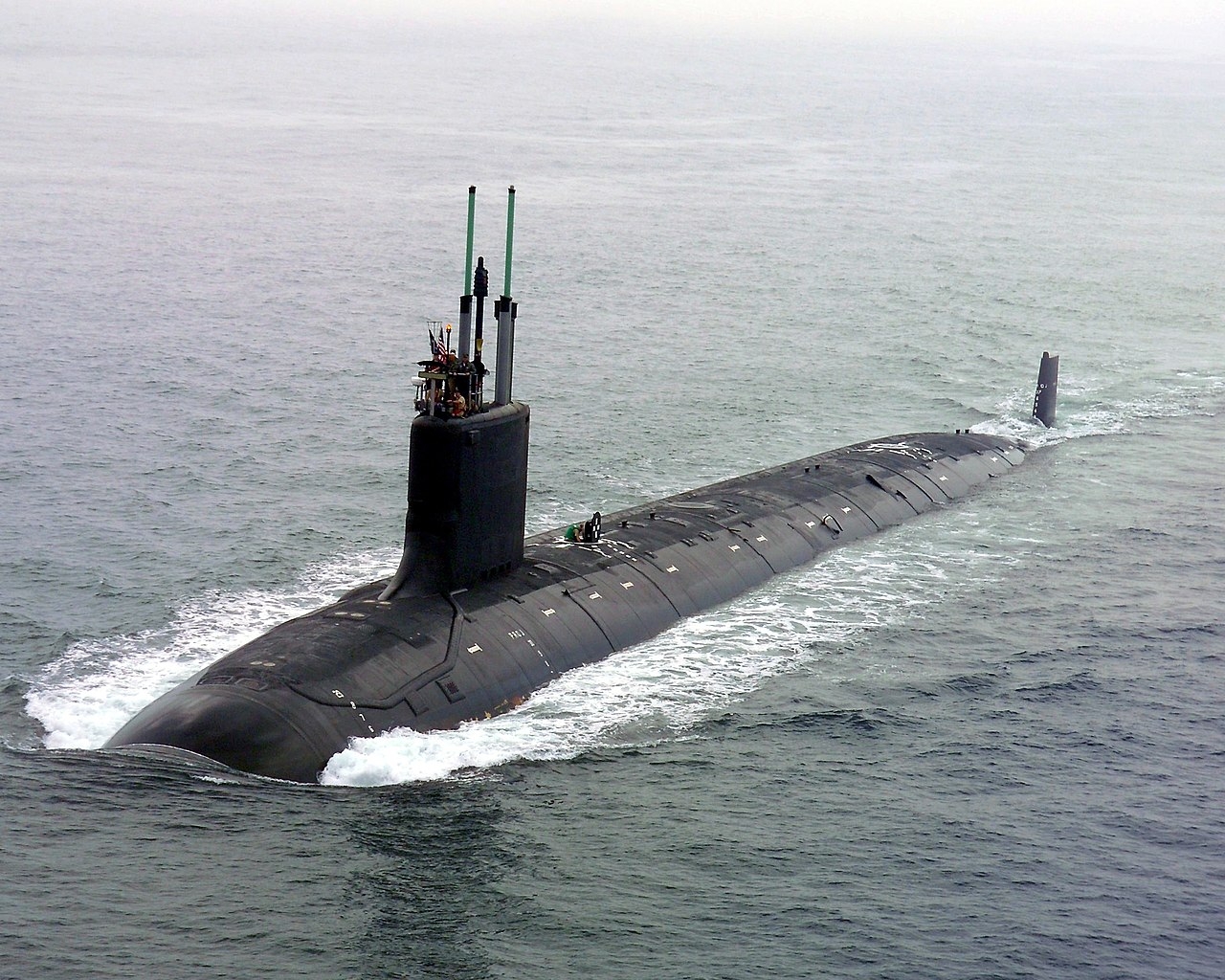
projection of Western military power in the region. Pictured: The USS Virginia nuclear-powered attack submarine. (Image source: U.S. Navy) |
Australia, the United Kingdom and the United States have announced
a new tripartite strategic alliance aimed at countering China's growing
assertiveness in the Indo-Pacific region. The AUKUS defense agreement,
under which Australia will acquire American-designed nuclear-powered
submarines, is a welcome paradigm shift intended to enhance the
projection of Western military power in the region.
AUKUS will supplement the Quadrilateral Security Dialogue
(also known as "The Quad"), a military partnership between Australia,
India, Japan and the United States aimed at protecting freedom of
navigation in the broader Asia-Pacific region. It will also strengthen Five Eyes, an intelligence-sharing alliance comprising Australia, Canada, New Zealand, the United Kingdom and the United States.
AUKUS, which has been described
as the foundation of an Indo-Pacific version of the North Atlantic
Treaty Organization (NATO), appears to be the centerpiece of an emerging
security architecture to check China's territorial ambitions.
Australian Prime Minister Scott Morrison, in a statement, explained the purpose of AUKUS:
"The security challenges in the Indo-Pacific region have
grown significantly. Military modernization is occurring at an
unprecedented rate and capabilities are rapidly advancing and their
reach expanding. The technological edge enjoyed by Australia and our
partners is narrowing.
"AUKUS will build on the three nations' longstanding and ongoing
bilateral ties and will enable the partners to significantly deepen
cooperation on a range of emerging security and defense capabilities,
which will enhance joint capability and interoperability. Initial
efforts under AUKUS will focus on cyber capabilities, artificial
intelligence, quantum technologies, and additional undersea
capabilities.
"This is an historic opportunity for the three nations, with
like-minded allies and partners, to protect shared values and promote
security and prosperity in the Indo-Pacific region.
"AUKUS will complement Australia's network of strategic partnerships,
including with our ASEAN friends, our Pacific family, our Five Eyes
partners, the Quad and other like-minded partners."
Notably, the AUKUS agreement does not include any member state of the
European Union, which was completely left in the dark about the new
alliance. AUKUS was announced on September 15, just hours before the EU unveiled
its much-hyped "Strategy for Cooperation in the Indo-Pacific." The EU
had been hoping that its new plan would highlight its "strategic
autonomy" from the United States in the Pacific region. Instead, the EU
was eclipsed by AUKUS and exposed as a paper tiger. A humiliated EU
foreign policy chief Josep Borrell admitted:
"We were not informed. We were not aware. We regret not
having been informed. We were not even consulted. I, as [the EU's] High
Representative, was not aware of it, and I assume an agreement of such
nature was not brought together overnight."
The United States is apparently sending a message to its traditional
security partners in Europe that they should stop fence-sitting and pick
a side regarding China, and possibly other adversaries of the West.
This is something the EU and its largest member states have been
unwilling to do.
The EU, under the direction of German Chancellor Angela Merkel and French President Emmanuel Macron, recently negotiated a controversial trade deal with China. The so-called Comprehensive Agreement on Investment
(CAI) was widely criticized because European leaders, in their rush to
reach an agreement with Beijing before the Biden administration took
office, sacrificed their professed concern for human rights on the altar of financial gain.
Human rights experts say that at least one million Muslims in Xinjiang, China's biggest region, are being detained in up to 380 internment camps, where they are subject to torture, mass rapes, forced labor and sterilizations.
Columnist Gideon Rachman, writing for the Financial Times, warned
that relying on an American security guarantee in Europe, while
undermining American security policy in the Pacific, "does not look like
a wise or sustainable policy over the long run." He added:
"The Europeans are also kidding themselves if they think
they can be blind to the increasingly authoritarian and aggressive
nature of Xi Jinping's China. For the past 70 years, Europeans have
benefited from the fact that the world's most powerful nation is a
liberal democracy. If an authoritarian nation, such as China, displaces
America as the dominant global power, then democracies all over the
world will feel the consequences."
Professor Andreas Fulda, a well-known China expert at the University of Nottingham, noted:
"Too many European elites still do not want to admit that
democracies are in a systemic rivalry with autocracies. Refusing to
acknowledge reality is convenient for them since it justifies their
inaction. But we need to do the opposite and double down in our defense
of democracies."
French Meltdown
As part of the agreement to acquire eight nuclear-powered submarines
with help from the US and the UK, Australia cancelled a contract worth
tens of billions of dollars — once dubbed the "contract of the century" — under which France was to supply Australia with 12 diesel-powered submarines.
France has reacted angrily to its change of fortunes. French Foreign
Minister Jean-Yves Le Drian called AUKUS a "stab in the back." He added: "This is not over. We're going to need clarifications. We have contracts."
In a subsequent interview with France 2 television, Le Drian escalated his attacks on Australia and the United States:
"There was lying, there was duplicity, there has been a major breach of trust, there has been contempt."
Speaking to France Info television, he added:
"The American behavior worries me. This unilateral,
brutal, unpredictable decision is a lot like what Mr. Trump did. We
learned brutally through a statement by President Biden that the
contract that the Australians signed with France is over and that the
U.S. will make a nuclear offer to the Australians."
French Ambassador to Australia Jean-Pierre Thébault said
that Australia's decision to cancel the deal was akin to "treason."
France recalled its ambassadors to Australia and the United States, and
the French Embassy in Washington, D.C. canceled
a reception it was hosting to mark the 240th anniversary of the Battle
of the Chesapeake, a decisive naval battle that helped the Americans
secure their independence from Great Britain.
Australia's Prime Minister Scott Morrison pushed back against the French narrative. He said
that he had told French President Emmanuel Macron in June that Canberra
was considering walking away from the submarine contract:
"I made it very clear, we had a lengthy dinner there in
Paris, about our very significant concerns about the capabilities of
conventional submarines to deal with the new strategic environment we
are faced with."
In an interview with Agence-France Presse, Morrison added:
"I think they would have had every reason to know that we
had deep and grave concerns that the capability being delivered by the
French submarine was not going to meet our strategic interests. We made
very clear that we would be making a decision based on our strategic
national interest. I don't regret the decision to put Australia's
national interest first. Never will."
In fact, the French deal to build submarines for Australia had been
dogged by years of problems, including cost overruns, production delays,
culture clashes and security breaches. The project, announced in 2016,
was originally slated to cost €31 billion (50 billion Australian
dollars). That figure has since almost doubled to €56 billion (90
billion Australian dollars). In addition, the cost of maintenance was
set to cost another €90 billion (145 billion Australian dollars) over
the life of the submarines.
Moreover, France was unable to deliver the first submarine before
2035, with construction of the rest extending well into the 2050s.
Australia feared that the submarines would be obsolete by the time they
were to be supplied. With its current submarines slated for retirement
in 2026, Australia would have been left vulnerable at a time of
increasing tensions with China.
Australia and France were also in conflict over the participation of
local industry. When the deal was announced in 2016, France pledged that
90% of the construction work would take place within Australia and
would create nearly 3,000 domestic jobs. By 2021, however, Naval Group,
the French company building the submarines, had reduced that figure to
60%, and it reportedly said that it could be reduced even further.
In April 2019, a report by the Australian Broadcasting Corporation highlighted
some of the cultural clashes between French and Australian workers: the
French practice of being late for meetings; the French sanctity of the
lunch break; and the French practice of taking an entire month off from
work during the traditional summer holiday — even though the submarine
contract was suffering from lengthy delays. Naval Group said that it was
developing "intercultural courses" for French staff being posted to
Australia. The aim was to prepare French expatriates and their families
for "how to behave, how to understand and decode."
Adding insult to injury, hackers leaked
more than 20,000 pages of secret French documents on the combat
capability of submarines it was building for India. The data breach raised concerns about the security of the Australian submarines.
David Sanger, national security correspondent for The New York Times, noted that the decision to create AUKUS was made on the sidelines of the Cornwall G7 summit in June:
"By the time the Biden administration began engaging
Australia and Britain seriously about its emerging strategy to counter
China, a three-year-old contract worth $60 billion or more for a dozen
submarines, to be constructed largely by the French, was already
teetering, American officials said. The submarines were based on a
propulsion technology that was so limited in range, and so easy for the
Chinese to detect, that it would be obsolete by the time the first
submarines were put in the water, perhaps as long as 15 years from now.
"There was an obvious alternative: the kind of nuclear-powered
submarines deployed by the Americans and the British. But American and
Australian officials agreed that if the French caught wind of the fact
that the plug was going to be pulled on one of the biggest defense
contracts in their history, they almost certainly would try to sabotage
the alternative plan, according to officials who were familiar with the
discussions between Washington and Canberra.
"So they decided to keep the work to a very small group of officials,
and made no mention of it to the French, even when Mr. Biden and Mr.
Blinken met their French counterparts in June."
Hugh Schofield, Paris correspondent for the BBC wrote:
"The fact is that the Australians calculated they had
underestimated the Chinese threat and so needed to boost their level of
deterrence. They acted with steely disregard for French concerns but,
when it comes to the crunch, that is what nations do. It is almost the
definition of a nation: a group of people who have come together to
defend their own interests. Their own, not others'.
"The lesson of the last week is that France by itself is too small to
make much of a dent in strategic affairs. Every four years the Chinese
build as many ships as there are in the entire French fleet. When it
came to the crunch, the Australians preferred to be close to a
superpower, not a minipower.
Richard Whitman, professor of politics and international relations at the University of Kent, added:
"The US thinks about how to contain China. And Australia
too is in the position of thinking about how one contains, as opposed to
how one accommodates; that's the fundamental difference with France. As
a consequence, the US looks like the better partner — when France was
always a second-order partner that could supplement rather than replace
anything the US might have to offer."
Geopolitical analyst Joseph Siracusa, in an interview with Sky News Australia, said that France's anger stems from the fact that it is being forced to choose between the United States and China:
"The French are very angry, not just about the submarine.
They've been trying to avoid choosing between Washington and Beijing.
They want their own 'strategic autonomy.' Europe thought they could play
the honest broker between Washington and Beijing, and then wake up one
morning and find out that the United States, Britain and Australia have
tied up together with this nuclear-enabled deal, and of course, it's
forcing Europe to make decisions it doesn't want to make.
"I think it was the only option for Australia because the French were
not going to annoy or unnecessarily irritate Beijing. They wanted
trade, economic, and investment relations.
"Now, Australia will have the capability to sink the Chinese navy in
72 hours; that's what this is all about. The Chinese know they have been
outmaneuvered, and they're very angry. In a very short period of time,
Australia has gone from a doormat to something very considerable — it's
an extraordinary development."
European affairs analyst Edward Lucas noted:
"France is furious. The ostensible reason is that the new
British-American deal to supply nuclear-powered submarines to Australia
has cost it a lucrative defense contract. The real reason is that the
emerging alliance to counter the Chinese Communist Party's imperialist
ambitions underlines France's impotence — and the irrelevance of its
plans for European 'strategic autonomy'.
"The lesson of the past few weeks is that the world does not run on
Brussels time, with its long periods for consultation, courteous
attention to the electoral cycles of 27 countries, and sacrosanct
weekends, evenings, and lunch breaks. It runs on the brutal tempo seen
in the Taliban's advance to Kabul, and in the Chinese leadership's
headlong pursuit of regional military superiority. Running on Brussels
time, the EU finds it hard to deal with threats close to home (fragility
in the Western Balkans, a crackdown in Belarus, jihadists in the Sahel,
civil war in Syria), let alone with superpowers like Russia and China.
The result: when serious countries take serious steps to deal with
serious threats, the unserious ones are left on the sidelines....
"The price of credibility is capability: when Europeans show that
they can exercise diplomatic, economic, and military power in a
sustained, determined manner, they will also show that they are
worthwhile partners in global security."
Robert Singh, a professor of American politics at Birkbeck, University of London, added:
"In Washington, that episode [the hurried signing of the
EU trade agreement with China] contributed to a skepticism towards
Paris. France is very much seen as too soft on China — at a time when
the US is clearly concerned that too many states on every continent are
being suckered by China's economic statecraft into positions where US
security alliances are likely to be endangered. So to see France do what
it did with that trade deal was very disappointing to the Biden
administration. My impression is that the US won't care very much that
it has outraged France with this Australian submarine deal."
Chinese Belligerence, European Myopia
The impact of French mismanagement of the submarine project was
compounded by China's increasing bellicosity toward Australia. After
Canberra called for an investigation into the origins of the Coronavirus
pandemic, for instance, Beijing responded with a trade war. Australia
apparently has concluded that the United States is the only country that
can contain China. Geopolitical analyst Craig Hooper stated:
"The events of last week demonstrate that geopolitical
change happens fast. In the space of just five years, China's appetite
for regional imperialism forced a complete revision of Australia's
strategic position. In 2016, Australia's lash-up with France for 12
conventional submarines was seen as an innovative opportunity for France
and Australia to position themselves as a relatively well-armed, albeit
inoffensive and nominally non-aligned set of Pacific 'balancers,'
buffering growing friction between China and America....
"China had other ideas about such inoffensive balancing. To the
Chinese, the sophisticated middle path was just an admission of weakness
and low resolve. Almost immediately as the ink dried on the sub
agreement, China began putting an enormous amount of energy into
shrinking Australia down to an impotent Chinese suzerainty. To that end,
China directly tinkered with Australian politics, funding pro-China
news outlets, thinkers, and politicians. It interfered in Australia's
regional affairs, opened a vicious trade dispute, and presented
Australia with a humiliating and sovereignty-eroding set of terms to
restore favorable relations.
"In the end, China's existential threat made Australia and France's
experiment in inoffensive deterrence — replicating the
collaborative-but-unaligned approach of Sweden or Finland in Europe —
untenable. France underestimated how China's naked military ambition,
chronic disregard for international order, and barely concealed
aspirations to control the deep Pacific and Antarctica pushed Australia
to make tough decisions about the future."
Commentator Wolfgang Münchau, in an essay published by the London-based The Spectator, wrote that AUKUS is a "disaster" for the European Union:
"It is hard to overstate the importance of the so-called
Aukus alliance between the US, the UK and Australia — and the implicit
geopolitical disaster for the EU. The alliance is the culmination of
multiple European failures: naivety at the highest level of the EU about
US foreign policy; Brussels's political misjudgments of Joe Biden and
his China strategy; compulsive obsession with Donald Trump; and the
attempt to corner Theresa May during the Brexit talks. If you treat the
UK as a strategic adversary, don't be surprised when the UK exploits the
areas where it enjoys a competitive advantage.
"The EU has outmaneuvered itself through lazy group-think. While
German political parties are still discussing the pros and cons of Nato,
the Biden administration is moving beyond Nato towards a multipolar
defense strategy. Nato remains a pillar but it is now supplemented by
informal Indo-Pacific alliances. One of them is the Quad: the US, Japan,
India and Australia. Five Eyes is an informal intelligence alliance
between the US, Canada, UK, Australia and New Zealand. Aukus is a
nuclear submarine pact between the US, the UK and Australia. This is the
variable geometry of the new international order — whereas the
monolithic EU is stuck with its 27 veto-wielding members in the foreign
affairs council."
The editorial board of the London-based The Telegraph wrote:
"The Aukus defense pact between the UK, US and Australia
is game-changing. A courageous decision to share nuclear technology with
a friendly power, it re-tilts UK foreign policy towards the Pacific,
where the threat of China must be managed, and proves that Global
Britain is a concrete idea. Brexit, finally, is making a real, historic
difference.
"To the French, however, it is a betrayal. Some degree of annoyance
might be understandable, given that the country has lost out on a deal
to sell 12-diesel powered submarines to Australia. But the extent of
Emmanuel Macron's fury is absurd, and only shows the sublime lack of
self-awareness that has come to characterize Europe's myopic political
elites.
"Paris has recalled its ambassadors from Canberra and Washington;
Britain has been labelled a poodle. The deal was, allegedly, a 'stab in
the back.' All this is petulant and stunningly hypocritical: the
European establishment has a long history of treating its geopolitical
partners abysmally while wearing a mask of moral superiority....
"Paris is hardly a stranger to hard-nosed realpolitik, being among
the leading proponents of the view that international affairs is about
defending your national interests even at the cost of those of your
allies....
"Evidently, the Aukus partners sought a nimble alliance that can
react fast to events; the plan was apparently sealed at the G7, only in
June. It is also a deal based on trust. The UK and the US have been
partners in nuclear technology since the 1940s: the last time the US
shared nuclear propulsion technology was with Britain in 1958. Drawing
Australia into that relationship, a rising power with historic links to
the UK and a member of the elite Five Eyes intelligence sharing group,
was not a thoughtless betrayal of the French. It was entirely rational
in the circumstances....
"The US was disgusted by Germany's pipeline deal with Russia, and
while Washington is now seeking partners that will stand firm against
China, Europe has too often shown itself willing to compromise with
Beijing in order to secure trade and investment advantages....
"Aukus vindicates the UK's exit from the EU. Brexit set the UK free
to re-evaluate its own interests and serve them better. The deal proves
decisively that the Remainer claim that Britain can have no influence
outside of a European bloc, to which it must necessarily surrender its
sovereignty or become irrelevant, was a lie. The UK is an attractive
geopolitical partner, with significant military and diplomatic
advantages, that now has the capacity to act more flexibly in global
affairs. Mr. Macron will just have to get used to that."
Veteran European affairs columnist Gerard Baker, writing for The Wall Street Journal, added:
"To its credit, the Biden administration has largely
signed on to the idea that the defining issue of the 21st century will
be the strategic rivalry between the U.S. and China....
"But Europe has made clear it doesn't want to join that rivalry. Even
France, which uniquely now since the U.K. left the bloc has the
military capabilities to project power globally, has indicated its
reluctance. Condemning the U.S. this weekend, the French Foreign
Minister Jean-Yves Le Drian said, 'We see the rise of an Indo-Pacific
strategy launched by the United States that is militarily
confrontational. That is not our position.'
"That's because the EU continues to decline to take any serious
responsibility for global peace and security, preferring to see the
economic and commercial opportunities in the relationship with China,
rather than the threat the Chinese Communist Party represents....
"This is the existential problem for the EU exposed by Mr. Biden's
undiplomatic coup: There has probably never been as large a mismatch
between the economic weight of an institution and its political and
military strength. Through its history the EU has prioritized — to great
success — its economic interest, safe in the knowledge that the U.S.
security umbrella was there to protect it. Now that the U.S. really
needs it to share some of the costs of that umbrella, the EU is missing
in action."
Professor of French History, John Keiger, writing for The Spectator, concluded:
"What the three Anglosphere states in the Aukus pact have
put together is a loose, flexible and nimble arrangement for managing
Indo-Pacific security directly. This is something that is second nature
to states of a culture that General de Gaulle always referred to as
'Anglo-Saxon'. It is just the kind of arrangement that is anathema to
the formal, rational and legalistic method of the French and their
cultural offshoot the EU, whose modus operandi was best demonstrated by
the glacial formalism applied to the Brexit negotiations....
"Aukus members probably wanted France in the pact. Diplomatically and
militarily she has much to offer in terms of naval projection, nuclear
submarines and weapons, intelligence and physical presence by dint of
her overseas territories in the south Pacific. But wishing to react
rapidly, they were probably anxious about her cultural proclivity to
define every term, role and eventuality. The crucial problem for France
is that by her own admission the Australian deal wasn't merely about
submarines. It was the keystone in a regional security edifice carefully
pieced together that will now have to be remodeled completely, were
that possible. This is the source of their disappointment and public
outrage.
"The second problem for Paris is that Aukus is not just a coalition
of three. It will be the nexus of a much broader web drawing in other
informal regional groupings with varied objectives from security to
trade, such as the Quadrilateral Security Dialogue, or Quad, of US,
Japan, India and Australia, or the 12 nation Trans Pacific Partnership
trade agreement which includes the US (albeit withdrawn under Trump),
Australia, Japan, Vietnam, Malaysia, Singapore, New Zealand and a
pending UK membership.
"France could now find herself outside these concentric circles. Her
only full access would be by belated invitation to the sanctum sanctorum
of Aukus. But as a late joiner she might be required to be amenable on
other matters....
"What Macron does next is therefore key. With the presidential
election campaign unofficially underway and France about to take up the
presidency of the EU council for six months, he is certain to make
grandiloquent statements about France and Europe's only salvation lying
in European 'strategic autonomy' from the US and NATO. But Macron knows
in his heart of hearts, like his French predecessors, that this has been
on the cards since the French inspired — and French scuppered —
European Defense Community of 1954 and that it will go nowhere during
his mandate.
"What's more, an EU defense and security role in the Indo-Pacific
will go no further than gesture politics, as only France has the
capability to deploy in the area. Macron will have to swallow his pride
and go with Aukus."