Saturday, October 2, 2021

Americans' Shifting Views on the Palestinian-Israeli Conflict - Eytan Gilboa


by Eytan Gilboa

Turning Israel's struggle for survival upside down—with aggressors turned into hapless victims and vice versa—the fake Palestinian narrative of unblemished victimhood has made inroads into American public opinion.
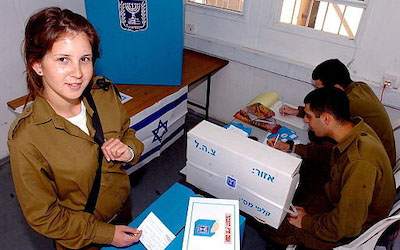
The positive favorability rating of Israel among Americans is likely related to views on the Israeli and Palestinian political systems. While Israel is a thriving liberal democracy, the PA is a corrupt, ineffective, and failed dictatorship.

As the worldwide mass demonstrations during the latest war between Israel and Hamas vividly illustrate, every conflict is fought twice: first on the battlefield, then in public opinion. Having failed to destroy the State of Israel upon its birth and in ensuing decades of terrorism, the Palestinians waged a sustained propaganda battle to win over Western hearts and minds, especially in the United States, the foremost world power and Israel's staunchest and most longstanding ally.

Turning Israel's struggle for survival upside down—with aggressors turned into hapless victims and vice versa—the fake Palestinian narrative of unblemished victimhood has made inroads into American public opinion. This has been especially true since the onset of the Oslo "peace process," which transformed the Palestine Liberation Organization (PLO) overnight from the world's leading terror organization into a (supposed) peaceable political actor.

Yet, examination of American attitudes toward the Palestinian-Israeli conflict over the past two decades, as reflected in national public opinion surveys during this period, reveals stable and highly favorable feelings toward Israel, albeit not without some widening fissures, and unfavorable, if somewhat improving, attitudes toward the Palestinians. Indeed, even the foremost indicator of the improving Palestinian image—the growing support for the establishment of a Palestinian state within the framework of the two-state solution—is not only a corollary of pro-Palestinian sentiments but also of the widespread belief that, as the only (perceived) road to peace, such a move is in Israel's best interests.

Trends and Issues

Favorability. General feelings toward peoples and nations influence opinions on specific issues and policies, and surveys use the term "favorability" to gauge such feelings. Over the past two decades most surveyed Americans held positive opinions of Israel, with its favorability rate rising from 62 percent in 2000 to 74 percent in 2020 (an average 64 percent rate in 2000-10, and 71 percent in 2011-20). By contrast, favorable opinions of the PLO-controlled Palestinian Authority (PA), established in 1994 by the Oslo accords as the official governing body of the West Bank and the Gaza Strip's Palestinians, remained conspicuously low (and virtually unchanged) over the past two decades: 21 percent favorability rate in 2000 and 23 percent in 2020.
Apart from the numerous, mutually beneficial aspects of the longstanding U.S.-Israeli relationship (e.g., military, intelligence, and technological collaboration), this substantial favorability gap is probably related to the diametrically opposed nature of the Israeli and Palestinian political systems. While Israel is a thriving liberal democracy, the PA is a corrupt, ineffective, and failed dictatorship. During its 27-year existence, it has been headed by only two leaders: Yasser Arafat until his death in November 2004, and Mahmoud Abbas ever since (despite the expiry of his presidential term in early 2009). Similarly, the PA held parliamentary elections only twice—in January 1996 and January 2006—after which it effectively ceased to function as Abbas would not allow Hamas, which won the 2006 elections by a landslide, to run the PA. This drove the Islamist terror organization to eject the PLO violently from Gaza in 2007 and to establish its own repressive rule there.

Nor has the PA ever established an independent media and judiciary or respected basic human rights including freedoms of life, liberty, opinion, expression, assembly, and women rights.[1] And while the PA regularly blames its ineptness and failures on the "Israeli occupation," the truth is that this "occupation" ended in January 1996 when Israel withdrew its forces from the West Bank's populated areas, with the exception of Hebron where redeployment was completed in early 1997, while withdrawal from the Gaza Strip's populated areas had been completed by May 1994. Since then, 95 percent of the West Bank and the Gaza Palestinian population have lived under the rule of the PA (and since 2007, under Hamas's rule in Gaza), which have turned these territories into repressive dictatorships.[2]

Another cause of the negative view of the PA (and Hamas) has been its persistent use of terrorism—from Arafat's tacit encouragement of Hamas's and the Islamic Jihad's 1990s suicide bombings; to its four-year-long terrorist war (September 2000- February 2005), euphemized as the "al-Aqsa Intifada"; to the firing of thousands of rockets from the Gaza Strip on Israeli population centers; to the "pay and slay" policy of remunerating convicted terrorists imprisoned in Israel. Indeed, whenever Palestinian terrorism seemed to be abating, there was a spike in the PA's favorability image among Americans, notably in 2005 when the "al-Aqsa Intifada" withered away following Arafat's death and Israel's successful counterterrorism measures.

There is a historic trend of greater American sympathy with Israelis than with the Palestinians.

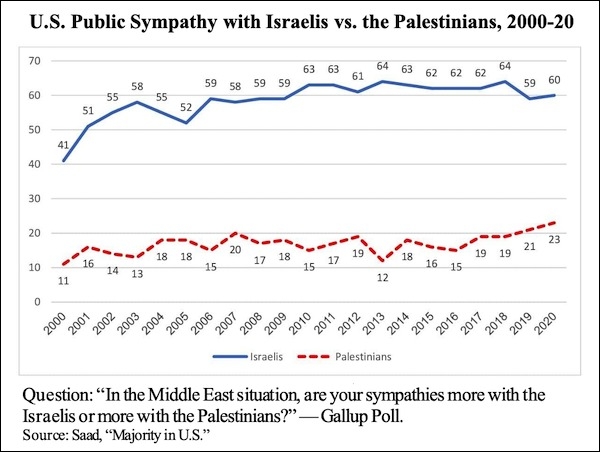
Sympathies. As with the favorability factor addressing attitudes toward Israel and the PA as political entities, the "sympathy" factor, exploring sentiments toward Israelis and Palestinians as national communities, has evinced a historic trend of greater American sympathizing with Israelis than with the Palestinians (or other Arabs for that matter). Examples include: the overwhelming U.S. public support for the establishment of a Jewish state before the passing of the November 1947 U.N. partition resolution when 65 percent of Americans surveyed in a Gallup poll supported the idea[3]; the wall-to-wall sympathy for Israelis and censure of Arab aggression during the 1967 Six-Day War (56 percent vs. 4 percent),[4] and a figure of 64 percent in sympathy with Israelis during the 1991 Gulf War, compared to 7 percent with the Palestinians.[5]

There has, of course, been the occasional fluctuation from this pattern in accordance with regional vicissitudes. After the September 1982 killing of hundreds of Palestinians in the Beirut refugee camps of Sabra and Shatila by a local Christian militia, for example, the gap between sympathy for Israelis and Palestinians narrowed to its slimmest point (32 percent vs. 28 percent). Conversely, Palestinian support for Saddam Hussein's brutal occupation of Kuwait and his unprovoked missile attacks on Israel led to a record sympathy gap of 57 percent in favor of Israelis. But on the whole, the "sympathy index" during the latter part of the twentieth century reveals a substantial and stable gap in favor of Israelis.

This pattern stayed virtually unchanged in 2000-20, with American public opinion remaining vastly more sympathetic to Israelis than to Palestinians. Thus, the sympathy gap between the two groups grew from 35 percent in 2001 to 48 percent in 2010 (51 percent vs. 16 percent and 63 percent vs. 15 percent respectively) before narrowing to 37 percent in 2020 (60 percent vs. 23 percent). This shows that the increase in sympathy for the Palestinians did not come at the expense of sympathy for Israelis, with the average gap in their favor over the past two decades standing at 41 percent, being slightly wider in 2020 than in 2001: 37 percent vs. 35 percent.[6]

As in previous decades, there were some fluctuations from this general pattern of stability, mainly in the extent of sympathy for the Palestinians: the greater their political intransigence and physical violence, the less public American sympathy there was for their cause and the reverse. Thus, for example, the outbreak of the "al-Aqsa intifada" widened the sympathy gap in favor of Israelis from 30 percent in 2000 to 45 percent in 2003 with this gap narrowing to 38 percent in 2007 with the abating of this war of terror.

Paradoxically, the sympathy gap in Israelis' favor widened noticeably during Barack Obama's two terms in office (from 41 percent in 2009 to 47 percent in 2016) and narrowed by the same ratio during Donald Trump's presidency (from 43 percent to 37 percent). Obama took an unabashed, anti-Israel stance. He told Abbas, "You will never have an administration as committed [to the Palestinian cause] ... as this one."[7] The Palestinians likely took this as a carte blanche for shedding all pretenses of seeking a settlement and left the negotiating table with Israel. Similarly, Hamas exploited Obama's anti-Israel stance by transforming the Gaza Strip into an ineradicable terrorist bastion that rained thousands of rockets and missiles on Israel's population centers, triggering four ferocious wars (in 2008-9, 2012, 2014, and 2021). By contrast, Trump's staunch support for Israel generated a timid Palestinian policy for fear of retribution by the unpredictable U.S. president as vividly illustrated by the relative calm along the Gaza-Israel border, the low-key response to recognition of Jerusalem as Israel's capital, or to the move of the U.S. embassy to the city. All this occurred in stark contradiction of widespread apocalyptic predictions that these moves would trigger a regional conflagration.

The Two-state Solution

Since Jordan's renunciation of its claim to the West Bank in July 1988, and the PLO's feigned acceptance four months later of Security Council Resolution 242 that created the land-for-peace formula, the resolution has been reinterpreted (or rather misinterpreted as it makes no mention of the Palestinians) to imply a two-state solution. It has been considered the cornerstone of a future Israeli-Palestinian peace, based on an Israeli state and a newly-established Palestinian state in the West Bank and the Gaza Strip living peacefully side by side.[8]

This misinterpretation gained further momentum with the 1993 launch of the Oslo process, which was widely seen as geared toward that goal though none of the agreements signed within this framework spelled it out. And while the PLO remained highly evasive, supporting the two-state solution while addressing foreign audiences and prophesying Israel's demise to its own Palestinian constituents, all Israeli prime ministers during the Oslo years (with the exception of Yitzhak Rabin who envisaged "an entity short of a state")[9] publicly endorsed the two-state solution.

Against this backdrop, very few American public opinion polls during the 1990s directly addressed the two-state solution, likely because it was generally assumed to be the only possible option. The issue resurfaced following the seeming collapse of the Oslo process after the launch of Arafat's war of terror in September 2000. In subsequent years, the American public's support or opposition to the idea fluctuated in line with the vicissitudes in the ferocity of Palestinian terrorism and the extent of their political intransigence.

Thus, for example, support for the two-state solution dropped from 53 percent in 1999 to 40 percent in 2000—its lowest point in the subsequent twenty years—before leaping to 58 percent in 2003—the highest level ever since.[10] This was due to Israel's highly successful counterterrorism campaign that broke the backbone of the Palestinian war of terror and enabled President Bush to make his June 2002 historic speech espousing the creation of a Palestinian state headed by "new leaders, leaders not compromised by terror" and predicated on "entirely new political and economic institutions based on democracy, market economics and action against terrorism."[11] And while this change of Palestinian leadership failed to materialize, support for the two-state solution remained steady for the rest of the Bush presidency, sliding gradually over the years to 52 percent in 2008 (with opposition rising from 22 percent in 2003 to 29 in 2008) as peace hopes faded after Hamas's January 2006 landslide victory in the Palestinian parliamentary elections and its violent takeover of the Gaza Strip the following year.[12]

During Obama's two terms in office, support for the Palestinians and the two-state solution dropped.

Just as American public sympathy for the Palestinians dropped noticeably during Obama's two terms in office, so did support for the two-state solution, and for the very same reason: Public opinion polls showed the strength of support for the creation of a Palestinian state to be dependent on the PA's recognition of Israel's right to exist and its determination to fight terrorism and dismantle the terrorist infrastructure in the territories under its control.[13] But with the most pro-Palestinian president in the White House since Jimmy Carter, the PA hardened its intransigence in the hope that Obama would deliver Israel on a silver platter, and American public support for the two-state solution dropped.

Thus, when in June 2009, Benjamin Netanyahu agreed to the establishment of a Palestinian state and five months later announced a 10-month construction freeze in the West Bank aimed at reviving "meaningful negotiations to reach a historic peace agreement that would finally end the conflict between Israel and the Palestinians," the PA's chief peace negotiator Saeb Erekat warned that the prime minister "will have to wait 1,000 years before he finds one Palestinian who will go along with him." In addition, Fatah, the PLO's largest constituent organization, reaffirmed its commitment to the "armed struggle" (the standard euphemism for terrorism) as "a strategy, not tactic ... in the battle for liberation and for the elimination of the Zionist presence."[14] With this rejectionist mindset persisting through the Obama years, accompanied as it was by rocket and missile barrages from Gaza on Israeli towns and villages, American public support for Palestinian statehood declined from 52 percent in 2008 to 44 percent in 2016 while opposition to the idea grew from 28 percent to 37 percent.[15]

This trend seemed to persist during Donald Trump's first year when the gap between support and opposition to the creation of a Palestinian state reached its narrowest point (46 vs. 42 percent)[16] due to the president's amenability to both the two-state and the one-state solution. "I can live with either one," he told Netanyahu in a White House meeting. "I'm very happy with the one that both parties like."[17]

When the PA responded with a more restrained policy, American public support for a Palestinian state grew steadily.

Yet, this approach was quickly reversed as the PA responded to Trump's staunch pro-Israel approach—manifested, among other things, in his recognition of Jerusalem as Israel's capital and the move of the U.S. embassy to the city—and adopted a more restrained policy in an attempt to weather the storm until the arrival of a friendlier administration. As a result of this lull, American public support for the establishment of a Palestinian state grew steadily, surging after the January 2020 release of Trump's long-awaited "Deal of the Century" peace plan to its highest level since Bush's 2002 speech, with opposition to the idea dropping to its lowest level (55 percent vs. 34).[18]

Political Attitudes

Republicans vs. Democrats. For decades, Israel enjoyed strong bipartisan political support in Washington. Spread almost evenly among Republicans and Democrats, this bipartisanship helped Israel promote favorable legislation in Congress and secure high levels of military aid. By the early 2000s, however, this pattern had fundamentally changed with Republicans sympathizing more strongly with Israel than Democrats. This partisan divide widened substantially over the next decades as growing numbers of Republicans sympathized more with Israelis than with the Palestinians (86 percent in 2020 compared to 59 percent in 2001) while the level of sympathy for the Jewish state among Democrats remained virtually unchanged (42 percent in 2001 compared to 44 percent in 2020). Thus, while in 2020, nearly 9 of 10 Republicans sympathized more strongly with Israelis than with Palestinians and only 5 percent had greater sympathy for the Palestinians, Democrats sympathized almost evenly with both sides: 44 percent vs. 38 percent.

The decline in sympathy for Israelis was the sharpest among liberal and/or progressive Democrats: in 2014-16, the share of liberals/progressives sympathizing with the Palestinians over the Israelis shot from 21 percent to 40 percent. This downward shift in sympathy for Israel was most pronounced during the Trump presidency as the progressive wing of the party became increasingly powerful and vociferous.[19]

Republicans and Democrats also differed on the establishment of a Palestinian state with support for the idea consistently stronger among Democrats. The gap between the parties was at its narrowest during the Bush presidency, so much so that in 2003, under Bush, Republican support for Palestinian statehood even surpassed that of the Democrats (60 percent vs. 55 percent). This was despite the fact that Democratic support for the idea grew at a far higher rate during the Bush presidency than during the Obama years (14 percent compared to 2 percent). The fact that Democrats' support for Palestinian statehood remained virtually unchanged under a staunchly pro-Palestinian Democratic president while significantly growing under a Republican president inimical to the PLO and PA (especially after being lied to by Arafat about his personal involvement in terror activities)[20] was due to Israel's suppression of Arafat's war of terror (2000-05), on the one hand, and the sustained rocket attacks on Israel's population centers attending Hamas' Gaza takeover in 2007.

Indeed, even during the Trump presidency, support among Democrats for the creation of a Palestinian state grew at a higher rate than under Obama's watch: from 61 percent in 2017 to 70 percent in 2020 (while Republican support for the idea grew by a whopping 19 percent: from 25 percent in 2017 to 44 percent in 2020). Thus, paradoxically, Trump's "Deal of the Century" produced strong bipartisan support for Palestinian statehood for diametrically opposed reasons: among Democrats, as a means to subvert the deal, which they considered an obstacle to Palestinian statehood, and among Republicans, as a means to promote the two-state solution.

Religious Attitudes

American Jews. For obvious reasons, American Jews have always felt attached to Israel, and this trend continued in 2000-20 with more than two thirds of surveyed members of this community feeling affinity and closeness to Israel, sympathizing much more with Israelis than with Palestinians (93 percent in 2001-14, dropping to 86 percent in 2015-19).[21] According to a 2019 survey, 80 percent of American Jews considered themselves pro-Israel (despite being critical of government policies) while 67 percent felt an emotional attachment to the Jewish state.[22]

As for the establishment of a Palestinian state, American Jewish support remained rather static during the Bush and Obama's presidencies (growing from 49 percent in 2002 to 52 percent in 2016), before gaining considerable momentum during the Trump years: from 52 percent in 2016 to 64 percent in 2020. This corresponds to the pattern of Democratic support for Palestinian statehood during the Trump years (hardly surprising given the historic Jewish identification with the party), with the notable exception that the rise in Jewish support for the idea during this period was more dramatic than that of Democrats and the general public (a 12 percent rise compared to 8 percent and 6 percent respectively). This is most likely due to the addition of the qualification "demilitarized" to the description of the Palestinian state in the American Jewish Committee Poll, on the one hand, and to the bipartisan nature of the Jewish community, on the other. As such, support for Palestinian statehood was both an anti-Trump statement by Democratic Party supporters (still the vast majority of American Jewry) and a vote of confidence in Trump and his policies by the growing number of American Jewish Republicans.

Christian Denominations. Religion has been a significant predictor of attitudes toward the Palestinian-Israeli conflict with devout Americans significantly more likely to sympathize with Israel than their less devout counterparts and vice versa. Aggregate Gallup data for 2000-19 shows that 66-71 percent of Americans who attended church weekly or almost weekly sympathized with Israel compared to 46-49 percent of those who never attended religious services (and who were twice more sympathetic to the Palestinians: 26 percent vs. 13 percent respectively).[23] The sympathy gap was at its lowest among those with no religious affiliation, with 38 percent sympathizing with Israel and 29 with the Palestinians.[24]
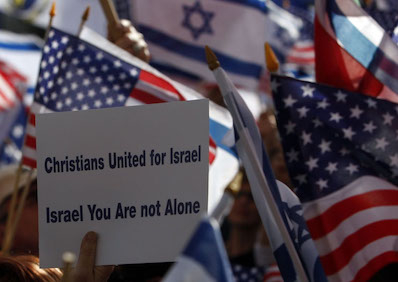
Devout American Christians are more likely to sympathize with Israel than their less devout counterparts are. Among Christians, Evangelical Protestants' support for Israel has intensified most over the past two decades.

As such, religiously unaffiliated Americans were most critical of Trump's Palestinian-Israeli policy with 47 percent thinking he favored Israel too much and 38 percent saying he struck the right balance between Israelis and Palestinians. By contrast, only 26 percent of American Christians thought Trump was overindulging Israel while 59 percent (72 percent of Evangelical Protestants) believed he struck the right balance. Interestingly, criticism of Trump's supposed indulgence of Israel was significantly higher among American Jews than among their Christian compatriots (43 percent vs. 26 percent), echoing the moderate or conservative voice of the Democratic party, as opposed to its liberal-progressive wing, which overwhelmingly believed Trump favored Israel too much (66 percent).[25]

Broadly speaking, sympathy or favoritism of both Israelis and Palestinians among American Christians grew substantially and rather symmetrically over the past two decades: from 41 percent sympathetic to Israelis vs. 13 percent sympathetic to Palestinians in 2003 to 69 percent vs. 41 percent in 2019: thus, a sustained 28 percent sympathy gap in favor of Israel during this period.[26] In terms of denominational affiliation, Mormons sympathized most strongly with the Israelis (79 percent vs. 11 percent with the Palestinians), followed by Protestants (66 percent vs. 13 percent) and Catholics (50 percent vs. 18 percent).[27]

Yet it was evangelical Protestants, sometimes called "Christian Zionists," whose staunch and consistent support for Israel has intensified most impressively over the past two decades. In 2003, 55 percent of white Evangelicals sympathized with Israel and only 6 percent with the Palestinians (compared to 41 percent vs. 13 percent of all surveyed Christian religious groups)[28]; by 2016, this ratio had grown to 79 percent (5 percent sympathized with the Palestinians). Support among evangelical Republicans was even higher—85 percent, compared to 69 percent of all Republicans.[29]

Even as American public attitudes toward the conflict became increasingly polarized during the Trump years, with Democrats more favorable for the first time toward Palestinians and the PA (58 percent vs. 57 percent) than toward Israelis and the Israeli government (27 percent vs. 26 percent),[30] evangelical support remained undaunted. Some 79 percent of Evangelicals had a favorable view of Israelis (compared to 35 percent of Palestinians), and 61 percent viewed the Israeli government positively—while only 13 percent had a positive view of the Palestinian Authority, and 79 percent viewed the authority negatively.[31]

Conclusion

While surveys of American public opinion show steady and consistently stronger sympathies for Israel and Israelis than for Palestinians and the Palestinian Authority in 2000-20, these attitudes have grown increasingly partisan over the past decade, culminating during the Trump presidency in Democrats sympathizing more with the Palestinians and the PA than with Israelis and the Israeli government. This shift was primarily a corollary of the relatively low level of Palestinian political and military militancy during the Trump years. Indeed, more than any other single factor, it is the intensity of Palestinian violence and intransigence that has determined the way Palestinians and the PA were seen by Americans and the extent of support for the establishment of a Palestinian state.
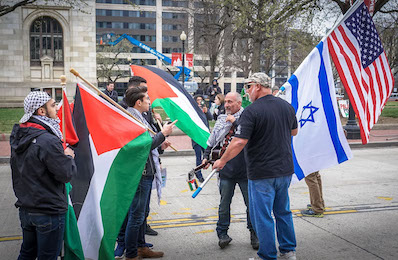
Supporters of Israel and the Palestinians meet. The intensity of Palestinian violence and intransigence has determined the extent of American support for the establishment of a Palestinian state. (Photo: Ted Eytan)

As a result, public sympathy with the Palestinians was less, even among Democrats, during the Obama presidency than during the Bush and Trump years as the PA and Hamas interpreted Obama's anti-Israel bias as free rein to walk away from the negotiating table and to subject Israeli civilians to years of sustained rocket and missile attacks. This Palestinian pattern seems to be repeating itself with the Biden administration's eagerness to reenter the Iran nuclear deal; its cold shouldering of America's longstanding regional allies; and its restoration of the Palestinian problem to the top of its agenda. These policies have already enticed Hamas into a war with Israel and triggered mass violence in the West Bank and by Israel's Arab citizens.

Though Palestinian violence and intransigence are almost certain to intensify in tandem with the Biden administration's increased pressure on Israel, this may not necessarily dampen public sympathy for the Palestinians as in past decades since several key developments seem to be working in their favor. For one thing, the fervent polarization of American politics, alongside the mainstreaming of anti-Semitism and the continued movement to the left of Democratic constituencies, may have made segments of American society less sensitive to anti-Jewish and anti-Israel violence. For another thing, with twice as many sympathizers among non-white Americans (33 percent in a 2020 survey vs. 18 percent of whites) as opposed to Israel's predominantly white sympathy base (68 percent in the same survey vs. 43 percent non-whites),[32] the Palestinians have successfully cast their fight to destroy Israel as a liberation struggle by a colonized indigenous people against a "privileged white oppressor."

Small wonder that as Hamas was deliberately perpetuating the wanton war crime of raining thousands of missiles on Israel's population centers, the Black Lives Matters movement tweeted its "solidarity with the Palestinians," adding a thinly veiled wish for Israel's demise: "We are a movement committed to ending settler colonialism in all forms and will continue to advocate for Palestinian liberation. (Always have. And always will be)."[33]

Israel and its allies in the United States must endeavor to restore the traditional, bipartisan support of Republicans and Democrats.

In light of the above polls, if Israel and its allies in the United States wish to maintain its still significant support vis-a-vis the Palestinians in American public opinion (60 percent vs. 23 percent in 2020),[34] they must address any liberal-progressive criticism, strengthen the bond with the American Jewish community—especially its younger segments—and endeavor to restore the traditional, bipartisan support of Republicans and Democrats.

Eytan Gilboa is Professor Emeritus of Political Science and International Communication at Bar-Ilan University and a senior research associate at the BESA Center for Strategic Studies. His publications include books and numerous articles on American-Israeli relations including The American Public and Israel in the Twenty-First Century (BESA, 2020).


[1] Bassem Eid, "Confronting Human Rights Abuses in the Palestinian Authority: An Essential Step for Progress in the Region," The Henry Jackson Society, London, 2016.

[2] Efraim Karsh, "The Oslo Disaster," Begin-Sadat Center for Strategic Studies, Bar-Ilan University, Mideast Security and Policy Studies, no. 123, 2016, pp. 21-2.

[3] Efraim Karsh, The Tail Wags the Dog: International Politics and the Middle East (London: Bloomsbury, 2015), p. 56.

[4] Eytan Gilboa, American Public Opinion toward Israel and the Arab-Israeli Conflict (Lexington, Mass.: Lexington Books, 1987), pp. 47-8.

[5] "American Sympathy toward Israel and the Arabs/Palestinians, 1967-2020," Jewish Virtual Library, Chevy Chase.

[6] "Republicans and Democrats Grow Even Further Apart in Views of Israel, Palestinians," The Pew Research Center, Washington, D.C., Jan. 23, 2018.

[7] Ben Birnbaum and Amir Tibon, "The Explosive, Inside Story of How John Kerry Built an Israel-Palestine Peace Plan—and Watched It Crumble," The New Republic, July 20, 2014.

[8] "Resolution 242 (1967) of 22 November 1967," S/RES/242 (1967), U.N. Security Council, New York.

[9] The 376th session of the 13th Knesset, Oct. 5, 1995.

[10] Lydia Saad, "Americans Closely Split Over Palestinian Statehood," Gallup, Washington, D.C., Feb. 24, 2015.

[11] "President Bush Calls for New Palestinian Leadership," White House archives, Washington, D.C., June 24, 2002.

[12] Lydia Saad, "Americans Still Doubt Mideast Peace Is in the Cards," Gallup, Washington, D.C., Feb. 27, 2014.

[13] See, for example, "Israel and the Palestinians," PollingReport, Washington, D.C., Aug. 5, 2020.

[14] Karsh, The Tail Wags the Dog, pp. 170-1.

[15] Saad, "Americans Closely Split Over Palestinian Statehood," Feb. 24, 2015; Saad, "Americans Still Doubt Mideast Peace Is in the Cards," Feb. 27, 2014.

[16] Lydia Saad, "Majority in U.S. Again, Support Palestinian Statehood," Gallup, Washington, D.C., Apr. 22, 2020.

[17] Politico (Arlington, Va.), Feb. 15, 2017.

[18] Saad, "Majority in U.S. Again, Support Palestinian Statehood," Apr. 22, 2020.

[19] Samantha Smith and Carrol Doherty, "Five facts on how Americans view the Israeli-Palestinian conflict," Pew Research Center, Washington, D.C., May 23, 2016; "Republicans and Democrats Grow Even Further Apart," Jan. 23, 2018; Lydia Saad, "Americans, but Not Liberal Democrats, Mostly Pro-Israeli," Gallup, Washington, D.C., Mar. 6, 2019.

[20] Douglas J. Feith and Lewis Libby, "How the Trump Plan Makes Peace Possible," Middle East Quarterly, Fall 2020.

[21] Frank Newport, "American Jews, Politics and Israel," Gallup, Washington, D.C., Aug 17, 2019.

[22] "American Jewry Position Survey," White Papers and Research, Ruderman Family Foundation, New York, Dec. 2019.

[23] Frank Newport, "Religion Plays Large Role in Americans' Support for Israelis," Gallup, Washington, D.C., Aug. 1, 2014; Newport, "Americans' Views of Israel Remain Tied to Religious Beliefs," Gallup, Mar. 19, 2019.

[24] Smith and Doherty, "Five facts," May 23, 2016.

[25] Gregory Smith, "U.S. Jews Are More Likely than Christians to Say Trump Favors the Israelis Too Much," Pew Research Center, Washington, D.C., May 6, 2019; "Half say Trump is 'striking about the right balance' in dealing with Israelis and Palestinians," Pew Research Center, Apr. 24, 2019.

[26] "American Evangelicals and Israel," Pew Research Center, Washington, D.C., Apr. 15, 2005; "Evangelical Protestants, mainline Protestants and Catholics express more favorable views of Israelis than Palestinians," Pew Research Center, May 6, 2019.

[27] Smith and Doherty, "Five facts," May 23, 2016; Newport, "Religion Plays Large Role in Americans' Support for Israelis," Aug. 1, 2014.

[28] "American Evangelicals and Israel," Apr. 15, 2005.

[29] Smith and Doherty, "Five facts," May 23, 2016.

[30] "U.S. Public Has Favorable View of Israel's People, but Is Less Positive Toward Its Government," Pew Research Center, Washington, D.C., Apr. 24, 2019.

[31] Smith, "U.S. Jews Are More Likely Than Christians to Say Trump Favors the Israelis Too Much," May 6, 2019.

[32] "Gallup News Service Gallup Poll Social Series: World Affairs—Final topline," Feb. 3-16, 2020.

[33] Twitter, Black Lives Matter, May 17, 2021.

[34] Saad, "Majority in U.S. Again, Support Palestinian Statehood," Apr. 22, 2020.


Eytan Gilboa is Professor Emeritus of Political Science and International Communication at Bar-Ilan University and a senior research associate at the BESA Center for Strategic Studies. His publications include books and numerous articles on American-Israeli relations including The American Public and Israel in the Twenty-First Century (BESA, 2020).

Source: https://www.meforum.org/62604/americans-views-on-the-palestinian-israeli-conflict

Follow Middle East and Terrorism on Twitter

Ali Alfoneh on the "Strategic Lessons" Guiding Iran's Behavior - Marilyn Stern


by Marilyn Stern

As U.S. policymakers wring their hands over the question of how to "persuade Iran to behave in a different way" than it has in the past, it is important to understand the "fundamental reasons" that Iran behaves the way it does.

Ali Alfoneh, senior fellow at the Arab Gulf States Institute in Washington, spoke to an August 13 Middle East Forum Webinar (video) about the "strategic lessons" driving the Iranian regime's increasingly confrontational behavior and what the United States can do about it.

As U.S. policymakers wring their hands over the question of how to "persuade Iran to behave in a different way" than it has in the past, it is important to understand the "fundamental reasons" that Iran behaves the way it does. Alfoneh believes that for all of its apocalyptic rhetoric, the Iranian regime's militant Islamist ideology is not the primary determinant of its behavior. The ruling mullahs are "extremely corrupt" and "more interested in the earthly paradise that they have in Tehran ... than the theoretical heavenly paradise which they may ... access ... in the next world." Their posture toward the outside world is influenced heavily by lessons learned from past experiences. And what are those lessons?

Iran's ruling mullahs are interested more in "earthly paradise" than in "heavenly paradise."

The first and simplest lesson is that proxy warfare works in advancing the Iranian regime's "regional objectives." In Syria, Iran achieved its goal of preserving the Assad regime against Sunni rebels hostile to Iran's Shi'a Islamist regime. In Yemen, through its Houthi allies, Iran denied a military and political victory to Saudi Arabia and the United Arab Emirates.

This lesson was reinforced by the U.S. withdrawal from Afghanistan, said Alfoneh. The two-decade-long proxy war waged by Pakistan against the U.S. in Afghanistan showed that even the world's most powerful country can be defeated in a proxy war. Pakistan won by changing American public opinion to conclude the "U.S. presence in Afghanistan was ... futile." Furthermore, the fact that the U.S. did not punish Pakistan for its aggressive contestation of American power taught Iran that having nuclear weapons provides "a free pass to engage in bad behavior and challenge the United States" without serious repercussions.

The second strategic lesson contributing to Iran's changed behavior is that "diplomacy doesn't always work." The 2015 Iran nuclear deal, or Joint Comprehensive Plan of Action (JCPOA), brokered by the Obama administration after many months of negotiations and backed by UN Security Council resolutions, was undone by the Trump administration, which re-instated sanctions as part of a "maximum pressure" campaign to win far-reaching concessions from Iran on its nuclear program, ballistic missiles, and other issues of concern. Now, Iranian leaders negotiate under the assumption that agreements cannot be trusted.

U.S. satellite imagery shows the precise points of impact that enabled Iranian drones to disable Saudi Arabia's Abqaiq oil processing facility in September 2019.

The third strategic lesson concerns the limits of American support for regional allies in their conflicts with Iran and its proxies. Although the Trump administration made a great show of encouraging Saudi Arabia, the UAE, and other Arab allies to resist Iran's bid for regional hegemony, Trump did not take decisive action when Iran began carrying out one violent provocation after another in the Gulf region in 2019, most notably the "pinpoint" missile and drone strike that disabled Saudi Arabia's Abqaiq oil processing facility that September. The passive American response demonstrated to the Iranians that "there is no appetite for war in Washington," Alfoneh explained. U.S. Arab allies drew the same conclusion and "have been trying to repair the relations with Tehran ever since."

The fourth and final lesson that has shaped Iran's behavior is that the regime can survive acute domestic hardships afflicting its subjects. Notwithstanding the economic impact of Trump's "maximum pressure" campaign on the Iranian population, the regime's security forces effectively suppressed protests. "When people are hungry, they cannot protest in an effective way and ... cannot threaten the survival of the regime," said Alfoneh.

People who are hungry and afraid of getting sick "cannot threaten the survival of the regime."

Likewise, while the mullah's mismanagement of the COVID pandemic has fueled popular disaffection with the regime, experience has shown that "poor people, sick people, people who are afraid of getting the disease ... do not constitute a lethal threat to the survival of the Islamic Republic." Indeed, it has shown "that the relative poverty of the people can be utilized ... to enhance [the] security and survival of the regime."

None of these lessons bode well for the Biden administration's efforts to achieve a diplomatic breakthrough with Tehran. Iran will approach negotiations with the U.S. cognizant of the pressure its proxies bring to bear on Washington and its allies, and of the former's limited backing of the latter; confident of its ability to withstand further "maximum pressure" if need be, and skeptical that any American concessions won at the negotiating table will be honored by future administrations.

Alfoneh expects Iran's new president to engage in even more "confrontational behavior" in the future. The regime will invest further in its shock troops, particularly the Islamic Revolutionary Guards Corps' Quds Force, which manages Iran's proxy wars abroad, and Basij militia, which has been effective in combatting domestic unrest. Militarily, Iran will continue improving and expanding its missile and drone arsenals to bolster deterrence against the U.S. and Israel.

Alfoneh emphasized that the Biden administration needs to develop a comprehensive strategy for how to contend with the Islamic Republic, beginning with a determination of "what it wants from Iran and what it is capable of delivering."


Marilyn Stern is communications coordinator at the Middle East Forum.

Source: https://www.meforum.org/62692/ali-alfoneh-on-strategic-lessons-guiding-iran-behavior

Follow Middle East and Terrorism on Twitter

Joe Biden’s Toxic Masculinity - William Kilpatrick


by William Kilpatrick

His need to prove his manhood is putting us all in danger.


According to some analysts, Joe Biden won the presidential election because he was perceived to be the kinder, gentler alternative to Donald Trump.

Trump was often portrayed as a prime example of “toxic masculinity”—a loud-mouth braggart who would go to wat at the drop of a hat in order to prove his toughness.

Increasingly, however, it looks as though Joe Biden is the one with a bad case of masculine toxicity.  And his need to prove his manhood may be putting us all in danger.

Almost everyone agrees that Biden’s manner of exiting Afghanistan has made the world a more dangerous place.  The common explanation is that the West’s enemies will be emboldened by Biden’s perceived weakness.  The irony is that Biden himself most likely intended the hasty retreat as a sign of strength—a bold and decisive, “damn-the-torpedoes” type of action.

Biden apparently hoped to accomplish what his predecessors had been unable to accomplish—namely, to bring our troops home from Afghanistan.  Moreover, to burnish his image, he determined to accomplish the task before the symbolic date of 9/11.  In many ways, it was typical of the traditional masculine behavior that is now condemned as toxic. For reasons I’ll discuss shortly, Biden quite likely saw himself as being in competition with previous presidents.  Unlike them, however, he would be the one to finally get things done.  In the process, he exhibited another masculine trait that is now considered toxic—a narrow focus on the task at hand with little concern for the larger context or for possible consequences.  Thus, in his anxiety to close shop in Afghanistan, he prematurely closed down Bagram Airbase, the logical place for staging an evacuation.  Biden also managed to invert the logical sequence for exiting Afghanistan.  Instead of bringing American civilians home first, he first evacuated the troops, leaving the civilians stranded in enemy territory.  Like a reckless teenager on his first solo drive, Biden ignored all the stop signs.

After recalling the soldiers he had impulsively sent home, Biden allowed the Taliban to supervise the roads leading to the Kabul Airport.  On August 26, an ISIS-K terror attack outside the airport gate killed thirteen U.S. service members and more than 100 Afghan civilians.  Biden responded later that day with a vow: “To those who carried out this attack…know this:  We will not forgive.  We will not forget.  We will hunt you down and make you pay.”

Now that’s a perfectly reasonable thing for the Commander-in-Chief to say—provided that the intended message is “Don’t mess with the USA, or there will be consequences.”  But it’s an altogether different thing if what the President meant was “Don’t mess with me.”  And with Joe Biden you never know for sure.  Was he trying to protect Americans or was he trying to protect his “rep” as a tough guy?  If his chief motivation was “this makes me look bad, so I gotta do something,” the “something” that gets done might well prove disastrous.  That turned out to be the case when, three days after the airport suicide attack, the U.S. military responded with a drone strike that mistakenly killed ten innocent civilians (including seven children) instead of ISIS terrorists.  What sort of pressure did Biden apply to the military?  Was it “Make sure you’re on target; we don’t want any civilian casualties”?  Or was it more along the lines of “Make them pay, and make it fast”?

Now, you might not think of Joe Biden as a tough guy with a reputation to defend, but there is a good deal of evidence that this is how he thinks of himself. Here are some examples:

  • At a rally in 2018, Biden boasted, “If we were in high school, I’d take him [Trump] behind the gym and beat the hell out of him.”
  • While touring an auto plant in March of 2020, Biden got into a heated argument with an auto worker over gun control.  Biden told the man, “You’re full of s***,” and then, “Don’t try me pal… do you want to go outside?”
  • While visiting a Mack Truck facility in June of this year, Biden claimed that “I used to drive an 18-wheeler, man.”
  • A video-clip from 2017 shows Biden speaking at a pool renaming ceremony in Wilmington, Delaware.  During his speech he recounted a story from 1962 when he worked at the same pool as a lifeguard.  The story concerned Biden’s face-off with “Corn Pop,” a gang leader and a “bad dude.”  After Biden expelled him from the pool, Corn Pop warned that he would be waiting outside.  And sure enough, after work, Biden, armed with a six-foot length of chain confronted Corn Pop and three of his gang—all carrying straight razors.  After some tense moments, Biden managed to defuse the situation with a combination of masculine persuasion and generous compromise.  And after that, the gang leader and the future president became good friends. Whether Biden’s “Blackboard Jungle” moment occurred as he described it is a matter for conjecture, but it does give us a window into his mind.

The anecdotes above suggest that Biden is very defensive about his masculinity.  He tells a story that calls attention to his toughness and bravery. On the campaign trail, he uses street language when arguing with a worker and then challenges him to a fight. On another occasion, he expresses a desire to “beat the hell” out of Trump.  In short, his interactions with other men often have a macho or mano y mano quality.

Here’s a final example.  In December, 2019 during a campaign stop in Iowa, Biden got into a tense exchange with a middle-aged man that ended with the 77-year-old candidate challenging the obviously overweight fellow to a push-up contest.  The catalyst for the challenge was the man’s contention that Biden was too old to be president.  Biden replied:

Look, the reason I’m running is because I’ve been around a long time and I know more than most people know and I can get things done.  That’s why I’m running.  You want to check my shape?  Let’s do push-ups together.  Let’s run.  Let’s do whatever you want to do.

When the man ended the conversation by saying that he wasn’t going to vote for him, Biden responded, “I knew you weren’t man.  You’re too old to vote for me.”

Sociologists, and psychologists have long known that boys and young men with an insecure sense of masculinity are prone to bullying, aggression, and violence.  But concerns about manhood are not limited to young men.  One’s sense of masculine identity can be undermined at any stage of life by job loss, financial problems, divorce, and health issues—or by old age.

Some men gracefully accept the physical and mental decline that comes with aging, but many do not.  Their strength and health are a matter of pride to them, and they often cannot accept or even admit any diminishment in their abilities.  In their own minds, some septuagenarians think that they are still in their forties or fifties—still capable of punching out a thirty-year-old if provoked.

For most elderly men in denial about their abilities, this is only a problem for themselves, their close relatives, and for unwary motorists who share the highways with them.  But if the elderly man in question happens to be the president of the United States, it’s a problem for everyone.  If the man who commands the Army, Navy, and Air Force can’t command his own impulses, then we’re all in trouble.

The question is, why did Joe Biden run for the presidency in the first place.  Except in the case of a severe stroke or aneurysm, cognitive decline is a slow not sudden process.  There was plenty of time for Biden to recognize the symptoms and to realize that he might be unable to carry out the duties of chief executive. When he threw his hat into the ring, he must have been aware that there would be problems down the road.  But apparently, his masculine pride overruled his common sense, and also his sense of responsibility to voters.  Instead of bowing out gracefully, he was determined to show everyone that he still had what it takes. Like an over-the-hill boxer, he deluded himself into thinking he could still go another ten rounds. In retrospect, his decision to run looks like a reckless choice—the kind of thing that a teenager might do on a dare.

Many who voted for Joe Biden are now having buyer’s remorse.  They thought they were voting for a kind and thoughtful elder statesman.  Now they are beginning to realize that the thoughtful old gentleman of their dreams is himself a dreamer—one who dreams adolescent dreams of glory about taking the “bad dudes” of this world behind the gym for a thrashing.

As for the really big bad dudes such as communist China? Well, that’s a different story. Like most bullies, Biden will willingly submit to the dominant males in the bully hierarchy. And he’ll expect you to submit also.


William Kilpatrick is a Shillman Fellow at the David Horowitz Freedom Center.  His books include Christianity, Islam, and Atheism: The Struggle for the Soul of the West (Ignatius Press), What Catholics Need to Know About Islam (Sophia Press), and The Politically Incorrect Guide to Jihad.

Source: https://www.frontpagemag.com/fpm/2021/10/joe-bidens-toxic-masculinity-william-kilpatrick/

Follow Middle East and Terrorism on Twitter

Tilting at the Windmills of Jihad - Mateen Elaas


by Mateen Elaas

Tawfik Hamid, an Egyptian medical doctor now living in the USA as an American citizen, claims, in an article, that the war on Islamic terror continues because we have been treating only symptoms rather than underlying causes.


Two weeks ago, on September 11th, The Wall Street Journal published an opinion piece entitled “The War on Terror Shifts to ‘Brainistan’.” Written by Tawfik Hamid, an Egyptian medical doctor now living in the USA as an American citizen, the article claims that the war on Islamic terror continues because we have been treating only symptoms rather than underlying causes.

Hamid knows something about the subject, revealing that as a young man in Egypt he was enthralled with the radical Islam of the Muslim Brotherhood and quickly joined the Jamaat Islamiyya movement founded by another medical doctor, Ayman Zawahiri, who of course later became the number 2 man of al-Qaeda under Osama bin Laden, and then its leader after bin Laden’s assassination. Within a few years, Hamid became disillusioned with the movement and began to speak out against what he now calls “the violent perversion of my faith.”

Based on his first-hand experience, Hamid asserts that the West is woefully ignorant of the Muslim militant mindset and so has failed completely to create and implement “…effective techniques to detect the jihadists and terrorists lurking among us.”

Likewise, we have failed to help Muslims eliminate the theological roots in their source materials out of which have grown the modern-day practices of jihadism. Hamid offers some suggestions as to how to get us on the right track.

Unfortunately, though what Hamid proposes looks impressive on paper, the devil is in the details, and once we look more deeply into his proposals we find them short on praxis and heavy on idealism.

For example, his first suggestion to make our country safe from terrorist attacks is: “Create and implement an impenetrable vetting process to detect terrorists….” Who could disagree with this? But the key word is “impenetrable”, and as Hamid himself notes, Muslim radicals embrace the practice of “taqiyya”, the use of lies and subterfuge for the protection and advancement of Islam in the world. Jihadists, he says, “…are as dedicated to lying as they are to dying.” While there is no doubt our immigrant vetting process needs stronger and more effective screening techniques, making it impenetrable is a pipedream. The bigger problem in this arena is not an effective process, but the will by our administration to employ it resolutely. The fear of being labelled “Islamophobic” squelches the smallest effort at detecting potential terrorists and forbidding them access to our shores. Until as a society we deal with the “Islamophobia” canard, even an “impenetrable vetting process” will prove useless since fearmongering will prevent its robust implementation.

Hamid’s second prescription is: “Initiate an education program for refugees to counter the root causes of Islamic radicalism, such as absolutism, judgmentalism and literalism.” He proposes utilizing various techniques of cognitive psychology supplant fundamental Muslim concepts and replace them with more moderate Western understandings. In essence, Hamid wants to “deprogram” Muslims from their orthodox beliefs so they are less likely to take the Qur’an, Hadiths and sunna so seriously. The Qur’an, however, is built upon a worldview of absolutism, judgmentalism and literalism. After all, Muslims are breastfed on the belief that the words of the Qur’an are the literal words of Allah – if this is no longer believed, then Islam’s raison d’etre comes into grave question, and Muhammad’s role as the perfect transmitter of Allah’s words is hates, and therefore for what the true Muslim is to love or hate. Worst of all human traits from Allah’s point of view is disbelief in him and his prophet. The Arabic root word in the Qur’an behind this concept of unbelief is kafara, from which the word kafir (disbeliever/infidel) and its plural kuffar derive. Kafara appears 525 times in fourteen derived forms throughout the Qur’an, a book slightly smaller than the New Testament. Such prominent usage underscores the judgment that those who refuse to believe in Islam are doomed to face the wrath of Allah and his followers. Indeed, Sura 98.6 declares, “Indeed, they who disbelieved [kafaru] among the People of the Scripture [Jews and Christians] and the polytheists will be in the fire of Hell, abiding eternally therein. Those are the worst of creatures.” The judgmentalism of the Qur’an against all who reject the message of Muhammad is impossible to erase from the hearts of those who enshrine it as the perfect and sublime words of Allah, impervious to change.

Perhaps Hamid’s reeducation idea would work with those Muslims less committed to the teachings of Islam. But for the fully-committed, hardened-in-their-faith radicals, such efforts prove fruitless, and indeed sometimes lead to even further radicalization. Back in 2004, the Saudi government began terrorist reeducation efforts, and in 2007 established the much-ballyhooed Mohammed bin Nayef Center for Counseling and Care (wryly labeled “the Betty Ford Center for Terrorists”), the kingdom’s vaunted extremist rehabilitation center. After years of efforts the government publicly acknowledges a 20% recidivism rate among “graduates”. Others, such as US intelligence agencies, put the failure rate much higher. In September 2014, for example, when Saudi police rounded up 88 suspected al-Qaeda operatives in the Kingdom, they discovered that 59 of them had completed their “rehabilitation” work at the bin Nayef center and been released back into society. Two months later, after an attack on Shi’ites in the village of al-Dalwah, authorities rounded up 77 members of the terrorist cell group behind the attack and discovered that 47 of them were alumni of the Saudi rehab center. The Obama administration, as well, released numerous Guantanamo terrorist detainees, after being reassured by countries willing to receive them that they would not return to battle, only to discover subsequently that such was not the case. Most recently, we saw that four of the five Afghan terrorists released to secure the freedom of US Army deserter Bowe Bergdahl have been chosen for senior positions in the new Taliban government of the Islamic Emirate of Afghanistan.

This is not to say that all reeducation efforts are necessarily doomed to failure, only that they are not the panacea some wish to claim.

Hamid’s third recommendation is: “Support efforts already under way in the Middle East to fight radicalism.” This piggy-backs on the reeducation recommendation above, though expands that to include what religious moderates and secularists are doing through social media and internet sites to neuter mainstream Islamic teachings and make them harmless to non-believers. Though these efforts attract the attention of those who know little of the history of Islamic practice and theology, others who are much more familiar with the Qur’an and the life of Muhammad will not be persuaded by unorthodox approaches to sweeping reinterpretations of the message of Islam.

Lastly, Tawfik Hamid calls for a strategic plan to defeat radical Islam by “cutting out the religious underpinning of jihad,” (what he calls “Brainistan”), something I believe to be utterly impossible without neutering Islam into a completely different religion. Since a core tenet of Islam is that the Qur’an is inviolable and cannot be changed, the idea of excising the many commands to violence and subjugation will fall on deaf ears among Muslims, or even worse (as Hamid himself knows) will lead to Muslims considering him a heretic worthy of death. The Arabic root term (jahada) for the noun jihad occurs 41 times in the Qur’an, in five derived forms. Four times it appears as mujahideen (those who engage in jihad) and in each of these cases it refers to armed conflict against infidels (see 4.95 and 47.31). Though jihad itself has the generic meaning of “striving, effort”, when it is paired with the prepositional phrase fi sabil allah (“in the way of Allah”), it invariably refers to military attempts to conquer the enemy. Even more disconcerting is that fact that the concept of jihad is often paired in the Qur’an with the term qatala (“to fight with the intent of killing”). This term is found 170 times in the Muslim scriptures in eight derived forms. Both jahada and qatala appear as commands from Allah – Muhammad and his followers are to wage war and kill the infidel until there is no more opposition anywhere to the supremacy of Islam. Worst of all is the promise Allah makes to the faithful in the form of a bargain – if they will fight in the way of Allah, killing and being killed for his sake, he will guarantee them a place in paradise. This is what fills the minds and hearts of jihadis as they head off to do their mayhem – should they die as martyrs in the process of killing others they will expect their virgin sex dolls and pastoral delights and a cornucopia of comestibles.

In addition to this is the fact that the Hadith traditions and the early biographies of Muhammad are shot through with the celebrated savage exploits of the Arabian prophet and his cronies, which in turn inspired those Islamic jurisprudents who put together Shari’a (the perfect laws of Allah for human society) to include a major section on the subject of jihad. In the Shari’a manual known as Umdat al-Salik (“Reliance of the Traveller”) jihad is straightforwardly defined as “to war against non-Muslims…signifying warfare to establish Islam” and it is enjoined as an obligation for every Muslim.

For Hamid to excise “the underpinning of jihad” from Islam would mean a radical alteration of the “perfect” Qur’an, the rejection of massive amounts of the Hadith traditions as well as of the earliest Muslim biographies of their prophet, and the acknowledgement that the impeccable Shari’a of Allah is in fact flawed and needs to be corrected. In effect, to remove the underpinning of jihad from Islam leads to the destruction of Islam and its claims to be the perfect religion of Allah delivered by his angel flawlessly to his prophet, the excellent example given to mankind for emulation.

 Read the rest here.


Mateen Elaas

Source: https://www.jihadwatch.org/2021/09/tilting-at-the-windmills-of-jihad

Follow Middle East and Terrorism on Twitter

Biden’s 'Evacuation' Was a Taliban Human Trafficking Scheme - Daniel Greenfield


by Daniel Greenfield

The Biden administration is covering up its final crime in Afghanistan.


After Biden evacuated tens of thousands of Afghan “translators”, refugee resettlement groups are desperately looking for translators to translate to the translators.

Why do Afghan translators, who were supposed to be able to translate from English to their native language, need help from translators?

It’s because they’re not translators.

In the last two years, Front Page Magazine ran multiple articles like How the 'Interpreter' Scam Brought 75,000 Iraqis and Afghans to America and 'Saving Afghan Interpreters' is a Scam That Would Bring 100,000 Afghans to U.S. exposing the “translator” scam. Now tens of thousands of Afghans are arriving in this country and they need translators because they don’t speak English.

As I previously pointed out, there were more Afghan “translators” applying for visas than there were American soldiers for them to translate for. But the vast majority of SIV visa applicants were never translators. The number of actual translators, Afghans embedded with U.S. forces who risked their lives by working in the field, was miniscule and was its own special category.

But by the end, almost any Afghan who worked for any U.S. organization could apply for a visa.

Biden’s disastrous Afghanistan retreat made that existing scam so much worse because he didn’t evacuate the approved SIV visa holders who might have actually worked for the U.S.

State Department sources have said that the majority of SIVs were actually left behind.

The Biden administration claims to have evacuated 124,000 people, of them only 5,500 Americans, from Afghanistan. 60,000 have been brought into the United States. Homeland Security Secretary Alejandro Mayorkas admitted that only 1,800 are SIV holders, another 8,000 are citizens or have green cards.

That leaves over 50,000 Afghans who were just brought here with no legal basis.

And there are tens of thousands of “evacuated” Afghans who might still be brought here.

According to Mayorkas, the "balance of that population are individuals whose applications have not yet been processed for approval who may qualify as SIVs and have not yet applied, who qualify or would qualify—I should say—as P-1 or P-2 refugees who have been employed by the United States government in Afghanistan and are otherwise vulnerable Afghan nationals, such as journalists, human rights advocates, etc.”

Mayorkas describes bringing a whole lot of people who “might” qualify as SIVs, if they were to apply for them, who “would” qualify for P-1 and P-2 visas: categories that took the existing translator scam and turned it into a free-for-all and allowed virtually anyone to qualify.

The Biden administration evacuated all these planeloads of “journalists” and “human rights advocates” who immediately began sexually assaulting some of the girls they were trafficking.

Two Afghan refugees at Fort McCoy have already been charged, one for sexually assaulting two minors, and another for beating his wife who alleged that he “beat me many times in Afghanistan to the point I lost vision in both eyes.”

The wife also told a translator “that nine women have been killed since getting to Fort McCoy and that she would be the tenth.” There’s been no confirmation of this, but even well before these two criminal cases, anonymous officials at Fort McCoy were warning that "older men were admitted together with young girls they claimed as 'brides' or otherwise sexually abused."

That’s strange behavior for “human rights activists”.

The human rights activists that the United States funded in Kabul were largely middle-aged women who didn’t wear burkas. We’ve seen and heard almost nothing from any of them at Fort McCoy or anywhere else in the resettlement system. Some have remained in Afghanistan and are risking their lives by courageously organizing protests against the Taliban.

They’re not raping children in Wisconsin.

The Afghan evacuees lean heavily toward “military age males” and older men with young girls. The women in those families that have come through tend to wear burkas and appear fearful.

Whoever the hell these people are, they’re not “human rights activists” and “journalists”.

Nor are they translators since most of them need translators and few have SIV visas.

The question no one asked Mayorkas is why the vast majority of SIV visa holders never got on board those planes, but people who he thinks “might” qualify did.

What process could have possibly resulted in such a strange outcome?

The answer comes in two damning parts.

Kabul embassy personnel had tainted the pool of applicants by sending out "electronic credentials". State Department officials claimed that the passes were widely distributed by the applicants and that soon everyone had them and was demanding access to the airport.

"Within an hour, everyone in the crowd had that pass," a senior official claimed.

He noted that, “every credential we tried to provide electronically was immediately disseminated to the widest possible pool,”

And while that might explain why a lot of people showed up who weren’t qualified, but were waving credentials, it doesn’t explain why so few of those who were actually qualified made it into the airport and onto a plane. The only explanation is that they were deliberately kept out.

The Biden administration outsourced security to the Taliban, which passed it along to checkpoints manned by the Haqqani Network which is allied with Al Qaeda. Biden officials provided the Taliban and Haqqanis with lists of qualified people they were supposed to admit.

And yet the Taliban repeatedly prevented some Afghans from getting to the airport while allowing others to make it through. They did so regardless of the official credentials.

The media reported on this behavior but treated it as random sadism or malice. It’s not.

The Taliban were experts at cashing in on the American presence in Afghanistan. At one point the Jihadis were making more money from “taxing” contractors working for us than they did from opium. There was no chance that the Taliban would leave all the money to be made from providing access to the evacuation flights on the table. And there’s no reason to think they did.

An Australian Financial Review columnist reported that, "Taliban fighters are allowing people to pass through if they pay thousands of dollars in bribes."

That was likely only the tip of the iceberg.

The distribution of electronic credentials was deliberately tainted in the pipeline and the Taliban controlled access to the Kabul airport to keep out legitimate SIV visa holders while allowing the tens of thousands of Afghans who were illegitimately evacuated to bribe their way in.

This wasn’t an evacuation: it was a massive Taliban human trafficking scheme.

The Taliban didn’t just cash in on all the reconstruction projects and the weapons left behind, they undoubtedly made a fortune from every seat in Biden’s Kabul airlift.

Now that tens of thousands of Afghans are here, they won’t be leaving. They can’t be deported and whether or not the “parolees” qualify for an SIV or P-2 visa is a mere technicality.

The truly explosive question is whether the Taliban just cashed in on the usual corruption in Afghanistan, or if they got any Al Qaeda or ISIS terrorists into the evacuation pipeline?

Did any of the Taliban grab the chance to get their own family members into the airport?

Probably.

Sources have said that 0.5% of Afghan evacuees have been flagged for terror ties. That’s a high percentage for “translators” and “human rights activists”. Some of the flags were reportedly triggered by terrorist family ties. In a tribal and clan society, Taliban and Al Qaeda family members are extremely unlikely to be working as translators or human rights activists.

Beyond just getting family members into the evacuation pipeline, did the Taliban get actual terrorists into the United States. Probably. But it’ll take us years and bodies to find out.

Biden and his administration have treated the Kabul airlift as a massive triumph, when it was actually the final act of a disaster that has brought rapists and terrorists to America.

The “translators” need translators, children are being sexually assaulted and women are being beaten before the refugees have even left Fort McCoy. Afterward things will get much worse.

Untold billions in taxpayer money will be squandered on resettling the beneficiaries of the Taliban’s human trafficking scheme. The Afghans will be signed up for every possible welfare program and a fortune will be spent just on translating for the “translators” at resettlement agencies, government agencies, schools, hospitals, and the local police.

More money will be spent on dealing with their abuses through the criminal justice system.

The SIV holders and their families who were left behind in Afghanistan, but who manage to eventually make it over here, will also have to be resettled, doubling our refugee load.

And then the terrorist plots will begin.

The Kabul airlift wasn’t heroic: it was a bleak farce in which the Biden administration allowed the Taliban to select who got on the planes. And then it’s shocked that the Afghans whom the Taliban chose are not the SIV visa recipients that were on the list, but a whole other crowd.

It will take us decades to discover exactly who are the Afghans that Biden brought to America.

The Biden administration will cling to the myth of its heroic airlift by retroactively legitimizing the tens of thousands of Afghans to cover up the final installment of its humiliating disaster. And the Taliban, once again, will have the last laugh as their human trafficking scheme pays off.

Human trafficking isn’t only for Mexican cartels, the Taliban likely made a fortune trafficking rapists and terrorists, and anyone who could pay, to Kabul airport. The old men raping young girls, the military age men scowling at the camera, and all the best of Afghanistan is here now.

And the Biden administration will cover up its final crime in Afghanistan.


Daniel Greenfield, a Shillman Journalism Fellow at the Freedom Center, is an investigative journalist and writer focusing on the radical Left and Islamic terrorism.

Source: https://www.frontpagemag.com/fpm/2021/10/bidens-evacuation-was-taliban-human-trafficking-daniel-greenfield/

Follow Middle East and Terrorism on Twitter