Sunday, December 25, 2022

'Frozen Conflict': A look back at 2022's key moments in Ukraine's fight with Russia - Michael Lee


by Michael Lee

The stalemate between Ukraine and Russia is likely to continue into 2023


While much of the world celebrates Christmas and rings in a new year, Ukrainians will be marking the passing the grim milestone of having reached the 10-month mark in Russia's invasion of Ukraine.

"Russian missile strikes are hammering Ukrainian infrastructure, leaving civilians without heat, electricity and drinking water, amid freezing temperatures," Rebekah Koffler, a former DIA intelligence officer and the author of "Putin’s Playbook: Russia’s Secret Plan to Defeat America," told Fox News Digital. "Putin's goal is to dislodge Ukrainians psychologically and abandon the fight."

Koffler's comments come as Russia's invasion of Ukraine is set to hit the 10-month mark and promises to spill over into 2023, a sort of stalemate many analysts failed to see coming when Russian forces crossed the border and spilled into Ukraine.

Expectations of a swift victory were likely shared by Russian President Vladimir Putin when he launched what he coined a "special military operation in Ukraine" on Feb. 24, a plan designed to bring a quick win that would usher in a new phase of Russian dominance in the region.

BIDEN TO DELIVER PATRIOT MISSILES TO UKRAINE AS ZELENSKYY VISITS WASHINGTON
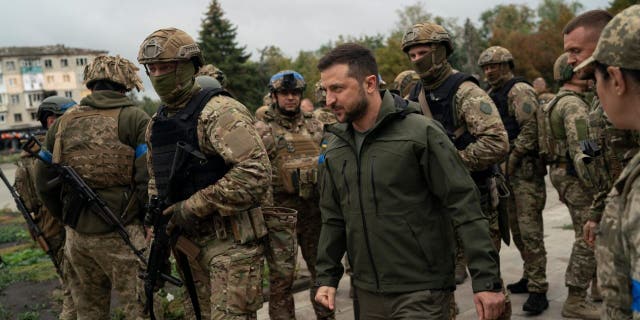
Surrounded by soldiers the Ukrainian President Volodymyr Zelenskyy attends a national flag-raising ceremony in the freed Izium, Ukraine, Wednesday, Sept. 14, 2022.

Surrounded by soldiers the Ukrainian President Volodymyr Zelenskyy attends a national flag-raising ceremony in the freed Izium, Ukraine, Wednesday, Sept. 14, 2022. (AP Photo/Leo Correa)

"Putin expected to subdue Ukraine within days, maximum weeks, force [Ukranian President Volodymyr] Zelenskyy to capitulate or flee and install a new government that is pro-Russian, or at minimum not pro-Western — a new regime that would abandon plans to join NATO," Koffler said.

However, such a quick victory for Putin has failed to materialize, setting the stage for a continuation of the war into 2023. As the world waits to see how the war unfolds in the new year, here is a look back at some of the key moments of the conflict in 2022.

Russia builds up forces on its border with Ukraine

As the world celebrated the calendar flipping to 2022, Russia was continuing its months-long build up of forces in Ukraine. By January, military analysts in Ukraine were estimating that Russia had amassed a force of close to 100,000 troops on the border, having ended the year by pushing for a ban on Ukraine joining NATO, a proposal that was rejected by both Ukraine and members of the alliance.

Russian troops began spilling into allied Belarus, also on the border of Ukraine, to conduct military exercises. The continued build up sparked international condemnation from the West, with the U.S. sending $200 million in security assistance to Ukraine and President Biden warning of consequences for Russia in the event of an invasion.
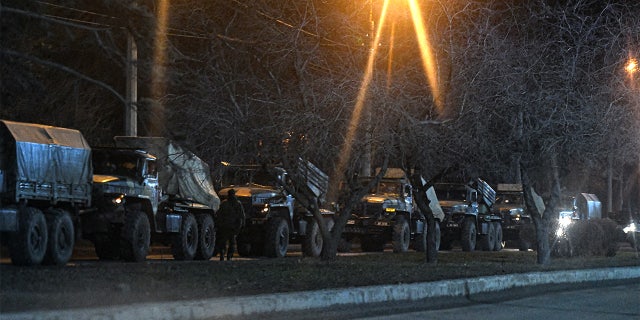
Russian military tanks and armored vehicles advance in Donetsk, Ukraine on February 24, 2022.

Russian military tanks and armored vehicles advance in Donetsk, Ukraine on February 24, 2022. (Photo by Stringer/Anadolu Agency via Getty Images)

PENTAGON: RUSSIA BUILDUP ON UKRAINE BORDER IS LARGEST SINCE COLD WAR, CONFLICT WOULD BE 'HORRIFIC'

"Russia will be held accountable if it invades," Biden said in a January press conference.

However, Russia's military buildup continued, reaching nearly 200,000 troops at Ukraine's border as the eventual invasion neared.

"Russia accumulated, over the course of approximately two months, a build up of 190 000 troops, including military hardware, logistics, supplies," Koffler said.

Initial invasion of Ukraine

On Feb. 21, Putin announced Russian recognition of two eastern Ukrainian breakaway regions in Ukraine, the Donetsk People's Republic and the Luhansk People's Republic. The move brought the first round of NATO sanctions against Russia and growing concern that an invasion of Ukraine was imminent.

Undeterred by Western threats, Putin launched his invasion of Ukraine three days later and sent in many of his troops on a mission for the "demilitarisation and denazification" of Ukraine.
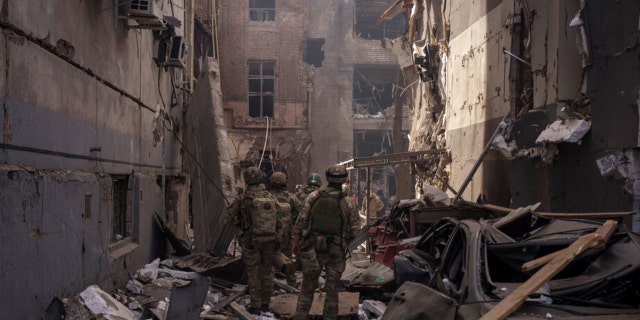
Ukrainian servicemen walk among debris of damaged buildings after a Russian attack in Kharkiv, Ukraine, Saturday, April 16, 2022.

Ukrainian servicemen walk among debris of damaged buildings after a Russian attack in Kharkiv, Ukraine, Saturday, April 16, 2022.  (AP Photo/Felipe Dana)

Within minutes of Putin's announced invasion, explosions could be heard in major Ukrainian cities such as Kyiv, Kharkiv and Odessa. Reports quickly circulated that Russian troops had landed in the crucial coastal city of Mariupol, while observers closely followed large units of Russian forces making a beeline for the capital.

RUSSIAN PRESIDENT VLADIMIR PUTIN ANNOUNCES ANNEXATION OF 4 UKRAINIAN TERRITORIES AFTER 'SHAM' REFERENDUMS

Heavy fighting broke out across the country and eventually spilled into Kyiv, while the Russian air force continued its bombardment of major cities and key infrastructure across the country. Many analysts expected the outmatched Ukrainian military to quickly fold under the pressure, but the country's resistance to the invasion proved more fierce than what had been predicted.

"Putin’s plan failed," Koffler said. "Ukrainians displayed an unparalleled will to fight against a much more powerful opponent. Ukraine’s President Zelenskyy chose to stay and fight with his people instead of accepting the West’s offers to evacuate him. What was supposed to be a 5-7 day blitzkrieg turned into a 10-month-long bloodbath, with no end in sight."
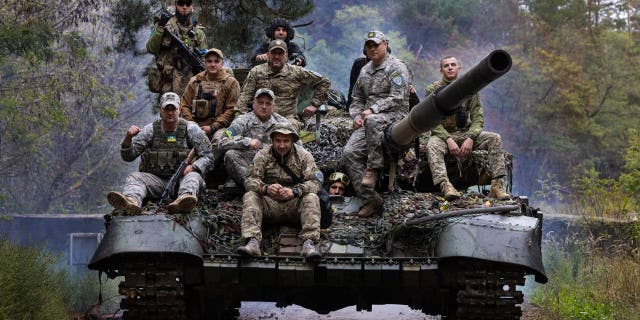
Ukrainian troops ride upon a repaired Russian tank in a wooded area outside the city on Sept. 26, 2022 in Kharkiv, Ukraine.

Ukrainian troops ride upon a repaired Russian tank in a wooded area outside the city on Sept. 26, 2022 in Kharkiv, Ukraine. (Photo by Paula Bronstein /Getty Images)

Billions worth of Western money and weapons continued to flow into Ukraine, giving their seemingly outmatched forces a chance to fend off the offensive. By April, Russian forces in the north began a retreat and reorganization of forces, while Ukraine maintained control of its capital.

ZELENSKYY SAYS MINES AFTER RUSSIAN RETREAT THREATEN KYIV

"A charismatic Ukrainian leader was able to secure billions of dollars in Western security assistance, including sophisticated weaponry, that allowed Ukraine, not only to defend many of its positions but also to re-capture some of the territories occupied by the Russians," Koffler said. "Ukrainian forces also benefited from superior training, real time intelligence, and other types of support provided by the U.S. and NATO."

Putin's new strategy

Having failed to quickly end the war, Russia reorganized its forces and shifted its focus to the southern and eastern portions of Ukraine. Ukrainian forces were put on the defensive across multiple fronts as the Russians secured key cities and infrastructure and amassed heavy forces with an eye towards maintaining an occupation of areas in Kherson and Donbas.

"Putin replaced multiple commanders and changed his strategy," Koffler said. "He concentrated his forces on Eastern Ukraine, having annexed four regions - Donetsk, Luhansk, Zaporizhzhia and Kherson - clearing doctrinal path to the employment of nuclear weapons, in the event that Russian forces were unable to prevail conventionally."
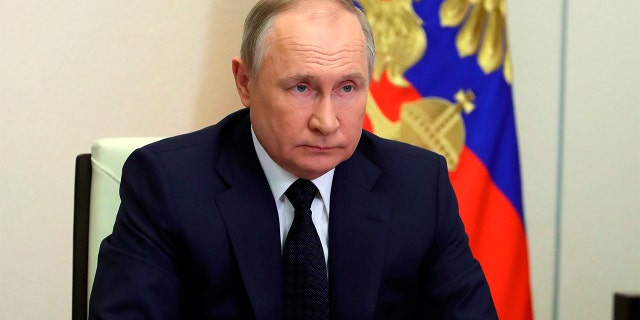
Russian President Vladimir Putin attends a cabinet meeting via videoconference at the Novo-Ogaryovo residence outside Moscow, Wednesday, March 23, 2022.

Russian President Vladimir Putin attends a cabinet meeting via videoconference at the Novo-Ogaryovo residence outside Moscow, Wednesday, March 23, 2022.  (Mikhail Klimentyev, Sputnik, Kremlin Pool Photo via AP)

UKRAINIAN FORCES RETREATING FROM EASTERN CITY SIEVIERODONETSK TO AVOID BEING ENCIRCLED BY RUSSIANS

Heavy fighting continued in the east and south throughout the spring and deep into the summer, while Putin shifted gears toward targeting critical infrastructure in a bid to weaken the will of Ukraine's civilian population.

"Moscow also launched ‘Strategic Operation to Defeat Critical Infrastructure of the Adversary,’ a war fighting doctrine, developed on Putin’s orders a decade ago as part of the plan to restore control over post-Soviet states, which Russia views as part or its strategic security perimeter - Putin’s version of the Monroe Doctrine," Koffler said.

Russia turned another Western adversary, Iran, to help sustain the new strategy, with the Kremlin purchasing hundreds of "kamikaze drones" and other unmanned aerial vehicles (UAVs) from Tehran that have been used to target Ukraine's civilian infrastructure. 

The cooperation in Ukraine has seemingly deepened ties between Iran and Russia, with Tehran going so far as to send military advisers to Crimea to train Russian forces on the use of the UAVs.

However, bolstered by continued U.S. and allied security assistance, Ukraine showed little sign that it was willing to give up on the regions, with Ukrainian President Volodymyr Zelenskyy vowing to retake the territories currently occupied by Russian forces, including the long-held Crimean Peninsula.

"Crimea is Ukrainian, and we will never give it up," Zelenskyy said during an August address.

Ukrainian forces launch massive counteroffensive

Zelenskyy showed he intended to make good on that promise by the end of August, launching a Ukrainian counteroffensive that suddenly put Russian forces on the defensive for the first time in months.

RUSSIAN TROOPS PULL BACK AS UKRAINIAN SOLDIERS RETAKE KEY AREAS IN KHARKIV
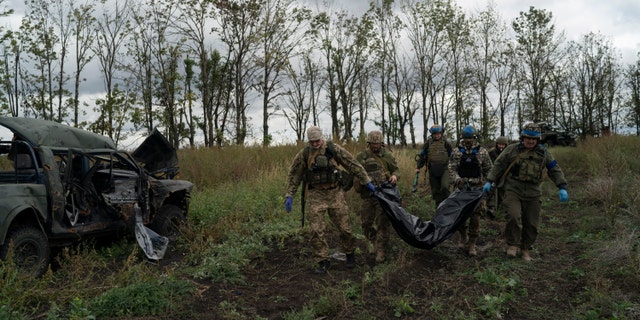
Ukrainian national guard servicemen carry a bag containing the body of a Ukrainian soldier in an area near the border with Russia, in Kharkiv region, Ukraine, Monday, Sept. 19, 2022.

Ukrainian national guard servicemen carry a bag containing the body of a Ukrainian soldier in an area near the border with Russia, in Kharkiv region, Ukraine, Monday, Sept. 19, 2022.  (AP Photo/Leo Correa)

Ukrainian forces attacked long-held Russian positions across the south and eastern regions of Ukraine with fierce flighting that eventually led to Ukraine regaining control of large areas it had lost in the months before.

"Zelenskyy mounted a blistering counter-offensive, in which Ukrainian forces recaptured approximately 5% of the 20% of Ukraine’s territory occupied by the Russians," Koffler said.

The offensive also worked to reignite international support for Ukraine, ushering in a renewed round of security assistance to assist Ukrainian forces in maintaining the offensive.

"He continued to galvanize the West to help his country defeat the Russian occupiers," Koffler said of the Ukrainian leader.

The Ukrainians had also once again dealt a large blow to Putin's war plan, forcing the Russian leader to bring more new troops to the fight as heavy Russian casualties mounted.

"Putin drafted an additional 318,000 troops, having invoked a partial mobilization, the first since World War II," Koffler said.

The offensive also forced Putin to admit that the conflict could be a protracted one, which would require the government to increase its funding for the effort.
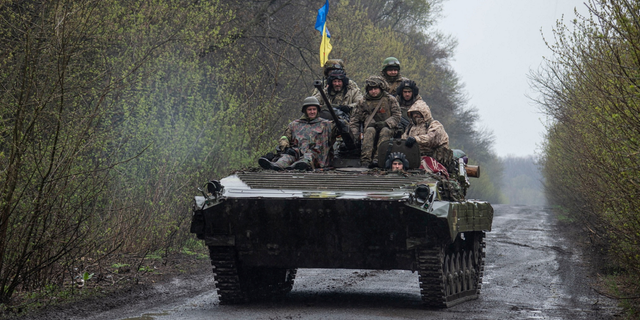
Ukrainian servicemen ride atop an armored fighting vehicle at an unknown location in Eastern Ukraine.

Ukrainian servicemen ride atop an armored fighting vehicle at an unknown location in Eastern Ukraine. (Press service of the Ukrainian Ground Forces/Handout via REUTERS)

WITH RUSSIA'S RETREAT FROM KHERSON, RUSSIA AND UKRAINE HAVE AN OPPORTUNITY TO NEGOTIATE PEACE

"Putin publicly acknowledged that Russia is in it for the long haul, having raised Russia’s defense budget for 2023 to $84 billion, a 40% increase," Koffler said. "Military age Russian men are fleeing by the thousands to escape mobilization."

Meanwhile, crippling international sanctions proved to be an obstacle to Russia's aims, limiting Putin's ability to resupply his forces with gear and munitions while applying pressure on him politically.

"The West placed draconian sanctions on Russia, Russian businesses, oligarchs and even Putin’s family," Koffler said. "The U.S. and European governments placed price caps on Russian oil, to hamper Putin’s ability to finance his war on Ukraine."

The road ahead

As Zelenskyy made his historic trip to the White House to meet with Biden this week, the future of the war in Ukraine remains as uncertain as ever. While the Ukrainian leader appealed for greater assistance, the U.S. is seeking to balance its continued support with Ukraine while attempting to avoid risking further escalation with Putin.

"Putin feels cornered - he cannot accept defeat," Koffler said. "It would mean not only loss of face for an arrogant West-bashing former spy operative, but most importantly, an anti-Russian neighbor, with which his country shares 1,400 miles border - which likely will host NATO forces, Russia’s top perceived adversary."
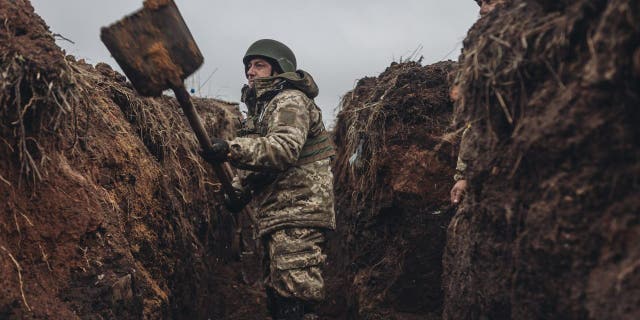
Ukrainian soldiers are seen in a trench in Bakhmut, Ukraine on Dec. 16, 2022.

Ukrainian soldiers are seen in a trench in Bakhmut, Ukraine on Dec. 16, 2022. (Photo by Stringer/Anadolu Agency via Getty Image)

UKRAINE'S ZELENSKYY VISITS FRONTLINE AS PUTIN CONCEDES SITUATION 'EXTREMELY DIFFICULT' IN ANNEXED REGIONS

Zelenskyy's trip came as Biden announced an additional $1.8 billion in security assistance in Ukraine, which will for the first time will include Patriot missile systems Kyiv has long coveted. It also comes as Congress appears poised to sign off on an additional $45 billion in aid for Ukraine, a development Koffler believes will make it hard for Russia to achieve its war aims.

"Putin cannot win either so long as NATO continues to ramp up its supplies of long range missiles to Ukraine," Koffler said. "He is probably mulling two options: 1) a protracted war of attrition - which suites his definition of victory because so long as there’s an active conflict in Ukraine, it cannot become part of NATO - Putin's red line; 2) Russia’s escalate-to-de-escalate nuclear strategy to shock Ukraine into submission and to disorient the West, at least temporarily and abandon support for Kyiv."

During Zelenskyy's address to a joint meeting of Congress Wednesday, the Ukrainian leader stressed the importance of supporting Ukraine now, arguing that Russia's aggression could eventually threaten NATO allies or even the U.S. homeland.
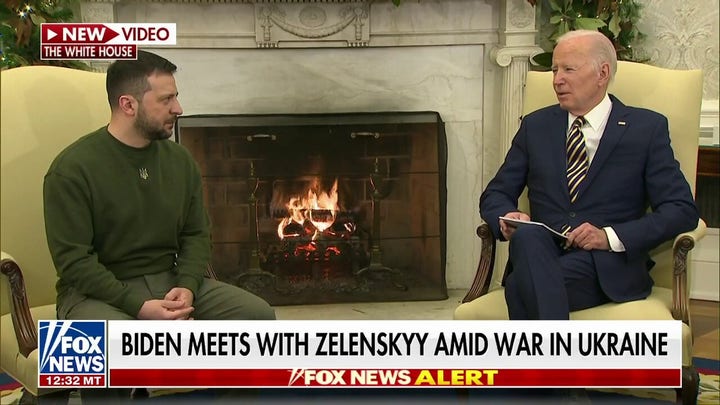
"The struggle will define in what world our children and grandchildren will live," Zelenskyy said. "This battle cannot be frozen or postponed, it cannot be ignored hoping that [an] ocean or something else will provide protection."

He also pointed to Russia's renewed partnership with Iran, warning the two "terrorist" countries cooperation threatens the rest of the world.

"When Russia cannot reach our cities by its artillery, it tries to destroy them with missile attacks and allies in the genocidal policy with Iran," Zelenskyy said. "Iran has become a critical threat to our infrastructure. The terrorists have found each other."
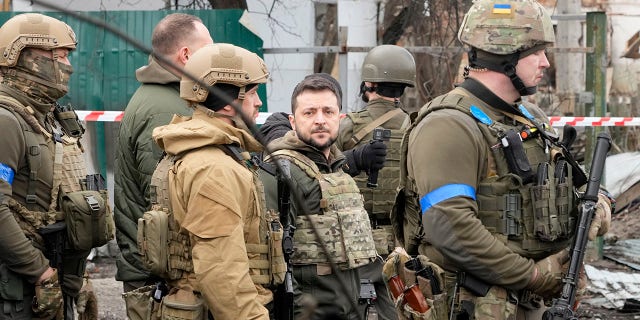
Ukrainian President Volodymyr Zelenskyy examines the site of a recent battle in Bucha, close to Kyiv, Ukraine, Monday, Apr. 4, 2022.

Ukrainian President Volodymyr Zelenskyy examines the site of a recent battle in Bucha, close to Kyiv, Ukraine, Monday, Apr. 4, 2022.  (AP Photo/Efrem Lukatsky)

As the war continues into 2023, Koffler does not see an end to the stalemate in sight, instead characterizing the war as a "frozen conflict."

"There’s no military path to victory either by Ukraine or by Russia in this conflict." Koffler said. "Ukraine cannot win because it doesn’t have nuclear weapons and Russia does."

PUTIN LANDS IN BELARUS TO PRESSURE ALLY TO JOIN THE OFFENSIVE IN UKRAINE WAR

However, Koffler noted that despite Russia's view that Ukraine is a critical buffer between itself and NATO, a path to victory for Russia will also remain elusive.

"Moscow cannot win this war, militarily so long as the U.S. and Europe continue to supply lethal military hardware to Ukraine," Koffler said. "But if NATO deployed forces into the theater - the only way to defeat Russia, conventionally — Putin will authorize a tactical nuclear strike in Ukraine. Biden knows this, this is why he announced in the beginning of this was that the U.S. will not deploy troops to fight on Ukraine’s behalf."
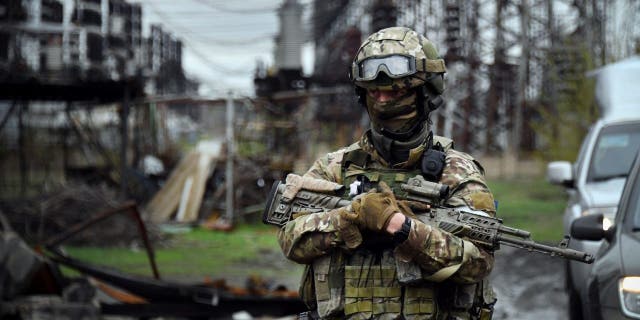
In this picture taken on April 13, 2022, a Russian soldier stands guard at the Luhansk power plant in the town of Shchastya.

In this picture taken on April 13, 2022, a Russian soldier stands guard at the Luhansk power plant in the town of Shchastya. (Photo by ALEXANDER NEMENOV/AFP via Getty Images)

Koffler also expressed pessimism at the chances the sides could reach a diplomatic solution to end the conflict, arguing that the terms of such a solution would likely be unacceptable to both sides.

"This is rapidly turning into Afghanistan 2.0," Koffler said. "My assessment is that 2-5 years from now, there will still be fighting on the ground in Ukraine. Even if some sort of a deal is brokered eventually — which I see no chance of right now — it will not bring ultimate peace because neither side trusts the other.

"The U.S. national security apparatus believes Putin would attack a NATO country if he is allowed to win in Ukraine— a nonsensical conclusion, given that the Russian military is failing to secure a clear military victory in Ukraine," she continued. "And Putin will never trust Washington - he knows that its goal is to remove him from power and to orchestrate Russia’s collapse."

However, Zelenskyy stressed the opposite in his speech, arguing that helping Ukraine achieve victory over Russia is a critical element to the defense of democracy around the world. 

"Your money is not charity," he said. "It’s an investment in the global security and democracy that we handle in the most responsible way."


Michael Lee is a writer at Fox News. Follow him on Twitter @UAMichaelLee

Source: https://www.foxnews.com/world/frozen-conflict-look-back-2022s-key-moments-ukraines-fight-russia

Follow Middle East and Terrorism on Twitter

New Twitter Files drop: the FBI was a liaison for all sorts of government agencies - Andrea Widburg


by Andrea Widburg

Thanks to the FBI’s Foreign Information Task Force, the entire federal government got access to Twitter and was able to control the flow of information.


The First Amendment is clear: The government may not regulate speech—yet that’s precisely what the latest Twitter Files from Matt Taibbi show the FBI did. In the lead-up to the 2020 election, acting on behalf of itself and other agencies, the FBI had Twitter censor anything that it deemed “misinformation.” Additionally, beginning in 2022, the FBI asked Twitter to shut down hundreds of accounts that countered the Biden administration’s Ukraine narrative. In other words, the government was doing indirectly, via Twitter, that which it cannot do directly: censoring speech with which it disagrees.

Matt Taibbi dropped the latest thread yesterday afternoon. (For your convenience, I’ve appended below the text of the thread without any images. You can find the thread with images here.) Taibbi opened by reminding his readers about the FBI’s snotty response to the last Twitter thread, which had shown that the FBI was putting its thumb on the scale regarding information related to the 2020 election:


Ostensibly, the FBI was working to monitor foreign influence on the election—which was a response to the Russia Hoax. As all of you recall, the Russia Hoax falsely claimed that, in 2016, the Russians, working in cahoots with Donald Trump, had flooded social media with false information intended to destroy Hillary’s candidacy.

To make sure the thing that hadn’t happened never happened again, the FBI formed a large Foreign Intelligence Task Force (“FITF”) to work with social media companies to block any foreign government’s effort to dominate the airwaves and mess with an American election. (One could say that messing with American elections is a job best done domestically.) The problem at Twitter, as even the partisan Yoel Roth (Twitter’s “safety” director) acknowledged, was that there was no evidence in 2020 that the Russians were up to their old tricks (the same “old” tricks that they’d never done before).

That was okay with the FBI. As Taibbi’s Twitter File drop shows, the FBI used the access the FITF gave it to flood Twitter with requests asking it to shut down posts or accounts with “misinformation,” even if they weren’t foreign. The word for that is censorship. The government cannot censor political speech—and it cannot avoid that absolute proscription by requesting or bullying a third party into censoring the speech on the government’s behalf. But that’s precisely what happened: FBI asked for censorship, and Twitter said “yes.”

Even worse, the FBI was acting as a conduit for other government agencies, most notably the CIA. The CIA’s involvement is especially disturbing, given that it has no mandate at all to operate within America. Its involvement in policing domestic “misinformation” is deeply concerning. In that vein, Harry Truman was already concerned in 1963 that the CIA was exceeding its mandate and involving itself in domestic politics:

Back on Dec. 22, 1963, exactly a month after the Kennedy assassination, former President Harry Truman wrote in the Washington Post that “for some time I have been disturbed by the way [the] CIA has been diverted from its original assignment. It has become an operational and at times a policy-making arm of the Government. This has led to trouble and may have compounded our difficulties in several explosive areas.” He added, “We have grown up as a nation, respected for our free institutions and for our ability to maintain a free and open society. There is something about the way the CIA has been functioning that is casting a shadow over our historic position and I feel that we need to correct it.”

Nor did the government’s interference with free speech end with the election. Taibbi also says that it continued to block any accounts that gave Americans views contrary to the government’s on such issues as Ukraine, China, and Venezuela. Again, that’s called censorship, and it’s unconstitutional for the government to do it directly or indirectly.

As you contemplate how our government has slipped ever so gently into Stasi-like censorship, remember that it wasn’t just doing this with Twitter. If Elon Musk were to purchase other social media companies, it would show the same thing.

It's demoralizing to learn that our security apparatus has functioned as a chief censor, ensuring that an election outcome favors the permanent state’s interest. What’s even more demoralizing is to realize that, unless the American people rise up and swamp the next election with more votes than can ever be cheated out of existence, the deep state will have succeeded in overthrowing the American government and installing in its place a left-wing technocracy.

Image by Andrea Widburg

TEXT (WITHOUT IMAGES) OF MATT TAIBBI’S LATEST TWITTER THREAD

 1.THREAD: The Twitter Files

TWITTER AND "OTHER GOVERNMENT AGENCIES"

After weeks of “Twitter Files” reports detailing close coordination between the FBI and Twitter in moderating social media content, the Bureau issued a statement Wednesday.

2.It didn’t refute allegations. Instead, it decried “conspiracy theorists” publishing “misinformation,” whose “sole aim” is to “discredit the agency.”

3.They must think us unambitious, if our “sole aim” is to discredit the FBI. After all, a whole range of government agencies discredit themselves in the #TwitterFiles. Why stop with one?

4.The files show the FBI acting as doorman to a vast program of social media surveillance and censorship, encompassing agencies across the federal government – from the State Department to the Pentagon to the CIA.

5.The operation is far bigger than the reported 80 members of the Foreign Influence Task Force (FITF), which also facilitates requests from a wide array of smaller actors - from local cops to media to state governments.

6.Twitter had so much contact with so many agencies that executives lost track. Is today the DOD, and tomorrow the FBI? Is it the weekly call, or the monthly meeting? It was dizzying.

7.A chief end result was that thousands of official “reports” flowed to Twitter from all over, through the FITF and the FBI’s San Francisco field office.

8.On June 29th, 2020, San Francisco FBI agent Elvis Chan wrote to pair of Twitter execs asking if he could invite an “OGA” to an upcoming conference:

9.OGA, or “Other Government Organization,” can be a euphemism for CIA, according to multiple former intelligence officials and contractors. Chuckles one: “They think it's mysterious, but it's just conspicuous."

10.“Other Government Agency (the place where I worked for 27 years),” says retired CIA officer Ray McGovern.

11. It was an open secret at Twitter that one of its executives was ex-CIA, which is why Chan referred to that executive’s “former employer.”

12.The first Twitter executive abandoned any pretense to stealth and emailed that the employee “used to work for the CIA, so that is Elvis’s question.”

13.Senior legal executive Stacia Cardille, whose alertness stood out among Twitter leaders, replied, “I know” and “I thought my silence was understood.”

14.Cardille then passes on conference details to recently-hired ex-FBI lawyer Jim Baker.

15.“I invited the FBI and the CIA virtually will attend too,” Cardille says to Baker, adding pointedly: “No need for you to attend.”

16.The government was in constant contact not just with Twitter but with virtually every major tech firm.

17. These included Facebook, Microsoft, Verizon, Reddit, even Pinterest, and many others. Industry players also held regular meetings without government.

18.One of the most common forums was a regular meeting of the multi-agency Foreign Influence Task Force (FITF), attended by spates of executives, FBI personnel, and – nearly always – one or two attendees marked “OGA.”

19.The FITF meeting agendas virtually always included, at or near the beginning, an “OGA briefing,” usually about foreign matters (hold that thought).

20. Despite its official remit being “Foreign Influence,” the FITF and the SF FBI office became conduit for mountains of domestic moderation requests, from state governments, even local police:

21. Many requests arrived via Teleporter, a one-way platform in which many communications were timed to vanish:

22.Especially as the election approached in 2020, the FITF/FBI overwhelmed Twitter with requests, sending lists of hundreds of problem accounts:

23. Email after email came from the San Francisco office heading into the election, often adorned with an Excel attachment:

24. There were so many government requests, Twitter employees had to improvise a system for prioritizing/triaging them:

25. The FBI was clearly tailoring searches to Twitter’s policies. FBI complaints were almost always depicted somewhere as a “possible terms of service violation," even in the subject line:

26. Twitter executives noticed the FBI appeared to be aasigning personnel to look for Twitter violations.

27.“They have some folks in the Baltimore field office and at HQ that are just doing keyword searches for violations. This is probably the 10th request I have dealt with in the last 5 days,” remarked Cardille.

28. Even ex-FBI lawyer Jim Baker agreed: “Odd that they are searching for violations of our policies.”

29.The New York FBI office even sent requests for the “user IDs and handles” of a long list of accounts named in a Daily Beast article. Senior executives say they are “supportive” and “completely comfortable” doing so.

30. It seemed to strike no one as strange that a “Foreign Influence” task force was forwarding thousands of mostly domestic reports, along with the DHS, about the fringiest material:

31. “Foreign meddling” had been the ostensible justification for expanded moderation since platforms like Twitter were dragged to the Hill by the Senate in 2017:

32. Yet behind the scenes, Twitter executives struggled against government claims of foreign interference supposedly occurring on their platform and others:

33. The #TwitterFiles show execs under constant pressure to validate theories of foreign influence – and unable to find evidence for key assertions.

34. “Found no links to Russia,” says one analyst, but suggests he could “brainstorm” to “find a stronger connection.”

35. “Extremely tenuous circumstantial chance of being related,” says another.

36. “No real matches using the info,” says former Trust and Safety chief Yoel Roth in another case, noting some links were “clearly Russian,” but another was a “house rental in South Carolina?”

37. In another case, Roth concludes a series of Venezuelan pro-Maduro accounts are unrelated to Russia’s Internet Research Agency, because they’re too high-volume:

38.The Venezuelans “were extremely high-volume tweeters… pretty uncharacteristic of a lot of the other IRA activity,” Roth says.

39. In a key email, news that the State Department was making a wobbly public assertion of Russian influence led an exec – the same one with the “OGA” past - to make a damning admission:

40. “Due to a lack of technical evidence on our end, I've generally left it be, waiting for more evidence,” he says. “Our window on that is closing, given that government partners are becoming more aggressive on attribution.”

41. Translation: “more aggressive” “government partners” had closed Twitter’s “window” of independence.

42. “Other Government Agencies” ended up sharing intelligence through the FBI and FITF not just with Twitter, but with Yahoo!, Twitch, Clouldfare, LinkedIn, even Wikimedia:

43. Former CIA agent and whistleblower John Kiriakou believes he recognizes the formatting of these reports.

44.“Looks right on to me,” Kiriakou says, noting that “what was cut off above [the “tearline”] was the originating CIA office and all the copied offices.”

45. Many people wonder if Internet platforms receive direction from intelligence agencies about moderation of foreign policy news stories. It appears Twitter did, in some cases by way of the FITF/FBI.

46. These reports are far more factually controversial than domestic counterparts.

47. One intel report lists accounts tied to “Ukraine ‘neo-Nazi’ Propaganda.’” This includes assertions that Joe Biden helped orchestrate a coup in 2014 and “put his son on the board of Burisma.”

48. Another report asserts a list of accounts accusing the “Biden administration” of “corruption” in vaccine distribution are part of a Russian influence campaign:

49. Often intelligence came in the form of brief reports, followed by long lists of accounts simply deemed to be pro-Maduro, pro-Cuba, pro-Russia, etc. This one batch had over 1000 accounts marked for digital execution:

50. One report says a site “documenting purported rights abuses committed by Ukrainians” is directed by Russian agents:

51. Intel about the shady origin of these accounts might be true. But so might at least some of the information in them – about neo-Nazis, rights abuses in Donbas, even about our own government. Should we block such material?

52. This is a difficult speech dilemma. Should the government be allowed to try to prevent Americans (and others) from seeing pro-Maduro or anti-Ukrainian accounts?

53. Often intel reports are just long lists of newspapers, tweets or YouTube videos guilty of “anti-Ukraine narratives”:

54. Sometimes - not always -Twitter and YouTube blocked the accounts. But now we know for sure what Roth meant by “the Bureau (and by extension the IC).”

55. The line between “misinformation” and “distorting propaganda” is thin. Are we comfortable with so many companies receiving so many reports from a “more aggressive” government?

56.The CIA has yet to comment on the nature of its relationship to tech companies like Twitter. Twitter had no input into anything I did or wrote. The searches were carried out by third parties, so what I saw could be limited.

Watch @bariweiss, @ShellenbergerMD, @lhfang, and this space for more, on issues ranging from Covid-19 to Twitter's relationship to congress, and more.


Andrea Widburg

Source: https://www.americanthinker.com/blog/2022/12/new_twitter_files_drop_the_fbi_was_a_liaison_for_all_sorts_of_government_agencies.html

Follow Middle East and Terrorism on Twitter

String of errors in federal statistics favoring Democrats raising concerns of manipulation - Ben Whedon


by Ben Whedon

Prominent among these erroneous numbers was the Bureau of Labor Statistics' reported overestimate of second quarter job growth by a sizable margin.

A recent string of errors and apparent discrepancies in federal statistics has raised concerns that such metrics, long regarded as irreproachably nonpartisan and credible, may have fallen prey to manipulation in favor of the incumbent Democratic Party.

The three most glaring recent examples of such statistical misfires are:

  • the Bureau of Labor Statistics' reported overestimate of second quarter job growth by a sizable margin;
  • the Census Bureau's population overcounts of blue states and undercounts of red states — in a reapportionment year;
  • the apparent disappearance of 50,000 asylum applications from the Executive Office for Immigration Review (EOIR).

1. In a boon to Biden, the Bureau of Labor Statistics allegedly overreported total job growth by more than 1 million.

According to the Bureau of Labor Statistics, the U.S. economy added 1,047,000 jobs in the second quarter of 2022. The Biden White House consistently highlighted this metric in the run-up to the November midterms as evidence of an economic rebound under the president's leadership. 

However, a separate report from the Philadelphia Federal Reserve released last week calculated actual job growth during that period at a mere 10,500 positions, meaning total employment remained essentially flat. The Philadelphia Fed report makes use of BLS data, but arrives at a different figure by using "more comprehensive, accurate job estimates released by the BLS as part of its Quarterly Census of Employment and Wages program," according to The Washington Times.

The BLS numbers reflect its monthly reported data, rather than the quarterly data sets on which the Fed report relied.

The Philadelphia Fed found, moreover, that BLS data underestimated unemployment numbers in 29 states and the District of Columbia. The disparities in some states were quite significant. In President Biden's own Delaware, for example, the BLS reported a 4.5% increase in payroll, whereas the Philadelphia Fed reported a 4.1% decline.

Such errors blatantly favoring the administration's narrative during an election year have led some lawmakers to begin questioning the reliability of BLS data. Florida Republican Sen. Rick Scott, for instance, has outright accused the Biden administration of lying about basic economic data to secure political gains.

"@JoeBiden's admin has been lying to the American people about our economy to prop up his failed agenda & I won't stand for it," he tweeted. "I'm requesting an immediate meeting with the head of @BLS_gov. WE NEED ANSWERS NOW!"

In response to criticism of its jobs estimate, a BLS spokesperson told Just the News: "BLS does not believe that the monthly CES data dramatically overestimated employment growth, though all survey data contain error and revisions are a necessary part of the statistical estimation process to ensure accuracy." 

2. The U.S. Census overcounted Democratic states, undercounted Republican states, affecting reallocation of congressional seats.

The 2022 midterm contests were the first to follow the reapportionment of congressional seats and redrawing of district lines as a result of the most recent U.S. Census. The decennial population survey was marred by large, consequential counting errors, with officials from the Census Bureau admitting it overcounted the populations of Democratic-leaning states while undercounting those of Republican-leaning ones. As a result, several population-losing blue states retained congressional seats to which they were not entitled at the expense of growing Republican states that merited greater representation.

A post-count analysis of the 2020 census found that red states Arkansas, Florida, Mississippi, Tennessee and Texas, along with traditionally Democratic Illinois, had all been undercounted significantly. By contrast, reliably Democratic states Hawaii, Massachusetts, Minnesota, New York, Rhode Island, and Delaware were overcounted, as were GOP-leaning Ohio and Utah.

The most severe error occurred in Arkansas, where census officials undercounted the population by 5.04%.

Following the bureau's admission of its errors, Republicans were livid, as the revelations came too late to affect congressional reapportionment.

"The numbers don't lie," Texas GOP Rep. Troy Nehls told Just the News in October. "Texas was undercounted by 2%, which means we were cheated out of an additional seat in Congress.

"And four other Republican states were as well. As a result, these red states have less representation in Congress, fewer votes in the Electoral College, and therefore receive less federal funding."

Such miscounts may have been intentional, Nehls suggested. 

"This wasn't a coincidence because things like this don't just happen," he said. "The bureaucrats in Washington have an agenda. They want Democrats in power and won't let anything get in their way. We must get to the bottom of what happened."

3. 50,000 asylum files disappeared, creating the illusion of a reduced backlog of claims.

A nonpartisan academic clearing house that handles government statistics recently decided to retract its data on illegal migrant children, citing concerns federal data had become too faulty to be reliable.

The Syracuse University-affiliated Transactional Records Access Clearinghouse (TRAC) in December announced that the loss of roughly 50,000 pending asylum applications allowed the Biden administration's Executive Office for Immigration Review (EOIR) to "falsely report that its asylum backlog had been reduced this past year when in fact it had markedly grown."

The organization reported that its warnings to the EOIR about faulty methodology for tracking minors had been ignored and that the issues were severe enough to warrant TRAC dropping its own reports entirely.

"TRAC has concluded that these flaws ... are so serious that the resulting statistics based on these data are not an accurate or reliable indicator of the quantity or characteristics of juvenile cases currently being handled by the Immigration Court," the group wrote.

"Government agencies should be transparent and accountable to the American public — but this is difficult if they don’t collect reliable information on what they are actually doing," the TRAC statement went on.

Of particular concern to TRAC were several problems it identified with the juvenile migrant data it routinely received from EOIR. For example, roughly 29% of cases before courts handling the cases of minors included individuals not listed in the data they received, according to the data collection organization. They found, moreover, that many migrants had been erroneously classified as juveniles despite being unreasonably old to merit such a designation. They further highlighted that 88% of juvenile migrants on the list did not appear in court cases involving families seeking asylum.

TRAC contends that its concerns fell on deaf ears.

"The Immigration Court's failure to respond to or address TRAC's findings of significant data quality issues regarding minors is particularly concerning given the highly sensitive nature of children facing deportation," the organization said.

These allegations come amid an unprecedented surge in illegal migration during fiscal year 2022, which saw a record 2.4 million migrant encounters, for a total of nearly 4 million since Biden took office in January of 2021. Those figures are expected to rise with the possible termination of the Title 42 immigration rule that allowed border authorities to swiftly deport migrants coming from a nation known to host a communicable disease.


Ben Whedon

Source: https://justthenews.com/politics-policy/wkdrecent-issues-federal-statistics-raise-concerns-manipulation-favor-democrats

Follow Middle East and Terrorism on Twitter

Iran protests reach 100 days: 5 things to know - The Foreign Desk Staff


by The Foreign Desk Staff

The demonstrations began after 22-year-old Iranian Kurdish woman Mahsa Amini was killed by the morality police in September over her hijab.


After 22-year-old Iranian Kurdish woman Mahsa Amini was killed by the morality police in September over her hijab, Iranians of all ages have taken to the streets to protest the Islamic Republic and its radical Sharia laws.

As protests surpassed 100 days this past week, Iranians continue to march throughout the country in town squares, local neighborhoods, bazaars, and universities, calling for an end to the mullahs’ reign. They have persisted in the face of brutal repression from Iranian security forces.

Here are five things to know about the upheaval.

1. Unity Inside and Outside Iran

Since protests began in September, Iranians from all occupations have come to the streets to protest the Islamic Republic, rallying behind slogans like “Women, Life, Freedom” and “Death to Khamenei.”

Inside Iran, Iranians say they’ve never been as united. Their message is clear: Freedom through regime change. Outside Iran, Iranians around the world have taken to the streets in different cities in solidarity with protesters while calling on elected representatives to sanction the Islamic Republic and abandon the nuclear agreement. 

2. Global Support

The governments of the U.S., Canada, the European Union and the United Nations have taken measures against the Islamic regime through condemnations and sanctions. The Biden administration has implemented economic sanctions against the regime’s security forces and morality police and ceased nuclear negotiations.

Canada implemented a series of sanctions, including banning members of Iran’s Islamic Revolutionary Guards Corps (IRGC) and their families from entering the country and further expanding on existing sanctions against regime officials and their financial assets.

Most recently, 29 members of the UN’s Economic and Social Council voted to remove Iran from a key UN women’s rights group just months after it joined, following the news of crackdowns continuing in the Islamic Republic despite international condemnation and economic pressure.

3. Celebrity Support

Notable actors, writers, musicians, and athletes around the world have spoken out and posted support for Iran’s protesters on their social media accounts. Celebrities like American actress Angelina Jolie and singer Justin Bieber have voiced support for Iranian protesters, taking to social media to post videos and photographs of protesters and anti-regime slogans like “Women, Life, Freedom.”

Other prominent figures like Reza Pahlavi, the son of the late Shah Mohammad Reza Pahlavi, and Iranian Empress Farah Pahlavi have also taken an active role in supporting the protests in Iran, calling on the international community to apply heavy pressure against the regime.

4. Silencing of Pro-Islamic Regime Lobbies

The unity inside and outside Iran has resulted in enormous backlash for many pro-Islamic Republic groups, individuals and lobbies. These entities are being named and shamed throughout social media as many try to delete previous articles, posts that openly supported the regime and its policies and even photographs of individuals with regime officials.

The exposure has led some individuals to change their posturing completely when it comes to supporting the regime and are now calling for regime change. Due to their history and support for the regime, more prominent lobbyists that were previously called on by the White House, State Department and mainstream media as experts are finding themselves marginalized and irrelevant.

5. Increased Brutality by the Regime

Iran’s Supreme Leader Ali Khamenei and President Ebrahim Raisi have denounced the protests as being supported by “foreign services,” deploying regime security forces, IRGC troops, Basij paramilitary forces, and plainclothes officers to crackdown on protesters. Reports indicate that the regime has also brought in fighters from Iran’s terror proxies in Iraq and other parts of the Middle East to aid in the brutal crackdown against demonstrators.

According to various human rights groups, the government has killed hundreds of protesters while imprisoning citizens and enacting brutal interrogations and torture methods against protesters. Young Iranian individuals like Majidreza Rahnavard have been hanged on cranes. Iranian women as young as 14 have been raped and killed by regime forces in prison and on the streets for supporting the protests. 


The Foreign Desk Staff

Source: https://justthenews.com/world/foreign-desk/5-things-know-100-days-protests-iran

Follow Middle East and Terrorism on Twitter

Ukraine: A Recipe for Appeasement - Amir Taheri


by Amir Taheri

If he skims through the Kremlin media, Kissinger would see that Putin won't be satisfied with just a chunk of Ukraine

  • Kissinger is reluctant or afraid to say what he really demands, which is appeasing Russia.

  • The grand old man of American diplomacy claims that the mumbo-jumbo he has just spewed would somehow create "a new structure towards achieving peace through negotiation." Later, however, he reduces "peace" to a "peace process" like the one he launched in the Middle East almost 50 years ago and which is supposed to be still going on fast to nowhere.

  • This war isn't about territory.

  • Russia has more "territory" than any other nation on the planet. Some claim that annexing Crimea was necessary to maintain Russia's naval presence in the Sea of Azov and the Black Sea. But that claim too could be dismissed as an excuse for aggression.

  • With his policy of détente during the Nixon and Ford administrations, Kissinger arguably helped prolong the life of the Soviet Empire by treating it as an equal partner, playing a leading role in the Helsinki Accords, and providing it with access to global capital markets among other favors bestowed.

  • If he skims through the Kremlin media, Kissinger would see that Putin won't be satisfied with just a chunk of Ukraine, as he has said many times, and has already set the theme for "protecting our kith-and-kin" in Moldova and Estonia, with less direct musings about a pan-Slav empire that could include Poland, Bulgaria, Serbia and Montenegro.

  • If implemented, Kissinger's "peace plan" could become a prelude to endless war, cold, lukewarm and hot, in Europe, and the most disastrous attempt at appeasement since the Chamberlain-Daladier duo went to Munich.

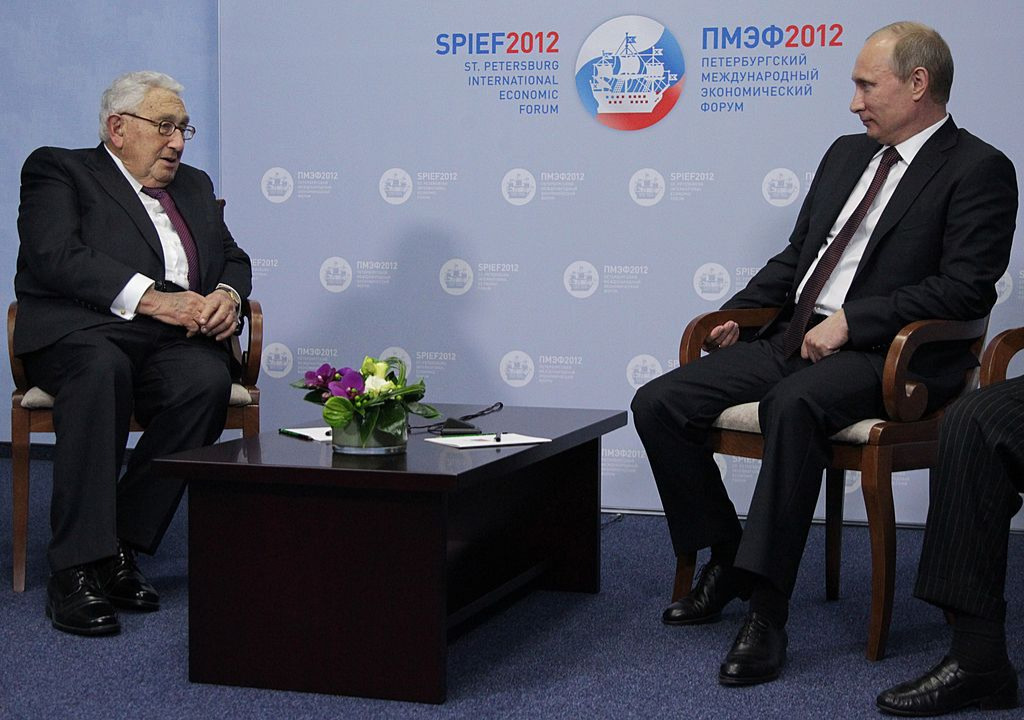
If implemented, Henry Kissinger's "peace plan" for Ukraine could become a prelude to endless war, cold, lukewarm and hot, in Europe, and the most disastrous attempt at appeasement since the Chamberlain-Daladier duo went to Munich. Pictured: Kissinger and Russian President Vladimir Putin talk during the Economic Forum in Saint-Petersburg, on June 21, 2012. (Photo by Anatoly Maltsev/AFP/Getty Images)

Russian military lore is full of references to the cold months ahead in that part of Europe as "General Winter". So, it is no surprise that President Vladimir Putin, disappointed in the performance of his generals, is looking at "General Winter" to help him snatch victory from the jaws of defeat as it had helped Kutuzov against Napoleon.

Putin's reading of history, however, is slanted in favor of his illusions. In the Napoleonic war, "General Winter" was on the side of the defender, not the aggressor. With "General Winter" unlikely to work for Putin, he may have to look at another grand old man, this time a diplomat, to help him out of the hole he has dug for Russia.

While reports indicate that Russia is mobilizing massive forces for a new attempt at dismantling Ukraine as a nation-state, former US Secretary of State Henry Kissinger, labeled "the grand master of diplomacy" by his adulators, is talking of peace with Vladimir Putin.

In an article published December 17, Kissinger writes:

"[T]he time is approaching to build on the strategic changes which have already been accomplished and to integrate them into a new structure towards achieving peace through negotiation.... A peace process should link Ukraine to Nato, however expressed. The alternative of neutrality is no longer meaningful..."

The paragraph just quoted shows that Kissinger is reluctant or afraid to say what he really demands, which is appeasing Russia.

He says "the time is approaching" but doesn't say at what speed or, if it is approaching, why not wait until it has arrived. He talks of "strategic changes which have already been accomplished", but doesn't say which changes and accomplished by whom. Does he see the annexation of Crimea and the presence of Russian forces in some 20% of Ukrainian territory as an accomplishment?

The grand old man of American diplomacy claims that the mumbo-jumbo he has just spewed would somehow create "a new structure towards achieving peace through negotiation." Later, however, he reduces "peace" to a "peace process" like the one he launched in the Middle East almost 50 years ago and which is supposed to be still going on fast to nowhere.

Kissinger demonstrates his inability to think, or at least to clearly state his thoughts by writing: "A peace process should link Ukraine to Nato, however expressed. The alternative of neutrality is no longer meaningful."

If anyone understands what the good doctor means, please let me know.

Last May, Kissinger proposed a ceasefire under which Russia would withdraw to the lines before the February invasion, but Crimea would be the subject of "negotiation."

He described the war as a "territorial conflict", unknowingly or deliberately misunderstanding its nature.

This war isn't about territory.

Russia has more "territory" than any other nation on the planet. Some claim that annexing Crimea was necessary to maintain Russia's naval presence in the Sea of Azov and the Black Sea. But that claim too could be dismissed as an excuse for aggression.

Ukraine had granted a 40-year lease to the Russian Navy to continue its presence in Crimea protected by 20,000 Russian troops. To offer further assurances to Putin, Ukraine had also agreed that the lease could be renewable at the end of its current term.

Kissinger may be making another error of analysis by identifying Russia with Putin.

In his new autobiography, Mikhail Khodorkovsky, once a close Putin pal and a leading oligarch, even suggests that, when it comes to international relations, Russia should not be regarded as a single entity.

He suggests that in the vast stretch of land between Europe and the Pacific Ocean, sandwiching Siberia between them, three Russias exist side by side. The first consists of Saint-Petersburg, Moscow and a few large cities where living standards, socio-political culture and common aspirations are close to median European standards.

In that Russia, Putin's rule is tolerated, partly because it has offered economic growth and prosperity, at least until now. However, that Russia does not share Putin's expansionist strategy and is uneasy about the war in Ukraine. A majority of the thousands of Russians who have left the country since Putin declared a partial mobilization came from that Russia.

The next Russia consists of what he calls "sultanates," patches of territory ruled over by governors appointed by Putin and answerable only to him. In many of those "sultanates" ethnic Russians form a minority of the population. Some "sultanates" like Chechnya support Putin's war, but others, like Tatarstan or Dagestan, try to stay out of the adventure started by Putin.

The third Russia consists of numerous towns, cities and villages, spread across the vast land like an archipelago inspiring and sustaining a sense of "away from it all" isolation.

Putin's Russia is an empire and, like all empires, lives in fear of losing territory with a constant urge to acquire new territory to preserve the old ones. Russia, as the USSR, ended up losing vast chunks of land when the empire collapsed in 1991. Putin's invasion and annexation of South Ossetia, occupation of Abkhazia and creation of a Trojan horse in eastern Moldova were signs of that fear and that urge.

Other signs include stationing Russian troops in Armenia, Azerbaijan and Tajikistan.

Empires do not stop until they are stopped.

They resemble the wolf of the steppes which, in a short story by Chekhov, pursues a man driving a troika pulled by dogs amid a snowstorm. The man tries to ward off the wolf by throwing food at it until he himself runs out of food. He ends up throwing the dogs at the insatiable wolf that remains in hot pursuit. At the end, only the man himself is left as food for his determined pursuer.

With his policy of détente during the Nixon and Ford administrations, Kissinger arguably helped prolong the life of the Soviet Empire by treating it as an equal partner, playing a leading role in the Helsinki Accords, and providing it with access to global capital markets among other favors bestowed.

If he skims through the Kremlin media, Kissinger would see that Putin won't be satisfied with just a chunk of Ukraine, as he has said many times, and has already set the theme for "protecting our kith-and-kin" in Moldova and Estonia, with less direct musings about a pan-Slav empire that could include Poland, Bulgaria, Serbia and Montenegro.

If implemented, Kissinger's "peace plan" could become a prelude to endless war, cold, lukewarm and hot, in Europe, and the most disastrous attempt at appeasement since the Chamberlain-Daladier duo went to Munich.

This article was originally published by Asharq al-Awsat


Amir Taheri was the executive editor-in-chief of the daily Kayhan in Iran from 1972 to 1979. He has worked at or written for innumerable publications, published eleven books, and has been a columnist for Asharq Al-Awsat since 1987.

Source: https://www.gatestoneinstitute.org/19258/ukraine-appeasement

Follow Middle East and Terrorism on Twitter

Biden Admin Plots to Ban Gas Stoves - Daniel Greenfield


by Daniel Greenfield

“We need to be talking about regulating gas stoves"


The Biden administration took the same governance that exists in California or New York and decided to apply it to the nation. That means every leftist agenda item is in the pipeline.

Free crack pipes? Sure. Telling 7-year-olds that they’re racists and should switch gender? Obviously. Getting rid of gas stoves?

Los Angeles banned gas stoves in 2023. Seattle and NYC have done it. Now it’s time for the Biden admin to do it nationwide.

A U.S. Consumer Product Safety Commission official said his agency will begin a formal review process that could lead to new regulations.

“We need to be talking about regulating gas stoves, whether that’s drastically improving emissions or banning gas stoves entirely,” said Commissioner Richard Trumka. “And I think we ought to keep that possibility of a ban in mind, because it’s a powerful tool in our tool belt and it’s a real possibility here.”

Trumka is a Biden appointee.

Biden’s minion claims that this is about child safety. Does the Planned Parenthood crowd which pats itself on the back every time it kills another million babies, and which cheers zero population growth, care about kids?

It’s about global warming.

Environmentalists are making the safety argument because it’s politically convenient. They want to mandate entirely electric systems. Everything else is a pretext.

The start of a federal process that could lead to more regulation of gas stoves is “a big step” said U.S. PIRG environment campaigns director Matt Casale.

He said the issue of gas stove health hazards is getting more attention, thanks in part to media reports and additional studies, including ones from Stanford and Harvard.

What does that study say?

A recent study from Stanford University found that gas stoves contribute more to climate change than previously realized. That’s because even when they’re not in use, gas stoves leak small amounts of methane into the air. And when it comes to total emissions in the U.S., the Environmental Protection Agency reported that residential and commercial properties made up 13 percent in 2020. Furthermore, the EPA reported about 80 percent of those emissions from homes and businesses came from the combustion of natural gas—the fuel used in appliances. Natural gas is mainly methane, a strong greenhouse gas that warms the planet.

Shelia Foster, an environmental law expert at Georgetown Law, told CNN that cities moving away from natural gas can make a significant impact on the climate. “Natural gas bans are kind of low-hanging fruit,” Foster told the news outlet

The real low-hanging fruit would be eliminating this collective of eco-hoax parasites who spend all of their time trying to find new ways to destroy our lives, impoverish us and then claim that they’re doing it for our own good.


Daniel Greenfield, a Shillman Journalism Fellow at the David Horowitz Freedom Center, is an investigative journalist and writer focusing on the radical Left and Islamic terrorism.

Source: https://www.frontpagemag.com/biden-admin-plots-to-ban-gas-stoves/

Follow Middle East and Terrorism on Twitter

How the FBI Used Twitter to Lie to You - Trish Randall


by Trish Randall

The FBI is allowed to lie to you. They can lie to acquire information or encourage a confession.


The FBI we know is a creation of Hollywood. From the beginning, J. Edgar Hoover sought to insert the bureau into movies and TV shows, to portray the agency as grounded in American values, and special agents as righteous competence personified. Even on the far-out “X-Files,” with its hinting at nefarious government activities, Agent Mulder’s one flaw was idealism bordering on naivete. For over a century, Hollywood has upheld the belief that a federal law enforcement/internal quasi-spy agency is necessary for the safety of a free society and its citizens.

This image of the FBI fails to highlight an important fact. The FBI is allowed to lie to you. They can lie to acquire information or encourage a confession. Unlike entertainment, agents don’t need a story to fill a certain screen time, or number of theater seats. They just need to convince a very small audience just dumb enough to reveal something incriminating to their new friends.

The Bureau had Hunter Biden’s laptop by December 2019, before Joe Biden was the Democrat candidate. Although Biden was such a ghost candidate that all his campaign events combined wouldn’t have filled a stadium washroom, trained, experienced FBI employees were desperate for the opposing candidate to lose, just as they’d opposed Candidate Trump in 2016.

The targets for the FBI’s 2020 fabrication were Twitter staffers with titles like “Trust and Safety,” “Site Integrity,” “Product Trust,” or “Legal Policy and Trust.” They mostly worked to prevent 280-character tweets causing distress to potential readers with marginalized identities. There were many ex-FBI staff at Twitter, including attorney James Baker. Twitter staffers were primed to expect nefarious Russian efforts to influence the 2020 presidential election, including fake information, a laptop that didn’t belong to Hunter Biden or was hacked, salacious contents that were false and would be leaked. Being asked to help the FBI and given temporary Top Secret Clearance were ego-feeding perks. Twitter executive Yoel Roth apparently enjoyed running out of boring names for meetings with the FBI.

Twitter staff was groomed to squash a story from Russian agents, with no evidence of Russians targeting the 2020 election. After spending $100,000 on ads in 2016 with no effect, the Russians had apparently given up.

Some people working at Twitter couldn’t see how Twitter rules against hacked materials or misinformation were applicable to the Hunter laptop story published by the NY Post in October 2020. Yet they blocked the laptop story, including the link to the original story from being shared on Twitter -- or even via private messages (or DMs) between Twitter users.

The operation hid the truth just long enough that the laptop documenting crimes by the family of the next president stayed mostly unknown until after the election. By March 2022, people who had voted for the man elected in Nov. 2020 were saying they would have voted differently if they’d heard about the laptop sooner.

It would seem awfully risky to use this flimsy story to convince a social media company to keep a secret that could be revealed by other means. Why not hold an official FBI press conference to claim that Russians loaded a laptop with fabricated evidence of Biden family crimes -- perhaps adding some patently ridiculous material? The Russians would announce, “That wasn’t our work.” The FBI would reply, “Of course the Russians would say that.” The controversy would probably still be going back and forth.
Now consider how phone and internet scammers work. Someone claiming to be an IRS agent contacts the victim out of the blue regarding (nonexistent) overdue taxes. She’s scheduled to be arrested, and a SWAT team is on the way. But all this trouble can be avoided by immediately purchasing $2000 worth of retail gift cards and reading the card numbers and PINs to the scammer over the phone.

Scammers’ demands are intentionally illogical as a way to identify the most gullible targets, who won’t figure it out before the cash is gone. There’s an urgent deadline, so victims have no time to think. Threats, yelling, and insults make clear thinking even harder. Flattery can work, too, with statements like, “You remind me of my granny.” Getting the cash doesn’t end the scam. The victim’s name goes on a list of easy marks for future scams, including an offer of getting the cash returned, for a price.

FBI operatives used Twitter staffs’ irrational hatred of Trump, a story stupid enough to confirm gullibility, the short timeframe before the election, and the flattery of having been deputized by the FBI to press action by Twitter. Maybe there was even earlier gullibility testing, using claims about hate speech and COVID.

Apart from grooming staff to conceal news of Hunter’s laptop, the FBI paid Twitter over $3 million for “processing requests.” At the FBI, 80 staffers were assigned to fight right-wing nationalism via  censorship of small accounts sharing obvious jokes. The FBI National Election Command Post  pressured social media companies to censor conservative posts as misinformation. The San Francisco NECP office gave Twitter 25 items for action on 11/6/20.

Since 1908, government and entertainment have sold Americans the FBI as a super-effective law enforcement agency. The FBI’s website has a Famous Cases & Criminals section featuring 100+ crimes/criminal enterprises and 1000+ criminals. Among the cases the FBI chose to highlight, a huge percent were solved not by agents’ efforts, but someone contacting the FBI with information. An illegal immigrant angling for a green card revealed Dillinger’s location. The Unabomber’s brother called after seeing familiar ideas and phrases in the published manifesto. The profile the FBI had developed was a married, disgruntled airline mechanic who took meticulous care of his car, living near Chicago.

But the most remarkable thing about the agency is that Theodore Roosevelt created the FBI via executive order after Congress refused his request to create a national police agency. Now that agency, born in defiance of congressmen who saw no constitutional place for a national police force, is staffed by people who think it’s their right to use any means they can find or develop, to override the constitutional procedure for choosing our president.

Image: FBI


Trish Randall

Source: https://www.americanthinker.com/articles/2022/12/how_the_fbi_used_twitter_to_lie_to_you.html

Follow Middle East and Terrorism on Twitter

Arizona county was stumped by unregistered voters, old addresses, discrepant tallies, emails reveal - Natalia Mittelstadt


by Natalia Mittelstadt

"It is your call how you want to handle the provisional ballots," the Pima County elections director wrote to the county recorder.


Following the Nov. 8 midterm elections, officials in Pima County, Ariz., struggled to determine how to handle provisional ballots cast by unregistered voters, discrepant provisional ballot totals, and ballots cast by voters with old addresses — even asking the secretary of state's office for guidance.

The confusion and uncertainty clouding county election officials' decision-making are revealed in newly released internal emails obtained through a public records request submitted by America First Legal Foundation.

A week after Election Day, Pima County Recorder Gabriella Cazares-Kelly wrote to Pima County Elections Director Constance Hargrove that the Recorder's Office found that 11 unregistered voters had cast provisional ballots but was unsure what to do about them because her office was "not normally in possession of the Provisional Ballots and my team is very opposed to opening them."

In reply, Hargrove sidestepped responsibility, writing to the recorder, "It is your call how you want to handle the provisional ballots."

There was also an issue with poll workers providing voters ballots with their previous rather than current addresses, potentially invalidating their votes.

"We're seeing that that Poll Workers issued ballots for a voter's previous address, instead of their new address, which puts them in the wrong precinct," Cazares-Kelly wrote in a Nov. 12 email to Hargrove. "This is not the voter's error, but it would make their vote ineligible. 

"This was an issue in the Primary Election as well and we decided to submit them as 'Duplication Required' and the races they were eligible to vote in were accepted.

"Are we okay to move forward with this process on our end, or are we wholly discarding ballots based on Poll Worker Error?" 

Here, too, the elections director ducked responsibility. "Gabriella, it is not my decision how you proceed," she wrote. "I do not know what the statute states about duplicating provisionals."

In a Nov. 15 email, Pima County Elections Deputy Director Jeremy George told Cazares-Kelly: "We do not have the authority to make a determination about what ballot to accept. We will process any provisionals received and accepted based on that ballot, but we will not duplicate onto a different ballot or make a determination about what ballot a voter should have voted."

On Nov. 12, Cazares-Kelly reached out to the secretary of state's office for guidance on how to deal with the ballot issue. 

"Since this was a poll worker error and not an out of precinct error on the voter's part, duplication of the eligible contests should be fine," replied State Elections Director Kori Lorick, who serves under Katie Hobbs in the secretary of state's office. "As with everything, please consult with your county attorney for legal advice."

Other issues in Pima County included "problem ballots" and ballot counting discrepancies.

"Problem ballots" were mentioned several times in emails with the Recorder's Office as ballots were being counted and processed.

Hargrove asked Cazares-Kelly on Nov. 17 what she meant by two "problem ballots." The recorder replied: "I don't want to highlight the 2 ballots or anything, but if you're asked — here's a talking point for the last two ballots: The final two ballots required administrative approval as we completed our final review of eligible ballots. All ballots in our possession get triple checked, documented, verified and archived."

On Nov. 15, the Recorder's Office reported having 460 problem ballots, and the recorder noted a discrepancy between the provisional and conditional provisional ballot totals tallied by her office and the Elections Department.

"[T]he number of provisional ballots and conditional provisional ballots wasn't adding up to your Day After Election Receipt, but we've started entering them to see exactly what we have," Cazares-Kelly wrote. "We were seeing: 1,615 provisionals in our system + 650 not in our system = 2265

"On your receipt, the conditionals were separated, but if we add the conditional provisionals 2265 + 70= 2335 that gets us closer to the original number listed on your receipt. However, I've been using the numbers from your receipt for reporting purposes which was 2460 Provisionals and 70 Conditional Provisionals."

There also appeared to be confusion within the Recorder's Office, as the senior applications developer asked on Nov. 14 why "the provisional records received is only 1,615 in our export and Precinct Central states 2,266."

Cazares-Kelly responded that Hargrove "theorized that the Provisionals and Conditional Provisional totals might've been combined in Tennex, [sic] but that would equal 2,336." Tenex Software Solutions is an elections technology company the county uses.

In another case Cazares-Kelly raised with Hargrove, a person from the nonprofit Organize Arizona said that at one vote center "voters had complained to them that the vote center was turning voters away, not issuing provisional ballots, and that it was mostly directed to Spanish voters."

In response to a request for comment, the Pima County Recorder's Office told Just the News on Thursday that they were collecting the information requested and hoped to provide it by the first week of January.

On Saturday, Maricopa County Superior Court Judge Peter Thompson reaffirmed Hobbs as the winner in Arizona's gubernatorial election, rejecting Republican nominee Kari Lake's challenge to the results of the contest. Lake vowed to appeal the decision.


Natalia Mittelstadt

Source: https://justthenews.com/politics-policy/elections/pima-county-az-election-non-registered-voters-wrong-addresses-problem

Follow Middle East and Terrorism on Twitter

Netanyahu pushing for Saudi-Israel deal with annexation pledge — report - Tovah Lazaroff


by Tovah Lazaroff

Netanyahu would reportedly suspend plans for annexing the West Bank in exchange for a Saudi deal as well.


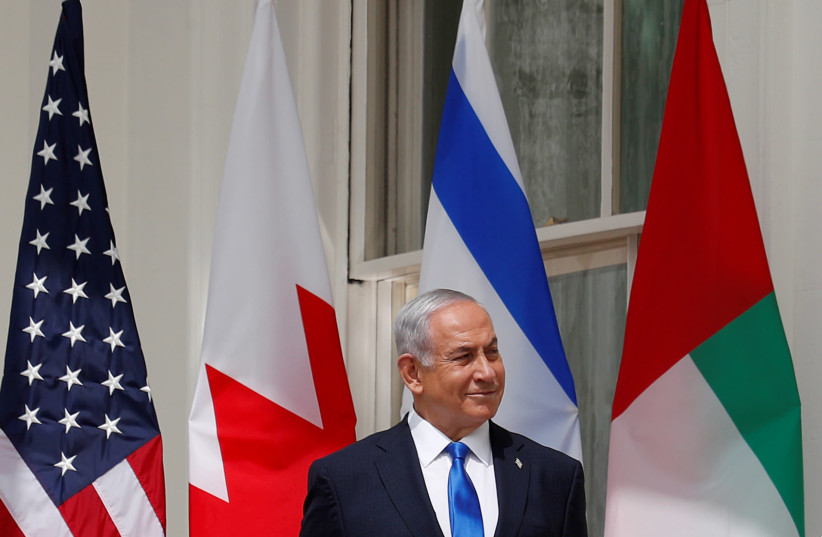
Israel's Prime Minister Benjamin Netanyahu istens prior to participating in the signing of the Abraham Accords at the White House in Washington, U.S., September 15, 2020 (photo credit: REUTERS//TOM BRENNER)
Israel's Prime Minister Benjamin Netanyahu istens prior to participating in the signing of the Abraham Accords at the White House in Washington, U.S., September 15, 2020
(photo credit: REUTERS//TOM BRENNER)

Incoming Prime Minister Benjamin Netanyahu's pledge to advance annexation policies in the West Bank is part of his push for a normalization deal with Saudi Arabia the Israeli media reported over the weekend.

The Hebrew daily Yediot Aharonot reported talks were underway between Israel, the United States and Saudi Arabia with respect to a normalization deal between the Jewish state and that Gulf country.

Such a deal would make Saudi Arabia the fifth Arab country to normalize ties with Israel under the auspices of the 2020 Abraham Accords.

Netanyahu will suspend plans to annex West Bank settlements in exchange for peace deal

The first four countries normalized ties with Israel in exchange for its suspension of plans to annex West Bank settlements. Netanyahu would similarly suspend plans for annexation in exchange for a Saudi deal as well, Yediot Aharonot said.

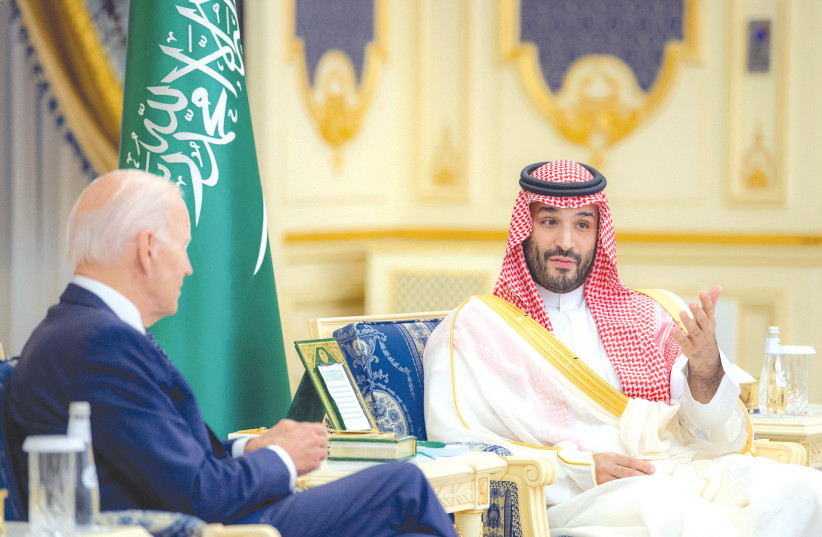
 SAUDI CROWN Prince Mohammed bin Salman and US President Joe Biden meet in Jeddah last Friday. (credit: Saudi Royal Court/Reuters) SAUDI CROWN Prince Mohammed bin Salman and US President Joe Biden meet in Jeddah last Friday. (credit: Saudi Royal Court/Reuters)

Netanyahu's promise to advance annexation policies in the West Bank is part of his coalition agreement with the Religious Zionist party, which has yet to be published or finalized.

In an interview with the US-based Jewish Insider published on Friday, Netanyahu said, "I hope to bring about a full, formal peace [with Saudi Arabia] as we’ve done with the other Gulf states like Bahrain and the United Arab Emirates. 

"It’s up to the Saudi leadership to decide that. I hope they will. And I intend to explore that alongside my other main goals. This is a very important goal, because if we have peace with Saudi Arabia, we are effectively going to bring an end to the Arab-Israeli conflict," Netanyahu told Jewish Insider.


Tovah Lazaroff

Source: https://www.jpost.com/middle-east/article-725732

Follow Middle East and Terrorism on Twitter