Sunday, May 19, 2024

The new anti-Americanism - Roger Kimball


by Roger Kimball

Although written in the abstract language of the graduate seminar, Empire has an ominously pragmatic aim: to undermine faith in the liberal institutions that inform American democracy.


I wonder if Empire—the nearly 500-page reader-proof tome by Michael Hardt and Antonio Negri—is about to make a comeback. The book has long-since disappeared into well-deserved oblivion.

But when it was first published some twenty years ago, it took the world—at least the gullible world of academia and adjacent media middens—by storm.

The venerable literary Marxist Fredric Jameson opined that it was “the first great new theoretical synthesis of the new millennium.” The Slovenian philosopher Slavoj Zizek—a plausible replacement for Jameson as the world’s trendiest academic Marxist—declared that it is “nothing less than a rewriting of the The Communist Manifesto for our time.”

Further down the intellectual food chain, Emily Eakin, a journalist for The New York Times, delivered herself of an ecstatic summary, simultaneously certifying and increasing the book’s prestige. Perhaps, she speculated, it is the “Next Big Idea,” the successor to structuralism and deconstruction in the halls of literary academia. It is too soon to say for sure, she cautioned, but, possessed as it is of “the formal trappings of a master theory in the old European tradition,” the book “is filling a void in the humanities.”

Neither blurb writers nor cultural journalists write under oath, of course. But even with all of the appropriate discounts, this is an exceptional outpouring. At the time, Hardt was a thirty-something associate professor in the literature program at Duke. His co-author, Antonio Negri (1933-2023), was  an Italian political philosopher in his late sixties who is described on the book’s dust jacket as “an independent researcher and writer and an inmate at Rebibbia Prison, Rome.” I will say more about Negri below.

Empire’s combination of owlish scholarly pretentiousness, on the one hand, and bristling Communist militancy, on the other, more or less guaranteed it at least a respectful audience in the academy.

About the former—the owlish pretentiousness—it must be said that Hardt and Negri had perfect pitch. There are few fashionable academic clichés that do not make at least a cameo appearance in Empire. On every page, Hardt and Negri field a large army of names and catch phrases—from Duns Scotus and Nicholas of Cusa to Michel Foucault and Gilles Deleuze, from “postmodernization” to “biopolitical production.” Their book luxuriates in a vast proliferation of abstract categories, schemas, and prognostications. They are particularly adept at maintaining an atmosphere of inescapable menace.

“In the passage from disciplinary society to society of control,” they write in one of many passages that takes off from the work of Foucault, “a new paradigm of power is realized which is defined by the technologies that recognize society as the realm of biopower. In disciplinary society the effects of biopolitical technologies were still partial in the sense that disciplining developed according to closed, geometrical, and quantitative logics.” Et very much cetera.

Contemporary academics simply love this sort of thing. Promiscuous talk about “power” and “discipline” seems to provide them with an almost erotic frisson. The charge is especially great when the talk is translated into academese—never say “discipline” when you can say “disciplinarity”—and dark, irresistible forces unrecognized by the rest of us are postulated. Empire is a veritable compendium of such passages. This alone makes it a good candidate for academic stardom.

Still, it took a while before the book really developed a following. But by the time Emily Eakin and The New York Times caught up with it, translation rights had been lined up in ten countries and the book had become the darling of right-thinking—which means left-leaning—literary academics from New York to Sydney.

It is worth pausing over Eakin’s mash note. Not because what she says is astute. She even manages to get the basic message of the book exactly 100 percent backward. But Eakin’s panegyric is symptomatic of the smug, destructive cultural milieu that nurtures books like Empire.

“Empire” is Hardt’s and Negri’s term for that transnational, capitalist entity—or perhaps it is a process; it is difficult to say—that has supposedly succeeded the nation-state. (The nation-state they regard as a dinosaur that is well on its way to the dust-bin of history.) Hence, “Empire” is not coterminous with the United States, though Hardt and Negri clearly believe that the U.S. figures prominently in the architecture of “Empire.”

In fact, what they call “Empire” does not really exist. Hardt and Negri sometimes come close to acknowledging this (though a page later they are populating Empire with all sorts of powers and attributes). In their preface, Hardt and Negri boldly claim that “Empire” is “not a metaphor but a concept, which calls primarily for a theoretical approach.”

The words “theoretical approach” should send a shiver down the spine of any sensible person. The burden of their remark is to declare intellectual open season. When it comes to applying a “theoretical approach” to a “concept,” the bottom line is: anything goes.

Still, using a capital letter whenever “Empire” is mentioned was a sound rhetorical move. It helps to give this airy nothing local habitation and a name, and people who are reassured by being told that something is not a metaphor but a concept will be grateful for that.

Eakin writes that Hardt and Negri believe “Empire is good news.” In truth, they excoriate it on virtually every page. “In Empire, corruption is everywhere,” they write in one typical passage. “It is the cornerstone and keystone of domination.”

One of their central questions is how the “multitude” (their term for what Marx called the proletariat) can become political and overcome “the central repressive operations of Empire.” (The answer comes on page 400: “We cannot say at this point.”) Does this sound like “good news?” No, Hardt and Negri do not regard Empire as good news.

They regard it as Marx regarded capitalism: something so bad that it would necessarily perish of its own badness. (Marx, being a Hegelian, substituted “contradictions” for “badness” in order to invest the process with the appearance of logical necessity, but there is no reason to dignify that philosophical sleight-of-hand by perpetuating the linguistic solecism.)

Eakin is also wrong to suggest that “Empire” may represent the “Next Big Idea.” This is mainly because Empire is based on a laughably tiny idea, and one that is also old and wrong.

The idea, again, is Marx’s idea about the inevitable collapse of capitalism. That idea seemed big once upon a time. It is now as thoroughly discredited as a historical or political idea can be. Hardt and Negri gussy up Marx with a formidable panoply of New Age rhetoric about globalization. But the creaking you hear as you make your way through the book is the rusty grinding of the dialectic: it goes nowhere, it means nothing, but it keeps creaking along.

Eakin is mistaken not only about the intellectual size of Empire. She is also wrong about the intellectual size of the movements Empire is enlisted to succeed. Structuralism was not an important intellectual development. Neither was deconstruction, post-colonialism, or new historicism, the other academic fads to which Eakin genuflects.

One and all, they were—and continue to be—intellectual con-games, utterly void of merit except as tools of obfuscation and intellectual corruption. (They can also help in the campaign to obtain tenure, but that is a separate matter.) One of the things that makes Eakin’s discussion of Empire so distasteful is the crass and stunningly superficial view of the humanities it presupposes. It is a view that celebrates novelty and “daringness” to the exclusion of concern for truth.

Of course, Eakin is not alone in this bad habit. On the contrary, the subordination of permanent human concerns to the winds of intellectual fashion is epidemic in the humanities. It is a major reason that Empire enjoyed its fifteen minutes of fame. But the fact that an evil is widespread and popular does not mean it is any less objectionable.

Eakin speaks of “the need in fields like English, history, and philosophy for a major new theory.” What those fields really need, however, is not a “major new theory”—or any sort of theory, come to that—but a return to first principles. Professors of literature do not require a theory to make Milton or Shakespeare come alive. What they need is a straightforward concern for the text and the questions it raises.

Great works of literature are inexhaustible when confronted by candid human curiosity. It is the same in other fields. Plato, Aristotle, Aquinas, and Kant seem like old hat only to someone who has lost the ability to read philosophy. But such persons ought not to be teaching.

Eakin quotes Stanley Aronowitz, a Marxist professor of sociology, who praises Empire for “addressing the crisis in the humanities, which has reached the point where banality seems to pervade the sphere.”

Aronowitz is right that there is a crisis in the humanities; he is right, too, that it is in part a crisis of banality. But the cause of the crisis is not the lack but rather the ceaseless pursuit of new theories. Is there anything more banal than the expostulations of Derrida, Foucault, and their countless epigones and progeny?

The triumph of what goes under the name “theory” has proven to be a prescription for frivolousness, grandstanding, and mendacity. If the past few decades have shown anything about the state of the liberal arts, it is that theory, so-called, does not enliven or illuminate the humanities; it replaces the humanities with an ideological counterfeit.

Which brings me back to Empire. Eakin cheerfully suggested that it was “filling a void in the humanities.” It would be more accurate to say that it epitomizes that void.

I have already mentioned the book’s style. When George Orwell observed that it was now “normal to come across long passages which are almost completely lacking in meaning,” he surely did not anticipate authors who would be able to keep up the unintelligibility for nearly five-hundred pages.

But it is not just the style of Empire that is rebarbative. Its judgments are too. They are mostly a tapestry of Marxist chestnuts updated for contemporary circumstances. Remember the Cold War? Leftist dogma maintains that it is impossible that the United States won the Cold War. Ergo, the fact that the United States did win it—that the policies of the Reagan administration brought about the collapse of the Soviet Union—must be denied at every turn.

So it is business as usual when Hardt and Negri solemnly assure us that “the United States did not defeat the socialist enemy” in the Cold War; rather, “The Soviet Union collapsed under the burden of its own internal contradictions.”

“Internal contradictions?” We require permits for handguns; why not for lethal concepts such as the Hegelian-Marxist dialectic? Its careless use is clearly a public intellectual-health hazard. The dialectic is the ultimate sophist’s tool.

Marx himself realized this. In an 1857 letter to Engels about an election prediction, Marx wrote: “It’s possible that I shall make an ass of myself. But in that case, one can always get out of it with a little dialectic. I have, of course, so worded my proposition as to be right either way.”

Hardt and Negri are not as cautious as the master. They were adept at deploying the dialectic, but they hadn’t mastered the art of duplicitous ambiguity. Most of us, looking back over the history of the nineteenth- and twentieth-century, would conclude that there was no international proletarian revolution as Marx predicted there would be.

But according to Hardt and Negri, such a judgment would be superficial and short-sighted: “actually,” they write, the proletariat “ ‘won’ ” because nation states are not as powerful now as they once were. I suspect that part of the reason Empire was such a hit in the academy was its superior insulation. Hardt and Negri have sealed every point of ingress; no hint of reality is allowed to seep in.

The single greatest embarrassment to Marxist theory has always been the longevity of capitalism. It was supposed to implode from “internal contradictions” long ago. But here it is 2024 and capitalism is still going strong and making the world richer and richer.

How is this possible? Hardt and Negri offer three hypotheses. One, that capitalism has reformed itself and is no longer in danger of collapse (an option they dismiss out of hand).

Two, that the Marxist theory is right except for the timetable: “Sooner or later, the once abundant resources of nature will run out.”

Three—well, it is a little difficult to say what the third hypothesis is. It has to do, they say, with the idea that capitalism’s expansion is “internal” rather than “external,” that it “subsumes not the noncapitalist environment but its own capitalist terrain—that is, that the subsumption is no longer formal but real.” I won’t attempt to explain this for the simple reason that I haven’t a clue about what it means.

Is there any important option they have neglected? Could it, just possibly, be that the “careful analyses of numerous Marxist authors” was just plain wrong? This is a possibility apparently too awful to contemplate, for Hardt and Negri never raise it.

It might seem that the best response to Empire would have been also the easiest: simple neglect. If anything is going to “implode” from its own “internal contradictions,” wouldn’t it be silly neo-Marxist diatribes written in polysyllabic gobbledygook? Who really cares whether books like Empire are considered hot stuff by the folks who run the Modern Language Association? Isn’t that just another confirmation of the complete irrelevancy of the academic world today? Writers like Hardt and Negri are clearly out of touch with reality; doesn’t that render them harmless?

Would that it were so.

Unfortunately, preposterousness has never been a barrier to effectiveness. There are plenty of ideas that are fatuous, wrongheaded, or simply ridiculous that nevertheless have a great and baneful influence on the world. Books like Empire are a veritable repository of such ideas.

The one unequivocally true statement in Empire is the observation that “the ‘merely cultural’ experimentation [of the 1960s] had very profound political and economic effects” (emphasis in the original). Hardt and Negri are both children of the 1960s, Hardt by adoption and Negri because he participated in them to the hilt.

Empire dilates enthusiastically on the radical movement of the 1960s, on the great benefits of ingesting mind-altering drugs and the happy “experimentation with new forms of productivity” undertaken by the feckless denizens of Haight-Ashbury and other ghettos of irresponsibility.

A prime ingredient of the ideology of the 1960s was anti-Americanism. America—generally spelled “Amerika”—was public enemy number one, not only because of the Vietnam War but also because of its embrace of capitalism and Western liberal values. Susan Sontag spoke for many left-wing intellectuals when she excoriated American culture as “inorganic, dead, coercive, authoritarian,” wrote that “the white race is the cancer of human history,” and insisted that what America “deserves” is to have its wealth “taken away” by the Third World.

Empire, like the anti-Israel protests sweeping college campuses today, was just another redaction of the radicalism and anti-Americanism of the 1960s. Which is to say that books like Empire are not innocent academic inquiries. They are incitements to violence and terrorism.

This was something that Antonio Negri, at any rate, understood perfectly well. Emily Eakin described Negri as a “flamboyant . . . Italian philosopher and suspected terrorist mastermind who is serving a 13-year prison sentence in Rome for inciting violence during the turbulent 1970’s.”

That is putting it mildly. Antonio Negri was an architect of the infamous Red Brigades, a Marxist-Leninist terrorist group. In 1979, he was arrested and charged with “armed insurrection against the state” and seventeen murders, including the murder of the Italian Prime Minister Aldo Moro, who was kidnapped in 1978 and shot dead fifty-five days later, his body dumped in a car.

Negri did not actually pull the trigger. But the authorities had no doubt that Negri was ultimately responsible. Negri fled to Paris, where he struck up friendships with Michel Foucault, Jacques Derrida, and other specimens of enlightenment. He eventually returned to Italy and negotiated a sharply reduced sentence for “membership in an armed band.”

There is nothing in Empire to suggest that Negri has had second thoughts about his activities in the Red Brigades. On the contrary, whenever violent insurrection is mentioned, it is praised. Empire concludes with a section called “Militant,” printed entirely in italics. “In the postmodern era, as the figure of the people dissolves, the militant is the one who best expresses the life of the multitude: the agent of biopolitical production and resistance against Empire.”

Hardt and Negri praise “the communist and liberatory combatants of the twentieth-century revolutions” and assure us that “militancy today is a positive, constructive, and innovative activity.”

The most nauseating part of the book comes at the very end: “This is a revolution that no power will control—because biopower and communism, cooperation and revolution remain together, in love, simplicity, and also innocence. This is the irrepressible lightness and joy of being communist.”

Although written in the abstract language of the graduate seminar, Empire has an ominously pragmatic aim: to undermine faith in the liberal institutions that inform American democracy.  It is a poisonous book whose ultimate goal was not to understand but to destroy society. Sensible citizens should be alarmed that it was glorified by trendy intellectuals and the press. It is sometimes suggested that America’s culture wars are over. The adulation showered upon Empire and its authors reminds us that the real battles have yet to be joined.


Roger Kimball

Source: https://amgreatness.com/2024/05/19/the-new-anti-americanism/

Follow Middle East and Terrorism on Twitter

Just look at what the leftist media aren’t covering - Jack Hellner


by Jack Hellner

If you want to be informed about what’s going on in the world, pay attention to what you don’t see in the New York Times.


The media, many Democrats, and some Republicans, like Romney and Murkowski, are having a cow that some Republicans are showing up at the political prosecution of Trump in New York, where there was no crime.  It is too bad that the Republicans didn’t show up at the N.Y. fraud case, where there was no fraud. 

Here is what Dana Milbank decided was a good opinion piece for Saturday. 

Somehow, we never saw opinion pieces like that when Democrats, like pigs going to slaughter, stood in line to falsely claim that Biden never was involved in the Biden family kickbacks, no matter how much evidence they saw that he was the big guy who took Hunter around the World on government jets taking kickbacks. 

The following are other opinion pieces from Saturday.  They essentially are Democrat talking points as they interfere in the elections. 

J.D. Vance wasn’t just some hillbilly after all

By Matt Bai

Harrison Butker doesn’t only kick footballs

By Kathleen Parker

Trump’s promises to oil executives ought to be illegal

By Jennifer Rubin

Trump promises tax cuts and fewer rules. CEOs shouldn’t fall for it.

By the Editorial Board

Shouldn’t they report these contributions to the Federal Election Commission or be taken to court for interfering in the election?

It appears that the WaPo, along with most media outlets, catch and kill, or downplay, stories that would be negative to Biden as they focus on destroying Trump, as they have for over eight years. 

Here are a few current examples:

How about Merrick Garland refusing to release the audio tape of Biden with Hur?  The public has seen the transcript, so any excuse not to release the tape is purely political. 

Why haven’t we seen huge stories in the media that the NIH deputy director admitted that Fauci lied under oath?  Are the media burying the story since they participated in spreading so many lies, including falsely claiming that the Wuhan lab as the source of COVID was a disproven conspiracy?

The media should be ashamed that they pretended that Fauci’s pronouncements were based on science, but they don’t seem to be. 

Why hasn’t Garland charged Fauci with perjury?  The answer is clearly that Democrats are allowed to lie with impunity. 

Maybe the media should report that the Biden administration doesn’t care whom it destroys as it micromanages the economy with massive regulations. 

Or they could report why the public can’t stand Biden’s economic policies instead of proclaiming that the public just doesn’t understand how successful Biden’s policies have been. 

According to an incredibly shocking new studymost Americans do not make enough money to “live comfortably” in the highly inflationary environment that we find ourselves in today. ...

A recent study has revealed the incomes needed for families to live comfortably across the United States — and the stark contrast in the cost of living between states is startling.

The study revealed that in the most expensive states, families need nearly $300,000 to simply live ‘comfortably.’

The least expensive state requires about half that salary — still over $100,000.

Meanwhile, the average annual salary in the US is $59,428, or $28.34 per hour, as of May 2024.

The study determined that Massachusetts is the most expensive state.

It takes a whopping $301,184 a year for a family of four to “live comfortably” there.

The least expensive state is Mississippi.

In the Magnolia State, it only takes $177,798 a year for a family of four “to cover their expenses and maintain a satisfactory quality of life”.

And this should be a huge story: that Jack Smith’s team mishandled classified documents and lied to the courts.  Somehow, most of the media don’t care about how corrupt the justice system is as long as the target is Trump. 

The media are a much bigger threat to a fair election than A.I., Russia, or China.  They gladly spread misinformation every day to target politicians whose policies they don’t like, and they bury negative truthful stories of people they do like. 

On a side note: It is a joke when people from Hollywood and the media pretend they don’t know who Diddy Combs is.  They also pretended that they didn’t know about Epstein, or Weinstein, or how corrupt Joe and his family have been.  They have known about the corruption for years. 

<p><em>Image via <a  data-cke-saved-href=

Image via Pxhere.


Jack Hellner

Source: https://www.americanthinker.com/blog/2024/05/just_look_at_what_the_leftist_media_aren_t_covering.html

Follow Middle East and Terrorism on Twitter

Iranian regime concerned for President Raisi's life after helicopter crash - Tzvi Joffre


by Tzvi Joffre

Foggy weather and huge boulders complicated rescue efforts for the president's helicopter, according to Iranian reports.


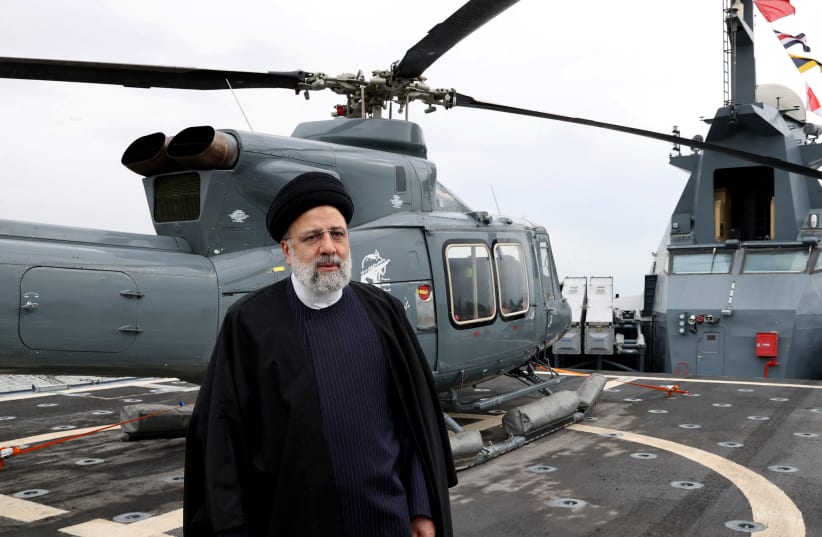
Iranian President Ebrahim Raisi visits the military equipment of IRGC Navy in Bandar Abbas, Iran, February 2, 2024. (photo credit: IRAN'S PRESIDENCY/WANA (WEST ASIA NEWS AGENCY)/HANDOUT VIA REUTERS)
Iranian President Ebrahim Raisi visits the military equipment of IRGC Navy in Bandar Abbas, Iran, February 2, 2024.
(photo credit: IRAN'S PRESIDENCY/WANA (WEST ASIA NEWS AGENCY)/HANDOUT VIA REUTERS)

The Islamic regime in Iran expressed concern for the lives of Iranian President Ebrahim Raisi and Foreign Minister Hossein Amir-Abdollahian after the helicopter they were traveling in suffered a "hard landing" on Sunday afternoon.

Details about the incident remained unclear as of Sunday afternoon, although reports indicated the accident involved the president's helicopter and foggy weather. As night fell, the searches became even more difficult. According to the Iranian IRNA news agency, the helicopter crashed in a forest area between the villages of PirDavood and Uzi in northwestern Iran.

According to the IRGC-affiliated Tasnim News Agency, emergency services were conducting searches to try and find the president's helicopter, but the foggy weather and huge, 70-meter tall boulders in the area were complicating search efforts. Over 40 rescue teams were operating in the area as part of search efforts.

The reformist Ensaf News site cited an informed source as saying that the crash was "serious" and that there was a "high probability" of injuries in the accident.

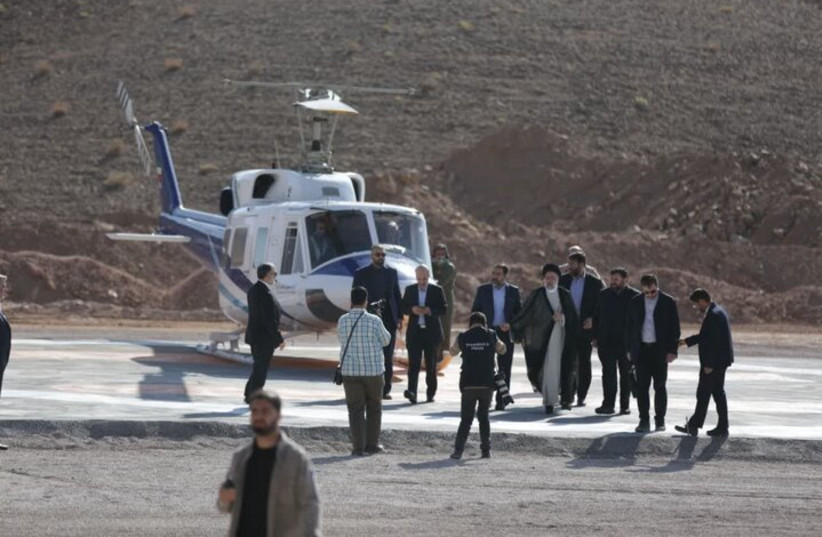
Iranian President Ebrahim Raisi seen before boarding a helicopter in Azerbaijan, May 19, 2024 (credit: MEHR NEWS AGENCY)Enlrage image
Iranian President Ebrahim Raisi seen before boarding a helicopter in Azerbaijan, May 19, 2024 (credit: MEHR NEWS AGENCY)

Iranian FM, regional leaders in helicopter with Raisi

Amir-Abdollahian and Mohammad Ali Ale-Hashem, the representative of the Guardianship of the Islamic Jurist in East Azerbaijan and the Imam of Friday Prayer in Tabriz, were reportedly in the helicopter with Raisi.

The Deputy Coordinator of Civil Affairs of East Azerbaijan said that there were three helicopters in the convoy, two of which landed safely and one of which fell, according to Iranian state media. The deputy coordinator added that he did not know any details about possible casualties or the exact cause of the accident.

Iranian media reported that some people were able to talk with Ale-Hashem shortly after the incident but that contact had since been lost.

Iranian Supreme Leader Ali Khamenei called on Iranians to pray for Raisi's health on Sunday evening, saying "If the people of Iran do not worry, there will be no disruption in the work of the country."

Regime religious leaders held prayers for Raisi's health in several locations across Iran, according to Iranian state media.


Raisi had met with Azerbaijani Elham Aliyev earlier on Sunday on the Azerbaijani-Iranian border.

Raisi is often referred to as the “butcher of Tehran” in light of his involvement in the mass executions of Iranian political prisoners in the 1980s.

US 'closely watching' reports about Raisi crash

The US State Department is closely watching reports of the crash of the helicopter carrying Iranian President Ebrahim Raisi and his foreign minister, a US State Department spokesperson said in a statement on Sunday.

Aliyev said he was "seriously worried" about Raisi on Sunday evening.

"Our prayers to Almighty God are with President Ibrahim Raisi and his accompanying delegation. As a neighboring, friendly and brotherly country, the Republic of Azerbaijan is ready to provide all kinds of support," said Aliyev.

The European Commissioner for Crisis Management, Janez Lenarčič, announced on Sunday evening that the EU had activated the Copernicus Emergency Management Service's rapid response mapping service in the area of the helicopter crash in order to help find Raisi after receiving a request to do so from Iran.

Reuters contributed to this report.


Tzvi Joffre

Source: https://www.jpost.com/breaking-news/article-801726

Follow Middle East and Terrorism on Twitter

With the fate of Raisi in question, his denial and hatred for Jews and Israel takes the spotlight - Jerusalem Post Staff


by Jerusalem Post Staff

The Iranian president's rhetoric has revisited not only historical controversies but also heightened current geopolitical tensions.


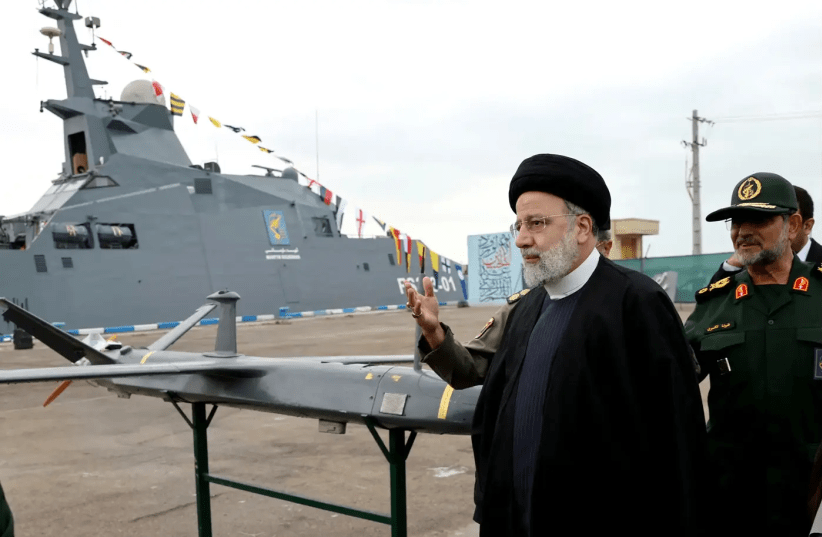
Sudan - Raisi passes by a ship (photo credit: Walla)
Sudan - Raisi passes by a ship
(photo credit: Walla)

Iranian President Ebrahim Raisi's provocative statements on the Holocaust and Israel have intensified global tensions and spotlighted the deep-seated rifts between Tehran and Jerusalem following his helicopter's "hard landing" due to foggy conditions on Sunday.

The helicopter carrying Raisi was forced to land amid challenging weather and crashed in a forested area between the villages of PirDavood and Uzi in northwestern Iran. Over 40 rescue teams have been deployed in the search efforts.

Raisi's comments during a September 19, 2022, CBS's "60 Minutes" interview have particularly ignited backlash. He suggested that "There are some signs that [the Holocaust] happened, but further research needs to be done to investigate it," a statement widely condemned as a form of Holocaust denial, especially sensitive given Israel's role as a refuge for Holocaust survivors. "If a state shakes hands with the Zionist regime, then they are an accomplice to their crimes,” he declared in 2022.

The Iranian president's rhetoric has not only revisited historical controversies but also heightened current geopolitical tensions. He has described Israel as a "false regime," reaffirming Iran's longstanding denial of Israel's legitimacy. Adding to tensions, Raisi has made threats against major Israeli cities, including Tel Aviv and Haifa, linking their potential destruction to provocations on Holocaust Remembrance Day.

Raisi's continuous denial of Israel 

On resolving the Israeli-Palestinian conflict, Raisi has been clear in his intentions, stating, "The only solution is a Palestinian state from the river to the sea.'"

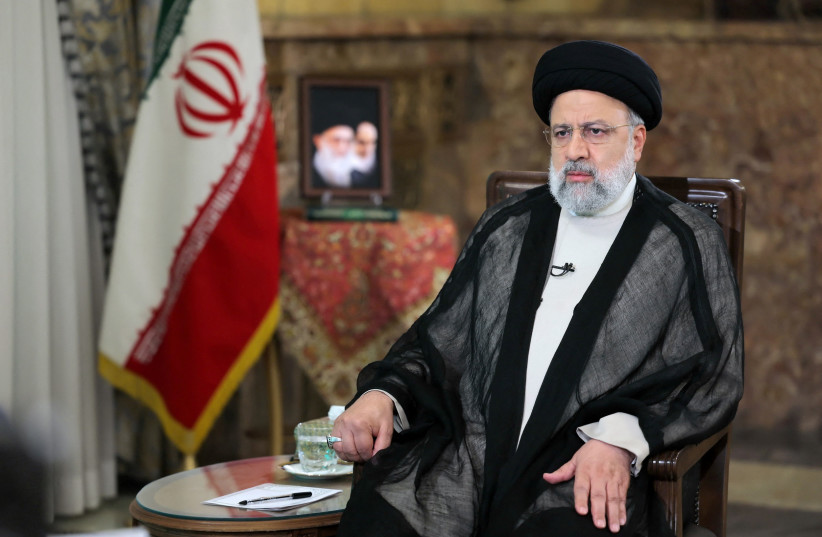
 Iranian President Ebrahim Raisi looks on during a TV interview, in Tehran, Iran May 7, 2024.  (credit: IRAN'S PRESIDENCY/WANA (WEST ASIA NEWS AGENCY)/HANDOUT VIA REUTERS)Enlrage image
Iranian President Ebrahim Raisi looks on during a TV interview, in Tehran, Iran May 7, 2024. (credit: IRAN'S PRESIDENCY/WANA (WEST ASIA NEWS AGENCY)/HANDOUT VIA REUTERS)

He has also remarked that the “Zionist regime’s crimes have crossed the redlines, which may force everyone to take action,” in reference to Israeli military actions in Gaza as of October 29.

The international response to Raisi's comments has been swift and widespread. Israeli officials and key global Jewish organizations, such as the United States Holocaust Memorial Museum and the World Jewish Congress, have criticized his remarks as antisemitic, urging a strong international response to Iran's leadership.

Lt. Gen. (Res.) Aviv Kohavi, former chief of staff of the Israeli army, highlighted the dangers of a regime distorting historical truths. During a visit to Auschwitz, he discussed the risks associated with such denials for global security, particularly concerning Iran's nuclear ambitions.

On the topic of normalizing relations with Israel, Raisi stated, “Countries that seek to normalize relations with this cruel and criminal regime are ashamed before their nations today.” He further predicted in January 2024 that the Israel-Hamas conflict would lead to "Israel's destruction.”


Jerusalem Post Staff

Source: https://www.jpost.com/middle-east/iran-news/article-801748

Follow Middle East and Terrorism on Twitter

Camp of the Dumbbells - Clarice Feldman

by Clarice Feldman

Neither the Biden administration nor the EU seems interested in the large and growing antipathy to open borders. And both will regret ignoring it.


In 1975 a Frenchman, Jean Raspail, wrote a fictional account of how western civilization was destroyed by unrestricted immigration from the Third World. His work, The Camp of the Saints, has been out of print for some time, but it again became popular in 2011 and  Amazon now is offering it on Kindle and you can read it free online. I urge you to do so, because it is probably the most prescient novel you will ever read.

Every day on X (formerly Twitter) I read accounts from around the world of the increased crime, inflation, hatred, and destruction of western civilization by the open borders policies of countries and the European Union. Bringing in hordes of undereducated men who live off the welfare state and hold views incompatible with ours is every bit as destructive of modern western life as Raspail envisioned it would be. Here’s a brief, representative sample of what I am reading every day online. (Online because the legacy media is largely ignoring it.)

The UK

Islamist extremists calling for an "Intifada revolution". We are a tolerant country, but this is vile. Every single weekend London is a no-go zone for Jews. I'm fed up of these disgusting, perpetual, hateful, disruptive protests. It has to stop! 

@AJPhillipsEsq

"Britain is visibly declining under the weight of mass immigration, a complete lack of social integration, inflation, high taxes and soaring energy prices. It’s now time for British politicians to prioritise the British people and the country" @GoodwinMJ

Ireland

Yesterday the government went all out in an attempt to plant illegal immigrants in Doneraile, Coole and Clonmel. All 3 attempted plantations were stopped. The Irish will never accept mass immigration. This is our island!

Sweden

But one EU country traditionally welcoming of immigrants is hatching plans that will make immigration and integration there more challenging moving forward.

In October, Sweden’s new government coalition announced an agreement that includes broad proposals aimed at decreasing the amount of immigrants brought into the country, a dramatic shift in precedent for a country long-known to be welcoming to non-citizens seeking a better life. Experts say while it’s too early to know how the plans will really impact migration, the possibilities are concerning.

“The general approach is to lower the standards in order to make Sweden less attractive as a destination,” says Bernd Parusel, a senior researcher at the Swedish Institute for European Policy Studies.

Analysts argue this push began when the Sweden Democrats, a far-right political party, made big gains in the country’s September parliamentary elections and, as a result, gathered more political influence. [snip]

Then came October’s Tidö Agreement, which lays out the policy priorities of the Sweden Democrats and three other governing parties: the Moderate Party, Christian Democrats and Liberals. While just one component of the coalition’s broader plans, the proposals related to modifying migration law are wide-ranging. The coalition hopes to make conditions and requirements for family reunification, labor immigration and Swedish citizenship more strict. Even the country’s asylum reception legislation “will be adapted to ensure that it is not more generous than is required of any member state under EU law.” The package is “very comprehensive,” says Parusel, who notes that about 19 pages of the 62-page agreement document are devoted to asylum, migration and integration.

“Immigration to Sweden has been unsustainable,” reads a statement by new Prime Minister Ulf Kristersson of the center-right Moderate Party, delivered in October to the country’s legislative body, the Riksdag. “This government’s message is that this cannot continue. A paradigm shift is now taking place in Swedish migration policy.”

Netherlands

Geert Wilders has announced that the 5-month negotiations on forming a coalition government have finally been successful.

His PVV party will rule together with 3 other right-wing parties.

The "Hope, Courage and Pride" coalition platform presented today introduces strict measures on asylum seekers, scraps family reunification for refugees, and will reduce the number of non-EU students coming to the country.

"Deport people without a valid residence permit as much as possible, even forcibly," the agreement says.

The coalition will also strive to get a Dutch opt-out from the EU’s new Migration Pact and its mandatory migrant relocation quotas.” And I think both will regret ignoring it.

Neither this administration nor the EU seems interested in the large and growing antipathy to open borders. And I think both will regret ignoring it. In thr EU:

The tortuous and often explosive undertaking came to an end on Tuesday afternoon, as member states gathered to give the very final green light to the five regulations that make up the New Pact on Migration and Asylum, an all-encompassing overhaul that seeks to ensure all countries, regardless of location, shoulder their fair share.

Among other things, the New Pact envisions stricter rules to expand the screening of applicants, carry out health and security checks, speed up examination procedures and provide counselling free of charge. Its main novelty is a system of "mandatory solidarity" that would give governments three options to manage asylum seekers: relocate a certain number, pay €20,000 for each one they reject, or finance operational support.

The initial goal is to have 30,000 relocations per year.

As expected, Poland and Hungary, the most ardent critics, voted against the entire package of legislation. Since the reform was presented in 2020, the two have consistently resisted the system of "mandatory solidarity," falsely claiming it would force them to accept migrants against their will.

The Czech Republic and Slovakia, two skeptics, chose to abstain in the majority of files, while Austria voted against the Crisis Regulation.

However, the New Pact only needed a qualified majority so it moved forward and was formally ratified, sealing one of the greatest accomplishments of the current mandate. [snip]

Southern member states complained about being overwhelmed and left alone. Western and northern countries demanded stronger accountability and enforcement at the external borders, while eastern states resisted any initiative that resembled a relocation quota. [snip]

Amid the commotion, far-right forces saw their chance and jumped onto the topic as a trampoline to relevance and electoral success. The shockwaves of that political seism are still felt today, with polls ahead of the June elections predicting a sharp turn to the right.

Despite the sense of relief in Brussels, the thumbs down given by Poland and Hungary presaged a rocky start for what comes next: making the reform work.

The European Commission will present an implementation plan in June to outline the legal and operational elements necessary to put the New Pact into practice. Then, member states will have until January to submit their own national plans.

Not sensing the way the wind is blowing, the Biden administration has floated the notion that it may consider admitting refugees from Gaza, a place where the inhabitants have for decades been brainwashed by Hamas propaganda and would be unlikely to provide the kind of immigrants we need or want. 

Maybe a non-fiction version of Raspail’s work, The Camp of the Dumbbells, is due for publication.

 
Clarice Feldman

Source: https://www.americanthinker.com/articles/2024/05/camp_of_the_dumbbells.html

Follow Middle East and Terrorism on Twitter

Iran's New Proxy: American Universities - Robert Williams


by Robert Williams

The Alavi Foundation, according to its website, has indeed funded many of the universities where protests were taking place. The universities include those of the Ivy league, such as Columbia, Harvard, Princeton, Rutgers, as well as UCLA and many others.


  • "We are watching the demonstrations, and we like what we see, but it should not end with this.... These protestors are our people and will support Iran in an Iran-U.S. confrontation; Iran can repeat in the U.S. what it did in Lebanon but on a grander scale because the 'Hizbullah -style' groups in the U.S. are 'much larger' than in Lebanon.... America is the Great Satan and our enemy, but we have hope in these areas." — Foad Izadi, Teheran University, who studied at University of Houston and Louisiana State University, Ofogh TV (Iran), April 26, 2024.

  • [Hezbollah's Deputy Secretary-General Sheikh Naim] Qassem – who appeared almost taken aback at the eagerness of students on US campuses to join Hamas in its call for the genocide of Jews – was hopeful about the ability of America's students to help Hezbollah destroy Israel by turning the U.S. against its ally.

  • "We found evidence that the government of Iran really controlled everything about the [Alavi] foundation," Adam Kaufmann, investigations chief at the Manhattan District Attorney's Office, November 22, 2009.

  • The Alavi Foundation, according to its website, has indeed funded many of the universities where protests were taking place. The universities include those of the Ivy league, such as Columbia, Harvard, Princeton, Rutgers, as well as UCLA and many others.

  • In 2016, Harvard employed Ali Akbar Alikhani – who had warned about "the Jewish threat" -- from Tehran University's Faculty of World Studies, which is reportedly closely tied to the Iranian ruling regime, as a visiting scholar at Harvard's Center for Middle Eastern studies....

  • Hooshang Amirahmadi, the founder of the American Iranian Council (AIC), has admitted that the lobbying organization was created by the Islamic Republic of Iran to work for its interests in the US. Amirahmadi has had and continues to enjoy a successful academic career at Rutgers University....

  • Some faculty members at Rutgers recently called for the genocide of Jews.

  • In addition, at least five US universities -- Virginia Tech University, the University of Washington, Worcester Polytechnic Institute, Clarkson University, and the University of Louisiana at Lafayette -- have allegedly been cooperating with Iranian entities that are sanctioned by the US and the European Union, including the Iranian Aerospace Research Institute, Iran University of Science and Technology, and the Sharif University of Technology.

  • Iran can only be rejoicing at the moral and educational collapse they have helped create on American university campuses, which are grooming America's future teachers, judges and political leaders. Now, however, these campuses appear to be incubating America's future terrorists and creating a national security threat.

Iran can only be rejoicing at the moral and educational collapse they have helped create on American university campuses, which are grooming America's future teachers, judges and political leaders. Now, however, these campuses appear to be incubating America's future terrorists and creating a national security threat. Pictured: Pro-Hamas and anti-Israel protesters outside of Columbia University on April 24, 2024 in New York City. (Photo by Michael M. Santiago/Getty Images)

"Iran, you make us proud" and "Yemen, Yemen make us proud, turn another ship around," were among the chants by the pro-Hamas college students and the paid activists who organized them on U.S. campuses. They declared a "student intifada," conducted a Hamas-inspired "Day of Rage," bowed down to Allah and called for "Death to Israel" and "Death to America."

Meanwhile, Iran and the mouthpieces of its Islamist regime were paying extremely close attention. According to Tehran University Professor Foad Izadi, who is American-educated and considered one of Iran's main experts on the U.S. and a mouthpiece for the Iranian regime:

"...the demonstrations [on U.S. campuses] are important. What we in the Islamic Republic should do is... We are watching the demonstrations, and we like what we see, but it should not end with this...These protestors are our people and will support Iran in an Iran-U.S. confrontation; Iran can repeat in the U.S. what it did in Lebanon but on a grander scale because the 'Hizbullah -style' groups in the U.S. are 'much larger' than in Lebanon."

Izadi was educated at the University of Houston and received his doctorate from Louisiana State University before returning to Iran. In the West, he falsely poses as a peace activist, as a board member of the radical organization World Beyond War which calls itself "a global movement to end all wars."

Izadi urged the Iranian government to engage "on an operational level" with protesting students in the U.S. to try to "recruit connections and build networks" among them, adding

"Personally, I think that the potential to repeat in the U.S. what Iran did in Lebanon is much higher. Our Hizbullah-style groups in America are much larger than what we have in Lebanon. America is the Great Satan and our enemy, but we have hope in these areas."

Hezbollah in Lebanon is also paying extremely close attention. In a May 3 interview, Hezbollah's Deputy Secretary-General Sheikh Naim Qassem praised the pro-Hamas protests on American campuses.

"We appreciate and value this very much. Perhaps in the future, there will be cooperation among the youth of the world – in America, France, Britain, Germany, and all the activists. The [campus protests] are important, especially because they will have an impact on the U.S. elections. They will have an impact on the American position. Even if Biden says that he will not be influenced by this, he will whether he likes it or not. We will see him taking actions because of the protesters' influence on him."

Qassem – who appeared almost taken aback at the eagerness of students on US campuses to join Hamas in its call for the genocide of Jews – was hopeful about the ability of America's students to help Hezbollah destroy Israel by turning the U.S. against its ally.

"Where do the members of Congress come from? From among the people. If the people's perspective changes... There were never such level [of protests] in America... This would mean embarking on a new stage, and maybe one of these days, America will no longer support Israel to such an extent. Without support, Israel is nothing. We would not have to work hard in order to destroy Israel. Without support, it will be destroyed."

The Iranian regime – the patron and sponsor of Hamas, Hezbollah and the Houthis -- has been working on just such an outcome since the Islamic revolution in 1979. Now, Iran and others appear to be actively seeking to turn American youth against the US by infiltrating American campuses.

The New York Post wrote as early as 2009:

"The deep-pocketed Alavi Foundation has aggressively given away hundreds of thousands of dollars to Columbia University and Rutgers University for Middle Eastern and Persian studies programs that employ professors sympathetic to the Iranian dictatorship...

"In one of the biggest handouts, the controversial charity donated $100,000 to Columbia University after the Ivy League school agreed to host Iranian leader and Holocaust denier Mahmoud Ahmadinejad, according to the foundation's 2007 tax filings obtained by The Post."

"We found evidence that the government of Iran really controlled everything about the foundation," Adam Kaufmann, investigations chief at the Manhattan District Attorney's Office told the Post at the time.

The Alavi Foundation, according to its website, has indeed funded many of the universities where protests were taking place. The universities include those of the Ivy league, such as Columbia, Harvard, Princeton, Rutgers, as well as UCLA and many others.

"This is all about Iran laundering their policies through academe," said Michael Rubin, a senior fellow at the American Enterprise Institute. "And the ivory tower is prostituting itself for money."

According to Influence Watch, the Alavi Foundation has been investigated by the US government since 2003, and has funded several other institutions apart from American universities:

"It donated $50 million from its founding through 2014, including to non-Muslim groups such as the Clinton Foundation, to which it sent $30,000; Action Against Hunger, to which it sent $500,000; New York State World Trade Center Relief Fund, to which it sent $100,000; Harvard University, which received over $600,000; and the Catholic University of America, which received $375,000."

In 2020, the Education Department asked Harvard University to disclose more information about donations it received from the Alavi Foundation.

In 2016, Harvard employed Ali Akbar Alikhani – who had warned about "the Jewish threat" -- from Tehran University's Faculty of World Studies, which is reportedly closely tied to the Iranian regime, as a visiting scholar at Harvard's Center for Middle Eastern studies. At Harvard, he claimed to be a "professor of peace," centered on a project about "peaceful coexistence in Islam."

In November 2023, the U.S. House Committee of Education and the Workforce launched an investigation into former Iranian official Seyed Hossein Mousavian, who is a Middle East Security and Nuclear Policy Specialist at the Program on Science and Global Security at Princeton University.

"Higher education has bowed down to the radical left and enemies of America for far too long, and the mere fact that a former member of the Iranian regime is given a platform at Princeton is proof," said House Rep. Lisa McClain.

Mousavian served as Iran's ambassador to Germany from 1990-1997, during which time the Islamic Republic assassinated Iranian dissidents living in Germany. He remains employed at Princeton, while continuing to have close ties to the Iranian regime. According to Alliance Against Islamic Regime of Iran Apologists:

"During his time at Princeton, Mousavian has continued to support the Iran regime's hostile foreign interests. During a 2016 interview, Iran's then-foreign minister Javad Zarif told state television that he 'worked closely with [Mousavian] for many years,' adding that the professor 'is some[one] who is completely tied to the regime' and is 'currently working hard' for it."

Mousavian, who attended the funeral of the deceased arch-terrorist Quds Force of the Islamic Revolutionary Guards Corps commander Qassem Soleimani in Tehran in 2020, also appeared in an Iranian TV tribute to him.

"Individuals who are aligned with malignant regimes continue to permeate America's postsecondary education system," said U.S. Rep. Virginia Foxx, who chairs the Education and the Workforce Committee.

"Seyed Hossein Mousavian's refuge at Princeton for 15 years is a textbook example. These individuals pose a grave threat to America's national security posture, and they are left to fester without any intervening action or diligent oversight efforts. It's time for some much-needed sunlight to expose the blatant corruption and influence peddling that has become far too commonplace."

Similarly, Oberlin College, employed Iran's former UN ambassador, Mohammad Jafar Mahallati, who reportedly covered up the mass murder of 5,000 Iranian political prisoners in 1988 when he was the regime's ambassador to the UN. While at Oberlin, he called himself the "professor of peace." Mahallati taught at Columbia in the 1990s, where he was found guilty of sexually harassing a female student. Oberlin suspended him only in December 2023 after a three-year campaign by Iranian dissidents in the US. He taught students support for Hamas. According to the Alliance Against Islamic Regime of Iran Apologists.

"We demanded Mahallati's immediate termination after an Amnesty International report identified him as a chief conspirator in the Iran regime's attempts to hide the 1988 massacre of an estimated 5,000 political prisoners. In late September, the Department of Education Office of Civil Rights revealed that it was investigating a complaint that Mahallati taught students 'support for Hamas and terrorism' as part of a larger probe into anti-Semitism on Oberlin's campus."

The list of Iranian professors working on behalf of Iran's regime continues to grow. Hooshang Amirahmadi, the founder of the American Iranian Council (AIC), has admitted that the lobbying organization was created by the Islamic Republic of Iran to work for its interests in the US. Amirahmadi continues to enjoy a successful academic career at Rutgers University, where he is Distinguished Service professor, former director of the Rutgers' Center for Middle Eastern Studies and the founder of the Rutgers Center for Iranian Research and Analysis, on which he served as director for many years. Rutgers describes him as:

"Acclaimed for his contributions to improving United States-Iran relations through promoting world peace and humanistic studies... and founder of the American Iranian Council, a nonprofit research organization devoted to improving dialogue and understanding between the peoples of Iran and the United States."

"The problem of terrorism is a true myth. Iran has not been involved in any terrorist organization. Neither Hezbollah nor Hamas are terrorist organizations," Amirahmadi claimed in 2008. Between 2005 and 2007 alone, the Alavi Foundation donated $351,600 to the Rutgers Persian-language program, according to a spokesman for Rutgers. Students there may literally have been indoctrinated to love Hamas for at least a decade and a half. Some faculty members at Rutgers recently called for the genocide of Jews.

In addition, at least five US universities -- Virginia Tech University, the University of Washington, Worcester Polytechnic Institute, Clarkson University, and the University of Louisiana at Lafayette -- have allegedly been cooperating with Iranian entities that are sanctioned by the US and the European Union, including the Iranian Aerospace Research Institute, Iran University of Science and Technology, and the Sharif University of Technology.

Iran can only be rejoicing at the moral and educational collapse they have helped create on American university campuses, which are grooming America's future teachers, judges and political leaders. Now, however, these campuses appear to be incubating America's future terrorists and creating a national security threat.


Robert Williams is a researcher based in the United States.

Source: https://www.gatestoneinstitute.org/20654/iran-proxy-us-universities

Follow Middle East and Terrorism on Twitter

Media blame climate change for soaring insurance rates, but data doesn’t support narrative - Kevin Killough


by Kevin Killough

The data on weather trends shows little evidence that the frequency or intensity of storms are increasing, and critics say it’s a symptom of a much larger issue with a lack of skepticism and curiosity in climate reporting.


Homeowners across the U.S. are seeing skyrocketing insurance rates, increased deductibles, excluded protections, and canceled policies.

Insurers say that they’re having to adjust to changing conditions to remain profitable. Among the problems they blame is inflation, rinsing construction costs, and costs associated with regulatory compliance. But many insurers are also blaming climate change for driving extreme weather events and increasing losses, and much of the media coverage is zooming in on this narrative.

However, the data on weather trends shows little evidence that the frequency or intensity of storms are increasing, and critics say it’s a symptom of a much larger issue with a lack of skepticism and curiosity in climate reporting.

“Journalists aren't equipped to go into the studies. They're not economists. They're not climate scientists. They're journalists,” Ryan Maue, a research meteorologist told Just the News.  “They're supposed to ask questions and dig deeper by going to ask all the sources, or go find experts either to talk on the record or off the record. And for whatever reason, this field just does not do that.” 

Climate shocks

The Washington Post reported in September that Allstate, American Family, Nationwide, Erie Insurance Group and Berkshire Hathaway told regulators that “extreme weather patterns caused by climate change” led them to stop insurance people in some regions, exclude protections for some types of weather events, and raise monthly premiums and deductibles. 

The Financial Times reported in April that “Home insurance is becoming increasingly unaffordable in areas such as California and Australia, as global warming has made storms, floods and wildfires more frequent and severe.”

The New York Times Monday ran another such report, claiming that the insurers are bleeding cash from “climate shocks.” 

“The insurance turmoil caused by climate change — which had been concentrated in Florida, California and Louisiana — is fast becoming a contagion, spreading to states like Iowa, Arkansas, Ohio, Utah and Washington,” Times reporters Christopher Flavelle and Mira Rojanasakul wrote. 

The Times reporters claimed, without any attribution to any data source, that “as a warming planet makes events like hail and wind storms worse, insurers are fleeing.” 

Dr. Roger Pielke Jr., professor of environmental studies at the University of Colorado at Boulder, graphed the trends on hail and wind reports between 2010 and 2023 using data from the National Oceanic and Atmospheric Administration's Storm Prediction Center (SPC). Neither set of data showed any worsening trends over the time period. 

“Why is the climate beat so allergic to actual data when making claims about data?” Pielke asked in the post on X where he shared the data. 

Just the News reached out to Flavelle and Rojanasakul to ask if they had sought out this data, were aware it exists, or why it was excluded if they are aware of it. Neither reporter responded to questions for this story. 

Chris Martz, a metrology student in the Millersville University meteorology program, dove deeper into NOAA’s SPC data, as well as the AR6 report of the United Nations Intergovernmental Panel on Climate Change, a consortium of the world’s leading climate scientists. 

According to Chapter 11 of the report, which deals with extreme weather trends, no trends in hail have been observed, and therefore, no signal from climate change can be attributed to this type of event. 

“In the USA, it is indicated that there is no significant increase in convective storms, and hail and severe thunderstorms,” Section 7.3.2 of the chapter explains. It goes on to explain that trends are difficult to validate due to the lack of quality data, so any trends positive or negative are uncertain. 

The SPC data from NOAA, Martz shows in the post on X, also shows no increases in the frequency or intensity of tornadoes, either. 

To demonstrate trends in increasing frequency and severity of storms, the Times article relies primarily on trends in disaster costs over time, as shown in NOAA’s “Billion Dollar Disaster” tally, which is adjusted only for inflation. 

Pielke published a peer-reviewed article on a number of problems with the methodology that NOAA uses in its tally. Among many issues Pielke points out is that the tally doesn’t normalize disaster costs. As Pielke explains on hisThe Honest Broker” Substack, as development in an area increases, more development is impacted by storms. This will increase disaster costs over time independent of any trends in frequency or severity of storms. To adjust for these differences, researchers have to normalize disaster costs to get accurate information on trends. 

Pielke has been researching trends in normalized costs of disasters for decades, and his research consistently finds no increases. Disaster costs, he says, are a terrible metric for examining trends in climate events. For those trends, Pielke says you have to look at climate data.

Misinformation

On his X account, Maue has been criticizing the widespread media reporting connecting the insurance industry’s financial struggles with climate change. 

Maue argues that insurance companies are careful to be scientifically accurate in the public and written statements to avoid running into trouble with laws against fraud, but media outlets aren’t held to such high standards. 

“Instead, they interview conflicted activists in the industry to spread misinformation,” Maue said in an interview. 

He said he saw a similar narrative arise when utilities were blamed for their transmission equipment causing wildfires. The utilities tried to deflect blame for their equipment causing wildfires by claiming climate change was making it difficult to prevent fires. 

Dr. Matt Wielicki explains on his “Irrational Fear” Substack, the impact climate change is having on wildfires is “complex, and uncertainties and knowledge gaps still exist.” He then goes on to show that wildfire activity in the U.S. and Canada has been decreasing over the past century.

The media latched onto the narrative, however, and Maue said they’re doing the same thing with the problems in the homeowners insurance industry. 

“All the major media outlets are on board now with the narrative, without any hesitation or questioning or skepticism,” he said. 

One of the reasons, he said, is that many media outlets are directly receiving funding from anti-fossil fuel groups or they’re connected to groups like Covering Climate Now, which has some of the same funders and coordinates with media outlets to spread these narratives. 

“The insurance industry can't just come out and say, ‘Hey, you need to spend more on insurance rates because of climate change.’ So they essentially go through these third parties. And then the media is more than willing to report it because of a variety of agendas that they have that match up,” Maue said. 

Maue found an advertisement on LinkedIn for Swiss Re, a major global insurer, which warns that hurricanes are “set to intensify due to climate change.” Maue downloaded the report to which the ad links, and found that the company downplays the role of climate change in economic losses. 

“To date, the main drivers of rising economic losses have been growth, urbanisation and associated asset value creation: there are more assets that need to be insured….Currently, climate change plays a relatively small role but we expect its associated losses will contribute more to economic losses in the future,” the report states

Vague quotes

Several paragraphs into the Times article, the reporters mention that other factors are driving the losses that the insurance industry is experiencing, “including the rising cost of labor and materials to rebuild homes, outdated building codes, and the fact that Americans keep moving to areas that are at high risk of flooding or wildfire.” 

Then, in the next paragraph, the reporters switch back to unsubstantiated claims that the main culprit is climate change. 

“As the planet warms and storms and fires grow more intense, the cost of disasters is increasing faster than insurers can afford,” the reports wrote. 

Many of the insurers quoted in the article make vague statements about the connection between their business practices and climate change, and it wasn’t clear they were supporting the narrative.  

Bill Montgomery, chief executive of Celina Insurance Group, told the Times that “Climate change is real” and Celina “can’t raise rates fast enough or high enough.” 

A spokesperson for Secura said “The volatility has been all over the place.” The reporters' paraphrase part of a quote from a spokesperson for Pekin. “Severe weather combined with the rising costs of rebuilding is ‘making it unprofitable for us to successfully operate in’” Iowa, the Times reporters wrote. 

Just the News asked Celina, Secura and Pekin if they would agree that trends in extreme weather resulting from climate change are a significant driver in their decisions to raise rates, exclude coverage for some types of damages, or drop coverage in some states. None of them responded to the requests. 

The problems that homeowners are facing trying to find affordable coverage and insurers willing to provide adequate coverage is a real problem and one deserving of attention. However, the narrative that climate change is a significant cause of climbing insurance rates isn’t supported by climate research and data. If effective solutions are to be found, it’s going to require accurate information on what’s really causing the problems.


Kevin Killough

Source: https://justthenews.com/politics-policy/energy/media-blame-climate-change-soaring-insurance-rates-data-doesnt-support

Follow Middle East and Terrorism on Twitter

Illinois bill defines 'woman' as legislators oppose state sponsoring teen drag show - Catrina Petersen


by Catrina Petersen

“We’re sitting with a $800 million budget deficit and we’ve got state agencies paying for 10-year-olds to be sexually groomed,” said state Rep. Adam Niemerg. “These kids need to be protected."


(The Center Square) -

The Illinois Freedom Caucus is promoting the Women’s Bill of Rights to define biological sex and respect women.

House Bill 5830 from state Rep. David Friess, R-Red Bud, would define terms like "woman" and "man" and prevent judges and state agencies from redefining the word "woman" to mean anyone who “identifies” as a woman. Given Gov. J.B. Pritzker’s recent tweet stating, "I will fight like hell to protect women’s fundamental rights," the Freedom Caucus is hopeful he will ultimately sign the bill into law.

“Everyone here knows what a woman is,” said Friess. “This is not a hard issue.”

Several Democratic state representatives such as Janet Yang Rohr, D-Naperville, Elizabeth Hernandez, D-Cicero, and Will Guzzardi, D-Chicago, were asked for their thoughts on the bill. They all declined to comment.

The bill was inspired by the Independent Women’s Bill of Rights and Abbigail Wheeler of Springfield, who said she was banned from her local YMCA swim team for speaking out against a biological male in the women's locker room.

“I shared my experience where I encountered men changing in the women’s locker room at the local YMCA. I expressed my discomfort and fear of both my teammates and I told the YMCA and my swim coach. I was dismissed and shunned for my concerns," Wheeler said Friday during a news conference outside the Illinois State Capitol. "I was laughed at by my coach and I was made to feel my discomfort was wrong and that I should just be quiet. Why should we surrender our right to privacy in our own locker rooms? It became clear to me what was happening was fundamentally unjust. By allowing this, it creates an environment where any man can freely enter a woman’s locker room, changing spaces and do whatever perverted action he pleases.”

Illinois laws use the words "woman," "man," "male," and "female" at least 997 times.

Legislators are also calling for the state to not support teen drag shows.

The Illinois Department of Children and Family Services is a "Harvey Milk" sponsor of Springfield’s Pridefest. Republican legislators are calling on them to remove their sponsorship.

Harvey Milk sponsors pledge $2,000 for the event that features a “teen drag” show where 10-17 year olds will be provided a bag of supplies that contains “everything they need to create an impromptu drag costume.” Drag is wearing clothes typically worn by the opposite sex as a form of entertainment. Teens will participate in a costume change and perform on a stage.

State Rep. Adam Niemerg, R-Dieterich, called on state agencies to pull their sponsorships.

“We’re sitting with a $800 million budget deficit and we’ve got state agencies paying for 10-year-olds to be sexually groomed,” said Niemerg. “These kids need to be protected and we’re calling on every one of those individuals to pull their sponsorships immediately.”

Supporters say it’s the parents’ right to sign the children up for drag shows.

“Parents do all kinds of things that are inappropriate, but our biggest issue with this event is that the government is sponsoring it,” said Friess.

The Illinois Department of Human Rights also pledged $2,000 to become a sponsor. In a social media post, the department said it is a proud vendor and sponsor of the 2024 Springfield PrideFest.

Independent Women’s Voice ambassador Coach Kim Russell pointed to the media at Friday's news conference and asked a question.

“Maybe you're a Democrat or liberal … I ask you, do you want your children to be groomed by sexual predators and if our governmental agencies are paying for that … I ask you why?” said Russell.

Proponents of the PrideFest say it’s a family-friendly street festival celebrating the LGBT community and equality. The event festivities take place Saturday, May 18.


Catrina Petersen

Source: https://justthenews.com/nation/states/center-square/bill-defines-woman-legislators-oppose-illinois-sponsoring-teen-drag

Follow Middle East and Terrorism on Twitter

Western Universities: A Double Invasion - Amir Taheri


by Amir Taheri

[T]he street, and its politique de la rue in French, have invaded the university or at least part of it that wears the label of "humanities", a witches' brew of once academic subjects corrupted by ideology.


  • They introduce themselves as university students, young scholars who are supposedly training to become the nation's political guides and mentors.

  • However, you soon found out that their understanding of political issues, including the current war in Gaza, is a reflection more of street politics than academic methods. In other words, the street, and its politique de la rue in French, have invaded the university or at least part of it that wears the label of "humanities", a witches' brew of once academic subjects corrupted by ideology.

  • The crisis in Western universities is further complicated by the advent of wokeism, a corrupted secular version of the seminarian's sympathy for the innocent scapegoat, a sympathy extended to all real or imagined victims of injustice. While the seminary is chiefly interested in the text, faculty ought to be equally interested in the context. In many "humanities" departments in Western universities, however, the text comes from propagandist pamphlets written by polemicist professors, while the context is regarded as a mere diversion from the truth.

  • Shakespeare said it best: "Now confusion has made its masterpiece!"

The street's way of doing politics, tagging slogans on the walls, distributing leaflets, burning tires and garbage dumpster, and setting flags and effigies of figures you don't like on fire has replaced the traditional, admittedly tiresome, debates, discussions, essay writings, and what in the 1960s protests were called "teach-ins". Pictured: Anti-Israel protesters in Paris on May 11, 2024. (Photo by Anna Kurth/AFP via Getty Images)

If you visit Paris these days, you may run into solemn-looking youths distributing a tract that's says: "Palestine is fighting for all of us!" or tagging this message on the walls: "Stop Genocide in Palestine!"

They introduce themselves as university students, young scholars who are supposedly training to become the nation's political guides and mentors.

However, you soon found out that their understanding of political issues, including the current war in Gaza, is a reflection more of street politics than academic methods. In other words, the street, and its politique de la rue in French, have invaded the university or at least part of it that wears the label of "humanities", a witches' brew of once academic subjects corrupted by ideology.

The street's way of doing politics, tagging slogans on the walls, distributing leaflets, burning tires and garbage dumpster, and setting flags and effigies of figures you don't like on fire has replaced the traditional, admittedly tiresome, debates, discussions, essay writings, and what in the 1960s protests were called "teach-ins".

I first caught a glimpse of the street invading the faculty at the American University in Washington in the early 1980s, when journalism Professor Hamid Mawlana invited me to give a talk on my experience as a reporter. Being used to the strict protocols and dress codes of old European universities, I was surprised to see students appearing in shorts and t-shirts, while some drank coffee in styrofoam cups or giggled with neighbors. We could have been in a Starbucks, which didn't exist at the time.

A decade later, I had a similar experience when Jean-Louis Terrier invited me to give a talk on the Iraq war at École Nationale d'Administration -- the school designed to train France's future ruling elite -- then still located in Paris. Despite the presence of some students observing a certain dress code that an old fogey like me imagined necessary for an academic occasion, it was clear that the street had crept into the academy.

What was curious in both cases was the prejudicial approach to the subjects raised. The questioners were already certain that they knew the answers to the questions they asked because they had heard or read it somewhere in the streets, including in cafés. They sought confirmation for their prejudices.

In Washington, they seemed convinced that the media were controlled by you-know-who, and that the only true reporters were "investigative journalists" seeking to unmask politicians who were puppets for shadowy puppet-masters. The two Washington Post reporters who starred in the Watergate saga were role models. It made no use telling the students that all the two heroes did was to publish what "Deep Throat" fed them. Nor was it any use to remind them that a similar saga wouldn't have started without Daniel Ellsberg stealing the Pentagon Papers.

In Paris, too, the students already knew all the answers.

Fast-forward to these days.

This is how a professor at New York's Columbia University encourages the protests against the war in Gaza:

"Students have always been on the right side of history at Columbia University and other universities since the sixties. Today we honor those students who opposed an illegal and shameful war of genocide in Indochina in 1968, and Columbia University honors them... and one day what our students did here will be immortalized in the same way."

In other words, the US had gone to Indochina to kill all the Vietnamese, Cambodians and Laotians, for this is what genocide means.

We heard echoes of that in Paris.

One lecturer at the Paris Institute of Political Studies was telling a radio reporter that Israeli Prime Minister Benjamin Netanyahu would settle for nothing but genocide of Palestinians, as if the hapless Israeli PM were Genghis Khan with absolute power and no one in Israel to rap his knuckles.

In US and France at least, it is not only the street that has invaded the "humanities" departments. Another invader is the theological seminary, which inspires the method. If the academy or faculty are supposed to focus on raising questions, the seminary is designed to provide answers, answers even to unasked questions.

The academy recognizes no absolute truth and no concepts and theories that can't be questioned, doubted and challenged. The seminary, on the other hand, starts by setting what is known as the Kerygma, the proclamation of absolute and unalterable truth. Everything else is categorized as henid, vague notions that, like an effervescent tablet in a glass of water, dissolve into an irrelevance of being-and-not being.

The crisis in Western universities is further complicated by the advent of wokeism, a corrupted secular version of the seminarian's sympathy for the innocent scapegoat, a sympathy extended to all real or imagined victims of injustice. While the seminary is chiefly interested in the text, faculty ought to be equally interested in the context. In many "humanities" departments in Western universities, however, the text comes from propagandist pamphlets written by polemicist professors, while the context is regarded as a mere diversion from the truth.

Shakespeare said it best: "Now confusion has made its masterpiece!"

This article originally appeared in Asharq Al-Awsat


Amir Taheri was the executive editor-in-chief of the daily Kayhan in Iran from 1972 to 1979. He has worked at or written for innumerable publications, published eleven books, and has been a columnist for Asharq Al-Awsat since 1987. He is the Chairman of Gatestone Europe.

Source: https://www.gatestoneinstitute.org/20655/western-universities-double-invasion

Follow Middle East and Terrorism on Twitter