Monday, August 31, 2026

Shutdown-averting spending bill at top of 'to do' list as House comes back into session - Kevin Killough


​ by Kevin Killough

The government funding bill would postpone a possible shutdown from midnight Sept. 30 to Dec. 11, and it would extend the deadline to reauthorize lapsing surface transportation authorities.


The House will be back in session Monday, and Speaker Mike Johnson is hoping that a shutdown-averting spending bill can be sent to President Donald Trump's desk before lawmakers go back home. 

The item is the only must-pass legislation on the Capitol Hill agenda until later this year, Politico reported

The thin Republican majority has had difficulty opening the House floor for debate on many legislative priorities, and Republicans are eager to get back home ahead of the November midterms rather than deal with more problems in Washington. 

The government funding bill would postpone a possible shutdown from midnight Sept. 30 to Dec. 11, and it would extend the deadline to reauthorize lapsing surface transportation authorities. Republicans plan to get the bill to the floor Tuesday under a fast-track method requiring a two-thirds majority vote. 

The measure enjoys bipartisan support, which is expected to overcome Republican concerns about a provision to delay the start of an intoxicating help product ban, something the Senate inserted and the White House supports. 

The bill's bipartisan support is also likely to overcome GOP concerns about a Democrat-supported provision to temporarily hold up a Trump administration proposal to put political appointees in charge of federal grant proposals. 

Rep. Riley Moore, R-W.Va., told reporters earlier this month that he believes Congress can avoid any kind of shutdown, which is important ahead of the midterms. 

Members and aides speculate that House leaders will head home sooner than the currently scheduled Oct. 1 exit date. 

“So many people are having to run back and forth to campaign. I think we can get some other things done [beyond the spending stopgap], but the big bills will probably have to wait until after the election," Rep. Morgan Griffith, R-Va., told reporters Thursday.  


Kevin Killough

Source: https://justthenews.com/government/congress/shutdown-averting-spending-bill-top-do-list-house-comes-back-session

Follow Middle East and Terrorism on Twitter

How Oxford became a hub of anti-Israel radicalism - Canaan Lidor


​ by Canaan Lidor

Critics say anti-Jewish hostility, pro-Hamas rhetoric and foreign funding expose the university’s intellectual decline.


A passerby with the head covered with a keffiyeh walks past a banner reading "Welcome to the people's university for Palestine" at Oxford University, in Oxford, eastern England on May 7, 2024. Photo by Adrian DENNIS / AFP via Getty Images.
A banner at Oxford University in England reads “Welcome to the people’s university for Palestine” on May 7, 2024. Photo by Adrian Dennis/AFP via Getty Images.

At a prestigious British university with millions of dollars in funding from Qatar, a London-born student leader who identifies as a Palestinian is under police investigation for allegedly celebrating Hamas publicly.

Two decades ago, this scenario would have seemed unlikely at Oxford University, a symbol of British intellectual authority. Now, the outgoing president of the Oxford Union, the world-famous debating society at Oxford University, Arwa Elrayess, is suspected of celebrating terrorism when she said that Hamas may be “lauded as heroes.”

This controversy at Oxford is the latest in a string of incidents that, to critics, indicate moral and academic decline not only in the institutions that make up that bucolic center of higher learning, but throughout British universities.

Amid foreign influences, U.K. campuses have become hubs of hatred of “Zionists”—a term of abuse that’s often applied to any Jews who don’t vocally condemn Israel.

In October, Oxford student Samuel Williams drew attention to this trend, and to the hate that accompanies it, when he was filmed ecstatically leading the chant “Gaza, Gaza, make us proud, put the Zios in the ground” at a London demonstration, saying it had been “workshopped in Oxford.”

Williams is facing racist incitement charges and has been suspended from Oxford’s Balliol College, but his behavior was part of rhetoric that’s consistently directed at Jews at Oxford, watchdog groups say.

Jewish academics and students submitted to Oxford’s vice chancellor a dossier containing over 70 allegations of antisemitism that occurred on campus in 2023-2024. The abuse caused one student, Madeline Bryant, to resign as a student leader after saying she was targeted for being Jewish.

Ben Ashworth, a student who had run for a leadership position within the Oxford Union, described the debating society as a “breeding ground for anti-Jewish hatred,” following a campaign against him during his run for president. Ashworth is not Jewish but was targeted for attending a fact-finding trip to Israel.

The Oxford Union is a student-led framework that’s not officially part of the colleges and institutions that make up the university, but its leaders are students and it is widely seen as emblematic of the university’s spirit. The forum has hosted addresses by Nelson Mandela, Ronald Reagan, Mother Teresa, the Dalai Lama and Albert Einstein, and debates featuring leading politicians and philosophers.

The Oxford Union has become “a microcosm of the apparent capture of institutions, even whole regions, in the U.K.,” prominent Jewish Oxford alumnus and broadcaster Jonathan Sacerdoti told JNS.

An Oxford University spokesperson told JNS that it “condemns, in the strongest possible terms, any language urging violence against groups of people or expressing any form of racial hatred.” The university has taken “a number of actions in recent months, in collaboration with Jewish students and staff, to strengthen our approach to tackling antisemitism and fostering an inclusive environment,” the spokesperson said. This included “issuing targeted communications to students highlighting the Inclusive Student Life platform,” and delivering “Equality, Diversity and Inclusion inductions for students.”

The Oxford Union did not reply by press time to queries sent by JNS requesting its reactions to the allegations made by critics.

Activists attempt to push over a security fence near The Oxford Union, in Oxford, western England, on June 17, 2026. Photo by Henry NICHOLLS / AFP via Getty Images.
Activists attempt to push over a security fence near the Oxford Union, in Oxford, western England, on June 17, 2026. Photo by Henry Nicholls/AFP via Getty Images.

Sacerdoti was confronted with the shift at Oxford about two years before police began their investigation of Elrayess. She is suspected of violating British laws against glorifying terrorism in a 2025 WhatsApp chat involving dozens of participants. She has denied this, claiming her critics have misquoted her.

In 2024, Sacerdoti attended an Oxford Union debate titled “This House Believes Israel is an Apartheid State Responsible for Genocide.” This was under Elrayess’s predecessor, Ebrahim Osman-Mowafy, who was born in Egypt. The debate descended into disruptions, jeers and the ejection of a pro-Israel debater, and was a “low point” in its history, Sacerdoti said.

Gerald Steinberg, founder and president of NGO Monitor, a nonprofit that researches funding for anti-Israel activities, said, “The headline of the debate—during which many hecklers hurled insults in English and Arabic for minutes at Sacerdoti and another pro-Israel debater—signaled the Oxford Union’s “intellectual descent from serious debate to a kangaroo court with foregone conclusions.”

Steinberg had been invited to that debate but declined. The motion, defended at the debate by Norman Finkelstein and three other anti-Israel activists, passed by 278 votes to 59. One anti-Israel debater, Miko Peled, called the Hamas attacks “acts of heroism,” denied they constituted terrorism and advocated creation of a Palestinian state “from the [Jordan] River to the [Mediterranean] Sea.”

More than 300 academics signed an open letter addressed to William Hague, the newly elected Oxford chancellor, stating that the debate featured illegal glorification of terrorism.

Peled was not sanctioned at the debate. Pro-Israel debater Yoseph Haddad was ejected after displaying a shirt reading “Your terrorist is dead.” Some anti-Israel incitement was omitted from the video recording of the debate published by the Oxford Union, prompting allegations of an attempt to hide evidence.

“Not only institutions but local councils, mayoralties, whole regions—they appear to have been somehow captured by people of a singular outlook, ideologically or politically,” Sacerdoti said.

Einat Wilf, head of Israeli centrist political party Oz, who earned her Ph.D. at Cambridge, attended the latest Oxford Union debate on Israel in June, titled “This House Believes Israel Never Truly Wanted Peace with Palestine.” Wilf’s team lost, receiving about a third of the votes.

“Pretty early in the debate, I noticed something unexpected: Our opponents didn’t even bother to address the proposition and treated it as self-evident, and rushed to an action plan, namely dismantling Israel, that had nothing to do with the proposition being debated. They displayed a strikingly low level of debating skill,” she said of anti-Israel historian Ilan Pappé, journalists Sami Hamdi and David Hearst, and Palestinian activist Ghada Karmi.

These and other debates have chipped away at the reputation of the Oxford Union, Wilf said, as the university’s prestige also took hits for its politicization and the targeting of Jews on campus by some students.

Gavriella Epstein-Lightman, a Jewish first-year history student at Oxford, described, in a recent column in The Telegraph, the atmosphere on campus as “a conspicuous silence when it comes to calling out antisemitism. Outrage over prejudice on campus appears selective rather than principled. The double standard is increasingly difficult to ignore.”

When Tommy Robinson, the right-wing activist known for his criticism of Muslim immigration and his support of Israel, came to speak at Oxford, his arrival agitated robust opposition by students. But when the antisemitic streamer Hasan Piker was scheduled to speak, there was no such mobilization, she said.


Piker has referred to ultra-Orthodox Jews as “inbred” and called a Jewish online viewer a “bloodthirsty violent pig dog,” Epstein-Lightman noted. Piker had also said: “It doesn’t matter if rape happened on Oct. 7.” He has argued that “Hamas is a thousand times better” than the Israeli state.

Piker was barred from entering the U.K. and was not able to appear in person. The Oxford Union arranged for him and Cenk Uygur, another anti-Israeli pundit, to participate remotely. Piker read the British notice aloud in a video posted on X, while Uygur wrote that he had been barred from the country.

At Oxford, the capture was sudden, according to Ronnie Fraser, a historian and former prominent activist in the fight against boycott of Israel in British academia.

Oxford was the setting of one of the earliest cases of an open boycott against Israelis in 2003, when a professor, Andrew Wilkie, informed an Israeli applicant that he wouldn’t be considered for a lab position due to his IDF service. Wilkie was suspended for two months without pay for violating the university’s anti-discrimination policy.

“One wonders whether that would happen today,” Fraser said.

In the wake of that affair, which was unusual at Oxford, the university did not emerge as a major hub of anti-Israel activity until after Oct. 7, 2023, when anti-Israel activists set up encampments on campus, Fraser said.

Sacerdoti and others interviewed for this article said it was unclear whether Oxford’s shift was linked to the fact that the university has received at least $9.8 million in Qatari state-linked donations since 2009, according to its public records.

Oxford’s funding from Middle Eastern states, including Qatar, whose media operations spread anti-Israel propaganda and which is a major financier of Hamas, increased a hundredfold from 2001 to 2014, according to a 2021 report by Professor John Heathershaw of the University of Exeter and three other researchers.

Britain’s limited disclosure requirements mean the complete sum is unknown, Steinberg told JNS. The Institute for the Study of Global Antisemitism and Policy (ISGAP) is currently researching the issue of foreign funding for Oxford University-affiliated institutions, an ISGAP spokesperson said.

An Oxford University student, Ben Ashworth, told JNS he’s noticed the prominence of Al Jazeera, the Qatari-funded satellite network, as the go-to news source. “Few people consuming Al Jazeera seem to know it’s funded by Qatar,” he said.

Oxford University’s records show a steep increase in the share of foreigners studying there. In 2000, they accounted for about 13% of attendees. Today, overseas students constitute more than 40% of a student body of about 26,000.

In 2025, some 3,000 of the foreigners were from China and India. About 1,000 were from Muslim-majority countries, according to Oxford University’s records.

Wilf said Israel’s allies need to keep showing up on campus and at debates despite their hostile atmosphere, because prestigious universities are “where the whole war is being waged by laundering libels through institutions of prestige.”

Then there’s the need to stand by Jewish students at those institutions, who “no longer have the option to remain neutral,” Wilf said. “If they find the courage to speak up when they inhabit such a hostile environment, then we can do the same as visitors.”


Canaan Lidor is an experienced journalist and international correspondent for JNS, covering Europe, Australia and global Jewish affairs.

Source: https://www.jns.org/analysis/how-oxford-became-a-hub-of-anti-israel-radicalism

Follow Middle East and Terrorism on Twitter

Australian documentary on cancel culture quashing Jewish artists is itself canceled - Etgar Lefkowits


​ by Etgar Lefkowits

The 88-minute documentary, which includes prominent Australian Jewish artists, was also nixed by both Australia’s national public broadcaster, ABC, and the country’s multicultural network SBS, both of which are taxpayer-funded.


An Australian documentary on how antisemitic cancel culture post-Oct. 7 has manifested itself in the world of art has itself been “canceled,” with the country’s major film festivals and its two public broadcasters refusing to screen the film, the documentary’s producer and director said on Sunday.

The film ‘Cancelled,’ which portrays the doxing of Jewish artists in Australia following the Hamas-led attack on southern Israel three years ago, will premiere at the Jewish International Film Festival in Australia in September after the high-profile Sydney and Melbourne film festivals both rejected the movie.

The 88-minute documentary, which includes prominent Australian Jewish artists, was also nixed by both Australia’s national public broadcaster, ABC, and the country’s multicultural network SBS, both of which are taxpayer-funded. It will instead air on News24 Australia, formerly Sky News Australia, a subsidiary of Rupert Murdoch’s News Corp. 


Etgar Lefkowits

Source: https://www.jns.org/live/breaking-news#000001a0-56a7-d5c1-a5fd-77bfc4140000

Follow Middle East and Terrorism on Twitter

Sunday, August 30, 2026

Why Is the Trump Administration Determined to Arm Hostile Jihadist States That Will Outlast It? - Pierre Rehov


​ by Pierre Rehov

The real plan, as can be seen from Saudi Arabia's recent moves, seems to be to avoid joining the Abraham Accords, and instead position themselves in Gaza, right on the border of Israel, to be able to attack it after Trump leaves office.


  • An institution built around one person, such as US President Donald J. Trump, carries the expiration date of that person's term in office. The states that join it do not.

  • The real plan, as can be seen from Saudi Arabia's recent moves, seems to be to avoid joining the Abraham Accords, and instead position themselves in Gaza, right on the border of Israel, to be able to attack it after Trump leaves office. No one will have his determination to make sure that any agreements are enforced.

  • Early on, Saudi Arabia came up with a "poison pill": the kingdom conditioned joining the Abraham Accords on the creation of a Palestinian state. Saudi Crown Prince Mohamed bin Salman has since reached an agreement with the US that reportedly allows Saudi Arabia to develop domestic uranium enrichment capabilities under safeguards that fall short of the stringent standards previously demanded by Washington, rather than importing nuclear fuel as other Gulf countries do. The uranium enrichment would, of course, be supposedly "for peaceful purposes." However, these enrichment centrifuges could also be used to make nuclear weapons -- the same kind Iran is not allowed to have.

  • Secretary of Energy Chris Wright signed the nuclear framework before Trump, to his great credit, the next day presented his own "poison pill": first, Saudi Arabia would have to normalize its relations with Israel and join the Abraham Accords. This requirement seems to have been, revealingly, a dealbreaker.

  • Instead, Saudi Arabia organized the Mecca Joint Defense Agreement with Turkey, which has a vast military, and Pakistan, which has nuclear weapons. Based on the Middle East's frequent schoolyard excuse that "it all started when he hit me back," the three countries could, for instance, provoke or attack on Israel, then when Israel responds for its own self-defense, claim that all three of them had been attacked and "forced" to retaliate: Turkey with its conventional military, Pakistan with a nuclear weapon, and Saudi Arabia by financing the expedition.

  • [T]he most senior levels of the Israeli security establishment that concluded that Turkey is still financing Hamas. Turkish Foreign Minister Hakan Fidan holds a seat on the Gaza Executive Board, the body charged with implementing the disarmament of Hamas.

  • When the White House named the executive board for the Board of Peace in January, its members included Fidan, senior Qatari official Ali Al-Thawadi and Egyptian intelligence chief Hassan Rashad. Israeli Prime Minister Benjamin Netanyahu stated publicly that the composition had never been coordinated with Israel and ran contrary to its policy.

  • The Board of Peace itself, 28 countries operating under UN Security Council Resolution 2803, released an interim report to the UNSC that identified Egypt, Qatar, Turkey and the United States as the four mediating states. The 15-point roadmap that now governs Hamas's disarmament was drafted by those four "guarantors"... What, though, will they actually be guaranteeing?

  • A former senior Shin Bet officer with three decades in the service has argued that the parties actually driving developments inside the board are Qatar and Turkey, assisted by Egypt. The arrangement amounts to the Muslim Brotherhood supervising the supposed disarming of its own Palestinian branch, Hamas.

  • Turkey has been strengthening its hold on Syria and positioning its military there, potentially for a pincer attack on Israel: from Syria on Israel's east and Gaza on Israel's west.

  • Senior Israeli officials trace the Iranian money reaching Hamas and Hezbollah along a route running through Istanbul with Turkish President Recep Tayyip Erdogan's implicit permission.

  • Money often settles what communiqués leave open. Eight governments -- among them Saudi Arabia, Qatar, Kuwait, the United Arab Emirates and Morocco -- signed the founding donors' declaration behind roughly $17 billion in reconstruction pledges... Whoever pays the contractors, the suppliers and eventually the policemen, will decide who governs the streets they patrol.

  • The political alignment already exists on paper. On August 3, Qatar, Egypt and Turkey published a declaration in their capacity as mediating countries, condemning Israeli operations in Gaza and calling on the international community to compel Israel to stop.

  • Trump's term of office ends in January 2029. He personally chairs the Board of Peace and will pass on that position to whoever succeeds him. Every month of delay moves the supposed complete disarmament of Hamas closer to Trump's successor, and to the states that will still be seated at the table when he or she arrives.

  • [T]he US State Department informed Congress that Turkey has not met the statutory conditions... which require Ankara to give up its Russian-made S-400 surface-to-air missiles. Although Turkey tested the S-400 following its delivery and has not returned it to Russia, the Turkish government claims that the system is in storage — presumably until it is taken out of storage.

  • Erdogan has made no secret of his intentions regarding Israel, as well as Syria, Cyprus and Greece. As recently as March 30, 2025, he stated, "May Allah, for the sake of his name ... destroy and devastate Zionist Israel" He also reportedly prayed for "mercy upon the martyrs" of Hamas and the Palestinian Islamic Jihad and a "speedy recovery" for their wounded terrorists. Previously, Erdogan stated, "Jerusalem is our city," and "Patience brings victory," and that "We are determined to not give up on our rights on Jerusalem." This is the country to which Trump wants to supply stealth fighter jets?

  • The Saudi nuclear file runs on an identical clock. The draft nuclear cooperation agreement reported to Congress does not contain a Saudi commitment to forgo enrichment and reprocessing, a commitment Washington spent two decades calling the gold standard for nuclear nonproliferation. The Agreement refers instead to additional "safeguards" in the most sensitive areas of cooperation, which is diplomatic phrasing for enrichment centrifuges on Saudi soil.

  • Even if the S-400 batteries have been shipped off from Turkey to another country, and Hamas offices in Istanbul are shuttered and independently verified as closed, no F-35 stealth fighter jets should be supplied to Turkey. After all, the S-400 missile batteries could always find their way back.

  • In addition, no uranium enrichment centrifuges should be allowed in Saudi Arabia, even if a binding Saudi renunciation of enrichment and reprocessing were written into the operative text, not a side letter. As we have seen with Iran, no one but Trump can be counted on to enforce international commitments.

  • Not one dollar for Gaza reconstruction should be disbursed through channels controlled by governments that Israel has identified as financing Hamas, the organization the money is meant to displace.

  • What Turkey and Saudi Arabia want from Washington is hardware, and those F-35s will still be flying and those centrifuges will still be spinning, long after the people that vouched for them have left office.

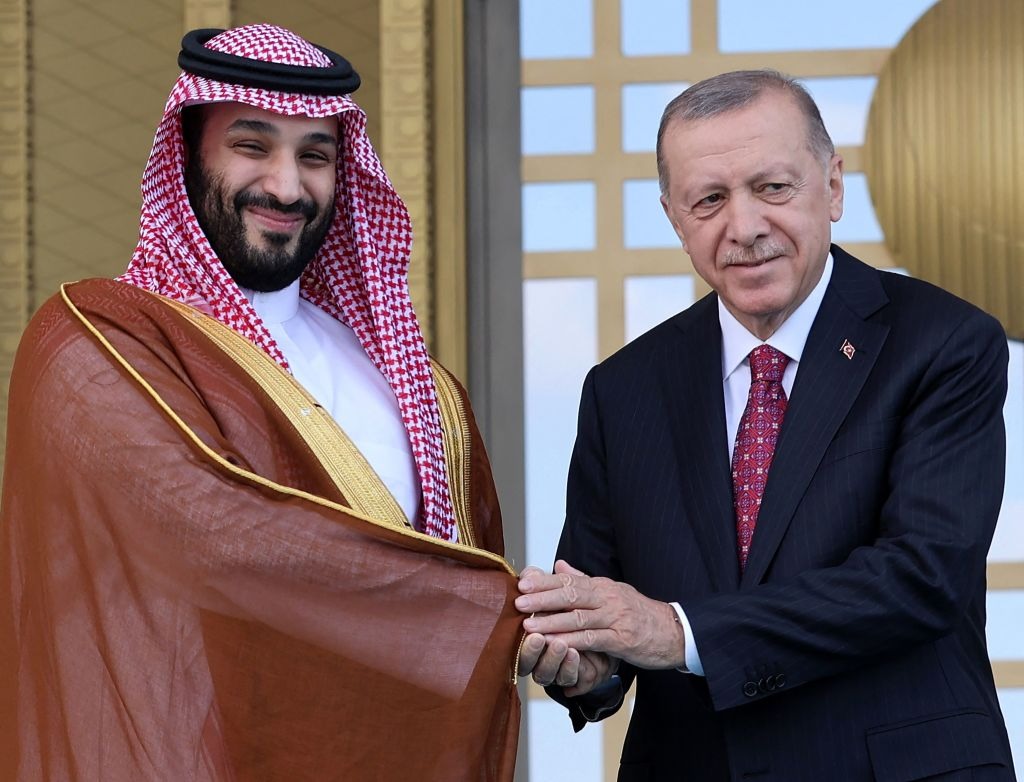
An institution built around one person, such as US President Donald J. Trump, carries the expiration date of that person's term in office. The states that join it do not. Nothing better explains the conduct of Turkey, Qatar, Egypt and Saudi Arabia over the past eight months — and nothing in current American policy appears to be taking the countless danger signals from them seriously. Pictured: Saudi Arabian Crown Prince Mohammed Bin Salman shakes hands with Turkey's President Recep Tayyip Erdogan in Ankara, on June 22, 2022. (Photo by Adem Altan/AFP via Getty Images)

An institution built around one person, such as US President Donald J. Trump, carries the expiration date of that person's term in office. The states that join it do not.

Nothing better explains the conduct of Turkey, Qatar, Egypt and Saudi Arabia over the past eight months — and nothing in current American policy appears to be taking the countless danger signals from them seriously.

The real plan, as can be seen from Saudi Arabia's recent moves, seems to be to avoid joining the Abraham Accords, and instead position themselves in Gaza, right on the border of Israel, to be able to attack it after Trump leaves office. No one will have his determination to make sure that any agreements are enforced.

Early on, Saudi Arabia came up with a "poison pill": the kingdom conditioned joining the Abraham Accords on the creation of a Palestinian state. Saudi Crown Prince Mohamed bin Salman has since reached an agreement with the US that reportedly allows Saudi Arabia to develop domestic uranium enrichment capabilities under safeguards that fall short of the stringent standards previously demanded by Washington, rather than importing nuclear fuel as other Gulf countries do. The uranium enrichment would, of course, be supposedly "for peaceful purposes." However, these enrichment centrifuges could also be used to make nuclear weapons -- the same kind Iran is not allowed to have.

Secretary of Energy Chris Wright signed the nuclear framework before Trump, to his great credit, the next day presented his own "poison pill": first, Saudi Arabia would have to normalize its relations with Israel and join the Abraham Accords. This requirement seems to have been, revealingly, a dealbreaker.

Instead, Saudi Arabia organized the Mecca Joint Defense Agreement with Turkey, which has a vast military, and Pakistan, which has nuclear weapons. Based on the Middle East's frequent schoolyard excuse that "it all started when he hit me back," the three countries could, for instance, provoke or attack on Israel, then when Israel responds for its own self-defense, claim that all three of them had been attacked and "forced" to retaliate: Turkey with its conventional military, Pakistan with a nuclear weapon, and Saudi Arabia by financing the expedition.

On August 17 in Jerusalem, Shin Bet director David Zini and military intelligence chief Maj. Gen. Shlomi Binder briefed Jared Kushner and a Board of Peace delegation on conditions inside Gaza and on Hamas's reconstruction of its military capabilities. Their presentation included an assessment from the most senior levels of the Israeli security establishment that concluded that Turkey is still financing Hamas. Turkish Foreign Minister Hakan Fidan holds a seat on the Gaza Executive Board, the body charged with implementing the disarmament of Hamas. Both facts sat in the same room on the same afternoon and produced no visible consequence.

When the White House named the executive board for the Board of Peace in January, its members included Fidan, senior Qatari official Ali Al-Thawadi and Egyptian intelligence chief Hassan Rashad. Israeli Prime Minister Benjamin Netanyahu stated publicly that the composition had never been coordinated with Israel and ran contrary to its policy. The Board of Peace itself, 28 countries operating under UN Security Council Resolution 2803, released an interim report to the UNSC that identified Egypt, Qatar, Turkey and the United States as the four mediating states. The 15-point roadmap that now governs Hamas's disarmament was drafted by those four "guarantors," together with High Representative for Gaza Nickolay Mladenov. What, though, will they actually be guaranteeing?

Israelis who have spent careers on this file do not treat the result as an accident. A former senior Shin Bet officer with three decades in the service has argued that the parties actually driving developments inside the board are Qatar and Turkey, assisted by Egypt. The arrangement amounts to the Muslim Brotherhood supervising the supposed disarming of its own Palestinian branch, Hamas.

The Board describes itself as an objective mechanism. Its operational majority consists of governments historically hostile to Israel, which have spent two decades keeping the Hamas solvent and trying to lend it political respectability.

Turkey has been strengthening its hold on Syria and positioning its military there, potentially for a pincer attack on Israel: from Syria on Israel's east and Gaza on Israel's west. On August 18, Israeli aircraft struck an airbase near Aleppo to stop a Turkish military deployment against which Jerusalem had warned Damascus for weeks.

At its inaugural summit in February, the Board of Peace denied Turkey a place in the International Stabilization Force, instead awarding troop slots to Albania, Indonesia, Kazakhstan, Kosovo and Morocco, and giving Egypt and Jordan stewardship of police reconstruction. That arrangement left Turkey with logistics.

Hamas nevertheless keeps offices and personnel on Turkish soil, where it recruits, raises money and plans terror attacks. Senior Israeli officials trace the Iranian money reaching Hamas and Hezbollah along a route running through Istanbul with Turkish President Recep Tayyip Erdogan's implicit permission.

Money often settles what communiqués leave open. Eight governments -- among them Saudi Arabia, Qatar, Kuwait, the United Arab Emirates and Morocco -- signed the founding donors' declaration behind roughly $17 billion in reconstruction pledges, against a World Bank estimate of $71.4 billion over a decade. A senior Board of Peace official, describing the three-year mechanism capped at $400 million for debts inherited from Hamas rule, said the outside money would come from regional partners rather than from Washington. Whoever pays the contractors, the suppliers and eventually the policemen, will decide who governs the streets they patrol.

The political alignment already exists on paper. On August 3, Qatar, Egypt and Turkey published a declaration in their capacity as mediating countries, condemning Israeli operations in Gaza and calling on the international community to compel Israel to stop.

Thirteen days later, a joint statement signed by Egypt, Qatar, Saudi Arabia, the United Arab Emirates, Jordan, Turkey, Pakistan and Indonesia accused Israel of disrupting peace efforts and urged the Board of Peace to take concrete measures against any party obstructing implementation. The guarantors have a shared position on how this war ends, and it has nothing to do with security for Israel, to say the least.

The resource they are actually managing is time.

Kushner left the Jerusalem meeting predicting that weapons from Hamas could begin coming out of Gaza within 30 days and that tunnels might be filled within 60-90 days.

Seven months after the ceasefire took effect, the International Stabilization Force has still not deployed, and the Palestinian "technocratic" committee built to administer Gaza cannot physically enter it. Trump's term of office ends in January 2029. He personally chairs the Board of Peace and will pass on that position to whoever succeeds him. Every month of delay moves the supposed complete disarmament of Hamas closer to Trump's successor, and to the states that will still be seated at the table when he or she arrives.

Two decisions now before Washington would outlast the arrangement entirely. Standing beside Erdogan in Ankara on July 7, Trump signaled willingness to for sell US F-35 stealth fighter jets to Turkey. Erdogan told reporters he had been promised five aircraft, a claim Trump neither denied nor corrected.

Two weeks later, the US State Department informed Congress that Turkey has not met the statutory conditions set by Section 231 of CAATSA and Section 1245 of the 2020 defense Authorization Act, which require Ankara to give up its Russian-made S-400 surface-to-air missiles. Although Turkey tested the S-400 following its delivery and has not returned it to Russia, the Turkish government claims that the system is in storage — presumably until it is taken out of storage.

While praising Turkey as a founding member of the Board of Peace, the State Department also voiced concern about the relationship with Hamas.

Erdogan has made no secret of his intentions regarding Israel, as well as Syria, Cyprus and Greece. As recently as March 30, 2025, he stated, "May Allah, for the sake of his name ... destroy and devastate Zionist Israel" He also reportedly prayed for "mercy upon the martyrs" of Hamas and the Palestinian Islamic Jihad and a "speedy recovery" for their wounded terrorists. Previously, Erdogan stated, "Jerusalem is our city," and "Patience brings victory," and that "We are determined to not give up on our rights on Jerusalem." This is the country to which Trump wants to supply stealth fighter jets?

The Saudi nuclear file runs on an identical clock. The draft nuclear cooperation agreement reported to Congress does not contain a Saudi commitment to forgo enrichment and reprocessing, a commitment Washington spent two decades calling the gold standard for nuclear nonproliferation. The Agreement refers instead to additional "safeguards" in the most sensitive areas of cooperation, which is diplomatic phrasing for enrichment centrifuges on Saudi soil. Saudi Crown Prince Mohammed bin Salman has said for years that the kingdom would pursue a nuclear weapon if Iran obtained one.

Once submitted, the US-Saudi nuclear cooperation agreement takes effect unless both chambers of the US Congress adopt resolutions of disapproval within 90 days.

Congress is the only American institution whose calendar runs longer than a presidency, and the remedies to the current administration arming terrorist-supporting, jihadist, long-term enemies of Israel are unglamorous but effective.

Even if the S-400 batteries have been shipped off from Turkey to another country, and Hamas offices in Istanbul are shuttered and independently verified as closed, no F-35 stealth fighter jets should be supplied to Turkey. After all, the S-400 missile batteries could always find their way back.

In addition, no uranium enrichment centrifuges should be allowed in Saudi Arabia, even if a binding Saudi renunciation of enrichment and reprocessing were written into the operative text, not a side letter. As we have seen with Iran, no one but Trump can be counted on to enforce international commitments.

Not one dollar for Gaza reconstruction should be disbursed through channels controlled by governments that Israel has identified as financing Hamas, the organization the money is meant to displace.

The Board of Peace was created by an executive decision and can be undone by one. What Turkey and Saudi Arabia want from Washington is hardware, and those F-35s will still be flying and those centrifuges will still be spinning, long after the people that vouched for them have left office.


Pierre Rehov, who holds a law degree from Paris-Assas, is a French reporter, novelist and documentary filmmaker. He is the author of six novels, including "Beyond Red Lines", "The Third Testament" and "Red Eden", translated from French. His latest essay on the aftermath of the October 7 massacre " 7 octobre - La riposte " became a bestseller in France. As a filmmaker, he has produced and directed 17 documentaries, many photographed at high risk in Middle Eastern war zones, and focusing on terrorism, media bias, and the persecution of Christians. His latest documentary, "Pogrom(s)" highlights the context of ancient Jew hatred within Muslim civilization as the main force behind the October 7 massacre.

Source: https://www.gatestoneinstitute.org/22814/trump-administration-determined-to-arm-hostile-jihadist-states

Follow Middle East and Terrorism on Twitter

The Specter that Haunts America - Amir Taheri


​ by Amir Taheri

The gospel of American neo-communists is riddled with contradictions.


  • After the crushing failure of European revolutions in 1848, many communist leaders... sought refuge in the US to escape European police. Though some morphed into capitalists, they gave local politics a leftist accent that is still there.

  • The gospel of American neo-communists is riddled with contradictions. They want to defund the police and virtually abolish the armed forces, while all communist systems so far did the opposite by creating a police state backed by a huge military machine.

  • They also talk of collective ownership of "the means of production and exchange." Yet those "means" are owned by 58 percent of Americans who hold stocks and won't be happy to be dispossessed in the name of "collective control."

  • And that's not to mention countless Americans who own small- and medium-sized businesses.

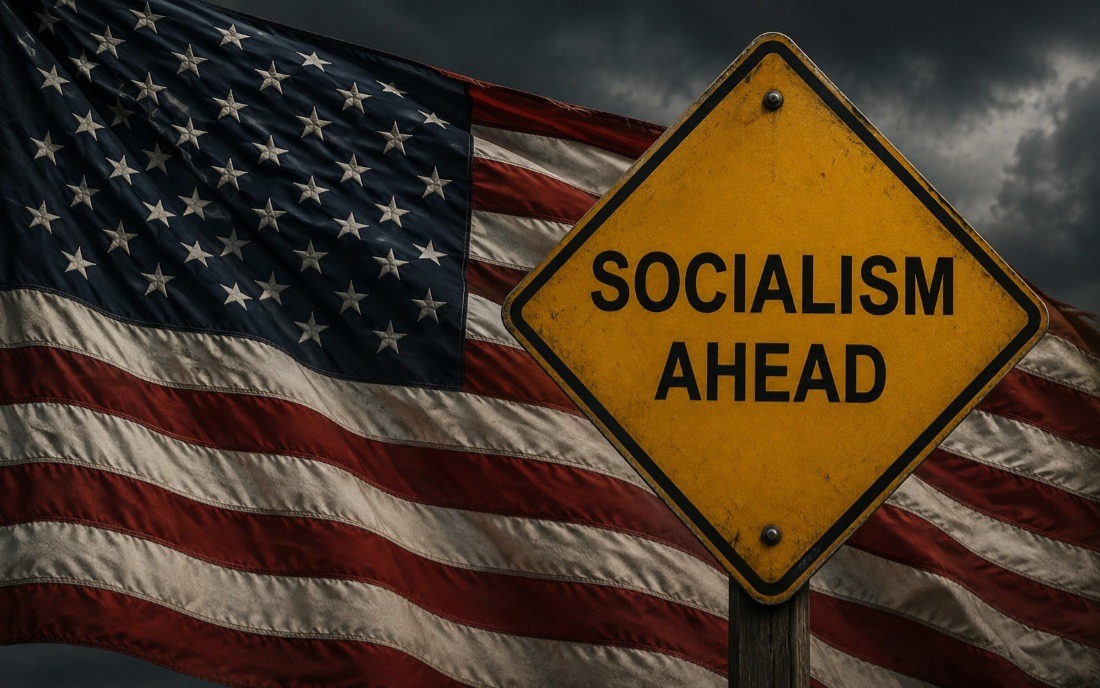
(Image source: OpenAI)

"A specter is haunting America; the specter of communism!"

Until recently this re-writing of the opening of The Communist Manifesto by Karl Marx and Friedrich Engels might have sounded like a sour joke. Now, however, we have in the United States politicians who describe themselves alternately as the Democratic Socialists of America or straight communists.

Their morale boosted by the election of Zohran Mamdani as mayor of New York City and the nomination of Abdul El-Sayed as a candidate for a Senate seat from Michigan in the upcoming elections, they openly talk of seizing control of the Democrat Party and reshaping it as an instrument for creating an "egalitarian" system in the US. One of their stars, US Representative Alexandria Ocasio-Cortez, is even putting out teasers about a possible presidential run in the 2028 elections.

This is not the first time that the Democratic Party, which is based on a coalition of ethnic, religious and cultural minorities, is taking a sharp left turn. In 1972, the party nominated George McGovern for presidency on a platform inspired by European social-democrat parties. In those days, however, it was Scandinavian social democracy that was hailed as the ideal form of government.

Though communism never became a major force in the United States, it often lurked in the background like the specter drawn by Marx.

A case could be made for an older history of communism in America.

In his 19th century "ancient society" theory, the American ethnographer Lewis Henry Morgan wrote of confederations created by Native Indian tribes in parts of the US and Canada.

In the Iroquois Confederacy, there was money, farmland was managed collectively by clans and food was shared, and a concept similar to "from each according to his/her ability, to each according to his/her needs" was applied.

Benjamin Franklin admired the unity of the Iroquois Confederacy, and in 1754 he suggested the 13 colonies form something similar.

After the crushing failure of European revolutions in 1848, many communist leaders, among them Friedrich Adolf Sorge, sought refuge in the US to escape European police. Though some morphed into capitalists, they gave local politics a leftist accent that is still there.

Nevertheless, Communism never became a major force in American politics.

Some historians suggest that this was due to the America's success in portraying communism as a military-security or even an existential threat illustrated by the "reds under the bed" witch-hunt of the 1950s rather than a rival view of the world. Thus, paradoxically, the USSR by its very existence helped the US avoid communism.

While communism was a taboo word until now, some American politicians used code words such as "social" and "collective" instead.

Fast forward: President John Kennedy's "ask not" rhetoric, perhaps inspired by Mao Zedong's "Little Red Book," designated the individual as one who ought to do something for the state rather than query what the state does for him.

President Bill Clinton's election slogan "It's the economy, stupid!" was a rehash of Marx's belief that the economy provides the infrastructure of society with politics as the superstructure.

In his 780-page autobiography, President Barack Obama praises "the collective spirit, a thing we all wish for, a sense of connection that overrides our differences."

He adds: "The 'regulatory state' conservatives complained so bitterly about had made American life a hell of a lot better." Some might compare this to Benito Mussolini's declamations about the big corporatist state that redistributes the fruits of national endeavor.

The gospel of American neo-communists is riddled with contradictions. They want to defund the police and virtually abolish the armed forces, while all communist systems so far did the opposite by creating a police state backed by a huge military machine.

American neo-communists talk of collective ownership of land while the federal government owns almost 30 percent of the total territory. Add to that land owned by the 50 states, and you already have a collective ownership similar to the Iroquois Confederacy.

They also talk of collective ownership of "the means of production and exchange." Yet those "means" are owned by 58 percent of Americans who hold stocks and won't be happy to be dispossessed in the name of "collective control."

And that's not to mention countless Americans who own small- and medium-sized businesses.

Mamdani's housing officer, Cea Weaver, suggests a freezing of rents and the creation of "powerful blocs of tenants", a recipe to deepen the great city's housing crisis. In such a situation, who would want to invest in building housing for rent?

The neo-communists' internationalist profile consists of unconditional support for Hamas, sympathy for the Khomeinist regime in Tehran and systematic opposition to the United States' projection of power, regardless of the context.

Various forms of crypto-communism have been present in many US elections. This autumn's midterm elections may be the first in which cryptos discard their masks. And that is good news. Cryptos base their hopes on Marx's prophecy about the "law of history," under which primitive communism leads to advanced communism after passing through feudalism, capitalism and imperialism.

However, don't tell anyone: there is no law of history, only tendencies, circumstances, contingencies, accidents, and good and bad luck.

Gatestone Institute would like to thank the author for his kind permission to reprint this article in slightly different form from Asharq Al-Awsat.


Amir Taheri was the executive editor-in-chief of the daily Kayhan in Iran from 1972 to 1979. He has worked at or written for innumerable publications, published eleven books, and has been a columnist for Asharq Al-Awsat since 1987. He graciously serves as Chairman of Gatestone Europe.

Source: https://www.gatestoneinstitute.org/22820/communism-specter-haunts-america

Follow Middle East and Terrorism on Twitter

Repeating the Tea Party Takedown Process on the America First Coalition - Stu Cvrk


​ by Stu Cvrk

Same playbook, same coalition.


In 2009, a grassroots revolt against bailouts, bureaucratic overreach, and a bipartisan Washington consensus was met—within a few short years—by a coordinated squeeze from four directions at once. The squeezers included the Democrat Party and Obama White House, their legacy media sycophants, the Republican establishment, and the trade associations and consultants who depend on both parties maintaining the status quo.

The Tea Party didn’t die of old age. It was out-funded, out-litigated, and out-narrated by a coalition that had far more to lose from its success than from its failure.

Fifteen years later, a strikingly similar coalition—Democrat officials and strategists, most of the legacy media, a bloc of Senate and House Republicans still oriented toward the pre-2016 political order, and a subset of online right-wing commentators who’ve concluded the project is either failing or captured—is running a comparable playbook against the America First/MAGA/MAHA coalition.

The methods have modernized, with X threads and Substack in place of cable news panels, court injunctions in place of some IRS forms, but the underlying logic is the same. Both movements threatened the machinery—earmarks, revolving-door contracts, regulatory capture, “electability” consulting feeds, and agribusiness and pharmaceutical lobbying arrangements—that both parties’ permanent power structure and their allied industries are built on.

The analysis below compares the two campaigns tactic by tactic.

THE GOP ESTABLISHMENT: FUND THE “ELECTABLE” OPPONENT, STARVE THE INSURGENT

Then:  After Tea Party victories in 2010 rattled the party establishment ahead of the 2012 Senate elections, particularly through candidates Christine O’Donnell and Sharon Angle, GOP strategist Karl Rove launched the Conservative Victory Project in 2013 explicitly to steer money away from grassroots-backed nominees toward establishment-vetted ones—a move so contentious it triggered what The Washington Post called an “internal GOP clash.”

The U.S. Chamber of Commerce followed in 2014, publicly pledging tens of millions to back “pro-business” candidates against Tea Party challengers in primaries, largely over the Chamber’s disputes with fiscal hawks on trade, the Export-Import Bank, and the federal budget.

Now: Senate Majority Leader John Thune (R-SD) and allies, including Mitch McConnell (R-KY), John Cornyn (R-TX), and Bill Cassidy (R-LA), have been characterized in conservative press as slow-walking Trump priorities—from ICE/Border Patrol funding in the reconciliation package to President Trump’s Ken Paxton endorsement over incumbent Cornyn in the Texas Senate primary—while Cassidy broke with the administration to back a War Powers resolution limiting the president’s authority on Iran.

Establishment-aligned money is again flowing to “electability”-branded candidates in contested 2026 primaries even where the MAGA base has coalesced around someone else, echoing the Rove/U.S. Chamber model down to the justification.

THE FEDERAL BUREAUCRACY AND COURTS: SLOW-WALK IT, LITIGATE IT, OR QUIETLY GUT IT

Then: Starting in 2010, IRS staff in Cincinnati began systematically flagging nonprofit applications from groups with “Tea Party,” “Patriots,” or “9/12” in their names for extended delays and invasive questionnaires. An internal email from exempt-organizations director Lois Lerner called the issue “very dangerous” as early as February 2011. IRS leadership denied any targeting to Congress for two years before Lerner publicly apologized in May 2013.

Nonprofit paperwork, not indictments, was the weapon used, and it worked by attrition, tying up volunteer-run groups in compliance costs and uncertainty through an entire election cycle.

Now: MAHA’s food and pesticide agenda has run into a parallel headwind of court rulings and internal reversal rather than an IRS-style paper trail. A leaked second MAHA Commission report dropped the pesticide restrictions and ultraprocessed-food limits the first report had flagged after the White House reportedly assured agriculture lobbyists those lines wouldn’t be crossed, which prompted even sympathetic voices like Fox’s Laura Ingraham (“Behold the power of Big Ag and Chemical Companies”) and commentator Jeffrey Tucker to accuse administration officials of being “in the pay of Big Food [and] Pharma.

The mechanism differs—industry capture from inside rather than IRS obstruction from outside—but the effect is the same. A popular policy gets slow-walked into irrelevance by the political machinery it threatened.

THE MEDIA: MOCK IT, THEN PAINT IT AS EXTREME

Then: When Rick Santelli’s February 2009 CNBC rant sparked the first Tea Party protests, media outlets including MSNBC, Talking Points Memo, and The Huffington Post treated it—per the Columbia Journalism Review’s own retrospective—with derision (using the “tea-bagger” epithet and mocking cable-panel humor) before pivoting to a second-phase narrative casting the movement as covertly funded and extremist. CJR’s own conclusion was this: “neither strategy—derision or conspiracy theory—worked,” largely because the mockery read as condescension to the people attending the rallies.

Now: The derision-to-extremism arc has compressed into just the second half. Coverage of MAGA over the past two years has centered on the “threat to democracy” framing that Joe Biden made explicit in public statements calling MAGA Republicans an “extremist threat.” This framing is being amplified by the legacy media into 2026 midterm coverage, arguing that MAGA messaging itself constitutes disinformation.

Where the Tea Party got laughed at first and demonized second, the campaign against MAGA—already a well-known quantity to the legacy media from Trump’s first term and 2024 campaign—mostly skipped straight to the demonization framing.

DEMOCRAT OFFICIALS: NATIONALIZE IT AS AN EXTREMIST THREAT, NOT A POLICY DISAGREEMENT

Then: The Obama White House and DNC treated the Tea Party less as a policy movement to rebut than a fringe to be delegitimized, dismissing it publicly, while privately, the IRS scrutiny described above proceeded on a parallel track.

Now: The rhetoric has escalated from dismissal to explicit “threat to democracy” language, deployed by Biden as president and carried into current DNC-aligned midterm messaging. Democrat campaign committee chairman Sean Patrick Mahoney has said Republicans and Democrats are “in agreement” that the MAGA agenda is “extreme.”

The strategic logic is the same as 2010-2014: reframe a policy and personnel fight over spending, immigration enforcement, and federal agency power as a question of legitimacy, which forecloses the need to engage the underlying grievances at all.

RIGHT-WING GATEKEEPERS AND DISILLUSIONED INSIDERS: THE COALITION EATS ITSELF

Then: Establishment conservative media was more muted in publicly savaging the Tea Party than the left-wing legacy media were, though figures aligned with the establishment Rove wing provided air cover for the “unelectable” narrative used to justify the Conservative Victory Project.

But the more corrosive insider threat was financial rather than editorial. Insider-led national groups and super PACs that claimed to represent the Tea Party—such as FreedomWorks, Tea Party Express, Tea Party Patriots, and various related fundraising vehicles—rapidly professionalized and commercialized the originally grassroots fiscal-conservative uprising by relentlessly soliciting small-dollar donations from ordinary supporters through emotional direct-mail and email appeals that promised to back “true” candidates and causes.

In practice, the vast majority of the tens of millions raised went to overhead, high consultant and vendor fees, lucrative salaries, media promotion deals, and further prospecting rather than to actual candidates, local organizing, or policy advocacy. A Politico analysis of 33 such PACs found that they raised $43 million from small donors but spent only $3 million on ads and candidate support against $39.5 million in operating expenses.

This diverted resources from authentic Tea Party chapters, eroded donor trust and grassroots energy, and ultimately fragmented and hollowed out the Tea Party into irrelevance. FreedomWorks, which raised over $23 million in the 2012 election cycle, had just $117,000 on hand by mid-2018, and Tea Party Express raised nothing at all in that cycle.

Now: This is where the current campaign has a genuinely new front the Tea Party era lacked at scale: a cohort of formerly pro-Trump online figures—Candace Owens, Tucker Carlson, Marjorie Taylor Greene, Alex Jones, Megyn Kelly, and Nick Fuentes among them—publicly breaking over Iran policy, the handling of the Epstein files, and unmet campaign promises, with Fuentes going so far as to declare “MAGA is dead” in November 2025 and Owens calling for invoking the 25th Amendment in April 2026.

Whatever their individual motives, the practical effect mirrors what the establishment Republican achieved through funding in 2013–14. It fractures the coalition’s public face and hands the “even conservatives agree” line to hostile media coverage without the Democrat or the GOP establishment having to lift a finger.

INDUSTRY AND K STREET: DEFEND THE ARRANGEMENT, NOT THE PARTY

Then: The Chamber of Commerce’s 2014 primary spending wasn’t ideological; rather, it was a direct response to Tea Party fiscal hawks threatening the Export-Import Bank, trade deals, and appropriations riders the Chamber’s members relied on.

Now: MAHA’s threat to agribusiness, ultraprocessed food, and pharmaceutical revenue models that were facilitated outside public scrutiny by the federal bureaucracy produced the same reflex from the same class of institutional actors. The difference this time is that the influence campaign came from inside a friendly administration rather than through an outside super PAC, which arguably makes it harder for the America First/MAGA/MAHA base to see or resist.

WHY THE TWO CAMPAIGNS?

In short, to protect the automatic federal spending that was being threatened by both grassroots movements.

Both the Tea Party and America First/MAGA/MAHA movements arrived after Washington had spent fifty years building a spending machine specifically engineered to run on autopilot, insulated from any single election. Each posed a direct threat to a different load-bearing piece of it.

The Shift to Omnibus Spending Bills

The starting point is the Congressional Budget and Impoundment Control Act of 1974, passed to formalize congressional control over spending. The process it created has been broken almost from the start. Congress has passed every required appropriations bill on time in only four of the last nearly fifty years (FY1977, 1989, 1995, and 1997). In 13 of the last 15 fiscal years, lawmakers passed not a single spending bill by the 1 October statutory deadline. Since 1998, it has taken an average of 117 days into the fiscal year to get final spending law, and in 12 of the last 15 years every appropriations bill was folded into an after-deadline omnibus rather than debated individually.

A 2,000-page bill negotiated by a handful of leadership staff in the final 48 hours and passed on a take-it-or-leave-it vote is functionally immune to line-item scrutiny by rank-and-file members, let alone interested voters, which is exactly why “something for everyone” omnibus packages became the default vehicle rather than the emergency measure they were meant to be.

Enter Continuing Resolutions

Continuing resolutions do the same work from the other direction. They auto-renew last year’s numbers and remove any occasion to debate whether a given program should exist at all. Meanwhile, the debt ceiling has become a recurring, choreographed showdown in which a routine increase is treated as inevitable rather than as an actual check on borrowing (currently more than $40 trillion).

Add Political Bribery and Its Protection Racket

Layered on top of all that is the money that financed the political class who benefit from that process. The Bipartisan Campaign Reform Act of 2002—McCain-Feingold—banned unlimited “soft money” contributions directly to parties and, in doing so, pushed the same money into 501(c)(4) nonprofits and, after the Citizens United Supreme Court decision in 2010, into super PACs that don’t have to disclose their donors. These PACs are “dark money” by statutory design rather than by accident!

The FEC—split evenly 3–3 by party—was structurally built to deadlock rather than aggressively enforce campaign spending laws. And it does so routinely on the exact question of which non-PAC groups should have to disclose their donors, which the Brennan Center has called “Probably the single greatest proximate cause of the ongoing surge in dark money in federal elections.”

A commission engineered to tie is not an oversight failure; it is oversight that was never supposed to happen.

Integrate the Federal Bureaucracy into the Spending Machinery

That dark money machinery increasingly runs through the administrative state’s own grantmaking apparatuses, not just election campaigns. Congressional testimony gathered in 2025 identified more than 35,000 nonprofits that receive a majority of their funding from federal agencies, with State Department and USAID grant pipelines singled out for funding NGOs that critics say recycle money back into the same political and personnel networks that authorized it. Officials who approve grants later join the NGOs they funded at high salaries while NGO-linked donors fund the campaigns of the officials who appropriate the next round of funding.

A funding stream that never has to win a floor vote is largely shielded from appropriations riders and rewards insiders on both ends of the rigged process. This is exactly the kind of “automatic” spending that both the Tea Party and America First/MAGA/MAHA movements were built to interrupt, if not terminate outright.

This is what motivated the creation of DOGE. Unfortunately, the NGO and grant funding pipelines were vigorously defended by lawsuits and federal agency resistance such that DOGE essentially ran out of political gas after making headlines in exposing around $215 billion of the targeted cuts of $2 trillion. Fortunately, the President’s Task Force to Eliminate Fraud carries on the mission of DOGE.

CONCLUDING THOUGHTS

None of the spending mechanisms described in the previous section are particularly exotic or secret. Each was built, amended, or left unreformed by both parties over five decades, and each converts a piece of the public’s money into something closer to a fixed cost that no single election can touch (which adds to the public’s frustrations by design).

That is the throughline: the Tea Party took aim at the omnibus/CR machine and the agency (the IRS) enforcing compliance from the grassroots up. America First/MAGA/MAHA has taken aim at the NGO/grant pipeline and the federal agencies like the State Department, USAID, and the EPA that are funding compliance from the top down.

Both movements threatened to gum up the works and convert “automatic” spending back into spending someone has to justify through regular order and fiscal debate in Congress—which is exactly why the same institutional coalition assembled to stop both. Both movements represent existential threats to the interests feeding freely at the trough that is continuously being filled by U.S. taxpayers.

The ongoing campaign to stop the America First/MAGA/MAHA coalition can only be thwarted by U.S. taxpayers’ attention to this matter. 


Stu Cvrk

Source: https://amgreatness.com/2026/08/28/repeating-the-tea-party-takedown-process-on-the-america-first-coalition/

Follow Middle East and Terrorism on Twitter

Russia’s hybrid warfare campaign in Europe is escalating - Nicholas Ballasy


​ by Nicholas Ballasy

Research cited by CRS found that reported Russian hybrid attacks in Europe quadrupled between 2023 and 2024.


Russia’s campaign of sabotage, cyberattacks, political interference and other covert operations across Europe is increasing in frequency and severity, according to a new Congressional Research Service report.

The assessment comes as German authorities investigate an explosives-laden drone discovered near a Ukrainian cargo aircraft at Leipzig/Halle Airport. 

A U.S. intelligence official told ABC News that the device and explosives were consistent with those used by Russia’s military intelligence service, the GRU.

The CRS report, Russian Hybrid Warfare Activities in Europe: Considerations for Congress, examined a growing series of Russian-linked operations since Moscow’s full-scale invasion of Ukraine in 2022. 

"Russia has multiple foreign intelligence agencies tasked with conducting traditional espionage operations to collect political, economic, and scientific/technological intelligence," the report reads. "These agencies also conduct Russia's hybrid warfare activities, in addition to their traditional espionage missions."

The report also identified assassination plots and airspace violations among the tactics attributed to Russia.

“These attacks have been increasing in number and severity,” the report also reads.

Research cited by CRS found that reported Russian hybrid attacks in Europe quadrupled between 2023 and 2024. 

Another assessment identified at least 151 reported Russian operations from February 2022 to March 2026.

The activity has extended well beyond Russia’s immediate neighbors. 

European governments have reported suspected attacks on critical infrastructure, cyber networks and transportation systems, as well as GPS interference and attempts to influence political processes.

The CRS report said Russia’s intelligence services have adapted their operations in response to increased European counterintelligence efforts, including the expulsion of Russian intelligence personnel. 

It described Russian intelligence activity as becoming “more aggressive,” while relying increasingly on methods designed to make attribution more difficult.

The Leipzig airport incident illustrates the potential security risks.

On Aug. 4, German authorities discovered the drone, which was carrying explosives and a detonator near a Ukrainian Antonov cargo aircraft. The device failed to detonate, but the discovery prompted a security response and temporarily disrupted airport operations. 

Leipzig/Halle is a major European cargo hub and is used by the United States and NATO allies for logistics supporting Ukraine, according to ABC News.

A U.S. intelligence official briefed on the investigation said that the drone’s construction and explosives were characteristic of equipment used by the GRU. German authorities have not publicly made a final determination.

The incident comes amid broader concerns about Russian activity in Germany and elsewhere in Europe. 

German Chancellor Friedrich Merz has described the country as increasingly subject to hybrid attacks, while European governments have continued to investigate suspected Russian sabotage and intelligence operations. 

For European governments, the challenge is determining responsibility and responding to operations that often fall between traditional categories of espionage, crime and military activity.

The CRS report warned that the continuing campaign has implications for U.S. and European security interests, concluding that “continued Russian hybrid warfare activities” raise questions about the long-term threat posed by Moscow. 


Nicholas Ballasy

Source: https://justthenews.com/government/federal-agencies/russias-hybrid-warfare-campaign-europe-escalating

Follow Middle East and Terrorism on Twitter

NY prosecutor claims Letitia James’ office pushed him to target Trump-linked entities - Nicholas Ballasy


​ by Nicholas Ballasy

Assistant Attorney General Daniel Wiesenfeld made the allegations in an agency-wide email Friday, claiming his supervisor instructed him to “find and pursue crimes” involving Trump


A prosecutor in New York Attorney General Letitia James’ office accused agency leaders of directing him to pursue President Donald Trump and other Trump-linked individuals and organizations without a legitimate basis.

Assistant Attorney General Daniel Wiesenfeld made the allegations in an agency-wide email Friday, claiming his supervisor instructed him to “find and pursue crimes” involving Trump, Truth Social and other entities despite what he described as a lack of credible justification.

The email was quickly removed from the inboxes of thousands of employees, according to the Times Union. 

Wiesenfeld was later placed on administrative leave with pay.

A spokesperson for James strongly rejected the allegations, saying the attorney general’s office remains committed to enforcing the law regardless of political beliefs and calling the matter a personnel issue.

Wiesenfeld could not immediately be reached for comment. The accusations added another chapter to the long-running political and legal feud between James and Trump. 


Nicholas Ballasy

Source: https://justthenews.com/government/courts-law/ny-prosecutor-claims-james-office-pushed-him-target-trump-linked-entities

Follow Middle East and Terrorism on Twitter

Virginia Attorney General creates unit to challenge federal actions - Shirleen Guerra


​ by Shirleen Guerra

Jones’ office said the unit will give the Attorney General’s Office permanent staff dedicated to identifying federal actions, responding to them and pursuing litigation.


(The Center Square) -

Virginia Attorney General Jay Jones is creating a four-attorney unit dedicated to challenging actions by the Trump administration that his office says exceed federal authority or threaten the commonwealth’s interests.

The Federal Accountability Unit will work across the Office of the Solicitor General and Civil Litigation Division and will be led by Deputy Solicitor General Megan Keenan.

Jones’ office said the unit will give the Attorney General’s Office permanent staff dedicated to identifying federal actions, responding to them and pursuing litigation.

“I have a fundamental responsibility as Attorney General to defend the Commonwealth and protect Virginians when the federal government exceeds its authority,” Jones said.

The unit will focus on issues including federal funding, elections, health care, immigration, environmental protections, consumer issues, constitutional rights, tariffs and other economic policies.

Jones also pointed to federal workforce reductions tied to the Department of Government Efficiency as an area the unit could address.

The team will be able to bring lawsuits on Virginia’s behalf, defend the commonwealth’s interests and work with attorneys general in other states on multistate litigation involving federal policies and actions.

State job postings show the Attorney General’s Office is recruiting for the new unit.

An assistant or senior assistant attorney general position for the Federal Accountability Unit carries a hiring range of $105,000 to $148,000.

A separate posting for a deputy or assistant solicitor general assigned to the unit lists a range of $117,000 to $148,000. Both postings list Sept. 8 as the application deadline and allow applicants to work from Abingdon, Fairfax or Richmond.

Jones, who took office in January, has made challenges to federal actions a focus of his first months as attorney general.

Since taking office, Jones has participated in cases involving tariffs, federal control over elections, conditions placed on emergency and counterterrorism funding, access to voter information, commercial driver data and federal housing funds.

His office has also challenged multiple rounds of Trump administration tariffs and joined litigation over executive actions affecting state election authority.

“We understand the weight of this work and the stakes for Virginians,” Keenan said. “We will move quickly, defend the Commonwealth, and meet unlawful action with the full force of the law.”

Jones’ office said it has joined dozens of multistate cases and pursued litigation involving federal workers, public funding, essential services, economic issues and constitutional rights since he took office. 


Shirleen Guerra

Source: https://justthenews.com/nation/states/center-square/virginia-attorney-general-creates-unit-challenge-federal-actions

Follow Middle East and Terrorism on Twitter
North American immigration to Israel surges as 1,100 arrive in August - Pesach Benson


​ by Pesach Benson

North American immigration to Israel has surged this summer


North American immigration to Israel has surged this summer, with more than 1,100 immigrants arriving in August alone.

According to Nefesh B’Nefesh, more than 2,200 North Americans are expected to immigrate to Israel between June and September on nearly 100 organized flights from the United States and Canada.

Approximately 2,700 North Americans have immigrated to Israel since January, and Nefesh B’Nefesh projects that more than 4,000 will make aliyah by year’s end, potentially making 2026 one of the organization’s strongest years since its establishment in 2002. 


Pesach Benson

Source: https://www.jns.org/live/breaking-news#000001a0-50c6-d401-afb9-5ddf88300000

Follow Middle East and Terrorism on Twitter