by Akiva van Konigsveld, David Isaac, Josh Hasen
“I am proud to lead a tremendous revolution in settlement in Judea and Samaria and to effectively kill the idea of a Palestinian state,” Israeli Finance Minister Bezalel Smotrich told JNS.
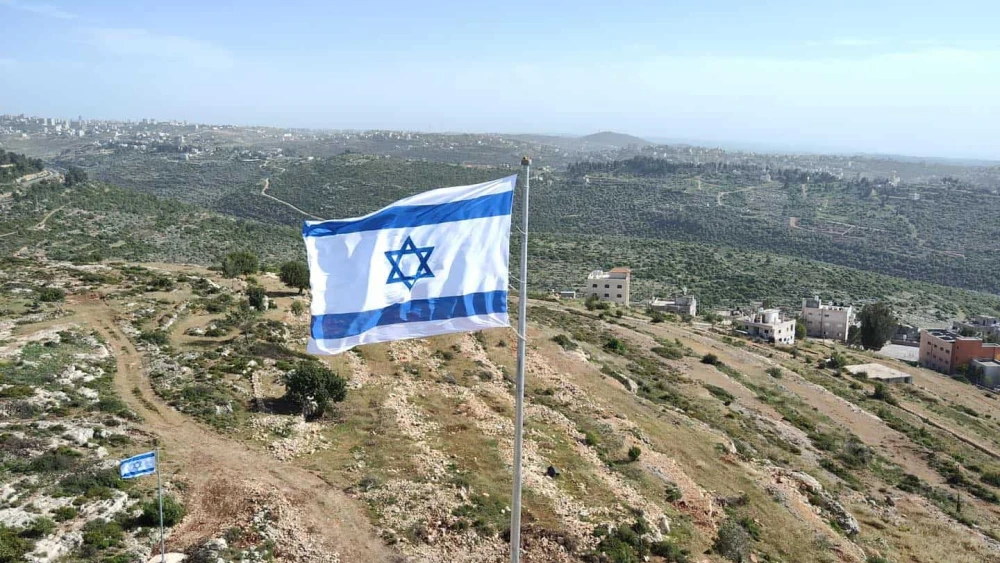 |
Since returning to office following the Nov. 1, 2022, election, the Israeli government led by Prime Minister Benjamin Netanyahu has spearheaded an unprecedented drive to expand Jerusalem’s control of Judea and Samaria.
No Israeli government since 1948 has done more to build up the Jewish heartland, numbers provided to JNS by Israeli Finance Minister Bezalel Smotrich’s Religious Zionism Party show.
In the past three years alone, 60,000 housing units were approved and 30,250 dunams (about 7,500 acres) were declared state land, allowing for Jerusalem to advance construction there. Smotrich also led Cabinet decisions establishing 104 new communities, and 160 agricultural farms were set up. Those farms, the party said, safeguard some 1 million dunams (roughly 247,000 acres) of state land.

For decades, the picture in Judea and Samaria looked very different. When ground was broken for Amichai in Samaria in 2017, it was the first new state-sanctioned community in the region in some 20 years. “After decades, I have the privilege to be the prime minister who is building a new community in Judea and Samaria,” Netanyahu said on June 20, 2017, as he announced the construction of the new town, which was intended to accommodate Israelis evicted from the Amona outpost.
The current government broke that pattern within months. In June 2023, Israel Hayom reported that the government had approved 13,000 homes in its first half-year in office, almost double the previous record, set during the first Trump administration.
By July 2024—as the Jewish state reeled from the deadliest single-day massacre since the Holocaust, and following the Knesset’s firm rejection of unilateral steps toward recognizing Palestinian statehood—Smotrich’s office announced that some 24,000 housing units had been approved during his tenure, compared with 20,000 in the three years from 2020 to 2022.
By December 2025, the total had reached 51,370 units, which Smotrich’s office described as an all-time high for a single term.

The push was made possible by the transfer of dozens of key powers from the Israeli Defense Ministry’s Civil Administration to a civilian official appointed by Smotrich, effectively giving the finance minister far-reaching powers over Judea and Samaria affairs.
“I am proud to lead a tremendous revolution in settlement in Judea and Samaria and to effectively kill the idea of a Palestinian state,” Smotrich told JNS.
The policy was “an important strategic step for the entire State of Israel that will prevent the next Oct. 7 in the heart of Israel,” the statement continued, referencing the Oct. 7, 2023, Hamas-led massacre that left roughly 1,200 people, primarily Jewish civilians, dead.
The Palestinian Authority’s battle to create facts on the ground
For years, the Regavim movement, an Israeli NGO dedicated to preserving and enforcing the rule of law and sovereignty, has warned that Palestinian construction in Area C of Judea and Samaria was creating facts on the ground that could ultimately reshape control of the territory. Now, the organization says Israel has begun responding with a level of enforcement and political determination that was largely absent in the past.
Naomi Kahn, director of the international division at Regavim, said the situation on the ground is “better than expected,” although her optimism about Israel’s response comes as the latest figures show a troubling reversal in the construction trend.
“The rate of demolition has seen a significant increase,” Kahn told JNS. “But at the same time, the rate of illegal construction, which had dropped, has increased, over the past seven months reaching heights not seen since 2023.”

Kahn nonetheless described the broader shift in Israel’s approach as significant.
“The State of Israel is finally taking the challenge seriously,” she said, referring to what she described as a new willingness to address illegal construction as a security threat. She also pointed to increased enforcement against security threats emanating from Area B, which is under Palestinian Authority municipal control and Israeli security control, including activity that she said threatened motorists traveling on roads in Area C.
“Israel has finally woken up,” she said.
The Fayyad Plan
Regavim has spent years documenting the Palestinian Authority’s implementation of the Fayyad Plan, a strategy named after former Palestinian prime minister Salam Fayyad that the organization says sought to establish facts on the ground through construction, agriculture, infrastructure and other forms of territorial development.
In its newly published book “From the River to the C,” Regavim describes the effort as a systematic attempt to establish a de facto Palestinian state in Judea and Samaria. The book argues that the strategy involved much more than individual unauthorized buildings, with schools, roads, water infrastructure and other projects helping establish permanent footholds and facilitate further construction and population growth.
The book points specifically to the area around E1 just east of Jerusalem as a key example. E1 is a strategically important stretch of land linking the capital to the Jordan Valley and the Dead Sea via Ma’ale Adumim. The book argues that Palestinian construction there is part of a broader effort to create territorial contiguity between Palestinian population centers and challenge Israel’s control of the strategic corridor.
The book also highlights the Khan al-Ahmar illegal Bedouin encampment along Highway 1 as a flagship example of the broader struggle over Palestinian construction in Area C, describing it as a focal point of international pressure on Israel over enforcement and demolition.
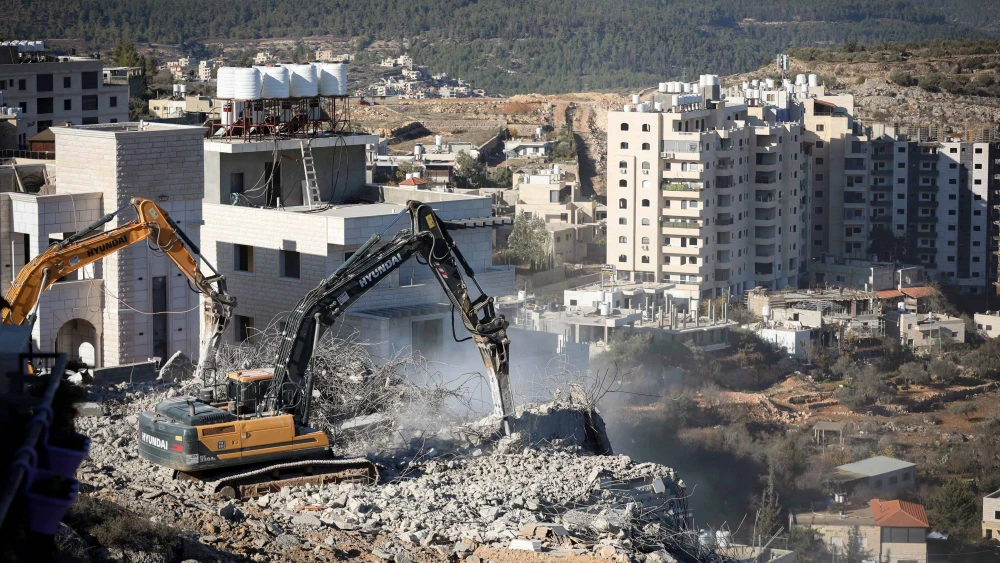
Regavim’s 2024 policy paper Turning Point: The War of Attrition documented nearly 97,600 illegal Arab structures in Area C as of May 2024. It recorded 9,956 new structures between April 2022 and May 2024, while noting that the monthly rate had fallen substantially during the latter part of that period—from an average of more than 600 new structures per month between January and June 2023 to 260 per month between June 2023 and May 2024.
The report attributed the decline to a combination of factors, including increased enforcement, a stronger security presence and economic difficulties within the P.A.
The book described a further shift, pointing to new government mechanisms and greater involvement by local authorities. It said surveys conducted in mid-2024 and early 2025 showed a decline of more than 50% in encroachment activity, while warning that the existing structures remained largely in place.
Kahn’s latest figures indicate that the trend has since reversed, with illegal construction accelerating again over the past seven months even as the rate of demolitions has increased.
Enforcement and deterrence
Eliram Azulay, head of the Hebron Hills Regional Council, sees a similar shift in his area in regard to enforcement.
He told JNS that there are approximately 17,000 illegal structures in the southern Hebron Hills, but that over the past two years there has been almost no growth.
Azulay said enforcement in recent years has run into the hundreds of cases—more than in any previous year—although he stressed that this remains small compared with the scale of existing illegal construction.
His priority, he said, is enforcement against structures located near Israeli communities and roads.
“Those are the ones that endanger us,” he said.

Azulay stopped short of describing the situation as a breakthrough, but said the increased enforcement is producing an important deterrent effect.
“I definitely think that the Arabs are being deterred in this regard,” he said. “They’re not building as quickly and they’re not starting as many new construction projects, because they know that they’ll be demolished fairly quickly.”
Kahn attributed the earlier decline in illegal construction partly to the P.A.’s financial difficulties, as well as to a growing realization among those undertaking illegal construction that Israeli authorities were increasingly likely to enforce the law.
“They don’t have as much money to burn, so they’re not doing it as much,” she said. “Also, because they know that the money’s going to go down the drain, because Israel’s finally begun to enforce the law.”

The international battle
The struggle over Area C has also played out beyond the territory itself.
Regavim has long argued that European funding and international diplomatic pressure have helped sustain Palestinian construction in Area C. The organization’s book cites European documents describing support for Palestinian planning and construction and argues that such activity can help expand P.A. control over the area.
The organization has also argued that international campaigns centered on allegations of “settler violence” contribute to a broader narrative that delegitimizes Israel’s authority and rights in Area C. That argument forms part of Regavim’s broader critique of international pressure on Israel to refrain from enforcing against Palestinian construction.

For Kahn, the central issue is whether Israel will continue asserting its own position despite that pressure.
Israel’s government has increasingly begun to make the case that, under its interpretation of the relevant legal and diplomatic framework, Israel has both the responsibility and the right to enforce the law in Area C, she said.
Kahn’s concern is what happens after the Knesset election on Oct. 27.
Previous governments, she argued, made political and coalition arrangements that resulted in enforcement against illegal Arab construction being frozen in various areas. The result, she said, was significant damage and a major setback.
“We’re hoping that the next government will continue with the seriousness of upholding the law despite massive international pressure not to enforce the law,” she said.
Forgotten context: The Palestinian terror war against Israel
The territorial battle in Judea and Samaria is unfolding against a backdrop often overlooked in international media: decades of Palestinian attacks and violence against Israel.
The Israel Security Agency (Shin Bet) 2025 Annual Summary, released in January 2026, noted a dramatic, 77% decline in major terrorist attacks in Judea and Samaria over last year—only 54 vs. 213 in 2024. While the numbers are a testament to the hard work of Israel’s security forces, observers tell JNS that the sheer scale of thwarted attacks shows that the terrorists don’t lack for motivation.

“We’re sitting on a powder keg,” IDF Lt. Col. (res.) Maurice Hirsch, director of the Palestinian Authority Accountability Initiative for the Jerusalem Center for Security and Foreign Affairs (JCFA) told JNS, explaining that the Hamas massacre of Oct. 7, 2023, has spurred terrorists in Judea and Samaria to greater effort.
“The P.A. leadership sees Oct. 7 as an unbridled political success. Western countries lined up to recognize a non-existent ‘State of Palestine.’ That’s why you have Arabs in Judea and Samaria registering high levels of support for the Oct. 7 massacre as the right decision,” he said.
Hirsch is most concerned about the Palestinian security force training in Judea and Samaria. He speaks about a scenario called “reversal of the rifles,” in which the Palestinian force turns its guns on Israelis. He underscored the possibility in a July JCFA report, “Planning the Next October 7 Massacre: The New Palestinian Terror Army.”
On Sept. 7, Israeli Defense Minister Israel Katz warned Ramallah that the IDF will launch an “all-out war” against the P.A.’s leadership and institutions should it be found to be planning such an attack.
The “nightmare scenario” has come up more frequently in high-level security discussions, Ynet reported on Sept. 4. In a February meeting, Netanyahu asked about the possibility. IDF Chief-of-Staff Lt. Gen. Eyal Zamir assured him that the IDF was ready, that the Judea and Samaria Division had drilled for it, and “if it happens, we know how to deal with it.”

Hirsch sees the wait-and-see approach as a mistake, however. “When Katz said if the P.A. turns their guns on us, we’ll know what to do, he echoes Oct. 6 conceptions. There, too, we didn’t take the initiative,” he said.
In the lead-up to the Oct. 7 massacre, Israel watched and waited as Hamas tunneled and trained. In Judea and Samaria, Israel has allowed a police force that was supposed to number no more than 12,000 to grow into an army of tens of thousands.
P.A. security forces sit on the country’s center next to dense population centers along a poorly defended border, Hirsch said. They have far greater capabilities than Hamas.
It’s unknown how many weapons Israel has given the P.A. The Defense Ministry and the IDF didn’t reply to a freedom-of-information request demanding the numbers. “Either they know the number and are too ashamed to admit it, or they don’t know the answer, which is even more of a disgrace,” said Hirsch. Despite this, no official complaint was filed, according to Hirsch, though Israeli law specifies that FoI requests must be responded to in a set time.
While it’s unlikely Israel continued to supply arms over the last two years, weapons smuggling continues apace, he noted. Israel intercepts only a fraction. Meanwhile, the United States continues to train P.A. security forces.
The “settler violence” narrative
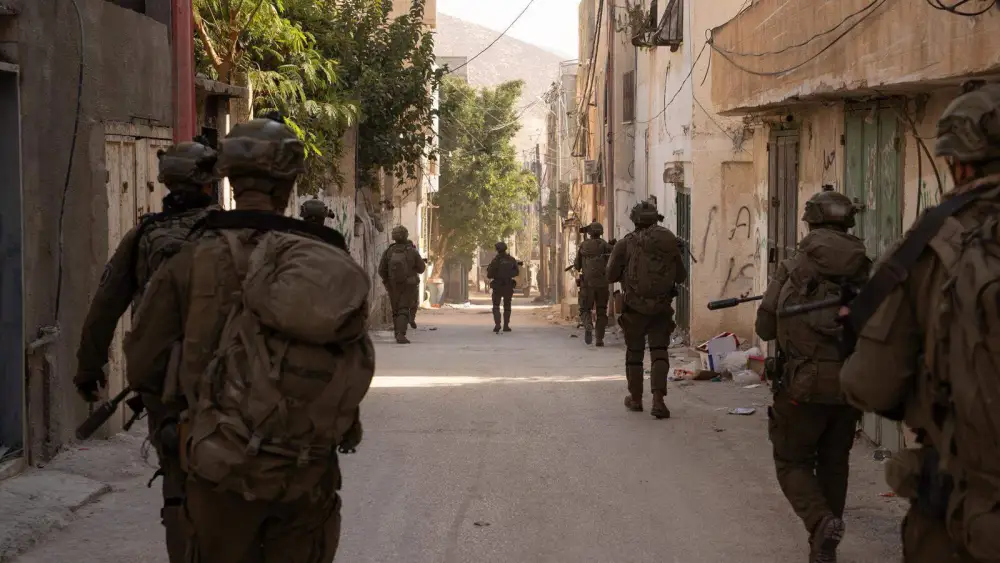
The IDF says there is no indication that the P.A. plans an imminent attack and has pointed to the reduction in Palestinian violence. Military heads have warned more about growing “settler violence” in recent months. IDF Chief-of-Staff Eyal Zamir and head of Central Command Maj. Gen. Avi Bluth have spoken out against the phenomenon.
According to security establishment data cited by the Institute for National Security Studies last month, some 660 incidents of Jewish nationalist crime were recorded in Judea and Samaria in the first half of 2026, a 63% increase over the previous six months.
However, Israeli Prime Minister Benjamin Netanyahu told CNN on Oct. 1 that “the settler violence thing is a tremendous hoax.”
“People create a symmetry between the acts of these people—what they do is cut down olive trees, they throw stones, and in one or two cases, they also claimed the lives of Palestinians,” the premier said. “If you look at the actual numbers,” he continued, lethal Palestinian terror attacks “occur daily.”
Netanyahu also told the United Nations General Assembly on Sept. 24 that nationalist violence in Judea and Samaria is committed by “a handful of juvenile delinquents, about 150 in number.”
“I won’t stand for vigilantism. We’re a country of law, so we put our Shin Bet on them,” he said, referring to the Israel Security Agency, Israel’s equivalent to the U.S. FBI. “But that’s what they call settler violence. And the number of casualties a year? Maybe two or three. In the total time this has been discussed, maybe two or three dead. Compared to the thousands of terrorist attacks against the peaceful settlers, honorable people, law-abiding people.”
Regavim’s Kahn told JNS that the problem is vastly overstated. “Every human society has a certain level of violence. The level of violence among the Jewish community of Judea and Samaria is among the lowest in the Western world,” she said. “I wish we could say we had zero violence. Israel invests huge resources trying to get to that zero. On the other side, what does the P.A. do? They invest huge resources in encouraging violence,” she said.
The settler-violence narrative is the result of a kind of state-sponsored information warfare, according to Kahn. Far-left Israeli NGOs, funded by foreign governments, file false incident reports of settler violence with OCHA, the United Nations Office for Humanitarian Affairs. These NGOs include B’Tselem, Bimkom, Breaking the Silence and Peace Now, she said.
“B’tselem is the oldest. B’tselem and Breaking the Silence together have been receiving money specifically for the settler violence narrative since at least 2015,” said Kahn.
OCHA adds these phony reports to its database of Jewish-instigated violence, she said. The governments funding the NGOs then point to OCHA’s numbers as evidence of widespread Jewish violence in Judea and Samaria, she continued.
“B’Tselem activists sit in an office in Tel Aviv, pick up the phone and complain that Mister X, Y, or Z Settler attacked them. They weren’t even there. There was nobody out in the field. It just simply didn’t happen,” said Kahn.
Many of these same organizations also fund activists who pose as tourists to enter the country, who then provoke confrontations with Jewish residents, she said. “They film it and carefully edit it so that the footage only shows the response to their provocation and not the provocation itself,” she added.
In a recent incident on Aug. 19, a British national, Finn Joughin, was arrested by Israeli security authorities for assaulting a minor in Samaria. He claimed he was protecting a Palestinian from violence.
OCHA is not transparent with its data, but Kahn said her group has obtained some. For instance, “Every time a group of non-Muslims goes up to the Temple Mount, lawful accompaniments overseen by the Waqf, it’s still considered ‘storming Al-Aqsa.’ Every single one of those incidents is listed as settler violence,” she said.
Warning signs
Ayelet Lash, a social activist who lives in Samaria, started following her Arab neighbors’ social media accounts after the Oct. 7, 2023, attack. She warns continuously about what she observes.
“On Telegram, TikTok, Instagram, you see their activities. You see their intentions. They write against the State of Israel. They yearn for the destruction of the State of Israel. Every time there was a round with Iran, immediately they were on Iran’s side, posting that ‘Inshallah, this time Israel will be destroyed.’ That’s their aspiration,” Lash told JNS.
She shares Hirsch’s fear about the ‘reversal of rifles’ risk. “It’s clear that the P.A. is entirely the PLO, intent on ‘freeing Palestine’ and destroying the State of Israel,” she said.
Hirsch and Lash argue that Israel shouldn’t wait to remove the threat.
“Without question, go in and dismantle them. Go city by city. Take the people who are part of this P.A. force into custody. Take away all of their weapons. Take away all of their capabilities. Reduce them to the force size that had been agreed upon,” said Hirsch.
The IDF is training for a “what-if” scenario, said Lash, but “the problem is it’s not a ‘what-if’ but a ‘when.’ We don’t have to train and wait for them. They will do it. They have the intention and the capability. We have to attack now. We haven’t learned the lesson. We continue to wait for them to start a war.”
Akiva van Konigsveld, David Isaac, Josh Hasen
Source: https://www.jns.org/analysis/the-battle-for-judea-and-samaria-the-jewish-peoples-biblical-heartland

No comments:
Post a Comment