by Gregg Roman
Washington Has Pulled Its Forces Out of Iran’s Easiest Reach and Pointed Its Airlift at Israel. The Satellites Show a Force Ready for a Short War, with Its Third Carrier Still in the Pacific.
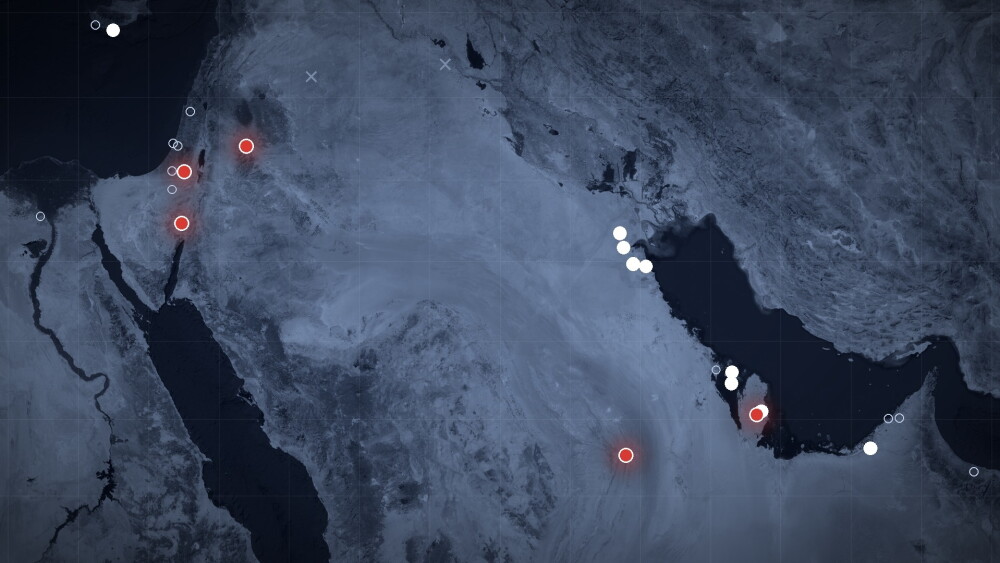 |
U.S. airlift turned toward Israel, Jordan, Saudi Arabia, and Qatar in late October as U.S. forces left Syria and Iraq.MEF Geospatial Intelligence Unit. |
In the last days before the American midterm elections, the public case that the United States is about to resume its war with Iran rests on a handful of statements and a great deal of anonymous sourcing. President Trump has said the United States will not launch new attacks before the November 3 vote, and has not ruled them out afterward. On October 31 he told reporters at his Florida residence that American forces still had “one or two sites” in Iran to “take care of,” adding, “we can do that in 10 minutes.” Israeli Prime Minister Benjamin Netanyahu has spoken of a “historic, one-time opportunity” to bring down the regime in Tehran. On October 27 the Wall Street Journal, citing two officials and flight-tracking data, reported that a Patriot air defense battery was moving from Texas to Israel, that troops were being moved off vulnerable bases, that munitions were being restocked, and that bombers and fighters were being readied. Israel’s Channel 14 reported that about 80 American refueling tankers had landed in Israel in 48 hours.
At the same time, Iranian negotiators spent a third straight day in Doha with Qatari mediators on a plan to reopen the Strait of Hormuz within two days of a deal. Foreign Minister Abbas Araghchi listed Tehran’s price: the lifting of the latest sanctions, the return of the June oil waivers, recognition of new shipping lanes drawn by Iran and Oman, an end to the fighting on all fronts, including Lebanon, and “a reduction in the US military presence in the region.” Secretary of State Marco Rubio said talks had “never stopped.” Vice President JD Vance sent a letter to Iran’s security chief, Mohsen Rezaei, who said its “tone has completely changed.”
So the question of the week is a physical one. Where are the American forces that would fight a second round, and what are they doing? The Pentagon does not publish its order of battle in wartime, and Central Command declines to discuss movements “for operational security reasons.” So, as it did for the East-West Pipeline strike in September, the Middle East Forum went to the satellites. We examined 43 American and allied bases in a box running from Greece to Pakistan and from Georgia to Diego Garcia, every clear morning from October 1 to November 1, and set what we saw against everything published about the force in the same month.

What a Satellite Can and Cannot See
The imagery is the same kind MEF has used before: publicly available, 10-meter optical frames that photograph each base every two to five days, always in mid-morning local time. At that scale a pixel is the size of a two-car garage. A KC-135 tanker, 41 meters long, is a cross four or five pixels across. A C-17 transport, at 53 meters, is a little larger. Those shapes can be counted on an open apron, and a ramp that held two dozen of them last week and holds none this week has told you something. A fighter, at 15 to 19 meters, is a smudge one or two pixels wide and cannot be counted. Neither can missile launchers, radars, vehicles, or people. Nothing at sea can be followed at all, because the satellite photographs land and coastal water and the fleets sail in open ocean.
Two other sources that would normally fill those gaps were closed this week. Commercial imagery at half-meter resolution, which would show aircraft by type, returned no frames of any kind for any of nine bases in the region over the past four days, while the same search over an air base in Missouri returned eight. The region’s imagery appears to be withheld. And flight tracking, which shows aircraft that broadcast their positions, is almost empty: a sweep of 10 regional hubs on the evening of November 1 found a single unidentified military transponder over Oman. American combat and support aircraft in the theater fly dark.
That leaves the open apron and the open press. Where the two agree, the picture below is firm. Where they disagree, we say so.
Two Carriers, Not Three
The core of any American air campaign against Iran is carrier aviation, and the count of carriers is the single best indicator of how heavy a campaign can be. The U.S. Naval Institute’s fleet tracker of October 26 places two carriers in the Arabian Sea: the USS George Washington, which arrived in August to relieve the Abraham Lincoln, and the USS George H.W. Bush, on station since April. The amphibious assault ship USS Boxer, with the USS Comstock, the USS Portland, and the 11th Marine Expeditionary Unit, has been in the Arabian Sea since July. Around them are about 20 American warships, many of which are enforcing the naval blockade of Iranian ports. Central Command said on October 31 that the blockade had turned back 144 commercial vessels.
The third carrier is not there. The USS Theodore Roosevelt, with the cruiser Chosin and the destroyer Decatur, was ordered to the Middle East in early October, but on October 26 it was still in the Philippine Sea, finishing the American-Japanese exercise Keen Sword, which ended on October 29. The USS Makin Island amphibious group, carrying the 13th Marine Expeditionary Unit, was in Yokosuka for maintenance. Officials expect both groups, with 9,000 to 10,000 more personnel, in Central Command’s area by mid to late November. From the Philippine Sea to the Arabian Sea is roughly 5,500 nautical miles, about two weeks at a carrier group’s sustained transit speed.
That matters for the timetable everyone is watching. If the United States strikes in the first days after November 3, it strikes with two carriers. The forces that would make a second round heaviest and longest arrive weeks later.
The Ramp at Al Udeid
Al Udeid Air Base, in the desert southwest of Doha, is the hub of the American air war in the Gulf. It houses the Combined Air Operations Center that runs every allied sortie in the region, and its long north ramp is where the tanker fleet parks. Tankers are what allow fighters and bombers to reach Iran and stay over it, and their movements are a tell.
They have been one before. An Egyptian open-source analyst who tracks the base posted time-lapse imagery showing that the American tankers left Al Udeid on February 27, one day before the war began, and did not return until June. By September 21 open-source watchers counted at least 25 on the ground again. On October 30 an open-source tracker read tanker cargo runs out of the base as a sign that the tankers would be pulled back again if fighting resumed, as they were in February.
Gregg Roman
Source: https://www.meforum.org/mef-reports/out-of-range-poised-to-strike-mapping-americas-force-posture-against-iran

No comments:
Post a Comment