Sunday, October 26, 2014

The Kurds in Turkey and the Fight for Kobani - Veli Sirin


by Veli Sirin


A historical process is now threatened with failure: the reconciliation of the Turkish State with the Kurds living in Turkey.
Turkish guns point in every direction but that of Kobani, and the Turkish air force continues bombing the Kurdish PKK, not ISIS. Many Kurds believe that the Turkish state considers it acceptable for the "Islamic State" to murder Kurds, and would rather bomb the Kurds than help them against ISIS.

The world has watched the town of Kobani on the Turkish-Syrian border, where the Wahhabi terrorists of the so-called "Islamic State" [IS], also known as ISIS, ISIL, and, in Arabic, the "Daesh," are fighting the Kurdish peshmerga, a word meaning "those facing death." The Turkish authorities, under President Recep Tayyip Erdoğan and the Islamist Justice and Development Party [AKP], have stood among the ambivalent observers of the battle for Kobani.

At the same time, he who is called "the man on the island" has put an ultimatum to Erdoğan. Abdullah Öcalan, in jail surrounded by the sea near Istanbul and still the real leader of the Kurdish Workers Party [PKK], has given the Turkish authorities more time to achieve a full agreement with its Kurdish subjects. If it does not, he says he can do "nothing more for the peace process." But as reported by the London Financial Times on October 22, Öcalan said he remained "optimistic" about relations between Ankara and the Kurdish revolutionaries. The PKK is designated a terrorist group by the United States and various European governments, as well as Turkey.

Still, a historical process is now threatened with failure: the reconciliation of the Turkish state with the Kurds living in Turkey. The country's Kurdish population stands at about 15 million, around one fifth of the total census. Kurds have been repressed since the founding of the Turkish Republic 90 years ago. In combat between the Turkish military and the PKK, almost 40,000 people have died.

Erdoğan's shining moment may have come when he asked the Turkish parliament, on August 11, 2009, "Where would Turkey be today, if we had not wasted 25 years in conflict, unsolved murders, and forcibly-relocated [Kurdish] villages?" At the end of the speech, he declared, "Nobody won. Everybody lost." Many legislators wept.

That was the beginning of a slow process that in 2013 was transformed into official negotiations between the state and the PKK, leading to an armistice. The authorities were to concede more rights to the Kurds and the PKK would end its armed campaign against the government.

Now, after this difficult path has been followed briefly, the arrangement is threatened. The principal obstacle to progress is the situation in Kobani. Kurdish advocates interpret Turkish ambiguity about permitting assistance to the Kurds in Kobani as an attack on all Kurds – whether Iraqi Kurds, with whom Ankara has a good relationship, or Kurds from the PKK. Many Kurds believe that the Turkish state considers it acceptable for the "Islamic State" to murder Kurds.

Öcalan subordinate Cemil Bayık, according to the Middle East news portal Al-Monitor, threatened on September 24 to resume the PKK guerrilla war against the Turkish military, unless Erdoğan and the AKP change their position toward the Kurds. If Kobani falls to ISIS, armed struggle may return to Turkey's Kurdish region.

At the same time, another contradiction is visible. While the AKP government claims that it wants to accelerate the peace process -- especially now, and with particularly greater speed -- at the same time, it condemns the Kurdish political leaders as warmongers. The Turkish regime insists on equating the PKK with ISIS, and alleges there is an alliance between Kurds in Syria and the Damascus dictator Bashar Al-Assad. In addition, this link supposedly extends to a coalition with other Erdoğan targets: the religious movement of Fethullah Gülen, a Turkish cleric who now lives in the U.S. and was formerly an ally of the AKP; and the foreign media. These two "enemies" were not only blamed for protests in Turkey, but, according to Erdoğan in an October 13 speech, reported by the Gülen-controlled daily Today's Zaman, they conspire to subvert its internal security. The Turkish state is also seeking ways to enhance police powers against its opponents, in measures described by the leading newspaper Daily Sabah on October 22.

Paradoxically, many Kurds live well in Turkey and support the AKP. Thus, it seems to be Erdoğan himself who destabilizes the country by oppressing the Kurds.

Pro-Kurdish demonstrations in Turkey, in early October, focused on the plight of Kobani. At least 33 people were killed in these protests, and hundreds injured, Daily Sabah reported.

The U.S. military has been helping the Kurds in Kobani recently by supplying arms, ammunition, and medical aid. CENTCOM, the U.S. military Central Command, has publicized several C-130 relief flights to the Kurds in Kobani. Erdoğan has opposed these arms shipments. Returning from Afghanistan on October 19, Erdoğan said that Turkey could not be expected to support such weapons deliveries, as noted by the London Guardian.

The U.S. continues to press Turkey regarding use of the American air base at Incirlik in southern Turkey, close to the Syrian border, for action against ISIS and, it is hoped by many, Syria's Al-Assad regime.

Additionally, some have proposed that Turkey open a corridor through Turkey from Iraqi Kurdistan -- but only to help the Iraqi Kurdish peshmerga soldiers, not Turkish Kurds, reach Kobani, according to AKP foreign minister Mevlüt Çavuşoğlu, as cited in Turkey's leading Hürriyet Daily News on October 21.

The main Kurdish force in Kobani, the People's Protection Units [YPG], is a militia made up of members the Democratic Union Party [PYD], a Kurdish movement in Syria affiliated with the PKK.

The Turkish air force, meanwhile, continues bombing the PKK, not ISIS. Turkey is attacking the fighters who could help defend Kobani.

On October 14, BBC News, as well as Turkish and Kurdish media, disclosed that F-16 and F-4 warplanes from the Turkish bases at Diyarbakir and Malatya bombed Dağlica, a Kurdish area in the extreme southeast of Turkey near the Iraqi border. Turkish authorities said the raids were a response to a PKK attack on a military outpost.

The Dağlica clash was the first between Turkish forces and the PKK since the armistice agreement of March 2013. Whoever first attacked whom, the PKK or the Turkish military, many Kurds remain convinced that the Turkish state would rather bomb the Kurds than help them against IS. Kurdish resentment is stoked by the spectacle of Ankara allowing Kurds be killed in Syria, on the Turkish border, while taking no action to prevent the slaughter.

On a hill in Atmanek, along the Turkish-Syrian frontier, Turkish tanks are parked, reconditioned for winter action. But their guns point in every direction except that of Kobani.

Turkish tanks near the border with Syria, October 2014.
Selahattin Demirtaş, chairman of the legal Kurdish party in Turkey, the People's Democratic Party [HDP], has called for more action from the AKP government. Cited in Today's Zaman for October 14, he declared: "We have not said the Turkish military should go to Kobani and fight against ISIS. We have said that there are tens of thousands of people [in Turkey willing to cross the border to fight against ISIS;] open the door."


Veli Sirin

Source: http://www.gatestoneinstitute.org/4816/kurds-turkey-kobani

Copyright - Original materials copyright (c) by the authors.

Democrats worried that youth vote alienation could lead to 'disaster' - Thomas Lifson


by Thomas Lifson


Slowly, ever so slowly, the millennial generation is waking up and noticing that they are getting massively screwed by the politics Democrats have imposed on the country. ObamaCare treats them as a cash cow, the economy, hobbled by excessive regulation and taxation, isn’t producing good jobs, much less careers, and the utopia promised by that guy was “like a god” six years ago, turns out to suck for them.

Celinda Lake, veteran Democrat political pollster sees the problem, and Paul Bedard of the Washington Examiner presents a summary of her views as expressed recently in  a Harvard Institute of Politics video interview:
“Millennials could have the definitive impact on the election, and that impact could be from them not showing up,” warned Celinda Lake.
“They look to have the lowest turnout rates right now which would be a disaster for progressive candidates,” she added in an online interview for Harvard University’s Institute of Politics. (snip)
“That’s the biggest concern right now for Democrats and progressives in particular, is that millennial voters look very, very discouraged. They don’t think that anyone has particularly spoken to them, anyone has been doing anything for them, it’s a bad economy, it’s expensive education, and all the kinds of concerns that millennials have,” said Lake.


Discouragement may be appropriate now, but the opportunity for conservatives is to turn disappointment into anger over the way they have been conned by Obama, by their professors and teachers, by the media, and by the Establishment, which today is run by and for progressives.

Youth naturally tend to rebel – it is part of the process of taking over the world from the older generation. And today, the only thing to rebel against is the world structured to benefit a ruling class that runs a gigantic con game, pretending to work for the benefit of the little guy while enriching and handing power to people like Sal Gore, George Soros, Hillary Clinton, Tom Steyer, Nancy Pelosi, and an entire panoply of self righteous hypocrites.
Taking advantage of this opportunity requires taking the offensive, going for the jugular of the left exactly the way the left has demonized Republicans, conservatives, religious people, and others who threaten their quest for power.

Objectively speaking, as Marxists always like to say, the younger generation’s interests have been sacrificed, and they have every right to be angry. It is up to conservatives to channel that anger toward the targets that rightfully deserve it.


Thomas Lifson

Source: http://www.americanthinker.com/blog/2014/10/democrats_worried_that_youth_vote_alienation_could_lead_to_disaster.html

Copyright - Original materials copyright (c) by the authors.
Terrorism Defies Definition - Daniel Pipes and Teri Blumenfeld


by Daniel Pipes and Teri Blumenfeld


Defining terrorism has practical implications because formally certifying an act of violence as terrorist has important consequences in U.S. law.

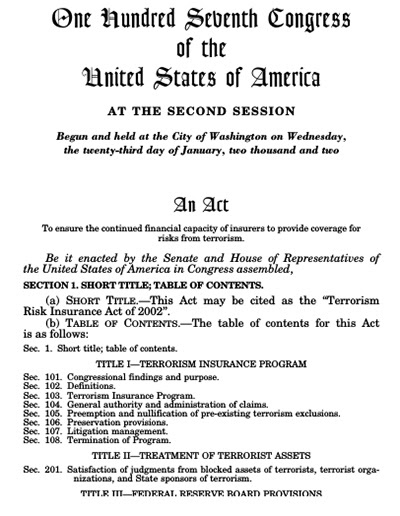
Terrorism suspects can be held longer than criminal suspects after arrest without an indictment They can be interrogated without a lawyer present. They receive longer prison sentences. "Terrorist inmates" are subject to many extra restrictions known as Special Administrative Measures, or SAMs. The "Terrorism Risk Insurance Act of 2002" gives corporate victims of terrorism special breaks (it is currently up for renewal) and protects owners of buildings from certain lawsuits. When terrorism is invoked, families of victims, such as of the 2009 Ft. Hood attack, win extra benefits such as tax breaks, life insurance, and combat-related pay. They can even be handed a New York City skyscraper.

The "Terrorism Risk Insurance Act of 2002" greatly increased the importance of defining what "terrorism" means.
Despite the legal power of this term, however, terrorism remains undefined beyond a vague sense of "a non-state actor attacking civilian targets to spread fear for some putative political goal." One study, Political Terrorism, lists 109 definitions. American security specialist David Tucker wryly remarks that "Above the gates of hell is the warning that all that who enter should abandon hope. Less dire but to the same effect is the warning given to those who try to define terrorism." The Israeli counterterrorism specialist Boaz Ganor jokes that "The struggle to define terrorism is sometimes as hard as the struggle against terrorism itself."

This lack of specificity wreaks chaos, especially among police, prosecutors, politicians, press, and professors.

"Violence carried out in connection with an internationally sanctioned terrorist group" such as Al-Qaeda, Hizbullah, or Hamas has become the working police definition of terrorism. This explains such peculiar statements after an attack as, "We have not found any links to terrorism," which absurdly implies that "lone wolves" are never terrorists.

If they are not terrorists, the police must find other explanation to account for their acts of violence. Usually, they offer up some personal problem: insanity, family tensions, a work dispute, "teen immigrant angst," a prescription drug, or even a turbulent airplane ride. Emphasizing personal demons over ideology, they focus on an perpetrator's (usually irrelevant) private life, ignoring his far more significant political motives.

But then, inconsistently, they do not require some connection to an international group. When Oscar Ramiro Ortega-Hernandez shot eight rounds at the White House in November 2011, the U.S. attorney asserted that "Firing an assault rifle at the White House to make a political statement is terrorism, plain and simple" – no international terrorist group needed. Similarly, after Paul Anthony Ciancia went on a shooting spree at Los Angeles International Airport in November 2013, killing a TSA officer, the indictment accused him of "substantial planning and premeditation to cause the death of a person and to commit an act of terrorism."

This terminological irregularity breads utter confusion. The whole world calls the Boston Marathon bombings terrorism – except the Department of the Treasury, which, 1½ years on "has not determined that there has been an 'act of terrorism' under the Terrorism Risk Insurance Act." The judge presiding over the terrorism trial in January 2014 of Jose Pimentel, accused of planning to set off pipe bombs in Manhattan, denied the prosecution's request for an expert to justify a charge of terrorism. Government officials sometimes just throw up their hands: Asked in June 2013 if the U.S. government considers the Taliban a terrorist group, the State Department spokeswoman replied "Well, I'm not sure how they're defined at this particular moment."

The whole world, except of the U.S. Department of the Treasury, sees the Boston Marathon bombings as terrorism.
A May 2013 shooting in New Orleans, which injured 19, was even more muddled. An FBI spokeswoman called it not terrorism but "strictly an act of street violence." The mayor disagreed; asked if he considered it terrorism, he said "I think so," because families "are afraid of going outside." Challenged to disentangle this contradiction, a supervisory special agent in the FBI's New Orleans field made matters even more opaque: "You can say this is definitely urban terrorism; it's urban terror. But from the FBI standpoint and for what we deal with on a national level, it's not what we consider terrorism, per se." Got that?

The U.S. Department of State has yet to figure out whether the Taliban are or are not terrorists.
This lack of clarity presents a significant public policy challenge. Terrorism, with all its legal and financial implications, cannot remain a vague, subjective concept but requires a precise and accurate definition, consistently applied.


Mr. Pipes (DanielPipes.org) is president of the Middle East Forum, where Teri Blumenfeld is a researcher. © 2014 All rights reserved by Daniel Pipes and Teri Blumenfeld.

Source: http://www.danielpipes.org/15066/terrorism-definition

Copyright - Original materials copyright (c) by the authors.

Jews must Display Sovereignty in Jerusalem - Dror Eydar


by Dror Eydar


It's not a matter of Right and Left, assuming that the sane part of the Left still sees united Jerusalem as the capital of Israel under any arrangement. It's time to acknowledge that we are facing an Arab-Palestinian war of the "popular uprising" type orchestrated by factors in the Palestinian Authority and the Islamic Movement in Israel along with Islamist players throughout the world, including leftist groups with a vested interest in destroying the vision of the city's unification. 

There is nothing spontaneous in these riots; the security apparatus is very familiar with the sources of terrorism in the capital and must address them methodically. We cannot "contain" any further disturbance. Rock throwing should be treated like shootings: with zero tolerance. 

Arabs in the region and in the world read those voices from among us that always blame us for any of our neighbors' acts of villainy. In their view, we are guilty of the murder of the 3-month-old baby last Thursday, because we settled in the land of our forefathers: in Kfar Shiloah (Silwan), in the City of David, and in east Jerusalem. This claim is fundamentally racist, as if the Arabs aren't responsible for their actions, and are behaving according to their nature by running over infants or firing rockets at day care centers every time the Yahud (Jew) doesn't do what they expect. 

These marginal voices don't determine how we live and we shouldn't pay attention to them, even if the world gives them a bigger stage than they deserve. The international media likes self-hating Jews, because if Jews admit that they are guilty, they have "permission" to add their own fuel to the fire, and besides, the turmoil becomes more tolerable. 

Don't apologize, don't be afraid
 
If Jews can't buy homes they paid for in full and live wherever they desire in sovereign Jerusalem where Israeli law applies the same as it does in Tel Aviv, we have lost the right to claim any of the land of Israel. If Jews cannot visit the Temple Mount and are forbidden to murmur the verses that the Levites recited there thousands of years before anyone had heard of Islam, there is no alternative but to close the entire mount -- to Muslims, too. 

The Arabs in the area have to pay a heavy price for their behavior on the Temple Mount, as well as their behavior in the capital in general. We Jews have made Jerusalem what it is today. We returned home, and have to behave like owners -- not apologize and not be afraid. The return to Zion and rebuilding of Jerusalem is the interest not only of the Jewish people; it's the historic vision of the entire free world.


Dror Eydar

Source: http://www.israelhayom.com/site/newsletter_opinion.php?id=10351

Copyright - Original materials copyright (c) by the authors.

Canada’s Jihad Denial - Robert Spencer


by Robert Spencer


michael-zehaf-bibeauCanada has experienced two murderous jihad terror attacks in the last three days, not long after the Islamic State called for such attacks – but the denial and obfuscation are as thick as ever.

On Monday, Ahmad Rouleau, a convert to Islam, hit two Canadian soldiers with his car, murdering Warrant Officer Patrice Vincent. Then he led police on a high-speed chase, during which he called 911 and explained that he was doing it all “in the name of Allah.” The chase, and Rouleau’s jihad, ended when he flipped his car and then, brandishing a knife, charged police, who shot him dead. One of Rouleau’s close friends said: “It was a terrorist attack and Martin died like he wanted to. That’s what happened….He did this because he wanted to reach paradise and assure paradise for his family. He wanted to be a martyr….The caliphate called all the Muslims on earth to fight. He listened to what they had to say and he did his part here.”

Then on Wednesday, Michael Zehaf-Bibeau, who has been widely reported to be a recent convert to Islam but whose father is a veteran of the jihad in Libya and who has been a Muslim for at least three years, went on a shooting rampage in Ottawa, murdering military reservist Corporal Nathan Cirillo and engaging in a gun battle inside Canada’s Parliament building. Canadian Foreign Minister John Baird said that there was “no evidence at this stage” that Zehaf-Bibeau had connections to any jihad groups, but CNN reported that “according to a U.S. counterterrorism source, Zehaf-Bibeau was connected to Hasibullah Yusufzai through social media. Yusufzai is wanted by Canadian authorities for traveling overseas to fight alongside Islamist fighters in Syria.” And “other radicalized people connected to Zehaf-Bibeau are still believed to be living in Canada, two U.S. law enforcement officials said.”

So Zehaf-Bibeau had connections to at least one jihadist who went to Syria to wage jihad, and Rouleau listened to what the Islamic State was saying, and “did his part” in Canada. What was the Islamic State saying? Late in September, the Islamic State’s spokesman, Abu Muhammad Al-Adnani, urged Muslims to murder non-Muslims in the West. “Rely upon Allah,” he thundered, “and kill him in any manner or way however it may be. Do not ask for anyone’s advice and do not seek anyone’s verdict. Kill the disbeliever whether he is civilian or military, for they have the same ruling.” He also addressed Western non-Muslims: “You will not feel secure even in your bedrooms. You will pay the price when this crusade of yours collapses, and thereafter we will strike you in your homeland, and you will never be able to harm anyone afterwards.”

Al-Adnani told Muslims to murder non-Muslims with any weapon at hand, or anything that could be used as a weapon: “If you are not able to find an IED or a bullet, then single out the disbelieving American, Frenchman, or any of their allies. Smash his head with a rock, or slaughter him with a knife, or run him over with your car, or throw him down from a high place, or choke him, or poison him.” Zehaf-Bibeau found a bullet. Rouleau found a car.

Yet despite the indications that Rouleau and Zehaf-Bibeau were heeding the Islamic State’s call to wage jihad at home by any means possible, the mainstream media was ready before the blood had dried to swing into the usual denial and obfuscation about the motives and goals of their attacks. Before Zehaf-Bibeau’s identity was known, CBC’s Doug Stoffel tweeted: “Amid the speculation in the #OttawaShooting in #Canada, it’s important to remember #ISIS hasn’t shown interest in attacks abroad.” Once Zehaf-Bibeau was identified as the shooter and was known to be a Muslim, ABC News one-upped Stoffel’s flagrantly counter-factual statement with the claim that “authorities in Canada are trying to understand what motivated a gunman to kill a soldier in the country’s capital Wednesday.”

In reality, what motivated him was blazingly obvious, but it was the one thing most Western government officials and all of the mainstream media have determined to ignore, and so the search was one for some other remotely plausible motive that could be sold to a public that is increasingly suspicious of what the government and media elites are telling them. 
Toronto’s Globe and Mail quoted a friend of Zehaf-Bibeau saying, “I think he must have been mentally ill,” although the only evidence for this that the paper presented was that “his friend frequently talked about the presence of Shaytan in the world – an Arabic term for devils and demons” – in other words, that Zehaf-Bibeau spoke frequently of what are standard beliefs of mainstream Islam.

Speaking of mental illness, in the wake of the Ottawa shootings, the police chiefs of Toronto and Ottawa wrote to local Muslim leaders, assuring them of their good will and urging Muslims to contact them in case of a “backlash.” These politically correct police chiefs seem to have imbibed the lesson well: after every jihad attack, Muslims are the victims, and need special reassurances. Of course, there should be no “backlash” against any innocent people and almost certainly won’t be, but this endless pandering is grotesque. Who is reassuring non-Muslims about keeping them safe from jihad attacks? Who is calling upon Muslim leaders in Canada or anywhere else to back up their condemnations of jihad terror with real action against it, including programs to teach young Muslims to reject that understanding of Islam?

No one. And that’s why Ahmad Rouleau and Michael Zehaf-Bibeau are likely to be only the first two in a long line of Muslims in Canada who heed the Islamic State’s call and murder their infidel countrymen. As long as politically correct fictions are allowed to befog the harsh realities of jihad, the bottom line is simple: more people are going to die.


Robert Spencer is the director of Jihad Watch and author of the New York Times bestsellers The Politically Incorrect Guide to Islam (and the Crusades) and The Truth About Muhammad. His latest book, Arab Winter Comes to America: The Truth About the War We're In, is now available.

Source: http://www.frontpagemag.com/2014/robert-spencer/canadas-jihad-denial/

Copyright - Original materials copyright (c) by the authors.

Iraqi security forces, Kurds gain ground against Islamic State


by Reuters and Israel Hayom Staff


In the latest fighting, 67 members of the Iraqi security forces and Shiite militias, as well as 300 Islamic State fighters, were killed, Iraqi officials say • Islamic State allegedly uses chemical weapons gas on Iraqi police.


Shiite fighters and Iraqi army members ride in vehicles during a patrol in Jurf al-Sakhar, Saturday
|
Photo credit: Reuters


Reuters and Israel Hayom Staff

Source: http://www.israelhayom.com/site/newsletter_article.php?id=20987

Copyright - Original materials copyright (c) by the authors.

An interview with Israeli Defense Minister Moshe Yaalon -  Lally Weymouth


by Lally Weymouth


Israeli Defense Minister Moshe Yaalon, known as a hawk, heightened U.S.-Israeli tensions earlier this year by criticizing John Kerry, saying the U.S. secretary of state had a “misplaced obsession and messianic fervor” about the peace process. On a trip to the United States this past week during which he met with Defense Secretary Chuck Hagel, Yaalon spoke with The Washington Post’s Lally Weymouth about the threat he sees from Iran, the Islamic State (also known as ISIS) and the Israeli-Palestinian conflict. Excerpts:


Q. You caused quite a stir with your remarks about Secretary Kerry.
 
A. We overcame that.


Secretary Kerry recently said the lack of resolution of the Israeli-Palestinian issue is leading to street anger and recruitment for the Islamic State. What is your response?
 

Unfortunately, we find the Israeli-Palestinian conflict is dominated by too many misconceptions. We don’t find any linkage between the uprising in Tunisia, the revolution in Egypt, the sectarian conflict in Iraq and the Israeli-Palestinian conflict. Mainly, these come from the Sunni-Shia conflict, without any connection to the Israeli-Palestinian conflict.

The core of the conflict is their reluctance to recognize our right to exist as a nation state of the Jewish people — whether it is [Palestinian Authority President] Abu Mazen or his predecessor [Yasser] Arafat. There are many who believe that just having some territorial concessions will conclude it. But I don’t think this is right.


Will territorial concessions bring peace?
 
No, they would be another stage of the Palestinian conflict, as we experienced in the Gaza Strip. We disengaged from the Gaza Strip to address their territorial grievances. They went on attacking us. The conflict is about the existence of the Jewish state and not about the creation of the Palestinian one. Any territory that was delivered to them after Oslo became a safe haven for terrorists.

Bearing that in mind, to conclude that after the [recent] military operation in Gaza this is a time for another withdrawal from Judea and Samaria [the West Bank] is irrational. If we withdraw now from Judea and Samaria, we might face another Hamastan.


So you think Hamas would take over the West Bank?
 
Sure. We just recently intercepted a terror network in the area of Ramallah. We arrested 96 Hamas terrorists.


They were supposed to be staging a coup to overthrow Abu Mazen?
 
Yes. They were operated and recruited by Saleh al-Arouri from Istanbul. We saved Abu Mazen from them overthrowing him. It might have become a Hamas-governed entity with Iranian arms.


Last summer, you and Prime Minister [Benjamin] Netanyahu decided to limit the operation in Gaza — not to reoccupy Gaza.
 
Yes.


Was that the right decision?
 

Absolutely. It was the right decision. From the very beginning, we understood it might be a tremendous mistake to send our troops to take over and occupy the Gaza Strip. That’s why we decided to avoid it and to direct our military operation toward the endgame, which was the Egyptian initiative [a cease-fire with no preconditions].


Why did the operation take 51 days?
 

Hamas is not marginal. It is a well-equipped militia and has 10,000 rockets, and the know-how and indigenous capabilities to produce rockets [which they got] from Iran. This is not just a terror organization.


How do you see the threat from ISIS?
 
ISIS is a new phenomenon, originating from al-Qaeda. This is not a threat for us. This is a threat to the free world as they actually claim to [want to] defeat all those who are not ready to follow their religious, Islamic way — whether they are Muslims, Christians, Kurds, Alawites, Shias or Jews. The idea to confront them by creating a coalition is an awakening. . . . Hopefully the coalition led by the United States will contain them.


Kobane [a Syrian town near the Turkish border] is about to fall. The ground forces seem to be weak.
 
I hope it is not too late to deal with it. Air superiority is very important.


It is important, but is it enough?
 
It is not enough. Don’t misunderstand me — I don’t recommend Western troops to be deployed. But the troops on the ground, whether they are Kurds, Iraqi armed forces or Syrian militias that are not extremists, should be supported by the West in order to be able to defeat ISIS.


Is it too late in Syria?
 

It is never too late. Syria is a microcosm of the region. What we see now is fragmentation, the collapse of the nation-state.


So you see a breakup in Syria?
 
Yes. We have Alawistan — an Alawite enclave led by President Bashar al-Assad, who controls 25 percent of the Syrian territory. We have Syrian Kurdistan in the northeastern part [of the country]. We have many Sunni enclaves. But the Sunnis are divided — we have Muslim Brotherhood Sunnis, we have ISIS, we have Jabhat al-Nusra. We have the Free Syrian Army, which we believe should be supported.


What is Israel’s strategy in Syria?
 
We don’t want to be involved. We enjoy a relatively calm situation on the border of the Golan Heights. They understand that if they violate our sovereignty, we immediately respond.


How are you going to ensure that in rebuilding Gaza, Hamas does not build more tunnels? 
 

We believe there is the potential to keep a calm situation along the border with Gaza [since] Hamas and Palestinian Islamic Jihad paid a heavy price [in] our military operation last summer. We understand there is a problem in Gaza — an economic problem, the need for reconstruction.

Part of our interest is to pave the way for the Palestinian Authority to get into the Gaza Strip. I’m not sure Abu Mazen is ready to take responsibility.


Right now doesn’t the Palestinian Authority have responsibility only for the crossings?
 
Not yet. But the opening of the Rafah crossing point is conditioned on the deployment of the Palestinian Authority troops. We proposed for them to be deployed on the Palestinian side of our crossing points as well.


Do you believe in a two-state solution?
 
You can call it the new Palestinian empire. We don’t want to govern them, but it is not going to be a regular state for many reasons.


What does that mean — the Palestinian empire?
 
Autonomy. It is going to be demilitarized.


In Gaza and the West Bank?
 

It is up to them. According to the agreement, they should be demilitarized. It is up to Abu Mazen if he is able or if he wants to demilitarize Gaza. Otherwise, we are not going to talk about any final settlement.


Is Abu Mazen the best Palestinian leader you’re going to get?
 
I don’t know, but he is not a partner for the two-state solution. He doesn’t recognize the existence of the Jewish state.


He says he is against violence.
 
Fine. But this is a tactical consideration. He believes he might get more by what he calls “political resistance” — going to the United Nations or to international bodies to delegitimize us. He prefers it to violence because in his experience, terror doesn’t pay off.


Is that why you said Secretary Kerry should just get a Nobel Prize and go home? Do you think the West just doesn’t get it?
 
I spoke about misconceptions. It is a misunderstanding, without naming anyone. It might be naivete or wishful thinking — ‘We the Westerners know what is good for the Arabs.’ To believe that you can have democratization with elections . . . it is collapsing in front of us. And part of it is ignorance, yes.


Israeli-U.S. relations are in terrible shape. Prime Minister Netanyahu and President Obama had a bad meeting this month. During the Gaza operation, for the first time, missile shipments didn’t go through automatically.
 
The issue of Hellfire missiles has been solved. It was a bureaucratic issue.


It doesn’t look like an unbreakable bond if, in the middle of a war, the administration decides to review what has always been military-to-military arms transfers.
 
I can tell you that between the Pentagon and the Israel Defense Forces there is an unbreakable bond.


What about the politicians?
 
We have disputes.


It seems to be a deep dispute.
 
With all the disputes, the United States is Israel’s strategic ally.


The Nov. 24 deadline for an Iranian nuclear agreement is approaching. Prime Minister Netanyahu has said that no deal is better than a bad deal. What do you hope comes out of these talks?
 
We are concerned about the potential deal. Because the framework of this deal is about how many centrifuges should this regime have. Why should they have the indigenous capability to enrich uranium? If they need it for civilian purposes, they can get enriched uranium from the United States or from Russia. Why do they insist on having the indigenous capability? Because they still have the aspiration to have a nuclear bomb.

With a bad deal — saying, ‘We will keep this regime from having a bomb for a year or year and a half’ — what does that mean? What about the missile delivery systems, which are not discussed? 

Why should they have missiles ready to adopt nuclear warheads? 

And they do?
 

Yes, hundreds of them. And what about their being a rogue regime instigating terror all over the Middle East and beyond? They are not involved in Afghanistan, Iraq, Syria or Yemen to serve American interests. This is not discussed. By rehabilitating the economy, they might feel confident to go on with these rogue activities, and at a certain point decide to break out from the deal and to have a bomb. That’s why our prime minister said that no deal is better than a bad deal.


And you agree with him?
 
Of course. In a deal they are going to get rid of any pressure. In the end, we should be able to defend ourselves by ourselves.


Does that mean Israel alone would consider using a military option?
 
It’s enough to say we should be ready to defend ourselves by ourselves.


As long as Benjamin Netanyahu wants to run for office, will you not run for prime minister?
 
As long as he is going the right way, why should I challenge him?


Do you intend to run for prime minister one day?
 
I don’t know. If the people of Israel want me, I will have to consider it.


Lally Weymouth is a senior associate editor at The Washington Post. lally.weymouth@washpost.com

Source: http://www.washingtonpost.com/opinions/an-interview-with-israeli-defense-minister-moshe-yaalon/2014/10/24/4b44a218-5aca-11e4-8264-deed989ae9a2_story.html

Copyright - Original materials copyright (c) by the authors.