Monday, May 25, 2015

Col. Richard Kemp:'World encourages violence by condemning Israel constantly' - Judith Bergman


by Judith Bergman

Hat tip: Jean-Charles Bensoussan

In an exclusive interview, Col. Richard Kemp, former commander of British Forces in Afghanistan, speaks about the conflict with Hamas, the ethics of war, the battle for public opinion, and the prospects for peace • Peace is far from breaking out, he says.


Col. Richard Kemp
|
Photo credit: Yoni Reif, Begin-Sadat Center for Strategic Studies

Judith Bergman

Source: http://www.israelhayom.com/site/newsletter_article.php?id=25717&hp=1

Copyright - Original materials copyright (c) by the authors.

How Anti-Israel Incitement Backfires - Khaled Abu Toameh


by Khaled Abu Toameh

  • Jordan has a peace treaty with Israel, while the Palestinian Authority (PA) is conducting security coordination with the Israeli Defense Forces. That is enough for their people to turn against them and accuse them of "collaboration" with the "Zionist enemy."
  • Will the PA and Jordan start educating their people abut tolerance and peace with Israel? Sadly, that is unlikely to happen, at least not in the near future. The anti-Israel rhetoric has made it impossible even to talk about the possibility of peace with Israel.
For several months now, the Palestinian Authority (PA) and Jordan have been strongly condemning visits by Jewish groups and individuals to the Temple Mount in Jerusalem.

The PA and Jordan have accused the Jewish visitors of "desecrating" the Haram al-Sharif [Noble Sanctuary], the name used by Muslims to refer to the Temple Mount.

The visits, which are held in coordination with the Jerusalem Police, are described by the PA and Jordan as attempts to "storm" the Al-Aqsa Mosque.

The charges made by the PA leadership and Jordan have triggered a campaign by Muslims to foil the visits by Jews to the holy site. Almost every day, Muslim hecklers intercept the Jewish visitors by hurling abuse at them and chanting "Allahu Akbar" ("Allah is Greater") in their faces.

In some cases, Palestinians have thrown shoes at the Jewish visitors, including children.

Hundreds of Muslims on the Temple Mount, yelling and throwing objects, surround three Jewish men and their children, as about a dozen police officers try to hold back the angry crowd and evacuate the Jews.

Various Palestinian groups have also recruited women and children to harass the Jewish visitors and any police officers accompanying them. The women, who are hailed as Murabitat ("the Steadfast"), have one main mission: to harass the Jewish visitors. They claim that their chief goal is to protect the Al-Aqsa Mosque against Jewish "aggression." Some of the women receive monthly salaries of up to 1500 shekels (about $400) to try and block the Jewish visitors.

But now those who have been inciting against Jewish visitors have fallen victim to their own campaign.

Palestinian and Jordanian officials who recently visited the Temple Mount received a firsthand lesson in what incitement can lead to. The officials themselves have fallen victim to hecklers who shouted profanities at them and forced them to flee the holy site.

The latest victim was Sheikh Ahmed Helayel, the Chief Islamic Judge of Jordan, who arrived at the Aqsa Mosque last Friday at the head of a leading Jordanian government delegation that also consisted of the kingdom's Minister of Wakf Affairs.

Sheikh Helayel was supposed to deliver the Friday sermon, but was forced to abandon the podium after scores of worshippers protested his presence and began hurling abuse at Jordan and him. He and all the members of the delegation were rescued by other worshippers who escorted them out of the Temple Mount.

The Palestinians who humiliated and expelled the Jordanian delegation belong to the radical international Islamist group Hizb-ut-Tahrir (Party of Liberation), the objective of which is to "resume the Islamic way of life by establishing an Islamic State that executes the systems of Islam and carries its call to the world."

One of the leaders of the mob shouted at the Jordanian cleric: "We were hoping to see you visit us at the head of an Islamic army that would liberate Jerusalem and the Aqsa Mosque, and not under the boots of the Israeli occupation." Another protester accused Jordan of "selling" the West Bank and Jerusalem to Israel in 1967.

The incident has deeply embarrassed the Palestinian Authority leadership, whose representatives were quick to condemn the assault on the Jordanian officials.

PA government spokesman Ehab Bsaisso expressed regret over the incident. The chief PA Islamic Judge, Mahmoud Habbash, denounced the incident as "immoral" and "un-Islamic." Habbash claimed that those responsible for the expulsion of the Jordanian officials from the Aqsa Mosque were "providing a free service to Israeli occupation."

It is worth noting that PA officials regularly encourage Muslim worshippers to intercept Jewish visitors to the holy site. But last year, Habbash, who also serves as religious affairs advisor to PA President Mahmoud Abbas, was forced to flee the Temple Mount after angry Palestinians attacked him with shoes, stones and eggs.

Still, officials from the PA and Jordan do not seem to have learned the lesson -- mainly that their incitement against visits by Jews will ignite a fire that will also consume them. Both Habbash and Sheikh Helayel found themselves in the same situation as Jews who are confronted by hecklers during their visits to the Temple Mount.

Palestinian and Jordanian officials who incite their people against Israel on a daily basis should not be surprised when their constituents spit in their face, throw shoes at them or expel them from a mosque.

Jordan has a peace treaty with Israel, while the PA is conducting security coordination with the Israel Defense Forces. That is enough for their people to turn against them and accuse them of "collaboration" with the "Zionist enemy."

Anti-Israel incitement has once again proven to be counter-productive. But will the Palestinian Authority and Jordan draw conclusions from their mistakes and start educating their people about tolerance and peace with Israel? Sadly, that is unlikely to happen, at least not in the near future. The anti-Israel rhetoric has made it impossible even to talk about the possibility of peace with Israel.


Khaled Abu Toameh  Follow Khaled Abu Toameh on Twitter

Source: http://www.gatestoneinstitute.org/5813/temple-mount-incitement

Copyright - Original materials copyright (c) by the authors.

The Israel-Scandals Syndrome - P. David Hornik


by P. David Hornik

So much attention to a small country’s affairs could seem flattering. Actually it’s the opposite—almost uniformly derogatory, unflattering, and essentially bigoted, and there are no apologies for it.


nhThe latest round of Israel scandals began on March 17, which was Israel’s election day, when Prime Minister Binyamin Netanyahu wrote in a Facebook post: “The right-wing government is in danger. Arab voters are coming out in droves to the polls. Left-wing organizations are busing them out.”

It sounded bigoted toward Arab voters. It was atypical of Netanyahu, and just a few days later he apologized to representatives of the Israeli Arab sector at his Prime Minister’s Residence in Jerusalem, saying, “I know the things I said several days ago offended some of Israel’s citizens, hurt the Arab citizens. This was never my intent. I apologize for this.”

Case closed? Apology for an unpleasant, atypical remark accepted? By Israeli Arabs, at least officially, yes. By others—no way.

The Obama White House, and the State Department (among many others), kept raking Netanyahu over the coals for his March 17 statement, even after his apology. Even two months later, in his latest interview to Jeffrey Goldberg, Obama was still talking about it, saying Netanyahu’s words were “contrary to the very language of the Israeli Declaration of Independence” and had “foreign-policy consequences.”

Meanwhile the Israel scandals continued. On May 7 the Israeli government approved the building of 900 housing units in Ramat Shlomo, a Jewish neighborhood in Jerusalem that is 20 years old and has 20,000 residents. The State Department weighed in immediately, calling the approval “damaging,” “disappointing,” and inconsistent with the two-state solution—which, logically speaking, would imply that Ramat Shlomo could not possibly be part of such a “solution” and, from now on, would have to be frozen in place.

And just around that time, another round of Israel scandals began—Scandalous Cabinet Ministers. With the new government finally being formed after difficult coalition negotiations, and new cabinet appointments being announced, the international media took over, shouting to the world that Very Bad People were taking office in Jerusalem.

So much attention to a small country’s affairs could seem flattering. Actually it’s the opposite—almost uniformly derogatory, unflattering, and essentially bigoted, and there are no apologies for it.

It started with the new justice minister, Ayelet Shaked, who was portrayed as a Dark Threat to Democracy. As Daniel Greenfield noted on Frontpage, the Washington Post, the London Times, and Foreign Policy all lambasted her. So did the New York Times, AFP, Reuters, and others.

Two main charges were leveled at Shaked. One concerned her Facebook post—last June, right after it was learned that three Israeli teenage boys had been kidnapped and murdered by Hamas—of an article by an Israeli journalist that included nasty words about Palestinians. Shaked almost immediately deleted the post and has called it a “mistake.” But in the Israeli goldfish bowl, a mea culpa—that is, if you’re a conservative politician—won’t get you anywhere.

The other charge was that Shaked, the new justice minister, was out to destroy Israel’s Supreme Court and its judiciary branch in general. Lost in the hostile media din was the fact that distinguished Israeli and foreign jurists, including some who are not on the political right, regard Israel’s Supreme Court as one of the most activist top judiciaries in the world, arrogating roles to itself that belong to the legislature, and hence as in need of reform. But why attend to such details when one could depict Shaked as the latest Israeli scourge of all that’s good and just.

And then there’s the new deputy foreign minister, Tzipi Hotovely. AFP has already darkly intimated that it has seen a video of her instructing Israeli envoys to quote the Bible about Israel’s rights to Judea and Samaria (the West Bank). Hotovely’s religious-historical attachment to these lands, shared by many Israelis, also won’t win her popularity with a world media and political establishment that—with all the fervor of a religious dogma—regards even Jerusalem’s Jewish neighborhoods as a sacred Palestinian trust.

And the new appointee as deputy prime minister, interior minister, and head of negotiations with the Palestinians, Sylvan Shalom? Also no good; as Jonathan Tobin notes, Shalom’s appointment has likewise sparked European and American criticism because he came out against a Palestinian state in the past. As Tobin observes, Netanyahu’s official stance favors a two-state arrangement. But it can also be asked why the recent violent upheavals in Yemen, Iraq, Syria, Lebanon, Egypt, Libya, and other Arab countries do not put in question the premise that creating yet another Arab state, this one abutting Jerusalem, Ben-Gurion Airport, and Tel Aviv, would be a plus for peace and stability. But, again, dogma brooks no doubts.

For a single month of May, the Ramat Shlomo building plans, plus the appointments of three Very Bad ministers, plus the continuing flak from Netanyahu’s March 17 post, might, to repeat, seem like a lot of scandals for a single small—it might be added, democratic—country. But the Israel-bashers were just getting warmed up.

The clincher, of course, came last Wednesday when Israeli defense minister Moshe Yaalon launched a new policy where Palestinians who pass through checkpoints to work in Israel would have to return to the West Bank through those same checkpoints. Since Israelis who live in the West Bank—owing to the fact that they do not pose a terror threat—do not have to go through checkpoints when leaving it or returning to it, the buses taking these Palestinians back to their homes in the West Bank would only have carried Palestinians, not Israelis.

This ignited fury. The internet erupted with shrieks of “segregated buses” and “apartheid buses.” It took just a few hours for Netanyahu, realizing this was a fight Israel was likely to lose, to scotch the new policy. Yaalon explained that its purpose had been to improve Israeli security and protect Israelis from terror attacks. But to say that, for the international Israel-condemning chorus, the security of Israelis is not high on the agenda is a great understatement.

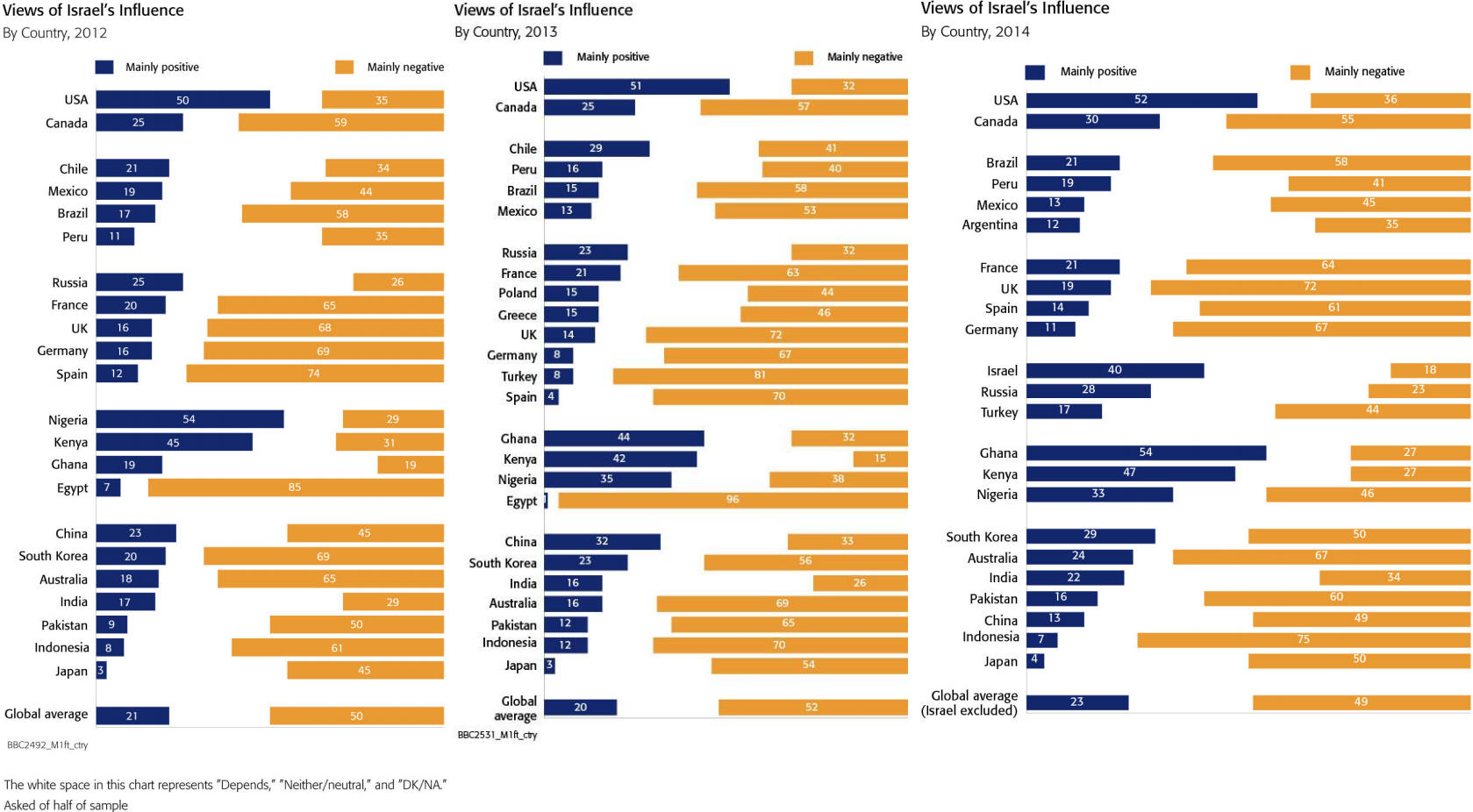
How important is all this reflexive, one-sided, distorted, uniquely disproportionate criticism of the Jewish state? The answer is that it is extremely important and poses a serious threat to Israel’s future. An annual BBC poll shows why.

The poll asks people in countries all over the world to rate the influence of particular countries as “mainly positive” or “mainly negative.” It turns out that, in 2012, 2013, and 2014, with the exception of the United States, Russia (just barely, in one year), and a couple of African countries, majorities (often large) in all countries consistently rated Israel’s influence as “mainly negative.”

Notably, that includes countries like South Korea, China, and India that have no antisemitic tradition, and whose governments have good relations with Israel’s government. If one asks where people in such countries are getting such a negative impression of Israel—a lone democracy in a dark region, a productive and beneficial dynamo in hi-tech, medicine, agriculture, water conservation, and other fields—the answer is, of course, the international Israel-bashing media, with an assist from reflexively Israel-criticizing governments and most of all, lamentably, the current one in Washington, though frequent public State Department criticism has been a feature of all recent U.S. administrations.

Even though Israel’s trade and, to a lesser extent, diplomatic relations with many countries are thriving, the effect of this delegitimization and demonization is seen most clearly when Israel engages in military conflicts with terror organizations and comes under severe, concerted pressures to desist, with TV screens all over the world depicting Israel, not the terror organizations, as the villain. Israel is still engaged in an uphill struggle—not just to survive but to establish that it has a right to survive.


P. David Hornik

Source: http://www.frontpagemag.com/2015/davidhornik/the-israel-scandals-syndrome/

Copyright - Original materials copyright (c) by the authors.

What Memorial Day Is About - Mark Tapson


by Mark Tapson

Obama has declared the fall of Ramadi a mere “minor setback”; meanwhile he and the Democratic party, who have worked assiduously to undermine America’s war efforts and to gut our military, urge you to celebrate a “Happy Memorial Day!” and enjoy your ice cream and BBQ.


memorial-day
Last Friday, as the week downshifted into the Memorial Day three-day holiday, the official Twitter account of the Democratic Party wished the country a “Happy Memorial Day weekend, everyone!” and tweeted a pic of – whom else? – President Obama lapping at an ice cream cone while media lapdogs zoomed their cameras in to capture the photo op. CNN anchor Jake Tapper injected a note of perspective by tweeting back, “Respectfully, @TheDemocrats, this is not what Memorial Day weekend is about.”

Indeed it is not, but for Barack Obama, of course, everything is about Barack Obama. And for the Democratic Party, everything is about selling the American people a crock of big-government idolatry, and so they followed up the Obama photo with tweets about a 15% off holiday sale at their website store – because nothing memorializes the men and women of our armed forces who paid the ultimate price for their country quite like a discounted “I Heart O’bama” Shamrock Lapel Sticker or a “Like a Boss” POTUS t-shirt.

This all came in the wake of the fall of Ramadi in Iraq to the demonic forces of ISIS – you know, the JV team that has absolutely nothing to do with Islam. In the early years of the war in Iraq, more American lives were lost in the intense fighting to secure the province of Anbar, which includes Ramadi and Fallujah, than anywhere else in the country.

Now our warriors who survived that fighting, and the families and friends of those who didn’t, are watching ISIS reclaim Iraq and are wondering what that sacrifice was for. It makes the loss of their loved ones and brothers-in-arms painful all over again. But not to worry – Obama has declared the fall of Ramadi a mere “minor setback”; meanwhile he and the Democratic party, who have worked assiduously to undermine America’s war efforts and to gut our military, urge you to celebrate a “Happy Memorial Day!” and enjoy your ice cream and BBQ.

In the very same month in 2004 when American warriors faced escalated attacks in Ramadi and Fallujah, my 81-year-old father Roger E. Tapson, a former U.S. Army Staff Sergeant and veteran of World War II, died in Sherman, Texas. He was buried near a small lake in the rolling, pastoral grounds of the Dallas-Ft. Worth National Cemetery alongside thousands of other veterans. There, those veterans, as poet Stephen Spender might say, are “feted by the waving grass, and by the streamers of white cloud, and whispers of wind in the listening sky.”

That cemetery is exactly the kind of place my dad would have described – without a hint of New Age devaluation of the word – as “spiritual.” It was the way I once heard him describe a still, brisk, early autumn morning on a gorgeously wooded golf course, his favorite place to be.

Spiritual indeed. To stand in a military cemetery among the unadorned, uniform white markers that stretch out in precise rows like an army-in-waiting, is to feel a spiritually heightened quality to your surroundings that demands humility, gratitude, and a more solemn reverence. You can feel that – to quote Spender once again – the fallen warriors have “left the vivid air signed with their honor.”

This is not to diminish the final resting place of anyone interred in civilian burial grounds, but the “vivid air” of a military cemetery is undeniably suffused with something extra, because it’s not merely a graveyard, but a memorial to qualities that constitute the best of humanity – honor, courage, dignity, service and sacrifice – and to warriors who once embodied them. Their grave markers stand as a challenge to those of us who remain.

Honor, courage, dignity, service, sacrifice – how many of us civilians can say that we commit to embodying those qualities in our daily lives? How many of us can say we are truly tested, body and soul, ever, much less on a daily basis, the way that the men and women of our military have been, and continue to be? How many of us can say we are ready and willing to do what is required for our country and our fellow Americans, even at the cost of our lives? Precious few if any, I would guess, and we civilians are all the lesser mortals for it.

That makes us all the more fortunate that there are Americans who can and do rise to that challenge on front lines around the world. It takes a special person to embrace that responsibility and earn a uniform of the United States armed forces, and it takes a special family – warriors too in their own way (“they also serve who only stand and wait,” as John Milton wrote) – to support their loved one from the home front.

That is why Memorial Day is not about ice cream and BBQs. It’s certainly not about Barack Obama, a man who has done more to diminish America’s standing, power, and military than any single figure in American history. It’s not a time to celebrate. It’s a day to be humbled and grateful that the men and women of the United States military have the rare and noble qualities it takes to be a sword between us and America’s enemies – when our government officials let them. It’s a time to honor the warriors who have purchased our freedom and rights and prosperity with their lives.

And this year in particular, it’s a time to meditate on the challenge that those fallen veterans have left us civilians: the challenge to do our part, to earn what our veterans have handed us, and to be warriors ourselves on the home front, so that their hard-won victories and sacrifices were not for nothing.


Mark Tapson, a Hollywood-based writer and screenwriter, is a Shillman Journalism Fellow at the David Horowitz Freedom Center. He focuses on the politics of popular culture.

Source: http://www.frontpagemag.com/2015/mark-tapson/what-memorial-day-is-about/

Copyright - Original materials copyright (c) by the authors.

Hebrew inscriptions, jewels of Palmyra’s Jewish past, may be lost forever - Ilan Ben Zion


by Ilan Ben Zion

With Islamic State now in control, fears grow for archaeological gems that point to the ancient city’s resonant Jewish history


The Islamic State flag  raised on top of Palmyra castle, May 22, 2015. (Photo credit: The website of Islamic State militants via AP)

Among the archaeological gems from Palmyra, the pearl of Syria’s desert, at risk after the Islamic State’s takeover last week are vestiges of its Jewish past, including the longest Biblical Hebrew inscription from antiquity: the opening verses of the Shema carved into a stone doorway.

Western archaeologists who visited the site in the 19th and 20th century discovered Hebrew verses etched into the doorframe of a house in the ancient city. But whether that inscription is still at the site is unclear. 

The last time a European scholar documented it in situ was 1933, when Israeli archaeologist Eleazar Sukenik of Hebrew University photographed it.

“What may have happened to it since is anyone’s guess,” Professor David Noy, co-author of Inscriptiones Judaicae Orientis (Jewish Inscriptions of the Near East), said in an email on Friday.

Three views of the Shema inscription found in a doorway in Palmyra, taken in 1884 and printed in Inscriptiones Judaicae Orientis. (S. Landauer)

Palmyra was one of the Roman Empire’s major cities, rising to prominence in the first centuries of the common era as a vassal state and entrepôt connecting West and East. Situated at an oasis in the desert frontier separating the empires of Rome and Parthia, Palmyra grew to an estimated population of 150,000-200,000 at its height in the third century CE. Textiles, perfumes, spices and gems came from India and the Far East, and metals, glass, wine and cash from Rome passed overland, bypassing the longer Red Sea trade route.
Eleazar Sukenik, photographed in 1951 (Eldan David - National Photo Collection / Wikipedia)
Eleazar Sukenik, photographed in
1951 (Eldan David – National
Photo Collection / Wikipedia)

Because of its unique location, Palmyrene culture and art exhibited a fusion of Roman and Persian traditions. Traditional Mesopotamian mud bricks comprised the majority of the city’s architecture, Jørgen Christian Meyer, an archaeologist from the University of Bergen explained, but temples to Semitic gods such as Bel, Baalshamin and Al-lat were constructed in Classical style with stout columns hewn of stone.

When the city was abandoned following its destruction in 273 CE and left to the elements, the mud brick disintegrated, leaving behind a petrified forest of stone columns.

During its centuries of prosperity and decline it was home to a thriving Jewish community.

“What we see in Palmyra is a multicultural, and possibly also a multi-identity city,” Meyer, who headed a Norwegian-Syrian archaeological excavation at the site in 2011, just as the civil war started heating up. “Here we’ve got this mixture of Greek, Aramaic, Middle Eastern, Roman culture. This is fantastic.”

“That’s why it’s a unique place from a historical point of view, a cultural point of view,” he said.

Solomon’s Tadmor

That fusion included Jews. Two locally produced terra cotta lamps found next to one of the great pagan temples bear menorahs on either side of a conch, suggesting close integration of Jews and gentiles.
Solomon and the plan for the First Temple. (Illustration from a Bible card published by the Providence Lithograph Co.)
Solomon and the plan for the First
Temple. (Illustration from a Bible
card published by the Providence
Lithograph Co.)

Known in Hebrew and Aramaic as Tadmor, Jewish legend attributed the city’s construction to King Solomon. Josephus Flavius, writing in the first century CE, ascribed its construction to King Solomon, saying that the city of Tamar referred to in Kings I was the “very great city” Josephus’s contemporaries knew in the Syrian Desert.

“Now the reason why this city lay so remote from the parts of Syria that are inhabited is this, that below there is no water to be had, and that it is in that place only that there are springs and pits of water,” the Jewish Roman historian said. “When he had therefore built this city, and encompassed it with very strong walls, he gave it the name of Tadmor, and that is the name it is still called by at this day among the Syrians, but the Greeks name it Palmyra.”

Modern scholars, however, dispute the veracity of Josephus’s claim that it was built by Solomon. Archaeological evidence indicates that the Classical city of Palmyra didn’t predate the first century BCE, and the biblical city of Tamar was likely in today’s Negev Desert.

“The place had certainly existed and had been referred to centuries before. But there is nothing in the archaeological record to show that there was any settled occupation of the site through the Hellenistic period,” wrote Fergus Millar in The Roman Near East. “Suggestions of a phase of urban development in Palmyra before the disturbances of the late Hellenistic period can only be speculation.”

The ancient Roman city of Palmyra, northeast of Damascus, Syria, released by Syria's official news agency SANA, May 17, 2015. (SANA via AP)
The ancient Roman city of Palmyra, northeast of Damascus, Syria, released by Syria’s official news 
agency SANA, May 17, 2015. (SANA via AP)

Nonetheless, during Palmyra’s height during the Roman era, the city became home to a substantial Jewish community, as testified in Jewish texts. Two 3rd century CE Jewish tombs in Beit Shearim, outside Haifa, identify individuals as the interred sons of Palmyrenes. A passage in the Mishnah, compiled in the first to third centuries CE, also refers to one Miriam of Palmyra as living in the city during the first century CE.

Palmyra's Theater (Jerzy Strzelecki)
Palmyra’s Theater (Jerzy Strzelecki)
It’s clear that there was a serious Jewish community. Jews from [Palmyra] brought them for burial [in Israel] and wrote on the sarcophagus that they were from there.” Daniel Vainstub of Beersheba’s Ben-Gurion University of the Negev said. “We know from the Talmud that some of the locals converted to Judaism.”

But most significantly, etched into the doorway of a house in central Palmyra, northeast of its main colonnaded street, were the four opening lines of the Shema, one of the central Jewish prayers, verses from the book of Deuteronomy. Scholars have debated whether it was an entryway to a synagogue, but now they lean toward it having been a private home.

Partial view of the ancient oasis city of Palmyra in Syria, March 14, 2014 (AFP/Joseph Eid, File)

The Biblical passage differs from the traditional text only inasmuch as it substitutes God’s name Yahweh for adonai — my Lord.

On the sides of the doorway were two other apotropaic inscriptions in Hebrew script believed taken from Deuteronomy as well. It was last photographed in the 1930s, and scholars contacted by the Times of Israel couldn’t ascertain whether it was still at the site, or whether in the intervening decades it was destroyed or sold on the black market.

“They’re part of the limited but clear evidence for Jews at Palmyra,” Tawny Holm, a Jewish Studies professor at Pennsylvania State University, said of the missing finds. They likely dated from before the 6th century CE, possibly from before the city’s destruction in 272-3, but “the inscription could have been added later,” she noted.

The queen of Palmyra

Queen Zenobia's Last Look Upon Palmyra, by Herbert Gustave Schmalz. (Original on exhibit, Art Gallery of South Australia, Adelaide.)
Queen Zenobia’s Last Look Upon
Palmyra, by Herbert Gustave
Schmalz. (Original on exhibit,
Art Gallery of South Australia,
Adelaide.)
In one of its more thrilling episodes, Palmyra was briefly ruled by Queen Zenobia, who launched a rebellion against Rome. After taking the throne from after her husband’s death in 267 CE, she succeeded in conquering much of the Levant, including Judea, and by 271 had taken Egypt. 

Though Christian accounts claimed she was Jewish, there was no contemporary Jewish acknowledgement of such. In fact, Judeans sided with Rome, and Rabbi Johanan bar Nappaha, who lived in the Galilean town of Sepphoris during Zenobia’s rise and fall, is quoted in the Mishnah saying, “Happy will he be who sees the fall of Tadmor.” (He died happy in 279, a few years after the city fell to Rome in 273.)

Evidence of Jewish inhabitation of Palmyra tapers off after the 4th century, Vainstub said, when the re-inhabited city was a shadow of its former glory. Centuries later, after the Muslim conquest, Palmyra began its slow decline into obscurity. At some point a Jewish man, one Tsadik the Cohen son of Eliezer, carved his name into a column of the Temple of Bel, which had years before been converted into a church and then abandoned.

Rabbi Benjamin of Tudela, a 12th century Spanish Jew who chronicled his travels through Europe, Asia and Africa, visited Palmyra during his travels around Syria in the late 1160s or early 1170s. Describing Palmyra, he compares it to the ancient ruins he saw at Baalbek in Lebanon.

Benjamin of Tudela in the Sahara (Dumouza, 19th-century engraving)
Benjamin of Tudela in the Sahara
(Dumouza, 19th-century engraving)
“At Tarmod (Tadmor) in the wilderness… there are similar structures of huge stones,” he wrote. Cataloguing Jewish communities he visited, Benjamin of Tudela said Palmyra was hope to about 2,000 Jews — Damascus at the time had 3,000 and Jerusalem he said only had 200.

“They are valiant in war and fight with the Christians and with the Arabs, which latter are under the dominion of Nur-ed-din the king, and they help their neighbors the Ishmaelites,” Benjamin of Tudela wrote.

In 1400, Turkic Muslim conqueror Tamerlane sacked the city and razed it, effectively ending centuries of Jewish inhabitance in Palmyra.

With the site’s conquest to 21st century Islamist warriors, however, archaeologists and historians are fearful for the ruins of the ancient city. The Islamic State may destroy them for the sake of propaganda as they did the antiquities of Hatra and Mosul in Iraq in recent months. UNESCO chief Irina Bokova called for an immediate cessation of hostilities and for the international community “to do everything in its power to protect the affected population and safeguard the unique cultural heritage of Palmyra.”

“No harm has really happened to the ruins of Palmyra, until now,” Meyer, the Norwegian archaeologist who excavated the site, said on the phone on Wednesday. “What will happen now is quite another thing.”

“What I fear now is that ISIS will also use the ruins in Palmyra in their psychological warfare, and that means the destruction of the place,” he said.


Ilan Ben Zion

Source: http://www.timesofisrael.com/hebrew-inscriptions-jewels-of-palmyras-jewish-past-may-be-lost-forever/

Copyright - Original materials copyright (c) by the authors.

Andrew McCarthy, Rand Paul both wrong on 4th Amendment - Mark J. Fitzgibbons


by Mark J. Fitzgibbons

I’ve commented that the violations of the Fourth Amendment we should fear the most are “administrative subpoenas,” where government may unilaterally search and seize private property without getting a warrant from a judge. That allows institutionalized evasions of probable cause, and creates a “soft police state.”

Senator Rand Paul claims the PATRIOT Act provision allowing government collection of metadata of Americans violates the Fourth Amendment protection of privacy. Over at National Review Online, Andrew McCarthy blasts Paul as “laughably wrong when he insists the NSA program violates the Fourth Amendment.”

Actually, both of them are wrong. They rely on judicial interpretations that are inconsistent with the language, purpose and history of the Fourth Amendment.

The Fourth Amendment protects private property from government trespass. Senator Paul’s argument is flawed by claiming it protects privacy without reference to private property. The “privacy” doctrine is what allowed the Supreme Court to conclude that government may get private property from third-parties, claiming it has “no reasonable expectation of privacy.”

Government has extrapolated this doctrine beyond the “plain-view” exception to government trespass. For example, a hacker may not legally get that private property because that is invasion. When government invades and removes this private property under color of law, that’s totalitarian.

McCarthy relies on a construction that government may search and seize private property in the hands of third parties such as phone companies without a warrant. That is inconsistent with the law of trespass. The “trespass of asportation” prohibits anyone from removing private property without consent of the owner. If a phone company gave my phone records to a private individual without my consent, I’d have a cause of action.

There is a privacy element in the legal protections of private property. The Fourth Amendment, though, was written to protect private property. When we view the Fourth Amendment that way, it incidentally protects privacy -- but so does the law of trespass.

I agree with McCarthy “that the NSA doesn’t even know your name.” I’ve commented that the violations of the Fourth Amendment we should fear the most are “administrative subpoenas,” where government may unilaterally search and seize private property without getting a warrant from a judge. That allows institutionalized evasions of probable cause, and creates a “soft police state.”

Administrative subpoenas are what FDR progressives created and progressive judges upheld to keep government’s thumb on commerce. They are illegal, institutionalized threats to religious liberty, free speech, and private property. They are irreconcilable with the Fourth Amendment.

McCarthy writes: “Progressives claim the [Constitution] is ‘organic,’ so at least they are honest about the fact that they are changing it — not putting on ‘constitutionalist’ airs as Paul does.”

The trouble is, both McCarthy and Senator Paul rely on flawed judicial interpretations that have effectively amended and weakened the Fourth Amendment, which has created a soft police state in America. Restoring the private property basis of the Fourth Amendment brings clarity.

A “21st Century Fourth Amendment” introduced in Virginia earlier this year remedies several incorrect judicial interpretations of the Fourth Amendment, and is a good model for all the states and even the federal government.


Mark J. Fitzgibbons

Source: http://www.americanthinker.com/blog/2015/05/andrew_mccarthy_rand_paul_both_wrong_on_4th_amendment.html

Copyright - Original materials copyright (c) by the authors.

Obama v. King David: Honoring Fallen Warriors - Jan LaRue


by Jan LaRue

[Obama] should bring together our best generals, including those retired, to formulate a winning war strategy and prosecute it as if our lives and the life of our country depend on it.

The dissimilarity between the warrior King David and President Obama, the warrior politician, comes to mind this Memorial Day.

America’s warriors who gave the last full measure of devotion to secure the now fallen Anbar Province in Iraq will be paramount in the thoughts of a grateful nation this Memorial Day.
Between April 2004 and September 2007, 1,335 Americans died in the battle for Fallujah and Ramadi. Two received the Medal of Honor posthumously “for conspicuous gallantry and intrepidity at the risk of his life above and beyond the call of duty.”
  • Marine Cpl. Jason Dunham fell on a live grenade to save fellow Marines.
  • Navy SEAT Michael A. Monsoor fell on a grenade to save nearby sailors during the battle for Ramadi in 2006.
  • Marc Alan Lee became the first Navy SEAL killed in the Iraq War. Lee’s mother is making it her mission to remind Obama and Gen. Martin Dempsey, chairman of the Joint Chiefs of Staff, of her son’s sacrifice at Ramadi.
  • Navy SEAL Chris Kyle wrote about Lee in his book American Sniper. Kyle was known to our enemy as the “Devil of Ramadi” because of his deadly accuracy. They put an $80,000 bounty on his head. Kyle received multiple medals, including two Silver Stars and five Bronze Stars. He died near his Texas home at the hands of a former Marine that Kyle was trying to help.
Whether their sacrifices matter in President Obama’s dithering war strategy is a mystery.
It speaks volumes about Obama that his press secretary, Josh Earnest, thinks it’s appropriate to dismiss the fall of Ramadi with a snarky comment:
  • Are we going to light our hair on fire every time that there is a setback in the campaign against ISIL?”
I’d prefer that his boss gets a fire in his belly and turns our military loose to defeat these savages as quickly as possible. It’s what America used to do when we were at war.

It’s the way King David, Israel’s warrior King, and his men fought when their lives and the life of their country were at risk.

David’s last words are recorded in the Bible in 2 Samuel, chapter 23. David spent five, brief verses on his humble beginnings to become
“the man raised on high, the one anointed by the God of Jacob. … The one who rules the people with justice, who rules in the fear of God.”
David used the remaining 34 verses to honor the mighty warriors by name who fought by his side. They are the men God chose and equipped to make David their king. God made doubly sure that His warriors were honored by including their exploits in the 11th chapter of the Book of First Chronicles.

The Bible honors David’s mighty warriors as brave, mighty, choice, valiant, honored, fighting, leading, victorious men who stood their ground and risked their lives. David doesn’t include himself in his account of a particular battle with the Philistines, an ancient version of today’s Jihadis, but the writer of I Chronicles does:
“There was a portion of a field full of barley, where the troops had fled from the Philistines. But Eleazar and David took their stand in the middle of the field and defended it. They killed the Philistines, and the Lord gave them a great victory.”
David’s heart for his warriors is expressed in a touching account of another encounter with the Philistines:
“Three of the 30 chief men went down to David, to the rock at the cave of Adullam, while the Philistine army was encamped in the Valley of Rephaim. At that time David was in the stronghold, and a Philistine garrison was at Bethlehem. David was extremely thirsty and said, “If only someone would bring me water to drink from the well at the city gate of Bethlehem!” So the Three broke through the Philistine camp and drew water from the well at the gate of Bethlehem. They brought it back to David, but he refused to drink it. Instead, he poured it out to the Lord. David said, “I would never do such a thing in the presence of God! How can I drink the blood of these men who risked their lives?” For they brought it at the risk of their lives. So he would not drink it. Such were the exploits of the three warriors.”
The water was as precious to David as the blood of his men. Only the Lord was worthy of it.
Their exploits read like the battlefield citations of America’s warriors, 3,493 of whom have received the Congressional Medal of Honor, most of them posthumously. Nineteen received the Medal twice. Reading some of their citations is a fit way for Americans to honor them on Memorial Day.

Obama will superficially honor them by making another speech while pretending that his feckless war strategy is working.

He should bring together our best generals, including those retired, to formulate a winning war strategy and prosecute it as if our lives and the life of our country depend on it.

Obama placed his hand on a Bible and took an oath to God when he became President and Commander in Chief of the armed forces of the United States.

The “fear of God” is the fire in the hair that Obama and company should ponder.


Jan LaRue is senior legal analyst with the American Civil Rights Union.

Source: http://www.americanthinker.com/articles/2015/05/obama_v_king_david_honoring_fallen_warriors.html

Copyright - Original materials copyright (c) by the authors.

Hezbollah chief: When we defeat IS, it will be a message to Israel - Daniel Siryoti, News Agencies and Israel Hayom Staff


by Daniel Siryoti, News Agencies and Israel Hayom Staff

"We can launch dozens, if not hundreds, of missiles within only a few seconds," says Hezbollah leader Hassan Nasrallah at ceremony marking 15 years since Israel's withdrawal from Lebanon • Nasrallah calls al-Qaida, Islamic State an "existential threat."


Hezbollah leader Hassan Nasrallah at Sunday's rally
|
Photo credit: AP

Daniel Siryoti, News Agencies and Israel Hayom Staff

Source: http://www.israelhayom.com/site/newsletter_article.php?id=25703

Copyright - Original materials copyright (c) by the authors.