Monday, September 28, 2015

The Middle East Studies Blind Spot: Anti-Semitism - Jeffrey Herf


by Jeffrey Herf

Yet the discipline of Middle East Studies today, rather than building on this valuable scholarly legacy, shows too little interest in the topic. Or it finds anti-Semitism's origins in the existence and policies of Zionism and the state of Israel while neglecting the presence of such antagonism in the years before Israel's founding.

 
Sayyid Qutb
[Ed. note: HNN title is "The Middle East Studies Blind Spot."]

Anti-Semitism, the hatred of the Jews as Jews, has a history in the Arab states and in Iran. It is blatant and obvious in the declarations of the government of Iran and in the public statements of Islamist organizations such as Hamas and Hezbollah. The link between Islamism and anti-Semitism has been a continuing theme of the Muslim Brotherhood in Egypt since the canonical writings of Hassan al-Banna, Haj Amin al-Hussein, and Sayyid Qutb from the 1930s to 1950s. The evidence of its presence is extensive in the files of the American and British diplomatic archives. It was a theme in the liberal and left-leaning journalism of the World War II era and in the scholarship of the postwar decades.

Yet the discipline of Middle East Studies today, rather than building on this valuable scholarly legacy, shows too little interest in the topic. Or it finds anti-Semitism's origins in the existence and policies of Zionism and the state of Israel while neglecting the presence of such antagonism in the years before Israel's founding. In so doing, the current disinterest evinces the entry into the academy of aftereffects of the leftist ideological offensive against Israel and Zionism that achieved so much success at the United Nations from the 1960s to the 1980s and that culminated in the UN's "Zionism is racism" resolution of November 1975. In the last decades of the Cold War, the Arab states, the Palestine Liberation Organization, and the Soviet bloc placed the entire blame for the Israel-Arab-Palestinian conflict on Israel. As I am documenting in At War with Israel: East Germany and the West German Radical Left, 1967-1989, forthcoming with Cambridge University Press in spring 2016, these countries and organizations equated Israel with Nazi Germany and succeeded in preventing any public examination of the policy of expulsion and ethnic cleansing of the great majority of Jewish citizens of Israel that would have resulted from an implementation of the PLO's Charter of 1968. The flow of such ideas into the academy has created a regrettable blockage of research into the issue of anti-Semitism in an Arabic, Islamist and also Iranian context.

During World War II and in the immediate postwar decades, it was common knowledge that leading political figures from Arab countries, most famously the Grand Mufti of Jerusalem, Haj Amin al-Husseini, eagerly collaborated with the Nazi regime. The left-leaning press of the time, most notably the Manchester Guardian in Britain and The Nation magazine in the United States, documented his anti-Semitic speeches which were broadcast in Arabic by the Nazi regime in the Middle East. Officials of the U.S. State Department and the Office of Strategic Services were also aware of the enthusiasm for Husseini's collaboration with Hitler voiced by Hassan al-Banna, the leader of Egypt's Muslim Brotherhood. In 1963, Manfred Halpern, formerly in the State Department but then a professor at Princeton, published The Politics of Social Change in the Middle East and North Africa. Halpern then described the Muslim Brotherhood as a form of "neo-Islamic totalitarianism." In 1966, the Polish émigré historian Lukasz Hirszowicz's The Third Reich and the Arab East drew on files of the Nazi regime to document its efforts to seek support from Arabs based on shared antagonism to Britain and to Zionist plans for a Jewish state in Palestine. In 1986, in his Semites and Anti-Semites, the historian Bernard Lewis documented these lineages and noted their ideological aftereffects in succeeding decades.

In the aftermath of the Iranian revolution of 1979 and then even more after the attacks of September 11, 2001, intellectuals and scholars in Europe, the United States, and Israel published a body of work that examined both the links between Nazism and Islamism and that explored the roots of Jew-hatred in the Islamist interpretation of Islam. In 2002, Paul Berman in Terror and Liberalism examined the mélange of modern totalitarian and Islamist forms of hatred of modernity and the Jews in the works of Sayyid Qutb. In the same year in Germany, Matthias Kuentzel documented connections between Nazi propaganda during World War II, the ideas of an "anti-Jewish war" in the Muslim Brotherhood, and then in Al Qaeda. In 2007, Küntzel's work was published in English translation as Jihad and Jew-Hatred. In 2006, in Nazi Propaganda for the Arab World, I drew on German and American government archives to offer far more evidence about the cultural fusion between Nazi and Islamist themes in the Nazi regime's propaganda aimed at the Arab countries during World War II. That work included evidence about postwar influences in the Muslim Brotherhood and in Husseini and Qutb's words and deeds of the late 1940s and early 1950s.

In 2009, Meir Litvak and Esther Webman of the University of Tel Aviv published From Empathy to Denial: Arab Responses to the Holocaust, a superb study of Arab public expressions of Holocaust denial and accusations that the state of Israel was comparable to Nazi Germany. In numerous essays and books, most importantly the 2010 work A Lethal Obsession: Antisemitism from Antiquity to the Global Jihad, Robert Wistrich, the long-serving director of the Vidal Sassoon International Center for the Study of Anti-Semitism, examined what he described as a shift of the global center of gravity of anti-Semitism from Europe to the Middle East and Iran. Also in 2010, Klaus Michael Mallmann and Martin Cupper's 2006 work on Nazi policy toward the Middle East was published in English translation as Nazi Palestine: Plans for the Extermination of the Jews of Palestine.

Some Middle East specialists have contributed to this body of work. In 2011, Bassam Tibi's Islamism and Islam examined Islamism as a distinctive twentieth century tradition that interpreted the religion of Islam to be inherently anti-Jewish, anti-democratic, and to offer legitimations for the use of terror. In 2014, Barry Rubin and Wolfgang Schwanitz, in Nazis, Islamists and the Making of the Modern Middle East,offered further archival support to the history of collaboration with Nazism and its consequences. Klaus Gensicke, Fouad Ajami, and the essays and novels by the Algerian writer Boualam Sansal have added to the canon of intellectual interventions and scholarship that examines hatred of the Jews and resulting hatred of Israel.

These works, and others, offer abundant evidence that hatred of the Jews and Judaism has and continues to play a central role in the Islamist ideological tradition, in both its Sunni and Shia variations. It was and remains a cause and not only an effect of the conflict between Israel, the Arab states, and the Palestinian organizations. While it borrows from the conspiracy theories and racial stereotypes of its European predecessor, it also finds support in tendentious readings of various passages of the Koran and the Islamic commentaries about that work. For the above-mentioned authors, the relationship between Islam and anti-Semitism has the same logical structure as that between Christianity and anti-Semitism. They assume that as with Christianity, so with Islam a view sympathetic to Jews and Judaism was and is conceivable. However, like Christianity, Islam has been and is open to anti-Jewish interpretations made all the more lethal for their apparent divine legitimation. The above-mentioned scholarship asks that scrutiny of Islam and Islamism regarding "the Jewish question" be no more—but also no less—critical than has been the case with the extensive and ongoing scholarship on anti-Semitism in its European, Western, and Christian forms. Contrary to defensive reactions one sometimes hears from Middle East Studies scholars, none of these works generalize from particular authors or movements to all Muslims, all Arabs, or all Iranians. Rather, they carefully document the existence of anti-Jewish hatreds among some significant Arab political traditions.

The response of most practitioners of the current discipline of Middle East Studies to this body of scholarship has been at best grudging and at worst hostile and dismissive. One biographer of Husseini, Phillip Mattar, downplayed his ideological passions and presented him primarily as an opportunist who collaborated with the Nazis due to an anti-colonial alliance of convenience. Gilbert Achcar's 2010 work The Arabs and the Holocaust acknowledged Husseini's anti-Semitism but argued that he became an unimportant figure in the postwar decades (see my review in the New Republic). In 2010, at a conference in Tel Aviv on Arab responses to fascism, one participant opined that work on Haj Amin al-Husseini was unwelcome because its publication was bad for the Palestinian cause. Rejection of this scholarship is rarely so bald-faced, but the suspicion lurks that any discussion of anti-Semitism in an Arab and Islamic context serves "imperialist" or "Zionist" goals and thus must be dismissed. One standard answer has been to blame the state of Israel or the policies of the United States and earlier those of Britain and France for the prevalence of paranoid, anti-Jewish conspiracy theories. Another is to neglect the obvious such as the now well-known anti-Semitic themes of the Hamas Covenant of 1988 or the Holocaust denial that finds its way onto Arab and Iranian television and to various websites. Yet another form of avoidance is to insist that expressions of Islamism from the Muslim Brotherhood, Hamas, Hezbollah, Iran, and even the Islamic State have nothing to do with Islam or rather with interpretations of Islam.

The argument that revelation of the truth will harm the political goals of some state, class, nation, or religion has often served to suppress the growth of knowledge. The suppression or postponement of knowledge about hatred of the Jews and Judaism in modern Arab and Islamist politics damages the prospects for a compromise peace with the Jewish state in the Middle East and lends legitimacy to terrorism directed against it. Yet the conspiracy theories of anti-Semitism also harm their advocates. By blaming all social, political, economic, and cultural problems on the Jews or the Zionists they make it impossible for anti-Semites to understand the real causes of the problems of their own societies. They foster irresponsibility and thus failure.

The greatest irony about Middle East Studies and the Jewish question is that avoidance of facts about the affinities between Islamism and Nazism—with the European extreme right—has become a leftist academic signal of anti-colonial militancy. Rarely if ever has avoidance of research on the history of anti-Semitism found a more effective banner than that of the slogans of leftist anti-racism and anti-Zionism. Yet perhaps out of the chaos, violence, death, terror, and destruction engulfing the Arab Middle East today there will emerge a young generation of intellectuals and scholars for whom the above-mentioned scholarship will prove important as they realize that the Jews, Zionism, and Israel were not and are not the "problem" that is preventing their societies from achieving political stability and economic success. If so, perhaps these young scholars, disillusioned with the era of Islamist fanaticism, will be able to contribute to a much needed, yet now blocked, scholarly advance on the Jewish question within the Arabic and Islamic context.


Jeffrey Herf, Distinguished University Professor in the Department of History, University of Maryland, College Park, is an affiliate of the Middle East Forum. His study, At War with Israel: East Germany and the West German Radical Left, 1967-1989, is forthcoming with Cambridge University Press in Spring 2016. This essay was sponsored by the Middle East Forum.

Source: http://www.campus-watch.org/article/id/15095

Copyright - Original materials copyright (c) by the authors.

First Citizens' Referendum on the EU - Timon Dias


by Timon Dias

  • Prior referenda have always been reluctantly initiated by their national governments, not by the people themselves.
  • Within a time frame of six weeks, the campaign, initiated and led by the largest Dutch blog, GeenStijl.nl, gathered more than 430,000 signatures, while only 300,000 were needed to mount the referendum. By law, the referendum will have to be held within six months.
  • In short, in a democracy, the Dutch people should have been consulted before ratifying a treaty of this magnitude. That did not happen.
  • Voting the treaty down would send a clear signal that there is a democratic deficit likely to bring down the already fragile Dutch cabinet.
  • The current referendum will send a strong message about democracy to the unaccountable, unelected and untransparent European Commission and the EU as a whole.

The Dutch did it! In a development that, apart from Gatestone Institute, very few international media outlets anticipated, the Dutch people have just become the first in EU history to mount an EU referendum -- the subject being the Dutch government's ratification of the Association Treaty between the EU and Ukraine, which took place without consulting the Dutch people.

Prior referenda on the EU, such as the ones held by the Netherlands and France on whether or not to implement a European constitution in 2005 -- as well as future referenda such as the British one about leaving the EU, to be held by the end of 2017 -- have always been reluctantly initiated by national governments, not by the people themselves.

Within a time frame of six weeks, a campaign, initiated and led by the largest Dutch blog, GeenStijl.nl, gathered more than 423,000 signatures, with only 300,000 needed to mount the referendum. By law, the referendum will have to be held within six months.

The referendum concerns the Association Treaty between the EU and Ukraine, ratified by the Dutch government this summer. The process was conducted with next to no debate about the issue and without consulting the Dutch population, even as many Dutch citizens seemed to oppose the treaty.

According to the treaty [art. 453] Dutch citizens will have to pay financial aid to the Ukrainian government - rumored to be among the most corrupt governments of the European continent -- because: "Ukraine [is] eligible for financial assistance through the relevant EU-mechanisms and instruments for financial aid." Strangely, the treaty does not specify how this aid money is to be spent. So why should Dutch taxpayers be keen to write a blank check to a foreign government rumored to be corrupt?

In addition, the treaty [art. 19] would imply the creation of a visa-free travel arrangement between Ukraine and EU member states. As Ukraine is also reported to be a major hub for human trafficking, one of the "largest suppliers of slave labor in Europe" and one Europe's most important transit countries for international drug trafficking, it may be understandable if the Dutch might prefer to oppose an unrestricted travel arrangement between Ukraine and the EU.

In addition, Ukraine is in a state of civil war, and also in a state of war (by proxy) with the continent's strongest military power, Russia. The treaty would therefore imply Dutch involvement in this conflict: as the treaty [art. 2] repeatedly states: "The promotion of respect for the values of sovereignty and national integrity, the impermeability of borders and independence (...) compose the essential elements of this Treaty."

Why do many Dutch citizens seem to oppose the EU-Ukraine treaty? European Commission President Jean-Claude Juncker (right) has shown the EU's contempt for member-state citizens when he said, "When it becomes serious, you have to lie," and "Of course there will be transfers of sovereignty. But would I be intelligent to draw the attention of public opinion to this fact?"

Since Russia's annexation of Crimea can very much so be explained as violation of Ukraine's sovereignty, the treaty implies that the Netherlands will have to contribute to the undoing this violation.

Also, Ukraine has a strong far-right political undercurrent that might not be compatible with the Dutch political culture.

In short, in a democracy, the Dutch people should have been consulted before ratifying a treaty of this magnitude. That did not happen. And even more shockingly, some Dutch elected members of parliament didn't bother to read the Treaty either. Alexander Pechtold, leader of centrist D66 Party, one of the biggest opponents of this referendum, and one of the fiercest pro-EU figures within the Dutch parliament, casually admitted on camera that he never read the treaty before voting in favor of it.

Dutch law, regrettably, only allowed this treaty to be subjected to an advisory referendum. This means that even if the Dutch people overwhelmingly vote this treaty down, the government can still choose to ignore that outcome.

However, if the Dutch people vote this treaty down, but the government chooses to ignore this, it would send a clear signal that there is a democratic deficit likely to bring down the already fragile Dutch cabinet, which consists of the Tory and Labour party. There is more.

The referendum will coincide with the Dutch EU-chairmanship from January to June 2016. Understandably, Dutch cabinet ministers -- all of them pro-EU minded -- are now in a bit of a panic about how to avoid the referendum having its expected negative outcome.

Whether or not the Dutch government will launch a counter-campaign in favor of the treaty, is now being fiercely debated.

Making matters even more volatile, it is rumored that the Dutch Prime Minister, Mark Rutte, might be initiating a bid to become the next President of the EU. Should he apply for the position, a Dutch referendum that could disrupt EU policy this gravely might look problematic on his resumé.

Sources within the cabinet are already claiming that the referendum is a "thorn in their sides."

The current referendum will send a strong message about democracy to the unaccountable, unelected and untransparent European Commission and the EU as a whole.

For more than a decade, national sovereignty has been gradually taken away from the people of Europe. The only reason the EU was able to bleed so much sovereignty from the people, was that apparently the public did not fully understand or care sufficiently about what was happening to their countries or what was being taken from them. Those who did care were evidently not able to educate others quickly or effectively enough.

The EU presumably knows full well that the model that enabled this referendum can easily be duplicated for future referenda. If the Dutch can do it, so can the citizens of other EU member states. And If they do, the EU, which seems to have gotten into the habit of making policies with impunity, may have to start returning national sovereignty to where, in democracies, it rightly belongs: the people.


Timon Dias

Source: http://www.gatestoneinstitute.org/6585/eu-citizens-referendum

Copyright - Original materials copyright (c) by the authors.

Obama Throws Christian Refugees to Lions - Raymond Ibrahim


by Raymond Ibrahim

While America prepares to take in tens of thousands of Muslims, Obama is deporting Christians back to ISIS on a technicality.


Raymond Ibrahim is a Shillman Fellow at the David Horowitz Freedom Center.
Originally published by the Gatestone Institute.

The fate of those Iraqi Christians who had fled from the Islamic State only to be incarcerated in the United States has finally been decided by the Obama administration: they are to be thrown back to the lions, where they will likely be persecuted if not slaughtered like so many Iraqi Christians before them.

Fifteen of the 27 Iraqi Christians that have been held at a detention center in Otay Mesa, California, for approximately six months, are set to be deported in the coming weeks. Some have already been deported and others are being charged with immigration fraud.

Many of the Iraqi Christian community in San Diego—including U.S. citizen family members vouching for the refugees—had hopes that they would eventually be released.  Mark Arabo, a spokesman for the Chaldean community, had argued that “They’ve escaped hell [IS]. Let’s allow them to reunite with their families.”  One of the detained women had begged to see her ailing mother before she died.  The mother died before they could reunite, and now the daughter is to be deported, possibly back to the hell of the Islamic State.

Why are Christian minorities, who are the most to suffer from the chaos engulfing the Middle East, the least wanted in the United States?

The answer is that the Obama administration defines refugees as people “persecuted by their government.”  In other words, the only “real” refugees are those made so due to the actions of Bashar Assad.  As for those who are being raped, slaughtered, and enslaved based on their religious identity by so-called “rebel” forces fighting Assad—including the Islamic State—their status as refugees is evidently considered dubious at best.

As Abraham H. Miller argues in “No room in America for Christian refugees”:  “What difference does it make which army imperils the lives of innocent Christians?  Christians are still be[ing] slaughtered for being Christian, and their government is incapable of protecting them. Does some group have to come along—as Jewish groups did during the Holocaust—and sardonically guarantee that these are real human beings?”

In fact, from the start of Western meddling in the Mideast in the context of the “Arab Spring,” Christians were demonized for being supportive of secular strongmen like Assad.   In a June 4, 2012 article discussing the turmoil in Egypt and Syria, the Independent’s Robert Fisk scoffed at how the Egyptian presidential candidate “Ahmed Shafiq, the Mubarak loyalist, [and rival to the Muslim Brotherhood’s Morsi] has the support of the Christian Copts, and Assad has the support of the Syrian Christians. The Christians support the dictators. Not much of a line, is it?”

More than three years later, the Western-supported “Arab Spring” proved an abysmal failure and the same Christian minorities that Fisk took to task were, as expected, persecuted in ways unprecedented in the modern era.

Even without defining refugees as people “persecuted by their government,” the Obama administration never seems to miss an opportunity to display its bias for Muslims against Christians.  The U.S. State Dept. is in the habit of inviting scores of Muslim representatives but denying visas to solitary Christian representatives.  While habitually ignoring the slaughter of Nigerian Christians at the hands of Boko Haram, the administration called for the “human rights” of the jihadi murderers.  And when persecuted Copts planned on joining the anti-Muslim Brotherhood revolution, Obama said no.  Then there is the fact that every Arab nation the Obama administration has meddled in—especially, Libya and Syria—has seen a dramatic nosedive in the human rights of Christian minorities.

The Obama administration’s bias is evident even regarding the Iraqi Christians’ illegal crossing of the U.S.-Mexico border, the occasion on which they were arrested. WND correctly observes: “At the same time the Obama administration [is] deporting Christians, it has over the years allowed in hundreds of Muslim migrants from Africa and the Middle East who crossed the Southern border the same way the Chaldeans did.”

Meanwhile, as the Obama administration nitpicks at the definition of refugee and uses it against severely persecuted Christian minorities, it turns out that four out of five migrants—or 80 percent—are not even from Syria.

And while Christian minorities pose little threat to the United States—indeed, they actually bring benefits to U.S. security—Muslims all around the U.S. are supporting the Islamic State and Muslim clerics are relying on the refugee influx to conquer Western nations, in the Islamic tradition of Hijra, or jihad by emigration.

As Koran 4:100 puts it: “And whoever emigrates for the cause of Allah will find on the earth many locations and abundance. And whoever leaves his home as an emigrant to Allah and His Messenger and then death overtakes him—his reward has already become incumbent upon Allah.”

In Islamic usage, the “cause of Allah” is synonymous with jihad to empower and enforce Allah’s laws on earth, or Sharia.  In this context, immigrating into Western lands is a win-win for Muslims: if they die in the process somehow, paradise is theirs; if they don’t, the “locations and abundance” of the West are theirs.

All the while, true Christian refugees, fleeing the same hostile Muslim forces being allowed to enter Europe and America by the thousands, are thrown back to the lions by the Obama administration.


Raymond Ibrahim is a Shillman Fellow at the David Horowitz Freedom Center, a Judith Friedman Rosen Writing Fellow at the Middle East Forum and a CBN News contributor. He is the author of Crucified Again: Exposing Islam’s New War on Christians (2013) and The Al Qaeda Reader (2007).

Source: http://www.frontpagemag.com/fpm/260266/obama-throws-christian-refugees-lions-raymond-ibrahim

Copyright - Original materials copyright (c) by the authors.

To This Secular Muslim, Ben Carson Had a Point - Asra Q. Nomani


by Asra Q. Nomani

Take it from someone who's been fighting it her whole adult life: The sad truth is that too many Muslims want to mix mosque and state.


This column originally appeared in the Daily Beast. 

Ben Carson's blunt remarks about a Muslim president triggered much outrage, even after he partially walked them back. But secular Muslims like me, who reject political Islam, understood what he meant: He doesn't want a Muslim as president who doesn't believe in the strict secular separation of mosque and state, so that the laws of the state aren't at all touched by sharia, or Islamic law derived from the Quran and hadith, the sayings and traditions of prophet Muhammad. Neither do we. We really don't want a first lady—or a president—in a burka, or face veil.

Carson's comments underscore a political reality in which Muslim communities, not only in far-flung theocracies like Saudi Arabia and Iran, but also in the United States, still struggle with existential questions about whether Islam is compatible with democracy and secularism. This struggle results in the very real phenomenon of "creeping sharia," as critics in the West call it (and which some Muslims like to mock as an "Islamophobic" allegation). While the U.S. Constitution's First Amendment states the United States "shall make no law respecting an establishment of religion," the Quran states that Allah "takes account of every single thing (72:28)," which has led to the divine mandate by leading Muslim scholars to reject secularism, or alamaniya, or the way of the "world," derived, from the Arabic root for world, alam.

In too many instances, we are seeing an erosion of those boundaries, in part led by some Muslims, increasingly using America's spirit of religious accommodation and cultural pluralism to challenge rules that most of the rest of America accepts. Many of those incursions have been led by the Council on American-Islamic Relations (CAIR), a controversial self-described advocacy group for Muslims that, not surprisingly, called for Carson to step down this week.

For example, when I was a girl in New Jersey in the early 1970s, we took our Muslim holidays off, if we wanted, but didn't demand the rest of the school take the day off with us. Last week, however, four decades later, New Jersey Muslims stormed out of a Jersey City school board meeting after the school board refused to cancel school at the last minute for the Muslim holiday called "Eid al-Adha," or "the Feast of Sacrifice," being celebrated Thursday. CAIR has lobbied public school officials for the change for the sake of "diversity and inclusion."

At the meeting, the local NBC news segment showed an older woman yelling in Arabic that the holiday was her "right," followed by a young Muslim woman, wearing a headscarf and smiling eerily as she said, "We're no longer the minority. That's clear from tonight. We're going to be the majority soon."

The thinly veiled threat was as disturbing to me as it might be to other Americans. Unspoken is the sharia ruling that Muslims engage in no work or school on the day of Eid-ul Adha, but, instead, as the prophet Muhammad is quoted as saying in a hadith, "O people of Islam, these are days of eating and drinking."

Yet it is unreasonable and, quite frankly, selfish for Muslim parents to demand an unplanned holiday, forcing other parents to scramble to find child care, as board member pointed out. But, sadly, on the eve of the "Festival of Sacrifice," there is one issue that too many Muslims find difficult to sacrifice: Their belief that mosque and state must not be separated but must in fact be intermingled.

This month, an ExpressJet flight attendant, Charee Stanley, a relatively new convert to Islam, demanded the Equal Employment Opportunity Commission reinstate her job after she was put on leave for refusing to serve alcohol. CAIR argued the flight attendant deserved "a religious accommodation."

But Ali Genc, senior vice president of media relations at Turkish Airlines, said in an interview that his carrier, based in a Muslim country, doesn't make such allowances, saying, "The service and consumption of alcoholic beverages onboard is regulated in the framework of the rules of Turkish Airlines. In this respect, a refusal of such service by our cabin crew is not possible as a matter of course."

Some years ago, a Muslim woman, Ginnah Muhammad, demanded her right to enter a Michigan small claims courtroom with a face veil, a demand that was correctly refused. CAIR supported her petition, saying removing the veil meant denying the woman her "constitutional rights."

Before that, another Muslim woman convert, Sultaana Freeman, sued the Florida Department of Highway Safety and Motor Vehicles to allow her to take her driver's license photo with her veil. CAIR supported her demand, saying the woman "sincerely" believed it would "advance her piety." These efforts at appealing to schools, courts, and other government structures to suit hyper-conservative interpretations of sharia reveal how some Muslims are going too far in demanding accommodations by U.S. authorities, blurring the mosque and state divide.

Corey P. Saylor, director of the "department to monitor and combat Islamophobia" at CAIR, disputed my argument that the organization has worked to erode secularism in the United States, saying, "CAIR's legal and political advocacy aims to preserve our nation's spirit of religious accommodation from efforts to erode it or restrict it to certain faiths."
It's not "time to pull the plug" on Carson's campaign for his indelicate comments on Islam, as columnist P.J. O'Rourke argues. But it is time to continue the politically incorrect but critical conversation that he started.
He added, "Americans of the Islamic faith have equal rights and responsibilities in civic life and may argue for policies they favor, and win or fail based on a well-established political and legal process to which everyone has, and should have, equal access."

In the cases that I cited "the courts or relevant political entities make the final decision," Saylor said, "not us." Indeed, fortunately, CAIR has so far lost its Florida, New Jersey and Michigan efforts.

Carson wasn't being hyperbolic in expressing concern. Globally, Muslims express deep problems with separation of mosque and state. In a 2013 Pew Research Center survey, an alarming percentage of Muslims worldwide, numbering 99 percent in Afghanistan and 45 percent in Russia, answered "favor" when asked whether they favor or oppose making sharia the law of the land. A disturbing percentage supported including sharia in family, marriage, and criminal law, including settling property disputes, deciding child custody arrangements, stoning people for adultery, and cutting off the hands of thieves. While to be sure the survey wasn't conducted in the West, the results reveal cultural mindsets.

In the United States, I first confronted our Muslim community's difficulty with the concept of secularism in late 2003 when I walked through the front door of my mosque in Morgantown, West Virginia, citing Islamic rights as well as civil rights granted me as a woman in this country. Soon after, the Pittsburgh Post Gazette wrote an article that included this passage: "Dalía Mogahed, outreach coordinator for the Pittsburgh mosque, agrees on Muhammad's respect for women but says Nomani is viewing the issues through the eyes of a secular feminist rather than the eyes of a Muslim."

Secular feminist?

I read the passage twice because to me, being a secular Muslim feminist wasn't a contradiction in terms. To me, though they are few and far between, we have Islamic theologians who advocate for equal rights for women and secularism in governance. But the criticism was a wakeup call to me of the challenges we face advocating for secular values among Muslims. (Mogahed later led survey research at Pew and was a member of an Obama administration advisory council. She didn't return a request for comment.)

It's not "time to pull the plug" on Carson's campaign for his indelicate comments on Islam, as columnist P.J. O'Rourke argues. But it is time to continue the politically incorrect but critical conversation that he started.

The presidential candidate is talking against a backdrop of 9/11 and a reality in which political Islam expresses itself violently in the West and in Muslim countries from Iraq to Indonesia. To me, not acknowledging this real issue among Muslims amounts to another Carson allegation, of Muslims practicing taqiyya, or deception.

Much of the modern-day debate dates back to 1977 when Yusuf Al-Qaradawi, a theological brain trust of the Egyptian Muslim Brotherhood political party, fighting secularism, wrote, "Al-Hulul al Mustawradah wa Kayfa Janat 'alaa Ummatina," or "How the Imported Solutions Disastrously Affected Our Ummah," casting secularism and Islam in a cosmic battle, with a section entitled, "Secularism vs. Islam."

He wrote: "Secularism may be accepted in a Christian society but it can never enjoy a general acceptance in an Islamic society." Today, even ordinary Muslims ask questions like, "Is it permissible to pray behind imams who...promote democracy and secularism?" The answer from too many in Muslim leadership is no.

Carson dared to address an explosive issue that Muslims are still struggling to resolve on issues of sharia and fiqh, a related concept, referring to Islamic jurisprudence. Not long ago, Ayad Jamal Deen, a former Iraqi parliament member and courageous intellectual and religious cleric, admitted, "In my opinion, the fiqh is more dangerous than nuclear technology." He acknowledged that "Islam has been politicized and is used as a sword." We would be wise to listen to advocates of secularism who have battled the forces of political Islam.

In his Fox walk-back interview, Carson said, "Now, if someone has a Muslim background, and they're willing to reject those tenets and to accept the way of life that we have, and clearly will swear to place our Constitution above their religion, then of course they will be considered infidels and heretics, but at least I would then be quite willing to support them."

To me, Carson's words aren't "anti-Muslim" either, as a Guardian headline described them. They are a realistic mirror on the challenges Muslims today face with the notion of strict secularism.

Even John Esposito, founding director of Georgetown University's Prince Alwaleed bin Talal Center for Muslim-Christian Understanding, funded by a rich member of the theocratic Saudi ruling family and criticized for publishing "apologist" explanations of Islam, wrote not long ago:

"Many Muslims, in particular Islamists, cast secularism as a completely foreign doctrine imposed on the Islamic world by colonial powers." Even "secular reformers" who appreciate Western secular democracies "opt for a state that reflects the importance and force of Islamic principles and values as they proceed to engage in wide ranging reformist thinking."

Interestingly, for secularists, like Iraqi-born Faisal Saeed Al Mutar, founder of the Global Secular Humanist Movement, raised by a liberal Muslim family and now living in New York City, it's actually strict secular Muslims who could truly understand the critical need for a separation of mosque and state. He said in an interview that he doesn't agree with Carson's edict and noted, "I would also argue that secular Muslims would make the best presidents on the topic of the First Amendment because they understand the most [that] the marriage between religion and politics is very poisonous."

One of his Facebook friends responded: "Faisal Saeed Al Mutar for President." Meanwhile, some of his Muslim critics have also called him a "heretic" and an "infidel," not to mention "Uncle Tom" and "sellout."


Asra Q. Nomani

Source: http://www.investigativeproject.org/4988/to-this-secular-muslim-ben-carson-had-a-point

Copyright - Original materials copyright (c) by the authors.

Israel's biggest fears are materializing - Boaz Bismuth


by Boaz Bismuth


Washington is reaching out to Russia, which is openly helping Syrian President Bashar Assad, who is working in conjunction with Iran, which in turn supports Hezbollah. Now Europe is prepared to talk to Assad, but what about us, for heaven's sake?
 

The Munich moment is upon us. U.S. Secretary of State John Kerry with Iranian Foreign Minister Mohammad Zarif at U.N. headquarters on Saturday
|
Photo credit: AP


Boaz Bismuth

Source: http://www.israelhayom.com/site/newsletter_article.php?id=28525

Copyright - Original materials copyright (c) by the authors.

Watch: Haunting Video Shows Darker Side of 'Moderate' Rouhani - Ari Soffer


by Ari Soffer

In powerful video, Iranian human rights group shows how behind his image as a 'moderate' lies a darker side to Iran's president.


Iranian President Hassan Rouhani has done his best to cultivate an image of moderation, contrasting himself as more pragmatic and less extremist than his predecessor Mahmoud Ahmadinejad. It is in part that image which helped woo western powers into signing the controversial nuclear agreement with the Islamic Republic - despite Rouhani's prior record of conning inspectors during his tenure as Iranian chief nuclear negotiator.

But as a haunting video by the International Campaign for Human Rights in Iran illustrates, behind the spin lies a far darker reality.

Under Hassan Rouhani's presidency the number of political prisoners in Iran has continued to soar, with many jailed either on blatantly political "crimes" or trumped-up drugs charges.

More alarmingly still, the rate of executions in Iran - already the second-highest in the world in 2014 - has skyrocketed, with as many as 800 executed since the beginning of this year alone, in what Amnesty International has branded a "killing spree."

The video harks back to Rouhani's election pledge to solve the many domestic problems plaguing Iran - in large part due to sanctions leveled by world powers over Tehran's illegal nuclear weapons program - but notes how in reality, behind his promises and speeches at the UN Rouhani's government continues to imprison and kill peaceful protesters and other political dissidents.

Religious minorities - such as Bahai and Christians - are also particularly persecuted in Iran.

Many of those opposed to the nuclear deal have lamented the complete absence of any commitment by Iran to end its massive, ongoing human rights abuses, both against its own citizens as well as abroad via its vast network of terrorist proxies, instead granting billions of dollars in sanctions relief while the regime continues its bloody domestic crackdown against dissent and expansionist policies abroad.


Ari Soffer

Source: http://www.israelnationalnews.com/News/News.aspx/201143#.VgmAwZezddt

Copyright - Original materials copyright (c) by the authors.
Egyptian Author Sayyid Al-Qemany: Using One's Mind Has Become A Crime, Free Thought Has Become Heresy - MEMRI


by MEMRI


In an in-depth interview, Egyptian author Sayyid Al-Qemany said that Egypt was "in the garbage bin of nations" because of the stagnation of its mentality. "Our people is controlled by a Wahhabi mentality, Al-Qemany said, adding that a Wahhabi is "a criminal with a divine license." "Using one's mind has become a crime," he told the interviewer. "We need to reform our mentality regarding religion and everything else." The interview was posted on the Internet on August 20, 2015. Following are excerpts:


Sayyid Al-Qemany: "We will suffer from the consequences of the 1967 war."

Interviewer: "Are you suffering to the sense of defeat, or to the arrogance and our feeling that we are something special..."

Sayyid Al-Qemany: "I'm talking about our defeat and about realizing that we are worthless, that we are the dregs of the Earth's nations. I was still a student when I said that we were in the garbage bin of nations. We are in the garbage bin of nations, and we don't even know it. We feel as if we are like the Pharaohs, like Ramesses, and so on.
[…]

Capture5072.JPG 

"No matter what you do, as long as your mentality, your way of thinking, remains static, in one place, without going anywhere... Abd Al-Nasser is gone, and along comes Sadat, Sadat is gone, and along comes [actress] Layla Mourad... The result is one and the same."
[…]

Interviewer: "We are always talking about colonialism. You say that colonialism and benefits..."

Capture50721.JPG 

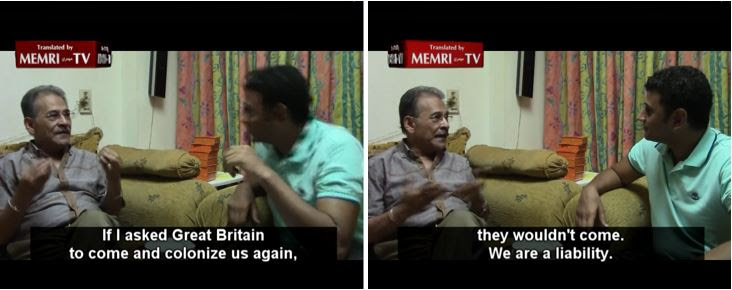
Sayyid Al-Qemany: "Great benefits! Now look, son. If we held a bid, looking for someone to colonize us, nobody would come. If I asked Great Britain to come and colonize us again, they wouldn't come. We are a liability.

Capture50722.JPG 

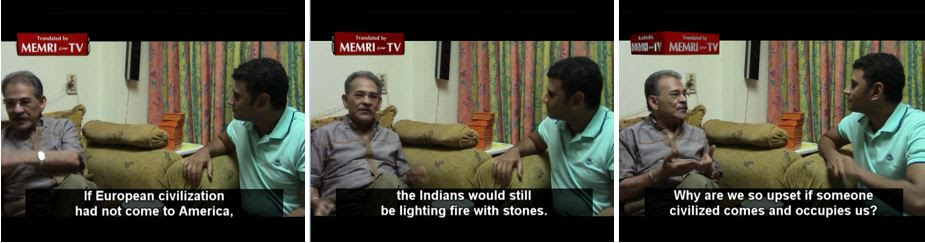
"[If they had come], they would have fixed everything. Our railroad was the greatest railroad in the world. The train was the most magnificent and the most punctual. It was the pride of Egypt. Who built it? The British. We did the actual work, but if the British hadn't been there, we wouldn't have done that either. If European civilization had not come to America, the Indians would still be lighting fire with stones. Why are we so upset if someone civilized comes and occupies us? They are more capable than we are. We are told that colonialism is the reason for our backwardness. That is not true.
[…]

"When the [Arab Spring] events took place in Tunisia, I was asked whether I expected this to happen in Egypt. I said that I hoped it would not. I said that our people is controlled by a Wahhabi mentality. The entire people is Wahhabi. What is a Wahhabi? A criminal with a license, a divine license. Our Lord gives him a license to be a criminal.
[…]

Capture50723.JPG 

"Unfortunately, our culture is built upon lies, and our history is a fabrication. This has ruined our memory. A colleague said to me that the Muslim Brotherhood should rise to power, so that people would feel what it was like, and would then chuck them forever. I asked him: Haven't we been trying them for 1,400 years? He said: 'The people has no memory, because what students learn as school is not the truth.'

Capture50724.jpg 

"They are told about the glory of the caliphate and the greatness of the Islamic nation… The focus is on the nation and on its greatness, at the expense of the citizen. That's one problem. The nation is great, and Islam is great, and it does not matter who gets chopped to pieces underneath. It does not matter if the citizen gets chopped to pieces, if he gets burned, if his property is taken from him, if he suffers injustice, or if he is killed for no reason. The caliph would wake up one morning in a good mood, and would give a sack of gold to the first person he would meet. When he would get up on a bad day, he would give the order for his tailor to be killed."
[…]

Capture50725.jpg 

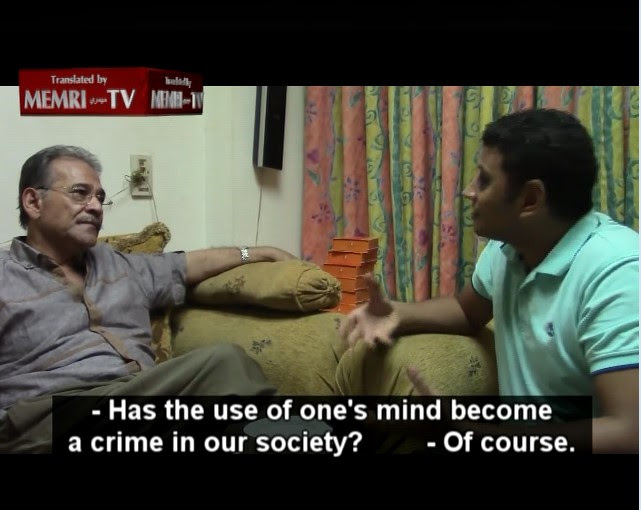
Interviewer: "Has the use of one's mind become a crime in our society?"

Sayyid Al-Qemany: "Of course. That's the problem. Sheikh Muhammad Hassan said: 'You have our Lord's religion, so you should step on your mind with your shoes.' Would you use your brain if he tells you that the Lord does not want you to think? He tells you that it's in the Lord's book and that you should beware not to think! If you have any question, ask Allah! If you need help, seek it with Allah! But how? Allah answers the prayer of the oppressed. He hangs it I don't know where – somewhere in the heavens – and responds to these prayers 'even if after a while.'

"Well, if You are our Lord, and You have the ability to help me, why don't You help me now?! Why 'after a while?!' Aren't You capable of helping the oppressed? Aren't you God? So help me now. Why 'after a while'? Are You waiting for me to get things better all by myself, and I'll say 'thank you?'

Capture50726.jpg 

"There are very basic questions, but these people have decided not to use their minds. So they have erased Egyptian consciousness altogether. They have erased everything related to the country in the Egyptian mind. Consequently, any kind of thought has become heresy.
[…]

"[Al-Sisi] came from the armed forces and saved Egypt, so I salute and thank him. Is there anything greater than saving the country? That's the only thing I care about, so I say: Thank you, leader. But there is much to say about what followed. I have many objections and concerns in this regard."
[…]

Sayyid Al-Qemany: "I don't understand his position about the Salafis."

Interviewer: "He was talking to a group of workers..."

Capture50727.JPG

Sayyid Al-Qemany: "The first moment of sadness occurred on July 3, when he made his speech. I saw that the people sitting there all had long beards – the Salafis, the church, and Al-Azhar… Oh man… I was looking for an Egyptian Ataturk. Weeks before, I said that we needed an Egyptian Ataturk. Only an Egyptian Ataturk could set this country straight. I was hoping that Al-Sisi would become an Ataturk. But this did not happen. He has a different charisma, a different mentality. Al-Sisi is a kind, quiet, good, modest man..."

Interviewer: "Did you hear what he said [about renewal of religious discourse]?"

Capture50728.JPG

Sayyid Al-Qemany: "I did, and I thought it was nothing but talk, I'm sad to say. [Reforming religious discourse] is not something you instruct to do. Reforming of mentality... This is not about reform of religious discourse. We need to reform our mentality regarding religion and everything else.
[…]

Capture50729.JPG

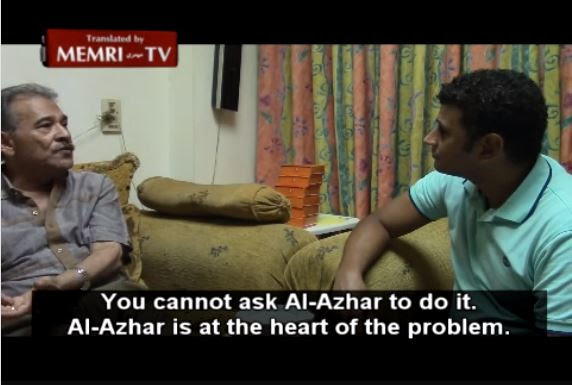
"You cannot just reform religious discourse. You cannot tell the virus to kill itself. You cannot ask Al-Azhar to do it. Al-Azhar is at the heart of the problem.
[…]

"Instead of begging Saudi Arabia and the Gulf for alms, we should change the second article of the Egyptian constitution, and state that the U.N. Charter, the Geneva Convention, and the Universal Declaration of Human Rights are the main source for legislation in the Egyptian Republic. You will see how the world reacts then."

View The Clip


MEMRI

Source: www.http://memri.org

Copyright - Original materials copyright (c) by the authors.
End Antisemitism in Football - Michael Curtis


by Michael Curtis

The most disturbing incidents have affected football clubs in London, especially the team Tottenham Hotspur, usually refered to as Spurs.

Anti-Semitism is a foul disease seemingly incurable, whose virus makes those infected lack any moral sensibility or civilized behavior. Hatred of Jews, the most global form of intolerance, has now been spreading in the turf of English Football.

Violence and expressions of racism on the part of spectators at football games in Britain has been common since the late 1970s. Strong passions by fans expressing tribal loyalties is to be expected, but the upsurge of anti-Semitic demonstrations, many by British neo-Nazis, insufferable prejudiced, and would-be Islamic jihadists, in recent years has been warped by vehement hatred and envy.

Jews have contributed in considerable fashion to football in Britain, particularly in London, as an exhibition “Four, Four Jew,’’ a title based on a football tactical formation, showed when on display at the London Jewish Museum in October 2013. Though few Jews play in professional teams, Jews are to be found in club organizational and executive activities.

The organization Kick it Out, formed in 1993 to tackle racism in football, has reported on the increasing number of anti-Semitic incidents among soccer spectators and the messages published on Twitter in 2015. Unfortunately, the disease also spread to some players. The most-well known incident was that of the French player Nicolas Anelka who, in December 2013 after scoring a goal for his team West Bromwich, used the infamous “quenelle” anti-Semitic gesture. This was the gesture, evoking neo-Nazi salutes, that had been invented by the French comedian Dieudonne who had been punished in France for his unrelenting anti-Semitic utterances.

The most disturbing incidents have affected football clubs in London, especially the team Tottenham Hotspur, usually refered to as Spurs. Located in north London the Spurs has had and retains a considerable Jewish following, the result of the heritage of Jewish immigrants who settled in that London area in the late 19th and early 20th century.

As a response to the insults, abuse, and derogatory language against Jews, the Spurs supporters, both Jews and non-Jews, have resorted to what is in effect a highly controversial form of self-identification. They use the nickname “Yids” as a badge of pride or honor, a term that has customarily been used by anti-Semites. They shout the term back at opponents.

The most recent startling incident occurred in the match between Spurs and their great archrival, the London team Arsenal, a rivalry even more intense than that between the NY Yankees and the Boston Red Sox. The game played between the two teams on Yom Kippur in September 2015 at the Spurs stadium in White Hart Lane resulted in both physical violence and bitter anti-Semitic chants. Arsenal fans ripped up part of stadium property and tore down hoardings at the stadium in celebration after the victory of their team. A number were arrested for criminal damage, assault, and public disorder.

Even more disturbing were the chants of Arsenal supporters during the game. They included expressions such as “Back to Auschwitz you go,” and “Every Tottenham fan can be put back in the gas chambers and gassed to death.”

Britain imbeciles are not alone in this outrage behavior. Football teams in Berlin, Utrecht, and Poland, have suffered from it. The team most affected is the Ajax club in Amsterdam in the Netherlands, identified as one with “Jewish roots,” whose rivals have chanted anti-Semitic rhetoric  such as “Hamas, Hamas, Jews to the gas.”

As in the case of cancer no remedy of cure is yet available to overcome the virus or to end the disease of antisemitism. But means are available to punish those who should be punished. The evil antisemitism must be outlawed and made a criminal offence. It must be recognized as the most pernicious violation of religious, cultural, and ethnic rights.

The complex issue of free expression must be tackled in a forthright manner. Societies should not tolerant the intolerant. Freedom of expression should not be used to defame or to call for the elimination of other groups. Instead, libel defamation of groups should be considered a criminal offence.

In spite of criticism of the behavior of Spurs fans, British Prime Minister David Cameron defended them. He argued there was a difference between Spurs fans self-describing themselves as Yids and someone calling a Yid as an insult. He believed hate speech should be prosecuted, but only when it’s motivated by hate. Everyone can agree that anti-Semitic utterances, threat, or physical action, whether by neo-Nazis, right-wing extremists, left wing anti-colonialists, or Islamic jihadists in different formulations, is primarily motivated by hatred of Jews.

The motto of the Tottenham Hotspur is Audere est Facere (To dare is to do). This should be the motto of the international community in dealing with the disease of anti-Semitism. 


Michael Curtis

Source: http://www.americanthinker.com/articles/2015/09/end_antisemitism_in_football.html

Copyright - Original materials copyright (c) by the authors.