Tuesday, July 26, 2016

Ethnic Opposition to Iran’s Regime Is on the Rise - Lt. Col. (ret.) Michael Segall


by Lt. Col. (ret.) Michael Segall

The Iranian regime, which so far has been spared the regional repercussions of the Arab Spring – or Islamic Awakening as the regime calls it – is now starting to feel the effects.


Institute for Contemporary Affairs
Founded jointly with the Wechsler Family Foundation
Vol. 16, No. 12

Iran’s Ethnic Diversity (U.S. Institute of Peace)
  • Since June 2016, Iran has been enduring terror attacks and assassinations by ethnic-opposition elements operating within its territory and adjacent to it.
  • Attacks on Iranian petroleum infrastructure in Ahvaz are a reaction to Iran’s ongoing repressive policy against the Arab minority in Ahvaz, including the ongoing arrests, trials, executions, and expulsions of young people in that area.
  • There are currently six to seven million Kurds living in Iran. Although they are part of the Iranian state, they may be distinguished from the Shiite minority by language and religion (most Kurds are Sunnis).
  • The Arab Sunni fighters’ targeting of the oil facilities, if it gains momentum, could pose a problem for Iran just as it is trying to renew oil exports after the lifting of sanctions. Attacks on energy infrastructure for gas and oil could foster an unsafe, unstable environment for international energy companies.
  • Iran’s security forces have been cracking down on the Arabs, augmenting this population’s discontent along with its separatist aspirations.
  • The Iranian regime, which so far has been spared the regional repercussions of the Arab Spring – or Islamic Awakening as the regime calls it – is now starting to feel the effects.
Since June 2016 and to a lesser extent before then as well, Iran has been enduring terror attacks and assassinations by ethnic-opposition elements operating within its territory and adjacent to it. These include Kurds in the north and near the Iraqi border, Salafi Sunnis near Iran’s eastern border with Pakistan, and Sunni Arabs in the Khuzestan province near the Iraqi border in the southwest. 

The Growing Arab Opposition

Early in June, a Sunni group called Suqour al-Ahvaz (Hawks of Ahvaz) took responsibility for an explosion that caused a fire at the Bou-Ali-Sina Petrochemical Complex in Bandar-E Mahshahr, Khuzestan.1, 2   Iran denied their boast and claimed it was a leak that had led to the explosion.3 The complex where the explosion occurred is known for protest demonstrations over the difficult employment conditions there.

Twitter post
The group also issued a statement calling for continued resistance to the Iranian occupation of Arab lands, which had “crossed a red line.” The statement also said the explosion was a reaction to Iran’s repressive policy against the Arab minority in Ahvaz, including ongoing arrests, trials, executions, and expulsions of young people in the area, and warned of further attacks on vital infrastructures and strategic facilities in Iran. The group’s spokesman said this was a new tactic aimed at damaging the Iranian economy, which thrives at the expense of the people of Ahvaz who live under the poverty threshold.

Furthermore, in an appeal to a target audience in Arab countries that is fearful of Iran, the group emphasized that it condemned Iran’s involvement in Syria, Iraq, Yemen, Bahrain, and Saudi Arabia and averred that it also intended to take action in the “Iranian interior” and to continue the “legitimate struggle until the Arab people of Ahvaz receive their full rights to their land.”4

On July 11, the group said it had attacked another oil facility in the area.5 It was the gas and liquid gas pipeline of the Marun Oil and Gas Exploitation Company at the Marun oil field in Khuzestan. One worker was killed and another wounded.6  Subsequently, a state of emergency was reported in Ahvaz.7

On July 17, 2016, the al-Farouq Battalion of Arab Struggle Movement for the Liberation of Ahvaz (ASMLA) targeted oil pipelines in the Johar as-Sabaa’ (Haftkel) district (75km northeast of Ahvaz). According to the group’s statement, the perpetrators managed to escape despite IRGC efforts to capture them. ASMLA reported that IRGC set up a security cordon around the area.8

A commander in the al-Faruq Battalions said that that the operation came in response to the ongoing transgressions of the Persian occupation state against the Arab people of Ahvaz and the spreading sectarian strife and immoral intervention in the affairs of neighboring countries including Saudi Arabia. He threatened further attacks, adding that the al-Faruq Battalions performed a careful study of the strategic target points on the oil pipelines stretching from the Johar as-Sabaa’ area to the inside of Iran, and they had managed to infiltrate the security cordon on this important economic region and successfully carry out this special attack.9

The sabotaged Bou-Ali-Sina Petrochemical Complex in Bandar-E Mahshahr, Khuzestan

The sabotaged Bou-Ali-Sina Petrochemical Complex in Bandar-E Mahshahr, Khuzestan

Social media reacted to the attacks with the hashtag #TheAhvazisshakeIran trending on Twitter and praising the resistance. The Elaph newspaper claims that the ASMLA recently warned that they will begin targeting foreign oil companies that work with Iran, and that invest in the oil of the Ahvaz region.10

In March, ASMALA called on all international oil companies not to legitimize and collaborate with the “Iranian regime’s oppression of the Ahwazi people by rushing to invest in the Iranian oil sector following the lifting of international sanctions.” ASMLA stressed that “the profits attained by the Iranian regime from the sale of the oil and gas resources in Ahwaz are used both in the brutal oppression of the Ahwazi people, who are denied any share in or profit from their own resources, and in funding terrorist entities which actively work to destabilize security and stability in the Arab world and elsewhere.11” 

Long live Arab Ahwaz
“Long live Arab Ahwaz” (Twitter)12

Over three million Arabs live in oil-rich Khuzestan. Unemployment has risen and air pollution is measured at very high levels. If the attack was indeed perpetrated by this group, then the Arab opposition has dealt a very hard blow to Iran’s oil and gas industry.

In mid-June, another Sunni opposition group, the Arab Struggle Movement for the Liberation of Ahvaz (ASMLA), announced that it had attacked an oil pipeline in the Zarqan area of Khuzestan. The group claimed it had also carried out additional, similar attacks. Its military wing, the Martyr Mohye al-Din al-Nasir Battalions, posted a short video showing the pipeline that was blown up and asserted that the attack was a reaction to Iranian security forces’ activities in the area.

The statement issued by the group read:
In conjunction with the 11th anniversary of the founding of ASMLA, the Martyr Razi al-Zarqani Battalion conducted a special operation targeting oil pipelines in the Zarqan area of the provincial capital [that] crippled the flow of oil from Ahvaz toward Tehran [dubbed “the capital of the occupation”]. [T]he targeting of the main oil pipelines came in response to the arbitrary Persian occupation arrests against Ahvazi activists as well as its continuing crimes against the rights of the Arab Ahvazi people and its profaning of the Arab nation. The Martyr Mohye al-Din al-Nasir Battalions will continue its special operations against the centers of the occupation state and its oil installations until the liberation of the last inch of Ahvazi soil.
The Iranian media gave the event almost zero coverage, and Iranian security forces imposed a closure on the area where it had occurred.

Global Jihad

Twitter post 

In eastern Iran near the Pakistani border, groups affiliated with global jihad continue to act against the Iranian Revolutionary Guard Corps (IRGC) and Border Guard Command forces stationed in the area,  sometimes hitting them hard. In June the global-jihad group Jaish al-Adl attacked Iranian forces operating in the Sistan and Balochistan Province. Ansar al-Furqan, a jihadi organization active in the Balochistan area, claimed it had killed dozens of Iranian soldiers in a suicide bombing13  in the city of Khash.14 Near the Pakistani border in Sistan and Balochistan, five members of the Border Guard Command were killed in a clash with armed Sunni elements who fled back into Pakistan.15

The Iranian Kurds

Along with the intensified activity of the separatist forces in Khuzestan and the jihadi groups along the Pakistani and Afghani borders, June also saw stepped-up activity by the Kurdish opposition in Iran. In June, the Kurdistan Democratic Party of Iran (KDPI) attacked IRGC patrols along the Iran-Iraq border in the area of Oshnavieh and Sarvabad, cities that neighbor the Kurdish enclave in northern Iraq. Several IRGC members and Kurdish fighters were killed in the clashes.16 In another incident in June some fighters of another Kurdish group, PartiyaJiyana Azad a Kurdistanê (PJAK), were killed. The PJAK has links with the Turkish PKK near the city of Sardasht along the Iraqi border.

Currently, six to seven million Kurds live in Iran. Although they are part of the Iranian state, they are distinct from the Shiite minority in several major regards, including language and religion (most Kurds are Sunnis). The Kurds, who are mainly concentrated along the Iraqi border, are poor compared to Iranians who live in the large cities. At the end of May 2016, President Hassan Rouhani visited some Kurdish areas and promised that centers for the study of the Kurdish language would be established and that Kurdish-populated parts of northwestern Iran would be developed after years of neglect:17 According to Rouhani,
The Islamic Republic of Iran heed [sic] the problems of its diverse people; our security now is far more than the territories located beyond the borders but having the same ethnic population; Kurds enjoy better situation [sic] in terms of security than their counterparts in Iraq, Turkey, and Syria; it is an honor for the Islamic Republic not to succumb to religion and ethnicity in providing its people with the same level of development and welfare.
The KDPI has long striven for independence in the Kurdish regions of northern Iran. The increased activity stems from growing awareness of possible Kurdish independence in Syria along the Turkish border, and of the freedom and relative independence enjoyed by Kurds in northern Iraq. The group’s military arm, which numbers thousands of fighters, is based in northern Iraq but has not been absorbed by the Kurdish population there. The KDPI is trying to pursue an independent agenda but appears to be caught between conflicting interests; to some extent, the Kurdish groups in the four main countries with sizable Kurdish populations (Syria, Turkey, Iraq, and Iran) are waging struggles against each other.

Iran’s Ethnic Diversity (U.S. Institute of Peace)

For example, the Kurds in northern Iraq’s Kurdish enclave are trying to maintain open channels for oil exportation both to Turkey and Iran and certainly, do not want to open a front with Iran despite the KDPI’s growing military activity. Likewise, the Kurds in northern Iraq are maintaining a careful policy of nonintervention in Turkey’s difficult and bloody struggle against the PKK, which sometimes includes Turkish bombing of Kurdish targets in northern Iraq. Iran, too, in the wake of clashes with the KDPI, has threatened that the IRGC will not hesitate to act against “terrorists” in their main strongholds in northern Iraq if they do not cease their activity, saying that “they will be targeted wherever they are.”18

In sum, last month Iran had to deal with subversive activity– though so far of low intensity – by a number of ethnic elements on all its borders in the northwest, the southwest, and the east of the country. The Arabs (in Khuzestan) and the Kurds are trying to pursue a separatist national agenda, and they are inspired by the geostrategic changes in the Middle East and the efforts to reshape it.

The Arab Sunni fighters’ targeting of the oil facilities, if it gains momentum, could pose a problem for Iran just as it is trying to renew its oil exports after the lifting of sanctions. Attacks on energy infrastructure for gas and oil could foster an unsafe, unstable environment for international energy companies. Such companies are in any case concerned about Iran’s intention to renew contracts using the buyback system, which is more beneficial for a state than for foreign companies. Iran has been reporting little on the attacks on its energy infrastructure, which have mainly been occurring in the Khuzestan province. Meanwhile, Iran’s security forces have been cracking down on the Arab minority there augmenting this population’s discontent along with its separatist aspirations.

It may be early to envision the mounting ethnic-religious protest in Iran causing a substantial change in the regime’s behavior. It is, however, clear that the Iranian regime, which so far has been spared the regional repercussions of the Arab Spring – or Islamic Awakening as the regime calls it – is now starting to feel its effects.

* * *
Notes
1http://www.shana.ir/fa/newsagency/pictorial/264440 ; https://www.youtube.com/watch?v=KVMDGYVH8N8
2http://www.arabi21.co/story/919480/%D8%B5%D9%82%D9%88%D8%B1-%D8%A7%D9%84%D8%A3%D8%AD%D9%88%D8%A7%D8%B2-%D8%AA%D8%AA%D8%A8%D9%86%D9%89-%D8%B9%D9%85%D9%84%D9%8A%D8%A9-%D8%AA%D9%81%D8%AC%D9%8A%D8%B1-%D9%85%D9%86%D8%B4%D8%A3%D8%A9-%D9%85%D8%B9%D8%B4%D9%88%D8%B1-%D8%A7%D9%84%D9%86%D9%81%D8%B7%D9%8A%D8%A9
3http://www.shana.ir/fa/newsagency/264365/%d9%86%d8%b4%d8%aa%db%8c-%d8%af%d8%b1-%d9%88%d8%a7%d8%ad%d8%af-900-%d9%be%d8%a7%d8%b1%d8%a7%d8%b2%d8%a7%db%8c%d9%84%db%8c%d9%86-%d8%b3%d8%a8%d8%a8-%d8%a2%d8%aa%d8%b4-%d8%b3%d9%88%d8%b2%db%8c-%d9%be%d8%aa%d8%b1%d9%88%d8%b4%db%8c%d9%85%db%8c-%d8%a8%d9%88%d8%b9%d9%84%db%8c-%d8%b3%db%8c%d9%86%d8%a7-%d8%b4%d8%af
4 https://justpaste.it/w0dq
5 https://twitter.com/JAna__AlaAM/status/752612135885209600
6 http://www.shana.ir/en/newsagency/264746/Pipeline-Blast-in-Marun-Kills-1-Injures-Another
7 https://twitter.com/alhosam511/status/752498208966868992
8 http://www.albawaba.com/news/ahwazi-arab-resistance-blow-iranian-pipeline-863908
9 https://www.facebook.com/permalink.php?story_fbid=584986431680996&id=422489744597333
10 http://elaph.com/Web/News/2016/7/1099323.html?entry=Iran
11 http://ahwazna.net/en-189_Ahwazi_movement_calls_on_intl_firms_not_to_partner_in_Irans_crimes_.html
12 https://twitter.com/popk999/status/751907997257961473
13 https://twitter.com/Al_Maqal_Pubs/status/742611565124325376
14https://sabq.org/%D9%85%D9%82%D8%AA%D9%84-%D9%88%D8%AC%D8%B1%D8%AD-%D8%B9%D8%B3%D9%83%D8%B1%D9%8A-%D8%A5%D9%8A%D8%B1%D8%A7%D9%86%D9%8A-%D8%A8%D9%80-%D8%AE%D8%A7%D8%B4-%D9%88%D8%A3%D8%AD%D8%AF-%D8%A7%D9%84%D9%85%D9%86%D9%81-%D8%B0%D9%8A%D9%86-%D9%8A-%D9%87%D8%AF%D9%8A-%D8%B3%D8%A7%D8%B9%D8%AA%D9%87
15 http://www.presstv.ir/Detail/2016/07/06/473906/Iran-border-guards-terrorists-Sistan–Baluchestan
16 http://www.azernews.az/region/98078.html
17 http://en.mehrnews.com/news/117008/Rouhani-unveils-largest-industrial-complex-in-western-Iran
18 http://www.tasnimnews.com/en/news/2016/06/26/1115831/irgc-to-target-terrorists-positions-wherever-they-are-commander


Lt. Col. (ret.) Michael Segall

Source: http://jcpa.org/article/ethnic-opposition-to-irans-regime-is-on-the-rise/

Follow Middle East and Terrorism on Twitter

Copyright - Original materials copyright (c) by the authors.

How Trains Are A Prime Target for Terrorists - Abigail R. Esman


by Abigail R. Esman

"--when it comes to the possibility of a major attack on U.S. or European railway or metro systems, former Homeland Security officer Sean Burke told Boston's WCVB news, "We have to expect it. That's the bottom line."


On July 18, a young man stormed through a train outside of Wurzburg, Germany. Crying "Allahu Akbar," (God is greatest) he brandished an axe high into the air, then slashed at the men and women seated around him. Within minutes, the car, as one person described it, " looked like a slaughterhouse."

Then he fled.

By the time the day had ended, five people had been seriously wounded: four on the train, and a woman who had the misfortune of walking her dog at the moment he passed by. She remains in critical condition.
A day later, the Islamic State took credit for the attack, calling the killer, a 17-year-old refugee who was ultimately shot and killed by German police, a "soldier for ISIS." It was the first full-scale Islamic terrorist attack in Germany.

But it was not the first Islamic terrorist attack on a train. Far from it: starting with the 2004 commuter train bombings in Madrid and the July 7, 2005 bombings of the London Underground, trains and metros have been a common target for extremist groups. Some efforts, like the bombing of the Brussels metro station this past April, succeeded; many more have failed. But the attempts, successful or not, betray a gaping hole in international security, and one that may not be easy to repair.

In fact, a 2007 report from the Council on Foreign Relations noted that "security professionals see trains as some of the likeliest targets." Consequently, when it comes to the possibility of a major attack on U.S. or European railway or metro systems, former Homeland Security officer Sean Burke told Boston's WCVB news, "We have to expect it. That's the bottom line."

Such an attack, if large enough, could be devastating. While air traffic remains substantial, five times as many people ride trains as fly in the United States, and in Europe, the rapid, efficient and low-cost trains often offer the best transportation options between countries, especially in an era of long airport security lines and early check-ins. Moreover, freight shipments, including highly toxic industrial chemicals, travel the same routes as passenger trains, frequently passing through densely populated areas. Because of this situation, the Council on Foreign Relations reported in 2007 that former White House Deputy Homeland Security Adviser Richard Falkenrath considered such trains "the single greatest danger of a potential terrorist attack in our country today.'"

Yet security on both continents is weak, and in Europe, often at the bare minimum; one will rarely find a policeman or other security personnel at a train station in the Netherlands, for instance. Even on international trains, like the high-speed Thalys between the Netherlands, Belgium, and France, customs and immigration officials are few and far between. Rarely is anyone asked for ID (let alone a passport), and there are, as in the U.S., no security screenings even at major rail stations like Paris' Gare du Nord and Berlin Hauptbanhof.
Which may in part explain why the real identity of the axe-wielder in Bavaria is still uncertain: at a July 20 press conference in Berlin, officials admitted that his name is still uncertain since he, like many other asylum seekers, entered the country without a passport or other identifying papers. Indeed, Time reports that, "Authorities have discovered that he could be from Afghanistan or Pakistan, and that the information he provided to officials in Germany could be partly or entirely false."

It also likely explains the many other, less successful attempts on European trains, such as the 2006 plot to bomb trains at the Cologne station; an attempt to blow up the main train station in Bonn in 2006; a suspected plot disrupted last New Year's Eve to send suicide bombers onto trains in Munich; and the foiled attack by Ayoub el Khassini, who opened fire on a Thalys train in August 2015. In the latter instance, three American tourists – two of whom were in the military - ultimately overpowered and subdued the Moroccan-born Belgian resident, who had boarded the train armed with a Kalashnikov, pistol, hammer, bottle of petrol, nearly 300 rounds of ammunition, and other weapons.

Yet, counterterrorism and national security officials in the U.S. as well as Europe admit there is little they can do. As Time notes, in Europe, "some of the trains linking major cities stop at countless small towns along the way," and the cost of installing metal detectors and setting up TSA-style inspections at all of these stations would be prohibitive. As Christophe Piednoel, a spokesman for the French SNCF railway told Liberation, "Stations are public places....We cannot ask the French to wait one hour before boarding a train. Moreover, 15,000 trains cross France every day, and traverse 3000 stations."

The same is true in the U.S., where some say Amtrak, which carries over 30 million passengers a year through 46 states and parts of Canada, is a prime target. Tracks pass through tunnels, across bridges, in and out of remote villages and major cities. As Burke also told WCVB, "The passenger rail system is designed to be open. It's specifically put in densely populated areas. [It's] a system that is vulnerable really from the beginning of its trip to the end of its trip."

Added to that is the threat of toxic, chemical freight, which is carried in pressurized tanks: the CFR report points out that "security along their route tends to be lax, and at times tanks sit unmonitored in rail yards for days at a time." Despite this fact, efforts to reroute such shipments have failed; not only are they costly, but impractical, since many of the shipments are themselves bound for populated areas, including major cities.

Despite this danger, the TSA all but overlooks train safety, budgeting just 2 percent of its spending on train and subway security, according to the New York Times. Even considering the practical complications and costs of adding metal detectors to all train stations and subway entrances in the country, this hardly seems like enough. New York subways are regularly patrolled by transit authority police who will perform random searches of bags, but with 5.6 million passengers riding the system daily, these measures scarcely seem adequate.

What is especially disturbing is that security officials, both in the U.S. and in many European countries, even seem aware of this: after the Paris attacks in November 2014, K-9 teams swept train stations across America. And after the Brussels metro attacks, train terminals saw a stepped up police and military presence in a number of major cities and even some smaller European towns. In New York and Washington, D.C., security was intensified not just on trains and subways, but also on bridges, tunnels, and even highways.

And then, suddenly, they were gone. It was as if the dangers in New York and Washington and Chicago were resolved, once the perpetrators of the attack in Brussels had been arrested or killed.

True, records show that TSA at airports have failed to stop a single terrorist attack (though they did find over 2,200 firearms, along with grenades, knives, and other weapons in 2015). At the same time, that may be because their presence discourages potential terrorists from attempting to strike on board a plane these days. There are, after all, easier options. Like trains.


Abigail R. Esman, the author, most recently, of Radical State: How Jihad Is Winning Over Democracy in the West (Praeger, 2010), is a freelance writer based in New York and the Netherlands.

Source: http://www.investigativeproject.org/5531/how-trains-are-a-prime-target-for-terrorists

Follow Middle East and Terrorism on Twitter

Copyright - Original materials copyright (c) by the authors.

How Trump’s Speech Won Over This Skeptical Voter - Yuri Justo


by Yuri Justo

Trump’s three major proposals are all very possible and could be completed within a few years.


I have not been a Trump supporter from the first. I much preferred Rubio, many of whose positions I still support. As a military aviator, John McCain’s story of heroism made him something of a secular saint, and I strongly supported him during his election run. As a believing Christian I was and am skeptical of Trump’s relationship with faith. But I was won over by Trump’s acceptance speech this last Thursday. What I heard was a plan: A plan with attainable, measurable objectives with outcomes directly tied to their accomplishment. This simplicity, modesty in scope, and realistic attainability completely changed my opinion about Trump.

First, Trump said that he will improve America’s security by building a wall. Building a serious border wall is a practical action that can be completed. Once complete it will improve security if supported properly. Examples from countries around the world prove this: For example, many years ago, I lived in the Palestinian West Bank territories. There was no real border, and weekly, suicide bombers would go from the Palestinian areas and blow themselves up wherever Jews would gather. Eventually Israel built its wall. This was very controversial. But no longer do suicide bombers attack. The wall worked. The same had to be done on Israel’s southern border as thousands of African refugees walked across the Sinai and into Israel. That wall also stopped the in-flow. Illegal immigration has been a subject of conversation ever since I could read the newspapers. A wall might finally end this conversation at least regarding the southern border.

Secondly, Trump said that he would re-negotiate our trade deals. This, he said, would improve the economy. When people ask: “When was America ever great?”, I think back to the mid-80s to the mid-90s. At that time, I remember Walmart being full of products that were “Made in America”. I remember visiting friends in small country towns that worked at factories making clothes. After NAFTA was enacted our factories made their way south of the border. Then came China’s entrance into the WTO: the shelves filled with Chinese products. Yes, things were cheaper -- but at what cost to our economy and our society? For 20 years wages have not risen for most workers. The American dream -- that our children will do better than us -- is in danger. Bernie Sanders’ popular candidacy showed that right and left, Americans want a re-negotiation of our trade deals. So, who better to work on a better deal for the country than the author of the Art of the Deal? 

Thirdly, Trump said that he would win the fight against ISIS. This is also eminently achievable. Under Obama we have fought ISIS with both hands behind our back. We have not tried to win, but rather have tried to use the minimum force necessary to prevent a total collapse. This gave ISIS years of safe haven. Years to perfect its recruiting strategies and plan attacks upon the weaknesses of the West. If ISIS had been swiftly defeated sometime around 2013 most likely the horrifying recent terrorist attacks around the world would also not have happened. As a veteran of the successful struggle against ISIS -- at that time called the Islamic State in Iraq -- I was maddened by Obama’s choice to throw our success away in 2011 and 2013 by first withdrawing and then choosing to only minimally assist the Iraqi Forces when ISIS invaded Iraq. Obama’s strategy has proven unrealistic and dangerous to the world’s safety. If we want to win, can we? Yes. Will Americans die in the fighting? Most likely. Can it happen quickly? Upon the president’s orders, the planning and preparations can begin; against such a militarily weak enemy, victory on the battlefield (defined as defeating militarily significant formations, not complete pacification) is merely a matter of time.

Trump’s three major proposals are all very possible and could be completed within a few years. There are 1,989 miles along our southern border. 700 miles of fencing have already been completed after 4 years of work. That leaves 1289 miles to go, almost all in Texas. As for trade deal re-negotiations, these can be accomplished relatively quickly: NAFTA negotiations began in 1991, and the agreement was signed by the end of 1992. Regarding winning against ISIS, the French faced a similar Islamist foe in Mali in 2013.  They began serious combat (eventually involving 4,000 soldiers) on 11 January, and were mopping up fleeing remnants by March 31, 2013.

Trump is not a messiah. He is not claiming to heal the planet and slow the oceans’ rise as Obama proclaimed in his acceptance speech. Instead, Trump is an executive, one who has listed his relatively modest objectives and milestones along the way. That is what I heard in his acceptance speech and I was won over.


Yuri Justo

Source: http://www.americanthinker.com/articles/2016/07/how_trumps_speech_won_over_this_skeptical_voter.html

Follow Middle East and Terrorism on Twitter

Copyright - Original materials copyright (c) by the authors.

Department of Homeland Security Targeting the Wrong Enemy - A.J. Caschetta


by A.J. Caschetta

The Obama era is one of willful blindness to the jihadist movement that has declared war on America.


  • President Obama has surrounded himself not with military strategists but rather with fiction writers, wide-eyed diplomats whose strategy is "don't do stupid shit," and law enforcement officials who believe that "Our most effective response to terror and hatred is compassion, unity and love."
  • Only "rightwing extremism" is obvious to the Obama Administration. Everything else is apparently too complex and nuanced for labels. Even Micah Xavier Johnson, who said that he was motivated by "Black Lives Matters" rhetoric and hatred of white people, is a conundrum to the president, who bizarrely asserted that it is "hard to untangle the motives of this shooter."
  • The Obama era is one of willful blindness to the jihadist movement that has declared war on America. CIA Director John Brennan purged the word "jihad" from the agency's vocabulary. Obama's two Attorneys General have done the same at the Department of Justice.
  • The federal government has spent the last 8 years pretending that "rightwing extremists" are more numerous and dangerous than the careful and intelligent jihadist attackers, whom it insists are just "madmen" or "troubled individuals."
Anyone surprised by President Barack Obama's recurring attempts at exploiting jihadist attacks in his efforts to restrict gun ownership should read the earliest known document concerning terrorism assembled by his administration. The unclassified assessment by Department of Homeland Security (DHS), titled "Rightwing Extremism: Current Economic and Political Climate Fueling Resurgence in Radicalization and Recruitment," is dated April 7, 2009 -- a mere 77 days after Obama's inauguration.

The document was leaked shortly after its release to law enforcement officials across the country and made public by Roger Hedgecock on April 13, 2009. It laid out the new president's legislative and executive priorities on terrorism, guns and immigration. Uniquely combining these three issues would become a predictable, coordinated pattern during Obama's two terms in office.

The assessment boldly delineated the Tom Ridge and Janet Napolitano eras at the DHS. As Eli Lake wrote the day after the document was leaked, "Since its inception in 2003, the department has focused primarily on radicalization of Muslims and the prospect of homegrown Islamist terrorism." Under Obama's leadership, attention was directed away from Muslims and Islamist terrorism and redirected towards limiting the Second Amendment, scrutinizing military veterans and expanding both legal and illegal immigration.

Contrary to criticism of the Obama administration as uninterested in the plight of military veterans, the DHS assessment shows that vets were very much a priority. The document's authors, in fact, were worried that "military veterans facing significant challenges returning into their communities could lead to the potential emergence of terrorist groups or lone wolf extremists."

The only significant acts of domestic terrorism perpetrated by veterans lately have not been inspired from the right, however: Micah Xavier Johnson and Gavin Long are products of a "left wing," anti-police, anti-establishment ideology. The assassinations they carried out fit the pattern of the so-called "New Left" wave of terror carried out in the 1970s by the Weather Underground and the Black Panthers.

The language of the document also foretells the Obama story. In its brief seven pages of text there are 25 references to gun control, weapons and ammunition-hoarding. Terrorists motivated by "anti-immigration" and "white supremacist" ideologies are mentioned 11 times, and veterans returning home from Afghanistan and Iraq are mentioned 9 times. Variations of "extremism," which would become Obama's preferred euphemism, occur 42 times.

Timothy McVeigh is the model terrorist in the document. DHS spokeswoman Sara Kuban said a goal of the report was "to prevent another Tim McVeigh from ever happening again."

The 1990s figure prominently in the DHS prognostication, meriting 17 references. The "poor economic climate," the Clinton "assault weapon" ban and "a perceived threat to US power and sovereignty by other foreign powers" are envisioned as parallel to the situation in 2009. Looking back at the 1990s and predicting similar troubles in the age of Obama, Napolitano's DHS made no mention of the most significant development in the evolution of political violence to occur in the 1990s: the rise of Al-Qaeda.

Military strategists worth their pay will recognize the DHS version of "preparing to fight the last war," but then Obama has surrounded himself not with military strategists but rather with fiction writers, wide-eyed diplomats whose strategy is limited to "don't do stupid shit," and law enforcement officials who believe that "Our most effective response to terror and hatred is compassion, unity and love."

In a passage about "the historical election of an African American president and the prospect of policy changes," there is a reference to "the shooting deaths of three police officers in Pittsburgh, Pennsylvania, on 4 April 2009." The shooter in question was Richard Poplawski, who ambushed the police called to his home to investigate a domestic disturbance. The DHS concludes that "his racist ideology and belief in antigovernment conspiracy theories" led to his "radicalization," though years later, after Poplawski was convicted and sentenced to death, reporters and even the jury were still unsure of his motives.

The Poplawski shooting occurred just three days before the date on the document. Compare that remarkably speedy conclusion to the way the Obama Administration has handled jihadist attacks. Maj. Nidal Malik Hasan's November 5, 2009 attack in Fort Hood, Texas, and Alton Nolan's September 24, 2014 ritual beheading of a coworker at the Vaughan Foods plant in Moore, Oklahoma, are described as "workplace violence."

FBI Director James Comey expressed confusion over Omar Mateen's motives for the recent Orlando jihad attack, even though Mateen's attack was accompanied by the jihadist's battle cry "Allahu Akhbar" and a pledge of allegiance to Abu Bakr al-Baghdadi, Caliph of the Islamic State during a 911 call. Before that it was the San Bernardino husband-wife jihadist team whose motives were ostensibly a mystery to the FBI.

Only "rightwing extremism" is obvious to the Obama Administration. Everything else is apparently too complex and nuanced for labels. Even Micah Xavier Johnson, who told Dallas police that he was motivated by "Black Lives Matters" rhetoric and hatred of white people, is a conundrum to the president, who bizarrely asserted that it is "hard to untangle the motives of this shooter."

Left: The 2009 Department of Homeland Security assessment titled "Rightwing Extremism: Current Economic and Political Climate Fueling Resurgence in Radicalization and Recruitment." Right: Micah Xavier Johnson, who murdered five Dallas police officers and injured nine others, said that he was motivated by "Black Lives Matters" rhetoric and hatred of white people.

After the 2009 DHS assessment was widely and rightly criticized, the Southern Poverty Law Center (SPLC) complained that the administration "let its team devoted to non-Islamic domestic terrorism fall apart in the aftermath of... [the] controversial leaked report." But while the "Extremism and Radicalization Branch, Homeland Environment Threat Analysis Division" may have been dropped, but the principles that led to the document were not.

Even more so than the Bush era, the Obama era is one of willful blindness to the global jihadist movement that has declared war on America. CIA Director John Brennan purged the word "jihad" from the agency's vocabulary. Obama's two Attorneys General have done the same at the Department of Justice.

The federal government has spent the last eight years pretending (maybe even believing) that "rightwing extremists" are more numerous and dangerous than the careful and intelligent jihadist attackers, whom it insists are just "madmen" or "troubled individuals."
 
 
A.J. Caschetta is a Shillman-Ginsburg fellow at the Middle East Forum and a senior lecturer at the Rochester Institute of Technology.
A.J. Caschetta

Source: https://www.gatestoneinstitute.org/8549/dhs-rightwing-extremism

Follow Middle East and Terrorism on Twitter

Copyright - Original materials copyright (c) by the authors.

Refugee Jihad Spreads in Germany - Joseph Klein


by Joseph Klein

Why the recent wave of attacks is only the beginning.


The German people are suffering the consequences of Chancellor Angela Merkel’s reckless open door “refugee” policy. Merkel laid down the welcome mat for around a million migrants last year, many of them from troubled areas of the Middle East and South Asia, including Syria, Iraq and Afghanistan. There have been four violent attacks in Germany within just the past week. Two of them were committed by Syrian migrants. A third was committed by an Afghan asylum seeker. The fourth, a mass shooting in Munich, was committed by the German-born son of Iranian asylum-seekers.

ISIS had forewarned that attacks in Germany were coming. Shortly after the Brussels airport attack, ISIS sent out a call for an attack on Germany’s Cologne airport.  An ISIS video threatened to turn Germany into a “battle field” and targeted Chancellor Merkel for murder. After the attack in Nice, ISIS supporters celebrated on social media and said that Germany was next.

Now that the attacks have started, German government officials are trying to calm peoples’ fears, minimizing as much as possible any connection to ISIS.  Chancellor Merkel’s Chief of Staff Peter Altmaier actually claimed early last week, after the first attack, that terrorist acts committed by refugees are “not larger or smaller than that in the rest of the population."

However, the official explanations, including claims as to the mental instability of the perpetrators, ignore the reality that the attackers find legitimacy for acting on their hatred from the “new normal” of violence created by the successful actions of ISIS.

At least two of the most recent attacks in Germany have been directly linked to ISIS.

A Syrian asylum seeker, whom had pledged his allegiance to ISIS, blew himself up last Sunday and injured twelve other people, outside of a wine bar in the town of Ansbach.  It could have been far worse. His original target appeared to have been a music festival, but fortunately he was turned away because he did not have a ticket to the event. ISIS claimed that the suicide bomber "was a soldier of the Islamic State."

The Afghan refugee who attacked train passengers in Germany early last week, injuring four people, two of them critically, was found to have had an ISIS flag in his room. He is reported to have shouted "Allahu Akbar" (God is great) several times. A news agency linked to ISIS claimed the assailant "carried out the operation in answer to the calls to target the countries of the coalition fighting the Islamic State."

A machete-wielding Syrian asylum-seeker, who killed a pregnant woman in Germany, was arrested on Sunday. The police claim that, based on the current evidence, “there is no indication that this was a terrorist attack."  Nevertheless, ISIS exploited the incident to urge more so-called “lone wolf” attacks.

The shooting spree at a shopping mall in Munich last Friday, which resulted in the deaths of nine people, in addition to the shooter who killed himself, appears to have been the work of a mentally deranged German born son of parents whom had emigrated from Iran. Deranged or not, the killer managed to shout out the Islamic rallying cry, “Allahu Akbar,” according to the Daily Mail. When some Germans gathered peaceably over the weekend to mourn the victims of this vicious attack, they were met by more shouts of “Allahu Akbar.”

Some German officials, channeling President Obama, are calling for stricter gun control even though Germany already has very strict laws and three of the four attacks during the last week were not carried out with guns.

Local authorities are also calling for the compulsory teaching of Islam in Germany’s schools. “It is appropriate to bring in classes on Islam in state schools or schools overseen by the state,” Gerd Landsberg, head of the association of local councils, said last week. This is multiculturalism on steroids. And it will most certainly backfire. Does anyone seriously think that jihadists are just going to sit back and outsource the teaching of Islam to “Crusader” schools using token Muslims as teachers whom the jihadists consider infidels? It is the mosques in Germany where youth are indoctrinated by radical imams. They also learn the path of jihad from their peers on the street or in jails, as well as from radical Islamist propaganda on the Internet.

At least some German officials concerned with security recognize that there is a problem with the flow of refugees entering their country. The following is a quote from Germany’s 2015 Annual Report on The Protection of The Constitution: Facts and Trends:

“Islamist organisations in Germany see the tide of refugees from Syria and Iraq as a chance to gain new followers by winning refugees over to their extremist ideology under the cover of humanitarian aid. Such activities are likely to increase in future. The contacts Salafists or Islamists make with refugees will remain relevant to Germany's domestic intelligence services…Particular attention has to be paid to so-called unaccompanied young refugees since, due to their situation, they are likely to be particularly susceptible to Islamist promises…Given the continuous immigration into Germany, it also has to be assumed that active or former members, supporters, and sympathisers of terrorist organisations as well as individuals with an extremist orientation and/or Islamistically motivated war criminals may be among the refugees.”

For years, Western European governments have tolerated the rise of radical Islam in their countries for fear of being branded Islamophobes. They also did not want to discourage Muslim immigrants needed to add to the labor force. However, the jihad cancer has grown out of control. Indeed, it is now reaching a near terminal state as Islamist refugees, who refuse to assimilate into the culture of their new home or accept its values, trample on the lives of their hosts. Germany is in the direct eye of the storm.


Joseph Klein is a Harvard-trained lawyer and the author of Global Deception: The UN’s Stealth Assault on America’s Freedom and Lethal Engagement: Barack Hussein Obama, the United Nations & Radical Islam.

Source:  http://www.frontpagemag.com/fpm/263631/refugee-jihad-spreads-germany-joseph-klein

Follow Middle East and Terrorism on Twitter

Copyright - Original materials copyright (c) by the authors.

The Presbyterian Church USA's Obsession With Israel - Joseph Puder


by Joseph Puder

Institutional anti-Semitism becomes too apparent to ignore.


The Presbyterian Church USA (PC-USA) assembled in Portland, Oregon for its 222 General Assembly, lasting from June 18-25.  Once again, latent anti-Semitism in the form of controversial resolutions on divestment from Israel became a major issue in the proceedings.  Delegates from 171 PCUSA presbyteries, representing the 1.57 million members, along with other participants and observers from around the world, gathered in Portland for the biennial General Assembly (GA).

Elements from within the PCUSA displayed their unrestrained prejudice against the Jewish state when according to the former Vice President of the Institute on Religion and Democracy, Alan Wisdom, only one resolution about the Middle East entailed “anything besides the Israeli-Palestinian conflict.” He described the PCUSA GA as an “onslaught of anti-Israel legislation.”

Wisdom further explained that “of the six items placed before the assembly’s Middle East Issues Committee, five aimed harsh criticism at Israel.” Only one issue raised gently concerned itself with the threats to Middle Eastern Christians.  That resolution does not even bother to identify the threat as being Islam and Muslim radicalism and jihadism.  Instead, it qualified the threat coming from “unnamed religiously based actors in the region.”

The multiple anti-Israel resolutions proposed divesting from companies doing business in the Jewish state, with one specifically called the PCUSA, to prayerfully consider Boycott, Divestment, and Sanctions (BDS) against the State of Israel.  Israel alone was singled out.  The only vibrant democracy in the Middle East where religious freedom exists and is flourishing, where human and civil rights are sacrosanct, was vilified.  Yet, Arab Palestinian Muslim terrorism, authoritarianism, anti-Semitism, incitement against Israelis and Jews, and denial of human rights and religious freedom has been ignored.  

There were no “overtures,” i.e. resolutions against the most notorious dictatorships in the Middle East including the Islamic Republic of Iran, which tramples on basic human rights, denies religious freedom to Christians, Jews, or Baha’is, hangs youthful dissidents, gays and lesbians, and oppresses its minority Kurdish, Baluchi, and Ahwazi people.  The hypocrisy and glaring bias displayed by the PCUSA General Assembly was obvious when the worst human rights offenders in the Middle East including Saudi Arabia, Turkey, Assad of Syria, and a host of other Middle East Muslim states did not get mentioned, let alone subjected to BDS.

Religion News Service (RNS) appeared with a headline on June 25, 2016 that read “Presbyterian Vote to continue pressure on Israel.” The RNS article reported the following overtures that PCUSA approved at its biennial assembly: “A report of a committee charged to evaluate the two-state solution to the Israeli-Palestinian conflict.  The report was approved 429-129 with an amendment that affirms the right of the people of Israel to exist as a sovereign nation.” Critics said that the report questioned the right of Israel to exist as the sanctuary for Jews it was created to be. Delegates rejected a minority report that referred to the adopted report as “pugnaciously flawed.”

There was a call for a “prayerful study” of the BDS movement and opposition to BDS.  The approval of this overture trumped a move to end any church affiliation with BDS, a global campaign (BDS was founded by Qatari-born Palestinian Omar Barghouti, who received his education at Tel Aviv University!) to apply economic pressure to Israel, and boycott its institutions and products.  

Another overture related to Middle East Issues urged the realty company RE/MAX to stop sales of property within Jewish settlements in the occupied territories.  Prior to the GA, supporters of the overture said they received a letter from RE/MAX CEO Dave Liniger stating that the company “will no longer receive any income from the sale of Jewish settlement properties in the West Bank”

Gary Ratner, Senior Executive of StandWithUs, who participated in the PCUSA GA, pointed out that “the real tragedy as it related to Israel is that while the vast majority of Presbyterians in the pews and appointed commissioners are fair-minded and have a favorable view of Israel, unfortunately, the information they receive from the headquarters leadership is biased due to their pro-Palestinian bent.  It is ironic that the Middle East Issues Committee has only found it proper to discuss Israel/Palestine while ignoring the genocide in Syria, Iran’s nuclear quest, and the mayhem in Yemen and Libya.  Moreover, the Committee’s so-called “experts,” who the commissioners rely on, are known to hold a pro-Palestinian bias.  In speaking to some of the commissioners, I discovered that they are not aware of the nature of the anti-Israel overtures presented, and then, when they are made aware of the facts, they are actually shocked and dismayed.” 

The BDS movement is not content with applying economic pressure to Israel. It clearly seeks the destruction of the Jewish state. The Palestinian-Arab founders of the BDS movement sought to succeed in harming Israel where Palestinian terror and Arab states wars against Israel have failed.  Neither caused Israel to succumb, and in fact, Israel has prospered through it all.  The BDS campaign is a continuation of war against the Jewish state.  The Arab states too, have had economic boycotts that sought to constrict Israel’s economic activities, and isolate it politically.  Today, many of the Arab states trade with Israel albeit, “under the table.”  The fact that western Christian churches such as the PCUSA are willing to engage in a war against the Jewish state, under the bogus guise of “helping the suffering Palestinians,” is nothing less than latent anti-Semitism.  

The BDS movement, if anything, has hurt Palestinians living in the West Bank by jeopardizing their livelihood. In an interview with this writer, Palestinian-Arab-Muslim human rights activist Bassem Eid expressed his outrage at the BDS movement’s hypocrisy.  He characterized the BDS campaign against Israel and specifically against the companies operating in Judea and Samaria as “genocide for the Palestinian economy.”  Bassem explained that 92,000 Palestinians are working in Israel, and an additional 15,000 in Judea and Samaria.  Should these Palestinians lose their jobs, their extended families and the Palestinian economy would be undermined.  Bassem angrily exclaimed, “I would like to ask who appointed the BDS to speak on behalf of the Palestinians?” He added, “The BDS movement is operating in Europe and the U.S., but has no presence in the West Bank and Gaza, or even in the Arab world.  These BDS people are exploiting the Palestinian suffering, and much like the UN and UNRWA, are making a nice living off our backs and our suffering.”

In preparation for the 222 session of the PCUSA General Assembly in Portland, Oregon, the Presbyterian for Middle East Peace (a grassroots group of Presbyterian lay and clergy volunteers who want the PCUSA to be an effective peacemaker in the Middle East) issued a booklet titled Reformed and Reforming: a Word of Hope. In it they conclude that “The determination to divest has overridden the reasoned researched thinking that used to be the foundation of the PCUSA’s social policies.”

A clear pattern has emerged from the recent PCUSA GA’s in Pittsburgh (2012), Detroit (2014) and now Portland. It is an obsession with Israel.  No other countries are slated for divestments, even the most outrageous violators of human rights.   Nathan Sharansky, a dissident in the former Soviet Union and author of The Case for Democracy, established the 3D test for anti-Semitism: Demonization, Double Standard, and De-legitimization of Israel. The elements within the PCUSA that have repeatedly pushed overtures against Israel qualify as latent anti-Semites by applying double standards, seeking to demonize Israel as an oppressor of Palestinians, and partnering with Palestinians in waging a campaign to delegitimize Israel.


Joseph Puder

Source: http://www.frontpagemag.com/fpm/263614/presbyterian-church-usas-obsession-israel-joseph-puder

Follow Middle East and Terrorism on Twitter

Copyright - Original materials copyright (c) by the authors.

Germany: Christian Names for Muslim Migrants? - Soeren Kern


by Soeren Kern

Muslim immigrants almost invariably choose traditional Arabic or Turkish names, presumably to prevent their integration into German society


  • "The United States is full of anglicized German names, from Smith to Steinway, from Miller to Schwartz. The reason: integration was made easier. ... I think that German citizens of foreign origin should also have this possibility." — Ruprecht Polenz, former secretary general of Germany's ruling Christian Democratic Union.
  • Non-Muslim immigrants generally choose traditional German names for their children to facilitate their integration into German society. By contrast, Muslim immigrants almost invariably choose traditional Arabic or Turkish names, presumably to prevent their integration into German society. A 2006 study found that more than 90% of Turkish parents give their German-born children Turkish first names.
  • A 2016 study found that 32% of ethnic Turks in Germany agree that "Muslims should strive to return to a societal order such as that in the time of Mohammed." More than one-third believe that "only Islam is able to solve the problems of our times." One-fifth agree that "the threat which the West poses to Islam justifies violence." One-quarter believe that "Muslims should not shake the hand of a member of the opposite sex."
Muslim migrants in Germany who feel discriminated against should be given the right to change their legal names to Christian-sounding ones, according to a senior German politician.

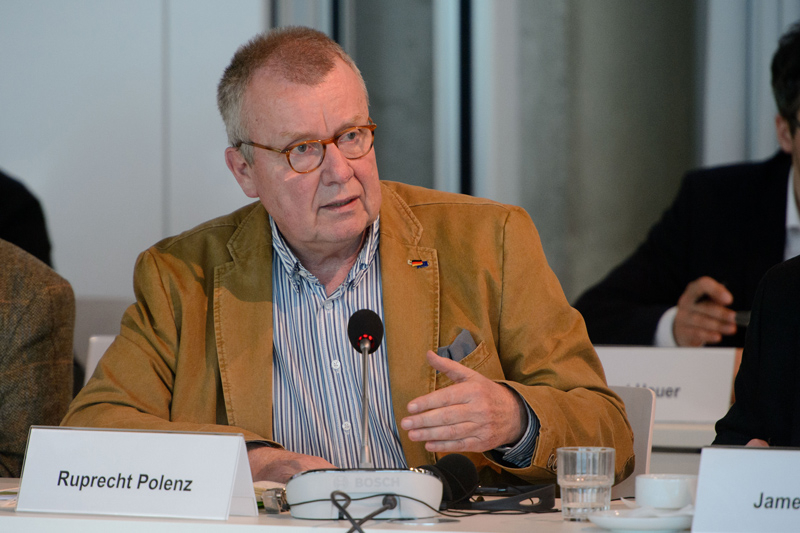
The latest innovation in German multiculturalism is being championed by Ruprecht Polenz, a former secretary general of the ruling Christian Democratic Union (CDU). He believes the German law which regulates name changes (Namensrecht) should be amended to make it easier for men named Mohammed to become Martin and women named Aisha to become Andrea.

German law generally does not allow foreigners to change their names to German ones, and German courts rarely approve such petitions. By custom and practice, German names are only for Germans.

According to Polenz, who served as a member of parliament for nearly two decades, the law in its current form is "ignorant" and should be changed:
"An ignorant law: the United States is full of anglicized German names, from Smith to Steinway, from Miller to Schwartz. The reason: integration was made easier. It no longer appeared as though a family was not from the USA. I think that German citizens of foreign origin should also have this possibility."
Polenz elaborated:
"The desire to adopt a German name is solid evidence that you feel German and would like to be seen as a German. In the context of integration this is entirely desirable. It simply does not make sense to prohibit this....
"In everyday life we ​​unfortunately often see that naturalization or possessing a German passport is not enough to be regarded as a German."
Muslims with foreign-sounding names often find it difficult to find a job, Polenz said, and the possibility of a name change might prevent discrimination and promote integration.

Indeed, academic studies (here and here) have found that immigrants with Arab or Turkish last names are less likely to be invited to job interviews than equally qualified migrants with non-Muslim sounding names.

Ruprecht Polenz, a former secretary general of Germany's CDU party, believes the German law which regulates name changes should be amended to make it easier for Muslim migrants to change their legal names to Christian-sounding ones. (Image source: stephan-roehl.de/Flicker)

The former president of the Constitutional Court in North Rhine-Westphalia, Michael Bertram, has called for German courts to allow a name change if "a foreign-sounding name makes it difficult to integrate into the economic and social life in this country."

He was referring to a case in which a court in Braunschweig rejected a petition by a German-Turkish family to change their surname. The parents had complained that in school their German-born children were being treated as "educationally disadvantaged migrants" and that teachers were addressing them in Turkish, a language they did not understand because they only speak German at home.

The court insisted on the principle of "name continuity" (Namenskontinuität) because there is "a public interest in maintaining the traditional name to enable social orientation and identification for security purposes."

In a precedent-setting case in May 2012, a court in Göttingen ruled that neither the fear of discrimination, nor the desire for integration, are sufficient legal grounds for migrants to change their names to German ones.

The case involved a family of asylum seekers from Azerbaijan who wanted to adopt German first and last names to prevent possible discrimination and to avoid being linked to a particular ethnic or religious group.

The court ruled that although discrimination due to a foreign-sounding name was always a possibility, it is not within the purview of the law that regulates names to "counteract a social aberration" (gesellschaftlichen Fehlentwicklungen), i.e., discrimination.

The court added that the plaintiff's names were not any more or less unusual than those of the majority of other migrants living in Germany. Moreover, although the children had Muslim-sounding names, it would not pose a big problem because others would not necessarily associate them with active religious practice.

Even if the existing German law were changed, it is unlikely that many Muslim migrants would adopt Christian names. Muslims who have children in Germany are already free to give them German first names, but they rarely do.

According to the Center for Onomatology (the study of the origin of names) at the University of Leipzig, Muslim and non-Muslim immigrants differ substantially in the way they choose names for their German-born children.

Non-Muslim immigrants generally choose traditional German names for their children to facilitate their integration into German society. By contrast, Muslim immigrants almost invariably choose traditional Arabic or Turkish names, presumably to prevent their integration into German society.

While non-Muslim immigrants name their children Sophie or Stefan, Muslim immigrants — including those whose families have been living in Germany for two, three or four generations — overwhelmingly give their children Muslim names such as Mohammed, Mehmet or Aisha.

A 2006 study produced by the University of Berlin found that more than 90% of Turkish parents give their German-born children Turkish first names; fewer than 3% give them German names.

A 2012 study found that 95% of ethnic Turks living in Germany believe it is absolutely necessary for them to preserve their Turkish identity. Nearly half (46%) agreed with the statement, "I hope that in the future there will be more Muslims than Christians living in Germany." Only 15% consider Germany to be their home.

A 2016 study found that 32% of ethnic Turks in Germany agree that "Muslims should strive to return to a societal order such as that in the time of Mohammed." More than one-third (36%) believe that "only Islam is able to solve the problems of our times." One-fifth (20%) agree that "the threat which the West poses to Islam justifies violence." One-quarter (23%) believe that "Muslims should not shake the hand of a member of the opposite sex."

Some politicians believe that giving Muslim migrants the right to adopt Christian-sounding names will ease their integration into German society. But empirical evidence shows that most Muslims in Germany do not want German names and many have no desire to integrate into German society.
 
 
Soeren Kern is a Senior Fellow at the New York-based Gatestone Institute. He is also Senior Fellow for European Politics at the Madrid-based Grupo de Estudios Estratégicos / Strategic Studies Group. Follow him on Facebook and on Twitter. His first book, Global Fire, will be out in 2016.
Source: https://www.gatestoneinstitute.org/8547/germany-muslims-names

Follow Middle East and Terrorism on Twitter

Copyright - Original materials copyright (c) by the authors.