Saturday, July 30, 2016

Time For Israel To Walk Away From US Aid - Caroline Glick


by Caroline Glick

...And better serve the country's security interests in the process.


Originally published by the Jerusalem Post. 


On Monday, acting head of the National Security Council Yaakov Nagel will sit down with his US counterpart, Susan Rice, and try to conclude negotiations about a new, multi-year defense assistance package.
We must all hope that he fails.


No clear Israeli interest will be advanced by concluding the aid deal presently on the table. 


Indeed, the deal now being discussed will cause Israel massive, long-term economic and strategic damage. This is true for a number of reasons.


First, there is the issue of the deal’s impact on Israel’s military industries, which are the backbone of Israel’s strategic independence.


Under the current defense package, which is set to expire next year, a quarter of the US aid Israel receives is converted to shekels and spent domestically. 


Reportedly, the deal now under negotiation will bar Israel from using any of the funds domestically.


The implications for our military industries are dire. Not only will thousands of Israelis lose their jobs. Israel’s capacity to develop its own weapons systems will be dangerously diminished.


Then there is the problem of joint projects.


Today, Israel receives additional US funds to develop joint projects, including the Iron Dome and David’s Sling short range missile and rocket defense programs. These programs were undertaken in response to threats that weren’t foreseen when the current deal was negotiated a decade ago.


According to reports, the deal now being negotiated denies Israel and the US the ability to fund jointly new projects or to provide supplemental funding for existing projects. All funding for all projects will be covered by the lump sum that is currently being negotiated.


Not only does this preclude new projects, it prevents Congress from exercising oversight over administration funding of existing joint projects with Israel. President Barack Obama has consistently tried to slash funding of missile defense programs, only to be overridden by Congress. Under the deal now on the table, Congress will be denied the power to override a hostile administration.


Given the obvious problems with the aid program currently being proposed by the Obama administration, there’s little wonder that until now, Prime Minister Benjamin Netanyahu has publicly stated that if necessary, Israel is ready to wait for the next administration. Some argue that Netanyahu’s apparent newfound interest in concluding negotiations on Obama’s terms owes to his fear that this is the best offer Israel is likely to get. Both Hillary Clinton and Donald Trump for various reasons, it is argued, will be less likely to offer significant increases in US military assistance.


Assuming this is accurate, the question becomes whether Israel has an interest in the assistance at all.


And so we come to the F-35.


For Israel, to a significant degree, the aid package on offer is about the F-35, the US’s fifth generation fighter, otherwise known as the Joint Strike Fighter.


Last month Defense Minister Avigdor Liberman and IAF Chief of Staff Brig.-Gen Tal Kelman flew to Texas to ceremonially “take possession” of Israel’s first two F-35s. Both aircraft are set to be delivered to Israel in December.


To date, the IAF has purchased 33 F-35s – all with US aid money. The IAF wants to purchase a total of 75 F-35s, which are supposed to replace the F-16s and the F-15s that the IAF currently fields.


As Liberman made clear during his visit, whether Israel purchases them or not is entirely dependent on the aid deal.


We should not take them. We should walk away.


And we should walk away even if we receive nothing in exchange for the planes we reject.


The F-35 is a disaster of epic proportions, for the US first and foremost. If Israel agrees to base its next generation fighters on the F-35, it will be a disaster for us as well. Although it is late in the game, we need to cut our losses.


To date, the F-35 has cost the US $400 billion.


That is twice what it was supposed to cost. The project is already four years behind schedule and still in development. It won’t be operational until May 2018 – at the earliest.


The F-35 is a jet that was developed by a committee and tasked with doing everything. So it isn’t surprising that it doesn’t work. In February, J. Michael Gilmore, the director of the Pentagon’s Operational Test and Evaluation office, submitted a scathing report to Congress on the F-35 program.


It is worth going through just a few of his findings.


The F-35’s calling card is its stealth capacity.


According to the engineers at Lockheed Martin, the JSF is supposed to be all-but-invisible to radar systems. Its stealth system is supposed to be far superior to the stealth capabilities of its third generation predecessors.


But at present, its stealth systems do not work, and it is unclear whether they will ever work as planned.


First there is the problem with the JSF’s cooling systems. The JSF is too hot. To prevent its single engine from melting down in flight, pilots are forced to open its weapons bays at high speeds and altitudes every 10 minutes. When the weapons bays are open, the stealth systems do not work.


Then there is the software. The F-35 is considered one big flying computer. It uses over 20 million lines of computer code. These codes are supposed to make it the most maneuverable and stealthy aircraft in history. The problem is that the codes are defective. The software programs that enable the plane to fly, maneuver, and engage in combat are all defective. So are the software programs that control the plane’s stealth capabilities.


And fixing them is not a simple process.


The fixed software systems can’t simply be attached to existing hardware – or to existing planes. The planes themselves have to be rebuilt to adjust to the new software. So the models that have already been produced, including the two F-35s that are set for delivery in December, will all have to be rebuilt before they will be combat ready.


And as a panel of US defense and aviation experts that convened in late February following the publication of Gilmore’s report noted, that too will take time and cost hundreds of millions of dollars.


Another major problem is that the F-35’s nerve center is dysfunctional and there is no clear path to fixing it. The F-35 is controlled by the Autonomic Logistics Information System. The ALIS is a central computer system, located in the US.


All F-35s all over the world will be required to log into the ALIS system to upload computer files after each flight and to check flight readiness. The ALIS is supposed to identify broken parts and help speed up repairs and handle mission data uploads.


ALIS has the capacity to prevent F-35s from taking off. ALIS can lock out pilots and ground crews if it sees danger. If this happens, maintenance technicians have to convince the computer that they either dealt with the issues the computer identified or that it was a false alarm.


Dan Grazier, a member of that panel, whose deliberations were reported by This Week, warned that this power renders the entire F-35 fleet vulnerable to hackers. If someone were able to convince the computer that something was wrong across the fleet, they might be able to keep all the F-35s grounded. Although the damage wouldn’t be permanent, it could continue long enough to cause the US or an ally to lose a battle or fail a mission.


For Israel, this vulnerability is prohibitive even if ALIS is ever made to work. The significance of ALIS control over all F-35s worldwide is that the US – and anyone able to hack the US system – will control the IAF. It will operate at the pleasure of the US government, and those able to hack US computers. They will be able to ground IAF planes whenever they wish.


This critical problem was acknowledged obliquely by Lt.-Col. Yotam, the commander of Israel’s first F-35 or Adir squadron, in an interview with Israel Defense in April.


Lt.-Col. Yotam said, “The maintenance concept of the Adir is based on international management and logistics in terms of spare parts and maintenance echelons.”


Israeli experts note that although in theory Israel will be able to crack the ALIS code and override it, it will take years to develop such a capacity. In the meantime, the IAF will become a contract employee of the US government whose operation is subject to US approval on a flight by flight basis.


The US Air Force, Marines and Navy are all trying to figure out how to deal with the deficiencies of the F-35. There is a vague hope that the US will develop a different fifth generation fighter.


More F-18s and A-10s will likely be ordered. Deputy Defense Secretary Robert Work told Fighting Global that he foresees using the current batch of F-15s into the 2040s. In other words, the US Air Force will deploy 70-year-old planes alongside the defective F-35s.


This, of course, is a disaster for the US. And if Israel goes ahead with the F-35 project it will be an even bigger disaster for us.


Back when the Pentagon convinced the Shamir government to scrap the Lavi project and purchase the F-16, the argument that won the day was economic. The Lavi was simply too expensive.


Today, both economics and strategic arguments indicate that the opposite is the case, even if walking away involves ending US military aid.


If Israel cuts its losses and begins to develop a fifth generation jet fighter that meets its own specific needs, rather than one designed by a committee to meet other countries’ needs poorly, it will end up both far safer and far more prosperous than if it goes ahead with the F-35 project. It will produce a better plane, better suited for Israeli defense needs, and simultaneously stimulate the growth of Israeli military industries, providing jobs for thousands of Israelis.


If Israel walks away from the military assistance package currently under discussion, it will be in a position to sign joint development deals with the US and other governments on a project by project basis and so ensure that we develop the weapons systems we need, not the ones the US thinks we should have, as we need them. Just as India is investing billions of dollars in joint projects with Israel, so will the US in the future.


It is far from clear that the US can afford its $400b. white elephant. It is abundantly clear that Israel cannot afford it.


Whether or not a Trump or Clinton administration will be more forthcoming is really beside the point. The point is that the US aid deal is really a deal for Lockheed Martin, not for Israel. And we need to say no.


Caroline Glick is the Director of the David Horowitz Freedom Center's Israel Security Project and the Senior Contributing Editor of The Jerusalem Post. For more information on Ms. Glick's work, visit carolineglick.com.

Source: http://www.frontpagemag.com/fpm/263674/time-israel-walk-away-us-aid-caroline-glick

Follow Middle East and Terrorism on Twitter

Copyright - Original materials copyright (c) by the authors.

Racially Incorrect Facts on Slavery: African Slave Traders - Jack Kerwick


by Jack Kerwick

The black roots of African slavery.


Ask yourself this: In all of the gazillions of lectures and tirades (there have, as to date, been no genuine conversations) on slavery, have you ever heard of the names of John Currantee and Ephraim Robin John? 

Such names—and there are many, many more—belong to a racially incorrect history of slavery, an historical account that threatens to rip asunder the ideological foundations of the Racism-Industrial-Complex (RIC), or Big Racism.

For centuries and centuries, courtesy of both Arabs and its indigenous peoples, slavery was endemic throughout the continent of Africa. Contrary to what contemporary mythical portraits like Roots would have us think, when Europeans began enslaving Africans in the 16th century, they—unlike Arabs—would not invade villages to obtain slaves. Rather, they would have to trade with the African flesh peddlers.

John Currantee, of the Fante people, was one such “caboceer” or trader. Ephraim Robin John, who the Europeans called “King George,” was another.  The latter was the leader of the Efik people.  Both had reputations for being particularly “canny and ruthless dealers” of human beings.  Both were representative of African slave traders in two respects: They could communicate in several European and African languages, and they exploited the divisions between the Dutch, the English, and the French to maximize their profits.
These African traders invariably hailed from the most powerful tribes, tribes that would prey upon and conquer weaker peoples—who they would then sell off across the Atlantic.  About 50 percent of all such enslaved Africans were prisoners of war.  Roughly 30 percent were criminals or in debt.  The 20 remaining percent consisted of those who African slave traders would kidnap.

Yet the enslavers exerted as well considerable power over their European partners, for in addition to getting the price that they wanted for the product that they were peddling, these black merchants of black bodies would also compel Europeans to pay “gifts” or “customs fees” (“dashee”).

In The Fante and the Transatlantic Slave Trade, Rebecca Shumway writes that “in the very territory where the majority of fortified European castles were built, giving the appearance of European control, the Africans residing under those structures were actually exercising greater control over trade than was typical for coastal West Africa in this period.”  The Fante, as one reviewer aptly put it, “maintain[ed] the upper hand in their dealings with Europeans.”

As an indication of just how wide of the mark is the popular notion that whites “stole” Africans from their homes, it is worth noting that the British government, in order to strengthen their trading partnerships with Africans, even invited the sons of African slave traders to come to England so as to study English! Moreover, friendships developed between some European and African dealers.

The enslavement of Africans by Europeans was made possible by the fact that Africans first enslaved—and then sold—Africans to these Europeans.  Nor is it the case, as Big Racism would like for us to believe, that Europeans were uniquely cruel to their captives.  In point of fact, African slave traders not infrequently subjected those who they kidnapped to treatment that had few peers anywhere as far as mercilessness and savagery are concerned.

Dr. Alexander Falconbridge was a European who served as a surgeon aboard multiple slave ships that sailed from West Africa to the Caribbean during the last quarter of the 18th century.  He would eventually become an abolitionist.  In 1788, he supplied the world with an all too rare account of the African participation in the slave trade.

Since “the black traders” take “extreme care” “to prevent the Europeans from gaining any intelligence” regarding the logistics involved in capturing slaves, Falconbridge drew his impressions—namely, that many, if not most, of the latter were abducted—from what he did observe directly as well as from the testimony of those Africans who had been captured.

One black captive, a man, told Falconbridge that he had been invited to drink with traders. As he proceeded to walk away, they seized him.  He broke free, but only to be hunted down by a “large dog” that “compelled him to submit.”  Dogs were used with regularity by African slave catchers.  As the man struggled in vain against the animal, his abductors, “being trained to the inhuman sport,” appeared to delight in his suffering.

A pregnant woman explained that she was returning home one evening from visiting with neighbors when traders seized upon her.  Since those Africans involved in slave trading increasingly traveled further and further into the interior to find human beings, this woman, like so many others, “had passed through the hands of several purchasers before she reached the ship.”

Falconbridge tells of a father and his son who, while tending to crops, were attacked, captured, and dragged off to be sold.  Another unsuspecting black man was invited by his companion to behold the gigantic European ships that were parked along the coast. Intrigued, he accepted the invitation.  Yet before he could realize that he had been manipulated, the soon-to-be slave was ambushed and taken on board the vessel.
It would be a mistake to think that the Africans didn’t have a sophisticated operation.  Falconbridge reports that traders would sail “up country” to “the fairs” in 20-30 canoes “capable of containing thirty or forty Negroes each” to purchase slaves. The canoes would be packed with “such goods” as were necessary for this purpose.  As the traders embarked, Falconbridge could see “colors flying” and “music playing;” it was a festive affair.

When the canoes return with their cargo, “the purchased Negroes are cleaned, and oiled with palm-oil [.]”  Then they are shown to the Europeans.

If, however, for whatever reasons, the captains passed on what the Africans were trying to sell, the latter would “beat those Negroes…and use them with great severity.” In a passage that is particularly revealing of the inhumanity of the treatment to which Africans would subject their own, Falconbridge writes: “It matters not whether they [the African slaves] are refused on account of age, illness, deformity, or for any other reason.”  Off the coast of New Calabar, what is today known as Nigeria, “the traders, when any of their Negroes have been objected to, have dropped their canoes under the stern of the vessel, and instantly be headed them, in sight of the captain” (italics added).

To repeat: Slaves that Europeans didn’t want African traders swiftly decapitated.

Don’t expect to hear about this in that “honest conversation” of race that the left assures us we need to have.


Jack Kerwick

Source: http://www.frontpagemag.com/fpm/263659/racially-incorrect-facts-slavery-african-slave-jack-kerwick

Follow Middle East and Terrorism on Twitter

Copyright - Original materials copyright (c) by the authors.

Secular And Islamist Scholars Clash During Kuwaiti TV Debate On Arab Youth Engagement With Terror Organizations - MEMRI


by MEMRI

Dashti and Al-Manna argued that although the Islamic scholars repeatedly emphasized that they do not support ISIS, their statements are in line with ISIS ideology.

During a TV debate dedicated to the engagement of Arab youth with ISIS and other terror organizations, liberal activists Nasser Dashti and Ayed Al-Manna clashed with Islamic sheikhs Abdallah Al-Hamdan and Khaled Al-Sultan. The latter compared the extremism of the Islamist terror organizations to extremism he alleged exists among secular Arabs, saying that "the same crimes are committed by both camps." Dashti and Al-Manna argued that although the Islamic scholars repeatedly emphasized that they do not support ISIS, their statements are in line with ISIS ideology. Dashti concluded that the time has come to remove religion from public life in the Arab world and to confine it to the private sphere. The show aired on the Kuwaiti Al-Shahed TV on July 11.


5596MTV A.jpg

Nasser Dashti: "The religious heritage is the cause of the cultural and ideological catastrophes from which we are suffering.

[...]

5597MTV B.JPG

"I pay no attention to the fatwas of all those religious sheikhs. These fatwas have ripped our countries and our peoples apart, have sown destruction and discord, and have led people astray. In the wake of these fatwas, we have seen nothing but ignorance, bombings, takfir, and ethnic cleansing."

[...]

5597MTV C.jpg

Khaled Al-Sultan: "We are experiencing two kinds of extremism - religious extremism, on the one hand, and extremism in leniency and indifference toward religion, on the other hand. The same crimes are committed by both camps. Many of the (terror) incidents you are seeing in the world today... In America, for example, a man killed his mother, his wife, and his three daughters. Was that man religious?! Was he a Muslim?!"

Dashti: "That's pure evil."

Al-Sultan: "That man was an atheist. He wasn't religious.

[...]

"It's true that our interpretation of Islamic texts is based on an erroneous understanding."

[...]

5597MTV D.jpg

Dashti: "How can an erroneous understanding continue for over 14 centuries? How come only the Islamic nation finds it difficult to understand its heritage and its religious texts?

[...]

"The Quran does not speak. People do. These are religious texts... Let me give you an example of a nice verse: 'Whoever kills a soul unless for another soul - it is as if he has killed all of Mankind.' The verse that immediately follows reads: 'The penalty for those who wage war against Allah and His Messenger...' Go on, complete the verse. It is that 'they be killed or crucified or their hands and feet be cut on alternate sides.' Look what kind of verse immediately follows the (positive) verse. The religious texts, the heritage, and the interpretations contain good and evil at the same time, and that is a problem."

[...]

5597MTV E.jpg

Ayed Al-Manna: "The Muslims in America, in Britain, in France, in Canada, and in China - how come they do not slaughter one another? Aren't there Muslims there too?"

5597MTV F.JPG

Nasser Dashti: "Why do the Muslims dream of emigrating to the infidel countries?"

Abdallahy Khizam Al-Hamdan: "What my colleague Dr. Khaled Al-Sultan said is based on principles."

Host: "What Nasser Dashti said is also based on principles."

Al-Hamdan: "No, it is devoid of principles."

Host: 'You are claiming that what he said is devoid of principles?"

Al-Hamdan: "What Mr. Dashti said is as empty as can be."

Host: "So you claim that his words are empty?"

Al-Hamdan: "Very empty. They are not based on principles."

Host: "What about Dr. Ayed Al-Manna? Some of the things he said are correct, and some need to be corrected."

[...]

5597MTV G.jpg

Dashti: "People are always saying that ISIS does not represent Islam, that the militias do not represent Islam..."

Al-Sultan: "True, they don't."

5597MTV H.jpg

Dashti: "But if you asked Dr. Al-Sultan here about apostates, he would say that apostates should be killed. The People of the Book? He'd say that they should pay the jizya in humiliation. What about polytheists? They should be fought."

Al-Sultan: "These are all violations, like running a red light..."

Dashti: "When someone commits a traffic violation, he pays a fine. He doesn't get executed."

Al-Sultan: "The Ministry of the Interior is in charge of dealing with traffic violations, and it sends the perpetrator to court."

Al-Sultan: "These are all violations, like running a red light..."

Dashti: "When someone commits a traffic violation, he pays a fine. He doesn't get executed."


Al-Sultan: "The Ministry of the Interior is in charge of dealing with traffic violations, and it sends the perpetrator to court. Who decides in those cases of apostasy and executions? The ruler, the judge. I don't allow myself or you to..."

Dashti: "Are you comparing a traffic violation to the killing of someone who left his religion?!"

[...]

5597MTV I.jpg

Al-Sultan: "According to the Shari'a, (an apostate) should be killed.

Dashti: The People of the Book should pay the jizya tax?"

Al-Sultan: "Yes."

Dashti: "'In humiliation'"?

Al-Sultan: "Yes, in humiliation. So what? We pay for visas 'in humiliation,' so what?"

Dashti: "Do you get smacked on the back of your head while paying for your visas?"

Al-Sultan: "'In humiliation' does not mean being beaten."

Dashti: "The viewers can search on Google or in Lisan Al-Arab what 'humiliation' means."

Al-Sultan: "Fine. Go check the word in the Lisan Al-Arab dictionary. It's like when you go to an embassy and pay for a visa, whether you like it or not."

[...]

Al-Mahdan: "Good people, we do not support ISIS..."

Al-Manna: "You're done supporting them?"

Al-Mahdan: "Let me finish."

Al-Manna: "You're done with them?"

5597MTV J.JPG

Al-Mahdan: "We do not support ISIS. Not today, not yesterday, and not tomorrow.

[...]

5597MTV K.JPG

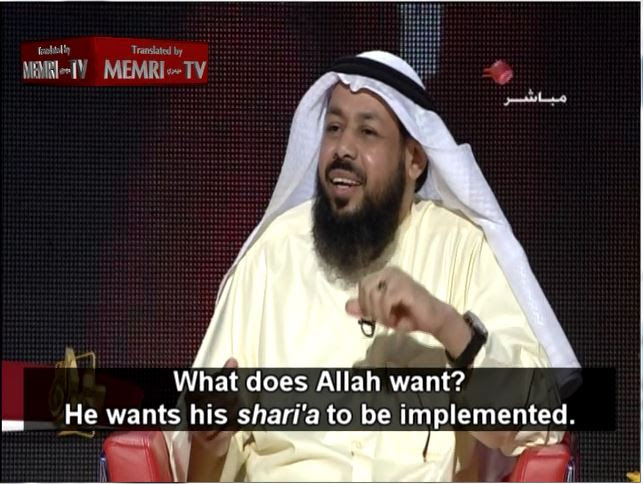
"What does Allah want? He wants his shari'a to be implemented. Along comes a human being and defies Allah with his mind. He defies the Creator who created this mind."

5597MTV L.jpg

Al-Manna: "That's exactly what ISIS is saying. Why don't you support them and that's it? That is exactly what they say. You want an Islamic state, and they have declared one. Why don't you support them?"
[...]

5597MTV M.jpg

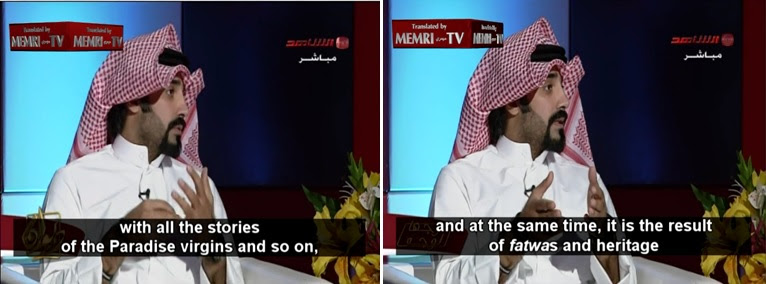
Dashti: "With regard to the question why our youth are being led astray, I believe that the reason is the concept of the Hereafter, which is instilled in their minds, with all the stories of the Paradise virgins and so on, and at the same time it is the result of fatwas and heritage that prohibit all the innocent pleasures in their lives. They banned music, signing, theater, sculpture, love... Everything. Such a person has nothing to lose in this world.

[...]

5597MTV N.jpg

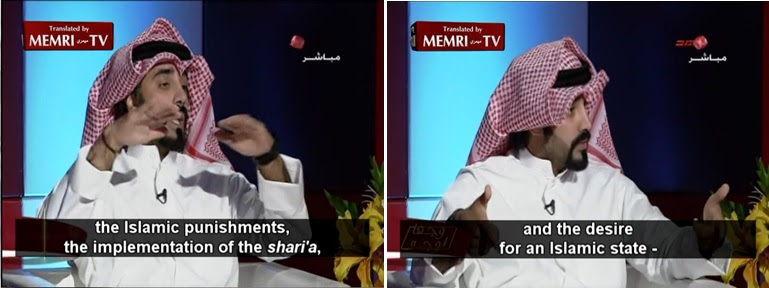
"So far, my two colleagues have not denounced the fundamentals of ISIS. They share with ISIS the fundamentals and ideological means - the Islamic punishments, the implementation of the shari'a, and the desire for an Islamic state - but they employ appeasing words: 'true Islam,' 'the people in charge'... I believe that the time has come for us to adopt the secular, rational, scientific approach, and to remove religion from public life and confine it to the private sphere. Every person is free to understand his religion as he sees fit, and he is free to change his religion, to adopt any school of thought or religion, and to spread his ideas in keeping with the modern rules of human rights."


MEMRI

Source: http://www.memritv.org/clip/en/5597.htm

Follow Middle East and Terrorism on Twitter

Copyright - Original materials copyright (c) by the authors.

Germany: "No Change to Open-Door Migration Policy" - Soeren Kern


by Soeren Kern

"Not a word to the citizens who for a year have had to deal with the consequences of the asylum onslaught. Not a word to the local communities that are unable to cope with the financial and burdens of accommodating asylum seekers."

  • Chancellor Merkel said she knows that Germans are worried about their personal safety: "We are doing everything humanly possible to ensure security in Germany," she noted, but added, "Anxiety and fear cannot guide our political decisions."
  • "The chancellor remains committed to her current course of action. A classic Merkel refrain follows: 'There must be a thorough analysis.'" — Thomas Vitzthum, political editor of Die Welt.
  • "The country is split, its citizens deeply insecure? 'We can do it!' Sexual assaults on women in swimming pools and at festivals? 'We can do it!' Terrorist attacks by Islamists in Germany? 'We can do it!' Growing frustration and rising political apathy among the population? 'We can do it!' But who are the 'we'? ... Not a word to the citizens who for a year have had to deal with the consequences of the asylum onslaught. Not a word to the local communities that are unable to cope with the financial and burdens of accommodating asylum seekers." — Editorial in the newspaper, Junge Freiheit.

German Chancellor Angela Merkel has rejected criticism of her decision to allow more than a million mostly Muslim migrants to enter Germany last year.

Speaking at an annual summer press conference in Berlin on July 28, a defiant Merkel ignored critics of her refugee policies and insisted there would be no change to her open-door migration stance. She also said she bears no responsibility for a recent spate of violent attacks in Germany.

Germany has been rattled by an axe attack on a train in Würzburg, a mass shooting in Munich, a machete attack in Reutlingen and a suicide bomb in Ansbach — all within a week.

The attacks, which left 13 dead, were all carried out by Muslims: Three of the attacks were carried out by asylum seekers and one by a German-Iranian who harbored a hatred of Arabs and Turks.

Merkel, who interrupted her summer holiday to attend the 90-minute press conference, which was pushed forward by a month, reiterated her credo: "We can do it!" ("Wir schaffen das!"). She has repeated the phrase over and over since Germany's migration crisis exploded on September 4, 2015, when she opened up the German border to tens of thousands of migrants stranded in Hungary. She said:
"We decided to fulfill our humanitarian obligations. I did not say it would be easy. I said back then, and I will say it again now, that we can manage our historic task — and this is a historic test in times of globalization — just as we have managed so much already, we can do it. Germany is a strong country."
Merkel said the goal of jihadists was to "divide our unity and undermine our way of life. They want to prevent our openness to welcoming people. They want to sow hate and fear between cultures and also among religions."

The chancellor said she knows that Germans are worried about their personal safety: "We are doing everything humanly possible to ensure security in Germany," she noted, but added, "Anxiety and fear cannot guide our political decisions."

Merkel also outlined a nine-point plan to increase security in Germany: 1) an early-warning system to identify radicalization among migrants; 2) an increase in staff at Germany's intelligence agencies; 3) an information technology office to focus on tracking internet communications between jihadists; 4) regular joint exercises with the police and the military to practice counter-terrorism measures; 5) expanding research on Islamic terrorism and radicalization; 6) improving European cooperation on intelligence sharing; 7) restricting the sale of weapons online; 8) a national registry to monitor people entering and leaving the country; and 9) making it easier to deport asylum seekers who break the law.

Merkel concluded by refusing to budge an inch: "For me it is clear: we stick to our principles. We will give those who are politically persecuted refuge and protection under the Geneva Convention." She added: "I cannot promise you that we will never have to take in another mass wave of refugees."

German Chancellor Angela Merkel (left) rejects criticism of her decision to allow more than a million mostly Muslim migrants to enter Germany last year. "We can manage our historic task... we can do it. ... Anxiety and fear cannot guide our political decisions," she said at a July 28 press conference, adding, "I cannot promise you that we will never have to take in another mass wave of refugees."

Merkel has come under increasing criticism for her handling of the migration crisis. The anti-immigration party, Alternative for Germany (AfD), noted:
"Given the mounting, extremely serious incidents, the AfD calls on the government urgently to fulfill its duty and stabilize the security situation in Germany through effective border controls. Other steps such as the immediate and consistent deportation of offenders must necessarily follow."
The newspaper, Bayernkurier, a publication run by the Christian Social Union (CSU), the Bavarian sister-party to Merkel's Christian Democratic Union (CDU), wrote:
"Not only have Angela Merkel's policies been a stimulus package for right-wing populists, the security risks that the chancellor has created with her open borders are also abundantly clear."
The newspaper, Die Welt, said Merkel's repetition of the words "We can do it!" amounted to a "provocation" and criticized her nine-point plan as "vague." In a scathing attack, the paper's political editor, Thomas Vitzthum, wrote:
"Angela Merkel maintains her entire position. She defends her actions last year. No admission of error can be heard. Nor should anyone expect to see repentance in the future. The chancellor remains committed to her current course of action. Today is not the time to discuss what additional new measures should be taken, she says. A classic Merkel refrain follows: 'There must be a thorough analysis.'"
In an editorial, the right-leaning newspaper, Junge Freiheit, wrote that Merkel does not care about the consequences of her policies:
"The country is split, its citizens deeply insecure? 'We can do it!' Sexual assaults on women in swimming pools and at festivals? 'We can do it!' Terrorist attacks by Islamists in Germany? 'We can do it!' Growing frustration and rising political apathy among the population? 'We can do it!'
"But who are the 'we'? Not a word from Merkel. Not a word about the women who are victims of sexual assault in Cologne and elsewhere — the victims of those who Merkel brought into the country with her open-border policy and friendly face.
"Not a word to the citizens who for a year have had to deal with the consequences of the asylum onslaught. Not a word to the local communities that are unable to cope with the financing and burdens of accommodating asylum seekers. Not a word for the police, who have reached their limits thanks to unbridled immigration. Not a word for the food pantries that need to ration the distribution of food due to distribution battles. Not a word about the split in society that Merkel's refugee policy has caused — not just a split country, but also splits among families and groups of friends. Not a word that her decisions have reduced Germany's influence in Europe."
The newspaper, Bild, wrote:
"Things can only go well if the problems are really solved! In particular, the deportations of rejected asylum seekers are a major problem. For months, the government has pledged to speed up repatriations, but little headway has been made. And also for the nine-point plan to combat terrorism: let us see action rather than just waiting and talking! Because by next summer, Germans will judge Merkel on what she really has done."
A recent poll found that two-thirds of Germans oppose a fourth term for Merkel. Only 36% of respondents said they wanted Merkel and her CDU to lead the government after federal elections in 2017.
 
 
Soeren Kern is a Senior Fellow at the New York-based Gatestone Institute. He is also Senior Fellow for European Politics at the Madrid-based Grupo de Estudios Estratégicos / Strategic Studies Group. Follow him on Facebook and on Twitter. His first book, Global Fire, will be out in 2016.
Source: https://www.gatestoneinstitute.org/8591/germany-open-door-migration

Follow Middle East and Terrorism on Twitter

Copyright - Original materials copyright (c) by the authors.
Will Europe Refuse to Kneel like the Heroic French Priest? - Giulio Meotti


by Giulio Meotti

Even Pope Francis, in front of the most important anti-Christian event on Europe's soil since the Second World War, stood silent and said that Islamists look "for money". The entire Vatican clergy refused to say the word "Islam".


  • Go around Europe these days: you will find not a single rally to protest the murder of Father Jacques Hamel. The day an 85-year-old priest was killed in a French church, nobody said "We are all Catholics".
  • Ritually, after each massacre, Europe's media and politicians repeat the story of "intelligence failures" -- a fig leaf to avoid mentioning Islam and its project of the conquest of Europe. It is the conventional code of conduct after any Islamist attack.
  • Europe looks condemned to a permanent state of siege. But what if, one day, after more bloodshed and attacks in Europe, Europe's governments begin negotiating, with the mainstream Islamic organizations, the terms of submission of democracies to Islamic sharia law? Cartoons about Mohammed have already disappeared from the European media, and the scapegoating of Israel and the Jews started long time ago. After the attack at the church, the French media decided even to stop publishing photos of the terrorists. This is the brave response to jihad by our mainstream media
Imagine the scene: the morning Catholic mass in the northern French town of Saint-Étienne-du-Rouvray, an almost empty church, three parishioners, two nuns and a very old priest. Knife-wielding ISIS terrorists interrupt the service and slit the throat of Father Jacques Hamel. This heartbreaking scene illuminates the state of Christianity in Europe.

Father Jacques Hamel was murdered this week, in the church of Saint-Étienne-du-Rouvray, by Islamic jihadists.

It happened before. In 1996 seven French monks were slaughtered in Algeria. In 2006, a priest was beheaded in Iraq. In 2016, this horrible Islamic ritual took place in the heart of European Christianity: the Normandy town where Father Hamel was murdered is the location of the trial of Joan of Arc, the heroine of French Christianity.

France had been repeatedly warned: Europe's Christians will meet the same fate of their Eastern brethren. But France refused to protect either Europe's Christians or Eastern ones. When, a year ago, the rector of the Great Mosque of Paris, Dalil Boubakeur, suggested transforming empty French churches (like that one in Saint-Étienne-du-Rouvray) into mosques, only a few French intellectuals, led by Alain Finkielkraut and Pascal Bruckner, signed the appeal entitled, "Do not touch my church" ("Touche pas à mon église") in defense of France's Christian heritage. Laurent Joffrin, director of the daily newspaper Libération, led a left-wing campaign against the appeal, describing the signers as "decrepit and fascist".

For years, French socialist mayors have approved, in fact, the demolition of churches or their conversion into mosques (the same goal as ISIS but by different, "peaceful" means). Except in the Saint-Germain-des-Prés quarter of Paris, and in some beautiful areas such as the Avignon Festival, France is experiencing a dramatic crisis of identity.

While the appeal to save France's churches was being demonized or ignored, the same fate was suffered by endangered Eastern Christian being exterminated by ISIS. "It is no longer possible to ignore this ethnic and cultural cleansing", reads an appeal signed by the usual combative "Islamophobic" intellectuals, such as Elisabeth Badinter, Jacques Julliard and Michel Onfray. In March, the newspaper Le Figaro accused the government of Manuel Valls of abandoning the Christians threatened with death by ISIS by refusing to grant them visas.

Go around Europe these days: you will find not a single rally to protest the killing of Father Hamel. In January 2015, after the murderous attack on Charlie Hebdo, the French took to the streets to say "Je suis Charlie". After July 26, 2016, the day an 85-year-old priest was murdered in a church, nobody said "We are all Catholics". Even Pope Francis, in the face of the most important anti-Christian event on Europe's soil since the Second World War, stood silent and said that Islamists look "for money". The entire Vatican clergy refused to write or say the word "Islam".

Truth is coming from very few writers. "Religions overcome other religions; police can help little if one is not afraid of death." With these words, six months after the massacre at the magazine Charlie Hebdo, the writer Michel Houellebecq spoke with the Revue des Deux Mondes. Our elite should read it after every massacre before filling up pages on "intelligence failures."

It is not as if one more French gendarmerie vehicle could have stopped the Islamist who slaughtered 84 people in Nice. Perhaps. Maybe. But that is not the point. Ritually, after each massacre, Europe's media and politicians repeat the story of "intelligence failures". In the case of the attack in Saint-Étienne-du-Rouvray, the story is about a terrorist who was placed under surveillance.

The "intelligence failure" theory is a fig leaf to avoid mentioning Islam and its project of the conquest of Europe. It is the conventional code of conduct after any Islamist attack. Then they add: "Retaliation" creates a spiral of violence; you have to work for peace and show good intentions. Then, in two or three weeks, comes the fatal "we deserve it". For what? For having a religion different from them?

We always hear the same voices, as in some great game of dissimulation and collective disorientation in which no one even knows which enemy to beat. But, after all, is it not much more comforting to talk about "intelligence" instead of the Islamists who try, by terror and sharia, to force the submission of us poor Europeans?

Europe looks condemned to a permanent state of siege. But what if, one day, after more bloodshed and attacks in Europe, Europe's governments begin negotiating, with the mainstream Islamic organizations, the terms of submission of democracies to Islamic sharia law? Cartoons about Mohammed and the "crime" of blasphemy have already disappeared from the European media, and the scapegoating of Israel and the Jews started long time ago.

After the attack at the church, the French media decided even to stop publishing photos of the terrorists. This is the brave response to jihad by our mainstream media, who also showed lethal signs of cowardice during the Charlie Hebdo crisis.

The only hope today comes from an 85-year-old French priest, who was murdered by Islamists after a simple, noble gesture: he refused to kneel in front of them. Will humiliated and indolent Europe do the same?
 
 
Giulio Meotti, Cultural Editor for Il Foglio, is an Italian journalist and author.
Source: https://www.gatestoneinstitute.org/8576/europe-islam-kneel

Follow Middle East and Terrorism on Twitter

Copyright - Original materials copyright (c) by the authors.

Middle East Studies Implicated in AMCHA's Campus Anti-Semitism Report - Cinnamon Stillwell


by Cinnamon Stillwell

While faculty who help foster campus anti-Semitism hail from all disciplines, the centrality of Middle East studies academics cannot be ignored.

Rabab Abdulhadi
The AMCHA Initiative's recently released "Report on Antisemitic Activity During the First Half of 2016 At U.S. Colleges and Universities With the Largest Jewish Undergraduate Populations" exposes the bias and politicization afflicting the field of Middle East studies.

The report finds a direct correlation between campus anti-Semitism and the "presence of one or more faculty who have endorsed an academic boycott of Israel," which, given the large number of Middle East studies academics who are boycott, divestment, and sanctions (BDS) supporters or organizers, serves as a strong indictment of the field.

Moreover, the report notes a sharp rise in campus incidents that "contained expression opposing the existence of Israel as a Jewish state" and, as an example, cites a March 2016 event in which San Francisco State University's Rabab Abdulhadi--a founding member of the U.S. Campaign for the Academic and Cultural Boycott of Israel--proclaimed that "Zionism is racism" and "there can only be peace if Israel is defeated." It also references an event the same month sponsored by Brown University's Middle East Studies Department and featuring its director, Beshara Doumani, and Israeli Knesset member Haneen Zoabi, who declared in her keynote speech that "the main opposition to democracy [in Israel] is the definition of Israel as a Jewish state."

While faculty who help foster campus anti-Semitism hail from all disciplines, the centrality of Middle East studies academics cannot be ignored. Tasked with providing an education based on objective analysis, too many of these professors are instead contributing to a climate in which Jewish and pro-Israel students feel ignored and victimized. They claim their single-minded obsession with the world's lone Jewish state does not constitute anti-Semitism, but when that is the effect, such protestations ring hollow.


Cinnamon Stillwell is the West Coast representative for Campus Watch, a project of the Middle East Forum. She can be reached at stillwell@meforum.org.
Source: http://www.campus-watch.org/blog/2016/07/middle-east-studies-implicated-in-amcha-campus

Follow Middle East and Terrorism on Twitter

Copyright - Original materials copyright (c) by the authors.