Saturday, April 8, 2017

Say what?! UN Human Rights Council declares Israel world's No. 1 human rights violator - Anne Bayefsky


by Anne Bayefsky


Hat tip: Dr. Jean-Charles Bensoussan

-- the former President [Obama] obtained yet another three-year term for the United States on the Council that began on January 1, 2017.

This article by Anne Bayefsky originally appeared on Fox News.

According to the U.N.'s top human rights body, Israel is the worst human rights violator in the world today. That's the result of the latest session of the UN Human Rights Council which wrapped up in Geneva on Friday by adopting five times more resolutions condemning Israel than any other country on earth.

President Trump's administration is currently a member of this reprehensible body. To borrow Elie Wiesel's counsel to President Reagan not to pay his respects at a German graveyard containing Nazi SS remains: "That place, Mr. President, is not your place."

The Bush administration refused to join the Council when it was created in 2006.

On March 31, 2009, President Obama - fully aware of its entrenched anti-Israel and anti-Jewish bias - made jumping on board one of his very first foreign policy moves. Moreover, in an unscrupulous attempt to control his successor, the former President obtained yet another three-year term for the United States on the Council that began on January 1, 2017.

If President Trump were to choose a swift departure from the Council as one of his very first foreign policy moves, it would demonstrate a principled reset of American values and priorities on the world stage. March 31, 2017, the anniversary of Obama's decision, would be an auspicious date to make that point.

The reasons for leaving are many. Here are a few:
The Council plays a leading role in the demonization and delegitimization of the Jewish state by the United Nations.

In its history, the Council has condemned Israel more often than any other of the 192 UN states. Comparative totals after this session's pogrom tell the story: Israel - 78 resolutions and decisions, Syria - 29, North Korea - 9, and Iran - 6. For Saudi Arabia, Russia, and China, there's nothing at all.

Think of it this way: 500,000 dead in Syria, forced starvation and mass torture in North Korea, systematic and lethal oppression in Iran, gender apartheid in Saudi Arabia, and an elementary lack of basic freedoms affecting over a billion in Russia and China.

But at the U.N. Human Rights Council, little democratic Israel is the problem.

U.N. Ambassador Nikki Haley rightly objected to a recent UN report charging Israel with "apartheid." But the malicious slur of "apartheid Israel" is a staple of the Council's fixed agenda, which dedicates time for hate-speech and incitement at every session, and transmits it around the world via a U.N. webcast.

Contrary to rule of law 101, the Council has an investigator on the Israeli-Palestinian conflict with a license only to report on Israel.

This week, "expert" Michael Lynk presented a report praising one Manal Tamimi as a "human rights defender."

In the last six months alone, her twitter feed features: "God-chosen-Baby-burning #Israeli scum..." "Nazi Zionists force[s] shot a girl," and a caricature of Satan beseeching Netanyahu for lessons on evil.

The "Human Rights" Council is now the principal U.N. engine of "BDS" - the campaign to boycott, divest and sanction Israel. Economic strangulation is Plan B for Israel's enemies, war and terrorism having so far failed to rid the world of a Jewish state. The Council has sponsored the creation of a blacklist of companies around the world 'directly or indirectly' doing business with Israeli settlements - in effect, Israel period.

Obama's routine was to vacate the U.S. seat temporarily during the Israel-bashing agenda item, make a speech about "unacceptable" Israel-bias, vote against the anti-Israel resolutions, and then pay for their implementation in the name of some greater good. The Trump administration should not be working from the same playbook.

Make no mistake: there is no middle ground. Staying on the Council means American taxpayers will pay for the production of a blacklist of American companies doing business with Israel. The State Department representative told the Council Friday that it will not provide information for the blacklist. But, of course, the U.N. will simply get what it wants from the Palestinian entourage.

With predictable regularity, the subject of U.N. reform bubbles to the surface of this toxic environment. The ploy needs to be challenged head on.

The only body that can change the Human Rights Council is the one that created it - the General Assembly, where the U.S. has one vote and Islamic states have 56. 

As Freedom House attests, less than half the members of the General Assembly are fully free democracies. The majority aren't going to create a club they can't join.


It is understandable why Council members like Saudi Arabia, Qatar, Cuba and China want to masquerade as human rights authorities. But why would the United States want to legitimize this charade by standing beside them?


While America fiddles, the world's rogues are reaching into your pockets in the name of their entitlements. This week the Council adopted resolutions inserting itself into "foreign investment," "capital inflows," "foreign trade," and "financial markets," while demanding more "technology transfer," and a "development-oriented outcome of trade negotiations of the World Trade Organization."


Sure, we voted against - and we lost. In fact, of the 15 resolutions this session adopted by vote, the United States lost 12 of them. Setting ourselves up for target practice is not a foreign policy in which Americans can take pride.

Mr. President, the UN "Human Rights" Council, is not your place.


Anne Bayefsky is the Director of the Touro Institute on Human Rights and the Holocaust and President of Human Rights Voices. Follow her @AnneBayefsky.

Source: http://www.foxnews.com/opinion/2017/03/24/say-what-un-human-rights-council-declares-israel-worlds-no-1-human-rights-violator.html

Follow Middle East and Terrorism on Twitter

Copyright - Original materials copyright (c) by the authors.

Get Ready for the Trump Doctrine - Gregg Roman


by Gregg Roman


Obama's response to Assad's 2013 chemical attack was a legendary failure.


Originally published under the title "Trump Learned from Obama's Mistakes and Took Action."


Trump has shown that bold leadership and decisive action are the way to win friends abroad, not multilateralism and diplomatic nicety.

When Syrian dictator Bashar al-Assad launched the 21st century's second deadliest chemical weapons attack on Tuesday, President Trump must have paged through President Obama's playbook in responding to this century's deadliest chemical attack less than four years earlier and resolved to do exactly the opposite. It turns out he's onto something.

When pro-regime Syrian forces gassed the Damascus suburb of East Ghouta in 2013, a year after President Obama warned Assad that use of chemical weapons would cross a red line, the Obama administration spent three weeks preparing to do something.

Cognizant that the American public was overwhelmingly opposed to military action, it decided to win congressional authorization first. Unwilling to act alone, the administration worked to secure international support for and participation in U.S.-led retaliatory air strikes.

Concerned that U.S. military action against the Assad regime would raise expectations of a broader policy shift against Assad, making it even harder to persuade the rebels to attend U.S.-brokered peace talks, Obama administration officials worked to deflate these hopes. Secretary of State John Kerry famously assured the world that the planned strikes would be "unbelievably small."
Obama's response to Assad's 2013 chemical attack was a legendary failure.

The result was a legendary failure. Angry over the intentionally negligible scope of the planned air strikes, congressional

Republicans withdrew their support. Britain's parliament voted against air strikes, while NATO allies demurred with the exception of France. Moves to secure an Arab League resolution fizzled.

President Obama ended up abandoning the planned attack in favor of a Russian-brokered commitment from Assad to dismantle his chemical weapons arsenal. Not only was the agreement not fully implemented — smaller-scale chemical weapons use continued intermittently until this week — but it forced the international community to acknowledge and deal with Assad for the first time since the civil war began, leading Sunni governments to step up support for militant Islamists and paving the way for Russia's military intervention the following year.

Obama's former defense secretary, Leon Panetta, later conceded that his handling of the crisis, "sent a mixed message, not only to Assad, not only to the Syrians, but to the world."

President Trump appears to have learned all these lessons in the wake of the Syrian regime's chemical weapons attack on a rebel-held town in Idlib province on Tuesday. He acted unilaterally, neither waiting for nor requesting the participation of other nations. He felt no inclination to shield himself from public backlash by seeking authorization from congress. And he acted quickly, with airstrikes coming less than three days later.


Trump's response was quick, unilateral, and politically courageous.
Rather than assuring everyone beforehand that the planned strike would not change Washington's posture in Syria, Trump hinted at further action, "to end the slaughter and bloodshed in Syria" and "end terrorism of all kinds and all types."

Although Trump's military action was every bit as limited as the air strikes planned by the Obama administration four years ago, it is likely to be far more effective in achieving its aims.

In addition to sending a clear message to the Assad regime that the U.S. will not hesitate to punish further use of chemical weapons, Trump's military action signals unmistakably to other states in possession of unconventional weapons that the U.S. will respond forcefully to their use. The fact that the Trump administration was visibly warming to Assad as of the beginning of this week underscores that improved relations with Washington won't offer much protection against the consequences of WMD use.By washing away the stain of Obama's shameful handling of the 2013 Ghouta attack, Trump's bold action will make it easier for the U.S. to establish and enforce red lines regarding other adversaries on a range of other issues without having to resort to force.

But here's the kicker. Ordinarily, an American president launching unilateral military action without United Nations approval or anything but pro forma consultation with allies would elicit howls of protest from the international community — doubly so, you'd think, if his name happened to be Donald Trump. The astonishingly favorable reaction to the strike throughout the world underscores that bold American leadership and decisive action are the way to win friends, not multilateralism and diplomatic nicety.


Gregg Roman is director of the Middle East Forum, a research center headquartered in Philadelphia.

Source: http://www.meforum.org/6636/syria-trump-doctrine

Follow Middle East and Terrorism on Twitter

Copyright - Original materials copyright (c) by the authors.

Going Overboard with #Russiagate - Robert Caskey


by Robert Caskey

Of course, the main weakness in the Russia case is that there is not a shred of evidence pinning the President to the Kremlin.

It’s a sad day for politics in America when Rep. Trey Gowdy has to plead with Democrats in Congress to be “constructive” and responsible in finding the truth, but Gowdy knows as well as anyone that his appeal is doomed to fall on deaf ears. Democrats in Congress and their allies in the media have officially become obsessed with the alleged links between the Trump administration and Russia, and it has very little to do with concerns over the integrity of the electoral process or the fate of American democracy.

In reality, the president’s opponents see the investigations into Trump campaign associates and hangers-on as an invaluable weapon. With the electorate booting the Democratic Party completely out of power, what better way is there to undermine the administration and cast a cloud of illegitimacy over the duly elected commander-in-chief?

Tim Weiner puts it perfectly when he says the FBI’s investigation could take “years to resolve,” which is music to anti-Trump ears. After all, as long as the press and the Democrats can keep RussiaGate on the front page, President Trump and the GOP will never have a chance to tackle their legislative priorities and will be stuck in a constant cycle of mini-scandals that undermine the administration without ever actually impugning it. The objective isn’t to figure out whether the Trump campaign colluded with the Russians to defeat Hillary Clinton, but to dominate the political agenda and suffocate any real discussion of policy.

This is why, regardless of the results of a Senate Intelligence Committee investigation and an FBI probe into allegations of collusion between Moscow and senior members of Trump’s team, the Left will do all it can to prevent the RussiaGate narrative from dying.

Of course, the main weakness in the Russia case is that there is not a shred of evidence pinning the President to the Kremlin. The closest the Democrats can get is onetime advisors such as Paul Manafort, who chaired the Trump campaign for a few months last year but who was forced out after the allegations of corruption dating back to his work for Ukraine’s former president Viktor Yanukovych emerged. Manafort was removed from the campaign well before the election and plays no part whatsoever in the administration, but none of that matters to the media: they are perfectly happy to keep mining Manafort’s past to score points against his former clients.

As it turns out, Trump is not the only billionaire whose reputation Manafort has unfairly tarred by association. Last month, the Associated Press published claims that Manafort secretly worked for Russia’s Oleg Deripaska on a plan that would “greatly benefit the Putin government.” The news agency quoted anonymous sources as saying Manafort signed a $10 million annual contract with Deripaska in 2006, after pitching a strategy that would boost Russia’s influence in the U.S.

Deripaska, though, refused to take the aspersions lying down. Instead, he took out quarter-page and later full-page advertisements in outlets like the Washington Post and the Wall Street Journal to refute the idea any such contract was ever signed. On top of that, he signaled his readiness to take part in any Congressional hearings on the subject in order to clear his name. His letter makes an important point: the Associated Press produced no evidence to support the claims it published, and the only thing linking Deripaska to a pro-Putin influence campaign is Manafort’s alleged attempt to sell him on it. The Russian businessman’s ties with Trump, for that matter? Nonexistent.

Like Trump, Deripaska’s only crime was apparently hiring Manafort to do any work whatsoever. Unfortunately for the Russian, not even being cheated by the political operative is enough to keep him from being lumped into the wider feeding frenzy.

Again, protestations to the contrary don’t matter. Regardless of what comes to light as part of the probes into Trump’s alleged links with Moscow, Democratic lawmakers, the media, and the president’s enemies within the Republican Party have no intention of letting this go. This is all they have after the desperate attempt to overturn the results of the election in the Electoral College failed (although Faith Spotted Eagle is presumably enjoying her one electoral vote). Rather than accept that Trump won the election fair and square and fight him on policy, his opponents have decided that the Russian scandal is the best way to handicap the new administration. As some on the Left openly admit, the final objective is impeachment: a pipe dream, but an enticing one.

President Trump’s opponents will continue to lay this trap for as long as they can, and the administration needs to take care not to fall into it by indulging conspiracy theories and letting themselves get bogged down fighting interference actions. Instead, Republicans need to remain focused on policy priorities. Without a real leg to stand on, the story will eventually run out of steam. The only question is how much of Trump’s time in office it manages to eat up before it does.

Robert Caskey

Source: http://www.americanthinker.com/articles/2017/04/going_overboard_with_russiagate.html

Follow Middle East and Terrorism on Twitter

Copyright - Original materials copyright (c) by the authors.

Pentagon investigating possible Russian attempt to cover up Syria gas attack - Rick Moran


by Rick Moran

The Russians have been accused of bombing several hospitals after particularly brutal air attacks on civilians. Their goal is to kill survivors who could tell international investigators what happened as well as eliminating physical evidence of the incident.

The Pentagon says it is looking into charges that Russia bombed a hospital in Idib province - site of the sarin gas attack on civilians - in order to cover up evidence that forces loyal to President Bashar Assad carried out the atrocity.

Washington Times:
Tuesday’s chemical weapons attack was the third time regime forces used such weapons since a 2013 pact with Russia to dismantle his chemical stockpile and the deadliest since a Syrian attack using weaponized chlorine bombs struck Idlib that year.
“We know the Russians have chemical weapons expertise in country,” a senior military official said, noting any details regarding collusion between Moscow and Damascus on chemical weapon capabilities could not be discussed publicly.
“We are carefully assessing any information that would implicate that the Russians knew or assisted with this Syrian [chemical weapons] capability,” the official said, speaking on the condition of anonymity.
“At a minimum, the Russians failed to reign in Syrian activity” regarding the regime’s chemical weapons program, the official told reporters at the Pentagon Friday. At worst, Moscow actively took measures to willfully destroy any evidence of Assad forces using chemical weapons.
U.S. intelligence officials spotted a Russian drone conducting aerial surveillance over hospital, which was being used as a casualty collection point for victims of the Idlib strike.
“Some hours later, the [drone] returned and the hospital was struck” by a conventional airstrike, the official said.
“We don’t know who struck [the hospital], we do not have positive accountability yet,” the official said. “But the fact that someone would strike the hospital — potentially to hide the evidence of a chemical attack … is a question that we are very interested in.”
Moscow thus far has denied any involvement with the sarin attack or any subsequent strikes against anti-government targets in the area. Officials from the Russian Ministry of Defense on Friday said it was suspending communications with U.S. counterparts geared toward deconflicting operations in Syria.
Why Russia? The Russians have been accused of bombing several hospitals after particularly brutal air attacks on civilians. Their goal is to kill survivors who could tell international investigators what happened as well as eliminating physical evidence of the incident.

In this case, it was important to leave as few survivors as possible since it has been confirmed that the nerve agent sarin gas was used.

Unlike chlorine gas, which has commercial and industrial uses beyond being a weapon of mass destruction, sarin gas is created specifically as a weapon of war. That sarin was used on civilians in Idib suggests that the Obama administration's boasting of getting rid of all Syrian chemical weapons was premature.

In short, Assad and the Russians pulled a fast one on the naive former American president.

The tide of war was running against President Assad before the Russian intervention. Since then, Russia has used indiscriminate bombing of civilian targets as an effective weapon that has turned the tide against the rebels. Assad now seems headed for victory in the civil war and he has Russia's willful violation of international law to thank for it.


Rick Moran

Source: http://www.americanthinker.com/blog/2017/04/pentagon_investigating_possible_russian_attempt_to_cover_up_syria_gas_attack.html

Follow Middle East and Terrorism on Twitter

Copyright - Original materials copyright (c) by the authors.
Trump's Right Move Against Assad - Joseph Klein


by Joseph Klein


The days of a weak-kneed Obama are over.


On April 4th dozens of people, including children, died in a horrific way as a result of a chemical attack in a northern rebel-held area of Syria. Intelligence sources point to the regime of President Bashar al-Assad as responsible for the attack, which was carried out by relatively sophisticated aircraft and followed up by an air attack on a hospital treating the wounded. The United States, the United Kingdom and France promptly called for an emergency session of the United Nations Security Council to consider a draft resolution condemning the attack and demanding a thorough impartial investigation by the UN’s Joint Investigative Mechanism. Russia balked at such a resolution, and, along with the Syrian regime itself, blamed terrorists for the attack.

More than a day of negotiations in an attempt to reach agreement on a consensus resolution proved to be futile. On Thursday evening, President Trump decided to launch a missile attack against the airbase within Syria said to have been the staging ground from where the chemical attack was launched.  Trump had declared his red line just the day before and, unlike former President Obama, swiftly followed through with a narrowly targeted, proportionate attack to deter Assad from any further use of deadly chemical weapons.

On Friday morning, Bolivia, a non-permanent member of the Security Council, requested an open meeting of the Security Council to decry what its ambassador called an aggressive unilateral action in which the United States assumed the position of “investigator, prosecutor, judge, jury and executioner.”   Russian Ambassador Vladimir Safronkov used his remarks to lash out at what he claimed were the “illegitimate actions of the US.” He warned that “the aggression by the US has only facilitated the strengthening of terrorism.”  Ambassador Safronov claimed that the draft resolution that had been proposed by the US, the UK and France was “greatly erroneous, based on predetermining Damascus being guilty.”  He asked rhetorically, “Where is your principle of assuming innocence?” He accused the three Western permanent members of the Security Council of harboring the “paranoiac idea of overthrowing the legitimate government of Syria.” All Russia has asked for, he said, was a professional independent investigation with experts selected “on a geographical basis.”

U.S. Ambassador to the UN, Nikki Haley, presided over the Security Council meeting as its president this month. Waiting until the other members of the Council had spoken, she then addressed the Council in her national capacity and delivered a short but pointed rebuke to Russia’s apologies for the Syrian regime. She said that the time had come for action, noting that Russia was prepared to use its veto power again, as it had done 7 times previously, to protect the Assad regime and thwart any action by the Security Council. “Further delay would only have strengthened Assad. We were not going to allow that,” Ambassador Haley said. “The US took a very measured step last night. We are prepared to do more. But we hope that will not be necessary."

Russia had vetoed a previous draft Security Council resolution last February, on which Bolivia also voted no, which would have punished the Syrian regime for earlier chemical attacks that the Organization for the Prohibition of Chemical Weapons-UN Joint Investigative Mechanism had definitively attributed to the regime. It is obvious that the call by Russia and Bolivia for an independent investigation of this week’s chemical attack rings hollow. They refused to accept the past findings of such an independent investigation that ran counter to their defense of the Assad regime, and are only trying to buy more time for the regime to continue acting with impunity.

Russia now claims the illegitimacy of military action without Security Council authorization when it suits its purpose, while acting to neuter the Council from taking even any modest steps. Russia also took, without any hesitation or consultation with the Security Council, its own unilateral military actions with its invasion of Ukraine, occupation of Crimea and mass killings of civilians in aid of Assad in East Aleppo.

President Trump’s decision to launch the limited military strike against one Syrian airbase was a proportionate response to the Syrian regime’s flagrant violation of international humanitarian law and its own treaty obligations against the use of chemical weapons. If Assad resorts again to chemical weapons or commits other deadly mass killings of civilians, he should expect a more severe reprisal.

A Russian warship is reportedly headed towards the US destroyers from which the missiles were launched against Syria. Russian President Vladimir Putin would do well to act cautiously. He is no longer dealing with weak-kneed Barack Obama, who drew red lines but did not follow through. President Trump has demonstrated to the world, and especially to Russia, Iran and North Korea – and to ISIS and all other Jihadist groups as well -- that he means what he says.

Joseph Klein is a Harvard-trained lawyer and the author of Global Deception: The UN’s Stealth Assault on America’s Freedom and Lethal Engagement: Barack Hussein Obama, the United Nations & Radical Islam.

Source: http://www.frontpagemag.com/fpm/266365/trumps-right-move-against-assad-joseph-klein

Follow Middle East and Terrorism on Twitter

Copyright - Original materials copyright (c) by the authors.

Middle East: A Shift from Revolution to Evolution - Najat AlSaied


by Najat AlSaied

Mosques, whether in the Arab and Muslim world or in the West, should be places of worship only and must not transformed to centers for polarizing society or for recruitment by political religious groups.

  • The lesson the Trump administration might learn from the disastrous mistakes of its predecessor is that the main sources of terrorism in the region are political Islam and all its related religious groups. All these radical groups, including ISIS, Al-Qaeda, Jabhat Al-Nusra and Hamas have been spawned by a political Islam driven by the ideology of the Muslim Brotherhood.
  • The fight, therefore, should not be against Islam, but against political Islam. Islam needs to be practiced the way other religions are, as a private personal faith that should be kept separate from public life and politics, and whose expression should be confined to worship only.
  • Mosques, whether in the Arab and Muslim world or in the West, should be places of worship only and must not transformed to centers for polarizing society or for recruitment by political religious groups.
After each Islamist terrorist attack in the West, the public is divided into two camps: one angry and one indifferent. The problem with defeating Islamist terrorism seems to be that either it is attacked by conservatives who call Islam an evil cult or it is forgiven entirely by liberal apologists. What, then, is the answer?

One of the main failures in Western analyses of the origins of terrorism in the Middle East and North Africa is that the West attributes them to a lack of democracy and a lack of respect for human rights. This is, indeed, part of the cause, but the root of the problem is a lack of development and modernity. U.S. President Donald Trump did not exaggerate when he said that the Obama administration's foreign policy was disastrous. It was catastrophic mainly for two reasons. One was the knee-jerk support for the "Arab Spring" and for extremist Islamic political groups such as the Muslim Brotherhood. The second was the alliances the Obama administration built with unreliable countries such as Qatar, which supports radical political groups such as the Muslim Brotherhood. In addition, Obama made the mistake of continuing to try to appease Iran's theocratic regime.

The Arab Spring's uncalculated, hasty attempt to establish so-called democracy only generated more turmoil and chaos in the region. Certain radical political groups simply exploited the elections to serve their own political and sectarian agendas; that swoop for power only resulted in more authoritarian and dictatorial regimes, as have played out, for instance, in Egypt, where we have witnessed the murder of civilians and police officers by the Muslim Brotherhood. In other countries, the situation is even worse; attempts to install democracy have totally destroyed the state and facilitated the spread of terrorist militias, as in Libya.

It is ironic that Western countries and their advocates stress the need to apply democratic practices in Arab countries, but evidently do not recall that development and secularism preceded democracy in Western Europe. The United Kingdom, which has the oldest democratic system, did not become fully democratic until 1930. France became fully democratic only in 1945, 150 years after the French Revolution.


The Emir of Qatar, Sheikh Tamim bin Hamad Al-Thani, at the Arab Summit in Jordan on March 28, 2017 delivered a speech in which he indicated his continuous support for the Muslim Brotherhood:
"If we are serious about focusing our efforts on armed terrorist organizations, is it fair to consider any political party we disagree with as terrorist? Is our goal to increase the number of terrorists?"
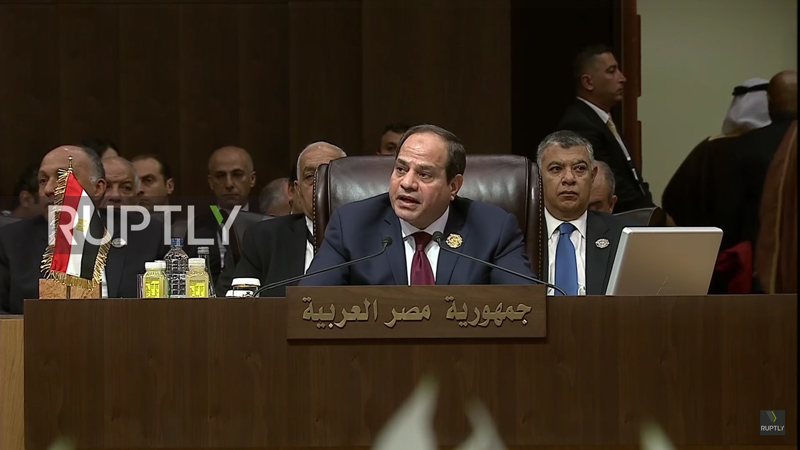
Many Arab leaders were infuriated by his speech; at the forefront was President Abdel Fattah el-Sisi of Egypt, who left the Arab Summit Hall during the speech to meet King Salman of Saudi Arabia.

Most Arab leaders and analysts, in fact, are enraged by Qatar's continuous support for Islamist political groups such as the Muslim Brotherhood, because these groups are a threat to their national security.


President Abdel Fattah el-Sisi of Egypt speaks at the Arab Summit, on March 29. The previous day, Sisi walked out of a speech by the Emir of Qatar, Sheikh Tamim bin Hamad Al-Thani. Sisi was infuriated by Al-Thani's declaration of support for the Muslim Brotherhood. (Image source: Ruptly video screenshot)

Another consequence of Obama's foreign policy -- in particular attempts to get close to Iran's hostile regime -- has been a fraying of relationships with old Arab allies of the United States. Some of Obama's advisors thought that replacing Saudi Arabia with Iran was somehow "better" for the United States, if Iran "is beginning to evolve into a very civilized and historically important country" -- an analysis that can be described as completely short-sighted.

The Saudi regime, with all its flaws, is a monarchy run by princes; the Iranian regime is a theocracy run by clerics. The Saudi regime is not a theocratic regime but a hybrid structure, which is neither wholly secular nor wholly religious. As such, the religious class functions under the authority of the ruling class. Princes are driven by self-interest; clerics are driven by ideology. In terms of extremism, the Iranian regime is pushing for hegemony, whilst Saudi Arabia has been taking only a defensive, rather than an expansionist, position.

The motivation of Saudi Arabia in exporting mosques world-wide and installing radical Saudi imams is defensive, not expansionist as in Iran. Saudi Arabia's impetus is to confront Iran's hegemony and the spread of its hostile ideology. It is this strategy, which Saudi Arabia has practiced since 1979 to balance Iran's power and to combat its rebellious ideology, that must change.

That Iran's Khomeini regime sought to embarrass Saudi Arabia -- a country that is home to Islam's two holiest mosques, in Mecca and Medina -- by portraying it as not sufficiently Islamic, meant that the foundational Islamic Wahhabism of the Saudi Kingdom was aggressively reinforced. This emphasis resulted in even more constraints being put in place in Iran: especially on entertainment. Since the Khomeini revolution in 1979, all plays, fashion shows, international events, and cinemas have been banned. As for women, the Commission for the Promotion of Virtue and Prevention of Vice has increasingly harassed them. As for minorities, especially Shia challenging the Iranian Shia regime and its support for Shia militias -- particularly the dominant Revolutionary Guards -- books were published attacking the Shia:
More books appeared, attacking the Shias and especially Khomeini's views. These books – like the arguments of Khomeini's followers – rejected modern thinking as an "intellectual invasion." Saudi Arabia, considered the guardian of Sunni Islam, spent billions of dollars on challenging the Khomeini-backed Shiites.
This religious one-upmanship -- a competition over which body can be the "most religious" -- must stop. Saudi Arabia would do well to understand that in order to confront the hegemony of the Iranian theocratic regime, the answer is not to radicalize Saudi society but to return to the way it was before 1979.

The best way to defeat the rebel hostile regime in Iran might be through creating an inclusive and tolerant society in Saudi Arabia. Saudi Arabia needs to change its approach towards Iran because the current strategy has not worked. The current strategy has done nothing except to strengthen the Iranian regime's dominance; distort, globally, the image of Saudi Arabia and accelerate terrorism.

The lesson the Trump administration might learn from the disastrous mistakes of its predecessor is that the main source of terrorism in the region are political Islam and all its related religious groups. All these radical groups including ISIS, Al-Qaeda, Jabhat Al-Nusra and Hamas have been spawned by a political Islam driven by the ideology of the Muslim Brotherhood. Extremist jihadists such as Osama bin Laden, Abdullah Azzam and Ayman al-Zawahiri were all taught by the Muslim Brotherhood.

Political Islam practiced by the Iranian theocratic regime has been comfortably generating Shia radical militias, including the terrorist group, Hezbollah. The fight, therefore, should not be against Islam, but against political Islam. Islam needs to be practiced the way other religions are, as a private personal faith that should be kept separate from public life and politics, and whose expression should be confined to worship only. Mosques, whether in the Arab and Muslim world or in the West, should be places of worship only and must not transformed to centers for polarizing society or for recruitment by political religious groups. Unfortunately, Western countries have turned a blind eye to the political activities inside these mosques.

The danger of these religious political groups is that they do not believe in democracy or human rights; they just use elections to grasp power in order to impose a system of "Islamic Caliphate" as their only form of government. Most of these groups use religion as an ideology to oppose governments other than their own, and when they are criticized or attacked, they play the role of the oppressed.

The Trump administration needs to take advantage of the fact that the majority of people in the Middle East and North Africa have lost faith in religious political groups, especially since the failure of the Muslim Brotherhood in Egypt and Tunisia.

Before the Arab Spring, support for these groups was huge; now it stands at less than 10% of the population. This study was conducted in the Arab world, not including Turkey. The Muslims who support Turkish President Recep Tayyip Erdogan are the Muslim Brotherhood.

Most recent polls indicate that the majority of people in Arab and Muslim countries prefer religion to be kept separate from politics.

The country that is working the most systematically to fight these religious political groups in the region is the United Arab Emirates (UAE). There are several institutes and think tanks researching how to combat these groups. Dr. Jamal Sanad Al-Suwaidi, Director General of the Emirates Center for Strategic Studies and Research (ECSSR), has given a robust analysis of these groups and how to combat them in his book, The Mirage. In it, he cites a study on public opinion on political religious groups: A survey of the UAE population, on how these groups are able to influence the public by taking advantage of certain flaws in the system: 53.9% because of corruption; 47.9% because of poverty and 29.1% because of an absence of civil society groups that confront these opportunists.

The Middle East-North Africa region will undoubtedly have to go through several stages before it can successfully establish democracy. An evolutionary developmental approach will definitely be better than the failed revolutionary democratic one pursued by the Obama administration.

Secularization is also crucial in the fight against terrorism. Trying to build a democracy before going through the stages of secularism and political reformation -- which includes rectifying existing flaws, such as corruption; modernization which means the liberation of the region from extremist totalitarian religious dogma and all other forms of backwardness in order to kick-start a renaissance; and scientific development -- will not only be inadequate but will actually generate more terrorism by helping radicals to keep gaining power. It would be like a farmer who wants to plant roses in arid desert soil full of thorns.
Najat AlSaied is a Saudi American academic and the author of "Screens of Influence: Arab Satellite Television & Social Development". She is an Assistant Professor at Zayed University in the College of Communication and Media Sciences in Dubai-UAE. She can be reached at: najwasaied@hotmail.com
Source: https://www.gatestoneinstitute.org/10173/middle-east-revolution-evolution

Follow Middle East and Terrorism on Twitter

Copyright - Original materials copyright (c) by the authors.
Sisi as key to Arab anti-ISIS pact with Israel - debkaFile


by debkaFile

To stamp out this sprawling, multi-branched menace [ISIS], the Trump administration needs to bring Egypt, Jordan and Israel into a coalition for a sustained, common campaign.


US President Donald Trump’s first face to face with Egyptian President Abdel-Fatteh El-Sisi at the White House Monday, April 3, focuses on four main topics, debkafile reports: The fight against Islamist State terror rampant in Egyptian Sinai and neighboring Libya; topping up US military assistance to Cairo, aid for easing Egypt’s dire economic straits and, finally, the effort to bolster normal relations between the Arab world (including the Palestinians) and Israel.

From the moment he assumed the Egyptian presidency in June 2014, El-Sisi has waged a never-ending war on Islamist terror against Ansar Beit-al Maqdis, which later pledged alliance to the Islamic State’s leader Abu Bakr Al-Baghdadi. The Egyptian army has so far been worsted.  The Egyptian president is not deaf to the criticism of the Second and Third Armies’ failure to overcome a few thousand armed men, even though they can at a moment’s notice raise several thousand more fighters from the Bedouin tribes of Sinai. US intelligence has rated the Egyptian forces as slow-moving and unwieldy; but for limited forays, its contingents preferring to sit safely in their barracks rather than risk going out and pursuing the enemy across the Peninsula.

Shortly before President El-Sisi’s trip to Washington, the Egyptian air force conducted intense bombardments of ISIS concentrations around the northern town of El Arish, killing at least 14 terrorists, nabbing 22 and seizing large caches of roadside bombs. But they too long delayed bearding the Islamists in their main stronghold atop Mount Jabal Hala in central Sinai. ISIS is therefore free to move around the territory and strike at will, the while expanding its operations into Egypt proper.

The weekend air strikes came after months in which ISIS overran sections of El Arish, Sinai’s biggest town (pop: 100,000). Their grip is such that Egyptian forces no longer dared venture into those lawless neighborhoods, especially at night. Earlier this year, terrible persecution including executions forced the few thousand indigenous Christians, most of them Copts, to flee their homes in El Arish. Egyptian forces proved unequal to safeguarding the US-led international observer force (MFO) monitoring the 1972 Egyptian-Israel peace treaty at a nearby station.

American military aid to Egypt stands today at $1.3bn a year. Even though the US president means to slash foreign aid programs, he may make an exception in this case and expand military assistance - possibly in the coin of advanced military hardware, given the country’s unending frontline battle against Islamist terror.

Its presence in El Arish, 130km from the Egyptian-Israeli border, plants the peril on the doorsteps of Egypt’s neighbors as well: Northern Sinai borders on Israel, its northwestern district shares a border with the Gaza Strip, abutting in the east on Jordan and in the southwest on Libya. The cities of western Sinai sit on the banks of the Suez Canal.

The Islamic State’s Sinai affiliate is closely allied with Salafi organizations in the Gaza Strip and works hand in glove with its Palestinian Hamas rulers, especially in the lucrative arms-smuggling business.


Al-Baghdadi last year posted a group of Iraqi officers in his service to the Sinai contingent. They travelled through southern Jordan to reach the peninsula. The Islamist cells in Libya have moreover made ISIS-held turf in Sinai their safe highway for traveling undetected to their other strongholds across the Middle East.


To stamp out this sprawling, multi-branched menace, the Trump administration needs to bring Egypt, Jordan and Israel into a coalition for a sustained, common campaign.

The Obama administration, which boycotted President El-Sisi for persecuting Egypt’s Muslim Brotherhood, tried unsuccessfully to build Turkey, Egypt and Israel into a counterterrorism pact. The Trump administration, for which the Brotherhood is anathema, has a better chance. But first, relations between the Arab world and Israel need to be placed on a regular footing. Some groundwork already exists in the informal bilateral military ties Egypt and Jordan maintain with Israel. debkafile’s military sources have revealed in past reports the limited give-and-take relations for fighting terror Saudi Arabia and Abu Dhabi maintain with Israel.


The US President’s advisers recognize that before a broad, effective front against ISIS and Al Qaeda can be put together from these partial, often covert ties, progress is necessary towards normalizing relations between the Arab governments and the Jewish state, including the Israeli-Palestinian track.

Trump will certainly want to hear what role his Egyptian guest is willing to take for bringing this process forward. He will ask his next Middle East visitor, Jordan’s Abdullah II, the same question, when he arrives in Washington Tuesday. As for the Palestinian leader Mahmoud Abbas, he was promised an invitation to the White House this month, but not yet been given a date. He is clearly being left to wait until the senior players in the region have had their say. Our Washington sources report that President Trump aims to complete his plan for bringing together Egypt, Saudi Arabia, Jordan and Israel on a new footing by September.


debkaFile

Source: http://debka.com/article/25993/Sisi-as-key-to-Arab-anti-ISIS-pact-with-Israel

Follow Middle East and Terrorism on Twitter

Copyright - Original materials copyright (c) by the authors.

Sentenced to Death for "Insulting Islam" - Majid Rafizadeh


by Majid Rafizadeh


Can you imagine making a joke and facing death as a result?

  • "During his interrogation, Sina was told that if he signed a confession and repented, he would be pardoned and let go," said the source in an interview with CHRI on March 21, 2017. "Unfortunately, he made a childish decision and accepted the charges. Then they sentenced him to death." "Later he admitted that he signed the confession hoping to get freed," said the source. "Apparently the authorities also got him to confess in front of a camera as well." -- Center for Human Rights in Iran (CHRI).
  • When the Islamists gain power, they immediately create their own "judiciary system" in order to "legitimize" their implementation of sharia law. In fact, the judiciary system is used less as a tool for bringing people to justice, and more as a tool to suppress freedom of speech and of the press.
To radical Islamist groups, Islam is not a religion which all are free to pursue; it is a weapon. It is the most powerful tool that can be wielded with manipulative skill to control entire populations. Beneath their fierce rule, every aspect of daily life is dictated. What is worn, what is eaten, what you say and what you write are all scrutinized; violations of these stringent laws are met with extreme punishments. Can you imagine making a joke and facing death as a result? Can you imagine the constant fear of doing the wrong thing, saying the wrong thing, when you have seen people beaten, stoned, or killed in the street for nothing more than a mild transgression?

Freedom of speech and press are the Islamists' top enemies. They are targeted on a regular basis, making it difficult or impossible for the truth to be revealed to the world. While others may take their privacy for granted, the people living under this kind of tyranny must think about everything they say and do. Sometimes even the bravest of souls turn away in the face of such intimidation. Can it really be as restrictive as described? Yes, and far worse than you can imagine.

Sina Dehghan, 21, for example, was arrested by Iran's Islamic Revolutionary Guard Corps (IRGC) when he was 19 for "insulting Islam". Charges were brought against him for insulting the Prophet Muhammad on the messaging app LINE.

According to the Center for Human Rights in Iran (CHRI):
"During his interrogation, Sina was told that if he signed a confession and repented, he would be pardoned and let go," said the source in an interview with CHRI on March 21, 2017. "Unfortunately, he made a childish decision and accepted the charges. Then they sentenced him to death." "Later he admitted that he signed the confession hoping to get freed," said the source. "Apparently the authorities also got him to confess in front of a camera as well."
Such a sentence may seem like madness, but in fact there is a cold and calculated pattern to these actions. When extremist Muslims gain power, they immediately create their own "judiciary system" in order to "legitimize" their implementation of sharia law. This judiciary system is, in fact, used less as a tool for bringing people to justice, and more as a tool to suppress freedom of speech and freedom of the press. Once this silence is ensured, they are able to oppress the entire society, restrain any budding opposition, imprison and torture innocent people and sentence thousands to death.


Sina Dehghan, 21, has been sentenced to death in Iran for "insulting Islam". There are many people like him in Iran who are currently imprisoned, tortured on a daily basis, or awaiting their execution for "insulting Islam", "insulting the prophet", "insulting the Supreme Leader" -- the examples are endless. (Image source: Center for Human Rights in Iran)

By imprisoning, torturing and hanging idealistic and rebellious young people, the ruling politicians and the Islamist judiciary system are using them as an example to send a message to millions of people that they will not tolerate anyone who opposes their religious or political view.

Radical Islamist groups have been using the same tactic in other nations to impose fear and shock in the public. They aim at silencing people and making them subservient. Once they have control, they will stop at nothing to keep it.

For the Islamists, once you submit to their religion, your freedom of speech and of the press belong to Allah. Your only job is to exercise silence and obedience, and follow your religious leader, imam, sheikh, or velayat-e faqih ("guardianship of the Islamic jurist").

As the Center for Human Rights in Iran pointed out:
"Security and judicial authorities promised Sina's family that if they didn't make any noise about his case, he would have a better chance of being freed, and that talking about it to the media would work against him," added the source. "Unfortunately, the family believed those words and stopped sharing information about his case and discouraged others from sharing it as well." "Sina is not feeling well," continued the source. "He's depressed and cries constantly. He's being held in a ward with drug convicts and murderers who broke his jaw a while ago."
For the ruling Islamists, it does not matter if you have been a loyalist all your life. If you speak up or oppose them just once, you will be eliminated. As CHRI quoted one source: "He was a 19-year-old boy at the time (of his arrest) and had never done anything wrong in his life."

One of Dehghan's co-defendants, Mohammad Nouri, was also sentenced to death for posting anti-Islamic comments on social media. Another co-defendant, Sahar Eliasi, was sentenced to seven years, and later the sentence was reduced to three years.

What does the term "anti-Islamic" mean exactly in an Islamist judiciary system? If it carries a death sentence, you might assume that the parameters of the law would be well outlined. However, that is not the case. For the ruling Islamists, the term "anti-Islamic" is completely ambiguous and subjective, and can relate to anything that opposes their view or their power. What might seem like an innocent remark, could change a life forever.

If they are such violent and oppressive people, you might wonder how they are ever able to gain power. They do this through manipulation, charm and countless false promises.

Some radical Islamists, before they gain power, promise people equality, justice, peace, and a far better life. They appeal to the young, to the traditional, and to the hopeful. But once they seize power, they close an iron grip around any and all freedoms, available to their people -- in particular freedom of speech.

Once radical Islam has gained power, established its own judiciary system, or infiltrated the legal system with its sharia law, no one is capable of criticizing the government or the political establishment. In a social order ruled by radical Islam, the government is Islam; the government is the representative of Allah and the Prophet Muhammad. Ruling politicians who decide the laws are "divine" figures supposedly appointed by God. They are not to be questioned.

There are many people like Sina Dehghan who are currently imprisoned, tortured on a daily basis, or awaiting their execution for "insulting Islam", "insulting the prophet", "insulting the Supreme Leader" -- the examples are endless. The issue is that we do not hear about these cases. Some media outlets refuse to report on them in order to appease the Islamic Republic of Iran -- just further proof of how coercive their power can be. The only way to reduce it -- and the oppression and slaughter of so many people -- is to bring attention to the human rights abuses conducted under the Islamic banner of religious "legitimacy " and "authenticity".

This type of tyranny is a danger, not just for those enduring it, but for the world.

  • Follow Majid Rafizadeh on Twitter
Dr. Majid Rafizadeh political scientist and Harvard University scholar is president of the International American Council on the Middle East. He can be reached at Dr.rafizadeh@post.harvard.edu.

Source: https://www.gatestoneinstitute.org/10170/iran-insulting-islam

Follow Middle East and Terrorism on Twitter

Copyright - Original materials copyright (c) by the authors.

A 1,389 Year-Old ‘Phobia’? - Raymond Ibrahim


by Raymond Ibrahim

Why history is one of the best antidotes to Muslim apologetics.


Raymond Ibrahim is a Shillman Fellow at the David Horowitz Freedom Center

A direct correlation exists between Western ignorance of history and Western ignorance of Islam’s “troublesome” doctrines.  It is this connection that allows Islam’s apologists to get away with so many distortions and outright lies meant to shield Islam. 

Take, for instance, Reza Aslan, apparently CNN’s resident “cannibal”: he recently claimed that “Islamophobia”— defined by CAIR as “unfounded fear of and hostility towards Islam”—was created by a few “clowns” in 2014.

To be sure, Western fear of Islam is something of a recent phenomenon in modern times.  Because the world was a much bigger place a few decades ago, and Islam was oceans away, the average American hardly knew anything about Muhammad’s creed.  However, as the world has become smaller—as Muslims have grown in numbers in Western societies, as modern technology has made it possible for the weaker to terrorize the stronger, and then broadcast it for the world to see (Internet)—so has the Western world been hearing, seeing, and experiencing more and more of Islam.

But Aslan’s lament is not that, although people were once ignorant they are now wise to Islam.  Rather, he accuses a number of writers and activists—the aforementioned “clowns”—of manufacturing a menacing image of Islam, which, in turn, has prompted Western people to develop an “unfounded fear of and hostility towards Islam”—or, in a word, “Islamophobia.”

Such a claim relies on an obscene amount of historical ignorance.  The fact is, Western peoples, including some of their luminaries, have portrayed Islam as a hostile and violent force from the very start—often in terms that would make today’s “Islamophobe” blush.  And that wasn’t because Europeans were “recasting the other” to “validate their imperial aspirations” (to use the tired terminology of Edward Said that has long dominated academia’s treatment of Western-Muslim interactions).  Rather, it was because, from the very start, Islam treated the “infidel” the same way ISIS treats the infidel: atrociously.

According to Muslim history, in 628, Muhammad summoned the Roman (or “Byzantine”) emperor, Heraclius—the symbolic head of “the West,” then known as “Christendom”—to submit to Islam; when the emperor refused, a virulent jihad was unleashed against the Western world.  Less than 100 years later, Islam had conquered more than two-thirds of Christendom, and was raiding deep in France.  While these far-reaching conquests are often allotted a sentence, if that, in today’s textbooks, the chroniclers of the time, including Muslim ones, make clear that these were cataclysmic events that had a traumatic effect on, and played no small part in forming, the unconquered portion of Christendom, which became Europe proper.  As Ibn Khaldun famously put it after describing incessant Muslim raids for booty and slaves all along Europe’s Mediterranean coasts, “the Christians could no longer float a plank on the sea.”  They took to the inlands and the Dark Ages began.

But it wasn’t just what they personally experienced at the hands of Muslims that developed this ancient “phobia” to Islam.  Beginning in the eighth century, Islam’s scriptures and histories—the Koran, hadith, sira and maghazi literature—became available to those Christian communities living adjacent to, or even under the authority of, the caliphates.  Based solely on these primary sources of Islam, Christians concluded that Muhammad was a (possibly demon possessed) false prophet who had very obviously concocted a creed to justify the worst depravities of man—for dominion, plunder, cruelty and carnality.  This view prevailed for well over a millennium all over Europe (and till this day among “Islamophobes”); and it was augmented by the fact that Muslims were still acting on it by invading Christian territories, plundering them, and abducting their women and children.

Here is a miniscule sampling of what Europeans thought of Islam throughout the centuries:

Theophanes, the Byzantine chronicler (d.818):
He [Muhammad] taught those who gave ear to him that the one slaying the enemy—or being slain by the enemy—entered into paradise [see Koran 9:111].  And he said paradise was carnal and sensual—orgies of eating, drinking, and women. Also, there was a river of wine … and the women were of another sort, and the duration of sex greatly prolonged and its pleasure long-enduring [e.g., Koran 56: 7-40, 78:31, 55:70-77].  And all sorts of other nonsense.
St. Thomas Aquinas, one of Christendom’s most influential philosophers (d.1274):
He [Muhamad] seduced the people by promises of carnal pleasure to which the concupiscence of the flesh urges us …. and he gave free rein to carnal pleasure. In all this, as is not unexpected, he was obeyed by carnal men. As for proofs of the truth of his doctrine…. Muhammad said that he was sent in the power of his arms—which are signs not lacking even to robbers and tyrants [i.e., his “proof” that God was with him is that he was able to conquer and plunder others]….  Muhammad forced others to become his follower’s by the violence of his arms.
Marco Polo, world famous traveler (d.1324):
According to their [Muslims’] doctrine, whatever is stolen or plundered from others of a different faith, is properly taken, and the theft is no crime; whilst those who suffer death or injury by the hands of Christians, are considered as martyrs. If, therefore, they were not prohibited and restrained by the [Mongol] powers who now govern them, they would commit many outrages. These principles are common to all Saracens.
When the Mongol khan later discovered the depraved criminality of Achmath (or Ahmed), one of his Muslim governors, Polo writes that that the khan’s

attention [went] to the doctrines of the Sect of the Saracens [i.e., Islam], which excuse every crime, yea, even murder itself, when committed on such as are not of their religion. And seeing that this doctrine had led the accursed Achmath and his sons to act as they did without any sense of guilt, the Khan was led to entertain the greatest disgust and abomination for it. So he summoned the Saracens and prohibited their doing many things which their religion enjoined.
Alexis de Tocqueville, French political thinker and philosopher, best known for Democracy in America (d.1859),
I studied the Quran a great deal. I came away from that study with the conviction that by and large there have been few religions in the world as deadly to men as that of Muhammad. As far as I can see, it is the principal cause of the decadence so visible today in the Muslim world and, though less absurd than the polytheism of old, its social and political tendencies are in my opinion more to be feared, and I therefore regard it as a form of decadence rather than a form of progress in relation to paganism itself.[8]
Winston Churchill, a leader of the Allied war effort against Hitler during WWII (1965):
How dreadful are the curses which Mohammedanism [Islam] lays on its votaries! Besides the fanatical frenzy, which is as dangerous in a man as hydrophobia in a dog, there is this fearful fatalistic apathy.  The effects are apparent in many countries. Improvident habits, slovenly systems of agriculture, sluggish methods of commerce, and insecurity of property exist wherever the followers of the Prophet rule or live.  A degraded sensualism deprives this life of its grace and refinement; the next of its dignity and sanctity.  The fact that in Mohammedan law every woman must belong to some man as his absolute property, either as a child, a wife, or a concubine, must delay the final extinction of slavery until the faith of Islam has ceased to be a great power among men.
Lest it seem that these and other historic charges against Islam are simply products of Christian/Western xenophobia that simply cannot tolerate the “other,” it should be noted that many of Islam’s Western critics regularly praised other non-Muslim religions and civilizations, including what is today called “moderate Muslims.”   Thus Marco Polo hailed the Brahmins of India as being “most honorable,” possessing a “hatred for cheating or of taking the goods of other persons.” And despite his criticisms of the “sect of the Saracens,” that is, Islam, he referred to one Muslim leader as governing “with justice” (p.317) and another who “showed himself [to be] a very good lord, and made himself beloved by everybody (p.332).”

Winston Churchill summed up the matter as follows:  “Individual Moslems may show splendid qualities—but the influence of the religion paralyses the social development of those who follow it. No stronger retrograde force exists in the world.”

Apologists like Reza Aslan can say whatever they want; they claim that Islam is forever and perpetually “misunderstood”— and can bank on Western ignorance of its own history to get away with it.  But fear and dislike of Islam has been the mainstream position among Christian/Western people for nearly 1,400 years—ever since Muhammad started raiding, plundering, massacring, and enslaving non-Muslims (“infidels”) in the name of his god; and it is because his followers, Muslims, continue raiding, plundering, massacring, and enslaving “infidels” that fear and dislike of Islam—what is called “Islamophobia”—exists to this day.

Raymond Ibrahim is a Shillman Fellow at the David Horowitz Freedom Center, a Judith Friedman Rosen Writing Fellow at the Middle East Forum and a CBN News contributor. He is the author of Crucified Again: Exposing Islam’s New War on Christians (2013) and The Al Qaeda Reader (2007).

Source: http://www.frontpagemag.com/fpm/266355/1389-year-old-phobia-raymond-ibrahim

Follow Middle East and Terrorism on Twitter

Copyright - Original materials copyright (c) by the authors.