Sunday, May 14, 2017

In Palestinian Authority And In Jordanian, Egyptian, And Saudi Press, Harsh Criticism Of New Hamas Policy Document - MEMRI


by MEMRI

PA and Fatah officials, and articles in the PA press --  criticized the document and its contradictions, accusing Hamas of attempting to mislead the public and of posing as a democratic, peace-seeking movement when it is no such thing

On May 1, 2017 in Doha, a week before he stepped down as Hamas political bureau head, Khaled Mash'al announced the release of Hamas's new policy document.[1] This document has been very harshly criticized by the Palestinian Authority and Fatah, which rejected it and expressed suspicion about its credibility and about the timing of its release. Palestinian Authority (PA) President Mahmoud 'Abbas forcefully attacked it, stating that it included many contradictions and thus was not worthy of serious attention. PA and Fatah officials, and articles in the PA press, likewise criticized the document and its contradictions, accusing Hamas of attempting to mislead the public and of posing as a democratic, peace-seeking movement when it is no such thing, and of seeking to eradicate the PLO and take its place. It was also claimed that the document's release – just prior to 'Abbas's White House visit – was aimed at sabotaging the visit. 

The Hamas document was also criticized in the Jordanian, Egyptian, and Saudi press, which are known for their support for the Arab peace initiative – of which the section on recognizing Israel if it withdraws from the 1967 territories has so far been rejected by Hamas.[2] Senior writers and columnists in the state presses of Jordan, Egypt, and Saudi Arabia have, like the PA, argued that the document is full of contradictions that are difficult to resolve. They expressed doubt regarding the credibility of Hamas's intentions, and stated that the document was aimed strictly at improving the organization's situation in light of the changes in the region and in the world that do not benefit Hamas, and that it must also take actual steps as well as bolder decisions. 
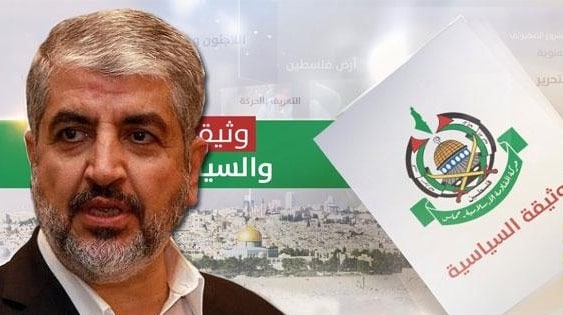

Khaled Mash'al and Hamas's new policy document (image:nwatan.ps, May 3, 2017)

This paper will review criticism of Hamas's new policy document by the PA and by the Jordanian, Egyptian, and Saudi press. 

PA President 'Abbas: The Hamas Document Includes Both Statements And Their Opposites; We Won't Take It Seriously

In an interview with the Russian RT channel, PA President Mahmoud 'Abbas said of the Hamas document: "This document includes many contradictions, and therefore it is unclear. In 1988, we [i.e. the PLO] made clear decisions. We said that we recognize the legitimate international [decisions]. That was it. This meant [UN] resolutions 242 and 338 and all those resolutions. We have adhered to this to this day. But when you write something and its opposite in a single document, people will not accept it, and therefore neither we nor the international community will take this document seriously."[3]

Fatah: Hamas Must Apologize To The PLO And The Palestinian People 

PA and Fatah officials expressed similar criticism of the document, even calling on Hamas to apologize to the PLO and the Palestinian people for adopting, 30 years later, a PLO position for which Hamas had accused the PLO of betrayal, and because of which it had even caused a schism among the Palestinians. They stated that Hamas was trying to clean up its image in the international community, while at the same time oppressing its people.

Fatah spokesman Osama Al-Qawasmeh said: "Hamas's consent to the establishment of a Palestinian state in the 1967 borders as an agreed-upon formula and as implementation of international law is absolutely identical to the position taken by all the [PLO] factions in 1988; it was not [only] Fatah's position but a position agreed upon by all the [PLO] factions." He continued: "If it took Hamas 30 years to [stop] using our position against us, how long will it take for it to understand that national unity and an end to the schism are better for the Palestinian people? And what pretext will Hamas now give the Palestinian street for continuing the coup and the schism?" He also said that Mash'al had aimed his statements and his speech [on May 1] at the entire world except for the Palestinian people, but had not answered the question that everyone was waiting for him to answer – that is, how to restore national unity.

Al-Qawasmeh even demanded that Hamas apologize to the PLO: "Hamas must apologize to the PLO for the 30 years in which it accused [the PLO] of betrayal and heresy and for causing the grave schism in the Palestinian street, the jewel in the crown of which was the Hamas coup [against the PLO in the Gaza Strip] that tarnished the image of the Palestinian people, of its struggle, and of its just cause."[4]

In an additional statement, Al-Qawasmeh noted: "The new Hamas document has nothing new in it except for a collection of contradictions."[5]

PLO Executive Committee member Ahmed Majdalani said: "Hamas presents itself to the world as an open democratic organization abiding by international legitimacy and law, and as interested in peace, while to Palestinian society it sends a message of terrorism and suppression of the fundamental freedoms of all." He noted: "There is a chasm between Hamas's political discourse and its actions in the field, and the discourse that it uses in its new policy document is aimed at allowing it to integrate with the changes affecting the world and the region." The document, he added, is a response to the demands of Hamas's allies in the region so that they will be able "to market it in the framework of its efforts to be an alternative to the PLO or to be a side on the regional equation." He also said that the timing of the document's release – just prior to 'Abbas's White House visit – was in no way coincidental, but deliberate: "Hamas's disregard of the issue of national reconciliation in its document shows that this issue does not top its agenda and will not be part of its policy any time soon."[6]

Fatah Central Committee member Jibril Rajoub told the London-based Saudi daily Al-Hayat: "We welcome the development in the Hamas movement, but we had hoped that it would submit the document to President Mahmoud 'Abbas for him to take it with him to the White House – not [submit it] to the Turkish foreign minister.[7] Had Hamas [truly] sought a partnership with the PLO, it would have submitted its document to the international community by means of the PLO head ['Abbas] – but it aspires to be an alternative to the PLO."[8]

Editorial In PA Daily Al-Hayat Al-Jadida: Hamas Aims To Eradicate The PLO 
 
Similar claims were made in articles in the PA press, which likewise stated that the release of the document just prior to 'Abbas's visit to Washington and his meeting with U.S. President Trump was meant to sabotage that visit. In its May 5, 2017 editorial, the PA daily Al-Hayat Al-Jadida wrote: "We have said, and the facts and signs all indicate, that Hamas was never a resistance movement in the true sense of the word, and that in the history of the modern Palestinian national struggle it has not been present at all in the paths of the armed struggle. (The suicide operations that were carried out in the days when the [PA's] political struggle against the occupation escalated so that the transitional sections of the Oslo [Accords] would be precisely implemented had nothing to do with this struggle)... It is no accident at all that this announcement [of the Hamas policy document] comes on the eve of [PA] President Abu Mazen's [i.e. Mahmoud Abbas's] meeting with U.S. President Donald Trump, during which President Abu Mazen will present the perception of the Palestinian [Authority] with regard to a just peace and its willingness to actualize it on all levels in the framework of a solution that will respect the historic rights of our people... The aim of [Hamas's] announcement is to market [Hamas] and sabotage Abu Mazen's visit to Washington...

"Hamas's policy document... exposes the essential truth regarding [Hamas's] hidden political plan, [which is] a plan for rule by the Muslim Brotherhood that seeks nothing but to eradicate the PLO, the only legitimate representative of the Palestinian people..."[9]

Al-Hayat Al-Jadida Columnist: Hamas's Talk About A State In 1967 Borders Contravenes The Situation On The Ground

Al-Hayat Al-Jadida columnist 'Omar Hilmi Al-Ghoul wrote: "On the face of it, anyone following [Hamas] might think that the document includes a policy innovation that is manifested, first and foremost, in its agreement to the establishment of a state within the June 4, 1967 borders. In this context, many of those following [Hamas] have praised this 'development,' seeing it as an essential turning point in Hamas's political track. But this is not true, because various Hamas leaders, among them Khaled Mash'al himself, have announced dozens of times that they agree to a state in the June 4, 1967 borders, and have even agreed to a state with temporary borders.

"The worst thing is that it [Hamas] is continuing to this very day to cling to [its] emirate in the Gaza Strip. Thus, the talk about a state in the 1967 borders actually contradicts the reality on the ground. Had Hamas been truly, and in principle, interested in [implementing] what is stated in the document, it would have changed its political behavior, and agreed to return the legitimate rule of the southern provinces [i.e. give the Gaza Strip to the PA]."[10]

Former PA Minister: The Hamas Document Contradicts Itself 

Ashraf Al-Ajrami, a former PA minister for prisoner affairs and a columnist for the Palestinian daily Al-Ayyam, described the Hamas document as an "important step" and as "a positive development that may serve the [Palestinian] national plan," but also highlighted the contradictions in it. He wrote: "The language of Hamas's new plan allows it to say one thing and its opposite [at the same time]: It agrees to a state in the 1967 borders with Jerusalem as its capital, and at the same time says that it wants a greater Palestine, from the sea to the river, from Ras Naqura to Rafah. It is certainly using moderate language to foreign elements in order to prove that it has essentially changed, and at the same time using extremist language to its members and its public, in order to emphasize that it has not compromised on its positions.

"Essentially, there are real changes in the movements' positions, as agreeing to a state in the 1976 borders implies recognition of the two-state solution, even though [Hamas] continues to say that it does not recognize Israel and to cling to all the land of the homeland. This can present it in a flexible light to some elements."[11]

Jordanian Writers: The Hamas Document Is Not Enough – Hamas Needs To Make Additional Concessions And To Recognize Israel

As noted, similar criticism of the document appeared in the Jordanian press; articles stated that Hamas was using doublespeak in its document and that Hamas aimed to sabotage 'Abbas's visit to the White House. One writer, a former Jordanian minister and diplomat, even called on Hamas to make greater concessions and to recognize Israel.

To The International Community, Hamas Talks Of A State In The 1967 Borders; To The Arabs, It Says There Is No Compromise On The Land Of Palestine 

Fahd Al-Fanek, the former editor of the Jordanian state daily Al-Rai and today a senior columnist for the daily, wrote: "The front-page headlines indicated that Hamas has agreed to a Palestinian state in the 1967 borders. This is considered a compromise for nothing in return, because the state to which Hamas has agreed is not being offered to it.

"If we leave aside the newspaper headlines and get down to the details in the inside pages [of the newspapers], we will find that there is nothing new in Hamas's statements at the [May 1] political conference in Qatar that was headed by Khaled Mash'al. The agreeing to a state in the 1967 borders is the part of Hamas's announcement that is directed at the international community and Israel, while the part directed at the Palestinian and Arab citizen says that there is no compromise on any part of the land of Palestine for whatever reason, under any conditions, and [despite any] pressure [on it], and no matter how long the occupation continues. Hamas rejects any alternative to the complete liberation of Palestine, from the sea to the river...

"Israel will take advantage of Hamas's declaration in order to prove its position that the two-state solution was not rejected by Israel but by the Palestinians, and that a Palestinian state in the 1967 borders is only a temporary formula with the anticipation of absolutely eradicating Israel from the map later on... Hamas did what it thought it would take to thwart the mission of PA President Mahmoud 'Abbas in Washington, which is backed by [resolutions] of the [last] Arab summit [that again adopted] the two-state solution. It would not be strange for Hamas to agree to a Palestinian state in the 1967 borders because it has already agreed to a state within the borders of the Gaza Strip and signed a hudna with no expiration date with Israel, which it calls a calm [tahdiya]..."[12]

Hamas Must Make Additional Concessions And Recognize Israel 

Former Jordanian minister and diplomat Bassam Al-'Amoush wrote: "Hamas is talking with us today – after its 30 years of existence and in the harshest of conditions, in which the Arab body is torn to shreds and destroyed – about a [Palestinian] state [in the territories of] the West Bank and the Gaza Strip. Can this happen [while giving Israel] nothing in exchange?... Are the Arab countries referring to peace according to the logic that Hamas is discussing – that is, that the Zionists relinquish the [West] Bank and the [Gaza] Strip while Hamas retains the right to the 1948 territories?... It is not possible to agree to only half of the truth, because all the negotiations [conducted] worldwide [throughout] history and [that will be conducted] in the future mention concessions by the sides so that, in the best case scenario, they meet in the middle...

"In all honesty, it will not help Hamas to present itself as believing in striving for peach and political activity as long as it does not make concessions, as Fatah and the PLO have... The specific compromise that Hamas must make is to recognize Israel. Without this [move], it will be impossible for it to join the Madrid peace club. Hamas must choose between the path of the PLO and the path of the resistance, because as of now, these two paths do not cross."[13]

Fears That Hamas Has Received Promises For A Palestinian State In Gaza Territory Alone And For Taking Fatah's Place

Saleh Al-Qallab, former Jordanian information minister and columnist for the government Al-Rai daily, wrote: "Hamas hastened, in its recently published document, to adopt everything it had rejected for over 30 years, the most important of which is agreement to the establishment of the longed-for Palestinian state in the 1967 borders... The question that is asked again and again by the Palestinians and everywhere else is: What are the reasons for Hamas's unsurprising awakening, which came after long preparation? I wonder whether the reason for this is promises [that Hamas has] received from Arab and international elements that it will inherit [the administration of] the entire Palestinian arena and take the position of Fatah in this arena. There is information about moves in which some of the Arabs and Muslim states concerned are involved, [to advance] a solution to the dispute between the Palestinians and the Israelis that is not the solution of the Oslo Accords... The great fear is that this proposed solution will end up [achieving] a Palestinian statelet with clipped wings, with a few border adjustments, according [to the plan] that the Israelis have presented again and again as an alternative to the state in the 1967 borders to which the PLO has clung, [which includes both] the West Bank and the strip, with East Jerusalem as its capital."[14]

Egyptian Columnists: We Don't Trust Hamas; It Must Sever Ties With The Muslim Brotherhood
 
In Egypt too, whose relations with Hamas in recent years have been very tense because of Hamas's affiliation with the Muslim Brotherhood (MB) which is banned there, columnists in the government newspapers attacked the Hamas document for its doublespeak and contradictions. They said that in contrast to the reports and expectations, the document includes no explicit renunciation of the MB by Hamas, and stressed that the movement must take bolder steps.

The Hamas Document Is Rife With Contradictions, Political Maneuvering, And Word Play

Muhammad Abu Al-Fadhl, columnist for the Egyptian Al-Ahram daily, wrote: "Anyone who has read the new Hamas document realizes that it was written in order to satisfy all sides and the political elements... When Khaled Mash'al announced... [the release of] his document, many agreed that its wording was ambiguous... Most of its 42 sections are rife with blatant double meaning. [Thus], the new document includes recognition of the June 4, 1967 borders, but no explicit recognition of Israel. It refers to the importance of political activity, but also of preserving the weapons of the resistance. The document ignores [Hamas's] adherence to affiliation with the MB, which was noted in its first document, of 1988 [that is, the Hamas Charter], but stresses its commitment to the [MB] organization's ideological framework. There is a long list of additional political maneuvering and word play [in it], by virtue of which any element can find what it wants in the document. [It contains] no backtracking from the previous document. Ultimately, [the new document] complements the old one, directly or indirectly...

"Obviously, the movement has not managed to fool the world, which was expecting a move that was compatible with the regional and international developments and would be consider the balance of power that is not in the Arabs' and Palestinians' favor and not in the favor of the forces with ideological positions like those of Hamas. But the movement acted in accordance with its history and with its roots, [which are embedded] in the Muslim Brotherhood... The document confirms that [Hamas] is a strictly self-serving movement that is amazingly inconsistent, allowing it to adapt to a highly complex atmosphere over the years and helping it to resolve contradictions that are difficult to resolve.

"Whoever followed the document from the beginning [of its drafting] to the announcement [of its release] in Doha know very well that its sections are packed with doublespeak in order to please both its friends and its rivals. The movement will find it difficult to please both, and soon it will have to take clear and specific stands on thorny issues..."[15]

Likewise, Yusuf Ayyoub wrote in the Egyptian daily Al-Yawm Al-Sabi': "At the end of the day, Hamas sought [with this document] to address everyone and please all elements – the Americans, the Israelis, and the Europeans – by agreeing to the form of a state that the PA had declared [that is, a Palestinian state in the 1967 borders], and at the same time telling the Palestinians and the Arab people that it is still the resistance movement that will not compromise on the weapons of the struggle against Israel until it establishes the greater Palestinian state...

"Thus, the content of the document was directed at everyone, and every person reads it as he wishes. What is important is that everyone is pleased with Hamas. Without a doubt, this is a game that was preceded by many preparations, until the document was finalized. But I believe that the document will only harm Hamas and damage its credibility and status – which are already shaky in Palestine and in the Arab world."[16]

The Document Is Worthless For Egypt As Long As It Is Not Accompanied By Deeds And Hard Decisions

Al-Ahram columnist Hani 'Asal wrote: "The Hamas document does not constitute a strategic or even a tactical change – it is only a cosmetic change for a movement that began as a resistance [movement] and ended [as a movement] abandoned by both its rivals and its allies! All the statements that appear in the new Hamas document are only 'beautiful words' meant to create a sense of tranquility and optimism among some people – but this does not contradict the fact that there are a thousand reasons to view this document with suspicion, concern, and caution...

"Hamas's historic step, which came a million years too late, took place, suspiciously, at the same time as Gaza's political and economic isolation grew... The Hamas document will remain for Egypt a worthless piece of paper and nothing more, as long as it is not accompanied by deeds, by commitments, and by 'hard' – even very hard – decisions... some of which require a great deal of courage and concessions, not only cosmetics..."[17]

Editor of Egyptian Government Daily: Hamas Must Now Apologize For Harming Sadat, Who Called For A Palestinian State 

Dandarawi Al-Harawi, editor of the Egyptian daily Al-Yawm Al-Sabi', which is affiliated with the Egyptian regime, wrote: "We expected Khaled Mash'al, who held the press conference in Doha, or Isma'il Haniya, who held a second press conference at the same time in Gaza, to address the UK news agency Reuters' [report] that the [new Hamas policy] document included a clear section on [Hamas's] renunciation of the Muslim Brotherhood. But we kept waiting, and the document included no such clear renunciation...

"A close examination of the document's sections reveals earthshaking surprises, including official recognition of the State of Israel and of the June 4, 1967 borders. The document contains no mention of the usual sentence of the Hamas movement [about] 'the destruction of Israel' – only a focus on accepting reality and recognizing the State of Israel...

"In light of the movement's recognition of the June 4, 1967 borders, it must apologize clearly and openly to Egypt and express deep regret for all the harm it caused it, and to the late president Anwar Al-Sadat, who was ahead of his time in demanding the establishment of a Palestinian state [alongside Israel]. Now, 40 years later, the movement accepts what Sadat [demanded]...

"What remains is a clear truth, and this is that Hamas is doing nothing for any general purpose or interest – only for [its own] purpose and aims. By means of this document, the movement has sown the seeds for the establishment of a state in Gaza, and as a result, has created a situation of three states on the Palestinian lands – the State of Israel, the State of Gaza, and the State of Ramallah – while the name Palestine is eradicated from the map..."[18]

Saudi Writers: The Document Is Vague And Unclear, Acknowledges Hamas's Failure 

Criticism of Hamas and its new policy document was also voiced in the Saudi press. Hassan Heidar, a columnist for the London-based Saudi Al-Hayat daily, described it as absurd that, on the one hand, Hamas agrees to a state in the 1967 borders, but on the other hand, it refuses to negotiate with Israel about this. He wrote: "In their new perspective [as set out in the policy document], all that the Hamas members did was to move to a new stage of obfuscation. According to Khaled Mash'al, the document – in which Hamas defined itself as 'an Islamic Palestinian liberation and resistance movement for whom the source of authority for laying its foundation, its goals, and its ways of action is Islam' – does not cancel out, [its 1988] founding charter...

"With regard to its agreement to a Palestinian state in the 1967 borders – it is unclear how Mash'al's statement that negotiations with the occupation is not [one of Hamas's] founding principles gibes with [the statement] that [Hamas] is using realpolitik. It is not clear with whom Hamas will negotiate over the establishment of the longed-for state except Israel, or whether any international element, or the UN, would be willing to sponsor negotiations of this kind if there is no mutual recognition between the two sides. [It is also not clear] whether Hamas wants the PA to continue with the treachery of which [Hamas] accuses it and negotiate over the borders of the state, and then to hand it over to [Hamas]. Is there a difference between negotiating with Israel and accepting a state in the 1967 borders from the national point of view or from the Islamic point of view, when the end result is the same? Why does Hamas today accept what it condemned the PLO leadership for 30 years ago?...

What is most astounding of all is that some top Hamas officials say that their adherence to the motto of 'liberation of Palestine from the river to the sea' by means of armed struggle is aimed at stopping the Islamic State and preventing its spread to Gaza. They forget that it was Hamas that paved the way for the emergence of [this] extremist organization and its ilk, by means of the extremist policy that it employed in the Gaza Strip and by means of its extremist ideas that it disseminated among the [Gaza] residents – ideas which constitute the main foundation of the ideology of the Muslim Brotherhood..."[19]

Mutlaq bin Sa'ud Al-Mutairi, columnist for the Saudi Al-Riyadh daily, wrote: "The Hamas leaders discovered... that [the movement's] political impact in Gaza had begun to fade, that President Mahmoud 'Abbas was working to bring Gaza back to the PA, and that the circumstances in the region and internationally were not favoring Hamas, particularly when some of the countries were taking advantage of these circumstances to use Hamas for military activity against Israel – activity that would serve them but not the Palestinian people...

"Therefore, Hamas realized that its legitimacy depended on its enemy [Israel] accepting it as a possible partner for negotiations. So the Hamas document is aimed at persuading Israel that Hamas is a partner for peace, and not an eternal enemy...

"The main importance of the document is that it is an indirect announcement by Hamas that it has lost everything, and wants to participate in everything."[20]


[3] Arabic.rt.com, May 8, 2017.
[4] Amad.ps/ar, May 1, 2017.
[5] Al-Quds Al-Arabi (London), May 5, 2017.
[6] Wafa.ps, May 4, 2017.
[7] According to several reports in the Arab press, Turkey was involved in drafting the Hamas policy document. See e.g., Al-Sharq Al-Awsat (London), May 5, 2017.
[8] Al-Hayat (London), May 4, 2017.
[9] Al-Hayat Al-Jadida (Palestinian Authority), May 3, 2017.
[10] Al-Hayat Al-Jadida (PA), May 3, 2017.
[11] Al-Ayyam (PA), May 3, 2017.
[12] Al-Rai (Jordan), May 4, 2015
[13] Ammonnews.net, May 6, 2017.
[14] Al-Rai (Jordan), May 3, 2017.
[15] Al-Ahram (Egypt), May 4, 2017.
[16] Al-Yawm Al-Sabi' (Egypt), May 3, 2017.
[17] Al-Ahram (Egypt), May 3, 2017.
[18] Al-Yawm Al-Sabi' (Egypt), May 3, 2017.
[19] Al-Hayat (London), May 4, 2017.
[20] Al-Riyadh (Saudi Arabia), May 3, 2017.


MEMRI

Source: https://www.memri.org/reports/palestinian-arab-reactions-to-hamas-policy-doc

Follow Middle East and Terrorism on Twitter

Copyright - Original materials copyright (c) by the authors.

Kentucky court rules Christian printer doesn't have to make gay pride T-shirts - Rick Moran


by Rick Moran

In this case, the court accepted the argument that the owner was not discriminating when refusing to print words on the T-shirt at odds with his religious beliefs.

It's a small victory for religious freedom but at this point, any win is welcome.

An appellate court in Kentucky has ruled that a Christian print shop owner can refuse service to a gay rights organization who wanted him to supply "gay pride" T-shirts. 

In this case, the court accepted the argument that the owner was not discriminating when refusing to print words on the T-shirt at odds with his religious beliefs.

Wall Street Journal:
The ruling by the Kentucky Court of Appeals favored the business owner. A crucial difference in this case was the expressive nature of the service denied: literally words on a shirt.
In a split vote, a three-judge panel concluded that the store, Hands on Originals, couldn’t be forced to print a message with which the owner disagreed.
The dispute started in 2012 when Gay and Lesbian Services Organization in Kentucky asked Hands on Originals to make T-shirts with the name and logo of a pride festival.
Blaine Adamson, owner of Hands on Originals, said he refused to print the shirts because it violated his business’s policy of not printing messages that endorse positions in conflict with his convictions.
Mr. Adamson offered examples of other orders he refused, such as shirts featuring the word “bitches” or a depiction of Jesus dressed as a pirate.
The gay-rights group filed a complaint with the Lexington Fayette Urban County Human Rights Commission, which in 2014 ordered Mr. Adamson to make the shirts.
Friday’s decision affirmed an earlier ruling from a lower court. The commission, which brought the appeal, said the store was in violation of a local “fairness” ordinance banning discrimination on the basis of sexual orientation in places of public accommodation.
The Kentucky Court of Appeals, one level below the state’s Supreme Court, disagreed, ruling that the conduct by the business wasn’t discrimination, rather a decision not to promote certain speech.
One judge on the panel dissented, saying he thought Mr. Adamson’s shop had engaged in “deliberate and intentional discriminatory conduct.”
In other lawsuits against religious business owners, courts have rejected First Amendment defenses.
The decision bucks the recent legal trends that elevates discrimination and discriminatory behavior above free speech and freedom of religion. In other cases, the courts have seen it as their duty to promote gay equality and punish discrimination regardless of religious beliefs. The Kentucky court disagreed, putting religious freedom ahead of the notion that a business must serve everyone, regardless of whether the sentiments expressed are in line with their faith.

What is particularly disturbing about these cases is that the gay couples and organizations who claim discrimination had other options. They could have gone to another printer, another baker or photographer for the service. Instead, they deliberately targeted the Christian businessman, believing that their refusal to serve them would mean notoriety and settlement money. 

One case of a similar nature may end up being heard by the Supreme Court. Masterpiece Cakeshop in Colorado was found guilty and fined for discrimination after refusing to bake a gay wedding cake. We should know in a few weeks if their appeal to the Supreme Court has been accepted. 


Rick Moran

Source: http://www.americanthinker.com/blog/2017/05/kentucky_court_rules_christian_printer_doesnt_have_to_make_gay_pride_tshirts.html

Follow Middle East and Terrorism on Twitter

Copyright - Original materials copyright (c) by the authors.
Review Course: The Birds and the Bees - David Solway


by David Solway

For the gender radicals, biology itself is irrelevant.

The birds and the bees have got it right. There's a male, there's a female, there's progeny. And the social organism thrives. In our heavily (and increasingly) sexualized culture, this appears to be less and less the case.

On any reasonable scale of values, sex is merely one of many human needs and preoccupations, fundamental but not exclusive. However, instead of simply acknowledging the natural binary and getting on with life, the focus is now on sex-related phenomena in any of their multiple forms and aberrations: sexual politics, sexual performance, sex education, sex scandals, same-sex marriage, sexual coercion (the rape culture meme), and – perhaps most notably – sex changes, cosmetic, chemical, and surgical. To top it off, the male-female divide has been reconceived as a "social construct" that must be unlearned, a relic of the oppressive and unenlightened past.

For the gender radicals, biology itself is irrelevant. In its place, they propose a metaphysics of gender, in which sexed identity is a psychic essence known through an almost mystical apprehension quite apart from the body and its chromosomes, morphology, and hormonal structure. The latest fad – amounting to an epidemic – that has come to afflict us is gender "self-identification" and transgender fluidity, spewing forth a multiplicity of different genders of choice (which can also change from day to day) and spawning a blizzard of surrogate pronouns (zir, hir, elr, zis, ze, etc.) that normal people are forced to recognize – in some places, like the province of Ontario, by law, and also as Bill C-16, now in its second reading in the Canadian Senate, stipulates. In New York City, refusal to use gendered pronouns can result in fines of up to $250,000. Transgender options and their designators continue to proliferate. Thirty-one gender pronouns – and counting – are like virgins in Islamic heaven, the reward for an act of linguistic terrorism.

As theologian Fay Voshell points out, a statement issued by the National Center for Lesbian Rights (NCLR) serves to illustrate the rigid zealotry we are now dealing with. "We believe that every LGBT child is born perfect and that any young person's identity as lesbian, gay, bisexual, or transgender should be honored, celebrated, and supported," the organization declares – thus elevating the presumed sexual orientation of a minute segment of the underage population to the level of a legitimate given, a reified perfection. The William Institute estimates that only 0.3 percent of Americans self-confirm as transgender, 1.8 percent as bisexual, and 1.7 percent as lesbian or gay. The figures of the National Health Interview Survey are in the same demographic range. This is hardly a burning social question.

Note as well that sexual orientation is, quite suddenly, no longer a matter of choice, nor is it regarded as a "social construct." It is now rooted in the genome. The hubris of the NCLR is rivaled only by its state of cognitive dissonance and taxonomic extravagance. Its members and the like-minded multitudes seem to care little that there are no legal standards and no objective tests to show that an individual suffers gender dysphoria requiring social recognition or, in some cases, surgical intervention. Rather shockingly, the latter determination depends simply on a diagnostician's acceptance of a person's current feeling and subjective assessment. As Walt Heyer, who spent years living as though he were a female and then stopped, writes in Paper Genders, the only place where sex change can be said to occur is on paper and on driver's licenses and the like.

Similarly, Paul McHugh, distinguished science professor of psychiatry at Johns Hopkins University, the institution that pioneered the idea of gender reassignment surgery (before suspending the practice), has become a gender skeptic. Writing for The Witherspoon Institute, he argues that the idea that "one's sex is fluid and a matter of choice... is doing much damage to families, adolescents and children and should be confronted as an opinion without biological foundation." Transgendered people merely become "counterfeiters or impersonators of the sex with which they 'identify.'" The hypothesis, he continues, "that gender identity is an innate, fixed property of human beings that is independent of biological sex... is not supported by scientific evidence." "Gender dysphoria," he concludes in the article, titled "Transgenderism: A Pathological Meme," "should be treated with psychotherapy." The idea of physical sex change is a hormonal fraud, no less than felt gender variance provoking multiple pronominal reference is a personal and cultural disorder.

The fact is, as any sane person knows, there are two genders and only two genders. They are, admittedly, qualified by occasional anomalies (e.g., the intersex condition in which a person is born with both sets of genitalia) and by a range of personal inclinations, impulses, and desires that stretch the boundaries of normative practice and reject but do not refute the biological imperative. This is an aspect of human freedom and marginal desire, but it does not alter the reality that there are two genders and only two genders. Personal inclinations do not alter biology and should not be institutionalized, on peril of social anarchy. Similarly, there are only two gender-specific pronouns: he and she. Anyone who believes otherwise is living in a fantasy world; is suffering from a state of traumatic confusion; is a total stranger to elenchical thought; or is, I regret to say, certifiable.

Moreover, the preoccupation with gender identity obscures personal identity, which is a much more complex and profound category. Personal identity is a spiritual and psychological dimension encompassing such modalities of being as one's relation to the Divine, one's sense of historical existence, one's adherence to or struggle with an ethical code of conduct, how one understands the mystery of love, the way one confronts the tragic dilemma of mortality – in brief, identity pertains to the essence, not the accidents, of one's being. It involves what makes us imprescriptibly human, as creatures with souls, irrespective of sex – or, to cite an analogous issue, of skin color. Even if one could actually change one's sex or skin color, the basic elements that establish one's intrinsic identity remain in force. It is not necessary to be Christian to appreciate Saint Paul's apothegm in Galatians 3:28 that, Jew or Greek, slave or bond, male or female, the soul is one.

Confusing personal identity with gender identity allows for personal identity to go undeveloped while supplanting it with what we might call genital (or, analogously, epidermal) identity. The trade-off is a mug's game, a profound reduction of the self, of the possibility of achieving moral and intellectual substance. The vectors and concomitants of desire or the socially reactive brackets and classifications one negotiates have little to do with the core phenomenon of true individual identity.

The sexual obsessions of our time are rightly understood as forms of prideful dementia, expressing the effort of human beings to create what only God or Nature can create. It is the transgression – with the emphasis on trans – that the Book of Genesis warned against: "ye shall be as gods," as the serpent insinuated, a temptation that led to the Fall, or the building of the Tower of Babel, which generated a confusion of languages, including thirty-one pronouns, no doubt.

The signs of a culture on the skids are all around us, of which gender mania and sex cathexis are both integral factors and paramount examples. Thankfully, the birds and the bees have retained their sanity, or seed dispersal would significantly decrease, and the honey jar would soon be empty.

David Solway

Source: http://www.americanthinker.com/articles/2017/05/review_course_the_birds_and_the_bees.html

Follow Middle East and Terrorism on Twitter

Copyright - Original materials copyright (c) by the authors.

The Great Price of "Blaspheming" against Muhammad - Raymond Ibrahim


by Raymond Ibrahim

Although Islam's blasphemy law is most associated with Pakistan, several other Muslim nations use it to persecute Christians and other minorities.

  • Because the word of a Christian "infidel" is not valid against the word of a Muslim, accusations of blasphemy, often with little or no evidence, routinely lead to the beating, imprisonment, and possible killing of Christians and other minorities every month in Pakistan.
  • "The available evidence in all these cases suggests that charges were brought as a measure to intimidate and punish members of minority religious communities... hostility towards religious minority groups appeared in many cases to be compounded by personal enmity, professional or economic rivalry or a desire to gain political advantage." — Amnesty International.
  • "Iran sentences a 21-year-old man to death for 'insulting Islam' ... after confessing when police promised he would be pardoned if he came clean." — Daily Mail.
A few days ago in Pakistan, a Christian pastor who has been "tortured every day in prison" since 2012 when he was first incarcerated, was sentenced to life in prison. Zafar Bhatti, 51, is accused of sending "blasphemous" text messages from his mobile phone; but human rights activists contend that the charge "was fabricated to remove him from his role as a Pastor." His wife, Nawab Bibi, says:
"Many Muslim people hated how quickly his church was growing; they have taken this action to undermine his work. Yet despite their actions the church grows. I wish our persecutors would see that Christians are not evil creatures. We are human beings created by God the same God that created them although they do not know this yet."
She adds, "There have been numerous attempts to kill my husband — he is bullied everyday and he is not safe from inmates and prison staff alike." In 2014, he "narrowly escaped assassination after a rogue prison officer," Muhammad Yousaf, went on a shooting spree "to kill all inmates accused of blasphemy against Islam."

Bhatti is one of countless Christian minorities to suffer under Pakistan's blasphemy law, which has helped make that country the fourth-worst nation in the world in which to be Christian.

Asia Bibi, a Christian wife and mother, has been on death row since 2010 on the accusation that she insulted the Islamic prophet Muhammad. According to Section 295-C of Pakistan's penal code:
"Whoever by words, either spoken or written or by visible representation, or by any imputation, innuendo, or insinuation, directly or indirectly, defiles the sacred name of the Holy Prophet Muhammad (PBUH) shall be punished with death, or imprisonment for life, and shall also be liable to fine."
Because the word of a Christian "infidel" is not valid against the word of a Muslim, accusations of blasphemy, often with little or no evidence, routinely lead to the beating, imprisonment or killing of Christians and other minorities every month in Pakistan.[1] An Amnesty International report from 1994 summarizes the situation:
Several dozen people have been charged with blasphemy in Pakistan over the last few years; in all the cases known to Amnesty International, the charges of blasphemy appear to have been arbitrarily brought, founded solely on the individuals' minority religious beliefs... The available evidence in all these cases suggests that charges were brought as a measure to intimidate and punish members of minority religious communities... hostility towards religious minority groups appeared in many cases to be compounded by personal enmity, professional or economic rivalry or a desire to gain political advantage. As a consequence, Amnesty International has concluded that most of the individuals now facing charges of blasphemy, or convicted on such charges, are prisoners of conscience, detained solely for their real or imputed religious beliefs in violation of their right to freedom of thought, conscience and religion.
Other Christians accused of blasphemy never get the chance for even a mock trial and are dealt "justice" at the hands of angry mobs -- such as the young Christian couple burned alive on a spurious accusation of blasphemy in November 2014. A report from 2012 found that "Since 1990 alone, fifty-two people have been extra-judicially murdered on charges of blasphemy" in Pakistan.

Last month, three burqa-wearing sisters shot and killed a man accused of committing blasphemy in 2004. "[W]e couldn't kill him at the time because we were too young then," they explained.

Also last month, a 23-year-old college student "was killed and another seriously injured by a vigilante mob for allegedly 'publishing blasphemous content online.'" The incident occurred on campus; the mob was yelling "Allahu Akbar" throughout.

Although Islam's blasphemy law is most associated with Pakistan, several other Muslim nations use it to persecute Christians and other minorities. Days ago, around the same time Bhatti was being sentenced to life in Pakistan, in Indonesia, Ahok, the Christian governor of Jakarta, was sentenced to two years in prison on the charge of insulting Islam and desecrating the Koran.[2] Similarly, on March 30, a report appeared saying, "Iran sentences a 21-year-old man to death for 'insulting Islam' ... after confessing when police promised he would be pardoned if he came clean."


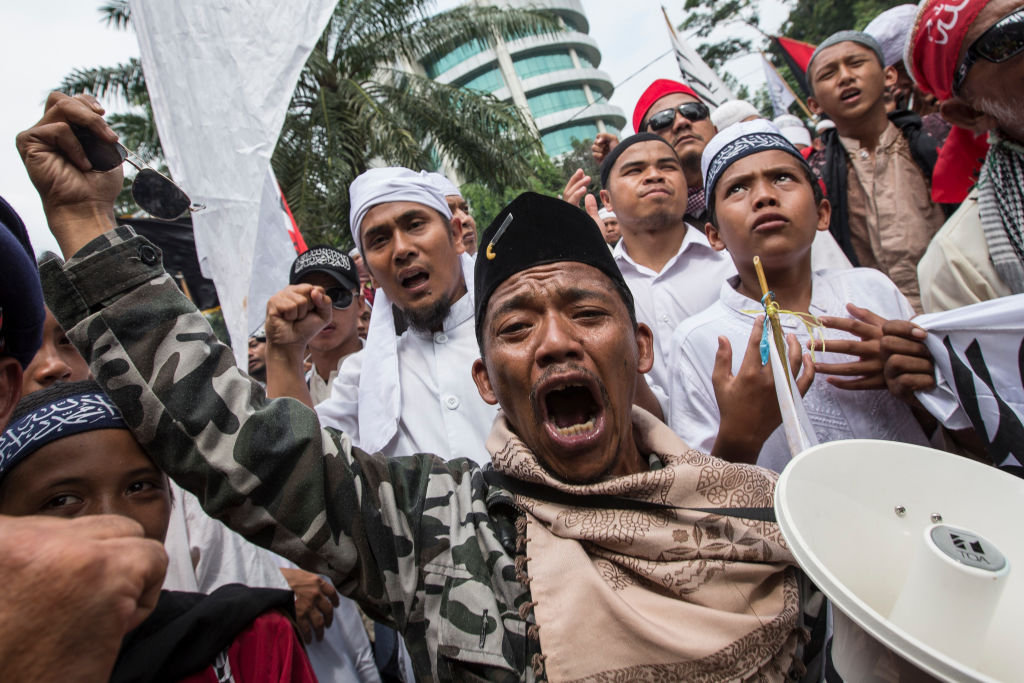
Members of various Islamist groups celebrate in Jakarta, Indonesia on May 9 after Ahok, the Christian governor of Jakarta, was convicted of committing blasphemy. (Image source: Ed Wray/Getty Images)

Earlier this year in Algeria, Samir Chamek, a 34-year-old Christian man, was sentenced to a year in prison after a court found him "guilty of insulting Islam and its prophet over items he posted on his Facebook page." They were described as "accusing the prophet Muhammad of terrorism and murder and comparing the prophet to Hitler, mentioning the persecution and massacre of the Jews." Also in Algeria, last August, a Muslim convert to Christianity was sentenced to the maximum five years in prison for saying that the light of Jesus will outshine Islam and its prophet Muhammad on social media, which the court ruled as "blasphemous."

In October, in Ethiopia, four Christian girls -- aged 18, 15, 14, and 14 -- handed out a booklet entitled, "Let's speak the truth in love." Because it challenged Islamic accusations against Christianity, local Muslims deemed the book blasphemous and rioted. They attacked a church and assaulted Christians. The girls were arrested and, after a brief court hearing on November 15, sentenced to a month in prison.

As in Pakistan, Muslims mobs and "vigilantes" often take "the law" into their own hands. In March, in India, a Muslim-turned-atheist "was hacked to death by a four-member gang" of Muslims. Last September, a Christian writer and activist was murdered outside of a courthouse in Jordan. The 56-year-old man was earlier arrested for sharing a "blasphemous" cartoon about the Islamic prophet Muhammad. As he was walking into court to stand trial for "contempt of religion" and "inciting sectarian strife," a man dressed in traditional Muslim garb shot him to death.

Last August, in Nigeria, after two university students got into an argument, the Muslim student accused the Christian student of insulting Muhammad. Soon a mob of Muslims assembled and said the Christian must die. Then they savagely beat and nearly killed him. The following day, mobs of Muslims rioted and vandalized Christian campuses and churches.

Such nonstop accusations, incarcerations, murders, torture and death penalties meted out to non-Muslims on the mere accusation of "blasphemy" -- at the hands of mobs, vigilantes, and court judges -- call into question any claims of tolerance, modernity or pluralism in many Muslim-majority nations.
Raymond Ibrahim is the author of Crucified Again: Exposing Islam's New War on Christians (published by Regnery with Gatestone Institute, April 2013).

[1] At least one but often more blasphemy-related cases appear practically every month in Pakistan and are documented in the monthly "Muslim Persecution of Christians" reports. The following are incidents that occurred in the last report, January 2017:
  • An evangelical Christian was arrested on charges of blasphemy and faces the death penalty. According to a complaint by a Muslim, Haji Nadeem, Shahbaz Babu desecrated the Koran by writing his name on some pages, tearing them up and then scattering them on the street in front of a mosque. Although the Muslim admits he did not see the accused in the act, Babu—whom rights activists say is "completely illiterate"—was nonetheless arrested. In a nation where the mere accusation that an infidel insulted Islam could get the non-Muslim killed by the mob, executed by the state or simply imprisoned, Babu's defenders wonder at the notion that he "is supposed to have desecrated the Qurʾān in secret, but then left the evidence for everyone to see." Others say that he was disliked by the mosque because several members had stopped attending it and listening to the evangelist who is popular in his region.
  • An imam in Lambanwali accused an elderly Christian of writing and sending to him a series of "derogatory letters" in which he defamed Islamic prophet Muhammad. Once the blasphemy accusation was made, police promptly stormed the Christian's home in the night and arrested his entire family. Although the man denies the accusation—correctly pointing out that only a suicide would do what he is accused of doing in Pakistan—he "is likely to face an imprisonment of 10 years while there are assumptions that Section 295-C might be invoked in order to aggravate the punishment to death penalty," said the report.
  • A blasphemy case was registered against Shaan Taseer—son of Salman Taseer, a human rights activist and defender of persecuted Christians who was assassinated by Muslims—for saying "Merry Christmas."
  • Five Christian rights activists were known for their public opposition to the country's blasphemy laws all went missing within the same week.
[2] The blasphemy controversy erupted when a video appeared online of Ahok saying that many Muslims misunderstand Koran 5:51 -- which commands Muslims not to befriend Jews and Christians. That a Christian would dare try to distort the Koran's call for hostility against Christians and Jews in order to boost his chances at reelection was deemed blasphemous enough to prompt mass riots and calls for his death in Indonesia.

Raymond Ibrahim is the author of Crucified Again: Exposing Islam's New War on Christians (published by Regnery with Gatestone Institute, April 2013).

Source: https://www.gatestoneinstitute.org/10346/islam-blasphemy-christians

Follow Middle East and Terrorism on Twitter

Copyright - Original materials copyright (c) by the authors.

Germany Confiscating Homes to Use for Migrants - Soeren Kern


by Soeren Kern

Meanwhile, some Germans are asking what is next: Will authorities now limit the maximum amount of living space per person, and force those with large apartments to share them with strangers?

  • In an unprecedented move, Hamburg authorities confiscated six residential units in the Hamm district near the city center. A trustee appointed by the city is now renovating the properties and will rent them — against the will of the owner — to tenants chosen by the city. District spokeswoman Sorina Weiland said that all renovation costs will be billed to the owner of the properties.
  • Similar expropriation measures have been proposed in Berlin, the German capital, but abandoned because they were deemed unconstitutional.
  • Some Germans are asking what is next: Will authorities now limit the maximum amount of living space per person, and force those with large apartments to share them with strangers?
Authorities in Hamburg, the second-largest city in Germany, have begun confiscating private dwellings to ease a housing shortage — one that has been acutely exacerbated by Chancellor Angela Merkel's decision to allow more than two million migrants into the country in recent years.

City officials have been seizing commercial properties and converting them into migrant shelters since late 2015, when Merkel opened German borders to hundreds of thousands of migrants from Africa, Asia and the Middle East. Now, however, the city is expropriating residential property units owned by private citizens.

In an unprecedented move, Hamburg authorities recently confiscated six residential units in the Hamm district near the city center. The units, which are owned by a private landlord, are in need of repair and have been vacant since 2012. A trustee appointed by the city is now renovating the properties and will rent them — against the will of the owner — to tenants chosen by the city. District spokeswoman Sorina Weiland said that all renovation costs will be billed to the owner of the properties.

The expropriation is authorized by the Hamburg Housing Protection Act (Hamburger Wohnraumschutzgesetz), a 1982 law that was updated by the city's Socialist government in May 2013 to enable the city to seize any residential property unit that has been vacant for more than four months.

The forced lease, the first of its kind in Germany, is said to be aimed at pressuring the owners of other vacant residences in the city to make them available for rent. Of the 700,000 rental units in Hamburg, somewhere between 1,000 and 5,000 (less than one percent) are believed to be vacant, according an estimate by the Hamburg Senate.


Hamburg, Germany. (Images source: Morris MacMatzen/Getty Images)

Socialists and Greens in Hamburg recently established a "hotline" where local residents can report vacant properties. Activists have also created a website — Leerstandsmelder (Vacancy Detector) — to identify unoccupied real estate in Hamburg and other German cities.

It remains unclear why the landlord in Hamm left his apartments vacant for more than five years. Some have posited that, given the location of the properties, the renovation costs may have been too high and probably would not have been offset by the rental income.

Others are blaming city officials for not approving more building permits to allow for the construction of new residential units. A study conducted in 2012 — well before the migrant crisis reached epic proportions — forecast that by 2017, Hamburg would have a deficit of at least 50,000 rental properties.

In 2016, however, only 2,433 new residential units came onto the market, while only 2,290 new building permits were approved, according to statistics provided by the City of Hamburg. These numbers were up slightly from 2,192 new units and 2,041 new permit approvals in 2015.

In 2012, Hamburg's Socialist government presented a plan to build 6,000 new residential units per year. The plan never materialized, however, because prospective builders were constricted by government-imposed rental caps which would have made it impossible for them to even recover their construction costs.

Since then, the city has turned to seizing private property to resolve its self-inflicted housing crisis.

On October 1, 2015, the Hamburg Parliament (Hamburgische Bürgerschaft) approved a new law that allows the city to seize vacant commercial real estate (office buildings and land) and use it to house migrants.

City officials said the measure was necessary because, at the time, more than 400 new migrants were arriving in Hamburg each day and all the existing refugee shelters were full. They said that because the owners of vacant real estate refused to make their property available to the city on a voluntary basis, the city should be given the right to take it by force.

The measure was applauded by those on the left of the political spectrum. "We are doing everything we can to ensure that the refugees are not homeless during the coming winter," said Senator Till Steffen of the Green Party. "For this reason, we need to use vacant commercial properties."

Others have argued that efforts by the state to seize private property are autocratic and reek of Communism. "The proposed confiscation of private land and buildings is a massive attack on the property rights of the citizens of Hamburg," said André Trepoll of the center-right Christian Democratic Union (CDU). "It amounts to an expropriation by the state." He said the proposed measure is a "law of intimidation" that amounts to a "political dam-break with far-reaching implications." He added: "The ends do not justify any and all means."

Katja Suding, the leader of the Free Democrats (FDP) in Hamburg, said that the proposed law is an "unacceptable crossing of red lines... Such coercive measures will only fuel resentment against refugees."

Similar expropriation measures have been proposed in Berlin, the German capital, but abandoned because they were deemed unconstitutional.

In November 2015, lawmakers in Berlin considered emergency legislation that would have allowed local authorities to seize private residences to accommodate asylum seekers. The proposal would have authorized police forcibly to enter private homes and apartments without a warrant to determine their suitability as housing for refugees and migrants.

The legislation, proposed by Berlin Mayor Michael Müller of the center-left Social Democrats (SPD), would have amended Section 36 of Berlin's Public Order and Safety Law (Allgemeine Gesetz zum Schutz der öffentlichen Sicherheit und Ordnung, ASOG), which currently allows police to enter private residences only in extreme instances, to "avert acute threats," that is, to fight serious crime. Müller wanted to expand the scope for warrantless inspections to include "preventing homelessness."

The proposal was kept secret from the public until the leader of the Free Democrats (FDP) in Berlin, Sebastian Czaja, warned the measure would violate the German constitution. He said:
"The plans of the Berlin Senate to requisition residential and commercial property without the consent of the owner to accommodate refugees is an open breach of the constitution. The attempt by the Senate to undermine the constitutional right to property and the inviolability of the home must be resolutely opposed."
Since then, both the mayor's office and the Senate appear to have abandoned their plans.
Following an investigation, Gunnar Schupelius, a columnist with the Berlin newspaper BZ, wrote:
"A strange report made the rounds at the weekend: The Senate would authorize the police to enter private homes to house refugees, even against the will of the owner. I thought it was only satire, then a misunderstanding, because the Basic Law, Article 13, states: 'The home is inviolable.'
"So I went on a search for the source of this strange report and found it. There is a 'proposal' which the Senate Chancellery (Senatskanzlei) has apparently circulated among the senators. The Senate Chancellery is another name for the mayor's office. The permanent secretary is Björn Böhning (SPD)...
"The proposal is clear: The police can enter private property without a court order in order to search for housing for refugees when these are threatened with homelessness. You can do that 'without the consent of the owner.' And not only should the police be allowed to do this, but also the regulatory agencies.
"This delicate 'proposal' attracted little public attention. Only Berlin FDP General Secretary Sebastian Czaja spoke up and warned of an 'open preparation for breach of the constitution.' Internally, there should have been protests. The 'proposal' suddenly disappeared from the table. Is it completely gone or will it return?"
It remains unclear why no one has challenged the constitutionality of Hamburg's expropriation law.

Meanwhile, some Germans are asking what is next: Will authorities now limit the maximum amount of living space per person, and force those with large apartments to share them with strangers?
Soeren Kern is a Senior Fellow at the New York-based Gatestone Institute. Follow him on Facebook and on Twitter.
Source: https://www.gatestoneinstitute.org/10352/germany-migrants-property-rights

Follow Middle East and Terrorism on Twitter

Copyright - Original materials copyright (c) by the authors.

University of Chicago Supporting Terrorists - Sara Dogan


by Sara Dogan


Silencing opponents.


FrontPageMag Editor’s note: The University of Chicago joins nine campuses on the list of “Top Ten College Administrations Most Friendly to Terrorists and Hostile to the First Amendment.” The University of Chicago provides financial and institutional support to terrorist-linked campus organizations such as the Hamas-funded hate-group Students for Justice in Palestine while actively suppressing speech exposing the truth about Israel’s terrorist adversaries and their allies in the United States.

Last night, the Freedom Center placed posters exposing the links between the terrorist group Hamas and SJP on the University of Chicago campus. When the Freedom Center placed similar posters on the campus last fall, a university spokeswoman called them “defamatory and inconsistent with our values and policies.” This latest round of posters serves to inform students about SJP’s true motives and allegiances and challenges the Chicago administration to uphold their stated commitment to free expression.

University of Chicago: Campus administration

The University of Chicago has long prided itself on producing independent thinkers and encouraging a certain iconoclasm among its students and faculty. In the fall of 2016, the university’s dean of students, John Ellison, engendered a national controversy by making an explicit statement in support of free speech in a letter to incoming students: “Our commitment to academic freedom means that we do not support so-called trigger warnings, we do not cancel invited speakers because their topics might prove controversial and we do not condone the creation of intellectual safe spaces where individuals can retreat from ideas and perspectives at odds with their own.”

It seemed that Ellison was bravely sailing against the winds of political correctness, but recent events at the University of Chicago suggest that this cherished commitment to free speech applies to students and campus organizations that seek Israel’s destruction, but not to those who defend the Jewish state and expose the terrorist connections of its enemies.

In the past few years, Chicago has witnessed the development of a highly active BDS campus movement, U of C Divest, which is currently supported by more than 20 student organizations on campus. In the spring of 2016, U of C Divest succeeded in passing a resolution endorsing BDS in Chicago’s student government. During the debate over the resolution, an amendment supporting the continued self-determination of the Jewish people and the existence of Israel was rejected, indicating that the coalition’s goals align with Hamas’s aims of destroying the Jewish state.

 The University of Chicago has brought numerous pro-Hamas speakers to campus. In October 2015, UC-SJP hosted BDS movement founder Omar Barghouti for a speech on “BDS and the Ethical Obligation to End Complicity in Oppression.” During his address, Barghouti labeled Israel a “savage unrepairable society” that conducts “ethnic cleansing.” He praised terrorism against Israel’s Jews, stating that “resistance” is a legitimate response to “the violence of an oppressive system.” Several UC organizations and departments co-sponsored Barghouti’s address including the Global Voices Program – University of Chicago International House, the Pozen Center for Human Rights, the Department of Political Science, and the Department of International Studies.

Later that same month, UC-SJP held a panel titled “Jerusalem in Crisis: Insider Perspectives on the Violence in Palestine-Israel” as part of the “UChicago Israeli Apartheid Week.” One speaker at the event, a graduate student member of SJP, stated: “Palestinian violent resistance against the violent Israeli military is always justified; it is the equivalent of biting the hand that is trying to choke you to death.”

In February 2016, a throng of angry protestors interrupted and threatened a Palestinian human rights activist, Bassam Eid, who came to speak on U. Chicago’s campus about the oppression of Palestinians by the theocratic terrorist regimes in the West Bank and Gaza. SJP members and supporters on campus were upset that Eid’s remarks were critical of the Palestinian Authority (PA) and failed to condemn Israel’s “occupation” of Palestine. In the video of Eid’s speech a young man can be seen screaming in Arabic: “I’m going to destroy this place!” and “I’m going to kill this motherf*****!” and “Wait until you go to your car!” Eid later declared himself to be “terrified” by the ordeal.

 The University of Chicago has put forth a “Statement on Principles of Free Expression” which states that it “is an institution fully committed to the creation of knowledge across the spectrum of disciplines and professions, firm in its belief that a culture of intense inquiry and informed argument generates lasting ideas, and that the members of its community have a responsibility both to challenge and to listen.”

An examination of recent events on campus reveals that these principles are not applied without bias. SJP continues to function as a student organization in good standing at the University of Chicago, despite inviting speakers to campus that have engaged in anti-Semitic attacks and expressed Hamas propaganda which threatens the existence of the Jewish state. Yet, when the David Horowitz Freedom Center worked with activists to hang posters on campus which proposed a more truthful narrative revealing the financial and organizational connections between Hamas and Students for Justice in Palestine through a Hamas-front calling itself American Muslims for Palestine (AMP), University spokesperson Marielle Sainvilus said:  “While the University of Chicago encourages the free exchange of diverse ideas and perspectives concerning a wide range of issues, these flyers are defamatory and inconsistent with our values and policies.”

For their blatant hypocrisy in allowing and defending speech supporting Hamas while vilifying  speech critical of that anti-Israel terror group, the University of Chicago administration makes our list of Administrations Most Friendly to Terrorists and Hostile to the First Amendment.

Sara Dogan

Source: http://www.frontpagemag.com/fpm/266686/university-chicago-supporting-terrorists-sara-dogan

Follow Middle East and Terrorism on Twitter

Copyright - Original materials copyright (c) by the authors.

Increasing nervousness: Trump's approaching visit to the Middle East - Dr. Mordechai Kedar


by Dr. Mordechai Kedar

Will the US president be able to solve the paradoxes faced by the US in Mideast alliances and will he see through the false presentations he is going to be shown?

If there are  no last minute changes, President Trump will be embarking on a trip to the Middle East that includes Israel, the PA and Saudi Arabia. The trip has a very tight schedule because those planning it at each stop are trying to cram as many events, places and people as they possibly can into the time alloted for the President's visit.
In the nature of things, there will be long lines of people who want to shake hands with the important visitor, the most powerful man in the world. Each one of them is confident that Trump will remember the one sentence he manages to slip in between the shoves of those who are next in line and the elbows of the security detail protecting Trump from all angles. Trump's speechwriters are putting in long  hours to prepare suitable texts for each stop and its audience, hoping the listeners will take his words to heart. 

One thing is certain, a week affter Trump's visit, he won't remember a word of the texts he read out loud. A week? That long? I must be an incurable optimist.

Everyone knows that Trump himself knows very little about the MIddle East's problems and hasn't the sliightest idea where to find a solution for them and how to go about doing so, especially when compared to the presidents who preceded him, who spent a good deal of time learning the problems involved and put much wasted effort into attempting to find solutions for them. The 100 days of Trump's presidency presented the world with a leader imbued with a feeling of power, who acts according to his own instincts and whose reactions are not predictable. As I wrote these lines, Trump fired the head of the FBI and my heart tells me that this was not the result of a long, carefully considered analysis of the situation.

Israel plans an itinerary including Yad Vashem, the Western Wall, the President's House, Massada and a dinner with the Prime Minister for the honored guest. The itinerary is filled with symbolism, focused on Jerusalem, on ancient and recent Jewish history, and is intended to strengthen Trump's consciouusness of the connection between the Jewish nation and its capital city and homeland - and the need for the world and the USA in particular to protect this connection and strengthen it. Naturally, it is impossible to  include lengthy, deep discussions in a trip of this brief duration, and anyway, it is doubtful Trump has spent a significant amount of time discussing the problems of the Middle East with real seriousness. Not one of his advisors has professional expertise or experience regarding the Middle East, so the results are liable to be superficial at best.

The one thing all Trump's Middle Eastern hosts are afraid of is a combination of three factors: One is Trump's businessman's way of  thinking that leads him to want to close a deal at any price, even at the expense of things that are of utmost importance to his partners. The second is his characteristic use of power when dealing with friends and enemies, and the third is the impulsivity his actions reflect, a trait that raises doubts about the effectivity of the solutions he might suggest. In this  kind of  situation, especially taking into account his lack of knowledge and experience of the Middle East, his advisors become increasingly important, especially their relations with one another and the demarcation of each one's areas of responsibililty.

I think that in each of Trump's stops, his hosts are preparing themselves for a guest who may present ideas with which they disagree, but whose ideas they will listen to without making their opinions obvious so as not to lose his and his advisors' good will.  They are preparing presentations that he will  enjoy, speeches he will be pleased to hear, anything to prevent his getting angry if his plans are not carried out the  way he wants them to be - and the probability of that is rather high.

The most extreme example of this will probably occur in Saudi Arabia. Trump is supposed to be the guest of honor at a conference of leaders of Islamic nations, called to discuss the extremism that has enveloped Arab and Islamic society and suggest ways of coping with this phenomenon. Trump's motivation for getting involved in the problem of Islamic radicalization stems from his gut - and on the mark - feeling that the radical hostility towards current regimes in Islamic countries may turn against the USA, which is a friend and ally of these regimes.That happened in the early years of this century - notably the 9/11 attack by Bin Laden and al Qaeda - and that is how it has continued up to the present. The problem facing Trump and the conference is that in the background there is the growing tension between the Saudis, representing the Sunnis, and Iran, which represents the Shiites, and the horrific wars being waged by these two antagonists in Yemen, Syria, Iraq and Lebanon.

The only way the Saudis and other Sunni countries can deal with Iran without a direct and terrible war against that country is through the Sunni Salafist groups, such as those operating in Syria and Iraq, who are fighting Iran and its allies - Hezbollah, Assad and Russia. How can the American president deal with an Iran which is constantly increasing its armaments and power without recourse to the "extremist" organizations funded by Saudi Arabia?

This is where the possiblity of "boots on the ground" arises, meaning that American troops will be sent to the Jihadi fields of the Middle East in order to advance America's security interests, while at the present time there are already American soldiers in Syria, Iraq, Afghanistan and for all we know, in other regions at war.

Trump needs  the cooperation of the Islamic countries for US operations against two Islamist powers, ISIS and Iran.  The problem is that this contains an internal paradox: Shiite Iran has the most to gain from the elimination of ISIS, a Sunni force, and its destruction will allow Iran to return the areas in Syria conquered by ISIS in 2014 to its ally, Assad, In addition, the Saudis have been and still are the main supporters of ISIS - behind the scenes, of course. This is why, in Riyadh, Trump will listen gravely, by way of earphones, to the speeches of leaders who are all united against "extremism and terror" while simultaneously, some of them are funding (and not only funding) those very same organizations against which they speak in that so very important conference taking place in  Riyadh.

Egypt is not on Trump's itinerary for security reasons, but Trump may meet with the Egyptian president, Al Sisi, while at the Riyadh conference. Perhaps a meeting has already been planned.

It is clear that this tour is intended to advance the establishment of a pro-American coallition in the  Middle East, one that the Americans believe will succeed in creating a force against the Russia-Iran axis of which Turkey is a not insignificant member. The pro-American coalition Trump is trying to create will include the Saudis, Jordan, Egypt, Israel, the Palestinian Authority and the Kurdish orgabizations trying to gain liberty and independence in the Turkish regions of Syria despite the fierce opposition of Turkish president. Erdogan. 

To enable the formation of this coalition, the sides must find solutions to some "incidental" problems that exist between them, such as the establishment of a Palestinian State and peace with Israel. This is what lies behind the sudden "smiles and peace talk attack" act displayed by Mahmoud Abbas and the other act put on by Jordanian King Abdullah's claiming that his country is ISIS' next target. In both these mendacious presentations the facts are not of any importance, because Trump doesn't check the truth of what he is told anyway, a telling example of that being Abbas' totally false presentation of PA "education for peace."

It can be concluded that Trump's Middle East visit will be judged by its results and not by the honeyed words he is going to hear during the days he is in the region. It is here, in the small and infuriating things, that evil lurks. We can only wish Trump,his advisors, the USA and the entire world, the ability to reach a deep understanding of the Middle East's problems and of the correct solutions that actually can be carried out, not just written glowingly on paper, in this war-torn area.

Written for Arutz Sheva, translated from Hebrew by Rochel Sylvetsky.


Dr. Mordechai Kedar is a senior lecturer in the Department of Arabic at Bar-Ilan University. He served in IDF Military Intelligence for 25 years, specializing in Arab political discourse, Arab mass media, Islamic groups and the Syrian domestic arena. Thoroughly familiar with Arab media in real time, he is frequently interviewed on the various news programs in Israel.

Source: http://www.israelnationalnews.com/Articles/Article.aspx/20506

Follow Middle East and Terrorism on Twitter

Copyright - Original materials copyright (c) by the authors.