Sunday, November 5, 2017

IDF recovers bodies of 5 terrorists from Gaza terror tunnel - David Rosenberg


by David Rosenberg

After far-left NGO, Hamas regime demand return of dead terrorists' bodies, IDF seizes terrorists' remains from terror tunnel.


Terror tunnel
Terror tunnel
Flash90
Israeli forces operating in a terror tunnel along the border with Gaza have located and retrieved the bodies of 5 of the 12 Islamist terrorists killed when the IDF demolished the tunnel in a controlled explosion last week.

The tunnel, part of a network which extended from the city of Khan Yunis in the southern Gaza Strip into Israeli territory, was destroyed as part of the IDF’s efforts to prevent terrorists from maintaining underground routes the Gaza security fence.

Twelve Hamas and Islamic Jihad terrorists operating in the tunnel at the time of the explosion were killed, with several others injured.

Despite demands by Hamas and Islamic Jihad that they be permitted to enter the tunnel to retrieve the bodies of their fellow terrorists, Israel refused, saying it would not permit any entry into the tunnel system, which extended into Israeli territory.

"Following the request of the International Committee of the Red Cross to reveal the location of the terrorists missing under the tunnel, which was handled by the IDF this week, the Coordinator of Government Activities in the Territories, Major General Yoav Mordechai, spoke to the head of the delegation of the International Committee of the Red Cross," the COGAT announcement said. It also noted that Maj. Gen. Mordechai "made it clear that Israel would not allow search operations in the security barrier area in the Gaza Strip without progress on the issue of Israeli POWs and MIAs."

Petitioners from the far-left Israeli-Arab NGO Adalah turned to the Supreme Court, calling on the court to force the government to permit Hamas to retrieve the bodies of the dead terrorists.

On Sunday, however, it was revealed that IDF forces operating in the tunnel following the demolition had located the remains of five of the terrorists.

The terrorists’ bodies have been recovered and are currently being held by Israel.

"We are indeed in possession of those bodies of five terrorists," IDF spokesman Jonathan Conricus told AFP.

"All were killed or died inside Israeli territory, not in the Gaza Strip."

The Hamas terror group has held the bodies of two slain IDF soldiers, Hadar Goldin and Oron Shaul, in captivity since 2014, demanding the release of large numbers of jailed Arab terrorists as a goodwill gesture before negotiations for the soldiers’ release even begin. Three Israeli citizens are also believed to be held by Hamas.


David Rosenberg

Source: http://www.israelnationalnews.com/News/News.aspx/237674

Follow Middle East and Terrorism on Twitter

Copyright - Original materials copyright (c) by the authors.

Between a rock and a hard place - Yoav Limor


by Yoav Limor

While the covenant between the Israeli Druze and the State of Israel is clear and unquestionable, Hader is an enemy village whose allegiance lies with Assad.

The events in the Golan Heights last weekend are yet another reminder of how easily Israel could be sucked into the civil war in Syria, even if ostensibly nothing new happened. Tahrir al-Sham – a terrorist alliance of radical Sunni rebel groups, predominantly the al-Qaida-linked Nusra Front – perpetrated a suicide bombing against supporters of Syrian President Bashar Assad in the Syrian Druze village of Hader. At no point was Hader in danger of being taken over, but the incident threatened to ignite the entire region.

The incident led the Druze in Israel to believe their Syrian brethren were in danger. Community leaders acted on two fronts, pressuring political and military leaders on the one hand and sending Druze out to the street. Hundreds of youth arrived at the border and even broke through the fence at a certain point. The Israel Defense Forces were forced to adopt a two-pronged approach to ease the tension: first by deterrence, warning Tahrir al-Sham that an attack on Hader will not be tolerated, and second by reassuring both the Druze community leaders and its youth that they have they IDF's protection, convincing them to return to Israeli soil.

In this case, Israel is stuck between a rock and a hard place. While the covenant between the Israeli Druze and the State of Israel is clear and unquestionable, Hader is an enemy village whose allegiance lies with Assad. In fact, Hezbollah cells have been sent from the village to operate against the IDF. Supporting Hader, therefore, would not just support the Druze, but help Assad in the civil war in Syria.

On the other hand, refraining from aiding Hader would not only be a slap in the face of Israeli Druze, some of whom have relatives in Hader, but would also aid the rebels, in this case, al-Qaida in the Golan. No one in Israel has any illusions about what will happen if Hader is conquered and terrorists will be a stone's throw away from Majdal Shams.

The Israeli decision was unambiguous. Just like the last time it was feared the village would be captured, in 2014, Israel made it clear last Friday that it would protect Hader as part of its covenant with the Druze in Israel. This, however, should not be taken to mean that the IDF intends to send ground forces into Syrian territory. Israel dominates Hader topographically and could have stopped the rebels from arriving by an aerial operation and long-range fire.

Even though Israel made a clear call, the problem remains. All anyone who wants to drag Israel into the Syrian civil war, or even just to undermine the close ties with the Druze community, needs to do it attack Hader. This does not bode well for Israeli strategy in Syria, as it takes some of the control over events in the area away from Israel and places it in the hands of irresponsible third-parties in the Golan Heights.

While the Syrian front eventually subsided Saturday, at least temporarily, the Lebanese front heated up. Lebanese Prime Minister Saad Hariri's resignation does not directly affect Israel, but his resignation speech sounded as if it was taken straight out of the Israeli government's book. He blamed Hezbollah and Iran in meddling in internal Lebanese interests and disclosed an alleged assassination attempt against him just a few days earlier.

There is no doubt Hariri fears he might be assassinated, not only because that was the end his father, Rafik Hariri, met in 2005, but also because he knows his rivals wells and understands their motivations. This was not the first time he had publicly denounce the Shiite axis and not only was it personally brave, it was also a public call for the international community to save Lebanon. Over the next few days, we will learn whether he was acting independently or on behalf of his Saudi patron-partners.

Hariri's speech made things complicated for Hezbollah: Not only did he hint that the Shiite terrorist organization was responsible for the foiled attempt on his life and openly accuse it of trying to usurp control of Lebanon, Hezbollah now stands to be blamed for the political chaos that already simmering in Lebanon over the prime minister's resignation. This means that instead of resting on its laurels and recovering after the military victory in the Syrian civil war, Hezbollah will be trapped in a new political quagmire in Lebanon.


Yoav Limor

Source: http://www.israelhayom.com/opinions/between-a-rock-and-a-hard-place-2/

Follow Middle East and Terrorism on Twitter

Copyright - Original materials copyright (c) by the authors.

Modernizers launch a coup within the House of Saud - Thomas Lifson


by Thomas Lifson

A coup is taking place within the House of Saud, in which a modernizing monarch is grabbing power and taking out rivals

A coup is taking place within the House of Saud, in which a modernizing monarch is grabbing power and taking out rivals. Forces now under command of the ruler just arrested 11 princes among dozens of others and is launching financial investigations that could lead to serious punishment. In Saudi Arabia, they behead people (at least 157 times in 2015) and amputate a limb off of thieves. It is widely believed that baksheesh is not unknown in Saudi Arabian business circles, and an “anti-corruption committee” was recently formed. In other words, the tools are in place to take out any opposition among the powerful, within or outside the royal family.

Bloomberg reports:
Prince Miteb, son of the late King Abdullah, was removed from his post as head of the powerful National Guards.
That’s the first thing you do in coup: grab control of the forces on the ground.
Billionaire Prince Alwaleed bin Talal was picked up at his desert camp, the senior official said. Authorities did not disclose the evidence that prompted the arrests.
Prince Alwaleed bin Talal presides over a vast financial empire (estimated $35 billion in 2015):
Alwaleed is the largest individual shareholder of Citigroup, the second-largest voting shareholder in 21st Century Fox and owns a number of hotels. TIME even called him "Arabian Warren Buffet".

The second thing you do is take out any potential bankroller of rivals.

It all began a month after the historic visit of President Trump, when 81-year-old King Salman displaced the previous crown prince, who was his nephew, as tradition of succession required,[i] and installed that Crown Prince Mohammed bin Salman as effectively the monarch. 


MBS, as the Crown Prince is known, is the leader who is launching what modernizers hope will be a Saudi Version of the Meiji Restoration[ii] in Japan, transforming the political economy and culture out of necessity – in order to survive in the modern world system. The Saudis have practiced religious and cultural isolationism, while their oil allowed the country to avoid the necessity of building an economy that could supply anything else that the rest of the world would be willing to pay for.

The power grab was necessary, because Saudi Arabia has to modernize, and it won’t be pleasant for lots of people, in and out of the royal family. Thanks to fracking and associated technologies, prices are never going to return to $100 a barrel. The regime itself is at stake because the population is growing and the young have few prospects of employment. The House of Saud almost fell in 1979, when the Grand Mosque in Mecca was seized by Shiite insurgents (The Saudi Shiite minority is concentrated in the oil producing region near Iran) declaring their prophet to be the Mahdi. The entire religious legitimacy of the family is that they are custodians of the holy places of Islam, and yet they had to bring in Pakistanis to retake the holy of holies, the Kaaba.

Source: Wikimedia
They understand that in order to stay in power, they have to deliver change.

When President Trump visited Riyadh in May, the discussions must have included a mutual understanding of the changes the Regime has in mind. The US delegation included veteran Saudi-hand Secretary of State Tillerson and economic visionary Wilbur Ross of the Department of Commerce. These are precisely the people a monarch would want to talk to about restructuring his regime to cope with a reality that has changed. A big part of the modernization is entering closer relations with Israel, a natural mutual ally in resisting Iranian Shiites. Purportedly clandestine cooperation is widely in to be underway already. 

Of the people arrested, Alwaleed bin Tala is the most intriguing for Americans thanks to his Twitter sparring with candidate Trump during the election, and for a startling connection unearthed by Jack Cashill more than five years ago in World New Daily.
In late March 2008, on a local New York City show called “Inside City Hall,” the venerable African-American entrepreneur and politico, Percy Sutton, told host Dominic Carter how he was asked to help smooth Barack Obama’s admission into Harvard Law School 20 years earlier.
The octogenarian Sutton calmly and lucidly explained that he had been “introduced to [Obama] by a friend.” The friend’s name was Dr. Khalid al-Mansour, and the introduction had taken place about 20 years prior.
Sutton described al-Mansour as “the principal adviser to one of the world’s richest men.” The billionaire in question was Saudi prince Al-Waleed bin Talal.


Deep currents are being stirred.
Hat tip: Clarice Feldman

[i] This spread power around in the family, allowing for the growth of factionalism within the clan. Now that there is a direct and clear lineage, power can be grabbed at the very top and the rest of the clan brought into line.
[ii] I studied, wrote and taught the Meiji Restoration and realize the many differences in the specifics of the two countries’ situations. No exact parallel is implied.


Thomas Lifson

Source: http://www.americanthinker.com/blog/2017/11/modernizers_launch_a_coup_within_the_house_of_saud.html

Follow Middle East and Terrorism on Twitter

Copyright - Original materials copyright (c) by the authors.

Mullahs Tremble as Iran's People Honor Cyrus the Great at Pasargad - Hassan Mahmoudi


by Hassan Mahmoudi

Large groups of people defied the mullahs and gone to Pasargad to pay their respects to King Cyrus II by foot and vehicle.

This past Oct. 29, Iranians marked the international day of Cyrus the Great, the ancient ruler of the Persian empire whose legacy is credited with forging the Iranian national identity. King Cyrus II is held in great regard in Iran for creating the largest empire of civilized nations then known in the world, around 600 years before Christ. King Cyrus was not only a master military strategist, he differed from other conquerors of the time in his tolerance of the customs and cultures of those who came under his rule. He was the author of the world’s first human rights charter. He is an honored figure in Judaism because he freed the Jews from Babylonian captivity, declared that the temple in Jerusalem be rebuilt, and allowed the Jews to return to their homeland. In Islamic holy readings, he is considered a just ruler.


Iranians commemorate this day by gathering at Pasargad, the tomb of Cyrus the Great, which is located in the Fars province. Siasat Rouz, one of the state-run Iranian newspapers said, “The cyberspace is filled with pictures of Cyrus’s tomb and invitations to attend the commemoration ceremony!”


But recognizing Cyrus as a just ruler does not register with Iran’s mullahs, whose own rule compares quite poorly to the ancient Persian king. Terrified of large gatherings and potential protests against the government, the Iranian regime resorted to military exercises on the day Iranians remember Cyrus and increased suppressive activities in different cities in the Fars province, especially regions that surround the Pasargad tomb.

This year, Iran’s Revolutionary Guards and state security forces established a virtual military curfew in the surrounding regions. They blocked all roads that lead to Pasargad and prevented vehicles from going to the site. The Revolutionary Guards distributed an announcement to all vehicles and people who are moving toward Pasargad, which read: “The illegal gathering at Pasargad on Oct. 29 was orchestrated by the dissenters and anti-state movements. All mischief-makers will be dealt with through law and the judiciary.”


Despite all these measures, large groups of people defied the mullahs and gone to Pasargad to pay their respects to King Cyrus II by foot and vehicle

People from all over the country headed for Pasargad on Friday, Oct. 27, in a show of unity against the regime and in commemoration of Cyrus the Great. Worried about protests and uprisings against the regime, state officials expanded their suppressive measures a few weeks ago in order to prevent any gathering from taking shape. These measures have further escalated in the past week and day. 

From sources in Iran, these actions are listed as:
  • Revolutionary Guards, state security forces and plain-clothes agents gathered into the Fars province and controlled the roads and pathways that lead to Pasargad, in order to prevent people from entering the area.
  • Some of these forces are patrolling the area in black vehicles. All of the roads and parking lots surrounding the Pasargad site are swarming with security forces.
  • Revolutionary Guards and state security are patrolling the area with helicopters.
  • Parts of the Isfahan-Shiraz highway has been blocked by Iran’s City and Road Construction Office under the pretext of repairs and maintenance.
  • On Friday, Oct. 27, security forces forced a number of people at Sa’adat Shahr (25 km distance from Pasargad) to leave the city. A number of people were arrested in this area.
  • State security forces set up a long succession of motorcycles to patrol the area, in a bid to cause fear and panic.
  • Between 5,000 and 8,000 anti-riot forces were dispatched to the area.
  • Regime forces made widespread arrests in the past few few days in order to cause fear among people and create the impression that anyone participating in the Cyrus Day event will be convicted of political crimes.
  • Iran’s Revolutionary Guards blocked all roads that lead to the area. State security threatened people who were heading to the area, telling them, “If you’re going to Pasargad, you’re with the Mojahedin (MEK),” referring to the regime’s main opposition group, which has been banned since 1981.
  • Despite the blockade, people found alternative ways through the mountains in order to reach the site. Regime forces have arrested and beaten some of the people who have tried to reach Pasargad through the mountains.

Hassan Mahmoudi is a human rights advocate, specializing in political and economic issues relating to Iran and the Middle East. @hassan_mahmou1Source: http://www.americanthinker.com/articles/2017/11/irans_mullahs_tremble_as_iranians_honor_cyrus_the_great_at_pasargad.html

Follow Middle East and Terrorism on Twitter

Copyright - Original materials copyright (c) by the authors.

Time for an Assyrian Regional Government in Iraq - Uzay Bulut


by Uzay Bulut

After centuries of persecution, is it not the time for Assyrians and other persecuted Christians to finally have their own government?" — Sabri Atman

  • As can be seen in the region every day, it is not realistic to expect the Assyrians to be quiet and accept their "fate" under the tender mercies of Shiite or Sunni rule.
  • The future Assyrian regional government could be an independent state or autonomous region like the Kurdistan Regional Government (KRG) in Iraq. Even if it is city-state like Vatican City, it would be monumental in stopping the annihilation of Assyrian people and could also serve as a safe haven for other persecuted minorities.
  • "Thank God that Jews, a historically persecuted people just like us, now have Israel... After centuries of persecution, is it not the time for Assyrians and other persecuted Christians to finally have their own government?" — Sabri Atman, founder of the Assyrian Genocide and Research Center.
When ISIS invaded Iraq and its Nineveh Plain in 2014, one of the most victimized peoples were Assyrians, a Christian community indigenous to the region.

After the defeat of ISIS, some of the displaced Assyrians from the Nineveh Plain finally returned to their homeland, but today, they are fleeing their homes as their towns once again become a battleground -- this time between Iraqi and Kurdish forces.

The Assyrian-Syriac-Chaldean people have inhabited the Middle East since the beginning of recorded history. We might now, however, be witnessing the disappearance of this community. The end of the Assyrians in Iraq means the eventual end of the Assyrians altogether.

The Threat of Iran

Christians are also increasingly facing threats from Shiite Iran as, after its gains against ISIS in Iraq and Syria, it attempts to expand its influence in the region.

"Iran is aggressively establishing schools and mosques and libraries and other structures within the main Christian towns," said human rights lawyer Nina Shea, who once served on the U.S. Commission on International Religious Freedom.

A UN- and US-protected region is needed in northern Iraq to help restrict the empowerment and Iranification of Iraq, according to experts in the region Andrew Doran, Robert Nicholson, Mark Tooley, and Stephen Hollingshead. They argue that U.S. Ambassador Nikki Haley should call on the UN and US coalition allies to establish a protected zone for genocide victims in northern Iraq:
"The UN has a duty to protect Northern Iraq's indigenous peoples. It can also promote stability and security in the Middle East by preventing Iranian expansion to the Mediterranean Sea. Such a zone would also be a bulwark against Iranian-backed militias in Northern Iraq.
"What is required for administrative, juridical, and economic functions to take hold in these communities is to be liberated from the immediate threat — Iran. The presence of a multinational coalition force would likely be sufficient to deter Iranian aggression.... There are already U.S. and other coalition forces on the ground in northern Iraq. The force required to deter external aggression would be small. It is also worth noting that these communities in Northern Iraq were rarely covered in the news from 2003 until 2014, when ISIS conquered them. This is because they were peaceful, productive, and proven allies of the United States. They have suffered much for that alliance. This is no time to abandon them to Iran."

Centuries of Persecution

"The Assyrian homeland is in northern Mesopotamia, present-day Iraq, where the ancient cities of Assur and Nineveh were built," writes the scholar Hannibal Travis.
"For 300 years, Assyrian kings ruled the largest empire the world had yet known. The Assyrian Church of the East records that the Apostle Thomas himself converted the Assyrians to Christianity within a generation after the death of Christ. Christianity was 'well established and organized' in Mesopotamia by the third century CE."
Today a stateless and persecuted people, Assyrians have been continuously brutalized by Muslims in the region -- Turks, Kurds, Arabs, and Persians.

Every fifty years, there has been a massacre of Assyrians, according to the Assyrian International News Agency (AINA).

According to a report by the Center for the Study of Genocide and Human Rights of Rutgers University:
"The Assyrian people have been repeatedly victimized by genocidal assaults over the past century... Massacres, rapes, plundering, cultural desecrations, and forced deportations were all endemic. Around 750,000 Assyrians died during the genocide, amounting to nearly three quarters of its prewar population. The rest were dispersed elsewhere, mostly in the Middle East.
"Unfortunately, the persecution of Assyrians did not end with the collapse of the Ottoman Empire. From August 8-11, 1933, in the newly established state of Iraq, Assyrian villagers in the northern Iraqi town of Simele were brutally murdered. Some 3,000 men, women, and children were killed by Iraqi soldiers and Kurdish irregulars."
As a result of continued persecution and discrimination, the Assyrians in Turkey, Syria and Iran, once sizable communities, have almost completely been exterminated, apart from those who have fled to the U.S., Australia, Europe, Canada and Lebanon.

Why an Assyrian Regional Government (ARG) is an Urgent Need

The situation of Assyrians in Iraq is beginning to resemble the previous situation of those in Turkey, Iran, and Syria. Given all of the persecution to which Assyrians have been exposed and the lack of any support or protection from the West, the only way for Assyrian-Syriac-Chaldean people to survive is to have a protected "enclave" in the Nineveh Plain. As can be seen in the region every day, it is not realistic to expect the Assyrians to be quiet and accept their "fate" under the tender mercies of Shiite or Sunni rule.

Muslims make up a majority of the population in 49 countries around the world today. Regrettably, the proven hatred of many Muslim fanatics in that part of the world will not magically disappear. It is also delusional to argue that an Assyrian autonomy would somehow "destabilize" a region of chronic, bloody instability.

The future Assyrian Regional Government could be an independent state or autonomous region like the Kurdistan Regional Government (KRG) in Iraq. Even if it is city-state like Vatican City, it would be monumental in stopping the annihilation of Assyrian people and could also serve as a safe haven for other persecuted minorities.


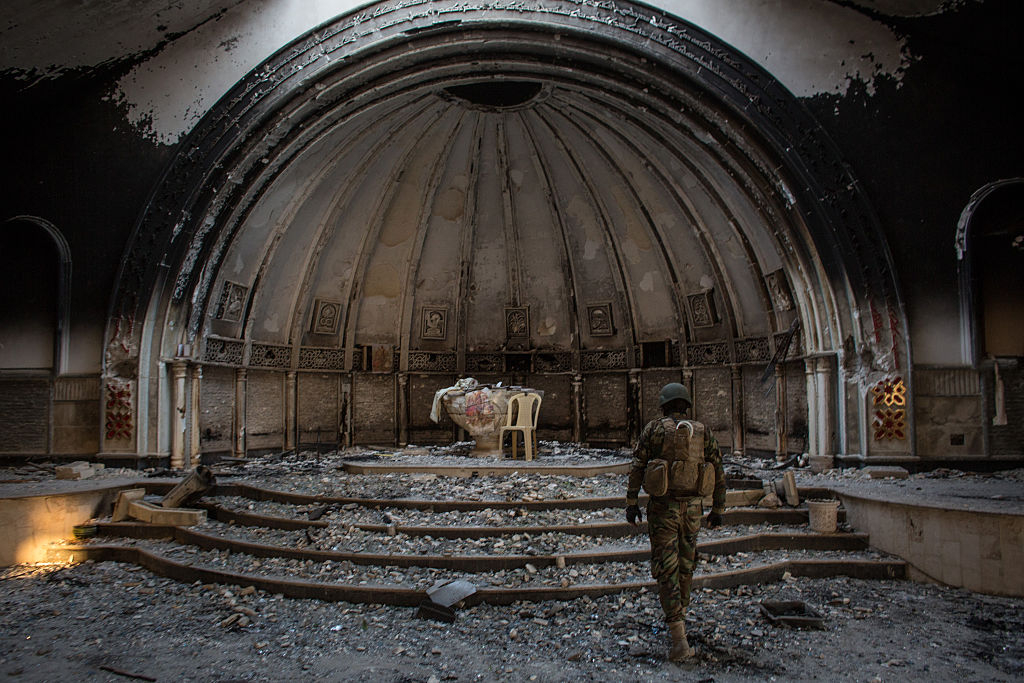
A fighter from the Nineveh Plain Protection Units (NPU) walks through a destroyed church on November 8, 2016 in Qaraqosh, Iraq. The NPU is a militia made up of Assyrian Christians that was formed in late 2014 to defend against ISIS. Qaraqosh is a mostly Assyrian city near of Mosul that was captured by ISIS in August 2014, and liberated in November 2016. (Photo by Chris McGrath/Getty Images)
All the Assyrian activists, politicians and scholars with whom Gatestone spoke asserted that the Assyrians should have a right to self-rule and security in the Nineveh Plain.

Yacoob Yaco, for instance, an Assyrian MP and political chair of the Nineveh Plain Protection Units (NPU), said that Assyrians are willing to defend their homeland. "For us to be able to do that effectively, the leading countries of the world must help us determine our fate, and to have our own political and military entity."

Joseph Baba, the Western Regional Director for the Assyrian American National Federation, told Gatestone:
"We would like to help establish a political structure in Nineveh Plain -- a secular republic -- that is pluralistic and respects the ethnic and religious diversity of the Nineveh Plain. The Assyrian government would also cooperate with its neighbors and others to bring peace to the region and open the door to endless business opportunities for many Western countries to invest."
"Forced displacement, persecution and genocide have caused the drastic decrease in our population," said Anahit Khosroeva, an Assyrian historian specializing on genocide studies, who is based in Armenia.
"The international community just closes eyes on all these...The West should not continue ignoring Assyrians and Yazidis. Every inch of this land and every line of history tells who this territory belongs to. We deserve a state."
David William Lazar, the Chairman of the American Mesopotamian Organization, called for "the establishment of three new provinces in the districts of the Nineveh Plain, Talafar and Sinjar. "The current Iraqi constitution allows the proposed region to have its own parliament and executive branch similar to the region under the control of the Kurdish authorities."

"The world should not expect us to be protected by any other forces but our own," Juliana Taimoorazy, a leading Assyrian activist and the Founding President of the Iraqi Christian Relief Council, told Gatestone. "We have been betrayed by both the Iraqi military and the Kurdish Peshmerga, over and over again."

She called on the Kurdish government to recognize Assyrian rights. "There are also Assyrians living under Kurdish rule. We ask the Kurdish government to honor Assyrians under their rule by recognizing our identity, flag, schools, churches, and language."

In an interview with Gatestone, Sabri Atman, the founder of the Assyrian Genocide and Research Center (Seyfo Center), said:
"There are two options. Either Assyrians in Iraq will have their own government in Nineveh and will be a free nation, or they might be extinct in a few decades. In order to stop the latter from happening, the Assyrian administration in Nineveh should be protected by the UN and the US. Thank God that Jews, a historically persecuted people just like us, now have Israel. The Assyrian claim for autonomy has never been realized. After centuries of persecution, is it not the time for Assyrians and other persecuted Christians to finally have their own government?"

Uzay Bulut, a journalist born and raised in Turkey, is currently based in Washington D.C. She is a writing fellow of the Middle East Forum.

Source: https://www.gatestoneinstitute.org/11294/assyrian-regional-government

Follow Middle East and Terrorism on Twitter

Copyright - Original materials copyright (c) by the authors.

"We Are Going to Burn You Alive!" - Raymond Ibrahim


by Raymond Ibrahim

"Islam is an open-ended declaration of war against non-Muslims"

  • "They defend freedom of worship in the West in order to ban it in their homeland. They fight to build mosques in someone else's homeland whilst destroying churches and synagogues where they have power." — Kamel Abderrahmani, Arab journalist, Algeria.
  • "ISIS publicly caged and burned alive 19 Yazidi girls for refusing to have sex with ISIS fighters, according to local activists. Yazidi leaders last year showed Fox News photographs of the Islamic jihadists burning babies to death on a slab of sheet metal, photos that show tiny, roasted bodies side by side as flames engulfed them." — ISIS in Iraq, Fox News, June 14.
  • The Erdogan government seized at least 50 Syriac churches, monasteries, and Christian cemeteries, many of which were still active, in Mardin province, and declared them "state property." — Turkey.
  • A presidential order replaced Christian education with Islamic Studies in secondary schools. While the subject, "Christian Religious Knowledge," no longer exists, Islamic, Arab, and French studies have been introduced in the new curriculum.... The Christian Association of Nigeria further denounced this move "to force Islamic studies down the throats of non-adherents of the religion," as being an "agenda deliberately crafted towards Islamization." — Nigeria.
Jesuit Father Henri Boulad, an Islamic scholar of the Egyptian Greek Melkite rite, pulled no punches in an interview concerning the motives of Islamic terror and Western responses to it. "Islam is an open-ended declaration of war against non-Muslims" and those who carry out acts of violence and intolerance are only doing what their creed requires, said the priest. The interview continues:
Those who fail to recognize the real threat posed by Islam are naïve and ignorant of history, he said, and unfortunately many in the Church fall into this category.
Citing a letter he wrote last August to Pope Francis, Father Boulad said that "on the pretext of openness, tolerance and Christian charity — the Catholic Church has fallen into the trap of the liberal left ideology which is destroying the West."
"Anything that does not espouse this ideology is immediately stigmatized in the name of 'political correctness,'" he said.
The priest went so far as to chastise Pope Francis himself—a fellow Jesuit—suggesting that he has fallen into this trap as well.
"Many think that a certain number of your positions are aligned with this ideology and that, from complacency, you go from concessions to concessions and compromises in compromises at the expense of the truth," the priest wrote to Francis.
Christians in the West and in the East, he wrote the Pope, "are expecting something from you other than vague and harmless declarations that may obscure reality."
"It is high time to emerge from a shameful and embarrassed silence in the face of this Islamism that attacks the West and the rest of the world. A systematically conciliatory attitude is interpreted by the majority of Muslims as a sign of fear and weakness," he said.
"If Jesus said to us: Blessed are the peacemakers, he did not say to us: Blessed are the pacifists. Peace is peace at any cost, at any price. Such an attitude is a pure and simple betrayal of truth," he said.
The priest also stated his belief that the West is in an ethical and moral debacle, and its defense of Islam is a denial of truth.
"By defending at all costs Islam and seeking to exonerate it from the horrors committed every day in its name, one ends up betraying the truth," he wrote.
June's roundup of Muslim persecution of Christians around the world includes, but is not limited to, the following:
Muslim Attacks on and Desecration of Christian Churches
Philippines: On June 21 in the village of Malagakit, the Bangsamoro Islamic Freedom Fighters (BIFF) — which earlier pledged allegiance to the Islamic State — vandalized a Catholic church. Describing the desecration as "wicked," the chief police inspector said the "crucifix and images of the Virgin Mary and Jesus Christ were destroyed while the sacred hosts were thrown all over the floor." Cardinal Quevedo, who condemned the sacrilege in the strongest terms possible, challenged the leaders of the BIFF to punish its men who desecrated the chapel: "If the BIFF wants to have an image as a respecter of all religions, it must punish its members who perpetrated the odious desecration and educate all its members in strictly respecting other religions," the prelate said. "Last month, terrorist gunmen also desecrated St. Mary's Cathedral in Marawi, some 150 kilometers from Cotabato," the report noted. "The gunmen were seen on a video [here] destroying religious images and burning the cathedral."
Egypt: An Islamic terror cell consisting of six members, two of whom were described as "suicide bombers," planning on bombing yet another Coptic Christian church in Alexandria, was exposed and arrested by police before they could launch their attack. According to a statement from the Egyptian Interior Ministry, "one attacker had planned to detonate an explosive vest inside the church and the other to blow himself up when police arrived to the scene." Several similar, recent attacks on Christian churches in Egypt had left about 100 churchgoers dead and hundreds severely wounded.
Separately, authorities raided a church-owned building being used by the local Coptic Christian community for worship. After police removed furniture, Christian iconography and other items from the building, they chained down the doors to prevent Christians from entering the building. Christians had for some time tried to have the building legally recognized as a church, only to face a backlash from both local Muslims and authorities. According to a local Christian:
"During the early hours of Friday, June 16, we [Christians] were surprised to find the furniture, rugs, icons, pictures, and worship utensils ... had been thrown outside and the building closed down with seals and chains. We took the belongings into our homes. We don't know why the police did that."
When dozens of church leaders met with the local governor insisting that they needed a place to worship, he told them the building they were using had been found to be in a state of disrepair and needed to be demolished.
Algeria: On June 9, the state oversaw the demolition of the Catholic church located in Sidi Moussa, 15 miles from Algiers. According to Kamel Abderrahmani, an Arab journalist who covered the incident:
"Algerian authorities found a very shallow argument to justify this anti-Christian act. According to the authorities concerned, the church was listed in the red category by the technical inspection services. The legitimate question that arises from this is, since the building was deemed in danger of collapse, why was it not restored and listed as part of the national heritage? The statement of the mayor was of unprecedented clarity. He had announced the construction of a mosque and a Quranic school on the same site. Such statements caused outrage, as many saw the demolition as an act of vandalism."
Kamel also noted how the Algerian government had demolished other churches on other pretexts, and concluded by calling Muslim governments and activists "hypocrites":
"If the mayor of Paris or Rome had destroyed a mosque to build a church, what would have happened? Sunni Muslims would have shouted scandal and Islamophobia! This question shows the hypocrisy of Islamists and their double standards. They defend freedom of worship in the West in order to ban it in their homeland. They fight to build mosques in someone else's homeland whilst destroying churches and synagogues where they have power."
Iraq: In June 2015, when Mosul was under the Islamic State's control, the group had announced it was converting St. Ephrem Church into a "mosque of the mujahedeen." The cross from the dome was broken off, and all Christian symbols were purged from within the house of worship. Now, months after Mosul was liberated, the occupied church was exposed as being used as a sex-slave chamber where approximately 200 Yazidi girls and women were abused by the Islamic State. A report recounts "ISIS' depravity towards Yazidi women and girls. On the floor of the iconic house of worship lie tiny pieces of pink and yellow underwear and flower headbands belonging to the very young Yazidi sex slaves the barbaric terrorist group took captive." The June 14 report also notes:
"Last week, according to local activists, ISIS publicly caged and burned alive 19 Yazidi girls for refusing to have sex with ISIS fighters, according to local activists. Yazidi leaders last year showed Fox News photographs of the Islamic jihadists burning babies to death on a slab of sheet metal, photos that show tiny, roasted bodies side by side as flames engulfed them....The butchered Christian building and its Yazidi remnants serve as chilling reminders of the genocide experienced by the two religious minorities."
Spain: A Muslim man stormed a Christian church during a marriage ceremony, and started shouting "Allahu Akbar" — "Allah is greatest." He "tried to throw liturgical objects around him to attack the priest and churchgoers," according to a report. A number of wedding attendants managed to apprehend the 22-year-old Moroccan and hand him over to police, who reportedly charged him with "disturbing public order, crime against religious feelings and threats." Police also investigated the church for potential explosives before permitting the wedding ceremony to resume. According to the officiating priest, the incident began when a "group of young troublemakers" started making offensive noises at the back of the church.
"Suddenly, someone started to shout and charged at the altar. A lot of people, including the bride's mother, were crying, and there were people who had already jumped out of the pews because we did not know whether this person came alone or not, or if he was armed."
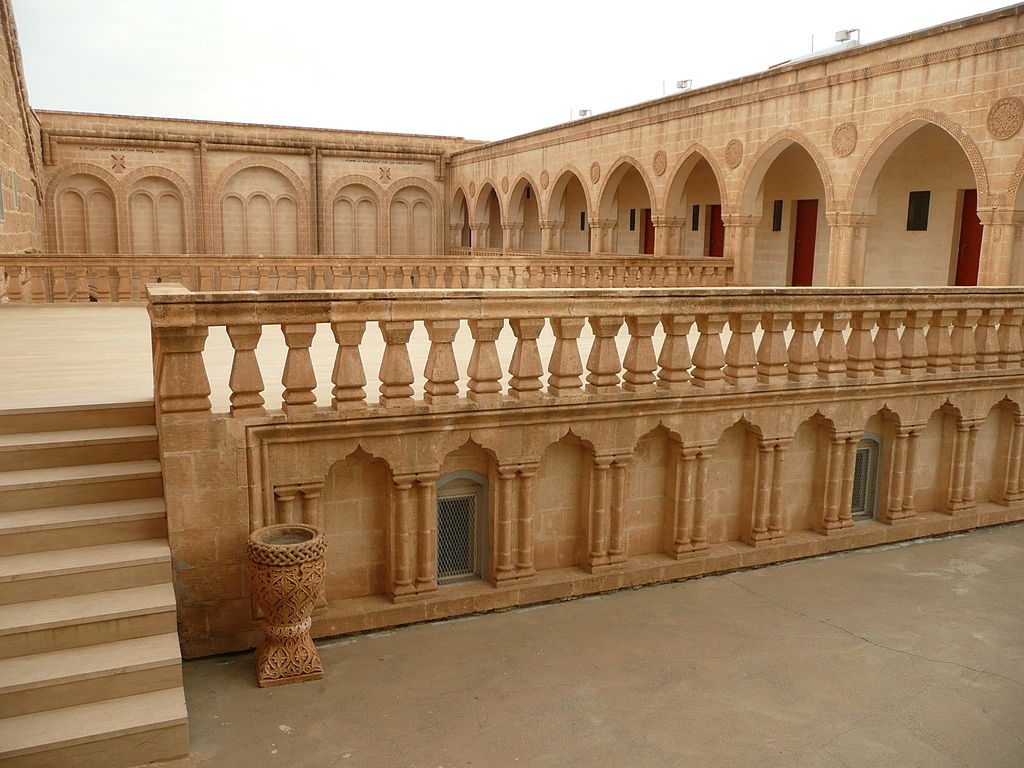
Turkey: The Erdogan government seized at least 50 Syriac churches, monasteries, and Christian cemeteries, many of which were still active, in Mardin province, and declared them "state property." According to the report, "The Syriacs have appealed to the Court for the cancellation of the decision." The Chairman of Mor Gabriel Monastery Foundation — a 1,600 year-old monastery that was still in use and also seized — said, "We started to file lawsuits and in the meantime our enquiries continued."

The Syriac Orthodox Mor Gabriel Monastery is one of at least 50 Syriac churches, monasteries, and Christian cemeteries in Mardin province, Turkey that were recently seized by the Turkish government and declared "state property." (Image source: Nevit Dilmen/Wikimedia Commons)
The Muslim Slaughter of Christians
Pakistan: A Chinese Christian couple—Lee Zing Yang, 24, and his wife Meng Lisi, 26 — were abducted in Quetta and executed on the accusation that they were preaching Christ to Muslims; the Islamic State claimed responsibility for their killing and released "video footage showing the bloodied body of the Chinese man, Lee Zing Yang, taking his last breaths," says a report. The Pakistani government cited the murdered couple's "misuse of the terms of a business visa" as playing a major role in their deaths: "instead of engaging in any business activity they went to Quetta and under the garb of learning Urdu language ... were actually engaged in preaching."
Kenya: Armed Muslims connected to neighboring Somalia's Islamic terrorist group, Al Shabaab, walked into an elementary school compound in Garissa and shot a Christian teacher to death. When a Muslim teacher interfered with their attempts to abduct another Christian teacher, "Al Shabaab got angry," reported another anonymous teacher, "and told the teacher, 'We are going to teach you a lesson for protecting the infidels,' and immediately the two were carried away to unknown destination"—but not before the Somali militants proceeded to "beat Muslims of Somali descent at the school for housing Kenyan Christians."
Philippines: More news and revelations concerning the jihadi uprising that began in late May in the Islamic City of Marawi appeared in June. The eight or nine Christians originally reported as being tied together and shot dead, execution style, had apparently first been ordered to recite the Islamic confession of faith, which they refused to do, an act leading to their execution. "Their bodies were reportedly thrown into the ditch, and a signboard was placed beside them reading 'Munafik,' which means traitor or liar," said a report. "The assailants also asked Police Senior Inspector Freddie Solar to recite the Muslim creed, and as a non-Muslim [Christian] he too declined and was killed." Seventeen others were found ritually decapitated or butchered by the Islamic State-affiliated militants. A priest and 13 parishioners from the St. Mary Cathedral were also kidnapped; the priest "appeared in a propaganda video on Tuesday (May 30) pleading for his life."
Egypt: More eyewitness details concerning the Islamic State massacre of 29 Christian pilgrims traveling to a Coptic monastery in the Egyptian desert in May 2017 emerged. One ten-year old boy, who witnessed the slaughter of his father, recounted:
"We [he and his 14-year-old brother] saw dead people, just dumped on the ground. They asked my father for identification then told him to recite the Muslim profession of faith. He refused, said he was Christian. They shot him and everyone else with us in the car.... Every time they shot someone they would yell God is great [Allahu Akbar]."
Although President Sisi had depicted the terrorists as "foreigners," the ten-year-old said that the fifteen assailants "had Egyptian accents like us and they were all masked except for two of them ... They looked like us and did not have beards." The same report states that, a month after the massacre, the Egyptian government had failed to provide adequate security for the residents of Dayr Jarnous, a Christian village that was home to seven of those killed, "and has done nothing to help the victims' families."
Muslim Attacks on Christian Religious Freedom
Pakistan: A new blasphemy case was registered against yet another Christian. After Mohammad Irfan refused to pay a repair bill to Ishfaq Masih, a Christian who fixed his bicycle, the Muslim denounced the Christian of blaspheming against Islamic prophet Muhammad, leading to the Christian's arrest. According to Masih's cousin:
"During the argument, Irfan said that he obeys only one master, Prophet Muhammad, to which Ishfaq said that he was a Christian and his faith ends at Christ. Upon hearing this, Irfan raised a clamor that Ishfaq had blasphemed against Muhammad. Soon a mob gathered at the spot, and someone called the police, who took Ishfaq into custody."
Mohammad Irfan also rallied a number of other Muslims — including Mohammad Irfan, Mohammad Nawaz, Mohammad Naveed, and Mohammad Tahir — who claimed that they "heard Ishfaq Masih say derogatory words against the Muslim prophet." According to the Christian's lawyer, only one of the four "witnesses" was even present during the altercation.
"Irfan had gathered the other men, including the complainant Mohammad Ishfaq, and they then concocted the allegation against Ishfaq Masih and got him arrested.... The FIR [First Information Report] is quite weak, as it does not contain any specific blasphemous words that my client may have allegedly said.... It also shows that the police did not even bother to investigate the charge before registering a case against the poor man. This is the routine practice of the police in blasphemy cases, and it's a shame that nothing is being done to stop it."
Separately, after a Christian couple was slaughtered for preaching Christ among Muslims (see Slaughter section), a South Korean Christian was arrested for allegedly also engaging in "illegal preaching activities." Authorities revoked his visa and ordered him to leave the Muslim nation.
Philippines: A Muslim teacher in the Muslim majority island of Mindanao forced Jen-Jen, a young Christian schoolgirl apparently of Islamic origins, to say Islamic prayers in class or else fail the class. According to the report:
"Despite being uncomfortable, Jen-Jen learned the words of the prayer to recite to the teacher. But rather than asking Jen-Jen to say the words in an oral test, the teacher later announced students would be required to go to a mosque and pray the prayer aloud."
When the girl and another Christian classmate told the teacher that praying in a mosque contradicts their faith in Christ, the Muslim teacher "ignored the request and told them to turn away from Christ," adding: "You must comply or else you will fail in this subject. You should revert to your Islamic faith." The girl was then "forced to complete the long walk to the mosque while wearing a traditional Muslim dress and veil covering, despite burning up with a fever."
"The schoolgirl got so sick, however, that she lost consciousness and blacked out. Even as she came back to, the teacher refused to excuse her from listening to the entirety of the Muslim imam's message. Since the day at the Mosque, Jen-Jen has been pressured to conform to many other Muslim practices, such as fasting during the month of Ramadan.... [O]ther students have also teased and bullied Jen-Jen because of her faith, sometimes bombarding her as she walked to and from school and pushing her or insulting her."
Malaysia: The Centre for Human Rights Research and Advocacy — the statement of purpose of which is to define and promote "Human rights from the Muslim perspective" — asserted that all forms of Christian evangelicalism should be banned. According to the CEO of the Centre, Azril Mohd Amin, "It is a fact that the groups that are spreading Christian propaganda to Malaysians, especially Muslims, will keep up their efforts as they believe that there is no effective law that can stop them." Jo-Anna Henley Rampas, a leading member of a more progressive and inclusive party, responded by saying this move is "reflective of the erosion of religious freedom in the country" thanks to the "federal government's failure to instil proper understanding, tolerance and harmony among citizens."
Muslim Contempt for and Abuse of Christians
Pakistan: A Christian sanitary worker died after pious Muslim doctors who were fasting for Ramadan refused to touch the "unclean" infidel's body. Thirty-year-old Irfan Masih had fallen unconscious along with three other sanitary staff while cleaning a manhole on June 1. He was rushed to a governmental hospital where the doctors refused to treat him; he died hours later. "The doctors refused to treat him because they were fasting and said my son was napaak [unclean]," said the mother of the deceased. A few weeks later, a court, responding to complaints from hospital officials accusing the family and friends of Irfan of terrorizing the hospital, ordered police to register a complaint against them. "The hospital has levied a false charge against us in order to save themselves," explained a cousin of the deceased, who also works in sanitation.
"The doctors were responsible for Irfan's death, because he would have been alive today had they not refused to treat him immediately. Our outburst against the doctors was natural, but we did not damage or steal anything from the hospital. It is a lie, and even the police know it."
A senior police official admitted that "we believe that the hospital is making frivolous accusation against these people..... The hospital is ostensibly trying to pressure the family to withdraw their case."
Egypt: Suzan Ashraf Rawy, a 22-year-old Christian woman, was reportedly kidnapped on the morning of June 5 while walking to the Coptic Orthodox church where she worked. "When she did not return home that evening, her mother called the church," an area Christian leader said. "That is when she discovered Suzan did not arrive at the church in the morning. It is expected that she has been abducted." She is the third Christian woman in the area of Al Khosous, a predominantly Christian town on the outskirts of Cairo, to disappear since May 30, when a Copt accidentally shot and killed a Muslim bystander during a quarrel with someone else. "Since then, the Muslims started to wage revenge attacks on the Christian community living there, especially the women," the Christian leader said. According to the report:
"Two other young Coptic Christian women disappeared without a trace after the May 30 incident. The families of the women suspected to have been kidnapped have received no communication from alleged kidnappers, the sources said. Area Muslims have long disfigured Christian women for not wearing veils by throwing acid on them, but there has been a surge in such attacks in the past few weeks, sources said.... Fear has seized Coptic Christians in the area, with women afraid to leave their homes. One of the church women's meetings, which Rawy attended, has been suspended until further notice out of fear for the safety of the participants."
Bangladesh: Three Muslim men sexually assaulted a 20-year-old Catholic girl in the village of Madarpur on June 18. Her loud cries drew the attention of village locals who came to her rescue, prompting the rapists to flee. After her parents filed a complaint, they began to receive threatening messages to withdraw it or else. "Last year her family was involved in a land dispute," adds the report. "The violence - a premeditated attack - was also witnessed by the police, deployed by the Muslims who wanted to expropriate the land. The young woman, along with her parents, was forced to leave the house and live in a slum."
Pakistan: The home of a journalist who extensively covers the plight of religious minorities in the Muslim nation was vandalized. When Rana Tanveer, chief reporter of The Express Tribune, went to the police, they failed to register a formal complaint. Days later, an unidentified vehicle intentionally ran over Tanveer, while he was riding his motorcycle in Lahore on Friday, June 9. According to the report:
"Tanveer underwent surgery for a fracture in his pelvic bone on Saturday. His recovery may take months and he has expressed fears for his safety as well as that of his family.... Tanveer says that his work on exposing the poor treatment meted out to the country's religious minorities like the Ahmadis and the Christians has made him a target of extremists."
Sudan: A court in El Gedaref fined a number of Christians for selling food and tea during Ramadan, the Muslim month of fasting: "This is a clear discrimination against Christians and contrary to the slogans of religious coexistence launched by the Sudan Government for the international community," contended one defense layer. About a dozen people were each fined $2,000 Sudanese dollars ($298 USD).
Iraq: "[T]roubling issues related to discrimination and even violence targeting ethnic and religious minorities" are widespread in Kurdish-ruled territories, one report found, adding:
"Christian citizens of the KRI [Kurdish Region of Iraq] have issued complaints and held protests against Kurdish residents for attacking and seizing their land and villages in the provinces of Dohuk and Erbil.... Some Assyrian Christians accuse Kurdish government and party officials of taking lands for personal use or financial gain. These Christians believe they are specifically targeted as part of a policy to Kurdify historically Christian areas.... Minorities continue to fear growing extremism in the majority population, which they believe could threaten them in the long term."
Most Kurds are Sunni Muslims.
Nigeria: A presidential order replaced Christian education with Islamic Studies in secondary schools. While the subject, "Christian Religious Knowledge" no longer exists, Islamic, Arab, and French studies have been introduced in the new curriculum. The Christian Association of Nigeria (CAN), which protested the new changes in front of the presidential palace, currently filled by a Muslim, described the change as "a time-bomb, obnoxious, divisive and ungodly.... To us in CAN, its introduction is an ill-wind that blows nobody any good for so many reasons." According to the report, "The end result [of these changes] is that a Christian student will be left with no option than to settle for Islamic Arabic Studies since French teachers are more or less non-existent in secondary schools," all of which "will deprive pupils of moral trainings which CRK [Christian Religious Knowledge] offers." The Christian Association of Nigeria further denounced this move "to force Islamic studies down the throats of non-adherents of the religion," as being an "agenda deliberately crafted towards Islamization."
Separately, a Christian priest and his companions who were abducted by Islamic militants in April told of their experiences in June, when they were released. Fr. Sam Okwuidegbe identified his "kidnappers as Fulani herdsmen, an Islamic radical group that has killed thousands of people in Nigeria, including many Christians, in the past couple of decades" notes the report. That he was unable to recall any phone numbers for the Islamic terrorists to call to negotiate a ransom for his release "triggered a series of beatings," says Fr. Sam.
"they huddled me up, hands and feet tied to the back with a rope like a goat before a kill. They removed my cassock, then my shirt, threw me into the dirt on the ground, and began to beat me with the back of their guns, they'd kick me hard on my sides, slap across my face, push and pull me hard across the ground ... one of them said 'We are going to burn you alive!'"
Another man in captivity did manage to recall a phone number, a ransom was set, and the men were eventually released.
Due to the ongoing bleeding of Nigeria's Christian population — increasingly at the hands of Muslim Fulani herdsmen and not just the Islamic terror group, Boko Haram — a number of leading Nigerian churches issued a statement calling on the government "not to abdicate its responsibility of protecting all Nigerian citizens." According to the communique:
"We are worried that the murderous activities of Fulani herdsmen have continued unabated and unchecked. The recurring and orchestrated killings of Christians in Southern Kaduna, mass killings in parts of Benue State and others across the country have increased suspicion that the so-called herdsmen are an extension of terrorist groups carrying out an evil agenda of ethnic and religious cleansing. Characteristically, these mindless attacks are often unprovoked."
Earlier in January, Bishop Diamond Emuobor, chairman of the Christian Association of Nigeria, said that, because Christians are facing increasing dangers at the hands of extremists, so "Christians should defend themselves and he who has no sword, should sell his coat and buy one to defend himself. We are all human beings, nobody should catch you like a snail and slaughter because you believe in Jesus Christ."
About this Series
While not all, or even most, Muslims are involved, persecution of Christians by Muslims is growing. The report posits that such Muslim persecution is not random but rather systematic, and takes place irrespective of language, ethnicity, or location.

Raymond Ibrahim is the author of Crucified Again: Exposing Islam's New War on Christians (published by Regnery with Gatestone Institute, April 2013).

Source: https://www.gatestoneinstitute.org/11299/muslim-persecution-christians-june

Follow Middle East and Terrorism on Twitter

Copyright - Original materials copyright (c) by the authors.