Sunday, November 19, 2017

Stunning evidence of the power of the MSM to kill news favorable to Trump - Thomas Lifson


by Thomas Lifson

Amazing! An entire state could be rescued by a deal announced ten days ago, and yet nobody there knows about it, except for a few pols and business people.

The invaluable Salena Zito once again has talked to ordinary folks in a location that barely gets any attention from media swells, and delivers an insight that future historians will honor, even of the Pulitzer Prize committee continues to snub her. She has demonstrated that the mainstream media are able to suppress life-changing news that could rescue the beleagured economy of an entire state so thoroughly that ordinary folks in street are unaware of it. 


Writing in the New York Post:
Last weekend in Beijing, as part of his 12-day trip to Asia, President Trump announced that the US and China had signed an $83.7 billion deal to create a number of petrochemical projects in West Virginia over the next 20 years.
If the agreement holds tight, it is an economic game changer for the state.
And yet, speaking to the locals here, you wouldn’t even know it had happened.
“I am surprised I heard nothing about it on the national news, nor in my local paper and newscasts,” said Jerald Stephens, 67, a West Virginia native and union rep, who has been a keen observer of local politics for as long as he can remember.
The BBC and CNN covered the news in their business sections, while The New York Times picked up a short story by The Associated Press on the deal. The stories’ headlines were muted; their placement low-key.
“One would have suspected that the prospect of an investment this large — nearly three times the total annual budget for the department of energy — would have been front-page news,” said Paul Sracic, political-science professor at nearby Youngstown State University.
That is an understatement. Bloomberg has covered it, of course, but that’s because it gets paid by decision-makers to keep them well informed (because investment decisions are affected). In additon, virtually everyone in West Virginia would be affected by the deal, and the news has been out for over two weeks. Yet they have been kept in ignorance because general news outlets they read have been totally silent. 

Bruce Einhorn of Bloomberg described the project on Nov. 8:
West Virginia: the state signed an MOU with China Energy Investment Corp. The Chinese company plans to invest in West Virginian shale gas development and chemical manufacturing projects over two decades, according to the state’s Department of Commerce, which did not offer details. The size of the proposed investment is $83.7 billion, larger than the state’s gross domestic product last year of $73.4 billion.
Jim Poulson of Bloomberg added details the following day:
The memorandum of understanding marks the first step in a series of commitments the company expects to make in West Virginia. These include power generation, chemical manufacturing and underground storage of natural gas liquids derivatives.
However, the deal is not carved into stone, which should mean that the entire State of West Virginia is on tenterhooks.
Although the deal’s non-binding, it was welcomed in a state that’s borne the brunt of coal’s long-term decline. West Virginia Governor Jim Justice, a coal and real estate mogul elected to office last year, has lobbied the Trump administration to prop up the state’s coal-mining sector.
“Expanding Appalachia’s energy infrastructure, including developing a regional storage hub and market for natural gas liquids, will have a transformative effect on our economy, our security and our future,” U.S. Senator Shelley Moore Capito, a West Virginia Republican, said in the statement.
So, this is a deal that would transform economic life for some of the most economically depressed people in the country, and they have no idea at all that it is in process, needs their support, and could be derailed. And they have no clue!

Iowahawk, another supremely insightful commentator unjustly snubbed by Pulitzer, has already gained immortality with this tweet, that completely sums up this incident.


As a candidate, Donald Trump promised to “make deals” that would benefit America. He is precisely delivering on this promise. In addition to the project in West Virginia, deals amounting to a quarter trillion dollars were announced in the wake of the visit to China.

[media crickets]

In addition, the deal reveals that President Trump has gotten the Chinese to consider becoming dependent on America for important energy supplies. That makes them far less likely to be antagonistic toward us, and addresses the chronic huge balance of payments deficit we suffer with China, keeping two more promises: to keep us safe and to keep us from digging that trade deficit hole deeper.

But this is news too helpful to Trump to be reported. 

Thomas Lifson

Source: http://www.americanthinker.com/blog/2017/11/stunning_evidence_of_the_power_of_the_msm_to_kill_news_favorable_to_trump.html

Follow Middle East and Terrorism on Twitter

Copyright - Original materials copyright (c) by the authors.

A Palestinian Arab state – enhancing or eroding US national security? - Yoram Ettinger


by Yoram Ettinger

President Trump's non-certification provides Congress with an opportunity to reclaim its constitutional role as a co-equal and co-determining branch of government

www.TheEttingerReport.com
President Trump's refusal to recertify that Iran's Ayatollahs comply with the July 14, 2015 Iran Nuclear Deal Framework (JCPOA), and that the agreement is in the US national security interest, removed the Ayatollahs' peaceful "screen saver" and laid the ground to expose the Ayatollahs' rogue reality. 


President Trump acted in accordance with the May 22, 2015 bi-partisan Iran Nuclear Agreement Review Act, which was enacted - in defiance of President Obama's opposition - with a veto-override majority.  


On the other hand, the multinational JCPOA – which produced unprecedented tailwind to Iran's revolutionary goals - was engineered by President Obama and Secretary of State Kerry, along with the other permanent members of the UN Security Council (Russia, China, Britain and France), Germany and the European Union.


President Trump's non-certification provides Congress with an opportunity to reclaim its constitutional role as a co-equal and co-determining branch of government, while exposing the inherently rogue Ayatollahs, who have intensified instability, unpredictability, subversion, terrorism and wars in the Persian Gulf, the Arabian Peninsula, the Middle East at-large, Africa, Asia and other parts of the globe.


According to the
first Article of the US Constitution, as documented in a following paragraph, the power of the US Congress is not limited to legislation and appropriation, but extends to oversight and review of the Executive Branch on the domestic and national security fronts: "Congress shall have power to… provide for the common defence.... Define and punish…offences against the law of nations. Declare war….raise and support Armies…. Provide and maintain a Navy. Make…regulations of the land and naval forces…. Suppress insurrections and repel invasions…."


Moreover, the second Article of the US Constitution provides the President with the power to commit the US to treaties with foreign entities - such as the JCPOA - but only with the advice and consent (
ratification) of two thirds of the Senate. In 2017, the US Senate can reclaim this power which was dismissed, in 2015, by President Obama and conceded by Congress.


Congress demonstrated its posture as the world's most powerful legislature, and its co-equal role in the shaping of the US national security policy, during many critical junctions in recent US history.  For example, the Senate has refused to ratify President Clinton's 1999 Comprehensive Test Ban Treaty; Congress prevented the supply of AWACS (Airborne Warning and Control System) to Iran on the eve of the Ayatollah Khomeini revolution; the Senate Majority Leader, Harry Reid (D-NV), foiled President Obama's attempts to close down the Guantanamo detention camp; Congress authorized the 1991 and 2003 wars against Iraq; Congress terminated the US military involvement in Vietnam, Laos and Cambodia (the Eagleton, Cooper and Church Amendments), Angola (the Clark Amendment) and Nicaragua (the Boland Amendment; Congress overrode President Reagan's veto, bringing down South Africa's white regime; Congress overhauled the US intelligence community (Senator Church's and Congressman Pike's Committees); Congress  - in defiance of President Nixon – forced the USSR/Russia to allow free emigration (the Jackson-Vanik Amendment); etc..


When examining the impact of the JCPOA on the US national security, Congress should assess the dramatic erosion of the US posture of deterrence, as reflected by the surging geo-strategic posture of Russia. Both the Ayatollahs, as well as the pro-US Arab countries - especially Saudi Arabia, which recently concluded critical military transactions with Russia - consider the signing of the 2015 Agreement a reflection of unprecedentedly slackened US strategic reliability.


Congress should scrutinize the Ayatollahs' systematic anti-US conduct since their 1979 toppling of the pro-US Shah, including their annual commemoration of the November 1979 takeover of the US Embassy in Teheran, which is highlighted by the theme of "Death to America."


Congress should investigate the
Ayatollahs' school curriculum - the most authentic reflection of their mission and tactics, depicting the US as "the arrogant, idolatrous, modern-day crusader, infidel, oppressor, Great Satan." Grade 12 Iranian students are taught – in "Religion and Life," pages 103 and 104 – that dissimulation and tenuous pacts with "un-Godly governments" – such as the US - are proper, but only until the balance of power shifts in favor of the "believers."  Furthermore, the need for child martyrdom, during the apocalyptic battle against the US, is intensively inculcated in all twelve grades.   


Downplaying the significance of the Ayatollahs' school curriculum – lest it undermine the pursuit of an agreement – would catapult Iran to an imperial position, and possibly usher in the first nuclear war.

While the US has rolled-back its sanctions on Iran, the Ayatollahs have rolled-forward their drive to evict the US from the Gulf and the Arabian Peninsula through subversive, terroristic and military attempts of regime-change in pro-US Arab countries in the Persian Gulf – most notably Saudi Arabia and Bahrain - and beyond.


The mega-financial benefits from the JCOPA have enabled the Ayatollahs to expand their presence in Iraq, Syria and Lebanon, posing a growing threat to the pro-US regime in Jordan, while bolstering their presence in Africa and in Latin America, including Mexico, Cuba, Venezuela, Ecuador, Bolivia and the terror-ridden tri-border region of Brazil, Argentina and Paraguay.


On the nuclear front – while rejecting US demands to allow
international inspectors to visit military sites - the Ayatollahs have tightened their ballistic and nuclear collaboration with North Korea, co-developing and test-firing nuclear and ballistic technologies and systems, which may also be purchased. It allows circumvention of the monitoring of nuclear programs in Iran.


In 1978/79, the US energized the Khomeini Revolution, which transformed Iran from "the US policeman in the Gulf" to the US nightmare in the Middle East. In 2017, a determined Congressional oversight, and the resurrection of the US posture of deterrence – not diplomacy – could spare the globe of a most rogue anti-US regime and a potential nuclear war. 


Yoram Ettinger

Source: http://theettingerreport.com/Iran-and-MidEast/Iran-%E2%80%93-will-the-US-Congress-rise-to-the-challenge-.aspx

Follow Middle East and Terrorism on Twitter

Copyright - Original materials copyright (c) by the authors.

Saudi Arabia, Arab allies in urgent talks on Iran, Hezbollah - Reuters and Israel Hayom Staff


by Reuters and Israel Hayom Staff 


"What Iran is doing against some Arab countries calls for more than one measure to stop these violations, interference and threats," says Arab League deputy chief, adding that meeting aims to send a "strong message" to Iran to step back from policies.

Saudi Arabia and other Arab foreign ministers were scheduled to hold an emergency meeting in Cairo on Sunday to discuss confronting Iran and its Lebanese Shiite ally Hezbollah, who the Arab allies say are interfering in their internal affairs.
Regional tensions have risen between Sunni monarchy Saudi Arabia and Shiite Islamist Iran over Lebanese Prime Minister Saad Hariri's surprise resignation and after an escalation in Yemen's conflict.
Hariri, a long-time Saudi ally, resigned on Nov. 4 in an announcement made from Riyadh. Hariri cited fear of assassination and accused Iran and Hezbollah of spreading strife in the Arab world.
Hezbollah, both a military force and a political movement, is part of a Lebanese government made up of rival factions, and an ally of Lebanese President Michel Aoun.
Aoun has accused Saudi Arabia of holding Hariri hostage. Senior Lebanese politicians close to Hariri also said he was coerced into resigning. Saudi Arabia and Hariri both deny those accusations.
The emergency Arab foreign ministers meeting was convened at the request of Saudi Arabia with support from the UAE, Bahrain, and Kuwait to discuss means of confronting Iranian intervention, Egypt's state news agency MENA said.
Saudi Arabia's Foreign Minister Adel al-Jubeir told Reuters last week the kingdom's actions in the Middle East were only a response to what he called the "aggression" of Iran.
"What Iran is doing against some Arab countries calls for taking more than one measure to stop these violations, interference and threats, which are carried out through many various means," Arab League Assistant Secretary General Hossam Zaki told Asharq al-Awsat newspaper in an interview.
"Stopping them requires a joint Arab policy."
He said the meeting would send a "strong message" for Iran to step back from its current policies.
Egypt's state-owned newspaper Al-Ahram cited an Arab diplomatic source saying the meeting may refer the matter to the United Nations Security Council.
A source in Lebanon's foreign ministry said on Sunday the foreign minister was still in Beirut and was unlikely to attend. Lebanon will be represented by its representative to the Arab League, Antoine Azzam, the source said.
Anticipating confrontation at the Cairo meeting, a senior Lebanese official had told Reuters on Saturday that Lebanon's foreign minister may not go to Egypt.
After French intervention, Hariri flew to France and met French President Emmanuel Macron in Paris on Saturday.
Speaking in Paris, Hariri said he would clarify his position when he returns to Beirut in the coming days. He said he would take part in Lebanese independence day celebrations, which are scheduled for Wednesday.
Saudi Arabia also accuses Hezbollah of a role in the launching of a missile at Riyadh from Yemen this month. Saudi Arabia's Crown Prince Mohammed bin Salman said Iran's supply of rockets to Houthi militias was an act of "direct military aggression."
Yemen's civil war pits the internationally recognized government, backed by Saudi Arabia and its allies, against the Houthis and forces loyal to former president Ali Abdullah Saleh. Iran denies charges it supplies Houthi forces.

Reuters and Israel Hayom Staff

Source: http://www.israelhayom.com/2017/11/19/saudi-arabia-arab-allies-in-emergency-talks-on-iran-hezbollah/

Follow Middle East and Terrorism on Twitter

Copyright - Original materials copyright (c) by the authors.
Israel fires 'warning shot' after Syrian border construction - Daniel Siryoti, Eldad Beck, News Agencies and Israel Hayom Staff


by Daniel Siryoti, Eldad Beck, News Agencies and Israel Hayom Staff 


Senior Arab official to Israel Hayom: Feeling among Arab leaders and Israel is that this is last chance to stop Iranian threat diplomatically


Speaking from the French capital, Hariri said he will return home to Lebanon in the coming days, where he plans to declare a political stance for the first time since his mysterious resignation announcement from Saudi Arabia that unleashed fears of a crisis in Lebanon.

Hariri and his family met Saturday with French President Emmanuel Macron, who invited the Lebanese leader to Paris to dispel fears that he was being held in Saudi Arabia against his will. Macron is seeking to calm tensions and avert a proxy conflict between Saudi-backed and Iranian-backed camps in Lebanon.
A senior Arab official told Israel Hayom that the "feeling among Arab leaders in the region, and in Israel, is that this was the last chance to resolve the Iranian threat in the region diplomatically. If the move fails, no one can imagine the slippery slope the entire region is liable to enter."
Also speaking to Israel Hayom, a senior Arab diplomat said the Saudi government presented Hariri with an ultimatum: "Either you are with us in preventing Lebanon's 'abduction' by Iran and its Hezbollah proxy, or you are against us."
Arab news outlets, meanwhile, reported that Hezbollah over the weekend ordered its fighters to prepare for the possibility of an Israeli offensive against the organization in southern Lebanon and Syria. According to the reports, senior Hezbollah officials said the organization was convinced that Israel and Saudi Arabia were coordinated on the option of an Israeli attack in Lebanon.
The reports also said that Hezbollah, which allotted some 80% of its manpower to the war in Syria, has begun moving forces back to south Lebanon.
Defense Minister Avigdor Lieberman took to Facebook on Saturday and wrote: "Forty years after [former Egyptian President Anwar] Sadat's historic visit to Israel, I call on leaders in the region to follow in his footsteps, come to Jerusalem and turn over a new leaf not just for Israeli relations with the Arab world, but for the entire region. The Middle East needs a coalition of moderate countries against Iran. The coalition against Islamic State has concluded its work."
Hariri's appearance in Paris – looking relaxed and posing with his wife and older son on the steps of the Elysee Palace with the French presidential couple in front of a large crowd of journalists – contrasted with his limited-access, carefully choreographed appearances from Saudi Arabia.
Hariri told Lebanese President Michel Aoun on Saturday that he would take part in Independence Day celebrations in Beirut on Wednesday, according to Macron's office.
After his meeting with Macron, Hariri told reporters: "God willing, I will attend Independence Day in Lebanon and will declare my political stance from Lebanon and after meeting President Michel Aoun."
"As you know I have resigned and we will talk about this matter in Lebanon," Hariri said after thanking Macron, who he added "expressed pure friendship toward me that I will never forget."
The Independence Day ceremony is usually headed by the president, prime minister and parliament speaker, and Hariri's presence could help calm uncertainties that have escalated since his surprising resignation.
However, Hariri's political status is murky. Aoun has refused to accept Hariri's resignation, accusing the Saudis of holding him against his will.
A senior official in Macron's office said Hariri's place is first in Beirut, "which is the only place where he can hand his resignation to the Lebanese head of state."
The official, who spoke on condition of anonymity in accordance with French presidential policy, found it normal that Hariri would keep any announcement about his political stance for his fellow citizens.
Before leaving Riyadh, Hariri dismissed as "rumors" reports about his alleged detention in the kingdom.
In his Nov. 4 televised resignation announcement, Hariri had cited Iran and Hezbollah for meddling in Arab countries, particularly Saudi Arabia. He also said he was afraid for his life.
U.S. President Donald Trump on Saturday spoke with Macron about the situation in Lebanon and Syria, and both leaders agreed on the need to work with allies to counter Hezbollah and Iran's "destabilizing activities in the region," the White House said.
Saudi Arabia on Saturday asked its citizens for the second time in less than two weeks to leave Lebanon "as soon as possible" given the "circumstances" there. That raised fears of more punitive actions to come.
The French presidential official said it is essential that Lebanon be protected from "negative" foreign influences because the country needs stability and a strong state. The official didn't name any specific nations but said Lebanon should be protected from the "dangers that regional crises can pose to it."
The Arab League was due to hold a meeting on Sunday in Cairo at Saudi Arabia's urging where the crisis in Lebanon and Iran's role in the region are expected to be discussed.
Just before leaving Saudi Arabia, Hariri met with the Saudi crown prince and other senior officials, according to a member of Hariri's political party and two Lebanese television stations.
Hariri's younger son and daughter, Abdul-Aziz and Loulwa, remained in Saudi Arabia because they have school on Sunday, said Okab Saqr, a member of Hariri's parliamentary bloc.
The official with the French presidency said France is not worried that Hariri left two of his children in Saudi Arabia.
"We have no reason to be concerned about this," the French official said, answering questions about whether, as some have suggested, Saudi Arabia could use the children's whereabouts to maintain pressure on Hariri.
Hariri's exact next steps after his planned visit to Lebanon are unclear. Another French official said Saturday that France is offering Hariri the necessary support during this time of political turmoil in his country. The official was not authorized to be publicly named.
While Macron insists that he was not offering "exile," Hariri's return could be complicated by Lebanon's internal tensions.
During a phone call on Saturday morning, Macron and Aoun spoke about a return of Hariri to Lebanon that could help make Lebanese institutions "function normally again," the French presidential official said.
The French involvement in the matter is part of a broader Macron strategy to reassert France's influence in the region, while the United States under Trump is increasingly seen as unpredictable or disengaged. Macron's office said France's strategy was to talk to all powers in the region and not to appear as choosing a camp.

Daniel Siryoti, Eldad Beck, News Agencies and Israel Hayom Staff

Source: http://www.israelhayom.com/2017/11/19/israel-fires-warning-shot-after-syrian-border-construction/

Follow Middle East and Terrorism on Twitter

Copyright - Original materials copyright (c) by the authors.

The Usual Suspects and a New Method - Amir Taheri


by Amir Taheri

By turning Lebanon into one of its bunkers, Iran has done a great disservice to the whole region, not to mention the damage done and could still do to Lebanon.

Last week, two events injected energy and excitement into what was beginning to look like an anemic end of the year in the Middle East as far as political developments are concerned.

The first event was the decision by the Saudi leadership to create a new mechanism to deal with alleged cases of corruption, embezzlement and influence-peddling.

The sheer number of cases referred to a special court on those charges was enough to capture the headlines. The fact that the 208 people under investigation included princes, prominent bureaucrats, and business tycoons intensified the event's headline-grabbing potential.

But what really attracted world attention was the unexpectedness of the Saudi move.

Few, even among genuine or self-styled experts on Saudi Arabia, expected Riyadh to go right to the heart of the matter rather than dance around the issues as had been the norm in the past. Some observers, including many in Western think-tanks, warned of the danger of instability inherent in departure from old patterns of behavior.

However, the latest move is in accordance with the kingdom's new strategy aimed at recruiting the concept of change as an ally rather than a threat.

It is possible to argue that because old methods didn't produce the desired results, stability, which had been a key asset of the kingdom for decades, had morphed into stagnation. Thus, the new strategy is designed to end stagnation and prepare the path for a new form of stability capable of reflecting changed social, economic and political circumstances of the kingdom.

If Saudi Arabia is genuine in its declared desire to become an active member of the global system, the first thing it has to do is to offer the rule of law in the sense understood by most people around the world.

Trying to build an economy beyond oil, Saudi Arabia needs to attract massive foreign investment in both financial and technological domains. And that won't be possible without a strong legal system backed by transparency, competition and equality of opportunities.

And that means putting an end to influence-peddling, fake credit-lines secured by pressuring local banks, the grabbing of public land, "sweetheart" agency deals, kickbacks, baksheesh and, in short, the medieval wasitah culture.

The dramatic round up of "the usual suspects" shows that the new leadership in Riyadh is ready to cut the Gordian Knot with a hard blow.

As for Lebanon, a similar method has been used.

Prime Minister Saad Hariri's resignation ends the "grin-and-bear it" tradition in the face of intolerable situations. Under that method, Middle Eastern leaders brush the dirt under fine carpets, including at times that, as was the case with Hariri, they have responsibility without power.

Regardless of how Hariri's resignation came about, it has dramatically highlighted the fact that the "deal" made over Lebanon in October 2016 has failed.

Under that "deal", the Islamic Republic of Iran, operating through its Hezbollah network in Beirut, secured the presidency for General Michel Aoun in exchange for Hariri returning as Prime Minister.

Soon, however, it became clear that while Aoun and Hariri respectively played the roles of President and Prime Minister, real decisions were taken in Tehran. Iranian President Hassan Rouhani made that point clear in a speech in Tehran, when he said that "nothing is done" in a number of Arab states, notably Lebanon, without Iran's approval.

Hariri's dramatic departure shows that "this kind of Lebanon" doesn't work.

The current line-up under which a foreign power controls the country through one part of one community among all Lebanese communities is fundamentally flawed and dangerous in the medium and long terms.

Lebanon's raison d'etre, and the principal factor in its survival and partial success as a state, has been its system of power-sharing based on respect for diversity. Whenever one community or a combination of communities tried to exercise exclusive power, the country was plunged into turmoil.

In the 1950s, the Maronite community tried a power-grab, which led to inter-communal conflict and foreign military intervention. In the following decade, a similar bid was made by pan-Arab elements backed by Nasserist Egypt, again producing conflict and foreign meddling.

The 1975-90 Civil War also had its genesis in foreign intervention, through rival local sectarian proxy groups.

In part of that period, Aoun tried to switch Lebanon to the side of Saddam Hussein in Iraq while, backed by Iran, Hafez al-Assad threw Syria's weight behind the rival camp.

Between 1984 and 1990, Aoun wore many hats as Prime Minister, Defense Minister, Foreign Minister, Information Minister and military junta chief, often all at the same time. When we first met him in Paris in October 1990, his main message was "saving Lebanon from Syria and Iran."

Aoun's analysis would have been appreciated if he had talked of "saving Lebanon from domination by any foreign power."

There are some nations whose chief vocation is to be neutral, acting as buffers among rival power blocs. Switzerland was allowed to form and mature as a safe haven for rival European powers often at war against one another.

Afghanistan was created as a buffer between the Tsarist, British and Persian Empires in Asia. In post-colonial Indochina, the kingdom of Laos played that role until the US sucked it into the Vietnam War as collateral damage. In Latin America, that role has been assigned to Uruguay, and in Central America to Costa Rica.

During the Second World War, neutral Sweden provided a channel of communication between the United States and Nazi Germany and a safe haven for people fleeing from the Nazis and the Soviets.

After World War II, by being declared neutral, Austria played a crucial role in the repatriation and/or transfer of millions of refugees across war-shattered Europe.

By turning Lebanon into one of its bunkers, Iran has done a great disservice to the whole region, not to mention the damage done and could still do to Lebanon.


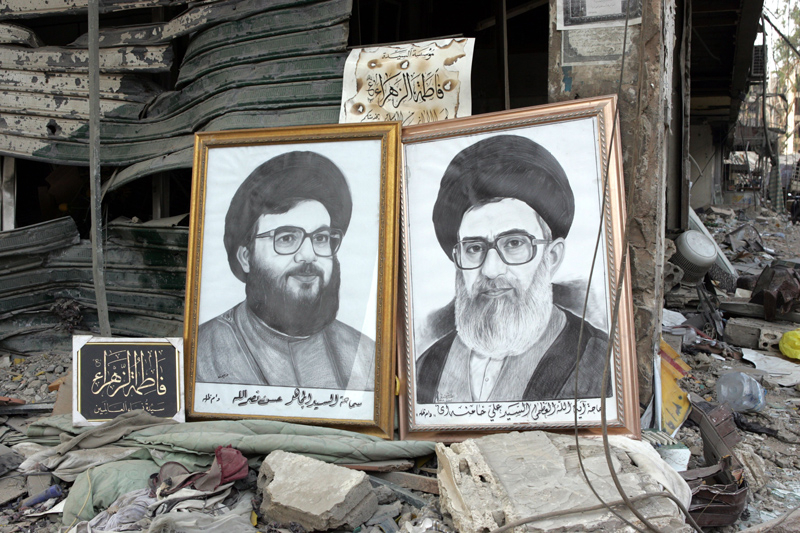
Pictured: Portraits of Hezbollah leader Hassan Nasrallah (left) and Iran's Supreme Leader Ayatollah Ali Khamenei (right) in Beirut, Lebanon, in 2006. (Photo by Marco Di Lauro/Getty Images)
Hariri's resignation could prove useful by posing a crucial question: Should Lebanon re-become Lebanon or should it be a glacis for the Islamic Republic in its quest for an unattainable regional hegemony? Part of the answer, of course, depends on the Lebanese themselves. They should decide whether or not they want to have two governments, one visible the other semi-visible, two armies, and a master puppeteer laughing at them in Tehran.

A Lebanon run from Tehran through Hezbollah gunmen is unlikely to attract the investment, trade, tourism and cultural exchanges that it needs to function as a modern dynamic society.

When Iran itself is denied all those things, how could it provide them for Lebanon? Iranian intervention that contributed to turning Iraq, Syria and Yemen into battlefields could do the same to Lebanon.
This article first appeared in Asharq Al Awsat

Amir Taheri, formerly editor of Iran's premier newspaper, Kayhan, before the Iranian revolution of 1979, is a prominent author based on Europe. He is the Chairman of Gatestone Europe.

Source: https://www.gatestoneinstitute.org/11393/saudi-arabia-new-strategy

Follow Middle East and Terrorism on Twitter

Copyright - Original materials copyright (c) by the authors.

Europe: Destroyed by the West's Indifference? - Giulio Meotti


by Giulio Meotti

The West today keeps on hiding its deepest secret: that there is an Islamic war going on against our own Judeo-Christian civilization.

  • Our media and intelligentsia are always on alert to defend everything coming from Islam, from women's veils to the "right not be offended" by cartoons. The same establishment, however, lies in a coma when it comes to Christian symbols under attack.
  • The West today keeps on hiding its deepest secret: that there is an Islamic war going on against our own Judeo-Christian civilization.
  • "They want Christianity eradicated, and they want to convert all Muslims to their crusade... They want it to be a holy war. And they want Christians gone. And I don't think that narrative is getting the attention it should get..." — Piers Morgan, Daily Mail.
There are pictures one cannot forget -- for instance, of Russian troops hoisting their flag over burning Berlin in 1945. It was the end of Nazism but the rise of Communism. Another photo is of U.S. Marines raising the American flag over the battle-scarred Japanese island of Iwo Jima.

Today the West faces another totalitarianism: radical Islam. One place that witnessed the new horror is Mount Sinjar in the Nineveh province of Iraq, once a home to religious minorities, especially Christians and Yazidis. Thousands of years of history changed when the jihadists of ISIS invaded Sinjar in August of 2014. They slaughtered men and enslaved girls and women. Christian churches were razed to the ground, and houses of worship, looted.

In 2016 alone, 90,000 Christians around the world were murdered for their faith, according to a report from the Center for the Study of Global Christianity. Between 2005 and 2015, 900,000 Christians were martyred. According to Open Doors, another Christian advocacy group, one out of every 12 Christians today experiences extreme persecution for their faith; the total comes to 215 million around the world.

"The persecution of Christians is real. It is global in scope, brutal in its nature, daily in its occurrence, and growing worse than ever", said University of Notre Dame Professor Dan Philpott. A recent report by the World Council of Churches put the number of Christians left in Iraq at fewer than 250,000. "Christianity is finished", said Canon Andrew White, the great vicar of Baghdad.

Christians have also been fleeing Sinai: the Egyptian branch of ISIS has been slaughtering them in a campaign of "religious cleansing". ISIS released a video calling on its supporters to target Christians across Egypt, describing them as its "favourite prey". The Islamists then targeted two packed Egyptian churches, where they slaughtered 47 Christians. From Cairo to Saint-Étienne-du-Rouvray in northern France, churches now appear Islamists' preferred targets.

There is, in all this bad news, a beam of hope; the valiant Kurdish Peshmerga fighters liberated Sinjar and rescued tens of thousands of Yazidis and Christians. On Easter Sunday, an unidentified soldier planted a cross on the soil where a Mount Sinjar church had once stood. It was a declaration of the resurrection of life after the onslaught of the Islamic State. This cross was like the flag raised in Iwo Jima.

Yet, no Western newspaper, which could help the public rally for their Christian brethren, published this extraordinary photograph. Why? Our general unwillingness to address any threat indicates a Western impotence in the face of barbarism. An editor at the Daily Mail, Piers Morgan, has commented that while terror attacks in the Western capitals all got "huge attention," the ones against Christians did not.
"They want Christianity eradicated, and they want to convert all Muslims to their crusade. They want it to be a holy war. And they want Christians gone. And I don't think that narrative is getting the attention it should get in the American media and, I have to say, in other media as well around the world".
"The Western world has long gotten used to the persecution of Christians in the Middle East, as if their bad lot is inevitable and simply has to be accepted," noted a Canadian philosopher, Mathieu Bock-Côté, in Le Figaro. "Christianity is destined to die or have no more than a residual existence in what used to be its cradle".

While natural disasters such as tsunamis or earthquakes spur solidarity throughout the West, the disappearance of entire Christian populations and their ancient civilizations never seems to disturb anyone. Perhaps it is a sign of denial by the West. Perhaps it is the result of rejecting Judeo-Christian history and humanistic values -- those that cause the demonization the foremost victim of jihad, Israel, instead of the jihadists trying to destroy it. In 2014, we saw tens of thousands of people marching in the streets of European capitals in favor of the Palestinians, even as they were carpeting Israel with missiles and shouting "death to Israel and the Jews". We have seen how unspeakable Christian agony in Islamic lands has led to only a few hundred people turning out on the streets of London and Paris.

Our media and intelligentsia are always on the alert to defend everything coming from Islam, whether women's veils or the "right not be offended" by cartoons. The same establishment, however, lies in a coma when Christian symbols come under attack. Wilfred McClay, in an essay, "The Strange Persistence of Guilt", notes that while religion is in retreat in the West, guilt seems as powerfully present as ever, and a cult of being or protecting a victim proliferates. People rush to nurture the perfect victim: threadbare, with no identity, who has run away from "war". Christians under Islam are not part of that group. Muslims are.

The West today keeps on hiding its deepest secret: that there is an Islamic war going on against our own Judeo-Christian civilization. Few people in the West see in the media the houses of Christians in Mosul marked with an "N". The Islamic State painted it for "Nasrani" ("Nazarene") -- Arabic for "Christian". A genocide symbolized by one letter. But no one sees it or cares.

American television networks devoted six times more air-time to covering the death of a gorilla, Harambe, than they did to the Islamic State beheading 21 Coptic Christians on a beach in Libya, according to a study by the Media Research Center. How is it possible that the killing of a gorilla moves the Western public more than 19 Yazidi girls burned alive in a cage? Few people saw the photograph of Khaled al Asaad, the brave archaeologist who refused to lead ISIS to the antiquities of Palmyra. The henchmen of ISIS beheaded him and hung him upside down. We turned away in horror.

A famous 9/11 picture by Thomas Hoepker, taken at a restaurant in Brooklyn, shows a group of young New Yorkers sunbathing, relaxed and calm, observing the smoke rising from the Twin Towers on the other side of the East River. Since then, the only enemy we ever point to is us. We censor the existential threat Western civilization is facing -- whether on an Iraqi mountain or Paris's Champs-Élysées. If Eastern Christianity can be extinguished so easily, Western Europe will be next.

Giulio Meotti, Cultural Editor for Il Foglio, is an Italian journalist and author.

Source: https://www.gatestoneinstitute.org/10297/christians-persecution-indifference

Follow Middle East and Terrorism on Twitter

Copyright - Original materials copyright (c) by the authors.

German official: We can't say 'never again' and condone anti-Israel efforts - Reuters and Israel Hayom Staff


by Reuters and Israel Hayom Staff 

Day after German court upholds Kuwait Airways' right to refuse Israeli passengers, German official urges government to revoke airline's landing rights, saying, "We can't remain silent"

The German government should revoke landing rights for Kuwait Airways given its ban on Israeli passengers, a senior Justice Department official said on Friday, adding that such discrimination was intolerable.

Christian Lange, parliamentary state secretary in the ministry, appealed to German Chancellor Angela Merkel to personally advocate a ban on Kuwait Airways' operations in Germany.

A German court ruled on Thursday that the airline had the right to refuse to carry an Israeli passenger due to his nationality, a verdict that Jewish groups said condoned anti-Semitism.

Lange told Merkel in the letter that he had received countless phone calls from members of the Jewish community and from others in Israel, expressing shock about the court ruling, made just days after Germany solemnly marked the anniversary of the Nov. 9, 1938 Nazi pogroms against the Jews.

"We cannot say 'Never again' at a remembrance ceremony, but then remain silent when activists in Germany call for a boycott of Israel, or, as in this case, when an airline refuses to carry Israeli citizens," Lange said.

"Especially the German government must make clear that we reject this form of discrimination and hate, and that we stand by the side of our Israeli friends," he told the chancellor.

The Lawfare Project, the legal group that represented the plaintiff in the case, has vowed to appeal the ruling.

"To see a Jewish person banned from exercising his freedoms in Germany in 2017 is chilling enough. To see that discrimination whitewashed and legitimized by a German judge is grotesque," said the group's executive director, Brooke Goldstein.

Deputy German Foreign Minister Michael Roth also criticized the airline's policy, telling Die Welt newspaper that he had contacted the Kuwaiti ambassador in Germany about the issue.

German Transport Minister Christian Schmidt told Bild newspaper that it was not acceptable to discriminate against airline passengers because of their nationality, and said the German government would address the matter with the Kuwaiti government.

"This requires contacts at the ministerial level," Schmidt told the newspaper in an interview to be published on Saturday.

"We will do all we can within our legal means to prevent something like this in the future," Schmidt told the paper.

There was no immediate response to a request for comment emailed to the airline.


Reuters and Israel Hayom Staff

Source: http://www.israelhayom.com/2017/11/19/german-official-we-cant-say-never-again-and-condone-anti-israel-efforts/

Follow Middle East and Terrorism on Twitter

Copyright - Original materials copyright (c) by the authors.