Tuesday, November 21, 2017

Holding the PLO Accountable - Caroline Glick


by Caroline Glick


Is the US's enabling of the PLO coming to an end?


Originally published by the Jerusalem Post.

Is the PLO’s long vacation from accountability coming to an end? How about the State Department’s? In 1987 the US State Department placed the PLO on its list of foreign terrorist organizations. The PLO was removed from the list in 1994, following the initiation of its peace process with Israel in 1993.

As part of the Clinton administration’s efforts to conclude a long-term peace deal between the PLO and Israel, in 1994 then president Bill Clinton signed an executive order waiving enforcement of laws that barred the PLO and its front groups from operating in the US. His move enabled the PLO to open a mission in Washington.

In 2010, then president Barack Obama upgraded the mission’s status to the level of “Delegation General.” The move was seen as a signal that the Obama administration supported moves by the PLO to initiate recognition of the “State of Palestine” by European governments and international bodies.
Whereas Obama’s PLO upgrade was legally dubious, the PLO’s campaign to get recognized as a state breached both of its agreements with Israel and the terms under which the US recognized it and permitted it to operate missions on US soil.

The operation of the PLO’s missions in the US was contingent on periodic certification by the secretary of state that the PLO was not engaged in terrorism, including incitement of terrorism, was not encouraging the boycott of Israel and was not seeking to bypass its bilateral negotiations with Israel in order to achieve either diplomatic recognition or statehood. Under Obama, the State Department refused to acknowledge the PLO’s breach of all the conditions of US recognition.

Angry at the administration’s facilitation of PLO breaches, in 2015 Congress mandated stricter and more precise conditions for continued operation of the PLO’s mission in Washington. Starting in 2016, the PLO was explicitly banned from advocating the prosecution of Israelis by the International Criminal Court. In 2015 the PLO joined the ICC with the explicit purpose of advocating the prosecution of Israelis. And in conformance with this purpose, in his speech before the UN General Assembly in September 2017, PLO/PA chief Mahmoud Abbas called for the ICC to prosecute Israelis for building communities in Judea and Samaria.

Given his experience with US administrations since Clinton, Abbas had every reason to believe that he would suffer no repercussions for his statement. No US administration had ever called the PLO/PA to account for its open breach of the terms of US recognition. So it isn’t surprising that Abbas and his advisers were utterly shocked when on Friday, US Secretary of State Rex Tillerson sent a letter to the PLO mission in Washington informing PLO envoy Husam Zomlot that he could not renew certification of PLO compliance with US law in light of Abbas’s statement in September.

The only way for the mission to remain in place is if President Donald Trump certifies within 90 days that the PLO is engaged in “direct, meaningful negotiations with Israel.”

One of the primary functions of the PLO mission in Washington is to promote and fund the boycott movement against Israel – in contravention of the terms of its operation and the terms of its agreements with Israel.

In written testimony to the House Foreign Affairs subcommittee on the Middle East and North Africa in February, Jonathan Schanzer of the Foundation for Defense of Democracies revealed that the mission is “said to be actively promoting campus BDS [boycott, divestment and sanctions] activity in the US.”

“PLO operatives in Washington, DC,” Schanzer said, “are reportedly involved in coordinating the activities of Palestinian students in the US who receive funds from the PLO to engage in BDS activism. This, of course, suggests that the BDS movement is not a grassroots activist movement, but rather one that is heavily influenced by PLO-sponsored persons.”

In April 2016, Schanzer informed Congress that the PLO consulate in Chicago is a major funder of the BDS campus group Students for Justice in Palestine. The chairman of the US Coalition to Boycott Israel, which among other things funds BDS, is Ghassan Barakat, an official at the PLO’s Chicago consulate. His colleague, Senan Shaqdeh, is a member of the coalition. Shaqdeh also claims to be the founder of Students for Justice in Palestine, the antisemitic BDS group that operates on campuses throughout the US.

As Schanzer noted, in 2014 Shaqdeh traveled to Ramallah to meet with Abbas and PA Prime Minister Rami Hamdallah.

Aside from the fact that the US has refused to hold the PLO accountable for its actions for a quarter century, the PLO has another good reason to be shocked by Tillerson’s letter: the US consulate in Jerusalem operates as almost a mirror to the PLO mission in Washington.

The US consulate in Jerusalem has the same status as an embassy. Like the US ambassador in Tel Aviv, the US consul general in Jerusalem reports directly to the State Department. He is not accredited to Israel. His area of operations includes Jerusalem and its environs within and beyond the 1949 armistice lines, including Beit Shemesh, Mevasseret Zion, Judea and Samaria.

Israeli citizens who live within the consulate’s area of operations are not permitted to receive consular and visa services from the embassy in Tel Aviv. Among the hundreds of thousands of Israeli Jews that are required to receive US consular services from the consulate rather than the embassy are tens of thousands of Jewish dual nationals.

And yet, as Yisrael Medad has exhaustively documented, the Jerusalem consulate maintains an effective boycott of both these dual nationals and Israeli nationals who live in its area of operation. All of the consulate’s activities for US citizens are directed specifically and openly toward “Palestinian residents of Jerusalem and the West Bank.”

Consul General Donald Blome similarly directs all of his efforts toward reaching out to the Palestinians, ignoring as a regular practice the millions of Jews who live in his area of responsibility.

The consulate also openly rejects the notion that Israel and Jews have ties to its area of operations. For instance, Blome went on a hike around Judea and Samaria in July where he effectively erased the Jewish heritage sites in the areas. The consulate echoed UNESCO’s Jew-free version of the history of the land of Israel in a press release that celebrated his walk along the “Masar Ibrahim Al-Khalil” trail in celebration of “the connection of the people with the land.” Jews were not mentioned in the press release. And the historical name of the route he took is “Abraham’s path.”

Scholarships to study in the US and jobs listed on the website are open to “Palestinian residents of Jerusalem and the West Bank.”

In other words, while the PLO missions are pushing the BDS agenda in the US, the US consulate in Jerusalem is implementing it on the ground in Israel.

Tillerson’s letter to the PLO mission on Friday came two weeks before Trump will have to decide whether or not to sign a related waiver. On December 1, Trump will either allow the 1995 Jerusalem Embassy Act to come into force or he will sign a waiver postponing the embassy move for yet another six months.

In a congressional hearing on the issue of moving the embassy to Jerusalem on November 8, Rep. Ron DeSantis said that transfer of the embassy may be delayed due to the Trump administration’s “efforts to pursue a peace deal between Israel and the Palestinian Arabs.”

DeSantis argued that until the embassy is moved the Trump administration should take “incremental steps” that move it toward the goal.

Among the steps he advocated, DeSantis said “the American consulates in Jerusalem should report to the American embassy in Israel, not directly to the State Department.”

Tillerson’s letter to Zomlot was shocking because it represented the first time since 1993 that the PLO has been held accountable for its actions. The time has come for the State Department, too, to be held accountable for its behavior. And the best way to start this process is to follow DeSantis’s advice, subordinate the US consulates in Jerusalem to the US ambassador and end their boycott of Jews – US citizens and non-citizens – who live in the Jerusalem area, in Judea and Samaria.


Caroline Glick is the Director of the David Horowitz Freedom Center's Israel Security Project and the Senior Contributing Editor of The Jerusalem Post. For more information on Ms. Glick's work, visit carolineglick.com.

Source: http://www.frontpagemag.com/fpm/268476/holding-plo-accountable-caroline-glick

Follow Middle East and Terrorism on Twitter

Copyright - Original materials copyright (c) by the authors.

North Korea Returned to Terrorism State Sponsor List - Joseph Klein


by Joseph Klein


Tougher sanctions on the way.


President Trump announced on Monday that “the United States is designating North Korea as a state sponsor of terrorism.” The designation, he said, “will impose further sanctions and penalties on North Korea and related persons, and supports our maximum pressure campaign to isolate the murderous regime that you've all been reading about and, in some cases, writing about.” North Korea is joining Iran, Sudan and Syria as designated state sponsors of terrorism.

The Treasury Department will be announcing additional sanctions on Tuesday, which President Trump claimed would “be the highest level of sanctions by the time it's finished over a two-week period.”

According to the State Department’s website, countries determined to have repeatedly provided support for acts of international terrorism are designated pursuant to three laws: the Export Administration Act, the Arms Export Control Act, and the Foreign Assistance Act. Such a designation results in restrictions on U.S. foreign assistance, a ban on defense exports and sales, certain controls over exports of dual use items, and miscellaneous financial and other restrictions. However, North Korea has little to lose in those respects, given that it is already so heavily sanctioned by the United States that there is a lack of any direct trade with or assistance from the United States today. What is important is that, as the State Department's website explains, the designation “also implicates other sanctions laws that penalize persons and countries engaging in certain trade with state sponsors.” The latter would provide President Trump with an additional tool to use in imposing secondary sanctions on countries or firms doing business with North Korea. China is undoubtedly taking notice.

President Trump cited the North Korean regime's threats of nuclear devastation, support for acts of international terrorism including assassinations on foreign soil, and the tragic death of 22-year-old student Otto Warmbier attributed to his imprisonment and mistreatment while in North Korean custody as reasons for the designation. “It should have happened a long time ago,” the president said. “It should have happened years ago.”

President Trump’s action restores North Korea to its previous status on the U.S. list of state sponsors of terrorism. The regime was first placed on the list in 1988, following the 1987 bombing of a South Korean air flight. North Korea was also accused of selling weapons to terrorist groups and giving asylum to Japanese Communist League-Red Army Faction members.

North Korea tested its first nuclear weapon in October 2006, while it was still on the list of state sponsors of terrorism. Two years later, near the end of former President George W. Bush’s presidency, North Korea was removed from the list to help boost negotiations for a nuclear deal, including a preliminary agreement on measures to verify North Korea’s nuclear weapons programs and some dismantling of its nuclear facilities. As usual, North Korea’s word turned out to be nothing more than smoke and mirrors. North Korea refused to allow inspectors to carry out sampling at its nuclear facilities. No agreement was finalized on verification. By the end of 2008, the six party talks aimed at resolving the North Korean nuclear issues ended in stalemate. However, North Korea was not placed back on the list of state sponsors of terrorism.

North Korea had no intention of negotiating in good faith to unwind its nuclear program. It took only four months into the Obama presidency before North Korea announced its second nuclear test. "Such provocations will only serve to deepen North Korea's isolation. It will not find international acceptance unless it abandons its pursuit of weapons of mass destruction and their means of delivery," former President Barack Obama said at the time. Other than pushing for toothless United Nations Security Council sanctions resolutions and engaging in some tough rhetoric, which North Korea routinely ignored, the Obama administration stood by and continued to pursue its “strategic patience” policy. North Korea remained off the U.S. list of terrorism sponsoring states for the duration of Obama’s two terms in office, while North Korea conducted three more nuclear tests as well as missile test launchings. 

North Korea continued its provocative actions after President Trump took office. It conducted yet another nuclear test and test launched multiple ballistic missiles, including one believed capable of reaching the U.S. mainland and possibly able in the near future to deliver a nuclear weapon. However, this time the regime is dealing with a president who has already lost his patience. President Trump has combined a strong, credible military presence in the region with more economic pressure on the North Korean regime through a combination of the strongest UN and U.S. sanctions to date. He has managed to obtain more cooperation from China on this front in less than one year than Obama had managed to obtain in eight years.

Just a week after the conclusion of his Asia trip, President Trump announced his decision to ramp up economic pressure even further with the new sanctions that will follow in the wake of returning North Korea to the list of state sponsors of terrorism. The president had made the isolation of the North Korean regime a central focus of his meetings with Chinese President Xi Jinping and other government leaders.

There are some so-called experts in and out of the U.S. government who claim that North Korea does not technically meet the criteria for designation as a state sponsor of terrorism, which requires evidence that a state has "repeatedly provided support for acts of international terrorism." They are wrong. Aside from the examples cited by President Trump, North Korea has been implicated in supplying arms to Hamas, with Iran as the intermediary. North Korea has also helped Hezbollah and possibly Hamas in building their underground terror tunnels. North Korea has also provided missile parts and technology assistance to the world’s leading state sponsor of terrorism, Iran. In short, there is more than enough evidence that North Korea meets the criteria for designation as a state sponsor of terrorism.

The leftwing Peace Action organization has predictably criticized President Trump’s decision. Jon Rainwater, Executive Director of Peace Action, called instead for “unconditional negotiations.” He declared that the “designation makes getting to the negotiating table, let alone securing an agreement, all the more difficult.” If that is so, then why didn’t the de-listing of North Korea for the last nine years yield any progress towards moving North Korea away from its current destructive path? Things have only gotten much worse during that time.

If what is past is prologue, we can expect the North Korean regime to use President Trump’s decision as a pretext for more fiery rhetoric and possibly a resumption of missile and/or nuclear tests following a relatively quiet period. But it would have only been a matter of time before the regime continued along this path anyway. Handling North Korea with kid gloves to lure them back to the negotiating table does not work, as we have learned repeatedly. President Trump does not want the United States to fall into that trap once again.

Joseph Klein is a Harvard-trained lawyer and the author of Global Deception: The UN’s Stealth Assault on America’s Freedom and Lethal Engagement: Barack Hussein Obama, the United Nations & Radical Islam.

Source: http://www.frontpagemag.com/fpm/268475/north-korea-returned-terrorism-state-sponsor-list-joseph-klein

Follow Middle East and Terrorism on Twitter

Copyright - Original materials copyright (c) by the authors.

Palestinians: If You Do Not Give Us Everything, We Cannot Trust You - Bassam Tawil


by Bassam Tawil

Trump will soon learn that for Mahmoud Abbas and the Palestinians, 99% is just not enough.

  • The Palestinians have made up their mind: The Trump peace plan is bad for us and we will not accept it. The plan is bad because it does not force Israel to give the Palestinians everything.
  • If and when the Trump administration makes public its peace plan, the Palestinians will be the first to reject it, simply because it does not meet all their demands.
  • Trump will soon learn that for Mahmoud Abbas and the Palestinians, 99% is just not enough.
The Palestinians are once again angry -- this time because the Trump administration does not seem to have endorsed their position regarding the Israeli-Palestinian conflict. The Palestinians are also angry because they believe that the Trump administration does not want to force Israel to comply with all their demands.

Here is how the Palestinians see it: If you are not with us, then you must be against us. If you do not accept all our demands, then you must be our enemy and we cannot trust you to play the role of an "honest" broker in the conflict with Israel.

Last week, unconfirmed reports once again suggested that the Trump administration has been working on a comprehensive plan for peace in the Middle East. The full details of the plan remain unknown at this time.

However, what is certain -- according to the reports -- is that the plan does not meet all of the Palestinians' demands. In fact, no peace plan -- by Americans or any other party -- would be able to provide the Palestinians with everything for which they are asking.

Palestinian requirements remain as unrealistic as ever. They include, among other things, the demand that millions of Palestinian "refugees" be allowed to enter Israel. Also, the Palestinians want Israel to withdraw to indefensible borders that would bring Hamas and other groups closer to Tel Aviv.

The Palestinian Authority (PA) and its leader, 82-year-old Mahmoud Abbas, now in the twelfth year of his four-year term, continue to insist that they will accept nothing less than a sovereign and independent Palestinian state, with east Jerusalem as its capital, on the entire lands captured by Israel in the 1967 Six Day War.

Most dangerous is that even in the unlikely event that Abbas would sign some deal, another leader can come along later and legitimately say that Abbas had no authority to sign anything as his term had long since expired.

Hamas, the Palestinian Islamist terror group controlling the Gaza Strip, maintains that it will never accept the presence of Israel on "Muslim-owned" land. Hamas wants all the land Israel supposedly "took" in 1948. Translation: Hamas wants the destruction of Israel in order to establish an Islamic Caliphate where non-Muslims would be granted the status of dhimmi ("protected person").

Unlike the Palestinian Authority, Hamas deserves credit for being clear and consistent about its true goal. Since its establishment three decades ago -- and despite recent illusory hopes expressed by Western pundits -- Hamas has refused to change its ideology or soften its policy. It resolutely sticks to its stance that no Muslim is entitled to give up any part of Muslim-owned lands to non-Muslims (in this instance, Jews. The same held true for "cleansing" Turkey of Armenian and Greek non-Muslims).

The Janus-faced Palestinian Authority, on the other hand, continues to speak in multiple voices, sending conflicting messages both to its people and the international community. No one really knows whether the PA has a clear and unified strategy in dealing with Israel.

Mahmoud Abbas knows how to sound extremely nice, and often does so when he meets with Israelis and Western leaders. But when he speaks in Arabic to his own people, sometimes it is hard to distinguish Abbas from Hamas leader Ismail Haniyeh.


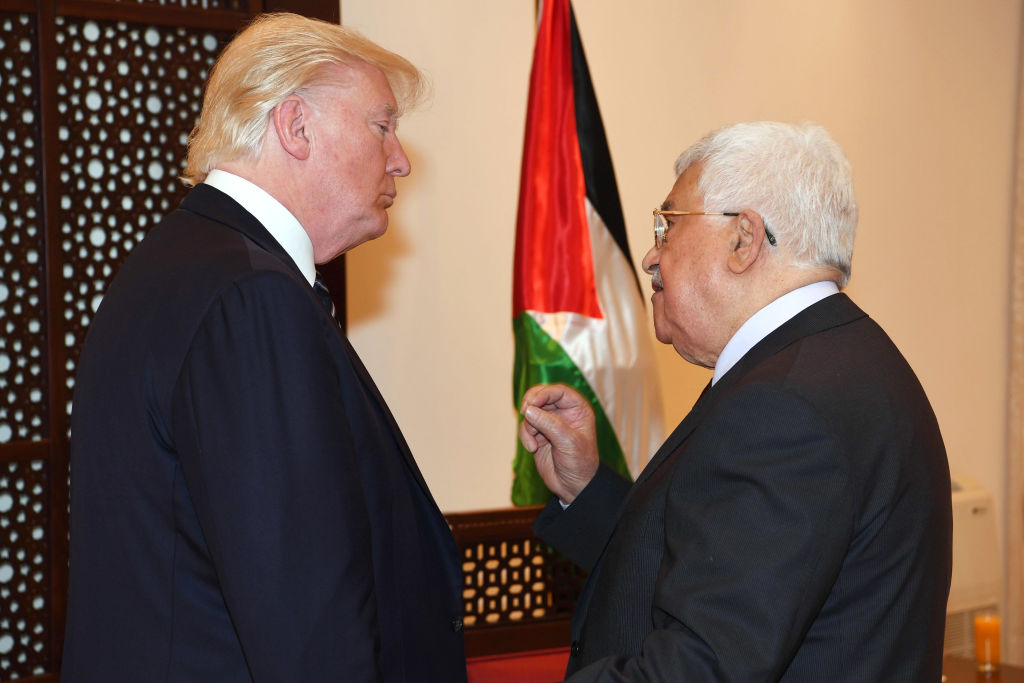
US President Donald Trump talks with Palestinian Authority President Mahmoud Abbas on May 23, 2017 in Bethlehem. (Photo by PPO via Getty Images)
Some of Abbas's top officials sound even more extreme than Hamas. Except, of course, when these soft-spoken, Western-educated Palestinian officials are dispatched to talk to Westerners. Then, all of a sudden, comes the honey.

Because the Palestinian Authority leaders and their surrogates speak in more than one voice, they send conflicting messages to the world about their actual intentions, often managing to fool everyone. Too often the world believes the messages they want to hear instead of the less-comfortable real ones.

The Palestinian Authority's contradictory messages have created the impression that it is both a peace partner and an enemy -- depending on whom you heard and when you heard him.

One thing is clear: from the Palestinian angle, there is no love lost between the US and them. From their point of view -- and this is a point of view that they have held for an exhaustingly long time -- the US is unable to play an unbiased role as a mediator in the conflict with Israel. What eats at the Palestinians is the strong and strategic alliance between the US and Israel.

The Palestinians have accused every US administration over the past four or five decades of being "biased" in favor of Israel. The Palestinians would certainly like to see the hundreds of millions of dollars in financial aid every year they receive from the US continue. Yet, no matter what the US does for the Palestinians, the Americans will always be denounced for their alleged bias in favor of Israel.

The Trump administration is about to receive a lesson in Palestinian politics. If and when the Trump administration makes public its peace plan, the Palestinians will be the first to reject it, simply because it does not meet all their demands.

Mahmoud Abbas knows that he cannot come back to his people with anything less than what he has promised his people: 100%.

The past few days have already given us indications of the Palestinian response. Here, for instance, is what Abbas's spokesman, Nabil Abu Rudaineh, had to say when he was asked to comment on reports concerning the peace plan and the US threat to close down the PLO's diplomatic mission in Washington: "The American administration has lost its ability to play the role of mediator in the region. The US can no longer be seen as the sponsor of the peace process."

Abu Rudaineh's remarks were rather more restrained than comments concerning the Trump administration made by other Palestinian officials and factions.

The PLO's chief negotiator, Saeb Erekat, went as far as threatening that the Palestinians would suspend all communication with the US if the PLO's diplomatic mission is shuttered.

Of course, no one seems to take Erekat's threat seriously. Suspending contacts with the US is tantamount to suicide for the Palestinians. Without US financial and political support, the Palestinian Authority and Erekat would disappear from the scene within days. At this stage, it remains unclear whether Erekat's talk about suspending contacts with the Americans includes the refusal to accept US financial aid.

Yet, Erekat's threats should be seen in the context of growing Palestinian rage and hostility toward the Trump administration. This anger is now being translated into a rhetorical onslaught against Trump and his administration. Palestinians are now accusing the current administration of working and conspiring towards "liquidating" the Palestinian cause with the help of some Arab countries, including Saudi Arabia and Egypt.

The Palestinians have made up their mind: the Trump peace plan is bad for us and we will not accept it. The plan is bad because it does not force Israel to give the Palestinians everything. For the Palestinians, the plan is bad because it is viewed as part of a conspiracy concocted by Jared Kushner and Saudi Arabia's crown prince, Mohammed bin Salman. The Palestinians have convinced themselves that Trump wants to "liquidate" their cause, not solve it.

Trump is about to go through the same process that President Bill Clinton experienced at Camp David 17 years ago. Then, much to the astonishment of Clinton, Yasser Arafat turned down flat an astoundingly generous offer by then-Israeli Prime Minister Ehud Barak. Trump will soon learn that for Mahmoud Abbas and the Palestinians, 99% is just not enough.

Bassam Tawil, a Muslim, is based in the Middle East.

Source: https://www.gatestoneinstitute.org/11402/palestinians-trump-peace-plan

Follow Middle East and Terrorism on Twitter

Copyright - Original materials copyright (c) by the authors.
With Iran on Its Doorstep, Israel Quietly Readies Game-Changing Air Power - Yaakov Lappin


by Yaakov Lappin

Israeli air power now has capabilities beyond any yet seen in military history.


BESA Center Perspectives Paper No. 649, November 21, 2017

EXECUTIVE SUMMARY: Israeli air power now has capabilities beyond any yet seen in military history. Its aerial strike capabilities are likely to prove decisive to the outcome of any military action taken against Iran in Syria.

Iran has big plans to create a military outpost in Syria, right on Israel’s doorstep. From there, the Islamic Republic could threaten and attack Israel in the future.

Israel is currently employing two tools to try and prevent this from happening: diplomacy and deterrence. Diplomatically, Jerusalem is reaching out to global powers and the international community, informing them of the consequences of Iran’s actions in a bid to create pressure on Tehran. To achieve deterrence, Israel is making clear to Iran and its agents that it has no intention of allowing them to proceed with their plans.

But what can Israel do if these prevention efforts fail, as they might? In such a scenario, Israel would have to fall back on military action. Some of that action would likely involve Israel’s new aerial strike capabilities.

These recently developed capabilities might well surpass any display of air power seen in military history thus far. They are based on an ability to use precise intelligence, combined with precision-guided weaponry, to destroy up to several thousand targets in just a matter of hours.

This is a tool that the Israel Air Force, together with the Military Intelligence Directorate of the Israel Defense Forces (IDF), has been developing quietly over recent years. It is a game-changing capability that significantly boosts Israeli deterrence against its enemies. It also boosts actual war fighting capabilities, should these be called upon.

In recent weeks and months, there have been indications that Iran is testing the waters in Syria. It is seeing how far it can go, and how far it can push Israel’s red lines.

In November, a Western intelligence source shared satellite imagery with the showing a new Iranian base being built south of Damascus. The facility can house hundreds of personnel and vehicles. It is a mere 50 kilometers from Syria’s border with Israel, and represents the tip of the iceberg of Iran’s plans for Syria.

This month, during a visit to London, Prime Minister Benjamin Netanyahu told the BBC in an interview that the Iranians “want to bring their air force there, right next to Israel, they want to bring Shi’ite and Iranian divisions right next to Israel. They want to bring submarines. So we will not let that happen, we will resist it.”

Israel’s Kan News broadcaster also recently reported Iranian plans to set up a division in Syria made up of 5,000 soldiers, air force bases containing Iranian fighter jets, and Iranian naval bases on the Syrian coastline.

Iran has already deployed to Syria thousands of Shiite militia members recruited from across the Middle East. They have been armed and trained by the Iranian Republican Guards Corps and the elite overseas Iranian Quds Force.

The Iranians also run militia units made up of Syrian recruits. The Commander of the Quds Force, Qassem Solemani, was recently photographed in eastern Syria with members of one such militia, the al-Baqr Battalion. The Iranians also helped build up other Syrian military forces, like the 313 Battalion.

At the same time, Iran appears to have stepped up efforts to create missile factories on Syrian soil, which it can use to arm its chief Shiite proxy, Hezbollah. One of these factories was reportedly struck by Israel last month.

As ISIS crumbles and the remainder of the Syrian Sunni rebels face defeat in Syria, Iran, which runs Assad’s ground war, will be free to shift the focus of its Syrian presence towards Israel.

Israel is prepared to deal with this threat militarily if necessary, though the intelligence challenge would be considerable. Many of the targets in question would not be clear-cut Iranian military entities, but rather proxies and militias attempting to disguise themselves or embedded into the local environment. Still, Israel’s intelligence capabilities should be up to the job of detecting and monitoring the targets and passing them on to the air force.

So far, Israel has used its precision strike capabilities for pinpoint attacks on targets that are part of the Hezbollah–Iran weapons program. But these same strike capabilities can be activated on a grand scale. The same air power can also be directed against the Assad regime, which the Iranian axis has fought for years to rescue and preserve.

In theory, Israel could inform Iran that its treasured Assad regime would be in jeopardy if Israel’s red lines are crossed in Syria.

Needless to say, any major escalation in Syria would almost certainly draw in Hezbollah in Lebanon as well, as the two fronts are interlinked. The Syrian-Lebanese border has become more of an imaginary line on a map than a real international boundary, as Hezbollah moves weapons and fighters across it on a regular basis. Any escalation on the Syrian front could easily activate the Lebanese front.

The stakes in Syria are very high, and Israel remains committed to the objective of preventing conflict on its northern fronts. So far, it has succeeded in this goal.

Russia has thus far appeared to help restrain its radical allies in Syria, but its role in any potential escalation remains unclear.

But should Iran ignore all of Israel’s warnings, Israel’s new air power will likely prove decisive to the outcome of military action in this arena.


This article was published by i24NEWS on November 14, 2017.

BESA Center Perspectives Papers are published through the generosity of the Greg Rosshandler Family


Yaakov Lappin is a Research Associate at the Begin-Sadat Center for Strategic Studies, where he recently published the study The Low-Profile War Between Israel and Hezbollah. He specializes in Israel’s defense establishment, military affairs, and the Middle Eastern strategic environment.

Source: https://besacenter.org/perspectives-papers/iran-doorstep-israel-readies-air-power/

Follow Middle East and Terrorism on Twitter

Copyright - Original materials copyright (c) by the authors.

Uranium One Noose is Tightening - Thomas Lifson


by Thomas Lifson

Now that the FBI’s informant on the Uranium One deal has been outed and the nondisclosure agreement formerly muzzling him abrogated, it is possible to see the outlines of the devastating case to be made against not just Hillary Clinton, but the entire Obama administration.

Now that the FBI’s informant on the Uranium One deal has been outed and the nondisclosure agreement formerly muzzling him abrogated, it is possible to see the outlines of the devastating case to be made against not just Hillary Clinton, but the entire Obama administration. Two intrepid reports, John Solomon of The Hill and Sara Carter of Sinclair Broadcasting, are gaining access to some of the reported 50,000 documents in the possession of William Campbell, the whistleblower who went to the FBI with the scary details of what appeared to him to be an illegal attempt by Russian entities to take over the world uranium market, including even the uranium resources in our ground.

Reporting in The Hill, Solomon calls our attention to what could be a key to understanding the magnitude of the scandal:
Campbell, who was paid $50,000 a month to consult for the firm, was solicited by Rosatom colleagues to help overcome political opposition to the Uranium One purchase while collecting FBI evidence that the sale was part of a larger effort by Moscow to make the U.S. more dependent on Russian uranium, contemporaneous emails and memos show.

“The attached article is of interest as I believe it highlights the ongoing resolve in Russia to gradually and systematically acquire and control global energy resources,” Rod Fisk, an American contractor working for the Russians, wrote in a June 24, 2010 email to Campbell.
The Russian plot to “control global energy resources” was reported by Campbell to the FBI a year prior to approval of the acquisition. There is every reason to expect – and the proof would be available to congressional investigators or (cough) a special counsel or US attorney – that this information was passed up the chain to AG Eric Holder and even President Obama. Yet, CFIUS – the group of agency head that must approve such transactions on which Holder and Hillary sat – went ahead and approved this sale that the US knew was part of a Russian plot to control the world uranium and energy markets.

Justice Department officials confirmed the emails and documents gathered by Campbell, saying they were in the possession of the FBI, the department's national security division and its criminal division at various times over the last decade. They added that Campbell's work was valuable enough that the FBI paid him nearly $200,000, mostly for reimbursements over six years, but that the money also included a check for more than $51,000 in compensation after the final convictions were secured.

The information he gathered on Uranium One was more significant to the counterintelligence aspect of the case that started in 2008 than the eventual criminal prosecutions that began in 2013, they added.

Solomon and Carter were interviewed last night on Hannity, along with Sullivan’s lawyer Victoria Toensing, and under questioning let us know that the money trail from Russia all the way to American political figures via cutouts will be exposed by documented evidence. 


Now, contemplate the magnitude of a scandal that could demonstrate foreign money leading to the approval of a sale that harms national security and aids a hostile power (about whose danger the Democrats have been hyperventilating for the past year). Here is a poor quality bootleg video of the segment, that may or may not last on YouTube. If a better cope becomes available, we will post that.


But only if the Sessions Justice Department is willing to press the case, or is forced to approve a special counsel:
The memos, reviewed by The Hill, conflict with statements made by Justice Department officials in recent days that informant William Campbell’s prior work won’t shed much light on the U.S. government’s controversial decision in 2010 to approve Russia’s purchase of the Uranium One mining company and its substantial U.S. assets.

Campbell documented for his FBI handlers the first illegal activity by Russians nuclear industry officials in fall 2009, nearly a entire year before the Russian state-owned Rosatom nuclear firm won Obama administration approval for the Uranium One deal, the memos show.
This official reticence, whatever its origin, will be overcome as Sullivan’s cache of 50,000 documents leaks out bit by bit. Attorney Toensing knows exactly what she is doing here, and how outside pressure can affect the grinding of the gears of justice.

Thomas Lifson

Source: http://www.americanthinker.com/blog/2017/11/uranium_one_noose_is_tightening.html

Follow Middle East and Terrorism on Twitter

Copyright - Original materials copyright (c) by the authors.

The Lie That Reelected Obama - Matthew Vadum


by Matthew Vadum

Al-Qaeda was not “on the run” while POTUS 44 was in office.

The previous administration deliberately understated al-Qaeda’s strength in 2012 so President Obama’s worse-than-useless counter-terrorism policy would seem like it was actually working, clearing the way for his easy reelection victory over Republican Mitt Romney, according to new evidence.

Intelligence was just one of the many areas of government activity relentlessly politicized by the Obama administration. In the Obama era, the Departments of Defense, Justice, and Education, to name only a few of the affected federal agencies, were also infested with determined radical ideologues bent on fundamentally transforming American society. Many of the left-wing extremists are still in positions of authority in the government as they undermine President Trump’s policies and directives every day.

For conservatives and other patriots, proof Obama twisted the facts about al-Qaeda for his own gain is yet another painful reminder of the Left’s virtually unchallenged mastery of the art of story-telling, even when, as in this instance, the story is a complete and utter lie, one of many propagated by Team Obama. Led by creative writer and Obama aide Ben Rhodes, left-wingers also managed to trick reporters and others into disseminating dangerous falsehoods about the laughably weak, unenforceable nuclear nonproliferation deal with the Islamic Republic of Iran. Rhodes is also credited with writing Obama's June 2009 Cairo speech, a piece of public relations outreach intended to flatter Muslims.

And it turns out the picture Obama’s people painted of Osama bin Laden, who was dispatched to the hereafter by U.S. Navy SEALs on May 2, 2011, was completely wrong. In the lead-up to his death, bin Laden wasn’t some out-of-touch, semi-retired, has-been figurehead in al-Qaeda, the Muslim terrorist group that engineered the 9/11 attacks. From his nondescript compound in jihadist-friendly Pakistan, he was in fact minutely involved in day-to-day operations and planning for al-Qaeda, as thousands of documents recently released by the Trump administration show. The U.S. military seized the material from bin Laden’s home.

It was New York Times foreign correspondent Rukmini Callimachi who spilled the beans Friday at an event at the Foundation for Defense of Democracies (FDD), putting into context the 17 cherry-picked documents the Obama administration made public in May 2012 in an effort to downplay the continuing significance of al-Qaeda.

“The overall narrative that I think was being pushed to the press, and if you look back at the editorials that were done when that trove came out, was an image of bin Laden isolated, he had lost control of this group,” Callimachi said, according to a report in the Weekly Standard.

This prompted fellow journalist Kim Dozier to ask her: “Do you think that was something that was kept from the public’s view because it revealed that there had to be reams of communication going back and forth, which means U.S. intelligence, Western intelligence, was missing this?”

“Think back to when bin Laden was killed,” Callimachi said. “It was 2011, it was right before a major campaign season. I don’t want to underplay the role that the killing of Osama bin Laden had, but I think that that was theorized into something much bigger.”

“The head of the organization has been killed, and now—these are literally quotes that I would get: the organization has been ‘decimated,’ the organization is in ‘disarray,’ the organization is ‘on the run,’” she added. “At the same time that we were preparing to pull out troops from Iraq and Afghanistan, I think that it was important to portray this [i.e. al-Qaeda] as a problem that no longer existed.”

Expanding on this line of thinking, FDD’s Thomas Jocelyn said, “that narrative that came out in 2012, we knew immediately was wrong, totally wrong, and was basically a cherry-picked version of what’s going on.”

The masters of propaganda at the DNC succeeded in driving Obama’s misleading talking points home to the American voters.

They crafted that made-for-TV moment on Sept. 6, 2012, at the Democratic National Convention in Charlotte, N.C., when Vice President Joe Biden triumphantly declared, “Osama bin Laden is dead, and General Motors is alive,” to thunderous applause. The speech helped to crystallize in the public consciousness the false idea that President Obama was giving the jihadists hell, instead of the reality, which was that Obama was merely inconveniencing the terrorists from time to time.

Although Biden’s assertions about OBL and GM were true, bin Laden’s terrorist group, al-Qaeda, wasn’t “decimated,” or even “on the run,” as President Obama said in his stump speeches on the campaign trail that year. It was thriving.

Team Obama promoted other lies to ensure the 44th president’s reelection. When bad news in Libya briefly caused the Obama campaign heartburn, the leftist propaganda machine kicked into high gear.

Obama White House officials told anyone willing to listen that a spontaneous demonstration sparked by Muslim anger over an obscure anti-Islam video had magically materialized in a city blanketed by al-Qaeda flags and that within hours this supposedly organic melee had turned deadly. Obama sent UN Ambassador Susan Rice onto five Sunday talk shows to promote the made-up story.

The false narrative obscured then-Secretary of State and future presidential candidate Hillary Clinton’s bungling of the response to the politically inconvenient Sept. 11, 2012, Muslim terrorist attack in Benghazi, Libya, that left four Americans, including Ambassador Chris Stevens, dead. Early reports indicated Stevens had been violently sexually abused before being killed by his jihadist captors. The rape claim has neither been proven nor refuted, and no autopsy report for Stevens has seen the light of day.

Unless conservatives brush up on their narrative-creating skills, they are going to keep getting ambushed by leftist liars over and over again.

Who knows how many more Obama wannabes the Democratic Party has in the pipeline?


Matthew Vadum, senior vice president at the investigative think tank Capital Research Center, is an award-winning investigative reporter and author of the book, "Subversion Inc.: How Obama’s ACORN Red Shirts Are Still Terrorizing and Ripping Off American Taxpayers."

Source: http://www.frontpagemag.com/fpm/268467/lie-reelected-obama-matthew-vadum

Follow Middle East and Terrorism on Twitter

Copyright - Original materials copyright (c) by the authors.

Keeping our cool with Saudi Arabia - Dr. Mordechai Kedar


by Dr. Mordechai Kedar

Seventy years of ostracism by the Arab world fills us with false hope at the sight of an Arab smile. We should take a leaf from their book and remember that "God is with the patient" (Quran, 2:153).

Revelry and rivers of enthusiasm washed over Israeli media over the past week: "Saudi newspaper interviews Israeli chief of staff!" "Peace with Saudi Arabia has begun!" "The days of the messiah are upon us!" That was the general spirit of the responses to the interview Chief of Staff Lt. Gen. Gadi Eizenkot gave to the Arabic news website Elaph last Thursday.

This site is, in fact, not at all a Saudi newspaper, as claimed in the various reports, and is run from London by two people, one born in Saudi Arabia and the other in Iraq.

Few Israelis know that the interviewer was not some Saudi journalist who landed in Israel in secret, as was suggested, but by Druze-Israeli Majdi Halabi, one of our own, who serves as Elaph's Israel correspondent.

This site has given a platform to a number of Israeli writers since its establishment in 2001, including articles by my mentor, the late Prof. Shmuel Moreh, and even yours truly. But by all means, if we can get everyone excited about a historical event or the coming of the messiah, why not?

Incidentally, I combed the Saudi news outlets for any mention of the interview, but I did not find one.

It is true that Eizenkot said very interesting things in the interview, including that "we will not tolerate the entrenchment of an Iranian presence in Syria in general, and particularly west of the Damascus-Suwayda road [forming a line running roughly parallel to the Israel-Syrian border]. We will never allow any Iranian presence – we warned them against building military facilities and bases, and we will not allow it."

What he said, in other words, is that we control a strip of land inside Syria, dozens of kilometers wide, along our border, and we will do everything in our power to expel the Iranians from there. But what will happen if the Iranians do build a base there to test our mettle? What if they publicly declare that an attack on their base will spark a big war? Will the IDF actually strike?

It seems that Israelis – both senior officials and professional interviewees – have forgotten the first rule of the Middle East bazaar culture, a rule we learned from the godfather of negotiations in our region (and my esteemed teacher, may he live many years), Professor Moshe Sharon: "Never show excitement, because then the price will climb to a level you won't be able to afford." The Saudis need us because of the Iranians. They would be willing to get into bed with the devil himself if he would protect them from the Persians.

We must maintain a neutral poker face so that they feel they have to work hard to convince us to give them what they want on our terms. For example, a Saudi embassy in Jerusalem. Why? Because. That's our demand.

Seventy years of solitude, hatred, boycotts and insults from our neighbors have caused us to be moved by any semblance of a smile, to lose our cool over a handshake, to become excited when a question asked by an Israeli reporter is answered begrudgingly by a lowly Saudi prince, to cry with joy after a Kuwaiti representative remains in the auditorium when our ambassador speaks. Our obsession with displays of Arab attention and Arab gestures has become a psychological disorder. They fully exploit our desperate desire for their smiles, delighting in our "learned" commentators' analyses of their every move.

This unbridled excitement proves that we did not learn the lesson our neighbors learned from the Quran: "Verily, God is with the patient" (2:153) – meaning that if you want God to help you, do not become overexcited, do not leave the safety of your front yard, do not show emotions and do not make haste. Be cool-headed and patient and make sure to maintain your poker face.

The stress and fear of Iran that is pushing the Saudis in our direction is presenting us, perhaps for the first time, with an opportunity to set our own terms: direct peace negotiations solely with the Saudis, without any foreign intervention; a Saudi embassy in Jerusalem; recognition of Jewish rights to live everywhere in Israel; a clear distinction between Israeli-Saudi peace and the Israeli-Palestinian conflict; a Saudi pledge to refrain from voting against Israel in international forums; full normalization, including scientific, cultural, commercial and industry cooperation and the acceptance of flags and anthems at sports events. Have a problem with that? See ya.

Anyone who thinks that this sort of peace – which would be much better than the agreements Israel currently has with Egypt and Jordan – is impossible, is stuck in the mentality of Moses' 12 spies, who told him after scouting the Holy Land: "We seemed like grasshoppers in our own eyes, and seemed the same in their eyes" (Numbers 13:33). On the day that we see ourselves at our true size, our neighbors will treat us properly. Until that day, however, let's hold the festivities.


Dr. Mordechai Kedar is an Israeli scholar of Arabic culture and a lecturer at Bar-Ilan University.

Source: http://www.israelhayom.com/opinions/keeping-our-cool-with-saudi-arabia/

Follow Middle East and Terrorism on Twitter

Copyright - Original materials copyright (c) by the authors.

A baseless liberal myth - Prof. Efraim Inbar


by Prof. Efraim Inbar

A Gaza version of the Marshall Plan is a bad and harmful idea.

Voices from inside the IDF and out are advising Israel to spearhead a broad international aid plan for the Gaza Strip. According to the plan's initiators, its purpose would be to prevent economic deterioration that could spark unrest and bring to power forces even more radical than Hamas. Improving the economy in Gaza, supporters of the plan hope, would also reduce motivation for terrorism against Israel.

The logic behind this aid plan is flawed for several reasons:

1. The assumption that poverty creates terrorism is a factually baseless liberal myth. There is no correlation between standard of living and political violence and terror. Poor countries do not suffer from terrorism any more than richer countries. Take India, for example. The Palestinians launched their campaign of terror in 2000, when their economy was at its peak.

2. Believing that economic prosperity among Gazans will temper the worldview of Hamas' military wing is unforgivably naive. Radical ideology and religious zealotry will not be affected by the wealth of unarmed Gazans. In dictatorial regimes such as the one in Gaza, whoever controls the weapons makes the decisions. Middle Eastern tyrants do not hesitate to shoot their political rivals.

3. Large-scale economic aid to Gaza means supporting a bitter enemy determined to destroy the Jewish state. Did the West ever consider economic help for the people living under Islamic State's so-called caliphate in an attempt to curb increasing radicalization? Israel does not need to concern itself with the viability of Hamas, the Palestinian branch of the Muslim Brotherhood. Radical Islam can be defeated only when enough Muslims realize the extremist version of their religion is the main source of their suffering, not their well-being.

4. It is an Israeli interest for Hamas to be weak. This is precisely what Egypt wants, as does the Palestinian Authority. A Hamas mired in problems is far less likely to seize control of the PA. A weak Hamas is also more responsive to Egyptian pressure aimed at forcing the group to reduce the help it provides to radical Islamist elements in Sinai fighting the Egyptian army.

5. Any measure to bolster Hamas will come at the PA's expense. Although none of the Palestinian factions are true peace partners, the PA is less militant. Ultimately, it is a more palatable partner for the purpose of managing the conflict.

6. Israel's fight against Iran's hegemonic aspirations in the region – the country's predominant strategic problem – would also be impaired by Israeli efforts to help the Hamas government. Hamas cooperates with Iran. Egypt, Saudi Arabia and its allies in the moderate Sunni camp are fed up with Hamas and the Muslim Brotherhood. These countries are also gravely fearful of Iran's expanding regional influence. Sending Israeli aid to the Hamas-controlled Gaza Strip is  not conducive to improving relations with the moderate Sunni countries in their stance against Iran. Giving Hamas economic aid buttresses the radical Islamic camp, of which Iran is a part.

A Gaza version of the Marshall Plan is a bad and harmful idea. Israel needs to persist with its carrot-and-stick policy, which has been substantially successful over the years, even if finding the perfect balance in this fragile equation is complicated and fraught with uncertainty. Israel has no interest in a humanitarian crisis in Gaza (and concerns about that have been overblown), but the proposal to institute a Marshall Plan for Gazans is certain to disrupt the delicate balance between punishment for bad behavior and incentives for behavior that Israel does not find pernicious.


Prof. Efraim Inbaris president of the Jerusalem Institute for Strategic Studies, professor emeritus at Bar-Ilan University, founding director of the Begin-Sadat Center for Strategic Studies and a Shillman-Ginsburg fellow at the Middle East Forum.

Source: http://www.israelhayom.com/opinions/a-baseless-liberal-myth/

Follow Middle East and Terrorism on Twitter

Copyright - Original materials copyright (c) by the authors.

Ayelet Shaked: 'Huge opportunity to escape two-state solution paradigm' - Mordechai Sones


by Mordechai Sones


'Palestinian statehood no longer only path to Middle East peace. We think valid peace can be born of strength, from strengthening Yesha'


Justice Minister Ayelet Shaked spoke on Monday evening at a conference held by Arutz Sheva and the Orthodox Jewish Chamber of Commerce at the King David Hotel in Jerusalem.

"I think that Arutz Sheva symbolizes right-wing, Zionist media, it is one of the leaders I would say, in the field of the Israeli media, and it's not an obvious thing in Israel unfortunately, but Arutz Sheva is definitely the leader. It gives us the power to act and to publicize what we are doing.

"It's a very unique time for us in the Ministry of Justice and in Israel. During the recent months we're actually changing the old rules, the old paradigm regarding the law in Judea and Samaria. We started from the Regulation Law, and we are doing a lot of very important things regarding the settlements in Judea and Samaria, we are finally building 300 units in Beit El, and just this week we approved building 91 houses in Ofra, something that was stuck for a long time. Haresha is another small village that will now be able to be developed after a recent decision of the Attorney General, and we are doing a lot of effort in the Ministry of Defense and the Ministry of Justice in order to strengthen our presence in Judea and Samaria.

"I think the government as a whole is doing a really important job, I know that the Minister of Transportation was here, and I'm sure that he spoke about the roads that finally this government approved a budget for those roads. I think that the fact that we have a very friendly administration in the United States is a huge opportunity not to stay in the old paradigm of 'two states'. We know that this solution will not help to strengthen the Jewish State. The Jewish Home, our party, calls always to think out of the box. When we speak with people from the Trump administration, we urge them to think out of the box.

"A Palestinian state is no longer the only solution for peace in the Middle East. We think that a valid peace can be born from a position of strength, from building and strengthening the settlements in Judea and Samaria, and from encouraging economic peace and economic development of the Palestinian Authority.

"So I think we are at a very historical point where we have a very friendly administration in the United States, a right-wing government here in Israel; I think this specific government is making breakthrough in a lot of subjects, in the Judicial system, in the educational system, in transportation; and the fact that you are sitting here in this event - I'd say the vast majority is from the coalition, Knesset members from the coalition, and some Knesset members from the opposition, and I will emphasize two things: One, I will say our appreciation for Arutz Sheva, and the other thing is our appreciation for our good friends from America, and the fact that when we combine forces - forces from Israel and forced from the United States - we can work together on the values we all believe in. Thank you very much."


Mordechai Sones

Source: https://www.israelnationalnews.com/News/News.aspx/238293

Follow Middle East and Terrorism on Twitter

Copyright - Original materials copyright (c) by the authors.

North Korea bans drinking, singing -- Gerry Willig


by Gerry Willig

North Korea steps up repression of own citizens as US declares rogue regime a state sponsor of terror.


Kim Jong Un
Kim Jong Un
Reuters
North Korea stepped up its repression of its own citizens by banning drinking and singing,the Yonhap news agency reported Monday.

According to the report, North Korean citizens are banned from attending “any gatherings related to drinking, singing and other entertainment."

The move may be part of an effort to stifle “a possible negative impact” of sanctions against the rogue regime for its recent nuclear weapons tests.

US President Donald Trump designated North Korea as a State Sponsor of Terrorism Monday.

"Should have happened a long time ago. Should have happened years ago," Trump declared, according to AFP, citing the death of US student Otto Warmbier, who had been held in a North Korean jail and the assassination by nerve agent of the elder brother of North Korean leader Kim Jong Un on foreign soil as reasons for the move.

At the same time, Secretary of State Rex Tillerson later stressed that Washington has not given up hope that sanctions and diplomacy can pressure Kim into agreeing to sit down and discuss his nuclear disarmament.

Tillerson said that punitive measures were already having a "significant effect" on Pyongyang's economy -- even if China has yet to cut off oil supplies to its sole refinery -- and added, "We still hope for diplomacy."

There have been increased tensions between the United States and North Korea in recent months, as Pyongyang continues to conduct nuclear and ballistic missile tests in defiance of UN sanctions.

Visiting Seoul last week, Trump warned North Korea he was prepared to use the full range of U.S. military power to stop any attack, but also urged Pyongyang to “make a deal.”

Last week, the president said that the "twisted dictatorship" in North Korea cannot blackmail the world, adding that the goal is to "denuclearize" North Korea and stressing the U.S. has made clear "all options remain on the table."


Gerry Willig

Source: https://www.israelnationalnews.com/News/News.aspx/238319

Follow Middle East and Terrorism on Twitter

Copyright - Original materials copyright (c) by the authors.