Sunday, November 26, 2017

Palestinian Double-Dealing Won’t Work Forever - Jose V. Ciprut


by Jose V. Ciprut

Times have changed. The PLO’s duplicity, at long last, just might blow up in its face.

BESA Center Perspectives Paper No. 657, November 26, 2017

EXECUTIVE SUMMARY: By refusing to be Israel’s direct interlocutor, and by turning instead to third parties in the hope of cornering Israel into submission, while also demanding that it be prosecuted for “war crimes,” the PLO manifests inordinate duplicity vis-à-vis Israel. It disqualifies itself entirely from the trust of the Jewish state. The PLO will have to face the consequences of its actions: for, short of imperiling its own legitimacy, no “honest broker” could abet the PLO’s double dealings much longer.

“The General Delegation of the PLO (Palestinian Liberation Organization) to the US” – to use its formal name – is located at 1732 Wisconsin Avenue NW, Washington DC. In the good old days of the Obama administration, the delegation was granted permission to display a flag at that address, a courtesy it has used to declare the building an “Embassy.” This appears to be yet another case of “fake hat, no cattle.” It is a mystery why no one bothers to refute this illegal pretense, phony self-arrogation, abusive self-aggrandizement, and deliberately misleading grandiloquence.

On November 22, 1974, UNGA Resolution 3236 recognized “the right” – not “of Arabs of, or in, Palestine,” not even “of Palestinian Arabs” – but “of the Palestinian people” to self-determination, national independence, and sovereignty “in Palestine” (a “people,” on “its own exclusive land,” as this callously monopolized generic name seeks to suggest). Recognizing the PLO as the sole legitimate representative of the Palestinian people, UNGAR 3236 conferred upon it “observer status” at the UN.

Though it still flies the flag of a non-state, and despite the fact that its “peoplehood” remains a project in the making, the PLO has managed to ratchet up its status at the UN and in UN institutions such as UNESCO and the ICC. Little wonder then that the organization is in no hurry to settle directly with Israel the parameters of the statehood it covets.

This phenomenon does a disservice to genuine peoples, like Catalans and Kurds, who are by far more amply qualified to govern themselves.

The designation “Palestine” for the PLO was adopted by the UN – as recently as 1988 – in acknowledgment of the PLO’s unilateral declaration of “Palestinian independence,” even though the proclaimed Palestinian state has no formal status in the established international system. Yet non-statehood did not disqualify the “State of Palestine” from being “recognized” by developing countries in Africa and Asia (the 21 member countries of the Arab League; the 56 states of the Organization of Islamic Cooperation; and many formerly communist and “non-aligned” G-77 states, among them) as soon as the PLO declared its “independence” – without a referendum.

Beyond tailored lies designed to promote “Palestine” as an entity that it is not, what the PLO seems to need right now is self-sufficiency and well-governed societal stability. That combination would be conducive to modern democratic rule that can integrate rival factions, disarm rival militias, and steer a viable economy with a capacity to generate – and to redistribute – income fairly to its geographically, culturally, and traditionally disparate tribal subjects.

Despite the fact that a “State of Palestine” does not exist, it was, by September 14, 2015, already “recognized” by 136 (70.5%) of the 193 member states of the UN and two non-member states. The label does not guarantee Palestine’s viability as a functional entity until and unless it can also reach a “mutually just and durable peace” agreement with the democratic Jewish state of Israel, with which it must sincerely want to coexist. The sad realities on the ground indicate that the conditions for such mutual concordance and fraternal coexistence are not only nonexistent right now but unattainable for the foreseeable future, owing to the persistent absence of a shared ethical foundation.

The PLO can no longer credibly pretend to be amenable to negotiating peaceful coexistence with Israel at the same time that it refuses direct contact with it; waits for “an acceptable final deal” to be served up by a third party; and instructs yet another third party to prosecute its future peace partner for “serious war crimes” – in utter disregard of binding agreements to the contrary long known to all the stakeholders.

One cannot pretend to be ready in good faith to engage in peace negotiations with a putative future partner whom one formally asks the ICC to pursue and condemn for matters that should be resolved through direct negotiation. One must not expect to continue duping all of the parties all of the time by simultaneously undertaking actions and contradictory counteractions. One should not abuse the generous tolerance shown for too long by an honest broker whose patience is not endless. And one most certainly should not get on one’s high horse by suggesting that the foreseeable – and lawful – closure of PLO headquarters in the US capital as a result of the PLO’s defiance of the law of the land would result in the PLO’s irreversible discontinuation of all peace talks to be held via US mediation. Times have changed. The PLO’s duplicity, at long last, just might blow up in its face.

The Middle East is transforming. Lebanon’s double-speak about the need to keep its “South” aligned with the UN Resolution’s exigencies (“no militias”) while also asking its troops not to provoke a conflict with Hezbollah or a war with Israel; Saudi Arabia’s labeling of Hezbollah as a terror group; the Arab League’s recognition of Iran as a warmonger, exporter of terror, and meddler in regional countries’ internal affairs; Qatar’s role in the Gulf’s disquiet; Iran’s opportunistic pursuits and direct threats to Israel’s longevity; Assad’s gratitude to Moscow for “saving [whatever little is left of] Syria” are not good omens for stable peace or sustainable prosperity in this fragile, volatile, and divided region.

For the moment, the PLO’s US office will not be closed. If it knows what’s good for it, the PLO would be well advised henceforth to behave honestly.


BESA Center Perspectives Papers are published through the generosity of the Greg Rosshandler Family


Jose V. Ciprut is a conflict analyst, social systems scientist, and international political economist.
 

Source: https://besacenter.org/perspectives-papers/palestinian-double-dealing/

Follow Middle East and Terrorism on Twitter

Copyright - Original materials copyright (c) by the authors.

Anatomy of a smear - Rabbi Steven Pruzansky


by Rabbi Steven Pruzansky

It would be edifying if Israelis truly understood what is happening in American Jewish life and paid less attention to the instigators of insincere indignation, such as those who smeared Hotovely. Netanyahu should have supported her.

As if on order, no sooner had I written “Life with a Smear” when we were presented with a real life example of a smear – a deliberate and conscious attempt to manipulate and distort the words of a public figure in order to shame her, force an apology, get her fired and ruin her life and career – all for the purpose of gaining some petty, partisan, political advantage.
    
The other day, Israel’s Deputy Foreign Minister Tzipi Hotovely purported to “disrespect” and “outrage” “all of American Jewry” (these are actual quotes from her critics) by articulating basic truths of which all American Jews are aware. Asked why there is a disconnect these days between much of American Jewry and Israel on diplomatic issues, and how such matters as the “Kotel” controversy have angered such a large part of American Jewry, she answered that Israel is the homeland of all Jews, “of all streams,” and every Jew should come live here and thereby influence Israeli society. But, she added, most American Jews are “not understanding the complexities of the region,” as they are –and here are the phrases that allegedly ticked off the self-appointed leaders of branches of American Jewry that are in such a steep decline – “people that never send their children to fight for their country, most of the Jews don’t have children serving as soldiers, going to the Marines, going to Afghanistan, going to Iraq. Most of them have quite comfortable lives. They don’t know how it feels to be attacked by rockets.”
     
If we parse her words fairly and objectively, it is clear that her sentiments are true and indisputable. Most American Jews do not have children serving as soldiers, Marines, in Afghanistan or Iraq. That is obvious, and I would speculate that most American Jews don’t even know someone who serves in the American military or served in Iraq or Afghanistan. (I do – a young former congregant was a Marine who fought during some of the harshest combat in Fallujah, Iraq, and I was proud to officiate at his wedding at which he wore his full dress uniform, replete with sword, and of course a good number of chaplains.) But most don’t, and that is true today of most Americans.
     
This is not because American Jews are selfish, uncaring, unpatriotic or disloyal. In truth, we are underrepresented in the American military according to our percentage of the population, but that has to do mostly with the underrepresentation of particular socio-economic brackets in the American military and the underrepresentation in the military of sections of the country where most Jews live. The higher socio-economic bracket to which one belongs and the more liberal the area of the country in which one lives, we find the lower the rate of participation in the military. This is true for Jews and non-Jews. We can quibble whether this should be so but not whether it is so. It is, and so it has been since the United States abolished the draft 45 years ago. (Parenthetically, only 25 % of the current members of Congress have served in the military, compared to close to 80% of the congressmen in the 1970’s.)
     
What Tzipi Hotovely said is absolutely true.
     
But this is how a smear works: Rick Jacobs, the leader of Reform Judaism who has become an open foe of a strong, proud, traditional Israel, castigated her for being “ignorant and ill-informed,” because, as he said, “my father served with distinction” in the American army. Indeed – we honor his father’s service! – but she did not say that Jews have never served in the American military (“never send” is not the same as “never sent,” and even that phrase was clarified), but rather that most Jews “don’t” serve in the American military. Note the verbal legerdemain – pretending her remarks were a blanket statement about the past rather than a comment on the present. That is rank dishonesty, and he should be ashamed of himself for engaging in it.
     
The point is not whether his father served or even whether he served (I assume he didn’t; he and I both came of age after the United States switched to an all-voluntary military). When there was a draft, Jews were drafted and served like any other citizen; American Jews fought in World War II in a greater proportion than our share of the population. I’ve walked the grounds of the American military cemetery at Normandy. The Stars of David that mark the graves of the dead American-Jewish soldiers stand out, if only because the thousands of crosses are arranged so neatly. But they are there, in almost every row. She was speaking about current events, how most American Jews today are detached from a military life, and how that surely taints their views on Israel where fighting in the military in an existential conflict that will not end is part of life and the expectation of almost every teenager. And she is correct – so correct that I would be curious to learn how many of her critics, or her critics’ children, have fought in the American military.
     
Here’s another shameful smear: the accusation that she was disrespecting all those young American Jews who go to Israel and enlist in the IDF. Again – smear. Distortion. Misrepresentation. Lie. And this is how it works – did she mention lone soldiers? Did she mention the IDF? Of course not. Look at both her words and the context. In our community, many dozens of youngsters over the years have enlisted in the IDF, and we are proud of all them. But have any of them fought in Afghanistan or Iraq? Not to my knowledge…   So this is a blatant effort to willfully distort her words. She made no reference to the IDF – so how can she be accused of disrespecting those who fight in the IDF? But this is how the smear game works – more verbal sleight-of-hand – denouncing someone for what was said and is true by attributing to them things that were not said and are false.
     
There are two real problems at play here, and Minister Hotovely is responsible for neither of them. The officialdom of the heterodox movements is uncomfortable, even resentful, of a successful woman who is proudly Jewish, proudly religious, proudly traditional, proudly Israeli and proudly right-wing.  She undermines several of their persistent narratives about Orthodoxy and traditional life in Israel. Seeing the Deputy Foreign Minister of Israel wearing a shaitel must gall them. Too bad – for them.
    
And the bigger problem is this: with the heterodox movements in a free fall, both in terms of raw numbers as well as influence in American politics because of the persistent liberal bias, they need an enemy to energize their base. They need to periodically – these days, it’s every few weeks – find a scapegoat, an accusation, an insult or a cause to get their people riled up. It can be the Haredim to whom they attribute all sorts of mischief and ill-will. It can be the Kotel, where suddenly – literally, suddenly, after many decades – the status quo of exclusively traditional prayer bothers them. It is as if they woke up one day and realized – or contrived – that the status quo must bother them. It can be the non-acceptance of their conversions, their rabbis, or their modes of worship in one form or another. It can be the growth of the settlements or a forceful response to Arab terror or Gazan rockets. But it is always something.
    
That is why even an apology from Tzipi Hotovely, which she proffered because that is the way the smear game is played (and shame on the Prime Minister for not standing behind her), will not suffice for the complainants. They want her and her kind out! It is not her but what she stands for that irritates them. She is a constant reminder of what they too could have – with their children and grandchildren – if only they would return to the honest study of Torah and the true observance of mitzvot. That is why they seem to be perpetually aggrieved and always cross about something going on in Israel.
    
When many Israelis speak of “American Jewry,” they conjure to themselves a benign image of Jews who proudly love and support Israel, feel a deep emotional bond, and constitute a solid bloc of the type of encouragement and cooperation that one can expect from family. Would that it were so – but those days are long gone, sadly. Most American Jews today are unaffiliated – they do not identify as Orthodox, Reform or Conservative. They don’t feel that bond with Israel that their parents and certainly their grandparents did, most by far have never even visited Israel, and the ranks of American Jewry (including the heterodox movements) have been decimated by intermarriage that has obviously sapped their identification with Jews and the Jewish State. And the heterodox movements are permeated with Western ideas and values that occasionally conflate with Jewish ideas and values, but not always, and they can by and large no longer tell the difference.
    
The cause of Israel struggles today on college campuses because too many young Jews are cut off from their Jewish identity. The more the Jew is disengaged from Judaism, Torah, mitzvot and Jewish values, the more he or she will be disengaged from Israel. It is a tragic but accurate formula – that is why Minister Hotovely was banned by a “Jewish” group from speaking at Princeton – but there is little that Israel can do to reverse that trend. Identification and support for Israel will result from an enhanced sense of Jewish identity but those young Jews who are estranged from Israel have already embedded another identity and set of values and priorities. That is what has to be reversed and at this the heterodox movements are ill-equipped as they have long fostered an alienation from Torah.
    
That is why they force themselves to be outraged, manufacture slights and insults, and are avid players of the “Gotcha Game,” in which they monitor every single word of their targets in order to find the one word that they can wrench from context, cast in the most negative light or otherwise twist and falsify – all so that they can show relevance to their dwindling flock and their fellow travelers in the secular media. This is the smear game in action.
    
It would be edifying if Israelis truly understood what is happening in American Jewish life, paid less attention to the instigators of insincere indignation, and more attention to those Jews whose Jewish children and grandchildren will be building Torah, supporting Israel, making aliya and preserving the future of the Jewish people. And, of course, it would be an absolute delight if all Jews – of every stripe and background – did the same, and in so doing brought the era of redemption closer.

Rabbi Steven Pruzansky is spiritual leader of Congregation Bnai Yeshurun in Teaneck, New Jersey and anoted lecturer and author.. A past President of the Rabbinical Council of Bergen County, he also served as a Vice-President of the Rabbinical Council of America, is a trustee of the RCA on the Board of the Beth Din of America, as well as a dayyan on the Beth Din itself, is a member of the Rabbinical Alliance of America, and was American co-spokesman for the International Rabbinic Coalition for Israel. Ordained at Yeshiva Bnei Torah in Queens, NY, he also has a Juris Doctor degree from the Benjamin Cardozo School of Law.

Source: https://www.israelnationalnews.com/Articles/Article.aspx/21318

Follow Middle East and Terrorism on Twitter

Copyright - Original materials copyright (c) by the authors.

Did Lebanon's PM Saad Hariri just sign his own death warrant? - Rick Moran


by Rick Moran

Hariri vows to prevent Hezb'allah from exporting violence to the Sunni Middle East.

Lebanon's Prime Minister Saad Hariri said on Saturday that he would not accept Hezb'allah's stated policy of interferring in the internal affairs of other Arab countries - a direct challenge to Hezb'allah's power in Lebanon.

Hariri resigned as prime minister earlier this month but withdrew the resignation at the behest of Lebanon's Christian President Michel Aoun. 

Hariri challenging Hezb'allah - and by extension, Iran and Syria - is eerily reminiscent of his father's actions which led to his assassination in 2005. Rafiq Hariri died in a car bomb explosion on February 14, 2005, just a few days after a meeting with Hafez Assad, Syria's president at the time.

Reuters:
Lebanese Prime Minister Saad al-Hariri said on Saturday that he would not accept Iran-backed Hezbollah’s positions that “affect our Arab brothers or target the security and stability of their countries”, a statement from his press office said.
The statement did not specify which countries he meant.
Everyone knows that Hariri is talking about Saudi Arabia and the Gulf states, who are under direct threat from Hezb'allah.

Hezbollah is fighting alongside Syrian President Bashar al-Assad in Syria. Gulf monarchies have accused the Shi‘ite group of also supporting the Houthi group in Yemen and of backing militants in Bahrain. Hezbollah denies any activity in Yemen :or Bahrain.

Hariri’s resignation pitched Lebanon to the forefront of a regional power tussle this month between Saudi Arabia and Iran, which backs Hezbollah. The two regional powers back competing factions in Iraq, Syria, Lebanon and Yemen.
After returning to Lebanon this week, he shelved the decision on Wednesday at the request of President Michel Aoun, easing a crisis that had deepened tensions in the Middle East.
Following his announcement, made on Lebanon’s independence day, hundreds of Hariri supporters packed the streets near his house in central Beirut, waving the blue flag of his Future Movement political party.
On Saturday, he said that his decision to wait instead of officially resigning is to give a chance to discuss and look into demands that will make Lebanon neutral and allow it to enforce its “disassociation” policy.
The "disassociation policy" would make Lebanon neutral. This is the farthest thing from Hezb'allah's mind. The terrrorists have every intention of supporting terrorist groups and rebels in Yemen, Bahrain, and elsewhere. The heart of their policies is to check Saudi Arabian influence on behalf of their paymasters in Iran.
In 2005, it was the Syrian occupation of Lebanon and Hezb'allah's support for President Hafez Assad that Hariri was fighting. A report on the elder Hariri's assassination released in 2005, found members of Assad's family personally responsible for Hariri's murder. Cell phones used during the car bombing were traced to Hezb'allah operatives. A tribunal was set up to try those responsible for the assassination, but Hezb'allah and the Lebanese government refused to cooperate.
Now, Saad Hariri finds himself in a similar position as his father - opposing Hezb'allah. For all the talk of Hezb'allah being a "political organization," the fact is, they have the guns to enforce their will and are not shy about using them. 
The terrorists had no comment on Hariri's statement, but issued a statement of their own looking forward to "dialogue."
On Saturday, Hezbollah’s International Relations Officer Ammar Moussawi said that the Shi‘ite group is ready to reach understandings with “our partners in the country”, and that the group is open to real dialogue and cooperation with all, Lebanon’s state news agency NNA reported.
Hezb'allah's idea of "dialogue and cooperation with all" leaves a lot to be desired.


Rick Moran

Source: http://www.americanthinker.com/blog/2017/11/did_lebanons_pm_saad_hariri_just_sign_his_own_death_warrant.html

Follow Middle East and Terrorism on Twitter

Copyright - Original materials copyright (c) by the authors.
US changes course, allows PLO office to remain open - AP and Israel Hayom Staff


by AP and Israel Hayom Staff

Days after insisting PLO's Washington office must close, U.S. State Department says instead it has advised the office to limit its activities in next 90 days "to those related to achieving a lasting, comprehensive peace" between Israel, Palestinians.


The PLO's Washington office
Photo: AP

U.S President Donald Trump's administration has backtracked on its decision to order the Palestinian Liberation Organization's office in Washington to close, instead saying it will merely impose limitations that it expects will be lifted after 90 days.

Last week, U.S. officials said the PLO mission could not stay open because the Palestinians had violated a provision in U.S. law requiring the office to close if the Palestinians call on the International Criminal Court to prosecute Israelis. The move triggered a major rift in U.S.-Palestinian relations that threatened to scuttle Trump's ambitious effort to broker a peace agreement between Israel and the Palestinians.

The United States delayed shuttering the office for a week while saying it was working out the details with the Palestinians, before abruptly reversing course late Friday, as many Americans were enjoying the long Thanksgiving  Day weekend. State Department spokesman Edgar Vasquez said the U.S. had "advised the PLO office to limit its activities to those related to achieving a lasting, comprehensive peace between the Israelis and Palestinians."

Vasquez said even those restrictions will be lifted after 90 days if the U.S. determines the Israelis and Palestinians are engaged in serious peace talks. In an effort led by Trump adviser and son-in-law Jared Kushner, the White House has been preparing a comprehensive peace plan to present to both sides in the coming months.

"We therefore are optimistic that at the end of this 90-day period, the political process may be sufficiently advanced that the president will be in a position to allow the PLO office to resume full operations," Vasquez said.

The reversal marked a serious departure from the administration's interpretation of the law only a week earlier. Officials said then that one way or another, the office had to close because Palestinian Authority President Mahmoud Abbas had called on the ICC to investigate and prosecute Israelis. That same law, though, says that the president can let the office reopen after 90 days despite an ICC push if serious Israeli-Palestinian talks are deemed to be underway.

Asked how the Trump administration explains its new interpretation of what must happen if the Palestinians call for an ICC investigation, Vasquez said, "These actions are consistent with the president's authorities to conduct the foreign relations of the United States."

There were no indications that the Trump administration had initially moved to close the office as part of a premeditated strategy to strengthen its hand in eventual peace talks.

Instead, officials explained the move by saying Secretary of State Rex Tillerson, in a strict interpretation of the law, determined that Abbas' speech had crossed the legal line.

The chaos that ensued, with the U.S. unable for several days to explain if the office was truly closing and when, indicated it had caught much of the government off guard.

The move led the Palestinians to issue an angry response last weekend threatening to suspend all communication with the U.S. Additionally, senior Palestinian negotiator Saeb Erekat accused the U.S. of bowing to pressure from Prime Minister Benjamin Netanyahu's government "at a time when we are trying to cooperate to achieve the ultimate deal."

Vasquez said the original position had never been intended to create leverage or impose pressure. The State Department said that the administration is actively working to pursue lasting Israeli-Palestinian peace.

The requirement about the mission closing stems from a little-known provision in U.S. law that says the U.S. cannot allow the Palestinians to have a Washington office if they back the ICC's move to investigate or prosecute Israeli nationals for alleged crimes against Palestinians.

Speaking at the United Nations in September, Abbas said that the Palestinians had "called on the International Criminal Court to open an investigation and to prosecute Israeli officials for their involvement in settlement activities and aggressions against our people."

The PLO is the group that formally represents all Palestinians. Although the U.S. does not recognize Palestinian statehood, the PLO maintains a "general delegation" office in Washington that facilitates Palestinian officials' interactions with the U.S. government.

The United States allowed the PLO to open a mission in Washington in 1994, after then-President Bill Clinton waived a law that said the Palestinians could not have an office. In 2011, under the Obama administration, the U.S. started letting the Palestinians fly their flag over the office, an upgrade to the status of their mission that the Palestinians hailed as historic.

Israel opposes any Palestinian membership in U.N.-related organizations until a peace deal has been reached.

The Israelis and Palestinians are not engaged in active, direct negotiations. But Trump's team, led by Kushner, is working to broker a deal aimed at settling the intractable conflict.

The Trump administration has not disclosed details about its effort to achieve an agreement that ostensibly would grant the Palestinians an independent state in exchange for an end to its conflict with the Israelis. Kushner and other top Trump aides have been shuttling to the region to meet with Palestinians, Israelis and officials from Arab nations.


AP and Israel Hayom Staff

Source: http://www.israelhayom.com/2017/11/26/us-changes-course-allows-plo-office-to-remain-open/

Follow Middle East and Terrorism on Twitter

Copyright - Original materials copyright (c) by the authors.

Saturday, November 25, 2017

But for the grace of God: Iran in Syria - Dr. Martin Sherman


by Dr. Martin Sherman

Only by resisting concessions on the Golan, did Israel prevent deployment of Iran on the fringes of the Galilee; only by resisting territorial concessions in the “West Bank” can Israel prevent them from deploying on the fringes of Greater Tel Aviv.


Israel has a strategic interest in disassociating Syria from the extremist axis that Iran is leading. Syria is not lost, Assad is western educated and is not a religious man. He can still join a moderate grouping. -  Lt. Gen. Gabi Ashkenazi, Chief of Staff of IDF, Nov 13, 2009.
 …we should not belittle the signals of peace coming from Syria. - Ehud Barak, Israeli Defense Minister, Nov 13, 2009.

Syria is the key to regional change for us. If I was prime minister, I would pin all my hopes on Syria. – The late Binyamin Ben-Eliezer, former Israeli Defense Minister (2001-2002), May 23, 2010.

Just how appallingly wrong these assessments by the most senior echelons of the Israeli security establishment proved to be was driven home by a recent BBC report, indicating that the Iranian military is engaged in the construction of what appears to be a permanent military base in Syria. But more on these—and other—disturbing lapses in judgment a little later. 

Permanent Iranian presence in Syria?

Based on satellite images commissioned by the BBC, the report suggests extensive ongoing construction between January and October this year, just outside a site used by the Syrian army near the town of El-Kiswah, 14 km (8 miles) south of Damascus. 

It comes on the heels of evermore disturbing accounts of the increasingly pervasive presence of Iranian forces throughout Syria - with Russian endorsement and US acquiescence – together with growing concern that Tehran will soon attempt to deploy both air and naval forces, including submarines and set up weapons production plants to supply its Lebanese proxy, Hezbollah. 

In the discussion of the ramifications of these revelations, attention appeared to focus mainly on two cardinal issues: (a) The significance for the completion of the “Shi’ite arc of influence”, stretching from east of the Persian Gulf to the Mediterranean and the creation of a land-based logistical supply line from Iran to Hezbollah in Lebanon; and (b) the stern warnings issued by Israel that it would not permit an Iranian takeover of Syria, hinting that it would be prepared to use military force to prevent this.

However, there is another vital element germane to the expanding Iranian military presence in Syria—and one that has received remarkably little media attention. It is, however, one whose relevance Israel will ignore at its peril.

Inconvenient but incontrovertible fact

After all, as ominous as the current Iranian military deployment in Syria is, it might well have been far more menacing. Indeed, the fact that the Iranian Revolutionary Guard is not perched on the Golan Heights, overlooking the Sea of Galilee, is solely because Israel did not fall prey to the seductive temptation of the land-for-peace formula, as urged by many, in both the international community and in its own security establishment (see introductory excerpts)—and did not cede the strategic plateau that commands the approaches to the entire north of the country. 

One can only shudder with dread at the thought of the perilous predicament the country would be in, had it heeded the call from the allegedly “enlightened and progressive”  voices, who – up until the gory events of the Syrian civil war that erupted in 2011—hailed the British trained doctor, Bashar al-Assad, as a moderate reformer, with whom a durable peace deal could be cut - f only an intransigent Israel would yield the Golan to his regime.

Indeed, it is an inconvenient—albeit incontrovertible—fact that every time Israel has relinquished/abandoned territory, to Arab control, that territory has – usually sooner rather than later – become a platform from which to launch lethal attacks against Israel - almost immediately in Gaza; within months in Judea-Samaria; within years in south Lebanon and after several decades in Sinai, now descending into the depravity and brutality of a Jihadi-controlled no-man’s land—with no good options on the horizon.

This is something Israeli policy makers dare not disregard. For as dangerous and detrimental as the outcomes of previous withdrawals proved to be, they are likely to pale into insignificance compared to consequences of territorial concession in Judea-Samara (a.k.a. the “West Bank”).  

Compounding the gravity

Indeed, even the Golan, with all its vital strategic significance, cannot match the importance of the highlands of Judea-Samaria, commanding Israel’s urban megalopolis in the coastal plain. As I have pointed out elsewhere, any forces deployed on these highlands command all of the following: major airfields (civilian and military) including the country’s only international airport; major sea ports and naval bases; vital infrastructure installations (power transmission, water systems, and communication networks); main land transport routes (road and rail); principal power plants; the national parliament and most government ministries; crucial centers of civilian administration and military command; and 80% of the civilian population and the commercial activity in the country.   

Significantly, all of these strategic objectives will be within easy range of weapons being used today against Israel from territories previously relinquished to Arab control.

Compounding the gravity of any threat entailed in Israel yielding sizeable portions of Judea-Samaria to the Palestinian-Arabs are reports of renewed ties between Iran and Hamas, purported to be “stronger than ever.”  

An Iranian proxy over-looking Tel Aviv? 

Addressing journalists in Gaza last August, Hamas leader, Yehiyeh Sinwar declared that the terror group had restored relations with Iran after a five-year rift, due to Hamas’s refusal to support Assad, and is using its newfound financial and military aid to gear up for new hostilities against Israel. According to Sinwar, "Today, the relationship with Iran is excellent, or very excellent”, adding that Iran is "the largest backer financially and militarily" of the organization’s military wing.

Clearly, were Israel to withdraw from Judea-Samaria, there is little that it could do to curtail the spread of Iranian influence. Indeed, without the IDF to prop up the corrupt kleptocracy of Fatah, it is more than likely that Hamas, increasingly an Iranian proxy in the mold of Hezbollah—despite being on opposite sides of the Sunni-Shia divide—could mount an effective challenge for power. This could be done either via the ballot (a recent Palestinian poll shows that Hamas’s Ismail Haniyeh would trounce Fatah’s Mahmoud Abbas) or by the bullet—as it did in in Gaza in 2007, and could well do again in Judea-Samaria, especially if bolstered by Iranian backing

Accordingly, just as it was only Israel’s resistance to territorial concession on the Golan that prevented the deployment of Iranian Revolutionary Guards on the fringes of the Galilee, so only by resisting territorial concessions in the “West Bank” can Israel prevent Iranian Revolutionary Guards (or any other Jihadi elements) from deploying on the fringes of Greater Tel Aviv.

Assessing new “peace initiatives”: Rank is no recommendation

These are the grim realities that any future “peace initiative” must take into consideration. 
This caveat takes on special significance in light of rumors that a new “peace” initiative is currently brewing within the Trump administration, seemingly enamored with the allure of cutting “the ultimate deal”. 

In this regard, Israel must internalize the lessons of the past and robustly resist pressures to relinquish further territory to Arab control. In particular, it must be wary of counsel from individuals and organizations, who have demonstrated, consistently and conclusively that—no matter what their past experience and seniority—their judgement cannot be trusted (see introductory excerpts). After all, as the past clearly indicates, when assessing such initiatives, rank is rarely any recommendation.

Indeed, not only have the “top brass” of Israel’s security establishment been hopelessly and hazardously wrong in appraising Assad’s role as a peace partner, they have been equally wrong in predicting his imminent fall.

Israel can ill-afford such lapses in judgement when it comes to making fateful decisions regarding concessions in Judea-Samaria that would critically imperil the vast majority of the nation’s population.  

With this in mind, it cannot for a moment forget what–but for the grace of God—our fate in the Golan would have been. 


Dr. Martin Sherman is the founder and executive director of the Israel Institute for Strategic Studies

Source: https://www.israelnationalnews.com/Articles/Article.aspx/21314

Follow Middle East and Terrorism on Twitter

Copyright - Original materials copyright (c) by the authors.

Palestinians vs. Trump: The Battle Begins - Bassam Tawil


by Bassam Tawil

The Palestinians have already made up their mind: Whatever comes from Trump and his Jewish team is against the interests of the Palestinians.

  • Although the full details of the proposed plan have yet to be made public, the Palestinians have already made up their mind: Whatever comes from Trump and his Jewish team is against the interests of the Palestinians.
  • The Palestinians' rhetorical attacks on the Trump administration are designed to prepare the ground for their rejection of the proposed "ultimate solution."
  • Take careful note: these warning shots may well be translated into yet another intifada against Israel under the fabricated pretext that the Americans and Israelis, with the help of some Arab countries, seek to strip the Palestinians of their rights. One wonders when the world will wake up to the fact that those rights have already been stripped from the Palestinians -- by none other than their own brainwashing, inciting and corrupt leaders.
Over the past year, the Palestinians have managed to keep under wraps their true feelings about US President Donald Trump and his Middle East envoys and advisors. In all likelihood, they were hoping that the new US administration would endorse their vision for "peace" with Israel.

Palestinian Authority (PA) President Mahmoud Abbas ensured that his spokesmen and senior officials spoke with circumspection about Trump and his Middle East advisors and envoys. The top brass of the Palestinian Authority in Ramallah felt it was worth giving Trump time to see if he was indeed gullible enough to be persuaded to throw Israel under the bus and fork over their demands.

Well, that bus has long passed.

The Palestinians are now denouncing Trump and his people for their "bias" in favor of Israel. Even more, the Palestinians are openly accusing the Trump administration of "blackmail" and of seeking to "liquidate the Palestinian cause." To top off the tone, the Palestinians are insinuating that Trump's top Jewish advisors and envoys -- Jared Kushner, Jason Greenblatt and David Friedman -- are more loyal to Israel than to the US.

The Palestinians' unprecedented rhetorical attacks on the Trump administration should be seen as a sign of how they plan to respond to the US president's plan for peace in the Middle East, which has been described as the "ultimate solution." Although the full details of the proposed plan have yet to be made public, the Palestinians have already made up their mind: Whatever comes from Trump and his Jewish team is against the interests of the Palestinians.


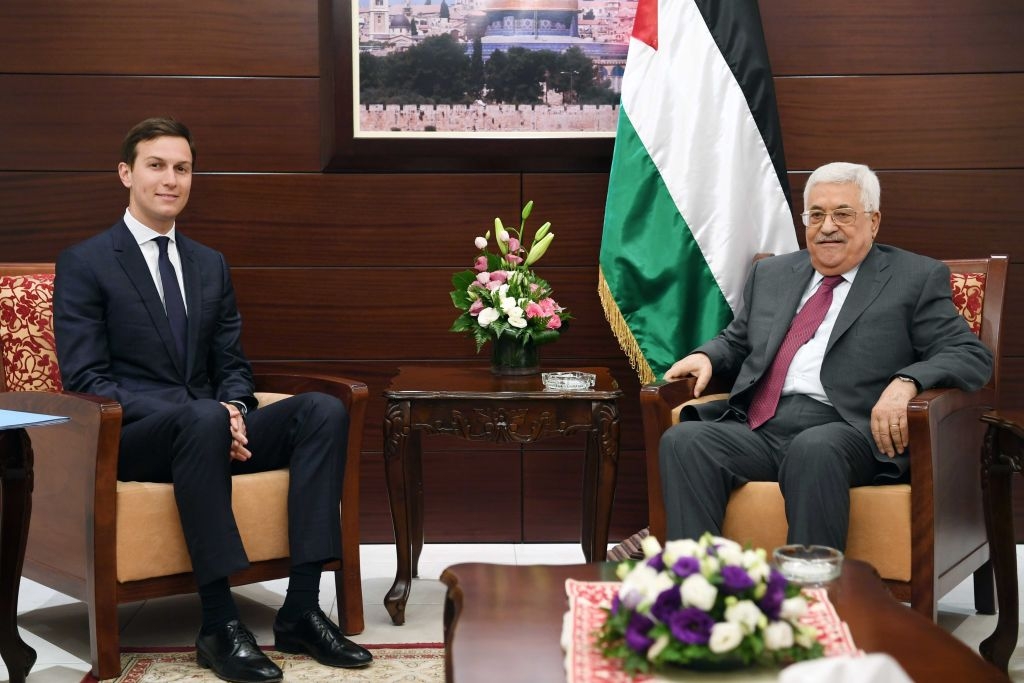
Palestinian Authority President Mahmoud Abbas (right) meets with Jared Kushner, Senior Advisor to U.S. President Donald Trump, on June 21, 2017 in Ramallah. (Photo by Thaer Ghanaim/PPO via Getty Images)
The Palestinian tone makes it clear that the Palestinian leadership and people have already relegated Trump's peace plan to the trash-bin as nothing more than Israeli-American conspiracy, in collusion with some Arab countries, to impose a solution on the Palestinians and "liquidate" their cause.

To them, the "real" Trump is now apparent. This is how one Palestinian political analyst, Dr. Mazen Safi, reacted to Trump's proposed peace plan and what he perceives as continued US support for Israel. "The US president and his administration have removed the mask from their face," he stated. "They are paving the way for a new Israeli aggression on our people and moving the region toward an explosion."

So what is really behind the Palestinian outrage with the Trump administration?

First, the Palestinians reject the idea of "regional peace" between Israel and Arab countries. The Palestinians maintain that peace between Israel and the Arab countries should come only after, and not before, the Palestinian issue is resolved. The Palestinians fear that any peace agreements between Israel and the Arab countries would come at their expense.

Echoing this fear, the Palestinian daily Al-Quds, which often reflects the views of the Palestinian Authority leadership, pointed out that the recent Arab League foreign minsters' meeting in Cairo chose to focus on the Iranian and Hezbollah "threat," breaking from the long-standing traditional obsession of the Arabs with the Palestinian issue. The Palestinians, according to the paper, feel abandoned by their Arab brothers.

"The Arab League meeting in Cairo came out with strong positions against the Iranian threat and didn't hesitate to classify Hezbollah as a terrorist group," Al-Quds complained in an editorial. "The meeting ignored the Palestinian cause. We are facing new Arab alliances against Iran, all under American pressure. This will have a negative impact on our cause."

The Palestinian daily went on to lambast the floating Trump peace plan. It stated that the proposed plan, as published in various media outlets, "Doesn't serve our interests and aspirations."

Second, the Palestinians are furious with US threats to shut down the PLO's diplomatic mission in Washington. They see the threat as an attempt to blackmail them not file charges of war crimes against Israel with the International Criminal Court. The Palestinians also see the threat as an attempt to force them to resume peace talks with Israel unconditionally.

"The US threat to close the PLO's diplomatic mission in Washington shows disrespect for the Palestinian rights and blind bias in favor of Israel," Al-Quds said in the same editorial. "It also coincides with growing hollow talk about a US peace plan that has been endorsed by President Trump."

Third, the Palestinians are now openly talking about Trump's Jewish advisors and envoys and their "influence" on him and his administration's policies. This is something that Palestinian Authority officials had refrained from mentioning in the past year because it rings of out-and-out anti-Semitism. Now, however, Palestinian officials and political analysts do not seem to have a problem talking about the influence of the "Jewish lobby" on Trump's decision-making process and policies.

Hassan Al-Batal, a political analyst closely associated with the Palestinian Authority, referred in a recent article to what he called "the three Jewish pillars of the Trump peace plan – Trump's son-in law (Kushner), Middle East envoy (Greenblatt) and the US Ambassador to Israel (Friedman)."

Al-Batal expressed "regret" that the recent meeting of the Arab League foreign ministers chose to condemn Hezbollah and Iran. "Palestine is currently witnessing a crisis with Washington," he said.

Bassam Abu Sharif, a former advisor to Yasser Arafat, went as far as referring to Trump's Jewish advisors as a "dangerous clique."

Abu Sharif said that he had no doubt that "what Kushner and his dangerous clique are planning is destructive and inhumane." The US, he charged, has one major goal: to take full control of the Middle East and steal its resources for once and for all. This requires -- according to their scheme -- the liquidation of the Palestinian cause."

Another political analyst, Talal Okal, who is also linked to the Palestinian Authority and its leadership, accused the Trump administration of "misinformation" and attempting to "blackmail" the Palestinians. Referring to the US demand that the Palestinians refrain from filing charges against Israel with the International Criminal Court and threatening to shut down the PLO's diplomatic mission in Washington, Okal wrote:
"The US administration is practicing blackmail against the Palestinian leadership by demanding that the Palestinians engage in unconditional negotiations with Israel and that the Palestinians refrain from pursuing war crimes against Israel with the International Criminal Court. It's obvious that the Trump administration is practicing a policy of misinformation."
Palestinian political analyst Hani Habib claimed that the Trump administration was preparing to blame the Palestinians for the failure of the next peace process. The Palestinians, Habib said, "must be united in facing all forms of American-Israeli blackmail. The US administration's threat to shut down the PLO's diplomatic mission in Washington calls into question its ability to play the role of a fair and honest mediator."

In an article entitled "Cheap American Blackmail," columnist Omar Hilmi Al-Ghul complained: "The US administration is once again ignoring Palestinian rights and interests. It's shamelessly and flagrantly seeking to confiscate the Palestinians' independent decision-making process."

Al-Ghul, too, made a reference to Trump's Jewish team:
"The team surrounding Trump, which is in collusion with Israel, is acting in a way that contradicts what the Palestinian leadership wants -- to maintain bridges with the US. The American blackmail of the Palestinian leadership is cheap and miscalculated."
This conspiracy theory, which claims that Trump's team cares more about Israel than US interests, is repeated in a statement by Fatah: "The US political blackmail contravenes international laws and resolutions pertaining to the Palestinian issue in particular and the peace process in general. This US position endorses the Israeli policy to end the two-state solution."

The Palestinians' rhetorical attacks on the Trump administration are designed to prepare the ground for their rejection of the proposed "ultimate solution."

The Palestinians want it to be seen as a plan concocted by a few Jewish officials in the Trump administration who are more loyal to Israel than their own country, the US.

These officials, the Palestinians argue, have endorsed the position of the Israeli government and serve as its mouthpiece. That is why, they argue, the Palestinians are unable to accept a plan that is in effect a "Jewish-American conspiracy to eliminate the Palestinian cause."

The Palestinians are also preparing the stage to accuse some Arab countries of "collusion" with this "conspiracy" -- putting them on a collision course with Saudi Arabia.

The Palestinian message to the Arab countries, especially Saudi Arabia, should be seen as a warning shot: Collaborate with the Trump administration in the alleged scheme at your peril.

The anti-Trump Palestinian stance is sounding the death-knell for US administration's effort to achieve comprehensive peace in the Middle East. Take careful note: these warning shots may well be translated into yet another intifada against Israel under the fabricated pretext that the Americans and Israelis, with the help of some Arab countries, seek to strip the Palestinians of their rights. One wonders when the world will wake up to the fact that those rights have already been stripped from the Palestinians -- by none other than their own brainwashing, inciting and corrupt leaders.

Bassam Tawil, a Muslim, is based in the Middle East.

Source: https://www.gatestoneinstitute.org/11431/palestinians-trump-rejection

Follow Middle East and Terrorism on Twitter

Copyright - Original materials copyright (c) by the authors.

Following the Trump-Russia Dossier Money - Matthew Vadum


by Matthew Vadum


Proof solidifies that Fusion GPS took money from Democrat law firms.


Unsealed bank records appear to reinforce the claim that Democrat Hillary Clinton’s campaign bought and paid for the sensational “piss-gate” dossier that used anonymous sources to smear President Trump by falsely linking him to Russia.

The dossier is the salacious, 35-page report commissioned by Democrat-aligned opposition research firm Fusion GPS. The statements in the partisan hit job were compiled by former British spy Christopher Steele and published by BuzzFeed. One claim was that Donald Trump hired prostitutes to urinate on a bed.

The dossier was just one of many particularly outrageous dirty tricks Clinton’s campaign to undercut her opponent’s campaign during the 2016 election cycle. Clinton also personally authorized the illicit efforts of socialist felon Bob Creamer and organizer Scott Foval who fomented violence at Trump campaign rallies, as James O’Keefe’s Project Veritas group revealed in undercover videos.

President Trump and his defenders have repeatedly suggested Democrats, Russia, or the FBI – or all three – may have helped fund the infamous document dump.

What’s new here are bank records from two Democrat-aligned law firms listing 112 transactions involving Fusion GPS. Clinton campaign and DNC lawyer Marc Elias reportedly hired Fusion GPS in April 2016 to conduct opposition research against Trump.

The documents were made public after Washington, D.C.-based federal Judge Richard Leon, who is presiding over a lawsuit related to Fusion’s records, ordered them unsealed. Fusion fought the unsealing request.

As the Daily Caller reports:
Perkins Coie, the law firm that represented the Clinton campaign and DNC, paid Fusion a total of $1,024,408 between May 24, 2016 and Dec. 28, 2016, the records show.
The largest payment was made just before the election. Perkins Coie made a $365,275 payment to Fusion GPS on Oct. 28, 2016, according to the records.
[…]
The records show that Fusion was also paid $523,651 by the law firm BakerHostetler between March 7, 2016 and Oct. 31, 2016.
Fusion worked for BakerHostetler to investigate Bill Browder, a London-based banker who helped push through the Magnitsky Act, a sanctions law vehemently opposed by the Kremlin.
BakerHostetler also acted for Prevezon Holdings and its owner, Russian businessman Denis Katsyv, who tried to blunt the effect of the sanctions.

Former Wall Street Journal reporter and Fusion GPS co-founder Glenn Simpson worked on the Browder project alongside Russian attorney Natalia Veselnitskaya, who famously attended a meeting at Trump Tower in Manhattan with top Trump campaign staffers on June 9, 2016. Veselnitskaya brought Simpson’s research with her to the meeting and shared it with Russia’s prosecutor general, Yuri Chaika, according to the Daily Caller.

Testifying before the House Intelligence Committee this week, Simpson said he was unaware that Veselnitskaya gave information about Browder information to Chaika or to Donald Trump Jr., the campaign’s lead person at the storied meeting. Simpson also testified that he only learned Veselnitskaya had attended the meeting when media outlets reported it.

The House Intelligence Committee is now seeking records it says are “related to Fusion’s payments to journalists who have reported on Russia issues relevant to its investigation.” The reporters’ names were not provided.

Lawyers for the committee said they want the paperwork covering nine payments to “three individual journalists … each of whom have reported on and/or been quoted in articles regarding topics related to the Committee’s investigation, some of which were published as recently as October 2017.”

Meanwhile, the mainstream media continues to promote the discredited Trump-Russia dossier in order to kneecap President Trump’s ambitious reform agenda.

Like the disgraced Dan Rather continuing to insist his fake Texas National Guard documents discrediting George W. Bush were real, scribes like Newsweek’s Jason Le Miere are still pushing the dossier and lying about it.

Le Miere lazily asserts:
The dossier, which alleged that Russia sought to interfere in the 2016 election and had extensive contacts with Trump campaign officials, has been taken seriously by the FBI and special counsel Robert Mueller. While much [sic] of its claims remain unverified, including an allegation that Trump had Russian prostitutes urinate on a Moscow hotel room bed once slept on by Barack and Michelle Obama, its central thesis has been corroborated.
But has “its central thesis” been corroborated? Its central thesis was not that Russia sought to interfere in the 2016 election. Everybody already knows that. Russia is always up to no good, as intelligence experts have been saying ad nauseam, and its illicit program to promote its interests doesn’t go dormant during U.S. election cycles.

The central thesis of the dossier is, as BuzzFeed reported at the time, that Donald Trump has “deep ties to Russia.” More specifically, the media outlet focused on the “explosive” but “unverified” assertion that “the Russian government has been ‘cultivating, supporting and assisting’” him for years, gaining “compromising information about him” in the process.

In other words, the dossier states, or at least implies, the Russians have blackmail-worthy material on Trump and that he is a puppet of Russian President Vladimir Putin, forced to do Putin’s bidding or face the release of whatever kompromat the Russians have on him.

The dossier, which BuzzFeed admitted is littered with errors, claims the Russians and the Trump campaign worked closely together, yet provides only unsourced evidence and rumors. The dossier is dominated by statements identified as coming from unnamed sources in and around the Trump team, the Kremlin, and the business community. Seemingly undermining a key contention raised in the case made against Trump, a dossier document claims Russians tried, but failed, to bribe the man who later became the 45th U.S. president.

Wall Street Journal columnist Kimberley Strassel told Fox News Channel's Tucker Carlson earlier this month that, "we do a disservice when we even refer to it as a 'dossier. That gives it too much mystique. This is an oppo research document but of lower quality than even oppo research documents."
But here's where they have been particularly clever: They didn't give it to the press, they sent it to the FBI and then they briefed the press, and then the press was able to claim that this was intelligence that the FBI possessed, which gave it some air of credibility.
To call this stratagem merely “clever,” is the grossest of understatements.

From a tactical perspective, it is truly brilliant.

But even truly brilliant tactics tend to fail when they are based on lies.

Matthew Vadum, senior vice president at the investigative think tank Capital Research Center, is an award-winning investigative reporter and author of the book, "Subversion Inc.: How Obama’s ACORN Red Shirts Are Still Terrorizing and Ripping Off American Taxpayers."

Source: http://www.frontpagemag.com/fpm/268518/following-trump-russia-dossier-money-matthew-vadum

Follow Middle East and Terrorism on Twitter

Copyright - Original materials copyright (c) by the authors.

Saudi Arabia's overreach on Iran, Lebanon - Mohamad Bazzi


by Mohamad Bazzi

The Arab League meeting capped a month in which the Middle East suddenly seemed to plunge toward a wider regional conflict.

On Nov. 19, Arab foreign ministers gathered in Cairo for an hourslong gripe session against Iran and its ally, Hezbollah. The Arab leaders accused Tehran and the Lebanese Shiite movement of destabilizing the Middle East, but they fell short of agreeing on concrete action.

The Arab League meeting capped a month in which the Middle East suddenly seemed to plunge toward a wider regional conflict. Saudi Arabia charged that a missile fired at its capital from Yemen on Nov. 4 was provided to Yemeni rebels by Iran and constituted "an act of war." Saudi leaders then pushed Lebanese Prime Minister Saad Hariri into a surprise resignation during a trip to Saudi Arabia as a way of exerting pressure on Iran and Hezbollah. "Wherever Iran is involved, there is nothing but devastation and chaos," Hariri said in his resignation speech on Nov. 4, which was broadcast from the Saudi capital, Riyadh. He added, "Iran's hands in the region will be cut off."

These actions underscore a newly aggressive Saudi foreign policy, led by Crown Prince Mohammed bin Salman, who is eager to challenge Iran more directly and has amassed tremendous power under the rule of his father, King Salman.

But forcing Hariri to resign and ratcheting up tensions with Iran over Yemen has backfired on the prince and his advisers. The lack of support from fellow Arab leaders for tougher action against Iran and Hezbollah shows that few Saudi allies are willing to confront Iran directly.

Saudi Arabia had invested years of political effort and tens of millions of dollars to support Hariri and his political movement in Lebanon, especially after the assassination of Hariri's father, Rafik, in February 2005. The elder Hariri had served as Lebanon's prime minister for more than a decade, and he became the country's most prominent Sunni leader and Saudi Arabia's most important Lebanese ally.

Saad Hariri took office in late 2016, forming a national unity government that included Hezbollah. The power-sharing agreement was approved by Iran and Saudi Arabia. But in recent months, Saudi leaders grew worried that Hariri, who has strong ties to Western and Sunni Arab leaders, was becoming a fig leaf for a government dominated by Hezbollah and its supporters, including Lebanese President Michel Aoun.

Saudi leaders thought that they would be able to push Hariri aside, withdraw political cover from Hezbollah, and make it easier for Sunni Arab states – along with the United States and Israel – to target the group. After an earlier round of sanctions, the U.S. Congress is considering a new sanctions bill targeting Hezbollah and its funders.

But after Hariri's sudden departure, Lebanese from all political factions rallied around him and insisted that his resignation was invalid because Saudi leaders coerced him. As international concern grew that Hariri was being held captive by his Saudi patrons, French President Emmanuel Macron invited him to Paris. Hariri met with Macron on Nov. 18 and returned to Lebanon for the country's Nov. 22 Independence Day celebrations.

Tensions have eased over the past week, and it's unlikely that the latest crisis will escalate into a military confrontation between Saudi Arabia and Iran. But while the prospect of direct clashes between the two regional rivals has eased, their ongoing proxy war is destabilizing the Middle East.

The two powers have backed competing factions in Iraq, Syria, Yemen and Lebanon since the United States invaded Iraq in 2003. While the conflict is partly rooted in the historical Sunni-Shiite split within Islam, it is mainly a struggle for regional political dominance between Shiite-led Iran and Sunni-led Saudi Arabia.

Their proxy battles, which now also involve other powers like Russia and the United States, are at the root of much of the death and destruction in the Middle East in recent years. They have cost hundreds of thousands of lives, especially in Syria, where more than 400,000 have been killed since the March 2011 uprising against the regime of President Bashar Assad, which is supported by Iran and Hezbollah. The Syrian war has also produced more than 5 million refugees whose search for sanctuary has triggered political crises in neighboring countries as well as Europe.

In January 2015, Saudi Arabia's King Abdullah died after 20 years in power. He was succeeded by his brother Salman, who quickly pursued a more aggressive foreign policy. Instead of relying on U.S. military intervention and battling Iran through surrogates and checkbook diplomacy, as his predecessor had done, the new king and his advisers launched a war against Houthi, mostly Shiite, rebels in Yemen in March 2015. As the war has dragged on, airstrikes by Saudi Arabia and its allies caused most of the estimated 10,000 civilian deaths.

Saudi Arabia is now bogged down in the Yemen conflict. Despite intensive airstrikes and a blockade, Riyadh and its allies still have not been able to dislodge the Houthis from Yemen's capital, Sanaa.

Yemen has become a central arena of the proxy battle, especially after Saudi Arabia's "act of war" accusation against Iran. The kingdom claimed that the ballistic missile it shot down on Nov. 4 en route to the Saudi capital had been smuggled into Yemen in parts. Saudi officials say members of Hezbollah and the Iranian Revolutionary Guard Corps assembled the missile and then helped Houthi rebels fire it from Yemeni territory. Iran and Hezbollah denied involvement in the missile launch.

Saudi leaders have since scaled back their efforts to declare Lebanon a hostile state. Already overstretched by Yemen and embroiled in a diplomatic crisis with Qatar, the kingdom cannot effectively challenge Hezbollah, Iran's main ally in Lebanon, without assembling a broader Arab and international coalition. But this is still a dangerous moment in the Middle East. As long as Iran and Saudi Arabia view their rivalry as a zero-sum game – where one can only gain at the expense of the other – there is a risk of miscalculation that spirals out of control.


Mohamad Bazzi is a journalism professor at New York University and former Middle East bureau chief at Newsday.


Mohamad Bazzi

Source: http://www.israelhayom.com/opinions/how-saudi-arabia-overreached-on-iran-lebanon/

Follow Middle East and Terrorism on Twitter

Copyright - Original materials copyright (c) by the authors.