Monday, November 27, 2017

Russia's Dangerous Nuclear "Diplomacy" - Debalina Ghoshal


by Debalina Ghoshal

Russia would undertake building and operating the nuclear power plants – then start influencing the foreign policy decisions of the country supposedly to "protect" the nuclear power plants from terrorists, and from there to project military influence in the region as it has done in Syria.

  • Russia's state owned nuclear energy organization, Rosatom, of Uranium One celebrity, has been trying to develop nuclear cooperation with most of the Middle East countries.
  • Russia would undertake building and operating the nuclear power plants – then start influencing the foreign policy decisions of the country supposedly to "protect" the nuclear power plants from terrorists, and from there to project military influence in the region as it has done in Syria. Russia has already strengthened its defense and military cooperation with Iran and Turkey.
  • Middle Eastern countries seem as eager to partner with a great power such as Russia as Russia does to partner with them. That way, "everyone" in the region could enjoy greater influence, militarily and otherwise.
Russia has been trying to relieve itself of the economic slowdown it has faced ever since the West imposed sanctions on it for invading the Ukraine. To that end, Russia's state owned nuclear energy organization, Rosatom, of Uranium One stardom, has been attempting to develop nuclear cooperation with most of the countries in the Middle East. Russia apparently considers the Middle East and North Africa two of the most lucrative markets; countries in the Middle East have already expressed interest in building 90 nuclear power plants at twenty-six sites across the region by 2030.

The Russian government has strongly supported the success of a company globally. Rosatom, for instance, already opened a regional office in Dubai, even though the United Arab Emirates does not have nuclear cooperation with Russia and cooperates with South Korea instead.

Russia, active during the "Iran deal" negotiations as a mediator between the E3 (Britain, Germany, France) with the United States on one side and Iran on the other, was one of the countries to gain from the Iranian nuclear deal – as was Rosatom. Russia, in 2015, signed nuclear cooperation agreements with both Iran and Jordan.

One the strategies Rosatom developed was the Build Own Operate (BOO) plan. Under it, Russia would undertake building and operating the nuclear power plants – then start influencing the foreign policy decisions of the country supposedly to "protect" the nuclear power plants from supposed terrorists, and from there to project military influence in the region as it has done in Syria, with its naval base at Tartus and its air base at Latakia.

Russia has already strengthened its defense and military cooperation with Iran and Turkey.
Rosatom has also signed nuclear cooperation agreements with Turkey and Saudi Arabia, and could also potentially play a significant role in the Gulf Cooperating Countries (GCC) Countries. Bahrain has already expressed desire for nuclear energy; Rosatom is certainly an option. Middle East countries all require inexpensive electricity; Russia would undoubtedly be happy to supply -- among other ventures -- nuclear power plants.

Rosatom will most likely face competition from other big players in the region such as China and South Korea, which are also trying to gain a foothold in the Middle East's nuclear energy market. South Korea has been working on enhancing nuclear cooperation with Jordan; the UAE has four South Korean nuclear power plants under construction. South Korea's conglomerate, Korean Electric Power Corporation (KEPCO), however, is apparently facing debt problems , a possible advantage for Rosatom. In addition, South Korea's new President Moon Jae-in evidently opposes nuclear energy and has ordered nuclear energy phased out. If South Korea walks out of the nuclear energy market in Middle East, that would give Rosatom one less competitor to deal with.

Meanwhile, more openings have appeared for Russia as Westinghouse Electric Co., once a subsidiary of Toshiba, has gone bankrupt, while the SA Areva of France is coping to recover from stagnation. At the moment, the only serious major threat to Rosatom would be China.

Russia, however, seems to be finding it easy to maneuver itself in the Middle East to establish a nuclear -- and diplomatic -- monopoly in the region. It has been providing lucrative offers to the Middle Eastern countries including financial packages for the nuclear deal. This means that Russia pre-financed the nuclear cooperation by providing loans that will later be paid off by the countries to which the loan has been provided. Russia has also been ensuring nuclear safety and waste management for the countries with which it is involved and sometimes even reprocesses spent fuel, as with Iran.
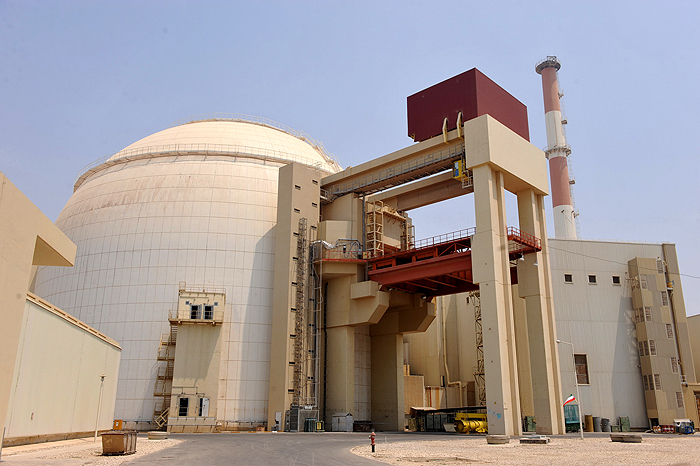

The Russian-built Bushehr nuclear power plant, in Iran. (Photo by IIPA via Getty Images)

Middle Eastern countries seem as eager to partner with a great power such as Russia as Russia does to partner with them. That way, "everyone" in the region could enjoy greater influence, militarily and otherwise.

Debalina Ghoshal, an independent consultant specializing in nuclear and missile issues, is based in India.

Source: https://www.gatestoneinstitute.org/11351/russia-nuclear-diplomacy

Follow Middle East and Terrorism on Twitter

Copyright - Original materials copyright (c) by the authors.

Moses Vindicated - Randolph Parrish


by Randolph Parrish

New research in the Sinai demonstrates that Exodus is authentic history


3500 years ago slaves toiling in the harsh mines of the Sinai scribbled some graffiti on the desert rocks. One of them wrote: "Moses then provoked astonishment." That, plus a lot of other inscriptions, deserve more than a passing glance. 

Most of us know about the Exodus and Moses courtesy of Cecil B. DeMille and Charleton Heston. But archaeological evidence of those events has been slow to come by. Now in a new book, The World's Oldest Alphabet, Douglas Petrovich has deciphered the Sinai inscriptions, and for the first time outside the Bible we can read how the slaves looked at things:
"He sought occasion to cut away to barrenness our great number, our swelling without measure." (Sinai 349)
"Our bond servitude had lingered. Moses then provoked astonishment. It is a year of astonishment."
(Sinai 361)
Anyone familiar with the book of Exodus will immediately spot parallels with the account of Pharaoh's attempt to reduce the number of newborn Israelites; and the subsequent actions of Moses. (Many of the Sinai inscriptions can be viewed with a simple Google search.)

So much then for the dismissive arguments that the Israelites could never have numbered enough to be considered a threat to Egypt. Or that there never was an Exodus. Or that Moses never existed. 


So much then for the JEPD theory of the Pentateuch (written, according to the theory, by a variety of late authors with varying concepts about the nature of God). So much for the idea that the Israelites never lived in Egypt at all, or were just a group of wandering tribes who made up most of their history centuries later. All washed away like pharaoh's chariots.

All this should be headlines, but it isn't.

Petrovich also demonstrates how the first alphabet was likely not created by Paleo-Canaanites or Phoenicians, but by the Hebrews, who developed it by adapting Egyptian picture images for their own use during their 400-year stay in Egypt. This, in fact, was probably the world's first truly phonetic alphabet. History, which usually credits that to the merchants in the Levant, may have to be revised on this score, also. 

The book is not an easy read. It is a scholarly work, laden to overflowing with citations, notes, references, and cross-checking. It is a philologist's delight. It is not written for a popular audience. (The author intends to follow it up with another volume on the Israelites in Egypt.)

If we were less preoccupied with safe spaces, trigger warnings, the introduction of all-inclusive pronouns, gender-neutral everything, and the latest Hollywood scandals, we might have taken notice of more important discoveries. But a self-absorbed society and the mainstream media's agendas have kept the focus elsewhere; and this is to be regretted, because in the meantime, genuinely significant news has been passing us by without our noticing it.

Randolph Parrish

Source: http://www.americanthinker.com/blog/2017/11/moses_vindicated_.html

Follow Middle East and Terrorism on Twitter

Copyright - Original materials copyright (c) by the authors.

Science Needs a New Paradigm - Robert Arvay


by Robert Arvay

When scientists resort to fantasy instead of observable, repeatable experiment by skeptics, then we have abandoned reason.


Science and politics used to be very separate institutions. Where they did overlap, science was nonpartisan. The role of scientists was to provide objective evidence -- and dispassionate, nonpolitical interpretations of that evidence. Indeed, one rarely if ever could detect the political leanings of any particular scientist. Also, science and religion used to get along, at least for the most part.

Today, that has changed, and the results include significant dangers for society. For example, the topic of climate change has produced the myth of “settled science.” Science is never settled. While we all may agree that the climate does change, there is an anti-capitalist agenda behind the claims of many scientists -- that we must radically reduce our standards of living to prevent climate catastrophe. Politics and ideology, not science, promote that so-called scientific view.

But there is an even deeper and darker implication involving the politicization of science. Its first major public confrontation was in a state court case, dubbed the Scopes Monkey trial, which tested a law that forbade the teaching of Darwinian Evolution theory in public schools. On a legal maneuver, Darwinism technically lost that particular trial, but all subsequent federal court rulings since then, have upheld the theory of evolution as accepted fact. Contrary theories are essentially forbidden. Evolution is “settled science.”

It is not the purpose of this commentary to litigate the theory of evolution, or any other particular scientific theory. Rather, it is to examine the cultural fallout from that theory. The late paleontologist George Gaylord Simpson, is quoted as having said that, “Man is the result of a purposeless and natural process that did not have him in mind. He was not planned.”

What Darwin and Simpson have done, along with others, is to introduce into society the physicalist paradigm, the one that holds that nothing exists except stuff, that is, material reality. According to physicalism, there is no spirit, no God, no eternal afterlife. By extension of that paradigm, you and I are nothing more than stuff, that is, the atoms that make up our physical bodies. If that is to be considered true, then it necessarily must follow, at least eventually, that we have no inherent right to be treated as anything more than protoplasm, nothing more than just another species of animal.

That paradigm is, of course, dangerous. It contradicts not only the Bible, but also the Declaration of Independence, the founding document of our nation, which states that we are endowed by our Creator -- repeat, by our Creator -- with certain inalienable rights, including life and liberty.

This is a critical central tenet of our modern civilization. It informs us that our rights come to us not from the government, but from God. No government has the right to infringe on those rights. Government is not the ultimate moral authority. It must be constrained to its limited functions.

If we are considered to be nothing more than atoms, if the courts believe that, if judges and lawmakers act upon that belief, then we are in serious jeopardy. Such a paradigm is the one upon which authoritarians establish totalitarian dictatorships. It is the one that justifies genocide, which defines humans as livestock, and morality as whatever is convenient for the ruling class.

However, the physicalist paradigm is not only morally wrong, it is also unscientific. The universe itself provides overwhelming evidence of planning and purpose by an Intelligent Designer (Creator, God). The proof is so complete that, in order to refute it, scientists have had to resort to a thoroughly unsupported, unscientific speculation that there are an infinite number of universes, whereby one of them was destined to be, purely by chance, like ours.

Once again, it is not the purpose of this commentary to provide detailed support for any one particular theory, whether multiverse or Intelligent Design. That has been done elsewhere, including in my book.

But, when scientists resort to fantasy instead of observable, repeatable experiment by skeptics, then we have abandoned reason, and begun slouching toward barbarism.

There is more than enough evidence for science to reject the physicalist paradigm, and to move toward a God paradigm. While neither can be absolutely proved by the rules of science, the world view adopted by scientists has enormous power to direct the efforts of science, for better or worse.

It is now time to consider the far-reaching implications of the paradigm that governs science, to begin thinking of how to embed our values, our morals, our very spirituality into the process of our further development. We must decide whether, and how, to preserve the best features of our human nature.


Robert Arvay

Source: http://www.americanthinker.com/articles/2017/11/science_needs_a_new_paradigm.html

Follow Middle East and Terrorism on Twitter

Copyright - Original materials copyright (c) by the authors.

Hijab Barbie: Useful Idiots of Cultural Jihad - Judith Bergman


by Judith Bergman

Rather than reminding girls of a world of opportunities, the hijab reminds them of all the things they cannot do in many Muslim countries.

  • Far from being a symbol of empowerment, the new Hijab Barbie is an example of a cultural and civilizational jihad -- and the submission of a Western company, Mattel, to that jihad. Cultural jihad is the attempt to change and subvert Western culture from within, or more simply put: to Islamize it.
  • Rather than reminding girls of a world of opportunities, the hijab reminds them of all the things they cannot do in many Muslim countries. These include decisions about their own lives and bodies, such as not having their genitals mutilated, and generally not leading the free lives that women in the West -- including the ones working at Mattel -- probably take for granted
A new Barbie doll has been launched as part of Mattel's "sheroes" line. It is a doll in full hijab modeled after American-Muslim Olympic fencer, Ibtihaj Muhammad, the first American athlete to compete in the Olympics wearing a headscarf, which -- apparently -- Mattel felt was something for little girls worldwide to emulate. That and the possibility of selling millions of toys in the burgeoning Muslim market, of course.


(Image source: Facebook screenshot via BBC/YouTube)
According to a statement from Mattel:
"Barbie is celebrating Ibtihaj not only for her accolades as an Olympian, but for embracing what makes her stand out," said Sejal Shah Miller, Vice President of Global Marketing for Barbie. "Ibtihaj is an inspiration to countless girls who never saw themselves represented, and by honoring her story, we hope this doll reminds them that they can be and do anything."
The attempt to paint the new Hijab Barbie as a symbol of empowerment for girls is, however, quite disturbing. Girls "being and doing anything they want" is considerably different from what this hijab-clad doll represents. Hijab Barbie represents, on the contrary, the often violent oppression that Muslim girls and women experience throughout the Muslim world. It also represents the gender-apartheid the Quran mandates, which limits the freedoms of Muslim girls and women in the extreme.

Far from reminding girls of a world of opportunities, the hijab reminds them of all the things they cannot do in many Muslim countries. These include decisions about their own lives and bodies, such as not having their genitals mutilated; not being married off to older men at a young age; not being able to leave the house without male permission or accompaniment; not wearing the clothes they might like and generally not leading the free lives that women in the West -- including the ones working at Mattel -- probably take for granted.

The new Hijab Barbie was presented at the fashion magazine Glamour's Women of the Year awards. Unfortunately, this would appear fitting, given that terrorist sympathizer and pro-sharia activist Linda Sarsour -- who has threatened jihad against US President Donald Trump and said she wishes she could take away the vagina of prominent author Ayaan Hirsi Ali, who herself underwent female genital mutilation (FGM) -- was named one of its "women of the year," along with the other organizers of last January's Women's March.

"I hope that little girls of color across the heartland will be inspired to embrace what makes them unique," said Ibtihaj Muhammad at the launch of the new Barbie doll. But Muslims are not "girls of color". Islam is a religion and an ideology, not an ethnicity.

Far from being a symbol of empowerment, the new Hijab Barbie is an example of a cultural and civilizational jihad -- and the submission of a Western company, Mattel, to that jihad.

Cultural jihad is the attempt to change and subvert Western culture from within, or more simply put: to Islamize it. The Muslim Brotherhood's strategy for the United States, as spelled out in a foundational Muslim Brotherhood document from 1991, openly states:
"The process of settlement is a 'Civilization-Jihadist Process' with all the word means. The Ikhwan [Muslim Brotherhood] must understand that their work in America is a kind of grand jihad in eliminating and destroying the Western civilization from within and 'sabotaging' its miserable house by their hands and the hands of the believers..."
The document then goes on to list the Muslim Brotherhood organizations and the organizations of its friends: Organizations such as CAIR, ISNA, ICNA among others.

Another example of recent cultural jihad are the attempts, in the wake of the terrorist car ramming attack in downtown Manhattan on October 31, to claim the war cry "Allahu Akbar", a supremacist term for "Allah is greater" -- meaning, greater than all other deities -- as something innocent and benign. A spokeswoman for the Council on American-Islamic Relations (CAIR) wrote in a piece for the New York Daily News:
"The next time you hear Allahu Akbar, whether... on an airplane, or in a shopping mall -- remember that the phrase used by millions of Muslims and Christians daily to praise God regardless of their circumstances, can never be justified for use when harming His creation."
The real purpose is more probably an attempt to condition people to the lie that "Allahu Akbar" is an innocent term -- so that the next time people hear it, they will not question its meaning, or fight or flee from a terrorist scene either from ignorance, or for fear of being labelled an "Islamophobe".

Another example of cultural jihad is the attempt to portray "jihad" as something other than what it really is -- war in the name of Islam against all non-Muslims. Instead, it is being portrayed as an "inner struggle" to "better oneself". All of this has as its purpose to condition people into believing that Islamist designs for Western society are benign and to distract from the fact that Islam is a supremacist ideology wishing to impose its rules of sharia upon the West, through peaceful or, if necessary, violent means [Sayyid Qutub, Social Justice in Islam].

Most successful of all the attempts at cultural jihad thus far has been the contention that Islam is a "religion of peace." In Islam, the phrase means that peace that will reign over the world after everyone has been converted to Islam. Nevertheless, many in the Western political, cultural and media establishment have accepted the inaccurate rendering to such an extent that years of evidence to the contrary and thousands of dead and wounded bodies from Islamic terrorist attacks have not been able to change this pretense. Furthermore, the constant repetition of this deception, just as the Muslim Brotherhood planned, has created a deep division between the establishment of the West and its citizenry.

Western civilization is indeed "destroying itself from within" by, among other things, giving in and submitting to Islam.

Mattel's new Hijab Barbie is an example of Western regression -- a development that women, especially those who define themselves as feminists, should be ashamed to promote, let alone celebrate. If, despite this, they decide to celebrate it anyway, they should at least do so in the knowledge that, far from creating more equality for women, they have quite simply been made the useful idiots of cultural jihad.

Judith Bergman is a columnist, lawyer and political analyst.

Source: https://www.gatestoneinstitute.org/11451/hijab-barbie

Follow Middle East and Terrorism on Twitter

Copyright - Original materials copyright (c) by the authors.

Sunday, November 26, 2017

Israel’s Secret War Against Terrorism’s Financiers - Ari Lieberman


by Ari Lieberman


A new book explores Israel’s daring covert operations against terrorism’s enablers.


Harpoon
Nitsana Darshan-Leitner and Samuel Katz
Hachette Books, 308 pp.


Mohammed al-Ghoul had no idea that loading cash-stuffed, leather suitcases into the trunk of his sedan would be one of the final acts of his life. Al-Ghoul was Hamas’s money man, responsible for distributing cash to the terror group’s members.

It was August 24, 2014 and the Gaza War wasn’t going well for Hamas. The Israeli Army (IDF) was wreaking havoc on the terror group, systematically knocking off its field commanders with unprecedented intelligence and accuracy. Hamas terror tunnels, some of which had taken years to construct, were being uncovered and destroyed by the IDF while the terror group’s rocket arsenal was dwindling rapidly.

But of even greater import for Hamas was the fact that its operatives weren’t getting paid. Some of its members hadn’t been paid for a month. Those that weren’t killed, wounded or captured began contemplating desertion. It was an untenable situation for Hamas.

Wiring money to Gaza wasn’t an option. Banks were on notice that wire transfers to the terror entity was a venture that carried high risk and little reward. But al-Ghoul had a plan that would provide a lifeline for Hamas.

Thirteen million dollars, secured from a friendly Muslim country, would be wired to the account of a moneychanger in Sinai. Once the moneychanger received confirmation that the funds were safely in his account, he would give a courier the cash. The courier would then smuggle it into Gaza via one of the many smuggling tunnels connecting the Gaza Strip to northern Sinai. Once in Gaza, the cash could be distributed to the fighters to stave off sagging morale and desertion.

Everything went according to plan. The courier delivered the cash to al-Ghoul, who along with his bodyguards began loading the trunk. Unbeknownst to al-Ghoul however, Israeli intelligence had been monitoring the entire sequence of events.

Lurking beyond visual range was an IDF AH-64 Apache Longbow armed with Hellfire missiles. A missile struck home instantly transforming al-Ghoul’s vehicle into a ball of flame and the car’s occupants into smoldering corpses. More importantly, most of the cash vaporized or otherwise became unusable. Hamas was unable to pay its fighters. Forty-eight hours later, Hamas, after losing 1,000 of its men, agreed to a ceasefire without a single of its demands being met.

Israel's approach to combating terror has always been somewhat unorthodox but effective. The myriad of terror threats facing the Jewish nation is like no other in the world and compels those on the forefront of combating terror to adopt novel, cutting edge methods to defeat the threat. Harpoon, a new book co-authored by counter-terrorism expert Samuel Katz and human rights attorney Nitsana Darshan-Leitner, of the Israel Law Center, provides us with intriguing insight as to some of those unique but very effective strategies.

In the early-1990s a few maverick-minded security officials understood that cash was indispensable to organized terror networks. They argued for the need to set up a special task force dedicated to identifying and tracking sources of terror financing and methods employed by terrorism’s financial enablers. In 2001, Prime Minister Ariel Sharon sanctioned the creation of a special unit, code-named “Harpoon,” tasked to do just that. The unit was headed by Sharon’s old army buddy, Meir Dagan, who had held various security posts in the past and would end up becoming head of Israel’s vaunted Mossad intelligence organization.

The unit employed the usual muscle one generally associates with such security-related outfits but also employed forensic accountants, tax experts and lawyers to execute their counter-terror operations. Katz and Darshan-Leitner detail some of the more intriguing and complex operations executed by Harpoon including elaborate, Harpoon-orchestrated Ponzi schemes directed at terrorist organizations. One such scheme cost the Iranian-backed terror group Hezbollah hundreds of millions of dollars and sowed dissention among its rank and file. Another Ponzi scheme targeted Yasser Arafat’s PLO, costing the group north of $100 million.

In other operations, Harpoon was less circumspect. During the 2006 Second Lebanon War, at Dagan’s urging, the Israeli Air Force targeted Hezbollah’s treasury offices and several Lebanese banks that housed Hezbollah accounts or otherwise laundered their money. $100 million went up in flames. Two weeks later, Hezbollah agreed to a ceasefire.

Harpoon also unofficially partnered with an Israeli NGO called the Israel Law Center (Shurat HaDin in Hebrew). The Israel Law Center, headed by Darshan-Leitner, specialized in bringing lawsuits against terror groups, their state-sponsors and financial institutions that aided and abetted terrorism through money laundering and maintaining terrorist accounts. 

Lawsuits were brought against Iran, Syria, North Korea, the PLO, Hamas, Hezbollah, the Amman-based Arab Bank, the Lebanese Canadian Bank (LCB) and other entities based on variety of legal theories including the Anti-Terrorism Act, the Foreign Sovereign Immunities Act, the Alien Torts Claims Act and even New York State tort law. Some of these lawsuits are still pending while others succeeded in extracting sizable sums from the defendants. Banks and other financial institutions suddenly became cognizant of the fact that doing business with terrorists could cost them a fortune and even bankruptcy. Other banks doing business with banks tainted by terror could also potentially be liable for damages as was the case with the New York-based American Express Bank, which acted as a correspondent bank for LCB and lost its jurisdictional argument.

Perhaps Harpoon’s greatest success was getting the U.S. government on board with the initiative. Harpoon partnered with the U.S. Treasury Department, the Department of Justice, the CIA and other sub-branches of the U.S. government to effectively tie up or seize terror funds. An Israeli source dryly noted that “the power of the U.S. Judiciary and other branches of government like Treasury wielded more force than a fleet of aircraft carriers.”

Harpoon reads like a fast-paced thriller but the James Bond-style operations executed by Israeli and U.S. operatives are not the stuff of fiction. They actually occurred and severely disrupted terrorist operations.

As a result of Israel’s actions, terrorists have now been forced to increasingly rely on hard cash to finance their operations. Banks even whiffing impropriety will immediately cease all contacts with the suspected party wishing to open an account, wire funds or engage in other seemingly innocuous business activity. This represents a break from the past and is a welcoming development but it opens the door to some disturbing questions regarding activities carried out by the Obama administration following the execution of the Iran deal in 2015.

In 2016, then Secretary of State John Kerry lobbied several large banks, including HSBC, to do business with Iran. He was firmly rebuffed by banking officials. The banks were cognizant of the fact that much of Iran’s economy, including its banking sector, is controlled by the Iranian Revolutionary Guard Corps and therefore sent Kerry packing. Why then did Kerry act in such an imprudent manner when it was patently obvious that Iranian banks, if given access to Western banks, would inexorably use those contacts for nefarious purposes?

Even more troubling is Obama’s 2016 transfer of $1.7 billion in cash to the Islamic Republic. The administration was certainly cognizant of the fact that Iran was constrained from wiring money to its terrorist proxy groups due to increased vigilance in the banking sector. The only method of currency delivery available to the Iranians was by physically transporting pallets of cash to the required destinations where the money would then be distributed to pay terrorist salaries and otherwise finance terror activities. Surely, Obama must have known that the $1.7 billion was not going to be used to build hospitals and schools. Indeed, the manner in which the Obama administration transferred the cash – in the dead of night away from prying eyes – lends credence to the notion that it was well aware of the consequences.

These are questions certainly worth exploring. In the meantime, Katz and Darshan-Leitner have done an admirable job providing readers with fascinating insight on the world of terror-financing and innovative methods used by Israel’s counter-terror and intelligence experts to successfully thwart terror-financing activities. 

Ari Lieberman is an attorney and former prosecutor who has authored numerous articles and publications on matters concerning the Middle East and is considered an authority on geo-political and military developments affecting the region.

Source: http://www.frontpagemag.com/fpm/268516/israels-secret-war-against-terrorisms-financiers-ari-lieberman

Follow Middle East and Terrorism on Twitter

Copyright - Original materials copyright (c) by the authors.

Israel vows to spare no effort to block UN settlement blacklist - AP


by AP

Human Rights Council list to name dozens of Israeli and international firms operating in Judea and Samaria in attempt to "investigate the implications of Israeli settlements on the Palestinians"

Weeks ahead of the expected completion of a U.N. database of companies that operate in Israeli settlements in Judea and Samaria, Israel and the Trump administration are working feverishly to prevent its publication.

While Israel is usually quick to brush off U.N. criticism, officials say they are taking the so-called "blacklist" seriously, fearing its publication could have devastating consequences by driving companies away, deterring others from coming and prompting investors in Israeli companies to dump shares.

Dozens of major Israeli companies, as well as multinationals that do business in Israel, are expected to appear on the list.

"We will do everything we can to ensure that this list does not see the light of day," Israel's U.N. ambassador, Danny Danon, told The Associated Press.

The U.N.'s top human rights body, the Human Rights Council, ordered the compilation of the database in March 2016, calling on U.N. rights chief Zeid Ra'ad al-Hussein to "investigate the implications of the Israeli settlements on Palestinians."

Israeli officials say that about 100 local companies that operate in the West Bank and east Jerusalem have received warning letters that they will be on the list. In addition, some 50 international companies, mostly American and European, also have been warned.

The companies have not been publicly identified, but one official said they include Israeli banks, supermarkets, restaurant chains, bus lines and security firms, as well as international giants that provide equipment or services used to build or maintain settlements. He spoke on condition of anonymity.

The only company to confirm receiving a warning letter has been Bezeq, Israel's national telephone company. Bezeq's chief executive, Stella Handler, posted a copy of the letter sent by Zeid's office in September on her Facebook page. It accused Bezeq of using West Bank land for infrastructure, providing phone and internet services to settlements and operating sales offices in the West Bank and east Jerusalem.

Handler angrily wrote that Bezeq provides service to all customers, regardless of race or where they live.

"The council's bias against Israel is so extreme that it has lost all relevance in the world," she wrote. "We will not cooperate with a move that is all in all anti-Israeli propaganda."

But hours later, Handler removed the post, saying she had done so at the request of the government. The Israeli official confirmed the government has asked companies not to speak about the issue. Bezeq declined to comment.

Israel has long accused the United Nations, and particularly the Human Rights Council, of being biased against it.

Israel is the only country that faces an examination of its rights record at each of the council's three sessions each year. Some 70 resolutions, or about a quarter of the council's country-specific resolutions, have been aimed at Israel. That is nearly triple the number for the second-place country, Syria, where hundreds of thousands have been killed in the long and devastating civil war.

Israeli leaders and many non-governmental groups also complain that some of the world's worst violators of human rights, including Venezuela, Saudi Arabia, Congo and Cuba, sit on the council.

Some Western diplomats have said the database could set a harmful precedent by blurring the line between business and human rights on issues that are better left to trade policy than the Geneva council.

Israel seems to have little leverage over the council. But its campaign has received a big boost from the United States. The Trump administration has taken a tough line against the U.N., demanding reforms and withdrawing from the cultural agency UNESCO because of alleged anti-Israel bias.

In a speech to the council last June, U.S. Ambassador Nikki Haley railed against its makeup and demanded that Israel be removed as a permanent fixture on its agenda. She also hinted that the U.S. could quit the council. The upcoming release of the database could test that commitment. It has triggered a quiet, but high-stakes effort by Israel and the U.S. to try to block its release.

"We just view that type of blacklist as counterproductive," State Department spokeswoman Heather Nauert said recently.

Danon accused the council of unfairly targeting Israel at a time of conflict throughout the world, saying it amounted to a "blacklist" of Jewish companies and those who do business with the Jewish state.

He also said it would turn the rights council into "the world's biggest promoter of BDS," referring to the international boycott, divestment and sanctions movement against Israel. Most of the companies linked to the blacklist are frequent targets of the BDS movement.

"What kind of message will this send?" Danon said.

Nabil Shaath, a senior Palestinian official, said the list was an "important step" moving from verbal condemnation to practical action against the settlements. He expressed hope that it would lead companies to stop doing business with the settlements and even lead to sanctions against those that continue.

The original resolution calling for the list stipulates only that the council's high commissioner is requested "to transmit the data therein in the form of a report" to the council.

To that end, Israel and its allies have been encouraging the council to leave the list out and submit only a basic, broad-strokes report that does not name names, according to several U.N. diplomats familiar with the discussions. The diplomats were not authorized to comment publicly and demanded anonymity.

The pressure campaign has shown some signs of success. After an earlier delay, Zeid's office said the release of the "report" has been pushed back again, from December to early next year.

For now, it does not appear that the list's publication would be the direct trigger that leads the U.S. to quit the council. Haley's office said it was focused on implementing reforms on the council, though publication of the list could make U.S. participation "less likely."

Eugene Kontorovich, the director of international law at the Kohelet Policy Forum, a conservative think tank in Jerusalem, said he was "deeply skeptical" of being able to stop the report's publication and the Israeli government would be better off trying to discredit the report ahead of time.

"I think it's important for people to understand how bad this is," he said.

He said the resolution would cause "reputational harm" to companies and put "a cloud over business in Israel," and although nonbinding,  it could be used as a basis for future legal action.

"The goal of this is to cause problems for Israel," he said.


AP

Source: http://www.israelhayom.com/2017/11/26/israel-vows-to-do-everything-we-can-to-block-un-settlement-blacklist/

Follow Middle East and Terrorism on Twitter

Copyright - Original materials copyright (c) by the authors.

How some Jews are empowering BDS - Seffi Kogen


by Seffi Kogen

Jews can be their own worst enemies, sometimes intentionally and sometimes when they mean well.


JTA-The BDS debacle at the University of Michigan proved once again that Jews can be their own worst enemies.

Since 2002, the University of Michigan’s Central Student Government (CSG) has, on 10 occasions, rejected resolutions to support the movement to boycott, divest from and sanction the State of Israel.

This month, however, for the first time, the resolution passed, to much hand-wringing in the Jewish community.

The students who fought the resolution — sacrificing sleep, schoolwork and social lives — did absolutely everything they could, and are to be commended. And, after the resolution passed, the university’s administration immediately announced that, despite the vote, Michigan would not become the first school in the country to divest from Israel.

Just why did the resolution pass this time? Contributing factors included strong bonds forged between various “progressive” coalitions and anti-Israel students; a stacked CSG (the vice president and several other members were staunch supporters of divestment); and a pervasive know-nothingness that saw the anti-Israel crowd raucously cheer the decision to prevent Professor Victor Lieberman — a recognized expert in the history of the Israeli-Palestinian conflict — from speaking at the debate on divestment from Israel.

But what sealed the deal in favor of BDS were Jews — in two different flavors of radicalism.
Sadly, Jewish Voice for Peace (JVP) has become an integral part of nearly every campus-based attack on Israel, and Michigan was no exception. Jarring, though unsurprising, was the op-ed from the University of Michigan chapter of JVP, published the day before the divestment vote, entitled “To fight white supremacy, support divestment.”

This, of course, is a blatant lie: The creation of the State of Israel was itself a historic triumph over a white supremacist regime that sought to destroy a people it considered racially inferior.

What is JVP’s evidence that Israel represents white supremacy? First, they charge that Jewish organizations (including my own, the American Jewish Committee) issued congratulations to President Trump after his November 2016 victory — which, as nonpartisan entities, they surely were right to do, whatever they thought of the new president. Next, they cite the odious Richard Spencer, the disreputable doyen of the alt-right, who, true to his trollish nature, heaps praise upon Israel despite his well-known disregard for Jews. Finally, they offer a litany of disputed racial incidents in Israeli history, as if Israel must be perfect to deserve to exist.

This rhetoric isn’t limited to Michigan. At schools across the country, and off-campus as well, JVP’s outspoken anti-Zionism gives cover to non-Jewish Israel-bashers and renders them immune to the charge of anti-Semitism, no matter how deserving of the label they might be.

Another factor that helped ensure the BDS victory is the blacklist at Canary Mission. The website, launched in early 2015, announced itself with a video featuring the tagline “It is your duty to make sure that today’s radicals are NOT tomorrow’s employees.” 

The site has documented the names, affiliations and activities of a number of young anti-Israel activists at campuses across the country, holding them accountable for the ill-advised tweets, their membership in political organizations and their anti-Israel campus activism.
Most or all of those exposed by the site are undoubtedly Israel-haters. But by creating the specter of a blacklist, it seems that Canary Mission handed powerful ammunition to the anti-Israel crowd at Michigan. Using Canary Mission as a bogeyman, BDS proponents so scared the members of the CSG that they would end up on a shadowy website intended to make them unemployable that they took the extraordinary measure of voting by secret ballot.

As the Washington Post’s memorable slogan puts it, “Democracy Dies in Darkness.” This deeply undemocratic decision to vote in secret left the members of CSG completely unaccountable to the voters who had elected them. Thus unburdened, they voted, narrowly, to divest.

Is all lost for the pro-Israel community on campus? Have we entered an era when these two oddest of Jewish bedfellows open the floodgates to widespread divestment? Hardly. The very next night, with no Jewish Voice for Peace op-ed and an open, roll-call vote, the University of Maryland student government heartily rejected BDS.


Seffi Kogen is the American Jewish Committee's assistant director for campus affairs.

Source:https://www.israelnationalnews.com/Articles/Article.aspx/21317

Follow Middle East and Terrorism on Twitter

Copyright - Original materials copyright (c) by the authors.

Lebanon: Is Cheat-and-Retreat Back on the Menu? - Amir Taheri


by Amir Taheri

When your back is to the wall, you sign whatever your adversaries want. And, because your adversaries do not have the same attention span, they will soon forget what you had signed.

The Arab League holds an emergency meeting on Lebanon. France and the United States agree to work together to contain the Lebanese Hezbollah. Russia indicates support for compromise. Iran's official government invites everyone to "joint diplomatic efforts" while the unofficial government promises fire and brimstone against attempts at curbing Hezbollah.

These recent Middle East headlines remind me of "The Adventures of Emir Arsalan The Famous", a popular Persian picaresque novel written in the 19th century.

At one point the eponymic hero, searching the world for the great beauty Farrokh-Laqa who may be nothing but a fantasy, feels as if his life has become a constant repetition of exactly the same events and images.

The novel's conceit echoes the Pythagorean theory of "eternal recurrence," according to which whatever is going to happen has already happened again and again.

In the case of Hezbollah, the "eternal recurrence" started at the moment of its birth in 1982, when then Iranian Ambassador to Damascus, Ayatollah Ali-Akbar Mohtashami, informed his masters in Tehran that he had created "a structure" to dislodge the network of Palestinian gunmen loyal to Yasser Arafat, who, until the Israeli military intervention, had turned parts of southern Lebanon into "Fatahland".

At the time, Iran and Israel were both happy to see the back of Arafat's fighters. Israel regarded their presence close to itself as a threat, while Tehran sought the destruction of the PLO because of Arafat's support for Saddam Hussein in his war against Iran.

Soon, however, it became clear that Tehran meant to use its new branch of Hezbollah as a Trojan horse to turn Lebanon into a satrapy in all but name. The scheme scandalized and frightened many in Lebanon, including then one-star General Michel Aoun, who emerged as a champion of the campaign against the creation of a parallel army in Lebanon.

A promise to disband the armed wing of Hezbollah became a major item in the secret negotiations that the late Ayatollah Ruhollah Khomeini's government held with the Reagan administration in Washington in 1985-86.

However, eight years later, Tehran was trying to sell the same bill of goods to a new US administration under President Bill Clinton.

In a 180-minute meeting in Damascus in 1993, Clinton's Secretary of State Warren Christopher made a deal with then Syrian President Hafez Assad, who assured him that Tehran was also on board.

The supposed "deal", sold by Christopher to the Israelis as a major achievement, persuaded Israeli leaders not to take military action against Hezbollah.

However, the belauded "deal" soon proved meaningless, as Hezbollah continued pinprick attacks against Israel's Lebanese allies while also seizing more Western hostages on command from Tehran.

Three years later, Christopher was back in Damascus demanding that Assad put the previous "deal" in writing, in exchange for Israel ending its "Operation Grapes of Wrath" without destroying Hezbollah's armed structures.

This time, other actors became involved in the charade.

Russian Foreign Minister Yevgeny Primakov, an old expert on the region, embarked on shuttle diplomacy to save Hezbollah from destruction, in exchange for a promise to dissolve its armed units.

France went further by inviting then Iran's Foreign Minister Ali-Akbar Velayati to Paris, where he signed an accord with his French counterpart, Hervé de Charrette, to guarantee the continued existence of Hezbollah in exchange for giving up its arms.

The tactic that Tehran used is known in diplomacy as "cheat-and-retreat": When your back is to the wall, you sign whatever your adversaries want. And, because your adversaries do not have the same attention span, they will soon forget what you had signed. Then you can resume your shenanigans until the next crisis.

In the past three decades, the tactic has worked several times in saving Hezbollah.

The only concession that Iran has given is that, since 2006, it has not used Hezbollah for attacking Israel. This may be because Tehran understands that it might not be possible to deceive the Israelis a fifth time and that the next round may force Israel to ignore "diplomatic initiatives" and UN "resolutions", and go Full Monty in removing Hezbollah from the equation.

Tehran has been using Hezbollah in other theaters, including Iraq, Syria and Yemen, as part of a strategy to dominate Arab states already weakened by civil war and/or foreign intervention.

"We're fighting away from our borders so that we won't have to fight along them," says Gen. Pour-Dastan, who was Commander of the Iranian Ground Forces until last month.

Hezbollah may not be the sharpest knife in Tehran's drawer, but it certainly is an element of instability in the region. As far as Iran is concerned this is a low-cost strategy, requiring only around $800 million a year, according to an analysis of Iran's budgetary allocations.

Hezbollah's primary victim remains Lebanon, a country that risks becoming an ungoverned space because its state institutions are becoming shadows while real power is exercised by Hezbollah.


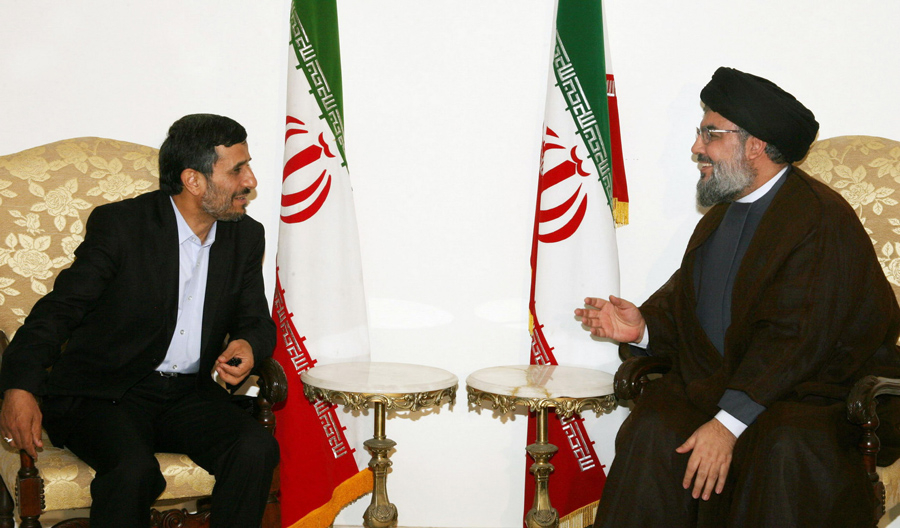
Hezbollah leader Hassan Nasrallah (right) meets with then Iranian President Mahmoud Ahmadinejad during Ahmadinejad's visit to Lebanon, on October 14, 2010. (Photo by Hezbollah Media Office via Getty Images)
We shall soon see whether "cheat-and-retreat" will once again deceive the Arabs and the Western powers into refraining from meaningful action to restore the authority of the Lebanese state.

For Lebanon to regain its dignity as a nation-state, Hezbollah must become a normal political party, not a Mafia-style armed group holding the nation to ransom on behalf of foreign paymasters.

The absence of strong state structures has been singled out by many Muslim scholars as the principal reason for the historic weakness of Islamic nations and their domination by Western powers from the 19th century onward.

In 1883, Jamaleddin Assadabadi, known to Arabs as al-Afghani, gave a lecture at Sorbonne University in Paris, in which he argued that Muslim nations would remain vulnerable for as long as their state structures could not exercise authority in the face of non-state forces controlled by interest groups or foreign powers.

This article first appeared in Asharq Al Awsat

Amir Taheri, formerly editor of Iran's premier newspaper, Kayhan, before the Iranian revolution of 1979, is a prominent author based on Europe. He is the Chairman of Gatestone Europe.

Source: https://www.blogger.com/blogger.g?blogID=7252498158295181812#editor/target=post;postID=8792259437821948938

Follow Middle East and Terrorism on Twitter

Copyright - Original materials copyright (c) by the authors.

Time to Drain the Swamp - Also in Europe - Geert Wilders


by Geert Wilders

We need to show that Europe's streets are our streets, that we want to stay who and what we are, and do not want to be colonized by Islam. Europe belongs to us!

  • Our democracies in the Western half of Europe have been subverted. Their goal is no longer to do what the people want. On the contrary, our political elites often do exactly the opposite. Our parliaments promote open-door policies that the majority of the people reject. Our governments sell out sovereignty to the EU against the will of the people. Our rulers welcome ever more Islam, although the majority of the people oppose it.
  • Our democracies have become fake democracies. They are multi-party dictatorships, ruled by groups of establishment parties.... The establishment parties control everything, not just the politicians in their pay, but also the top brass of the civil service, the mainstream media, even the courts.... They call us "populists" because we stand for what the people want. They even drag us to court.
  • We need to show that Europe's streets are our streets, that we want to stay who and what we are, and do not want to be colonized by Islam. Europe belongs to us!
Next month, I will be visiting Prague, the capital of the Czech Republic. I have been invited to speak to a group of Czech patriots. The Czechs are a freedom loving people. In 2011, on the occasion of the 100th birthday of Ronald Reagan, they named a street in Prague after this great American president and freedom fighter.

This fact reminded me of a shameful event in my home town of The Hague, the seat of the Dutch Parliament and the government of the Netherlands. Look for a Ronald Reagan Street in The Hague and you will find none. A proposal in 2011 to name a street in The Hague after Reagan ran into fierce political opposition. Leftist parties, such as Labor, the Greens and the liberal D66 party, argued that naming a street in honor of Reagan would "do the image of the city no good." The whole affair ended in a disgraceful political compromise. Last year, a short stretch of a local bicycle path was named the "Reagan and Gorbachev Lane".

This anecdote is indicative of the difference between East and West in Europe. We can see the same difference in the attitude of their ruling elites towards Islam, the new totalitarianism that is threatening Europe today. In the East, political leaders oppose Islam; in the West, they surrender.

Islam has already gained a strong foothold in Western Europe. Its streets have come to resemble the Middle East, with headscarves everywhere. Parts of Western Europe, such as the Schilderswijk district in The Hague, the Molenbeek borough in Brussels, the banlieues [suburbs] of Paris, Birmingham in Britain, the Rosengård area in Malmö, Sweden, and many other neighborhoods, have become hotbeds of Islamic subversion.

Islam's totalitarian nature cannot be denied. The command to murder and terrorize non-Muslims is in the Koran. Islam's prophet Muhammad was a mass murderer and a pedophile. Those who leave Islam supposedly deserve death. And everyone who criticizes Islam and exposes what it actually says, ends up like me: on an Islamic death list.

In the past decades, Islam has entered Western Europe with the millions of immigrants from Islamic countries. Now, the European Union wants to distribute third-world immigrants over all the 28 EU member states. The nations in Central and Eastern Europe reject the EU plans to impose permanent and mandatory relocation quotas for all EU member states. They warn about the dilution of their identity, which is not Islamic, but Judeo-Christian and humanist -- rooted in the legacy of Jerusalem, Athens and Rome; not Mecca.

Hungarian Prime Minister Viktor Orbán has denounced the EU's pro-immigration agenda as a means to eradicate the culture and Christian identity of Hungary. Czech President Miloš Zeman is an outspoken opponent of immigration and the Islamification of the Czech Republic. Slovak Prime Minister Robert Fico has said that "Islam has no place in Slovakia" and warns that "migrants change the character of our country." Polish Prime Minister Beata Szydło staunchly defends Poland's refusal to accept the EU-imposed immigration quotas. "We are not going to take part in this madness," she says. In the Eastern part of Europe, anti-Islamification and anti-mass migration parties see a surge in popular support.

Resistance is growing in the West, as well. This year, we have seen my party, the Party for Freedom (PVV), become the second-largest party in the Netherlands. This is a great achievement in a country with 13 parties in Parliament. In France, Marine Le Pen made it to the second round in the French presidential elections and her party, the Front National, got more votes than ever. In Austria, the FPÖ became the second biggest party. In Germany, the patriots of the AfD forced their way into the Bundestag.


Geert Wilders, leader of the Party for Freedom (PVV), casts his vote in The Hague during the Dutch general election that made his the second-largest party in the Netherlands, on March 15, 2017. (Photo by Carl Court/Getty Images)
However, the political elites in the West do all they can to keep the winners of the elections from power. Last month, in my country, the Netherlands, a new government coalition consisting of no less than four parties was formed. Because they stubbornly refused to talk to PVV, it took the political elites a record seven months to put together a coalition. They preferred to take in D66, the party which had denied Ronald Reagan his street in The Hague, and still they were only able to form a government with a majority of just one single seat in Parliament.

Our democracies in the Western half of Europe have been subverted. Their goal is no longer to do what the people want. On the contrary, our political elites often do exactly the opposite. Our parliaments promote open-door policies that the majority of the people reject. Our governments sell out sovereignty to the EU against the will of the people. Our rulers welcome ever more Islam, although the majority of the people oppose it.

Our democracies have become fake democracies. They are multi-party dictatorships, ruled by groups of establishment parties. They wheel and deal, often selling away the principles for which they have been elected. The establishment parties control everything, not just the politicians in their pay, but also the top brass of the civil service, the mainstream media, even the courts. Parties such as mine are excluded from coalition talks. They call us "populists" because we stand for what the people want. They even drag us to court.

Three decades ago, the countries in Central Europe witnessed a Velvet Revolution: Democratic, political and peaceful. They took to the streets. They decided that enough was enough. Thanks to their Velvet Revolution, they have leaders today who truly represent the people and who are not afraid to stand up for their nation and its identity.

We, in Western Europe, can learn lessons from the Velvet Revolution in the East. We, too, urgently need to make clear that enough is enough. In Western Europe, too, it is time to drain the swamp and to drive the elites from power. Peaceful and democratic, but thorough. We have to make our so-called democratic systems truly democratic again. The political actors should no longer be the professional politicians alone. The crisis is existential. It is time for every man and woman to do his and her duty. Because the survival of our nations itself is at stake.

We, too, have to make it very clear that we no longer want to take part in the madness of leaders, who sell out their country to the EU institutions in Brussels, and the madness of the EU elites, who sell out our continent to mass-immigration and Islam. That is why the PVV will demonstrate in the streets of Rotterdam on January 20th. We need to show that Europe's streets are our streets, that we want to stay who and what we are, and do not want to be colonized by Islam. Europe belongs to us!

Geert Wilders is a member of the Dutch Parliament and leader of the Dutch Party for Freedom (PVV) in the Netherlands.

Source: https://www.gatestoneinstitute.org/11440/geert-wilders-drain-swamp

Follow Middle East and Terrorism on Twitter

Copyright - Original materials copyright (c) by the authors.

Assad to Netanyahu: Ready to discuss Golan demilitarization - Mordechai Sones


by Mordechai Sones

Syrian president conveys via Putin possibility of Golan demilitarization. Israeli official: Israel will attack Iranian activity near border.


Putin taciturn: Meeting with Assad (L)
Reuters
During his visit to Sochi last week, Syrian President Bashar al-Assad conveyed to Prime Minister Binyamin Netanyahu a message that Damascus was ready to discuss the disarmament of the Golan Heights up to 40 kilometers from the separation line, and to examine autonomy for the Kurds and Druze in the country as part of a comprehensive agreement that would leave the current Syrian regime in power, according to the Kuwaiti newspaper Al-Jarida as reported by Nana 10 news.

According to the report, a Western source also told the newspaper that in Putin's telephone conversation with Netanyahu after the meeting, the latter assured his Russian counterpart that he was ready to discuss Assad's demands with the Israeli security institutions. However, he stressed the necessity of removing Hezbollah and Iran from Syria.


Putin, Assad, Russian DM & Chief of General Staff attend meeting in Sochi, Russia
Reuters
The source also said that a senior Israeli official recently said that Israel is certain that Assad is to be the last Alawite president in Syria. The source added that he expects the Syrian crisis to increase after the ISIS defeat, especially if "Tehran continues to play with fire", noting the Iranian presence in southern Syria, and that Israel has stressed that it will attack Iranian installations and activities within 40 kilometers of the Golan Heights.

According to the source, the official also said that "Syria will not be the same again as it was in the past, and it is determined to be a federal or confederate state." In the meantime, the source added that according to the senior official, Lebanon would not be immune to such a move taking place, and the new map of the region would reflect this.


Mordechai Sones

Source: https://www.israelnationalnews.com/News/News.aspx/238503

Follow Middle East and Terrorism on Twitter

Copyright - Original materials copyright (c) by the authors.