Saturday, June 16, 2018

Human Rights: Other Views - Part III - Denis MacEoin

​
by Denis MacEoin

Whereas refugees arriving under the UNHCR are entitled to be granted asylum and eventually citizenship, the UAE is clear from the start that it wants to send its refugees back home.

  • Whereas refugees arriving under the UNHCR are entitled to be granted asylum and eventually citizenship, the UAE is clear from the start that it wants to send its refugees back home. Back home to what? To a half-ruined country still ruled by one of history's most brutal dictators hand-in-hand with Iran, Russia, and Hizbullah?
  • As the years pass, as more and more countries struggle with poverty, conflict, religious extremism, terrorism, ethnic divisions, governmental incapacity, corruption, and declining levels of education, huge sections of the world's rapidly growing population will look in vain for safe places... The Western states who support the UNHCR cannot possibly handle this without suffering internal decline.

In the first part of this series, as many surveys have shown, we saw how difficult it has been, and apparently remains, for many Muslims to be assimilated into non-Muslim societies.

In Part Two, we examined how difficult it remains to allow Syrian and other refugees even to settle into other Muslim and Arab countries, including places such as Turkey, Lebanon, Iraq, and Jordan, which have taken in millions.

In this final part, we shall look at the remaining Muslim countries, which have taken in few or no refugees from the Syrian civil war. These are the richest countries in the Arab world, and the least troubled by disintegration. Many are generous in their funding for humanitarian aid, but that money is donated on the understanding that the refugees are looked after by the UNHCR and the countries they have already reached. Seeing why may be a help.

In 2014, Amnesty International published a short article, "Facts and Figures: Syria refugee crisis & international resettlement", in which it stated that "The six Gulf countries - Qatar, United Arab Emirates, Saudi Arabia, Kuwait and Bahrain - have offered zero resettlement places to Syrian refugees".

This conclusion was echoed Deutsche Welle, the BBC, Time magazine, CNN, the Washington Post , the Huffington Post, the Jerusalem Post and other media. The most detailed report, however, came from the Brookings Institution in a September 2015 article by Luay Al-Khateeb, a prominent Arab expert on the geopolitics and economics of the GCC. Al-Khateeb noted that:
"condemnation of the Gulf Cooperation Council (GCC) stance on the region's refugee crisis has reached a crescendo... they have countered criticism by asking the world to do more.
"The GCC, it is pointed out, has nonetheless given more money for refugees than any other [country]."[1]
As early as 2013, this amounted to $40 billion. Despite this generosity, the bulk of GCC aid money goes to other Muslim states, notably Egypt and Morocco, which, as noted in Part Two, have taken almost no refugees.

At this point, things become murkier. In 2015, Alex Nowrasteh, writing for Newsweek, argued that there are more Arabs and Muslims living in Arab and Muslim lands than ever before:
Many more Syrians are living in Saudi Arabia and the Gulf States than at the beginning of the Syrian civil war in 2011.
The World Bank reports that 1,000,000 Syrians resided in Saudi Arabia in 2013, a whopping 795% increase over 2010. There were 1,375,064 Syrian migrants living in the Gulf States in 2013, a 470% increase over 2010.
Excluding Oman, the 2013 Syrian population in every Gulf State has increased dramatically since right before the beginning of the Syrian civil war.
Others have also taken up cudgels on behalf of the GCC countries. Open Source Investigations, writing in December 2015, argued that the story about GCC failure to receive refugees is "a myth". Just before that, the Guardian opined that Saudi Arabia had said criticism of their refugee response was "false and misleading". The humanitarian organization HumanRefuge(e) published an article entitled "How Many Syrians Let in by the Gulf States?"

The HumanRefuge(e) post even features a map that purports to show high numbers of Syrian refugees who have been settled in Saudi Arabia.[2]

Why is there such a discrepancy between these two accounts: on the one hand, that the Gulf states have taken in no refugees and, on the other, that they have taken large numbers?

The explanation given by HumanRefuge(e), Open Source Investigations, the Saudi government and others hinges (or appears to hinge) on the fact that:
The UNHCR counts refugees using the 1951 Refugee Convention, among other protocols. Gulf states like Saudi Arabia, Kuwait, Qatar, and the UAE did not sign any UN protocols on refugees, so most refugees residing in these areas aren't counted by agencies like the UNHCR.
A clearer explanation is given by Chaker Khazaal, commenting on a 2014 report by Amnesty International:
The reason it's difficult to establish just how many refugees are being hosted by countries in the GCC is because they do not officially recognize incoming asylum-seekers as refugees. Since the GCC is not a signatory of the United Nations' 1951 Refugee Convention, they are not bound by law to provide these people with the standard treatment and rights typically afforded those seeking refuge in a new country.
Admittedly, while the Arab states of the GCC might not have officially resettled any of the Syrian refugees, it would be incorrect to say that Arab states have not received any of the millions of Syrians who have been displaced since the civil war began.
The problem is that being an official refugee and being a guest of a GCC work-sponsorship program are not one and the same. The most significant difference is that official refugees in countries that have agreed to the 1951 Refugee Convention are eligible to become citizens after a certain period of time.
There are (or have been) a lot of Syrians in some of the countries in question. But these are migrant workers, not people fleeing from the civil war. Instead of treating these workers as asylum seekers entitled to the rights of resettlement and citizenship, the Gulf states are trying hard to expel them.

Saudi Arabia, for example, has experienced physical and social decline from its migrant population. Dr Khalid Mandeli (PhD from Newcastle University), a lecturer at Jeddah's King AbdulAziz University, has published a number of articles that show concerns about the impact of migrant workers living in slum areas.[3] Their presence goes back to the 1970s, when the country brought in cheap foreign labour after the oil boom and religious awakening of the period.

By 2013, the Saudi government had embarked on a "Saudization" campaign that aims to remove foreign workers in order to put more Saudis to work. The result has been alarming:
Until recently, of the kingdom's 30 million residents, more than nine million were non-Saudis. Since the labour crackdown started in March, one million Bangladeshis, Indians, Filipinos, Nepalis, Pakistanis and Yemenis have left. And the campaign has moved into higher gear after the final deadline expired on 4 November, with dozens of repatriation flights now taking place every day. By next year, two million migrants will have gone.
In 2015, Human Rights Watch published a short report on the issue: "Detained, Beaten, Deported: Saudi Abuses against Migrants during Mass Expulsions". The report noted that:
None of the workers interviewed were allowed to challenge their deportations or apply for asylum. Saudi Arabia has not established an asylum system under which migrants could prevent their forced return to places where their lives or freedom would be threatened.
Is it plausible, however, that a country that sees foreigners as a problem and has no asylum system in place has brought in as many as two million Syrian refugees to add to their woes?

The same problem apparently lies behind the rejection of refugees in the rest of the region. Khazaal notes that:
The mass deportation of workers is considered to be a result of the region's reported attempts to prioritize giving employment opportunities to their local citizens. There is also widespread perception that Syrians wishing to seek refuge in the Gulf states are unlikely to be granted a visa in the first place.
This was confirmed by the BBC:
Although those fleeing the Syrian crisis have for several years been crossing into Lebanon, Jordan and Turkey in huge numbers, entering other Arab states - especially in the Gulf - is far less straightforward.
Officially, Syrians can apply for a tourist visa or work permit in order to enter a Gulf state.
But the process is costly, and there is a widespread perception that many Gulf states have unwritten restrictions in place that make it hard for Syrians to be granted a visa in practice.
In 2017, UNHCR reported on a "landmark agreement" between themselves and Kuwait to aid Syrian refugees. Good news, but it is important to read the small print. The agreement is worth $10 million and is aimed "to improve the living conditions of Syrian refugees in northern Iraq". But, given that Kurdistan is linguistically and culturally different from Syria, those refugees will find it hard, almost impossible, to settle there. Kuwait's money will only ease refugees living in camps.

Bahrain fits the same narrative. In March 2018 Bahrain pledged a mere $2 million "to build schools in the Zaatari Refugee Camp in Jordan". That is small help for a country already highly pressurized by the numbers of refugees it has taken. This too is not a solution.
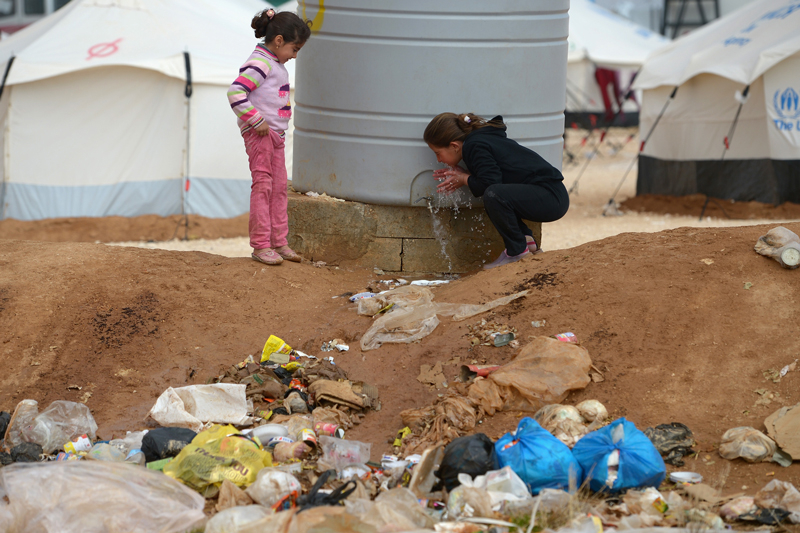

In March 2018, the Gulf kingdom of Bahrain pledged a mere $2 million "to build schools" in the Zaatari Refugee Camp in Jordan (pictured above). Photo by Jeff Mitchell/Getty Images.

The UAE boasted in 2016 that is planning to take in 15,000 refugees over the following five years -- three thousand a year. But the long-term prospects of those refugees are not encouraging. Reem Al Hashemi, the UAE's minister of state for international cooperation explained that:
Ultimately, we must offer a source of hope for displaced persons that allows them to maintain dignity, return home, reintegrate themselves into their societies, and rebuild their countries and their lives. [Emphasis in original.]
Whereas refugees arriving under the UNHCR are entitled to be granted asylum and eventually citizenship, the UAE is clear from the start that it wants to send its refugees back home. Back home to what? To a half-ruined country still ruled by one of history's most brutal dictators hand-in-hand with Iran, Russia, and Hizbullah? To Eastern Ghouta? To Aleppo, Homs, Hama, Lattakia, Deir al-Zur, al-Raqqa, Tartus, Daraa, al-Hasakeh, al-Qamishli? In order to "maintain their dignity... reintegrate themselves... and rebuild their countries and their lives"?

This is the response from the sixth richest country in the world (taking the Emirates together)? The second richest in the Arab world (after Saudi Arabia)? Where Abu Dhabi has been described as "the richest city in the world"?

What of Qatar, ranked by Fortune magazine in 2017 as the richest country in the world per capita? Qatar houses a large number of migrant workers, mainly Pakistani and Indian, with three out of four residents male. The migrants make up 94% of the country's workforce and 70% of its total population. In January 2017, Qatar offered to house Salvadorans who may be expelled from the United States. But they would be admitted on a temporary basis only. The treatment of migrant workers by the state, however, has been strongly condemned by the European Parliament and others. A report by the BBC in 2015 gives some details.

Conclusion

As the years pass, as more and more countries struggle with poverty, conflict, religious extremism, terrorism, ethnic divisions, governmental incapacity, corruption, and declining levels of education, huge sections of the world's rapidly growing population will look in vain for safe places in which to live, work, and raise their families. The Western states who support the UNHCR cannot possibly handle this without suffering internal decline.

This decline in many parts of the world will accelerate the growth of refugee and migrant populations, creating a downward spiral that will drag down even the more affluent countries. According to Paul Ehrlich, "Collapse of Civilization is a near certainty within decades". The failure of so many Islamic states and the refusal of some of the richest countries in the world to do much to help, alongside their expenditure of billions of dollars over many years to spread the radicalization of Islam and finance Islamic terrorism, is one of the greatest problems facing the modern world and challenging the democracies.

This situation theoretically calls for major intervention by the United Nations, but the UN is effectively controlled by the very countries that are causing or contributing to the problem. With the Organization of Islamic Cooperation adding to the pressures on the democracies by working in the interest of Muslim states, it is time for a response. But so far, the Western nations have shown no willingness to create one.
Denis MacEoin taught Arabic and Islamic Studies in England and is currently a Distinguished Senior Fellow at New York's Gatestone Institute.

[1] Saudi Arabia and Qatar have provided some $900 million in humanitarian aid to Syrians. The United Arab Emirates have donated $530 million in aid since 2012. Problematically, the UN High Commissioner for Refugees' Syria Regional Response Plan has requested another $4.5 billion, to ensure basic dietary and sanitation conditions in the refugee camps.
[2] Saudi Arabia (500,00 to 2.5 m.), Kuwait (120,000), Bahrain (1,750), Qatar (19,000 to 25,000), and the United Arab Emirates (242,000).
[3] E.g. Khalid Nasralden Mandeli, "The realities of integrating physical planning and local management into urban development: A case study of Jeddah, Saudi Arabia", Habitat International 32 (2008) 512–533


Denis MacEoin taught Arabic and Islamic Studies in England and is currently a Distinguished Senior Fellow at New York's Gatestone Institute.

Source: https://www.gatestoneinstitute.org/12334/refugees-arab-states

Follow Middle East and Terrorism on Twitter

Copyright - Original materials copyright (c) by the authors.

The Diplomatic Big Bang - Ahmed Charai

​
by Ahmed Charai

"The unspoken objective is to constrain the U.S., and to transfer authority from national governments to international bodies".

  • Diplomacy is changing before our eyes.
  • "The unspoken objective is to constrain the U.S., and to transfer authority from national governments to international bodies. The specifics of each case differ, but the common theme is diminished American sovereignty, submitting the United States to authorities that ignore, outvote or frustrate its priorities.... By reasserting their sovereignty, the British are in the process of escaping, among other things, the European Court of Justice and the European Court of Human Rights." — Ambassador John R. Bolton, Wall Street Journal, March 7, 2017.

The Singapore summit is indeed historic. First, it is so because just a few weeks ago we were closer to a nuclear war than to even the semblance of a peace process. The way we got here is surprising, because it did not obey the usual rules.

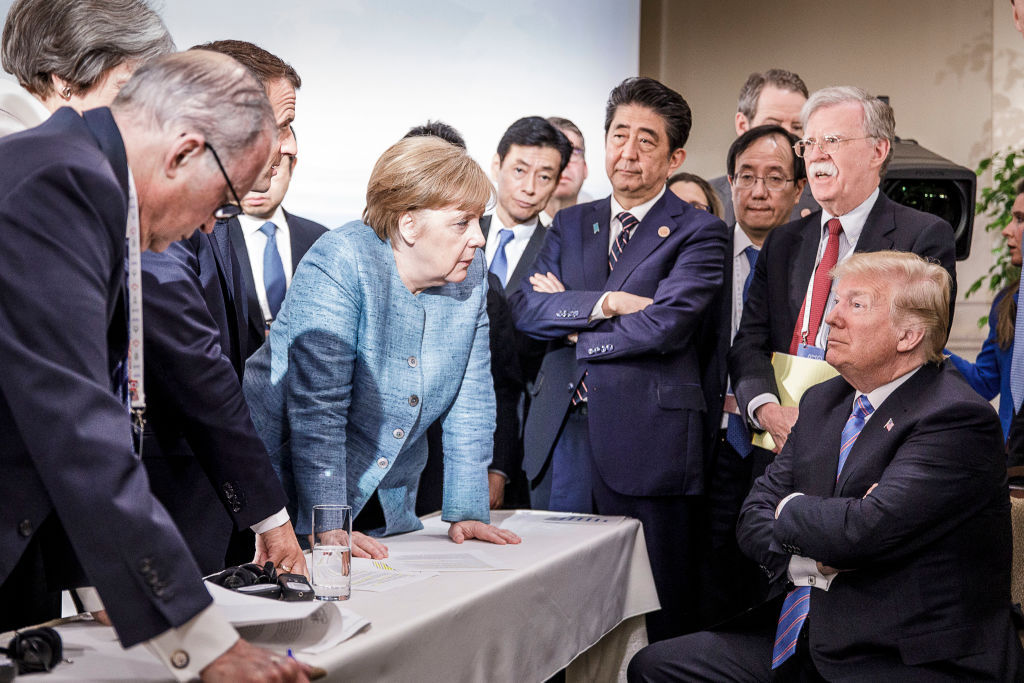
A few days ago, during the G7 summit held in Canada, US President Donald Trump upheld his decisions on tariffs and his positions on the trade deficit. These stances followed his decision to pull out of the Paris climate change agreement and the Iranian "nuclear deal". It is clear that the new US administration challenged the alliances inherited from the Cold War. President Trump, a businessman, not a politician -- one of the reasons he was elected -- is asking America's trading partners just to have "free, fair and reciprocal" agreements. It is probably not all that unusual to feel affronted when asked for money or to regard the person asking for it as mercenary or adversarial. It does not always mean that this feeling is justified.


Pictured: Donald Trump and other heads of state deliberate at the G7 summit on June 9, 2018 in Charlevoix, Canada. (Photo by Jesco Denzel /Bundesregierung via Getty Images)

In short, President Trump's arguments, which sound like a leitmotif, go back to the economic aspect of things. NATO? Why should it be normal that, in order to defend Europe, the American taxpayer pays the heaviest part. Free trade? Why should America suffer a trade deficit with so many countries? Climate change? The results of the Paris Climate Change conference, COP 21, were apparently not only costly but questionable, and to critics, looked like a list of unenforceable promises that would not have come due until 2030 -- if ever.

A new paradigm is shaping up on the international scene: This is the first time that the US domestic policy is to prevail over its so-called "strategic" role -- sometimes possibly to the detriment of allies.

Ambassador John R. Bolton, before he was appointed National Security Advisor, rejected any external constraints or supranational authority -- starting with the WTO's trade dispute body, the Dispute Settlement Understanding (DSU):
"The unspoken objective is to constrain the U.S., and to transfer authority from national governments to international bodies. The specifics of each case differ, but the common theme is diminished American sovereignty, submitting the United States to authorities that ignore, outvote or frustrate its priorities.... While many European Union governments seem predisposed to relinquish sovereignty, there is scant hint of similar enthusiasm in America.... By reasserting their sovereignty, the British are in the process of escaping, among other things, the European Court of Justice and the European Court of Human Rights."
Unfortunately, Europe is the first to suffer from this new reality. But is the European Union able to stage a showdown? Probably not. The populist wave flooding the EU countries is primarily the result of the social impacts of the fiscal policy imposed by Germany. While the US has an unemployment rate effectively past full employment, the rather sluggish growth in Europe produces a near-zero effect on this indicator. With 27 members, and because of the rule of "one country one vote," as well as a possibly outdated view of how to incentivize growth and finance pensions, Europe has been slowing down even the possibility any development on issues such as immigration or common defense. Europe is shattered, all the more that there does not seem to be any solution on the horizon.

The group called the European Union does not weigh much against the forced march of Donald Trump. The US president only believes in bilateral agreements when it comes to international relations. The use of the principle of ex-territoriality, or diplomatic immunity, has taken the agreement with Iran out of the equation. The big French and German companies have already withdrawn from it.

Diplomacy is changing before our eyes. "The Western camp," it seems, is becoming nothing more than a specter that does not rest on any on-the-ground reality.

Inevitably, each power will have to adapt, according to its own interests. As Europeans continue to cast their votes, these adjustments may, in turn, feed current divisions even more.

Ahmed Charai is a Moroccan publisher. He is on the board of directors for the Atlantic Council, an international counselor of the Center for a Strategic and International Studies, and a member of the Advisory Board of The Center for the National Interest in Washington and Advisory Board of Gatestone Institute in New York.

Source: https://www.gatestoneinstitute.org/12515/diplomatic-big-bang

Follow Middle East and Terrorism on Twitter

Copyright - Original materials copyright (c) by the authors.
Israel Moves To Thwart Growing Hamas Maritime Threat - Ari Lieberman

​
by Ari Lieberman

A series of offensive and defensive Israeli actions are keeping Hamas off balance.


When it comes to military firsts, Israel can probably take credit for the lion’s share. Israel was the first nation to capture an intact Soviet MiG-21, the first to capture a complete intact Soviet P-12 radar station, the first to employ militarized drones in the context of a large-scale, Wild Weasel, anti-SAM operation, and the first to destroy not one but two atom bomb facilities.

On June 2, 2018 the Israel Defense Forces executed another operational first. The Israeli Air Force bombed and destroyed a Hamas underwater terror tunnel. The tunnel, which was located approximately three kilometers from the Israeli border, was constructed for the purpose of concealing Hamas movements and allowing Hamas frogmen to enter the sea from an adjacent Hamas naval base undetected.

Hamas has been trying to improve its militarized maritime program and has invested substantial resources into improving and expanding its sea assault capabilities. On July 8, 2014 a cell of five heavily armed Hamas frogmen infiltrated Israel from the sea at Zikim Beach, which is located just north of the Gaza Strip. They were quickly detected and Israeli ground and naval units were dispatched to confront them. After a running battle, all five were liquidated. An IDF soldier was lightly wounded in the exchange.

While the attack was thwarted, it highlighted another danger and underscored the need to address the growing Hamas maritime threat. The frogmen were well trained and demonstrated considerable bravery. Though the cell was wiped out, the confrontation could have just as easily ended in disaster. 

In 1978, 11 PLO terrorists (the initial force consisted of 13 members but two drowned in route) landed on the Israeli coast at a beach site just north of Tel Aviv. In the ensuing hours they killed 38 Israeli civilians and wounded 71. It was the worst terrorist attack in Israeli history, surpassing the Park Hotel suicide bombing, which killed 30.

Recognizing the threat emanating from Gaza, Israel has imposed limitations on Gaza sailing zones. Currently, Gazans are not permitted to sale passed six nautical miles from shore. To ease economic burdens, Israel permits some Gaza fishermen to travel up to 10.4 nautical miles from shore. When imposing such restrictions, Israeli authorities are required to conduct a delicate balancing act, taking into account security needs and economic burdens to the local fishing industry.

Israel has also begun constructing an under-and above-water wall to thwart sea borne infiltration. The barrier, which defense ministry officials characterized as an “impregnable breakwater,” will be constructed in the vicinity of Zikim beach, the same beach that witnessed the 2014 infiltration. The barrier, believed to be the only one of its kind in the world will consist of three levels. It will have an underground component, topped by a level of armored stone and a third level of razor wire at the upper tier. Israel’s defense ministry believes that this undertaking will further undermine Hamas attempts to exploit vulnerabilities in Israel’s well-guarded but exposed coastline.

But the IDF is not merely thinking in terms of defense. As highlighted by the June 2, strike, the IDF has demonstrated that it will act preemptively and preventatively to eliminate threats to Israel’s security. On May 29, the Israeli Air Force struck a Hamas naval base destroying a quantity of what the IDF characterized as “advanced maritime weaponry.” These were underwater sea drones created for the sole purpose of carrying out terrorist attacks. They were the brainchild of Hamas engineer, Mohammed Zawahri. Zawahri was assassinated in Tunisia by unknown assailants in December 2017. In April 2018, Fadi al-Batsh, another Hamas engineer believed to be heavily involved in Hamas’s militarized drone program was killed in Malaysia under similar circumstances. Israel reserved comment on both attacks but both are widely believed to have been executed by operatives of Israel’s vaunted intelligence service, Mossad.

Hamas has demonstrated that there is no level of depravity to which it will not sink. The Islamist group has employed mortars, rockets, terror tunnels, IEDs, drones and even kite terror. The maritime threat is just another component of Hamas’s multi-tiered strategy of aggression and terrorism.

Throughout its history, Israel has had to confront a plethora of threats faced by no other nation in the world. It faces genocidal Islamist enemies, Sunni and Shia, on all fronts. As a consequence, Israel has had to excel in technological innovation to deal with the challenges.  It has also had to be at the top of its game and maintain a constant state of vigilance 24/7. Finally, Israel has had to adopt unique tactics to counter threats posed by malevolent adversaries. Defensive and offensive measures undertaken by Israel’s security forces – water barriers, covert operations, preemptive strikes – serve to keep the enemy off balance, thereby securing the safety of Israel’s citizens.


Ari Lieberman is an attorney and former prosecutor who has authored numerous articles and publications on matters concerning the Middle East and is considered an authority on geo-political and military developments affecting the region.

Source: https://www.frontpagemag.com/fpm/270470/israel-moves-thwart-growing-hamas-maritime-threat-ari-lieberman

Follow Middle East and Terrorism on Twitter

Copyright - Original materials copyright (c) by the authors.

Trump Administration Opens Office To Find Naturalization Fraudsters - Michael Cutler

​
by Michael Cutler

A great first step -- but much more needs to be done.


On June 11, 2018 the Washington Times published an article, U.S. launching office to identify citizenship cheaters, reporting that the Trump administration is opening an office to identify aliens who defrauded the naturalization process by concealing material facts in filing for U.S. citizenship and seek their denaturalization.

This is an important measure and one that enhances the enforcement of immigration laws from within the interior of the United States that will plug yet another gap in the highly porous immigration system.

This, as you will see, also has serious implication for national security.

However, generally most aliens who commit naturalization fraud also committed fraud in their applications for various immigration benefits that subsequently enabled the to apply for U.S. citizenship.

Because of the huge number of applications for various immigration benefits, more than six million applications for various benefits are processed each year by the beleaguered adjudication officers employed by USCIS (United States Citizenship and Immigration Services), many applications are adjudicated without so much as an in-person interview, let alone a field investigation conducted to verify the information contained in the applications.

This creates an invitation for fraud on a massive scale.

The Wasington Times article draws the parallel with this new effort to uncover aliens who lie on application for U.S. citizenship to previous efforts to identify Nazi war criminals who also gamed the naturalization process in order to secure U.S. citizenship to evade prosecution for their heinous crimes against humanity.

Naturalization fraud is of particular concern because U.S. citizenship provide the aliens with the veritable “Keys to the kingdom” as I have described in a series of previous articles and in my testimony before several Congressional hearings.

Here are a few reasons why citizenship is of particular concern and how some of the vulnerabilities must be addressed.

As the Washington Times article noted, aliens who acquire U.S. citizenship may be granted security clearances.  I recently wrote an article about an April 2018 Congressional hearing on how Iranian Sleeper Cells Threaten U.S.

Immigration fraud, including naturalization fraud, enables sleeper agents from foreign countries to embed themselves in the United States in furtherance of their nefarious and often deadly goals.

Additionally, aliens who naturalize may legally change their names.  In such instances, their U.S. passports only reflect their new names.

Criminals and terrorists can thus put themselves into their own “Witness Protection Program” concealing their original identities and gaining entry into countries around the world that might be aware of their original names and would never admit them if they knew who they really were.

However, when such an individual seeks entry with a new name, a name not known to border officials in that country it is likely that he/she will be permitted to enter that country.

The solution to this problem is simple and inexpensive-  have U.S. passports reflect both names.

I raised this issue when I appeared at a Congressional hearing but no action was taken.

This is further exacerbated because many of these naturalized citizens have dual citizenship, they retain the citizenship and passports of their countries of birth.

Dual citizen terrorists and fugitives who defraud the naturalization process can travel easily around the world by using their U.S. passport to travel to an intermediate foreign country, let’s say Germany.  They then conceal their U.S. passport and travel on the passport issued to them by their county of birth to travel to another country, perhaps to engage in terror-related activities. They return to Germany.  In Germany they conceal the passport from their country of birth and return to the United States on their U.S. passport.

A review of entry stamps in their U.S. passport will make it appear that they spent several weeks in Germany when, in reality, Germany was just an intermediate destination on their way to other countries.

Alternating passports covers their tracks the way a smuggler drags branches behind him to cover his tracks in the sand in the desert.

The Trump administration must finally require that the U.S. passports issued to naturalized citizens reflects all names that these individuals have used, to thwart the tactic I have described above.

While it is encouraging that for the first time in decades we have an administration that is determined to not only secure our borders against illegal immigration but restore integrity to the immigration system to protect America and Americans.

The administration would do well to do more than simply attempt to identify aliens who secured U.S. citizenship via fraud.  Denaturalization may be an involved process.  It would be far better to uncover fraud in applications for immigration benefits that precede U.S. citizenship.

In order to qualify for citizenship, an alien must first become a lawful immigrant.  In order to become a lawful immigrant an alien may have been granted political asylum or married a U.S. citizen or lawful immigrant.

Consider this except from the official report, 9/11 and  Terrorist Travel:
Although there is evidence that some land and sea border entries (of terrorists) without inspection occurred, these conspirators mainly subverted the legal entry system by entering at airports.
In doing so, they relied on a wide variety of fraudulent documents, on aliases, and on government corruption. Because terrorist operations were not suicide missions in the early to mid-1990s, once in the United States terrorists and their supporters tried to get legal immigration status that would permit them to remain here, primarily by committing serial, or repeated, immigration fraud, by claiming political asylum, and by marrying Americans. Many of these tactics would remain largely unchanged and undetected throughout the 1990s and up to the 9/11 attack.
Thus, abuse of the immigration system and a lack of interior immigration enforcement were unwittingly working together to support terrorist activity. It would remain largely unknown, since no agency of the United States government analyzed terrorist travel patterns until after 9/11. This lack of attention meant that critical opportunities to disrupt terrorist travel and, therefore, deadly terrorist operations were missed.

My recently published booklet, Immigration Fraud:  Lies That Kill also focused on the threat posed to national security by various forms of immigration fraud, including but not limited to naturalization fraud.

Let’s consider a few specific examples of terror suspects who engaged in immigration fraud.
The infamous Tsarnaev brothers Dzhokhar and his older brother Tamerlan carried out the deadly terror attack at the Boston Marathon on April 15, 2013.  They and other members of their family were granted political asylum when their authorized temporary period of admission into the United States expired, and they claimed to have “credible fear” that if they were to return to their native Russia, they would face persecution or worse.

Shortly after being granted political asylum in the United States, members of the family voluntarily returned to Russia.  There had been no regime change and therefore, it must logically be presumed that they committed immigration fraud by making a false claim to “credible fear” upon which their application for political asylum rested.

However, no such investigation was launched into this obvious fraud. 

Members of the Tsarnaev family were subsequently granted lawful immigrant status making them eligible to apply for United States citizenship. 

Tamarlan was killed during the terror attack.  Although he had applied for U.S. citizenship his application was held up when information was provided by the Russian government linking him possibly to Chechen terrorists.

Dzhokhar, however became a naturalized citizen.  He is now on death row awaiting execution.

On January 23, 2018 the Justice Department issued a press release, Ohio Man Sentenced for Providing Material Support to Terrorists, Making False Statements to Authorities. 

That “Ohio man” was Abdirahman Sheik Mohamud, a native of Somalia who had become a naturalized U.S. citizen as part of his strategy to facilitate his travel to Syria.

I wrote about this case in two previous articles, A Terrorist and Naturalization Fraud and How DHS Ineptitude Facilitates Terrorist Operations. As I noted in the first of those two commentaries, Mohamud committed fraud when he lied on his application for his U.S. passport by claiming he intended to travel to Greece when, in reality, he traveled to Syria.

Finally, on January 16, 2018 the DOJ and DHS jointly issued a press release, DOJ, DHS Report: Three Out of Four Individuals Convicted of International Terrorism and Terrorism-Related Offenses were Foreign-Born. 

That press release noted that:
The report reveals that at least 549 individuals were convicted of international terrorism-related charges in U.S. federal courts between September 11, 2001, and December 31, 2016.  An analysis conducted by DHS determined that approximately 73 percent (402 of these 549 individuals) were foreign-born.  Breaking down the 549 individuals by citizenship status at the time of their respective convictions reveals that:
• 254 were not U.S. citizens;
• 148 were foreign-born, naturalized and received U.S. citizenship; and,
• 147 were U.S. citizens by birth.
According to information available to U.S. Immigration and Customs Enforcement (ICE), since September 11, 2001, there were approximately 1,716 removals of aliens with national security concerns.

Clearly the Trump administration is on the right path, but more and bigger steps need to follow and follow quickly.

Nothing less than national security is at stake.


Michael Cutler

Source: https://www.frontpagemag.com/fpm/270462/trump-administration-opens-office-find-michael-cutler

Follow Middle East and Terrorism on Twitter

Copyright - Original materials copyright (c) by the authors.

Why It Is Good for Trump To Challenge the International Trade Establishment - E. Jeffrey Ludwig

​
by E. Jeffrey Ludwig

Self-interest and sovereignty require that we take steps to resist unfettered globalism.


Since the election of Pres. Trump, commentators have been asking repeatedly why he seems so cordial or complimentary of leaders of countries many consider to be "enemy countries" – especially the People's Republics of China and Russia – while being irritated with our neighbors and friends, especially on the economic front. Early on in his presidency, he indicted NATO members for not paying 2% of GDP for support of NATO. And in fact, only five of the 28 members are meeting that benchmark. 

Then, in a memorable speech from the Rose Garden on June 1, 2017, Trump withdrew the USA from the Paris Climate Accord. Students of the accord will understand that it is part of the globalist agenda thrusting toward a one-world government. In addition to presenting a host of specific reasons for leaving based on a lack of equity in the accord, he also stated, "And exiting the agreement protects the United States from future intrusions on the United States' sovereignty and massive future legal liability."

Most recently, he left the G7 meeting in Canada early and refused to sign the final communiqué that was issued, citing offense at the comments made by Canadian prime minister Justin Trudeau, which were publicly deemed to be a verbal stab in the back. The president announced increased tariffs on aluminum and steel from Canada and that there would be a variety of tariff hikes on G7 exports to the U.S.

He also has withdrawn from the Trans-Pacific Partnership, which was renamed and signed by eleven countries – Australia, Brunei, Canada, Chile, Japan, Malaysia, Mexico, New Zealand, Peru, Singapore, and Vietnam – in March of this year. None of these is considered an enemy by our leaders.

Despite these tensions with friendly nations, the USA is still a signatory to the General Agreement on Tariffs and Trade and a member of the World Trade Organization. We still are a major contributor to the International Monetary Fund and the World Bank, which were created, along with the United Nations, at the end of World War II. Negotiations about NAFTA continue, but we are still in that trade agreement. 

We can best understand this pushback by Pres. Trump in light of the world economic picture that has emerged since the end of WWII. International trade in our world, unlike during the period prior to WWII, is governed by a vast network of rules and regulations, and the products covered from every country are described by a variety of documents in mind-boggling detail as they move in and out of the world's ports of entry. Trade is no longer just a buyer finding a seller and vice versa; rather, it entails navigating a maze of rules that permits or denies entry into various ports, guides enforcement of health and safety requirements, requires differences in tariffs that depend on relatively small differences in the products' descriptions, and allows financing of that trade by daily trading in various currencies. International trade is a multilateral ship titanic with complex strategies for resolving disputes, assuring payments in different currencies, and evaluating quality. The rules and regulations for assuring the health and well-being and exchange of goods and services of all peoples defies the understanding of any single individual.

In this vast matrix, Pres. Trump is faced with a real dilemma: how to survive in this elaborate matrix while at the same time regaining some of the U.S. hegemony in world markets that was lost while this matrix evolved during the past 73 years (1945-2018)? Manufacturers and providers of services, as well as the buyers and sellers of those goods and services, find themselves under incredibly complex constraints. Unlike the original free-market models of Adam Smith, these free markets have been micro-managed into existence by the post-WWII multilateral agreements. There is an appearance of freedom, but the free markets so-called have been brought into existence by the regional and world players, both governmental and corporate. So the key question now is, how free are free markets? President Trump is trying to restore freedom where there is now too great an overlay of constraints, and this writer believes that Trump perceives that enhanced freedom is profoundly connected with greater U.S. hegemony in world markets. America's freedom and economic initiative were the bases for its becoming the world's strongest economy.

Yet the post-WWII thrust has been to implement the world economic model based on David Ricardo's Theory of Comparative Advantage, first published in 1817, which can be characterized as an economic version of the utilitarian principle of "the greatest good for the greatest number." Briefly, the idea is that every country has some unique efficiencies, which means that certain products will be produced more efficiently there than elsewhere. Thus, let's say certain goods and services can be produced more cheaply in other countries. Then the price of those goods and services will come down; consumers in the U.S. will be able to buy more of those goods and services; and the flow of cash to those countries will generate more worldwide demand for goods and services that we are producing, thereby creating more wealth here. Under this model, all boats are lifted by the rising (economic) sea.

One can see that as the apparatus of this matrix becomes more complex, as it assumes an international scale, or even a regional scale, managing the day-to-day working of said matrix becomes a herculean task beyond the scope of any national government. Thus, vast mechanisms have been created to administer this economic panorama. For example, the European Union is administered by a vast unelected bureaucracy that has its headquarters in Brussels, Belgium, and the World Trade Organization has a vast headquarters in Geneva, Switzerland.

While the U.S. is still at the top of the list of wealthiest countries, hegemony or control in trade has shifted toward these two above-mentioned bureaucracies and other bureaucracies, and away from the U.S. And all business models must now find a way to function within the regional and world trade matrices. Individual and corporate initiative is thereby diminished. Sectors of one's national economy – think of the coal industry or offshore drilling – become increasingly marginalized or defunct based on decisions of the masters of the matrices, not on our business or political leaders. Or we find that we rebuilt Japan's steel industry after WWII and find that in many areas, we became weaker in steel production than Japan. Self-interest and sovereignty then require that we take steps to resist the matrices that have developed. That is the underlying reason why Trump is giving some of our friends a so-called hard time, and why it is justified.

E. Jeffrey Ludwig

Source: https://www.americanthinker.com/articles/2018/06/why_it_is_good_for_trump_to_challenge_the_international_trade_establishment.html

Follow Middle East and Terrorism on Twitter

Copyright - Original materials copyright (c) by the authors.

The Revised Arms Export Policy of Israel and the US - Shimon Arad

​
by Shimon Arad

Israel should be wary of following the American lead in relaxing export standards for approving arms sales. 


BESA Center Perspectives Paper No. 866, June 15, 2018


EXECUTIVE SUMMARY: The divergence between the Trump administration’s desire to increase arms sales to the Middle East and the capacity limits of Arab clients for what the US currently markets makes the release of new types of advanced US weapon systems to the region more likely, which could undermine Israel’s qualitative military edge. While the administration’s global arms export drive may increase US-Israel competition for certain markets, it could also offer opportunities for joint arms export cooperation. Israel should be wary of following the American lead in relaxing export standards for approving arms sales.  


On April 19, 2018, the White House issued a national presidential security memorandum laying out a revised US Conventional Arms Transfer (CAT) Policy. Following a sixty-day period for feedback from the industry, a proposed action plan to implement the revised policy guidelines regarding conventional arms transfers and unmanned aerial systems export policy will be submitted by the State Department in coordination with the Defense, Commerce, and Energy Departments for the president’s approval.


At its core, this new policy initiative is designed to ease regulations and increase the accessibility and competitiveness of US weaponry in order to bolster America’s share of the global arms market. As Peter Navarro, White House National Trade Council head stated, the change “will allow allies and partners to more easily obtain American security goods, which in turn improves the security of the United States while reducing the need for them to buy Chinese and Russian systems.”


Increasing arms sales is an important policy objective of the Trump administration, with the president himself pushing foreign leaders to buy American-made military systems and equipment. Expanding arms sales is seen as not only serving security and foreign policy interests but also underwriting the administration’s “America First” policy through the economic benefits that will be derived from expanding the ability of the defense industrial base to create jobs and innovate.


Arms exports constituted over 6% of the value of all US exports in the period from 2007 to 2014. According to a recent release by the authoritative Stockholm International Peace Research Institute (SIPRI), between 2013 and 2017 the US extended its lead in arms exports to 34% of total arms sales in the world. Increasing or even preserving the significant contribution of foreign military sales to America’s economy will require continued substantial orders from the Middle East and Asian markets that have led the rising trend of arms imports over the last decade. The consequent effort to maintain the Middle East as a substantial outlet for US-made arms could have a number of notable implications for Israel.


Breaking the quality barrier


While the Middle East market accounted for half (49%) of total US arms exports in the 2013-17 period, the combination of a present downward swing in demand for major US-made weapon systems in the Middle East and a deliberate policy of arms purchase diversification by the Arab states means innovative measures are going to be needed if the US is to achieve or exceed previous levels of arms sales to the region. This will necessitate going beyond current limits on arms sales to the Arab states.


Following a decade of large-scale sales of fighter jets, helicopters, warships, and air-defense systems, the Arab clients are close to or at their capacity limits for these types of US-made arms. With the residual market for such expensive weapon systems being shared with European and Russian arms manufacturers, the US will need to push the envelope in order to garner large-scale arms sales to the region in the coming years.


This makes the release of new types of advanced capabilities to the Arab states in the near future much more likely. Prime candidates are the F-35 fifth-generation fighter jet and armed drones. Though this would be very problematic from a Qualitative Military Edge (QME) perspective, the sale of F-35s and armed drones to the Arab countries would be very lucrative and could contribute considerably to keeping the Middle East as a major arms market in the years to come.


Between competition and cooperation 


In 2017, Israel’s arms exports reached a record $9.2 billion thanks to increased sales to India, Asia, and Europe of air-defense systems, radars and electronic warfare systems, and drones. Increased competition between Israel and the US for certain arms markets is growing more likely, but mutual benefit through cooperation on specific arms export projects is also possible.


Obviously, Israel and the US will not compete on arms sales across the board, but a more assertive US drive could bite into traditional Israeli markets. The military UAV market, especially armed UAVs, is one such area of potential competition. To date, the US has adopted a strong presumption of denial when considering the sale of armed UAVs around the world. The review initiated by the administration of the UAV export policy, including the intention to try and reform the Missile Technology Control Regime (MTCR) that governs the export of missiles and drones, indicates that the US is looking to expand its share of the UAV market, in which Israel is a major player.


More competition in places central to Israel’s success in arms exports – like India, Asia, and Europe – may also be in the cards. The US has upped its marketing efforts in these places, as exemplified by the Trump administration’s recent approval to supply India with armed Predator-B (MQ-9) UAVs. Up to this point, India’s armed drones have been Israeli-made Harpy systems.


On the other hand, there may be more opportunities for cooperation in arms exports between Israel and the US. Poland recently signed a $4.76 billion deal for the purchase of the US-made Patriot air-defense system. Initially, the Israeli-made David’s Sling interceptor missiles were in the running to be integrated into the sale. Though Poland eliminated the Israeli missiles from the competition, the demand for air and missile defense systems around the world could increase the potential for US-Israeli cooperation in this field.


Relaxing Israeli export rules


The review of the US conventional arms and UAV export policy may also encourage some in the Israeli defense establishment to consider a comparable easing of Israeli regulations on arms exports. Recently, a number of regulatory changes were made to streamline arms export marketing procedures. These do not, however, circumvent the procedures that supervise Israel’s arms export policy.


Israel is regularly criticized for selling weapons to countries that have problematic human rights track records, such as Myanmar, South Sudan, and Honduras. The upswing in Israel’s arms exports to countries in Africa, South America, and Asia that suffer from corruption or poor human rights records highlights the need to maintain strict standards and procedures for the approval of arms exports.


In short, Israel should be able to compete for arms markets globally without compromising the rigorous guidelines that govern the arms export process.


Recommendations


Within the context of its security dialogue with the US, Israel must relay its strong opposition to the release of the F-35 fifth-generation fighter jet to the Arab states. Israel must retain its regional exclusivity of this platform since its regional aerial superiority depends, to a large degree, on the technological advantages that the F-35 fighter affords it.


In addition, areas of cooperation in arms exports need to be earnestly explored with regard to those systems for which Israeli-US collaboration provides mutual benefits in securing arms deals. Air defense systems seem to be the prime candidate for this kind of partnership. At the same time, rules of competition need to be established with regard to the other arms export endeavors that will be contested between the US and Israel.


Finally, Israel should be wary of relaxing standards and procedures for approving arms exports. A more competitive global arms market is no excuse for the reversal of human rights, corruption, and security restrictions on arms sales.


BESA Center Perspectives Papers are published through the generosity of the Greg Rosshandler Family


Shimon Arad is a retired Colonel of the Israeli Defense Forces (IDF). His writings focus on regional security matters.

Source: https://besacenter.org/perspectives-papers/arms-export-policy-israel/

Follow Middle East and Terrorism on Twitter

Copyright - Original materials copyright (c) by the authors.

Netanyahu: Iran has brought 80,000 Shiite fighters into Syria - Reuters and Israel Hayom Staff

​
by Reuters and Israel Hayom Staff 

Israel has targeted Iranian-backed Shiite militias from Afghanistan and Pakistan, brought in to Syria to attack Israel and "convert" Syria's Sunni majority, PM Benjamin Netanyahu says, warning of "endless upheaval and terrorism in many, many countries."


Homeland Security Forum conference in Jerusalem, Thursday
Photo: Reuters 

Israel has attacked Iranian-backed Shiite Muslim militias in Syria, Prime Minister Benjamin Netanyahu said on Thursday, casting such actions as potentially helping to stem a Syrian Sunni Muslim refugee exodus to Europe.

Israeli officials have previously disclosed scores of airstrikes in Syria to prevent suspected arms transfers to Lebanon's Shiite Hezbollah fighters or to Iranian military deployments, who have been helping the Syrian  regime beat back the seven-year-long rebellion.

But Israel has rarely provided official details on the operations, or described non-Lebanese militiamen as having been targeted.

Speaking at the International Homeland Security Forum in Jerusalem on Thursday, Netanyahu accused Iran of bringing in 80,000 Shiite fighters from countries including Pakistan and Afghanistan to mount attacks against Israel and "convert" Syria's Sunni majority.

This is "a recipe for a re-inflammation of another civil war – I should say a theological war, a religious war – and the sparks of that could be millions more that go into Europe and so on," Netanyahu said.

"And that would cause endless upheaval and terrorism in many, many countries. Obviously, we are not going to let them do it. We'll fight them.

"By preventing that – and we have bombed the bases of these Shiite militias – by preventing that, we are also offering, helping the security of your countries, the security of the world."


Reuters and Israel Hayom Staff

Source: http://www.israelhayom.com/2018/06/14/netanyahu-iran-has-brought-80000-shiite-fighters-into-syria/

Follow Middle East and Terrorism on Twitter

Copyright - Original materials copyright (c) by the authors.