by Soeren Kern
Following is a brief summary of a few Ramadan-related occurrences in several European countries:
- In France, the government, which previously vowed to reduce foreign influences on the practice of Islam in the country, approved visas for 300 imams from Algeria and Morocco to lead Ramadan services in French mosques.
- "Every message, no matter how poisonous the message is, should have the right to be expressed." — Ahmed Aboutaleb, Mayor of Rotterdam, the Netherlands.
- "The Turkish minister of foreign affairs tried to teach me a lesson about my Islamic identity. It is going too far if a foreign state, which is far away, tries to teach the mayor of Rotterdam about Dutch law and how I should apply it." — Ahmed Aboutaleb, Mayor of Rotterdam, the Netherlands.
Muslims across Europe are marking the end of Ramadan, the Islamic holy month, which in 2018 was observed between May 17 and June 15, in accordance with the Islamic lunar calendar.
Ramadan, a major topic for public discussion in Europe this year, received considerable media coverage, a reflection of Islam's rising influence.
Muslim leaders sought to leverage the media attention to showcase Ramadan — a time when Muslims abstain from eating and drinking between sunrise and sunset, to commemorate, according to Islamic tradition, the revelation of the Quran to Mohammed — as the peaceful nature of Islam in Europe.
European multiculturalists, normally strict enforcers of secularism when it comes to Christianity, made great efforts to draw up guidelines, issue instructions and carve out special privileges to ensure that Muslims were not offended by non-Muslims during the festival.
Breaking with the past, however, a growing number of European politicians publicly spoke out against Ramadan, especially regarding the adverse effects of prolonged fasting on school-aged children. The backlash, evidenced by the emergence of politically incorrect political parties in Europe, appears to reflect a growing wariness of runaway multiculturalism and the steady erosion of Western values.
Following is a brief summary of a few Ramadan-related occurrences in several European countries:
In Austria, the Secretary General of the Austrian People's Party, Karl Nehammer, called for a ban on fasting for school-age children. He said that he had received "innumerable" reports from teachers about the welfare of children during Ramadan. "If religious rituals, regardless of religion, endanger the health of children, this is clearly going too far," Nehammer said. "If religion is placed above the welfare of the child, that must stop."
The Islamic Religious Community in Austria (Islamischen Glaubensgemeinschaft in Österreich, IGGiÖ) accused Nehammer of trying to "ban" Ramadan. IGGiÖ spokeswoman Carla Amina Baghajati described Nehammer's comments as "offensive and humiliating" and, in a twist of logic, claimed that Nehammer was actually pushing Muslim children toward Islamic fundamentalism:
In Belgium, Saint John's Catholic church in Brussels hosted an iftar dinner — a meal after sunset during the month of Ramadan. "What we are doing tonight is an extraordinary symbol of the power that comes from common initiatives like this," said Catholic priest Jacques Hanon. "We want to show a strength that lies in responding to setbacks, fears, violence, hatred and discrimination together."
The chairman of the Islamic communities in Brussels, Lahcen Hammouche, said:
In Cyprus, the Department of Public Works announced that it had fast-tracked the taxpayer-funded renovation of a mosque in Paphos so that it would be available for use during Ramadan:
The leader of the National Front, Marine Le Pen, said that "it is unacceptable that the Ministry of the Interior organizes the arrival of 300 foreign imams in our country for Ramadan; it is a violation of the principle of secularism (laïcité)." Her former ally in the 2017 presidential race, Nicolas Dupont-Aignan, demanded that foreign imams be required to swear an "oath of loyalty to France and the Republic."
Elsewhere in France, in Chambourcy, the managers of a Carrefour hypermarket complied with Muslim demands to remove Israeli dates from the store's "Ramadan department." Customers complained that the presence of Israeli products was "an affront to Muslim customers."
Europe 1 radio reported that Ramadan was a "commercial bonanza" for French retailers. Mimoun Ennebati, the head of a French Muslim association, said that "a priori, large distributors do not want to offend a certain clientele" during Ramadan. He estimated that practicing Muslims increase their spending by 30% during the month of Ramadan.
Meanwhile, in Mantes-la-Jolie, a suburb of Paris, a 42-year-old man was charged with manslaughter after shaking his five-month-old daughter to death. The man, confessing to the crime, said: "I was observing Ramadan and without eating, my nerves were on edge."
In Germany, Martin Sichert, a lawmaker from the anti-immigration party, Alternative for Germany (AfD), called for Muslim doctors, nurses, pilots, bus and train drivers to be banned from working during Ramadan if they are fasting. "What patient should have to be operated on by a surgeon who has not had anything to drink for 12 hours?" asked Sichert, a member of the parliamentary committee for labor and social issues. "Why should people have to be transported around by other people who might face concentration problems and dehydration because they have been fasting for hours?"
Family Minister Franziska Giffey warned that "strict interpretations" about fasting were having an adverse impact on Muslim students: "Children need to drink and eat regularly, otherwise they can no longer pay attention in class or work together in physical education." She also said there was growing peer pressure to observe the fast during Ramadan: "There should be no discrimination, no matter if someone is fasting or not."
Heinz-Peter Meidinger, president of the German Teachers Union (Deutsche Lehrerverband), expressed concern that "a lot of students now take the fast very seriously." He complained that Muslim parents increasingly were pressuring teachers to reschedule exams until after Ramadan. This delay, he said, was having a negative impact on non-Muslim students.
In Landshut, Bavaria, Christian politicians and clergy walked out of an inter-cultural Ramadan festival after Quranic verses were sung in Arabic, rather than in German, as initially promised. "Singing the Quran in Arabic is incompatible with the goals of successful integration," said Thomas Haslinger, the district chairman of the Christian Social Union in Landshut.
Meanwhile, Deutschlandfunk, a German public radio station, in a segment about Ramadan, claimed that "Ramadan is an old German custom that has been around here longer than Oktoberfest." Author Eren Güvercin added: "Islamic religious practice has long since found its home in Germany. And we German Muslims are looking forward to Ramadan in our Germany. Nobody can deny that to us."
In Greece, hundreds of Arab and Kurdish asylum seekers clashed in a dispute over the Ramadan fast at the Moria Refugee Camp, on the island of Lesbos. Mohammed Khalil, a 19-year-old Kurdish migrant from Syria explained: "The fight began when some Arab youths started to fight with Kurds over fasting.... Some Arabs from Syria, Iraq, Yemen, and Algeria came and said Rojava [Syrian Kurdistan] Kurds are infidels and are not allowed to fast. Then the fight started. The refugee Arabs left and later returned with reinforcements. A bloody fight ensued."
In Iceland, where the sun at this time of the year rises at 3am and sets at midnight, Muslims observed the Ramadan fast according to Mecca time, where the sun sets at around 7pm, to avoid having to fast for 20 hours or more. Ahmad Seddeeq, an imam at the Islamic cultural center of Iceland who is originally from Egypt, said it was easier to fast in a cool climate: "I have done this for years, and I find it more difficult in my country, where it is 40 to 45 degrees Celsius (104-113F)."
In Italy, students at the Albert Einstein high school in Turin rescheduled a class dinner until after 10pm so that Reda Herradi, a 17-year-old Italian-Moroccan classmate, could attend. Local newspapers praised "the most beautiful side of integration, when young people of Italian origin and others of foreign origin, Catholics and Muslims, spend their days in contact with each other." Luisa Mondo, a mother of one of the students said: "What is striking is the naturalness of it all. In a heterogeneous and multi-ethnic neighborhood, a group of teenagers taught us what true integration is." In the comments section, readers pointed out that this was not an example of "true integration," but rather one of "reverse integration" in which the Italian hosts integrated themselves into the culture of the foreigner.
Also in Turin, 35,000 Muslims gathered in Dora Park to mark Eid al-Fitr, the end of Ramadan: "Record turnout: this year we had to enlarge the prayer area on the sides of the pavilion to welcome the faithful. Many young people and women," said Ismail Sikder, head of the Dar As-Salaam mosque and organizer of the event. After a series of congratulation speeches by Catholic clergy and local politicians, Monica Cerutti, Councillor for the Piedmont region, announced a taxpayer-funded program to provide cost-free circumcisions for Muslim boys. "This is a concrete example, but there are many other points of encounter and relationship between the Piedmont region and the Muslim community," said Cerutti. The free circumcisions are being offered after the death of a boy from Ghana who bled to death after a home circumcision.
Also in Turin, a 40-year-old Moroccan man was arrested after he kicked and punched his wife for not respecting Ramadan. The woman reported her husband after "a night of terror in which he also poured a bucket of water on her mattress to keep her awake," police said.
In Cascina (Pisa), Mayor Susanna Ceccardi approved a request by the Senegalese community to celebrate Eid al-Fitr at a municipal gymnasium, but only after that community "firmly condemned" all acts of violence produced by Islamic fundamentalism. "According to [Italian journalist] Oriana Fallaci, for whom we will name a square next Monday at Cascina, 'freedom is a duty before a right,'" said Ceccardi. "This municipal administration demands a clear stance on the issue of Islamic fundamentalism, without equivocation." Ceccardi also repeated her opposition to the construction of mosques in Italy:
In Trent, Imam Aboulkheir Breigheche addressed hundreds of Muslims who gathered to mark Eid al-Fitr:
Meanwhile, more than 5,000 Muslims gathered to celebrate Eid al-Fitr in Florence; 3,000 in Piacenza, and many more in Bari, Bologna, Brescia, Cosenza, Genoa, Lodi, Monfalcone, Naples, Rome, Trent, Trieste, Vasto and Venice, among other cities.
In the Netherlands, Tofik Dibi, a Dutch-Moroccan former Member of Parliament, tweeted an image of a sharpshooter with the words: "This is me when you have a drink at an outside terrace during Ramadan." He later said he was annoyed by the angry reactions to his tweet: "My inbox has turned into a sewer because drama queens are trying to distort my Ramadan joke."
In Rotterdam, Mayor Ahmed Aboutaleb defended a decision to allow a group called Patriotic Europeans against Islamization of the West (Pegida) to protest against Ramadan outside a mosque in the port city. "Every message, no matter how poisonous the message is, should have the right to be expressed," Aboutaleb said.
Pegida had planned to hold "pork barbecues" outside several mosques across the country but the demonstrations were banned in Utrecht, The Hague, Arnhem and Gouda. Aboutaleb had approved the protest but a bus carrying about 20 Pegida supporters turned back after several hundred people had gathered for a counter-demonstration.
Turkey's EU Affairs Minister, Ömer Çelik, criticized Aboutaleb:
In The Hague, Muslim youths were believed to be behind several attacks on a Hindu temple in the Schilderswijk district. The temple has often been the target of vandalism during Ramadan: "We are harassed by young people not only during Ramadan, but also during our own religious festivities," said Siddharth Ramdhani, a temple spokesman.
Meanwhile, Coca-Cola Netherlands shared a new advertisement on its Facebook page to fight prejudices during Ramadan. The video shows a young Muslim woman who resists temptation during the final hours of fasting before sunset, when a non-Muslim passerby in a tracksuit offers her a Coca-Cola. The Muslim woman refuses to accept the drink, because sunset has not yet arrived. The non-Muslim woman waits with her for the sun to set so they can drink from the iconic bottle together. The video ends with the slogan: "What unites us is greater than what divides us."
In Spain, where Madrid Mayor Manuela Carmena eliminated or replaced numerous Catholic symbols and traditions, and in 2017 rebranded Christmas as a neo-pagan "Festival of the Cultures" (Feria de las Culturas), eight districts of the city hosted more than 20 cultural events to celebrate Ramadan.
The program, called "Nights of Ramadan" (Noches de Ramadán), and paid for by Spanish taxpayers, was aimed at "bringing the Ramadan religious festival closer to the citizens of Madrid."
In Switzerland, the Child and Youth Health Department sent a letter to the principals of all secondary schools in Geneva advising them on the physical effects of fasting on students and providing recommendations for addressing problems such as hypoglycemia or dehydration. In the interests of "promoting the integration of everyone," the letter also urged teachers to show tolerance for Muslim students by reducing the physical efforts required of them and by rescheduling camps or study trips until after the end of Ramadan.
The letter provoked a fierce backlash from local politicians, who accused the state of "adapting the curriculum and school activities to the Islamic calendar." Jean Romain, president of the Grand Council (legislature) of Geneva, said that the letter was "appalling" because the law clearly requires schools to follow secularism: "The department's management is not doing its job.... Religions must neither legislate nor regulate the public domain. We have adopted a law on secularism, apply it!"
In St. Gallen, schools reported a surge in truancy during Ramadan and also in requests for special treatment for Muslim students. "In our opinion, observance of Ramadan is not compulsory for children and adolescents," said Headmaster Hannes Schwarz, who added that primary school students are now fasting in Switzerland. A Zurich primary teacher, who asked to remain anonymous, said: "I have second graders who are fasting. They talk about it, they think it's cool and they encourage each other." Islam expert Saïda Keller-Messahli said she was concerned about how strictly Muslim children were adhering to fasting: "In Europe, Ramadan is interpreted much more strictly than in Muslim countries."
In the United Kingdom, Paigham Mustafa, a Scots-Muslim writer, was threatened with death after he wrote in a Facebook post that fasting between dawn and dusk during the month of Ramadan is not decreed by the Quran. In a series of threatening messages under the post, one critic said: "Shut up or else you will get your head chopped off...shut up or else you will be beheaded...shut up you kafir [disbeliever] dog... you will get beheaded... we will kill you kafir." A separate message sent privately by another critic said: "Quran says kill people like you. You deserve to be killed. We will kill you." Mustafa replied: "I think it is important to emphasize that it is not Islam that I am against. I simply want to make people aware of those rituals that are not in the Quran. I did not say that it is wrong to fast, but ritual fasting is not decreed." Mustafa and his family were offered police protection.
In London, Southwark Cathedral hosted an iftar dinner — a meal after sunset during the month of Ramadan — as part of the program of events to mark the anniversary of the London Bridge attack. The Bishop of Southwark, Christopher Chessun, spoke about "a city of peace" and "a community of peace" before inviting those gathered at the cathedral to exchange a sign of peace with one another. A local community activist, Amir Eden, said: "This event is another opportunity to bring people together, of different religions and of no particular religion, to celebrate our love and compassion for each other."
In Dalston, east London, religious advisers at the Masjid Ramadan mosque announced that bitcoin, the cryptocurrency, is halal (permissible according to Islamic law) for Ramadan donations if it is "transacted in a lawful manner." The mosque, also known as Shacklewell Lane Mosque, said it would accept donations in two different cryptocurrencies, Bitcoin and Ethereum. Zayd al Khair, a religious adviser at the mosque, said:
In Keighley, fire chiefs urged Muslims observing Ramadan to be vigilant and guard against fire risks in the home. Chris Kirby, the West Yorkshire brigade's area manager for fire safety, said: "Ramadan is a time of great importance for Muslims but it is also a time during which everyone should be extra vigilant when cooking, especially if they're feeling fatigued by the end of a full day of fasting."
Back in London, Metro, the United Kingdom's highest circulation newspaper, published instructions for Muslims to fail to keep the fast. An article — "How much is Fidya and Kaffarah for Ramadan 2018?" — stated:
Soeren Kern is a Senior Fellow at the New York-based Gatestone Institute. Follow Soeren Kern on Twitter and Facebook
Source: https://www.gatestoneinstitute.org/12519/ramadan-europe Ramadan, a major topic for public discussion in Europe this year, received considerable media coverage, a reflection of Islam's rising influence.
Muslim leaders sought to leverage the media attention to showcase Ramadan — a time when Muslims abstain from eating and drinking between sunrise and sunset, to commemorate, according to Islamic tradition, the revelation of the Quran to Mohammed — as the peaceful nature of Islam in Europe.
European multiculturalists, normally strict enforcers of secularism when it comes to Christianity, made great efforts to draw up guidelines, issue instructions and carve out special privileges to ensure that Muslims were not offended by non-Muslims during the festival.
Breaking with the past, however, a growing number of European politicians publicly spoke out against Ramadan, especially regarding the adverse effects of prolonged fasting on school-aged children. The backlash, evidenced by the emergence of politically incorrect political parties in Europe, appears to reflect a growing wariness of runaway multiculturalism and the steady erosion of Western values.
Following is a brief summary of a few Ramadan-related occurrences in several European countries:
In Austria, the Secretary General of the Austrian People's Party, Karl Nehammer, called for a ban on fasting for school-age children. He said that he had received "innumerable" reports from teachers about the welfare of children during Ramadan. "If religious rituals, regardless of religion, endanger the health of children, this is clearly going too far," Nehammer said. "If religion is placed above the welfare of the child, that must stop."
The Islamic Religious Community in Austria (Islamischen Glaubensgemeinschaft in Österreich, IGGiÖ) accused Nehammer of trying to "ban" Ramadan. IGGiÖ spokeswoman Carla Amina Baghajati described Nehammer's comments as "offensive and humiliating" and, in a twist of logic, claimed that Nehammer was actually pushing Muslim children toward Islamic fundamentalism:
"This leads to a dangerous alienation in society. Children and adolescents especially feel this enemy policy. They are in danger of deliberately turning away from local society and becoming even more susceptible to radical ideas."Peter Kusstatscher, director of HTL Villach, the largest school in Austria, said that Ramadan itself was radicalizing some Muslim students: "You now notice how they radicalize themselves in the subject matter of Islam and radically live out their beliefs." He described an incident where a Muslim student insulted a female classmate because she was wearing make-up during Ramadan. "Of course, we intervened because this was not about showing tolerance towards a religious community," he said.
In Belgium, Saint John's Catholic church in Brussels hosted an iftar dinner — a meal after sunset during the month of Ramadan. "What we are doing tonight is an extraordinary symbol of the power that comes from common initiatives like this," said Catholic priest Jacques Hanon. "We want to show a strength that lies in responding to setbacks, fears, violence, hatred and discrimination together."
The chairman of the Islamic communities in Brussels, Lahcen Hammouche, said:
"We have chosen this moment of the holy month of Ramadan, the month of sharing and forgiveness, to celebrate and share with churches of all faiths and all cultures, to show that Muslims are not all terrorists and that we are all capable and must have a good coexistence among religions and other philosophies."Hammouche did not say whether Belgian mosques would reciprocate by celebrating Christian holidays at their facilities.
In Cyprus, the Department of Public Works announced that it had fast-tracked the taxpayer-funded renovation of a mosque in Paphos so that it would be available for use during Ramadan:
"Despite delays in the project, the Department of Public Works, respecting the request of the Muslim community to secure a comfortable and safe site in order for them to exercise their religious rights and given that it was not possible to find another site managed to get the contractor to go ahead with construction work in the mosque so that it may be completed and used with safety during Ramadan."In Denmark, Integration Minister Inger Støjberg called on practicing Muslims to take a vacation during Ramadan to avoid negatively impacting the rest of society. In an opinion article published by the Danish newspaper BT, she wrote:
"We must address the problems that Ramadan presents us in the present. Undeniably, the demands of a modern and efficient society such as that of Denmark are quite different from those in Mecca during the time of Mohammed....In France, the government, which previously vowed to reduce foreign influences on the practice of Islam in the country, approved visas for 300 imams from Algeria and Morocco to lead Ramadan services in French mosques. The move sparked a backlash from across the political spectrum. "To ask Algeria and Morocco to send us imams during the month of Ramadan is unacceptable," said the former Socialist Prime Minister Manuel Valls, who has pledged to "cut all bridges" between Muslims in France and "third countries."
"It can be very dangerous for all of us if the bus driver neither eats nor drinks during the whole day, and of course one does not perform at the same level at the factory or at the hospital if you do not eat and drink during daylight hours for a whole month.
"I respect that Muslims want to practice their religion and traditions, but I think religion is a private matter and that it is necessary for us to ensure that it does not become a social issue. I do not want to deprive Danish Muslims of the opportunity to cultivate their religion and religious holidays, but I would encourage them to go on vacation during the month of Ramadan so that it does not adversely affect the rest of the Danish society."
The leader of the National Front, Marine Le Pen, said that "it is unacceptable that the Ministry of the Interior organizes the arrival of 300 foreign imams in our country for Ramadan; it is a violation of the principle of secularism (laïcité)." Her former ally in the 2017 presidential race, Nicolas Dupont-Aignan, demanded that foreign imams be required to swear an "oath of loyalty to France and the Republic."
Elsewhere in France, in Chambourcy, the managers of a Carrefour hypermarket complied with Muslim demands to remove Israeli dates from the store's "Ramadan department." Customers complained that the presence of Israeli products was "an affront to Muslim customers."
Europe 1 radio reported that Ramadan was a "commercial bonanza" for French retailers. Mimoun Ennebati, the head of a French Muslim association, said that "a priori, large distributors do not want to offend a certain clientele" during Ramadan. He estimated that practicing Muslims increase their spending by 30% during the month of Ramadan.
Meanwhile, in Mantes-la-Jolie, a suburb of Paris, a 42-year-old man was charged with manslaughter after shaking his five-month-old daughter to death. The man, confessing to the crime, said: "I was observing Ramadan and without eating, my nerves were on edge."
In Germany, Martin Sichert, a lawmaker from the anti-immigration party, Alternative for Germany (AfD), called for Muslim doctors, nurses, pilots, bus and train drivers to be banned from working during Ramadan if they are fasting. "What patient should have to be operated on by a surgeon who has not had anything to drink for 12 hours?" asked Sichert, a member of the parliamentary committee for labor and social issues. "Why should people have to be transported around by other people who might face concentration problems and dehydration because they have been fasting for hours?"
Family Minister Franziska Giffey warned that "strict interpretations" about fasting were having an adverse impact on Muslim students: "Children need to drink and eat regularly, otherwise they can no longer pay attention in class or work together in physical education." She also said there was growing peer pressure to observe the fast during Ramadan: "There should be no discrimination, no matter if someone is fasting or not."
Heinz-Peter Meidinger, president of the German Teachers Union (Deutsche Lehrerverband), expressed concern that "a lot of students now take the fast very seriously." He complained that Muslim parents increasingly were pressuring teachers to reschedule exams until after Ramadan. This delay, he said, was having a negative impact on non-Muslim students.
In Landshut, Bavaria, Christian politicians and clergy walked out of an inter-cultural Ramadan festival after Quranic verses were sung in Arabic, rather than in German, as initially promised. "Singing the Quran in Arabic is incompatible with the goals of successful integration," said Thomas Haslinger, the district chairman of the Christian Social Union in Landshut.
Meanwhile, Deutschlandfunk, a German public radio station, in a segment about Ramadan, claimed that "Ramadan is an old German custom that has been around here longer than Oktoberfest." Author Eren Güvercin added: "Islamic religious practice has long since found its home in Germany. And we German Muslims are looking forward to Ramadan in our Germany. Nobody can deny that to us."
In Greece, hundreds of Arab and Kurdish asylum seekers clashed in a dispute over the Ramadan fast at the Moria Refugee Camp, on the island of Lesbos. Mohammed Khalil, a 19-year-old Kurdish migrant from Syria explained: "The fight began when some Arab youths started to fight with Kurds over fasting.... Some Arabs from Syria, Iraq, Yemen, and Algeria came and said Rojava [Syrian Kurdistan] Kurds are infidels and are not allowed to fast. Then the fight started. The refugee Arabs left and later returned with reinforcements. A bloody fight ensued."
In Iceland, where the sun at this time of the year rises at 3am and sets at midnight, Muslims observed the Ramadan fast according to Mecca time, where the sun sets at around 7pm, to avoid having to fast for 20 hours or more. Ahmad Seddeeq, an imam at the Islamic cultural center of Iceland who is originally from Egypt, said it was easier to fast in a cool climate: "I have done this for years, and I find it more difficult in my country, where it is 40 to 45 degrees Celsius (104-113F)."
In Italy, students at the Albert Einstein high school in Turin rescheduled a class dinner until after 10pm so that Reda Herradi, a 17-year-old Italian-Moroccan classmate, could attend. Local newspapers praised "the most beautiful side of integration, when young people of Italian origin and others of foreign origin, Catholics and Muslims, spend their days in contact with each other." Luisa Mondo, a mother of one of the students said: "What is striking is the naturalness of it all. In a heterogeneous and multi-ethnic neighborhood, a group of teenagers taught us what true integration is." In the comments section, readers pointed out that this was not an example of "true integration," but rather one of "reverse integration" in which the Italian hosts integrated themselves into the culture of the foreigner.
Also in Turin, 35,000 Muslims gathered in Dora Park to mark Eid al-Fitr, the end of Ramadan: "Record turnout: this year we had to enlarge the prayer area on the sides of the pavilion to welcome the faithful. Many young people and women," said Ismail Sikder, head of the Dar As-Salaam mosque and organizer of the event. After a series of congratulation speeches by Catholic clergy and local politicians, Monica Cerutti, Councillor for the Piedmont region, announced a taxpayer-funded program to provide cost-free circumcisions for Muslim boys. "This is a concrete example, but there are many other points of encounter and relationship between the Piedmont region and the Muslim community," said Cerutti. The free circumcisions are being offered after the death of a boy from Ghana who bled to death after a home circumcision.
Also in Turin, a 40-year-old Moroccan man was arrested after he kicked and punched his wife for not respecting Ramadan. The woman reported her husband after "a night of terror in which he also poured a bucket of water on her mattress to keep her awake," police said.
In Cascina (Pisa), Mayor Susanna Ceccardi approved a request by the Senegalese community to celebrate Eid al-Fitr at a municipal gymnasium, but only after that community "firmly condemned" all acts of violence produced by Islamic fundamentalism. "According to [Italian journalist] Oriana Fallaci, for whom we will name a square next Monday at Cascina, 'freedom is a duty before a right,'" said Ceccardi. "This municipal administration demands a clear stance on the issue of Islamic fundamentalism, without equivocation." Ceccardi also repeated her opposition to the construction of mosques in Italy:
"Our position has not changed: we are absolutely against the construction of mosques in our country, because as of today there are no guarantees that the exercise of the Islamic religion does not create problems of public security and not hide terrorist activities."In Cagliari, the capital of Sardinia, a school offered a special menu consisting of traditional Arabic dishes, including couscous, humus and chorba, to mark the end of Ramadan. A spokesperson from the anti-immigration Sardinian Social Movement said: "We hope that students will also have the opportunity to opt for the ordinary menu. It would be absurd to subject all students to a diet designed specifically to meet the religious needs of a minority of students."
In Trent, Imam Aboulkheir Breigheche addressed hundreds of Muslims who gathered to mark Eid al-Fitr:
"The message we want to send today, at the end of this Ramadan festival, is that this community of Islamic faith, made up of people of all origins, is a solid and numerous community that wants to keep its own religious and cultural traditions, so as to make it possible for the next generation to grow in a balanced way."In Palermo, Mayor Leoluca Orlando said: "The conclusion of Ramadan is a particularly significant moment for all Muslims, a moment of sharing and reflection that links this community in a very strong way to Palermo and its thousand-year intercultural and multicultural tradition."
Meanwhile, more than 5,000 Muslims gathered to celebrate Eid al-Fitr in Florence; 3,000 in Piacenza, and many more in Bari, Bologna, Brescia, Cosenza, Genoa, Lodi, Monfalcone, Naples, Rome, Trent, Trieste, Vasto and Venice, among other cities.
In the Netherlands, Tofik Dibi, a Dutch-Moroccan former Member of Parliament, tweeted an image of a sharpshooter with the words: "This is me when you have a drink at an outside terrace during Ramadan." He later said he was annoyed by the angry reactions to his tweet: "My inbox has turned into a sewer because drama queens are trying to distort my Ramadan joke."
In Rotterdam, Mayor Ahmed Aboutaleb defended a decision to allow a group called Patriotic Europeans against Islamization of the West (Pegida) to protest against Ramadan outside a mosque in the port city. "Every message, no matter how poisonous the message is, should have the right to be expressed," Aboutaleb said.
Pegida had planned to hold "pork barbecues" outside several mosques across the country but the demonstrations were banned in Utrecht, The Hague, Arnhem and Gouda. Aboutaleb had approved the protest but a bus carrying about 20 Pegida supporters turned back after several hundred people had gathered for a counter-demonstration.
Turkey's EU Affairs Minister, Ömer Çelik, criticized Aboutaleb:
"On Thursday, at the time of the breaking of Ramadan fast, members of this fascist organization will hold a barbeque party in front of Rotterdam's Laleli Mosque and they will roast pigs on spits.Aboutaleb replied: "The Turkish minister of foreign affairs tried to teach me a lesson about my Islamic identity. It is going too far if a foreign state, which is far away, tries to teach the mayor of Rotterdam about Dutch law and how I should apply it."
"Granting legal permission to such an immoral activity is a deficiency of morality. Other municipalities in the Netherlands did not allow Pegida to roast pigs in front of mosques at the fast-breaking time. However, Ahmet Aboutaleb, Mayor of Rotterdam, who is of Moroccan origin, thinks that this activity of Pegida is not against the law. Such a gross tragedy!"
In The Hague, Muslim youths were believed to be behind several attacks on a Hindu temple in the Schilderswijk district. The temple has often been the target of vandalism during Ramadan: "We are harassed by young people not only during Ramadan, but also during our own religious festivities," said Siddharth Ramdhani, a temple spokesman.
Meanwhile, Coca-Cola Netherlands shared a new advertisement on its Facebook page to fight prejudices during Ramadan. The video shows a young Muslim woman who resists temptation during the final hours of fasting before sunset, when a non-Muslim passerby in a tracksuit offers her a Coca-Cola. The Muslim woman refuses to accept the drink, because sunset has not yet arrived. The non-Muslim woman waits with her for the sun to set so they can drink from the iconic bottle together. The video ends with the slogan: "What unites us is greater than what divides us."
In Spain, where Madrid Mayor Manuela Carmena eliminated or replaced numerous Catholic symbols and traditions, and in 2017 rebranded Christmas as a neo-pagan "Festival of the Cultures" (Feria de las Culturas), eight districts of the city hosted more than 20 cultural events to celebrate Ramadan.
The program, called "Nights of Ramadan" (Noches de Ramadán), and paid for by Spanish taxpayers, was aimed at "bringing the Ramadan religious festival closer to the citizens of Madrid."
In Switzerland, the Child and Youth Health Department sent a letter to the principals of all secondary schools in Geneva advising them on the physical effects of fasting on students and providing recommendations for addressing problems such as hypoglycemia or dehydration. In the interests of "promoting the integration of everyone," the letter also urged teachers to show tolerance for Muslim students by reducing the physical efforts required of them and by rescheduling camps or study trips until after the end of Ramadan.
The letter provoked a fierce backlash from local politicians, who accused the state of "adapting the curriculum and school activities to the Islamic calendar." Jean Romain, president of the Grand Council (legislature) of Geneva, said that the letter was "appalling" because the law clearly requires schools to follow secularism: "The department's management is not doing its job.... Religions must neither legislate nor regulate the public domain. We have adopted a law on secularism, apply it!"
In St. Gallen, schools reported a surge in truancy during Ramadan and also in requests for special treatment for Muslim students. "In our opinion, observance of Ramadan is not compulsory for children and adolescents," said Headmaster Hannes Schwarz, who added that primary school students are now fasting in Switzerland. A Zurich primary teacher, who asked to remain anonymous, said: "I have second graders who are fasting. They talk about it, they think it's cool and they encourage each other." Islam expert Saïda Keller-Messahli said she was concerned about how strictly Muslim children were adhering to fasting: "In Europe, Ramadan is interpreted much more strictly than in Muslim countries."
In the United Kingdom, Paigham Mustafa, a Scots-Muslim writer, was threatened with death after he wrote in a Facebook post that fasting between dawn and dusk during the month of Ramadan is not decreed by the Quran. In a series of threatening messages under the post, one critic said: "Shut up or else you will get your head chopped off...shut up or else you will be beheaded...shut up you kafir [disbeliever] dog... you will get beheaded... we will kill you kafir." A separate message sent privately by another critic said: "Quran says kill people like you. You deserve to be killed. We will kill you." Mustafa replied: "I think it is important to emphasize that it is not Islam that I am against. I simply want to make people aware of those rituals that are not in the Quran. I did not say that it is wrong to fast, but ritual fasting is not decreed." Mustafa and his family were offered police protection.
In London, Southwark Cathedral hosted an iftar dinner — a meal after sunset during the month of Ramadan — as part of the program of events to mark the anniversary of the London Bridge attack. The Bishop of Southwark, Christopher Chessun, spoke about "a city of peace" and "a community of peace" before inviting those gathered at the cathedral to exchange a sign of peace with one another. A local community activist, Amir Eden, said: "This event is another opportunity to bring people together, of different religions and of no particular religion, to celebrate our love and compassion for each other."
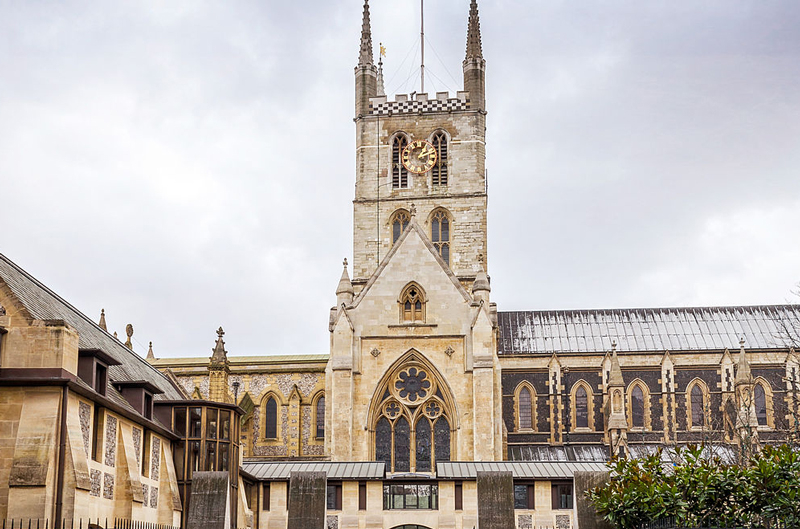
In London, Southwark Cathedral hosted an iftar dinner — a meal after sunset during the month of Ramadan — as part of the program of events to mark the anniversary of the London Bridge attack. (Garry Knight/Wikimedia Commons)
|
In Dalston, east London, religious advisers at the Masjid Ramadan mosque announced that bitcoin, the cryptocurrency, is halal (permissible according to Islamic law) for Ramadan donations if it is "transacted in a lawful manner." The mosque, also known as Shacklewell Lane Mosque, said it would accept donations in two different cryptocurrencies, Bitcoin and Ethereum. Zayd al Khair, a religious adviser at the mosque, said:
"Any money or currency is neither halal, permissible, nor haram, impermissible. Guidance is about the value which it represents. If money is transacted in a lawful manner then it is halal. We do not always know the source of cash donations, but we take these in good faith too."In Kent, the International Glaucoma Association (IGA) warned Muslim glaucoma patients not to stop taking eye drop medication during Ramadan because stopping drops even for a short period of time could cause permanent loss of vision. Some Muslims stopped using their eye drops during Ramadan, believing that using them would break their fast. IGA Development Manager Subhash Suthar advised patients to use caution when using eye drops so that the fluid stays in the eye and does not drain into the throat and thereby violate the fast.
In Keighley, fire chiefs urged Muslims observing Ramadan to be vigilant and guard against fire risks in the home. Chris Kirby, the West Yorkshire brigade's area manager for fire safety, said: "Ramadan is a time of great importance for Muslims but it is also a time during which everyone should be extra vigilant when cooking, especially if they're feeling fatigued by the end of a full day of fasting."
Back in London, Metro, the United Kingdom's highest circulation newspaper, published instructions for Muslims to fail to keep the fast. An article — "How much is Fidya and Kaffarah for Ramadan 2018?" — stated:
"No matter how hard you try while fasting, sometimes life happens. Instead of feeling terrible about this, there are ways to show your dedication instead of simply fasting. Two of these are Fidya and Kaffarah.
"Fidya is a payment to charity if you cannot fast during Ramadan.... You're supposed to pay it before you miss a fast, or before Ramadan if you know you can't participate for the whole month. It's calculated by working out mudd, which is an offering of one meal to someone who can't afford one.
"Two mudd is equal to one Fidya payment. This year, that's been calculated by the Human Relief Foundation at £4, or £120 for the whole of Ramadan. Muslim Aid puts it at £5, or £150 for the whole month. Islam Freedom recommend a £3 payment per day.
"Kaffarah is a similar idea but is payable if you intentionally miss a fast. However, understandably, Kaffarah is a lot more. If you intentionally break fast, you must either pay enough to feed 60 people (60 mudd) or fast for 60 continuous extra days for each day you missed Ramadan as penance. That's £240 at HRF for Kaffarah, so it's certainly better to avoid breaking fast. If you choose to donate to a different charity, it's £300 with Muslim Aid, or £180 with Islam Freedom."
Soeren Kern is a Senior Fellow at the New York-based Gatestone Institute. Follow Soeren Kern on Twitter and Facebook
Follow Middle East and Terrorism on Twitter
Copyright - Original materials copyright (c) by the authors.