Sunday, July 29, 2018

Old Prosecutors Speaking Frankly - Clarice Feldman

​
by Clarice Feldman

Some wise old legal pros discuss the demented antics of Mueller, Comey, and company.

About once a year the Society of Old Prosecutors meets in a private libation spot the name of which I am honor bound not to disclose. We met to discuss the week’s events and, as long as I don’t name the participants, I was given permission to share some of the talk. (Given the mad-dog operations of the Special Counsel some feared that to publicly state their views they’d be subject to midnight FBI raids with their nightgown-garbed wives rousted from bed and felt up by armed agents, or all their assets seized and their private correspondence unrelated to anything handed over to Democratic spinners like Lanny Davis to be megaphoned on CNN.)
Lawyer 1: The President is denying his former lawyer Cohen’s claim that he approved the meeting in Trump Tower. Funny that meeting, isn’t it? I mean, why did Loretta Lynch allow Natasha Veselnitskaya to have a special visa to enter the country and why did Natasha choose as her translator Anatoli Samochornov, who for over a decade was a U.S. State Department Translator?’ I’ve handled far weaker entrapment cases.
Lawyer 2: Funnier yet, the meeting was ostensibly to discuss Russian orphan adoption issues. But even if it had been to hear the dirt Russia had on Hillary, when and why and how would it be unusual or illegal for a campaign to want to hear dirt on a competitor? I mean, get real -- Hillary paid for the Dossier which was confected by an anti-Trump former UK spy whose sources were all Russian. Not since I read Alice in Wonderland as a kid, have I seen such an upside down universe.
Lawyer 3: Now speaking of the Dossier, how much longer will the FISC continue in operation after having rubberstamped over and again widespread spying on a political campaign based on the most idiotic of warrants? I cannot imagine a regular court granting these and FISC was, we were told by most (but not the late Robert Bork) that it would provide greater protections for citizens against unwarranted privacy intrusions.
Lawyer 1: DOJ and the FBI did some audacious tap dancing in those applications, didn’t they? Didn’t tell the Court they were relying on an unverified piece of campaign dirt gathering; didn’t tell the court it didn’t even know who the sources were that the author of the Dossier relied on. Used newspaper articles to justify the warrant! And then didn’t note that the articles were themselves part of Christopher Steele’s propaganda effort for Hillary. I’d have been disbarred had I ever tried such stunts.
Lawyer 2: And that’s not all -- they twisted Carter Page’s history. For three years he acted as an informant and witness for the FBI and they reframed his history to make it seem he was “an agent of a foreign power who knowingly engaged in clandestine intelligence activity that may have involved criminal violations."
We took a short break while we nibbled on some fine cheese with crackers and mango chutney. After the drinks were refreshed and the waiter left, the conversation continued.
Lawyer 4: It’s not only the lies in the warrant applications and the brutish search techniques that fully explain how Stalinist this whole business is. Look at the latest indictments. He indicts some Russian companies thinking they’d never appear and there’d be no trial, One enters an appearance, denied the charges, notes how idiotic the indictment was, as among other things, its names a nonexistent corporation, and demands discovery. He indicts 12 Russian officials knowing he has no jurisdiction over them, they won’t appear and the case will never go to trial and as an extra bit of partisan play tosses into the indictment claim that “an unidentified candidate for U.S. Congress requested and received” dirt from a hack, allegedly by these Russians, from Guccifer to whom they’d given the hacked material.
Lawyer 3: Trey Gowdy has demanded that Sessions hand over all the documentation respecting the identity of this person. I doubt he exists except in the imagination of the prosecution, or his name surely would have been leaked by now. And it’s indisputable that the government has never examined the “hacked” servers and technical experts insist that the speed of downloaded material makes certain it was not removed by a hack, but was an inside job by someone using a thumb drive.
Lawyer1: Don’t forget the spying charge and arrest against Maria Butina.
And we all roared.

We’re in D.C., and know what you might have missed, the Washington Post article about this gal -- who was most certainly no undercover spy -- republished in the Chicago Tribune but pretty much ignored elsewhere. 

He pulled out his copy of the article about the alleged undercover spy and read excerpts aloud to roars of laughter.
“‘Butina’s cellphone case was emblazoned with a famous photograph of Russia President Vladimir Putin riding shirtless on a horse. She would buy friends shots of vodka at Russia House, the Dupont Circle restaurant popular with the Russian diplomatic set, sometimes challenging male friends to down horseradish-infused shots, She bragged to classmates that she had worked for the Russian government.’”
“’In November 2016, just three months after arriving, she hosted a “stars and Tsars”-themes costume party at CafĂ© Deluxe… Butina went as Empress Alexandra, the wife of the last emperor of Russia…’”
Lawyer2: That’s a new definition of “Covert agent” isn’t it? Obviously the crack prosecution thought that because she was working with some gun advocates to help her campaign for a Second Amendment type shift in Russian gun laws, they could wrap the NRA into the Russian collusion ball of wax. I guess the tipoff she was an undercover spy was her attendance at the National Prayer Breakfast.
I piped in my two cents: “Luckily for us, we have defense counsels, civil lawsuits, and congressmen like Nunes to chip away at the DOJ/FBI wall of obfuscation and cover-up. This week, Judge Ungaro ordered GPS Fusion to disclose details of its Dossier work -- how did they create it, conduct the investigation for it, and disseminate the dossier. That case comes about in a lawsuit against left-wing BuzzFeed that falsely reported that Aleksey Gubarev’s viruses and malware infiltrated the DNC networks. The source of the claim was the 17th memo in the Dossier, which made those claims and stated he had been working with Russian intelligence, claims Gubarev vehemently denies.

And then there are the indefatigable guys at Judicial Watch.

The FBI ordered Comey to preserve his records. This week they sought a court order requiring these records be preserved.
Judicial Watch argues that there is reason to be concerned that the responsive records could be lost or destroyed.” Judicial Watch points out that in June 2018, the DOJ’s Inspector General stated, “We identified numerous instances in which Comey used a personal email account (a Gmail account) to conduct FBI business.”
The filing comes in an April 2018 Freedom of Information Act (FOIA) lawsuit filed after the DOJ failed to respond to Judicial Watch’s May 2017 request and DCNF’s February 2018 request (Judicial Watch and The Daily Caller News Foundation v. U.S. Department of Justice (No. 1:18-cv-00967)). The lawsuit is seeking:
  • All records written or ordered written by Comey summarizing his conversations with any of the following individuals: Barack Obama, Joe Biden, Hillary Clinton, Senator Chuck Schumer, Representative Nancy Pelosi, and Senator John McCain.
  • All records that identify and describe all meetings between former FBI Director James Comey and President Barack Obama.
“It is incredible that it took Judicial Watch’s prodding of the FBI for it to ask Mr. Comey to return federal records – over a year after he was fired,” said Judicial Watch President Tom Fitton. “Mr. Comey continues to be protected by the FBI and DOJ. It is outrageous that the agencies oppose a simple preservation order to make sure no Comey records are lost or destroyed.”
It asked the FISC for transcripts of all the hearings before it on the DOJ warrants against Carter Page. If successful, this will further document the corrupt, dishonest way the warrants were obtained. Judicial watch details the reasons for the request:
Last week, in response to a Judicial Watch FOIA lawsuit, the Department of Justice released 412 pages of heavily redacted documents relating to FISA warrants targeting Page. The warrants provide evidence that the FISA court was never told that the key information justifying the requests came from a minimally-corroborated “dossier” that was created by Fusion GPS, a paid agent of the Clinton campaign and Democratic National Committee.
Judicial Watch initially sent a Freedom of Information Act (FOIA) request to the DOJ and then filed suit seeking the FISA transcripts (Judicial Watch v. U.S. Department of Justice (No. 1:18-cv-01050)). In a June 2018 letter, the Justice Department told Judicial Watch it had no Page FISA court hearing transcripts.[snip]
In February, Republicans on the House Intelligence Committee released a memo criticizing the FISA targeting of Carter Page. The memo details how the “minimally corroborated” Clinton-DNC dossier was an essential part of the FBI and DOJ’s applications for surveillance warrants to spy on Page.
On February 7, 2018, House Intelligence Committee Chairman Devin Nunes wrote a letter to Judge Rosemary M. Collyer, the presiding judge at the Foreign Intelligence Surveillance Court (FISC) requesting transcripts of “any relevant FISC hearings associated with the initial FISA application or subsequent renewals related to electronic surveillance of Carter Page.” On February 15, Judge Collyer replied that the FBI and DOJ “possess most, if not all, of the responsive materials the Court might possess, and we have previously made clear to the Department, both formally and informally, that we do not object to any decision by the Executive Branch to release any such FISA materials to Congress.”
The Committee also asked the court to confirm the existence of transcripts of hearings regarding applications for or renewal of FISA warrants related to Page. Judicial Watch points out that Presiding Judge Rosemary M. Collyer did so, stating:
[Y]ou may note that the Department of Justice possesses (or can easily obtain) the same responsive information the Court might possess, and because of separation of powers considerations, is better positioned than the Court to respond quickly. (We have previously made clear to the Department, both formally and informally, that we do not object to any decision by the Executive Branch to convey to Congress any such information.)
In its motion, Judicial Watch points out “to date, no transcripts of hearings regarding applications for or renewal of FISA warrants related to Page have been released to the public.” And, it argues that potential concerns about classified information are likely unwarranted, since the president has declassified the congressional memo, and the FBI has released the FISA warrant applications, application renewals, and court orders related to Page: “Therefore, most -- if not all -- of the information contained in the transcripts likely has been declassified.”
Lawyer 1: No doubt the FBI and DOJ have been working furiously to cover up malfeasance on the part of their former (and perhaps some present) officials and of the flaws in these agencie's procedures. We have to await the next report from the Inspector General to learn more about the misuse of FISA and the skullduggery involved in getting the warrant.
Lawyer 2: “Still nothing from Sessions’ designated U.S. Attorney Huber.”
Lawyer 3: “I think the president will eventually simply declassify the still redacted warrant applications. I think the last three indictments -- of the Russia corporations, the intelligence officials, and the alleged spy -- will not survive much longer.”
I added, "these three seem to be a futile attempt to persuade the public that there’s a reason to continue this farce. There isn’t, of course. It’s been a means of harassing the new administration for the crime of beating Hillary and her Deep State enablers."

At this point the club lights started to flicker and we had to leave, but it’s likely it won’t be our last meeting.

Clarice Feldman

Source: https://www.americanthinker.com/articles/2018/07/old_prosecutors_speaking_frankly.html

Follow Middle East and Terrorism on Twitter

The crown prince's speech - Dr. Mordechai Kedar

​
by Dr. Mordechai Kedar

Something is rotten in the land of Iran and maybe, just maybe, it is beginning to reach the point where people are wiling to sacrifice to replace theocracy with secularism.


The Shah of Iran, Mahmad Reza Pahlevi, was deposed in 1979 and exiled to Egypt with his family where he died one year later. Upon reaching the age of twenty, the late Shah's son Reza Pahlevi II was crowned in his stead by those loyal to the monarchy, but the fact that the young prince was in exile robbed the move of any practical significance.

Reza II is now 58 years of age, sufficiently experienced, still comparatively young and with a long period of active life ahead of him. He is seen by many within Iran and outside of it as the natural heir to the ayatollah regime once it collapses  -  if he so desires. True, a good many Iranians remember the cruel and dictatorial nature of the Shah's regime, but since the rule of the ayatollahs is infinitely worse, there are a good many Iranians pining over rose-colored memories of that former period. They see Reza as the only person capable of finding a common denominator that can convince most of the opposition to rally together and begin a rebellion to attempt, and hopefully succeed, in ridding the country of suffocating theocratic rule.

Mahmoud Al Udi, a journalist at the Elaph website, the daily Arabic independent online newspaper, spoke to Reza recently and published a four part interview with him.  The entire interview will be brought below, in installments, along with readers' comments and my remarks (the latter in parentheses, MK).

Headline: 

Reza Pahlevi:  'The Iranian people's famished stomachs will do away with the Iranian regime.'  The crown prince posits that only secularism can save Iran from political disintegration.

 By Mahmoud Al-Udi

(Paris). In the course of an interview for Elaph with Crown Prince Reza Pahlevi II, the eldest son of the former Shah, he spoke about many issues that touch upon the deteriorating situation in Iran, calling the situation one of unprecedented deterioration in every sphere. This has nothing to do with internal deterioration regarding freedom, economics etc., but to the way Iran's internal collapse will deleteriously affect the entire region.

In the first part of  the interview in Paris, Pahlevi opened various issues, leading with his absolute faith that secularism is  the only solution that can preserve religious liberty for all Iranians as well as ensure that religion is not used for political purposes. Taking advantage of religion is the basis for the present regime's existence and the means by which its administration continues to lead the country and its regional environment to wrack and ruin. 

Elaph reporter:  Did you support the former Iranian President Mahmoud Khatami's declaration several days ago when he said that Iran has regressed at least a century in terms of democracy and justice?

Crown Prince Reza Pahlevi: "I think the consequences of the way the current regime thinks and acts are much more dangerous. Most dangerous of all is that this regime is bringing Iran and its surroundings to ruination, and I want to stress that the severity of the situation is way beyond administrative failure or corruption.  

"The entire infrastructure is being destroyed. In the past, we were a model of successful pluralism, with multiple ethnic groups and a large variety of religions and sects, all living in a palpable peace and social harmony, but the Shiite ethnic ideology that today's regime is based on is a source of the inner deterioration is exported to neighboring countries like Saudi Arabia and the Persian Gulf states. The Sunni-Shiite conflicts, replete with the most terrible ideas, began from there.  In the past, we did not live in this kind of atmosphere, we did not experience the ethnic disagreements we see today. 

"This regime wants to make being secular a sin. We want the separation of church and state to prevail, because secular society does not accept sectarian thinking and we see that as a deliverance.

Elaph: You say that secularism is the solution. Can you explain that more clearly?

Prince:  "Yes, it is the solution because Iran can have ethnic and religious pluralism for its many distinct communities. We are in need of an ideology that ensures the population's ability to live together no matter what sect or religion each person belongs to. This is nothing new, Iran once had an atmosphere of equality, democracy and liberty. We want to see the French model in Iran, for example, because that is the best example of coexistence: Muslims, Christians and Jews live together under one flag in one homeland."

Elaph:  What happened as Iran went progressively from being a model of living together to its present state?

Prince; "The value system based on equality and coextistence existed in Iran until the revolution led by the mullahs, who brought in sectarianism and ignorance, and now we are very close to pre-Renaissance Europe, when religious leaders made the decisions, constituted the government and held all  the power in their hands. 

"If a poll of Iranians were to take place, the results would show that the people want freedom and  equality, dream of a constitution that promises them these values and realizes the aspirations of Iranian youth. We have large numbers of young adults who do not agree with and cannot bear to continue to live under the present regime."

The crown prince remembers an important event in which Khomeini and other Arab leaders, headed by the late Egyptian President Anwar al Sadat and the late King Hassan II of Morocco participated and says: "Khomeini claimed that he and his regime represent the authentic Islam, but President Sadat and  King  Hassan II retorted: 'Do you think we are not real Muslims? And if you, Khomeini, represent the side that is correct and authentic Islam, whom do we represent?'"

Elaph: Why do you think secularism is definitely on the way? Is it really just a matter of time?

Prince: "The Iranian regime believes that secularism is opposed to Islam, without understanding that it is not opposed to religion per se, it simply ensures freedom. I ask Khatami as a religious man: 'You are familiar with the 12 Imams (who led the Shiites from the 7-9th centuries). Why were just two of them rulers? Do you want to rule in the name of the Islamic revolution or in the name of Shia Islam?'

"Khatami's declaration is a veiled admission that the regime is based on an error, that now we are facing an admission of the failure of coexistence. I think that very soon we will be able to implement the separation of religion and  state, so that the populace is freed from suppression. From my viewpoint, the public has reached a high level of development and involvement so that it is only a matter of time (until we achieve a secular government). This is directly connected to Iranian culture, a culture with good reasons for national pride."

Summing up, Crown  Prince Reza Pahlevi II adds: "At the end of the day, when your stomach is empty, there is a dearth of products to purchase and a pervasive feeling that there is no real change on the horizon,  the people weep for liberty and know full well that there are conditions for ensuring liberty. I have full confidence that  Iranian citizens will accept responsibility for guarding these limitations. If  you look at Iran, you will  discover that it can progress because of its human and natural resources as well as the multi-faceted talents of its people. Yes, there is a certain amount of readiness, but we must not remain as we are now. The present situation frustrates the Iranian people and our neighbors are surely influenced by the level of this frustration in our country.(End of part I)

Readers' comments:

"An Iraqi who hates traitors" writes under the heading  "The contented Middle East," as follows:
"The people of the Middle East brought the world all kinds of cultures, all the monotheistic) religions were born in this region. In addition to this historic background, the area has vast natural deposits (of oil and  gas) that were meant to change the entire Middle East population into the richest in the entire world. Since that is so, whence all the poverty, backwardness, destruction and that accursed hatred that sets each of our countries on fire one after another?  Hasn't the time come for all the sane people who live in these states to get together, call themselves the "Association of Middle Eastern States" and begin a grassroots initiative, not an official  one, that brings about a meeting of all the sane people, far from the religious, ethnic and sectarian consciousness – and concentrates on man, on how to guard his honor, on how to provide him with a decent living, on how to spread love, peace and cooperation for the good of all the nations of the Middle East."

Another reader greets the first reader's words sarcastivally: "...Far from the religious, ethnic and sectarian consciousness,?.. Are  the Arabs  capable of living with others? The massacres of Christians in 1933, of Jews in 1948, of Shiites against Kurds just a few months ago and the terrible blow to Kurdish honor in Kirkuk…?"

(to be continued) 

Translated from Hebrew by Rochel Sylvetsky


Dr. Mordechai Kedar is a senior lecturer in the Department of Arabic at Bar-Ilan University. He served in IDF Military Intelligence for 25 years, specializing in Arab political discourse, Arab mass media, Islamic groups and the Syrian domestic arena. Thoroughly familiar with Arab media in real time, he is frequently interviewed on the various news programs in Israel.

Source: http://www.israelnationalnews.com/Articles/Article.aspx/22528

Follow Middle East and Terrorism on Twitter

As US pushes for Mideast peace, Saudi king reassures allies - Reuters

​
by Reuters

With Trump's peace push still in the dark, senior diplomat in Riyadh says US made a mistake in thinking 'one country could pressure the rest to give in ... No Arab leader can concede on Jerusalem or Palestine.'

Saudi Arabia has reassured Arab allies it will not endorse any Middle East peace plan that fails to address Jerusalem's status or refugees' right of return, easing their concerns that the kingdom might back a nascent US deal which aligns with Israel on key issues.

King Salman's private guarantees to Palestinian Authority President Mahmoud Abbas and his public defense of long-standing Arab positions in recent months have helped reverse perceptions that Saudi Arabia's stance was changing under his powerful young son, Crown Prince Mohammed bin Salman, diplomats and analysts said.


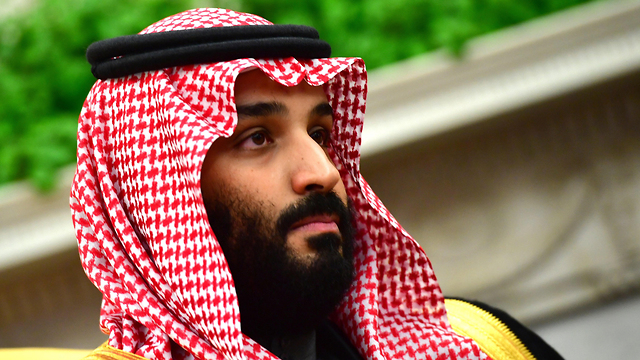
Crown Prince Mohammed bin Salman with President Trump (Photo: Reuters)

This in turn has called into question whether Saudi Arabia, birthplace of Islam and site of its holiest shrines, can rally Arab support for a new push to end the Israeli-Palestinian dispute, with an eye to closing ranks against mutual enemy Iran.

"In Saudi Arabia, the king is the one who decides on this issue now, not the crown prince," said a senior Arab diplomat in Riyadh. "The US mistake was they thought one country could pressure the rest to give in, but it's not about pressure. No Arab leader can concede on Jerusalem or Palestine."
Palestinian officials said in December that Prince Mohammed, known as MbS, had pressed Abbas to support the US plan despite concerns it offered the Palestinians limited self-government inside disconnected patches of the West Bank, with no right of return for refugees displaced by the Arab-Israeli wars of 1948 and 1967.
Such a plan would diverge from the Arab Peace Initiative drawn up by Saudi Arabia in 2002 in which Arab nations offered Israel normal ties in return for a statehood deal with the Palestinians and full Israeli withdrawal from territory captured in the 1967 Six-Day War.
Saudi officials have denied any difference between King Salman, who has vocally supported that initiative, and MbS, who has shaken up long-held policies on many issues and told a US magazine in April that Israelis are entitled to live peacefully on their own land - a rare statement for an Arab leader.
The Palestinian ambassador to Riyadh, Basem Al-Agha, said that King Salman had expressed support for Palestinians in a recent meeting with Abbas, saying: "We will not abandon you ... We accept what you accept and we reject what you reject."
He said that King Salman naming the 2018 Arab League conference "The Jerusalem Summit" and announcing $200 million in aid for Palestinians were messages that Jerusalem and refugees were back on the table.
The Saudi authorities did not respond to a request for comment on the current status of diplomatic efforts.

Red lines 

Diplomats in the region say Washington's current thinking, conveyed during a tour last month by top White House officials, does not include Arab east Jerusalem as the capital of a Palestinian state, a right of return for refugees or a freeze of Israeli settlements in lands claimed by the Palestinians.
Senior adviser Jared Kushner, President Donald Trump's son-in-law, has not provided concrete details of the US strategy more than 18 months after he was tasked with forging peace.
A diplomat in Riyadh briefed on Kushner's latest visit to the kingdom said King Salman and MbS had seen him together: "MbS did the talking while the king was in the background."
Independent analyst Neil Partrick said King Salman appears to have reined in MbS' "politically reckless approach" because of Jerusalem's importance to Muslims.
"So MbS won't oppose Kushner's 'deal', but neither will he, any longer, do much to encourage its one-sided political simplicities," said Partrick, lead contributor and editor of "Saudi Arabian Foreign Policy: Conflict and Cooperation".
Kushner and fellow negotiator Jason Greenblatt have not presented a comprehensive proposal but rather disjointed elements, which one diplomat said "crossed too many red lines".
Instead, they heavily focused on the idea of setting up an economic zone in Egypt's Sinai Peninsula with the adjacent Gaza Strip possibly coming under the control of Cairo, which Arab diplomats described as unacceptable.

 (Photo: EPA)
(Photo: EPA)

In Qatar, Kushner asked Emir Sheikh Tamim bin Hamad al-Thani to pressure the Islamist group Hamas to cede control of Gaza in return for development aid, the diplomats said.
One diplomat briefed on the meeting said Sheikh Tamim just nodded silently. It was unclear if that signalled an agreement or whether Qatar was offered anything in return.
"The problem is there is no cohesive plan presented to all countries," said the senior Arab diplomat in Riyadh. "Nobody sees what everyone else is being offered."
Kushner, a 37-year-old real estate developer with little experience of international diplomacy or political negotiation, visited Jordan, Saudi Arabia, Qatar, Egypt and Israel in June. He did not meet Abbas, who has refused to see Trump's team after the US embassy was moved to Jerusalem.
In an interview at the end of his trip, Kushner said Washington would announce its Middle East peace plan soon, and press on with or without Abbas. Yet there has been little to suggest any significant progress towards ending the decades-old conflict, which Trump has said would be "the ultimate deal".
"There is no new push. Nothing Kushner presented is acceptable to any of the Arab countries," the Arab diplomat said. "He thinks he is 'I Dream of Genie' with a magic wand to make a new solution to the problem."
A White House official told reporters last week that Trump's envoys were working on the most detailed set of proposals to date for the long-awaited peace proposal, which would include what the administration is calling a robust economic plan, though there is thus far no release date.


Reuters

Source: https://www.ynetnews.com/articles/0,7340,L-5319007,00.html

Follow Middle East and Terrorism on Twitter
Regavim's new discreet cooperative initiative with Negev Bedouin - Mordechai Sones

​
by Mordechai Sones

Arab and Bedouin suffering gun violations but afraid to lodge police complaint get discreet hotline to complain and receive legal counsel.

See video of uncontrolled drive-by shooting here.


The problem of illegal guns in the Arab sector reaches the news every so often, bringing with it a new wave of discussion, criticism, and the usual hand-wringing. Unfortunately, it usually ends there; no one seems to have found a way to deal with the problem systematically.

The most recent round was brought on by a series of videos that innocent bystanders posted on social media, capturing masked gunmen shooting automatic weapons from vehicles speeding through Beer Sheva's Ohalim Junction and in residential areas in Segev Shalom and Rahat. The videos went viral, and the entire country was, once again, talking about the problem.

Almost immediately, a Rahat resident sent an uncensored version of one of the videos to Regavim's Facebook Messenger inbox. In this video, the license plate numbers of the vehicles involved in the shooting spree were plainly visible, and the frightened citizen who shared the footage asked for Regavim's help to file an official complaint with the police.


Regavim's Hot-shot hotline
Regavim
Residents of Israel's Arab and Bedouin communities live under the shadow of the free-for-all of illegal firearms and random shooting in the streets of their towns, committed by local criminals. Although the innocent, law-abiding residents have been suffering this reality for years, they do not file complaints with the authorities for fear of reprisals.

Regavim stepped up to meet the challenge, creating a unique, discreet, Arabic-language system for citizens wishing to file complaints. The Regavim "Hot-Shot Hotline," as they have begun to call it, is a protected message system that runs through a unique Hebrew-Arabic Facebook page, allowing anyone with first-hand information or direct involvement in shooting incidents to submit an official police complaint through Regavim's legal team.

"The lack of law enforcement in the Arab sector is a serious and painful problem whose victims are members of the Arab sector themselves, but Arab MKs have chosen, time and time again, to pass the blame and point accusative fingers at the Israel Police and the State of Israel itself," said Regavim's spokesman.

"The Arab public's representatives must take a real leadership role, and not simply pay lip service or play their usual blame game. Decisive action is required; they must take responsibility for their own community. Regavim will provide free legal counsel to anyone who is interested in submitting a discreet complaint to the Israel Police."


Mordechai Sones

Source: http://www.israelnationalnews.com/News/News.aspx/249685

Follow Middle East and Terrorism on Twitter

New campaign: 'The goal of the NIF - to harm religious Zionism' - Hezki Baruch

​
by Hezki Baruch


New campaign by Chotam organization launches today, presenting proofs that NIF is targeting various arms of religious Zionism.


The Chotam organization, which fights for Jewish values in the Israeli public arena, is launching a new campaign aimed at exposing the concerted effort of the New Israel Fund (NIF), through the many organizations it supports, to harm religious Zionism and its various branches.

The initiators of the campaign note that the NIF is taking action against the Jewish Home party, as well as against the flagship institutions of religious Zionism, such as the "Bnei David" institutions in Eli, against which “The Secular Forum” started a campaign calling for the end of the government's financial support for the institutions.

As a result, Chotam decided to embark on a public campaign to shed light on the attempts to undermine religious Zionism.


"The NIF has set itself the goal of eliminating the pillars of religious Zionism, and we must put an end to this once and for all. The time has come for us to wake up and present the truth and the entire spectrum of the fund's activities against the national religious public. We must take care that the NIF and its various organizations do not destroy the blessed activity over the years of religious Zionist institutions.”

As part of the campaign, the organization produced a booklet detailing how the NIF operates in an organized manner against religious Zionism and its representatives.


Hezki Baruch

Source: http://www.israelnationalnews.com/News/News.aspx/249684

Follow Middle East and Terrorism on Twitter

Lockheed Martin’s Compact Fusion Reactor - Lt. Col. (res.) Dr. Raphael Ofek

​
by Lt. Col. (res.) Dr. Raphael Ofek

If Lockheed Martin’s hopes are realized, the fear of global energy scarcity will become a thing of the past, and mankind will have the benefit of an environment unsullied by energy pollution.


BESA Center Perspectives Paper No. 909, July 29, 2018

EXECUTIVE SUMMARY: Lockheed Martin recently registered a patent on a revolutionary design of a Compact Fusion Reactor (CFR), a mobile device small enough to be mounted on a truck. One version is designed to produce 100 megawatts, enough to power a city of 100,000 people. The CFR, which provides clean energy without producing radioactive waste, has both civil and military applications. In principle, it can be installed on large aircraft carriers, submarines, large transport planes, and probably also fighter jets and large drones. If Lockheed Martin’s hopes are realized, the fear of global energy scarcity will become a thing of the past, and mankind will have the benefit of an environment unsullied by energy pollution. 

On February 15, Lockheed Martin, the American advanced technologies consortium, obtained a patent on a revolutionary design for a Compact Fusion Reactor (CFR), a mobile device that can be mounted on trucks as well as aircrafts and ships.

Development of the CFR started in 2010 in Palmdale, California. Apparently the project is advancing faster than expected, since at that time, Dr. Thomas McGuire, the project’s head, declared that the goal was to have a working device in five years and a commercial production reactor design within ten.

Two CFR prototypes were introduced by Lockheed Martin on December 25, 2017. The first is the T4B, which is two meters long, one meter in diameter, and about 20 tons in weight. The T4B can produce one megawatt of energy. The second prototype, the TX, is 18 meters long, seven meters in diameter, and about 2,000 tons in weight. The TX can produce 200 megawatts of energy. However, Lockheed Martin believes the TX’s weight can be reduced to 200 tons.

Fusion is a thermonuclear process in which the nuclei of hydrogen atoms join together and release a vast quantity of energy. The sun is essentially a very powerful thermonuclear reactor in which fusion reactions occur due to extremely high temperature and pressure conditions induced on the hydrogen nuclei – conditions that overcome electrostatic repulsion between the protons inside those nuclei.

On earth, artificial fusion is possible only between deuterium and tritium, the heavier isotopes of hydrogen (D-T fusion). Deuterium, whose nucleus contains one proton and one neutron, is quite abundant on earth – it is found in one out of every 6,700 hydrogen atoms in water, and is radioactively stable. However, tritium, whose nucleus contains one proton and two neutrons, is radioactive, with a half-life of 12.3 years. There is no natural tritium to be found on earth, but it can be produced by irradiating lithium with neutrons (tritium breeding).

Mankind succeeded in harnessing nuclear fusion for destructive purposes when it developed a thermonuclear weapon, also called a hydrogen bomb. Hydrogen bombs can be hundreds or even thousands of times more powerful than nuclear fission bombs like those dropped on Japan in WWII, since the energy released by fusion is infinitely more vast than in fission of heavy nuclei like uranium and plutonium.

In addition to the scale of power released by fusion, this process has advantages over fission as a source of energy production. First, it is easy to distill deuterium from the inexhaustible amount of seawater – unlike the uranium needed for fission, which is less abundant and the extraction of which is complex. Also, lithium metal is relatively abundant in earth and in seawater. Lastly, helium, which is produced during fusion, is not radioactive, in contrast to the radioactive waste produced during nuclear fission. Nuclear waste has a long lifespan and requires special operations for its management, disposal, and burial.

There was a swift transition from the use of nuclear fission to produce devastating weapons during WWII to its use for civilian applications. In the first half of the 1950s, nuclear fission was being used in electrical reactors. However, the shift from military to civilian use was much slower for fusion. Though the first test of an explosive thermonuclear device by the US was conducted on November 1, 1952, the effort to harness fusion for development of an electricity-producing thermonuclear reactor has not borne fruit – until now.

This was not for lack of trying. For years, billions were invested around the world in studies attempting to enable the controlled release of thermonuclear energy. The motivation to implement nuclear fusion in electricity production stemmed not only from the tremendous amount of energy that can be produced in the fusion process, but also from the fact that that energy would be clean, without any of the by-products of long-lived radioactive waste.

This field started in the 1950s with Soviet physicists Igor Tamm and Andrei Sakharov, who invented a toroidal-shaped thermonuclear device called the Tokamak. The device is a three-dimensional concentric ring containing very hot plasma of deuterium and tritium nuclei confined by powerful magnetic fields. The first Tokamak became operational in 1958, but it has not yet matured to technological and commercial feasibility.

The prototypes of commercial Tokamak reactors developed in the Western world, particularly in the US, either produced less energy than they needed to heat the plasma to the desired temperature, or suffered from instability problems. They have all failed to live up to expectations despite huge investments. The JET (Joint European Torus), built in Britain, cost half a billion dollars  through the end of 2014. The TFTR (Tokamak Fusion Test Reactor), built in the US, cost an unknown number of billions of dollars. The ITER (International Thermonuclear Experimental Reactor), built in France, is expected to go into operation in 2025. The cost of the ITER is estimated at $22-50 billion. Through June 2015, $14 billion had been invested in it.

In addition to the Tokamak, there were designs based on other processes to harness fusion for producing electricity, but they too were unsuccessful. In the 1980s, an Israeli company investigated the possibility of establishing a fusion reactor in the Negev to generate electricity, but the project was not feasible. (Readers interested in fusion reactors are welcome to read the author’s doctoral dissertation, “Interactions of D-T neutrons in graphite and lithium blankets of fusion reactors: measurements and calculations”, Ben-Gurion University of the Negev, May 1986.)

Following registration of the CFR patent by Lockheed Martin, Dr. McGuire was interviewed on “The War Zone” website. He explained that the toroidal geometry implemented in a Tokamak device limits the intensity of the magnetic pressure that can be applied to D-T plasma. The analogy would be bicycle tires that burst when overinflated. Lockheed Martin’s breakthrough stems from its device’s much more complicated geometry. It consists of a plasma cell and superconducting magnetic fields applied to the plasma, which enables a very high process efficiency. As McGuire put it, “Instead of a bike tire expanding into the air, we have something more like a tube that expands into an ever-stronger wall.” He added that the system is regulated by a self-tuning feedback mechanism whereby the farther out the plasma goes, the stronger the magnetic field pushes back to contain it.

As of yet, there is no published information on the economic aspects of the CFR: the amount Lockheed Martin invested in the project, the assessed price of the different CFR models, or their operating costs. However, based on the information the company has released, it seems the amounts are quite low.

Furthermore, according to the released information, Lockheed Martin’s reactor concept is supposed to be multipurpose, with many civil applications:
  • a 100 MW CFR, which can be installed onto a truck, can provide electricity to a town with a population of 80,000-100,000. Lockheed Martin estimates that it would require approximately 12 kg of D-T fuel to refuel the reactor for a year;
  • the CFR could provide energy in unlimited quantities and at low cost to remote areas of developing countries;
  • the CFR could be used in seawater desalination and water purification at reduced rates. The company estimates that desalination costs would be reduced by 60%;
  • the CFR could be installed on ships, which would allow them to sail across the seas to unrestricted ranges;
  • the CFR could be installed on civilian or military transport aircrafts such as the C-5 Galaxy of the US Air Force, which would allow unlimited range and incomparable durability using hydrogen fuel in the amount of only a few bottles a year; and
  • it can accelerate the development of space flights to great distances.
Moreover, according to the published information, the CFR may have significant military applications:
  • the CFR’s installation on submarines can enable them to cruise far below sea level. The CFR’s dimensions and weight will be significantly lower than those of the enriched uranium-fueled reactors installed on today’s nuclear submarines. It would thus reduce the risk of exposure to nuclear radiation on those submarines;
  • it will be possible to power a Nimitz-class aircraft carrier with a 100 MW CFR to lengthen its stay at sea;
  • as mentioned, equipping military transport aircraft with CFR would allow them to stay in the air much longer and fly much farther. It would thus enable the quick moving of military forces to areas of tension throughout the world;
  • Lockheed Martin is considering, among other things, installing CFRs on fighter jets. This would mean that shoot-downs or accidents would not result in any exposure to nuclear radiation; and
  • it will be possible to put a CFR on a drone to enable it to stay aloft and patrol indefinitely.
If Lockheed Martin’s hopes about its CFR are realized, the fear of catastrophic global energy depletion will become a thing of the past, and mankind will enjoy an environment without energy pollution.


BESA Center Perspectives Papers are published through the generosity of the Greg Rosshandler Family


Lt. Col. (res.) Dr. Raphael Ofek, a BESA Center Research Associate, is an expert in the field of nuclear physics and technology who served as a senior analyst in the Israeli intelligence community.

Source: https://besacenter.org/perspectives-papers/lockheed-martins-compact-fusion-reactor/

Follow Middle East and Terrorism on Twitter

Germany: Rise of the Salafists - Soeren Kern

​
by Soeren Kern

In addition to the Salafists and Millî Görüş, BfV estimates that Germany is now home to 1,040 members of the Muslim Brotherhood, 950 members of Hezbollah and 320 members of Hamas.

  • "Salafists see themselves as defenders of an original, unadulterated Islam.... As a consequence, Salafists want to establish a 'theocracy' according to their interpretation of the rules of sharia, one in which the liberal democratic order no longer applies." — Annual Report of Germany's Federal Office for the Protection of the Constitution (BfV).
  • "Under the guise of humanitarian aid, Islamists succeed in radicalizing migrants. In the past, Salafists in particular tried to reach out to migrants. They visited refugee shelters for this purpose and offered assistance. The target group was not only adult migrants, but also unaccompanied adolescents, who, due to their situation and age, are particularly susceptible to Salafist missionary activities." — Annual Report of Germany's Federal Office for the Protection of the Constitution (BfV).
  • The BfV report makes a direct link between the increase in anti-Semitism in Germany and the rise of Islamist movements in the country: "The 'enemy image of Judaism' therefore forms a central pillar in the propaganda of all Islamist groups.... This poses a significant challenge to the peaceful and tolerant coexistence in Germany."
The number of Salafists in Germany has doubled over the last five years and now exceeds 10,000 for the first time, according to Germany's BfV domestic intelligence agency. BfV estimates that Germany is home to more than 25,000 Islamists, nearly 2,000 of whom pose an immediate threat of attack.
The new figures are included the latest annual report of the Federal Office for the Protection of the Constitution (Bundesamt fĂĽr Verfassungsschutz, BfV), and presented by Interior Minister Horst Seehofer and BfV President Hans-Georg MaaĂźen in Berlin on July 24.

The report, considered the most important indicator of internal security in Germany, draws a bleak picture. The BfV estimates that the number of Islamists in Germany increased to at least 25,810 by the end of 2017, up from 24,425 in 2016.

Strangely, the report does not provide any estimates for the number of followers of the Islamic State or al-Qaeda living in Germany. As a result, the actual number of Islamists in Germany is undoubtedly higher than 25,810.

According to the report, Salafists comprise the single largest Islamist group in Germany. The number of Salafists in Germany jumped to 10,800 in 2017, up from 9,700 in 2016; 8,350 in 2015; 7,000 in 2014; 5,500 in 2013 and 4,500 in 2012.
The BfV report states:
"Salafists see themselves as defenders of an original, unadulterated Islam. They model their religious practice and lifestyle exclusively on the principles of the Koran, the Prophet Mohammed and the first three Muslim generations, the so-called righteous ancestors (Al-Salaf al-Salih in Arabic). As a consequence, Salafists want to establish a 'theocracy' according to their interpretation of the rules of sharia, one in which the liberal democratic order no longer applies.
"Political and jihadi Salafists share the same basic ideology. They differ primarily in the means by which they wish to achieve their objective, the 'Salafist theocracy.' Political Salafists spread their Islamist ideology through intensive propaganda activities — which they describe as 'missionary work' (Dawa) — to transform society, through a long-term process, according to Salafist norms.
"Many political Salafists position themselves as being against terrorism. They emphasize the peaceful nature of Islam and reject open calls for violence. Nevertheless, it should be noted that political Salafism has an ambivalent relationship to violence because in principle it does not exclude religiously inspired violence as a means to achieve its goals.
"In their interpretations of Islam, political Salafists make selective use of the classical works of the Islamic legal literature, which affirms a strong affinity to violence when dealing with non-Muslims. Salafists believe that the universal claim of Islam, due to its superiority as the divine plan of salvation for all of humanity, must be imposed by force if necessary. Therefore, the fundamental affirmation of violence is an intrinsic part of Salafist ideology.
"The two Salafist currents have different but easy-to-bridge views on under which prerequisites violence may be used. This explains why the transition from political to jihadist Salafism is fluid."
The BfV report states that Salafists are focusing their proselytizing and recruiting efforts on migrants seeking refuge in Germany:
"Under the guise of humanitarian aid, Islamists succeed in radicalizing migrants. In the past, Salafists in particular tried to reach out to migrants. They visited refugee shelters for this purpose and offered assistance. The target group was not only adult migrants, but also unaccompanied adolescents, who, due to their situation and age are particularly susceptible to Salafist missionary activities.
"The diverse propaganda activities of Salafists, which they play down as 'proselytizing' or 'inviting people to Islam' — it is in truth a systematic indoctrination and often also the beginning of radicalization — are successful: Salafism is the fastest growing Islamist trend in Germany.
"The Salafist scene represents the essential recruitment field for Jihad. Almost without exception, all persons with a German connection who have joined the jihad were previously in contact with the Salafist scene."
According to BfV, the growth of Germany's Salafist movement is being fueled in part by migrants from Chechnya:
"Within the Salafist scene in Germany, actors of North Caucasian origin — especially from the Russian Republic of Chechnya — have gained importance. Particularly affected are federal states in Eastern and Northern Germany, as well as North Rhine-Westphalia.
"The North Caucasus Islamist scene is characterized by sprawling, Europe-wide networks and characteristics. It is largely sealed-off to the outside. A critical factor for radicalization is the personal contact spectrum, which connects elements from the religion and the traditional clan structure. The North Caucasus Islamist has established contacts with Middle Eastern jihadi groups due to the 'successes' of the North Caucasus fighters in Syria or Iraq."
The BfV report makes a direct link between the increase in anti-Semitism in Germany and the rise of Islamist movements in the country:
"Islamist propaganda often combines religious, territorial and/or national-political motives with an anti-Semitic worldview. The 'enemy image of Judaism' therefore forms a central pillar in the propaganda of all Islamist groups....
"The BfV recorded a large number of anti-Semitic incidents in 2017. The spectrum of incidents ranged from anti-Israeli banners at public events and anti-Semitic sermons to anti-Semitic posts on social media and verbal or physical attacks against individual Jews.
"The BfV has found that all the Islamist groups active in Germany spread and nurture anti-Semitic ideas. This poses a significant challenge to the peaceful and tolerant coexistence in Germany."
According to BfV, the second-largest Islamist movement in Germany is Millî Görüş (Turkish for "National Vision"), which has around 10,000 members in the country. The movement is strongly opposed to Muslim integration into European society:
"The movement believes that a 'just' political order is one founded on 'divine revelation' while those systems designed by humans are 'vain.' At present, the 'vain' Western civilization dominates, based on violence, injustice and exploitation of the weak. This 'vain' system must be replaced by a 'just order,' based exclusively on Islamic principles, rather than man-made ones and thus 'arbitrary rules.' All Muslims should contribute to the realization of the 'just order.' To do this, Muslims must adopt a certain vision (Görüş) of the world, namely a national/religious ('Milli') vision, a 'Millî Görüş.'"
In addition to the Salafists and Millî Görüş, BfV estimates that Germany is now home to 1,040 members of the Muslim Brotherhood, 950 members of Hezbollah and 320 members of Hamas.

After presenting the BfV report Interior Minister Horst Seehofer demanded that the government speed-up deportations of Islamists. "We do not have anything under control in any area," he concluded.


Pictured: Thousands of people listen as Salafist preacher Pierre Vogel speaks during a gathering of sympathizers on July 9, 2011 in Hamburg, Germany. (Photo by Christian Augustin/Getty Images)


Soeren Kern is a Senior Fellow at the New York-based Gatestone Institute. Follow Soeren Kern on Twitter and Facebook
 
Source: https://www.gatestoneinstitute.org/12773/germany-salafists

Follow Middle East and Terrorism on Twitter

Israel intercepts ship trying to break Gaza blockade - AP

​
by AP

The IDF intercepts a flotilla with 22 activists on board that was headed to Gaza with an intention to break the naval blockade on the strip; The activists, some of which are Israeli, said the vessel was hijacked; IDF 'Incident passed without exceptional events.'

Israel's military says it has intercepted a ship carrying activists en route to Gaza aiming to violate the legal naval blockade on the coastal territory. 

The IDF Spokesperson's Unit said the ship had been monitored and was detained according to the international law.
"The IDF forces clarified to the activists on the ship that they are violating the legal naval blockade and that any humanitarian equipment can be transferred to Gaza through Ashdod Port," the statement read.

Freedom Flotilla
Freedom Flotilla 

The incident incident passed "without exceptional events" and the ship was taken to the Port of Ashdod.
The Freedom Flotilla Coalition, an umbrella group comprising pro-Palestinian and Islamic charities from around the world, said on Twitter that Israel had "hijacked" the vessel.


  It said there were 22 activists from 14 countries, mainly from Europe but also Malaysia, the US and Israel, carrying 100 boxes of medical aid for Gaza, on board of the Al Awda ship, which is only a few days ahead of another boat also making its way to the strip in an effort to break the blockade.
Israel and Egypt imposed a blockade on Gaza after the Islamic militant group Hamas took over the territory in 2007.

  Israel says it is crucial to prevent Hamas, a group sworn to Israel's destruction, from arming. Critics say it is collective punishment of Gaza's 2 million people.
There have been several attempts to sail to Gaza in recent years, most notably in 2010 when nine Turkish nationals died during a violent confrontation with Israeli naval commandos.

Yoav Zitun contributed to this report.


AP

Source: https://www.ynetnews.com/articles/0,7340,L-5319047,00.html

Follow Middle East and Terrorism on Twitter

Trump unimpressed by Iran's threats - Prof. Eyal Zisser

​
by Prof. Eyal Zisser

Not only have they failed to deter the American president, they have steeled his resolve to restore Iran to its natural size and place – on the margins of Middle East influence.

The world is long since accustomed to the ugly voices of violence and hate emanating daily and nightly from Tehran. Incited mobs chant "Death to America" and "Death to Israel" in city squares, while Iran's leaders promise to destroy Tel Aviv and wipe Israel off the map.

It's possible, of course, to ignore these voices or diminish their importance. The international community has done so for years, hoping the Iranians would moderate their rhetoric and perhaps even change their behavior. It has never happened. Quite the opposite; the Iranians expanded the scope of their subversive activities across the Middle East – from Iraq, Syria, Lebanon and Gaza to the Persian Gulf and Yemen.

The Iranians were fortunate until Donald Trump was elected president of the United States. This unconventional president chose to respond to the Iranians in kind – not just with warnings but effective, painful action. His withdrawal from the nuclear deal and the economic sanctions he re-imposed on Iran pushed it into a corner, threatening to eliminate its oil exports and cripple its sputtering economy. More importantly, Trump's initiatives have, for the first time, frightened the Iranians into thinking he could go further than any previous president and work to overthrow the ayatollah regime.

The Iranians responded – as usual – with a barrage of denigration and threats. The first to hurl threats was Iranian President Hassan Rouhani, widely considered the moderate voice in Iran. He warned that Iran would act to curb oil exports from neighboring Gulf States, chief among them Saudi Arabia, and even told Trump that war with Iran would be the "mother of all wars." Trump, however, is not Barack Obama. Rouhani's threats were swiftly met with a decisive response: "Never, ever threaten the United States again, or suffer consequences the likes of which few throughout history have ever suffered before. … Be cautious!"

Joining the chorus of intimidation was Maj. Gen. Qassem Soleimani, commander of the Revolutionary Guards Corps' elite Quds Force, which implements Iran's terrorist activity and subversion across the region. Soleimani told Trump: "We are a nation of martyrdom and we await you. We are near you, where you can't even imagine. … Come. We are ready. … If you begin the war, we will end the war. You know that this war will destroy all that you possess."

One can't help be reminded of former Iraqi dictator Saddam Hussein, who on the eve of his downfall vowed to unleash the "mother of all wars" on Washington if it attacked him. Or Hamas leader Ahmed Yassin, who before his assassination boasted that he and his people love death and desire it. Yassin died while trying to flee the missile speeding toward him. Saddam, meanwhile, along with his regime and military, vanished the moment the U.S. decided to go to war against him.

Iran purports to be a regional power but is ultimately a failed country that can neither provide employment nor, more recently, food and water to its people. The ayatollah regime is standing on the precipice of a trembling volcano at home, capable of erupting at a moment's notice. It's no surprise that Iran's leaders are afraid – more than ever – of a conflict with the United States. As usual, they wagered that the world would cow in fear to their threats. Evidently, not only did these threats fail to deter Trump, they steeled his resolve to restore Iran to its natural size and place – on the margins of Middle East influence.

It isn't difficult to find fair criticism of U.S. policy in the Middle East. The Americans lack a fundamental understanding of the region and tend to view what happens here through their uniquely American prism. They do all they can to avoid stepping in the Middle Eastern quicksand and haven't formulated a comprehensive, long-term policy to deal with its problems. But when the U.S. decides to act, it's best not to stand in the way of the unparalleled resolve and might it can bring to bear. Saddam learned this the hard way, as will the Iranians.


Prof. Eyal Zisser is a lecturer in the Middle East History Department at Tel Aviv University.

Source: http://www.israelhayom.com/opinions/trump-unimpressed-by-tehrans-threats/?redirected=284635

Follow Middle East and Terrorism on Twitter