Sunday, October 14, 2018

Russia raises the stakes in Syria - Caroline Glick

​
by Caroline Glick

While it is easy to conclude things have become far more dangerous, the fact is that there are certain important aspects of the situation on the ground that we just don’t know.
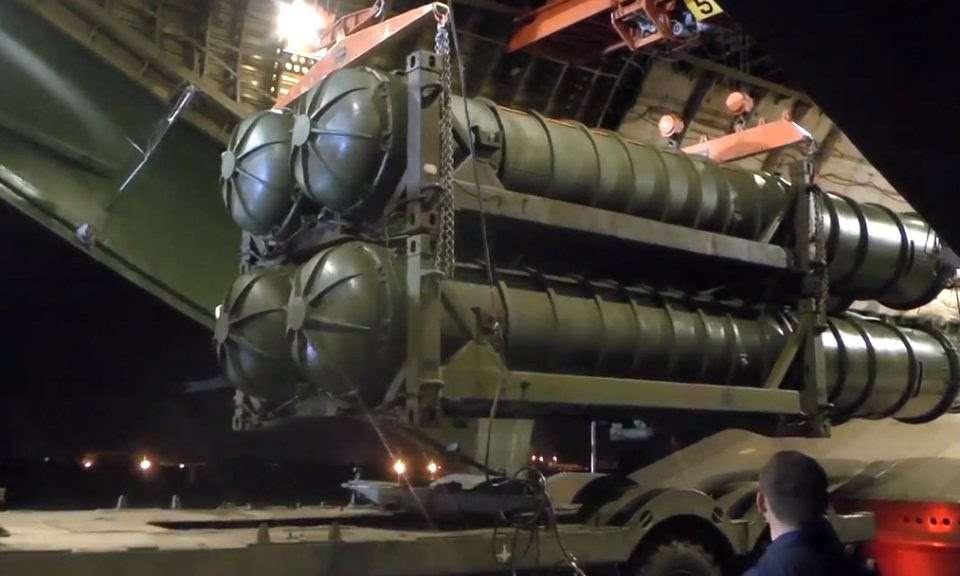
S-300-missiles

Russia’s sudden deployment of S-300 surface-to-air missiles in Syria last week raised the stakes in Syria significantly for the U.S. and Israel.

While it is easy to conclude things have become far more dangerous, the fact is that there are certain important aspects of the situation on the ground that we just don’t know.

Before we consider what we don’t know, it is important to understand what we do know about what has happened since a Syrian surface-to-air missile crew shot down a Russian IL-20 spy plane on September 17.

Russia deployed forces and aircraft to Syria in 2015 to prevent the defeat of the Iranian-backed regime of Syrian President Bashar Assad in the Syrian civil war. Shortly after Russian forces arrived in Syria, Israel’s Prime Minister Benjamin Netanyahu flew to Moscow to work out a deconfliction mechanism with Russian President Vladimir Putin. That mechanism enabled the Israeli Air Force (IAF) to continue attacking Iranian military targets in Syria, as it had been doing since the outset of the war in Syria without coming into direct conflict with Russia.

On September 17, the IAF bombed Iranian-Hezbollah targets in Syria’s Latakia region. According to Israel, the IAF informed the Russians of its plan to attack 12 minutes before the raid took place, sufficient time for all Russian air and other assets to avoid danger.

Ten minutes after the time that Israel claims its jets completed their mission and returned to Israeli air space, a Syrian crew manning a Russian-made S-200 surface to air missile battery shot down a Russian IL-20 spy plane. 15 Russian crew members on board were killed.

Rather than carry out an investigation of the Syrian action, the Russian Defense Ministry and some Kremlin spokesmen immediately blamed Israel for the attack.

Israel insists the attack was the result of indiscriminate missile fire by the Syrian crew.
Putin, for his part, made no comment about the incident until the next day. In stark contrast to his Defense Ministry, in a statement he issued after speaking with Netanyahu, Putin absolved Israel of responsibility. In his words, “It rather looks like a chain of tragic accidental circumstances. An Israeli jet did not shoot down our plane.”

Following Putin’s statement, Netanyahu sent a delegation led by IAF commander Maj. Gen. Amikam Norkin to Moscow to personally brief the Russian Defense Ministry about the findings of Israel’s own investigation into the incident. Norkin provided the Russians with detailed proof that Israeli aircraft were not in the area when the missile strike occurred.

The Russian Defense Ministry rejected Norkin’s data and stood by its own conclusion that Israel, not the Syrian S-200 crew, was responsible for the incident.

Three days later, Russian Defense Minister Sergei Shoigu announced that within two weeks, Russia would provide Syria with the S-300 surface to air missile system. He also said that Russia planned to jam radars of military planes striking from off the Mediterranean coast. In his words, “In regions near Syria, over the Mediterranean Sea, there will be radio-electronic suppression of satellite navigation, on board radar systems and communication systems of military aviation objects on Syrian territory.”

Eight days later, Shoigu announced that Russia had completed delivery of the S-300 system.

These new Russian assets can undermine Israeli air assaults in both Syria and Lebanon while bringing Israel into direct confrontation with Russian forces.

Moreover, with a tracking range that includes Europe, according to military analysts, the Russian electronic warfare and surface-to-air missile systems in Syria may threaten the U.S. operations in Syria and Iraq as well.

The immediate implications of the Russian move are dire. On the one hand, Shoigu said that Russia will be training Syrian crews to man the systems. But given Syrian incompetence (as revealed by the S-200 strike), and the long training period, it is clear that for at least the next three months, the S-300 system will be operated directly by Russian crews. The electronic warfare systems he described will likewise be Russian operated.

In other words, Russia is taking over direct responsibility for Syria’s air defense. All operations within Russian-controlled air space will be met by Russian air defense teams.

Russia’s immediate and vicious response to the September 17 incident indicates that it was preplanned. Russia’s Defense Ministry seem to have seized on the incident to take actions it had long intended to carry out. Indeed, the Russian Foreign Ministry announced in April that Russia was considering transferring the S-300 system to Syria following the U.S.-British-French air strikes carried out in retaliation for a Syrian chemical warfare attack.

Russia’s aggressive action has intimidated Israel into suspending its airstrikes in Syria. Although Israeli leaders have said repeatedly that Israel will not be deterred by the S-300 and will continue to attack Iranian targets to block Iran from entrenching its forces in Syria or transferring precision weapons to Hezbollah in Lebanon, a senior Israeli official acknowledged to Breitbart News Sunday that Israel has not carried out any strikes in Syria since September 17.

The S-300 deployment’s impact on the U.S.-Russian balance of power in Syria is less clear.
In late August, the Institute for the Study of War reported that at the time, Russian, Syrian and Iranian forces had deployed in the Deir Azzour region on the western side of the Euphrates River in preparation for an assault on U.S. and Syrian Democratic Forces (SDF) deployed on the eastern side of the river. U.S. forces at Tanf air base along the triborder area joining Jordan, Syria, and Iraq block Iran from transferring weapons and fighters to Syria overland from Iraq. U.S. forces in the Deir Azzour region block Russia from taking control of Syria’s oil fields.

In February, U.S. forces and allied SDF forces in the Deir Azzour area east of the Euphrates came under direct attack by a combined force comprised of Russian mercenaries from the private Wagner group; Syrian and Iranian forces; and Iranian-controlled militias. U.S. special forces in the area, assisted by Kurdish and Arab forces and reinforced by Marines, defeated the assault. Hundreds of Russian contract fighters were killed by a range of U.S. air and ground forces.

In response to the renewed buildup of Russian, Iranian, and Syrian forces on the western bank of the Euphrates in late August, hundreds of Marines were deployed to Tanf, where together with U.S. special forces and SDF forces they carried out eight days of intense, live fire ground and air exercises.

The exercise had the desired effect. The Russian, Iranian and Syrian forces stood down.
But less than a week later, the Russians exploited the IL-20 downing to upgrade and take direct control over Syria’s anti-aircraft systems in a manner that threatens both Israeli and American air operations.

What we know about recent events highlights what we don’t know.

The following are two issues that require clarification before drawing any strategic conclusions about the current crisis.

1. What is going on with Putin?

On the surface, it appears that Putin is a minority faction in the Kremlin. His friendly disposition towards Israel and Jews is clearly not shared by the Russian Defense Ministry. Israeli officials say the vicious attacks on Israel emanating from the Russian Defense Ministry show that Soviet-styled anti-Semitism remains the dominant view in Russian military circles.

Was Putin overruled by the Defense Ministry? If so, what does that mean about his hold on power? What does that tell us about his capacity to make deals with Israel or the U.S. regarding Syria, Iran and other key issues?

If Putin wasn’t overruled, does that mean his apparent moderation is a ruse? Has he been playing a good-cop, bad-cop routine with his Defense Ministry to lull the U.S. and Israel into complacency and set the conditions for Russia to threaten U.S. operations and interests in the Middle East?

It appears that at present Putin is becoming more hostile to Israel and the U.S. For instance, the Russians are reportedly seeking to use the new situation in Syria, where they are intimidating Israel into ceasing its offensive operations against Iran to force Israel to accept Russian mediation of the conflict between Israel and Iran. Given that Iran is Russia’s ally, and that it seeks Israel’s annihilation, it is impossible to imagine that Israel would be able to secure any of its strategic interest through such Russian-mediated contacts. Certainly the Russian initiative is designed to undermine U.S. leadership to curtail Iranian power.

So long as Putin’s position is unknown, it is impossible to estimate the likelihood of reaching a peaceful accommodation with Moscow.

2. Can the U.S. or Israel – or the two in conjunction – take action to defeat Russia’s takeover of Syrian airspace while averting a direct confrontation with Russia?

As Stephen Bryen explained at the Asia Times, the Syrian crews that may operate the S-300s are ill-equipped to handle the system. The system has no friend-or-foe identification (IFF) system. And it has a range that places Israel’s Golan Heights in easy striking distance. A Syrian missile attack on Israel from the S-300 will likely cause a full scale war to break out. The Syrian crews’ incompetence and the lack of friend-or-foe guidance makes the prospect of such a strike on Israeli territory, as well as further incidents of friendly fire against Russian aircraft, more likely.

The Russians have warned Israel not to try to take out the S-300 systems. An Israeli move to do so under the current hostile conditions could easily spark a war. A U.S. strike could also make Russia feel compelled to unleash its Iranian and Hezbollah partners to attack Israel and U.S. forces.

Israel and the U.S. have both claimed that they are capable of operating around the S-300. And in response to the S-300 deployment in Syria, according to some reports, the U.S. has moved F-35 stealth fighter jets to the region and agreed to provide Israel with additional F-35s from U.S. Air Force stocks.

If the U.S. and Israel wish to avert the conflict that a direct assault on the S-300s would likely precipitate, they could conceivably simply use the F-35s to discredit the system. If the F-35 is capable of evading the S-300, then such operations would not only defeat Russia on the ground, but they could also potentially cause significant harm to Russia’s reputation as an arms seller.

Last week, India signed a deal to purchase Russia’s S-400 surface-to-air missile system. How likely is that deal to come to fruition if the U.S. and Israel expose the failings of the S-300? What about Turkey’s agreement to purchase the S-400?

While these key issues remain unknown, there are low-risk moves the U.S. can take in response to Russia’s adoption of a new, far more aggressive posture towards Israel and the U.S. that could serve to deter Russian adventurism and empower any moderate voices in Moscow that may have been sidelined since Sept. 17.

First, the administration could recognize Israeli sovereignty over the Golan Heights. The move would empower Israel diplomatically and weaken the diplomatic position of Russia, Iran, and the Assad regime they control.

Second, the U.S. can launch a campaign to withdraw international recognition of the Assad regime.

Iran and Russia both base the legality of their operations in Syria on the fact that the Assad regime asked them to intervene in Syria. But the Assad regime only exists because of their support.

In truth, they are foreign aggressors asserting control over Syria and using a local Syrian proxy to legitimize their aggression. A U.S.-led campaign internationally to withdraw recognition of the Assad regime and remove regime representatives from international forums, including the UN, could weaken the Russian-Iranian political position in significant ways.

Third, the administration could ask Congress for a new, updated authorization for the use of force in Syria. Current authorization is based on the Obama administration’s strategy in Syria. The Obama administration’s strategy was to deploy U.S. forces to fight ISIS and take no action against Iranian or Russian forces in the country.

A revision of the authorization of force to reflect the changing strategic challenges on the ground, including the entrenchment of Iranian and Iranian proxy forces, and the offensive posture that Russian forces in Syria have adopted against the U.S. and its allies, could have a deterrent effect on Russia. It would also enable more flexibility over time for U.S. forces both to defend themselves and advance the wider U.S. objective of bringing about the withdrawal of Iranian and Iranian proxy forces from Syria.

Without clarity on Putin’s position, the relative threat that the new Russian systems in Syria pose to Israeli and U.S. operations, and Israeli and U.S. options for evading and indirectly defeating the S-300 and the auxiliary electronic warfare systems Russia has now deployed in Syria against them, it is hard to assess the overall strategic balance of power in Syria.

There are low-risk moves the U.S. can take to diminish Russia’s appetite for conflict. But more must be known to develop a comprehensive strategy for contending with Russia’s newly aggressive stance in Syria.

Originally published at Breitbart.com.


Caroline Glick

Source: http://carolineglick.com/russia-raises-the-stakes-in-syria/

Follow Middle East and Terrorism on Twitter


Danish BDS-Supporting Bank Behind Vast Money-Laundering Scheme - Dr. Manfred Gerstenfeld

​
by Dr. Manfred Gerstenfeld

Israel should use the Danske Bank case as a key example of fraudulent anti-Israeli moralists.

BESA Center Perspectives Paper No. 973, October 12, 2018

EXECUTIVE SUMMARY: Denmark’s largest bank, Danske Bank, has admitted that its Estonian banking subsidiary has been involved in what is probably the largest dirty money-laundering scandal in Europe’s history. In recent years, this deeply corrupt bank has boycotted several Israeli companies on “ethical grounds.” Israel should use the Danske Bank case as a key example of fraudulent anti-Israeli moralists. Revelations from further investigations into the bank’s misbehavior will likely result in many additional disclosures in years to come.

Somewhat surprisingly, Denmark has provided an example of a huge, morally corrupt, anti-Israel, BDS-promoting body. It was far more probable for such an organization to come to light in Norway or Sweden, where there are many more anti-Israel inciters.

It has recently become known that Denmark’s largest banking group, Danske Bank, has been involved for years in a vast dirty money-laundering scandal. This criminal activity was conducted by its subsidiary in Estonia between 2007 and 2015. The amount of money transferred abroad and being currently investigated is a staggering $234 billion. The bank estimates that a significant proportion of these payments was suspect.

Fifteen thousand accounts were reviewed. Of these, 6,200 had the most risk factors. The customers involved were primarily Russians and other Eastern Europeans non-resident in Estonia.

To carry out this scheme, Danske Bank’s subsidiary needed the help of major foreign banking correspondents. It has not yet been ascertained to what extent those banks were aware of what was going on. Yet, in 2013, JP Morgan terminated its correspondent banking relationship with the Estonian bank over doubts about its activities. It was replaced by Bank of America. Deutsche Bank also continued to make US dollar wire transfers on behalf of the Estonian bank.

In 2014, when Danske Bank had already received warnings about the unethical activities in its Estonian business, it decided to add Bank Hapoalim to a list of companies in which it could not invest due to its corporate accountability rules. The bank claimed that the exclusion was for “legal and ethical reasons.” Danske Bank said Bank Hapoalim was funding settlement activities and was “acting against the rules of international humanitarian law.” Danske Bank had also withdrawn its investments from the Israeli companies Africa Israel Investments Ltd., Elbit Systems, Aryt, and Danya Cebus.

The boycott of Bank Hapoalim was not without consequences for Danske Bank. Several states in the US, including Colorado and New Jersey, ceased doing business with the bank and/or sold their investments in it. In 2016, Danske Bank reversed its decision concerning Bank Hapoalim.

A year ago, the British daily The Guardian revealed that, based on leaked data, Azerbaijan’s leadership had used the bank to fund a secret $2.9 billion scheme to pay prominent Europeans through a network of British companies. The paper claimed that between 2012 and 2014, more than 16,000 covert payments were transacted through Danske Bank’s branch in Estonia. Part of this money appears to have been passed on to politicians and journalists within a lobbying operation framework.

The scheme was nicknamed “the Azerbaijan Laundromat.” Among those receiving payments were former members of the Council of Europe’s Parliamentary Assembly, as well as a board member of the European Bank for Reconstruction and Development (EBRD).

It has not been proven that all recipients knew the source of the money as it was disguised via intermediaries. Still, what was disclosed at the time was enormously shameful. But in view of what is now public knowledge about the extent of the money-laundering scandal, it is minor.

Danske Bank’s CEO, Thomas F. Borgen, recently tendered his resignation but said he would stay on until a suitable successor was found. He has since been ousted by the Board. A report on the scandal was prepared by a Danish law firm that had previously advised the bank – a choice that was criticized due to that prior relationship.

The report outlines how incompetent and negligent Danske Bank’s management was. It states inter alia that no adequate controls were put in place by the bank of its Estonian branch. Nor did it react to serious indications of wrongdoing over the years. There are also suspicions that some employees in Estonia assisted in the money laundering or colluded with clients.

Although the scandal has reached gigantic proportions, the full extent of its repercussions have not yet been fully exposed. Many more ramifications will take time to investigate. The UK National Crime Agency announced that it has begun an inquiry into the use of UK companies by the Danske Bank group involved in money laundering activities. The organization Corruption Watch has requested that serious consideration be given to withdrawing the bank’s UK license.

Danske Bank’s money-laundering activities are probably the largest in European history. Danish Business Minister Rasmus Jarlov said he expected Danish authorities to fine Danske Bank the equivalent of more than $600 million. Analysts expect that the bank may also be fined billions of dollars by US and European regulators. There are already voices urging the bank’s Board to assess whether management breached its fiduciary responsibilities and can be held liable. If so, they should be sued.

Israel is subjected to a constant barrage of extreme hate propaganda and discrimination by morally corrupt individuals and organizations. If Israel had, as it should have, an anti-propaganda agency, the Danske Bank scandal could be used as a prime example of fraudulent ethics. This case would be all the more useful as revelations from further investigations into the bank’s misbehavior will likely result in many additional disclosures in years to come.


BESA Center Perspectives Papers are published through the generosity of the Greg Rosshandler Family


Dr. Manfred Gerstenfeld­­­­­­­­­­­­­­­­­­­­ is a Senior Research Associate at the BESA Center and a former chairman of the Steering Committee of the Jerusalem Center for Public Affairs. He specializes in Israeli–Western European relations, anti-Semitism, and anti-Zionism, and is the author of The War of a Million Cuts.

Source: https://besacenter.org/perspectives-papers/denmark-bds-bank/

Follow Middle East and Terrorism on Twitter


At the UN, Trump restored America's global leadership - Caroline Glick

​
by Caroline Glick

Trump's dispute with globalists and globalism revolves around the form U.S. involvement should take and what the proper goal of that involvement should be.


Trump UNGA

In the tumult of the circus surrounding Judge Brett Kavanaugh’s Supreme Court nomination, little attention was paid to President Donald Trump’s speech last week before the United Nations.

This is a shame, because his address last week was arguably the most significant foreign policy address any U.S. president has delivered since the end of the Cold War.

Many of Trump’s critics insist his view of the world rejects the liberal world order America has led and defended since the end of World War II. But that assessment misconstrues Trump’s world view. Indeed, that ignores it.

Trump’s critics cannot see his world view because they are convinced the universe of foreign policy is but a narrow linear spectrum that veers between isolationism and globalism.

Trump, who has been a peripatetic foreign policy practitioner since his early days in office, is manifestly not an isolationist. He does not believe the U.S. can walk away from the world. He is deeply engaged with the world.

His argument with the globalists is not about whether the U.S. should be engaged with the world. His dispute with globalists and globalism revolves around the form U.S. involvement should take and what the proper goal of that involvement should be.

The four post-Cold War presidents who preceded him in office — George H.W. Bush, Bill Clinton, George W. Bush and Barack Obama — differed on many things. But they shared the basic globalist view that U.S. foreign policy should be undertaken to advance ideological goals not directly related to U.S. national interests. They all agreed with the basic proposition that the U.S. should carry out its foreign policy under the aegis of international or transnational governing structures, which they perceived as somehow more credible than unilateral action or action undertaken in informal cooperation with likeminded governments.

In his address at the UN, Trump rejected that general disposition. Trump explained that the purpose of U.S. foreign policy is not to advance hypothetical universal values. It is to promote real American interests.

He declared forthrightly, “We reject the ideology of globalism, and we embrace the doctrine of patriotism.”

Trump’s opponents insist that his nationalist worldview is antithetical to American values and traditions. But this is wrong. At the UN, Trump rightly rooted his nationalist foreign policy in the Monroe Doctrine, named for America’s fifth president James Monroe, who announced in 1823 that while the U.S. would not interfere with existing European colonies in the Western Hemisphere, or in the internal affairs of European powers, it would view any future effort by European powers to colonize independent states in the Western Hemisphere as “the manifestation of an unfriendly disposition toward the United States.”

The Monroe Doctrine guided U.S. foreign policy for a century. It protected both the United States and the independence of the nations of Latin America.

In the aftermath of World War I, then-President Woodrow Wilson, arguably the first globalist president, sought to tether the U.S. to the League of Nations, a global government created in the 1919 Treaty of Versailles. The League of Nations was supposed to prevent war through global consensus.

Opposition to the treaty in the Senate was led by then-Senate Majority Leader Henry Cabot Lodge (R-MA). Lodge’s 1919 speech explaining why the U.S. must never accept any form of global governing authority that would diminish its sovereignty and independence blocked ratification of the treaty. In his speech, Lodge spelled out a nationalist vision for U.S. foreign policy that Trump now continues.

Lodge said, “National I must remain, and in that way, I like all other Americans can render the amplest service to the world. The United States is the world’s best hope, but if you fetter her in the interests and quarrels of other nations…you will destroy her power for good and endanger her very existence. Leave her to march freely through the centuries to come as in the years that have gone. Strong, generous and confident, she has nobly served mankind.”

At the UN, Trump echoed Lodge’s worlds from 99 years ago.

“We are standing up for America and for the American people. And we are also standing up for the world,” he explained.

Throughout his speech, Trump embraced America’s leadership role in the world, but made clear that the purpose of U.S. leadership is first and foremost to secure American interests.

For instance, while he praised North Korean dictator Kim Jong-un’s “courage” for freeing American hostages, suspending nuclear and ballistic missile testing, and returning the remains of U.S. servicemen killed in the Korean War, Trump also said, without apology, that U.S. nuclear sanctions against North Korea “will stay in place until denuclearization occurs.”

Trump was even more forthright in his defense of his trade policies. After explaining how the trading policies and agreements he inherited have harmed the U.S. and benefited rule breakers, Trump turned directly to the greatest rule breaker: China.

“I have great respect and affection for my friend, President Xi,” he said, “but I have made clear our trade imbalance is just not acceptable. China’s market distortions and the way they deal cannot be tolerated.”

He gave much the same message to OPEC countries and to nations that receive U.S. financial and military assistance.

Regarding financial aid, Trump announced, “We are only going to give foreign aid to those who respect us and, frankly, are our friends. And we expect other countries to pay their fair share for the cost of their defense.”

The globalists argue that these sorts of statements harm America’s standing in the world by placing America’s allies and adversaries on the same moral plane. But they never explain how a nation like Germany, which has been outspoken in its efforts to undermine U.S. sanctions against Iran, and has accepted total energy dependence on Russia is in fact, a U.S. ally. They do not explain why it is more important for the U.S. to stand for populist forces like Egypt’s Muslim Brotherhood in pursuit of chimerical “democracy” than for it to stand with a friendly yet authoritarian regime like that of Egyptian President Abdel Fatah a-Sisi, which shares the U.S.’s profound interest in defeating jihadists.

Trump’s essential message is that the foundation of nationalist foreign policy is reality rather than ideology.

“America’s policy of principled realism,” he explained, “means we will not be held hostage to old dogmas, discredited ideologies, and so-called experts who have been proven wrong over the years, time and time again.”

In accepting the world as it is, his foreign policy doctrine is far friendlier to the nations of the world than the neo-imperialist policies of the globalists. The globalist aspiration to world government ignores differences in cultures and traditions in an effort to push everyone into an amorphous, homogeneous body of “internationalists” under governing structures that reflect the globalist aspiration and faith in nonexistent universal political traditions.

Trump waxed poetic about the rich diversity of the world community of distinct and proud nations.

“Each of us here today is the emissary of a distinct culture, a rich history, and a people bound together by ties of memory, tradition, and the values that make our homelands like nowhere else on Earth,” he said.

“I honor the right of every nation in this room to pursue its own customs, beliefs, and traditions. The United States will not tell you how to live or work or worship.

“We only ask that you honor our sovereignty in return.”

At the conclusion of his speech, he explained how “the doctrine of patriotism” can bring nations together to achieve common goals.

As always, he began his explanation by describing America first.

“In America, we believe in the majesty of freedom and the dignity of the individual. We believe in self-government and the rule of law. And we prize the culture that sustains our liberty -– a culture built on strong families, deep faith, and fierce independence. We celebrate our heroes, we treasure our traditions, and above all, we love our country.”

He then turned to his audience, the nations of the world.

“Inside everyone in this great chamber today, and everyone listening all around the globe, there is the heart of a patriot that feels the same powerful love for your nation, the same intense loyalty to your homeland….

“Our task is not to erase it, but to embrace it….

Trump’s doctrine of patriotism, maligned as somehow un-American by his critics, is the most American of doctrines. His speech was a seminal event in U.S. foreign policy because it restored a long tradition of American foreign policy.

No longer will it be possible to pretend away a long tradition of America-centered U.S. foreign policy. No longer will it be possible to pretend that the U.S. has but two choices: to isolate itself and abdicate world leadership or to embrace various institutions of global governance that limit U.S. sovereignty.

As Lodge put it in 1919, “Our idea is to make [America] ever stronger and better and finer, because in that way alone, as we believe, can she be of the greatest service to the world’s peace and to the welfare of mankind.”

Trump has not relinquished American global leadership. He has restored it.

Originally published at Breitbart.com. 


Caroline Glick

Source: http://carolineglick.com/trumps-speech-at-un-restored-us-global-leadership/

Follow Middle East and Terrorism on Twitter


Israel outraged after UN Security Council invites B'Tselem speaker - Ariel Kahana

​
by Ariel Kahana


Bolivia's U.N. envoy invites head of controversial rights group B'Tselem to represent Israeli civil society at U.N. Security Council


B'Tselem director Hagai El-Ad will address the U.N. Security 
Council, Thursday
Photo: Gideon Markowicz 


The director of controversial left-wing human rights organization B'Tselem Hagai El-Ad has been invited to address the U.N. Security Council on Thursday.

Council members will meet to discuss the situation in the Middle East. U.N. Middle East envoy Nickolay Mladenov will provide an overview of the situation in the region. Israel's Ambassador to the U.N. Danny Danon, the Palestinian observer in the U.N. Riyad Mansour and U.S. Ambassador to the U.N. Nikki Haley are also set to address the council.

The decision to invite El-Ad to address the council as a representative of civil society came from Bolivia's ambassador to the world body, Sacha Sergio Llorenti Soliz. The South American country currently holds the rotating presidency of the council.

While El-Ad has been invited to address the U.N. in the past, this will be the first time he will take part in an official meeting of the Security Council.

In a statement, Danon called the move shameful. He said it was not just a "disgrace for the organization, but also the crossing of red lines by foreign countries with an anti-Israel agenda, which finance and invite him to provide 'evidence' against us."


Ariel Kahana

Source: http://www.israelhayom.com/2018/10/14/israel-outraged-after-un-security-council-invites-btselem-speaker/

Follow Middle East and Terrorism on Twitter


Turkish Taffy - Clarice Feldman

​
by Clarice Feldman

In the Khashoggi affair, we are seeing lots of evidence of a press, in particular the Washington Post, that is terminally credulous and uninterested in the background and motives of its sources.

It seems to me the disappearance of Jamal Khashoggi, last seen in Istanbul, is Erdogan-brand Turkish taffy, a confection of sugary lies made to inflame Americans against the Saudis and aid the far more dangerous to our well-being mullahs of Iran. 

I confess to prejudice in this matter. I think Iran is a grave threat to the world, and the Saudis are aiding us in constraining the mullahs. Like Matthew Continetti, I believe the Saudis are now an important counterterrorism ally and roiling the waters there would disrupt “energy markets, create pockets of instability in which jihadists and Iranian-backed militias thrive, and cause headaches for Israel.”

If we disrupt our present relationship, why wouldn’t the Saudis turn elsewhere -- China and Russia -- and any influence we have in the Middle East would be lost. 

In fact, if those in Congress who believe this nonsense get their way and cut arms sales to the Saudis, the beneficiaries will be arms producers in China and Russia and, of course, Iran.

Emmett Tyrell, Jr. speaks for me in the American Spectator:
Today, the United States is faced with a potentially-nuclear-armed Iran that has spread itself far beyond its borders. Iran threatens America’s allies in Israel and the Sunni Arab states, as well as seeks undue control over the region’s vital oil and natural gas sources. What’s more, Iran’s ruling elite are intoxicated by a noxious mix of anti-Americanism, anti-Semitism, and radical Shiite orthodoxy. [snip] Thanks to the Trump Mideast policy, Israel and the Sunni Arab states are now moving closer together as they are increasingly threatened by Iran. Last year, President Trump presided over one of the largest arms sales to Saudi Arabia in history. And, the United States is buttressing Saudi Arabia’s efforts to roll back Iran’s influence in Yemen. All of these are good things that will contribute to the securing of U.S. interests in the region.
Do We Lose Little or Lose Big?
Naturally, just as things seem to be going well for the United States in the Mideast, the reality of Mideast politics hits American policymakers hard. Recently, a Washington Post contributor, Jamal Khashoggi, is believed to have been gruesomely murdered after he entered the Saudi embassy in Istanbul, Turkey. Now, American leaders are calling for an embargo of arms sales and foreign aid to Saudi Arabia until their behavior changes. I understand the desire to seek justice on Khashoggi’s behalf. But, punishing Saudi Arabia in this case will do nothing more than harm America’s already-tenuous ability to roll back the Iranians. Trying to socially reengineer Saudi foreign policy will be as idiotic as trying to turn Iraq into Idaho -- especially at a time when Washington needs Riyadh.
Unfortunately, we are not dealing with nice people in the Middle East. Washington policymakers need to stop thinking such leaders exist there. Saudi Arabia and other Sunni Arab states are essential in the American mission to isolate Iran. Either the United States is serious about rolling back Iran or it’s not. And, if Washington no longer believes returning Iran back to its containment is the best course, then overriding the terrible Iran deal was a catastrophic mistake on the part of the Trump Administration.
So why the fuss -- stirred by the Washington Post, for whom Khashoggi was the Saudi correspondent, and peddled by Iran’s supporters and Trump’s opponents, who falsely assert that he was a liberal, progressive voice for democracy?

He was anything but, as Daniel Greenfield and others remind us.
In the 1970s he joined the Muslim Brotherhood, which exists to rid the Islamic world of western influence. He was a political Islamist until the end, recently praising the Muslim Brotherhood in the Washington Post. He championed the ‘moderate’ Islamist opposition in Syria, whose crimes against humanity are a matter of record. Khashoggi frequently sugarcoated his Islamist beliefs with constant references to freedom and democracy. But he never hid that he was in favour of a Muslim Brotherhood arc throughout the Middle East. His recurring plea to bin Salman in his columns was to embrace not western-style democracy, but the rise of political Islam which the Arab Spring had inadvertently given rise to. For Khashoggi, secularism was the enemy.
The Washington Post was happy to provide a forum for a member of a terror network that is responsible for murdering countless Christians and Jews.
But it’s not just my prejudice that informs my view that this -- like Turkey’s case against the just released American hostage Pastor Andrew Brunson -- is an Erdogan confection of adulterated ingredients. The purported eyewitnesses seem to be liars who, like Khashoggi himself, have ties to the anti-U.S. Moslem Brotherhood and Iran, according to Daniel Greenfield. 

Hatice Cengiz, his purported fiancé who, we are told, waited for hours outside the Saudi consulate in vain for his exit, is connected to Qatar (an Iranian ally) which, like the Washington Post, has been promoting the story and has openly been critical of the Saudis, “While she claims to be Khashoggi’s fiancée, his family has denied ever hearing or knowing about her.” Also critical to this story are the purported eyewitness (Turan Kislakci) and the reporter (Jamal Eishayyal). Kislakci, who has led the protests against the Saudis, claimed that 15 Saudi operatives killed Khashoggi, which was debunked later by Turkish officials, who said that the 15-man team were investigators who entered with their agreement. Eishayyal, an Al Jazeera correspondent, is the brother of “the director of a Qatari-funded news website al-Araby al-Jadeed, which is supervised by the Muslim Brotherhood in Doha and in London and is run by Palestinian politicians, Asmi Bisharai, the adviser to the emir of Qatar. Their father is a leading Brotherhood figure who works for the Emir.”

Meanwhile the Washington Post, which has yet to explain why it hired a Moslem Brotherhood propagandist, is still being fed anti-Saudi and anti-Trump nonsense by Khashoggi buddy Khaled Saffuri, “an aide to US Al-Qaeda fundraiser Abdurahman Alamoudi (currently in federal prison) and friend of convicted/deported Palestinian Jihad leader Sami al-Arian.”

Indeed, Khashoggi tooled around Afghanistan with Osama bin Laden and al-Qaeda founder Abdullah Azzam.


The Turkish police reports keep shifting as the story falls apart. On Twitter, Turkish academic and columnist Emre Uslu contends that in the 650 meters distance between the hotel (where the claimed assassins stayed) and the consulate there are seven security cameras, but for some reason, the police haven't shown any of that camera footage to prove that they actually went to the consulate.

Perhaps Turkey is dialing down the story because, as journalist-in-exile Abdullah Bozkurt reminds us, the Saudis have plenty of dirt on the corrupt Erdogan, like the $100 million they wired to the Erdogan family foundation.

Not only are the sources of the Khashoggi tale suspect, but also the information they peddle is bizarre. First accounts were that the Turkish government had video and audio proof that Khashoggi was killed and dismembered in the consulate but wouldn’t release them because that would reveal where the cameras and recorders were hidden. Think: Surely if that were the case the Saudis would know from the claim itself where the cameras and recorders had been placed. Later accounts say Khashoggi recorded the proof on his Apple wristwatch synced to a phone outside the building. Whatever “proofs” of this bizarre tale the Turks and Iranian stooges are promoting, we haven’t seen it. 

On the other hand, we are seeing lots of evidence of a press, in particular the Washington Post, that is terminally credulous and uninterested in the background and motives of its sources at best, or at worst willing promoters of the mullahs and the Obama crowd that loved them.

Clarice Feldman

Source: https://www.americanthinker.com/articles/2018/10/turkish_taffy.html

Follow Middle East and Terrorism on Twitter


Breaking the Silence on donating to the New Israel Fund - Ronn Torossian

​
by Ronn Torossian

Hosting the NIF and donating to it is an anti-Israel act, even more so when it takes place in a synagogue. Read about what one of their grantees plans for this weekend.

Some American Jewish congregations are hosting memorials for American-born Israeli citizen Ari Fuld, who was killed in a terror attack, others host solidarity events with Jerusalem, and then there is Temple Beth Zion in Brookline, Massachusetts which opened the synagogue doors on Tuesday, October 9th for the New Israel Fund, an organization which openly advocates a boycott of the State of Israel. Did they realize what they are supporting?

A synagogue should not be open to an organization that unashamedly supports a boycott of Israel - The New Israel Fund, through its recipient organizations, continues to openly advocate a boycott of Israel, actively opposes the IDF and has funded the defense of families of Hamas terrorists in the Israeli Supreme Court.

This radically anti-Israel organization has been called an “anti-Zionist organization” by the Likud and is opposed across the Israeli political spectrum.

Recently, Prime Minister Netanyahu wrote on Facebook “The New Israel Fund is a foreign organization that receives funding from foreign governments and elements hostile to Israel, such as from the fund of George Soros. The ultimate objective of the fund is to erase Israel’s Jewish character and turn it into a state of all its citizens (a term used in Israel for non-Jewish, ed.), alongside a Palestinian nation-state that is free of Jews on the 1967 lines with Jerusalem as its capital. For decades the fund has funded anti-Zionist and pro-Palestinian organizations, including those who slander IDF soldiers such as Breaking the Silence and B’Tselem and those who fight for Palestinian terrorists such as Adalah."  

Benny Yanay of an Israeli military organization called Consensus, who represents a reported 3,000 members of the Israel Defense Forces said that “The New Israel Fund acts against Israel — against the soldiers of our country. It is supported by foreign governments and organizations so that Israeli soldiers will be weakened.” 

Tellingly, Birthright boycotts the New Israel Fund, and the Likud Party says the organization is Anti-Zionist. 

Israel’s economic minister noted “…New Israel Fund, I will boycott whoever persecutes Israeli soldiers. I will not apologize for it. He continued, “The NIF works methodically and consistently to attack our Israeli soldiers, accuse them of war crimes of torturing Palestinians and intentionally attacking women and children. They turn to the UN and to the committees that are most hostile to Israel and try their best to convince them that Israel is a war criminal. I repeat: They say that our soldiers- you, I, your friends and your families, your children and their friends – that we are all war criminals. The New Israel Fund invests large amounts of money through its organizations with one purpose - to harm IDF soldiers who are physically protecting us with their bodies."

There must be a red line drawn against extremist organizations that advocate any form of a boycott of Israel, whether from extreme anti-Zionist Neturei Karta or the New Israel Fund. Shouldn't Jewish places of worship refrain from allowing people who support a boycott of Israel to appear at their events?

Here is an example of what the NIF sponsors:

According to Israeli media reports, Breaking the Silence, the radical organization which is supported by the New Israel fund is a sponsor this weekend at an exhibition at 1:1 Center for Art and Politics in Tel Aviv, entitled “2205 State Crimes,” which memorializes Palestinian Arabs killed in Operation Protective Edge, most of whom were proven terrorists.

The exhibition, entitled “Crimes” by Santiago Sierra, includes the work, “2205 State Crimes,” which lists the names of the Palestinian Arabs killed during the IDF operation in Gaza. The exhibition presents Israel as a war criminal. According to the exhibition, those killed on the Palestinian Arab side are worthy of commemoration, but not even one name of an Israeli killed is mentioned. The exhibition will also include audio testimonies prepared by Breaking the Silence, of some 70 Israeli soldiers who participated in the operation, speaking about the “remote control occupation” policy implemented in the Gaza Strip.

The invitation to the exhibition states, “Whoever saw how we fought in Gaza – the artillery fire at the residential neighborhoods, the D9 flattening a house, and the loose open-fire orders, knows the price we paid for deterrence.”

Operation Protective Edge, which took place in the summer of 2014, was declared following the incessant firing of rockets from the Gaza Strip toward civilian populations and towns in southern Israel, and was launched in response to the IDF’s Operation Brother’s Keeper, which followed the kidnapping and murder of Gil-Ad Michael Shaer, Naftali Fraenkel and Eyal Yifrach in Gush Etzion. During Operation Protective Edge 68 IDF soldiers and six civilians were killed, and 1,433 soldiers and 837 civilians were injured. None of them will be mentioned in the exhibition.

Supporters of the New Israel Fund, including Oz Benamram of White & Case, David Myers of UCLA, leaders of the Leichtag Foundation should stop standing with organziaztions that stand against the IDF.


Ronn Torossian is one of the most well respected Public Relations professionals in the world, and founded 1 of the 15 largest PR firms in the U.S..

Source: http://www.israelnationalnews.com/Articles/Article.aspx/22852

Follow Middle East and Terrorism on Twitter


Dems, liberal media are terrified you will listen to what Kanye & Trump are saying - Tucker Carlson

​
by Tucker Carlson

Millions of American kids know exactly what Kanye West is talking about when he says that he didn't have a lot of masculine energy in his home when he grew up

There was an unexpected and kind of amazing moment at the White House Thursday. 
Kanye West, the rapper, showed up in the Oval Office and proceeded to give what amounted to effectively a campaign speech while sitting directly across from the president of the United States and while pounding on the presidential desk. 
You've likely already seen pictures of what happened. It's everywhere. And the scene may have confused you. You might have concluded it was a publicity stunt staged by famous people in order to become more famous.

You may have found yourself muttering about the debased and the celebrity-centered focus of our public discourse these days. You may even have felt a little sad knowing that the dignified country you grew up in is gone for good.

You can be forgiven for reaching those conclusions. But they're not the whole story of what happened today. Believe it or not, Kanye West said some genuinely interesting things this afternoon, things we ought to be talking about in public but are not. 

He'll probably destroy his career for saying them. He'll certainly be despised by many of his former friends. But before any of that happens, let's consider what he actually said. We'll go with the most offensive things first. 

Here they are: 

"You know, people expect that if you're Black you have to be Democrat.  I've had conversations that basically said that welfare is the reason why a lot of black people end up being Democrat. They say, you know, first of all, it's a limited amount of jobs. So the - the fathers lose the jobs, and they say, ‘We'll give you more money for having more kids in your home.’ I think it's the bravery that helps you beat this game called life. … You know, they tried to scare me to not wear this hat, my own friends. But this hat, it gives me - it gives me power, in a way. You know, my dad and my mom separated, so I didn't have a lot of male energy in my home. 

You know, I love Hillary. I love everyone, right? But the campaign ‘I'm with her’ just didn't make me feel, as a guy, that didn't get to see my dad all the time -- like a guy that could play catch with his son.”

She didn't make me feel like a guy who could play catch with his son. West didn't explain exactly what he meant by that. And yet, at the very same time, he could not have put it more precisely or more poignantly.

He grew up in a party whose policies have systematically destroyed the American family, especially in poor neighborhoods. I didn't have a lot of male energy in my home, West said, with obvious sadness. 

Millions of American kids know exactly what he is talking about.

The Democratic Party won't acknowledge these kids or their loss. To party leaders, fathers in the home are at best irrelevant. At worse, they're an impediment to political power. Married women tend to vote Republican and they know that.

When prominent Democrats attack the patriarchy, what they're attacking is fathers. When they wage war on toxic masculinity, what they're trying to suppress is masculinity itself. Everybody knows this. Few are brave enough to say it out loud.

West essentially did. And then he kept going. Here’s more:

“So, and that's a move. One of the moves that I love that liberals try to do, the liberal would try to control a black person through the concept of racism, because they know that we are very proud, emotional people. So when I said "I like Trump" to, like, someone that's liberal, they'll say, "Oh, but he's racist." You think racism could control me? Oh, they don't stop me. That's an invisible wall.

"You think racism can control me? It's an invisible wall. The reporters looking on seem stunned, even betrayed. And then, just to rub it in, West went on to defend the Bill of Rights, when asked by a reporter about gun violence and the Second Amendment: 

The problem is illegal guns. Illegal guns are the problem, not legal guns. We have the right to bear arms."

What do we make of all of this? 

Well, obviously, just from watching, you can tell that Kanye West is an eccentric guy. He meanders. He talks like someone who's never had to filter his thoughts, which he probably never has had to do. 

But much like someone else who comes to mind, West may be precisely crazy enough to think for himself, and that's a valuable quality right now. No consultant advised him to say any of that. Clearly, nobody controls him. Sometimes, he doesn't control himself.

But listen carefully to what he said. Sprinkled throughout his ramblings are flashes of truth, real insights into the way the world actually is rather than the way they tell us it is. Nobody else is allowed to talk this way. Go ahead and try it at work. You'll get fired.

West doesn't care. And that makes him dangerous to a system that is based almost entirely on piety and lying. If you're benefiting from a system like that, Kanye West must be crushed. 

Here's the math of it. The Democratic presidential candidates, everyone who runs, needs to get almost the entire black vote in order to win a national election. That's not easy to do. So, in order to do it, Democrats sell racial division.

They pit Americans against each other based on their ethnicity. You can't support them. They're the wrong color. You hear that all the time. It's now the essential Democratic argument. It's destructive. But more ominously for Democrats, it may no longer be working.

A poll by Public Broadcasting just last week found that Trump's approval rating with Hispanic voters is 41 percent. That's higher than it is with college-educated white voters. 

If anything like that ever happened among African-American voters, the game would be over. So, that can't happen. Kanye West must be destroyed. And so the thought police swooped in almost immediately to arrest this disobedient artist and declare him incompetent.

Here’s a sample of what anchors on other cable news networks and even a Congresswoman from California said after watching Kanye in the Oval Office: 

ALI VELSHI, CANADIAN TELEVISION JOURNALIST, NBC NEWS SENIOR ECONOMIC AND BUSINESS CORRESPONDENT, CO-ANCHOR OF VELSHI & RUHLE ON MSNBC: Wow. OK. I'm doing this for everybody who's watching us who turned their volume down, you can put it back up again. That was bonkers.

STEPHANIE LEIGH RUHLE, NBC NEWS CORRESPONDENT, ANCHOR, MSNBC LIVE: But if you think you're going to get a thoughtful play by play and political analysis, you're not because that was an assault on our White House.

KAREN LORRAINE JACQUELINE SPEIER, U.S. REPRESENTATIVE, CALIFORNIA'S 14TH CONGRESSIONAL DISTRICT: It was a combination of stream of consciousness. I felt like I was sitting in on a psychiatric visit and a commercial for Donald Trump.

DON LEMON, CNN TONIGHT HOST, CNN: What I saw was a minstrel show today. Him in front of all of these White people, mostly White people, embarrassing himself, and embarrassing Americans, but mostly, African-Americans.

Yes, shut up Kanye. You're crazy. Keep in mind this is coming from the same people who believed Hillary Clinton is entirely well, indeed a serious person. They're hoping this works, this crazy stuff, and that you believe them. 

And just in case you don't, they want to remind you that Kanye West is a race traitor as Don Lemon just said who has a low IQ. Here was what happened on CNN on Tuesday night:

BAKARI SELLERS, AMERICAN POLITICIAN, ATTORNEY: Kanye West is what happens when Negroes don't read. And - and we have this now. And now, Donald Trump is going to use it and pervert it and he's going to have somebody who can stand with him and take pictures.

TARA OLIVIA SETMAYER, CNN POLITICAL COMMENTATOR, ABC NEWS CONTRIBUTOR, FORMER GOP COMMUNICATIONS DIRECTOR ON CAPITOL HILL: Kanye because he's put on a MAGA hat and he's an attention whore, like the President, he's all of a sudden now the model spokesperson. He's the token Negro of the of the Trump Administration.

Got that? He can't read because he's the N-word. That's what the liberals on a liberal cable channel are now telling you. But they have no choice. They are terrified you will listen to what Kanye West is saying, and that's not allowed.

Adapted from Tucker Carlson's monologue on "Tucker Carlson Tonight" on October 11, 2018.


Tucker Carlson

Source: https://www.foxnews.com/opinion/tucker-carlson-kanye-trump-dems-liberal-media-are-terrified-you-will-listen-to-what-rapper-is-saying

Follow Middle East and Terrorism on Twitter