Sunday, January 6, 2019

US to stay in Syria, warns Assad against using chemical weapons - Yoni Hersch, Ariel Kahana, News Agencies and Israel Hayom Staff

​
by Yoni Hersch, Ariel Kahana, News Agencies and Israel Hayom Staff


U.S. National Security Adviser John Bolton, currently in Israel, to discuss keeping hundreds of American troops at strategic Al-Tanf base in Syria


National Security Adviser John Bolton
Photo: AFP 

Prime Minister Benjamin Netanyahu and his team of advisers were expected to meet with U.S. President Donald Trump's National Security Adviser John Bolton on Sunday evening in Jerusalem.

Netanyahu will present Bolton, who is on a four-day trip to Israel and Turkey, with the results and ramifications of Israel's operation to neutralize Hezbollah's cross-border tunnels.

The two will also discuss the fight against Iran and their countries' respective new footing ahead of the planned withdrawal of U.S. forces from Syria.

A senior U.S. official in Bolton's team told NBC News over the weekend that despite Trump's declaration that the withdrawal would be total, an American contingent could stay behind in Syria in the months following the pullout. The official also said the U.S. did not have a specific timetable for the planned withdrawal, despite reports last week that it would take place over a period of four months. Similar comments were also made by U.S. State Department officials, who said the pullout would be implemented in a manner that we and our partners "continue the pressure on ISIS and don't leave behind a vacuum for the terrorists."

Regardless of a timeline for the removal of U.S. forces, the official in Bolton's delegation added that some of the forces leaving Syria would be sent to Iraq. As for the forces that will perhaps stay behind, it's highly likely those will include the several hundred troops stationed at Al-Tanf, located on the strategic highway connecting Tehran with Baghdad and Damascus.

Bolton is expected to raise this possibility during his meetings in Israel. The senior American official said the U.S. was seeking input from leaders in Israel and Jordan before taking its next steps, including their views on the importance of the Al-Tanf base. According to NBC, keeping troops at Al-Tanf could alleviate Israeli concerns, and send a stern message to Iran.

In any case, Israel hopes to make the best of the planned U.S. withdrawal, which a senior Israeli official described as "turning lemons into lemonade."

As a reminder, Netanyahu's meeting in Brazil last week with U.S. Secretary of State Mike Pompeo – to discuss the American troop withdrawal – was reportedly very successful. A senior Israeli official said Pompeo had agreed to eight of the nine requests Netanyahu made in their meeting. He declined, however, to comment on the nature of the requests and refused to provide information as to which request was declined by the secretary of state.

Netanyahu also spoke with Russian President Vladimir Putin on Friday night. The two leaders discussed the situation in Syria and the airstrike attributed to Israel almost two weeks ago. According to the Prime Minister's Office, Netanyahu and Putin "agreed on the continuation of security coordination between their armies, and the prime minister said Israel was determined to continue its efforts to prevent Iran from establishing a military foothold in Syria."

Bolton, for his part, warned the Syrian government on Saturday that it should not see the impending U.S. military withdrawal as an invitation to use chemical weapons.

"There is absolutely no change in the U.S. position against the use of chemical weapons by the Syrian regime and absolutely no change in our position that any use of chemical weapons would be met by a very strong response, as we've done twice before," Bolton told reporters on his plane shortly before landing in Tel Aviv.

"So the regime, the Assad regime, should be under no illusions on that question," said Bolton.

He said he was not suggesting Syria appeared ready to use chemical weapons.

"As we elaborate how the [U.S. troop] withdrawal is going to occur and the circumstances, we don't want the Assad regime to see what we do as representing any diminution in our opposition to the use of weapons of mass destruction," he said.

If chemical weapons were to be used, "a lot of options would be on the table ... if they don't heed the lessons of those two strikes the next one will be more telling," Bolton said.

Bolton also will focus on Syria and "how the U.S. will work with allies and partners to prevent the resurgence of ISIS, stand fast with those who fought with us against ISIS, and counter Iranian malign behavior in the region," according to National Security Council spokesman Garrett Marquis, Fox News reported over the weekend.

Pompeo will also be in the Middle East this week and will stop in eight countries.

A State Department official, speaking on condition of anonymity to preview his trip, said the secretary's aim was to counter "false narratives" that the U.S. is abandoning the Middle East and to make the point that Iran continues to be a threat. "We are not going anywhere," the official said, Fox News reported over the weekend.

Pompeo also plans stops in Egypt, Bahrain, the United Arab Emirates, Qatar, Saudi Arabia, Oman and Kuwait. The U.S. hopes each country will play a significant role in a planned regional strategic partnership being called an "Arab NATO."

Bolton was expected to be joined in Turkey by veteran diplomat Jim Jeffrey and the chairman of the Joint Chiefs of Staff, Gen. Joseph Dunford. They are expected to pressure Turkish officials not to launch an offensive against Kurdish forces in Syria.

Turkey considers the Kurdish People's Protection Units, or YPG, a terrorist group linked to an insurgency within its own borders.

Pompeo told Newsmax Thursday that "ensuring that the Turks don't slaughter the Kurds" was part "of the American mission set," a comment that Turkey said showed a lack of information about the situation.

Ibrahim Hamidi, a journalist who covers Syrian affairs for the Saudi-owned newspaper Asharq Al-Awsat, wrote in a report published Saturday that the top commander of the YPG, Sipan Hemo, secretly visited Damascus and Moscow where he offered "a secret deal" that would include handing over border points to the Syrian government in return for accepting a Kurdish local administration with Russia as a guarantor.

Hamidi added that the offer aims to reach "understandings to fill the gap following the American withdrawal and to cut the road for Turkish intervention."

The talks with Russia and new overtures towards Damascus underline a recalibration of Kurdish strategy since Trump announced his decision to withdraw U.S. forces.

Analysts believe Assad and the YPG could eventually work together against Turkey-backed rebels in northwestern Syria.


Yoni Hersch, Ariel Kahana, News Agencies and Israel Hayom Staff

Source: http://www.israelhayom.com/2019/01/06/us-to-keep-forces-in-syria-warns-assad-against-using-chemical-weapons/

Follow Middle East and Terrorism on Twitter


In their wildest fantasies - Dr. Reuven Berko

​
by Dr. Reuven Berko

The Palestinians are trampling on the verses of the Quran that hold that the Jewish people are the chosen people, the inheritors of the land, who will return from all corners of the earth to their promised land.

The High Court of Justice is set to deliberate in the coming days whether the nation-state law should be changed so that "the right of return" will serve as a counterweight to the Law of Return, thereby allowing the Palestinians to drown Israel in hordes of "refugees" with knowledge of murder and rape that will "return" from the killing fields in Syria, Lebanon and Iraq to realize a peaceful state from the river to the sea. Funnily enough, that river of which they speak is located right here in Israel. While Arab countries maintain a partnership of interests with us against Iran and abandon the Palestinians' illusions of a "return and a Palestinian capital in Jerusalem," the Palestinians can take comfort in the Israel hatred popular in those countries of peace, where they stomp on our flag and defiantly oppose their dictatorial governments.

In the meantime, the Palestinians continue to engage in a collective battle against Israel's survival. In the racist trial of Issam Akel, sentenced to life in prison and heavy labor, the Palestinians declared it forbidden to sell land to Jews.

This is absurd. All the man did was sell the land back to its legal owners. These are properties the Muslims conquered from the Byzantines in 638 C.E. and which were returned to their Jewish owners in 1967. But from the Islamists' point of view, the rights of the owners of these forcibly conquered lands have expired. Now the Palestinian raiders pretend to be the landowners in our country.

Did the descendants of the Arab feudalists from Lebanon, who sold lands to Jews in the 19tth century, also put their parents on trial?

The Palestinians are trampling on the verses of the Quran that hold that the Jewish people are the chosen people, the inheritors of the land, who will return from all corners of the earth to their promised land. If the Jewish people have disappeared, as they claim to be the case, was the Prophet Muhammad anything more than a historian? They also trample on Christianity. At the same time as they pride themselves on being the "defenders of Christian sites," they claim the story of the First Temple in Jerusalem is a lie and that it was in fact built by our patriarch Abraham in Yemen. Well, if that is the case, where do they think Jesus, "the first Palestinian victim," spent his time? If there was no Jewish temple in Jerusalem, Jesus must necessarily be a legend.

Against the background of the upcoming elections, the former secretary general of the Balad party, Awad Abdul-Fatah, called on Israeli Arabs not to vote. He said the Israeli Left had been weakened and that the dream of turning Israel into a Palestinian state from the river to the sea through political means had expired. Describing Arab lawmakers in the Knesset as "fig leaves" to an "apartheid state," he called for the creation of a "popular alternative for the liberation of Palestine through the strengthening of the Arab street."

In the morning, the Palestinians contemplate the use of terror, and at night they plot to incite Arab citizens of Israel against the regimes of "betrayal and peace." Their activists, the members of the Joint Arab List, work to sow division and "popular resistance," meaning a mass violent revolt to leverage a Western boycott of Israel, use Israel's autoimmune justice system to weaken the country and enlist its supporters on the Left as agents of influence for the idea of national suicide through the creation of a "Palestinian state from the river to the sea."

The Palestinians repeatedly whisper in the Left's ears that our existence here is only temporary and that the Arab street now rising up will yet have its say. Indeed, the demographics and Palestinian schemes unite our ranks, but only the nation-state law will regulate the threat. The trends of incitement in Israel and Jordan are a warning sign of the illusions that "wolves and sheep will live together in peace" (Isaiah 11:6) and instead lead us to the desired solution, which is that the Gaza Strip should go to Egypt and the current demilitarized Palestinian enclave in Judea and Samaria to Jordan. This will result in a unity of language – Arabic, faith – Islam, a flag – four colors, demographics – mostly Palestinian, and history, as it would be another false invention straight out of the 1916 Sykes-Picot Agreement between France and Britain. Those Israeli Arabs interested in joining them would be more than welcome to do so.

The Palestinians are selling a combination of illusions, historical fiction and Israel hatred. Among Arab states, there are those who are now waking up from the brainwashing they've endured. It is only here in Israel that we continue to cooperate with the fraudulent ploy.


Dr. Reuven Berko

Source: http://www.israelhayom.com/opinions/in-their-wildest-fantasies/

Follow Middle East and Terrorism on Twitter


CBS rejects request to pull pro-Israel interview with Egyptian leader - Yoni Hersch

​
by Yoni Hersch


In "60 Minutes" interview set to air Sunday, Egypt's President el-Sissi says cooperation between Cairo, Jerusalem closer than ever


Egyptian President Abdel-Fattah el-Sissi
Photo: CBS News / 60 Minutes

CBS News has rejected a request from the Egyptian government to pull an interview with the country's President Abdel-Fattah el-Sissi.

Although the network declined to say what exactly drew opposition from Cairo, the government is believed to be concerned by el-Sissi's comments on Israel.

Asked in the interview with the "60 Minutes" program whether cooperation between Egypt and Israel was the closest it had ever been, el-Sissi responded, "That is correct. … We have a wide range of cooperation with the Israelis."

Egypt has been fighting an insurgency in the Sinai Peninsula for several years, battling an estimated 1,000 Islamic State-affiliated terrorists that Cairo has allowed the Israelis to attack by air.

In February, Egypt launched "Comprehensive Operation Sinai 2018" in an effort to rid the peninsula of terrorists.

In recent years Israel has allowed the Egyptian military to boost its presence in the peninsula several times as part of the country's war on terror.

Other than on security issues, Israel and Egypt maintain close diplomatic ties, as Egypt is the chief mediator between Israel and Hamas, the terrorist group that controls the Gaza Strip.

The interview, which was recorded when el-Sissi was in New York to attend a meeting of the U.N. General Assembly in late September, was set to air Sunday evening.

El-Sissi was also asked about reports from various human rights organizations that the Egyptian regime was holding some 60,000 political prisoners.

"I don't know where they got that figure. I said there are no political prisoners in Egypt. Whenever there is a minority trying to impose their extremist ideology we have to intervene regardless of their numbers."


Yoni Hersch

Source: http://www.israelhayom.com/2019/01/06/cbs-rejects-request-to-pull-pro-israel-interview-with-egyptian-leader/

Follow Middle East and Terrorism on Twitter


The Turks are coming – to Syria - Dr. Mordechai Kedar

​
by Dr. Mordechai Kedar

Arab hatred of Turkey is so extreme that the last thing the Arab states wish to see is the return of the Ottoman Empire whose police tortured and killed them without mercy. This can and should lead to strange alliances.

Anyone following Turkish media cannot help seeing the long lines of military transport vehicles – tanks, artillery, troop carriers and auxiliary vehicles – making their way south towards the Turkish-Syrian border. The Turks have no plans to attack Syria – their objective is to nip in the bud Syrian Kurd aspirations to establish an autonomous entity south of the border, the region in which the Kurds reside. 

This is not the first time Turkey has invaded the region northeast of Aleppo, Syria. Two years ago, Turkey conquered the border city of Jarablus in order to break the westward contiguity the Kurds had attempted to create in order to have direct access to the Mediterranean Sea.

Now Turkey threatens to conquer the city of Manbej, south of Jarablus and northeast of Aleppo, in order to consolidate its control over the Kurdish region and destroy any hopes of permanence for Kurdish autonomy born in the shadow of the chaotic period that began to envelop Syria in March 2011.  Turkey's designs against Syria received a shot in the arm two weeks ago from US President Donald Trump, who handed Erdogan an open check to do whatever he wishes to do in Syria.

It would be foolish to underestimate Erdogan's intentions. He hates the Kurds with a passion, both those living in Turkey and those in neighboring countries. The Kurds comprise between a fifth and a quarter of Turkey's population, and that fraction is constantly increasing because the Kurds have a higher birthrate than the Turks and because Turks have a inordinate tendency to emigrate to foreign lands.

Almost every city in Turkey has one or more Kurdish neighborhoods, filled with citizens, who despite their infighting, are a demographic and security  threat to the Turks. The government defines the Kurdish Workers Party as a terrorist organization to all intents and purposes, and is fighting a war to the death against it.  Over forty thousand civilians, both Turks and Kurds, have been killed in the struggle between the government and the Kurdish rebels who are Turkish citizens – with no end in sight.

Most of the Kurds live in one region, Kurdistan, divided, at the end of WWI among four countries – Turkey, Syria, Iraq and Iran. The Kurds in Turkey, like their brothers in Syria, Iraq and Iran, have two basic problems that prevent their gaining independence. One is that they live in an enclave with no access to the sea, allowing the countries that surround them to place them under siege and hold them in a political and economic vise. The second is their own internal disputes, preventing them from reaching a decision which a large majority will accept.

The internal conflicts came to the fore in September 2017, when Massoud Barazani, the Iraqi Kurdish leader, held a referendum among the Kurds over whether or not to separate from Iraq. Most of those who voted in the referendum voted to separate, but another part of the Kurdish nation, led by Jelal Talabani, did not take part in the vote due to opposition to the referendum and its results. The ensuing siege by the four states surrounding the Kurdish enclave convinced Barazani to give up on the idea of separating from Iraq and establishing an independent state.

The Syrian situation is similar to the Iraqi one, except for the referendum. The civil war and general paralysis Syria suffered from the latter part of 2011 onward, made the Kurds feel secure enough to establish an autonomous enclave, ignoring Turkish anger at the move. They fought ISIS and became the darlings of the West. As time went on, however, and especially after ISIS lost much of the territory it had overrun, the Kurdish forces lost their importance in the eyes of Western decision makers. The fact that they spilled rivers of blood in the war against ISIS is given short shrift today, and the world takes Erdogan into account much more than it does the Kurds.

The Kurds feeling of betrayal increased as a result of Trump's decision to remove US forces from Syria and hand Erdogan the country on a silver platter, allowing, in Trump's words, for Erdogan to deal with the terrorists left in Syria. The problem is that when Trump hears the word "terrorist" he hears ISIS, while Erdogan hears "Kurds." The Kurds, fearing Turkish brutality, turned to Assad begging him to save them from the Turkish army. 

Do you get it? Assad, the mass murderer par excellence, is less terrible than Erdogan – in Kurdish eyes. And Assad welcomed them, even though he knows very well that they do not really want to be his wards.

The Kurds of Syria, however, know that Assad won a colossal victory against all odds. The Russians, Iranians, Hezbollah and other Shiite militias did the dirty work for him, and as a result of this "victory," Arab and European states are on line waiting to renew their relations with Syria and re-open their embassies in Damascus. 

The reasons for this are twofold, the less important one being the desire to counter Iranian influence and convince Assad that he is better off returning to his former role as part of the Arab people rather than joining the Iranian coalition.  More importantly, the sad state of Arab economies leads to their desire to invest in rebuilding Syria in order to send unemployed workers there and garner economic gain from the operating rights to be awarded the states that invest in rebuilding Syria's infrastructure.

Economic considerations, however, do not tell the entire story. Egypt, the United Emirates and Bahrain – Saudi Arabia's allies in the anti-Iran coalition – suggested sending forces to help Assad deal with the situation. Arab hatred of Turkey is so extreme that the last thing the Arab states wish to see is the return of the Ottoman Empire, one hundred and one years after its defeat at the hands of Europe and humiliating ejection from the Arab lands.

The Arabs have never forgotten the Ottoman Turks' methods of maintaining their rule, how the Turkish police whipped the soles of their victims'  feet, hanged them to die on scaffolds, hoisted them on sharp petards to mangle their insides before they died. The Syrians and Iraqis have not forgotten how in the 80s, only about 30 years ago, the Turks diverted the waters of the Euphrates River to build the Attaturk Dam, leaving millions of Syrian and Iraqi farmers standing helplessly watching their crops wither in the fields while all their labors became as naught.

Arabs neither forget nor forgive. As I have said before, the old Bedouin tale of a man avenging his father's death 40 years posthumously and saying "I hurried" is applicable everywhere in the Arab world.. 

Erdogan has not only Arab hatred to take into account, but also the animosity of the Turkish Kurds who are not going to sit idly by for long  watching him attack their Syrian Kurdish brothers. He worries, and rightly so, that massive operations against the Kurds of Syria and Iraq are liable to bring the Turkish Kurds out to the streets to demonstrate at the very least, but possibly also to sow destruction and carry out terror attacks in the worst case. If that happens, he will be forced to break up the demonstrations by using force and find himself facing funerals which can turn into bloody and violent protests within minutes.

The Turkish economy is in bad shape, with a decline in the value of the country's currency, surging unemployment and rampant corruption in every level of government. This, too, may influence the Kurdish public which suffers more than the average Turk because they are kept on the sidelines of economic, social and political arenas. Erdogan continues to enjoy popular public support, but there is a limit to what the Kurds are willing to undergo.  A crushing operation against their brethren in Syria may be the straw that breaks the camel's back.

Erdogan is also afraid of the Europeans, because if his attacks on the Kurds lead to negative headlines in European newspapers, European tourists may avoid Turkey and travel to Greece or other middle eastern countries such as Israel for their vacations. Industrialists may move their factories out of Turkey if they realize that labels stating "made in Turkey"  is a good way to ensure their goods remain on the shelves.

In sum, one can say that the Kurds in Syria are endangered by Turkey, but not on the level spokespersons are trying to make the public believe, because they have a way out. Political savvy and a realistic approach concerning the balance of power in the region, would make it possible for the Kurds to live as Assad's subjects. Although this solution is far from ideal, in their view, it is quite possible that an alternate one might be worse, much worse, than the orderly life – limited and humiliating as it is – achieved by allying with Assad, the victor.      

Written for Arutz Sheva, translated by Senior Consultant, Op-ed and Judaism Editor, Rochel Sylvetsky.


Dr. Mordechai Kedar is a senior lecturer in the Department of Arabic at Bar-Ilan University. He served in IDF Military Intelligence for 25 years, specializing in Arab political discourse, Arab mass media, Islamic groups and the Syrian domestic arena. Thoroughly familiar with Arab media in real time, he is frequently interviewed on the various news programs in Israel.

Source: http://www.israelnationalnews.com/Articles/Article.aspx/23264

Follow Middle East and Terrorism on Twitter


France in Free Fall - Guy Millière

​
by Guy Millière

The author Éric Zemmour described the "yellow vests" revolt as the result of the "despair of people who feel humiliated, forgotten, dispossessed of their own country by the decisions of a contemptuous caste".

  • French officials evidently understand that the terrorists are engaged in a long war and that it will be difficult to stop them; so they seem to have given in. These officials are no doubt aware that young French Muslims are being radicalized in increasing numbers. The response, however, has been to strengthen Muslim institutions in France.
  • At the time President Macron was speaking, one of his emissaries was in Morocco to sign the UN Global Compact for Safe, Orderly and Regular Migration, which defines immigration as "beneficial" for the host countries. Under it, signatory states pledge to "strengthen migrant-inclusive service delivery systems."
  • A group of retired generals published an open letter, saying that signing the Global Compact was a further step towards "the abandonment of national sovereignty" and noted that "80% of the French population think that immigration must be halted or regulated drastically".
  • The author Éric Zemmour described the "yellow vests" revolt as the result of the "despair of people who feel humiliated, forgotten, dispossessed of their own country by the decisions of a contemptuous caste".

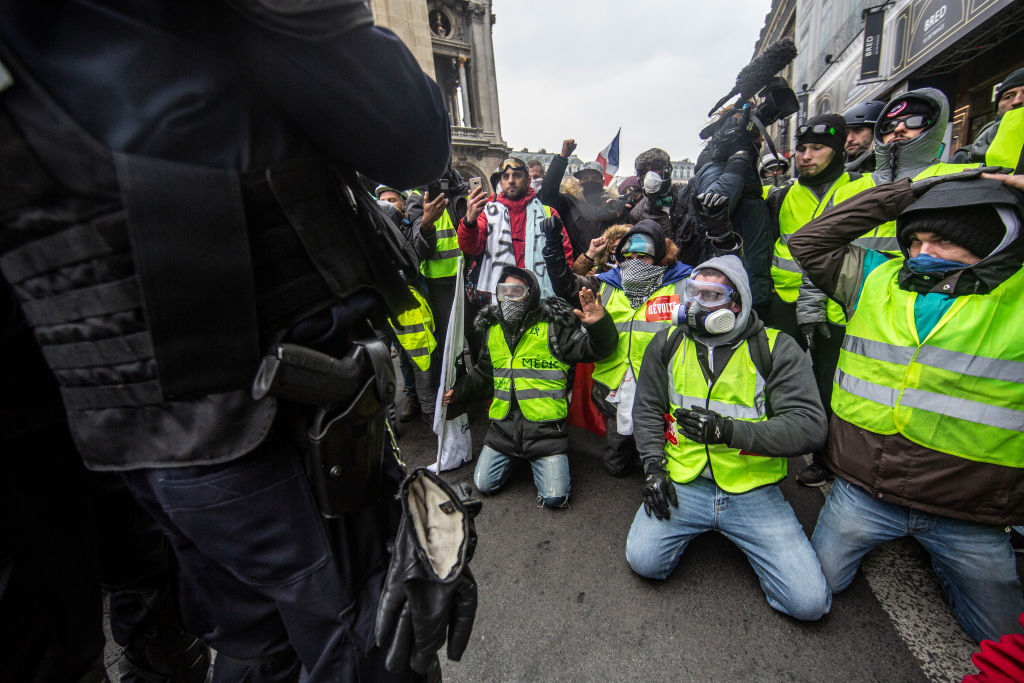
French President Emmanuel Macron seems to hope that weariness will lead the "yellow vests" protestors to give up, but there seems no sign of it yet. On the contrary, the "yellow vests" seem dedicated to bringing him down. Pictured: "Yellow vests" protesters on December 15, 2018 in Paris, France. (Photo by Veronique de Viguerie/Getty Images)

Strasbourg, France. Christmas market. December 11th, 8pm. A man shouting, "Allahu Akbar" ("Allah is the greatest") shoots at passersby, then wounds several with a knife. He murders three people on the spot and wounds a dozen others, some severely. Two will later die of their wounds. The murderer escapes. Two days later, the police shoot him dead.

He was known to the police. When members of the General Directorate of Internal Security and some gendarmes came to his home a few hours earlier, he had escaped. Although they knew he was an armed and dangerous Islamist ready to act, and that Christmas markets had been, and could be, likely targets, no surveillance was in place.

The murderer, Cherif Chekatt, should, in fact, have been kept off the streets. He was 29 years old, his name was on the list of people reported for terrorist radicalization (FSPRT), and he and had already been sentenced for crimes 27 times. He was nevertheless roaming around free, with no police oversight.

His case is similar to that of many jihadi terrorists in France in the last decade. Others include Mohamed Merah, who murdered Jewish children in Toulouse in 2012; Cherif and Said Kouachi, who murdered most of the staff at the satirical magazine Charlie Hebdo in 2015, and Amedy Coulibaly, who murdered people at a kosher supermarket few days later.

Successive governments have done exactly nothing to remedy the situation. Instead, they delivered speeches and stationed soldiers about the streets. "Young French people must get used to living with the threat of attacks", then-Prime Minister Manuel Valls said in 2015. Two years later, just before the first round of the presidential elections, Emmanuel Macron, still a candidate, used almost the same words. Terrorism, he said, is "imponderable" and will constitute a "threat that will be part of the daily life of the French for the years to come".

French laws are extremely lax. Even serial killers and terrorists are not sentenced to long prison terms. Most prisons have become jihadist recruiting stations. Currently, more than 600 no-go zones are under the control of imams and Muslim gangs. Islamists, apparently "ready to act", number in the thousands. The police simply do not have the personnel or material resources to monitor all of them

The only political leaders who have proposed tougher laws against terrorism, or who have said that exceptional measures were needed -- such as a wider use of electronic ankle-bracelets -- to counter increasing threats, come from parties considered "right-wing". The mainstream media immediately branded these leaders as "extremists" and their proposals were dismissed.

Macron and his government continue their unfortunate tradition of submitting to political correctness. It seems they prefer to appease extremists rather than confront them.

These politicians are undoubtedly aware that more riots could take place. In 2016, the head of the French General Directorate for internal Security, Patrick Calvar, spoke of a high risk of "clashes between communities", perhaps even civil war.

These officials evidently understand that the terrorists are engaged in a long war and that it will be difficult to stop them; so they seem to have given in. These officials are no doubt aware that young French Muslims are being radicalized in increasing numbers. The response, however, has been to strengthen Muslim institutions in France.

Although these officials also presumably see that Muslim immigration into France continues, and that hundreds of thousands of illegal Muslim migrants are creating increased security concerns, they do nothing to reverse the trend. The number of deportations is rising, but are still rare: slightly more than 26,000 persons were deported in 2017. Meanwhile, more than 150,000 illegal immigrants live in Seine Saint Denis, near Paris. Macron, since becoming President, has repeatedly said that those who call on him to expel illegal immigrants are "xenophobic".

Macron and the current government, in fact, have been encouraging more migration: all illegal immigrants in France receive financial assistance if they ask for it, as well as free health care; and they run almost no risk of being deported.

Each year, more than 200,000 residence permits are issued (262,000 in 2017), including to illegal immigrants. Many have no marketable skills, some receive for decades the minimum income paid to anyone in difficulty.

Social support for migrants, legal or not, adds to the cost of an increasingly expensive welfare system. France today is the most highly taxed country in the developed world: compulsory levies correspond to more than 45% of GDP. Unemployment is high at 9.1%. Typical salaries are both low and stagnant. A public school teacher starting out earns 1,794 euros per month ($2,052). A police officer after a year of service earns even less: 1,666 euros per month ($1,906).

Macron, when elected president, promised to boost growth and improve purchasing power. To encourage large and multinational companies to invest in France, he lowered their taxes and eliminated a tax on wealth. As he apparently did not wish to increase the French budget deficit (2.6% in 2017), he created new taxes and increased a few of the taxes paid by the entire population, including fuel taxes.

It was in this context that the "yellow vest" ("gilets jaunes") protestors – who have been rioting throughout France for the eight weekends, came into being. They have vowed to keep on demonstrating.

The new taxes, plus the increase in existing taxes, have led many people into real financial straits. Many also saw the reduction of taxes on large companies coupled with the removal of the wealth tax for the rich as outrageously unfair. They see perfectly well that a lack of security is spreading, that immigration is exploding and that the government is not providing sufficient law and order.

Macron's remarks, such as a comparing "those who are successful and those who are nothing" -- or his assertion that "the life of an entrepreneur is much harder than that of an employee" -- gave him the image of an arrogant upstart who despises the poor and knows nothing about the problems they face. Some of his utterances -- such as, "there is not a French culture" or the French are Gauls "resistant to change" -- led many to believe that he did not even have respect for the French or for France.

The proliferation of speed radars on the roads, and the lowering of the speed limit to 80km/h, apart from freeways, as well as a noticeable increase in speeding tickets as a result, also did nothing to help his approval ratings.

Finally, an additional increase in fuel taxes sparked a revolt that has not stopped to this day.
The first protest by the "yellow vests", which took place on November 17, spontaneously gathered hundreds of thousands of people across the country and had the support of more than 80% of the population.

Rather than react quickly and say that he understood the difficulties of millions of French, Macron waited 10 days until a second demonstration, bigger than the first, to respond. He then delivered a speech focusing on the environment and emphasizing that fuel taxes were necessary to fight "climate change".

His words appeared totally out of touch with the economic distress felt by the public.

Four days later, on December 1, a third demonstration drew even more people than the second. Protestors waved French flags and sang the national anthem. People who spoke on television said that Macron had made fun of them and reminded him of his promises. They demanded his resignation, new elections, and a return of sovereignty to the people.

Gangs from the suburbs looted stores and destroyed property. The police were particularly brutal to the protesters, but could not stop the looting or destruction.

Macron said nothing.

On December 8, the day of the fourth demonstration, Paris was effectively set under siege. Armored vehicles were deployed along the main avenues. Thousands of police officers sealed off access to the neighborhood of the presidential residence, the Élysée Palace. A helicopter waited in the courtyard of the Élysée Palace, in case Macron needed to be evacuated. Looting and destruction began again.

When Macron finally decided to say something, on December 10, he announced a slight increase in the minimum wage and the removal of some taxes. He promised to open a "national debate" and announced the need to review the rules for immigration. However, at the time Macron was speaking, one of his emissaries was in Morocco on behalf of France to sign the UN Global Compact for Safe, Orderly and Regular Migration, which defines immigration as "beneficial" for the host countries. Under it, signatory states pledge to "strengthen migrant-inclusive service delivery systems." The next day, the terrorist attack near a Christmas market in Strasbourg took place, in which five people were murdered.

The public's anger did not subside. The "yellow vest" protestors who spoke on television the following days said that Macron had evidently not taken the measure of what they were saying. They stated that talking about reviewing the rules for immigration while signing the Global Compact -- without taking into account the opinion of the population -- showed that Macron was a liar.

A group of retired generals published an open letter, saying that signing the Global Compact was a further step towards "the abandonment of national sovereignty" and noted that "80% of the French population think that immigration must be halted or regulated drastically".

"In deciding alone to sign this pact," the generals wrote, "... You are guilty of a denial of democracy, even treason, with respect the nation".

The Minister of Defense, Florence Parly, said that the generals' letter was "inadmissible and unworthy", but did not dispute the arguments it set forth. Again, Macron said nothing.

On December 22, when the fifth demonstration of the "yellow vests" took place, even though the protestors were fewer, their anger seemed more intense. Calls for Macron's resignation came from everywhere. A puppet representing Macron was symbolically beheaded by an imitation guillotine. A sculpture representing a yellow hand, resembling the logo of SOS Racism, the oldest organization fighting "racism" and "Islamophobia" in France, was burned.

Anti-Semites took the opportunity to offer their usual opinions, but were marginal. Benjamin Griveaux, the government spokesman, however, used their comments to attack the "yellow vest" protestors. He sent a tweet saying that the "yellow vests" were "coward[s], racist[s], anti-Semitic", and of the type that stages coups. Earlier, he had said that whatever happens, Macron would not "change course".

Macron seems to hope that weariness will lead the "yellow vests" to give up, but there seems no sign of it yet. On the contrary, the "yellow vests" seem dedicated to bringing him down. Those on television say they are determined to fight "to the end". The economic damage is considerable; the first estimates numbered hundreds of millions of euros.

"Macron and his team," wrote Ivan Rioufol, an editorial writer at Le Figaro, recently, "would be wrong to believe that if the mobilization weakens during the Christmas truce, it means they are out of the woods".

The author Éric Zemmour described the revolt as the result of the "despair of people who feel humiliated, forgotten, dispossessed of their own country by the decisions of a contemptuous caste". He concluded that he thinks that Macron has lost all legitimacy and that his presidency is over.

Radio commentator Jean-Michel Aphatie, said that the presidency and the government "hang on by a thread", and that the letter published by the generals is a strong sign that the French institutions are deeply shaken. "If the police falter," he stressed, "France could quickly slide towards chaos".

On December 20, two days before the fifth demonstration of the "yellow vests," police officers organized a protest in front of the Élysée Palace. The vice-president of an organization made up of police officers said that many members are exhausted, feel sympathetic to the revolt and are ready to join it.

The next day, the government increased police officers' salaries and paid them millions for overtime -- payments that had been overdue for months.

"The authorities are really afraid that the police could turn on them," commented the journalist Jean-Michel Aphatie. "It is hard to imagine. It is where we are in France, today".

The Macron's popularity is in free fall; it has dropped to 18%. No French president's popularity has dropped so low, so quickly. Flore Santisteban, a professor at the Paris Institute of Political Studies, quoted surveys showing that Macron now crystallizes "an intense hatred, and maybe more than hatred: rage".

Many commentators are wondering how Macron will still be able to govern in the coming weeks, and ask if he could be forced to resign and call for early presidential elections.

Several news analysts have said that this time, Marine Le Pen, the leader of the right-wing, populist National Rally party, could be elected president. The themes of her presidential campaign in 2017 resembled the claims of the "yellow vest" movement.

Macron still says nothing. He is nowhere in sight. His only recent public statements were made in foreign countries: Belgium and Chad. His last public appearance in France was on December 4, in the Massif Central, late in the evening. He went to see the damage done to an official building partly burned by vandals. Although his visit was unannounced, dozens of "yellow vests" arrived, insulted him, and he quickly left.

Polls show that Le Pen's National Rally could win the European Parliament elections in May 2019 with 24%-25% of the vote. Another right-wing, nationalist party, Debout la France! (France, Stand Up!) headed by MP Nicolas Dupont-Aignan, and allied to the National Rally party , could get 8%. The total would amount to 32%-33% percent of the vote. Macron's La République En Marche ! party, created two years ago, is expected to get only 18% of the vote.

Election to the European Parliament has no direct impact on French political life. Such a result, however, would be a scathing disavowal of Macron -- if he manages to stay in power until then.

A few months ago, Macron introduced himself as the champion of an open, "progressive" and multicultural Europe and described the defenders of national sovereignty and all those hostile to immigration and multiculturalism, as "lepers" and supporters of "bellicose nationalism" extolling "the rejection of the other". He pretended easily to triumph over them.

In July 2017, he hinted that he would rule like the Roman god Jupiter. It did not take long for him to fall from his pedestal.

On the evening of December 31, Macron offered the French people his wishes for the year 2019. He did not apologize. He ignored the grievances of the "yellow vest" protesters and their supporters. He merely said that "anger broke out" and that "order will be maintained without indulgence". He described in positive terms all that he had done since becoming President. He added that he would "go forward" in the same direction without changing a thing: "I intend to continue to follow the line that I traced since the first day of my mandate". He described his political opponents as "extremists", "demagogues" and "megaphones of a crowd full of hatred". He again said that the "fight against global warming" is an absolute priority.

Many of the "yellow vest" protestors, interviewed on television, appeared upset; some said they had decided not even to listen to the speech. Macron's political opponents criticized him harshly. Nicolas Dupont-Aignan wrote:
"Tonight the French had the confirmation that Emmanuel Macron learned nothing from the events of 2018. While his politics brought together more than 75% of the French against him, he appeared determined to continue, in defiance of democracy."
Laurence Saillet, of the moderate right party, The Republicans, said:
"I feel that while the 'yellow vests' were protesting, he was on another planet... He has not taken the measure of the country's anger. He makes no mea culpa, he even assessed his actions positively, precisely what is rejected by the French."
Marine Le Pen tweeted, "This president is an impostor. And a pyromaniac."

On January 3, Eric Drouet, one of the main faces of the "yellow vests" movement was arrested by a dozen policeman on his way to the Place de la Concorde in central Paris to light candles to pay tribute to the "yellow vests" wounded or killed since the beginning of the demonstrations. He was peacefully walking on the sidewalk with 15 to 20 of his friends. None of them was shouting or wearing banners, or even a yellow vest. Drouet was indicted for organizing an illegal protest. Macron's political opponents said that Macron was adding more fuel to the fire.

On January 4, after the first cabinet meeting of the year, Macron asked government spokesman Benjamin Griveaux to say that "those who continue to protest... are agitators who promote insurrection", and that the government must "go further, in a stronger way".

On Saturday January 5, thousands of "yellow vests" protested again, calling for Macron's resignation. They broke down the doors of Griveaux's office building as he fled. By evening, the streets of Paris and other cities looked like battlefields once more.

Guy Millière, a professor at the University of Paris, is the author of 27 books on France and Europe.

Source: https://www.gatestoneinstitute.org/13500/france-in-free-fall

Follow Middle East and Terrorism on Twitter


Financial institutions moving to shut foes of jihad terror out of the financial system altogether - Robert Spencer

​
by Robert Spencer

Hat tip: Dr. Jean-Charles Bensoussan


"Abandon free speech or lose your ability to process payments". Has it come to this?

Oppose jihad? Then starve.

This is not hysterical. It’s coming. In some ways, it is already here. It has started with me, but it won’t end with me. Read on. And donate to Jihad Watch, a 501c3 organization, here, and get the book The History of Jihad here, while you still can. It is not at all outside the realm of possibility that you may not be able to do either in the very near future.


“Bokhari: The Terrifying Rise of Financial Blacklisting,” by Allum Bokhari, Breitbart, January 2, 2019:

It is the most totalitarian form of blacklisting: not just to be prevented from speaking on a university campus, or to be kicked off social media, but to be shut out of the entire financial system. That is the terrifying new threat to freedom that western societies must now contend with.
Financial blacklisting doesn’t just rob you of a chance to spread your message: it robs you of your ability to do business, your livelihood, your very means of functioning in a capitalist society. Thanks to the encroachment of progressive ideology into the financial industry — including major credit card companies like Visa, Discover, and Mastercard — it has now become a reality.
I first wrote about the rise of financial blacklisting in July, in a column for Breitbart News in which I highlighted the growing tendency of online financial platforms — as well as Visa and MasterCard — to deny service to customers for political reasons. I was surprised to receive a strongly worded comment from the liberal Electronic Frontier Foundation (EFF), who bluntly warned that banks and credit card companies had become “de facto internet censors.” That even liberal groups had raised the alarm signaled the seriousness of the problem.
Since then, financial blacklisting has only gotten worse. In August, Mastercard and Discover deplatformed conservative and Islam critic Robert Spencer. In the same month, Visa and Mastercard ceased service to David Horowitz. While credit card processing service to Horowitz was eventually restored, Spencer remains financially blacklisted.
Crowdfunding platforms like Patreon, which allow online content creators to collect donations from their supporters, are frequently cast as the primary villains in financial blacklisting. Patreon’s recent ban of YouTuber Carl Benjamin, better known by his moniker Sargon of Akkad, triggered a crisis for the platform. Both donors and creators — including prominent atheist Sam Harris — quit the platform in protest, while Jordan Peterson and Dave Rubin pledged to create an alternative platform that is pro-free speech.
But Patreon and other crowdfunding platforms are not the real villains. They are dependent on the whims of the credit card companies, something that was already apparent in August when Mastercard forced them to withdraw service from Robert Spencer. We now know that the credit card companies were also a factor in Patreon’s decision to boot Benjamin.
YouTuber and Patreon creator Matt Christiansen recently released a transcript of his conversation with Jacqueline Hart of Patreon about Benjamin’s ban. Hart frankly admits that the sensibilities of credit card companies play a key role in Patreon’s decisions.
Here’s an excerpt of that transcript (emphasis ours):
JACQUELINE: The problem is is Patreon takes payments.  And while we are obviously supportive of the first amendment, there are other things that we have to consider. Our mission is to fund the creative class. In order to accomplish that mission we have to build a community of creators that are comfortable sharing a platform, and if we allow certain types of speech that some people would call free speech, then only creators that use Patreon that don’t mind their branding associated with that kind of speech would be those who use Patreon and we fail at our mission.  But secondly as a membership platform, payment processing is one of the core value propositions that we have. Payment processing depends on our ability to use the global payment network, and they have rules for what they will process.
MATT:  Are you telling me that this was Patreon’s decision then, or someone pressured you into this?
JACQUELINE:  No – this was entirely Patreon’s decision.
MATT:  Well then I don’t understand passing the buck off to somebody else.
JACQUELINE:  No, I’m not passing the buck off.  The thing is we have guidelines, but I’m trying to explain, #1 it is our mission to fund the creative class and obviously some people may not want to be associated.  
MATT:  Well if it’s your mission, then payment processors are irrelevant.  It’s your mission. That’s what you’re pursuing.
JACQUELINE:  We’re not visa and mastercard ourselves – we can’t just make the rules.  That’s what I’m saying – there is an extra layer there.
This “extra layer” places platforms like Patreon in an impossible position: abandon free speech or lose your ability to process payments. That’s also why so many free-speech alternatives to Patreon have failed: FreeStartr, Hatreon, MakerSupport, and SubscribeStar all tried to offer a more open platform, and were promptly dumped by the credit card companies. All are unable to do business.
This exposes the emptiness of establishment conservative arguments about the free market. Those who oppose Silicon Valley censorship aren’t allowed to just build their own alternative platforms. They must build their own global payment processing infrastructure to have any hope of restoring free speech online.
That, or they must find a way to stop Visa, Mastercard and Discover from taking advice from the far-left Southern Poverty Law Center (SPLC) and Color of Change. The former was allegedly responsible for the blacklisting of Robert Spencer, while the latter claims to have removed 158 funding sources from “white supremacist sites” — although as the group won’t list what those sites are, we don’t know if they really are “white supremacist.” The far left typically includes regular Trump supporters under the label….

Robert Spencer

Source: https://www.jihadwatch.org/2019/01/financial-institutions-moving-to-shut-foes-of-jihad-terror-out-of-the-financial-system-altogether

Follow Middle East and Terrorism on Twitter