Sunday, January 20, 2019

The Vatican Surrenders to China - Lawrence A. Franklin

​
by Lawrence A. Franklin

The Vatican may learn the hard way that the Communist Chinese government does not honor its agreements.

  • The Vatican may learn the hard way that the Communist Chinese government does not honor its agreements. Beijing may attempt to extort even more concessions from the Vatican, just as the Chinese regime demands ever more surrender of sovereignty from western companies that do business in China.
  • It is also highly dubious that the Vatican will purchase peace by this pact: the regime will continue to persecute the Church. If the Communist regime is true to form, thousands more crosses will be taken down from Christian churches, especially in areas that have a high Christian population.
  • The courageous elders of Chinese Catholicism, who have endured decades of government persecution and regime efforts to divide the Church, may be seen by their flocks as having been bypassed by the Vatican. Many, if not most, Chinese Catholics are likely to view this agreement as a cynical political betrayal by the Vatican rather than a faith-based decision.
  • "In light of this dismal record, it seems that prudence and caution would seem to be the order of the day in Vatican negotiations with the totalitarians in charge in Beijing, at whose most recent Party Congress religion was once again declared the enemy of Communism." — George Weigel, Catholic author and political analyst.
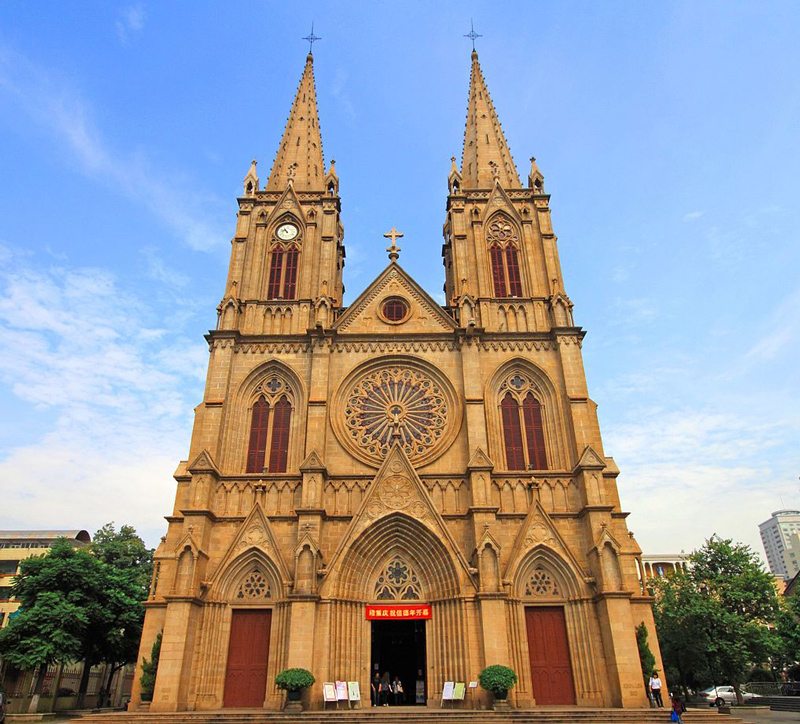
With a recent agreement signed between the Vatican and China's regime, Pope Francis surrendered partial control of the Chinese Catholic Church to the Chinese Communist Party. Pictured: The Sacred Heart Cathedral in Guangzhou, China. (Image source: Zhangzhugang/Wikimedia Commons)

Pope Francis has surrendered partial control of the Chinese Catholic Church to the Chinese Communist Party (CCP). His Holiness agreed to grant the Party considerable authority over personnel matters. After decades of refusing to give China the right to appoint Catholic bishops, as a condition for normalization of relations, the Vatican finally conceded to the regime's demand to allow the CCP a decisive role in the selection of bishops to head Catholic dioceses.

The Vatican's concession came despite the CCP's continued persecution of the unofficial, independent, underground Catholic Church in China. Yet the Vatican probably does not view this as a defeat but rather as a means to an end. The diplomatic hierarchy of the Catholic Church may be confident that the truth of its spiritual message will endure long after the CCP dissolves into the same historical trash bin as other totalitarian ideologies have done.

The Church's consenting to fold its independent political posture into the Chinese regime's Communist Party apparatus gives Beijing the authority to appoint bishops politically acceptable to the CCP. In granting China this right, the Vatican implicitly is recognizing the legitimacy of the regime's CCP instrument to infiltrate and control Roman Catholicism in China, which is the Chinese Patriotic Catholic Association (CPCA).

Pope Francis has also reinstated several pro-regime bishops whom the Vatican had once excommunicated because they willingly agreed to follow Communist China's directives, while forsaking their loyalty to the Church in Rome. Finally, the Holy See's bureaucracy also accepted Beijing's demand to reduce and restructure the Catholic Church's 137 dioceses across China.

This last Vatican concession may shred the religious authority of several bishops secretly appointed to some of these eliminated dioceses by Pope Francis and previous popes. For almost 70 years, after the CCP's successful takeover in China, Catholics have either attended churches approved by the government's Chinese Patriotic Catholic Association or churches aligned with the Vatican. Some Catholics even attend Mass in private homes to avoid surveillance by agents of the regime.

After a series of recent meetings between the Holy See and China's State Administration for Religious Affairs, Pope Francis dispatched a delegation in mid-December to meet with leading bishops of the pro-Vatican "Underground Church" and Chinese government officials. The delegation was ostensibly in China to pursue "practical steps" to implement the provisional agreement the Holy See had reached with China.

In reality, the Papal delegation may have been sent to China to make certain that the agreement's final implementation proceeded smoothly. The delegation included the Vatican's President-Emeritus of the Pontifical Council for Social Communications, Archbishop Claudio Maria Celli. The Archbishop carried a document signed by the Holy See's Secretary of State, Cardinal Pietro Parolin and by Cardinal Fernando Filoni, Prefect of the Vatican's Congregation for the Evangelization of Peoples.

The delegation's Papal directive instructed at least two prominent Catholic bishops of the "Underground Church" to retire or share their official duties with bishops approved by the CCP. While the exact wording of the Holy See's letter remains secret, some Vatican observers, presumably reflecting the Pope's decision to reverse years of resisting Beijing's demands, cited a few reasons for giving in. First, the Church probably needs to eliminate confusion among Catholics in China over the schism between Vatican-approved and regime-approved bishops. Another possible reason for the Vatican's apparent flexible stance is that a Church-state compromise would be necessary to improve pastoral care for existing Catholic faithful. The decision by the Vatican not to publish the letter, however, may suggest that the regime is also demanding that the Holy See break relations with Taiwan before it can normalize diplomatic ties to China. This supposition is based on the character of Beijing's previous agreements establishing bilateral relations with other countries, including Panama. Other countries that cut ties to Taiwan in order to open up embassies in China include the tiny African country of São Tomé and Príncipe as well as El Salvador. The prerequisite that states desiring formal ties with China must first sever formal diplomatic relations with Taiwan rests on Beijing calls its "One China" policy.

Communist China considers Taiwan an integral part of China, and thus rejects Taiwan's claim that it represents the legitimate government of China.

The Vatican's public relations officers seem to have tried to put the best face on the agreement with Beijing. Gregory Burke, the recently resigned Director of the Holy See's Press Office, suggested that this pact with the CCP was designed to be pastoral, not political, implying that it would help unify Chinese Catholics. The Vatican, however, in a seeming effort to douse speculation, has refused to reply to inquires whether the agreement is a first step in establishing diplomatic relations between the Holy See and the People's Republic of China. About half of the 98 dioceses have no Vatican-approved bishops, thereby often leaving their parishes without clerics to administer to believers. It is clear from Beijing's anti-Catholic harassment campaign that the Communist Party leadership is determined to co-opt, if not destroy, the independence of the Church in China. Regime harassment includes the dispatch of internal security police to strip churches of their statues, and the removal of crosses from steeples. Sometimes bibles are confiscated if seen in public. Masses are often celebrated in private homes to avoid being monitored by the state. On one occasion in early 2018, an entire Catholic Church was demolished, prompting a street demonstration by parishioners.

Perhaps the Vatican might be privately concerned that the CCP's continued opposition could complicate evangelization efforts among the Chinese people. The Vatican's desire to reach an agreement with Beijing may also be, in part, a reaction to the regime's efforts to sow dissent in the Church by supporting the Chinese Patriotic Catholic Association as an alternative church. With President Xi Jinping's endorsement, at the October's 19, 2018 Chinese Communist Party Congress, Beijing launched a "Sinicization" campaign to bring all religions in line with Chinese culture and values. This government tactic is probably designed to co-opt or to curb the growth of an independent Catholic Church, thereby enhancing Communist Party control of religion in China. One report alleges that Catholic evangelization of the Chinese people is stagnating in marked contrast to the rapid expansion of Protestant Christianity in the country. This disparity underscores the significance of Cardinal Filoni's presence in the Vatican delegation to China's Catholic Bishops: Filoni is responsible for the Vatican's worldwide evangelizing campaigns.

The Vatican's pact with Beijing is evoking a good deal of intense criticism from both leading Catholic intellectuals and human rights crusaders. Retired Cardinal of Hong Kong Joseph Zen bitterly critiqued the agreement as "an incredible betrayal," tantamount to giving "the flock to the wolves." The China Director of Human Rights Watch, Sophie Richardson, stated that "the Pope has effectively given Chinese leader President Xi Jinping a stamp of approval when the latter's hostility to religious freedom couldn't be clearer."

Even while Beijing and the Vatican were negotiating the future status of the Catholic Church in China, the Communist regime continued its pressure on the Underground Catholic Church to go along with its efforts to get the Vatican to comply with the state's wishes on the administration of the Catholic Church in China. The government harassed and arrested Bishop Joseph Guo Xijin during the years-long negotiations between the Holy See and China. During the talks, another Catholic prelate, 88 year-old pro-Vatican Bishop Peter Zhuang, was hauled before China's State Administration for Religious Affairs. Although Bishop Zhuang was released into the custody of a Vatican delegation, the event was held in the presence of Chinese Party officials, where he was coerced to retire in light of the Vatican-China deal.

Perhaps the true intention of the Communist regime was best characterized by Jesuit China expert at Santa Clara University, Father Paul Mariani, in December, 2018:
"The government has not given up its hope for control. They want the Church to be another tool of the state. That's common in China, across labor unions or NGOs — they all have to fall under the party at some level."
The Vatican may learn the hard way that the Communist Chinese government does not honor its agreements. Beijing might well attempt to extort even more concessions from the Vatican just as the Chinese regime demands ever more surrender of sovereignty from western companies that do business in China. These demands can include a requirement to form joint ventures with a Chinese company, with China holding a majority interest, the demand that all critical data be stored locally, and scrubbing any language to which Beijing objects.

It is also highly dubious that the Vatican will purchase peace by this pact: the regime will continue to persecute the Church. If the Communist regime is true to form, thousands more crosses will be taken down from Christian churches, especially in areas that have a high Christian population. In 2015, in Zhejiang Province, in the southeastern city of Wenzhou, where one in eight citizens are Christian, approximately 1,200 crosses were forcibly torn from their moorings.

The only likely benefit that the Vatican could derive from this Munich-style pact with the Chinese regime may be an official invitation to Pope Francis to visit China. That privilege, however, might well be outweighed by the potential harm for the future of Catholicism in China. The courageous elders of Chinese Catholicism, who have endured decades of government persecution and regime efforts to divide the Church, may be seen by their flocks as having been bypassed by the Vatican. Many Chinese Catholics, realizing that their hierarchy was reluctantly fused by the Vatican into a union with the state-controlled church, might retreat into private homes to attend Catholic services. Many, if not most, Chinese Catholics are likely to view this agreement as a cynical political betrayal by the Vatican rather than a faith-based decision.

The eminent American Catholic author George Weigel sums up the Vatican's past failed policies of negotiation with totalitarian regimes:
"In light of this dismal record, it seems that prudence and caution would seem to be the order of the day in Vatican negotiations with the totalitarians in charge in Beijing, at whose most recent Party Congress religion was once again declared the enemy of Communism."

Dr. Lawrence A. Franklin was the Iran Desk Officer for Secretary of Defense Rumsfeld. He also served on active duty with the U.S. Army and as a Colonel in the Air Force Reserve. He is also a practicing Catholic.

Source: https://www.gatestoneinstitute.org/13577/vatican-catholics-china

Follow Middle East and Terrorism on Twitter


Iron Dome intercepts projectile over Hermon region - Mordechai Sones

​
by Mordechai Sones

Launch identified short time ago over northern Golan Heights intercepted by Iron Dome, according to IDF Spokesman.


Visitors to the Hermon site, which is now full of skiers, reported today an interception was carried out by the area Iron Dome system.

A short time later, the IDF Spokesman issued a statement that a launch was identified over the northern Golan Heights area and was intercepted by the Iron Dome system.

According to the Hermon site routine continues, according to army instructions.

Earlier in the day, Syria announced its air defense systems had foiled an Israeli air strike in the south of the country.

A military source told the SANA news agency: "Our air defense systems thwarted Israel's air strike and prevented it from achieving its objectives." However, the source did not add further details. The IDF Spokesman did not respond to Syrian reports and claims.

Opposition sources later claimed the targets were Iranian bases located south of Damascus.


Mordechai Sones

Source: http://www.israelnationalnews.com/News/News.aspx/257870

Follow Middle East and Terrorism on Twitter


Report: Nasrallah embezzled millions from Hezbollah funds - Israel Hayom Staff

​
by Israel Hayom Staff

Saudi news outlet Al-Watan says Iranian forces have Hezbollah leader Hassan Nasrallah under house arrest and are pressuring him to divulge what happened to the tens of millions of dollars reportedly missing from Hezbollah bank accounts.


Hezbollah leader Hassan Nasrallah
Photo: EPA 

Hezbollah leader Sheikh Hassan Nasrallah is suspected of embezzling millions of dollars from the terrorist organization's coffers, the Saudi website Al-Watan Online reported Saturday.

According to Al-Watan, Nasrallah is under house arrest, guarded by Iranian forces, and is reportedly receiving medical treatment.

The Al-Watan report painted a dim picture of Nasrallah's situation, saying that the Iranian forces guarding him were pressuring him to divulge what had happened to tens of millions of dollars that Iran had deposited into Hezbollah's accounts. Nasrallah and his associates are suspected of taking the missing money for personal use.

There has not been any independent confirmation of the Al-Watan report. Sunni Saudi Arabia and Shiite Iran are arch enemies and are waging several proxy battles across the region.

Observers confirmed to Al-Watan that Hezbollah was in an "unusual" situation, with its leaders in worse shape than they have been since Iran founded the Lebanese Shiite proxy. The report said that Nasrallah's recent media absence was directly related to the missing millions.

The Al-Watan report comes a week after Lebanese media outlets reported on Jan. 12 that the Hezbollah leader had suffered a heart attack and was hospitalized in "serious condition" in Beirut. Other reports said that he had suffered a stroke and was fighting cancer.

None of the Lebanese reports about Nasrallah's health received official confirmation.


Israel Hayom Staff

Source: http://www.israelhayom.com/2019/01/20/report-nasrallah-embezzled-millions-from-hezbollah-funds/

Follow Middle East and Terrorism on Twitter


The Netherlands’ Profound Hypocrisy on the Jews - Dr. Manfred Gerstenfeld

​
by Dr. Manfred Gerstenfeld

Ignoring the truth of its past enables the Dutch government and parts of the political system to act as moral judges over others, with Israel a prime target.


The synagogue in Veghel, the Netherlands. All the Jews in the town of Veghel 
were killed during the Holocaust. Photo via Wikipedia

BESA Center Perspectives Paper No. 1,068, January 20, 2019

EXECUTIVE SUMMARY: The Netherlands’ attitude towards the Jews reveals Dutch society to be profoundly hypocritical. The Dutch government remains the only one in Western Europe that consistently refuses to admit, let alone apologize for, the massive failures of its predecessors towards the Jews during WWII. Ignoring the truth of its past enables the Dutch government and parts of the political system to act as moral judges over others, with Israel a prime target. 

The Netherlands is a profoundly hypocritical society. To prove such a statement in detail would require a lengthy book. One shortcut to support this claim is to look at the history of the relationship between Dutch Jews and the society at large.

The extreme behavior of the Dutch is not readily visible. The Netherlands isn’t particularly hospitable to its Jews, but neither can one rank its attitude towards them among Europe’s worst. Only a handful of foreign correspondents are based in the country, so negative aspects of the Netherlands rarely make it into the international media.

In May 1940, the Netherlands was occupied by the invading Germans within a matter of days. In the years to follow, more than 70% of its 140,000-strong Jewish population were murdered after having been sent to German camps, mainly in Poland. In the preparatory activities for what would lead to genocide, the Dutch authorities followed Nazi orders. Dutch police arrested Jews, including babies, simply for being Jews. Dutch railways transported Jews to the Dutch transit camp Westerbork, and from there to the German border. Dutch police guarded the Jews in the camp.

The Dutch government in exile in London gave no instructions to the bureaucracy in their occupied country. One government employee in London, Henri Dentz, wrote a report in December 1943 that stated that most Dutch Jews had already been murdered. This report was sent to all ministries and to a number of other Dutch institutions in London, including the Red Cross. After the war, Dentz testified that nobody wanted to read it.

While authorities in the occupied Netherlands assisted the Nazis, a small minority of good Dutchmen helped 24,000 Jews to hide. A third of these were ultimately betrayed. According to a historian with whom I spoke, the Netherlands was the only occupied country in which a group of volunteers and a special police unit were paid to hunt down Jews in hiding.

In spite of all this, the Dutch government remains the only one in Western Europe to consistently refuse to admit the huge failures of its wartime predecessors towards the Jews. Even the small states of Luxembourg and Monaco have admitted their wartime misconduct and offered apologies.

In an interview with an Israeli government radio station in 2000, then Dutch PM Wim Kok said: “The Dutch have never been responsible for the misconduct of the Germans in the Netherlands during the war.” He made no reference to the responsibility for wartime misconduct towards Dutch Jews by Dutch authorities, institutions, and many individuals. It was a classic straw man argument. No one accuses the Dutch of committing the Nazis’ crimes, only of committing their own.

This absence of admission and apology for crimes and negligence is a key element of the hypocrisy of Dutch society. That hypocrisy can be seen in Dutch behavior elsewhere. The Netherlands committed major war crimes in the military campaigns of 1947 and 1948 – euphemistically known as “police actions” – in its then colony, the Dutch Indies, now Indonesia.

Over the decades, hardly anyone has cared about those Dutch crimes, even after the publication of information about them. Consider, for example, the case of Dutch officer Raymond Westerling, who was in charge of “pacifying” parts of the island of Sulawesi during the Indonesian war. An interview with him in which he admitted to war crimes was filmed in 1969. Not a single Dutch TV station agreed to broadcast it. It was finally shown in 2012. In 1971, Westerling told a journalist over a glass of diluted whisky that he had court-martialed 350 captives and personally executed them. Again, no action was taken by justice authorities. In the late 1960s, a young Dutch historian, Cees Fasseur, was officially charged with investigating these “police actions.” He later admitted the superficial nature of his research.

In 1997, historian Ad van Liempt wrote a book, The Train of Corpses, in which he detailed how the Dutch starved to death about half of the local captives on a train transport during that war. Van Liempt told me that many had found it scandalous that he had written the book. A Dutch filmmaker known personally to me made a movie in 1995 about the Dutch army’s mass killings of hundreds of men in the village of Rawagede on the island of Java. He told me the locals spoke of similar crimes that had taken place in nearby villages.

In 2017, Dutch-Swiss historian Rémy Limpach published an 870-page book – with more than 2,400 footnotes – about Dutch war crimes that had been committed in 1947 and 1948 in the Dutch Indies against independence fighters and criminal bands. He concluded that these crimes were structural, not incidental, as had been previously claimed. The book gives many examples of the soldiers committing arson, torturing and shooting prisoners, and killing women and children. It also mentions their rape of minors. Several reviews were published, but there were no major reactions in Dutch society.

I asked two leading Dutch historians why the Netherlands is so indifferent towards its problematic past. Frank van Vree answered: “The history of war memory shows that the Netherlands is willing to look at the weaknesses of its society. But at the same time the obstinate thought exists that the Netherlands has erred in many ways; but all in all it has done many things better than others…The feeling of  ‘if we haven’t done it well, we’ve done it better than others’ is deeply ingrained in Dutch culture. On the one hand there is acknowledgement, on the other hand there is glossing over.”

Hans Blom said, “The Netherlands is a country where the need to make compromises was present very intensely early in its history. In addition one can say that the Netherlands in the 19th and 20th century has developed a tradition to think that ‘we’ are a country with very high moral standards. In the 19th century it became unavoidably clear that the powerful Netherlands of the Republic of the United Netherlands was no longer a significant factor…In these small Netherlands a self-image emerged that it is nicer to be the world’s most moral nation, rather than the most powerful. In such a tradition of high moral self-image, it is more difficult to publicly and properly treat events where that is evidently not the case.”

In this environment of make-believe, Dutch PM Mark Rutte even dared, in 2015, to say about the Netherlands: “We have a marvelously perfect country, full of energy and creativity.”

The above are only some examples of Dutch indifference to its own criminal past. Many others can be added. Neglecting this past enables the Dutch government and parts of the political system to act as moral judges over others. Israel is a prime target.


This is an edited version of an article published by Algemeiner on January 11, 2019.


Dr. Manfred Gerstenfeld­­­­­­­­­­­­­­­­­­­­ is a Senior Research Associate at the BESA Center and a former chairman of the Steering Committee of the Jerusalem Center for Public Affairs. He specializes in Israeli–Western European relations, anti-Semitism, and anti-Zionism, and is the author of The War of a Million Cuts.

Source: https://besacenter.org/perspectives-papers/netherlands-hypocrisy-jews/

Follow Middle East and Terrorism on Twitter


The Tables Turn on Pelosi and the Media - Clarice Feldman

​
by Clarice Feldman

This week, Nancy Pelosi learned a lesson about presidential power, and the media were gut-checked by the special prosecutor.

Saturday was National Popcorn Day, but I’ve been nibbling on popcorn all week as Nancy Pelosi learned a lesson about presidential power and the media was gut checked by the special prosecutor. I haven’t had this much fun since election night 2016.

While she might have thought otherwise, the power of the commander-in-chief is far greater than that of the speaker of the House, and the humiliating way this was brought home to the congressional equivalent of Maerose Prizzi (h/t Michael Walsh) was something. She anticipated that she and her posse of cronies and their families (reports of a ninety-some entourage in all) would hop a military plane for a free trip to Brussels, Afghanistan, and Egypt, doubtless with fawning media coverage, leaving the president to sit alone in the White House hoping fruitlessly they’d toddle in there to negotiate an end to the shutdown. Reports vary as to whether she was on the tarmac or on her way there when the president cancelled the flight as incompatible during a shutdown when federal workers were not being paid and illegal aliens were continuing to invade. 

The president twisted the knife, suggesting she was free to fly commercial, which served as a reminder of the enormous tab she ran up on such flights the last time she was speaker. She thought she had the upper hand in this. She learned she certainly didn’t, and was last seen at Reagan Airport, with one aide and a single security agent, heading out of town to somewhere on a commercial flight. The president cancelled his own trip to Davos and required other similar travel on military airplanes be made only at the approval of the secretary of defense until there is a budget he can sign that provides for a secure border barrier.

This may well have been a tit-for-tat response to Pelosi’s claim that the president should postpone his State of the Union address because the House chambers in which such things normally occur could not provide adequate security, something the Secret Service decried as untrue. Nevertheless, nothing could have better revealed the speaker’s callous disregard for the unpaid government workers who vote overwhelmingly Democrat or for the others whose lives have been disrupted by the shutdown and the inadequate security at our southern border. Or the superior power of the commander-in-chief.

Shortly after this, the flimsy publication BuzzFeed, which earlier had printed now debunked scandalous dossier fabrications, carried a sensational account by two reporters, one of whom was Jason Leopold, a known fabulist.
Those with hearts of stone will remember Jason Leopold from his days as a "Rove to be indicted" fantasist back in May 2006. Yeah, it all went to hell for Leopold and the only detail I remember was their changing of Rove's imminent arrest from "24 hours" to "24 business hours". I've never seen that term before or since, but it was a fun marker in the "Is there anything a hopeless partisan won't believe?" debate.
It claimed that Michael Cohen testified that Donald Trump had directed him to lie about a real-estate project in Russia.

For 12 hours the major media hyped the story, along with assertions by them and by Democrats that now they had him, that this was surely the basis for impeachment. Ronna McDaniel put together a montage of the frenzied coverage of the “bombshell”. Grabien did, too. Among the gems are these:
CBS News’s Paula Reid said: "If this 'BuzzFeed' news report is true, that the special counsel has evidence beyond just Michael Cohen's testimony, that the president directed his former personal attorney to lie to Congress, then we are likely on our way to possible impeachment proceedings. Because this, this is black and white.”
CNN’s Jim Sciutto said: "No reaction this morning from President Trump to a report that ties him directly to the very same offense for which the House of Representatives moved to impeach Richard Nixon and two decades later Bill Clinton... The key offense at issue here is what is known as suborning or encouraging perjury, witness tampering, obstruction of justice."
MSNBC contributor Jill Wine Banks said: “I think this is the kind of evidence that could influence Republicans as well as Democrats to act faster. Because they are the ones who got lied to, and the public got lied to. There were also evidence of Nixon lying to the public as grounds for impeachment. And so while absolutely these are impeachment offenses and should be looked at for that, and we in Watergate decided that the best approach was the political one of impeachment, it didn’t mean that the crimes that were committed weren’t also subject to being indicted."
The Washington Post’s Eugene Robinson said: “
ROBINSON: “It’s not just Cohen raising his hand and saying , you know, I know this thing. There’s actual evidence backing it up. That's -- that is a huge deal. We are talking subornation of perjury. You know, we're talking -- we’re -- we're deep in the realm now of credibly impeachable offenses. There is no excuse for this. And there is no way to talk you way out of this. If this is true the president's in deep trouble.”
CNN and MSNBC alone made almost 200 references in 12 hours to the BuzzFeed story.
The fun and games were soon over. In an unprecedented move, Special Counsel Mueller’s office said the story was untrue. 

Were the press, which peddled this bunk -- which they certainly knew was nonsense but failed to anticipate Mueller’s response -- chastened? Not really.

Don Surber fisked the after-incident tweets of Washington Post reporter Aaron Blake, tweet-by-tweet, and concluded:
OK, now my reply.

The BuzzFeed story was false.

BuzzFeed stories throughout the Trump presidency have been false.

No real journalist would have gone with the story. "According to BuzzFeed" does not let reporters off the hook because they vouched for BuzzFeed by basing stories on its reporting.

Blake needs to apologize. Blake needs to decide if he is a reporter or a pundit. If the former, he needs to keep his opinions to himself, get all sides of the story, and treat them with equal respect.

If he chooses to be a pundit, he needs to use the 24 Hour Rule in commenting on news that makes President Trump look bad because those cigars keep exploding on Blake and all of Trump's enemies in the press.
An even more savage analysis of today’s journalism was that of the trenchant David Burge (Iowahawk): “News 
there's a BuzzFeed Pulitzer in here somewhere.”

Meanwhile, there’s some big real news that the major media studiously avoid -- like what appears to be a major rounding-up of crooks in Illinois. (Ed Burke, a fifty-year alderman, was just indicted for extortion.) The latest arrest is of a DEA agent charged with conspiring to traffic guns and drugs with an international gang.

Just maybe, the extravagant salaries of the big-time news readers can be slashed, the money saved used to hire reporters who can do a better job on covering the the fine paid by Skadden Arps for failing to register under FARA when representing Ukrainian interests than did Bloomberg. 


Stuff like the firm’s work with Paul Manafort, Vin Weber and Tony Podesta to benefit Putin-backed Yanukovich. Or Cohen’s close relations with the Clintons, and his role in trying to frame Trump on their behalf.

Clarice Feldman

Source: https://www.americanthinker.com/articles/2019/01/the_tables_turn_on_pelosi_and_the_media.html

Follow Middle East and Terrorism on Twitter


France: I Am Angry, Therefore I Am - Amir Taheri

​
by Amir Taheri

"Yellow Vesters" might have good ideas when they know what they are talking about. Trouble is they often don't.

  • The beauty of capitalism is in its ability to make money out of anything. On Saturday, as all cafés in the Champs-Élysées were shut for fear of attack by "Yellow Vests", mobile kiosks appeared selling espresso and croissants at double the price.
  • One of the few shops open away from the battlefield offered a designer version of the "Yellow Vest" at 125 euros apiece, compared of just 20 euros for the shabby original. So far, no "Yellow Vest" T-shirts, posters and mugs. But we expect some next Saturday.
  • We asked a lady at the next table what she would recommend from the day's menu and she suggested "Aligot sausage with mashed potatoes". We took her advice and were delighted by our meal. Which shows that "Yellow Vesters" might have good ideas when they know what they are talking about. Trouble is they often don't.

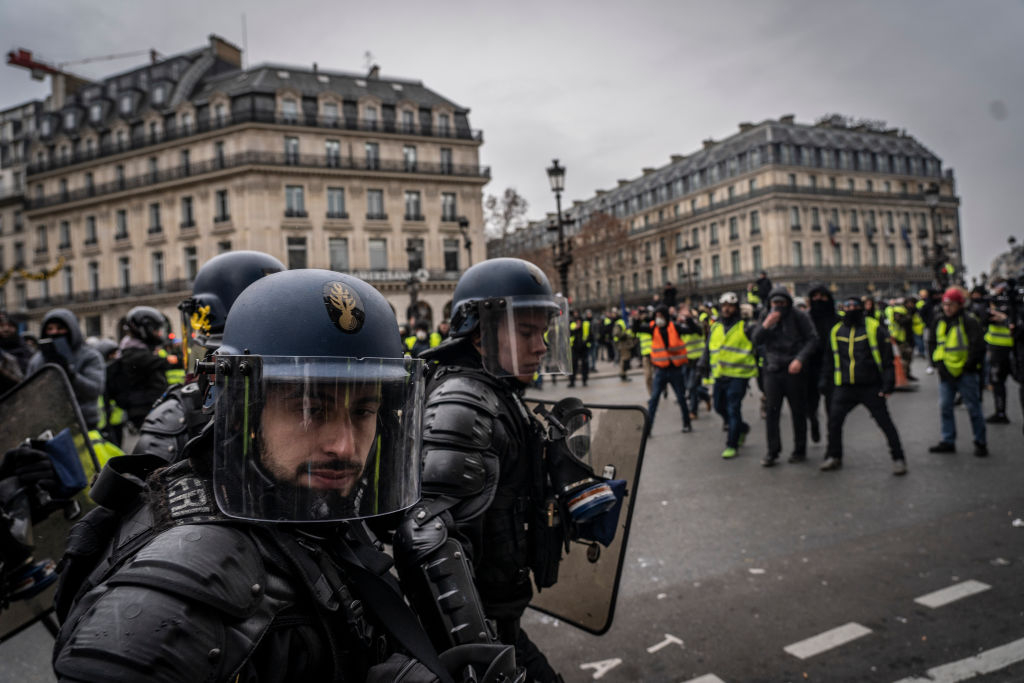
Even if the "Yellow Vests" form a political party in France, there is no guarantee that their cocktail of bourgeois boredom and anger would do better than Syriza in Greece, Podemos in Spain and half a dozen similar outfits in other European democracies. Pictured: Yellow Vest protesters march in front of police on December 15, 2018 in Paris, France. (Photo by Veronique de Viguerie/Getty Images)

"We are angry!" This is the sentence that I have repeatedly heard from Gilets Jaunes (Yellow Vests) demonstrators during the past three weeks while taking the political temperature in France. The assertion seems to refute my first diagnostic in a column last month that the movement reflected boredom rather than anger.

Having talked to dozens of rioters and observed some of their shenanigans including burning car tires, overturning parked cars and smashing shop-windows in posh streets, I am prepared to admit that both anger and boredom might be involved.

The first thing to note, though, is that this is not an uprising of the starving poor and homeless masses, supposing such strata exists in one of the world's most prosperous countries. The rioters we met were mostly apparently well-fed and eloquent middle and lower middle class in their mid-life. Mostly live in the provinces, especially Brittany, in mid-size towns and villages. Many are early retirees, in their 60s, with nothing exciting to do.
The rioters seem to be bored on their own behalf but angry on behalf of "the left-behind masses" they believe exist somewhere in France.

Last Saturday, the total number rioting in Paris and 12 other cities was put by the police at 50,000, a sharp fall compared to nine weeks ago when the fireworks started. But what do they actually want? It is hard to tell. Since there is no leadership structure and no spokespersons are allowed, one must do with anecdotal evidence.

My reporter's notebook includes some of their demands including a call on President Emmanuel Macron both to provide "true answers to our questions" and to resign. They also want "matters of public importance" to be decided through a referendum, or "direct democracy" as some call it, rendering the National Assembly (parliament) irrelevant. As for the upper chamber, the Senate, we heard calls for its outright abolition.

Another demand was for a mechanism that would allow citizens to dismiss cabinet ministers and members of parliament with petitions at any time rather than waiting for elections.
One demand was for the establishment of a "subsistence income" of no less than 1,700 euros a month, which would mean raising the current minimum wage by 300 euros. Many interviewees genuinely believed that "the rich", never defined, get an easy ride as far as taxation is concerned.

They want this corrected by a massive extension of the public sector, despite the fact that, compared to other major industrial democracies, the French state controls the highest portion of the gross domestic product (GDP) through a variety of direct and indirect taxes and levies.

Then, we had single-issue militants, including those opposed to gay marriage, those who wish the death penalty restored and those who want to ban all immigrants. A few, describing themselves as "Frexiteers", want France to exit the European Union.

The nationwide movement is a challenge to representative democracy in France. Aiming to replace institutions such as the presidency, the parliament, political parties, trade unions and the media with "direct street action," they promote the notion that complex political and economic problems have simple answers.

Sadly, President Macron, a novice in politics, who like most technocrats regards politics as a hindrance, may have fallen into their trap. He is trying to play his version of street politics by organizing what he grandiloquently calls "the Grand National Debate" outside the interface institutions of the republic.

Contempt for politics and politicians may be fashionable these days. But it doesn't make it right. Nor should one be misled by the label "populist" given to often small but loud groups of bored and/or angry bourgeois and looters and wreckers who operate in their shadow.
In modern France, the theme of "popular anger" is older than the republic itself. French politics have always vacillated between two rival temptations: Bonapartism and anarchy. Ironically it is only in the past two decades or so that French democracy has started to mature. The parliament has become more assertive, the judiciary more independent and the media less servile.

The claim that there is a hidden "suffering France" on whose behalf one is authorized to demean if not sabotage democracy is not new. François Mitterrand claimed he was speaking for "the left behind" ("laissés-pour-compte"). Jacques Chirac promised to heal "the social fracture". Nicolas Sarkozy cast himself as a champion of "silent majority". François Hollande was to be "an ordinary president" representing "the excluded ones". At another level, we have had Jean-Marie Le Pen beating the drum for "the forgotten" (les oubliés, in French), and Ségolène Royale promising proto-Maoist "citizen committees".

Even if the "Yellow Vests" form a party, there is no guarantee that their cocktail of bourgeois boredom and anger would do better than Syriza in Greece, Podemos in Spain and half a dozen similar outfits in other European democracies.

The beauty of capitalism is in its ability to make money out of anything. On Saturday, as all cafés in the Champs-Élysées were shut for fear of attack by "Yellow Vests", mobile kiosks appeared selling espresso and croissants at double the price. We had to retreat to Palais Royal, a mile away, to have lunch, leaving behind the Champs-Élysées battleground.

One of the few shops open away from the battlefield offered a designer version of the "Yellow Vest" at 125 euros apiece, compared of just 20 euros for the shabby original. So far, no "Yellow Vest" T-shirts, posters and mugs. But we expect some next Saturday.

We saw a new book with the title The Depth of Sky is Yellow by a lady journalist who must be the fastest pen alive, producing a tome about riots that started only five weeks before she hit the keyboard.

The restaurant in the Intercontinental Hotel was packed but we found a table in a bistro a bit further. There were many suffering "Yellow Vesters" having lunch in preparation for the big fight with the anti-riot police scheduled for 5:00pm at Arc de Triomphe.

We asked a lady at the next table what she would recommend from the day's menu and she suggested "Aligot sausage with mashed potatoes". We took her advice and were delighted by our meal.

Which shows that "Yellow Vesters" might have good ideas when they know what they are talking about. Trouble is they often don't.
This article was originally published in a slightly different version by Asharq al-Awsat

Amir Taheri was the executive editor-in-chief of the daily Kayhan in Iran from 1972 to 1979. He has worked at or written for innumerable publications, published eleven books, and has been a columnist for Asharq Al-Awsat since 1987.

Source: https://www.gatestoneinstitute.org/13580/france-angry

Follow Middle East and Terrorism on Twitter


'We will not change nation-state law,' justice minister tells Druze - Yair Altman and Danielle Roth-Avneri

​
by Yair Altman and Danielle Roth-Avneri 

Shaked expresses sympathy for the "true feelings" of the Druze, but argues that the nation-state bill does nothing to harm their equality and is vital for the country.


Druze protest leader Brig. Gen. (res.) Amal Assad, left, speaks 
with Justice Minister Ayelet Shaked, Friday
Photo: Moshe Ben Simhon 

Days after former IDF chief of staff and head of the Israel Resilience Party Benny Gantz told Druze leaders that he would "change" the controversial nation-state law, which the Druze argue makes them second-class citizens, Justice Minister Ayelet Shaked said on Friday that Israel would do no such thing.

In a meeting with Druze citizens who held a protest outside her home, led by Brig. Gen. (res.) Amal Assad and former MK Shachiv Shnaan – whose police officer son was killed in a terrorist shooting at the Temple Mount compound in the summer of 2017 – Shaked expressed her sympathy with the pain of the Druze but stressed that the nation-state law was vital and would not be changed.

Shaked said that as justice minister, she had worked on behalf of full equality for Israel's Druze community. She said that a Druze woman had been made a judge, that more qadim (judges) had been appointed to the Druze Shariah court, and that she had worked to increase the amount of money the government invests in the Druze community.

"The Druze are our brothers and the flesh and blood of the state of Israel. The nation-state law does not hurt equality between the Jews and the Druze in Israel. It says what is obvious, and comprises an interpretive tool for the courts that will balance out the problematic interpretation given to the Basic Law: Human Dignity and Liberty.

"The feelings of the [Druze] people are clearly genuine. In the next government, we will need to find a way to address that feeling, without changing the nation-state law," Shaked said.


Yair Altman and Danielle Roth-Avneri

Source: http://www.israelhayom.com/2019/01/20/we-will-not-change-nation-state-law-justice-minister-tells-druze/

Follow Middle East and Terrorism on Twitter


Saturday, January 19, 2019

Palestinians' Anti-Semitic Stereotyping of Jews - Bassam Tawil

​
by Bassam Tawil

Abbas and the Palestinian leadership are clearly trying to drag Israel into a religious conflict with all Muslims, not only Palestinians.

  • Abbas and the Palestinian leadership are clearly trying to drag Israel into a religious conflict with all Muslims, not only Palestinians. The Temple Mount has become their favorite platform for disseminating blood libels....
  • If anyone is defiling the sanctity of the holy site, it is Abbas and his representatives in the West Bank.
  • Were Israel to stop a Palestinian from entering a holy site because of his clothing, the foreign reporters based in Jerusalem and Tel Aviv would have rushed to the scene to interview the man and tell the world that Israel is violating freedom of worship. This is yet another example of how the media gives the Palestinians a pass and allows them to continue their vicious incitement against Israel.
Palestinians are continuing to use the Temple Mount, in Arabic known as the Haram al-Sharif, in Jerusalem, as a platform for incitement against Israel in general and Jews in particular.

This incitement, which began after Jewish tourists were permitted to resume their visits to the holy site in 2014, has since taken various forms. The Jewish visits to the holy site had been suspended for several years during the Second Intifada uprising, which erupted in September 2000.

Since 2014, the Palestinian Authority leadership, including President Mahmoud Abbas, have been waging an unprecedented wave of incitement against Israel and Jews to protest visits to the Temple Mount.

In 2015, Abbas announced that the Palestinians "won't allow Jews with their filthy feet to defile our Al-Aqsa Mosque."

He went on to praise Palestinians who were ready to sacrifice their lives in order to stop Jews from visiting the holy site: "We bless every drop of blood that has been spilled for Allah and Jerusalem. Every martyr (Shahid) will reach Paradise, and everyone wounded will be rewarded by Allah."


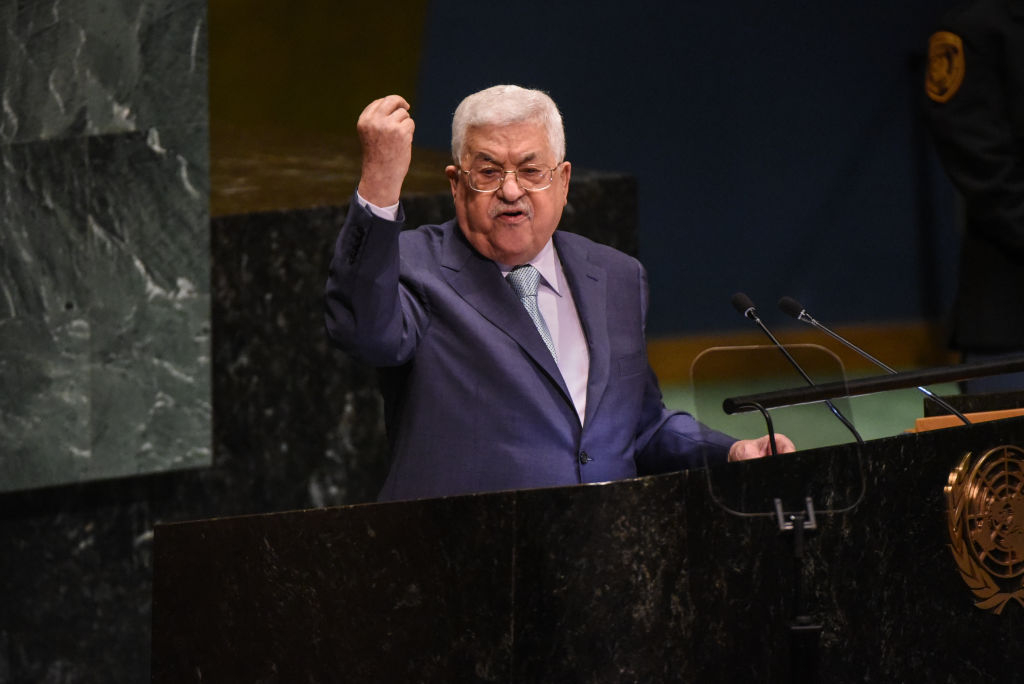
Palestinian incitement and the cynical exploitation of a holy site to spread lies and blood libels is barely noticed by the mainstream media in the West. (Photo by Stephanie Keith/Getty Images)

Abbas, his senior officials and media outlets have since been lying to their people and the rest of the world by claiming that "extremist Jewish settlers were forcibly and violently invading the Al-Aqsa Mosque." Of course, no Jewish extremist or settler has "invaded" any mosque on the Temple Mount, certainly not the Al-Aqsa Mosque. Most of the visitors happen to be religious Jews. The Palestinians, however, regularly label all religious Jews "extremists" or "settlers." It seems to be their way of stereotyping Jews as aggressors, colonialists and extremists.

The Jewish visits to the Temple Mount are conducted in coordination with the Israel Police and consist of a brief tour of the Temple Mount compound. The Jewish visitors do not enter the Al-Aqsa Mosque or the nearby Dome of the Rock. Yet this prohibition has not stopped Abbas and the Palestinian leadership, careful not to let facts get in their way, from continuing to peddle the lie that Jews are "storming" the two mosques.

What is dangerous about the Palestinian lies and incitement is that many Palestinians appear to believe them. The Jewish visitors are often greeted by angry Palestinian worshippers who hurl abuses at their police escorts and them

Early this week, the Palestinians provided yet another example of how they are using a holy site to spread lies and blood libels against Israel and Jews. The Palestinians also showed that their real goal is apparently to instigate a violent confrontation with Jews at the Temple Mount. That way, the Palestinians would be able to run and tell the world that Israel is trying to wage a religious war on Muslims.

The latest Palestinian provocation occurred when an Israeli policeman on a routine security check tried to enter the Dome of the Rock -- a daily practice on the part of the Israel Police and mainly aimed at ensuring the safety of Palestinian worshippers. There was, however, was one small "problem" with this specific policeman: he happened to be a religious Jew who was wearing a skullcap.

In keeping with their stereotyping of Jews, the Palestinians claimed that this policeman was an extremist Jewish settler, so they tried to prevent him from carrying out his task. Chanting, "Allahu Akbar!" ("Allah is Great!"), guards belonging to the Wakf Department, the Islamic religious body that manages the mosques at the Temple Mount, immediately closed the gates of the Dome of the Rock. The guards and dozens of Muslim worshippers barricaded themselves inside the mosque and began calling on other Palestinians to converge on the holy site to "protect" it from the Jews.

Hours later, thanks to negotiations between senior police officers and heads of the Palestinian religious authorities, an ensuing standoff between the protesters and the police ended peacefully. The Palestinian Authority, nevertheless, chose to take advantage of the incident to continue its campaign of incitement against Israel and Jews. A number of senior Palestinian officials, including Prime Minister Rami Hamdallah and his Minister for Religious Affairs, Yusef Edais, issued separate statements in which they condemned Israel for its "ongoing assaults and violations against the Al-Aqsa Mosque and other Islamic and Christian holy sites" in Jerusalem.

These statements are total falsehoods that appear in the context of the Palestinian leaders' daily incitement against Israel and Jews. The policeman was not part of any Jewish group touring the holy site. He had no intention of praying or "assaulting" any Islamic religious site. He was on a routine security patrol to ensure the safety of all visitors to the Temple Mount -- Jews, Christians and Muslims alike.

The Palestinian uproar over the scene of a religious Jewish policeman can, in short, best be described as a display of anti-Semitism. Otherwise, how do the Palestinians explain their non-objection to a non-religious Jewish policeman patrolling the holy site? Why is it all right for a policeman without a skullcap to enter the Dome of the Rock, but not all right for one wearing a skullcap to visit the site?

The Palestinians who protested against the policeman wearing the skullcap were following the words of their president, Abbas, when he stated that the Palestinians won't allow Jews with their filthy feet to defile the Al-Aqsa Mosque." In this instance, though, the Palestinians were disturbed not by the policeman's "filthy feet", but by the fact that he was a religious Jew. Perhaps Abbas should modify his statement from 2015 so that it would include, in addition to "Jews with their filthy feet," also: "Religious Jews wearing a skullcap."

Abbas and the Palestinian leadership are clearly trying to drag Israel into a religious conflict with all Muslims, not only Palestinians. The Temple Mount has become their favorite platform for disseminating blood libels and fabrications against Israel and Jews. If anyone is defiling the sanctity of the holy site, it is Abbas and his representatives in the West Bank. Abbas's ruling Fatah faction played a major role in the protests that erupted over the latest incident at the Dome of the Rock (involving the policeman with the skullcap. The police later detained Awad Salaymeh, a senior Fatah official in east Jerusalem, for his role in the incident involving the policeman. He and other Fatah activists were at the scene as part of their leadership's ongoing effort to instigate tensions between Jews and Muslims at the Temple Mount.

Other forms of Palestinian incitement against Israel and Jews at the Temple Mount include weekly sermons delivered by leading Islamic figures. Almost every Friday, another senior Islamic cleric uses the podium to deliver inflammatory sermons against Israel and Jews. One of these clerics is Sheikh Ekrima Sabri, the former Palestinian mufti of Jerusalem, who last week told his followers that Jerusalem will never be a Jewish city. Sabri and other senior clerics have also used the podium to warn Palestinians against selling their properties to Jews.

This Palestinian incitement and cynical exploitation of a holy site to spread lies and blood libels and stereotype Jews is barely noticed by the mainstream media in the West. Were Israel to stop a Palestinian from entering a holy site because of his clothing, the foreign reporters based in Jerusalem and Tel Aviv would have rushed to the scene to interview the man and tell the world that Israel is violating freedom of worship. This is yet another example of how the media gives the Palestinians a pass and allows them to continue their vicious incitement against Israel. The next time a Palestinian grabs a knife and goes out to stab a Jew, foreign journalists might consider the last time they failed to report on the Palestinian leaders, especially their incitement.


Bassam Tawil is a Muslim Arab based in the Middle East.

Source: https://www.gatestoneinstitute.org/13572/palestinians-anti-semitic-stereotyping-of-jews

Follow Middle East and Terrorism on Twitter