Saturday, April 27, 2019

Exposing Utilities’ Big Green Energy Con Game - H. Sterling Burnett

​
by H. Sterling Burnett

From Indiana to Iowa and beyond, electric utilities with existing coal plants are planning to replace them with wind power and, increasingly, solar power, the most expensive form of energy, excluding battery power.

Utilities in several states are attempting to run a con game on their respective states’ utility commissions and ratepayers. How? By claiming that their plans for prematurely shuttering existing, reliable, relatively inexpensive coal power plants and replacing them with expensive, intermittent renewable power sources will save ratepayers money “in the long run.” Meanwhile, they ask for an immediate increase in electric rates to pay for the transition.

The truth is, the “long run” never comes. Any 10-year-old child can tell you someone isn’t saving you money if he or she charges you more for something you already get for less.

From Indiana to Iowa and beyond, electric utilities with existing coal plants are planning to replace them with wind power and, increasingly, solar power, the most expensive form of energy, excluding battery power.

In late 2018, the Northern Indiana Public Service Company (NIPSCO), which provides electric power to approximately 460,000 customers across the state, filed a plan with the Indiana Utility Regulatory Commission (IURC) to prematurely shutter two large coal power plants and replace the electricity largely with solar and battery backup, as well as some wind and electricity purchased from other utilities. According to NIPSCO’s plan, demand would also be reduced.

While NIPSCO claims its move will eventually save ratepayers more than $4 billion, the utility requests that IURC approve a 12 percent rate increase to pay for the transition. James Taylor, my colleague at The Heartland Institute, asked during his Jan. 28 testimony before an IURC hearing discussing NIPSCO’s plan, “In what Alice-in-Wonderland universe does NIPSCO save consumers $4 billion by raising each household’s electricity bill more than $100 per year?”

Of course, Indianans will also likely pay more for goods and services, because businesses will pass at least some of their higher energy costs on to their customers.

In Iowa and Wisconsin, the story is the same. Alliant Energy, a Wisconsin-based utility that provides electric power to approximately 960,000 electricity customers in Wisconsin and Iowa, plans to reduce its carbon dioxide emissions by 80 percent by 2050 by closing all its coal power plants, the source of 33 percent of the electricity the utility currently produces.

Alliant estimates its plans will lower wholesale electric rates in the Midwest over the long term, but reducing wholesale electric rates doesn’t necessarily translate into saving the company’s business and residential customers money. As proof, Alliant asked the Iowa Utilities Board for a nearly 25 percent base rate increase to pay for new renewable power facilities. Iowa’s Utility Board has 10 months to consider Alliant’s rate hike, but in a show of extreme chutzpah, the company moved forward with a 5 percent base rate increase, a charge Alliant says it will refund if the Utility Board denies its proposal.

Coal plants can function efficiently for 30 to 50 years, sometimes longer. Wind turbines and solar panels—even if they operate as intended—generally have less than a 25-year lifespan. And even when solar panels are cleaned properly and regularly, they generate less power over time, declining sharply after 18 to 20 years.

Since many wind and solar facilities are financed over 30 years, the relatively short lifespan of wind and solar facilities means they often stop operating years before they are fully paid for. After including the cost of the high-priced battery backup units that utilities construct to provide power for periods when the sun isn’t shining and the wind isn’t blowing, it’s obvious any promised cost savings related to wind and solar will never materialize.

State utility commissions are charged with ensuring a reliable, abundant electric power supply. To avoid power shortages that occur during peak periods, when states’ populations grow, or when old power plants retire, utility commissions incentivize utilities to build new power plants by guaranteeing them a generous profit margin on their construction.

Because utilities are generally guaranteed a profit margin of about 10 percent or more on every dollar they spend on new facilities, they have a huge financial incentive to build expensive new power facilities, even when existing ones are working perfectly well. In addition, utilities such as NIPSCO and Alliant are rushing to claim the millions of dollars in federal taxpayer subsidies provided by a 30 percent tax credit for solar equipment and a 10-year production tax credit for wind and solar energy before they expire after 2020.

The move from coal to renewables is not about preventing climate change, and it’s certainly not about saving consumers money. It’s about using the climate change scare to pad utilities’ profits.

If utilities think it’s such a good idea to prematurely close well-functioning power plants and replace them with new, shiny, and expensive renewable power baubles, let them pay for it out of their own pockets rather than impose these unnecessary costs on ratepayers and taxpayers.

Until then, regulators and state lawmakers should just say “no” to utilities new rate hikes and unneeded power plant bait-and-switch plans.


Views expressed in this article are the opinions of the author and do not necessarily reflect the views of The Epoch Times.


H. Sterling Burnett (hburnett@heartland.org) is a senior fellow on energy and the environment at The Heartland Institute, a nonpartisan, nonprofit research center headquartered in Arlington Heights, Illinois.

Source: https://www.theepochtimes.com/exposing-utilities-big-green-energy-con-game_2892236.html

Follow Middle East and Terrorism on Twitter


The Operation Against General Flynn Started Long Before The Election - Michael Ledeen

​
by Michael Ledeen

President Trump will hopefully do the right thing soon.


Byron York seems baffled by the discovery in the Mueller report that the FBI was after General Michael Flynn long before the intercepts of his telephone conversations with Russian officials during the post-2016 election transition.  By that time, Obama Administration higher-ups in the intelligence community were warning Trump that Flynn had suspicious intimate contacts with the Russians, possibly in violation of the Logan Act.  As Byron writes:

Mueller strongly suggests something else was up. Obama administration intelligence officials "were surprised by Russia's decision not to retaliate in response to the sanctions," the report said. "When analyzing Russia's response, they became aware of Flynn's discussion of sanctions with Kislyak. Previously, the FBI had opened an investigation of Flynn based on his relationship with the Russian government. Flynn's contacts with Kislyak became a key component of that investigation.
Mueller attributed the information, which is on page 26 of Volume II of the report, to interviews with former Justice Department official Mary McCord, who was deeply involved in the Flynn case, and fired FBI Director James Comey.
The FBI investigation of General Flynn goes back several years, perhaps as far back as 2015.  This was undoubtedly because the intelligence community didn’t like Flynn, who had changed the way intelligence was collected and analyzed on the battlefields of Iraq and Afghanistan, taking it away from Washington military and intel officials and relocating it in theater. His methods worked well, but they greatly irritated the Washington-based intelligence crowd.  When Flynn was the head of the Defense Intelligence Agency (DIA), it became known that he intended to audit decades of covert budgets, checking to see if the funding, especially for CIA, actually went to the intended recipients for the approved missions.  If you ask me, the campaign against Flynn that so surprised Byron York is best explained by the intel community’s eagerness to lock him out of their system.  It was reinforced when Flynn criticized Obama’s Afghanistan policy in sworn testimony to Congress.

I suspect that if there is ever a proper inquiry into the operation, we’ll find that the CIA and FBI placed trusted informers inside Flynn’s offices at DIA.  It was clearly very important to them, as we see when Comey overrode his own officers to push the claim that Flynn had misled them.


Still earlier, the intelligence community invented a romantic relationship between Flynn and Russian historian Svetlana Lokhova.  This was one of the false tales that came to us courtesy of British intelligence, most famously the Steele Dossier, and undoubtedly involved the CIA.

When Flynn became Trump’s favorite national security adviser, it became even more urgent for the Dark State to take him out.  Having already organized the operation even before Trump became the Republican nominee, it was a relatively simple task to expand it, and as we know the FBI trapped him, as they had with Scooter Libby and others.

Full credit goes to Byron York for spotting the confirmation of the long-standing anti-Flynn operation, and for asking what it was all about. I believe I have written about the operation more than half a dozen times, but I never expected it to be documented in Mueller’s report. I hope it will be more fully explored when Mueller is questioned.

I also hope that President Trump will soon do the right thing, and pardon General Flynn. The government conjured a phony case against him. Now it’s time to turn him loose. Finally.


Michael Ledeen is a Shillman Journalism Fellow at the Freedom Center and Freedom Scholar at the Foundation for Defense of Democracies.

Source: https://www.frontpagemag.com/fpm/273569/operation-against-general-flynn-started-long-michael-ledeen

Follow Middle East and Terrorism on Twitter


The US Sanctions on Mullahs are Working - Majid Rafizadeh

​
by Majid Rafizadeh

The end of appeasement

  • "The golden days are gone and will never return. Iran doesn't have enough money to give us." -- A militant with an Iranian-backed militia in Syria, New York Times, March 26, 2019.
  • Feeling the pressure of sanctions on Iran, Hassan Nasrallah, the leader of Iran's proxy, Hezbollah, has also called on his group's fundraising arm "to provide the opportunity for jihad with money and also to help with this ongoing battle."
  • Iran's national currency, the rial, has dropped to historic lows — one US dollar, which equaled approximately 35,000 rials in November of 2017, now buys you nearly 130,000 rials.

Thanks to the Trump administration's sanctions, the flow of funds to the Iranian government is being cut off, impacting the Iranian leaders' efforts to fund and sponsor terrorist and militia groups across the region. Photo: Wikimedia Commons.
Critics of US President Donald Trump and his policy regarding the Iranian government are quick to condemn him for the sanctions he has imposed on the theocratic establishment. Their argument is anchored in the idea that the only informed and effective policy that will deal with Iran's clerical establishment is rooted in enticing them in from the cold: in other words, appeasement. 
These critics had the opportunity to initiate and expand appeasement policies during the eight-year administration of former President Barack Obama. Throughout this time, President Obama made unprecedented concessions in an attempt to appease the ruling mullahs. He met them with generosity and flexibility every step of the way. What was the outcome?

As sanctions against Iran were lifted during the Obama administration, it quickly became clear that those actions instead gave Iran global legitimacy in the eyes of the international community. This newfound legitimacy and the lifting of sanctions generated billions of dollars in revenue for Iran's military institution, the Revolutionary Guard Corps, as well as for Iran's militia and terror groups.

Tehran used that influx of revenues to expand its influence throughout the region, including in Syria, Iraq, Yemen and Lebanon. The expansion campaign proved to be immensely successful.

Now the latest reports show that those who support the idea of appeasing Iran, and criticizing Trump's strict policy toward Iran, are dead wrong.

The sanctions have, in fact, imposed significant pressure on the Iranian government to such an extent that the Iranian leaders are cutting their funding to their allies, militia and terror groups.

In an unprecedented move, on April 17 2019, the state-controlled Syrian newspaper Al-Watan made an astonishing revelation when it reported that Iran had halted its credit line to the Syrian government. This occurred one day after the Iranian foreign minister, Javad Zarif visited Syria on April 16, 2019.

The Syrian newspaper complained that Tehran has also been unable to ship oil to Syria in the past six months. According to Al-Watan, this has imposed significant pressure on the government of Bashar Al Assad as it faces a fuel shortage. The Syrian government only produces roughly 25% of the fuel that it needs, making it dependent on Iran to provide the rest.

In addition, the fact that Al-Watan made such a disclosure just one day after the Iranian Foreign Minister Javad Zarif visited the country, shows that Damascus has failed in its plea to convince Tehran to extend its credit line and oil exports to Syria.

Since US President Donald J. Trump withdrew from the Joint Comprehensive Plan of Action (JCPOA), commonly known as the Iran nuclear deal, Iran's oil revenues and exports have been steadily falling. Before the US pulled out of the nuclear deal and began taking a tougher stance towards the ruling clerics of Iran, Iran was exporting more than 2.5 million bpd. Iran's oil exports have since dropped to approximately 1.1 million barrels per day (bpd). That represents a decline of more than 50%.

According to the latest reports, US sanctions have also caused Iran to cut funds to its militias in Syria. Iran's militants are not getting their salaries and benefits, making it extremely difficult for them to continue fighting and destabilizing the region. A militant with an Iranian-backed militia in Syria told the New York Times, "The golden days are gone and will never return," he added "Iran doesn't have enough money to give us."

Feeling the pressure of sanctions on Iran, Hassan Nasrallah, the leader of Iran's proxy, Hezbollah, has also called on his group's fundraising arm "to provide the opportunity for jihad with money and also to help with this ongoing battle."

Iranian President Hassan Rouhani recently admitted that the Islamic Republic is encountering the worst economic crisis since its establishment in 1979. Iran's national currency, the rial, has dropped to historic lows — one US dollar, which equaled approximately 35,000 rials in November of 2017, now buys you nearly 130,000 rials.

Thanks to the Trump administration's sanctions, the flow of funds to the Iranian government is being cut off, thereby, in turn, impacting the Iranian leaders' efforts to fund and sponsor terrorist and militia groups across the region.

To the dismay of the proponents of the Iranian government and the advocates of pursuing policies of appeasement with the ruling mullahs-- and to the dismay of Trump's critics -- the US sanctions imposed on Iran are working.
  • Follow Majid Rafizadeh on Twitter

Dr. Majid Rafizadeh is a business strategist and advisor, Harvard-educated scholar, political scientist, board member of Harvard International Review, and president of the International American Council on the Middle East. He has authored several books on Islam and US Foreign Policy. He can be reached at Dr.Rafizadeh@Post.Harvard.Edu

Source: https://www.gatestoneinstitute.org/14126/the-us-sanctions-on-mullahs-are-working

Follow Middle East and Terrorism on Twitter


How Turkey's Democracy Went From Insanity to 'Beyond Insanity' - Burak Bekdil

​
by Burak Bekdil

"Turkey is the main consumer of the oil stolen from its rightful owners, Syria and Iraq"

  • "Bad economic management, among others, brought him [Erdoğan] to power ... It may remove him power, too." -- International banker who asked not to be named.
  • Ironically, the man who could recharge the machine called Erdoğan & Co. (or push it over the cliff) is the president's son-in-law, Berat Albayrak.
  • In December 2015, Russia's defense ministry said it had proof that Erdoğan and his family were benefiting from the illegal smuggling of oil from Islamic State-held territory in Syria and Iraq. "Turkey is the main consumer of the oil stolen from its rightful owners, Syria and Iraq.
  • So, guess when and where wonder boy Albayrak last came to the attention of the U.S. public? On April 16, when he met with President Donald Trump in Washington. A smiling Albayrak happily announced that Trump took a reasonable point of view regarding Turkey's planned purchase of the Russian-made S-400 surface-to-air missile system. He also said that there was agreement at his meetings in Washington to increase annual bilateral trade between the United States and Turkey to $75 billion.

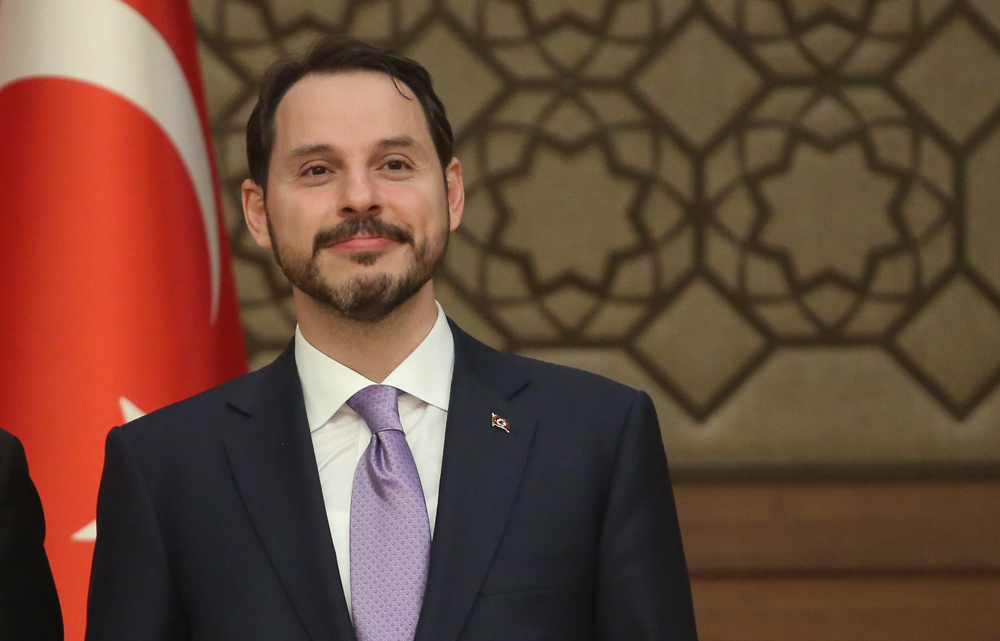
The man who could recharge the machine called Erdoğan & Co. (or push it over the cliff) is the president's son-in-law, Berat Albayrak. (Photo by Stringer/Getty Images)

In the country he has ruled since 2002, 80% of the minorities cannot openly express themselves on social media, and a good 35% say they are subjected to hate speech on the same platform. His top ulama [Islamic scholars] once issued a fatwa that read: "... a father kissing his daughter with lust or caressing her with desire has no effect on the man's marriage".

Between August 2014, when he was elected president of Turkey, and April 2016 he sued at least 1,845 people for insulting him, thereby winning the title of "the world's most insulted president".

Turkish President Recep Tayyip Erdoğan once accused Western Europe of "intolerance that spreads like the plague," and described Belarus, which Western countries describe as a dictatorship, as "a country in which people with different roots live in peace".

When Turkey, officially, was the world's biggest jailer of journalists Erdoğan's Islamist party drafted a bill that would release about 3,000 men who married children, including men who raped them.

In December 2016, Alperen, an often violent youth group who enthusiastically support Erdoğan, celebrated Christmas and New Year's Eve in Turkey by holding a man dressed as Santa Claus at gunpoint. A headline in an Islamist newspaper (also pro-Erdoğan) read, "This is our last warning, DO NOT celebrate."

In 2017, Erdoğan's law enforcement authorities arrested and indicted a liberal group for terrorism whereas the group had only carried a placard that read: "Let Nuriye and Semih live!" – Nuriye Özakça and Semih Gülmen were two teachers who went on a hunger strike to protest their dismissal from work without a legal pretext. Erdogan's Turkey probably became the first country worldwide where "not wishing death to someone" was a serious crime.

Also in 2017, Erdoğan's Education Minister, Ismet Yılmaz, decided that Turkey's national school curriculum should leave out evolution but add the concept of "jihad," as part of Islamic law, in schoolbooks.

The insanity goes on; it is probably now beyond the level it was before. The deputy leader of an ultranationalist party, Erdoğan's staunchest ally in the Turkish parliament, Yaşar Yıldırım, criticized the opposition for "trying to topple the one-man regime and substitute it with democracy" (and no typo here!) told a news broadcaster: "This is exactly what they [the opposition] is trying to do. We should not allow this to happen". It was not a slip of the tongue; Yıldırım has never denied saying it or that it was what he wanted to say.

It was Erdoğan and his ultranationalist partners who turned a simple municipal election into an existential political war. This municipal election of March 31, they insisted, was a matter of "national survival" for Turkey. They wanted to mobilize their voters. Their pre-election strategy when the Turks voted to elect their mayors -- to portray the polls as existential: if we lose, Turkey would be facing an existential threat – has become their worst nightmare. after March 31. The opposition won all three of the biggest cities (Istanbul, Ankara and Izmir). Turkey's Islamists lost Istanbul and Ankara for the first time since they had won them 25 years ago. The opposition also won major Mediterranean cities such as Antalya, Turkey's top tourist hub; Adana and Mersin as well as Bolu and Kırşehir in Central Anatolia, another first for the opposition, as well as Artvin on the eastern Black Sea.

Erdoğan, since that election night, has been trying to exert damage control and keep morale among party fans high. "We came first." "Our alliance [with the ultranationalists] still has more than 50% support." But he seems to remain nervous. Under new management. 25 years of Islamist rule in Istanbul (or in Ankara) may produce embarrassing documents.

There are many explanations for Erdoğan's decline, the most accurate possibly being different combinations of all of the factors. Erdoğan, immediately after he won the presidential race in 2018, warned his party administration of "metal fatigue". He was right about his suspicion. But he did not see that part of the metal fatigue was his own authoritarian rule.

Then, last summer, the lira plunge came after Turkey's political tensions with the United States peaked over the detention in Turkey of a U.S. pastor, Andrew Brunson, (who was later released.) In January, Turkey's jobless rate surged to its highest point in a decade at 14.7% with the ranks of the unemployed swelling by 366,000 people in one month. The number of people without jobs has now reached 4.7 million, with youth unemployment jumping to 26.7%, a record high, according to data that goes back to 1988. There is recession: in the last quarter of 2018, the economy shrank by 3%. The national currency, Turkish lira, is not enjoying a stable recovery. On Aug. 21, 2017, it closed the trading day at 3.5 against the U.S. dollar. On Apr. 24, 2018, 1½ years later, one dollar was traded at 5.9 liras, a rise of nearly 70%.

Erdoğan, whose political popularity coincided with record growth rates (though some economists call the Turkish success a bubble based on construction-consumption), knows that his political future greatly depends on the performance of the economy. "Bad economic management, among others, brought him [Erdoğan] to power ... It may remove him power, too," said one international banker who asked not to be named.

The Turkish economy remains vulnerable. So does the lira. If there are more more plunges in the national currency, or more price hikes (annual inflation rate already runs at around 20%), or if more past fans suffer more job cuts, they may turn against him.

Ironically, the man who could recharge the machine called Erdoğan & Co. (or push it over the cliff) is the president's son-in-law, Berat Albayrak.

Who is the man that some in the Ankara political circles jokingly call "Damat Ferit Pasha?"
The original "Ferit Son-in-Law" Pasha, was born in 1853, and was an Ottoman diplomat. In 1885 he was married to Mediha Sultan, the daughter of Sultan Abdulmajed, and given the title 'pasha' (an Ottoman general) in 1888. During the most turbulent years of the empire, in 1920, he served as the Ottoman sadrazam, or prime minister, for six months. In 1922, he fled to Europe and in 1923 he died in Nice.

Albayrak, another "son-in-law," has a different story. He was born in Istanbul in 1978, with ancestry from the Yenice village of a town called Of in Trabzon province in the eastern Black Sea region of Turkey. This village is located in mountainous terrain closer to the neighbouring province of Rize, where Erdoğan was born. Inhabitants of this region are predominantly migrants from Georgia who fled during the 19th century conflicts in the Caucasus between the Ottoman State and Russia. They are mostly of (more) Christian Orthodox or (less) Jewish heritage who, in order to integrate into the local community, and with pressure from the Ottoman administration, converted to Islam. When the modern Turkish Republic was established in 1923, most converts became Turkish-Muslim supremacists, although there is no way of knowing if the Albayrak family were converts.

Mostly due to poverty, immigrant families on the eastern Black Sea coast migrated westwards to Istanbul and settled in the more conservative parts of the city. They established their congregations, associations, mosques and other social structures around the Ismailağa off-shoot of the Menzil sect, which is dominant in today's state apparatus. These are extremely devout, Islamist sects trying to gain more and more power in state bureaucracy.

Berat's father, Sadık Albayrak is a prominent figure in the Sunni Islamist circles. Albayrak the father started his religious education during his childhood in his village and continued on to the religious Imam Hatip School in Trabzon province. He is one of the opinion leaders of the early Islamist movement in the 1960s. He has served as the chief imam of the Blue Mosque along with Beyazıd, Fatih and Şehzadebaşı mosques, which also served as the meeting points of the Ismailağa sect.

Albayrak's business grew and became a conglomerate, Çalık Holding, with a large number of interests, which included gold mining, pipelines, power distribution networks, public construction tenders, wind and hydroelectric power stations, telecommunications, media and energy.

The younger Albayrak was the CEO of Çalık Holding when, in 2004, he married Erdoğan's eldest daughter, Esra. In 2015, a year after Erdoğan's first presidential victory, he became the Energy Minister. He has postgraduate degrees from New York Pace University in finance, and an MBA from the Lubin University of Business in the United States.

In 2008 the Çalık group was at the center of a controversial privatization of the country's second largest media group, ATV-Sabah, then under the disposition of a government fund. Çalık , amid rumors of nepotism, acquired ATV-Sabah for $1.1 billion. The deal was financed by cheap loans from two government-owned banks, Halkbank and Vakıfbank, which granted a combined $750 million. The rest of the money came from a Qatari media group, Al Wasaeel International Media in return for 25% of ATV-Sabah shares.

In 2016 Powertrans, a company with links to Albayrak, allegedly made hefty gains in oil trading between Turkey and Islamic State. In December 2015, Russia's defense ministry said it had proof that Erdoğan and his family were benefiting from the illegal smuggling of oil from Islamic State-held territory in Syria and Iraq. "Turkey is the main consumer of the oil stolen from its rightful owners, Syria and Iraq. According to information we've received, the senior political leadership of the country - President Erdoğan and his family - are involved in this criminal business," said Deputy Defense Minister Anatoly Antonov.

So, guess when and where wonder boy Albayrak last came to the attention of the U.S. public? On April 16, when he met with President Donald Trump in Washington. A smiling Albayrak happily announced that Trump took a reasonable point of view regarding Turkey's planned purchase of the Russian-made S-400 surface-to-air missile system. He also said that there was agreement at his meetings in Washington to increase annual bilateral trade between the United States and Turkey to $75 billion.

Burak Bekdil, one of Turkey's leading journalists, was recently fired from the country's most noted newspaper after 29 years, for writing in Gatestone what is taking place in Turkey. He is a Fellow at the Middle East Forum.

Source: https://www.gatestoneinstitute.org/14139/turkey-democracy-insanity

Follow Middle East and Terrorism on Twitter


Wednesday, April 24, 2019

The European Union: Nurturing Instability and Terrorism in the Middle East - Naomi Linder Kahn

​
by Naomi Linder Kahn

The key actor in these land-grab projects is the Union of Agricultural Work Committees (UAWC).

  • The apparent objective of the Palestinian Authority (PA) is to annex these areas and bring them under PA control as part of its larger plan for the unilateral creation of a Palestinian state. This plan was publicized in 2009, in an official PA document written by then-Prime Minister Salam Fayyad; since its publication, it has been carried out virtually unhindered, with the help of massive European funding in violation of the Oslo Accords, and in violation of international law. Additionally, this type of activity is more easily presented to international media outlets and foreign benefactors as "humanitarian aid."
  • The key actor in these land-grab projects is the Union of Agricultural Work Committees (UAWC). UAWC maintains close organizational and operational ties to the Popular Front for the Liberation of Palestine, a terror organization that has carried out many deadly attacks against Israel's citizens - including numerous suicide bombings in the 2000s. UAWC is funded, for the most part, by European governments and humanitarian aid organizations, and by the European Union.
  • In recent years, and in particular since 2013, the Palestinians have intensified agricultural activity as a means of quickly and efficiently seizing large swaths of land under the guise of humanitarian aid for farmers. This activity is illegal and violates the international treaties to which the PA is a signatory. But this has not troubled foreign governments and organizations, including the European Union, who continue to bankroll this illegal activity – while at the same time vocally criticizing the State of Israel.

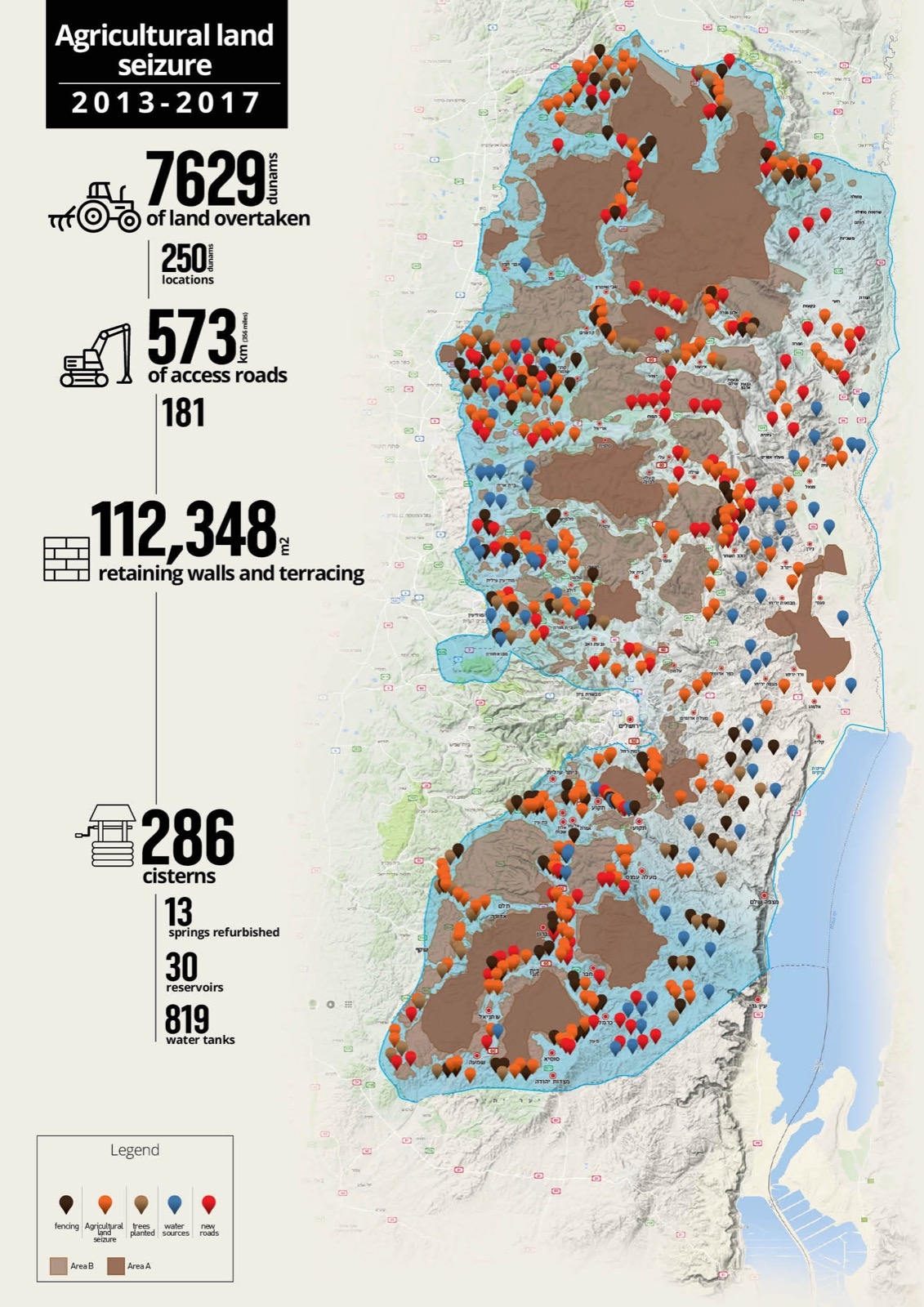
Pictured: Illegal land seizures of thousands of acres in the West Bank, funded by the European Union under the guise of "agricultural assistance." EU funding is facilitating a massive program of land theft by the Palestinian Authority. (Image source: Regavim)

Under the guise of "agricultural assistance," the Palestinian Authority is taking over Area C (the area placed under full Israeli jurisdiction in the Oslo Accords, pending a full peace agreement which would establish sovereignty over the area for one side or the other), with the help of massive European financial support -- in violation of the law, and of international agreements signed by the EU.

Over the past decade, the Palestinian Authority (PA) has implemented a long-term program aimed at taking control of strategic locations in Area C of the disputed territories of Judea and Samaria. The PA's apparent objective is to annex these areas and bring them under PA control, as part of its larger plan for the unilateral creation of a Palestinian state. This plan was publicized in 2009, in an official PA document written by then-Prime Minister Salam Fayyad; since its publication, it has been carried out virtually unhindered, with the help of massive European funding.

Since 2013 there has been a marked acceleration of the plan's execution, mainly through intensive, large-scale agricultural activity, with the understanding that this tactic, as opposed to illegal construction, enables the PA to take control of vast tracts of land relatively quickly. This activity, carried out under the umbrella of the Palestinian Authority's "Roots Project" (جذور or Juthoor), enables massive land grabs to be more easily presented to international media outlets and foreign benefactors as "humanitarian aid."

The key actor in these land-grab projects is the Union of Agricultural Work Committees (UAWC). With branch offices throughout Judea and Samaria, UAWC maintains close organizational and operational ties to the Popular Front for the Liberation of Palestine (PFLP), a terror organization that has carried out many deadly attacks against Israel's citizens, including numerous suicide bombings in the 2000s. UAWC is funded, for the most part, by European governments and humanitarian aid organizations, and by the European Union.

The majority of UAWC's activities are carried out in Area C. Among the more central projects: Illegal seizure of thousands of dunams of land through agricultural use, illegal seizure of water sources, and creation of new roads, ostensibly to facilitate Palestinian farmers' access to agricultural areas. These activities are concentrated in areas of strategic importance, particularly areas adjacent to Jewish settlements and the security barrier, as well as locations in Area C that serve as a buffer zone between Areas A and B (which are under full or partial Palestinian Authority jurisdiction, 
respectively).

Needless to say, all of this activity is carried out unilaterally, without permits or coordination with the State of Israel -- in violation of the law that is in force in these areas, in violation of the Oslo Accords, and in violation of international law.

A non-governmental organization, Regavim, dedicated to preserving Israel's land resources and promoting a forward-thinking land-use policy, has conducted precise documentation and mapping of PA activity in the field, and culled information regarding EU funding for UAWC activities by monitoring Palestinian and European Union publications, media reports, and internet coverage (such as this recent video which boasts of extensive illegal activity). The results of this research, which were presented in a comprehensive report to the Knesset Subcommittee of the Foreign Affairs and Defense Committee on Judea and Samaria, are summarized in "The Roots of Evil."

The Political Context – The Battle for Control of Judea and Samaria

In the "Interim Agreement between the State of Israel and the Palestinian Authority" signed in Oslo in 1993 ("The Oslo Accord") between Israel and the leaders of the PLO, the State of Israel officially recognized what had openly operated as a terrorist organization, and allowed it to establish a Palestinian Authority to oversee autonomous Arab governance in parts of Judea and Samaria.

Under these accords, Judea and Samaria were divided into three regions: Area A was placed under full Palestinian civil and security jurisdiction; Area B was assigned to PA civil control, while Israel remained responsible for security; and Area C, which was placed under full Israeli civil and security jurisdiction. Despite the fact that, in practice, many of the Oslo Accords' clauses were never activated and other elements are no longer relevant, the division of jurisdictional authority remains in force.

Almost a decade ago, then-Prime Minister of the Palestinian Authority Salam Fayyad began to promote a unilateral program for the creation of "an independent, fully autonomous Arab state on all of the territory of the West Bank and Gaza Strip, as per the 1967 borders, with Jerusalem as its capital." A central element of the Fayyad Plan is the attempt to deepen the PA's official administrative presence specifically in Area C and to establish de facto annexation of the territory, based on the underlying assumption that Areas A and B have already been "taken care of" by the Oslo Accords.

The implementation of this program of "creeping annexation" is carried out on two parallel tracks. The first involves cooperation with Israel: The PA submits requests to the relevant Israeli authorities for approval of "special priority" construction projects; generally, international funding for these projects is contingent upon a "seal of approval" from Israel. The second track, which is far more widespread, is the creation of facts on the ground, through extensive illegal construction and development, obviously without coordination or permission of the Israeli authorities. The projects in this illegal track are planned and executed according to a clear, systematic master plan that aims to create territorial contiguity for the future Palestinian state while disrupting the growth and contiguity of Israeli communities.

Over the past number of years, the illegal track has become not only more pronounced but more "creative," using agricultural work to establish facts on the ground -- in violation of the law in force in this region, in violation of the Oslo Accords which stipulate that the State of Israel is the sole sovereign over this territory, in violation of international law.

The PA has enjoyed the diplomatic support of European countries for decades. Although the European Union was an active participant in the formulation of the Oslo Accords and its representatives participated in the signing ceremony, in recent years the EU has actively funded many of the PA's illegal activities in Area C, contributing to the very projects that undermine those accords by taking unilateral steps to create a Palestinian state encompassing all of Judea and Samaria.

Palestinian "civil society" organizations and the PA itself have received massive practical and economic support from European governments and organizations. European funding, as well as diplomatic support and other forms of active participation, have been channeled directly to Fayyad Plan projects.

One of the methods employed by the European Union to create a de facto Palestinian state is to block the development of infrastructure and expansion of Jewish settlements in Judea and Samaria through Palestinian construction and agriculture. Over the last several years, the EU has built more than 2,000 structures in Area C for the Palestinian population, creating or supporting dozens of illegal settlement clusters, without requesting or receiving construction permits or coordinating these projects with the relevant Israeli authorities. In fact, when Prime Minister Benjamin Netanyahu protested the EU's blatant violation of the law, EU foreign policy chief Federica Mogherini gave an official commitment to desist from any additional illegal construction in the E1 area – but not in the rest of Area C. All of the EU-funded construction projects, agricultural projects, and infrastructure projects in Area C are clearly designed to establish territorial contiguity for the Palestinian Authority presence, in an attempt to preclude the possibility of annexation or development of these areas by Israel in the future. All are carried out illegally, in contravention of Israeli jurisdiction over this territory, under the guise of European Union Foreign Affairs Council humanitarian aid to needy Palestinian communities in Judea and Samaria.

The Legal Context – Ottoman Property Law in the Service of Land Expropriation

The law in force in Area C of Judea and Samaria, which is under full Israeli jurisdiction, is comprised of many layers of legal systems, including Ottoman law, Mandatory law, Jordanian law, military rule, international law, as well as legislative acts of Israel's parliament, the Knesset. In general, however, the essential underpinnings of property law in Area C rest upon Ottoman law.

According to Ottoman law and Israeli Supreme Court decisions that continue to enforce it, uncultivated land belongs to the sovereign – in this case, the State of Israel. Additionally, some of the land in Area C is classified as "survey land" – tracts that are not registered as privately owned, which the sovereign (the Israeli government) is in the process of regulating and registering as state land.

A private individual may be granted ownership of agricultural land (as per section 78 of the Ottoman Legal Code) if he held and cultivated the land in question for a consecutive period of several years (the precise period required is dictated by the nature of the land parcel itself).

Thus, a person who poaches land and uses it for agricultural purposes may claim ownership or other rights to the land in question, simply by claiming to have worked the land for a number of years. Palestinian land-use projects exploit this "loophole" in Ottoman law to great advantage.

Activities carried out under the Roots Project, the systematic program of land seizure in Area C, are presented as agricultural projects; nonetheless, many of these types of work – erecting fences and walls, excavation with heavy machinery, creation of roads, and more – require building permits, which they obviously do not have. On the other hand, the law is meticulously enforced against Jewish construction, resulting in what can best be described as "reverse apartheid:" A number of draconian regulations are applied exclusively to Jewish residents of Area C, such as "delimiting orders" and "obstructive use orders," which empower the authorities to demolish structures en masse and to bar residents, without due process, from contested areas.

The Union of Agricultural Work Committees – The Operational Arm of the Land Seizure Enterprise

The Union of Agricultural Work Committees (UAWC) is the main operational arm of the PA's plan to seize control of Area C and to create a de facto Palestinian state in this territory.

The Union, headquartered in Ramallah, is comprised of more than 65 branches of local agricultural councils throughout Judea, Samaria, and Gaza. With more than 100 employees, its annual budget exceeds 5 million euros (nearly $6 million USD). Its budget is based mainly on direct and indirect donations from foreign sources, including the European Union and the United Nations, and the governments of France, Norway, and Holland.

UAWC has both overt and covert ties to the terrorist organization Popular Front for the Liberation of Palestine (PFLP) and its activities are carried out in coordination with the Palestinian security apparatus and other Palestinian judicial bodies.

Both the PFLP and UAWC have attempted to obscure their close ties, in order to portray the civilian organization as an independent non-profit entity. Notwithstanding their efforts, there is clear evidence of their ideological and financial interdependence: An internal document prepared for the American humanitarian organization USAID in 1993 stated that the UAWC is "[t]he PFLP's agricultural organization" and "The PFLP's agricultural extension services are provided by the Union of Agricultural Work Committees (UAWC)." In fact, the PLO's dominant Fatah faction identified the UAWC as an "affiliate" of the PFLP.

The affiliation of the UAWC with the PFLP is ongoing, despite the classification of the PFLP as a terrorist organization both by the United States and the European Union. Senior figures in the PFLP hierarchy have served in senior positions in the UAWC, among them Jamil Muhamad Ismail Al Majdalawi, formerly the Vice President of the UAWC in Gaza, who is a well-known senior officer in the PFLP. He served as head of the political division of the PFLP in Gaza, and in 2013 acted as the PFLP's representative to Fatah bodies in the Palestinian Authority. Bashar Al Khiri served as Chief of the PFLP's Political Division in the early 2000s. He was arrested and imprisoned by the State of Israel, and after his release served as President of the UAWC Advisory Board from 2005-2010.

One of the European organizations that provides financial support for UAWC activities is Norwegian People's Aid (NPA), a Norwegian society that describes itself as "committed to building democratic society and to strengthening people's ability to take control of their own lives." NPA describes itself as non-political, although its views are not neutral. Thus, it "supports organizations that represent weak or vulnerable populations, particularly if they resist or are in conflict with those in power." NPA lists UAWC as one of its partner organizations in Palestine.

NPA, which was supported by the American government's humanitarian aid program USAID for many years, was brought up on charges of supporting terrorism by the US Department of Justice in 2017. In the course of the trial, which was concluded in 2018, the NPA admitted to supporting Iran, Hamas, and a number of other terror organizations.

From 2016 to 2018, NPA received 32,000,000 Norwegian kroner (3,320,000 euros – nearly $4 million USD) from the government of Norway (out of a total commitment of 50 million kroner) for joint UAWC-NPA projects.

In fact, the terrorist ties of the UAWC have not deterred the EU, which earmarked 3.6 million euros to the UAWC to run the Roots Project in the Bethlehem area in 2014, and funded 90% of its overall budget. Under the auspices of the Roots Project, a representative of the EU visited the area in order to report on the progress of the initiative and provide an overview of the UAWC's activities.

In March 2015 the inaugural ceremony for the Roots Project was held in Bethlehem. The EU's ambassador to the Palestinian Authority, John Gatt-Ruter, an honored guest, addressed the ceremony:
"The projects the European Union will carry out for the residents of Area C are essential, particularly in the agricultural sector, which is an important segment of the economy. This project will contribute to assistance for Palestinian farmers ... and establishing Palestinian facts on the ground ... The Union of Agricultural Work Committees has demonstrated its ability to carry out agricultural projects in many Palestinian areas, and the relationship with the European Union is the result of the successes achieved by the UAWC." [Emphasis added.]

Conclusions and Recommendations

In the past decade, the Palestinian Authority has made a concerted effort to gain control over as much land in Area C as possible. In recent years, and in particular since 2013, the Palestinians have intensified agricultural activity as a means of quickly and efficiently seizing large swaths of land under the guise of humanitarian aid for farmers. This activity is illegal, and violates the international treaties to which the PA is a signatory. But this has not troubled foreign governments and organizations, including the European Union, who continue to bankroll this illegal activity – while at the same time vocally criticizing the State of Israel.

Because of the large-scale strategic consequences of the Palestinian program of land seizure, this problem cannot be addressed as a case-by-case, localized problem. The larger picture must be taken into consideration, and the European Union must cease its unbridled intervention in the internal affairs of a democratic state (Israel) and its wholesale violations of international law and treaty – activities that entrench Palestinian intransigence, cripple the prospect for a negotiated settlement, and endanger the security of Israelis in a very real and immediate sense.

Naomi Linder Kahn is Director of the International Division of Regavim.

Source: https://www.gatestoneinstitute.org/14011/european-union-palestinians-instability

Follow Middle East and Terrorism on Twitter


How Palestinian Leaders Encourage Terrorism - Bassam Tawil

​
by Bassam Tawil

What message is Abbas sending to his people? That those who wish to eat had better turn to terror.

  • Palestinian Authority President Mahmoud Abbas's remarks at the Arab League gathering in Cairo demonstrate his preference for the well-being of terrorists over the ability of hard-working employees to put bread on the table for their families. These payments to terrorists and their families lie at the heart of Palestinian incitement to terror that drives the Israeli-Palestinian conflict.
  • If anyone is collectively punishing the Palestinians, it is Abbas himself. He is depriving tens of thousands of families of full salaries, thus preventing them from purchasing food for their children or paying various fees, including rent and university tuition. A Palestinian civil service employee who sends his son to university does not get a full salary. A Palestinian whose son sets out to murder a Jew is entitled to a full salary and earns more respect from Palestinian leaders.
  • What message is Abbas sending to his people? That those who wish to eat had better turn to terror. The families of the public employees who are now unable to pay their grocery bill and rent are now looking at the families of the terrorists with envy. They must be saying to themselves: "We are suckers because we didn't send our children to stab a Jew!" This is the education that the Palestinians leaders have been providing since 1965.

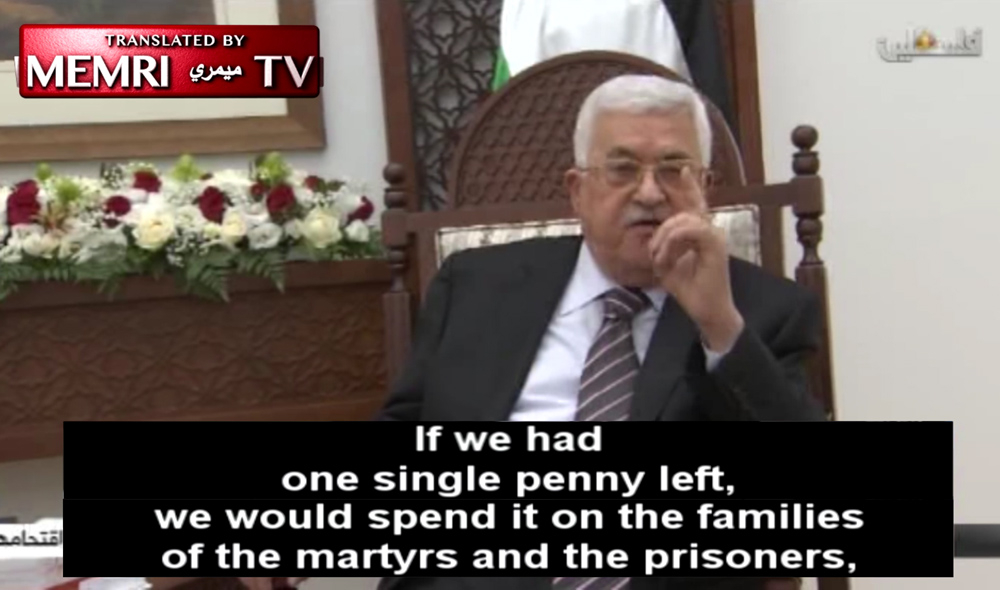
On July 23, 2018, at a ceremony honoring Palestinian terrorists, Palestinian Authority President Mahmoud Abbas said: "We will neither reduce nor withhold the allowances of the families of martyrs, prisoners, and released prisoners... if we had one single penny left, we would spend it on the families of the martyrs and the prisoners." (Image source: MEMRI)

Palestinian Authority (PA) President Mahmoud Abbas recently reaffirmed his longstanding commitment to pay families of Palestinians who were imprisoned for or killed during terrorist attacks against Israelis. "We have been paying the families of the prisoners and martyrs since 1965," Abbas told Arab League Foreign Ministers during an emergency meeting in Cairo on April 21.

Abbas's insistence on paying millions of dollars to families of Palestinians who murder or attempt to murder Jews, has cost the Palestinians a heavy price. In the past two months, Abbas's government has been unable to pay full salaries to its 200,000 employees. The reason? Israel has begun deducting, from the tax revenues it collects on behalf of the Palestinians, the same amount the PA government pays each month to the families of the prisoners and "martyrs."

Facing a sharp financial crisis, the PA government says it has been forced to pay its employees only 50%-60% of their salaries because Israel has been deducting the large sums of money that were supposed to go to the families of prisoners and terrorists who carried out attacks against Israelis.

In his speech before the Arab foreign ministers, Abbas urged the Arab states to provide the Palestinians with financial aid to prevent the PA from collapsing. Referring to Israel's opposition to the payments made to Palestinian terrorists and their families, Abbas explained: "We've been paying them since 1965 because they died or were imprisoned or wounded for the sake of a national interest and not for personal reasons. It's our duty to care for the families." Abbas further claimed that Israel has deducted more than $100 million from the tax revenues in the past two months.

According to a report published by Wafa, the total annual budget of the Palestinian Authority is $5 billion. The amount that supports prisoners directly is $155 million, out of which $147 million are spent on transfers to the prisoners. These include "salaries" to 5,000 current prisoners, paying Israeli fines for 1,200 prisoners, grants to 1,500 prisoners upon their release, grants for 1,200 unemployed released prisoners, salaries for 5,500 released prisoners and unspecified amounts to released prisoners who spent more than 10 years in jail.

The PA budget for supporting the families of "martyrs" and the wounded is $185 million, Wafa noted. This sum is used to make sure that 24,000 families of "martyrs" and wounded get a monthly allowance.

In a further example of business as usual, the Arab League ministers promptly issued a statement pledging $100 million per month to the PA to compensate it for the funds withheld by Israel. Based on past experience, though, the likelihood of this promise being fulfilled is next to nothing. The Arab states have been strikingly generous with the Palestinians when it comes to lip service. However, when it comes to filling Palestinian coffers, the Palestinians have, in the past 25 years, seen hardly any real assistance from their Arab brethren.

The failure of the Arab states to come to the aid of the Palestinians is far from a new development. In fact, the Palestinians have long lamented that the Arab world has turned its back on them.

Less well understood is Abbas's readiness to sacrifice the livelihood of tens of thousands of families of public employees for the sake of supporting Palestinian terrorists. Abbas's remarks at the Arab League gathering in Cairo and other statements he has made in the past few months demonstrate his preference for the well-being of terrorists over the ability of hard-working employees to put bread on the table for their families.

In the past few months, Abbas has made explicit his list of priorities – and topping that list are would-be Jew killers. The families of the terrorists, Abbas has stated, should be the first to receive salaries from his government. These families, according to him, are entitled to be at the head of the line of those standing to receive their salaries.

On July 23, 2018, at a Ramallah ceremony honoring Palestinian terrorists, Abbas referred to the prisoners and "martyrs" as "pioneers" and "stars in the sky of the Palestinian people's struggle who have a top priority in everything." Abbas said:
"We will neither reduce nor withhold the allowances of the families of martyrs, prisoners, and released prisoners, as some want [us to do]; if we had one single penny left, we would spend it on the families of the martyrs and the prisoners."
Abbas has been left with much more than a penny because Israel has been withholding only a small percentage of the tax and tariff revenues it collects on behalf of the Palestinians. Israel's move is not aimed at punishing the entire Palestinian public as much as sending a message to Palestinian leaders to cease and desist from paying Palestinians to murder Jews.

As Abbas stated explicitly, the Palestinian leadership has indeed been making such payments since 1965. Could he possibly have meant to imply that this fact makes such a policy moral? These payments lie at the heart of Palestinian incitement to terror that drives the Israeli-Palestinian conflict.

If anyone is collectively punishing the Palestinians, it is Abbas himself. He is depriving tens of thousands of families of full salaries, thus preventing them from purchasing food for their children or paying various fees, including rent and university tuition. The only families who continue to receive full salaries are those whose sons and daughters are in prison or in the grave for murdering or attempting to murder Jews. A Palestinian civil service employee who sends his son to university does not get a full salary. A Palestinian whose son sets out to murder a Jew is entitled to a full salary and earns more respect from Palestinian leaders.

What message is Abbas sending to his people? That those who wish to eat had better turn to terror. The families of the public employees who are now unable to pay their grocery bill and rent are now looking at the families of the terrorists with envy. They must be saying to themselves: "We are suckers because we didn't send our children to stab a Jew!" This is the education that the Palestinians leaders have been providing since 1965.

Bassam Tawil is a Muslim Arab based in Jerusalem.

Source: https://www.gatestoneinstitute.org/14134/palestinian-leaders-encourage-terrorism

Follow Middle East and Terrorism on Twitter


The walls are closing in on Obama - Thomas Lifson

​
by Thomas Lifson

Obama is implicated in the same felonies committed by Hillary Clinton that James Comey falsely claimed "no reasonable prosecutor" would pursue.

The truth of violations of law by the Obama White House, long buried, is being excavated by two private groups.

Judicial Watch has obtained testimony from a top FBI official that Hillary home-brew server emails were found in the White House. This means that Barrack Obama's illegal handling of classified information contained in those emails is closer to being exposed. This implicates him in the same felonies committed by Hillary Clinton that James Comey falsely claimed "no reasonable prosecutor" would pursue.

Judicial Watch announces:
Judicial Watch announced today that a senior FBI official admitted, in writing and under oath, that the agency found Clinton email records in the Obama White House, specifically, the Executive Office of the President. The FBI also admitted nearly 49,000 Clinton server emails were reviewed as result of a search warrant for her material on the laptop of Anthony Weiner.

E.W. (Bill) Priestap, assistant director of the FBI Counterintelligence Division, made the disclosure to Judicial Watch as part of court-ordered discovery into the Clinton email issue.
U.S District Court Judge Royce Lamberth ordered Obama administration senior State Department officials, lawyers, and Clinton aides, as well as Priestap, to be deposed or answer writer questions under oath. The court ruled that the Clinton email system was “one of the gravest modern offenses to government transparency.”
Priestap was asked by Judicial Watch to identify representatives of Hillary Clinton, her former staff, and government agencies from which “email repositories were obtained.” Priestap responded with the following non-exhaustive list:
  • Bryan Pagliano
  • Cheryl Mills
  • Executive Office of the President [Emphasis added]
  • Heather Samuelson
  • Jacob Sullivan
  • Justin Cooper
  • United States Department of State
  • United States Secret Service
  • Williams & Connolly LLP
Priestap also testifies that 48,982 emails were reviewed as a result of a warrant for Clinton email account information from the laptop of Anthony Weiner, who had been married to top Clinton aide Huma Abedin.
A complete copy of Priestap’s interrogatory responses is available here. Priestap, is serving as assistant director of the FBI’s counterintelligence division and helped oversee both the Clinton email and the 2016 presidential campaign investigations. Priestap testified in a separate lawsuit that Clinton was the subject of a grand jury investigation related to her BlackBerry email accounts.
“This astonishing confirmation, made under oath by the FBI, shows that the Obama FBI had to go to President Obama’s White House office to find emails that Hillary Clinton tried to destroy or hide from the American people.” said Judicial Watch President Tom Fitton. “No wonder Hillary Clinton has thus far skated – Barack Obama is implicated in her email scheme.”
Priestap was ordered to answer the written questions by United States District Court Judge Royce C. Lamberth when he ruled in January that Judicial Watch’s discovery could begin in Hillary Clinton’s email scandal. This action came in Judicial Watch’s July 2014 FOIA lawsuit for:
Copies of any updates and/or talking points given to Ambassador Rice by the White House or any federal agency concerning, regarding, or related to the September 11, 2012 attack on the U.S. consulate in Benghazi, Libya.
Any and all records or communications concerning, regarding, or relating to talking points or updates on the Benghazi attack given to Ambassador Rice by the White House or any federal agency.
Judicial Watch’s discovery seeks answers to:
- Whether Clinton intentionally attempted to evade the Freedom of Information Act (FOIA) by using a non-government email system;
- whether the State Department’s efforts to settle this case beginning in late 2014 amounted to bad faith; and
- whether the State Department adequately searched for records responsive to Judicial Watch’s FOIA request.
Judicial Watch continues its invaluable to service to the Republic (donate here — please, J.W. gets more bang for the buck than other political organization relying on donations) by pursuing Freedom of Information Act lawsuits where it matters. 
A second scandal threat for the Obama administration is also slowly being excavated. Proof is piling up that White House operatives exploited the NSA's surveillance of all electronic communications in the United States to monitor political opponents. This very long and detailed post by Sundance of Conservative Tree House defies any possibility of concise summary. But by putting together information from the Mueller Report with a ruling by FISA Court Judge Rosemary Collyer, Sundance teases out the clear implications. This requires time and focus to follow but is rewarded by a deeper understanding of how the Obama administration actually did spy on its opponents, not just on the Trump campaign.

Thomas Lifson

Source: https://www.americanthinker.com/blog/2019/04/the_walls_are_closing_in_on_obama.html

Follow Middle East and Terrorism on Twitter