Sunday, September 1, 2019

The world-wide war against radical Islam begins with these words - Leah Rosenberg

​
by Leah Rosenberg


Rabbi Lord Jonathan Sacks’ speeches are right on point. And this one is no different. If we want to win the world-wide war, we can’t ignore these words.


The World-Wide War

There is a world-wide war that those who are aware and not ignorant are trying to fight. Radical Islam has brought so much violence and death to the world – all in the name of religion, they say. As Rabbi Sacks says, “…in the name of the God of Love and peace and compassion.” 

God does not want us to kill innocent people. God does not want Muslims to go around slaughtering those who will not proclaim their allegiance to Islam. It is a sick distortion of the truth.

The World Ignores These Words

Why is it that people ignore these important words? Rabbi Sacks is not alone in speaking the truth. He just speaks it powerfully. Why do so many not care? Not naming the enemy does not make the enemy disappear. It just makes those of us who are aware and brave enough to address the world-wide war that much more alarmed. 

Wake up. People are still murdering others in the name of religion. People are still abusing God’s name. The end of the speech brings it all home. Rabbi Sacks says, “I believe that God Himself weeps at the evils being committed in His name.” 


Leah Rosenberg

Source: https://israelunwired.com/the-world-wide-war-against-radical-islam-begins-with-these-words/

Follow Middle East and Terrorism on Twitter


Beijing's worst nightmare from Hong Kong is on the horizon - Monica Showalter

​
by Monica Showalter

Mainland Chinese are starting to sneak into Hong Kong to join the democracy protests.


Here's a Wall Street Journal report to send shivers down the spines of the old gray men ruling Beijing, emphasis mine.
More than one million people have moved from mainland China to live, work and study in Hong Kong since 1997, when the U.K. handed over the city’s sovereignty to Beijing. Many of them share the antipathy for the protesters expressed by state-media portrayals across the border. Some, like a group of immigrants from Fujian province in the city’s North Point neighborhood, even fought against the protesters, answering a call from Beijing.
But a small cohort of mainlanders have joined the demonstrations, taking extraordinary risks to support a society that offers freedoms unavailable back home.
“My understanding is that ‘one country, two systems’ is a creative set of ideals,” Ms. Chen said. “Now those ideals are threatened.”
In more than a dozen interviews, these outliers said they value Hong Kong’s autonomy from Chinese control, especially when it comes to the city’s legal system and freedom of expression. They have joined marches, signed open online letters supporting Hong Kong and defended the movement in social-media battles against state-backed critics and misinformation.
In short, there's evidence that amid that sea of millions of Hongkongers protesting communism from China, some of them are mainland Chinese. Message: the mainland Chinese are getting ideas. The Chicoms of Beijing cannot wall them out from Hong Kong nor can they stop this.

And this raises the specter of what happens when they return to China, because many of these Chinese have their families there, and they will. Are these Chinese going to return back to China and spread that democracy 'virus' they passionately embraced in Hong Kong, kicking off similar protests in Chengdu, Tianjin, Harbin, Shenzhen, Wuhan and other giant cities to duplicate what the Hongkongers launched? It actually seems plausible. What's more, it will be an awakening as Chinese finally come to the realization that they deserve the same freedoms their fellow Chinese in Hong Kong have enjoyed until recently. When ten or twelve Chinese megacities start holding the kinds of protests Hong Kong is holding, Bejing's old gray rulers will have a hell of a problem on their hands. And that is their worst, their very worst, nightmare. 

Such protests would signal that the Mandate of Heaven is about to fall and big changes will be in store. That would explain why China's rulers are acting so nervous about it, desperate to check cellphones of returning mainlanders and whip out the facial-recognition technology. If the Hong Kong protests spread to the mainland as a result of the regime's failure to pacify the tiny enclave, that Mandate will, ironically enough, go down into Victoria Harbour.

Let's hope it happens.


Monica Showalter

Source: https://www.americanthinker.com/blog/2019/09/beijings_worst_nightmare_from_hong_kong_is_now_appearing_on_their_own_horizon.html

Follow Middle East and Terrorism on Twitter


Trump and the Deceiving of Mullahs - Amir Taheri

​
by Amir Taheri

[W]hether we like it or not, it is Khamenei, and not Rafsanjani, Khatami or Rouhani, who set the tune in the Islamic Republic.

  • Both President George W Bush and British Prime Minister Tony Blair told me at different times that they had identified "men with whom we can work" in Tehran and that the key to success was getting rid of Khamenei and his "hardliners."
  • [W]hether we like it or not, it is Khamenei, and not Rafsanjani, Khatami or Rouhani, who set the tune in the Islamic Republic.
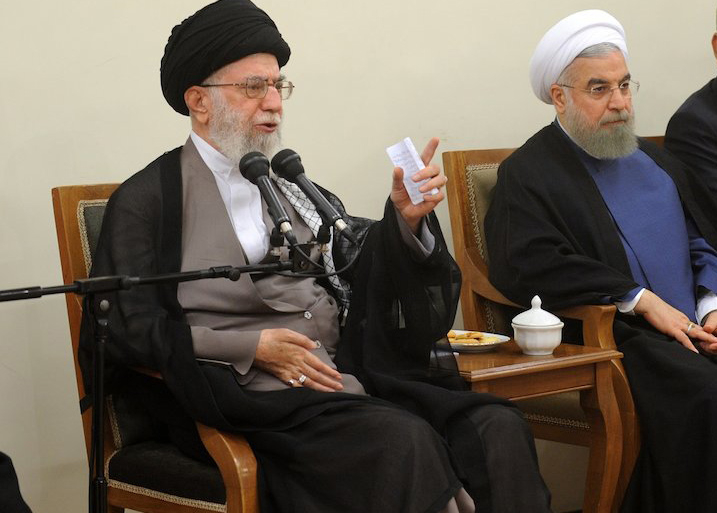
  • Thus if Trump, or anyone else, wish to make a deal with the present regime in Tehran, the man they should talk to is Khamenei, not Rouhani, an actor playing the president.
  • [T]he two are, in fact, just one creature in two disguises, a witch bent on doing mischief.
  • Trump has been warned!

If President Donald Trump, or anyone else, wish to make a deal with the present regime in Tehran, the man they should talk to is Ayatollah Ali Khamenei (left), not Hassan Rouhani (right), an actor playing the president. (Image source: khamenei.ir)

For a few hours last weekend, political circles in Tehran were seized with speculative fever regarding a possible meeting between US President Donald Trump and the Islamic Republic's President Hassan Rouhani. Trump had announced in Biarritz, where the G7's farcical summit was held, that he would be prepared to meet the Iranian mullah and believed that could happen soon. For his part, Rouhani went on TV to declare readiness to meet "anyone", with no ifs and buts.

One "reformist" analyst phoned me in the middle of night Paris time to "inform" me that, with help from Trump, his faction was about to win a decisive victory over the "hardline" faction led by Supreme Guide Ali Khamenei.

In his narrative, Rouhani would meet Trump in September when both are to attend the United Nations' General Assembly in New York. They would establish a "roadmap" leading to an agreement incorporating the Obama "nuke deal" plus additional demands by Trump. That, in turn, would lead to a lifting of US sanctions, saving the Iranian economy from a meltdown.

The "miracle" would coincide with the next general election in Iran and a secure landslide victory for "reformists". That, in turn, would enable them to press for Khamenei's retirement and replacement by Rouhani, while Muhammad-Javad Zarif, the "heroic" foreign minister, throws his hat, since he has no turban, into the ring for the presidency. With Khamenei and his "Russophile" faction eliminated, the "New York Boys" would put Iran on a new trajectory as the United States' key partner in the Middle East.

What was remarkable in that narrative was how stale it was.

Weeks after the mullahs seized power, the Carter administration in Washington identified Mehdi Bazargan, Khomeini's first prime minister, as "the man with whom we can work."

After he was kicked out, attention was turned to more ephemeral figures such as Ayatollah Muhammad Beheshti, Abol-Hasaan Banisadr and Sadeq Ghotbzadeh who were supposed to lead Iran out of its revolutionary phase into normality, whatever that meant.

With Ayatollah Khomeini, supposedly too old to last long, these were the men who would shape Iran's Thermidor, emerging from the reign of terror. Fariba Adelkhah, then a young researcher in Paris and later an ardent apologist for the Islamic Republic, even wrote a book bearing the title "Iranian Thermidor". (She is now a hostage in Tehran held by the very men she had so passionately defended in the French media.)

Over the years, we heard similar analyses from the Akbar Hashemi Rafsanjani faction in the 1980s, the Muhammad Khatami circle in the1990, and the Larijani brothers in 2004. Both President George W Bush and British Prime Minister Tony Blair told me at different times that they had identified "men with whom we can work" in Tehran and that the key to success was getting rid of Khamenei and his "hardliners."

At one point, the Reagan administration saw Rafsanjani, a wily mullah-cum-businessman, as the Iranian version of Deng Xiaoping. Tony Blair, no doubt under Jack Straw's influence, saw Khatami, a middling mullah and a wannabe intellectual, as the "Iranian Gorbachev".

As early as 2004, both the British and the French saw Rouhani as the man capable of delivering what Rafsanjani and Khatami had promised but failed to deliver. The horse on which John Kerry put his bet was Muhammad-Javad Zarif, whose team of "New York Boys" provided Rouhani with a "liberal" varnish.

Western analysts and their imitators inside Iran missed two crucial points.

The first was that, like most revolutionary regimes, the Khomeinist outfit had no mechanism for reform in the direction desired by the Iranian middle classes and the Western powers. Thus, even if its leaders tried to introduce reforms they would be doomed to failure. Lenin tried that in the 1920s with his New Economic Policy (NEP) that, instead of liberalizing the Soviet system, produced Josef Stalin. Mao Zedong's reform project, known as "The 100 Flowers," morphed into the Great Proletarian Cultural Revolution, millions of deaths and further hardening of the Communist regime. Khomeini himself attempted a similar move with his 8-Points reform project in 1981, leading to mass executions in 1988. In the Islamic Republic, the number of executions and political prisoners has always risen under "reformist" presidents such as Khatami and Rouhani.

The second point Western powers ignore is that Iranians today are divided into two broad camps, obviously with subdivisions within each camp. One camp consists of those, perhaps even a majority today, who are disillusioned with the Islamic Revolution and seek ways of closing its chapter as soon as possible. The idea of "change within the regime" appeals to some among them but has never offered a credible political platform from which to attempt a seizure of power within the regime.

In the second camp, we find all those who, for different reasons, are still committed to the Khomeinist Revolution. In that camp the "hardliners" have been and, I believe remain, in a majority. Thus, whether we like it or not, it is Khamenei, and not Rafsanjani, Khatami or Rouhani, who set the tune in the Islamic Republic. In fact, each time Western powers made a deal with the Islamic Republic it was ultimately with Khomeini and, after him, Khamenei. It was Khomeini who drunk the "poison chalice" by ending the war with Iraq, not Rafsanjani who played "strongman" at the time.

The Obama "nuke deal" started with negotiations that Khamenei ordered before Rouhani became president. The result, the JCPOA (Barjam in Persian), was adopted after Khamenei gave his tacit consent.

Thus if Trump, or anyone else, wish to make a deal with the present regime in Tehran, the man they should talk to is Khamenei, not Rouhani, an actor playing the president. On Tuesday, that fact was demonstrated by Khamenei ordering Rouhani to eat humble pie and publicly recant on his boast about a summit with Trump.

The "hardline vs. moderate" comedy played in Tehran reminds me of the French Opera Buffa in which two seductive girls adopt opposite profiles. "No-no-Nanette" always says no to admirers but she ends up in bed with all of them. In contrast, "Yes-yes Yolanda" offers tantalizing "yes" but never goes the whole way. In the end, we find out that the two are, in fact, just one creature in two disguises, a witch bent on doing mischief.

Trump has been warned!
This article was originally published by Asharq al-Awsat

Amir Taheri was the executive editor-in-chief of the daily Kayhan in Iran from 1972 to 1979. He has worked at or written for innumerable publications, published eleven books, and has been a columnist for Asharq Al-Awsat since 1987. He is the Chairman of Gatestone Europe.

Source: https://www.gatestoneinstitute.org/14788/trump-iran-deceiving-mullahs

Follow Middle East and Terrorism on Twitter


European Dreams vs. Mass Migration - Giulio Meotti

​
by Giulio Meotti

Unfortunately, the European mindset refuses to face the reality, as if the challenge is too severe to be addressed.

  • Unfortunately, the European mindset refuses to face the reality, as if the challenge is too severe to be addressed.
  • "The conference took place under the theme 'Penser l'Europe' ['Thinking of Europe']... There, I was disturbed to hear Tariq Ramadan speaking of Europe as dar al-Shahada, i.e. house of Islamic belief. The attending audience was alarmed, but did not get the message of the perception of Europe... as a part of house of Islam. If Europe is no longer perceived as dar al-Harb/house of war, but viewed as part of the peaceful house of Islam, then this is not a sign of moderation, as some wrongly assume: it is the mindset of an Islamization of Europe". — Bassam Tibi, Professor Emeritus of International Relations, University of Goettingen.
  • It is a false Marxist notion among young people here in Europe that if you are successful or comfortable, it can only have been at the expense of humanity: "If I win, somebody else must lose." There seems to be no concept at all of "win-win" -- "If I win, all of you can win too: everyone can win!" -- which underpins the free economy and has lifted so much of the world so spectacularly out of poverty.
  • It is important to... reject the current fashion of self-abasement. Europe seems to be afflicted with a skepticism about the future, as if the decline of the West is actually a justified punishment and a liberation from its faults of the past.... "For me, today," notes Alain Finkielkraut, "the most essential thing is European civilization".


The price for cultural relativism has become painfully visible in Europe. The disintegration of Western nation-states is now a real possibility. Multiculturalism -- built on a background of demographic decline, massive de-Christianization and cultural self-repudiation -- is nothing more than a transitional phase that risks leading to the fragmentation of the West. (Image source: iStock)

Europe presents itself as the vanguard of the unification of humanity. Europe's cultural roots, as a result, have been put at risk. According to Pierre Manent, a renowned French political scientist and a professor at the School for Advanced Studies in the Social Sciences in Paris:
"European pride or European self-consciousness depend on the rejection of European history and European civilization! We want nothing to do with the Christian roots and we absolutely want to be perfectly welcoming to Islam".
Manent delivered these words to the French monthly, Causeur. He cited, as an example, Turkey:
"It was very clear that not only was its massively Islamic character (even before Erdogan) not an obstacle but a sort of motive, a reason to bring the Turkey into the EU. It would finally have been the definitive proof that Europe had detached itself and freed itself from its Christian dependence".
Europe's southern border is now the front line for this mass-migration; Italy risks becoming that refugee camp. In the last few months, Italy has faced a succession of boats from Africa, challenging its policy: first the Sea Watch 3, then the Open Arms and finally the Ocean Viking. Until just before Italy's March 2018 elections, migrants were crossing the Mediterranean at the rate of 200,000 a year.

Since European security ministers failed to agree on the Mediterranean refugee crisis, Italy's Interior Minister Matteo Salvini, willing to stand virtually alone, chose to close Italian ports. Although Italian court tried to charge him with "kidnapping" migrants, Salvini's policy worked and landings plummeted. In the first two months of 2019, 262 seaborne migrants reached Italy, compared to 5,200 in the same period last year, and more than 13,000 in the same period of 2017.

The Italian government collapsed on August 20; there is now the great possibility that a new pro-immigration leftist coalition will take its place. A ship attempting to bring to Italy 356 migrants from Africa, more than all who came in the first two months, has been stranded at sea since it picked up the migrants between August 9-12, while awaiting permission to land. In one standoff after another, NGOs have been attempting to break Salvini's barricade against illegal immigration.

One ship already did. One of the captains of the Sea Watch 3, a German citizen, Pia Klemp, was even honored by the city of Paris for breaking the Italian blockade. According to the other German captain, Carola Rackete: "My life was easy... I am white, German, born in a rich country and with the right passport" -- as if her determination to help migrants would be, in her own words, related to the comparatively privileged life she has lived in the West.

It is a false Marxist notion among young people in Europe that if you are successful or comfortable, it can only have been at the expense of humanity: "If I win, somebody else must lose." There seems to be no concept at all of "win-win" -- "If I win, all of you can win too: everyone can win!" -- that underpins a free-market economy and has lifted so much of the world so spectacularly out of poverty. Many of the young people see only barriers to be broken down. Pascal Bruckner called it, the "tyranny of guilt".

Unfortunately, the price for cultural relativism has become painfully visible in Europe. The disintegration of Western nation-states is now a real possibility. Multiculturalism -- built on a background of demographic decline, massive de-Christianization and cultural self-repudiation -- is nothing more than a transitional phase that risks leading to the fragmentation of the West. Among the reasons for that, the historian David Engels listed "mass-migration, the aging of the population, Islamization and the dissolution of nation states".

Mass-migration has already undermined the unity and solidarity of Western societies and -- combined with demonizing Israel in the hope of obtaining inexpensive oil and preventing terrorism -- has destabilized the post-1945 political consensus.

German Chancellor Angela Merkel's policy of open doors -- "Wir schaffen das" ("We can do it") -- led to a right-wing party in her parliament. The Alternative for Germany (AfD) is now leading the polls in regional elections in the former East Germany. The French Socialist Party, which governed the country under President François Hollande, is now disappearing. The diktats of Brussels on immigration and quotas have broken the unity of Europe and resulted in the virtual "secession" of the Visegrad countries (Poland, Hungary, the Czech Republic, Slovakia). The migration utopia in Sweden brought a populist right-wing party into parliament, and the arrival of half a million illegal immigrants pushed the once-marginal League of Matteo Salvini to the top of Italy's political establishment.

This list does not even include Brexit, the British vote to leave the EU. According to German journalist Jochen Bittner, writing in The New York Times last year:
"In late 2015, the Leave campaign started putting up placards which showed the exodus of refugees from Syria and other countries through the Balkans, and adorned them with slogans like 'Breaking Point' and 'Take Back Control'. With Ms. Merkel declaring an open-door policy, the message hit home for millions of worried Britons and Europeans. Not coincidentally, it was around this time that support for Brexit began to tick up".
Instead of crying at "populism" and "nationalism" all the time, might Europe rethink its decision?

Currently, the Europe that promised to avoid building more walls after 1989, when the Berlin Wall came down, is raising one after another one to defend itself from an unprecedented situation. There is the 15-meter Spanish barrier in Ceuta and Melilla; the Hungarian wall of Prime Minister Viktor Orbán; one at Calais in France; an Austrian fence planned at its border with Italy, a fence Slovenia wants to build at its border with Croatia and North Macedonia's fence for its border with Greece.

Whether one likes it or not, Europe seems to be feeling an existential cultural threat from these great migratory flows. There is not only the pressure of illegal immigration; there is also pressure from legal immigration. More than 100,000 people applied for asylum in France in 2017, a "historic" number, and more than 123,000 applications in 2018. In Germany, there were 200,000 requests for asylum in 2018.

This mass immigration is changing Europe's internal composition. In Antwerp, the second-largest city in Belgium and the capital of Flanders, half the children in elementary schools are Muslim. In the Brussels region, you can get some idea of the change by studying the attendance of religion classes in primary and secondary schools: 15.6% attend Catholic classes, 4.3% Protestant and Orthodox classes, 0.2% attend Judaism classes, and 51.4% attend Islamic religion classes (12.8% attend secular "ethics" classes). Is it clearer now what will happen in the capital of the European Union? We should not be surprised that immigration tops the list of worries of the Belgian population.

Marseille, the second-largest city in France, is already 25% Muslim. Rotterdam, the second-largest city in the Netherlands, is 20% Muslim. Birmingham, the second-largest city in Britain, is 27% Muslim. It is estimated that in one generation, a third of the citizens of Vienna will be Muslim. "Sweden is in a situation that no modern country in the West has ever found itself in", observed Christopher Caldwell. According to the Pew Research Center, Sweden might well be 30% Muslim by 2050; and 21% Muslim in the unlikely event that the flow of immigrants stops altogether. Today, 30% percent of Sweden's babies have foreign-born mothers. The city of Leicester in the UK is presently 20% Muslim. In Luton, out of 200,000 inhabitants, 50,000 are Muslim. Most of the population growth in France between 2011 and 2016 was driven by the country's large urban areas. At the top are Lyon, Toulouse, Bordeaux and the Paris area, according to a study published by the French National Institute of Statistics and Economic Studies. In Lyon, there are about 150,000 Muslims out of a population of 400,000. According to one article, 18% of the newborns in France carry a name that is Muslim. During the 1960s, the number was 1%.

In the most extreme scenario, the percentages of Muslims in Europe in 2050 are estimated to be: France (18%), UK (17.2%), Netherlands (15.2%), Belgium (18.2%), Italy (14.1%), Germany (19.7%), Austria (19.9%), Norway (17%). 2050 is just over the horizon. What, then, is to be expected in two or three generations, when the late historian Bernard Lewis said that Europe would, "at the very latest", be Islamic ?

Unfortunately, the European mindset refuses to face the reality, as if the challenge is too severe to be addressed. "The unstoppable progression of this system makes me think of a tea on board the Titanic", prominent French philosopher Alain Finkielkraut writes.
"It is not by turning a blind eye to tragedy that it will be prevented from happening. What will be the face of France in fifty years? What will the cities of Mulhouse, Roubaix, Nantes, Angers, Toulouse, Tarascon, Marseille and the whole Seine Saint-Denis department look like?"
If the population changes, the culture follows. As the author Éric Zemmour points out, "after a certain number, quantity becomes quality".

While the power of European Christianity seems to be falling off a demographic and cultural cliff, Islam is making giant strides. It is not just a question of immigration and birth rates; it is also one of influence. "In September 2002 I participated in a meeting of the cultural centers of the leading European Union member states in Brussels", the German-Syrian intellectual Bassam Tibi, Professor Emeritus of International Relations at the University of Göttingen, wrote.
"The conference took place under the theme 'Penser l'Europe' ['Thinking of Europe'] while being given the title 'Islam en Europe'. There, I was disturbed to hear Tariq Ramadan speaking of Europe as dar al-Shahada, i.e. house of Islamic belief. The attending audience was alarmed, but did not get the message of the perception of Europe in an Islamist mindset as a part of house of Islam. If Europe is no longer perceived as dar al-Harb/house of war, but viewed as part of the peaceful house of Islam, then this is not a sign of moderation, as some wrongly assume: it is the mindset of an Islamization of Europe..."
The good news is that nothing is set in stone. Europeans could still decide for themselves how many immigrants their societies need. They could put in place a solution that is coherent rather than chaotic. They could still rediscover their humanistic heritage. They could resume having children and they could launch a real program of integration for the immigrants already in Europe. But none of these steps, necessary to avoid the transformation of large parts of the continent and its falling apart, is taking place.

It is important to listen to Pierre Manent's prognosis and to reject the current fashion of self-abasement. Europe seems to be afflicted with a skepticism about the future, as if the decline of the West is actually a justified punishment and a liberation from its faults of the past. Yes, many faults may have been terrible, but are they truly so much worse than the faults of many other countries, such as Iran, China, North Korea, Russia, Mauritania, Cuba, Nigeria, Venezuela or Sudan, to name just a few? More important is that at least the West, as opposed to many other places, has tried to correct its faults. Most important is to avoid over-correcting and ending up in a situation worse than before.

"For me, today," notes Finkielkraut, "the most essential thing is European civilization".

Giulio Meotti, Cultural Editor for Il Foglio, is an Italian journalist and author.

Source: https://www.gatestoneinstitute.org/14767/europe-dreams-immigration

Follow Middle East and Terrorism on Twitter


Mexico Bleeding - Stephen Brown

​
by Stephen Brown

Mexican murder rate hits unprecedented all-time high.


It is a very tragic story currently unfolding in America’s southern neighbor where deadly violence is now almost a way of life.

According to data released by Mexico’s National System for Public Security, murders this year in the Latin American country are at an all-time high. Statistics show there has been more killings in the first six months of 2019 than ever before in the country’s history. (Mexicans started keeping records on their country’s murder rate in 1996.)

The total number of victims for the first half of 2019 comes to more than 17,000 people, a new record. This represents a 5.6 per cent increase in killings over the same time period last year. And also amounts to about 90 people slaughtered per day.

Three thousand murders were recorded in June, 2019, alone, which is an increase of 232 over the same month last year. This is the most murders ever recorded for a single month.

These figures do not include victims of other serious crimes such as, for example, kidnapping, attempted murder or extortion.

The Mexican 2019 six-month homicide figure almost matches the American figure for the whole year of 2017 at 17.234, according to the FBI. There was also about a 7.6 per cent drop in the American rate in 2018. But America also has, according to Wikipedia, a population of 327,167.434. By contrast, Mexico’s is 126,577, 691.

Mexico’s horrifying figures stand in contrast to the 13,985 murders committed in the first six months of 2018, which was also a record year for homicides. The year 2018 also saw a 33 per cent increase in the murder rate over 2017, which, again, was yet another record year for killings in its own right.

So far in 2019, Mexico is on pace to easily surpass the 29,111 killings for all of last year by several thousand.

Much of the homicidal violence in Mexico is due to the notorious drug cartels which seem to murder with impunity. The homicide rate in Mexico had actually dropped between 2012 and 2015, causing people to think that the worst of the cartel violence was over. But this wasn’t so.

“Security experts say fueling the violence is the fact that many cartels have splintered into factions that have engaged in increasingly bloody battles over control,” stated a Fox news report.

The most violent state in Mexico, for example, is Guanajuato where the cartels Jalisco New Generation and Santa Rosa de Lima are fighting each other. There are currently 947 murders under investigations in this state. Cartel violence is usually about drug distribution and control of territory.

“In 2011, the Jalisco cartel dumped 35 bodies on an expressway in the Gulf state of Veracruz,” stated an Associated Press report.” In 2012, the Zetas dumped 48 decapitated bodies on a highway in northern Mexico and left 14 severed heads near a city hall.”

But the places in Mexico with the most homicides are the states of Veracruz, Chihuahua and Jalisco as well as Mexico City.

One of the most violent cities in Mexico, however, is the city of Tijuana, just south of the Californian border. Tijuana had 2,519 murders in 2018, a 40 per cent increase over 2017, which was itself a record-breaking year. Just last month, Mexico’s Citizens’ Council for Public Safety deemed Tijuana the most “violent” city in the world.

The violence in Mexico is simply reaching incredible dimensions, incomprehensible to most people.

For example, earlier this month police found 19 bodies hanging from bridges or hacked up. Nine were hanging from an overpass.

All had been shot to death. Some had their hands tied and some had their pants pulled down.

“Two of the bodies hung by ropes from the overpass by their necks and one of the dismembered bodies were women," said Adrian Lopez Solis, state attorney general for the state of Michoacan where the killings took place.

As well, the murderers hung a banner at the site of their killings with a message. The banner bore the initials of the very violent Jalisco New Generation cartel and the message read: “Be a patriot, kill a Viagra.” The Viagra is a rival drug cartel.

“This kind of theatrical violence where you don’t just kill, but you brag about killing is meant to intimidate and send a message to the authorities,” said Mexican security analyst Alejandro Hope.

Earlier, cartels did not make a show of publicly displaying their murder victims.

“For years, cartels had seemed loath to draw attention to themselves with mass public display of bodies,” stated an Associated Press story. “Instead, the gangs went to great lengths to hide bodies in clandestine burial pits or dissolving corpses in caustic chemicals.”

In another act of cartel violence, which would astound most Americans, last May the Jalisco New Generation gangsters, in a “particularly brazen attack,” drove one night “in a convoy of pickups and SUVs”, openly marked with the letters of their cartel, through the Michoacan city of Zamora. They shot up police vehicles and killed or wounded several police officers.   

This recent killing spree in Michoacan of 19 dead is similar to the 2006-2012 drug war in Mexico. The terror of those turbulent years in Michoacan state lasted until ranchers and farmers rose up in a vigilante group and drove the dominant cartel back then, La Familia, out of the state.

One of the former organizers of the vigilante group, however, in a very telling statement, recently told the Associated Press he wants to see the army return to his state.

“We’re worse off now than we were then,” he stated.

The question remains now whether this slaughter and record-breaking growth in the Mexican murder rate year after year can be stopped.

The president of Mexico, Andres Manuel Lopez Obrador, who took office last December, “insists it is under control.” But Obrador has “clashed” with reporters about over this.

One such reporter was Univision’s Jorge Ramos. According to Fox News, Obrador told Ramos: “Our data shows that we’ve brought this situation under control.”

Ramos, however, didn’t let Obrador off the hook, correctly responding: “The data I have shows something else, you’re not controlling, to the contrary, many Mexicans continue to die.”  

However, to his credit, Obrador says he intends to establish a new, 18,000 member National Guard to combat the cartels. Whether this will have an impact remains to be seen but does indicate the seriousness of the situation.

Perhaps a big reason for the extraordinarily high homicide rate in Mexico is that “nearly all such murders go unsolved and unpunished.”

“The number one issue we are dealing with in Mexico is impunity. The impunity rate for regular crimes is 90 per cent…” said a human rights activist in The Guardian newspaper.

Another possible reason is that this Latin American country, like many Arab countries, have not developed beyond the acceptance of such violence. They appear to have remained more violent than other societies and peoples. In order to deal with this, Mexicans probably will have to look inwards, do some soul-searching, in order to find answers in order to change this terrible situation plaguing their nation. Which is something they can only do themselves.


Stephen Brown is a contributing editor at Frontpagemag.com. He has a graduate degree in Russian and Eastern European history. Email him at alsolzh@hotmail.com.

Source: https://www.frontpagemag.com/fpm/274735/mexico-bleeding-stephen-brown

Follow Middle East and Terrorism on Twitter


Con Man Comey - Lloyd Billingsley

​
by Lloyd Billingsley

DOJ report unveils a former FBI boss' violations -- and "dangerous example.”


The Justice Department on Thursday released the delicately titled Report of Investigation of Former Federal Bureau of Investigation Director James Comey’s Disclosure of Sensitive Information and Handling of Certain Memoranda. Some news outlets described the inspector general (OIG) report as “scathing,” but readers have cause to wonder.

As the Washington Examiner noted, the report found “no evidence that Comey or his attorneys released any of the classified information contained in any of the Memos to members of the media.” Comey had, however, “violated Department or FBI policy” and “set a dangerous example” for current and former FBI employees.

But the OIG did not recommend prosecution.

That might be expected from an OIG who accused FBI Deputy Director Andrew McCabe of “lacking candor,” and violating FBI policy. The OIG released the report just before the Labor Day weekend, when it was least likely to command attention. In similar style in 2016, FBI boss Comey released documents on Hillary Clinton’s emails on the afternoon of September 2, just before the holiday weekend. Comey took the August 29 OIG report as confirmation that, as he said of Hillary Clinton, no reasonable prosecutor would charge him with anything.

The former FBI boss went into his end-zone dance, tweeting that “a quick message with a ‘sorry we lied about you’ would be nice.” That celebration may be premature. OIG Michael Horowitz is also investigating abuse of the Foreign Intelligence Surveillance Act, and Comey signed off on three of the four FISA applications for Carter Page. In addition, Attorney General William Barr and U.S. Attorney John Durham are investigating the origins of the Russia collusion probe.

Trump attorney Rudy Giuliani told reporters that Comey’s investigation of Hillary Clinton was “a sellout, a fix from day one.” The DOJ and establishment media should have seen it all coming.

As Christopher Andersen explained in the 2004 American Evita: Hillary Clinton’s Path to Power, Hillary Clinton was not from New York and in her quest to take the vacant seat of Daniel Patrick Moynihan, she needed creative ways to get votes. She visited the village of New Square, where four members of the Skver sect had been convicted of bilking government aid programs for some $30 million.

New Square voted overwhelmingly for Hillary and during the final days of his presidency President Bill Clinton opted to reduce the prison terms of the New Square offenders. James B. Comey, then U.S. attorney for the Southern District of New York, duly closed out the New Square clemency case. U.S. Attorney James Comey also “gave Bill and Hillary a pass,” in the case of fugitive Marc Rich, also pardoned by Clinton.

Comey became FBI director in 2013 under POTUS 44, formerly known as Barry Soetoro. He was in the process of transforming the USA into a country where the outgoing president appoints his successor and rigs the system in her favor. So no surprise that Comey would not recommend prosecution of an influence peddler who kept an illegal private server, destroyed more than 30,000 subpoenaed emails, smashed up electronic devices, and other violations that would have landed anyone else in prison.

Clinton crony Comey did his job and kept Hillary in the race. After she lost, Comey did his best to target the winner, Donald Trump, for which the DOJ Inspector General has now tapped him on the wrist. On the other hand, the investigation of Comey is hardly the only game in town.

“Entrenched officials in the Office of the Director of National Intelligence (ODNI) are refusing to declassify key documents related to the Trump-Russia affair more than three months after President Trump granted his attorney general the power to declassify the documents,” the alert Debra Heine notes in American Greatness, citing Paul Sperry of RealClearInvestigations.

Director Dan Coats and his deputy Sue Gordon, reportedly an ally of former CIA boss John Brennan, both resigned last month but the agency still withholds key information. The material includes an email exchange between James Comey and John Brennan in which Brennan argues for deploying the dossier in early drafts of the January 2017 intelligence assessment. That assessment spread the narrative that Russian President Vladimir Putin ordered the alleged Clinton campaign hacked to steal the election for Trump.

The material withheld by the ODNI also includes all FBI, CIA and State Department records related to Joseph Mifsud, the shadowy Maltese professor whose statements regarding George Papadopoulos allegedly triggered the Russia collusion probe. As this material suggests, a prime candidate for investigation should be John Brennan his own self.

As a voter for the Stalinist Gus Hall of the Communist Party USA in 1976, Brennan never should have been allowed anywhere near the CIA or any government post. Someone from outside the CIA should investigate every call and keystroke Brennan made, and everybody Brennan wanted to hire.

Contrary to what Brennan, Comey, Wray and Mueller seem to think, the CIA, FBI and ODNI are not branches of government. They are government agencies in the service of the executive branch. As this week’s OIG report confirms, government agencies can’t be trusted to investigate themselves.

As James Comey knows, the deep state is not like football, where the game does not continue until the penalty has been marked off. If nobody from the Hillary Clinton fix and coup attempt against President Trump winds up doing prison time, the deep state will have won.


Lloyd Billingsley is the author of  Barack ‘em Up: A Literary Investigation and, most recently, Sexual Terrorist, about the Golden State Killer.  Lloyd’s work has appeared in City Journal, the Wall Street Journal, Washington Times, California Globe, and many other publications. Bill of Writes: Dispatches from the Political Correctness Battlefield is a collection of his journalism. His crime books include A Shut and Open Case, about a double murder in Davis, California.

Source: https://www.frontpagemag.com/fpm/274792/con-man-comey-lloyd-billingsley

Follow Middle East and Terrorism on Twitter


A gay old time at the first straight pride parade - Taylor Day

​
by Taylor Day

I’m happy to see this sort of comedic mirroring of social justice warriorhood in a time when leftist radicals are redefining being straight and a Trump supporter as extremism.


The first-ever Straight Pride Parade had a successful launch in Boston on Saturday. The parody parade, organized by “Super Happy Fun America”, was attended by hundreds of people. According to their webpage, “The Straight Pride Parade [was] held to achieve inclusivity and spread awareness of issues impacting straights in Greater Boston and beyond.” The event started at Copley Square and the two-mile parade route ended at Boston City Hall where a “straight-pride” flag was risen, which has been the proud symbol of the movement for the “last 0.6 years.”


The event was also sponsored by Women of Eve, a women’s group which has been trying to get an ‘S’ for straight added to the LGBT acronym (complete with a petition).

Dangerous author and professional provocateur, Milo Yiannopoulos was the Grand Marshall of the parade. A video uploaded to Vimeo shows him tossing throat lozenges from a large float decorated in Trump/Pence banners to a crowd of protestors as they hurled homophobic insults to the openly gay former Breitbart editor.

Boston’s Emmerson College President Lee Pelton had sent out a school-wide memo in the days before the parade, encouraging students not to attend before completing a circuit on media circus to call the event a “perversion” and a “desecration of beauty, truth and generosity.”

A parade organizer, Samson Racioppi, shot back claiming Emerson College was suppressing their free speech saying, “They’re just heterophobic. They don’t want to afford us the right to walk down the street. That’s all we want to do is walk down the street.”

While Super Happy Fun America said all were welcome at their parade, they did state on their webpage that “Antifa (short for Anti-Fun) and other hate groups are not welcome because they are not happy and fun.” Antifa and hundreds of protestors showed up anyway and at least 34 arrests were made.

Even after the straight pride attendees dispersed, Antifa remained and tried to prevent law enforcement from reopening the road, while calling them Nazis, of course. Rep. Alexandria Ocasio-Cortez took to Twitter to crowdfund bail and legal fees for those that broke the law while spewing hate towards the parade-goers.

Other Leftists flocked to Twitter to express vitriol over a parade, mostly complaining about people finding their own normalcy worthy of celebration and the Trump 2020 flags that were on full display in the heart of Liberal America. Some Resistance leaders went so far as to call attendees “Incels” and “Nazis.”

The right to peacefully assemble is a constitutional right of all Americans no matter what they have chosen to assemble for nor how ridiculous it might seem. To exercise this right can never be considered hate speech no matter how loud those on the Left scream it to be. The City of Boston issued parade organizers lawful permits and police helped maintain a level of security during the event. Protestors still behaved in a juvenile and pedantic manner… while calling the parade juvenile and pedantic. It’s 2019 but they still want conservatives to stay in the closet.

The event itself still went off without a hitch or violence despite the wailing of the protestors and Twitter activists. Overall seemed to be quite the gay time. I’m happy to see this sort of comedic mirroring of social justice warriorhood in a time when leftist radicals are redefining being straight and a Trump supporter as extremism. If the Left decides to get mad over a parade obviously intended to mock them and not see the irony, that is unfortunate but just adds to the humor.

Connect with Taylor Day on Facebook and Twitter @TABYTCHI!

Taylor Day

Source: https://www.americanthinker.com/blog/2019/09/a_gay_old_time_at_the_first_straight_pride_parade.html

Follow Middle East and Terrorism on Twitter


Saturday, August 31, 2019

Incentivized Emigration: An idea whose time has come? - Dr. Martin Sherman

​
by Dr. Martin Sherman

Of all the policy paradigms for the resolution of the conflict between Israel and the Palestinian-Arabs, incentivized Arab emigration is the most humane if it succeeds and least inhumane if it does not.


"Past attempts to encourage Palestinians to voluntary emigrate have always failed, so time and effort would be better invested in reaching an Israeli-Palestinian peace agreement." - Yossi Beilin, former Israeli government minister, and a principal architect of the Oslo Accords, Al Monitor, August 26, 2019

The above quote is from an article by Beilin, still an unchastened champion of the fatally flawed process he helped initiate in the early 1990s,  in response to a spate of recent reports indicating that Israeli officialdom is considering—albeit with some hesitancy—the idea of offering the residents of Gaza material assistance to facilitate their emigration to third party countries—see for example here, here, here, and here.

Disingenuous dismissal?

Of course, Beilin’s dismissal of the notion of Israel encouraging Arab emigration is more than a little disingenuous. For if past failure is his criterion for disqualifying a policy proposal, the first to incur such rejection should surely be his own preferred Oslowian land-for-peace, two-state formula.
 

After all, from Beilin’s critique, the uninformed reader would never guess that far more “time and effort” has been invested in an almost three-decade long endeavor to "reach an Israeli-Palestinian peace agreement” than in any attempt at inducing Arab emigration.

Indeed, no other policy prescription has been backed with such massive and sustained outlays of treasure, political and diplomatic capital and...blood, as that embraced by Beilin and his like-mined pro-Oslowian ideologues—in their foolhardy gamble of trying to reach a resolution to the conflict with their overtly Judeophobic Palestinian interlocutors, by means of political appeasement and territorial withdrawal.

But setting aside for a moment Beilin’s disingenuous invocation of the lack of success of previous efforts to induce Arab emigration, there are substantive reasons why the past may well not be a reliable indicator of the future. 

The first is that the Arab population—particularly in Gaza—has already experienced the onerous travails of life under a duly elected Palestinian-Arab government. 

Documented desire to leave

This of course is particularly true for Gaza, although there is also considerable dissatisfaction in Judea-Samaria, where after over a quarter-century of government by Fatah, all that has been achieved is a dysfunctional polity and an emaciated economy, crippled by corruption and cronyism, with a minuscule private sector and a bloated public one, patently unsustainable without the largesse of its alleged “oppressor,” Israel.

But, it is Gaza, where the misguided experiment in two-statism was first initiated back in 1994, sparking a surge of deluded optimism fanned by the likes of Beilin, that has now become its gravest indictment—for both Jew and Arab alike.

The gross misgovernment of Gaza has left the general population awash in untreated sewage flows, with well over 90% of the water supply unfit for drinking, electrical power available for only a few hours a day, and unemployment rates soaring to anything between 40-60%--depending on the source cited or the sector involved.

Unsurprisingly, this has led to a wide spread desire to leave Gaza and seek a better future elsewhere—which is reflected in both numerous media reports and in statistical polling, which regularly shows that between 40-50% of respondents are willing to openly declare their desire to leave.

Significantly, according to some sources, since May last year, between 35-40,000 have  left—despite heavy restrictions at the border, ominous disapproval of the regime and the lack of any purposeful policy of Israel to incentivize their departure. 

Enhanced scale & scope

Another reason why past failures to induce emigration may not necessarily indicate that future attempts are futile is that any envisaged future endeavor must be qualitatively different in nature, in size and in scope to those previously undertaken.

In the past, the emigration initiatives have been timid, hesitant and surreptitious, while the material inducements offered were decidedly miserly.

In prior attempts, Israeli authorities attempted to conceal the initiative to encourage emigration. Thus, one internal Foreign Ministry memo (1968) stipulated: “This must be done discreetly and ‘spontaneously’ and under no circumstances should this be declared as official policy or appear to be organized by us.”

By contrast, what is called for today is an overt, publically declared strategic initiative, including an assertive public diplomacy offensive and accompanied by a comprehensive set of highly tempting incentives to leave and commensurately daunting disincentives for continued residency in Gaza. 

The point of departure for any successful incentivized emigration policy is to identify the Palestinian-Arab collective for what it is—and for what it identifies itself to be: An implacable enemy and not a prospective peace partner—and to differentiate between the inimical collective and non-belligerent individuals, which it may include. 

Disincentives for staying; incentives for leaving
 

This brings us to the disincentives for staying.

As its implacable enemy, Israel has no moral obligation or practical interest in sustaining the economy or social order of the Palestinian-Arab collective—either in Gaza or Judea-Samaria. On the contrary, an overwhelming case can be made – on both ethical and pragmatic grounds – that it should let them collapse by refraining from providing any of the goods or services it – perversely – provides today: water, electricity, fuel, tax collection and port services to name but a few. After all, these are in large measure used to sustain the hostility against Israel and imperil the lives of its citizens and undermine the security of the state. 

Although this cessation of provision should be executed gradually over a defined period of time, it will undoubtedly precipitate a grave deterioration in the already dire situation that prevails in Gaza.

Which brings us to the incentives for leaving.

In order to allow non-belligerent Gazans to extricate themselves from the inevitable humanitarian crisis such measures will entail, non-belligerent individuals should be offered generous relocation grants to allow them—and their dependents—the opportunity to seek more prosperous and secure lives elsewhere. 

As for the incentives, these need to be of a completely different order of magnitude to those of the past and sufficient not only to cover the travel cost of the recipients to their future countries of abode, but to make them relatively affluent and welcome emigres in those countries.

Approximating the Cost

It is not an easy task to determine the optimum compensation for prospective recipients, but for the sake of argument let us assume that 100 times the current Gazan GDP per capita per family is not an unreasonable point of departure. This would amount to about $250-300,000 per family. With the estimated number of families in Gaza around 400,000, the total cost would amount to about $100 billion or about one third of Israel’s total annual GDP.
 

At first glance this might appear daunting, but if the implementation of the initiative were spread over a period of a decade and half—far less than the efforts to effect a two-state outcome have been tried—this would come to only 2-3% of GDP—something Israel could probably shoulder on its own. If other OECD countries could be harnessed to participate, it could be implemented at a fraction of a percentage of their GDPs—showing that political legitimacy rather than economic cost is the principal obstacle to be overcome.

To give a sense of proportion, the US spent several trillion dollars on its military engagements in Iraq and Afghanistan, which dwarfs the size of the budget required to resettle all the Gazans, together with all their kinfolk in the “West Bank”, safely and comfortably in some third party country.

Who will host them?

One of the questions inevitably raised regarding the incentivized emigration idea is that of who the host countries are likely to be—especially given the migration crisis in Europe following the chaos in the wake of the “Arab Spring” and the Syrian civil war.

Indeed, according to the previously cited reports regarding renewed Israeli interest in encouraging Gazans to emigrate, it was noted that there was some difficulty in locating countries willing to accept them.
 

Clearly, however, within the parameters of the initiative set out previously, the situation would be very different. After all, within these parameters, the Gazan emigrants will not be arriving at the gates of their prospective host countries as destitute—or at least desperate—refugees but, as mentioned above, as relatively affluent emigrants by the standards of many such potential host countries.
 

Indeed, by absorbing Gazan emigrants, the host countries will generate significant capital inflows into their economies. For example, a country that accepts 3000 Gazan families can expect a capital injection of almost a billion dollars!
 

If additional international aid can be extended to the host countries, absorbing the Gazan emigrants could be an act that is both profitable and humane. 

The moral high ground 


Israeli officials have erred badly in being reticent as to the intention of encouraging Arab emigration. Indeed, there is no reason for any sense of moral unease. To the contrary, incentivized emigration is clearly morally superior to any other policy paradigm addressing the Israeli-Palestinian conflict—and certainly to that touted by Beilin calling for a two-state outcome. After all, any prospective Palestinian state will almost certainly be yet another homophobic, misogynistic Muslim majority tyranny—whose hallmarks would be: gender discrimination, gay persecution, religious intolerance, and political oppression of dissidents. Indeed, no two-stater, however fervent, has ever produced any persuasive argument why it would not be. 

Here of course, a trenchant question must be forced into the public discourse on the legitimacy of incentivized emigration in the context of the Israeli-Palestinian conflict in general, and of Gaza in particular. This is the question of “Who has the moral high ground?”

Is it those who advocate the establishment of said homophobic, misogynistic Muslim majority tyranny which would comprise the very antithesis of liberal values usually invoked for its establishment? 

Or is it those who advocate incentivized emigration and providing non-belligerent Palestinian individuals with the opportunity of building a better life for themselves elsewhere, out of harm’s way, free from the recurring cycles of death, destruction and destitution that have been brought down on them by the cruel corrupt cliques that have led them astray for decades.

The most humane; the least inhumane

Indeed, there is another, even more pertinent question to be asked of the proponents of Palestinian statehood:

Why is it morally acceptable to offer financial inducements to Jews to evacuate their homes to facilitate the establishment of said homophobic, misogynistic tyranny, which, almost certainly, will become a bastion for Islamist terror; while it is considered morally reprehensible to offer financial inducements to Arabs to evacuate their homes to prevent the establishment of such an entity?


The proponents of incentivized emigration need not feel any sense of moral discomfort as to their policy prescription—especially when compared to that of the proponents of Palestinian statehood.

Indeed, as I have demonstrated elsewhere, the incentivized emigration paradigm is in fact the most humane of all policy proposals if its implementation is successful; and the least inhumane, if it is not.


This is the message they should be propounding vigorously, openly and unabashedly--as the harbingers of an idea, whose time has come.


Dr. Martin Sherman served for seven years in operational capacities in the Israeli Defense establishment, was ministerial adviser to Yitzhak Shamir's government and lectured for 20 years at Tel Aviv University in Political Science, International Relations and Strategic Studies. He has a B.Sc. (Physics and Geology), MBA (Finance), and PhD in political science and international relations, was the first academic director of the Herzliya Conference and is the author of two books and numerous articles and policy papers on a wide range of political, diplomatic and security issues. He is founder and executive director of the Israel Institute for Strategic Studies (www.strategicisrael.org). Born in South Africa,he has lived in Israel since 1971.

Source: http://www.israelnationalnews.com/Articles/Article.aspx/24379

Follow Middle East and Terrorism on Twitter