Monday, September 2, 2019

In the UK, You Could Soon Be Arrested for Crimes You Haven’t Yet Committed - Robert Spencer

​
by Robert Spencer

Just thinking about opposing jihad terror will be crime enough.


Philip K. Dick’s story “The Minority Report,” made into a movie in 2002 directed by Steven Spielberg and starring Tom Cruise, takes us to a nightmarish Washington, DC, in the year 2054, where police arrest people based on crimes that psychics say they’re going to commit in the future. That dystopia could come to Britain 35 years early if the Tony Blair Institute for Global Change gets its way. According to the Guardian, the Institute has recommended that “a new law allowing for hate groups to be designated and punished before they turn to violence is needed in order to tackle far-right extremists.”

“Before they turn to violence” — that is, even if there is no indication that they will ever be violent.

The Guardian notes that the authors of Narratives of Hate: The Spectrum of Far-Right Worldviews in the UK, the Tony Blair Institute report calling for this, “acknowledge that the issue of linking violent and nonviolent extremism is contentious and steps would need to be taken to protect free speech.”

That’s window dressing meant to deceive the public into complacency. There is no way to criminalize certain opinions while protecting the freedom of speech.

The Guardian continues: “The law…would designate hate groups as organisations that spread intolerance and antipathy towards people of a different race, religion, gender or nationality, the report said.”

The danger of this is that it is universally taken for granted among the political and media elites that honest analysis of how jihadis use the texts and teachings of Islam to justify their actions and make recruits among peaceful Muslims constitutes spreading “intolerance and antipathy towards people of a different race, religion, gender or nationality.” Such analysis is consistently lumped together with racist groups, as if race hatred were the same thing as opposition to jihad mass murder and Sharia oppression of women, gays, and others.

The report focuses on genuinely racist and hateful groups that people will be reluctant to defend, but that’s just the camel’s nose under the tent. According to the Guardian, “the recommendations and conclusions are based on analysis of the overlap between four ‘nonviolent’ far-right groups – Britain First, For Britain, the British National party (BNP) and Generation Identity England – and the ideology of the terrorist Anders Breivik, who murdered 77 people in Norway in 2011.”

The “ideology of the terrorist Anders Breivik” is generally conflated with those who inspired him, according to media myth: critics of jihad violence and Sharia oppression of women and others. The fact that Breivik was hardly a counter-jihadi, and actually called for Europeans to ally with Hamas and al-Qaeda, is altogether forgotten, as it does not fit the narrative. So if the “ideology of the terrorist Anders Breivik” is actually criminalized, opposing jihad terror, mass Muslim migration into Europe, and the introduction of oppressive Sharia norms into the West will become a criminal act, even if the opponent of these things never calls for or condones any violence.

If the “ideology of the terrorist Anders Breivik” is going to be criminalized, will socialism and communism be outlawed also, since Stalin, Mao, Pol Pot and others murdered tens of millions in their names? Of course not. This proposed new law is designed solely to muzzle those who call for resistance to jihad violence and Islamization. Those who speak out against this proposal will inevitably be stigmatized as “racists” and “Islamophobes,” vehemently suspected of themselves being part of this “far-right fringe.”

And so there is likely to be no opposition to the Tony Blair Institute’s recommendation, and so very soon, even the tiny and embattled groups that are trying to resist jihad terror and Islamization in Britain today will be shut down, without anyone daring to speak out for them. What will happen then? What will this new Britain of “The Minority Report” look like when the real 2054 comes around? Probably it will be much more nightmarish than anything Philip K. Dick ever imagined.


Robert Spencer

Source: https://www.frontpagemag.com/fpm/274810/uk-you-could-soon-be-arrested-crimes-you-havent-robert-spencer

Follow Middle East and Terrorism on Twitter


Erdoğan's Elections: Heads I Win, Tails You Lose - Burak Bekdil

​
by Burak Bekdil

Erdoğan has taken to ridiculing even further whatever little remains of Turkey's democratic culture.

  • Turkish President Recep Tayyip Erdoğan promised party fans a clear election victory in Istanbul [on the June 23 rerun] -- but lost, this time, by a margin of more than 800,000 votes, compared to only 13,000 in the original race.
  • "Your wrath stems from the fear in you." — Meral Danış Baştas, Kurdish MP, replying to Erdoğan.
  • By using an administrative decision as a pretext to oust elected mayors, Erdoğan is effectively nullifying millions of Kurdish votes. Moreover, if the ousted mayors actually had proven links to terrorist organizations, why were they allowed to run in an election in the first place?
  • This drama will probably continue: Kurds will elect their leaders, Erdoğan will sack them. Kurds again will elect their leaders, Erdoğan will sack them too. Kurds will vote for other leaders and Erdoğan will sack them too.
  • Erdoğan should sit down, think and find out: why do his country's 20 million or so Kurds insist on invariably electing "terrorists" as mayors to their cities and towns, and defying his calls to do otherwise?


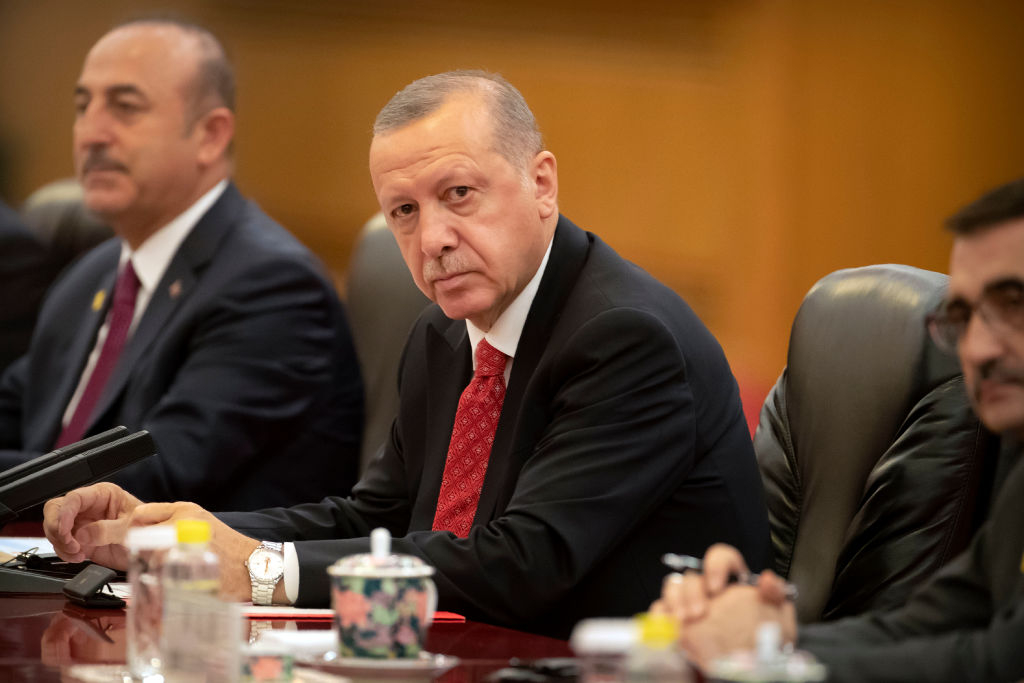
Turkish President Recep Tayyip Erdoğan has taken to ridiculing even further whatever little remains of his country's democratic culture. (Photo by Mark Schiefelbein - Pool/Getty Images)

No one in the saner parts of the world has ever claimed that Turkey's Islamist President, Recep Tayyip Erdoğan, is a liberal democrat who never in the slightest rigged election results. But he was, at least, known to respect the ballot box. No longer. Erdoğan has taken to ridiculing even further whatever little remains of Turkey's democratic culture.

Claiming vote-rigging, he pressured Turkey's supreme election board for a recount of ballots cast on March 31 in Istanbul, Turkey biggest city, which boasts more than 10 million registered voters. His Justice and Development Party (AKP) had lost municipal elections in Istanbul by a small margin of 13,000 votes. This was the first time Erdoğan's party had lost elections in Istanbul since 1994. The man who is notorious for saying "who wins Istanbul, wins Turkey" immediately ordered a rerun.

His cries of irregularities and fraud brought shy smiles to the faces of most foreign observers and Turks. "Sometimes you get the best detectives from the ranks of best thieves," joked a European diplomat who asked not to be named, in a private conversation with Gatestone on April 4. Although the Supreme Election Board did not find any vote-rigging in favor of the opposition, it ruled for a rerun on June 23. Grudgingly, voters changed their travel plans, and cancelled and remade their flight and hotel bookings to be present at the ballot box on June 23. Erdoğan promised party fans a clear election victory in Istanbul -- but lost, this time, by a margin of more than 800,000 votes, compared to only 13,000 in the original race.

The Islamist strongman had bitterly to admit defeat: 800,000 votes were just too many to hijack. He simply said there would not be other elections for four and a half years, when Turkey will hold presidential and parliamentary elections.

In the original March 31 local elections, along with Istanbul, Ankara and Izmir, Turkey's three biggest cities, his AKP party also lost other large provinces -- including Antalya, Mersin, Adana, Hatay and Bolu -- that typically had voted for it in previous polls.

Erdoğan, apparently, did not care much if he adhered to the rules as long as he won power. In 2016, Turkey's Interior Ministry appointed trustees to replace the elected mayors of 28 municipalities across the country, predominantly in Turkey's largely Kurdish eastern and southeastern provinces, on the grounds that the mayors allegedly had provided support to outlawed terrorist organizations. The target was the pro-Kurdish People's Democratic Party (HDP) which Erdoğan has declared a terrorist entity.

In his election campaign last October, Erdoğan did not mind threatening Kurdish voters: "Elections are nearing. If those involved with terror come out of the ballot box, we shall appoint trustees with no delay," he said in a speech. By then, 94 of 102 municipalities in Kurdish-majority cities and towns were administered by Ankara-appointed trustees, as Ankara moved to depose, arrest, and jail mayors in the aftermath of the 2014 city council vote. A Kurdish MP, Meral Danış Baştas, replied to Erdoğan in Kurdish: "Your wrath stems from the fear in you."

Elections have become an unpleasant political tug-of-war between the central government in Ankara and the Kurdish east: Kurds elect their leaders, who are then replaced by trustees from Ankara. Kurds once again elect their leaders, the government in Ankara once again appoints trustees to replace them -- a malignant vicious circle.

Erdoğan did not surprise anyone when, on August 19, his government replaced Kurdish mayors with state officials in three cities and detained more than 400 people for suspected militant links. The mayors of three major southeastern cities -- Diyarbakir, Mardin and Van -- are accused of various crimes, including membership in an alleged terrorist organization and spreading terrorist propaganda, according to the Interior Ministry. "This is a new and clear political coup. It is a clear and hostile stance against the political will of the Kurdish people," the HDP executive board said in a written statement. The three mayors had been elected with between 53% to 63% of the vote in their cities in March.

Erdoğan would do well to ask himself tough questions: If the Kurdish mayors actually had links to terrorism, why did the election board vet them favorably in the run-up to the vote? Does the fact that they have not been found guilty of any terror-related crimes after their election forcefully remind us that this is simply hijacking the votes of millions of Kurds? By using an administrative decision as a pretext to oust elected mayors, Erdoğan is effectively nullifying millions of Kurdish votes. Moreover, if the ousted mayors actually had proven links to terrorist organizations, why were they allowed to run in an election in the first place?

This drama will probably continue: Kurds will elect their leaders, Erdoğan will sack them. Kurds again will elect their leaders, Erdoğan will sack them too. Kurds will vote for other leaders and Erdoğan will sack them too.

Erdoğan should sit down, think and find out: why do his country's 20 million or so Kurds insist on invariably electing "terrorists" as mayors to their cities and towns, and defying his calls to do otherwise?


Burak Bekdil, one of Turkey's leading journalists, was recently fired from the country's most noted newspaper after 29 years, for writing in Gatestone what is taking place in Turkey. He is a Fellow at the Middle East Forum.

Source: https://www.gatestoneinstitute.org/14787/erdogan-elections-losses

Follow Middle East and Terrorism on Twitter


Revealed: How Stuxnet attack on Iranian systems succeeded - Gary Willig

​
by Gary Willig

Dutch intelligence agency AIVD reportedly recruited Iranian mole to deliver US-Israeli developed malware to Iranian uranium enrichment plant


An Iranian mole was responsible for the placement of the Stuxnet virus on the computers of an Iranian uranium enrichment plant, Yahoo News reported Monday.

According to the report, the malware was placed in the plant in Natanz in 2007, shortly after advanced centrifuges were installed at the facility.

The Dutch intelligence agency AIVD, acting on the behest of the CIA and the Mossad, recruited an Iranian engineer who worked at the plant. The engineer served as a mole for the intelligence agency and succeeded in delivering the Stuxnet virus via a USB drive.

The joint operation was called The Olympic Games, and was designed to set Iran's nuclear program back. The Stuxnet virus is believed to have destroyed up to 1,000 centrifuges at the Natanz plant.

The virus was discovered in 2010.


Gary Willig

Source: http://www.israelnationalnews.com/News/News.aspx/268295

Follow Middle East and Terrorism on Twitter


Model agency head wanted for questioning about Jeffrey Epstein’s sex ring has disappeared like a ‘ghost’ - Thomas Lifson

​
by Thomas Lifson

How many coincidences does it take to add up to the suggestion of a conspiracy?


The amazing string of “coincidences” deep-sixing evidence about Jeffrey Epstein and his sex ring activities keeps growing. The man known who mysteriously acquired vast wealth, and who flew the world’s rich and powerful to his private island in the company of pretty, but underage girls died in circumstances that were supposed to prevent suicide, and by sheer coincidence (we are assured) a series of coincidences made it possible and covered up any possible evidence of foul play.

Now, according to an exclusive in the UK Daily Mail, we learn that an associate of Epstein, a potential witness who recruited young girls for his modeling agency, whom French authorities “urgently” want to question, has disappeared. Sebastian Murphy-Bates writes:
A millionaire model agency boss who is thought to have key information about the Jeffrey Epstein scandal 'has disappeared like a ghost without a trace'.
Jean-Luc Brunel, 72, has vanished as police seek to ask the Frenchman 'urgent' questions about the paedophile.
Investigators are making enquiries in Brazil, the US and Europe and French prosecutors are also pursuing claims relating to the financier, who died aged 66 before he could face the latest allegations. (snip)
Brunel - who founded New York's MC2 - denies any involvement with crimes committed by Epstein.
A Paris legal source told the Daily Mirror: 'He is a ghost who has disappeared without trace.'
It comes after former model Svetlana Pozhidaeva, who was signed to MC2, was pictured at convicted paedophile Epstein's mansion in New York back in 2016. (snip)
[Virginia] Roberts [an Epstein victim who claims she slept with Prince Andrew] says she also slept with Brunel 'many times' when she was aged 16 to 19. Many of the girls believed to have been used by Epstein are alleged to have been 'sourced' in Paris.
Epstein owned a £7million apartment in the French capital, where Brunel also lived. The agency boss was searching for new talent in Brazil until the start of this summer.
This month, French prosecutors have started a preliminary inquiry into whether Epstein sexually abused minors from France.
They say Brunel is 'uncontactable' because he has no address, internet accounts or social media.
Jean-Luc Brunel (video screen grab via UKDM)

Of course, it’s possible that Brunel is on a vision quest in the Amazonian jungle or otherwise seeking privacy. But the inability of authorities in multiple countries to contact a man of wealth and fame is more than a little puzzling. If it is not merely paranoia to wonder if Epstein was at the heart of a ring of powerful, well-connected child-abusers, then one might suspect that those who were in a position to offer evidence exposing the larger contours of that ring might be disposed of before they could blow open the truth.

Naturally this can be dismissed as sheer paranoia. But as the coincidences pile up, that dismissal becomes more difficult to maintain with a straight face.

Thomas Lifson

Source: https://www.americanthinker.com/blog/2019/09/model_agency_head_wanted_for_questioning_about_jeffrey_epsteins_sex_ring_has_disappeared_like_a_ghost.html

Follow Middle East and Terrorism on Twitter


Progressives’ Cynical Exploitation of Mass Shootings - Bruce Thornton

​
by Bruce Thornton

The callous privileging one sort of death over another.


The second multiple-victim shooting in Texas in a week brought out the usual clichés and useless policy prescriptions from the progressive media and Democrats running in the presidential primary. And also as usual, the protestations of being “heartbroken,” and the demands for banning and confiscating certain weapons, are rote responses that apart from having little material value, display a cynical exploitation of suffering for political gain.

One wonders, for example, why all this “heartbreak” and “thoughts”––“prayers” are now verboten for progressives––are never publicized about the lethal violence in Chicago, Baltimore, and other blue-state fiefs. Fifty-three people died in August from mass shootings, an unusually high amount. The August toll in the Windy City was 46 murdered––almost a quarter fewer than last year. And these sorts of numbers happen every month of the year in Chicago totaling 539 dead in 2018. But do we hear politicians preening their “heartbreak” over these deaths? Are not those lives as precious as those of mass shooting victims? Aren’t those families of the victims just as devastated?

Most of the victims in Chicago and Baltimore are black, as are most of the murderers. I guess “black lives matter” only when the police are involved, or the perpetrator isn’t black. Black-on-black crime doesn’t fit the narrative of “racism,” “white privilege,” or “white supremacism”––unless one wants to depict blacks as helpless victims of “racism,” powerless to control their behavior. By the way, that claim has been an argument for slavery and segregation going all the way back to Aristotle. And just who created the character-degrading, family-destroying, federally subsidized blue-city hell-holes that comprise the “environment” manipulating black people into crime? No wonder race-industry progressives don’t want to call attention to these grisly facts.

More useful for the left are the deranged white losers who make up most mass shooters. No doubt environmental factors or mental illness somewhat account for their actions, but deterministic arguments always collide with the fact that millions of individuals with the same environmental or psychological challenges don’t go on murder sprees. In the end we don’t know why these shootings occur, because for all our pseudo-scientific “knowledge” about human behavior, it is still a mystery. Dostoevsky is closer to the mark than are deterministic explanations: Such horrors happen because a soul alienated from God is free to choose even murder simply because he can.

All that, however, is mere religious superstition and obscurantism to our enlightened “brights.” Talking about our spiritual alienation created by more than a century of radical secularism is so old-fashioned and unsophisticated, the argument of “smelly” Wal-Mart shoppers and “bitter clingers” to guns and religion. How much easier––and politically useful–– to focus on the material cause: guns and “gun violence.” After the latest Texas shooting, Dem primary candidates pounced on the opportunity to exploit the killings. Corey Booker hit every stale gun-control nostrum in his tweet: “Beginning on Day One in office, I will take executive action to reduce gun violence—closing dangerous loopholes in gun sales, cracking down on gun manufacturers, and investing in communities impacted by gun violence.”

The banality of these threats is equaled by their complete emptiness: what “loopholes”? “Cracking down” how? “Investing” in what? Since 1965 we’ve “invested” $20 trillion in dysfunctional “communities,” and little has changed other than the size of the redistributionist feds and the debt used to finance these “investments.” At least “Beto” O’Rourke is more honest, if also incoherent: “I want to be very clear. The government will not take away your guns. But if you own guns, you will be forced to sell them to the government.” And that logical contradiction is “very clear”?

For decades we’ve heard these gun-control mantras, yet none of them offer anything that could either pass Second Amendment muster of be effective. As I wrote a few weeks ago,

The argument that more gun control laws will lessen substantially such murders has been disproven with facts over and over. In the Nineties, gun homicides fell by half, even as the number of guns increased 56%. The reason has been obvious since Prohibition in the Twenties: if enough people want something, black markets and criminal gangs will exist to get it for them. We’ve spent about a trillion dollars on reducing the availability of drugs, yet any savvy teenager in America can get just about any drug in less than a day. Likewise, someone bent on mayhem can circumvent the most stringent gun control laws. Just look at the crime rate in Democrat-controlled cities like Chicago, D.C., or Baltimore. They have some of the most restrictions on guns, and some of the highest murder rates.
Then there’s the “assault rifle” hysteria, the demonizing of legal, semi-automatic rifles like the AR-15 merely on the basis of appearance. I addressed this anti-gun chestnut last February:

The left, of course, thinks “smarter” gun control is the answer. They want to ban “assault rifles,” a scare-term that confuses semiautomatic with automatic weapons, the sale of which is already strictly limited. Then they sell the bait-and-switch by highlighting sinister-looking add-ons like silencers or high-capacity magazines. But if anti-gun nuts were concerned with gun deaths rather than the relatively rare but more politically fungible multiple-victim school-shootings, they’d know that very few murders involve rifles. In 2016, murderers were 19 times more likely to use handguns than rifles. And more murders were committed with hands and feet than with rifles.  Demonizers of “assault rifles” forget that they were banned from 1994 to 2004, and that the ban was ineffective, failing to stop the Columbine shooters in 1999, or even to reduce firearm killings.
It gets tiresome having to say the same thing over and over, but as Orwell once said, restating the obvious is sometimes the highest duty in times of ideological passions.

Finally, we all know why the Dems circle mass shootings like buzzards. Progressivism is founded on the principle of serial “crises” that our Constitution and its divided government are incapable of resolving. Technocratic elites in federal bureaus and agencies armed with new “sciences” must be empowered to bring their superior knowledge to bear on such crises. The people who are supposed to be sovereign and self-governing also can’t address a “crisis” through their state and local governments, or with civil societies outside of government’s reach. To progs, their common sense and practical wisdom are relics of a less enlightened age in which tradition, faith, and experience guided action and set the limits to which improvements or solutions are possible given a complex, flawed human nature.

And if there is no crisis? Then create one, and offer intrusive government policies and regulations as the solution to the crisis. Mass shooting are frightening and tragic for the victims and their families. But as a cause of death, they are a tiny portion of even murders, let alone other causes like automobile accidents and heart disease. Astrophysicist and card-carrying progressive Neil deGrasse Tyson was savaged by the progressive media for comparing the 34 people murdered over 48 hours in El Paso and Dayton to the number of dead from other causes in the same time period: “500 to Medical errors, 300 to the Flu, 250 to Suicide, 200 to Car Accidents, 40 to Homicide via Handgun.” And he made the obvious point that “Often our emotions respond more to spectacle than to data” In a therapeutic age where sentiment and emotion, ginned up by endless commentary and dramatic videos from the media, such facts are not the “truth,” as Joe Biden might put it. Of course, deGrasse Tyson issued a groveling apology for being “insensitive.”

Yet forming policy for over 330 million people that preserves and protects their freedom should look to facts, not emotions, and to what benefits the most people now and in the future. It should proceed  on a recognition of what can and cannot be accomplished by politicized government bureaucracies. And we should be rational about what constitutes a “crisis.” Privileging one sort of death over another to create emotional spectacles is usually a tool of political opportunism that will do nothing to reduce the photogenic tragedy du jour.

Mass shootings are a problem, not a crisis to be exploited by politicians. Of course we the people should do whatever we can, but draconian gun control has decades of failure that suggests we should look to our families, churches, communities, municipalities, and states, rather than to a distant, overweening federal bureaucracy. That solution is merely a device for aggrandizing partisan political power at the expense of our freedom.


Bruce Thornton is a Shillman Journalism Fellow at the Freedom Center, a Research Fellow at Stanford's Hoover Institution, and a Professor of Classics and Humanities at the California State University. He is the author of nine books and numerous essays on classical culture and its influence on Western Civilization. His most recent book, Democracy's Dangers and Discontents (Hoover Institution Press), is now available for purchase.

Source: https://www.frontpagemag.com/fpm/274819/progressives-cynical-exploitation-mass-shootings-bruce-thornton

Follow Middle East and Terrorism on Twitter


Project 2019: How the New York Times Profits from Slavery Today - Daniel Greenfield

​
by Daniel Greenfield

Why the media is lying about the history of slavery.


"One slave from Megiddo, three slaves from Phoenicia, eight slaves from the Hittites, one slave from Cyprus," the ancient tablet reads.

The Minoan palace in which the tablet was stored existed between 1,900 and 1450 BCE. The Minoan civilization dates back to 2,000 BCE, as the oldest of the Greeks and, like most civilizations throughout history, including their Egyptian trading partners, bought, sold, and kept slaves.  

Western civilization did not originate slavery. Babylon’s Code of Hammurabi has a great deal to say about slaves. Much of it involves the death penalty for anyone stealing slaves. Rebellious slaves had their ears cut off. Civilizations from Egypt to Greece, from Babylon to China used slave labor.

Following in the tracks of the New York Times’ 1619 Project, a 2000 BCE project could be launched to indict all of western civilization as being built on the labor of slaves. Though such an accusation would be far truer of Egypt and Babylon, than of Minoan or even Mycenean Greece. Just as it is far truer today of the Islamic states like Qatar, adored by the New York Times, than it was of America even in 1619.

If slavery, as some have insisted, is America’s original sin, it’s more like mankind’s original sin.

The origins of slavery are too ancient to attach a date. Slavery predates even the crudest writing and implements. 2,000 BCE or over 4,000 years ago, is as good a date as any other. And slavery exists today, from the skyscrapers of Qatar to the millions of ingenious and cheap products pouring out of China.

No major civilization was immune from slavery, but western civilization was the least tainted by it.

The Greeks were less dependent on the massive collective labor on which the civilizations of Egypt, Babylon and China were built. They were also more individualistic and able to think in terms of individual rights on a level deeper than the Hammurabi Code’s obsession with property.

When Judaism, the religion of a nation of freed slaves, came to Europe, with the captured Jewish slaves brought in countless numbers from the fall of the second commonwealth of Israel, their origin story of G-d overthrowing a slaveholding empire to build a personal relationship with man supplanted the old Greek and Roman legends. Rome might have destroyed the nation of the liberated slaves, and enslaved them once more, but their beliefs brought down yet another slaveholding empire.

The Exodus became the defining story for Puritan refugees, abolitionists and African slaves in America who embraced its religious and political significance. Despite the historical revisionism of the 1619 Project, slavery had only a tenuous and controversial grip here. Unlike the Romans and the Greeks, even many Southern elites viewed it as an unpleasant moral compromise that tainted them and their nation.

Of all the world’s major nations, America’s origins are the least defined by slavery. From its origins, there were moral, economic and political tensions between slaveholders and small farmers, laborers, religious leaders and philosophers. The Civil War was not a sudden awakening, but the climax of an ongoing conflict that finally exploded, taking a million people with it, and transforming the entire country.

The 1619 Project claims to trace back all of American life to slavery. But 1619 is no true origin point. African slavery long predated 1619 and western civilization had slavery thousands of years before.

At Bigbury Camp in Canterbury, England, 2,500-year-old slave shackles turned up in 1861. The emergence of the ancient implements of slavery from a pre-Roman trade in slaves in the year that America went to war, in part, over slavery, makes a mockery of the 1619 Project’s revisionism.

The Romans had an endless appetite for slaves and England had little else to offer than captives. An apocryphal story has Pope Gregory encountering Anglo-Saxon slaves in Rome, and, because of their fair hair, dubbing them not ‘angles’, but ‘angels’. In the Doom Book of 893 CE, King Alfred the Great prohibited Christmas to slaves, but provided them some measure of liberty during the Embertides.

By then as much as 10% of England’s population consisted of slaves. A few centuries later, slavery had lapsed and then vanished. In 1569, a merchant brought a slave with him from Russia and whipped him. In his ruling, a judge declared that, “England was too pure an air for a slave to breathe in.”

Slavery lapsed into indentured servitude which was reinvigorated when the authorities decided to ship undesirable English and Irish people to labor in the newly settled colonies. When the project ran short of English slum dwellers, indentured servants from all over, including Europe and Africa, were brought in.

Captain John Smith of Jamestown, of Pocahontas fame, had started out as a slave, not to the Europeans, but to the Turks, who continued the practice of taking and holding European slaves long after the abolition of the slave trade in America. After fighting the Ottoman Empire, Smith was captured in battle, and then sold into slavery. “Sold for slaves, like beasts in a market-place”, he would later write.

Smith killed his master, stole his clothes and his horse, escaped, and ended up as President of Virginia.

1619 did not bring more than a handful of African servants, who later became slaves, to Virginia. But it did see the Poles, who had come as indentured servants, going on strike for the right to vote.

Rhode Island passed the first anti-slavery law in 1652, but it did not take effect until 1784, a year after the end of the Revolutionary War. Vermont abolished slavery in 1777, Massachusetts in 1783, Connecticut in 1784, and New York in 1799. Many of these measures did not immediately eliminate slavery, but imposed sunset provisions on importing new slaves and enslaving children.

The struggle over slavery began with independence and, was fought most fiercely not between North and South, but between a few special interests and revolutionaries, clergy and activists. The origins of slavery in America were complex and the 1619 Project’s attempt at historical revisionism ignores the complexity of slavery in Delaware, where Swedish settlers were busy enslaving local Indians.

The New York Times’ 1619 Project falsely claims that all American institutions were shaped by slavery. It would be more accurate to say that they were shaped by the opposition to slavery. The slaveholders envisioned America as a series of ports and plantations where raw materials would be harvested, processed, and then put on board ships that were bound for Europe.


Had this slave vision prevailed, America would have resembled European colonies in Africa and the Caribbean, a small elite ruling over a vast slave population, leaving behind nothing but empty manors.

From the Poles of Jamestown to the American Revolution to the Civil War, it was established that America would not be a place where British elites could get cheap raw materials through cheap labor. Trump’s election victory made the same point about cheap markets to San Francisco elites.

Slavery did not define America. The resistance of small farmers and free labor defined America.

The multiple revolts ensured that representative government, not royal charters, would govern America. In the next phase of American life, the westward movement of settlers ran up against efforts to set up plantation states, and were met with violent resistance by farmers and free laborers which led to the Civil War. Free settlers were able to open up the western states and build a nation ‘from sea to sea’.

There are places south of the border where the 1619 Project would be relevant. In 1444, Portugal brought back the first cargo of slaves. By 1510, the first slaves began arriving in the Spanish colonies.

Why is there no 1444 Project or 1510 Project?

Look no further than Rep. Alexandria Ocasio Cortez or the illegal alien migrant border protests. The Left’s absurd ideology insists that the descendants of Spanish colonists south of the border are victims while the descendants of English, French, Spanish, Scottish, Irish, German, Polish, Jewish and Swedish colonists in America are evil oppressors. There can be a 1619 Project, but no 1510 Project.

Everyone knows that minorities, a group that now encompasses Spanish colonists, can’t be racist.

Slavery has always been with us. And the protests against it are selective.

When President Trump envisions an American economy no longer dependent on the labor of Chinese political prisoners and which does not feed fortunes into the oil empires of Qatar or Saudi Arabia, why do the progenitors of the 1619 Project not cheer loudly for an end to slavery, instead of angrily booing?

Where is their condemnation of the Islamic enslavement of Africans, not centuries ago, but today?

The 1619 Project exposes the hypocrisy, not of America, but of the leftist radicals determined to destroy it. Rather than working to fight against slavery in the present day, they concoct new slanders and smears whose purpose is to delegitimize America, and make the case for the political power of their faction. And what their leftist faction wants to do with that power is wipe out freedom and the Bill of Rights.

How better to make the case for a new slavery than by exploiting the history of an old slavery.

Meanwhile the New York Times, which profits from its extensive tourism trade, offers a tour of The Secrets of Marrakesh. These ‘secrets’ focus on dining and shopping. No mention is made of the UN report documenting the 85,000 people living in slavery in Morocco today. There’s a tour of Egypt, or as the Times calls it, The Land of the Pharaohs, where Eritrean Christian refugees have been held in slave camps for ransom. There’s a trip to Istanbul where 50,000 political prisoners of the Islamist regime rot.

And there’s Qatar, where millions of slaves, 90% of the population, labor for their Muslim masters in the killing heat, suffering, dying by the thousands, raped in private households, and kept in thrall.

The New York Times has no Project 1619 for Qatar. There is instead a trip to Doha with Roger Cohen.

And there’s also one place that doesn’t appear on the Times itinerary: Pedophile Island.

In 2008, Landon Thomas Jr., a New York Times correspondent and personal friend of Epstein, visited the infamous island.

"As his legal troubles deepened, Mr. Epstein gazed at the azure sea and the lush hills of St. Thomas in the distance, poked at a lunch of crab and rare steak prepared by his personal chef, and tried to explain how his life had taken such a turn," the Times profile romantically muses about its favorite child rapist.

Somewhere in the distance the children were likely being kept.

There will be no 1619 Project for the New York Times. Not in Doha, Marrakesh or Pedophile Island.

The New York Times is playing a cynical game of indicting the America of today for an institution that dates back to the dawn of human history in order to build up its own political power. But a better place to begin may be with Project 2008 or 2019 which explores its own complicity in modern-day slavery.


Daniel Greenfield, a Shillman Journalism Fellow at the Freedom Center, is an investigative journalist and writer focusing on the radical Left and Islamic terrorism.

Source: https://www.frontpagemag.com/fpm/274738/project-2019-how-new-york-times-profits-slavery-daniel-greenfield

Follow Middle East and Terrorism on Twitter


The disintegration of Yemen - Neville Teller

​
by Neville Teller

New developments have complicated the conflict on the Arabian Peninsula's southern flank. What compromise can there be between the Saudi-backed president of a united Yemen and the UAE-backed southern separatists and Iranian-supported Houthis?


The disintegration of Yemen
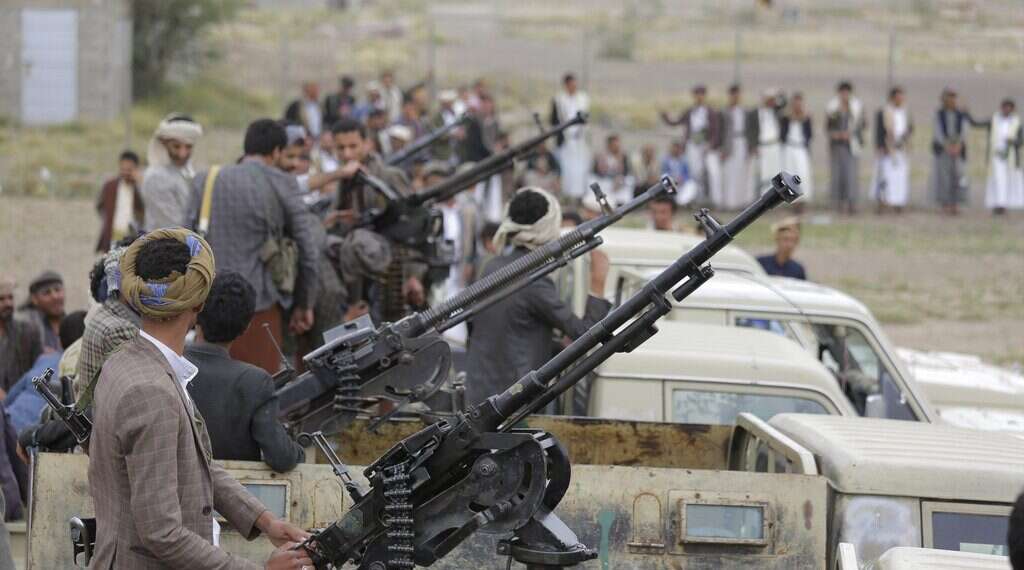
In this Aug. 1, 2019 file photo, Houthi rebel fighters ride on trucks mounted with weapons, during a gathering aimed at mobilizing more fighters for the Houthi movement, in Sanaa, Yemen. Airstrikes by the Saudi-led coalition fighting Yemen’s rebels Houthi hit a detention center in southwestern province of Dhamar, officials and the rebels’ health ministry said Sunday | Photo: AP/Hani Mohammed, File

Distressing as recent events have been in Yemen, a country torn apart by civil war that has led to a humanitarian disaster on a massive scale, the main outline of the conflict and the reasons behind it seemed, until quite recently, reasonably comprehensible. Now new developments have thoroughly complicated the issues.

This Yemen conflict started in the sadly misnamed “Arab spring” uprisings of 2011. Mass protests, a near-assassination of then-President Ali Abdullah Saleh, and pressure from neighboring petro-states forced Saleh to step down in favor of his vice president, Abed Rabbo Mansour Hadi. The political instability was largely caused by attempts of the Iran-backed Houthi rebels to overthrow Saleh’s government.

The Houthis, although on the Shia side of the great Islamic Sunni-Shia divide, are in fact a minority group – Zaydi Shiites. With the collapse of the Ottoman Empire in 1918, a Zaydi monarchy took power in North Yemen, but it was overthrown by republicans, and in 1962 the Yemen Arab Republic was formed.

These events in North Yemen were echoed by a constitutional upheaval in the south. In 1967 South Yemen was established as a socialist state under the protection of the USSR. Relations between the two Yemens deteriorated, and in 1972 they took up arms against each other. A ceasefire, brokered by the Arab League, included the aspiration of unification in due course. It took a further 18 years of military and political infighting before that aspiration was realized, but in 1990 the unified Republic of Yemen came into being. Ali Abdallah Saleh, who had been president of North Yemen since 1978, was proclaimed president of the newly united state.

Saleh had given up the keys of office with a very bad grace, and was quite prepared to ally himself with his erstwhile enemies, the Houthis, in an attempt to maneuver his way back to power. The subsequent turn of events seems depressingly familiar in the context of Yemen’s long history. Saudi Arabia, determined to prevent Iran from extending its footprint into the Arabian peninsula, intervened in March 2015 to beat back the Houthis. Saudi Crown Prince Mohammed bin Salman assembled a coalition of Arab states, obtained the diplomatic backing of the US, UK, Turkey, and Pakistan, and launched a series of airstrikes against the rebels.

The unconventional Saleh-Houthi partnership came to an abrupt end on December 2, 2017, when Saleh went on television to declare that he was splitting from the Houthis and ready to enter into dialogue with the Saudi-led coalition. This volte-face was to end in tragedy. On December 4, Saleh's house in Sanaa was besieged by Houthi fighters. Attempting to escape, he was killed.

Now the glue binding the two Yemens has come unstuck.

The first signs appeared as far back as 2007, when a south Yemen separatist movement was formed with the aim of re-establishing South Yemen as a sovereign state. Ten years later, in 2017, the movement set up the Southern Transitional Council, backed by the United Arab Emirates.

Separatists from the STC are part of the military coalition fighting the Houthi rebels; so is the UAE. But suddenly, in the first week of August 2011, separatist forces seized government military bases and began an assault on Aden. Thousands of people poured into the streets to support them, waving the old South Yemen flag.

It was a delicate situation. The UAE and Saudi Arabia had been firm allies in attempting to crush the Houthis but they now found themselves on opposite sides of this separatist uprising. Fortunately, cooler counsels prevailed. Saudi-UAE discussions led to a ceasefire. By August 16, southern separatists had vacated key public buildings in Aden, and the STC had welcomed Saudi Arabia’s call for dialogue.

But this episode introduces a new factor into an already complex situation. It is more than a minor spat between allies. In the long run, what sort of compromise can there be between the Saudi-backed president of a united Yemen fighting to maintain the integrity of his state, and the UAE-backed STC, dedicated to re-establishing an independent nation of South Yemen? Suddenly Yemen’s President Hadi is facing two enemies: the Houthis and the southern separatists.

Words issued on August 14 from UN envoy Martin Griffiths, currently watching events from the sidelines, sound true but ineffectual: “The conflict in Yemen can only be resolved through an inclusive political process.”

Indeed, but how long must Yemen’s agony persist?


Neville Teller

Source: https://www.israelhayom.com/2019/09/02/the-disintegration-of-yemen/

Follow Middle East and Terrorism on Twitter


Sunday, September 1, 2019

State Department warns Hezbollah - Elad Benari

​
by Elad Benari


State Department official voices concern over "destabilizing role" of Iranian proxies in Middle East.


The United States on Sunday voiced concern over the "destabilizing role" of Iranian proxies in the Middle East following Hezbollah’s firing of missiles into northern Israel.

A State Department official quoted by AFP said the US "supports Israel's right to self-defense".

"Hezbollah should refrain from hostile actions which threaten Lebanon's security, stability and sovereignty," the official added.

Earlier on Sunday, the US Special Representative for International Negotiations, Jason Greenblatt, backed Israel’s use of force on terrorist targets in southern Lebanon.

Greenblatt blamed Iran for the flare up, which saw multiple anti-tank missiles fired from southern Lebanon towards Israeli vehicles and an army base near the town of Avivim, in northern Israel.

“Missiles fired from Lebanon into Israel. Iran has proxies in Lebanon and Gaza that harm Israel, undermine chances for peace and threaten a better future for Palestinians,” Greenblatt tweeted.

“The US stands with Israel and fully supports its right to defend itself against all attacks,” he added.
Missiles fired from Lebanon into Israel. Iran has proxies in Lebanon & Gaza that harm Israel, undermine chances for peace & threaten a better future for Palestinians. The US stands w/ Israel & fully supports its right to defend itself against all attacks.
8:39 PM · Sep 1, 2019Twitter for iPhone

Israeli forces had retaliated on a number of targets in southern Lebanon, firing over 100 artillery shells and using airstrikes against Hezbollah sites.

Hezbollah claimed that it destroyed an armored Israeli vehicle, killing and injuring crew members inside.

Prime Minister Binyamin Netanyahu denied the claim, however, saying that no Israeli personnel were killed or wounded Sunday.

Prior to the comments by Greenblatt and the State Department official, Lebanon reached out to both the US and France, urging the two countries to intervene following the escalation.


Elad Benari

Source: http://www.israelnationalnews.com/News/News.aspx/268245

Follow Middle East and Terrorism on Twitter


The Shiite Crescent and Regional Disaster - Shoshana Bryen

​
by Shoshana Bryen


The Shiite Crescent is, for Iran, a single battlefront and the Islamic Republic has spent decades successfully exploiting it.


For decades, the concept of a “Shiite Crescent” anchored by the radical Shiite supremacists in Iran and passing through Iraq, Syria, and Hezb'allah to the Mediterranean Sea has been understood. It would provide Iran not only with closer access to Israel, but also spread across the northern borders of two key Sunni adversaries -- pro-American Jordan, and its most important enemy, Saudi Arabia, guardian of Mecca and Medina. It would further split off Sunni Turkey (a historic foe) from the other Sunni Middle East states.

The Crescent is, for Iran, a single battlefront and the Islamic Republic has spent decades successfully undermining and wrecking each subsidiary member.

Iraq is hardly a functional country. But as a staging ground for Iranian militias and weapons depots headed west, Iraq is a prize. Syria is largely a dead zone. But as a launching pad for Iranian military bases and attacks on Israel, Syria is a bonanza. Lebanon is a corrupt satrap of Syria and Iran, governed by a terror organization with a foreign legion and an international money/drug/weapons racket. But its very weakness and its border with Israel make Lebanon invaluable. 

Each member of this “gang of four” maintains a state of war with Israel and threatens it on a regular basis. Israel’s attacks on weapons centers Lebanon, Syria and Iraq are not an escalation of a fragile situation -- they are a defensive response to a high-tech military buildup orchestrated by Iran across the region. 

Israel has the support of the United States for its defensive actions. But until now, U.S. foreign and defense policy have actually made things worse for Israel and others in the region by empowering Iran – and even now, when the administration is aware of its malign nature, and has reimposed economic sanctions on Tehran, it needs a strategy against Iranian gains on the ground. 

Concern for Iranian expansion was the reason the United States supported the tyrant Saddam Hussein in the war he instigated against Iran in the 1980s. The 1990 Iraqi invasion of Kuwait, however, was a step too far for America. The tide began to turn on Saddam and on the concept of a bulwark against Iranian expansion. 

The year 2011 was key. The “Arab Spring” undermined and overthrew -- with American support -- the anti-jihadist, anti-Muslim-Brotherhood Hosni Mubarak in Egypt, ushering in a year of Brotherhood rule that saw jihadists released from prison and weapons imported across Sinai from Iran. The Egyptian military has spent years -- with some assistance from Israel -- trying to restore calm to the area. 

The anti-jihadist Moammar Qadaffi in Libya was next on the Obama list. Today, the country remains in turmoil with “militias” of every stripe fighting for territory and oil.

Whatever the merits of the U.S. entering Iraq in 2003, leaving in 2011 was an unmitigated disaster for Iraqis and everyone else. ISIS, followed by Iranian-commanded Shiite militias, ravaged the country, killing and enslaving Yazidis and Kurds, and erasing the border with Syria. With the ( temporary?) territorial demise of ISIS, the Iranian militias stayed behind to wreak their own form of havoc in the western, Sunni area of Iraq and bulldoze a path for Iranian weapons into Syria for better access to Israel.

American policy on Syria during the Obama administration, included pinkish lines against the use of chemical weapons instead of clear red ones, and on-again-off-again threats of military action. As Syria crumbled and Iran built and commanded militias in support of Assad, the administration poured arms and political support into what it called “secular, anti-Assad militias,” in the hopes of avoiding the deployment of American troops. “Our” militias, however, had their own ideas about their enemies and their friends -- and it isn’t altogether wrong to say that the U.S. ended up supporting ISIS and ISIS-related terror groups in Syria one or two steps removed.

It was the Trump administration that forced the definition of friends and enemies and actually wrested ISIS from its primary territorial base. But in a region bereft of stable government, it will appear again in some form.

Israel has regional red lines, which have been discussed with both the United States and Russia. These include ensuring that neither Iran nor Hezb’allah has military bases in southern Syria near the Israeli border; ensuring no use of chemical weapons; not permitting Iran to build weapons factories -- particularly nuclear-related or precision missile factories in other countries; and not permitting the movement of certain types of munitions across the Crescent.

Israeli action has certainly set back Iran's aspirations. But it will need the continued support of the United States -- and others, including the EU and the Sunni Arab States -- to come to terms with the “gang of four” and the havoc that is not limited to Israel, but has implications far beyond. And it will have to focus on Iran as the lynchpin of regional disaster.

Shoshana Bryen

Source: https://www.americanthinker.com/articles/2019/09/the_shiite_crescent_and_regional_disaster.html

Follow Middle East and Terrorism on Twitter


The world-wide war against radical Islam begins with these words - Leah Rosenberg

​
by Leah Rosenberg


Rabbi Lord Jonathan Sacks’ speeches are right on point. And this one is no different. If we want to win the world-wide war, we can’t ignore these words.


The World-Wide War

There is a world-wide war that those who are aware and not ignorant are trying to fight. Radical Islam has brought so much violence and death to the world – all in the name of religion, they say. As Rabbi Sacks says, “…in the name of the God of Love and peace and compassion.” 

God does not want us to kill innocent people. God does not want Muslims to go around slaughtering those who will not proclaim their allegiance to Islam. It is a sick distortion of the truth.

The World Ignores These Words

Why is it that people ignore these important words? Rabbi Sacks is not alone in speaking the truth. He just speaks it powerfully. Why do so many not care? Not naming the enemy does not make the enemy disappear. It just makes those of us who are aware and brave enough to address the world-wide war that much more alarmed. 

Wake up. People are still murdering others in the name of religion. People are still abusing God’s name. The end of the speech brings it all home. Rabbi Sacks says, “I believe that God Himself weeps at the evils being committed in His name.” 


Leah Rosenberg

Source: https://israelunwired.com/the-world-wide-war-against-radical-islam-begins-with-these-words/

Follow Middle East and Terrorism on Twitter