Sunday, September 22, 2019

Canada’s global warming models threw out actual historical data and substituted models of what the temperature should have been - Thomas Lifson

​
by Thomas Lifson

If global warming is not a fraud, why do the promoters of it so often do the sorts of things that fraudsters do?


Environment Canada, led by Justin Trudeau-appointed Environment Minister Catherine McKenna, is all-in on the hypothesis that manmade global warming is an existential threat to humanity. It is so important to hand control of energy use to the government that mere actual, historical data that might raise doubt about the extent of purported warming over time must be thrown out and replaced by “models” of what the “scientists” think the historical temperature record must have been.

In other words, the computer models Canada uses to measure and project “global warming” are themselves based on other computer models. The expression “Garbage in / garbage out” refers to the vulnerability of all computer models to poor quality data used as the basis of their calculations. The raises the awkward question of the quality of the models used in place of actual historical data. And it raises the question of why this scrapping of actual data and substituting of guesses (aka, models) was not made clear from the outset.

We only know about this fundamental issue because of the efforts of an intrepid reporter in Ottawa, who digs through Canadian government documents. Lorrie Goldstein explains in the Toronto Sun:
Canadians already suspicious of Prime Minister Justin Trudeau’s carbon tax are likely be even more suspicious given a report by Ottawa-based Blacklock’s Reporter that Environment Canada omitted a century’s worth of observed weather data in developing its computer models on the impacts of climate change.
The scrapping of all observed weather data from 1850 to 1949 was necessary, a spokesman for Environment Canada told Blacklock’s Reporter, after researchers concluded that historically, there weren’t enough weather stations to create a reliable data set for that 100-year period.
“The historical data is not observed historical data,” the spokesman said. “It is modelled historical data … 24 models from historical simulations spanning 1950 to 2005 were used.”
These computer simulations are part of the federal government’s ClimateData.ca website launched by Environment Minister Catherine McKenna on Aug. 15.
She described it as “an important next step in giving our decision-makers even greater access to important climate data for long-term planning. The more each of us uses this type of information, the more it will help.”
Blacklock’s Reporter notes that in many cases the data that were scrapped indicated higher temperatures in the past:
For example, Vancouver had a higher record temperature in 1910 (30.6C) than in 2017 (29.5C).
Toronto had a warmer summer in 1852 (32.2C) than in 2017 (31.7C).
The highest temperature in Moncton in 2017 was four degrees cooler than in 1906.
Brandon, Man., had 49 days where the average daily temperature was above 20C in 1936, compared to only 16 in 2017, with a high temperature of 43.3C that year compared to 34.3C in 2017.
Those of us who are castigated as “science deniers” for questioning the output of the models forecasting doom must point out that real scientists don’t hide or downplay the source of their data used as inputs, they are completely upfront and transparent.

James Delingpole of Breitbart points out that this sort of shenanigan is a tie-honored practice among the climate hysteria promoters.
McKenna’s Environment Canada is merely following the bad example set by several other institutional climate gatekeepers including NASA, NOAA, and the Climatic Research Unit (CRU) at the University of East Anglia.
NOAA, for example, has frequently been caught adjusting past temperatures downwards and more recent temperatures upwards in order to make “global warming” look more dramatic.
During the Climategate scandal, scientists at the CRU admitted that they had thrown away much of their raw data, leaving only their revised data intact.
Their excuse was that it had been done to “save space”.
As the London Times reported:
Scientists at the University of East Anglia (UEA) have admitted throwing away much of the raw temperature data on which their predictions of global warming are based.
It means that other academics are not able to check basic calculations said to show a long-term rise in temperature over the past 150 years.
The UEA’s Climatic Research Unit (CRU) was forced to reveal the loss following requests for the data under Freedom of Information legislation.
The data were gathered from weather stations around the world and then adjusted to take account of variables in the way they were collected. The revised figures were kept, but the originals — stored on paper and magnetic tape — were dumped to save space when the CRU moved to a new building.
Nobody was fired. And the scientists at CRU were subsequently rewarded with a visit from the Prince of Wales who pointedly congratulated them on their fine work.
If global warming is not a fraud, why do the promoters of it so often do the sorts of things that fraudsters do?


Thomas Lifson

Source: https://www.americanthinker.com/blog/2019/09/canadas_global_warming_models_threw_out_actual_historical_data_and_substituted_models_of_what_the_temperature_emshouldem_have_been.html

Follow Middle East and Terrorism on Twitter


Joint List MK: Gantz in exchange for illegal construction - Arutz Sheva Staff

​
by Arutz Sheva Staff

MK Ofer Cassif says Joint List conditions recommending Gantz on demands including opposition to law against illegal construction.


MK Ofer Cassif
MK Ofer Cassif
Knesset Spokesperson - Yitzhak Harari

Ahead of the recommendations to the president regarding who should lead the next government, the Joint List made it clear that they will only recommend Benny Gantz if he meets a series of demands they present to him.

In an interview with Galei Tzahal, MK Ofer Cassif said: "We have our demands and we are an actor in the political system. The decision to be made in the faction will obligate us all.

To the best of his Cassif's knowledge, his party's demands have, in the meantime, not been accepted by Blue and White. "Our opposition to the Kaminitz Law was from the beginning," he said. "It is a racist law that is only aimed at the Arab public, as is evident from statements made by Ayelet Shaked - that the law was aimed at Arabs."

The Kaminitz Law is intended to increase enforcement against illegal construction and to increase the punishment for such offenses.

It should be noted that the disagreement within the Joint List remains the same, with Balad members still opposing any recommendation of a candidate. In their opinion, such a recommendation would be for someone who will enter a unity government that they do not intend to promote anyway.


Arutz Sheva Staff

Source: http://www.israelnationalnews.com/News/News.aspx/269233

Follow Middle East and Terrorism on Twitter


Arab parties make dramatic move by endorsing Gantz for prime minister - Israel Hayom Staff

​
by Israel Hayom Staff

"We are ending Netanyahu’s Grip on Israel," chairman of joint Arab List writes in the New York Times. Move could all but ensure Blue and White leader gets presidential mandate to form government.


Arab parties make dramatic move by endorsing Gantz for prime minister

Chairman of the Joint Arab List Ayman Odeh flanked by senior party members | Photo: Michel Dot Com


In what has been called a "historic" decision by some on the Left, the Joint Arab List announced on Sunday that it was officially endorsing Blue and White leader Benny Gantz as the next prime minister, all but securing him a presidential mandate to form a government.

Writing for The New York York Times, the Chairman of the Joint Arab List MK Ayman Odeh said the Arab parties were supporting Gantz because "the Arab Palestinian citizens of Israel have chosen to reject Prime Minister Benjamin Netanyahu, his politics of fear and hate, the inequality and division he advanced for the past decade." He further said that they were "ending Netanyahu’s grip on Israel."

MK Ahmad Tibi, who is also in the Joint Arab List, further tweeted: "Today we are making history, we are going to do everything it takes to bring down Netanyahu."

Under Israeli law, following an election, the Israeli president must give the MK with the most support in parliament a chance to form a government. Since neither bloc won a decisive victory last week, it was not clear until Sunday who would get more recommendations.

But with Yisrael Beytenu refusing to recommend anyone, the Arab parties' support for Gantz could imply that they would vote with him during confidence votes, thus allowing him to swear in a government and to stay in power.

Arab parties have never officially joined an Israeli government, but they have occasionally struck unofficial agreements with the Left to help it win and retain power.

Israel Hayom Staff

Source: https://www.israelhayom.com/2019/09/22/arab-parties-make-dramatic-move-by-endorsing-gantz-for-prime-minister/

Follow Middle East and Terrorism on Twitter



Trump’s peace deal – anything in it for Jordan? - Neville Teller

​
by Neville Teller

Jordan's response to the economic component of the deal was that cash offers cannot replace a political solution. But some Jordanian officials reportedly believe the country could – and should – profit from any plan that promises billions in economic aid.


Trump’s peace deal – anything in it for Jordan?
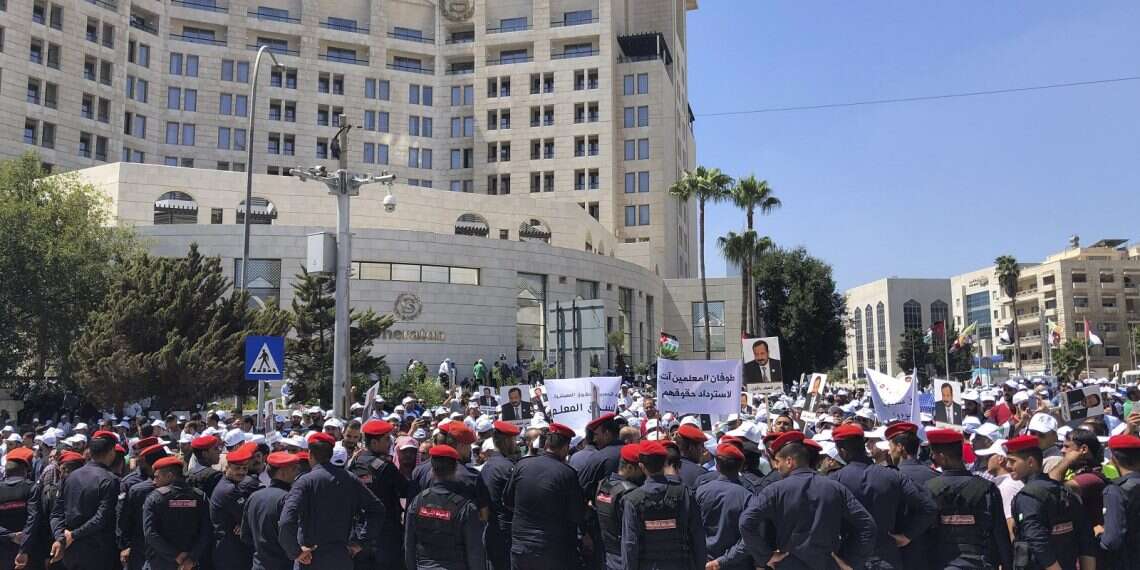
Security forces block a road as teachers protest in Amman, Jordan, Sept. 5, 2019 | Photo: AP/Omar Akour

 Jordan presents itself to the world as a constitutional monarchy – a state supporting a multiparty political system, an elected parliament, and a prime minister who is the head of government.

Constitutional experts beg to differ. Most maintain that Jordan is an autocracy in which authoritarian power is exercised by the king through legal manipulation, described by the Journal of Democracy as “selective economic reforms, new civil society regulations, and hollow pluralism initiatives.” In fact, the king is the country’s ultimate authority in respect of all three branches of government – executive, legislative, and judicial. He appoints the prime minister and chooses the cabinet. The judges are appointed and dismissed by royal decree. Political parties were legalized in 1992 provided they acknowledge the legitimacy of the monarchy.

These democratically dubious constitutional arrangements do not, however, affect the popularity of the monarchy, and there is no demand within Jordan for constitutional change. However, the usual consequences of autocratic rule – corruption, unemployment, poverty, high taxes, rising food prices, and poor government services – regularly result in outbursts of popular protest. Over the course of 2019, the scale and depth of Jordan's economic problems have been unprecedented, and massive public demonstrations have been the result.

In May and June, the public took to the streets in great numbers to protest increased taxes and soaring prices. The rebellion was nationwide, uniting all sectors of Jordanian society. In response, King Abdullah dismissed the government, froze prices, and appointed a new prime minister, Omar al-Razzaz, whom he ordered to produce reforms.

This pattern – public protest followed by promised government action – is normal for Jordan, but this time the old nostrum did not work. The government’s promises carried no weight with Jordan’s teachers, who organized mass strikes on September 5 and 8. The capital, Amman, was plunged into chaos as thousands of teachers from across the country, wearing white caps and carrying placards, paraded through the streets demanding better working conditions and a 50% salary increase that they said had been promised by the government five years ago. At the time of writing, the 100,000 teachers remain on strike and 1.4 million pupils and students are locked out of their classrooms.

Jordan’s domestic situation is parlous. The economy is close to breaking point. Public debt stands at $39.9 billion, nearly equal to the country's economic output, while unemployment is running at close to 20%. Meanwhile the Israel-Palestine issue looms. On June 22, 2019, the White House unexpectedly released the economic component of its peace plan. “Peace to Prosperity: A New Vision for the Palestinian People” set out in considerable detail a scenario under which, with a huge input of funding into the region, prospects for the Palestinians would be immeasurably transformed for the better. The plan covered all aspects of Palestinian life from education and health care to taxes, roads, and railways.

The US presented this leg of its ultimate deal in a workshop held in Bahrain which Palestinian Authority President Mahmoud Abbas urged the Arab world to boycott. Abdullah, a close ally of the US, ignored his plea and sent a delegation.

Although Jordan’s message was that no cash offers could replace a political solution, reports from inside Jordan indicate that some officials believe the country could – and should – profit from any plan that promises billions in economic aid. In June 2019, a prominent MP, Fawaz al-Zubi, said Jordanians should be open-minded about anything they could gain from the deal.

About what the plan might portend politically, there are only fears. Rumors abound in Jordanian official circles that Trump’s deal will include proposals potentially disastrous for the country, and that Jordan will be pushed toward accepting them in exchange for the economic aid that Saudi Arabia and other Gulf countries have traditionally provided. They believe that the Palestinians – or at least their regional supporters – might be bought off with the promise of a bright economic future and, in the process, Palestinian statehood would be buried, and with it, hopes of removing at least some of Jordan’s Palestinian citizens and refugees.

“Don’t meet trouble halfway” is a wise adage. Perhaps a jittery Jordan should take note, await the forthcoming peace deal with equanimity, and regard it, when it does finally arrive, as a challenge and an opportunity.


Neville Teller

Source: https://www.israelhayom.com/2019/09/22/trumps-peace-deal-anything-in-it-for-jordan/

Follow Middle East and Terrorism on Twitter


Saturday, September 21, 2019

US Adversaries: Nothing to Fear from the White House? - Con Coughlin

​
by Con Coughlin

With Mr Trump's focus firmly fixed on winning re-election in next year's presidential election contest, the Iranian regime has probably concluded that the White House is determined to avoid all forms of overseas military intervention at any cost.

  • This [shooting down a US Navy drone] was a clear-cut act of provocation against the US in violation of international law, one that required a firm and decisive response from the White House.
  • Yet, having initially threatened to respond militarily, President Trump then changed his mind, thereby allowing the Iranians off the hook.
  • With Mr Trump's focus firmly fixed on winning re-election in next year's presidential election contest, the Iranian regime has probably concluded that the White House is determined to avoid all forms of overseas military intervention at any cost.
  • The result is that Iran -- and other adversaries of the US, such as China, North Korea, Russia, Venezuela, Cuba and the Taliban -- now may feel even more emboldened to continue their provocative actions in the Gulf and elsewhere, knowing that, so long as Mr Trump is in the White House, they do not have to fear they will be subjected to military retribution from Washington.

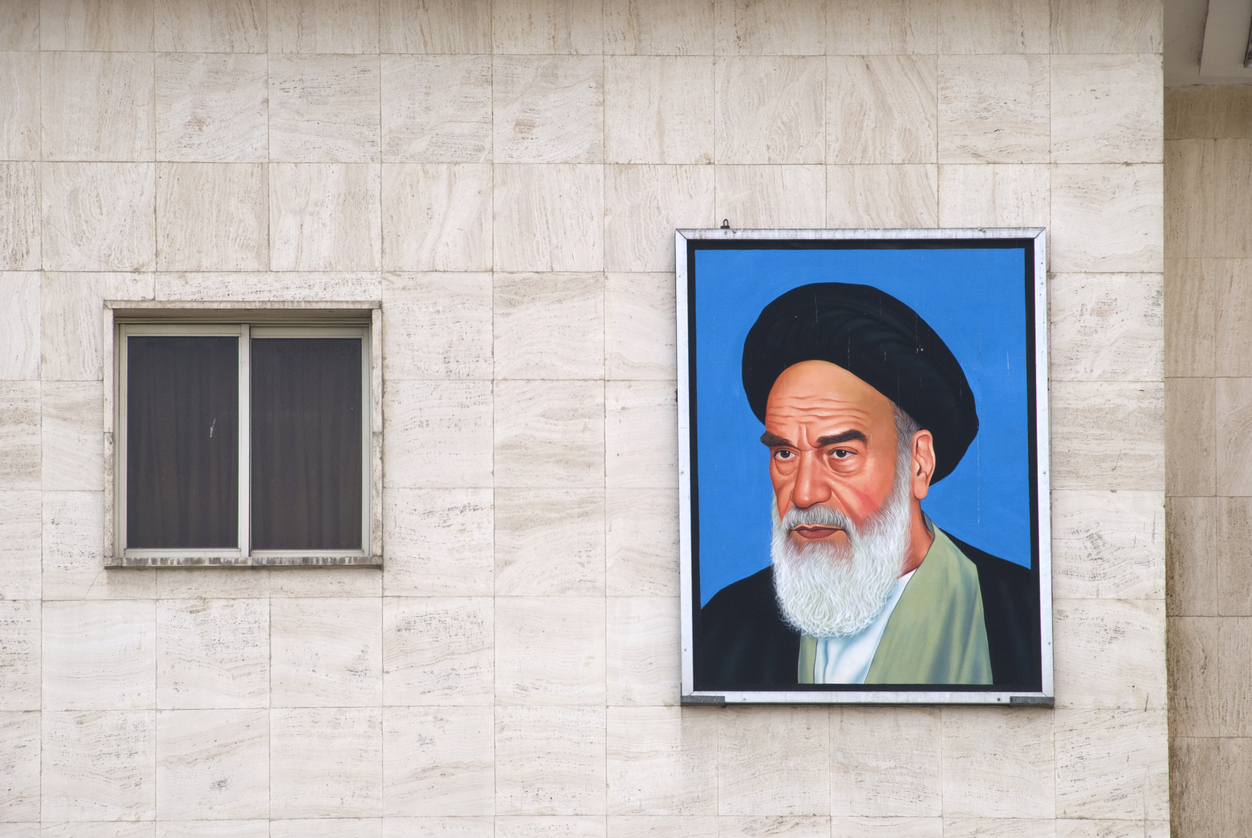
With President Trump's focus firmly fixed on winning re-election in next year's presidential election, the Iranian regime has probably concluded that the White House is determined to avoid all forms of overseas military intervention at any cost. Pictured: A portrait of Iran's previous "Supreme Guide," the late Ayatollah Ruhollah Khomeini. (Image Source: FrankvandenBergh/iStock by Getty Images)

For all US President Donald Trump's bluster that the US military is "locked and loaded", the reality is that the White House has absolutely no interest in launching military action against Iran in retaliation for its involvement in the devastating attack on Saudi Arabia's oil infrastructure. It is a decision doubtless not lost on Iran.

On the contrary, for all Mr. Trump's machismo posturing, the most the President can be expected to do is intensify the sanctions regime against Tehran, a move that is unlikely to strike fear into the hearts of Iran's battle-hardened veterans of its Revolutionary Guard.

Indeed, the President's disinclination to confront Iran over its increasingly aggressive conduct towards the US and its allies in the region appears only to have emboldened the ayatollahs to even greater acts of provocation, such as last weekend's attacks on Saudi Arabia's Khurais oil field and the Abqaiq oil processing facility, which resulted in the Saudis losing nearly 50 per cent of the country's oil processing capacity and for a while sparked a sharp jump in oil prices.

As senior Saudi officials said in the aftermath of the most significant attack Saudi has suffered since the First Gulf War, when Iraqi dictator Saddam Hussein fired a barrage of Scud missiles at his Saudi neighbours, the attack was not just an attack against the Saudi kingdom, but against the entire global economy.

Tehran has, of course, denied any involvement in the attack, a claim that holds no credibility whatsoever after Saudi officials later put on display parts of the weaponry used in the attack that proved categorically their Iranian provenance.

Markings on the cruise missiles used in the attack showed clearly that they were manufactured in Iran earlier this year, while wreckage from delta wing drones that are used by the Iranian military were also put on display.

Which begs the question why, if Iran had nothing to do with the attack, were Iranian missiles and drones involved?

Moreover, international pressure on Iran to explain its actions is likely to intensify, after it was shown that the attack originated from Iranian soil to the north of Saudi Arabia, and not from Houthi-controlled territory in Yemen to the south as was originally claimed.

Saudi defence officials insist the missiles' maximum 690-kilometre range is too short for them to have been fired from territory controlled by the Iranian-backed Houthis. The US assessment is that they were fired from western Iran, close to the Iraqi border, directly north of Abqaiq.

Yet, despite the Trump administration's constant assurances that it will protect its Saudi allies, the White House has pulled back from any talk of launching military action by way of retaliation, and Mr. Trump has instead ordered Steve Mnuchin, his treasury secretary, to draw up a new list of sanctions against Iran.

Rather than taking robust measures to punish Iran for its audacious attack on the Saudis, Mr. Trump's disinclination to take more robust action will only send a message to the hardliners who now dictate policy in Tehran that the US has no intention of escalating tensions with Iran.

With Mr. Trump's focus firmly fixed on winning re-election in next year's presidential election, the Iranian regime has probably concluded that the White House is determined to avoid all forms of overseas military intervention at any cost.

The writing was on the wall so far as Iran is concerned earlier in the summer, when Mr. Trump pulled back from launching military action against Iran after the regime shot down a US Navy drone operating in international waters in the vicinity of the Strait of Hormuz.

This was a clear-cut act of provocation against the US in violation of international law, one that required a firm and decisive response from the White House.

Yet, having initially threatened to respond militarily, Mr. Trump then changed his mind, thereby allowing the Iranians off the hook.

The result is that Iran -- and other adversaries of the US, such as China, North Korea, Russia, Venezuela, Cuba and the Taliban -- now may feel even more emboldened to continue their provocative actions in the Gulf and elsewhere, knowing that, so long as Mr. Trump is in the White House, they do not have to fear they will be subjected to military retribution from Washington.

Con Coughlin is the Daily Telegraph's Defence and Foreign Affairs Editor and a Distinguished Senior Fellow at Gatestone Institute

Source: https://www.gatestoneinstitute.org/14902/us-adversaries-nothing-to-fear-from-the-white

Follow Middle East and Terrorism on Twitter


Attack on Saudi Oil Facilities Puts US Commitments to the Test - Dr. James M. Dorsey

​
by Dr. James M. Dorsey

Will there be retaliation for the brazen, allegedly Iranian attack that severely damaged two of Saudi Arabia's key oil facilities? If so, how and when?


BESA Center Perspectives Paper No. 1,295, September 20, 2019

EXECUTIVE SUMMARY: Neither Saudi Arabia nor the US is rushing to retaliate for a brazen, allegedly Iranian attack that severely damaged two of the kingdom’s key oil facilities. That is not to say that Saudi Arabia and/or the US will not retaliate in what could prove to be a game changer in the geopolitics of the Middle East.

Reading the tea leaves of various US and Saudi statements on the allegedly Iranian attack on the kingdom’s key oil facilities on September 14, it is possible to discern constituent elements that could change the region’s dynamics.

They also shine a spotlight on the pressures on both countries, as well as on shifts in the US-Saudi relationship that could have long-lasting consequences.

With US Secretary of State Mike Pompeo visiting the kingdom to coordinate what his office described as efforts to combat “Iranian aggression in the region,” Saudi Arabia and the US will be seeking to resolve multiple issues.

These include collecting sufficient evidence to convincingly apportion blame; calibrating a response that would be appropriate but not drag the US and the Middle East into a war that few want; deciding who takes the lead in any military response, and managing the long-term impact of that  decision on Saudi-US relations and the US commitment to the region.

A careful reading of Saudi and US responses to the attacks so far suggests subtle differences between the two. They mask fundamental issues that have emerged in the aftermath of the attacks.


The discrepancy in the initial apportioning of blame raises the question whether Saudi Arabia is seeking to avoid being maneuvered into a situation in which it will be forced to take the lead in retaliating against the Islamic Republic with strikes against targets in Iran rather than Yemen.
Political scientist Austin Carson suggests that Saudi Arabia may have an interest in at least partially playing along with Iranian insistence that it was not responsible. “Allowing Iran’s role to remain ambiguous could reduce Saudi leaders’ need to appear strong… The Saudis are reportedly unconvinced by shared US intelligence that attempts to link the attacks to Iran’s territory. Some experts suggest this may reflect a more cautious approach to escalation,” Carson wrote in The Washington Post.

Saudi Arabia’s initial reluctance to unambiguously blame Iran may have a lot to do with Trump’s America First-driven response to the attacks, which appeared to contradict the Carter Doctrine proclaimed in 1980 by President Jimmy Carter.

The doctrine, a cornerstone of the Saudi-US relationship, stated that the US would use military force if necessary to defend its national interests in the Gulf.

Trump’s apparent weakening of the US’s commitment to the defense of the kingdom, as encapsulated in the doctrine, risks fundamentally altering a relationship already troubled by Saudi conduct in the more than four-year-long war in Yemen and last year’s killing of journalist Jamal Khashoggi in the Saudi consulate in Istanbul.

Signaling a break with the Carter Doctrine, Trump was quick to point out that the attacks were on Saudi Arabia, not on the US, and suggested that it was for the Saudis to respond.

“I haven’t promised Saudis that. We have to sit down with the Saudis and work something out. That was an attack on Saudi Arabia, and that wasn’t an attack on us. But we would certainly help them,” Trump said without identifying what kind of support the US would be willing to provide.

Despite blustering that the US was “locked and loaded,” Trump insisted that “we have a lot of options but I’m not looking at options right now.”

Trump’s response to a tweet by US Senator Lindsey Graham, a friend of the president who favors a US military strike against Iran, that “the measured response by President @realDonaldTrump…was clearly seen by the Iranian regime as a sign of weakness” was equally telling.

“No Lindsey, it was a sign of strength that some people just don’t understand.” Trump said.

Trump further called into question the nature of the US-Saudi defense relationship by declaring that “If we decide to do something, they’ll be very much involved, and that includes payment. And they understand that fully.”

The Saudi foreign ministry maintained, with the attacks casting doubt on the Saudi military’s ability to defend the kingdom’s oil assets and Trump seemingly putting the onus of a response on Saudi Arabia, that “the kingdom is capable of defending its land and people and responding forcefully to those attacks.”

Only indisputable evidence that the drones were launched from Iranian territory would incontrovertibly point the finger at Iran.

So far, the Saudis have stopped short of that while US officials have suggested that the drones were launched either from Iran or by pro-Iranian militias in southern Iraq.

Holding Iran responsible for the actions of a militia, whether in Iraq or Yemen, could prove tricky given longstanding questions about the degree of control Iran has over various groups it supports, particularly the Houthis.

The argument could turn out to be a slippery slope given that by the same logic, the US would be responsible for massive human casualties in the Yemen war resulting from Saudi use of American weaponry.

Military retaliation may not be immediate even if the US and Saudi Arabia do produce convincing evidence that Iran was directly responsible.

“No knee jerk reactions to this – it’s very systematic – what happens with patience is it prevents stupid moves,” a US official said.

The US is likely to attempt to first leverage that evidence in meetings on the sidelines of next week’s UN General Assembly to convince the international community, and particularly the Europeans, to drop opposition to last year’s US withdrawal from the international nuclear accord with Iran and the harsh economic sanctions the Trump administration has since imposed on Iran.

Both the US and Saudi Arabia will also want to use the opportunity of the UN gathering to try to ensure that the fallout of any military response is limited and does not escalate into a full-fledged war that could change the geopolitical map of the Middle East.

Said foreign policy analyst Steven A. Cook: “How the Trump administration responds will indicate whether US elites still consider energy resources a core national interest and whether the United States truly is on its way out of the Middle East entirely, as so many in the region suspect.”


Dr. James M. Dorsey, a non-resident Senior Associate at the BESA Center, is a senior fellow at the S. Rajaratnam School of International Studies at Singapore’s Nanyang Technological University and co-director of the University of Würzburg’s Institute for Fan Culture.

Source: https://besacenter.org/perspectives-papers/iran-attack-saudi-oil-facilities/

Follow Middle East and Terrorism on Twitter


Soros and the 'whistleblower' non-scandal - Thomas Lifson

​
by Thomas Lifson

Epic embarrassment ahead for Joe Biden? (I would say scandal, but we know that Dems do not engage in such unsavory things).


Oh, boy, hold onto your hats. The latest propaganda campaign to discredit President Trump has Soros roots, according to someone in the know that I trust.

Victoria Toensing is not given to empty charges (or empty threats).

The extremely knowledgeable and well connected D.C. super-lawyer took to Twitter yesterday to let us know that the fine hand of Soros is at work, and the she knows what is going on and will enlighten us in due time:


There is a conspiracy theory that has occurred to a number of conservatives: that this is really an operation meant to drive Biden out of the race because his corruption in Ukraine will torpedo him if he becomes the Democrat nominee. The theory is that only by first seeming to implicate Trump would the media leap onto the subject of Ukraine. Once the story is on the table, it will backfire as Biden's corruption becomes undeniable. 


Photo credit: YouTube screen grab (cropped).
 

Hat tip: Roger Luchs.


Thomas Lifson

Source: https://www.americanthinker.com/blog/2019/09/soros_and_the_whistleblower_nonscandal.html

Follow Middle East and Terrorism on Twitter


Bernie Sanders at the Islamic Society of North America - Hugh Fitzgerald

​
by Hugh Fitzgerald

Worshiping at the enemy's altar.


The organizers of the Islamic Society of North America’s (ISNA) convention, held in Houston at the end of August, had invited all the Democratic candidates for President to address them. It was a great disappointment to the group – which would prefer that the public not be reminded that it remains an unindicted co-conspirator in the Holy Land case – that of the 15-odd Democrats invited, only two, Bernie Sanders and Julián Castro, accepted the invitation. And of those two, Sanders received the greater media attention and audience applause.

Sanders was indignant about the “bigotry” he claimed was abroad in the land: “We must speak out at hate crimes and violence targeted at the Muslim community and call it what it is: domestic terrorism.” Apparently the hate crimes and violence aimed at non-Muslims by Muslims, domestic terrorism which has been far more deadly than “hate crimes” targeting Muslims, were of little concern to Senator Sanders. He never mentioned, nor alluded to, “hate crimes and violence” aimed at non-Muslims. Perhaps he needs to be reminded of what has happened in this country in recent years. Has he forgotten about the Muslim terrorist attacks, not just in New York and Washington on 9/11/2001, but subsequently, in Boston, Chicago, Minneapolis, Seattle, San Francisco, Los Angeles, in Fort Hood, Little Rock, Orlando, San Bernardino, Chattanooga, Chapel Hill, Arlington, Virginia, Garland, Texas? Could Senator Sanders have forgotten all about these Muslim terrorists who have so often set the country on edge? He has been so determined to see Muslims as victims that he apparently is unable to recognize their role as perpetrators of terrorist attacks.

Sanders gave over much of his speech to matters of general, not Muslim-specific, interest. He’s against climate change. He thinks health care “is a human right.” He wants the “billionaire class” to pay their “fair share of taxes.” He wants to “cancel all student debt.” He wants public colleges to be tuition free. “Bold leadership must take bold action.” And so on and so predictably forth. He might have made those banal points anywhere. Then, having delivered the left-liberal boilerplate, he had some tailor-made messages of support sure to win favor with the Islamic Society of North America.

First, Sanders declared he was against Trump’s “Muslim ban” and was proud, he said, when thousands of non-Muslim Americans “rushed to airports” to show their solidarity with Muslims harmed by the ban. Sanders said nothing about the non-Muslim countries – North Korea, Venezuela – included in the ban, nor about the fact that the ban was directed only at countries that were unable or unwilling to share certain information about their citizens with the American government, thereby posing a security threat. He said nothing about why Trump’s security measure had been upheld by the Supreme Court in Hawaii v. Trump. Nor did he mention that two Muslim countries – Iraq and Chad – had been dropped from the list of countries whose citizens were banned, once they improved their collection and sharing of information about those citizens. Most telling of all, 95% of the world’s Muslims remained unaffected by what some, including Sanders, continue misleadingly to call a “Muslim ban.” Sanders did not want to complicate his simple-minded morality tale of Trumpian “bigotry.”

He kept addressing his Muslim audience, cloyingly, as his “brothers and sisters.” I wonder if, in addressing an audience of Catholics, or of Evangelicals, or even of fellow Jews, he would call them “brothers and sisters.” I suspect not. And how many of the 7,000 in his ISNA audience could possibly think of the Jewish senator as their “brother”?

Sanders told the audience that he was “the proud son of Jewish parents.” His father, he told the audience, left Poland to escape poverty and antisemitism. It would be fascinating to find out what Senator Sanders knows about present-day antisemitism in Europe, and who today are the main carriers of that pathological condition. Does he know why Jews are fearful of wearing yarmulkes in many European capitals? Does he know why Jews have been leaving Malmö, in Sweden, moving out of certain neighborhoods in Paris and London, some even leaving Europe altogether, for reasons of safety, to make Aliyah to Israel? Does he know how many Jews have been set upon, harassed, and beaten, by Muslims all over Western Europe? Does he know about the more than a dozen Jews murdered by Muslims in France, including small children shot in front of their father (before he was then killed) outside a Jewish school, and two elderly women stabbed to death in separate incidents, one of them then set on fire and the other thrown out of a window, by Muslim neighbors they had befriended? It seems that Bernie Sanders hasn’t been following the news about antisemitism in Europe. He should look into it. It might provide a salutary shock.

Bernie Sanders could stand to learn more about the Muslim terrorists in Europe, who have murdered non-Muslims in attacks in Madrid, Barcelona, Paris (many times), Nice, Toulouse, Tours, St. Etienne-du-Rouvray, London (many times), Manchester, Brussels, Antwerp, Amsterdam, Rotterdam, Berlin, Munich, Hamburg, Frankfurt, Copenhagen, Oslo, Stockholm, Malmö, Helsinki, Turku, Moscow, St. Petersburg, Beslan. Those attacks should make a deep impression, even on the likes of Bernie Sanders. And what would he make of the fact that Muslim terrorists have been responsible for more than 35,000 terror attacks around the world since 9/11? Anything? Nothing?

Sanders almost certainly does not know what the Qur’an says about Jews – indeed, I suspect he’s never read the Qur’an — but it’s not too late for him to find out. There are several dozen verses instructing Muslims on the topic. Robert Spencer has gathered them for easy reference: “The Qur’an depicts the Jews as inveterately evil and bent on destroying the wellbeing of the Muslims. They are the strongest of all people in enmity toward the Muslims (5:82); as fabricating things and falsely ascribing them to Allah (2:79; 3:75, 3:181); claiming that Allah’s power is limited (5:64); loving to listen to lies (5:41); disobeying Allah and never observing his commands (5:13); disputing and quarreling (2:247); hiding the truth and misleading people (3:78); staging rebellion against the prophets and rejecting their guidance (2:55); being hypocritical (2:14, 2:44); giving preference to their own interests over the teachings of Muhammad (2:87); wishing evil for people and trying to mislead them (2:109); feeling pain when others are happy or fortunate (3:120); being arrogant about their being Allah’s beloved people (5:18); devouring people’s wealth by subterfuge (4:161); slandering the true religion and being cursed by Allah (4:46); killing the prophets (2:61); being merciless and heartless (2:74); never keeping their promises or fulfilling their words (2:100); being unrestrained in committing sins (5:79); being cowardly (59:13-14); being miserly (4:53); being transformed into apes and pigs for breaking the Sabbath (2:63-65; 5:59-60; 7:166); and more.”
Spencer notes:
The classic Qur’anic commentators do not mitigate the Qur’an’s words against Jews, but only add fuel to the fire. Ibn Kathir explained Qur’an 2:61 (‘They were covered with humiliation and misery; they drew on themselves the wrath of Allah’) this way: “This Ayah [verse] indicates that the Children of Israel were plagued with humiliation, and that this will continue, meaning that it will never cease. They will continue to suffer humiliation at the hands of all who interact with them, along with the disgrace that they feel inwardly.” Another Middle Ages commentator of lingering influence, Abdallah ibn Umar al-Baidawi, explains the same verse this way: “The Jews are mostly humiliated and wretched either of their own accord, or out of the fear of having their jizya [punitive tax] doubled.”
Ibn Kathir notes Islamic traditions that predict that at the end of the world, “the Jews will support the Dajjal (False Messiah), and the Muslims, along with ‘Isa [Jesus], son of Mary, will kill the Jews.” The idea in Islam that the end times will be marked by Muslims killing Jews comes from the prophet Muhammad himself, who said, “The Hour will not be established until you fight with the Jews, and the stone behind which a Jew will be hiding will say. ‘O Muslim! There is a Jew hiding behind me, so kill him.’” This is, not unexpectedly, a favorite motif among contemporary jihadists.
Many people in the Houston audience certainly would have known what the Qur’an has to say about Jews. I am sure Faiz Shakir, Sanders’ campaign manager, who introduced him so fulsomely in Houston, knows some, and possibly a great many, of these Qur’anic passages. And Muslims in the ISNA audience, too, would have known not just the verses specifically about Jews, but also the Qur’anic verse that tells Muslims that they are “the best of peoples” (3:110) and the other verse that describes non-Muslims as the “most vile of created beings” (98:6). But no one is about to bring these passages to Sanders’ attention; they would only discomfit him; he wouldn’t know what to think. Better to keep him in the dark. And that’s where, on the subject of Islam, by not reading the Qur’an and Hadith, Bernie Sanders has chosen to remain.

Eventually, having discussed income inequality, and global warming, and health care as a human right, and cancelling all student debt and making the “billionaire class” pay their “fair share of taxes,” Bernie Sanders  gave the members of the Islamic Society of North America just what they wanted to hear. He denounced Trump for once saying that “Islam hates us.” There are many people other than Donald Trump who believe that Islam hates us. They are not all right-wing white nationalists. The famously left-wing Italian journalist Oriana Fallaci believed, from her extensive dealings with them, that Muslims were taught to hate non-Muslims. The ex-Muslim Ayaan Hirsi Ali has described being raised in a society where people were taught to hate Infidels.

Trump carefully did not say that “all Muslims hate us.” He was referring to an ideology, Islam, and not to the human beings, Muslims, who may accept, or reject, in whole or in part, what the Qur’an inculcates about non-Muslims. Some Muslims clearly do not hate all non-Muslims, do not wish to “fight” and to “kill” them, to “smite at their necks” and “strike terror in their hearts,” as the Qur’an instructs. But many Muslims around the world clearly do. The existence of “moderate Muslims” does not vitiate the claim that “Islam hates us.” We have only to read the Qur’an and some of the most celebrated hadith to come to that melancholy conclusion. One wonders if Bernie Sanders will ever take the time to read the Qur’an, or will he instead remain happily secure within his complacent ignorance, convinced that “of course” Islam, like all religions, must be based on the principles of “justice, compassion, and tolerance.” Doesn’t his own campaign manager, Faiz Shakir, demonstrate those very principles in his dealings with his Jewish employer and friend, Bernie Sanders? And surely, Sanders assumes, Faiz must be a representative, rather than an exceptional, Muslim.
Sanders told his audience that because of Trump, many more Muslims ran for office and won elections in 2018. Is this true? There were two Muslim members of Congress before 2018; now there are three, a gain of exactly one. There does not appear to have been any discernible increase in the number of Muslims elected at the state or local level. Rashida Tlaib and Ilhan Omar have simply attracted a great deal of attention as Muslim politicians, and made them seem more numerous and significant than in fact they are. Muslims are 1.1% of the American population; they constitute 0% of the Senate, 0.75% of the House, 0% of the Governors. Sanders needs to look again at the results of the 2018 election before making these psephological gaffes.

Muslims in America and around the world are being unjustly tarred, Sanders insisted, with the brush of “terrorism.” Could the association of Muslims with terrorism have anything to do with the more than 35,000 terrorist attacks by Muslims since 9/11? Could it have anything to do with the existence of such groups of Islamic terrorists as Al-Qaeda, Islamic State, Boko Haram, Abu Sayyaf, Al Nusra Front, Lashkar-e-Taiba, Al Shebaab, Hamas, Hezbollah, Islamic Jihad? How much Islamic reality does Bernie Sanders expect us to ignore?

Sanders told his Houston audience that he deplored the rise of authoritarian rulers, which he appeared, confusedly and unfairly, to blame on the West. But he left out aspects of recent history: some of the worst despots in the Islamic world have been eliminated, often with the indispensable help of the Western powers. In Iraq, Saddam Hussein, a sadistic monster, was deposed by the American military. Should we be apologetic for that? Would Sanders prefer that Saddam Hussein were still ruling over Iraq? in Libya, Muammar Qaddafi was removed – killed – by Libyans who had received critical military assistance from NATO, including naval bombardments by American and British ships, and aerial bombings by the French, of Qaddafi’s forces. Was his removal to be deplored? Other authoritarians, like the massively corrupt Ben Ali in Tunisia, were chased out of office by opponents, many of whom – like the technocrat Mohamed Ghannouchi — had been raised in a Franco-Tunisian intellectual milieu, with Western democratic ideals. Ben Ali and his wife grabbed 1.5 tons of government gold and managed to flee to Saudi Arabia, which had always supported Ben Ali and has refused to extradite him. It’s not the West that should be embarrassed about Ben Ali, but the Saudis.

Authoritarianism, whose “rise” Sanders deplores, is nothing new in the Islamic world; the West is not to be blamed. It is the default political system for Islam. In the advanced democratic West, a government’s legitimacy is judged by how well it reflects the will of the people, however imperfectly expressed through elections. In the lands of Islam, a ruler’s legitimacy is judged by how well he reflects the will of Allah, as expressed in the Qur’an. As long as he remains a good Muslim, a despot must be obeyed. The ruling families of the Arab Gulf — the Al-Saud, the Al-Maktoum, the Al-Nahyan, the Al-Khalifa, the Al-Said, the Al-Mualla, Al-Nuaimi, Al-Qasimi, Al-Sabah, Al-Sharqi, Al-Thani – are all authoritarians, but they profit from the legitimacy of being considered good Muslims. They lavish their support on influential clerics; the clerics, in turn, provide their imprimatur to the rulers.

One form of authoritarianism, monarchy, was replaced in Iran by another form, theocracy, when the Shah fled and the Ayatollah Khomeini took his place as Absolute Leader. In Pakistan, a pseudo-democracy has disguised a series of authoritarian rulers, mostly military men, some more (such as General Zia ul-Haq) and some less (such as the politician Zulfikar Ali Bhutto) fervent in their Islamic faith. In Turkey, Recep Tayyip Erdogan has become increasingly authoritarian, having exploited the failed July 2016 coup attempt as an excuse to imprison thousands of his political enemies, including many journalists, and to cause many others to lose their employment — as judges, lawyers, teachers, civil servants of every type — with the government. Erdogan has even built himself a 1,500-room palace, as befits the Ottoman Sultan he would no doubt like to be. Neither in Iran, nor in Pakistan, nor in Turkey, has the West been responsible for these authoritarian regimes. They are home grown.

Sanders’ attempt to blame the Americans for this “rise in authoritarianism” is distinctly unfair. The Americans did not help put the Pakistani rulers in office. Nor did they promote or support Erdogan, who has always been anti-American and has become ever more so as he foresees a military contest “between the crescent and the cross.” Nor can the Americans be blamed for the seizure of power by the fanatically anti-American Khomeini in Iran. The Americans are to be faulted only for a naïve faith in the universal appeal of democracy. They tried, with a colossal investment in men and money, to install real democracy in Iraq; the failure of that attempt should be blamed not on America for trying, but on the Iraqis themselves for being so unwilling to compromise through electoral politics. The minority Sunnis in Iraq refuse to acquiesce in their loss of political and economic power when Saddam fell; the majority Shi’a are unwilling to relinquish any of the power that devolved to them when Hussein’s Sunni rule ended.

Sanders blames America for the rise of ISIS. He didn’t explain this in his Houston speech, but presumably he means that Saddam Hussein had been sufficiently ruthless to suppress the most fanatical Muslims and should not have been overthrown. It was only in the chaos that followed his downfall that ISIS managed to fill the power vacuum in northern Iraq, and from there enlarge the Islamic State to control more of Iraq, including the key city of Mosul, and eastern Syria as well. Should the Americans have foreseen the rise of ISIS? Why? It was an unprecedented phenomenon, an attempt by fanatics to set up what they called a “caliphate” where life would be lived strictly according to the laws of the earliest Muslims.

If the Arabs and Muslims could not have predicted the rise of ISIS, why should the Americans be criticized for failing to do so? Sanders might have told his audience the truth: “We went to Iraq with good intentions. We saw Saddam Hussein – correctly – as a monster of oppression and murder. He killed 182,000 Kurds in order to “Arabize” the Kurdish lands. He killed hundreds of thousands of Shi’a Iraqis to maintain the supremacy of his fellow Sunnis. But we underestimated the difficulty of transplanting democracy. It is a plant that requires long nurturing, and in our naïve enthusiasm we failed to realize that. We aimed too high. An enlightened authoritarian might have been the proper goal, as a political way-station on the path to a future democracy.” He might have; it would have been salutary; he chose to stick instead to the script his audience favored: Muslims always as victims.
Bernie Sanders seems, however, to be determined to make the same mistakes that the Americans made in Iraq. He claims that “I will make the promotion of democracy and human rights a priority for the USA.” How does he hope to plant democracy in the stony soil of Islam? Where has a true “democracy” ever been successfully established, for the long term, in any Muslim country? As for “human rights,” how does Sanders hope to have women and minorities treated equally in Muslim countries, given what is said about women and non-Muslims in the Qur’an and Hadith?

Sanders was indignant about India’s action in Kashmir, in abrogating Article 370 of the Indian Constitution, which had given the Kashmiris a high degree of autonomy. He claimed that “India’s action is unacceptable…The U.S. government must speak out boldly….in support of a U.N.-backed resolution that respects the will of the Kashmiri people.”

What “Kashmiri people” is he talking about? Does he mean to include the 300,000-600,000 Hindus (the “Pandits”) who were killed or fled Kashmir since 1990? Are they part of the “Kashmiri people” or does that phrase, for Sanders, only refer to the 96.4% of the population that is Muslim, now that so many Hindus have fled? Shouldn’t the hundreds of thousands of Hindus who were indigenous to Kashmir, but fled Muslim persecution and murder, also be counted as part of the “Kashmiri people”? And what about the people in Jammu, which has administratively always been, with Kashmir, part of one state: Jammu-Kashmir, J&K? Two-thirds of the people in Jammu are Hindus. Shouldn’t they be counted as well, as part of the population of the newly-declared “Union territory” of “Jammu and Kashmir”?

Sanders has no understanding of what the Hindus of Kashmir have endured over the past 30 years. He thinks that the Muslims can justly claim to be the only “Kashmiri people” who count. Can Sanders really be unaware of the fate of the Kashmiri Pandits? Yes, I think he can; worse still, he assumes he is well-informed about the matter. Perhaps his campaign manager Faiz Shakir has provided him with a potted Muslim history of Kashmir. And what does Sanders know about Muslim terror attacks inside India? Does he know how many of those attacks were carried out by Pakistan-based terrorists? He fails to mention the role of Pakistan, for example, in supporting the terrorists who struck Mumbai in 2008, killing 166 people. Did he notice that just the day before he gave his Houston speech, the Prime Minister of Pakistan, Imran Khan, becoming more hysterical every day, threatened to use nuclear weapons against India if the situation in Kashmir was not resolved to his liking? Shouldn’t Sanders have mentioned that astounding threat, or was he so dead set on taking the Muslim side, for that ISNA audience, that he wouldn’t admit to anything that might give others pause about Pakistan?

Bernie Sanders finally came to the subject his audience was most keen to hear about: Israel. Sanders first offered the usual bland pro forma reassurances, to show he was nothing if not fair-minded: “I am a strong supporter of the right of Israel to exist in independence, peace, and security.” How nice. He supports Israel’s right to exist. Should supporters of Israel be grateful? What other country has to be grateful when assured that it has a right to exist? And as an independent state? And in peace? Goodness, what more could any nation want? And security? My, what concessions.

Then came the take-away, in every sense: “But I also believe that the United States needs to engage in an even-handed approach toward that longstanding conflict which results in ending the Israeli occupation and enabling the Palestinian people to have self-determination in a sovereign, independent, economically-viable state of their own.”

What does Sanders mean by “Israeli occupation”? Not a single Israeli has been in Gaza since 2005. Almost all of them had left by 1997. Gaza isn’t “occupied.” What about the West Bank? Does Bernie Sanders know what was supposed to happen to the West Bank? It was assigned by the League of Nations to be part of the territory of the future Jewish National Home, that would eventually become the State of Israel. The Jordanian army managed to hold onto the West Bank when the guns stopped firing in 1949; that is the only reason the West Bank was not part of Israel from the very beginning of the state. Juridically, its status did not change: it was still part of the territory assigned to the Jewish National Home. The Jordanian occupation did not change that. In 1967, after the Six-Day War, Israel by force of arms came into possession of the West Bank. It could at long last enforce its preexisting claim to land that had been assigned to the Jews as part of the Mandate for Palestine.

Israel did not enforce that claim all at once. In the minds of some Israelis, even though they recognized that the state had a right to claim the entire West Bank, Israel might nonetheless want to give up some of that land if, by doing so, it could obtain a lasting peace. It soon became clear that the Arabs were not interested in anything less than a full withdrawal by Israel, back to the 1949 armistice lines. Israel then went ahead with its own plans, populating the area with Israelis, slowly building settlements that became villages that became cities, so that now there are 600,000 Jews living in what they have since Biblical times called “Judea and Samaria.” (The West Bank was a term concocted by Jordan in 1950 so as to avoid using the toponyms “Judea” and “Samaria.”) If Bernie Sanders thinks the Israeli “occupation” should “end,” then he must state clearly what that he means by that. I take it to mean that Bernie Sanders wants Israel to be forced back within the pre-1967 armistice lines, which Abba Eban famously called the “lines of Auschwitz,” with Israel only nine miles wide at its narrowest. And it means that he is willing to ignore – or he does not know — the provisions of the Mandate for Palestine itself.

Not only does Bernie Sanders likely not know the legal status of the West Bank according to the Palestine Mandate, but he likely is unaware of the other, entirely independent claim that Israel possesses to the West Bank. This claim is based on U.N. Resolution 242, which gave Israel the right to “secure and recognized boundaries.” According to the Resolution’s British author, Lord Caradon, “secure” boundaries meant borders that were “defensible.” According to Caradon, “the essential phrase which is not sufficiently recognized is that withdrawal should take place to secure and recognized boundaries, and these words were very carefully chosen: they have to be secure and they have to be recognized. They will not be secure unless they are recognized. And that is why one has to work for agreement. This is essential. I would defend absolutely what we did. It was not for us to lay down exactly where the border should be. I know the 1967 border very well. It is not a satisfactory border, it is where troops had to stop in 1947, just where they happened to be that night, that is not a permanent boundary… “

In a 1974 statement, Caradon said:
It would have been wrong to demand that Israel return to its positions of 4 June 1967. … That’s why we didn’t demand that the Israelis return to them and I think we were right not to.
Does Bernie Sanders understand what Israel has a right to claim, based on U.N. Resolution 242? Israel was not required to withdraw from “all” the territories it won in the Six-Day War, but only from “territories” – that is, some of the territories. This was heatedly discussed at the time; Arab delegates kept trying to insert the phrase “all the territories,” but were constantly rebuffed by Lord Caradon, who continued to insist that “withdrawal from [some] territories” was all that was required. Israel has relinquished the entire Sinai to Egypt, which constituted about 95% of the territory it won in June 1967; it has been argued that Israel has given back quite enough of “the territories” already – 95% of them — and need not give up any part of the West Bank. Israel could further argue that continued possession of the West Bank is essential to its “secure” – i.e., defensible – borders. Israel has to maintain control of the Jordan Valley and the heights of Judea, if it wants to secure the invasion routes from the East.

Bernie Sanders, then, does not understand that the West Bank was always meant to be included in the territory of the Mandate for Palestine, and is not “occupied” territory insofar as Israel is concerned (from 1949 to 1967 it was, in truth, “occupied” by Jordan). The League of Nations may have closed its doors, but by Article 70 of the U.N. Charter, the Mandate’s original provisions remained in force until the State of Israel was declared. This is something Bernie Sanders appears not to understand. Nor does he seem to know about Israel’s independent claim to much of the West Bank, based on U.N. Resolution 242.

There is another kind of knowledge that Sanders also lacks: a knowledge of Islam, and especially, an understanding of the doctrine of Jihad. For the Arab and Muslim war on Israel can only be grasped as a Jihad, that Muslims must continue, using various instruments, until the defeat of the Infidel. It’s a difficult and disturbing lesson to learn. It’s certainly not what Bernie Sanders at this point would allow himself to believe. But the best way to keep the peace, in such a conflict without end, is for Israel to rely on the same principle that served the United States so well during the Cold War: the principle of deterrence. That requires that Israel not only be a formidable adversary, but that it be readily seen to be a formidable adversary.

To force Israel to yield still more territory, beyond what it has already given back, to squeeze it into something like the 1949 armistice lines that Lord Caradon dismissed, would be to deprive the Israelis of the full deterrent effect of their present borders. For now, Israel can maintain its security by having its eastern border along the Jordan River, but any withdrawal from that eastern border would diminish the effectiveness of its deterrence. Furthermore, Israel has to retain the Golan, as part of its effort to keep “secure” boundaries;  the Golan looms forbiddingly over the northern part of the country; when Syria possessed it, the Syrians used the Golan to rain death down on Israeli farmers below; now that Israel has the Golan — which it annexed long ago, to near-total popular approval —  it can threaten all of southern Syria.

Bernie Sanders thinks that a “peace agreement” will keep the peace between Arabs and Israelis. He has never heard of the Treaty of al-Hudaibiyya, which Mohammed made with the Meccans in 628 A.D. It was to have lasted ten years; after 18 months, feeling his side had grown sufficiently strong, Muhammad broke the treaty and attacked the Meccans. That Treaty of al-Hudaibiyya has ever since been taken by Muslims as an example to emulate. The principle of Western law since Roman times, that Pacta sunt servanda – “treaties are to be obeyed” – is not a principle Muslims observe in their treaties with Unbelievers. If the peace is to be kept between Israel and the Arabs, it must be through Israel’s deterrence, requiring both military superiority (of men and weapons), and control of strategic territory.

One last observation. Bernie Sanders several times mentions the “Palestinian people.” That’s something he needs to investigate. If he does, he will discover that neither before, nor during, nor for nearly twenty years after, the 1948-49 war, was there any mention of a “Palestinian people.” Nor will Sanders find any mention of them, by an Arab diplomat, in any of the U.N. records, until late in 1967. The “Palestinian people” were invented by public relations experts, with some help from the K.G.B., to make more palatable the Arab war against Israel. Instead of a conflict in which nearly 20 Arab states made war — military, economic, diplomatic — on tiny Israel, that war could be re-presented to the world as between “two tiny peoples, each struggling for a homeland.” The phrase, and the concept, caught on, and now it would be difficult to undo the widespread belief in a “Palestinian people.” But a moment’s thought might give Bernie Sanders pause: what are the features, whether of religion, language, ethnicity, or folklore, that distinguish the “Palestinian people” from the other Arabs, especially those just across the river in Jordan?

There are no distinguishing characteristics to identify the “Palestinian people.” Bernie Sanders should commit to memory the famous admission by Zuheir Mohsen, in an interview he gave to the Dutch paper Trouw in 1977: “The Palestinian people do not exist. The creation of a Palestinian state is only a means for continuing our struggle against the state of Israel for our Arab unity. In reality today there is no difference between Jordanians, Palestinians, Syrians and Lebanese. Only for political and tactical reasons do we speak today about the existence of a Palestinian people, since Arab national interests demand that we posit the existence of a distinct ‘Palestinian people’ to oppose Zionism. Yes, the existence of a separate Palestinian identity exists only for tactical reasons, Jordan, which is a sovereign state with defined borders, cannot raise claims to Haifa and Jaffa, while as a Palestinian, I can undoubtedly demand Haifa, Jaffa, Beer-Sheva and Jerusalem. However, the moment we reclaim our right to all of Palestine, we will not wait even a minute to unite Palestine and Jordan.” Zuheir Mohsen was no minor figure; he was the head of the Palestinian terror group As Saiqa. His words carry weight.

All we ask of Bernie Sanders is that he learn more about the history of what he calls, a tad too breezily, Israel’s “occupation.” Considering the life-and-death stakes for the Jews of Israel, Sanders can surely take the time to study the Mandate for Palestine, both its text, and the accompanying maps showing the territory included in it. Next, he should read U.N. Resolution 242 and the interpretation of it by its author, Lord Caradon. Finally, he should investigate the origin, and reason for being, of the “Palestinian people.” That’s enough homework for now.


Hugh Fitzgerald

Source: https://www.frontpagemag.com/fpm/2019/09/bernie-sanders-islamic-society-north-america-hugh-fitzgerald/

Follow Middle East and Terrorism on Twitter