Tuesday, March 31, 2020

Palestinians: Despite Coronavirus, Jihad Against Israel Continues - Khaled Abu Toameh

​
by Khaled Abu Toameh

Palestinians in the Gaza Strip are again paying the price of failed leaders who care more about fighting Israel than saving the lives of patients and medical teams.
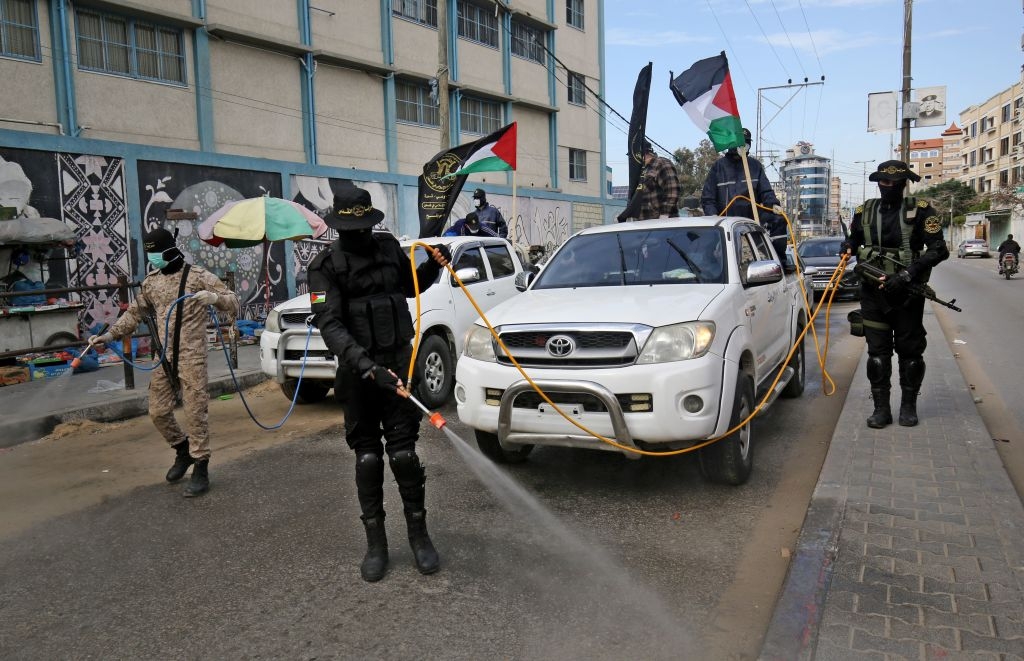
  • The rocket attacks against Israel appear aimed at distracting attention from the failure of Hamas and Palestinian Islamic Jihad (PIJ) to provide their hospitals with medical equipment and medicines to curb the spread of the disease. In the past decade, the two groups have invested millions of dollars in amassing weapons and building tunnels to infiltrate Israel and kill or kidnap Jews.
  • These leaders [of Hamas and PIJ] would rather see Palestinians die of the disease than join forces with Israel -- which has doing its utmost to help the Palestinians by providing them with tests kits, protective gear and training sessions for medical professionals....
  • The good news is that a majority of Palestinians disagrees with PIJ. A public opinion poll published last week by a Palestinian center found that 68% of respondents support the medical cooperation with Israel.
  • A statement issued by Hamas on March 30 said that "the only way to liberate the land is through resistance." The only "resistance" Hamas knows is the one that includes launching rockets and missiles at Israel or carrying out suicide bombings against Israelis.
  • Palestinians in the Gaza Strip are again paying the price of failed leaders who care more about fighting Israel than saving the lives of patients and medical teams.


As the world is busy pursuing the fight against the coronavirus pandemic, the Iranian-backed Hamas and Palestinian Islamic Jihad (PIJ) groups in the Gaza Strip have found the time to remind everyone that they remain committed to pursuing the fight against Israel. Pictured: Masked PIJ gunmen spray disinfectant in the streets of Rafah in the Gaza Strip, on March 26, 2020. (Photo by Said Khatib/AFP via Getty Images)

As the world is busy pursuing the fight against the coronavirus pandemic, the Iranian-backed Hamas and Palestinian Islamic Jihad (PIJ) groups in the Gaza Strip have found the time to remind everyone that they remain committed to pursuing the fight against Israel.

While many international media outlets and human rights organizations, including the United Nations, are warning of a "catastrophe" in the Gaza Strip after the discovery of nine coronavirus cases there, Hamas and PIJ -- the two dominant groups that have been ruling the Gaza Strip since 2007 -- seem to care less about the safety and health of their people.

For these groups, the "struggle" against Israel is manifestly more important than the fight against the immediate threat of a pandemic.

On March 27, a rocket was fired from the Gaza Strip toward the Israeli city of Sderot. The rocket, which fell in an open area, did not cause any casualties or property damage. This was the first rocket attack on Israel since the outbreak of the coronavirus pandemic. Since the beginning of this year and until early March, the Palestinians in the Gaza Strip have fired several rockets at Israel.

It remains unclear why the Palestinians chose to fire a rocket at an Israeli city at a time when Israel is busy trying to prevent the spread of coronavirus. It is also unclear why any Palestinian would think of launching a rocket toward an Israeli city at a time when Israel and the Palestinian Authority are working together to combat the disease.

Although no group has claimed responsibility for the March 27 rocket attack on Sderot, there is no way that it could have taken place without the knowledge or approval of Hamas or PIJ. The rocket attacks against Israel appear aimed at distracting attention from the failure of Hamas and PIJ to provide their hospitals with medical equipment and medicines to curb the spread of the disease. In the past decade, the two groups have invested millions of dollars in amassing weapons and building tunnels to infiltrate Israel and kill or kidnap Jews.

There is another reason why the rocket was fired from Gaza toward Sderot in Israel: to remind Palestinians, Israelis and the rest of the world that the outbreak of the coronavirus pandemic has zero impact on the ideology and plans of extremist Muslim groups.

The rocket attack was aimed at sending the message that the desire to kill or harm Jews remains as strong and relevant as ever, even during a global health crisis, when tens of thousands of people are dying after being infected with a lethal virus.

Hamas and PIJ have also made their intentions clear through separate statements they published on March 30 to mark the anniversary of "Land Day" -- a day of commemoration of the events of 1976, when Arab citizens of Israel protested against the Israeli government's announcement of a plan to expropriate thousands of dunams of land for state purposes.

In their statements, the two groups again stressed their determination to pursue the fight against Israel by all means.

Ignoring the Palestinians' fear of the virus in the Gaza Strip, the PIJ statement said:
"The resistance and the Palestinian people behind it will remain in a state of endurance and confrontation that will stop only with the expulsion of the Zionists from every inch of this holy land. The sacrifices of our people will continue until the liberation of all the land [from the Mediterranean Sea to the Jordan River]. Our people will not agree to give up one inch of the blessed land."
It is important to note that when PIJ talks about the "liberation of all the blessed land," it is actually stating its intention to destroy Israel and replace it with an Islamic state. That goal, according to the group, will be achieved after the "expulsion of all the Zionists." PIJ does not say where it wants to expel the "Zionists" to, but it makes it clear, through rockets, suicide bombings and other forms of terrorism, that it employs jihad (holy war) to achieve its goal.

PIJ is evidently more worried about normalization between Arabs and Israel than protecting the two million Palestinians in the Gaza Strip against a deadly epidemic. "Islamic Jihad stresses its rejection of all forms of normalization with the Zionist entity and calls for activating the work of anti-normalization and boycott committees of the Zionist entity," the group said in its statement.

By emphasizing their opposition to "all forms of normalization with the Zionist entity," the leaders of PIJ are announcing that they reject the current cooperation between Palestinians and Israel in combating the disease.

These leaders would rather see Palestinians die of the disease than join forces with Israel -- which has doing its utmost to help the Palestinians by providing them with tests kits and protective gear and training sessions for medical professionals since the first cases of coronavirus were discovered in Palestinian communities in early March.

The good news is that a majority of Palestinians disagrees with PIJ. A public opinion poll published last week by a Palestinian center found that 68% of respondents support the medical cooperation with Israel. Unlike the leaders of the Palestinian jihadi group, these Palestinians do not consider the cooperation (with Israel) in fighting the virus as a form of normalization "with the Zionist enemy" or an act of treason. PIJ, of course, rejects the perspective of these Palestinians and, as its statement shows, it does not hesitate to warn its people about working with Israel to curb the spread of a disease.

In this regard, Hamas has again shown that it is no different than its friends in PIJ. A statement issued by Hamas on March 30 said that "the only way to liberate the land is through resistance." The only "resistance" Hamas knows is the one that includes launching rockets and missiles at Israel or carrying out suicide bombings against Israelis.

One would think that the Hamas rulers of the Gaza Strip would be preoccupied with trying to prevent the spread of coronavirus among their constituents. That, however, is not what has been taking place.

In its statement, Hamas seems to be implying that it is more worried about US President Donald J. Trump's recently unveiled plan for Middle East peace, known as the "Deal of the Century," than anything else, including the health conditions in the Gaza Strip. Something else that appears to worry Hamas is whether Israel defines itself as a Jewish state or not. Hamas wished to remind everyone that it remains opposed to both the Trump plan and Israel's right to define itself as a Jewish state.

The Hamas and PIJ statements serve as a reminder that even during these critical times, extremists do not abandon their goals and aspirations for "expelling the Zionists" and destroying Israel, even when these Zionists are helping to save the lives of Palestinians.

The last rocket that was fired from Gaza toward Israel cost money that could have been used to purchase ventilators and coronavirus protective gear for Palestinian patients and medical professionals in the Gaza Strip.

The leaders of Hamas and PIJ, however, believe that the jihad against Israel is worth more than the many lives threatened by a pandemic. For these leaders, a peace plan presented by a US president and Israel defining itself as a Jewish state are more dangerous than a disease that is claiming the lives of tens of thousands of people worldwide.

Palestinians in the Gaza Strip are again paying the price of failed leaders who care more about fighting Israel than saving the lives of patients and medical teams. If and when the virus spreads in the Gaza Strip, the Palestinians living there can point the finger of blame directly at PIJ and Hamas.

  • Follow Khaled Abu Toameh on Twitter

Khaled Abu Toameh, an award-winning journalist based in Jerusalem, is a Shillman Journalism Fellow at Gatestone Institute.

Source: https://www.gatestoneinstitute.org/15825/gaza-hamas-coronavirus

Follow Middle East and Terrorism on Twitter


Wars Visible and Invisible - David Horowtiz

​
by David Horowtiz

The virus and the coup.


[Frontpagemag Editor’s note: This is Part 1 of a 3-Part Series. Read Part II: HERE.]

In mid-March, as America became the nation with the most cases of the coronavirus (if you trust the Chinese statistics), Trump declared himself “a wartime president,” fighting “an invisible enemy,” which he described as the most dangerous enemy of all.[1] But anyone paying attention to the political battlefield recently knows that there are actually two wars engulfing the country, posing dire threats to its future.

The second - visible - war was launched four years earlier by Democrats and their deep state allies to prevent Trump from being elected, then to sabotage his presidency through a vaunted “resistance,” and finally to remove him from office through several failed partisan impeachment attempts.

The first principal of psychological warfare is to attack the moral character and credibility of the adversary’s commander-in-chief. If their leader is convincingly portrayed as being driven by ulterior motives, which have nothing to do with the common good or winning the war, or worse as being a compulsive liar, he is effectively crippled in the task of mobilizing a united front in the war. Most people understand this, which is why there are so many calls for “unity” and working together in America’s current war with the invisible enemy.

Dealing with a viral epidemic is a complex matter for any leader. It requires a balancing act between reassurance and caution. Avoiding panic is one priority; sounding sufficient alarm so that potential targets will take precautions is another; and the two can obviously be in conflict. That’s why in wartime if the nation’s leader mis-speaks, or makes mistakes in assessing the battlefield, his countrymen who are dependent for their survival on his leadership normally rally around him, and hope he will do better. The last thing they do is exaggerate his errors, and do everything in their power to undermine his effectiveness as their leader.

Not so with Trump. The visible war to destroy his presidency by destroying the man has continued unabated throughout this crisis. Trump’s first action against the invisible enemy was his decision in January to ban all travel from China, the epicenter of the contagion. This life-saving move was immediately denounced by his chief political rival, former vice-president Joe Biden: “This is no time for Donald Trump’s record of hysteria and xenophobia, hysterical xenophobia,… and fearmongering.”[2]

Biden’s first presidential campaign ad followed in March, featuring this message: “Crisis comes to every presidency. We don't blame them for that. What matters is how they handle it. Donald Trump didn't create the coronavirus, but he is the one who called it a ‘hoax,’ who eliminated the pandemic response team, and who let the virus spread unchecked across America. He should stop talking and start listening to the medical experts.”[3] This was Biden’s response to the fact that Trump had shut down travel from China, declared a state of emergency  held daily hour-and-a-half briefings at the White House flanked by his scientific team to reassure, caution and guide the public in dealing with the virus and its spread. Every claim Biden made, moreover, was demonstrably false. Trump did not call the virus a “hoax”; he called the campaign to discredit him during the crisis a continuation of the “Russia hoax.” He did not eliminate the pandemic response team; and his chief medical adviser Dr. Anthony Fauci is on the record saying that whenever he and the president have disagreed on a matter affecting the virus, the president deferred to the doctor.[4]

When infections reached 100,000 making America the nation with the most cases in the world (assuming one could trust the numbers coming out of China), Trump’s political rival Hillary Clinton tweeted: “He did promise ‘America First.’”[5]

This was a reference to the slogan Trump used to defeat her in the 2016 election – it was, he had said, time to put America First. In using the phrase in this context, Hillary not only mocked the American victims of the virus but insinuated that Trump was responsible for the epidemic. She also denigrated Trump’s remarkably successful effort to revive America’s economy, restore its military, secure its borders, boost the nation’s confidence, and provide a leadership that put the safety and prosperity of Americans first.

In case anyone was uncertain of the priorities of Democrat leaders as to which war and which enemy was of primary importance, Nancy Pelosi was there to remind them. In a Sunday interview with CNN’s Jake Tapper on March 29, she accused the president of being responsible for the crisis. “His denial at the beginning was deadly. His delaying of getting equipment to where it is needed is deadly….When did the president know about this, and what did he know?....That’s for an after-action review.”[6] Quoting the key question in the Nixon impeachment inquiry was a not so subtle warning of what a new impeachment inquiry would look like if Democrats retained control of the House the following November.

Like Biden’s, Pelosi’s slanders had no basis in fact. The lack of masks, for example, was the result of the Obama administration’s failure to replenish the nation’s stockpile, which he and Biden had used up t during the H1N1 epidemic and failed to replace. The claim that Trump was in denial at the beginning of the crisis is belied by his swift ban on travel to China and the distortion of his remark that the Democrats’ attacks on him – not the virus – were an updated version of the Russia hoax.

A more pertinent question was what were Pelosi and the Democrats focused on as the virus spread from China outward and then to America in December and January 2018. Answer: led by Pelosi, Democrats were entirely focused on impeaching Trump on a partisan basis, and causing the entire nation to focus on that objective as well.

Here’s the timeline:  
On December 18, the Democrats in the House impeached the president without a single Republican vote. During the process the House prosecutors defended the unprecedented speed with which they drove the process as a matter of “national security” alleging that Trump had tried to rig the elections once and would likely do so again. For the same reason, Rep. Adam Schiff who was running the prosecution said the 130 million voters scheduled to cast their ballots in the coming elections could not be trusted to decide the president’s fate, which was better kept in the hands of Schiff and the 232 Democrats in the House.[7]

Then, in an unexpected move, Pelosi refused to send the impeachment articles to the Senate for trial. A month later, she changed her mind, sending them on January 15. This was only four days after China’s state media reported the first death from the virus in Wuhan. Five days later the first U.S. case occurred in a man who had traveled to the infected city. On January 23, the Chinese government sealed off Wuhan to stop the virus’ spread, even as the House prosecutors opened their case for the removal of President Trump.

On January 30, the World Health Organization declared a “global health emergency” because of the dangers posed by the virus. The next day Trump declared a state of emergency and imposed a ban on travel from China, which Democrats opposed as “racist” and “anti-immigrant.”

Five days later, Trump delivered his State of the Union message to a joint session of Congress. In it he said, “Protecting Americans' health also means fighting infectious diseases. We are coordinating with the Chinese government and working closely together on the Coronavirus outbreak in China. My Administration will take all necessary steps to safeguard our citizens from this threat.” When Trump’s remarks were over, Speaker Pelosi, who was standing on the podium behind him, tore up the official copy of his speech in front the television cameras, as a gesture of protest and contempt.

The next day the Senate voted to acquit Trump. It was only then that Pelosi’s party finally took up the subject of the virus in the House Foreign Affairs sub-committee on Asia.

Perhaps the most troubling aspect of the war on Trump – a war that for most Democrats takes precedence over the war on the virus, is how it shapes the attitudes of the media elites who should know better and who in other circumstances would have been critics not allies of self-absorbed, ethics-free Machiavellians like Nancy Pelosi.

Andrew Sullivan is a talented and nuanced writer, who has written sharp and valuable critiques of the ideological left. But when it comes to Trump, Sullivan’s usually astute judgment succumbs to calamitous outbreaks of Trump Derangement Syndrome. In a recent cleverly titled article “Trapped in Trump’s Blind Spot,” Sullivan dismisses Trump’s attempt to find light at the end of the tunnel before the measures to contain the virus kill the economy and leave millions of Americans without jobs to go back to. There were reasons to question Trump’s timetable – he originally proposed Easter Sunday as the day the nation would come back to life. But he has already adjusted the deadline by a month, and it is hard to fault his intention in providing a stricken nation with a ray of hope.

But Sullivan will have none of this. To him, Trump is an egomaniacal menace with no interest in the public good or in anything but himself. The nation is trapped because the Democrats’ three-year seditious effort to overthrow him failed. Therefore, since he is still the president, “given the crisis, we have only one option. We need to listen to the experts, rely on governors, trust in Drs. Fauci and Birx, and do our bit. But we also have a more urgent patriotic task: to ignore this president until we can eventually rid ourselves of him. This is too grave a crisis to give him the respect he doesn’t deserve.” (Emphasis added).

In other words, no support for the nation’s leader in his fight against the invisible enemy that has laid the nation low. To Sullivan, Trump’s determination to defeat the virus and revive the economy is “explained entirely by Trump’s reliably rock-solid instinct to preserve himself and his own perceived interests over any kind of rational assessment of the public good, or any measure of internal consistency or coherence.”[8]

This is the typical giveaway that shows we are dealing with an irrational tic rather than a credible analysis. It’s a giveaway because it is refuted by facts so obvious that everyone not so deranged can see them. One would never know from this arrogant dismissal, for example, that while Obama and Clinton made themselves multi-millionaires by exploiting the high offices with which they were entrusted, Donald Trump is the only American president who has donated his entire $400,000 annual salary to the public good, or that he had just given $100,000 – his first quarter paycheck - to the federal government to fight the corona virus decimating his countrymen.

To reduce Trump to such a repulsive caricature one has to ignore how he has dedicated himself against all odds – and opposition across the spectrum - to reshaping America’s trade deals in order to end the fleecing of his fellow citizens to the tune of trillions of dollars over three presidencies. The fleecing was done by foreign powers who took advantage of the laziness of previous presidents both Democrat and Republican who didn’t care enough to make those deals fair for the citizens they were supposed to serve. Truth be told, as a politician dedicated to the public good, Trump has few if any modern presidential rivals.

Ana Navarro is a pundit for CNN, ABC and other anti-Trump channels. Shocked by the fact that one poll was reporting that 51% of Americans approved of Trump’s handling of the corona virus, while only 45% disapproved, Navarro wrote: “Who are these 51% of Americans who approve of the way this lying, narcissistic, science-denying, petty, partisan, infantile, intellectual wasteland, lame excuse for a President with the vocabulary of a 4 year-old (apologies to 4 year-olds), is mishandling this crisis?”[9]

This was far more typical of media anti-Trumpers. These attitudes led to widespread calls from Democrats like Joe Biden for the president to just “shut up” as a way of helping the fight against the virus. The consensus among the anti-Trump media was that the hour-and-a-half daily press conferences held by Trump and his scientific team were Trump substitutes for the political rallies he could no longer hold because of the nation’s lockdown, and should be terminated for that reason. On the other hand, when the Democrat governor of New York, Andrew Cuomo held similar hour-long pressers about the virus, the response of the CNN-MSNBC-NY Times-Washington Post anti-Trump media was that the virus had caused the unlikely rise of a new “political hero” and would be a contender to replace the inadequate Biden as the party’s 2020 nominee.[10]

Few things could be more telling in revealing the agenda that the anti-Trump Democrats considered more important, or the war that was closest to their hearts. As for the damage they inflicted on a stricken nation by their sabotage of its duly elected leader, that toll was still being counted.

 David Horowitz is the author of the forthcoming Humanix book, Blitz: Trump Will Smash the Left and Win.

Notes:
 
[1] https://www.politico.com/news/2020/03/18/trump-administration-self-swab-coronavirus-tests-135590
 
[2] https://thefederalist.com/2020/03/19/neither-biden-nor-sanders-would-have-saved-american-lives-with-travel-bans-like-trump-did/
[3] https://www.cnn.com/2020/03/25/politics/biden-trump-coronavirus/index.html
[4] https://www.dailysignal.com/2020/03/24/the-truth-about-the-charge-that-trump-eliminated-white-house-pandemic-office-before-coronavirus/; https://thehill.com/homenews/media/489191-fauci-media-should-stop-pitting-me-against-trump
[5] https://thehill.com/blogs/blog-briefing-room/news/489905-hillary-clinton-on-us-leading-coronavirus-cases-trump-did
[6] https://thehill.com/homenews/house/490043-pelosi-trumps-denial-delay-on-coronavirus-response-is-deadly
[7] https://www.realclearpolitics.com/articles/2020/01/24/dems_cant_take_the_chance_of_voters_deciding_2020_election.html
[8] https://nymag.com/intelligencer/2020/03/andrew-sullivan-america-is-trapped-in-trumps-blind-spot.html
[9] https://twitter.com/ananavarro/status/1243668659299631110
[10] https://www.cnn.com/2020/03/28/politics/andrew-cuomo-polls/index.html


David Horowtiz

Source: https://www.frontpagemag.com/fpm/2020/03/wars-visible-and-invisible-david-horowitz/

Follow Middle East and Terrorism on Twitter


Pelosi's chutzpah - Jack Engelhard

​
by Jack Engelhard

Come November, voters need to remember that when it was time to rock and roll, Nancy Pelosi and her Democrat majority did the two-step waltz.

Do we really need Congress? 

Right now, it appears to some, or many, that the three branches of government are these – Executive, Judicial, and Nancy Pelosi. 

That is not what the Founders had in mind, but there it is.

If you are an American, any one of the 325 million, you could be thinking that Nancy Pelosi controls your fate. 

One person is all it takes to turn an entire nation upside down. Sometimes two, as when a Libertarian/Republican, Kentucky Congressman Thomas Massie, tried to derail final passage of the financial rescue CARES Act. Thank goodness he failed. Both sides gave him the cold shoulder. So at times both sides deserve credit and blame. Politicians are politicians.

So this is not a howl against Democrats in particular, rather all politicians who’ve forgotten the people they were sworn to serve.

In this case, it was House Democrats who played it much too close for comfort.

You knew that especially hard when the Republican Senate proposed a financial bill to boost cash-strapped Americans at this time of crisis, had it all ready to go, pronto, until Democrat leader of the House Nancy Pelosi flew in from California and said no way, let them eat cake. At a time when every day counted, she stalled the measure in order to include Mickey Mouse addendums, so that solar and wind panels shouldn’t suffer. Nor should illegal aliens.

If you are a law-abiding American, tough luck. You have to wait your turn. 

You would think the President would have the final say. But no. He can only enforce the laws, and the Supreme Court can only interpret the laws, which are made by Congress, and this means? This means Nancy Pelosi. She controls the House and whatever she says goes, or goes nowhere, as we saw her slow-walk and nearly wreck the desperately-needed deal.

Yes, the measure passed, but only after an agonizing week of political games…as millions waited for help to pay the rent. 

Come November, voters need to remember that when it was time to rock and roll, Nancy Pelosi and her Democrat majority did the two-step waltz.

Highly recommend you read this from The American Spectator – “The Impeachment That Killed Americans.” In short, while House Democrats were busy impeaching Trump, they had no time to focus on what could be coming over the horizon, namely the virus from China… and even today, Pelosi accuses Trump, yes, Trump, of having “fiddled while people died.” Now, that is chutzpah.

In turn, he called her, “A sick puppy.”
 

Why, you ask, didn’t the President go ahead and make the financial relief package just happen, just snap his fingers and get it into the system?

Legally, he can’t. It’s beyond his powers. Only Congress – Nancy Pelosi, that is, has power over the purse. But wait a minute.

As I recall, Barack Obama declared that he does not need Congress. He’s got a phone and a pen, he smirked, so he can do whatever he wants, and he did.

In dizzying speed, he shipped over $150 Billion to the mullahs in Iran, and he did not ask Congress for permission.

From somewhere, he found the money.

Why can’t President Trump do the same for Americans, Congress be damned?

I don’t know. I’ve been waiting for the question to come up during Trump’s daily press briefings, but the millennials who run our news media don’t know anything.

The news media have been despicable during this entire period…blaming Trump is all they wish to do…and like Congress, they are equally useless.

Next time we need to discuss why the major networks, including CNN, are not covering, or only partly covering, Trump’s daily press briefings, wherein his medical teams provide vital information. Is it because his ratings go up after he’s seen on Fox News, but for them, the general media, life and death are secondary to hating Trump? Yes, this needs to be discussed.


Jack Engelhard, New York-based bestselling American novelist, writes regularly for Arutz Sheva.
He wrote the worldwide book-to-movie bestseller “Indecent Proposal,” and the authoritative newsroom epic, “The Bathsheba Deadline,” followed by his coming-of-age classics, “The Girls of Cincinnati,” and, the Holocaust-to-Montreal memoir, “Escape from Mount Moriah,” for which contemporaries have hailed him “The last Hemingway, a writer without peer, and the conscience of us all.” Website: www.jackengelhard.com


Source: http://www.israelnationalnews.com/Articles/Article.aspx/25466

Follow Middle East and Terrorism on Twitter


Prager U Video: The Mainstream Media's Inconsistencies on the Wuhan Coronavirus - Prager University

​
by Prager University

When it becomes obvious what side you're on.


The Wuhan Coronavirus originated in China and the communist Chinese government suppressed information. Whose side is the American mainstream media on? Check out the latest short video below from Prager University to find out:


Prager University

Source: https://www.frontpagemag.com/fpm/2020/03/prager-u-video-mainstream-medias-inconsistencies-prager-university/

Follow Middle East and Terrorism on Twitter


Turkey's Foreign Policy Blunders Deprive It of Critical Arms Systems - Burak Bekdil

​
by Burak Bekdil

Erdogan's chickens come home to roost


The Altay Turkish battle tank, Istanbul 2019, photo via Wikipedia
 
BESA Center Perspectives Paper No. 1,512, March 31, 2020

EXECUTIVE SUMMARY: Recep Tayyip ErdoÄŸan’s flagrant deviations from western democratic norms and badly calculated, neo-Ottoman zigzagging between NATO and non-NATO state actors have left Turkey deprived of critical air defenses, fighter jets, tanks, and other systems at a time when Ankara is giving signals that it wants to play hardball with a rising number of regional and other adversaries.

The Turkish government first learned to use multibillion-dollar arms programs as leverage in its foreign policy calculus in the 1990s: we buy French (or German) to boost our EU accession process; we buy Israeli to enhance our strategic partnership; we buy US to maintain American political support, and so on. Nearly three decades later, Turkey is no longer an off-the-shelf buyer of arms, but foreign policy deliberations still play a major role in defense procurement (and vice versa). Now, however, major foreign policy miscalculations appear to have deprived the Turkish military of critical weapons systems.

It is true that President Recep Tayyip ErdoÄŸan’s ambitious campaign to design, develop, and build indigenous arms systems has been successful in boosting the local defense industry, particularly in the production of sensationally successful drone systems, naval platforms, armored vehicles, and smart ammunition—all of which were direct acquisitions from foreign buyers in the 1990s and early 2000s.

Turkey can now boast that it has developed locally built helicopter gunships, trainer aircraft, and a landing platform dock, all containing various levels of foreign technology transfer and licensing. Locally produced systems meet 70% of the military’s requirements, compared to 35% in 2002. In the same period, the number of defense procurement programs rose from 66 to over 700, or from $5.5 billion to $70 billion in contract value. Similarly, defense and aerospace industry turnover went from less than $1 billion to over $9 billion, and exports rose from $248 million to $2.7 billion. In 2019 there were five Turkish arms manufacturers on the global list of the top 100.

These figures undeniably represent a success story—but against that impressive backdrop, Turkey’s procurement system appears to have fallen victim to major foreign policy miscalculations, particularly in the past five years. The problems all concern technologies in which Turkey’s domestic capabilities have failed to achieve the desired end product.

Air defense

Turkish military planners first recognized the country’s “immediate need for long-range air and anti-missile defense systems” in the early 1990s, which led to a military program with an “urgent/top priority” tag. In 2013 ErdoÄŸan shocked his NATO allies when his government announced that it had selected CPMIEC, a Chinese contender, for the construction of a sophisticated air defense architecture. Under western pressure, contract negotiations with CPMIEC failed in 2015, and Ankara invited fresh bids from US (Patriot), European (SAMP/T), and Russia (S-400) suppliers. Ankara again shocked its western allies by selecting the Russian S-400 system, which it initially claimed it could integrate into the (mostly) US and NATO radar assets on Turkish soil. (Turkish officials later had to admit the S-400 could only be deployed as a standalone system.)

The $2.5 billion S-400 program would be the beginning of a broad, prosperous, and longer-term military procurement partnership between Ankara and Moscow. In 2019, despite warnings from NATO and the US, Turkey took delivery of the Russian S-400 system. ErdoÄŸan said his government would negotiate a second batch of S-400s, and an acquisition of the more advanced S-500 system is now being discussed.

NATO member states are hoping Ankara will leave the S-400 system in hangars and never make it operational, but the Turkish government insists the system will become operational in April. If this does occur, Turkey will be using a long-range air defense system nearly three decades after it decided to procure it “urgently.”

A next-generation fighter jet

In the mid-2000s ErdoÄŸan’s over-ambitious defense procurement bureaucracy began to toy with the idea of designing and building a “100% Turkish fighter jet” to end Turkey’s dependency on western (specifically US) suppliers. Funds were allocated and the TF-X program took off with great fanfare. The first indigenous Turkish fighter jet was to be in the air in 2023, the centenary of the Turkish Republic. As TusaÅŸ Turkish Aerospace Industries (TAI) went deeper into the TF-X program, it became clear that a 100% Turkish aircraft in the air by 2023 was a pipe dream.

TAI signed a pre-concept design agreement with British Aerospace for the “100% Turkish” aircraft. But the planned aircraft does not have an engine; Turkey will have to depend on a foreign engine supplier. Procurement planners had to silently move the production target from 2023 to 2025-26. Analysts think even 2030 could be too optimistic. According to some analysts, the most realistic target is “never.”

While Turkey was investing in the TF-X, it was also a member of the US-led multinational consortium building the next-generation F-35 Lightning II fighter jet. But because Turkey insisted on operating a Russian air defense system on NATO territory, its membership in the F-35 (Joint Strike Fighter) program was suspended. The first two F-35s built for the Turkish Air Force remain at a site in the US.

Ankara said it would sue the consortium to get its money back and take the matter to international arbitration for resolution, but according to the multinational F-35 contract, no partner can take a consortium decision to international arbitration. That is a legally binding clause in the contract Turkey signed and cannot be overruled by Ankara.

ErdoÄŸan responded by announcing that Turkey is willing to turn its back on the consortium and purchase the Su-35 or the more advanced Su-57 fighter aircraft from Russia, its new military partner. This is another mistake. Moscow initially said it is prepared to sell fighter jets to Turkey—but by “sell” it means “off-the-shelf,” with no technology transfer. In the F-35 program, Turkey would have been an equal partner.

Worse yet, Turkey and Russia have hugely divergent interests in Syria. Their unbridgeable differences over the future of that Arab state have brought Ankara and Moscow to a military crisis in the strategically important Syrian town of Idlib, where Syrian forces, with Russian air support, killed 34 Turkish soldiers on February 29. That incident forcefully reminded Ankara of the bitter truth that there are limits to any Turkish-Russian partnership.

Ankara does not know whether it should activate the S-400 system or, indeed, whether it can trust the Russians at all. Will the Russians sell fighters to Turkey and share technology? Or has Ankara invested too much on an emerging bloc with Russia? Was it all too good to be true? Probably.

Next-generation battle tanks

One of the most ambitious “100% Turkish” arms programs is the Altay, Turkey’s first homemade tank. After a private Turkish company built four prototypes of the Altay, the ErdoÄŸan government awarded the serial production contract, worth billions of dollars, to one of ErdoÄŸan’s business cronies.

On the technological level, this first Turkish tank has a serious problem: it has no engine or transmission system. These are not easy problems to solve.

Over the past couple of years, Altay executives have been rushing from one foreign supplier of engine and transmission systems to another without success. The Altay was originally designed to run on a German power pack (i.e., engine + transmission). But unfortunately for Ankara, Germany has persistently refused to issue export licenses for the critical parts that would make the Altay run on the battlefield. This is because of Turkey’s exponentially widening democratic deficit, which has ratcheted up European distrust of Ankara. ErdoÄŸan thought he could have his cake and eat it too: simultaneously run Turkey with an iron fist, make Turkey an EU member, and have access to critical arms systems made in the democratic parts of the world.

The Altay program, like the air defense project, dates back to the mid-1990s. If some miracle happens and Altay’s serial production begins in 2020, first deliveries will still not enter the inventory before 2024. In other words, as in the case of the air defense system, Turkey will possess domestically produced tanks more than three decades after it decided it needed them.

ErdoÄŸan’s bold deviations from western democratic norms and badly calculated, neo-Ottoman zigzagging between NATO and non-NATO state actors have left Turkey deprived of critical air defenses, fighter jets, tanks, and other systems at a time when Ankara is giving signals that it wants to play hardball with a rising number of regional and other adversaries.


Burak Bekdil is an Ankara-based columnist. He regularly writes for the Gatestone Institute and Defense News and is a fellow at the Middle East Forum. He is also a founder of the Ankara-based think tank Sigma.

Source: https://besacenter.org/perspectives-papers/turkey-nato-weapons/

Follow Middle East and Terrorism on Twitter


Monday, March 30, 2020

Coronavirus: How "Progressive" Ideology Led to Catastrophe in Spain - Soeren Kern

​
by Soeren Kern

"The Socialist-Communist government has once again put its political interests above the common good."


Translations of this item:
  • A class action lawsuit filed on March 19 accuses the Spanish government — highly ideological by any standard, as the Communist coalition partner, Podemos, was founded with seed money from the Venezuelan government — of knowingly endangering public safety by encouraging the public to participate in more than 75 feminist marches, held across Spain on March 8, to mark International Women's Day.
  • The Spanish government's main point man for the coronavirus, Fernando Simón, claimed in a nationwide press conference that there was no risk of attending the rallies on March 8. "If my son asks me if he can go, I will tell him to do whatever he wants," he said.
  • "Honestly, it seems to me a joke that the government has waited until today, clearly for political reasons, to make this announcement. The Socialist-Communist government has once again put its political interests above the common good. This gross negligence should lead to resignations. — Elentir, Contando Estrelas, March 9, 2020.

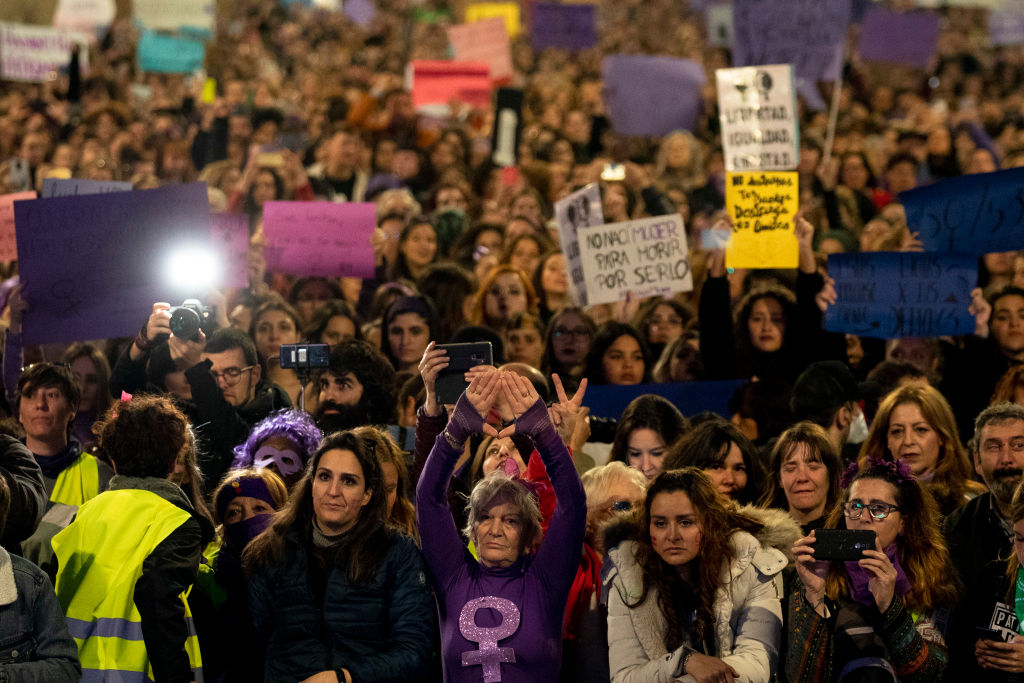
A class action lawsuit filed in Spain accuses the government of knowingly endangering public safety by encouraging the public to participate in more than 75 feminist marches on March 8, to mark International Women's Day, in the midst of the coronavirus pandemic. Pictured: A demonstration during International Women's Day on March 8, 2020 in Madrid, Spain. (Photo by Pablo Blazquez Dominguez/Getty Images)

The Spanish government, comprised of a coalition of Socialists and Communists, is facing legal action for alleged negligence in its handling of the coronavirus pandemic. The government is accused of putting its narrow ideological interests ahead of the safety and wellbeing of the public, and, in so doing, unnecessarily worsening the humanitarian crisis now gripping Spain, currently the second-worst afflicted country in Europe after Italy.
A class action lawsuit filed on March 19 accuses the Spanish government — highly ideological by any standard, as the Communist coalition partner, Podemos, was founded with seed money from the Venezuelan government — of knowingly endangering public safety by encouraging the public to participate in more than 75 feminist marches, held across Spain on March 8, to mark International Women's Day. The nationwide rallies were aimed at protesting the government's perennial bugbear: the alleged patriarchy of Western civilization.

Hundreds of thousands of people participated in those marches, and several high-profile attendees — including Spain's deputy prime minister, as well as the prime minister's wife and mother, and also the wife of the leader of Podemos — have since tested positive for Coronavirus Disease 2019 (COVID-19). It is unknown how many people were infected by the coronavirus as a result of the rallies.

The lawsuit, involving more than 5,000 plaintiffs, accuses Spanish Prime Minister Pedro Sánchez and his representatives in Spain's 17 autonomous regions of "prevarication" — a Spanish legal term that means lying and deceiving. The government was allegedly so determined to ensure that the feminist marches took place on March 8 that it deliberately downplayed warnings about the pandemic. These warnings include:
  • September 2019. The Global Preparedness Monitoring Board, an international panel of experts convened by the World Bank and the World Health Organization (WHO), warned of a "very real threat of a rapidly moving, highly lethal pandemic of a respiratory pathogen killing 50 to 80 million people and wiping out nearly 5% of the world's economy.
  • December 31. China alerted WHO to several cases of unusual pneumonia in Wuhan, a port city of 11 million people in the central Hubei province. The virus was unknown.
  • January 7. China identified the new coronavirus as the cause of a mystery disease in Wuhan.
  • January 21. WHO confirmed human-to-human transmission of the virus.
  • January 29. Spanish pharmaceutical cooperatives warned that pharmacies were running out of masks due to a surge in demand. Sales of masks surged by 3,000% in January compared to the year before.
  • January 30. WHO Director-General declared the coronavirus outbreak a public health emergency of international concern.
  • January 31. The first known case of COVID-19 in Spain was confirmed in La Gomera, Canary Islands, where a German tourist tested positive and was admitted to a local hospital.
  • February 12. Mobile World Congress, the world's largest mobile phone trade fair, which draws more than 100,000 participants from 200 countries, was cancelled due to fears of coronavirus. The financial loss to Barcelona and the city's hospitality industry was estimated to be €500 million ($560 million).
  • February 24. More than 1,000 guests and employees at the Costa Adeje Palace hotel in Tenerife, Canary Islands, were quarantined after an Italian citizen tested positive for COVID-19.
  • February 27. A 62-year-old man from Seville tested positive for COVID-19. His was the first case of local transmission of the virus in Spain. The man said that he believed he was infected during a banking conference in Malaga, where he sat next to a partner who traveled to the Canary Islands on vacation and had had contact with people from Asia. Doctors said that the diagnosis was of "great importance" because it proved that COVID-19 has been circulating in Spain without detection.
  • March 2. The European Center for Disease Control and Prevention advised European countries to cancel mass gatherings of people to prevent the transmission of coronavirus.
  • March 2. The Spanish Medical Agency sent a letter to pharmaceutical distributors to restrict the marketing of masks and to block their distribution across Spanish pharmacies. The agency's objective, on the advice of the Ministry of Health, was to ensure the supply of masks to hospitals and health centers at a time when the number of confirmed cases was beginning to multiply. The measure blocked sales to Spanish pharmacies, as well as sales abroad.
  • March 3. The regional health ministry in Valencia announced that the first coronavirus fatality in Spain died on February 13. Health authorities did not know he had the virus until 19 days after his death — an indication that Spanish authorities have been slow to understand the outbreak. Since coronavirus cases that end in death last between two and eight weeks, in addition to a 14-day incubation period, it is possible that the man was infected as early as the beginning of January.
  • March 3. Spanish authorities ordered major football and basketball matches to be held behind closed doors with no spectators allowed to prevent the spread of coronavirus.
  • March 6. The Spanish Ministry of Health advised: "The precautionary principle must prevail. The emergence of a hitherto unknown virus means that precautionary measures must be taken based on the existing scientific knowledge regarding viruses."
On March 7, despite these warnings, the Spanish government's main point man for the coronavirus, Fernando Simón, claimed in a nationwide press conference that there was no risk of attending the rallies on March 8. "If my son asks me if he can go, I will tell him to do whatever he wants," he said.

The intrepid, Spain-based journalist Matthew Bennett discovered that the Spanish government failed to report new coronavirus cases between March 6 and March 9, apparently in an effort to downplay the danger to the public of attending the rallies.

On March 9, after the number of confirmed coronavirus cases in Madrid doubled in one day, the President of the Autonomous Community of Madrid, Isabel Díaz Ayuso, ordered all schools in the capital to be closed for at least two weeks. The decision by the regional government caught the central government by surprise and effectively forced it to act.
  • March 10. Spanish Health Minister Salvador Illa, a Catalan philosophy major with no experience in medicine, said: "Today's situation may be different from yesterday's, it is changing, and this will continue to be so until we overcome this situation."
  • March 11. The Spanish government acknowledged that it knew on March 8, before the feminist rallies took place, that the coronavirus outbreak in Madrid was out of control.
  • March 12. Prime Minister Sánchez, defending himself against criticism that he allowed the marches to go ahead, said that his government was responding to the "dynamic" situation of the coronavirus by "adapting" to the "hourly" recommendations of scientific experts.
  • March 14. The central government announced a nationwide state of emergency that effectively placed 46 million people in lockdown for at least 15 days. All non-essential travel has been prohibited and people are confined to their homes except in cases of emergency or to purchase food or medicine. All schools and universities in the country are closed.
  • March 29. The lockdown, the strictest in all of Europe, was extended until April 11.
The lawsuit has been forwarded to the Spanish Supreme Court due to the prime minister's immunity.

Article 404 of the Penal Code establishes a penalty of between nine to 15 years of disqualification for public office for public officials convicted of the crime of prevarication.
Víctor Valladares, a Madrid-based lawyer who is leading the lawsuit, said:
"The result of the calls for these demonstrations and their direct approval by government delegations and by the inaction of the central government chaired by the accused, Prime Minister Pedro Sánchez, could not be more antagonistic to what the EU indicated in its report. Why was not an order issued to prevent any type of mass event?"
Meanwhile, the Association of Doctors and Medics of Madrid (AMYTS) and the Confederation of Medical Trade Unions (CESM) also filed lawsuits against the government. The complaint demands that the federal and local governments provide hospitals in Madrid with masks, protective glasses and waste containers within 24 hours.

The Spanish blogger Elentir, who operates the blog Contando Estrelas, a politically astute website that is essential to understanding contemporary Spanish politics, wrote:
"As we found out, 16 days late, the first death from coronavirus had occurred in Spain on February 13. Faced with the risk that the massive feminist mobilizations on Sunday, March 8 could be cancelled, Fernando Simón commented: 'We have no specific recommendation on the suspension of the rally on March 8.'
"On March 9, one day after the feminist marches, Health Minister Salvador Illa expressly recommend that all people with chronic diseases or multiple pathologies do not leave their homes except for emergencies.... He said this immediately after the feminist rallies held on March 8.
"Honestly, it seems to me a joke that the government has waited until today, clearly for political reasons, to make this announcement. The Socialist-Communist government has once again put its political interests above the common good. This gross negligence should lead to resignations."
Criticism of the Spanish government's handling of the coronavirus crisis has also come from members of the Socialist Party itself. On March 22, Juan Luis Cebrián, a co-founder of the newspaper El País, a notorious mouthpiece of the Socialist Party, wrote:
"The crocodile tears of so many political leaders who claim that no one could have imagined such a thing such as the coronavirus do not make any sense. There were not only those who imagined it: they foresaw it, and they seriously warned about it. There has undoubtedly been negligence on the part of the various health ministers and their bosses, and in France three doctors have already filed a complaint against the government for this reason. The consequence is that most Western nations today are overwhelmed in their abilities to fight the epidemic. They reacted late and erroneously. Lacking is: hospital beds, medical personnel, respirators and transparency in official information.
"On February 24, WHO officially declared the probability that we would be faced with a pandemic. Despite this and knowing the magnitude of the threat, which has already been fully realized in several countries, hardly any measures were taken in most of the potential scenarios for the spread of the virus. In the case of Spain, attendance at gigantic demonstrations was encouraged, the holding of massive popular festivals was promoted, urgent funding for research was delayed, the threat was minimized, and even the official still in charge today of the scientific recommendations dared to say between smiles that there was no risk to the population.
"This is not the time to open a debate on the subject, but it is legitimate to assume that in addition to political responsibilities, citizens... will have the right to demand legal redress if there is guilty negligence."
Spain is one of the European countries most affected by the virus: As of March 29, more than 80,000 people had been diagnosed with Coronavirus Disease 2019 (COVID-19) and more than 6,500 had died as a result. The actual number of people infected may be ten times higher due to the lack of testing of asymptomatic cases. As the pandemic runs its course, Spain is on track soon to overtake Italy as Europe's hardest-hit country.


Soeren Kern is a Senior Fellow at the New York-based Gatestone Institute.

Source: https://www.gatestoneinstitute.org/15821/coronavirus-spain-ideology

Follow Middle East and Terrorism on Twitter